THURIA: THE LESSER MOON
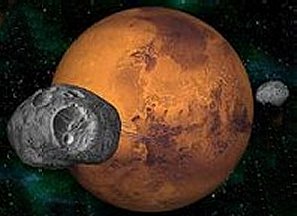

The Seventh Runner-Up in the Seven Wonders of Barsoom
by
Woodrow Edgar Nichols, Jr.

INTRODUCTION
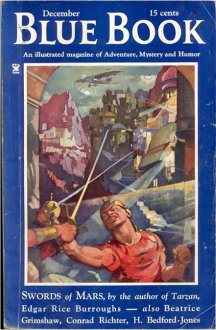
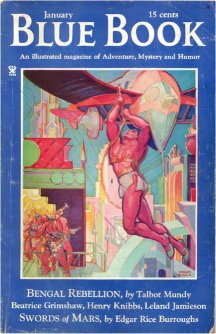
There is an inside joke in Swords of Mars when
Fal Silvas wants to see if John Carter, disguised as Vandor the Panthan,
can operate the mechanical brain in his spaceship:
“I had no intention of
letting Fal Silvas know that I could operate his invention, if he did not
already know it; and as I tried to keep my thoughts as far from it as possible,
I recalled football games that I had seen, a five-ring circus, and the
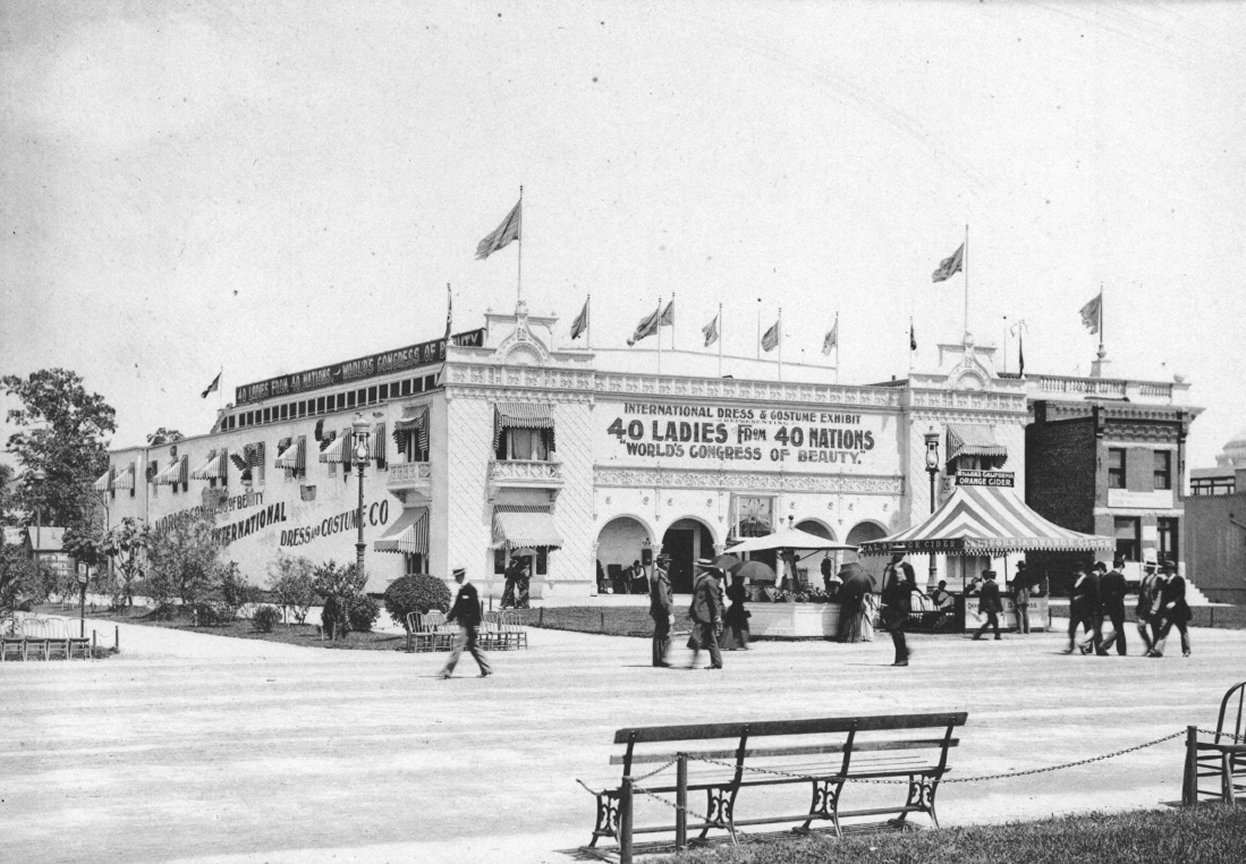
Congress of Beauties on the midway of the 1893 Chicago World’s Fair. In
fact, I tried to think of anything under the sun rather than Fal Silvas
and his mechanical brain.” (SM/7.)
Any man who wants to please a lady understands this joke,
but the main point is that ERB wrote this story in 1933, forty years after
the Columbian Exposition; yet it was still vivid in his memory. The Congress
of Beauties was a place where forty ladies from forty nations modeled their
native clothing, one among the hundreds of attractions at this fabulous
event.
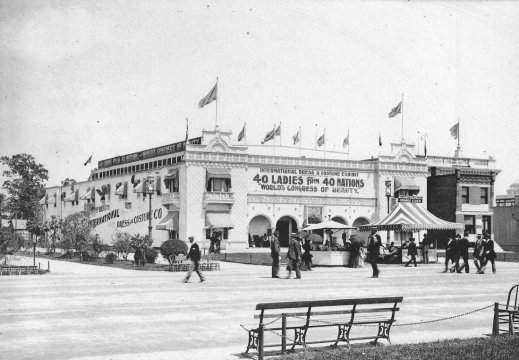
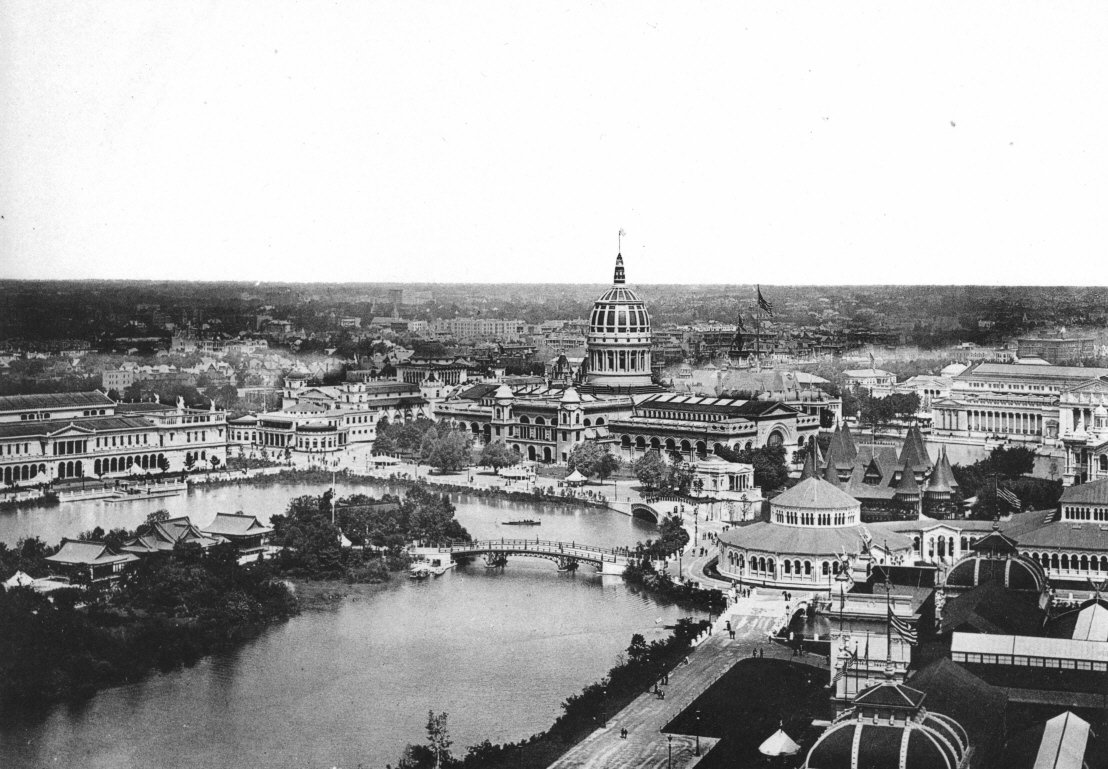
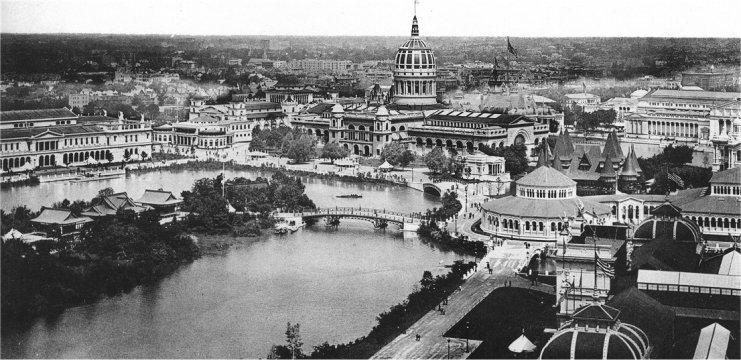
Many scholars believe that the “White City” – so called
because most of the buildings had a white stucco exterior and by night
it was lit up by Tesla’s alternating current light bulbs – was the main
influence on L. Frank Baum’s Emerald City in The Wonderful Wizard of Oz.
We know that ERB spent many a day at this fair (see ERBzine
#1275-1282 for
Bill Hillman's enchanting articles), and even drove passengers around in
an electric car to advertise his father’s battery factory. If you take
a good look at all the buildings and exhibits (see, e.g., www.gutenberg/org/files/22847/22847),
you cannot help but see many domes, spires, towers, and minarets, the signatures
of most Martian cities.
ERB was a good friend of Baum's and in Swords of
Mars he paid special tribute to the Land of Oz in the creation
of Thuria, Barsoom's lesser moon. (See, inter alia, ERBzine
#0304 and #1123.)
While the palace of the Emerald City is constructed of green glass, emeralds,
and other jewels, the Tarid castle is constructed from every kind of precious
gem, many unknown on earth. This means a near psychedelic experience when
looking at it, for it would, like the stones worn by the guardians of the
atmosphere factory and Holy Therns of the Tenth Cycle – that emit all nine
Barsoomian rays – scintillate in the sun. Moreover, while the Empress Ozma
ruled the Emerald City, the princess from Domnia, Ozara, is the Jeddara
of the Tarid realm.
The similarities end there, however, for as we will see,
this is a racy, sexy, fun adventure where strange creatures and telepathic
invisibility are at the top of the menu. And, as you have to enter Oz my
almost magical means – after all, it is somewhere over the rainbow – you
also have to enter Thuria by a means so preposterous that several characters
actually protest the absurdity of the whole idea. But once the protesting
is over, the real adventure of the imagination begins.
DATA
 We
first learned of possible life on Thuria when the Black Pirates were first
introduced in The Gods of Mars. It was part of the superstition
of the religion of Issus, fostered by the First Born, that they were from
and lived on the surface of Thuria. Even the Holy Therns were under this
delusion, but it was quickly shattered by John Carter when he took the
Black Pirate, Xodar, and Phaidor, the daughter of the highest thern, to
a dangerous altitude in a Black Pirate flier to demonstrate that there
is not enough air in the upper atmosphere to sustain life. Thus the Black
Pirates could not fly from Thuria to Barsoom in their fliers. But this
did not wholly solve the problem of whether there was intelligent life
on Thuria, for, after all, the First Born were part of the Tree of Life
on Barsoom.
We
first learned of possible life on Thuria when the Black Pirates were first
introduced in The Gods of Mars. It was part of the superstition
of the religion of Issus, fostered by the First Born, that they were from
and lived on the surface of Thuria. Even the Holy Therns were under this
delusion, but it was quickly shattered by John Carter when he took the
Black Pirate, Xodar, and Phaidor, the daughter of the highest thern, to
a dangerous altitude in a Black Pirate flier to demonstrate that there
is not enough air in the upper atmosphere to sustain life. Thus the Black
Pirates could not fly from Thuria to Barsoom in their fliers. But this
did not wholly solve the problem of whether there was intelligent life
on Thuria, for, after all, the First Born were part of the Tree of Life
on Barsoom.
This problem in finally solved in Swords of Mars,
when Carter actually goes there in an interplanetary spaceship. As we know,
this is made possible by the Mad Scientist Fal Silvas, who has constructed
the spaceship and the mechanical brain that runs it. Carter first learns
that Fal Silvas has specifically built the spaceship as a means of going
to Thuria when he protests that it would take a vast amount of wealth to
finance Fal Silvas’ robot army:
“‘Yes, vast wealth,’ he
repeated; ‘and it was for the purpose of obtaining this vast wealth that
I built this ship.’
“‘You intend to raid the treasure
houses of the great cities of Barsoom?’ I asked, smiling.
“‘By no means,’ he replied. ‘Treasures
vastly richer lie at the disposal of the man who controls this ship. Do
you not know what the spectroscope tells us of the riches of Thuria?’
“‘I have heard,’ I said, ‘but I
never took much stock in it. The story was too fabulous.’
“‘It is true, nevertheless,’ he
said. ‘There must be mountains of gold and platinum on Thuria and vast
plains carpeted with precious stones.’” (SM/7.)
Ur Jan, the head of the Zodangan Assassins Guild, kidnaps
Dejah Thoris with the help of the Mad Scientist, Gar Nal, who has built
a spaceship almost identical to Fal Silvas’, but without a mechanical brain.
They fly to Thuria, where they know Carter will never find her. When Carter
confronts Fal Silvas with the fact that Gar Nal’s ship is no longer in
its hangar, he is outraged:
“‘The calot!’ he exclaimed,
‘the son of a thousand million calots! He has beaten me. He will go to
Thuria. With the great wealth that he will bring back, he will do all that
I had hoped to do.’” (SM/12.)
Carter attempts to persuade Fal Silvas that they can follow
and destroy Gar Nal's spaceship on Thuria, but Fal Silvas is a coward and
is too fearful as to what might happen on Thuria. Carter protests that
they will be like giants on the surface of the small moon:
“What was I to do? I had
been depending upon Fal Silvas, and now he had failed me. ‘I cannot understand
you,’ I said; ‘with your own arguments, you convinced me that it would
be a simple thing to go to Thuria in your ship. What possible danger can
confront us there that we may not overcome? We shall be veritable giants
on Thuria. No creature that lives there could withstand us. With a stamp
of the foot, we could crush the lives from the greatest beasts that Thuria
could support.’
“I had been giving this matter considerable
thought ever since there first appeared a likelihood that I might go to
Thuria. I am no scientist, and my figures may not be accurate, but they
are approximately true. I knew that the diameter of Thuria was supposed
to be about seven miles, so that its volume could be only about two percent
that of, let us say, the Earth, that you may have a comparison that will
be more understandable to you.
“I estimated that if there were
human beings on Thuria and they were proportioned to their environment
as man on Earth is to his, they would be but about nine-and-a-half inches
tall and weigh between four and five pounds; and that an Earthman transported
to Mars [Thuria?] would be able to jump 225 feet into the air, make a standing
broad jump of 450 feet and a running broad jump of 725 feet, and that a
strong man could lift a mass equivalent to a weight of 4 1/2 tons on earth.
Against such a Titan, the tiny creatures of Thuria would be helpless –
provided, of course, that Thuria were inhabited.
“I suggested all this to Fal Silvas,
but he shook his head impatiently. ‘There is something that you do not
know,’ he said. ‘Perhaps Gar Nal, himself, does not know it. There is a
peculiar relationship between Barsoom and her moons that does not exist
between any of the other planets in the solar system and their satellites.
The suggestion was made by an obscure scientist thousands of years ago,
and then it seemed to have been forgotten. I discovered it in an ancient
manuscript that I came upon by accident. It is in the original handwriting
of the investigator and may have had no distribution whatsoever.
“‘However, the idea intrigued me;
and over a period of twenty years I sought either to prove or disprove
it. Eventually, I proved it conclusively.’
“‘And what is it?’ I asked.
“‘There exists between Barsoom and
her satellites a peculiar relation which I have called a compensatory adjustment
of masses. For example, let us consider a mass travelling from Barsoom
to Thuria. As it approaches the nearer moon, it varies directly as the
influences of the planet and the satellite vary. The ratio of the mass
to the mass of Barsoom at the surface of Barsoom, therefore, would be the
same as the ratio of the mass to the Thuria at the surface of Thuria.
“‘You were about right in assuming
that an inhabitant of Thuria, if such exists, if he were of the same proportion
to Thuria as you are to Barsoom, would be about eight sofs tall [9.36"];
and consequently, if my theory is correct, and I have no reason to doubt
it, were you to travel from Barsoom to Thuria you would be but eight sofs
tall when you reached the surface of the moon.’
“‘Preposterous!’ I exclaimed.” (SM/12.)
Well, at least we’re not dealing with ruby slippers, but
you get the idea. This is the only way we are able to have an adventure
on Thuria, so ERB provides us – no matter how absurd the theory is – with
the means to get there. Since Fal Silvas is a coward, Carter rescues Zanda
from a brain experiment, and together they steal the spaceship and meet
up with Jat Or, a padwar in
Carter’s palace guard. Jat Or has the same concerns about
traveling to Thuria:
“‘And suppose we get to
Thuria alive?’ interjected Jat Or. ‘You know I have been wondering about
that. I have been giving the matter considerable thought, naturally, since
you said that that was to be our destination; and I am wondering how we
will fare on that tiny satellite. We shall be so out of proportion in size
to anything that we may find there.’
“‘Perhaps we shall not be,’ I said,
and then I explained to him the theory of compensatory adjustment of masses
as Fal Silvas had expounded it to me.
“‘It sounds preposterous,’ said
Jat Or.
“I shrugged. ‘It does to me, too,’
I admitted; ‘but no matter how much we may abhor Fal Silvas’s character,
we cannot deny the fact that he has a marvelous scientific brain; and I
am going to hold my opinion in abeyance until we reach to surface of Thuria.’”
(SM/14.)
Let’s make sure the reader fully understands how we get to
Thuria; it is by the Theory of Compensatory Adjustment of Masses, or CAM
to be short. File that theory under: “In your dreams.”
As our three hardy astronauts approach Thuria, they discuss
the mechanical brain and problems of matching their velocity with that
of Thuria’s when the moon suddenly appears through the bug-eyes of the
spaceship:
“Jat Or was looking out
at the great orb of Thuria on our right. ‘How perfectly tremendous she
looks,’ he said. ‘It doesn’t seem possible that we have come close enough
to make her look as large at that.’
“‘You forget,’ I said, ‘that as
we approached her, we commenced to grow smaller – to proportion ourselves
to her size. When we reach her surface, if we ever do, she will seem as
large to us as Barsoom does when we are on its surface.’
“‘It all sounds like a mad dream
to me,’ said Jat Or.
“‘I fully agree with you,’ I replied,
‘but you will have to admit that it is going to be a most interesting dream.’”
(SM/15.)
So, our travelers have shrunk proportionally because of Thuria’s
peculiar relationship with Barsoom. Okay; enough said. Now, forget about
the theory and enjoy the story. The fact is, Toto, we are not in Kansas
any more. Jat Or is glued to the starboard bug-eye, when suddenly he exclaims:
“‘She is coming,’ he said
in a tense whisper. ‘Issus! What a magnificent and inspiring sight!’
“I went to the port and looked out
over his shoulder. There before me was a great world, one crescent edge
illuminated by the sun beyond it. Vaguely, I thought that I saw the contour
of mountains and valleys, lighter expanses that might have been sandy desert
or dead sea bottom, and dark masses that could have been forests. A new
world! A world that no earthman nor any Barsoomian had ever visited.
“I could have been thrilled beyond
the power of words to express at the thought of the adventure that lay
before me had my mind not been so overcast by fear for the fate of my princess.
Thoughts of her dominated all others, yet they did not crowd out entirely
the sense of magnificent mystery that the sight of this new world aroused
within me.” (SM/15.)
The ship begins spiraling down to the surface, but, since
it is night, Carter decides to order the ship to hover at two hundred haads
above the surface and cruise to the direction of the morning sun. Zanda
prepares them a meal and insists on remaining Carter’s slave even though
he has freed her in front of a witness. It is clear Zanda is totally in
love with Carter and is willing
to be his concubine; however, Carter thinks she would
be a perfect mate for Jat Or.
“As we cruised low over
Thuria, I saw forests below us, and meandering lines of lighter color that
I took to be brooks or rivers; and in the distance there were mountains.
It seemed a most beautiful and intriguing world.
“I could not be sure about the water
because it was generally believed on Barsoom that her satellites were practically
without moisture. However, I have known scientists to be mistaken.” (SM/15.)
When the reader considers that most Martian civilizations
had viewing instruments that could monitor everything that was happening
on Earth, it is a real mystery why Thuria would have remained so much a
mystery; unless it was all too tiny to view because of that peculiar relationship.
“I was becoming impatient.
It seemed that daylight would never arrive, but at last the first rosy
flush of dawn crept up behind the moutain tops ahead of us; and slowly
the details of this strange world took form below us, as the scene in a
photographic print takes magic form beneath the developer.
“We were looking down upon a forested
valley, beyond which low foothills, carpeted with lush vegetation, ran
back to higher mountains in the distance.
“The colors were similar to those
upon Barsoom – the scarlet grasses, the gorgeous, strange-hued trees; but
as far as our vision reached, we saw no living thing.
“‘There must be life there,’ said
Zanda, when Jat Or commented upon this fact. ‘In all that wealth of beauty,
there must be living eyes to see and to admire.’
“‘Are we going to land?’ asked Jat
Or.
“‘We came here to find Gar Nal’s
ship,’ I replied, ‘and we must search for that first.’
“‘It will be like looking for a
tiny bead among the moss of a dead sea bottom,’ said Jat Or.
“I nodded. ‘I am afraid so,’ I said,
‘but we have come for that purpose and that purpose alone.’
“‘Look!’ exclaimed Zanda. ‘What
is that – there – ahead?’
“Looking down in the direction that
Zanda had indicated, I saw what appeared to be a large building on the
bank of a river. The structure nestled in a clearing in the forest, and
where the rising sun touched its towers they sent back scintillating rays
of many-hued light.
“One section of the building faced
upon what appeared to be a walled court, and it was an object lying in
this court which aroused our interest and excitement to a far greater extent
than the building itself.
“‘What do you think it is, Zanda?’
I asked, for it was she who had discovered it.
“‘I think it is Gar Nal’s ship,’
replied the girl.
“‘What makes you think that?’ asked
Jat Or.
“‘Because it is so much like this
one,’ she replied. ‘Both Gar Nal and Fal Silvas stole ideas from one another
whenever they could, and I should be surprised indeed if their ships did
not closely resemble one another.’
“‘I am sure that you are right,
Zanda,’ I said. ‘It is not reasonable to assume that the inhabitants of
Thuria have, by some miraculous coincidence, constructed a ship so similar
to that of Fal Silvas’s; and the possibility is equally remote that a third
Barsoomian ship has landed on the satellite.’
“I directed the brain to spiral
downward, and presently we were flying at an altitude that gave us a clear
view of the details of the building and the surrounding terrain.’” (SM/15-16.)
Carter lands his ship next to Gar Nal’s and they argue for
a few moments if Zanda should go with Carter and Jat Or and explore, but
she ends the dispute by donning a full military harness and insisting that
she fight alongside with them. They disembark:
“Before us loomed the castle,
a strange weird building of unearthly architecture, a building of many
towers of various types, some of the standing alone and some engaged in
groups.
“Partially verifying Fal Silvas’s
theory of the tremendous mineral wealth of the satellite, the walls of
the structure before us were constructed of blocks of precious stones so
arranged that their gorgeous hues blended and harmonized into a mass of
color that defies description.” (SM/16/)
Carter checks out the interior of Gar Nal’s ship, making
sure it is not occupied. He reports his findings to Jat Or and Zanda and
then invisible hands seize all three of them and drag them inside the castle,
as the voice of Dejah Thoris warns them from a tower overhead. As Carter’s
last act before he is dragged inside, he gives a directing command to the
brain to lift off and hover a hundred feet above the castle.
Zanda is separated from them and Jat Or comments on the
utter futility they confront in not being able to see or hear their foes,
to which Carter responds:
“‘But eventually we must
find someone whom we can see and against whom we can pit our own brain
and fighting abililty on a more equable basis, for this castle and what
we see about us indicate the presence of creatures not unlike ourselves.
Notice, for instance, the benches and divans along the walls of this corridor.
They must have been intended for creatures like ourselves. The beautiful
mosaics that decorate the walls, the gorgeous rugs and skins upon the floor
– these things are here to satisfy a love of beauty that is a peculiar
attribute of the human mind, nor could they have been conceived or produced
except by human hands under the guidance of human brains.’
“‘Your deductions are faultless,’
replied Jat Or, ‘but where are the people?’
“‘There lies the mystery,’ I replied.
‘I can well believe that our future depends upon its solution.’...
“At the end of the corridor, we
were conducted up a wide and ornate staircase to the next level of the
castle; and presently we were led into a large room – a vast chamber at
which we saw at the far end a single, lonely figure.
“It was Zanda. She was standing
before a dais upon which were two large ornate throne chairs.
“The room was gorgeous, almost barbaric
in its decoration. Gold and precious stones encrusted floor and walls.
They had been fabricated into an amazing design by some master artist who
had had at his disposal rare gems such as I had never seen either upon
earth or upon Barsoom....
“We stood there before the dais
for several minutes, and then we were dragged away and conducted from the
room. Along another corridor we were taken, a narrower corridor, and up
a winding stairway which Jat Or had some little difficulty in negotiating.
Such contrivances were new to him, as stairways are not used on Mars, where
inclined ramps lead from one level of a building to another.” (SM/17.)
The three are separated and Carter is taken to the top of
a tower and locked into a cell with a strange creature:
“As I turned to inspect
my prison, my eyes fell upon a figure seated upon a bench at the far side
of the room.
“For want of a better word, I may
describe the figure that I saw as that of a man; but what a man!
“The creature was naked except for
a short leather skirt held about its hips by a broad belt fastened by a
large golden buckle set with precious stones.
“He was seated upon a red bench
against a panel of gray wall; and his skin was exactly the color of the
wall, except that portion of his legs which touched the bench. They were
red.
“The shape of his skull was similar
to that of a human being, but his features were most inhuman. In the center
of his forehead was a single, large eye about three inches in diameter;
the pupil a vertical slit, like the pupils of a cat’s eyes. He sat there
eyeing me with that great eye, apparently appraising me as I was appraising
him; and I could not but wonder if I presented as strange an appearance
to him as he did to me.
“During those few moments that we
remained motionless, staring at one another, I hurriedly took note of several
of his strange physical characteristics.
“The fingers of his hands and four
of the toes of each of his feet were much longer than in the human race,
while his thumbs and large toes were considerably shorter than his other
digits and extended laterally at right angles to his hands and feet.
“This fact, and the vertical pupils
of his eye suggested that he might be wholly arboreal or at least accustomed
to finding his food or his prey in trees.
“But perhaps the most outstanding
features of his hideous countenance were his mouths. He had two of them,
one directly above the other. The lower mouth, which was the larger, was
lipless, the skin of the face forming the gums in which the teeth were
set, with the result that his powerful white teeth were always exposed
in a hideous, death-like grin.
“The upper mouth was round, with
slightly protruding lips, controlled by a sphincter-like muscle. This mouth
was toothless.
“His nose was wide and flat, with
upturned nostrils. At first I detected no ears, but later discovered that
two small orifices near the top of the head and at opposite sides served
the purpose of audition.
“Starting slightly above his eye,
a stiff yellowish mane about two inches wide ran back along the center
of his cranium.” (SM/17.)
Thus, we are introduced to Umka, the Cat Man. Umka is one
of the strangest creatures Carter has ever met, but by thinking outside
of the box, Carter is able to learn from Umka the Tarid language and the
truth about his captors. But first Carson explores his room.
“It was circular and evidently
occupied the entire area and evidently the highest level of a tower. The
walls were panelled in different colors; and even here in this high-flung
prison cell was evidence of the artistic sensibilities of the builder of
the castle, for the room was indeed strangely beautiful.
“The circular wall was pierced by
half a dozen tall, narrow windows. They were unglazed, but they were barred.
“On the floor, against one portion
of the wall, was a pile of rugs and skins – probably the bedding of the
creature imprisoned here.
“I walked to one of the windows
to look out, and as I did so the creature rose from the bench and moved
to the side of the room farthest from me. It moved noiselessly with the
stealthy tread of a cat; and always it transfixed me with that terrible,
lidless eye.
“Its silence, its stealth, its horrible
appearance, made me wary lest it leap upon my back should I turn my face
away from it. Yet I cast a hasty glance through the window and caught a
glimpse of distant hills and, below me, just outside the castle wall, a
river and beyond that a dense forest.
“What little I saw suggested that
the tower did not overlook the courtyard in which the ship lay, and I was
anxious to see that part of the castle grounds to ascertain if I had been
successful in directing the brain to take the ship to a point of safety.
“I thought that perhaps I might
be able to discover this from one of the windows on the opposite side of
the tower; and so, keeping my eyes on my cellmate, I crossed the room;
and as I did so he quickly changed his position, keeping as far from me
as possible.
“I wondered if he were afraid of
me or if, cat-like, he were just awaiting an opportunity to pounce on me
when he could take me at a disadvantage.
“I reached the opposite window and
looked out, but I could see nothing of the courtyard, as others of the
numerous towers of the castle obstructed my view on this side. In fact,
another loftier tower rose directly in front of me in this direction and
not more than ten or fifteen feet distant from the one in which I was incarcerated.
“Similarly, I moved from window
to window searching in vain for a glimpse of the courtyard; and always
my weird companion and terrible cell-mate kept his distance from me.” (SM/17.)
Carter now turns his attention to Umka. He worries that the
creature is waiting for darkness, thus giving him the advantage of better
night vision:
“As I glanced at him again,
I noticed a surprising change in his appearance. His skin was no longer
gray but vivid yellow, and then I noticed that he was standing directly
in front of a yellow panel. This was interesting in the extreme.
“I moved toward him, and again he
changed his position. This time he placed himself in front of a blue panel,
and I saw the yellow tint of his skin fade away and turn to blue.” (SM/17.)
Umka is a chamelion; but he can speak and is smart enough
to know that Carter seeks his friendship and knowledge of his captors.
But first, try as he might, Carter is unable to set up common ground with
Umka, resigning himself to observation only. He walks over to the bench
Umka had quitted, and sits down:
“Immediately it took up
a new position as far from me as possible and this time in front of a green
panel, whereupon its color immediately changed to green. I could not but
wonder what kaleidoscopic result would be obtained were I to chase the
thing around the multi-colored apartment. The thought caused me to smile,
and as I did so I saw an immediate reaction in my cell-mate. He made a
strange purring sound and stretched his upper mouth laterally in what might
have been an attempt at an answering smile. At the same time he rubbed
his palms up and down his thighs.” (SM/17.)
Finally, they have common ground. They begin to engage in
conversation, and then food is delivered to them by invisible means:
“We were thus engaged when
the door to the room opened; and several vessels appeared to float in and
settle themselves on the floor just inside the door, which was immediately
closed.
“My companion commenced to purr
excitedly, and ran over to them. He returned immediately with a jar of
water and a bowl of food which he set on the bench beside me. He pointed
to the food and then to me, as though indicating that it was mine.
“Crossing the room once more, he
returned with another jar of water and a cage containing a most remarkable
appearing bird.
“I call the thing a bird because
it had wings; but to what family it belonged, your guess is as good as
mine. It had four legs and the scales of a fish, but its beak and comb
gave its strange face a bird-like appearance.
“The food in the bowl set before
me was a mixture of vegetables, fruit, and meat. I imagine that it was
very nutritious, and it was quite palatable.
“As I quenched my thirst from the
jar and sampled the food that had been brought me, I watched my companion.
For a moment or two he played with the bird in the cage. He inserted a
finger between the bars, whereat the creature flapped its wings, voiced
a shrill scream, and tried to seize the finger with its beak. It never
quite succeeded, however, as my cell-mate always withdrew his finger in
time. He seemed to derive a great deal of pleasure from this, as he purred
constantly.
“Finally he opened the door in the
cage and liberated the captive. Immediately the creature fluttered about
the room, seeking to escape through the windows; but the bars were too
close together. Then my companion commenced to stalk it, for all the world
like a cat stalking its prey. When the thing alighted, he would creep stealthily
upon it; and when he was close enough, pounce for it.
“For some time it succeeded in eluding
him; but finally he struck it down heavily to the floor, partially stunning
it. After this he played with it, pawing it around. Occasionally he would
leave it and move about the room pretending that he did not see it. Presently
he would seem to discover it anew, and then he would he would rush for
it and pounce upon it.
“At last, with a hideous coughing
roar that sounded like the roar of a lion, he leaped ferociously upon it
and severed its head with a single bite of its powerful jaws. Immediately
he transferred the neck to his upper mouth and sucked the blood from the
carcass. It was not a pretty sight.
“When the blood had been drained,
he devoured his prey with his lower jaws; and as he tore at it he growled
like a feeding lion.
“I finished my own meal slowly,
while across the room from me my cellmate tore at the carcass of his kill,
swallowing in great gulps, until he devoured every last vestige of it.
“His meal completed, he crossed
to the bench and drained his water jar, drinking through his upper mouth.
“He paid no attention to me during
all these proceedings; and now, purring lazily, he walked over to the pile
of skins and cloths upon the floor and lying down upon them curled up and
went to sleep.” (SM/17.)
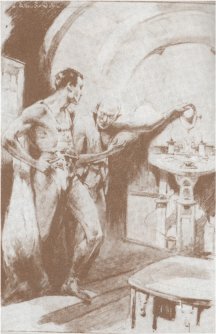
This scene is captured by J. Allen St. John and can be viewed
at ERBzine #0736. Carter
learns many things from Umka in the days to come:
“The very first day that
I discovered that I could express myself well enough for him to understand
me, I asked him who it was that held us prisoner.
“”The Tarids,’ he replied.
“‘What are they?’ I asked. ‘What
do they look like? Why do we never see them?’
“‘I do see them,’ he replied. ‘Don’t
you?’
“‘No; what do they look like?’
“‘They look very much like you,’
he replied; ‘at least they are the same sort of creature. They have two
eyes and a nose and only one mouth, and their ears are big things stuck
on the sides of their heads like yours. They are not beautiful like we
Masenas.’
“‘But why do I not see them?’ I
demanded.
“‘You don’t know how,’ he replied.
‘If you knew how you could see them as plainly as I do.’
“‘I should like very much to see
them,’ I told him. ‘Can you tell me how I may do so?’
“‘I can tell you,’ he said, ‘but
that does not mean that you will be able to see them. Whether you do so
or not will depend upon your own mental ability. The reason you do not
see them is because by the power of their own minds they have willed that
you shall not see them. If you can free your mind of this inhibition, you
can see them as plainly as you see me.’
“‘But I don’t know how just how
to go about it.’
“‘You must direct your mind upon
theirs in an effort to overcome their wish by a wish of your own. They
wish that you should not see them. You must wish that you should see them.
They were easily successful with you, because not expecting such a thing,
your mind has set up no defense mechanism against it. Now you have the
advantage upon your side, because they have willed an unnatural condition,
whereas you will have nature’s forces behind you, against which, if your
mind is sufficiently powerful, they can erect no adequate mental barrier.’
“Well, it sounded simple enough;
but I am no hypnotist, and naturally I had considerable doubt as to my
ability along these lines.
“When I explained this to Umka,
he growled impatiently.
“‘You can never succeed,’ he said,
‘if you harbor such doubts. Put them aside. Believe that you will succeed,
and you will have a very much greater chance for success.’
“‘But how can I hope to accomplish
anything when I cannot see them?’ I asked. ‘And even if I could see them,
aside from a brief moment that the door is open when food is brought us,
I have no opportunity to see them.’
“‘That is not necessary,’ he replied.
‘You think of your friends, do you not, although you cannot see them now?’
“‘Yes, of course, I think of them;
but what has that to do with it?’
“‘It merely shows that your thoughts
can travel anywhere. Direct your thoughts, therefore, upon these Tarids.
You know that the castle is full of them, because I have told you so. Just
direct your mind upon the minds of all the inhabitants of the castle, and
your thoughts will reach them all even though they may not be cognizant
of it.’” (SM/18.)
I don’t about you, but there was a time in Umka’s lecture
when I thought I heard the voice of Yoda: “Do, or do not; there is no try.”
Anyway, Carter begins practicing these mental techniques as Umka picks
his brain for information about life on Barsoom:
“He asked me many questions
about myself and the land from which I came, and seemed surprised to think
that there were living creatures upon the great world that he saw floating
in the night sky.
“He told me that his people, the
Masenas, lived in the forest in houses built high among the trees. They
were not a numerous people, and so they sought districts far from the other
inhabitants of Thuria.
“The Tarids, he said, had once been
a powerful people; but they had been overcome in war by another nation
and almost exterminated.
“Their enemies still hunted them
down, and there would long since have been none of them left had not one
of their wisest men developed among them the hypnotic power which made
it possible for them to seemingly render themselves invisible to their
enemies.
“‘All that remain of the Tarids,’
said Umka ‘live here in this castle. There are about a thousand of them
altogether, men, women, and children.
“‘Hiding here, in this remote part
of the world, in an effort to escape their enemies, they feel that all
other creatures are their foes. Whoever comes to the castle of the Tarids
is an ememy to be destroyed.’
“‘They will destroy us, you think?’
I asked.
“‘Certainly,’ he replied.
“‘But when, and how?’ I demanded.
“‘They are governed by some strange
belief,’ explained Umka; ‘I do not understand it, but every important act
in their lives is regulated by it. They say that they are guided by the
sun and the moon and the stars.
“‘It is all very foolish, but they
will not kill us until the sun tells them to, and then they will not kill
us for their own pleasure, but because they believe that it will make the
sun happy.’” (SM/18.)
The Tarids are in the same condition as the Orovars in Horz
and the Lotharians in Lothar, just a thousand of them left, each race suffering
from their own delusions; the Tarids from some form of astrology. Carter
learns to inhibit the wish of the Tarids and learns to see and hear them;
that they have very white skin and blue hair and eyebrows. ERB does not
inform us of whether
or not they had body hair and thus we assume that they
did not. We do not know if they differed in this way from the Red, Black,
Yellow, or White Martians; but we do know that in this way they are like
the Green Martians whom we are informed were devoid of body hair.
The reason it is assumed that Red, Black, Yellow and White
Martians have body hair is that Carter’s nakedness is never pointed out
as an anomaly when he is among them. We assume that Carter has body hair
because he is from the Earth, but we also know that it is unlikely that
he was born on the Earth, for he is ageless and is able to die and come
back to life and astral travel.
Thus, it is up to the individual’s reader’s imagination
whether any of them had body hair. It's the same with the issue of circumcision.
When next Carter and Umka are led before the two thrones,
Carter is able to see that all of the Barsoomians are present, the room
is full of people, the Jeddak, Ul Vas, is very fat, and the Jeddara, Ozara,
is very beautiful:
“Occupying the throne at
the man’s side was a young and very beautiful woman. She was gazing at
me dreamingly through the heavy lashes of her halfclosed lids. I could
only assume that the woman’s attention was attracted to me because of the
fact that my skin differed in color from that of my companions as, after
leaving Zodanga, I had removed the disguising pigment.
“‘Splendid!’ she whispered, languidly.
“‘What is that?’ demanded the man.
‘What is splendid?’
“‘She looked up with a start, as
one awakened from a dream. ‘Oh!’ she exclaimed nervously; ‘I said that
it would splendid if you could make them keep still; but how can you if
we are invisible and inaudible to them, unless,’ she shrugged, ‘you silence
them with the sword.’
“‘You know, Ozara,’ demurred the
man, ‘that we are saving them for the Fire God – we may not kill them now.’
“The woman shrugged. ‘Why kill them
at all?’ she asked. ‘They look like intelligent creatures. It might be
interesting to preserve them.’” (SM/18.)
Carter informs his companions of the mind trick and they
agree to work together in concert in order to escape. The Jeddara believes
that Carter can see them because of where he looks when they speak, but
the Jeddak proves her wrong to his own satisfaction, Carter breathing a
sigh of relief at almost getting caught:
“The girl shrugged her
shapely shoulders and turned away with a bored yawn, but presently her
eyes came back to me; and though I tried not to meet them squarely thereafter,
I was aware during all the rest of the time that I was in the audience
chamber that she was watching me.
“‘Let us proceed,’ said Ul Vas.
“Thereupon an old man stepped to
the front and placed himself directly before the throne. ‘All-highest,’
he intoned in a sing-song voice, ‘the day is good, the occasion is good,
the time has come. We bring before you, most august son of the Fire God,
seven enemies of the Tarids. Through you, your father speaks, letting his
people know his wishes. You have talked with the Fire God, your father.
Tell us, All-highest, if these offerings look good in his eyes; make known
to us his wishes, almighty one.’
“Ever since we had come into the
audience chamber, Ul Vas had been inspecting us carefully; and especially
had his attention beern centered upon Dejah Thoris and Zanda. Now he cleared
his throat.
“‘My father, the Fire God, wishes
to know who these emenies are,’ he said.
“‘One of them,’ replied the old
man who had spoken before, and whom I took to be a priest, ‘is a Masena
that your warriors captured while he was hunting outside our walls. The
other six are strange creatures. We know not from whence they came. They
arrived in two unheard-of contraptions that moved through the air like
birds, though they had no wings. In each of these there were two men and
a woman. They alighted inside our walls; but from whence they came or why,
we do not know, though doubtless it was their intention to do us harm,
as is the intention of all men who come to the castle of the Tarids. As
you will note, Allhighest, five of these six have red skins, while the
sixth had a skin only a little darker than our own. He seems to be of a
different race, with his white skin, his black hair, and his gray eyes.
These things we know and nothing more. We await the wishes of the Fire
God from the lips of his son, Ul Vas.’
“The man on the throne pursed his
lips, as though in thought, while his eyes travelled again along the line
of prisoners facing him, lingering long upon Dejah Thoris and Zanda. Presently
he spoke.
“‘My father, the Fire God, demands
that the Masena and the four strange men be destroyed in his honor at this
same hour, after he has encircled Ladan seven times.’
“There were a few moments of expected
silence after he had ceased speaking – a silence that was finally broken
by the old priest.
“‘And the women, All-highest?’ he
asked; ‘what are the wishes of the Fire God, your father, in relation to
them?’
“‘The Fire God, to show his great
love,’ replied the jeddak, ‘has presented the two women to his son, Ul
Vas, to do with as he chooses.’...
“Again Ul Vas was speaking. ‘Remove
them now,’ he commanded.
‘Confine the men in the Turquoise
Tower, and take the women to the Tower of Diamonds.’...and so I went quietly,
as they led me away with my fellow-prisoners, my last memory of the audience
chamber being the veiled gaze of Ozara, Jeddara of the Tarids.
“Umka and I were not returned to
the cell in which we had previously been incarcerated; but were taken with
Jat Or, Gar Nal, and Ur Jan to a large room in the Turquoise Tower.” (SM/18-19.)
Isn’t religion just grand when you are the son of the god?
We see that Ul Vas’s Fire God father resides between his legs rather than
up in the sky. Ozara has her own Fire Goddess working for her as she copulates
Carter with her eyes. After all, it may not have just been Carter’s eyes
that gave him away to Ozara.
For several days the prisoners work on wishing away the
influence of the Tarids until finally a guard comes for Carter. They escort
him to Ozara’s chambers where Ulah the slave girl relieves the guard of
custody and leads him into Ozara’s bedchamber of seduction. To fully appreciate
the next scene, you have to remember that everyone is naked, with genitalia
fully exposed (see, “Nakedness on Mars,” ERBzine
#3177), and that the nature of Ozara’s game is to expose the fact that
Carter can see and hear them. She intends her pose to create a physical
reaction in Carter, as suggested by the great Frank Franzetta depiction
of the scene, which can be viewed at ERBzine
#0736.
Swords of Mars is secretly dedicated to
Florence Dearholt who was married to Ashton Dearholt at the time (the first
letter of each chapter spells out, “To, Florence, with all my love, Ed”).
Ashton had brought a championship swimmer named Ula back from a field trip
to Guatemala. The three of them were living together in Ashton’s house
until ERB divorced Emma and married Florence. It is easy to assume that
Ozara represents Florence in this story and that the slave girl, Ulah,
represents Ula from Guatemala, whose fate after Ashton died in 1942, is
unknown. It is obvious that ERB’s hormones were raging during this period
and that this fact would be reflected in his writings. Let us see as Ulah
leads Carter to Ozara:
“The room into which I
was now conducted, though slightly smaller, was far more beautiful than
the other. However, I did not immediately take note of its appointments,
my attention being immedetiately and wholly attracted by its single occupant.
“I am not easily surprised; but
in this instance I must confess that I was when I recognized the woman
reclining upon a divan, and watching me intently through long lashes, as
Ozara, Jeddara of the Tarids.
“The slave girl led me to the center
of the room and halted. There she waited, looking questioningly at the
Jeddara; while I, recalling that I was supposed to be deaf and blind to
these people, sought to focus my gaze beyond the beautiful empress whose
veiled eyes seemed to read my very soul.” (SM/19.)
This is a brazen sexual invitation. We can only imagine how
Ozara displayed her naked charms on the divan. Frazetta depicts it as Goya’s
“Naked Maja.” With such a pose, all it takes – as Ozara well knew and counted
on – was one look at her and Carter’s genitalia would give him away, not
so subtly suggested by her veiled eyes reading his very soul. She demands
privacy:
“‘You may retire, Ulah,’
she said presently.
“The slave girl bowed low and backed
from the room.
“For several moments after she departed,
no sound broke the silence of the room; but always I felt the eyes of Ozara
upon me.
“Presently she laughed, a silvery
musical laugh. ‘What is your name?’ she demanded.
“I pretended that I did not hear
her, as I found occupation for my eyes in examination of the beauties of
the chamber. It appeared to be the boudoir of the empress, and it made
a lovely setting for her unquestionable loveliness.” (SM/19.)
You can bet by this time, Carter’s physical reaction was
letting the cat out of the bag, as made clear by the following exchange:
“‘Listen,’ she said, presently;
‘you fooled Ul Vas and Zamak and the High Priest and all the rest of them;
but you did not fool me. I will admit that you have splendid control, but
your eyes betrayed you. They betrayed you in the audience chamber; and
they betrayed you again just now as you entered this room, just as I knew
they would betray you. They showed surprise when they rested upon me; and
that can mean only one thing; that you saw and recognized me.
“‘I knew, too, in the audience chamber,
that you understood what was being said. You are a highly intelligent creature,
and the changing lights in your eyes reflected your reaction to what you
heard in the audience chamber.
“‘Let us be honest with one another,
you and I, for we have more in common than you guess. I am not unfriendly
to you. I understand why you think it to your advantage to conceal the
fact that you can see and hear us; but I can assure you that you will be
no worse off if you trust me, for I already know that we are neither invisible
nor inaudible to you.’” (SM/19.)
Carter figures out that it is to his advantage to trust Ozara
for the time being and admits to being able to see and hear her and the
others. She questions Carter about who he is and why he has come and he
asks her why she has taken such an interest in him:
“She contemplated me in
silence for a moment, her beautiful eyes momentarily dreamy.
“‘Perhaps it is because we have
so much in common,’ she said; ‘and again perhaps because of a force that
is greater than all others and that seizes and dominates us without our
volition.’
“She paused and regarded me intently,
and then she shook her head impatiently.
“‘The thing that we have in common,’
she said, ‘is that we are both prisoners in the castle of Ul Vas. The reason
that I have taken this interest in you, you would understand if you are
one-tenth as intelligent as I gave you credit for.’” (SM/19.)
Ozara must have been frustrated by Carter’s lack of pursuit
after she so wantonly offered herself to him. She wants to escape the castle
and to motivate Carter, she is willing to become lovers with him. Normally,
we would expect ERB to give his, “I’m not really a ladies man” speech at
this point, but he never does with Ozara. We will find him later in the
story actually deserting Dejah Thoris (read “Emma”) in order to save Ozara.
Yes, there is a lot going on in this story.
Carter is shocked that a Jeddara regards herself as a
prisoner but then discovers that she is not a Tarid:
“I am a Domnian. My country,
Domnia, lies far away across the mountains that lie beyond the forest that
surrounds the castle of Ul Vas.’
“‘And your people married you to
Ul Vas, Jeddak of the Tarids?’I asked.
“‘No,’ she replied; ‘he stole me
from them. My people do not know what has become of me. They would have
never willingly sent me to the court of Ul Vas, nor would I remain here,
could I escape. Ul Vas is a beast. He changes his jeddaras often. His agents
are constantly searching other countries for beautiful young women. When
they find one more beautiful than I, I shall go the way of my predecessors;
but I think that he has found one to his liking already, and that my days
are numbered.’
“‘You think that his agents have
found another more beautiful than you?’ I asked; ‘it seems incredible.’
“‘Thank you for the compliment,’
she said, ‘but his agents have not found another more beautiful than I.
Ul Vas has found her himself. In the audience chamber, did you not see
him looking at your beautiful compatriot? He could scarcely keep his eyes
from her, and you will recall that her life was spared.’
“‘So was the life of the girl, Zanda,’
I reminded her. ‘Is he going to take her also to be his jeddara?’
“‘No, he may only have one at a
time,’ replied Ozara. ‘The girl whom you call Zanda is for the High Priest.
It is thus that Ul Vas propitiates the gods.’
“‘If he takes this other woman,’
I said, ‘she will kill him.’
“‘But that will not help me,’ said
Ozara.
“‘Why?’ I asked.
“‘Because while one jeddara lives,
he cannot take another,’ she explained.
“‘You will be destroyed?’ I asked.
“‘I shall disappear,’ she replied.
‘Strange things happen in the castle of Ul Vas, strange and terrible things.’”
(SM/20.)
Carter devises an escape plan. Ulah takes them files so that
they can take care of the metal bars in the windows, then he gets Ozara
to go to the Tower of Diamonds and put a scarlet scarf in the window to
let Carter know that they are ready to be rescued.
He wills the spaceship to come to the tower window after
the bars have been removed; there are no bars in the Tower of Diamonds
because it is the highest tower with no way out but down. They overpower
the two Tarids who were trapped inside the spaceship when Carter ordered
it to rise and hover. They all board and Carter directs it down into the
courtyard where they also recover Gar Nal’s spaceship.
With both ships in tandem, they fly to the window in the
Tower of Diamonds, but Carter makes a mistake and fails to tell the spaceship
to hover, and it flies away after he enters the Tower, losing precious
minutes of escape time, for the guards below have spotted them and raised
the alarm.
After an incredibly exciting swordfight, everyone gets
away except for Carter and Ozara; Carter had promised her he would not
abandon her, and in order to keep his promise, he had to abandon his incomparable
princess. Carter manages to escape and with the help of Ulah rescues Ozara,
exiting the castle from a secret door that leads into the river that runs
beside the castle.
“Dark forbidding waters
closed over our heads and swirled about us as we rose to the surface; and,
equally dark and forbidding, the forest frowned upon us. Even the moaning
of the wind in the trees seemed an eerie warning, forbidding, threatening.
Behind us, warriors in the doorway shouted curses upon us.
“I struck out for the opposite shore,
holding Ozara in one arm and keeping her mouth and nose above water. She
lay so limp that I thought she had fainted, nor would I have been surprised,
for even a women of the strongest fiber might weaken after having undergone
what she had had to during the last two days.
“But when we reached the opposite
shore, she clambered out on the bank in full possession of all her faculties.
“‘I thought that you had swooned,’
I said; ‘you lay so very still.’
“‘I do not swim,’ she replied; ‘and
I knew that if I struggled, it would hamper you.’ There was even more to
the erstwhile Jeddara of the Tarids than I had imagined.
“‘What are we going to do now, John
Carter?’ she asked. Her teeth were chattering from cold, or terror; and
she seemed very miserable.
“‘You are cold,’ I said; ‘if I can
find anything dry enough to burn, we shall have a fire.’
“The girl came close to me. I could
feel her body trembling against mine.
“‘I am a little cold,’ she said;
‘but that is nothing; I am terribly afraid.’
“‘But why are you afraid now, Ozara?
Do you think that Ul Vas will send men after us?’
“‘No, it is not that,’ she replied.
‘He couldn’t make men come into this wood at night, and even by daylight
they would hesitate to venture into it on this side of the river. Tomorrow
he will know that it will be useless to send after us, for tomorrow we
shall be dead.’
“‘What makes you say that?’ I demanded.
“‘The beasts,’ she said, ‘the beasts
that hunt through the forest by night; we cannot escape them.’
“‘Yet you came willingly.’
“‘Ul Vas would have tortured us,’
she replied; ‘the beasts will be more merciful. Listen! You can hear them
now.’” (SM/24.)
Carter makes a fire with a device he has in his pocket pouch.
He then asks her why Ul Vas’s men would hesitate to enter the forest on
this side of the river:
“‘The Masenas,’ she replied.
‘They often come up the river in great numbers, hunting the Tarids; and
unfortunate is he whom they find outside the castle walls. It is seldom,
however, that they cross to the other side of the river.’
“‘Why do they hunt the Tarids?’
I asked. ‘What do they want of them?’
“‘Food,’ she replied.
“‘You don’t mean to say that the
Masenas eat human flesh?’ I demanded.
“She nodded. ‘Yes, they are very
fond of it.’...
“‘But I was imprisoned for a long
time with one of the Masenas,’ I reminded her. ‘He seemed very friendly.’
“‘Under those circumstances of course,’
she said, ‘he might not try to eat you. He might even become very friendly;
but if you should meet him here in the forest with his own people, you
would find him very different. They are hunting beasts, like all of the
other creatures that inhabit the forest.’” (SM/24.)
The fire is not enough to keep the larger beasts away. They
climb a huge tree and discover a huge nest in the upper branches.
“I immediately examined
the tree, climbing to the highest branches that would support my weight.
With the aid of my light, I discovered that no creature was in it, other
than Ozara and myself; and high among the branches I made a happy find
– an enormous nest, carefully woven and lined with soft grasses.
“I was about to call down for Ozara
to come up, when I saw her already ascending just below me.
“When she saw the nest, she told
me that it was probably one of those built by the Masenas for temporary
use during a raid or expedition into this part of the forest. It was certainly
a most providential find, as it afforded us a comfortable place in which
to spend the remainder of the night.
“It was some time before we could
accustom ourselves to the noises of the beasts howling beneath us, but
at last we fell asleep; and when we awoke in the morning, they had departed;
and the forest was quiet.
“Ozara had told me that her country,
Domnia, lay across the mountains that rose beyond the forest and that it
might be reached by following the river down for a considerable distance
to the end of the range, where we could follow another river up to Domnia
upon the opposite side.’” (SM/24.)
ERB downplays it so much, it almost goes over our heads:
but yes, they spent the night together, likely in each other’s arms because
of the cold. The next morning they head out on their adventure and eventually
a few days later, are captured by a Masena patrol and taken captive to
the Masena village:
“After perhaps an hour,
we came to a section of the forest from which all the brushwood had been
cleared. The ground beneath the trees was almost like a lawn. The branches
of the trees were trimmed to a considerable distance about the ground.
“As we reached the edge of this
parklike space, our captors set up a loud roaring which was presently answered
from the trees we were approaching.
“We were dragged to the foot of
a great tree, up which several of our captors swarmed like cats.” (SM/24.)
They are hoisted up into the tree to a rude platform upon
which is built one of the strange aboreal houses of the Masenas.
“Now, in all directions,
I could see similar houses as far as my eyes could penetrate through the
foilage. I could see that in some places branches had been cut and laid
from tree to tree to form walk-ways between the houses. In other places
there were only lianas where the Masenas must have crossed hand over hand
from one tree to its neighbor.
“The house into which we were now
conducted was quite large and easily accommodated not only the twenty-odd
men that had captured us but fully fifty more that soon congregated.
“The Masenas squatted upon their
haunches facing the far end of the room where sat, alone, a single male
that I took to be their king.
“There was a great deal of meowing
and purring as they discussed us in their language, and finally I became
impatient. Recalling that Umka has spoken the language of the Tarids, I
thought it not at all unlikely that some of these others might; and so
I addressed them in that tongue.
“‘Why have you captured us?’ I demanded.
‘We are not your enemies. We were escaping from the Tarids, who are. They
had imprisoned and were about to kill us. Do any of you understand what
I am saying?’
“‘I understand you,’ said the creature
whom I took to be king. ‘I understand your words, but your argument is
meaningless. When we leave our houses and go down into the forest we may
mean harm to no creature, yet that does not protect us from the beasts
of prey that feed upon the flesh of their kill. There are few arguments
that would satisfactorily overcome the cravings of the belly.’
“‘You mean that you are going to
eat us?’ I demanded.
“‘Certainly,’ he replied.
“Ozara shrank closer to me. ‘So
this is the end,’ she said, ‘and what a horrible end! It did us no good
to escape from Ul Vas.’
“‘We have at least had three days
of freedom that we would not otherwise have had,’ I reminded her; ‘and,
anyway, we must die some time.’” (SM/24.)
I couldn’t help thinking of the Ewok village when reading
this scene, how about you?
Anyway, as fate – aka ERB – would have it, Umka comes
to the rescue and escorts them to Fal Silvas’s spaceship, which Zanda has
finally learned how to control. She is with Jat Or and Ur Jan; Gar Nal
has captured Dejah Thoris and taken her somewhere they know not. In a sad
scene, they take Ozara back to Domnia:
“Ozara’s father is the
jeddak of Domnia. He is a powerful man, with political affiliations in
other cites of the nearer moon. His agents are everywhere among the peoples
with whom his country has relations, either amicable or otherwise; and
it was not long before word reached him that a strange object had become
disabled and had been captured in the country of Ombra. In it were a man
and a woman.
“The Domnians gave us explicit directions
for reaching Ombra; and, exacting a promise from us that we would return
and visit them after the conclusion of our adventure, they bid us good-bye.
“My parting with Ozara was rather
painful. She told me quite frankly that she loved me, but that she was
resigned to the fact that my heart belonged to another. She exhibited splendid
strength of character then that I had not believed she possessed, and when
she bid me farewell it was with the wish that I find my princess and enjoy
the happiness that I deserved.
“As our ship arose above Domnia,
my heart was full with a sense of elation, so great was my assurance that
I should soon be united with the incomparable Dejah Thoris. I was thus
certain of success because of what Ozara’s father had told me of the character
of the Jeddak of Ombra. He was an arrant coward, and almost any sort of
demonstration would bring him to his knees suing for peace.
“Now we were in a position to make
a demonstration such as the Ombrans had never witnessed; for, in common
with the other inhabitants of Thuria that we had seen thus far, they were
entirely ignorant of firearms.
“It was in intention to fly low
and make my demands for the return of Dejah Thoris and Gar Nal to me, without
putting myself in the power of the Ombrans.
“If they refused, which I was quite
certain that they would, I intended on giving them a demonstration on the
effectiveness of the firearms of Barsoom through the medium of the ship’s
guns that I have already described. That, I was confident, would bring
the Jeddak to terms; and I hoped to accomplish it without unnecessary loss
of life.’” (SM/24.)
The best laid plans of mice and men....Fal Silvas reaches
out telepathically and regains power over the ship, commanding it to return
to Zodanga. And so our astronauts leave the enchanted land of Thuria behind.
ANALYSIS
The religion of the Fire God and Issus seem to be both
based on solar worship. Perhaps this is why the Black Pirates came to be
associated with Thuria. The High Priest of Issus addressed her as: “Daughter
of the Lesser Moon, thou only art all-powerful.” (GM/22.)
Thus, there may have been some sort of connection between
Thuria and Barsoom at one time, especially since we know they are in a
kind of peculiar relationship with their masses. We learned that there
are at least three countries of the white skinned, blue-haired race: the
Tarids, the Domnians, and the Ombrans. And what about that name, Domnia?
Doesn’t it conjure up images of black leather and whips and, “Yes, mistress!”
Yes, this isn’t the same land of L. Frank Baum. But in
certain ways, I found the Land of Oz to be a scary place when I was a kid.
I believe I read The Marvelous Land of Oz when I was ten years old.
I really loved the story with its feminist army, witches, saw-horses, Gumps,
and, of course, I totally identified with the boy, Tip, throughout the
story. At least until the end. That’s
when I got the shock of my life. I mean it really creeped
me out.
It turns out that Tip was actually the girl, Ozma, rightful
ruler of the Emerald City. This reminded me of the creepy feeling I would
get when I saw pictures of my Uncle Fran with long hair in a dress when
he was a young boy. Ernest Hemingway suffered equally under a horrid Victorian
experiment at the time to stamp out male aggression at a young age.
Swords of Mars is not a story for kids:
it is totally an adult adventure. If you could not feel the sexual tension
between Carter and Ozara as you read the story, then you were not really
reading it. I like to think that five years later, an egg was hatched to
Ozara with a male child with super-human abilities, with likely a cover-up
virgin birth story to go with it.
And there you have it,
ERB’s Thuria, the Lesser Moon:
the Seventh-Runner Up in the Seven Wonders of Barsoom!