THE SEVEN WONDERS OF
BARSOOM SERIES
THE RELIGION OF ISSUS I:
First Runner-Up in the Seven Wonders of Barsooom
by
Woodrow Edgar Nichols, Jr.

INTRODUCTION
Coming up with any list of wonders is always going to
disappoint some fans. The selections are largely random and arbitrary and
of such a bias, they likely expose more about the person that chooses them
than the actual wonders themselves. Thus, the necessity of runner-ups,
just to make sure all of the salient high points of Martian civilization
are realized and discussed.
It should be noted that I have dealt with religion upon
Mars much in the same way ERB dealt with it in his novels: full of superstition
and hyprocisy based on fear and deception. Personally, I feel that our
planet would be better off without any of it. That's why only the sadistic
Temple of the Sun made my list of Seven Wonders, and, even then,
in last place.
Needless to say, there is a lot written about the religion
of Issus and it is both important in the history of Barsoom as well as
the frank illustrations they give us about religion on Earth.
DATA
A. Structure and Beliefs.
The religion of Issus, like almost all organized religions
on Earth, is composed of three layers of deceit and error. The first layer
is composed of the laity, the millions of Barsoomians, red, yellow, and
green, who adhere to its belief system based on fear and superstition without
question. The second layer is composed of the clergy, the Holy Therns,
bald-headed white people wearing blond wigs, who know the deception of
the first layer, but are themselves the victims of the deception of the
third layer. The third layer is composed of the true aristocracy of the
religion, the Black Pirates, or First Born, of Barsoom, led by their goddess,
the shriveled old hag, Issus herself, Goddess of Death and Daughter of
the Lesser Moon. Of course, Issus herself, deceived her own people into
believing that she was all-knowing and all-powerful, a myth that John Carter,
the savior of Mars, exposed violently.
We first hear about the religion of Issus in A Princess
of Mars during a conversation between John Carter and Dejah Thoris
while they are both captives of the Tharks, a tribe of Green Martians:
“‘In the name of my first
ancestor, then,’ she continued, ‘where may you be from? You are like unto
my people, and yet so unlike. You speak my language, and yet I heard you
tell Tars Tarkas that you had but learned it recently.
All Barsoomians speak the same tongue
from the ice-clad south to the ice-clad north, though their written languages
differ. Only in the valley Dor, where the river Iss empties into the lost
sea of Korus, is there supposed to be a different language spoken, and
except in the legends of our ancestors, there is no record of a Barsoomian
returning up the river Iss, from the shores of Korus in the valley of Dor.
Do not tell me that you have thus returned! They would kill you horribly
anywhere upon the surface of Barsoom if that were true; tell me it is not!’
“Her eyes were filled with a strange,
weird light; her voice was pleading, and her little hands, reached up upon
my breast, were pressed against me as though to wring a denial from my
heart.
“‘I do not know your customs, Dejah
Thoris, but in my own Virginia a gentleman does not lie to save himself;
I am not of Dor; I have never seen the mysterious Iss; the lost sea of
Korus is still lost, so far as I an concerned. Do you believe me?’
“And then it struck me suddenly
that I was very anxious that she should believe me. It was not that I feared
the results which would follow a general belief that I had returned from
the Barsoomian heaven or hell, or whatever it was.” (PM/11.)
We soon learn why Dejah Thoris was so concerned at the beginning
of the next volume in the first three novels which make up what is known
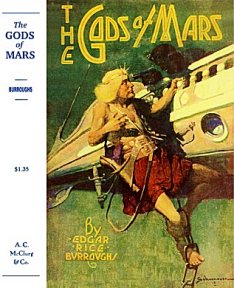
as “The John Carter of Mars Trilogy,” The Gods of Mars. Ironically,
John Carter himself is ERB's poke at Christianity: his initials are the
same as Jesus Christ's; he has a supernatural advent upon another world;
and at the end of the
first novel, he expires in self-sacrifice at the atmosphere
factory just in time to save the whole planet. He then disappears and ten
years later – a little longer than the three days it took Jesus to return
– Carter resurrects back on Mars: in its Heaven. So, in debunking religion,
ERB virtually creates a religious myth of his own, nearly stated as dogma
in Carter’s defense in the Temple of Reward. (See below)
Carter finds himself back on Barsoom after suddenly astral-travelling
from his cottage overlooking the Hudson River; he has no idea where he
is. He wakes up naked in a strange and beautiful forest of gigantic multicolored
trees; the ground is covered with a close-cropped sward of scarlet vegetation.
It all appears to be parklike in its upkeep. Through the trees he sees
a most
un-Martian sight: an open sea.
As he leaves the forest he comes to a broad expanse of
meadow land; to his left, the sea as far as he can see; to his right, a
mighty river flowing between scarlet banks as it empties into the sea.
A little distance up the river mighty perpendicular gold metal bluffs rise
thousands of feet high, at the base of which the river emerges from a subterranean
tunnel.
Then Carter sees the gruesome blue plant men, the caretakers
of the park: monsters who suck the blood from their victims. Carter hears
a weird cry from the bluffs, the plant men rally and attack a group of
Green Martians who have gathered on top of a boulder to defend themselves.
The plant men kill all but one with their hammer-like tails and Carter
joins in the fight to help the one survivor, who turns out to be Tars Tarkas.
After an incredible battle with the plant men and the
great white apes who are called to help their monster allies, Carter and
Tars Tarkas escape in a tree trunk and climb up the inside of the tree
to a cave in the golden cliffs. Michael Whelan does a great job depicting
this battle in his cover art of a Ballantine paperback. (See ERBzine
#0423.)

While exploring a corridor inside the cave, Tars Tarkas
explains everything to Carter:
“‘You have not told me
where we are,’ I reminded him.
“‘We are where I expected to find
you, John Carter – and another. Many years ago you heard the story of the
woman who taught me the thing that green Martians are reared to hate, the
woman who taught me to love. You know the cruel tortures and the awful
death her love won for her at the hands of the beast, Tal Hajus.
“‘She, I thought, awaited me by
the Lost Sea of Korus.
“‘You know that it was left for
a man from another world, for yourself, John Carter, to teach this cruel
Thark what friendship is; and you, I thought, also roamed the care-free
Valley Dor.
“‘Thus were the two I most longed
for at the end of the long pilgrimage I must take some day, and so as the
time had elapsed which Dejah Thoris had hoped might bring you once more
to her side, for she has always tried to believe that you had but temporarily
returned to your own planet, I at last gave way to my great yearning and
a month since I started upon the journey, the end of which this day you
have witnessed. Do you understand now where you be, John Carter?’
“‘And that was the River Iss, emptying
into the Lost Sea of Korus in the Valley Dor?’ I asked.
“‘This is the valley of love and
peace and rest to which every Barsoomian since time immemorial has longed
to pilgrimage at the end of a life of hate and strife and bloodshed,’ he
replied. ‘This, John Carter, is Heaven.’
“His tone was cold and ironical;
its bitterness but reflecting the terrible disappointment he had suffered.
Such a fearful disillusionment, such a blasting of life-long hopes and
aspirations, such an uprooting of age-old tradition might have excused
a vastly greater demonstration on the part of the Thark.
“I laid my hand upon his shoulder.
“‘I am sorry,’ I said, nor did there
seem aught else to say. “‘Think, John Carter, of the countless billions
of Barsoomians who have taken the voluntary pilgrimage down the cruel river
since the beginning of time, only to fall into the ferocious clutches of
the terrible creaturs that to-day assailed us.
“‘There is an ancient legend that
once a red man returned from the banks of the Lost Sea of Korus, returned
from the Valley Dor, back through the mysterious River Iss, and the legend
has it that he narrated a fearful blasphemy of horrible brutes that inhabited
a valley of wondrous loveliness, brutes that pounced upon each Barsoomian
as he terminated his pilgrimage and devoured him upon the banks of the
Lost Sea where he had looked to find love and peace and happiness; but
the ancients killed the blasphemer, as tradition has ordained that any
shall be killed who return from the bosom of the River of Mystery.
“‘But now we know that it was no
blasphemy, that the legend is a true one, and that the man told only of
what he saw; but what does it profit us, John Carter, since even should
we escape, we also would be treated as blasphemers? We are between the
wild thoat of certainty and the mad zitidar of fact – we can escape neither.’”
(GM/3.)
As they proceed, a mysterious voice warns them to turn back:
“‘Fools! Fools!’ it shrieked.
‘Thinkest thou to defeat the eternal laws of life and death? Wouldst cheat
the mysterious Issus, Goddess of Death, of her just dues? Did not her mighty
messenger, the ancient Iss, bear you upon her leaden bosom at your own
behest to the Valley Dor?
“‘Thinkest thou, O fools, that Issus
will give up her own? Thinkest thou to escape from whence in all the countless
ages but a single soul has fled?
“‘Go back the way thou camest, to
the merciful maws of the children of the Tree of Life or the gleaming fangs
of the great white apes, for there lies the speedy surcease from suffering;
but insist in your rash purpose to thread the mazes of the Golden Cliffs
of the Mountains of Otz, past the ramparts of the impregnable fortresses
of the Holy Therns, and upon your way Death in its most frightful form
will overtake you – a death so horrible that even the Holy Therns themselves,
who conceived both Life and Death, avert their eyes from its fiendishness
and close their ears against the hideous shrieks of its victims.
“‘Go back, O fools, the way thou
camest.’” (GM/3)
They fight off banth after banth that keep mysteriously appearing,
and with the aid of a mirror on the back of Tars Tarkas’s harness, Carter
discovers a secret revolving door, jumping through it into another chamber
on the other side. He fights and kills two lesser therns in the chamber
with the help of one of the prisoners chained against a wall, a totally
naked girl who
turns out to be Thuvia, Princess of Ptarth. After she
calms and sends away the attacking banths, she confronts Carter and Tars
Tarkas with their folly, explaining her history:
“‘Tell me,’ I said, ‘and
who be you, and why a prisoner yet with power over the ferocious beasts
of the place that denotes familiarity and authority far beyond that which
might be expected of a prisoner or a slave?’
“‘Slave I am,’ she answered. ‘For
fifteen years a slave in this terrible place, and now that they have tired
of me and become fearful of the power which my knowledge of their ways
has given me I am but recently condemned to die the death.’
“She shuddered.
“‘What death?’ I asked.
“‘The Holy Therns eat human flesh,’
she answered me; ‘but only that which has died beneath the sucking lips
of a plant man– flesh from which the defiling blood of life has been drawn.
And to this cruel end I have been condemned. It was to be within a few
hours, had your advent not caused an interruption of their plans.’
“‘Was it then the Holy Therns who
felt the weight of John Carter’s hand?’ I asked.
“‘Oh, no; those whom you laid low
are lesser therns; but of the same cruel and hateful race. The Holy Therns
abide upon the outer slopes of these grim hills, facing the broad world
from which they harvest their victims and their spoils.
“‘Labyrinthine passages connect
these caves with the luxurious palaces of the Holy Therns, and through
them pass upon their many duties the lesser therns, and hordes of slaves,
and prisoners, and fierce beasts; the grim inhabitants of this sunless
world....
“‘Now and again some hapless pilgrim,
drifting out upon the silent sea from the cold Iss, escapes the plant men
and the great white apes that guard the Temple of Issus and falls into
the relentless clutches of the therns; or, as was my misfortune, is coveted
by the Holy Thern who chances to be upon watch in the balcony above the
river where it issues from the bowels of the mountains through the cliffs
of gold to empty into the Lost Sea of Korus.
“‘All who reach the Valley Dor are,
by custom, the rightful prey of the plant men and the apes, while their
arms and ornaments become the portion of the therns; but if one escapes
the terrible denizens of the valley for even few hours the therns may claim
such a one as their own. And again the Holy Thern on watch, should he see
a victim he covets, often tramples upon the rights of the unreasoning brutes
of the valley and takes his prize by foul means if he cannot gain it by
fair.
“‘It is said that occasionally some
deluded victim of Barsoomian superstition will so far escape the clutches
of the countless enemies that beset his path from the moment that he emerges
from the subterranean passage through which the Iss flows for a thousand
miles before it enters the Valley Dor as to reach the very walls of the
Temple of Issus; but what fate awaits one there not even the Holy Therns
may guess, for who has passed within those gilded walls never has returned
to unfold the mysteries they have held since the beginning of time.
“‘The Temple of Issus is to the
therns what the Valley Dor is imagined by the peoples of the outer world
to be to them; it is the ultimate haven of peace, refuge, and happiness
to which they pass after this life and wherein an eternity of eternities
is spent amidst the delights of the flesh which appeal most strongly to
this race of mental giants and moral pygmies.
“‘The Temple of Issus is, I take
it, a heaven within a heaven,’ I said. ‘Let us hope that there it will
be meted to the therns as they have meted it here unto others.’
“‘Who knows?’ the girl murmured.
“‘The therns, I judge from what
you have said, are no less mortal than we; and yet have I always heard
spoken of with the utmost awe and reverence by the people of Barsoom, as
one might speak of the gods themselves.’
“‘The therns are mortal,’ she replied.
‘They die from the same causes as you or I might; those who do not live
their allotted span of life, one thousand years, when by the authority
of custom they may take their way in happiness through the long tunnel
that leads to Issus.
“‘Those that die before are supposed
to spend the balance of their allotted time in the image of a plant man,
and it is for this reason that the plant men are held sacred by the therns,
since they believe that each of these hideous creatures was formerly a
thern.’
“‘And should a plant man die?” I
asked.
“‘Should he die before the expiration
of the thousand years from the birth of the thern whose immortality abides
within him then the soul passes into a great white ape; but should the
ape die short of the exact hour that terminates the thousand years the
soul is forever lost and passes for all eternity into the carcass of the
slimy and fearsome silian whose wriggling thousands seethe the silent sea
beneath the hurtling moons when the sun has gone and strange shapes walk
through the Valley Dor.’” (GM/4.)
They discuss their chances for escape, recruit the other
prisoners, and Thuvia leads them to a chamber where they can all get weapons.
On the way they she tells them:
“‘And even then, O Prince,’
she cried, ‘the arm of the Holy Thern is long. It reaches to every nation
of Barsoom. His secret temples are hidden in the heart of every community.
Wherever we go should we escape we shall find that word
of our coming has preceded us,
and death awaits us before we may pollute the air with our blasphemies.’”
(GM/4.)
Before they reach the weapons room, they meet a Holy Thern
of the Tenth Cycle, Sator Throg:
“He wore in addition to
his leathern trappings and jewelled ornaments a great circlet of gold about
his brow in the exact center of which was set an immense stone, the exact
counterpart of that which I had seen upon the breast of the little old
man at the atmosphere plant nearly twenty years before....
“The stone worn by the thern who
confronted us was of about the same size as that which I had seen before;
an inch in diameter I should say. It scintillated nine different and distinct
rays; the seven primary colors of our earthly prism and the two rays which
are unknown upon Earth, but whose wondrous beauty is undescribable.” (GM/4.)
The thern orders them to stop, but Thuvia raises her revolver
and fires point blank, killing him instantly, revenging herself. This had
been the Holy Thern on watch who had coveted her and made her his plaything
for fifteen years. Thuvia notices a remarkable resemblance between the
thern and Carter and gets an idea:
“She smiled and for answer
approached the body of the man she had just slain, and kneeling beside
it removed the circlet of gold from the forehead, and then to my utter
amazement lifted the entire scalp bodily from the corpse’s head.
“Rising, she advanced to my side
and placing the yellow wig over my black hair, crowned me with the golden
circlet set with the magnificent gem.
“‘Now don his harness, Prince,’
she said, ‘and you may pass where you will in the realms of the therns,
for Sator Throg was a Holy Thern of the Tenth Cycle, and mighty among his
kind.’
“As I stooped to the dead man to
do her bidding I noted that not a hair grew upon his head, which was quite
as bald as an egg.
“‘They are all thus from birth,’
explained Thuvia noting my surprise. ‘The race from which they sprang were
crowned with a luxurious growth of golden hair, but for many ages the present
race has been entirely bald. The wig, however, has come to be a part of
their apparel, and so important a part do they consider it that it is cause
for the deepest disgrace were a thern to appear in public without it.’”
(GM/4.)
The escaping party takes the body of Sator Throg along with
them and eventually find the weapons storeroom where Carter takes the opportunity
to get some sleep. He is awakened by gunfire. The other prisoners are ambushed
and killed by a search party: Carter, Thuvia, and Tars Tarkas only survive
because they were sleeping on the floor. The leader of the ambush is specifically
looking for them, but Carter pretends he is Sator Throg and is offended
by the ambush, telling the leader that he has captured the suspects, thus
accounting for Tars Tarkas, and that the dead white body on the floor belongs
to John Carter. But, of course, the white body is bald and the leader suspiciously
and grudgingly accepts Sator Throg’s story:
“‘What will the fellow
do first, Thuvia?’ I asked. ‘How long will it be before they may return
for us?’
“‘He will go directly to the Father
of the Therns, old Matai Shang. He may have to wait for an audience, but
since he is very high among the lesser therns, in fact as a thorian among
them, it will not be long that Matai Shang will keep him waiting.
“‘Then if the Father of Therns puts
credence in his story, another hour will see the galleries and chambers,
the courts and gardens, filled with searchers.’
“‘What we do then must be done within
an hour. What is the best way, Thuvia, the shortest way out of this celestial
Hades?’
“‘Straight to the top of the cliffs,
Prince,’ she replied, ‘and then through the gardens to the inner courts.
From there our way will lie within the temples of the therns and across
them to the outer court. Then the ramparts – O Prince, it is hopeless.
Ten thousand warriors could not hew a way to liberty from out this awful
place.
“‘Since the beginning of time, little
by little, stone by stone, have the therns been ever adding to the defences
of their stronghold. A continuous line of impregnable fortifications circles
the outer slopes of the Mountains of Otz.
“‘Within the temples that lie beyond
the ramparts a million fighting-men are ever ready. The courts and gardens
are filled with slaves, with women and with children.
“‘None could go a stone’s throw
without detection.’” (GM/5.)
They head for the top of the cliffs and come to an opening
overlooking the Valley Dor. This scene is vividly depicted by Thomas Yeates.
(See,
www.tarzan.org/yeates/gallery4.html;
it’s the third picture down on the left in the Barsoom Portfolio II):
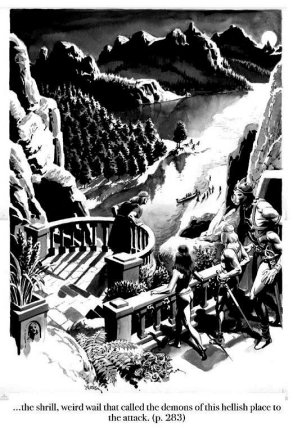
“At our right the sun was
setting, a huge red orb, below the western range of Otz. A little below
us stood the Holy Thern on watch upon his balcony. His scarlet robe of
office was pulled tightly about him in anticipation of the cold that comes
so suddenly with darkness as the sun sets....
“The declining sun lighted brilliantly
the eastern banks of Korus, the crimson sward, the gorgeous forest. Beneath
the trees we saw feeding many herds of plant men. The adults stood aloft
upon their toes and their mighty tails, their talons pruning every available
leaf and twig. It was then that I understood the careful trimming of the
trees which had led me to form the mistaken idea when first I opened my
eyes upon the grove that it was the playground of a civilized people.
“As we watched, our eyes wandered
to the rolling Iss, which issued from the base of the cliffs beneath us.
Presently there emerged from the mountain a canoe laden with lost souls
from the outer world. There were a dozen of them. All were of the highly
civilized and cultured race of red men who are dominant on Mars.
“The eyes of the herald upon the
balcony beneath fell upon the doomed party as soon as did ours. He raised
his head and, leaning far out over the low rail that rimmed his dizzy perch,
voiced the shrill, weird wail that called the demons of this hellish place
to attack.
“For an instant the brutes stood
with stiffly erected ears, then they poured from the grove toward the river’s
bank, covering the distance with great, ungainly leaps.
“The party had landed and was standing
on the sward as the awful horde came in sight. There was a brief and futile
effort at defense. Then silence as the huge, repulsive shapes covered the
bodies of their victims and scores of sucking mouths fastened themselves
to the flesh of their prey.
“I turned away in disgust.
“‘Their part is soon over,’ said
Thuvia. ‘The great white apes get the flesh when the plant men have drained
the arteries. Look, they are coming now.’
“As I turned my eyes in the direction
the girl indicated, I saw a dozen of the great white monsters running across
the valley toward the river bank. Then the sun went down and darkness that
could almost be felt engulfed us.” (GM/5.)
They finally make their way to the gardens of the therns,
assisted by a pack of banths Thuvia has recruited. There they discover
that the therns are under attack by many fliers of the Black Pirates of
Barsoom, who are stealing as many beautiful women as they can get their
hands on.
Carter manages to highjack one of their fliers, but the
weight of the three of them is too much, so he sets the controls and jumps
off, letting Tars Tarkas and Thuvia get away while he holds off a dozen
or so Black Pirates. An anchor clunks him on the head, he makes a leap
for it, and escapes as the ship attached to the anchor floats off. Carter
climbs aboard after dispatching a Black Pirate trying to prevent him from
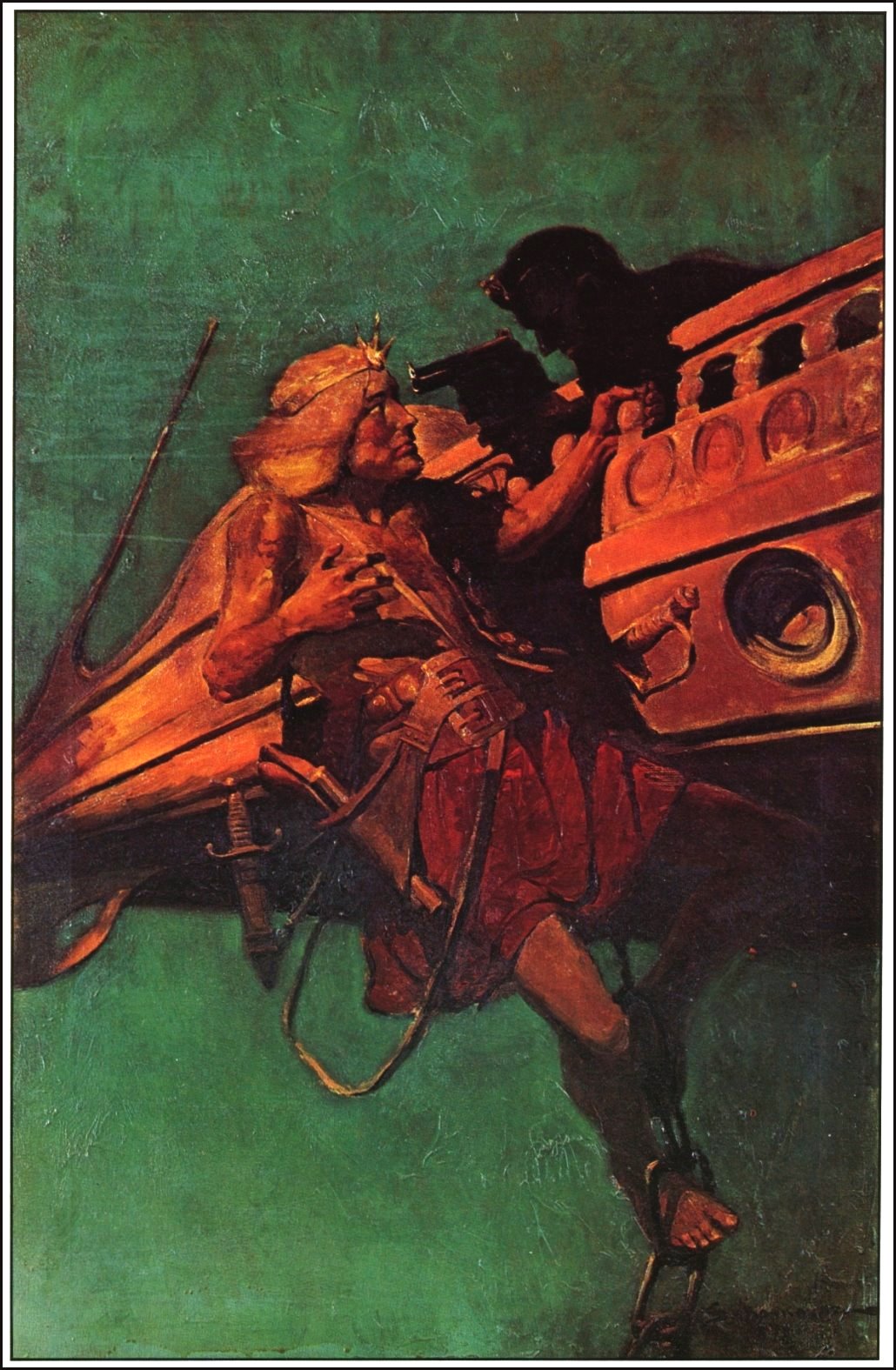
boarding. There is some great cover art of this scene by Frank Schoonover
and Gino D’Achille which can be viewed at ERBzine
#0423.

 The rest of the crew are sleeping and he spies a thern girl
bound to one of the rapid firing guns. He releases her and together they
dispatch all but one to the Lost Sea of Korus below. The sole survivor,
Xodar, is securely bound in his harness, and then the girl queries about
who he is and where he is from for she has seen through his disguise, the
whole time openly flirting with him. Carter tells her he is from another
world; the girl believes him and introduces herself:
The rest of the crew are sleeping and he spies a thern girl
bound to one of the rapid firing guns. He releases her and together they
dispatch all but one to the Lost Sea of Korus below. The sole survivor,
Xodar, is securely bound in his harness, and then the girl queries about
who he is and where he is from for she has seen through his disguise, the
whole time openly flirting with him. Carter tells her he is from another
world; the girl believes him and introduces herself:
“‘I am Phaidor, daughter
of Matai Shang, Holy Hekkador of the Holy Therns, Father of Therns, Master
of Life and Death upon Barsoom, Brother of Issus, Princess of Life Eternal.’”
(GM/7.)
Carter takes the ship as high as it will go to answer two
questions as Phaidor and Xodar succumb to the lack of oxygen: the first
is to prove that Phaidor is just as mortal as he is; the second is to dispell
the common Barsoomian rumor that the Black Pirates come from Thuria, the
lesser moon. He brings these facts to their attention:
“‘There is immortality
only in Issus,’ she replied. ‘And Issus is for the race of the therns alone.
Thus am I immortal.’
“I caught a fleeting grin passing
across the features of the black as he heard her words. I did not then
understand why he smiled. Later I was to learn, and she, too, in a most
horrible manner.
“‘The other,’ I replied, ‘is that
our dusky friend here does not hail from the nearer moon – he was like
to have died at a few thousand feet above Barsoom. Had we continued the
five thousand miles that lie between Thuria and the planet he would have
been but the frozen memory of a man.’
“Phaidor looked at the black in
evident astonishment.
“‘If you are not of Thuria, then
where?’ she asked.
“He shrugged his shoulders and turned
his eyes elsewhere, but did not reply.
“The girl stamped her little foot
in a peremptory manner.
“‘The daughter of Matai Shang is
not accustomed to having her queries remain unanswered,’ she said. ‘One
of the lesser breed should feel honored that a member of the holy race
that was born to inherit life eternal should deign even to notice him.’
“Again the black smiled that wicked,
knowing smile.
“‘Xodar, Dator of the First Born
of Barsoom, is accustomed to give commands, not to receive them,’ replied
the black pirate.” (GM/7.)
Carter tells them he intends on taking both of them to Helium
as witnesses to the false religion of Issus. Then Xodar distracts him with
a long history lesson of his race and religious beliefs:
“‘The First Born of Barsoom,’
he explained, ‘are the race of black men of which I am a Dator, or, as
the lesser Barsoomians would say, Prince. My race is the oldest on the
planet. We trace our lineage, unbroken, direct to the Tree of Life which
flourished in the center of the Valley Dor twenty-three million years ago.
“‘For countless ages the fruit of
this tree underwent the gradual changes of evolution, passing by degrees
from true plant life to a combination of plant and animal. In the first
stages the fruit of the tree possessed only the power of independent muscular
action, while the stem remained attached to the parent plant; later a brain
developed in the fruit, so that hanging there by their long stems they
thought and moved as individuals.
“‘Then, with the development of
perceptions came a comparison of them; judgments were reached and compared,
and thus reason and the power to reason were born upon Barsoom.
“‘Ages passed. Many forms of life
came and went upon the Tree of Life, but still all were attached to the
parent plant by stems of varying length. At length the fruit tree consisted
in tiny plant men, such as we now see reproduced in such huge dimensions
in the Valley Dor, but still hanging to the limbs and branches of the tree
by the stems which grew from the tops of their heads.
“‘The buds from which the plant
men blossomed resembled large nuts about a foot in diameter, divided by
double partition walls into four sections. In one section grew the plant
man, in another a sixteen-legged worm, in the third the progenitor of the
white ape and in the fourth the primeval black man of Barsoom.
“‘When the bud burst the plant man
remained dangling at the end of his stem, but the three other sections
fell to the ground, where the efforts of their imprisoned occupants to
escape sent them hopping about in all directions.
“‘Thus as time went on, all Barsoom
was covered with these imprisoned creatures. For countless ages they lived
their long lives within their hard shells, hopping and skipping about the
broad planet; falling into rivers, lakes, and seas, to be still further
spread about the surface of the new world.
“‘Countless billions died before
the first black man broke through his prison walls into the light of day.
Prompted by curiousity, he broke open other shells and the peopling of
Barsoom commenced.
“‘The pure strain of the blood of
this first black man has remained untainted by admixture with the other
creatures in the race of which I am a member; but from the sixteen-legged
worm, the first ape and renegade black man has sprung every other form
of animal life upon Barsoom.
“‘The therns,’ and he smiled maliciously
as he spoke, ‘are but the result of ages of evolution from the pure white
ape of antiquity. They are a lower order still. There is but one race of
true and immortal humans on Barsoom. It is the race of black men.
“‘The Tree of Life is dead, but
before it died the plant men learned to detach themselves from it and roam
the face of Barsoom with other children of the First Parent.
“‘Now their bisexuality permits
them to reproduce themselves after the manner of true plants, but otherwise
they have progressed but little in all the ages of their existence. Their
actions and movements are largely matters of instinct and not guided to
any great extent by reason, since the brain of a plant man is but a trifle
larger than the end of your smallest finger. They live upon vegetation
and the blood of animals, and their brain is just large enough to direct
their movements in the direction of food, and to translate the food sensations
which are carried to it from their eyes and ears. They have no sense of
self-preservation and so are entirely without fear in the face of danger.
That is why they are such terrible antagonists in combat.’” (GM/7.)
Xodar is able to distract Carter long enough to prevent him
from noticing a black battleship bearing down on him until it is too late.
He is hence captured and Carter and Phaidor are bound together and placed
in a cabin below decks. Phaidor tells him she fears her fate for in the
millions of years the Black Pirates have only stolen women:
“‘Do you know where we
are going?’ she said.
“‘To solve the mystery of the eternal
hereafter, I imagine,’ I replied.
“‘I am going to a worse fate than
that,’ she said, with a little shudder.
“‘What do you mean?’
“‘I can only guess,’ she replied,
‘since no thern damsel of all the millions that have been stolen away by
black pirates during the ages they have raided our domain has ever returned
to narrate her experiences among them. That they never take a man prisoner
lends strength to the belief that the fate of the girls they steal is worse
than death.’
“‘Is it not a just retribution?’
I could not help but ask.
“‘What do you mean?’
“‘Do not the therns themselves do
likewise with the poor creatures who take the voluntary pilgrimage down
the River of Mystery? Was not Thuvia for fifteen years a plaything and
a slave? Is it less than just that you should suffer as you have caused
others to suffer?’
“‘You do not understand,’ she replied.
“We therns are a holy race. It is an honor to a lesser creature to be a
slave among us. Did we not occasionally save a few of the lower orders
that stupidly float down an unknown river to an unknown end all would become
the prey of the plant men and the apes.’
“‘But do you not by every means
encourage the superstition among those of the outside world?’ I argued.
‘That is the wickedest of your deeds. Can you tell me why you foster the
cruel deception?’
“‘All life on Barsoom,’ she said,
‘is created solely for the support of the race of therns. How else could
we live did the outer world not furnish our labor and our food? Think you
that a thern would demean himself by labor?’
“‘Is it true that you eat human
flesh?’ I asked in horror.
“She looked at me in pitying commiseration
for my ignorance.
“‘Truly we eat the flesh of the
lower orders. Do not you also?’
“‘The flesh of beasts, yes,’ I replied,
‘but not the flesh of man.’
“‘As man may eat of the flesh of
beasts, so may gods eat of the flesh of man. The Holy Therns are the gods
of Barsoom.’
“I was disgusted and I imagine that
I showed it.
“‘You are an unbeliever now,’ she
continued gently, ‘but should we be fortunate enough to escape the clutches
of the black pirates and come again to the court of Matai Shang I think
that we shall find an argument to convince you of the error of your ways.
And – ,’ she hesitated, ‘perhaps we shall find a way to keep you as – as
– one of us.’” (GM/8.)
It is obvious that Phaidor has fallen in love with Carter
and desires to make love to him. If it is not obvious to you now, then
see what happens next:
“Again her eyes dropped
to the floor, and a faint color suffused her cheek. I could not understand
her meaning; nor did I for a long time. Dejah Thoris was wont to say that
in some things I was a veritable simpleton, and I guess that she was right.
“‘I fear that I would ill requite
your father’s hospitality,’ I answered, ‘since the first thing that I should
do were I a thern would be to set an armed guard in the mouth of the River
Iss to escort the poor deluded voyagers back to the outer world. Also should
I devote my life to the extermination of the hideous plant men and their
horrible companions, the great white apes.’
“She looked at me really horror
struck.
“‘No, no,’ she cried, ‘you must
not say such terribly sacrilegious things – you must not even think them.
Should they ever guess that you entertained such frightful thoughts, should
we chance to regain the temples of the therns, they would mete out a frightful
death to you. Not even my – my –’ Again she flushed, and started over.
‘Not even I could save you.’” (GM/8.)
Carter gives up his attempt to create a human conscience
in Phaidor after she has offered herself to him:
“I said no more. Evidently
it was useless. She was even more steeped in superstition than the Maritans
of the outer world. They only worshipped a beautiful hope for a life of
love and peace and happiness in the hereafter. The therns worshipped the
hideous plant men and the apes, or at least they reverenced them as the
abodes of departed spirits of their own dead.’” (GM/8)
Xodar returns and allows them on deck to witness the entrance
to the Sea of Omean and the real Martian heaven, enjoying the look of dismay
in Phaidor’s eyes as he tells her:
“‘It will be an excellent
lesson for the daughter of the therns,’ he added, ‘for she shall see the
Temple of Issus, and Issus, perchance, shall embrace her.’
“Phaidor’s head went high.
“‘What blasphemy is this, dog of
a pirate?’ she cried. ‘Issus shall wipe out your entire breed an’ you ever
came within sight of her temple.’
“‘You have much to learn, thern,’
replied Xodar, with an ugly smile, ‘nor do I envy you the manner in which
you will learn it.’” (GM/8.)
They fly back the same way they had escaped, and Carter marvels
at the sight of the south polar ice cap; they cross over the great bowl
depression of the Otz Valley. Xodar acts as their tour guide:
“‘Yes,’ answered Xodar.
‘You crossed this ice field last night in the long chase that you led us.
The Otz valley lies in a mighty depression at the south pole. It is sunk
thousands of feet below the level of the surrounding country, like a great
round bowl. A hundred miles from its northern boundaries rise the Otz Mountains
which circle the inner Valley of Dor, in the exact center of which lies
the Lost Sea of Korus. On the shore of this sea stands the Golden Temple
of Issus in the Land of the First Born. It is here that we are bound.’”
(GM/8.)
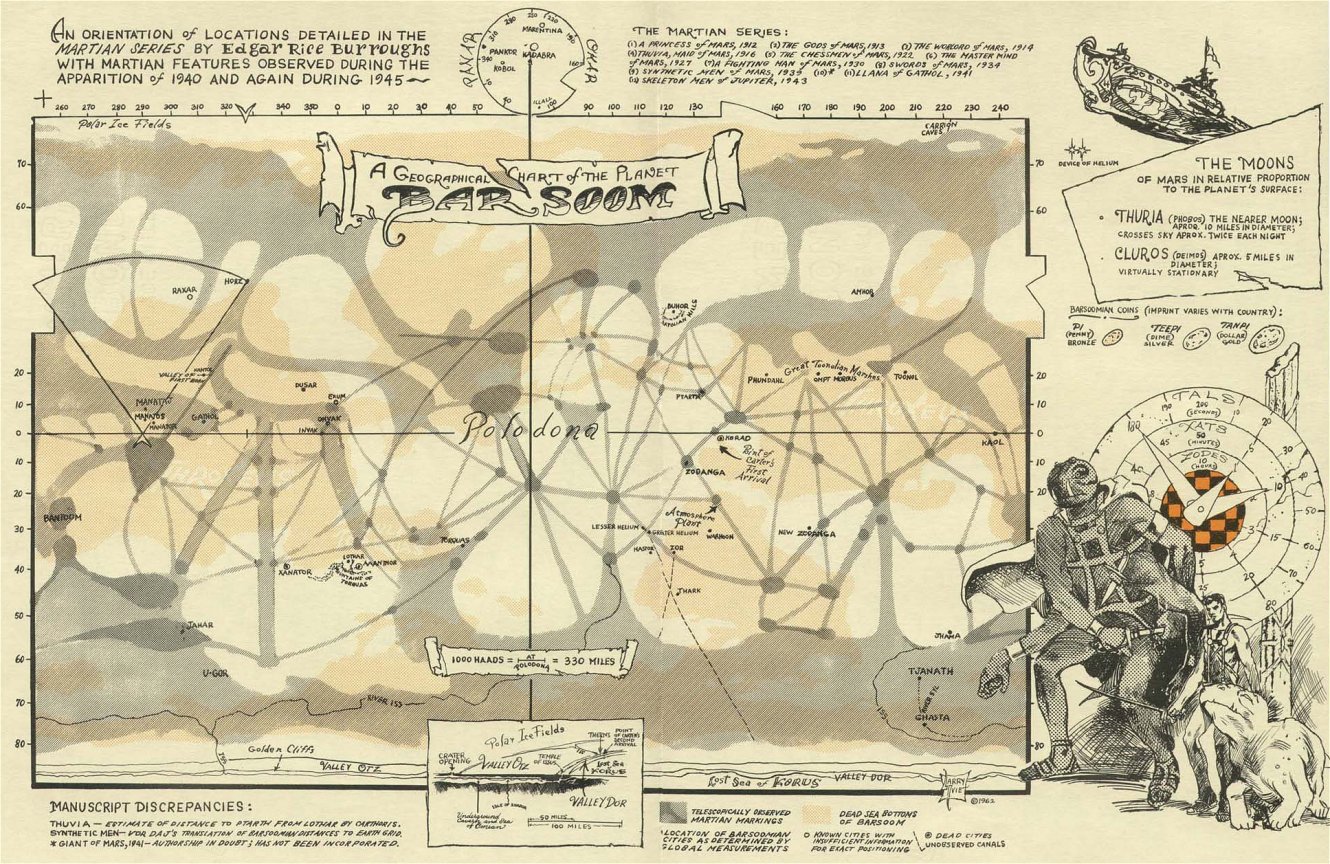
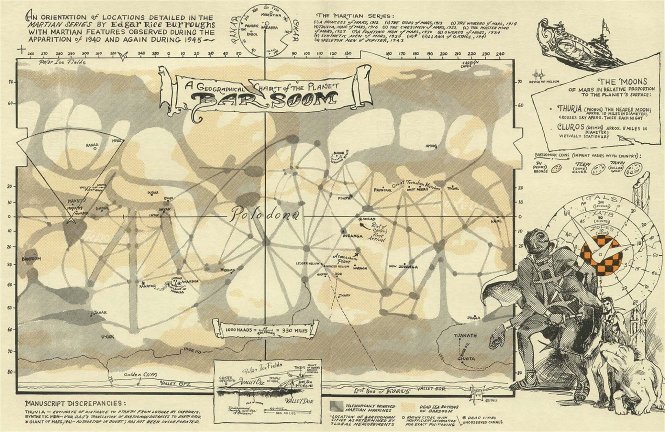
If all of this geography is getting too much for you, some
wonderful maps have been drawn depicting both the south and north poles
that can be viewed at ERBzine
#2807. They cross a village of lost souls inhabited by pilgrims who
lost their nerve to finish the voyage or those who escaped and feared their
fates if they returned to their homeland.
“Xodar had left us to attend
to some duty on the vessel, and Phaidor and I stood alone beside the rail.
The girl had not once spoken since we had been brought to the deck.
“‘Is what he has been telling me
true?’ I asked her.
“‘In part, yes,’ she answered. “That
about the outer valley is true, but what he says of the location of the
Temple of Issus in the center of his country if false. If it is not false
– ’ she hesitated. ‘Oh, it cannot be true, it cannot be true. For if it
were true then for countless ages have my people gone to torture and ignominous
death at the hands of their cruel enemies, instead of to the beautiful
Life Eternal that we have been taught to believe Issus holds for us.’
“‘As the lesser Barsoomians of the
outer world have been lured by you to the terrible Valley Dor, so may it
be that the therns themselves have been lured by the First Born to an equally
horrid fate,’ I suggested. ‘It would be a stern and awful retribution,
Phaidor; but a just one.’
“‘I cannot believe it.’
“‘We shall see,’ I answered.” (GM//8.)
In this scene and in a few others, ERB perfectly captures
the cognitive dissonance of the human mind when it is confronted with facts
that contradict what it has been taught to believe.
Overcoming religious delusion is the greatest challenge
the human mind can face and ERB manages to capture it in a very artistic
and nonplayful manner.
Xodar then takes their ship to a volcanic opening and
descends thousands of feet to a subterranean sea, Omean, where they are
escorted the base of the Land of the First Born in a submarine. As the
craft submerges, Phaidor becomes pathetic in her denial:
“Phaidor grasped my arm.
“‘Save me!’ she whispered. ‘Save
me and your every wish shall be granted. Anything within the power of the
Holy Therns to give will be yours. Phaidor –’ she stumbled a little here,
and then in a very low voice, ‘Phaidor is already is yours.’
“I felt sorry for the poor child,
and placed my hand over hers where it rested on my arm. I presumed my motive
was misunderstood, for with a swift glance about the apartment to assure
herself that we were alone, she threw both her arms around my neck and
dragged my face down to hers.’ (GM/8.)
ERB chose this point to start a new chapter. We must always
remember that except for harnesses that are worn for utility and ornamentation,
everyone is naked on Mars, with genitalia fully exposed. (See “Nakedness
on Mars,”
ERBzine #3177.)
When we fully understand this, we begin to understand ERB's problems he
faced with both his family and the censors, because, after all, John Carter
is a married man. This story was told to the public in the winter and spring
of 1913, at the height of Victorian morality and Puritanical prudery.
ERB spends the next few paragraphs of chapter nine to
explain that he is not a ladies man and that he is a fool in the ways of
a man with a maid, but this is always a subtle tip-off that what is being
narrated is racy, suggestive, and sometimes pornographic. The reader is
left to his or her imagination as to exactly what transpired before Carter
broke off the embrace and explained his
great love for his incomparable princess to Phaidor.
Phaidor is madly in love with Carter and is extremely jealous, taking the
opportunity to act like her race still controls the world:
“‘Dog,’ she hissed. ‘Dog
of a blasphemer! Think you that Phaidor, daughter of Matai Shang, supplicates?
She commands. What to her is your puny outer world passion for the vile
creature you chose in your other life?
“‘Phaidor has glorified you with
her love, and you have spurned her. Ten thousand unthinkable atrocious
deaths could not atone for the affront that you have put upon me. The thing
that you call Dejah Thoris shall die the most horrible of them all. You
have sealed the warrant for her doom.
“‘And you! You shall be the meanest
slave in the service of the goddess you have attempted to humiliate. Tortures
and ignominies shall be heaped upon you until you grovel at my feet asking
the boon of death.
“‘In my gracious generosity I shall
at length grant your prayer, and from the high balcony of the Golden Cliffs
I shall watch the great white apes tear you asunder.’” (GM/9.)
Carter seems to understand the mental turmoil she suffers
and not to add any more discomfort, merely points to the nearest porthole
to remind her that they are underwater going to a certain doom. She sits
down on a bench, her face buried in her arms, sobbing “more like a very
unhappy little girl than a proud and all-powerful goddess.” (GM/9.)