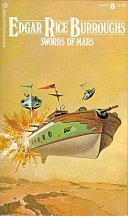
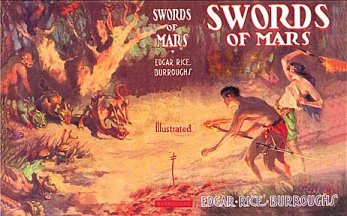
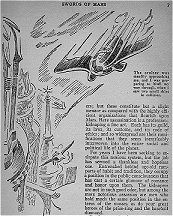
In Swords
of Mars a pair of rival Zodangan scientists build sealed airships
designed to travel into outer space. One of them is piloted by an
electronic brain susceptible to telepathic influence.
All right, if we accept the concept of Barsoomian airships
it should be an inevitable development that the Barsoomians should achieve
near space travel. Since their airship technology works on
gravity repulsion, there is no reason they cannot leave the atmosphere.
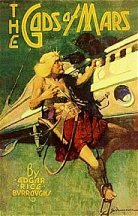
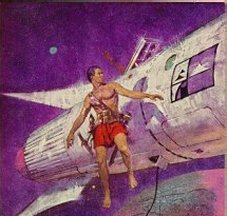
In fact, in Gods of
Mars an Airship which John Carter is on goes so high that the crew
almost asphyxiates. There is also Barsoomian folklore of an airship
that made it all the way up to orbital levels and remains there with its
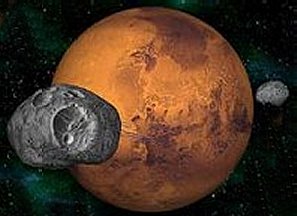
dead crew, a tiny third satellite. So, it is no surprise that
Barsoomians make it into space, the only question is why didn’t they do
it sooner?
One answer might be propulsion. Barsoomian
airship technology works by essentially negating gravity, but out in interplanetary
space, there would be no gravity to negate. Barsoomian science
lacks an effective propulsion technology, and there is little evidence
apart from their radium pistols, that their technology ever developed in
directions which might allow such propulsion technology to evolve.
There is little or no evidence that Barsoomian technology, for instance,
ever had a fossil fuels or hydrocarbon stage. Rather,
other methods were so much more efficient that rival technologies
were strangled at the outset. Without such a technology, rockets
or the equivalent, there would be no hope of reaching Earth, Venus or Mercury,
or any other world. A Barsoomian expedition would flounder in space.
For Barsoomian technology, travel further than Thuria and Cluros would
be impossible.
Despite this limitation, Barsoomian scientists are
able to monitor Earth and to detect life on other planets.
With respect to Earth we are told the Barsoomian instruments can capture
Earthly images as small as blade of grass. With respect to Venus
and Mercury, we are told that Barsoomians are well aware that life and
intelligence exists on those worlds, but little else is known.
This poses an interesting question. Why wasn’t
the life John Carter found on Thuria known of on Barsoom? Surely
a telescope camera capable of photographing blades of grass on Earth fifty
million miles away should have been able to spot signs of life, and of
intelligent life on Thuria, a bare few thousand miles away.
However, when John Carter arrives on Thuria, he
discovers not just life, but civilization, and at least two races of sentient
beings. What they’re doing on such a tiny world is another
mystery.
There is an interesting bit of discussion prior
to the voyage where John Carter and Fal Sivas discuss the merits and hazards
of Thuria. Carter argues that proportionately, Barsoomians should
be thousands of times stronger or larger than any hypothetical Thurians,
adjusting for differences in size and gravity between worlds.
Fal Sivas responds that they will shrink upon approaching
Thuria, until they are proportionately sized to that world.
What an odd contention! It suggests that Carter and other Earthmen
must have shrunk going to Barsoom, and that a Barsoomian might grow going
to Earth. More to the point, it makes absolutely no sense,
it is physics for imbeciles, and certainly not borne out by any science
existing in Burroughs time or after.
Are we looking at a duel of scientific illiterates
here? In John Carter’s case, certainly. He is a fighting
man, not a scientist. In the case of Fal Sivas, we might have
less confidence, but taking into account his rivalry, his cowardice, his
insane schemes, we must conclude that he is not a true scientist, but that
all too common related species: A crackpot. He has had a couple
of good ideas, and no shortage of bad ones.
Allow me to offer an alternate theory of Thuria.
There is no special reason that Barsoomians could
not have traveled to Thuria ages before before John Carter’s time.
All the critical elements of technology were there, from anti-gravity,
to artificial life support for a long long time. The artificial life
support domes of Okar and Panar, and the atmosphere plant, for instance,
date to the time of the collapse of the Barsoomian ecology and civilization.
In fact, there is substantial evidence that Barsoom
had passed its technological apex and deteriorated by John Carter’s time.
There are references to a number of feats which current Barsoomian technology
could no longer duplicate, such as indefinitely glowing lights, or the
atmosphere plant.
Given this, it is likely that Barsoomians did in
fact travel to Thuria, or at least to outer orbits around Barsoom.
And in fact, there is one slight bit of folklore that suggests such travel
might in fact have taken place - the myth that the Black Pirates are derived
from Thuria.
If they did travel, what did they likely find out
there? Probably nothing, barren rock.
But let’s speculate a bit here. Perhaps the
ancient Barsoomians were a little more ambitious. Remember,
even on its deathbed, with the environment in a state of collapse, oceans
evaporating and green hordes making war, the besieged Orovars were still
able to construct a gigantic atmosphere plant to stabilize the planet.
The Okars were able to construct at least one polar dome with its own atmosphere
plant, as did the Panars. These are the accomplishments of
a desperate civilization literally collapsing as it was building.
What could such a civilization do at the height of its powers?
I would argue that the ancient Barsoomians created
the Thuria that John Carter encounters.
How? Well, let’s be realistic.
Thuria is far too small to hold an atmosphere or any significant amount
of water. Life on the surface of Thuria is a dead letter from the
start.
But how about inside? Life could exist
in pockets or hollows found or created inside Thuria. Burroughs certainly
had no problem with hollow worlds, as we have seen with Pellucidar.
Life might exist in a hollow Thuria. All the Barsoomians would
have had to do would be to make sure it was sealed, install a sufficiently
effective airlock, and pump in whatever they needed.
With an adequate rate of spin, centrifugal force
would have created enough gravity to be Barsoom normal. Again,
Burroughs was aware that centrifugal force could alter the effect of gravity.
The gravity of Jupiter at its equator is reduced to manageable levels by
this effect in The Skeleton Men of Jupiter.
What I’m suggesting is that ancient Barsoomians
took Thuria, converted it into an O’Neill colony and populated it.
They may well have done the same with Cluros.
This is obviously a titanic effort. Why should
they do something like this? There are several possible explanations.
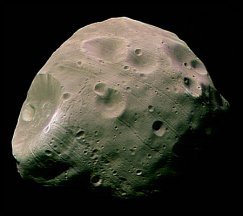
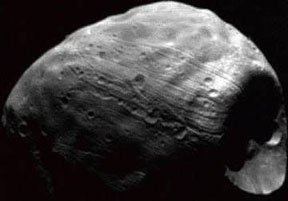
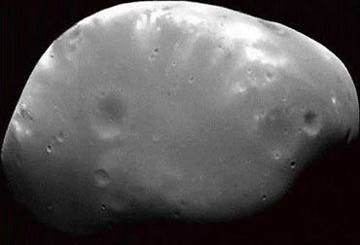
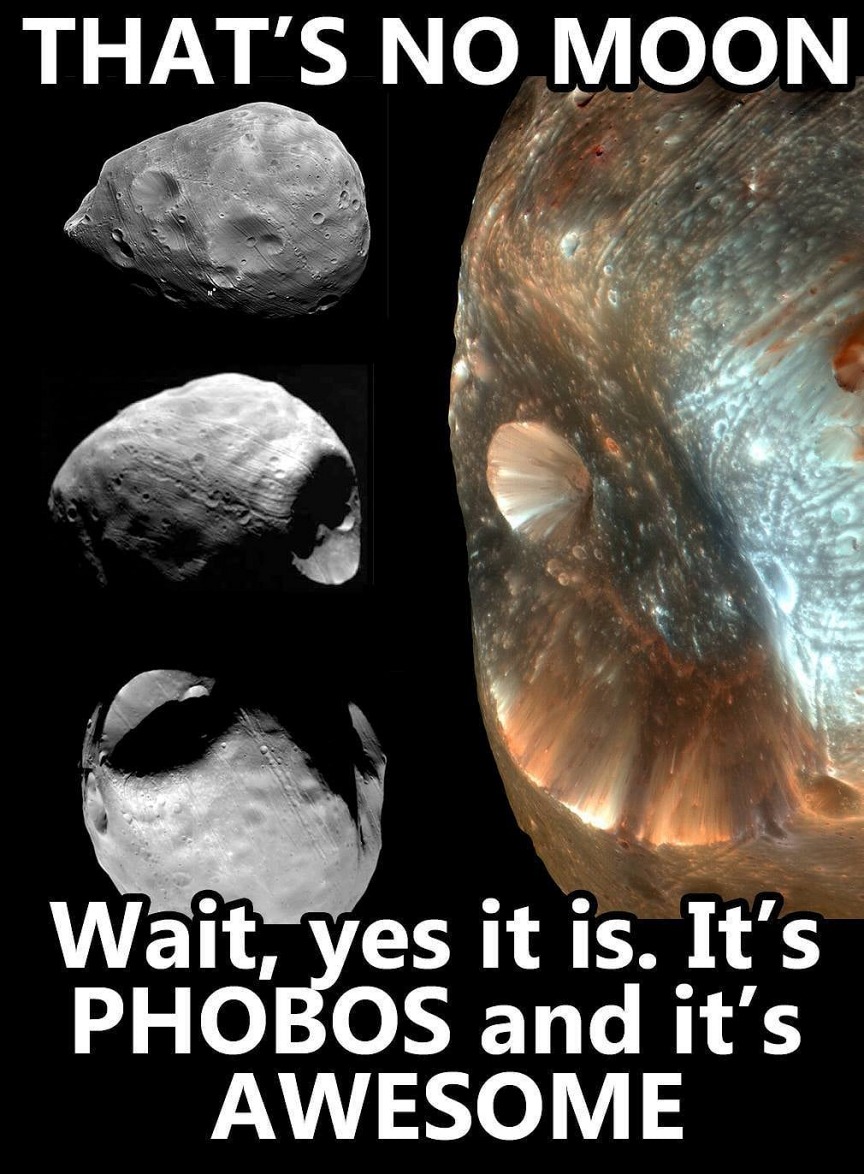
Perhaps Thuria was already hollow. Thuria
and Cluros, or Phobos and Deimos are probably captured asteroids or comets.
They, or Thuria may well have been hollow naturally. Or, they may
have begun as comets, essentially snowballs of ice, rock, hydrogen and
other volatiles, which over billions of years accreted a hard shell of
rock and metal. In either case, the Barsoomians would have
found a near ready made project.
Alternately, Thuria may well have begun
as a mining project, hollowed out to give Barsoomians a cache of special
heavy metals not found normally on their world. In this case,
the creation or re-creation of Thuria as an O’Neill colony would have followed
a lengthy period of industrial use.
How much space would we be looking at inside Thuria.
Difficult to say for sure. But assuming Thuria was a cylinder 21
miles long and 7 miles diameter, we would be looking at a maximum interior
space of approximately 460 square miles. At 15 by 5 a maximum
of 235. And at 10 by 3.5 a maximum of 110.
These space estimates are only estimates.
Some adjustments have to be made for the thickness of the skin of Thuria.
Perhaps these estimates should be reduced as much as 30% for this reason.
It is likely that some measures must have been taken to allow light in,
large window slits as conceived in modern versions of O’Neill colonies
would have reduced surface area by another third. This gives us a
minimum range of 150 to 30 square miles internal area.
Alternately, Barsoomians might have arranged the
internal geography to be folded or scalloped or looped, potentially doubling
the surface area, giving a maximum range of 900 to 220 square miles internal
area.
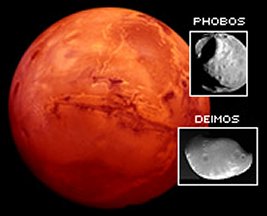 Finally, Thuria might have been considerably larger than Phobos or Deimos.
Consider that John Carter describes Thuria as appearing round from the
viewpoint of the surface of Barsoom. But we know it is actually oblong.
Is Thuria orbiting with its long axis parallel to Barsoom? If so,
it should appear oblong. If it is orbiting in a tumble, it will grow
and shrink. If it is orbiting with its long axis at right angles
to Barsoom, then a Barsoomian would only see the end, would only see the
width, not the length. A Thuria with a 15 mile wide base, 45
miles long (much larger than either of the current Martian satellites,
but perhaps viable if an existing satellite was used as the raw material
to construct a new, hollow one, would have a maximum internal area of approximately
2100 square miles.
Finally, Thuria might have been considerably larger than Phobos or Deimos.
Consider that John Carter describes Thuria as appearing round from the
viewpoint of the surface of Barsoom. But we know it is actually oblong.
Is Thuria orbiting with its long axis parallel to Barsoom? If so,
it should appear oblong. If it is orbiting in a tumble, it will grow
and shrink. If it is orbiting with its long axis at right angles
to Barsoom, then a Barsoomian would only see the end, would only see the
width, not the length. A Thuria with a 15 mile wide base, 45
miles long (much larger than either of the current Martian satellites,
but perhaps viable if an existing satellite was used as the raw material
to construct a new, hollow one, would have a maximum internal area of approximately
2100 square miles.
These are all tiny by planetary standards, but at
the same time, it is comparable to the surface area of the Kamtol valley,
or the northern domes of the Okar and Panar. In short, just
large enough to sustain a viable pocket ecology and culture.
And large enough to sustain an adventure.
As to the life found on Thuria, it is difficult
to say for sure whether it is related to Barsoomian life, Burroughs barely
describes most of it, and tends to describe it mostly in general and vague
terms. Thuria has forests, plants, animals and sentient creatures.
Only one animal is described. A four-legged
creature with membranous wings and scaly skin. Although not
apparently known on Barsoom, it would not have appeared out of place there
There is one suggestive overlap in the botanical
sphere. A man-eating vine, similar to the man-eating plants
of Barsoom.
The Tarids are simply Orovars with blue hair.
Whether this is a mutation which spread through an isolated population
or whether this was actually a part of the Orovar genome is uncertain.
We know that bluebirds on Earth are not actually blue, their colour is
actually light refracting through a lack of colour. The Orovar appear
to lack pigment compared to other Martian races, so perhaps this is the
cause. Tarid society seems to be organized roughly on the same
lines as Barsoomian society, even to the point of the titles of Jeds and
Jeddaks. And like the Barsoomians, the Tarids have strong telepathic
abilities.
A particularly interesting overlap is that the Tarids
have mastered the art of psychic invisibility. Down on Barsoom, the
denizens of the cities of Invak and Onvak appear to have also mastered
a form of invisibility.
The biggest obstacle are the Masena. Simply
put, there is nothing like them on current Barsoom. The plant
men are one eyed, like the Masena, but so biologically different as to
be unrelated. The ears are set high up, as with the Green men
and White Apes, but otherwise they share no characteristics. The
Masena are distinguished by a double mouth, a single central eye, and prehensile
hands and feet.
The prehensile hands and feet can be dismissed quickly
as an arboreal evolution, or possibly an adaptation to lack of gravity.
The Masena may have originally been low gravity or zero gravity labourers
on the early stages of mining and excavating Thuria.
The other features are more difficult. The
upper mouth may simply be a modified enlarged nose, perhaps with a flexible
lips to seal around breathing tubes.
The single eye seems unique. Such creatures
could not have effective binocular vision. Does the comparatively
huge single eye provide for a more detailed visual picture?
It is likely that the Masena, with its huge lens and cornea has a strong
visual sense. But there is little to explain it on Barsoom.
My best guess is that the Masena may, on the evidence
of the high set ears, be a modified dwarf version of the Green man/White
ape stock. Certainly the six limbed stock have substantial
variations in eyes - we have the bizarre compound eye of the apt, the protruding
eyes capable of independent movement of the Green men. So, this may
have been a variant.
We also note that many of Ras Thavas' hormads possessed
variant features, including asymmetrical eyes, which may imply that the
Masena may be a form of hormad that bred true.
Finally, Rykors who are effectively headless, and
the Kangaroo-like Marsupials demonstrate the extreme plasticity of Barsoomian
humanoids.
This theory gives us a fascinating glimpse into
the heights reached by the Barsoomian Orovar civilization, and leads us
to speculate further. Did the Orovars make it to Earth?
Are there Martian genes in terrestrial humans? Perhaps this
explains why, despite differences in anatomy and apparent evolutionary
antecedents, John Carter was able to interbreed. Did the Barsoomians
make it to the Moon? To Venus? To Mercury? To Jupiter?
Each of these worlds share human normal populations with unquestionably
alien local populations, and even non-human intelligences. Are the
human appearing populations of those worlds transplanted Barsoomians, or
at least, host to Barsoomian DNA?
Consider the similarity of Poloda, the name of the
world system in Beyond
the Farthest Star to Polodonna, the Barsoomian term of Equator.
Or, consider humans faculties for transmogrification
between worlds. At least two humans, John Carter and Ulysses
Paxton, have been able to transport themselves from Earth to Mars.
And there appears to be at least one case of transport from Earth to Venus.
Perhaps terrestrial DNA has influenced the emergence
Irregardless, we must contemplate that Thuria means
the ancient Barsoomians were able to extend themselves and their technology
into space, and there are more than a few suggestions that ancient times
saw some greater degree of interplanetary travel.
~ Den Valdron