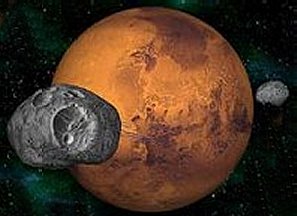
Actually, there are a lot of peculiarities to
Phobos and Deimos in popular culture. My argument on Thuria
as a hollow world, an O’Neill Colony, is essentially derived from an analysis
of Burroughs text, overlaid with modern sensibilities. But
there’s quite a bit of peculiar folklore about Phobos as an artificial
little world, that is available for those who go looking for it.


One of these is that the existence of the two Martian moons
was actually predicted by Jonathan Swift in Gulliver’s
Travels 150 years before astronomers discovered them. In
the section on Laputa, he wrote in unnerving detail of these moons.
http://www.malaspina.org/home.asp?topic=./search/details&lastpage=./search/results&ID=173#lecture
 Meanwhile,
Phobos and Deimos were deemed to be very peculiar moons indeed. Their
orbits, their sizes and dimensions, their high albedo all prompted one
Soviet astrophysicist named Iosef Shklovsky to speculate that the Martian
moons might well be artificial structures. He based this in part,
on studies of Phobos orbit which he felt were not sustainable for a natural
body.
Meanwhile,
Phobos and Deimos were deemed to be very peculiar moons indeed. Their
orbits, their sizes and dimensions, their high albedo all prompted one
Soviet astrophysicist named Iosef Shklovsky to speculate that the Martian
moons might well be artificial structures. He based this in part,
on studies of Phobos orbit which he felt were not sustainable for a natural
body.
Among his reasons were, Shklovsky stated Phobos was being
"slowed by electromagnetic drag and tidal friction more than was possible
was an actual solid moon." Given that Mars no longer has a
live magnetic field, I find myself wondering what ‘electromagnetic drag’
he was talking about. But you know, that’s Soviet science for
you, they couldn’t have known at the time that there was no magnetic field
and therefore no electromagnetic drag. He also based his findings
on what was then believed to be the thickness of the Martian atmosphere,
which seriously overestimated the actual case.
Now, this finding, sometime in the back in 1958, was no
big deal. The Soviet scientists were always coming up with goofy
theories, including the lysenkoist approach to evolution, and the notion
that Tungaska was a spaceship explosion. Soviet science of
the 50's and 60's seems to be a wilder and hairier place than the west,
largely because Soviet scientists had to spend a lot of time impressing
non-scientists in the party establishment, rather than each other.
Thus, a wild and flashy theory would get you further, politically, than
a conservative theory supported by proof.
Oddly, Shklovsky found adherents in the west.
In particular, a Dr. Fred Singer, science advisor to President Eisenhower
signed on in 1960, supporting the Shklovsky theory.
 Now,
I’m not sure what Singer’s field of specialty was. But judging
from this corker, from Singer about Phobos “its purpose would probably
be to sweep up radiation in the Mars' atmosphere, so that Martians could
safely operate around their planet.” I wouldn’t put too much faith in the
guy. His conception of a cosmic hoover, while pictaresque, is staggeringly
illiterate.
Now,
I’m not sure what Singer’s field of specialty was. But judging
from this corker, from Singer about Phobos “its purpose would probably
be to sweep up radiation in the Mars' atmosphere, so that Martians could
safely operate around their planet.” I wouldn’t put too much faith in the
guy. His conception of a cosmic hoover, while pictaresque, is staggeringly
illiterate.
Astonishingly, a few years later, in 1963, Raymond H.
Wilson Jr., Chief of Applied Mathematics at NASA, climbed on board, stating
that "Phobos might be a colossal base orbiting Mars." He also stated that
NASA itself was considering the possibility.
http://www.rense.com/general20/eisenhowerWH.htm
Now the case for Phobos, based on 'impossible orbital
eccentricities' which suggested that it was a hollow body rather than a
solid one, seems to be one of those conclusive things. A hollow
body would mass much less than a solid one, and its mass would be distributed
differently.
You could then dope this out by carefully studying the
orbital permutations. As pure mathematics, it would admit to no errors.
The face on Mars may be subjective, but the structure of Phobos orbit is
not.
Nevertheless, the subject faded away. I
can’t find any further serious or semi-serious references to possible artificiality
of Phobos based on orbital mechanics after 1967-69. Which,
coincidentally, would be about the same time that Russian and American
space probes were arriving which would have gotten the most accurate readouts
on Martian conditions, and the best data on orbits yet.
So, my assumption is that the orbit hypothesis simply
evaporated. The data was refined, the mathematics were double
checked, and voila, it turned out that there wasn’t anything patently artificial
in Phobos orbit at all.
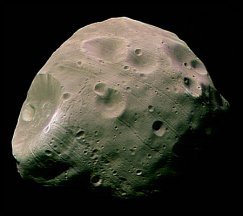
Meanwhile, a few years later, as pictures from space probes
began to come in, it became clear that Phobos was a lot weirder looking
than anyone had imagined. For one thing, there was an immense
deep crater in one side of the moon, something that might have looked suspiciously
like an airlock. For another, there was a series of reasonably
straight, reasonably parallel lines or grooves streaking across the surface.

Unfortunately, these images came out at an inopportune
time. Well after the death of Shklovsky’s hollow satellite
theory, and well before the Cydonia theories. So, for the most
part, Phobos remarkable features were considered ‘remarkable’ and nothing
more.
Still, if we take a look at it, it’s quite visually arresting.

http://news.bbc.co.uk/1/hi/sci/tech/4004001.stm
http://space.about.com/library/weekly/bliphobos3.htm
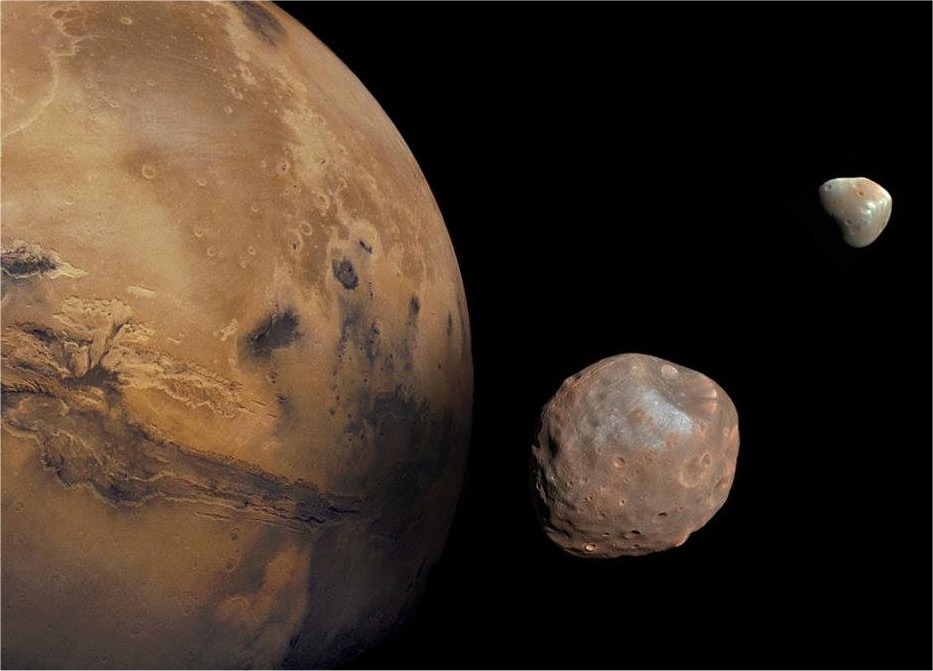
Just for the record, here's one of Deimos.

Of course, it was inevitable that Phobos would get swept
up in the Cydonia theories, particularly as those theories lost any basis
in reality and became outright projection fantasies. Here are
a few cute links.
Strange
Moons of Mars
Soviet probe
meets ufo on Phobos mission?
Chain
Craters of Phobos
Cydonian
Imperative
Mars
Anomalies
UFO
Area Phobos
Astronaut
"UFO" Sightings
The favourite loony theory appears to be that there was a
possible spaceship or foreign object hanging around Phobos that destroyed
one of Earth’s space probes. This is less Cydonia, and much
more conspiracy theory. But it all intersects. Other researchers
have concentrated on peculiar ‘crater chains’ or anomalous boulders.

Carlotto's animation shows the Face as seen from the
direction of the "City" based on Viking and MGS data.