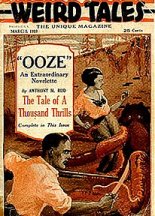
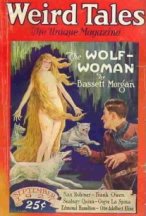
And there you have the feud? Or do you?
The timing does seem suspicious, and appears to suggest a bitter rivalry
and a certain amount of poaching. Kline’s Mars novels do read
a lot like Burroughs, their styles are very similar, and it may be with
justice that he's described as the best of those working alongside Burroughs
in that particular genre.
But, let's face it. Burroughs didn't have
his name stenciled on Mars, Kline didn't own Venus. Adventure
stories on both worlds had been written long before, including a trio by
Gustavus Pope starting in 1894, which included A Journey to Mars,
A Journey to Venus and even a Pellucidar type novel.
After seven Mars novels, Burroughs was clearly running
dry on Barsoom and needed a change of pace. Venus was a chance to
do something different. The same might be said for Kline who
seems to have started and finished in Weird Tales type stuff, and was stretching
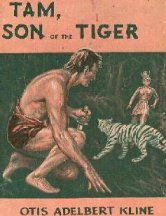
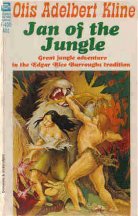
his wings a bit with adventure novels. If Jan and Tam was a
Tarzan clone, Kline at least kept them both out of Africa, in respect for
Burroughs major active series, and its not like he did an 'inner world'
novel. And there doesn't seem to be any sort of resonance in their
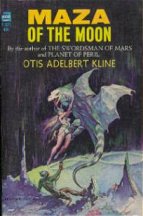
Moon novels, which were decades apart.
Further, the two men worked at different rates.
Burroughs was a full time writer, as we can tell from his voluminous production.
Kline had his fingers in all sorts of things and wrote part time, therefore
he tended to write much more slowly than Burroughs, accounting for his
much lower output. Given that he was working at a slower rate, the
actual timing of publication may not reflect when each started their projects
and may not actually support a feud.
The two men never met, much less had a fist fight, and
the survivors and heirs of both recall no mention of any animosity, nor
is there any written record of such animosity or competition in the letters
and notes of either men. For a decade-long-game of one upsmanship,
there's remarkably little documentary or direct evidence.
Meanwhile, Burroughs had other imitators, like Ralph Milne
Farley who wrote his 'Radio Planet' books set on Venus, and the two men
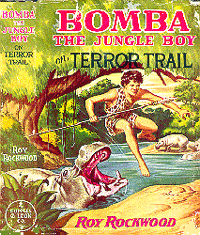
were apparently friends. And there was Roy Rockwood, who wrote
an absolutely wretched series of 'Bomba,
the Jungle Boy' books ripping off Tarzan, and we don't hear Burroughs
getting all twisted up over that. At least Kline’s books were
really good.
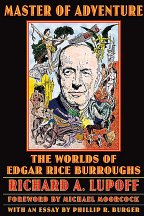
Richard Lupoff canvasses the matter thoroughly in his
Edgar Rice Burroughs: Master of Adventure and on this one, I'm inclined
to agree with him. The feud is at best unproven,
and seems more likely its hoopla manufactured by Editors and Publishers
and supported by genre historians like Sam Moskovitz to sell more books.
Still, its one of those things that insinuates itself
into the legend and folklore, and you can't help discussing the feud, if
only to debunk it. The feud or rivalry, whether it existed
or not, was probably good for Kline’s career and reputation, although it
pigeonholed him as a Burroughs imitator. Like it or not, there
were a lot of good pulp writers in the '30s, and not many of them are remembered
today. Kline is better remembered than most, and if he owes
a bit of that to a fictional rivalry... Well, life is full of ironies.
The final irony is that it was Burroughs who gave Kline’s
books a second lease on life well over a decade after both men had died.
In the 1960s, starting from 1962, on and lasting up to the mid-seventies
at least, there was a Burroughs explosion. Spurred partly by
the release of unpublished works, the new availability of his existing
works, by Tarzan in film and television and a science fiction adventure
boom that included Barsoom, Burroughs was hot again. As hot,
perhaps, as he'd ever been in life, and even getting critical respect and
attention. In short, anything he had done sold, even his lesser
one shot novels.
The demand and cachet of Burroughs was so great, the Kline’s
books, specifically the Mars and the Jan books went back into print.
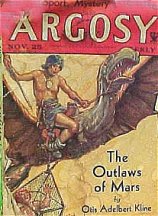
In fact, the back covers of the copies of Swordsman of Mars and
Outlaws
of Mars in my possession spend as much time mentioning Burroughs (above
Kline’s name and in equally big and red letters) and his characters John
Carter and Tarzan as they do talking about Kline or his book.
The flyleafs of both books contain a piece written by the founder of the
Burroughs
Bibliophiles celebrating the resemblance, which is as close to an official
endorsement as a Barsoom novel as they could get. Burroughs
name is mentioned on the front of Outlaws of Mars, while on the
back of ‘Swordsman of Mars’ they mention Burroughs and not Kline’s name.
Really, it's embarrassing. The emphasis on the resemblance
to Burroughs is so pronounced that it's right up to the point of skirting
copyright infringement laws.
Unfortunately for Kline, it didn't last. Which
is a shame, because his Martian books are actually quite good.
But we'll see what the future holds. In the meantime, his works
are well worth searching out.
SWORDSMAN OF MARS
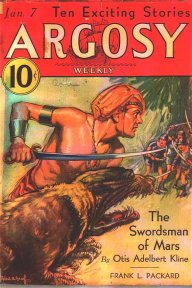 Harry Thorne wakes up, and he's not happy about that. You see,
Harry's been having a hard life, his business failed, he's unemployed and
unemployable, his wife has left him, he's got no family no friends....
So Harry felt that the sensible thing to do was end it all.
Harry Thorne wakes up, and he's not happy about that. You see,
Harry's been having a hard life, his business failed, he's unemployed and
unemployable, his wife has left him, he's got no family no friends....
So Harry felt that the sensible thing to do was end it all.
Which is why he's so surprised and displeased to be waking
up. However, instead of being in a room with padded walls,
as he expects after a failed suicide attempt, Harry finds he's in a normal
bedroom, one with a pretty nice view of a mountain valley.
A Doctor Morgan joins him and makes Harry an offer he cannot refuse:
A trip to Mars.
It seems that the Doctor has made telepathic contact with
a Martian scientist, and together, they've figured out a way to send people
back and forth between the two planets.... Spiritually at least.
Basically, it involves two nearly identical men on each world switching
bodies and minds with each other.
Of course, by now it's 1933 and there was much more skepticism
that Mars was likely uninhabitable and uninhabited than there was in Percival
Lowell's time. Doctor Morgan neatly skips around this problem
by explaining that he's not sending Harry to the Mars of the present day,
but one millions of years in the past. Be that as it may, however,
their connection is real time, because a problem has come up.
It seems that the Doctor's first candidate for astral
body exchange was a Richard Boyd. Unfortunately, Boyd's gone renegade
and has now set out to conquer the planet. So the Doctor wants
to solve this problem by sending Harry Thorne to go put paid to him.
One would think that the simpler thing to do would be to let the local
Martians know that there's a world conquering Earthman on the loose.
After all, the best way to fight a house on fire isn't necessarily to burn
down the garden shed. But what the hell. Harry doesn't
have anything better to do with his life.
Off Harry goes to Mars, exchanging bodies with the awkwardly
named Borgan Thakkor. Which, together with ‘Harry Thorne’ goes
to show you that Kline could have made a living in the modern day coming
up with names for Porn stars.
Unfortunately, things don't go well. While standing
around waiting to be picked up in his new body, Harry is stung by a two-foot
mosquito. He conceals the wound but loses blood.
Shortly thereafter, the man he's been sent to kill shows up and challenges
him to a duel, Harry faints. It's apparently really bad form
to back down from a duel on Mars, especially by fainting, and it's a huge
stain on Harry's honour.
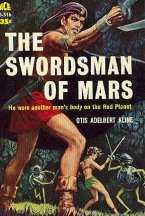 Well,
there's nothing left for Harry but to retire in shame back to his ancestral
homeland, or his bodies ancestral homeland (practically no one knows about
the switch), a great big feudal castle called Thakkor Castle in the middle
of a great big swamp called the Thakkor Marshes. It turns out that
Harry's bodies father has just died, so it's a big to do. Around
this time, he encounters an occasional bodyguard, a feudal liege called
Yirl Du (You'll Do? Another porn name) who will keep on dropping
in and out of the novel by the strangest coincidences, but who helps keep
Harry alive.
Well,
there's nothing left for Harry but to retire in shame back to his ancestral
homeland, or his bodies ancestral homeland (practically no one knows about
the switch), a great big feudal castle called Thakkor Castle in the middle
of a great big swamp called the Thakkor Marshes. It turns out that
Harry's bodies father has just died, so it's a big to do. Around
this time, he encounters an occasional bodyguard, a feudal liege called
Yirl Du (You'll Do? Another porn name) who will keep on dropping
in and out of the novel by the strangest coincidences, but who helps keep
Harry alive.
Unfortunately, flying back on large bird creatures, Harry
and his companions are waylaid by assassins. Harry's mount
is almost killed, and they both wind up in the swamp.
A swamp monster spots Harry and decides he'll make a good meal, but unfortunately,
another swamp monster has the same idea. As the two of them
fight it out, Harry dives, but his situation looks grim. Then
suddenly, he's grabbed by a third swamp monster and carried to a boat where
a beautiful woman awaits him. Her name is Thain, and it turns
out she's a good friend of Harry's body. And this is all sounding
much more pornographic than it is. Turns out the third swamp
monster is a sort of giant reptilian semi-aquatic Martian dog critter.
No mention of how many legs it has.
Thain, it turns out, is a Princess. Her Dad
is Mirador Vil (Vil is roughly equivalent to Jeddak) who used to rule Xancibar,
the local Martian city state/nation whose territories include Harry's bit
of swamp. The trouble is a few years back, a gang of rabble rousers
called the Kamud started up with talk of social reform, and before you
know it, they'd eased Mirador out of the way in the name of liberty, equality,
free elections and state ownership of property. Then they discovered
that some people were more equal than others and that elections weren't
really necessary.... And at some point, Mirador realized he'd better
start hiding out. Which is why he and his daughter are packing
it in the swamp.
But anyway, Thaine takes Harry to her cottage.
There, they're accosted by strange men about five feet tall with
bright yellow skin, mongoloid features, pipe stem arms and legs and weird
armour. After a pitched battle, in which Thaine proves herself
to be quite the swordswoman, all the little yellow men are dead.
The yellow men are Ma Gongi. Thane explains
that they're originally from Earth's Moon. It seems that the Moon
was once a free planet that tried to invade Mars. In the great war,
the Martian civilization and environment were destroyed, the moons of Mars
were created somehow, and the Moon wound up parked around Earth.
It's a good story, but apparently, there's no plot point that stands on
it except that the Ma Gongi once had superweapons and everyone hates them.
Personally, I'm skeptical. Among the Ma Gongi’s sins, as far
as Thaine is concerned, is their habit of eating the little people, who
are her friends.
After spending a theoretically chaste night together,
she takes him out to walking distance of his castle and blows him a kiss.
During the morning, he notices hoarfrost on the leaves, which melt as the
sun warms them. Apparently, it gets freezing cold at nights.
Luck, is not with Harry, however. It seems that
he's been declared dead on account of reports of his fall, they've ritually
scattered his ashes, and the state has seized his property. Harry
gets into a fight with a state trooper, kills him, and the next thing you
know, he's in chains and heading for the big city on charges of impersonating
a dead man, among other things.
Harry winds up in Dukor, the capital city of Xancibar,
in prison, where he gets into a fight with a big bully of a prisoner while
in line for food. The guards, for their amusement, hand them swords
to duel with, and Harry literally carves his name into the bully.
In the process, he makes friends with a guard named Kov Lutas.
Kov Lutas then takes him to see the Dixtar (Dictator,
like you didn't figure that one out) of Xancibar, Irintz Tel, who listens
to his story, pronounces him not guilty and assigns him to guard his daughter,
Neva. And he also assigns Kov Lutas as co-bodyguard, news which
turns Kove Lutas deathly pale.
It seems there's some weird freudian stuff going on.
Neva is a ravishing blonde beauty and her dad is kind of neurotic about
the subject of his daughter. She can't help flirting with the
guards, and he keeps executing them for falling in love with his daughter.
So being assigned to look after the Dixtar’s daughter is a death sentence.
Now, you're thinking, and I'm thinking, this is just twisted
messed up bad news. Harry's already met his Princess.
Nothing good is going to come out of this, and if he's got a brain in his
head, he's going to keep it in his pants and put a padlock on it.
Nothing doing. Harry falls straight away for
her at first sight. The two of them hit it off splendidly.
Later Harry rescues her from an assassination attempt by a Ma Gongi disguised
as a flowerpot (I'm not making this up).
A word about ethnicity. Obviously Kline couldn't
make his Martians red, but he's almost completely silent about their actual
ethnic character. They may be white, particularly since Neva is a
blonde, but then, perhaps blondeness is one of those rare recessives that
an otherwise brunette population throws up once in a while.
The only other races are the human Ma Gongi and the not human little people.
Of course, the situation is bad enough, but it turns out
that Richard Boyd in his Martian guise is engaged to Princess Neva, and
he's Assistant Dixtar, which puts him second in command of the whole state.
Boyd tries to enlist Harry in his plans to conquer Mars, Harry refuses.
There's an ugly confrontation involving Princess Neva and Boyd is tossed
into a garden pool. Then, to make matters worse, the Princess
takes Harry as her date on some ceremonial occasion.
At this point, Harry's Martian friends realize he's not
going to get himself out of this. They reappear, offering an
escape plan. But before Harry can carry through with the plan, he's
lured by Princess Neva into a clinch, and soon that freudian thing is coming
down on Harry. He flees but is captured, just before being
beheaded, Princess Neva, sends him off to the Baridium mines.
Luckily, Harry doesn't spend too much time in the mines.
His friends arrange an escape. Harry and a companion head out, crossing
the desert on ‘desert shoes’ which are sort of crosses between stilts and
pogo sticks, but wicked fun to read about. Out in the desert,
they get chased by a flightless, featherless thirty foot tall predator
bird, but manage to kill it.
Then they make it to Thakkor swamp where Harry is temporarily
separated from his companion. Luckily, Harry sees a bat chasing
a big butterfly and overcome by sympathy kills the bat. It
turns out that the butterfly is actually a three foot tall insect winged
woman with antenna. She gives Harry a ring that will release a smell
that calls for the assistance of her people, and then vanishes before his
eyes. Turns out, she's one of the ‘little people’ that Thaine
has earlier told him about.
Later, Harry wanders into a grove of big caterpillars
and winds up touching a cocoon. There's an unearthly scream, arrows
are suddenly flying past him out of nowhere, and he goes for the ring.
When he rubs it, a whole bunch of three foot insect winged warriors appear.
Seems that they can be invisible whenever they want. After
the misunderstanding is sorted out and everyone has a good laugh, they
take him to Thaine, and thereafter disappear from the plot.
Arriving at her cabin, it turns out that Princess Thane
is jealous of Princess Neva, and proves it by sticking her tongue down
the back of Harry's throat.. But there's heroing to be done, so the
warrior princess joins with Harry and his companion back to his stronghold,
where they discover that the plot has been happening without them.
Richard Boyd has been in cahoots with the Ma-Gongi, who
have rediscovered some of their old super science: Specifically,
their disintegrator ray. Armed with a few disintegrator rays,
Boyd has overthrown the Dixtar, pronounced himself Vil/Dixtar/King and
turned Thakkor castle,
Harry's bodies home, into an involuntary home for
political prisoners.
Of course, since the population is feudally loyal to Harry's
body, he walks in and takes over, rescuing Princess Neva, Mirador Vil,
the Dixtar as well as sundry other Martian friends.
But then Boyd gets wind of it and shows up with his disintegrators,
a small army (including Ma-Gongi) and a big bag full of cheap threats from
the discount shop. It looks like the disintegrator ray is going
to have it. Boyd gives them a day to decide to surrender, which,
all things considered, is pretty nice of him. Harry and pals
decide to go down fighting, but then the Dixtar sends out a note offering
to sneak Boyd's forces into the castle.
Harry gets wind of it, and turns the plot around.
In a reverse trojan horse, while Boyd's men infiltrate the castle, his
men sneak out a hidden passage and grab all the disintegrator guns while
Boyd's taking over the castle. Then there's a brief siege again,
before the Ma-Gongi surrender and hand over Boyd.
Boyd makes a break for it, kidnaps Thaine and heads for
his secret base of operations, with Harry in hot pursuit. There's
some swinging on a chain, Thaine fights a duel, Harry fights a duel, in
the excitement, Boyd loses his head. In the end, it all works out,
when Thaine decides she loves Kov Lutas, and Princess Neva was working
on Harry's side all along.
OUTLAW OF MARS
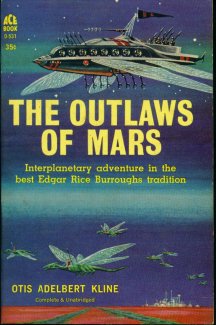 Jerry Morgan, a hot headed young man who's been cashiered out of the army
on a bum rap goes to visit his uncle Doctor Morgan. The Doc
tells his nephew that he's got the deal of a lifetime. It seems that
since sending Harry Thorne to Mars, the Doctor has made contact with Venus
and made two more exchanges over there. And the contact with
Venus has allowed him to amp up the energy, allowing him to physically
teleport or astrally transport whole bodies over. No
more of this body switching. The Doc just needs one more volunteer
for Mars.
Jerry Morgan, a hot headed young man who's been cashiered out of the army
on a bum rap goes to visit his uncle Doctor Morgan. The Doc
tells his nephew that he's got the deal of a lifetime. It seems that
since sending Harry Thorne to Mars, the Doctor has made contact with Venus
and made two more exchanges over there. And the contact with
Venus has allowed him to amp up the energy, allowing him to physically
teleport or astrally transport whole bodies over. No
more of this body switching. The Doc just needs one more volunteer
for Mars.
Of course Jerry agrees to go, and before you know it,
he's on Mars. His first act is to pass out, because he's not used
to the Martian air. Not a good start, and it gets worse.
Unused to the gravity, he accosts a young lady. Then he tries to
make amends by shooting a fierce creature that seems about to attack them.
Unfortunately, the lady is the crown princess Junia, and that creature
was her favourite Dalf. Jerry almost loses his head, but luckily,
the Martian scientist who brought him here intercedes on his behalf.
Jerry has arrived in the city of Raliad, in the Empire
of Kalsifar, which is right next door to Xancibar. We also hear mention
of another Martian state or empire called Nunt, but although it plays a
role in the plot, we don't go there.
The people of Raliad are ethnically mixed.
They started off as a black nation, were conquered by whites who eventually
merged with the population, producing a brown coloured people. Later
on, another white tribe took over, and hasn't quite been absorbed into
the mix yet. The result is that Kalsifar is mostly brown people,
with a few genuine blacks and some whites. It's also a slave-based
society, and in this novel, we actually see real slavery in action.
This may actually be a part of the reason for Kline’s
current obscurity. After all, racial politics are very touchy
at the best of times, and his depiction of a mostly white ruling class
lording it over a mostly black or brown nation is touchy. The
racial politics are incorporated into the novel itself, since one of the
themes is that of the old brown aristocracy and ruling family seeking to
re-establish itself by overthrowing the white rulers. You can
see there's all sorts of political correctness issues.
To be fair to Kline though, it really doesn't come across
that way. His black or brown people are not presented as in
any way inferior to the whites, you can't tell one race from another by
their actions, their mannerism, their diction, etc. Basically,
everyone pretty much speaks the same way, so the language is often colour
blind. Nor does Kline go out of his way to play favourites.
One of Jerry Morgan's chief lieutenants is a black dwarf. On
the other side of the coin, a white prince, Shiev is portrayed as a dissolute
wastrel. The villain of the piece, Thoor Novil, is a brown
man, but his uncle is the white emperor. It's not his skin colour
that makes him a bad guy, it's just the fact that he's a vicious bastard.
Thoor Novil's sister, princess Nisha, has fallen in love with Jerry at
first sight, and wants to marry him, and he's mightily tempted but he's
already fallen for the white princess Junia. Oddly, race doesn't
enter into this triangle at all. So, the bottom line is that
Kline is actually fairly generous and colour blind in his depiction of
a society which nevertheless contains racial tensions.
But still, there is that black/brown/white thing.
The politically correct people do have a point in that racism and racist
stereotyping was endemic during those days, and quite often it is blatant
and blatantly offensive. Hell, I'm old enough to remember Star
Wars: A New Hope and just how blatantly offensive Jar Jar Binks, Watto
and other aliens were. Well, those days aren't as far in the
past as we'd like to think. I suspect Kline was just a little
too upfront, if he'd made his Martians blue and turquoise, there's have
been no problem (just a hint, should a publisher ever re-issue).
But anyway, moving along. Jerry immediately
falls afoul of palace politics. Here's the situation:
Numin Vil (Vil means King) runs the place. His two children
are Junia Sovil (Sovil is Princess) and Sheovil Movil (Movil is Prince),
are directly in line for the throne. But there are another
couple of royals, Thoor Movil and Nesha Sovil, who are the children of
the brother of the King and of the old brown royal line of Kalsifar.
Thoor Movil is third in line for the throne, and he's also the head of
the Kalsifar intelligence service. There's also visiting
Prince, Manith Zovil, from the neighboring state of Nunt, who is visiting.
Six royals and no waiting, always a recipe for intrigue.
Well, immediately Jerry is caught up in it.
Nesha has the hots for his bod. But he's got the hots for Junia who
is far more receptive than she has a right to be. King Numin doesn't
trust Jerry as far as he can throw him. Meanwhile, both Manith
and Thoor are also interested in Junia. Thoor figures that Junia
will consolidate his claim to the throne. Sheovil is just a
weakling and an obnoxious drunk.
To complicate matters, out in the boonies, there is this
guy named Sarkis the Torturer, who claims to be the reincarnation of Sarkis
the Sun God, and a warrior of prophecy destined to restore the brown race
(or at least its aristocracy and royalty) back to power, and who is causing
more and more trouble.
Immediately, Jerry is the victim of an assassination attempt
from Thoor, when a slave gives him poisoned wine. But Jerry realizes
something is up and doesn't drink it. From there, he's invited
to a night of gaming with the Princes. It doesn't go well,
Thoor maneuvers Jerry into a fight with the finest swordsman in the city,
luckily, Jerry is better. But then, he pisses off Sheovil.
He just wants to go sleep it off for the night when he
is commanded to attend Princess Nesha. She's naked in all the
right ways and practically climbs Jerry like a ladder. She promises
to protect him from Thoor. Jerry, the big putz, has his heart
set on the Princess whose dog he shot. Nesha flips out and scratches
him up, but then feels bad and dresses his wounds. It's a well
written passage, genuinely erotic, urgent and sensual, with a sense of
real people and real feelings.
Finally, he gets back to his quarters, when Prince Manith
shows up, covered in someone else's blood. It seems that Sheovil
simply attacked Manith out of the blue. Thoor had basically
pumped up the drunken and belligerent wastrel Prince and sent him out to
toast either Manith or Jerry, either way, Thoor comes out ahead.
Unfortunately for Sheol, Manith kills him. Jerry cleans Manith
up and promises to keep his secret, just as the guards burst in.
Thoor is aching to blame Jerry, but there's no blood and no wound.
Manith goes home to Nunt, and some piece and quiet.
Jerry is in trouble, it's just a matter of time before
Thoor pins it on him. Luckily, he's kidnapped by Nesha who
dyes his skin brown, tarts him up as one of her slaves, and sends him out
of the city to the canal building crew.
Yes, we actually get to see slaves doing hard labour,
and its not fun. We also get to glimpse canals under construction,
so that's pretty cool. And, to top it off, it becomes a minor
plot point later.
Jerry's not on the crew too long though, he winds up kidnapped
by Sarkis the Torturers raiders. He defeats a warrior to win an officership
with Sarkis, but instead, gets sent to the slave execution pits anyway.
Sarkis is a mysterious guy wearing a gold mask, points if you can figure
out who is under the mask in less than three seconds.
Jerry leads an escape that night with a giant white companion,
a fisherman (so not all whites are aristocracy). His escape
bird (they travel on giant birds, two men to a bird) dies, so they wind
up in a Marsh.
Jerry and his pal wander around the desert for a little
while until they come to a battle between two groups of desert tribesmen
in arabic style robes, who are riding around on giant flightless birds.
Jerry and his giant friend watch the battle, a couple of unhorsed birds
head towards them. The giant wants to grab them and vanish.
Jerry, however, sees an opportunity and leads his friend into the battle,
winning it for the tribesmen. He then convinces them that he,
not Sarkis, is the hero of prophecy....
The next couple of chapters are sadly brief, more a summary
of Jerry's rise to desert warlord than an actual depiction.
Jerry gets another friend, a black dwarf, and meanwhile, begins uniting
tribes and freeing slaves left and right. Using hit and run
tactics, and playing it very much like Laurence of Arabia, Jerry grows
in fame and power until he's a rival to Sarkis and a threat to Numin.
Sarkis sends Jerry a challenge to go one on one in the
sight of their respective armies. Jerry senses a trap but goes
for it. Sarkis sends a ringer, but Jerry kills him anyway.
Then, Jerry discovers the trap. Numin's army is coming up from
behind him. Jerry's army will be trapped between the two and
destroyed.
Under cover of night, Jerry uses his forces to attack
Sarkis’ camp and finds it empty. His enemy has disappeared.
Meanwhile, Numin is bearing down, so Jerry spreads his forces and, like
Laurence of Arabia, melts into the desert. Meanwhile, Numin
is in trouble. While he was out of town, Sarkis snuck his army
around back and took over. Then they locked the doors.
Jerry, at this point, leaves his army behind, and goes
into John Carter mode, disguising himself as a brown slave, sneaking into
the occupied city, rescuing Princess Junia and giving Sarkis a good drubbing
(but not, unfortunately, killing him or removing the mask).
Unfortunately, their escape goes wrong when they hit a sandstorm.
Blind and off course, they crash in the desert and have to walk.
At an oasis, Jerry has to deal with a succession of monsters culminating
in a 40 foot tall flightless predator bird.
Eventually, they find their way to a stream which leads
to the Thakkor Marshes. They encounter Thaine's dog and stay
at her cabin in the swamp. They discuss going to castle Thakkor
or Dukar for help, but decide against it. Instead, they head
back towards Raliad, taking the dog with them. There's a slow boat
trip on the canal, with some more intrigue to spice it up, since there's
a reward for Junia’s return. But mostly, this is a ‘getting to know
the Princess’ part of the adventure. After all, there has to be some
demonstration that there's a foundation for their love. The
references to the previous novel are nice, but not overplayed.
Jerry's idea is to return the Princess to her Dad, form
an alliance, crush Sarkis and become a son-in-law. That
doesn't work, since it turns out that Numin has instead allied with Sarkis
against Jerry.
So, Jerry calls his army together, teaches them how to
make bombs, hijacks a bunch of canal building machines and invades Kalsifar,
cutting through the defenders like a chain saw through a bucket of kittens.
Jerry fights his way all the way to the throne room where Sarkis is holding
Junia hostage.
Sarkis demands safe passage, Jerry agrees, but its just
a ruse. Sarkis isn't really interested in living if he can't
be god king, and he just wants to kill Junia and Jerry. Luckily,
Jerry is fast and mean, and slowly cuts Sarkis to pieces. Turns
out he's Prince Thoor, like anyone was surprised at that. Manith
Zovil shows up with his Dad's army from Nunt, and confesses that he was
the one who killed Sheovil. Since he's got an entire army standing
behind him, and he's pals with Jerry, King Numin decides to let bygones
be bygones. Princess Nesha, who's been helping her brother
gets caught, stripped of her royalty and sold into slavery.
Jerry renounces the throne of Kalsifar, returning it to
Numin, he prefers the life of a desert nomad... Obviously, he's totally
gone Laurence of Arabia. Junia, lovestruck, chooses him over
Manith, and they live happily ever after.

 . . .. . .
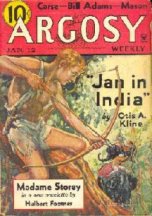
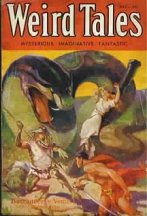
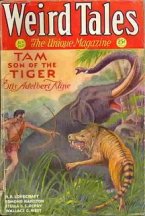
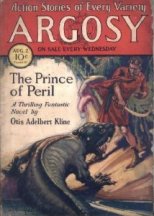
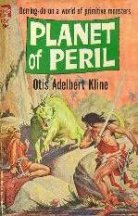
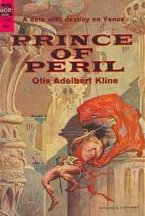
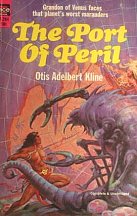














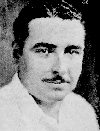 Otis
Adelbert Kline is the third major writer whose Martian stories we will
try to integrate into Barsoom.
Otis
Adelbert Kline is the third major writer whose Martian stories we will
try to integrate into Barsoom.