.
APOCRYPHAL BARSOOMS II
Part 2 of a 16,700-word article
by Den Valdron
Continued
from Part I
CONTENTS
GEORGE GRIFFITHS
1901
HONEYMOON IN SPACE
A
Short and Bloody Trip to Mars
A
Happier Visit to Venus
Where
on Barsoom are we?
ARNOULD GALOPIN
1905
DR. OMEGA, THE FANASTIC ADVENTURES
OF THREE FRENCHMEN ON MARS
HENRI GAYAR
1908
THE WONDROUS ADVENTURES OF
SERGE MYRANDAHL
The Story
Shades
of Barsoom
GUSTAVE
LE ROUGE 1908 & 1909
PRISONER OF THE PLANET MARS
& WAR OF THE VAMPIRES
A
Story Worthy of John Carter!
A Barsoomian
Mirror
CHARLES TORQUET
1906
THE CALL FROM ANOTHER WORLD
JEAN LA HIRE
1911
THE CONQUERERS OF MARS
MARCEL LAURIAN
1912
THE WAR OF DWARVES AND GIANTS
ANONYMOUS
1921
MESSAGE FROM THE PLANET MARS
HENRI ALLORGE
1924
HEAVEN vs. EARTH
LORD DUNSAY
1924
TERCER’S MARTIANS, TRAVEL
TALES OF MR. JORKENS
JEAN DE
LA HIRE 1926
THE GREAT ADVENTURES OF A
BOY SCOUT
STANLEY WEINBAUM
1934
A MARTIAN ODYSSEY
PAUL
CHARLES SEVERIN 1935
HAPPY MARTIANS
GUY SEVERAC 1945
CONQUERERS OF INFINITY
VARLET &
JONQUEL 1921
TITANS OF THE SKY &
THE
AGONY OF EARTH

GEORGE
GRIFFITHS
1901
HONEYMOON IN SPACE
1901 brought George Griffith's serial, Stories of
Other Worlds, also known as Honeymoon
in Space.
A
Short and Bloody Trip to Mars
An aristocrat, Lenox, receives the use of an anti-gravity
ship from a brilliant mysterious scientist, and goes on a tour of
the solar system with his bride and a Scottish butler/handyman.
The trio start with the moon, move on to Mars, visit Venus
and then press on to Jupiter and Saturn. Of course, we're primarily interested
in the trip to Mars. We are not predisposed to a good impression of the
Martians. Before even approaching Mars, Griffiths characters have a fairly
caustic discussion of the probable nature of the Martians:
"I wonder what they're
thinking about us down there.....but still you never know. You see,
their ideas of right and wrong and hospitality and all that sort of thing
might quite different to what we have on the earth. In fact, they
may not be men at all, but just a sort of monster with perhaps a
superhuman intellect, with all sorts of extra-human ideas in it."
That's a pretty clear hint that they were expecting something
along the lines of H.G. Wells' Martian invaders. And indeed, if we
accept that
War of the Worlds and Barsoom are all in the same universe,
they may well be referring to the actual experience of the Martian
invasion only two or three years before. Their spaceship has certainly
been armed to the teeth.
Our protagonists, after first checking out Phobos and
Deimos to ensure there is no life there, descend into the Martian
atmosphere, doing a bit of sightseeing. They're soon confronted by
a fleet of aerial Martian warships which attacks them with poison gas shells.
After rising above the fleet, they destroy a Martian ship and then
descend towards a great city located near the equator. They observe
a park with fairly typical Barsoomian flora:
"By this time the Astronef
was hanging suspended over an enormous square about half the size of Hyde
Park. It was laid out just as a terrestrial park would be in grassland,
flower beds, and avenues, and patches of trees, only the grass was a reddish
yellow, the leaves of the trees were like those of a beech in autumn, and
the flowers were nearly all a deep violet, or a bright emerald green."
A large, but orderly crowd, all dressed identically comes
out to meet them. They are greeted by the Martian leaders. These Martians
are bald, asexual giants, eight or nine feet tall, with no visible
distinctions between sexes.
"That's brains - too much
brains, in fact! These people have lived too long. I daresay they've
ceased to be animals - civilised themselves out of everything in the way
of passions and emotions, and are just purely intellectual beings,
with as much human nature about them as Russian diplomacy or those
things we saw at the bottom of Newton crater. I don't like the look of
them."
And based on that, at the first sign of trouble, they turn
their machine guns on the crowd slaughtering hundred of unarmed people,
kidnapping, interrogating and killing the Martian leader.
As it turns out, they're right. The Martian society of
the giants, they find by interviewing the leader, has evolved to a sterile
intellectual perfection, in which human feelings have been purged. Intellectually
accomplished and telepathic, they are yet sterile and barren. Although
advanced, they are a slaveholding society, and avariciously covet the beauty
of the Earth woman.
Which, I suppose, makes our heroes act of interplanetary
mass murder all right... Or maybe not.
A
Happier Visit to Venus
Perhaps the best case for placing 'Honeymoon in Space'
in Burroughs universe comes not from Mars, but from Venus. Alighting on
some random region of Venus, they encounter a race of Bird people.
Allow me to contrast their observations with Burroughs descriptions:
".... yet they haven't got feathers." "Yes, they have, at least round the
edges of their wings or whatever they are-- "You're quite right. Those
fringes down their legs are feathers, and that's how they fly. They seem
to have four arms." In some respects they had a sufficient resemblance
to human form for them to be taken for winged men and women, while in another
they bore a decided
resemblance to birds. Their bodies and limbs were almost
human in shape, but of slenderer and lighter build; and from the shoulder-blades
and muscles of the back there sprang a pair of wings arching up above their
heads. Between these and the lower arms, and continued from them down the
sides to the ankles, there appeared to be a flexible membrane covered with
a light feathery down, pure white on the inside, but on the back a brilliant
golden yellow, deepening to bronze towards the edges, round which ran a
deep feathery fringe." (Griffith)
"Their chests were large and shaped like those of birds. Their wings, which
consist of a very thin membrane supported on a light framework, are
similar in shape to those of a bat and do not appear adequate to the support
of the apparent weight of the creatures' bodies, but I was to learn later
that this apparent weight is deceptive, since their bones, like the bones
of true birds, are hollow." (Burroughs)
"Below
this and attached to the inner sides of the leg from the knee downward,
was another membrane which reached down to the heels, and it was this which
Redgrave somewhat flippantly alluded to as a tail. Its obvious purpose
was to maintain the longitudinal balance when flying." (Griffith)
"Similar feathers also grow at the lower extremity of the torso in front,
and there is another, quite large bunch just above the buttocks--a
gorgeous tail which they open into a huge pompon when they wish to show
off." (Burroughs)
Zaidie. "And look what funny little faces they've got! Half bird, half
human, and soft, downy feathers instead of hair. I wonder whether they
talk or sing." (Griffiths)
They
had low, receding foreheads, huge, beaklike noses, and undershot jaws;
their eyes were small and close set, their ears flat and slightly pointed.
Feathers grew upon their heads instead of hair. (Burroughs)
"Some
of them stroked her smooth, shining sides with their little hands, which
Zaidie now found had only three fingers and a thumb. Many ages before they
might have been bird's claws, but now they were soft and pink and plump,
utterly strange to work as manual work is understood upon Earth." (Griffith)
". . .
their arms were very long, ending in long-fingered, heavy-nailed hands.
The lower part of the torso was small, the hips narrow, the legs very short
and stocky, ending in three-toed feet equipped with long, curved talons."
(Burroughs)
"Just listen,"
she went on, stopping in the opening of the doorway, "have you ever heard
music like that on earth? I haven't. I suppose it's the way they talk.
I'd give a good deal to be able to understand them. But still, it's very
lovely, isn't it?" Zaidie sang the old plantation song... (Griffith)
"Their
voices were soft and mellow, and their songs were vaguely reminiscent of
Negro spirituals," (Burroughs)
Griffith's Angels of Venus, interestingly, are distinguished
only by sizes, which our travellers take for sexual differentiation. But
it is not at all clear that they are male and female. Burroughs' Wieroo
of Caprona are exclusively male.
Griffith's Angels of Venus are innocents from a Garden
of Eden. Meanwhile, Burroughs Angans are simply shallow and superficial,
lacking deep emotions or convictions.
What we've got here are two radically different takes
on what is essentially the same creatures: Biblical angels transposed to
science fiction. Burroughs makes no secret of it, the name 'Angan' is obviously
a play on 'Angel'. The Wieroo of Caprona consider themselves the servants
of God, and in fact, speaker to God is their highest title. Angels
are next to God and above man in the celestial order, the Wieroo consider
themselves and in the logic of Caprona, are the most highly evolved 'humans.'
Angels are the spirits of the dead gifted with wings, and the Wieroo
look like flying corpses. No question is that it's angels all around!
The big difference is that Griffiths goes for a sweet,
treacly sentimental take on these creatures, as opposed to their 'mass
murder' approach to the Martians. He's completely uncritical, the 'Angels'
are by definition good and innocent, and he looks no further.
Burroughs takes on Angels are more mature and completely
unsentimental. His Wieroo are an unappealing pinnacle of evolution, having
ascended to actual angels, they have left humanity behind. They're
literally flying corpses in Burroughs' descriptions, and that's singularly
unattractive. The Wieroo are so 'perfected' that they've lost all feminine
qualities and therefore are all male. Their perfection leaves them so individualist
that they can barely manage a functioning society.
Meanwhile, Burroughs' Angans are an assault on Angels
from the other direction. Rather than being divine and innocent, the Angans
are merely stupid and shallow. Their innocence, an innocence which Griffiths
celebrates, Burroughs denounces as ignorance. The Angans 'innocence' means
that they have no convictions, they have no love, no loyalty, they blow
in the wind and stand for nothing, they're completely unreliable. They
lack the intellectual foundations for anything meaningful.
It's interesting that Burroughs has taken an idea that
Griffith used here (and that others used elsewhere) and pushed it so hard
and in such a stern direction. There's no sentimentality at all in Burroughs,
his characters deal with the Angans and Wieroo face to face. In contrast,
Griffiths characters do not 'deal' at all with their Angels, they 'ideal'
them. Burroughs has taken practically the same idea and same creature and
put a hard spin on it, in such a way that the Angans and Wieroos are comments
on our own society and illusions.
In the same way, H.G. Wells took the same notion of evolution
of sterile intelligence for Martians that Griffiths worked with, and he
too pushed it hard and in stern directions. Griffith's Martians are
simply assholes, cold enough to justify Zaidie and Lenox's mass murders.
Wells' Martians are actual monsters. But like Burroughs and his angels,
Wells uses his Martians to comment on our own society, on our own conceptions.
Burroughs Angels and Wells Martians are, in some sense, reflections of
our own society, and of our own hypocrisy. On the other hand, Griffith's
Martians and Angels are simply others, they are not reflections at all,
and there is no sense of hypocrisy or irony in dealings with them.
I suppose that this is why we remember and continue to
read Burroughs and Wells, whereas Griffiths has fallen completely out of
sight. I am not, by the way, suggesting that Griffith inspired
any part of Burroughs. Griffith simply drew superficially from the common
well of ideas and inspirations floating around at the time. Burroughs drew
more and drank deeper of that well, and there you have their differences
and commons.
Despite the similarities of Angels and Angans on Venus,
even that comes from the common well. If Mars was a planet of war, Venus
was the planet of love. You expected monsters on Mars and Angels on Venus.
At best, Wells may have read Griffith and took his Angels of Venus as a
sloppy, sentimental slap in the face. If so, then the Angans and Wieroo
are a couple of stiff haymakers in rejoinder.
Be that as it may, it seems that the creatures that Zaidie
and Lenox meet on Venus differ from Burroughs' Angans only in the point
of view of the observers. They're Angans, they're on Amtor, which
would mean that Mars is Barsoom.
We should note that Zaidie and Lenox also visit the surface
of the Moon, where they find the surface devoid of life and filled with
ruins of a vanished civilization, with animal life persisting only in the
deepest valleys. Not too bad a match for the world of the Moon Maid.
Where
on Barsoom are we?
Griffith's Martians share some features with the Barsoomians.
A slaveholding, city-based society, Barsoomian foilage, a universal language
based on telepathy, a warlike nature, aerial fleets that are confined
to the atmosphere, canals, the whole nine yards.
On the other hand, they're bald giants. But so what? The
Therns are just as bald, and compared to the Green Men, they're not gigantic
at all. They're merely taller than the average run of Barsoomians, and
well within the ranges attributed to human giants on Earth.
Psychologically, they're different from most Barsoomians,
mainly in being jerks, but one could imagine an inbred culture on
Barsoom turning out this way. There's even a reasonable geographical cue,
their city is located on the equator, bisected by a canal.
Because I actually have a copy of this story to read,
we can even locate them with some degree of confidence. From five miles
up, our space travellers initially note that they are about 5 miles up
between latitudes 40 and 50. They see what they believe are continental
islands (highlands surrounded by dark mossy areas), and follow this from
the equator a short distance north, until they find a large city at the
tip of a continental peninsula they describe as the 'London' of Mars.
Referring to the topographic Map and using this description,
we can actually find a reasonable location for this london at the border
between green (midland) and yellow (low highland) areas on the map, even
down to the peninsula. They do not, however, visit this city.
Instead, the press on traveling closer to the Equator, and coming across
a pair of cities divided by a large canal or river, definitely a body of
water this time, which they describe as the 'New York' and 'Brooklyn' of
Mars. This is the city of the Giants in which they land.
Now, following the topography map, if we start at the
'London' area, and follow the border between green midlands and yellow
low highlands west, we find at approximately 5 degrees latitude and -15
degrees longitude what appears to be a large river or canal. It works,
check it out for yourself.
Of course, these regions are right in the middle of explored
civilized Barsoom as John Carter knows it. But they never visit 'London'
so it may well be chock full of Red Men. As for the Twin Cities of the
Giants, their race is obviously sociopathic and anti-social, so they probably
don't get much in the way of tourists, while at the same time clearly having
aerial fleets and technology to defend themselves. The conclusion
is that on John Carter's Barsoom, everyone knows about the Twin Cities
of the Giants but no one has a reason to go there.
The big obstacle to this being Barsoom is that as our
heroes approach Mars, they claim to see the dying seas and oceans.
Of these are honeymooners not trained scientists or observers, and their
observations are being made from an altitude of up to hundreds of miles.
By the time they’re around a mere five miles up they’re heading over land.
Anyone who has flown over seas in an airplane can testify that from several
miles up, its not terribly obvious. So its quite more than
likely that they are simply following their own expectations to see seas
and oceans and mistaking dark flat sea bottoms covered with moss
for actual seas. Certainly they've brought their preconceptions and prejudices
to Mars. So, I think we can happily ascribe this to Barsoom.
ARNOULD
GALOPIN
1905
DR. OMEGA, THE FANASTIC ADVENTURES
OF
THREE FRENCHMEN ON MARS
1905 Arnould Galopin - "Le Docteur
Oméga - Aventures Fantastiques de Trois Français dans la
PlanPte Mars" [Dr. Omega - Fantastic Adventures Of Three Frenchmen
On Planet Mars] (Libr. Mondiale).
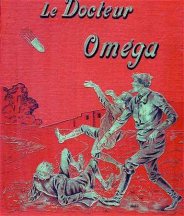 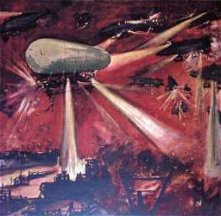 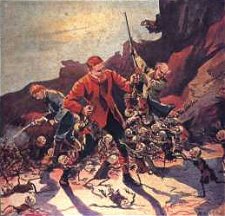
Dr. Omega invents a spacecraft dubbed "Cosmos"
to travel to the Red Planet. The "Cosmos" is a projectile-shaped vehicle
built using an antigravitational substance called "repulsite". It can also
function on land and under water. This is another in a long line
of anti-gravity spaceships.
Mars turns out to be inhabited by some strange beings,
including giant dinosaurian beasts, ugly little dwarfs with death rays,
and bat or insect-winged humanlike creatures. This would be
the fourth appearance of winged Martians. (Wells, Kline and La Faure)
In a revised version, Les Chercheurs d'Inconnu [Seekers
of the Unknown] serialized in 12 issues in 1908-09, Galopin changed the
name of the ship to "Excelsior" and the substance to "stellite".
HENRI GAYAR
1908
THE WONDROUS ADVENTURES OF
SERGE MYRANDAHL
In 1908, we have Henri Gayar writing - "Les
Aventures Merveilleuses de Serge Myrandhal sur la Planete Mars" [The
Wondrous Adventures Of Serge Myrandhal On The Planet Mars] (Laumonier).
The
Story
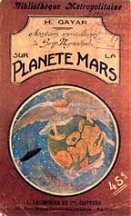 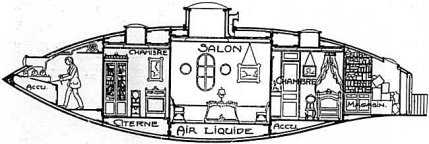 Myrandhal reaches Mars via a spaceship called “Velox” powered
by the psychic energy of a thousand hindu fakirs. Then he disappears.
His fiancé, his best friend and a little dog named Spot (I’m not
making this up), go off in search for him in a second, smaller ship.
Myrandhal reaches Mars via a spaceship called “Velox” powered
by the psychic energy of a thousand hindu fakirs. Then he disappears.
His fiancé, his best friend and a little dog named Spot (I’m not
making this up), go off in search for him in a second, smaller ship.
They discover that the Velox has been trapped in a volcanic
geyser while exploring Mars' northern regions. However, no
sooner do they get it free than Serge’s friend is abducted by Houas, small,
red-furred manlike dwarves who live underground in volcanically heated
caverns. But it turns out they’re fairly benign, and Serge even adopts
one.
The Houas reveal the existence of a higher race on Mars,
beautiful winged humanoids called Zoas, which Serge also referrs to as
"Elohim" (a type of Angel). Myrandahl is all hot to go
there, and since the two psychic powered spaceships convert into boats,
they set out on the Martian sea, sailing around the coast southwards.
They pass through a Sargasso sea, and finally come to the ruins of an underground
city.
They find resting there, in crystal eggs since time immemorial,
the mummies of the Zoa, an exquisite winged race which became more and
more diaphanous and asexual. They became extinct: "They surpassed the allowed
intelligence and reached the apex; they are become scholars as gods; they
did not have any more reason to exist." The group find a few last Zoa resting
on a bed; the group calls them the "Elohim." At the end, when Serge finally
establishes communication with Earth, thanks to a telepathic transmitter,
his friend rushes in shouting, "The Elohim have awoken!"
In a later version, published in 1927 as Les Robinsons
de la Planete Mars [The Robinsons of Planet Mars] under the pseudonym
of "Cyrius", Gayar got rid of the psychic energy and instead used the planetary
force of attraction; he also added German villains to the plot and prophetically
rechristened the rocketships V1 and V2.
Shades
of Barsoom
One of the interesting things here is the Hindu mystic
driven ‘psychic powered ship’. Robert Darvel in Prisoner
of the Planet Mars finds himself launched to Mars by a device powered
by a monastery of Hindu fakirs.
Within Burroughs, a key part of Carson Napier’s skills
was his high development of psychic power in Tibet, which he proposed to
use for communicating between worlds. In the context of this
and other stories, his psychic prowess may have been intended to have more
applications to space travel.
As for the inhabitants of Mars here, we have no trace
of small red-furred dwarf, but then again, Barsoom is a big place, so there’s
no inherent obstacle. Certainly, dwarf races on Mars will appear
several more times in other stories. They may be an isolated
population which Carter has never encountered. Certainly, they
are not nearly as strange as the Kaldanes or the Lothars.
The winged, diaphanous and asexual race of Zoas (Elohim)
on the other hand, we have seen before, or at least, creatures like them.
They are reminiscent of Wells' flying Martians from ‘The Crystal Egg’,
Kline’s butterfly-winged little people from Swordsman of Mars, and
Graffigny and La Faure’s Adventures of a Russian Scientist and Galopin’s
Dr.
Omega. This, therefore is the fifth appearance of such creatures.
This is also the second appearance of dwarflike Martians.
They had previously troubled Dr. Omega in 1905, though these dwarfs are
far more primitive.
Meanwhile, the geography of the story from the brief descriptions,
seems suggestive. The northern volcanic region filled with
caverns is likely Alba Patera, an immense shield volcano at the upper edges
of Tharsis. Serge crosses a sea, which in Barsoomian terms
is almost certainly Gulliver Jone’s Opal Sea, immediately to the east of
Alba Patera in Tempe Terra. Thereafter, he heads south, down
canals or rivers, through the great valley of the Kaolian forests, into
a Sargasso sea which is most likely a section of the Toonolian Marshes,
and then finally into more volcanic caves on the opposite side of the Marshes,
near or at Tharsis southern flank.
GUSTAVE
LE ROUGE
1908 & 1909
PRISONER OF THE PLANET MARS
& WAR OF THE VAMPIRES
A
Story Worthy of John Carter!
There are a couple of novels in 1908 and 1909, which
if they are not set upon Barsoom, perhaps ought to be, French “pulp”
author Gustave LeRouge’s (1867-1938) wrote “Le prisonnier de la planete
Mars [The Prisoner of Planet Mars]” and it’s sequel, “La guerre
des vampires [War of the Vampires]”
 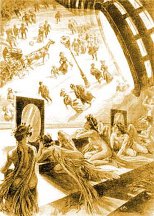 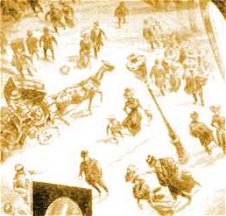
Robert Darvel, a young American scientist/engineer
journeys to Tibet, and the monastery of Chelambrum, where Prince Ardavena
convinces him to construct a psychic energy condenser, an elaborate machine
which would combine the psychic energies of a thousand fakirs or holy men
into a chamber where a person could then use them to communicate with other
planets. LeRouge puts a lot of time and energy into convincing the audience
of the ins and outs of this remarkable machine.
Darvel was previously attempting to communicate with Mars
by writing gigantic letters in the siberian tundra, in the hopes that the
Martians would be able to see it and respond by writing equally gigantic
symbols on their planet's surface. Don't laugh, this was actually a fairly
serious notion by astronomers, around this time.
It is these activities which inspire Ardavena to recruit
Darvel, who immediately turns his attention to the possibilities of psychic
communication. Unfortunately, things do not go well for Robert.
Prince Ardavena turns out to be an evil schemer who wishes to use the device
for his own power.
Meanwhile, the 'energy condenser' turns out to be far
more powerful than Robert figured, when it physically catapults him to
Mars. Essentially, Darvel seems to have stumbled across an artificial means
of duplicating John Carter's 'astral jumps' between the worlds.
Unfortunately, once on Mars, Darvel has no way to get
off, or to communicate. He discovers that Mars is a low marshy region,
inhabited by a primitive and rather unhappy race of small humans. They
wear feathered cloaks, but lack the wherewithal to make fire.
Darvel describes exotic creatures including giant crabs,
giant clams and giant moles, which he speculates have dug Schiapelli's
canals. He also encounters large Octopi with humanoid faces, something
which is vaguely suggestive of Wells' WoW invaders.
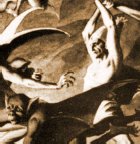 In
addition, there are 'bat winged' 'humanlike' creatures called Erloor, vampiric
creatures who dominate the humans. Like any good hero, Darvel proceeds
to introduce chaos to Mars. He gives the gift of fire to the humans, and
then proceeds to overthrow the Erloor. Sentiment leads him to spare a small
Erloor child who leads him to the cave of the Erloor, where he's taken
prisoner. In
addition, there are 'bat winged' 'humanlike' creatures called Erloor, vampiric
creatures who dominate the humans. Like any good hero, Darvel proceeds
to introduce chaos to Mars. He gives the gift of fire to the humans, and
then proceeds to overthrow the Erloor. Sentiment leads him to spare a small
Erloor child who leads him to the cave of the Erloor, where he's taken
prisoner.
Luckily, he's rescued by the Martians he liberates.
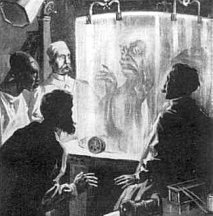
Darvel then discovers another race of 'Erloor', except these are invisible.
They're described as having shimmering dragonfly wings, in drawings, they
have round human heads, small bodies and two boneless tentacular arms ending
in flexible fingers. They keep crystal urns, somewhat reminscent of Wells'
crystal egg. Luckily, Darvel finds an opal helmet which allows him to see
them.
Darvel, goes underground to combat these invisible Erloors
and finds an entire civilization of sleepers in caves under the surface
of the planet, he also discovers an underwater city whose inhabitants remain
completely indifferent to the action on the planet surface.
Darvel discovers that there's a pecking order on Mars.
At the bottom are the primitive savages of the swamp, above them the 'bat'
Erloors, above them the invisible Erloors, and at the top of the heap,
a Giant Brain which claims to rule the planet from its crystal mountain.
It savagely rules the invisible Erloors, who are fairly unhappy about the
whole thing.
 ![Portrait of Robert Darvel [on Mars]](darvelh3.jpg) 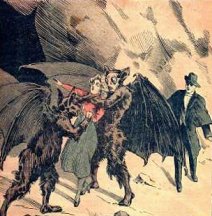
Darvel cuts the Giant Brain's power, interrupting
its rule. But the Brain recovers, uses its Erloor slaves to capture Robert
and sends him back to Earth, using the power of a Volcano to speed him
on his way.
In the next book, Robert discovers that fifteen of the
invisible Erloor have accompanied or preceded him to Earth. They want Robert
to go back to Mars and kill the giant brain so that they can rule the planet,
and threaten his fianc . And so, late in the innings, we've got another
Burroughs trope, the 'lady love' in peril, John Carter would sympathize.
Robert manages to kill all the Erloor except one, which retreats to Tunisia,
to write bitter Erloor poetry.
Although chock full of Burroughs style adventure, called
frantic and even surreal by his critics, Darvel's story frequently bogs
down in Jules Verne style exposition, nowadays called 'technobabble' and
in Wellsian digressions. Still, fans of Gustave LaRouge describe the Robert
Darvel stories as his masterpiece.
Darvel was clearly influenced by both of Wells' Martian
stories, which may account for a resemblance or two. Gustave LaRouge, like
both Wells and Burroughs clearly was doing his homework, his writing shows
familiarity with both Flammarion and Schiaprelli. However, despite preceding
A Princess of Mars by four years, its almost certain that it was
not an influence on Burroughs, since it was written in French and not published
in English or in America. Of course, caution is advised. I've had no opportunity
to read LaRouge, or even a detailed translation. This synopsis is generated
entirely by internet research, with the generous if erratic assistance
of translator programs.
A
Barsoomian Mirror
In Barsoomian terms, Darvel has almost certainly wound
up somewhere in the Toonolian Marshes. The descriptions are
very suggestive of the 1800 mile long swamp which represents the last remnant
of Mars great seas, a largely unexplored and unexplorable region occupied
by races of feathered cloak wearing primitive savages and by remnants of
old Barsoomian life.
A small note on Barsoomian and Martian Geography here.
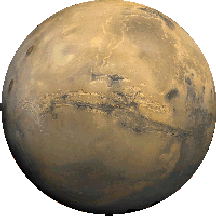
The Toonolian Marshes are most likely identified with Valles Marinis, the
vast canyon complex, which is related to and which begins in the Tharsis
uplift region. Tharsis itself is a geologically volcanically elevated bulge
on the Martian surface, containing several volcanoes. It's also the most
likely spot on the planet for an immense cavern complex. So if we transpose
Darvel to Barsoom, the geography continues to work. He starts off in the
Toonolian Marshes in a 'no man's land', winds up entering cavern complexes
which lead to Tharsis. The Great Brain then uses one of the
Tharsis volcanoes, both for power, and to help get rid of him.
In short, while we cannot pinpoint Darvel’s location precisely,
we can identify with a great deal of certainty, the real areas of Barsoom
or Mars that he would have been in.
Interestingly, Darvel’s journey is almost a mirror image
of Serge Myrandahl’s in Gayer’s story published later in the same year.
Both reach Mars via psychic power from an army of Hindu Fakirs.
Serge starts trapped in a volcanic geyser, and Darvel ends up being shot
out of a volcano. Both begin by encountering primitive races
and seeking out the higher ones. Myrandahl’s primitives, though
ultimately good hearted, are more primitive and less sympathetic than Darvel’s,
while Darvel’s primitives are oppressed and waiting liberation.
Myrandahl travels down into a Sargasso sea that might well be a section
of the Toonolian Marshes. Both find underground caverns and seek
out winged races, though Myrandahl’s are dead and benign while Darvel’s
are very much alive and dangerous. It’s almost as if they very
nearly crossed paths.
Darvel’s two novels featuring flying martian humanoids
are the sixth and seventh occurrences of such creatures. Interestingly,
like Kline’s little people in the ‘Swordsman of Mars’ the higher race of
Erloors has the power of invisibility. Invisibility,
by the way, appears several times in the Barsoom stories, the natives of
Invak and Onvak are invisible, the inhabitants of Thuria master psychic
invisibility, the Jahar scientist Phor Tak invents invisibility as do the
Skeleton Men of Jupiter.
The Erloors are also vampires, but this is consistent
with H.G. Wells’ Martians. His Martian flyers are associated
with the Sarmak invaders who themselves are vampiric, it stands to reason
then that the flyers may be vampiric themselves. The Erloors
also show signs of being a hive society, with two different types of Erloors
and a ruling ‘Great Brain.’ Wells’ Martians, in the two races
living together without conflict may also be hive creatures. Burroughs
Kaldanes are definitely hive creatures.
The Giant Brain is interesting, because philosophically,
this entity seems to reflect the Kaldanes' racial objective, though it's
rather more aggressive. The Kaldanes' hypothetical giant brain will basically
sit and think until the end of time. This one amuses itself by playing
little tin god. In another sense, the Great Brain is a fairly logical
extension of Wells' Martians. His inhuman invaders have reduced themselves
to literally nothing but brain, so it would follow that their society,
and perhaps the related society of the flyers would be ruled by an ultimate
brain.
Also reminiscent of Wells’ Martian stories are the giant
crabs, suggestive of the giant beetles, and the pseudo-human faced octopi,
perhaps another version of the ‘big head’ Sarmak Martians.
The only thing that Darvel misses is the more civilized
Barsoomians. But this story takes place after Wells' Martian invasion,
and after the John Carter/Gulliver Jones crusade against the 'big head'
Martians as chronicled by Effinger and Moore. So the related species of
flyers, and the controlling intelligence is probably keeping a low profile.
Darvel never finds an advanced human Barsoomian city like Phundahl or Toonol
because the Erloors are themselves careful to stay away and restrict all
travel and communication there. Darvel is more interested in fighting the
Erloors than in exploring randomly in the hope of finding a completely
hypothetical (to him) higher Barsoomian culture.
Not even the underwater city is completely out of place,
since it may be at the bottom of the deep canyons of the Toonolian Marshes.
Meanwhile, there are manifest Burroughsian elements. The American
hero, the threat to his fiancee, the endangered Martian humans, the sleeping
cave dwellers. Only the undersea city seems out of place.
Robert Darvel takes his place alongside Frederick Hamilton,
Gullivar Jones, Ulysses Paxton and John Carter, Harry Thorne and Jerry
Morgan as a select group of American adventurers on Mars. One wonders if
they met for poker on Friday nights when Dejah Thoris was out with the
other Princesses.
Of the various Mars stories I've researched, this and
Gustavus Pope’s
Journey to Mars are the two that seem like they
would be fun to read, and would be fun to actually work to integrate directly
into Barsoom. Alas, with the limited information we have available to us,
we can only qualify this as a very intriguing possibility.
CHARLES
TORQUET
1906
THE CALL FROM ANOTHER WORLD
1906 Charles Torquet - "L'Appel d'un
Autre Monde" [The Call From Another World] in Je Sais Tout (15 Nov).
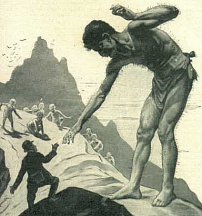 An American occultist who has visited Mars through astral travel reports
the existence of two species of Martians: hairy giants, four times the
size of men, and smaller, wall-crawling cave dwelling dwarfs or pygmies.
An American occultist who has visited Mars through astral travel reports
the existence of two species of Martians: hairy giants, four times the
size of men, and smaller, wall-crawling cave dwelling dwarfs or pygmies.
Giants are not atypical on Barsoom, although these seem
to be human giants. The fact that they are hairy beings suggest
that they may be related to the hairy red men, the Thither people, who
inhabit the edges of Tempe Terra of the Tharsis region.
If so, this would put the giants and pygmies deeper within
Tempe Terra. And this would also place them relatively close
to the cave dwelling dwarfs of Gayer’s tale of Serge Myrandahl.
This, by the way, is the third appearance of dwarfs or pygmies.
JEAN LA
HIRE
1911
THE CONQUERERS OF MARS
1911 Jean de La Hire - "Le Mystére
des XV" [The Mystery Of The XV] in Le Matin, 1911; reprinted as 2 vols.,
Le Secret des XII [The Secret Of The XII] and Les Conquérants
de Mars [The Conquerors Of Mars] (Jaeger, 1954).
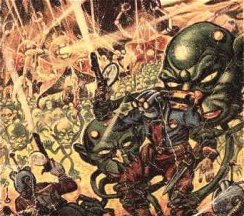 Mad scientist Oxus and his 14 associates travel to Mars on
a radioplane using a series of hertzian relays, planning to colonize the
planet. There, he faces his arch-enemy the Nyctalope, and the Martians
from H.G. Wells'
War of the Worlds.
Mad scientist Oxus and his 14 associates travel to Mars on
a radioplane using a series of hertzian relays, planning to colonize the
planet. There, he faces his arch-enemy the Nyctalope, and the Martians
from H.G. Wells'
War of the Worlds.
If we count Gustave Le Rouge’s Prisoner of Mars,
this is the third appearance of H.G. Wells' Sarmak Martians.
Jean de La Hire will write a sort of sequel bringing back
the H.G. Wells Martians once again as, improbably enough, a Boy scout adventure.
MARCEL
LAURIAN
1912
THE WAR OF DWARVES AND GIANTS
1912 Marcel Laurian - "L'Étrange
Aventure de M. Narcisse Barbidon" [The Strange Adventure of Narcisse
Barbidon] Reprinted as Les Hommes-Singes [The Ape-Men] and La
Guerre des Nains et des Géants [The War of the Dwarves and the
Giants] (1919).
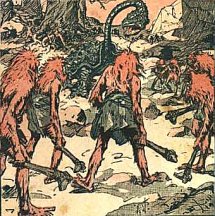 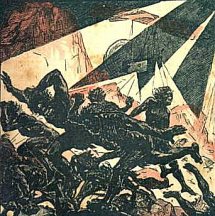
Like Verne's Hector Servadac, Prof. Barbidon, his daughter,
nephew and man-servant are carried to Mars on a chunk of Peru, after a
meteorite crashed into the Earth. There, they encounter the
technologically-advanced and telepathic dwarves of the wondrous city of
Lankmirakar. They help them in their battle against the luminous electro-magnetic
beings of Pomernia. They discover prehistoric monsters, black-skinned and
red-skinned anthropoids, winged sphinxes, mermaids, and cyclops. They meet
Nostradamus from Earth, and a Persian sorcerer called Mahousky-Khan. They
eventually return to Earth on a chunk of electrically-powered mountain,
and land safely in the Sahara.
In a Barsoomian context, this seems like an awfully long
shot. But the black and red skinned humanoids or ape-men are
reminiscent of Burroughs black and red skinned races. They’re also
reminiscent of the red cave-dwarfs that Serge Myrandahl meets in Gayer’s
story.
Dwarfs, although not seen in Burroughs Barsoom, have been
encountered now several times in other stories. This is their
fourth appearance.
The winged sphinx and cyclops seem like creatures of classical
greek mythology. But on the other hand, a sphinx is a winged creature
with a humanlike head and nonhuman body, so in that sense, it resembles
some of the species of winged flyers we meet. If so, this would
be an eighth appearance for such creatures.
And its worth noting that John Carter himself encounters
a race of cyclopes, one eyed beings, in the Masena race of Thuria.
As for Nostradamus and Mahousky-Khan, it’s well established
that humans from Earth are able to psychically project or incarnate upon
Mars. We’ve seen that in Flammarion, Burroughs, LaRouge and Kline.
So, without knowing more detail of the novel, we might
indeed have Barsoom once again. The presence of Dwarves probably
puts us on or around the northern part of the Martian Tharsis region.
The presence of a winged flyer is also suggestive of Tharsis.
But no further detailed identification of location is possible.
ANONYMOUS
1921
MESSAGE FROM THE PLANET MARS
1921 Anonymous - Fascinax No. 13.
"Un Message de la Planete Mars" (Message from Planet Mars).
A French pulp Super-hero named Fascinax defeats bat-men-like
Martians who have travelled to Earth in a rocketship and plan to invade
-- however, this may be an elaborate fake scheme by human villains.
For the record, this amounts to the ninth story which
features winged Martians.
HENRI ALLORGE
1924
HEAVEN vs. EARTH
1924 Henri Allorge - "Ciel contre Terre"
[Heaven
vs. Earth] (Hachette).
Earth is again attacked by vampire-like Martians who are
described in reviews and notes as looking like Le Rouge's Erloors from
"Le Prisonnier de la Planete Mars". These Martians, however, are defeated
by alcohol.
 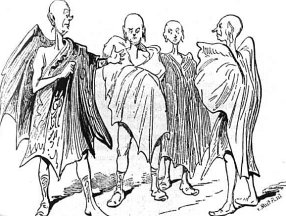 Well, with the little we’ve got to go on there isn’t much
to say. But we do appear to have the tenth appearance
of ‘bat-winged’ or ‘insect winged’ ‘humanlike’ flying Martians.
LeRouge’s particular concept of the Erloors proved influential, since several
stories copied his creatures closely.
Well, with the little we’ve got to go on there isn’t much
to say. But we do appear to have the tenth appearance
of ‘bat-winged’ or ‘insect winged’ ‘humanlike’ flying Martians.
LeRouge’s particular concept of the Erloors proved influential, since several
stories copied his creatures closely.
LORD DUNSAY
1924
TERCER’S MARTIANS, TRAVEL
TALES OF MR. JORKENS
 In 1924, Lord Dunsany, writing his Travel Tales of Mr. Jorkens
describes a traveller named Tercet who, upon flying in an airplane to Mars,
encounters humans kept like poultry in wire cages. He kills
one of their inhuman captors, a creature reminiscent of Wells’ ‘big head’
Martian invaders. Tercer then returns to his plane and flies
off. But years later, as related in Mr. Jorkens Returns To Africa,
he receives a challenge from the Martians, loads up with weapons, and takes
off. The sole message that comes back from him is "Victory."
In 1924, Lord Dunsany, writing his Travel Tales of Mr. Jorkens
describes a traveller named Tercet who, upon flying in an airplane to Mars,
encounters humans kept like poultry in wire cages. He kills
one of their inhuman captors, a creature reminiscent of Wells’ ‘big head’
Martian invaders. Tercer then returns to his plane and flies
off. But years later, as related in Mr. Jorkens Returns To Africa,
he receives a challenge from the Martians, loads up with weapons, and takes
off. The sole message that comes back from him is "Victory."
Well, there are slight overtones of both Wells’ and Burroughs,
and this is written late enough that it might well be a pastiche and the
resemblances may be deliberate. However, we’d have a bit of
trouble incorporating this into Barsoom.... An airplane?
Really now. And to make matters worse, on the way back from
Mars in his airplane, Tercer makes a stop on an asteroid and encounters
elephants the size of mice.
Still, it's Barsoomian in that we have a human race, as
well as the fourth appearance of a Wells’ Sarmak type Martian.
JEAN
DE LA HIRE
1926
THE GREAT ADVENTURES OF A
BOY SCOUT
1926 - Jean de La Hire - "Les Grandes Aventures
d'un Boy Scout" [The Great Adventures of a Scout] (Ferenczi) (illustrations
by Geeorges Vallée). 30-episode magazine serial.
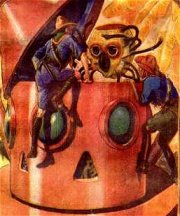 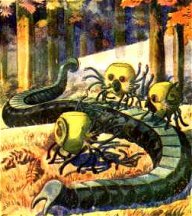
The hero, Franc-Hardi, accompanied by eleven boy scouts and
five girls, explores the solar system in Engineer Korrid's (who appeared
in the Nyctalope saga) radioplane.
On Mars, they meet men from Earth who came to the Red
Planet in the 18th century. Then they meet the native Martians,
who happen to be bear sized round creatures, essentially heads, with large
eyes, parrotlike beaks and two clusters of eight tentacles.
Essentially, Wells' Martians.
The artists depictions of these creatures make them look
pretty cute, actually. But we can still count this as the fifth
appearance of an H.G. Wells’ ‘Sarmak’ type Martian.
STANLEY
WEINBAUM
1934
A MARTIAN ODYSSEY
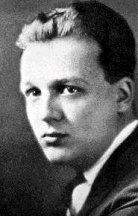 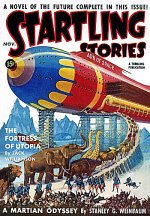
1934 - Stanley G. Weinbaum, A Martian Odyssey,
Wonder Stories, July & Startling Stories, November ~ 1st hardcover
ed. New York: Fantasy Press (1949).
Stanley
Weinbaum’s story takes us back to Lowell’s Mars, a dying world, mostly
desert, empty but for dunes and arrow straight canals, and yet, with a
breathable atmosphere. Weinbaum’s Earthmen are explorers in
the 21st century, charting the world in its twilight, when one of the explorers
meets an alien intelligence.
That intelligence is Trrrweerrlll P-p-p-proot., called
Tweel for short in the story. Tweel is not a humanoid creature.
Instead, the first description is ‘That freak ostrich’
“The martian wasn’t a bird really, it wasn’t even birdlike, except at first
glance. It had a beak all right, and a few feathery appendages,
but the eighteen inch beak wasn’t really a beak. It was somewhat
flexible. I could see the tip bend slowly from side to side.
It was almost like a cross between a beak and a trunk. It had four
toed feet, short arms and four fingered things - hands you’d have to call
them. A little roundish body, and a long neck ending in a tiny
head - and that beak. It stood an inch or so taller than I,” relates
Jarvis,
its temporary companion.
Tweel is an extraordinary leaper, able to jump dozens
of feet straight up in the air, flip around and come back down like a missile.
He has desert adaptations, feathery structures that cover his nostrils
and eyes during a sandstorm.
Tweel is intelligent. He has tools, sophisticated
equipment, he can communicate the difference between carbon and silicon
based life. However, his intelligence seems to have basic differences
from human. Communication is difficult and always imperfect,
there is always a point at which it breaks down.
Burroughs never wrote anything like Tweel, of course.
But on the other hand, Otis Adelbert Kline included no less than three
different breeds of flightless bird in his area of Mars. The
first to be seen is the Koree a 30 foot tall ostrich like desert predator
in Swordsman of Mars. The next is the Rodal, a ten foot
tall bird, five feet at the shoulder, which appears to be a riding mount
for desert nomads. Finally, there is the Koroo, a forty foot tall
oasis hunter in Outlaw of Mars.
In comparison to these monsters, Tweel is a runt.
But still, all four birds seem to follow the same general body plan of
a distorted ostrich. It is not hard to see them as being related.
In the articles on Kline, I speculate that the Elyssium plateau was, during
Mars wet period, was a large permanent madagascar sized Island in the polar
sea. Perpetually isolated from the mainland, it, like Madagascar
and New Zealand were colonized by birds who eventually became flightless
giants. The isolated line of evolution that leads to the Koree,
Koroo and Rodal might well produce a Tweel.
Kline’s Martian books came out in 1933 and Weinbaum’s
story followed in 1934. So it’s unlikely that Kline was inspired
by Weinbaum or vice versa. More likely, the giant flightless birds
of each man were independent inventions.
Larry Niven, in his book Rainbow Mars includes
Tweel’s race, along with Wells’ invaders, Burroughs' red men, green men
and kaldanes, and Lewis’ sorns, hrossa and pfifltrigii. So,
who am I to argue with the great Larry Niven? Somewhere on
Barsoom, perhaps around the lost sea of Kline’s areas, a race of strange
intelligent birds endures.
PAUL
CHARLES SEVERIN
1935
HAPPY MARTIANS
1935 Paul Charles Severin - "Heureux
Martien" [Happy Martians] (Livres Nouveaux).
Paul de Kervan travels to Mars on the "Épervier"
(a propeller plane!). He finds a society ruled by an avaricious Queen.
Soon a revolution begins. Kervan marries a beautiful Martian girl.
An Airplane yet again? One wonders if Mr. Kervan
knew Mr. Tercer. This is potentially Barsoomian only for the
‘human’ Martians.
GUY SEVERAC
1945
CONQUERERS OF INFINITY
1945 Guy Séverac - "Les Conquérants
de l'Infini" [Conquerors of Infinity] (La Jeunesse).
Young scientist Henri Nissac and girl-friend Georgina
Smolen travel to Mars in a rocket. Martians are technologically advanced,
peaceful, tentacled, spherical beings, with great mental powers. Returning
to Earth, they crash in the desert and forget their journey.
The description of tentacled spherical beings sounds like
yet another iteration of Wells Sarmak Martians, the sixth.
MARS VERSUS JUPITER?
A COUPLE OF ODDITIES:
VARLET
& JONQUEL
1921
TITANS OF THE SKY &
THE
AGONY OF EARTH
1921 Théo Varlet &
Octave Jonquel - "Les Titans du Ciel" [The Titans of the Sky] (1921)
and "L'Agonie de la Terre" [The Agony of Earth] (1922) (MalfPre).
A sequel to Wells' War of the Worlds. The Jovians
intervene to help Earth after another Martian attack on Earth, this time
using rockets filled with deadly gases.
Earth is almost completely destroyed by the Martians.
The Soviets take over. Meanwhile, the Jovians punish Mars by using focused
solar energy to destroy it. However, the Martian Overlords (who look
like Le Rouge's Erloors from "Le Prisonnier de la Planete Mars")
escape to Earth.
Our planet is then revealed as the place where Martian
souls reincarnate. Souls are alleged to travel inward from Mars, to the
Earth, to Venus, to Mercury, to end up being one with the Sun. This explains
the original invasion.
In Volume Two, the destruction of Mars has released millions
of Martian souls ready to take over human bodies. The heroes fight the
body-snatching Martians, this time with the help of the Venusians.
This is definitely not Barsoom, although it has enough
affinities to make us stop and take a second look. In some ways,
this is some fevered Wells/Burroughs melange.
The notion of souls of Martians reincarnating on Earth
is obviously a clever inversion of Flammarion’s notion of Earth souls reincarnating
on Mars. Particularly significant, since ‘reincarnation’ or
astral teleportation plays such a critical role in Burroughs universe.
Meanwhile, both sets of H.G. Wells’ Martians make an appearance
here, including the tentacled big heads or Sarmaks, showing up for the
seventh time, and the winged flyers who resemble Erloors tenth occurrence.
Sadly, this cannot take place in Burroughs Universe because
there is no subsequent invasion from Mars. Instead, Earth fights
a savage world war off and on from 1914 to 1967 which causes quite enough
trouble, thank you.
1931 brought a separate unrelated novel: Pierre
Lavaur - "La ConquLte de la Terre" [The Conquest of Earth] (Tallandier).
The Jupiterians are at war with Mars and kidnap Astronomer Edgar Rogotha.
Colonel Mac Brody helps defeat an invasion.
The war with Jupiter is reminiscent of both Burroughs'
Skeleton Men of Jupiter in which Jupiter plots an invasion of Mars,
and the Titans of the Sky, in which Jupiter interferes with a Martian
invasion of Earth.
Why Jupiter? Obviously, it’s the next planet
out after Mars, duh!
|

 . . .. . .