It was a favourite even in the early days of
telescopes, for the 17th century astronomers. Fontana made
the first sketch of the red planet. Huyghens in 1666 determined the
length of the Martian day, followed in the same year by Cassini’s description
of the polar caps.
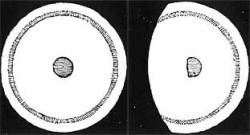
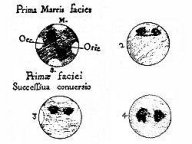
Fontana sketches and Cassini's Mars
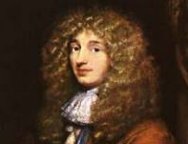
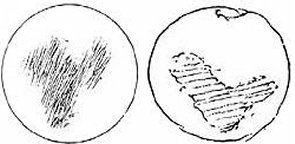
Huygen's Mars
Oddly red in colour, astronomers could train their telescopes
upon it and make out actual surface features, and more than that, they
could observe changes, marking the progress of seasons.
They could discern the white polar caps and watch them swell and retreat
over the Martian year good evidence there for ice of some sort, almost
certainly water ice. They could occasionally spot clouds,
and see when dust storms obscured the entire surface of the planet, clear
evidence of a reasonable atmosphere.
They could make out light and dark features that seemed
remarkably consistent, and yet, changed slightly over time and with seasons.
The equatorial region seemed the source of a dark thick, dark erratic band.
The upper hemisphere was somewhat light, the southern hemisphere somewhat
dark. It was speculated at first that the upper hemisphere
was a continent, the darker areas were seas.
Later, around 1890 evidence of water waned, perspectives
changed and the notion arose that the light areas were desert, and the
dark areas the marshy remnants of dried seas. The conception
of the Martian atmosphere changed, due to the infrequency of clouds and
dust storms, the air was thought to be relatively thin.
Notwithstanding this interpretation, it is remarkable
how the maps made were quite close to telescope photographs, and even of
the maps drawn from the space probes. Genuine features, including
Syrtis, Hellas, Argyre and the poles were accurately described.
Over centuries, astronomers proved themselves by giving us reasonably accurate
broad descriptions of the planet. (Some degree of caution must be
used with maps of this era, since due to astronomical convention, they
were done upside down, with north and south reversed) Where they
fell off, was with fine details, like the canals....
The earliest sketches or drawings of Mars which appear
to show canals actually date back to 1840, and appear again independently
in 1864, though they were not called canals then.
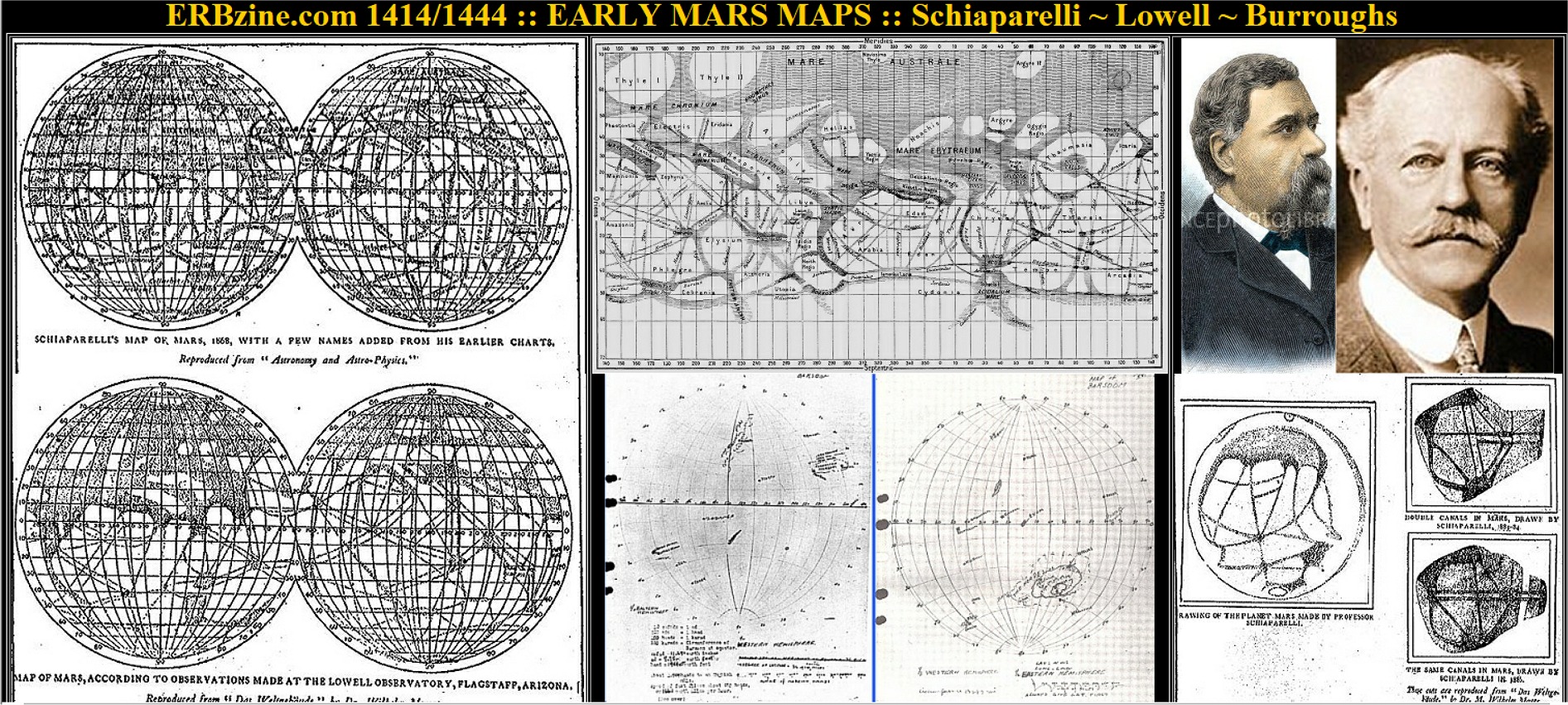
Schiaparelli was the first astronomer to identify the
illusory features as Canals, in 1877. Producing the first accurate
(for its time) detailed map of mars. This was also the
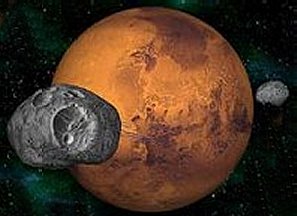
year that Mars two moons, Phobos and Deimos were discovered.
So there was a kind of ‘plausibility by association.’ If one
new feature (the moons) were accepted, why not the other (the canals).
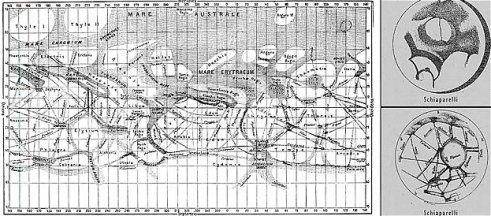
Schiaparelli's
Mars 1888
Schiaparelli repeated and elaborated on his observations
two years later in another close approach in 1879, eventually identifying
some sixty distinct canal like structures. He called them ‘Canali’
or channels, which did not necessarily mean they were products of intelligent
life.
But on the other hand, he refused to rule out intelligence
and failed to propose any other explanation. He felt that they
might be a system for distributing water from melting polar snows to other
parts of the planet, a theory which naturally inspires thoughts of intelligent
origin. In other words, Schiaparelli was being coy, describing
structures which were highly suspicious and suggestive of life and intelligence,
but at the same time, reluctant to speculate as to their origins, refusing
to rule intelligence out, or to embrace it.
 Unfortunately,
for the next several years, no one else saw canals on Mars.
The next observations were nine years later, by a pair of Astronomers.
But indeed, they were observed only infrequently after that.
Lowell writes in 1895 that the number of people who had seen and described
the canals could be counted on one hand. The astronomy community
capable of making those observations was small, but not that small.
Unfortunately,
for the next several years, no one else saw canals on Mars.
The next observations were nine years later, by a pair of Astronomers.
But indeed, they were observed only infrequently after that.
Lowell writes in 1895 that the number of people who had seen and described
the canals could be counted on one hand. The astronomy community
capable of making those observations was small, but not that small.
This was also an age of canals on Earth. The Suez
Canal had been built in 1860, and the French had begun an effort at central
American canal to unite the Pacific and the Atlantic. Canals,
even fairly large ones had been built in the United States and Canada,
France and England, so they were well known, but the new giant Panama and
Suez canals were literally an order of magnitude greater, transforming
continents. The notion that there were similar works
on Mars came naturally.
Nevertheless, the fact that they were being spotted independently
by a handful of observers, the fact that they preceded their official discoverer
by a generation, and the fact that they were quite consistent among those
who observed them, suggested that there was actually something real there,
so the scientific and the popular communities generally accepted their
existence. Even the failure of these canals to appear in most
photographs was not damning, particularly as at least a few photographs
under perfect conditions, seemed to show some of them.
Part of this acceptance lay in the fact that observation
conditions were often imperfect, due to inclination, Mars was best observed
from the southern hemisphere. The power of telescopes, and
the weather conditions and local conditions of observatories varied widely.
So no one took it all that seriously if features so subtle were not universally
recognized.
Another part of this was that Mars orbits and Earth’s
orbits were quite different. Close approaches varied from fifty
million miles to an optimum of about thirty five million. Only about
every several years were the planet’s lined up at closest approaches.
Following Schiaparelli, the best oppositions occurred in 1892 and 1894,
1907 and 1909 and 1924 and 1926.
The first two sets of dates are particularly critical.
1892 and 1894 were the crucial times during which Percival
Lowell made his critical observations and wrote his popular book
on Mars, a book that Edgar Rice Burroughs undoubtedly read and was
influenced by. It was also likely this book and these same
series of observations
that brought Mars into prominence and inspired both Arnold’s and Wells
respective books about Martians. Meanwhile, 1907 and 1909 would have
put Mars prominently in the news once again, only a few years before Burroughs
wrote A Princess of
Mars.
The astronomer, Pickering, in 1892, came up with the suggestion
that canals were not truly watercourses. They were too thick for
that, the smallest were estimated to be ten to twenty miles in width, the
largest were 150, rather. He thought instead they were bands
of vegetation, perhaps fed by watercourses. But the actual canals
or Martian rivers were too small to see, we were observing the vegetation
that grew up around them. This neatly explained why some different
numbers of canals were seen... Some simply would not be in season
at some times. Several other noteable astronomers wrote of
Mars canals, including Kayser, Proctor, Green, Dreyer and Flammarion.
Meanwhile, there was a picture being built up of Mars.
There was a growing consensus in the 1892-1894 period that its small size
and lack of reflections indicated that there were no major areas of deep
water on the planet. The lighter area of the north, and in
the south, were taken as evidence of continental structure, perhaps worn
smooth and reduced to desert. The dark central band which waxed and
waned with the seasons was assumed to be a dry sea bed. Vegetation
living off residual moisture in the sea bed was considered a likely explanation
for the seasonal changes.
Mars, astronomers decided, was a dry planet having lost
most of its waters to space or absorbed by the planet’s chemical processes.
The lack of clouds and the difficulty in observing signs of atmosphere
lead to the belief in a very thin and perhaps slowly vanishing atmosphere,
perhaps comparable to the mountain regions of Earth. It was
believed to be a very old world.
In short, this was hardly different from the Barsoom that
Burroughs described. He was building his world based on the
state of the scientific art of his time, and indeed, that persisted for
decades after. And for that matter, this was the science
picture of Mars that anchored both Wells' War
of the Worlds and Arnold’s Gulliver
Jones of Mars. So with respect to the Arnold/Burroughs
thing, at least one source of similarity was that they were both drawing
on the same picture of Mars present and past.
These theories made Mars a world unlike any other in the
solar system. It was a world with a past. The moon had always
been a rock, we couldn’t tell what was under Venus clouds, and the other
planets seemed stolid and timeless. But Mars had a past, a
past that included continents and oceans and thick air and possibly life.
It had been a young world like Earth. And now it was an old world,
the seas dried up, the continents worn away, endless encroaching deserts
and life clinging on in drying sea beds. It was a vision both
romantic and evocative, disturbing in its hints of our own fate, tragic
or disquieting to contemplate life and intelligence trapped on that dying
world. Mars, shared with Earth a uniquely metaphysical
distinction of being world with history written upon it.
Canals really came into their own with Percival Lowell,
who built on Schiaparelli’s work. Through painstaking observations,
Lowell built up a detailed
map, identifying over 180 canals (subsequent astronomers
eventually charted over 500) including most of those seen by Schiaparelli.
His observations, while more extensive, were in general agreement with
his predecessors. Lowell formed a theory of a dying world,
its seas dried up, its continents worn away. The canals, he
concluded, were artificial structures created by the inhabitants of Mars
in order to draw moisture from the poles, or from the remnants of the Martian
seas.
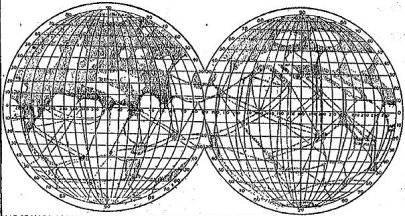
Lowell's
Mars
The canals, as described by Lowell, Schiaparelli and others,
were peculiar features indeed. For the most part they were
absolutely straight, adjusting only for curvature of the planet.
Their lengths varied from 250 miles to 4000 miles. They often joined
one another, like spokes in the hub of a wheel, though angles varied.
Their thickness was uniform along their length, varying from 20 mile thick
small canals, to giants 140 miles thick. There were double
canals, structures running parallel to each other. There seemed to
be triangular structures joining canals, similar to river deltas.
Their ‘oasis’ or joining points defied explanation.
In short, Lowell’s theory that they were the work of intelligent
beings was regarded as wild by other astronomers, not because it flew in
the face of data. In fact, the work of intelligence was quite
a good explanation for what Lowell and others were recording. But
the conservative minds of the scientific community simply argued that there
might be other explanations for these structures.... Like vegetation.
Their problem with Lowell was that they merely considered him premature.
Nevertheless, Lowell’s speculative book was read widely,
and almost certainly by Burroughs himself. Lowell’s romantic
depiction of a dying civilization, struggling desperately to survive by
building a network of canals, finds its way into Burroughs.
A link to the book, now available on the net can be found at the Bibliomania
site:
Indeed, at the conclusion of his discussions, Lowell dwells
at length on the nature of the Martians. The passages are worth
quoting here,
for the echoes of John Carter’s own experiences:
“We may, perhaps, in conclusion,
consider for a moment how different in its details existence on Mars must
be from existence on the Earth. If we were transported to Mars, we should
be pleasingly surprised to find all our manual labor suddenly lightened
threefold. But, indirectly, there might result a yet greater gain to our
capabilities; for if Nature chose she could afford there to build her inhabitants
on three times the scale she does on Earth without their ever finding it
out except by interplanetary comparison. Let us see how. As we all know,
a large man is more unwieldy than a small one. An elephant refuses to hop
like a flea; not because he considers the act undignified, but simply because
he cannot bring it about. If we could, we should all jump straight across
the street, instead of painfully paddling through the mud. Our inability
to do so depends upon the size of the Earth, not upon what it at first
seems to depend, on the size of the street.
As the reader must also note, the
deduction refers to the possibility, not to the probability, of such giants;
the calculation being introduced simply to show how different from us any
Martians may be, not how different they are.
Mars being thus old himself, we
know that evolution on his surface must be similarly advanced. This only
informs us of its condition relative to the planet's capabilities. Of its
actual state our data are not definite enough to furnish much deduction.
But from the fact that our own development has been comparatively a recent
thing, and that a long time would be needed to bring even Mars to his present
geological condition, we may judge any life he may support to be not only
relatively, but really older than our own.
Quite possibly, such Martian folk
are possessed of inventions of which we have not dreamed, and with them
electrophones and kinetoscopes are things of a bygone past, preserved with
veneration in museums as relics of the clumsy contrivances of the simple
childhood of the race. Certainly what we see hints at the existence of
beings who are in advance of, not behind us, in the journey of life.
To talk of Martian beings is not
to mean Martian men. Just as the probabilities point to the one, so do
they point away from the other. Even on this Earth man is of the nature
of an accident. He is the survival of by no means the highest physical
organism. He is not even a high form of mammal. Mind has been his making.
For aught we can see, some lizard or batrachian might just as well have
popped into his place early in the race, and been now the dominant creature
of this Earth. Under different physical conditions, he would have been
certain to do so. Amid the surroundings that exist on Mars, surroundings
so different from our own, we may be practically sure other organisms have
been evolved of which we have no cognizance. What manner of beings they
may be we lack the data even to conceive.”
And there we have it folks. John Carter’s astonishing
leaps. The detailed portrait of an ancient world with an ancient
civilization technically more advanced than our own. And of
course, the glimmers of the Green Men appear in speculations of Martian
giants three times our size, of nonhuman nature. The outlines
of Barsoom can be found in Lowell.
The canals on Mars were a done deal. I have
a book on astronomy, originally published in 1922, reprinted in 1939, which,
despite noting that the canals were still controversial and that some astronomers
disputed their very existence, states that “the canals, as far as
they are considered to be line like markings, have been completely verified.”