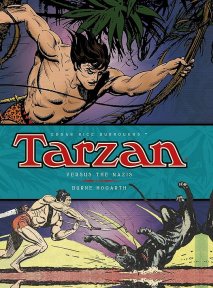
August 6: On this day in 1944, the Burne Hogarth Tarzan Sunday story arc, Tarzan Against the Nazis,
began. It ran for thirty-two Sundays and concluded on March 11, 1945,
not quite two months before Germany’s unconditional surrender. The
story arc has been reproduced in two sets of reproductions of Hogarth’s
Sunday pages. NBM, Tarzan in Color Vol. 13 and Titan Book’s Complete
Burne Hogarth Library volume titled “Tarzan Verus the Nazis.”
Interestingly, the daily comic strip by Rex Maxon titled Tarzan Against
Hitler ran about a year earlier.
The ape kicked the dead Hauptsturmführer. “Didn’t work out well for this one, did it?”
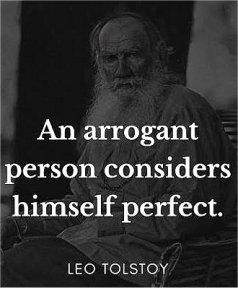
HUMILITY IS FOR THE INCOMPETENT

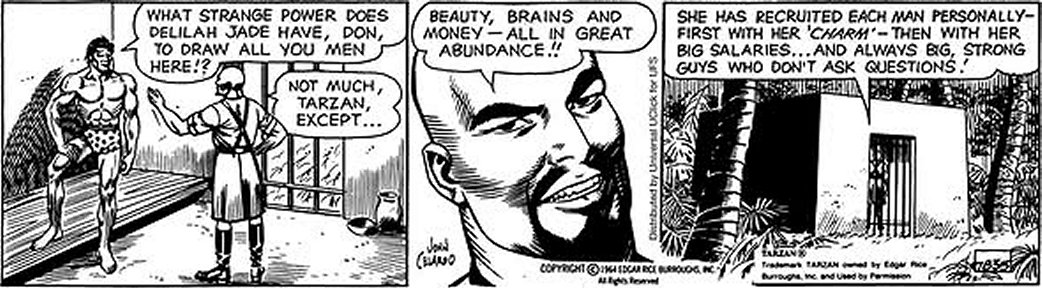
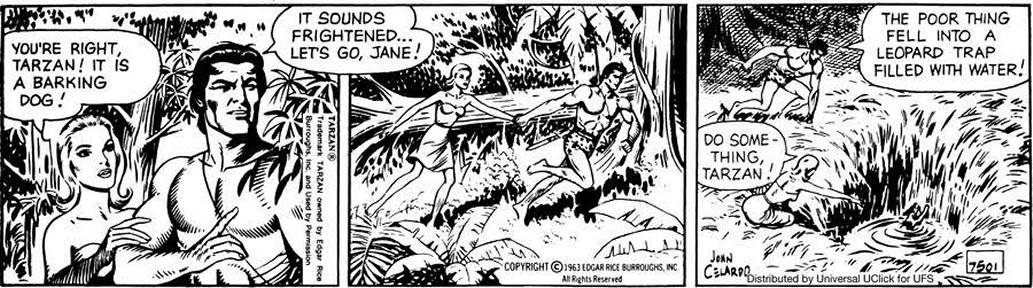
August 7: On this day in 1962, the John Celardo scripted and illustrated Tarzan daily newspaper comic story arc, “Tarzan and the Queen of Diamonds,” began. The story ran for eighty-two episodes.
The
story opens with Tarzan asking what powers Delilah Jade has to cause
men to serve her. The man replied, “Not much, Tarzan, except beauty,
brains, and money – all in great abundance.” The seductive Jade appears
a few episodes later and she’s supremely over confident that she’s
smarter, more alluring, and more powerful than any other person.
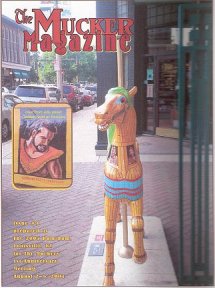
By a strange coincidence, I was researching some old Edgar Rice Burroughs themed fanzines, and articles in one issue of the “Mucker Magazine”
and two other magazines stood out. All three were written by the same
person, possibly the poorest selling author alive. In all three
articles, he extols his skill and magnificence while condemning the
rest of us poor mortals for not acknowledging his manifest superiority
and buying multiple copies of his books. He and Delilah Jade have much
in common.
The drabble, “Humility is for the Incompetent,”
for today was inspired by Delilah Jade and the narcistic author. It’s a
FILK song based on a song by Mac Davis. To quote the song, “You’re So
Vain” by Carley Simon, “You probably think this song is about you.”
HUMILITY IS FOR THE INCOMPETENT
Oh Lord, it’s hard to be humble
When your work’s perfect in every way
I can’t wait to read my next story,
Because my writing gets better each day.
To read me is to love me,
I must be one hell of a man.
Oh, Lord, it’s hard to be humble
But I’m doing the best that I can.
I used to have me some good friends
But they were just jealous, you see,
Living in the shadow of the greatness
That’s perfectly embodied in me.
You know that I don’t even miss them
'Cause I treasure my own company.
NOT IN KANSAS
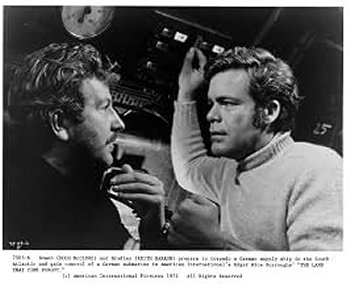
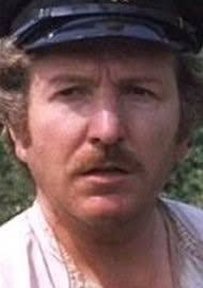
August 8: On this day in 1934, actor Keith Barron, who planed Bradley in “The Land That Time Forgot” and Dorsett in “At the Earth’s Core,”
was born in Mexborough, United Kingdom. Keith appeared in films and on
television from 1961 until 2017. His television roles included the
police drama The Odd Man, the sitcom Duty Free, and, playing Gregory
Wilmot in period drama Upstairs, Downstairs. His career included
performances on stage, radio, television, and film. He appeared in
Doctor Who and The Avengers.
The drabble for today, “Not In Kansas,” was written by Edgar Rice Burroughs for The Land That Time Forgot. In the novel, it’s attributed to Bowen Tyler upon arrival in THE LAND THAT TIME FORGOT.
NOT IN KANSAS
All
about us was flora and fauna as strange and wonderful to us as might
have been those upon a distant planet had we suddenly been miraculously
transported through ether to an unknown world. But the life! It teemed.
The tall, fernlike trees were alive with monkeys, snakes, and lizards.
Huge insects hummed and buzzed hither and thither. Mighty forms could
be seen moving upon the ground in the thick forest, while the bosom of
the river wriggled with living things, and above flapped the wings of
gigantic creatures such as we are taught have been extinct throughout
countless ages."
THANK GOD, IT'S FRIDAY
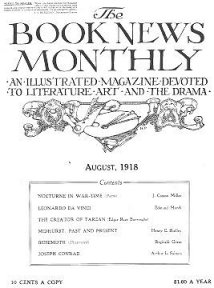
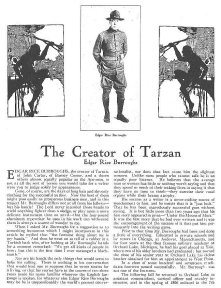
August 9: On this day in 1918, Edgar Rice Burroughs was credited with the article, “The Creator of Tarzan” to THE BOOK NEWS MONTHLY,
an Illustrated Magazine Devoted to Literature, art, and The Drama. Th
article included a photograph of ERB in uniform and black and white
illustrations silhouetting the cover art from the first edition of
TARZAN OF THE APES. The article is written in third person and is
credited to Edgar Rice Burroughs, but I don’t believe ERB wrote the
article. A few of the comments are ones that ERB would have been
unlikely to make – in my humble opinion. The drabble for today, “Thank God, it’s Friday,”
is an excerpt from the article and one of the reasons that I question
the identity of the actual author. I can’t see ERB making the comment
about Robinson Crusoe.
THANK GOD, IT'S FRIDAY
The
story of Tarzan is the Robinson Crusoe idea over again. The lone man or
boy fighting for his existence single-handed against nature always
attracts readers when done well. This interest comes doubtless from
something within us which goes back to when our ancestors were doing
this kind of thing. Tarzan represents individual freedom, which no
matter how we subscribe to social laws and restrictions, is always
present with us There is not a man or woman who occasionally does not
like to get away into a more or less primitive wilderness where he is
“monarch of all he surveys.”
WE BRING YOU TARZAN
The story is basically the same as Tarzan and the Forbidden City, and there has been extensive debate about which came first, radio or book. To make it even more fun, the magazine version, “The Red Star of Tarzan,” is different from both. Listen to the radio show, read the book and the magazine versions and make up your own mind.
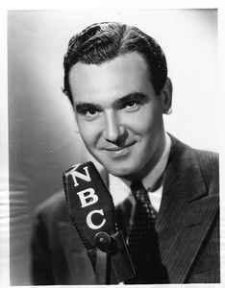
The radio show featured Karlton KaDell as Tarzan. Jennette Nolan, Don Wilson, and Victor Rodman were also in the cast.
The drabble for today, “We Bring You Tarzan,” is the introduction to each episode and it clearly says that the radio show was adapted from the novel.
WE BRING YOU TARZAN
We
bring you Tarzan, that immortal character of Edgar Rice Burroughs, in
an exciting new serial entitled TARZAN AND THE DIAMOND OF ASHER, which
is adapted from the novel, 'Tarzan And The Forbidden City.' Deep in the
heart of Africa rises an extinct volcano, in which lies The Forbidden
City of Asher... To reach this stronghold two safaris endure hardships
and perils that bring death to some and high adventure to all... One
safari is bent on the rescue of the son of its leader... the other,
headed by a wily and unscrupulous Oriental, seeks only the Father of
Diamonds.”
MOONLIGHT SONATA
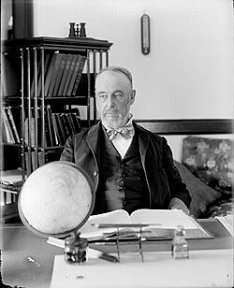
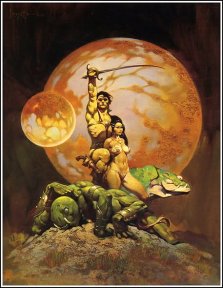
August 11: On this day in 1877, Astronomer Asaph Hall discovered and named the Martian moons, Phobos and Deimos.
I’ll cut him some slack for the names he chose. He didn’t realize that
the Barsoomian natives had been call the moons, Turia and Cluros for
centuries. Edgar Rice Burroughs hadn’t even been born, let alone
written the saga of John Carter. Some sources give August 12, 1877 as
the date of discovery, but Hall’s journal claimed a first sighting on
August 10, with formal verifications continuing through August 18th.
There is no evidence that Hall was able to see Helium or any other
Barsoomian cities.
<>In
1875 Hall was given responsibility for the USNO 26-inch telescope, the
largest refracting telescope in the world at the time. It was with this
telescope that he discovered Phobos and Deimos/ Hall also noticed a
white spot on Saturn which he used as a marker to ascertain the
planet's rotational period. In 1884, Hall also determined the orbits of
some of the moons of other planets, accurately calculated the mass of
Mars, and discovered some double stars.
Burroughs used Hall’s descriptions of the two moons and their orbits when he wrote The Princess of Mars,
in 1917), describing Mars' twin natural satellites, the "hurtling moons
of Barsoom,” utilizing their wildly differing, hyper-fast orbital
mechanics to cast dramatic, fast-moving shadows across the dying red
planet's harsh landscape.
The drabble for today, “Moonlight Sonata,” was written by Edgar Rice Burroughs in his first description of ‘moons of Mars’ in chapter five of A Princess of Mars, aka Under the Moons of Mars. As always, slightly edited to be exactly 100 words in length.
MOONLIGHT SONATA
Mars'
moons are vastly nearer her than is our moon to Earth; the nearer moon
about 5000 miles distant, while the further but 14,000 miles away,
against the nearly one-quarter million miles which separate us from our
moon. The nearer Martian moon makes a complete revolution in 7½
hours, so she hurtles through the sky like some huge meteor two or
three times each night, revealing all her phases during each transit of
the heavens.
The
further moon revolves about Mars in 30¼ hours, and with her
sister satellite makes a nocturnal Martian scene one of splendid and
weird grandeur.
LUNCH MONEY
August 12: On this day in 1963, the John Celardo written and illustrated Tarzan daily newspaper comic story arc, “Tarzan and the Missionary,”
began. There were forty-two daily episodes. Tarzan and Jane encounter a
priest, the missionary Father Joseph, who was trying to make peace
between a warlike tribe and a peaceful tribe. The warlike Mambus tribe
took offense at his interference. Tarzan is in his loincloth, but Jane
spends the entire story in a strapless short-sleeved knee length dress
– a interesting choice of clothing for the jungle. The drabble for today, “Lunch Money,” was inspired by one of the lessons in the story arc.
LUNCH MONEY
Father
Joseph said, “Tarzan, thank you for interceding. I tried to help the
submissive Boluga tribe end their slavery to the warrior tribe, the
Mambus, but my teachings fell upon deaf ears.”
“They
didn’t. Succor and teach. When I defend a man, I save him for one day,
but if I teach him to defend himself, I save him forever.”
“Interesting parable,” said the priest. “I’ve heard a similar one about teaching a man to fish.”
Tarzan laughed. “Teaching a man to fish doesn’t help the man if he can’t keep other men from taking the fish away from him.”
HOW'S THAT AGAIN?
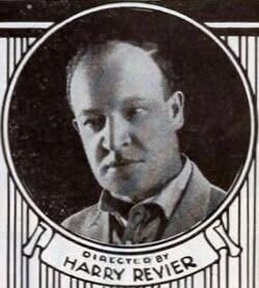
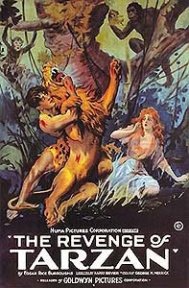
August 13: On this day in 1857, director Harry Revier, The Return of Tarzan, aka The Revenge of Tarzan and The Son of Tarzan,
died in Winter Park, Florida. . Most of his output consisted of
low-budget programmers, one-shot features or serials often made for
companies organized only to make that one film, distributed haphazardly
if at all (then, as now, it was much easier to actually get a film made
than to get it distributed). Two exceptions are the two Tarzan films.
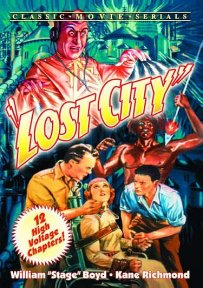
His credits included “The Lost City, which starred he who would become
Hopalong Cassidy, William Boyd. The fictional drabble for today, “How’s That Again?” may not amuse you, but I like it.
HOW'S THAT AGAIN?
Harry
noticed an attractive young extra reading while she waited for her
scene. He saw the book was “King Solomon’s Mines’ and introduced
himself.
“I noticed the book you’re reading. Haggard was a true master of adventure romance stories.”
She
nodded. “My favorite type of book. I liked “The Scarlett Pimpernel” and
“Captain Blood.” I know they’re all old books, but people don’t write
books like those anymore.”
Harry smiled. ‘Sad isn’t it. I loved the Tarzan stories, but my favorite is “A Princess of Mars.” Do you like Burroughs?”
“I really couldn’t say. I’ve never crawled inside of one.”
A MOVEABLE FEAST
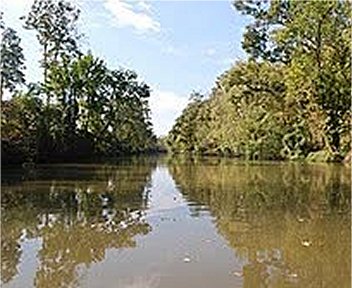
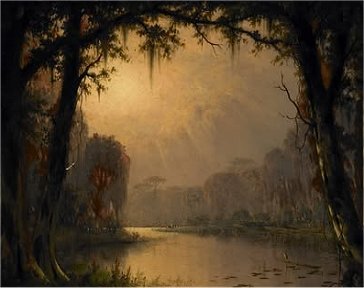
August 14: On this day in 1917, Filming began on the Bayou Teche, Louisiana for the first Tarzan film, Tarzan of the Apes, which starred Elmo Lincoln and Enid Markey.
The Teche begins in Port Barre where it draws water from Bayou
Courtableau and then flows southward to meet the Lower Atchafalaya
River at Patterson. During the 18th-century Acadian migration to the
area - then known as the Attakapas region - the Teche was the primary
means of transportation. There were two Civil War battles on the Bayou,
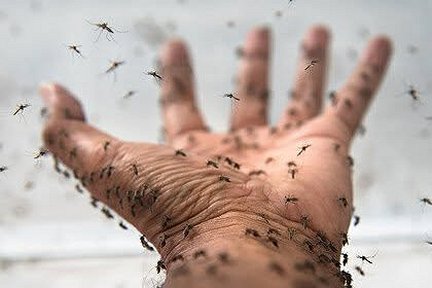
It
was hot, so hot the men in the ape costumes could only work for a
couple of minutes before removing their masks. Besides the heat, the
cast and crew had to deal with chiggers, wasps, alligators, snakes,
lizards, flies, leaches, no-see-ums, and mosquitos. A lovely day on the
bayou!
The fictional drabble for today, “A Moveable Feast,” was inspired by the Bayou and by the film.
A MOVEABLE FEAST
Enid
Markey said, “You’re lucky, Elmo. This long dress I’m wearing is so hot
I could pass out. Those poor actors wearing those horrible ape costumes
have to be roasting. You only have to wear that brief Tarzan costume.”
“I’m
not lucky. The rest of you are covered up. The mosquitos, chiggers,
flies, and wasps are eating me alive. But I have a plan.”
“I’m going to drink heavily. Once I’m full enough, I’ll pass out and I won’t care about the bugs.”
“The bugs will be full enough they won’t care about me.”
GENEALOGICAL PERSUASION
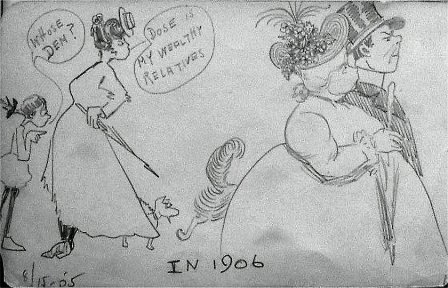
August 15: On this day in 1906, Edgar Rice Burroughs drew the comic illustration, “dem is my wealthy relations.” Ed drew a number of comic sketches throughout his life and several of them may be viewed on the website https://www.erbzine.com. Burroughs occasionally drew illustrations along with inscriptions when he autographed his books for friends and family. The fictional drabble for today is “Genealogical Persuasion,”
was inspired by what I decided to call Robert’s Law of Relativity and
of course, the comic illustration by Edgar Rice Burroughs.
GENEALOGICAL PERSUASION
“Hilarious cartoon,” said Emma. “I suppose everyone has rich relatives.”
Ed
laughed. ‘Well, everyone likes to claim rich or famous relatives. Find
a gold mine and a hundred distant kinfolks will find you.”
“Are you suggesting that people will say they’re related to people in hopes of financial gain?”
“Don’t
be so naive. I’m not suggesting it. I’m saying that it’s a fact. I’m
calling it Robert’s Law of Relativity. “Nothing finds family faster
than fortune or fame.”
“Cynical, but true. Why would you call it Robert’s Law instead of Ed’s Law?”
“Robert is the one who wrote this drabble.”