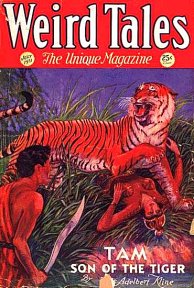
 One
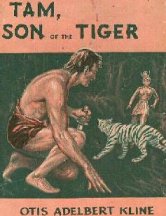
thing to say about Tam, Son of the Tiger, is that it doesn't waste
time. Within the first three pages, young Tam is abducted by a Tiger.
The next eighteen years whiz by in less than thirty-six pages.
One
thing to say about Tam, Son of the Tiger, is that it doesn't waste
time. Within the first three pages, young Tam is abducted by a Tiger.
The next eighteen years whiz by in less than thirty-six pages.
Basically, the story is that a White Burmese or Bengal
Tiger, named Leang, is strolling around minding its own business when little
Tam Evans, mistaking it for a big kitty, comes along and starts harassing
the poor thing. Now normally, it would be lunch time, but in
fact, this Tiger was raised by a human so she's a lot more tolerant than
she ought to be, and a couple of her kittens have died, so she just up
and adopts the fearless little nipper.
Tam's somewhere between two and five years old I figure,
he's old enough to go toddling around and playing with balls and stuff,
and he's got some basic language skills, so he's not exactly a newborn
raised from savagery, he's got a head start. Anyway, along comes
the next several years of being raised on tiger milk and raw meat, and
learning to be a tiger.
You would think that's the sort of thing that would screw
a person up pretty thoroughly, and in fact, Tam is growing up into a fine
young headcase. Then the guy who raised the Tiger in the first place,
a wandering buddhist monk, Lozong, shows up.
Lozong is actually a pretty interesting character.
His family was Tibetan, but had moved to Hanchow China when he was a boy.
He became a Christian and joined the YMCA, travelled to Japan, saved the
descendant of a Samurai and learned martial arts and swordsmanship.
From there he'd returned to Tibet and found his village slaughtered by
Chinese soldiers. He turned brigand and became the most ferocious
bandit in the region. Tiring of bloodshed at thirty, he entered
a Lamasery and swiftly rose to Abbot or Chief Lama. Then he
simply decided to become a wandering Monk, stopping to raise a tiger cub
named Leang, and then continuing his travels. When he encounters
Tam's father, the group of Europeans already know his name. He's
famous throughout this part of Asia. It's a hell of a life,
and you sort of wish that Kline would have written a book about him, rather
than letting him sit as a supporting character.
After some awkward moments, where Tam tries to kill and
eat him (well, just kill him) the Monk begins the long process of humanizing
Tam... A process that includes teaching him not only half-remembered
English, but various languages, including ancient Sanskrit, as well as
reading, writing, in these languages, mathematics and geography, as well
as martial arts and swordsmanship. Talk about lucky breaks
or what.
The bottom line is that Tam grows up to be a weird hermit
of a young man, but not a raving psycho loony. Well, not as
much of a raving psycho loony.
There is actually a partial literature on real feral children.
Kids who wind up adopted by or living with animals, usually dogs or wolves,
and who lose touch with humanity. Generally, its not a good thing,
kids need human contact growing up for proper stimulation, they go through
critical developmental stages psychologically, including language acquisition
and reasoning. If they don't get the right stimulation at the right
time, which normally comes from hanging with humans, the wiring doesn't
develop at all.
So instead of Tarzan, growing up as a sort of feral noble
savage and genius savant, teaching himself to read, and independently inventing
an inner life, most feral children wind up as severely damaged goods.
Hell, when you think of it, Tarzan was raised by near-hominid apes, so
he had a huge leg up, practically raised by humans, and even then, he possessed
an infrahuman quality. Although he fit easily into human culture,
he was an ape at heart.
On the other hand, Tigers aren't even close to human.
Tam should have grown up with severe malnutrition and a whole host of developmental
handicaps and rampaging psychosis. Hell, he should have simply been
eaten.
To be fair, Tam wasn't exactly raised by tigers.
It was more like he spent a really really long vacation with them.
He fell in with them after he was running around a little and talking,
so he'd passed some critical physical and linguistic thresholds, and a
few years later he started hanging with a real human.
I don't even know why I'm taking this seriously.
But anyway, Tam grows up surprisingly normal. I'm
not sure how a human raised by tigers would think, psychologically.
But Tam seems all too normal, even levelheaded, where Tarzan really did
have a certain inhuman quality. So, on the whole, it doesn't really
work. It's just basically a piece of shtick, part of the whole ‘raised
by animals’ Jungle man thing that was popular around this time.
But anyway, back to the ‘Plot’. One day, Tam
is out searching for his elephant, when he runs into a beautiful maiden.
Yeah I know, if I had a nickel for every time that happened
to me.
Actually, he rescued her from a tiger. It
turns out that she's a half-goddess Princess, named Nina, from an underground
kingdom fleeing from her enemies who are out to conquer the surface world
Like I said, if I had a nickel for every time that happened
to me.
It turns out that Tam is a figure of prophecy. What's
the prophecy? Beats me, it gets referred to several times through
the book but nobody actually gets around to mentioning what it was.
Maybe Otis had a sequel in mind. Tam's response is pretty interesting,
actually worth quoting:
“What prophecy?”
“It's a secret, I should never have
mentioned it.”
“Never mind,” replied Tam, “I'll
forget it. Prophecies bore me anyhow. Tell me who you are and
where you live.”
And this gentle reader, is the closest that the book ever
gets to suggesting that, just maybe, Tam's not quite the same as your average
person in terms of his mental layout.
Things start to happen pretty fast after that:
The bad guys, who are pasty faced four-armed giants riding prehistoric
monsters show up and kick ass. Tam is knocked out for a day, wakes
up and decides that this is as close to getting laid as he ever got in
his life, and starts off in hot pursuit.
Okay, now flash back a bit, and we focus on some great
white hunters who are sitting on a hill watching a battle. Basically
four-armed pasty giants on prehistoric critters are fighting regular-sized
white people on mammoths. The battle goes badly for the little guys,
and the princess.... Tam's princess, is forced to flee. Here's
an amazing coincidence, turns out that one of the great white hunters is
Tam's long lost Dad. Eventually, they head over to the battle
site where they encounter a survivor, and Tam's foster dad, the Monk.
Anyway, still in flashback, they find the site where Tam
rescued the Princess. Lozong shows up to explain things to
them, and Mr. Evans realizes that this is his long lost son. Then
they all of them head off in search of Tam, who himself is in hot pursuit
of his girl, who is herself in the possession of the bad guys.
Oh yeah, Tam's on his elephant, who's finally showed up,
and Tam has followed the four-armed critters into an underground world.
And the two tigers who are Tam's foster mom and brother, are accompanying
the monk, Lozong. So everyone is accounted for. With
a cast like that chasing after each other, you almost expect some Scooby
Doo/Marx Brothers antics, but that never quite materializes.
Tam follows the bad guys into a vast underground world,
called Irimatri. How vast? We'll get to that. He
catches up with the bad guys, rescues the Princess, but later gets captured.
That's going to happen a lot. Tam and the Princess Nina get
taken to the city of the bad guys, who are called the Saiva, worshippers
of Siva or Shiva. Tam gets sentenced to be eaten by a giant
snail (I'm not making this up) but escapes without too much trouble and
rescues the Princess. They head off into the woods where she's kidnapped
by Monkey men. He rescues her again. Tam winds up fighting
a dinosaur, and Nina gets kidnapped by dog-headed men. Tam encounters
some red four-armed giants, who are much friendlier, and rescues Nina once
again. They all head towards Nina's kingdom.
Meanwhile, Tam's real dad, foster dad, tigers and sundry
wind up getting captured and enslaved by blue four-armed giants who aren't
actually evil, but they just don't like all this traipsing around and want
some peace and quiet. They escape and head to Nina's kingdom as well.
Unfortunately, while Nina was gone, her evil uncle took
over. His evil scheme involves marrying her to his deformed mentally
defective son (or having her raped by a dog-headed man, he's pretty flexible)
and putting his own daughter on the throne. Luckily, Tam comes to
the rescue. You see a pattern? This girl is just high
maintenance.
Anyway, there's a picturesque pilgrimage to the celestial
home of the gods, in which Tam encounters but doesn't do anything fun with
Serpent Men, and gigantic naked female black four armed followers of Kali.
It's worth mentioning that Jan in India encounters Kali worshippers and
a giant, black, female four-armed statue of Kali. Tam
gets to rescue Princess Nina a few more times. Then they all
live happily ever after, with Nina marrying her hero, which, considering
how accident prone she is, is probably a wise move. Let's face
it, this girl needs a big strapping jungle guy around to rescue her two
or three times a day.
So, how does it all stack up?
Not bad, but perhaps not too great. There's
no shortage of action and adventure, Tam hardly takes a breath, without
getting into mortal combat with Tigers, White Giants, Giant Snails, Monkey
Men, Dog Men, Dinosaurs and sundry other critters. And when
Tam isn't having a battle, then evil dudes are conspiring, his family is
having a battle, there's thrilling escapes and rescues. All
the while his girlfriend Nina is always getting into trouble.
It's pretty damned lively.
On the other hand, we don't get much of a sense of Tam,
except that he's earnest, plucky and very put upon, but he takes it all
in good spirit. Unlike Jan who comes across as a fully
realized character, Tam is mostly a cipher. The characterization
for everyone except the Monk Lozong is pretty thin. The romantic
relationship with Nina is pretty undeveloped, which makes sense because
its pretty much happening during a book length car chase scene, and we
have to take it for granted.
One of the big drawbacks to the incredibly fast pace is
that there's very little time for Kline to develop this exotic world he
creates. As an example, towards the end we meet the Nagamanacs,
or serpent men. It's a brief encounter, which goes along the
lines of:
“Hi, we're Serpent men.”
“Pleased to meet you.”
“Yeah, likewise. Oh well, be seeing you around.”
“Later, gator.”
We don't actually learn any more than that.
Instead, there's a headlong rush of exotic details and events, which in
the simple rush of events, never quite gets developed.
This isn't to slag Kline, since he does put a lot of effort
into describing scenes and events, but all too often he just skims.
It might have been better if Tam stretched out across
another twenty or thirty thousand words, or perhaps spun off a sequel or
two. Certainly we could have stood to have the personality
of a man who was raised by Tigers fleshed out a bit more (or then again,
that might not have been a good idea). Or better yet, it would have
been fascinating to have gotten a better look into the lives of these four-armed
giants.
But what the heck, it's a fun read, an exotic adventure
and a nonstop ride. Can we ask for anything more?
Four-Armed
Giants, Children of Barsoom
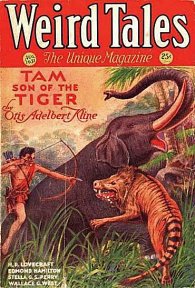 Richard
Lupoff, in his book Edgar Rice Burroughs, Master of Adventure suggests
that the resemblance of the four-armed giants in Tam, Son of the Tiger
to the four-armed, giant Green Men of Mars may not be entirely coincidental.
The Tharks are a good collective name for the giants of Irimatri, who seem
to be far and away the dominant race of the underground world.
There are several individual varieties, the pasty white-skinned Saiva,
the red-skinned Brahm, the blue-skinned Vishnu and the black skinned Kali.
Out of nine known nations, the Tharks represent four, three more are non-Thark,
and two others, the peoples of Yama and Indra are unknown, but one or both
may be Thark.
Richard
Lupoff, in his book Edgar Rice Burroughs, Master of Adventure suggests
that the resemblance of the four-armed giants in Tam, Son of the Tiger
to the four-armed, giant Green Men of Mars may not be entirely coincidental.
The Tharks are a good collective name for the giants of Irimatri, who seem
to be far and away the dominant race of the underground world.
There are several individual varieties, the pasty white-skinned Saiva,
the red-skinned Brahm, the blue-skinned Vishnu and the black skinned Kali.
Out of nine known nations, the Tharks represent four, three more are non-Thark,
and two others, the peoples of Yama and Indra are unknown, but one or both
may be Thark.
So what do these ‘Thark’ of Irimatri look like.
Well, they're giants, standing eight to ten feet tall, with four arms.
Habitually, they ride baluchitherium or indricotherium, a species of extinct
hornless rhinoceros that was the largest mammal that ever lived.
They seem to be a fairly warlike race or races. Females are
described as slightly smaller than the males.
After that, the description gets a little fuzzy.
Do they have hair? Or are they bald? Do they have fangs?
Red eyes? Big ears or no ears? How are the females distinct
from males, besides size? We don't know.
Kline describes the Saiva as hideous in appearance, but does not go into
specific details.
Interestingly, he does spare a paragraph:
“What surprised Tam the
most was the variety of monstrous forms which these people assumed.
Some of them had but one eye, placed just above the nose. Some had
three and even four eyes. And there did not seem to be any uniformity
in the number of limbs. The number of arms varied from two to eight,
four being the average, and some of them had as many as six legs.
From the uniform size of the soldiers and the fact that they were all four
armed, two legged and two eyed, Tam judged that the individuals who formed
the army were chosen from among those who had these particular qualifications.”
One would assume that the other colours of the Tharks bear
the same tendency towards diversity.
As for the rest, we learn very little. They live
in cities, their cities sport a diversity of architectural styles, they
work at a variety of occupations and their individuals are as different
as ours are. We see some children, already larger than humans
when half grown. But we don't see infants and have no idea whether
they give live birth or lay eggs. Their religion seems to consist
of worship of patron gods with a dollop of reincarnation.
But here's a very interesting thing. On two
occasions, they refer to humans as ‘earthlings’:
“You know much for a modern
earthling,” said the girl finally. “I thought the world had forgotten
Nina.” (Pp 40)
“For the most part, the outer-earthlings
have forgotten the Gods..... What are you outer-earthlings
doing in Iramatri, and why were you trespassing on my lands? (Pp
116)
“Outer-earthling he is, but you
miscall him weak,” retorted the scientist. (Pp 117)
That's pretty much a naked admission that they're not from
around here. Even back in the 1930s when this was written,
pretty much nobody walked around calling people Earthlings unless they
happened to originate on another planet. I would take this
as a deliberate hint by Kline that the four-armed giants are not native
to earth.
In which case, where are they from? Well,
that's a mystery, ain’t it?
To be fair, Hindu mythology is full of multi-armed deities
and demons. So it's no question as to where Kline's real inspiration
for these creatures comes from. In his gods, in his monsters,
in his exotic underground world, he's drawing from the rich and vivid traditions
of Hindu myth. Traditions that, because they've been almost completely
ignored in western fantasy, reverberate with a rich and exotic strangeness.
But Kline at points appears to want to have it both ways.
His Irimatri is not completely defined by myth and folklore. Is this
magic and legend in the strangeness, or is there some science and super-science
behind it all?
His protagonists struggle to find a logical explanation
for the light within the cavern, and it's suggested that there is indeed
one. Most of the animals seen come, not from myth, but from
prehistory. Races like the Hanuman, Nacamanac and Zargr have their
counterparts in the races of Pal-Ul-Don and Pellucidar, notably the Don,
the serpent-like horribs Horribs and the bestial Sagoths. Nina wears
what is apparently an electronic device which amounts to a GPS locator
for Irimatri, and there are references to ‘terrible weapons’ stored away.
So, it seems that Kline is leaving himself the ‘out’ that
Irimatri is not a supernatural land, but the refuge of a prehistoric race
or races that once achieved levels of super-science unknown today.
But obviously the four-armed giants are pretty much incompatible with any
vertebrate evolution on Earth. So I think that Kline is acknowledging
that they must be from outer space.
Which takes us to... Barsoom? Not necessarily.
Four-armed alien races are not all that big a stretch, or unknown to pulp
science fiction writers, or even regular science fiction writers.
I believe that Isaac Asimov in some of his early stories included a race
of four-armed aliens. Except of course, that they're giants.
In particular, they're four-armed, equestrian, warrior, alien giants
riding around on monsters. That sounds a lot like Tharks.
Sort of inescapably like Tharks.
Of course, in the context of the story, they would have
to be warriors. And what with one thing and another, the fact
that they're riding around on big critters may not count for too much.
What are they going to do, walk?
Finally, as we'll see, Irimatri has strong overtones with
Pellucidar, and its bizarre mix of fauna. And many of the other races
seem to have their counterparts with Burroughs, all of which adds to the
circumstantial series of affinities.
Of course there are discrepancies. Kline's
giants are on the small side, but that might relate to Earth's heavier
gravity. And they don't seem to bear the Green Man's remarkable
appearance, and they're not green... On the other hand, the Siva
are described as ‘horrible’ and Hindu statuary depict fangs, tusks, so
they may be closer than we think. Kline's giants may be ‘lost
races’ of Thark, now extinct or well hidden on Barsoom. Or
perhaps they diverged radically after they got to Earth. Our glimpse
of civilian inhabitants of the Saiva city suggest that there's a lot of
radical mutation going on, with eyes running from one to four, arms from
two to eight and legs up to six.
Interestingly, we have reason to believe that the Green
Men of Barsoom may be susceptible to rapid mutation or evolution.
Basically, they lay eggs, as many as thirteen a year, over an immensely
long lifespan. That's a lot of opportunities to play with the genetic
lottery. And Barsoomian life shows a lot of flexibility in
the number of limbs, and even with the eyes, as we see in the Apts and
Masena Cat Men.
Indeed, there's a suggestion that Barsoomian species genetic
coding may include greater or fewer limbs. Generally, specific species
on Barsoom have fixed numbers of limbs, but that may simply be natural
selection. Barsoom's Calot has ten legs, but interestingly,
on Thanator there is a creature almost identical to the Calot, the Othode,
with only six. So perhaps evolution or natural selection for
Barsoomian life can throw in or subtract pairs of legs.
In any case, we might infer that the Irimatri population
of giants is extremely inbred, and may be popping out genetic defects or
mutations at a high rate. It's worth noting that the ‘two-legged,
two- eyed, four-armed’ variety seems to have a special social status.
The bottom line is that while there are other explanations
for everything, the sheer volume of similarities and correspondences with
Burroughs' races and worlds suggest that, while we can never be conclusive,
we can form a pretty reasonable judgment that the four-armed races of Kline's
underworld are descended from the four-armed races of Burroughs' Barsoom.
If we accept that Kline's worlds are contiguous with Burroughs,
that Kline's Mars and Venus are just different parts of Barsoom and Amtor,
that Irimatri is related to Pellucidar... Then I don't think we've
got any choice but to acknowledge the four-armed giants as long lost cousins
to the Tharks.
The Scenic
Road to Barsoom
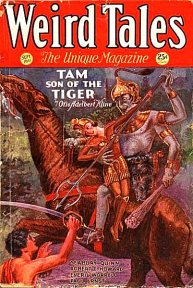 There
is an indirect theory that might allow us to get Kline's four-armed giants
to Barsoom. Bear with me. Most of the four-armed
giants we see in Tam belong to Brahm, Siva and Vishnu. But we do
get a glimpse of black-skinned, giant, four-armed amazons who serve Kali.
Kali, or her people and her cult, therefore, are real in Tam.
There
is an indirect theory that might allow us to get Kline's four-armed giants
to Barsoom. Bear with me. Most of the four-armed
giants we see in Tam belong to Brahm, Siva and Vishnu. But we do
get a glimpse of black-skinned, giant, four-armed amazons who serve Kali.
Kali, or her people and her cult, therefore, are real in Tam.
Now, if we look to Jan in India, the sequel to
Jan of the Jungle, Jan encounters a cult of Kali worshippers.
He doesn't encounter a four-armed giantess, but his girlfriend Ramona is
shown a giant statue, jet black, of a four-armed giantess and told that
Kali really did inhabit such a body. Well, this may be crazy religious
talk. Or it may be literal truth. Still, the fact
that Jan encounters the Kali cult allows us to infer that he may well be
in the same ‘universe’ or reality as Tam.
Indeed, there are other overlaps between Jan and Tam.
In Jan, the apes and monkeys have a non-human language. In Jan, this
non-human language is shared by semi-human ape men. Also in Jan,
we have a lost world of dinosaurs and prehistoric creatures.
So there are definitely shared traits, which suggest that the two inhabit
the same world.
Okay, looking to Jan of the Jungle, the first Jan
story, Jan encounters a lost world containing two civilizations.
One of these are the Lemurians who adopt Jan as their own.
But the other are a strange oriental race of yellow men who venerate feathered
serpents or dragons. Kline identifies these as Aztecs.
But their real origins seems to be more clearly oriental.
Now, this gets us into Kline's ‘Doctor Morgan’ universe,
as identified by J.G. Huckenpohlar. Huck notes that several
of Kline's interplanetary adventures: Outlaw of Mars,
Swordsman of Mars, Planet of Peril, Prince of Peril and Port of
Peril, as well as the story Vision of Venus, all feature a sort
of ‘deus ex machina’ character named Doctor Morgan. Kline's Martian
adventures are so close to Barsoom that the difference is barely worth
counting. For more on this, check out my other Kline articles.
In Swordsman of Mars, we encounter a yellow, oriental
race called the Ma Gongi, who are supposed to be from the moon, refugees
from some ancient war. The Ma Gongi appear in Maza
of the Moon, and Man in the Moon. Although Doctor Morgan
doesn't appear in these stories, they're clearly connected to Swordsman
of Mars, and therefore are part of the Doctor Morgan universe.
In Port of Peril, there's a yellow race on Venus
called the Huitsen who, although it's never explicitly stated, do appear
to be derived from the Ma Gongi. The Ma Gongi environment on
the moon possesses feathered serpents and creatures very much like Chinese
dragons. More particularly, the Ma Gongi in the Doctor Morgan
universe founded the oriental cultures of East Asia, as well as colonies
on Mars and probably Venus.
So, if Jan of the Jungle features an anomalous
oriental culture impossibly in the middle of a lost world in South America
which venerates dragons and winged serpents, then I'm inclined to see this
as another Ma Gongi offshoot. Which would place Jan neatly
in the Doctor Morgan universe,
And Jan in India features a Kali cult, which connects
Jan to Tam, which suggests that Tam, Son of the Tiger is also in
the Doctor Morgan universe. Which features a Mars that bears
a startling resemblance to Barsoom, and indeed, fits quite neatly in with
Barsoom.
Or at the very least, we now have the Doctor Morgan universe
paralleling Burroughs universe in so many particulars on Mars, Venus, Lost
Worlds, Jungle Men and Four-Armed giants, so similar in style, so frequently
compared by fans, that we might as well just call it a day and treat
it all as the same reality. It's like magnets, if they get close
enough, they just kind of jump together, you know what I mean? Or
to put it another way, if it walks like a duck, talks like a duck, and
swims like a duck, it's probably a duck. Or, a difference that makes
no difference, is no difference.
The Lost
World of Irimatri
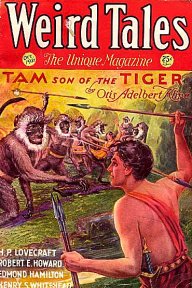 Lost
Worlds are not uncommon in the pulp universe of Edgar Rice Burroughs and
his colleagues. Tarzan was always stumbling across lost cities and
civilizations. Opar, Athne and Cathne, Xuja and so on.
It seems that some days, Tarzan couldn't throw a rock without braining
some unlucky member of a hidden lost race.
Lost
Worlds are not uncommon in the pulp universe of Edgar Rice Burroughs and
his colleagues. Tarzan was always stumbling across lost cities and
civilizations. Opar, Athne and Cathne, Xuja and so on.
It seems that some days, Tarzan couldn't throw a rock without braining
some unlucky member of a hidden lost race.
The most famous early Lost World, of course, was Arthur
Conan Doyle's ‘Maple White Land’ named after its first, deceased discoverer,
and rediscovered by Professor Challenger in South America.
It was a strange land containing both true humans and ape-men, dinosaurs,
pterodactyls and prehistoric birds and mammals of different epochs and
continents.
Doyle's lost world set the pattern for many that would
come after. Indeed, his novel was made into a stop motion animation
feature at the turn of the century, which directly inspired King Kong.
Meanwhile, in literature, Edgar Rice Burroughs was clearly inspired by
Doyle's lost world, creating his own, first in Caprona, in his Land
that Time Forgot trilogy. He went at it again in Tarzan the
Terrible, with Pal-Ul-Don in Africa. And he created the ultimate
‘Lost World’ with his Pellucidar. Meanwhile, Ralph Milne Farley,
contributed his own version of a Pellucidar story with his Radio Flyers
and Radio Gun Runners serials, and Lin Carter was inspired by Pellucidar
to create Zanthodon.
See how it all tends to connect up conceptually?
Of course, its likely that there were ‘lost worlds’ of dinosaurs in caves
or hidden valleys before Doyle thought it up. And inner worlds existed
in literature before Pellucidar. Hell, just look at Jules Verne's
‘Journey to the Center of the Earth.’ Nevertheless, the ideas and
concepts were floating around, passed from one writer to the next, and
the big ones, like Doyle and Burroughs were particularly influential.
Anyway, the fact that everyone is using the same basic
set of sloppy ideas for a setting, tends to inspire us to try and connect
them. If we're finding all these lost worlds in different parts
of the world which repeatedly share the same features, shouldn't we assume
that they may be related in some way. They're not simply ‘fossil
remains’ snapshots of particular eras, rather, over and over, they pose
impossible mixes of flora and fauna, creatures that could never have existed
together.
Irimatri is pretty typical of these lost worlds.
Let's look at the range of species. First we have dinosaurs
of various sorts, particularly, Tyrannosaurus Rex and Styracosaurus are
described. Protoceratops is referred to. Pterosaurs and creatures
that might be Itchysaurs are described. All well and good,
we're looking at a Cretaceous, Mesozoic Era landscape, somewhere from 100
to 65 million years ago.
So what are Indricotherium doing wandering around there?
It's from the Oligocene and Miocene eras. It's 25 million years
out at least. Andrewsarchus, a giant hoofed predator from 32
million years ago is seen. How about Mammoths from only a few million
years ago.
In the real world, none of these creatures ever met each
other, and certainly none ever met a dinosaur. They're all separated
from each other by gaps of millions of years. So what are they
doing hanging out?
Well, to be fair, all of these critters populated asia,
so they could have just kept on wandering into Irimatri from time to time,
like a homeless shelter against extinction.
But wait. Tam also sees diminutive proto-horses
and giant flightless predator birds snapping them up. We have
a problem here. Horses evolved in North America, proto-horses never
made it to Asia. Meanwhile, giant flightless Predator birds
evolved in North and South America when each of these were island continents,
but never spread to Asia. So what did they do? Take a
cab.
In fact, this sort of thing is a problem with just about
every ‘lost world’ found on the surface or in underground caverns, including
Professor Challenger's, Skull Island, Caprona and Pal-Ul-Don. And
many of these lost worlds have other problems. They're too
small to sustain the giants they possess. Limited territory often
means that giants downsize to dwarfs, but this doesn't seem to be happening.
If anything, many specimens are even bigger than the fossil record.
And worse, many of these lost worlds feature species which
just don't exist in the fossil record and may never have evolved on the
surface.
All of which suggests that most of the ‘lost worlds’ that
we encounter are connected. If not to each other, then they are connected
to and derived from a ‘super lost world’: Pellucidar.
As to the mechanics and how this operates, I'd refer you to my articles
on Pellucidar, Zanthodon, Caprona and Va-Nah.
But the bottom line is that Pellucidar is an inner world
which from time to time, opens up to the surface, leaving little ‘islands’
of underworld life trapped on the outer earth, or in great caverns.
Irimatri, I would argue, is not just Kline being inspired
by Burroughs Pellucidar, but rather, Irimatri actually is a part of Pellucidar.
Or at least, that it is a remnant of or connected to Pellucidar.
In support of this, there are the strange mysteries of
the animal life. But I'd also argue that several of the intelligent
races of Irimatri have counterparts in Pellucidar.
Hanuman
- the Monkey Race
Are the non-human followers of the monkey god, Hanuman.
What are they? Well, obviously, they're Monkeys.
“He looked up and saw,
peering down at him, its beady eyes glistening beneath its beetling brows,
an enormous monkey fully as large as a tall man. Except for its immense
size, it might have been an ordinary Hanuman monkey of the Burmese and
Indian jungles; its hands and face were black like those of its smaller
outer-earthly prototype, and it was covered with grayish brown hair.
But there was something about this monkey, other than its great size, which
distinguished it from its simian cousins of the upper jungles. For
in its glittering eyes was a look of intelligence that was strangely human.
Strapped about its hairy waist was a belt from which there hung a curved
knife like an Indian kukrie. Its left hand held a bundle of short
javelins and from its right, another, even as he looked, hurtled towards
him.”
Okay, let's be fair here. Hindu mythology owns an Anthropomorphic
Monkey God named Hanuman, so it's not really a stretch. Although
Kline goes further into showing us more of these monkeys lives than some
of his other races, there isn't anything about them which isn't a reasonable
general fictional extrapolation. So we don't necessarily have
to connect these Hanuman to anything.
On the other hand, the fact that we don't need to doesn't
necessarily prevent us from wanting to try. Can these Hanuman be
fit into Burroughs universe? If we look closely, there are
a few interesting things going on. These aren't ordinary monkeys.
Well, that's obvious, what with their being human sized
and intelligent. But there's a little more to it than that.
Regular asian and hanuman monkeys have tails, of course, but they are not
prehensile tails. They're just plain old regular tails.
But these Hanuman...
“The two embattled simians
were rolling over and over on the floor, a mass of flying feet and tails.
Yet neither, it seemed, had been able to injure the other vitally.” (Pp
123)
“Half turning, the big monkey suddenly
whipped his long, muscular tail around Tam's legs, squeezing them together
and throwing him heavily.” (124)
That's a prehensile tail. And prehensile tails are
not found among old world monkeys, but strictly around new world monkeys.
Obviously, Kline has mixed up his monkey traits.
But wait! Burroughs universe contains no less than
four prehensile-tailed humanoid races in Pal-Ul-Don. The hairless
Ho Don, the black hairy Waz Don, their hybrid Waz-Ho-Don, and the bestial
Tor-O-Don. In addition to prehensile tails, all of these races
have monkey-like feet, adapted for tree living.
And it gets better, Pellucidar gives us a race of prehensile-tailed,
arboreal-footed monkey-men and a second race of saber-toothed, prehensile-tailed,
arboreal-footed monkey-men. In short, in three different novels,
chronicling Pal-Ul-Don and Pellucidar, Burroughs gives us at least five
distinct races of creatures very much like the Hanuman.
Moreover, the ‘Monkey-Men’ of At The Earth's Core in
Pellucidar, live in sophisticated villages above the jungle canopy,
much like the Hanuman in Kline's novel do. A treetop village
with a woven floor and sophisticated huts, and signs of urban planning....
that's not an impossible coincidence, but it does suggest a strong cultural
relationship between the two species.
Then there's language:
“All around him was the
simian chatter, loudest just above him. Now as he rested and listened,
there came to him memories of the language of the relatively tiny Hanumans
of the upper jungles, which he had learned to understand and to duplicate.
The tones of these large subterranean cousins of theirs were deeper and
more voluminous, but the language was similar. And it was evident
that a violent quarrel was taking place above him.”
Now, this is pretty interesting, because with the exception
of the dog headed men, everyone else in Irimatri is speaking ancient Sanskrit.
But somehow, the Hanuman have their own language, and astonishingly, it
is almost the same as the language of real monkeys on the surface.
Okay, at this point, let's turn to Burroughs.
The apes that raise Tarzan have a language, which we call Mangani, after
their race. Mangani is not confined to the great apes, but rather,
is apparently spoken by all primates. Gorillas and Chimps speak
Mangani, even African monkeys speak a simplified form of Mangani, and can
understand the ape language.
Indeed, Tarzan discovers that Mangani is quite widespread.
Not only is Mangani spoken by Orangutans in Asia, but it is even spoken
by the Sagoths of Pellucidar. The Don of Pal-Ul-Don speak a
language derived from Mangani. Meanwhile, the Monkey-Men of Pellucidar
quixotically speak a language of their own, unidentified, which is clearly
distinct from the universal language of humans in Pellucidar.
So, in Burroughs world, there's really no doubt but that
the Hanuman monkeys of the surface are speaking a simplified Mangani.
Which would mean that the Hanuman race of the underworld are either speaking
Mangani, or a language derived from Mangani, perhaps the Don tongue.
Ah well, it's a nice theory. Is there anything to
support it?
Sadly, we only get to learn one word of the Hanuman language,
as two of them argue over the captive Princess Nina, they call her a ‘Sa’.
‘Sa’, a footnote assures us, means ‘she’ or ‘woman’ or ‘female.’
The conversation is here:
“The golden sa should be
given to me, O Chief, as it was I who captured her.”
"The sa is mine, hunter,” replied
a deep rumbling voice. All things brought in from the chase belong
to your chief, who is responsible only to the great god, Hanuman.”
“But the sa is not a thing of the
chase, brought in to be eaten. I would take her to mate, like any
sa of our race, as is the custom when one of our warriors captures a strange
sa.”
“The golden sa is not of our race
and the rule does not apply. Nor did you win her in combat. You only
stole her as she slept. Leave the sa with me and go to your hut.
I have spoken.
But the hunter replied, “Depart
then, warriors of the Council, I remain to claim the sa from our chief
by combat.
“This is a sa of another race, and
you cannot so claim her,” replied the rumbling voice of the Chief.
“A sa is a sa,” said one, her race
should not matter.
“Enough. I will fight this
upstart, since he insists. I will kill him. Then the sa will
be mine. I have spoken.”
So let's take a wander over to the Don
and Mangani languages and see if ‘Sa’ or ‘Za’ gives us a match:
At first glance, its not encouraging. The
Mangani word for ‘female’ seems to be ‘Kalan’. Note that Tarzan's
mother was ‘Kala.’ The general term for mother is ‘Kalu.’
The Mangani also have another word for ‘she’ which is ‘Mu.’
And a word for female mate which is ‘Por-Kalen.’ There
are no equivalent words given to us for the Don language.
But let's look a little further. Girl for
both Don and Mangani is ‘Za.’ Well, that pretty much settles
it there, doesn't it? But what the hell, let's go a little
further.
The Mangani word for sister is ‘Za-Balu’ or ‘Sa-Balu’.
‘Balu’ in Mangani means baby, so a ‘Sa-Balu’ means ‘girl baby.’
A lion in Mangani is a ‘Numa’, but a lioness is a ‘Sa-Bor’.
Zan in Mangani and Sat in Don means skin. Perhaps an inference that
females have smoother skin, or that skin is an attractive feminine quality.
The Mangani word for fish is ‘Pi-Sa’, but let's not dwell on that.
The Don word for ‘kind’ which may denote empathy or relatedness, both indirectly
suggesting feminine qualities is ‘Sa-to.’ The nose, a feature of
aesthetic beauty, is ‘Sar’ in Don.
In short, ‘Sa’ or ‘Za’ seems to appear frequently in Mangani
and Don denoting female or feminine qualities, and is in fact a root word
for ‘she’ or an adjective denoting femaleness. But look a little
further. Clearly the Mangani employ a different word for full
fledged mature breeding females of their race, which seems to be ‘Kal**’
or perhaps Ka**. This would be closest to our term ‘woman.’
‘Za’ or ‘Sa’ seems to refer to girls, or immature females, or to aspects
of femaleness. In short, ‘Za’ seems to mean ‘female in nature,
but less than a complete woman.’
Which is exactly what you would call a captured woman
of another race.
Let's be honest here. Trying to argue that a single
word means two speeches are the same or related would cause any real linguist
to be rolling around on the floor with uncontrollable laughter.
On the other hand, we aren't talking about real languages
here. We don't get anything like a full linguistic roster,
or even a glossary of a few dozen or hundred words. One single
word of the Hanuman speech, and the statement that it is simply a more
complex form of the language of surface monkeys is all we get.
But what do we make of the fact that the Hanuman language
has an outright Mangani term? Coincidence? Possibly.
Well, it could be deliberate. Remember that Kline
was by all accounts a dedicated fan and reader of Burroughs, as seen by
him writing Burroughsian tales. He obviously studied the Tarzan stories.
So he may well have picked up the term Za and used it as Sa here as a little
‘in joke.’ Remember, Kline and Burroughs were part of a community
that included publishers, writers, fans, fanzines, social occasions, conventions.
In-jokes of every sort were common.
Or it could be subconscious. Kline clearly
read Burroughs and he was a huge fan. ‘Alien’ terms inserted into
a non-human's speech gives it flavour, as in fact, was Kline's use of it
in the Hanuman speech. It makes it exotic, it gives it a different
voice. These words, for that reason, stand out a little, and become
memorable. It sticks in the back of the mind. So one
day, Kline is writing Tam, he's writing the Hanuman argument, but it's
dull, it could be any tribesmen arguing, and he wants to emphasize that
this is an exotic nonhuman race. He decides to add a word,
to make it more exotic. He thinks he's chosen something at random,
but really, his subconscious has popped out a dimly remembered Mangani
word.
So, though its doubtless a shocking coincidence, or perhaps
a deliberate in-joke, or perhaps simply a bit of subconscious borrowing,
we have a single good, hard piece of evidence to strongly suggest that
the language of the Hanuman either is Mangani or Don, or closely related
to those languages.
Take it all together, and you've got a very good case
that the Hanuman are part of the family of tailed races of Pellucidar and
Pal-Ul-Don.
Zargs and
Sagoths
“But they had not gone a hundred feet when they
were halted by a shower of stones, and there charged out at them from the
thicket a mob of hairy, shambling creatures, manlike and yet ape-like.
They were armed with slings and clubs, and each carried a bag of large
pebbles that hung from a cord around his neck.
“They saw our smoke and sent the Zargs to cut off our
retreat before they charged,” said the girl.”
These are the Zargs, described later as ‘shambling hairy
creatures,’ ‘hairy men,’ ‘hairy troglodytes’ Unfortunately,
we don't get a better description than that. So we're left
with an impression of primitive cave-men or ape-men, not quite human, hairy
like animals. Their shambling gait suggest that they haven't quite
fully mastered bipedalism. Their preference for clubs and slings,
rather than spears, swords, knives or bows and arrows suggests a primitive
nature.
They serve the Saiva, and probably the other more advanced
races, and speak ancient Sanskrit to communicate with their masters.
We have no indication that they have a language of their own. They
have no nation or domain of their own, and we get no indication of their
home life.
That's pretty much all we have to go on. They're
generic ape-men. Indeed, they bear quite a resemblance to the
Hairy Ape-Men who inhabit Jan's lost world. Indeed, Kline
uses almost exactly the same language to describe the Hairy Ape-Men of
Jan of the Jungle. That's not a huge stretch,
Jan's ape men are generic themselves. But having said that, the resemblance
between the two sets of ape-men suggest that Jan and Tam exist in the same
universe.
But they also resemble the Sagoths of Pellucidar.
“Behind them, streaming
through the pass which leads into the valley, came a swarm of hairy men
-- gorilla-like creatures armed with spears and hatchets, and bearing long,
oval shields. . . . Our guards, whom I already have described as gorilla
like men, were rather lighter in build than a gorilla, but even so they
were indeed mighty creatures. Their arms and legs were proportioned more
in conformity with human standards, but their entire bodies were covered
with shaggy, brown hair, and their faces were quite as brutal as those
of the few stuffed specimens of the gorilla which I had seen in the museums
at home. ... Their only redeeming feature lay in the development of the
head above and back of the ears. In this respect they were not one whit
less human than we.” (At the Earth's Core)
The Sagoths are a bit more sophisticated in terms of weapons
and wardrobe than the Zagr, but they're clearly cut from the same cloth.
The names of both races, Zagr and Sagoths, are obviously similar.
And each are the henchman of more powerful and more intelligent races,
although there are known to be free roving bands or tribes of Sagoths.
The Zagr serve the Saiva, the Sagoths serve the Mahars. It's
not much of a stretch to see the Zagr as simply a branch of the Sagoths.
Of course, if the Zagr are a branch of the Sagoths, then
Irimatri, and possibly Jan's lost world are connected in some way to Pellucidar.
And Burroughs Pellucidar is in the same universe as Barsoom....
After the elaborate discussions of the Four-Armed Giants
and the Hanuman, this is rather brief. Sorry about that. I
work with what I get.
Nacamanacs
- The Serpent Men
The Nacamanacs are the serpent race of Irimatri, one of
the seven nations in this underground realm. Again, I think that
Kline is basing his race on Hindu folklore and myth, particularly the tales
of the Naga, supernatural beings with both human and serpent attributes.
“From the glint of day
blaze on their bodies as they moved, he judged that they wore close fitting
polished armor.... As its square nose slid upon the gently sloping
bank, Tam saw that the rowers were not wearing armor, but were covered
from head to foot with scales like those of a cobra.
“What are these creatures?” Tam
asked Nina.
“The Nagamanacs,” she replied.
“The Snake-men. They are evolutionary descendants of the Nagas, the
great serpents who ruled the Earth long before the advent of man.
They are immune from attack by the Nagas and Maha-Nagas, and for this reason
are able to exist on the shores of the River of the Gods, where they ferry
pilgrims to and fro for a fee.”
“One of the Nagamanacs, who appeared
to be a leader, now leaped from the prow of the boat and advanced towards
them. Tam saw that he was hairless and that the markings on his scaly
body corresponded to those of a cobra, even to the dread spectacle mark.
He came straight to where Nina sat on her mount and bowed low before her.
“Speak Nagamanac,” she commanded.
“We await your pleasure, Majesty,”
he said, and Tam saw that when he opened his mouth to speak that his teeth
were needle-sharp like the fangs of a serpent. “Will it please your
Majesty to cross to the Land of the Gods in our humble craft?”
“Your price, boatman?” she inquired.
“A hundred fish spears with heads
of steel and a hundred keen-bladed kukries.”
And that's it. This is all the description that
we get of the Nacamanac. For the record, lets compare this
to the descriptions of the Horibs in Tarzan at the Earth's Core.
“What are Horibs?” asked
Tarzan.
The girl shuddered. “The snake people,”
she whispered in an awed tone.
“Snake people.” repeated Tarzan,
“and what are they?”
“Let us not speak of them. They
are horrible. They are worse than the Gyors. Their blood is cold and men
say that they have no hearts, for they do not possess any of the characteristics
that men admire, knowing not friendship or sympathy or love.”
Now for the first time Tarzan was able to obtain
a good view of the snake-men and their equally hideous mounts. The conformation
of the Horibs was almost identical to man insofar as the torso and extremities
were concerned. Their three-toed feet and five-toed hands were those of
reptiles. The head and face resembled a snake, but pointed ears and two
short horns gave a grotesque appearance that was at the same time hideous.
The arms were better proportioned than the legs, which were quite shapeless.
The entire body was covered with scales, although those upon the hands,
feet and face were so minute as to give the impression of bare skin, a
resemblance which was further emphasized by the fact that these portions
of the body were a much lighter color, approximating the shiny dead whiteness
of a snake's belly.
They wore a single apron-like garment fashioned from a
piece of very heavy hide, apparently that of some gigantic reptile. This
garment was really a piece of armor, its sole purpose being, as Tarzan
later learned, to cover the soft, white bellies of the Horibs. Upon the
breast of each garment was a strange device -- an eight-pronged cross with
a circle in the center. Around his waist each Horib wore a leather belt,
which supported a scabbard in which was inserted a bone knife. About each
wrist and above each elbow was a band or bracelet. These completed their
apparel and ornaments. In addition to his knife each Horib carried a long
lance shod with bone. They sat on their grotesque mounts with their toes
locked behind the elbows of the Gorobors, anomodont reptiles of the Triassic,
known to paleontologists as Parciasuri. Many of these creatures measured
ten feet in length, though they stood low upon squat and powerful legs.
As Tarzan gazed in fascination upon the Horibs, whose
“blood ran cold and who had no hearts,” he realized that he might be gazing
upon one of the vagaries of evolution, or possibly upon a replica of some
form that had once existed upon the outer crust and that had blazed the
trail that some, to us, unknown creature must have blazed from the age
of reptiles to the age of man. Nor did it seem to him, after reflection,
any more remarkable that a man-like reptile might evolve from reptiles
than that birds should have done so or, as scientific discoveries are now
demonstrating, mammals must have.
These thoughts passed quickly, almost instantaneously,
through his mind as the Horibs sat there with their beady, lidless eyes
fastened upon them, but if Tarzan had been astounded by the appearance
of these creatures the emotion thus aroused was nothing compared with the
shock he received when one of them spoke, addressing him in the common
language of the gilaks of Pellucidar.
As Jason watched the Horibs at their grizzly feast, he
became suddenly conscious of a remarkable change that was taking place
in their appearance. When he had first seen them and all during the battle
they had been of a ghastly bluish color, the hands, feet and faces being
several shades paler than the balance of the body, but as they settled
down to their gory repast this hue gradually faded to be replaced by a
reddish tinge, which varied in intensity in different individuals, the
faces and extremities of a few of whom became almost crimson as the feast
progressed.
The general conformation of the creatures, their weapons,
which consisted of long lances and stone knives, the apron-like apparel
which they wore and the evident attempt at ornamentation as exemplified
by the insignia upon the breasts of their garments and the armlets which
they wore, all tended toward establishing a suggestion of humanity that
was at once grotesque and horrible, but when to these other attributes
was added human speech the likeness to man created an impression that was
indescribably repulsive.
So powerful was the fascination that the creatures aroused
in the mind of Jason that he could divert neither his thoughts nor his
eyes from them. He noticed that while the majority of them were about six
feet in height, there were many much smaller, ranging downward to about
four feet, while there was one tremendous individual that must have been
fully nine feet tall; yet all were proportioned identically and the difference
in height did not have the appearance of being at all related to a difference
in age, except that the scales upon the largest of them were considerably
thicker and coarser. Later, however, he was to learn that differences in
size predicated differences in age, the growth of these creatures being
governed by the same law which governs the growth of reptiles, which, unlike
mammals, continue to grow throughout the entire duration of their lives.
When they had gorged themselves upon the flesh of the
Korsars, the Horibs lay down, but whether to sleep or not Jason never knew
since their lidless eyes remained constantly staring. And now a new phenomenon
occurred. Gradually the reddish tinge faded from their bodies to be replaced
by a dull brownish gray, which harmonized with the ground upon which they
lay.
The adult females differed but slightly from the males.
Aside from the fact that they were hornless and went naked, Jason could
discover no other distinguishing feature. He saw no signs of a village,
nor any indication of arts or crafts other than those necessary to produce
their crude weapons and the simple apron-like armor that the warriors wore
to protect the soft skin of their bellies.
The prisoners were now dragged from their mounts and herded
together by several of the warriors, who conducted them along the edge
of the lake toward a slightly higher bank.
On the way they passed a number of females laying eggs,
which they deposited in the soft, warm mud just above the water line, covering
them lightly with mud, afterwards pushing a slender stake into the ground
at the spot to mark the nest. All along the shore at this point were hundreds
of such stakes and further on Jason saw several tiny Horibs, evidently
but just hatched, wriggling upward out of the mud. No one paid the slightest
attention to them as they stumbled and reeled about trying to accustom
themselves to the use of their limbs, upon all four of which they went
at first, like tiny, grotesque lizards.
See the difference. The Horibs, although
their presence in Tarzan at the Earth's Core is hardly more elaborate
than that of the Nacamanacs in Tam, are a much more vividly realized
race. Burroughs describes them in detail, focusing on, not just their
appearance, but their clothing and weapons, the nature of their culture.
We see the community of the Horibs, observe females and children, get a
sense of their home life and way of thinking. Throwaway details
of weapons and symbols suggest a culture deeper and more elaborate than
we actually see. In short, Burroughs gives us a lot of information
on the Horib, and he suggests a lot more, to persuade us that these are
real beings just living their lives before Tarzan and Jason come along,
and who will go on living their lives after Tarzan and Jason have left.
In contrast, the Nacamanacs are barely sketched out.
They're simply yet another wonder, dropped in, briefly touched upon, and
simply dropped. We don't have any idea of the Nacamanacs home life,
or how they get along with each other, what concerns them. They're
almost ciphers.
This is my big complaint with Tam, Son of the Tiger.
We see this kind of thing over and over. The Zargr are barely described,
even though they show up several times. Worse, the descriptions of
the four armed giants are tenuous at best: How many fingers
do they have? What colour are their eyes? Do they have fangs?
Are their facial features human, and how human? Etc.
It's a bit frustrating. I think that to have made Tam
a more fully satisfying work, Kline needed to spend more time.
He gives us this elaborate, beautiful, exotic world full of exotic and
mysterious races, and then just sprints through it.
On the other side of things, the lack of key detail makes
it easier for us to merge Kline's world and creatures with those of Burroughs.
Indeed, although detail helps us assign the Hanuman to the family of Burroughs
tailed races in Pal-Ul-Don and Pellucidar, it is the lack of contradictory
detail which helps us identify the Sagoth with the Zagr, and allows us
to argue that the four armed giants originate from Barsoom (okay, I admit
that I have to argue my way up from contradictory detail, for the four-armed
giants...).
But anyway, getting back to Horibs and Nacamanacs, we've
got a few similarities. Both are explicitly races of ‘serpent men.’
Not dinosaur-men, not lizard-men, not even reptile-men. Serpent men.
Both are covered with scales. Both are semi-aquatic, the Nacamanacs
being shore dwellers, river traders and fish eaters; the Horib making their
home and dens in river banks. Both speak the local language,
Gilak and Sanskrit, rather than their own language. Both seem oddly
low tech, the Horib technology lacks metal and is confined to stone and
bone, while the Nacamanac must trade for metal implements.
There's enough there to support a conclusion that the
Horibs of Pellucidar and the Nacamanacs of Kline's underground world are,
if not the same, then at least closely related races.
And for the record, there's a couple of other interesting
references to ‘serpent men’ that might be worth giving a thought to.
Robert E. Howard's King Kull frequently warred upon serpent men in the
hyperborean age. Meanwhile, Leigh Brackett's Sword of Rhiannon
features a race of serpent men who are connected to ancient gods of super-science
on Mars. There, however, I would leave it to the reader to
establish whatever connections and theories they wish.
The Manacvan
- Dog Faced Men
The Manacvan are a race for which Pellucidar has
no equivalent, nor for that matter, does any other Burroughs world.
The Manacvan are also called Man-dogs or dog-faced Men. In
appearance, they resemble naked white men or women, but with the heads
or faces of dogs or wolves and long bushy tails resembling the brush of
a fox.
Unlike most of the other races, excepting only the Zargs,
the Manacvan are almost unique in having no patron god and no realm of
their own. Unlike the Zarg, they have no relationship with
any of the dominant races. They do not speak Sanskrit, but
they may have their own language.
They travel in packs and are notorious man eaters.
Men who fall into their hands are immediately eaten. Women who fall
into their possession are ‘horribly mistreaten’ before being torn to pieces
and devoured. Presumably, the Manacvan lust after human
females. It's likely, however, that the majority of their diet
is not human but regular carnivore prey. However, they also
practice cannibalism, devouring even members of their own family or pack.
The Manacvan hunt with ropes, which they use to lasso,
snare or bind their prey, and they live in earthen burrows. But there
is little other evidence of technology. In combat with each
other, they eschew weapons and use their jaws and fists.
They're definitely nasty brutes. Although
no such creatures appear in Burroughs, they do appear frequently in myth
and legend. Anubis, the Jackal Headed god of Egypt comes to mind
immediately, of course. But both Hindu and European folklore contain
tales of dog headed people and races. Indeed, Europeans believed
for a long time that a dog headed race of people lived in Ethiopia, or
India, and one of the early Christian saints was a dog headed man.
The Geography
of Tam's Lost World, Iramatri
 Iramatri
is a vast underground world inhabited by prehistoric creatures and strange
beings largely unknown on the surface. It lies approximately
seven days hard travel due north from Tam's home.
Iramatri
is a vast underground world inhabited by prehistoric creatures and strange
beings largely unknown on the surface. It lies approximately
seven days hard travel due north from Tam's home.
It is accessed by an entrance in a cliff face, in a valley
that is just short of the mountain range which marks the border between
Tibet and Burma. The entrance is sealed by a huge trap door which
swings on an ancient hinge, and is opened by pressing a lever concealed
on a giant statue of a female buddha in front of it.
The trap door opens to a dark descending passageway which
eventually opens, after several miles travel, into a vast underground realm
which it is intimated, is beneath Tibet. Tam estimates that
he is miles underground. The cavern opens onto a cliff face
with a long winding road down which takes several hours to traverse.
How vast? We don't rightly know. The
few times we're given measurements, Kline mischievously gives them in the
terms of the people within. Thus we get helpful statements like “For
the first hundred varsads we will travel northwest...” (pp 95) However,
we do get a few ideas of the size of the place.
The underground land is divided into seven realms or nations,
each worshipping a hindu deity, respectively Nina, Indra, Brahm, Vishnu,
Saiva, Hanuman and Vasuki. Each with its own population and
capital city.
The land which seems closest to the entry to the outside
world is Vishnu, the land of blue giants, who are charged with guarding
the Portal. T he Vishnu control the principal highway or road leading
towards the portal. However, the area is principally
wild jungle and by avoiding the road, one can travel to the Land
of the Saiva or pasty white giants. Saiva may border on Vishnu,
since Saiva attempted to negotiate with Vishnu on the quest to conquer
the outside world. In the novel, it's noted that the
Saiva warriors snuck through the Vishnu jungles to reach the portal.
Vishnu is the most southerly of the lands of Iramartri, and may well be
the largest, since its territory not only completely encloses the portal,
but it has borders with both Siva and Nina's lands, and they don't have
borders with each other. The inference is that Vishnu also borders
either or both Hanuman and Brahm.
Interestingly, Nina was able to take a small party through
the jungles to the Portal outside. To do this, apparently she had
to either pass through Saiva land, and possibly intervening nations, and
awoke Saiva pursuit. Or perhaps she passed through Vishnu land and
the Saiva were tipped off. It's clear though that neither Saiva nor
Nina's territory is near the portal.
Arya, or Nina's land, is due straight northeast of Saiva
territory. However, a straight line travel would take one throuh
Vishnu, which means that Vishnu's borders must fold around Saiva.
Nina and Tam, while in Saiva's territory, decide to travel northwest along
a river, possibly the Ind. Between Saiva's domain and Nina's
land of Arya, are two intervening nations, Hanuman, the land of monkey
people, and the land of Brahm. One crosses the river to go from Siva
to Hanuman, and it marks the division between Hanuman and Siva.
A river, probably also the Ind, divides Saiva from Vishnu.. The lands of
Brahm and Nina are divided by the River Ind.
The geography gets kind of interesting, but it looks like
Saiva has no actual border with Nina's land, but is off to the side.
Vishnu's land borders directly on that of Nina's land, but is not separated
by the river Ind, and in fact, no major rivers actually run through it,
it looks like the big river, or rivers constitute part of its borders.
But if Vishnu borders on both Nina's land and Saiva, then it must also
border on one or both of Hanuman and Brahm.
We don't have clear indications of direction, but the
path to the Land of the Gods is through the western gate, but the road
lies northward.
Three days journey by mammoth north from Arya brings you
to a place where three highways blend into one. The Southern
road leads to Arya. The Southwest leads to the land of Indra.
The other road, Southeast, leads to Nagatun.
We can assume that one of these nations borders Saiva,
directly or indirectly. My guess is that the likely border is with
Indra, since the land that the Nagatun is likely closer to the length of
the black river. The people there, the Nagamanacs, seem to be connected
to the great serpents who rule the river, so we might assume that the river,
for part of its length, runs southeast.
Soon after that, the road ends in a vast impenetrable
marsh. This is probably the vast trackless swamp which contains
the Island, Mananavarta, where criminals and exiles are sentenced.
The seven nations jointly maintain the prison, each contributing guards
and officers.
Beyond that is a large river or lake, or perhaps a small
sea, called Kalaudan, or Black Water, the River of the Gods.
The ‘river’ has its own islands, and its large enough to support a seven
headed, cobra hooded water serpent that can swallow seven full grown mammoths
at a time and swim off for a nap.
On the other side of the River, or at the end of the River,
is the shores and banks of the Land of the Gods. The ‘Land of the Gods’
is bordered by a fifty foot wall with an large gateway, guarded by the
black children of Kali. Within the wall is a country of low rolling
hills, with a road paved with white stone running through it. The
countryside is divided into fields raising many different kinds of crops,
which are tended by people of all nations.
A few miles in is a second wall, higher than the first,
manned by the Red Warriors of Brahm. Within this is a belt of thick
forest, the hunting preserve of the Gods. Beyond that is a
third wall guarded by the warriors of Indra. This leads to a region
of lakes which is described as the fishing ground of the Gods, guarded
by Vaishnava warriors. The fourth wall, guarded by Saiva warriors
encloses graves and mausoleums, and is the burial ground of the Gods.
Beyond that is a ring shaped city, surround an immense
white mountain, approximately ten to twenty miles beyond the first wall,
is an immense white mountain whose peak seems to reach up to the mists
shrouding the top of the immense cavern. This is the Mountain of
the Gods.
Passing through the city and approaching the mountain,
is a small park and a wall guarded by Arya warriors of Nina. This leads
to a path up the side of the mountain, there's an fiery chasm which must
be crossed. That leads to a path straight up, and eventually a doorway
which opens to a staircase that actually goes above the area of luminousity
(apparently, Iramatri's light comes from electrically charged clouds) which
takes you to the Antechamber of the Gods, and finally the ‘Most High Place’
where the Gods live.
Overall, the ‘Land of the Gods’ seems to be a relatively
small place, perhaps no more than twenty to thirty miles across at most,
and with a surface area of perhaps only a few hundred square miles.
It is densely populated with representatives of all the races, but does
not seem to have a distinctive race of its own.
For each of these realms, the nations contribute levies
of their own people to maintain and operate. Nina's nation,
Arya, sends ten thousand male and ten thousand female slaves to serve.
The nations or Iramatri collectively send one hundred and forty thousand
slaves each year to serve for a term. It appears that the land has
its own indigenous population who are served by the slaves.
There appear to be two other adjacent lands, as Nina explains:
“Her (Kali's) nation is
not in Iramatri, but lies beyond the Land of the Gods in a place of eternal
darkness which borders the domain of Yama, King of Hell.”
Even the lands of Kali and Yama send slaves to work in the
Land of the Gods, which means that it is geographically connected.
It would appear that the lands of Kali and Yama lay on the other side of
the land of the Gods and actually consists of an unlit or poorly lit area
of the Iramatri cavern. We never see these lands, so there's not
much that we can say.
So, how big is this place? By any reckoning
its huge. Arya supports a population of at least 200,000, and
its population may be as high as two to three million, since at one point,
there's a reference to raising an army of a million men. Assuming
that the other nations are of comparable size, the complete population
may run anywhere from two to twenty millions.
That's pretty hefty, particularly when you consider that
these populations are basically practicing iron age, non-mechanized, pre-industrial
agriculture. Under those circumstances, a population density
of twenty millions or so is extraordinary. A more realistic
figure may be between two and five million. Even so, that's
still substantial, particularly for the level of technology and the gigantic
size of many of the inhabitants.
It's also worth noting that much of the territory seems
to be unoccupied or wild jungle and forest. From what we see,
substantially less than half of the territory is cultivated.
Indeed, indications are that as little as fifteen to twenty per cent of
the territory may be occupied. Large herds of wild animals
roam freely. The lands from the portal to Saiva are jungle,
the lands between Vishnu and Arya are jungle. Nina and Tam
pass through Brahm and Hanuman without coming across much indication of
cultivated land.
Irimatri may well be contiguous with a substantial area
of Tibet or the Himalayan Plateau. The mix of species suggests
that it is connected to or related to Pellucidar. However,
it is at best, only a few or few dozen miles beneath the surface of the
Earth, so clearly its part of the surface, rather than being a part of
Pellucidar.
It is possible that Irimatri may be a simple Hoos, and
that its large territory may simply be a geographical distortion.
Perhaps its really a deep bowel whose sides, by a quirk of hollow earth
gravity, give the illusion of being flat land.
Or, here is another possibility. Perhaps Irimatri
began as an immense Hoos, an into Pellucidar between the Indian and Asian
continental plates, and when the Hoos closed, it pulled the plates together,
one on top of each other, creating the Asian himalayan plateau over and
above the section of the Indian plate which became Irimatri.
Irimatri definitely connects to the surface, and it may still have connections
to Pellucidar.
On the
Edges of Irimatri
Interestingly enough, there was a second Tarzan clone
who hung about in an Immense cave system in the Himalayas.
His name was Morgo the Mighty, who appeared in a serial in ‘The Popular
Magazine’ written by a ‘Sean O'Larkin.’ Morgo was actually
James Cooper, a nine-year-old English boy who was separated from his parents
on a Himalayan expedition (cause climbing Everest is a family outing) and
wound up in an immense cave system. Unlike Irimatri, it seems
to have been a genuine immense cave system, rather than an underground
lost world. Morgo grew up amid jungles of fungus, and had as
companions members of a race of flying bat-men called Bakketes.
Actually, according to the cover art, the bat-men basically seem to be
just big ass bats, but there you go. There were also ape-men,
dinosaurs and other monsters.
One is tempted to consider Morgo's land an outlier of
Tam's Irimatri, which itself we're arguing is an outlier of Pellucidar.
I mean, dinosaurs and ape men under the Himalayas? What are the odds?
In
Tam, we're already told that there are adjacent lands to Irimatri,
the dark and lightless realms of Yama and Kali. So its hardly a stretch,
and there is a nice bit of elegance to connecting these two lost worlds.
Unfortunately, all I've got of Morgo is a couple of book
and internet descriptions, and a single internet reproduction of a magazine
cover. So I'm not really in a good position to go gung ho seeing
if we can fuse them. At best, I can raise the possibility.
And while we're making connections, we also have the similarly
named Morgyn the Mighty, yet another Tarzan clone (though a bit of a Hercules)
who is described by Jess Nevins as ‘fighting for good in the remote places
above and beneath the earth.’ Is Morgyn an older heavier version
of Morgo, gone wandering from his Himalayan cave haunts? Morgyn
was, like Morgo, a Brit. In this case, he was a British comic
book character who also came out around 1930.
Tharks
in Pellucidar?
There are more than enough overlaps and similarities to
make a good case that the four-armed giants are descendants of the Green
Men or White Apes of Barsoom. And its pretty much a no-brainer
that the Irimatri, with its dinosaurs, ape-men and monkey men must be an
outlier of Pellucidar.
So... What the heck are Tharks doing in Pellucidar.
That's a long walk from the purple moss and red deserts?
Is there an explanation? I think we can provide
one. If you read Secret of Thuria, you'll note that I
argue that the ancient Orovars managed to achieve space travel, and that
Thuria is an artificial habitat they carved out. In Burroughs
Barsoom, the Barsoomians appear to have, and appear to have had for a long
time, all the basics that should have allowed them to travel through space.
If we look to Otis Adelbert Kline's novels and stories,
particularly
Swordsman of Mars, Maza of the Moon and Man in the
Moon, we learn that in ancient times, white Martians achieved space
travel and visited other worlds. They encountered the yellow
race of the Ma Gongi on the Moon and the two races exchanged colonies on
each others worlds. At some point, the Martians
and the Ma Gongi went to war, nearly destroying both their worlds.
However, there's evidence in Kline that the Martians and
Ma Gongi may have planted colonies on more than each other's worlds.
The oriental civilization of China is clearly a descendent, for Kline,
of the Ma Gongi. The yellow civilization of the Huitsen on
Venus seems to be another Ma Gongi offshoot. And finally, the
city of Kor in South America, which Jan discovers, may be a third Ma Gongi
outpost.
So if the Ma Gongi are getting around, why not Kline's
White Martian race, Burroughs Orovars? In Kline's universe,
there are strong indications that his Zarovians of Venus northern hemisphere
may well be transplanted Martians, or Orovars. The strange
white human race of Irimatri, who refer to surface humans as ‘earthlings’
may well be another colony of Kline's White Martians.
In Burroughs, it's worth noting that the Pellucidarean
land beneath Pellucidar's moon is called Thuria, the same as Barsoom's
moon. Coincidence? Actually, probably just lazy
writing, but you never know.... Burroughs may have been dropping a hint.
In Linguistic
Archeology and Orovars, a sort of sequel to Religions
of Mars, I argued that ancient Barsoomian language had been heavily
influenced by the Tur cult. Tur, or variations like Tor, Thor,
Thur showed up constantly, in peoples names, in geographic names, in mathematics
and other references. Tur, in turn seemed to give rise to derivative
words like Bar, Far, Kar, Sar, etc., which showed up frequently and seemed
to be important concepts to the Barsoomians. This is the short
version, just read the articles.
Anyway, the interesting thing is that Tur is not confined
to Barsoom. Tur, as noted, shows up in Thuria, both a Barsoomian
moon, and a moon shadowed Pellucidarean land. But Thorth shows
up in Kline's Venus as the dominant religion. Which seems to
drift into Burroughs Venus as Thor. It shows up in Lynn Carter's
Callisto as Thanator. And even in Ralph Milne Farley's, where
we encounter the Priests of Kar.
The implication is that the Orovars got around like gangbusters
and left cultural traces here and there.
At this point, I'll fess up to a bit of embarrassment.
Y'see, early on, I wrote a paper called Are
Barsoomians Human. One of the things that I relied
upon was the fact that humans, earth normal humans, kept showing up on
world after world as the dominant species, while other alien races tended
to be confined on their world. Thus, we don't see Tharks all
over the Solar System.
As it turns out, we do see Tharks all over the solar system
- the Blue Giants of Kline's Irimatri, the Sabits of Kline's Venus, the
Formians and Blue Apes of Farley's Venus, the Brue of Cummings Mercury,
the four armed giants of Carter's Callisto, even Burroughs Pellucidar Ants.
There seemed to be a lot of six limbed or four armed giants floating around.
Worse, we noticed in addition to the amphibian Lu of Caprona,
two separate amphibian races, Kline and Burroughs respectively, on Venus,
and a further amphibian race is briefly encountered on Carter's Callisto.
Bird winged humanoid races appear on Mercury, in several different depictions
of Venus, including Kline and Burroughs, on Carter's Callisto.
So it appears that the nonhumans got around too.
Did they astral teleport as I'm arguing for the humans? Possibly.
Or possibly they're transplants.
There are some other small anomalies. The
Othode of Carter's Callisto is a dead ringer for Barsoom's Calot.
One thing is for sure, even if we allow that humans might teleport, or
even semi-humans, the Calots and Othodes are definitely animals, and not
teleporters. There's a six-limbed creature of Burroughs Venus,
the Tongzan, which seems more appropriate to Barsoom as well. Again,
its another creature that's definitely an animal and not a teleporters.
These anomalous animals suggest that they were transported from Barsoom
and went native.
So perhaps the Orovars, or possibly the Orovars and Ma
Gongi were responsible for transporting the other non-human races to other
worlds, perhaps as slaves or specialized labourers.
It's not out of the question. Our own western
civilization did quite a bit of that in the last few centuries.
Africans, for instance, were transported en masse to North and South America,
to the point where they became almost the exclusive population of the Caribbean,
and a large portion of the population of the United States and Brazil.
The British also relocated large numbers of Hindu to Guyana and the Island
of Trinidad, creating strange outposts of Indian culture.
So, it sort of makes sense to transport races of bird-winged
fliers from Venus to Mercury and Thanator. Or to plant colonies
of Amphibian men from Earth on sweltering Venus or a sea of Thanator.
And as for the Tharks, a race of four-armed warrior giants....
Well, they were at war, remember?
The Orovars probably had no particular interest in relocating
beings as dangerous as the Tharks offworld. But once the war broke
out between the Orovars and Ma Gongi, what better soldiers could they find?
So a contingent of Tharks were sent to Kline's Venus,
and with the fall of the Orovars, the leftover cultures became the white
human Zarovians (Zar-Orovar) and the Sabits. On the isolated
realm of Poros, they became Formians, with a population of White Apes becoming
dwarf Blue Apes. Around Jupiter, a small force was captured
and enslaved by the yellow race.
And in the Himalayan area, a military force of Orovars
and Tharks established a base in a fortified underworld not too far from
the terrestrial Ma Gongi outposts.
Once the Martian civilization of the Orovars fell, all
the colonies and military outposts were left to their own devices, losing
much of their history and culture, and leaving the Tharks to mutate into
different races.
So, how's that sound?