It should be noted that in the last few thousand
years on Earth, Monotheistic Gods have proven quite good at motivating
their followers on religious crusades of political, military and theological
expansion. One has only to look at the rapacious histories of the
Christian and Muslim cultures to see this. Following and worshipping
a single God may well be a critical advantage in building, expanding or
maintaining an Empire.
Of course, the lesser God’s seldom give way easily.
In Egypt, the rival temples succeeded in putting Akhnaton’s attempt at
monotheism down and obliterating Akhnaton’s very name for thousands of
years.
Christianity responded to this, in part, by incorporating
rival Gods as saints and angels. Churches were frequently built over
pagan holy spots, and pagan rituals and ceremonies were incorporated and
duly christianized.
Another approach appeared to be underway in Hindu Theology.
There, Gods were consolidated by inventing the notion of aspects and avatars.
Thus, one god could have many forms. A benign God, if angered, could
take on a different appearance or set of characteristics, an aspect or
avatar. Thus, a God might have several different natures and
appearances, but still be seen as a single God. This undoubtedly
arose because India’s multitude of kingdoms and societies sported a multitude
of related pantheons, and the notion of aspects and avatars was an effort
to ‘shorthand’ or translate from one pantheon to the next.
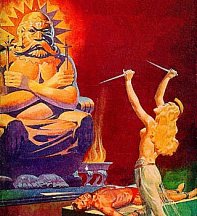
In Phundahl, the Tur Cultists worship at a variety of
idols of radically different appearance and mien, all of which are cheerfully
admitted to be Tur. These are almost certainly rival or lesser
Gods, now incorporated as aspects or avatars of Tur.
The incorporation of these rival Gods as aspects of Tur
may well have been the secret of Tur’s success and emergence as a monotheistic
God.
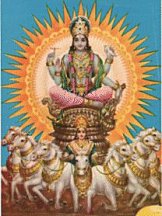
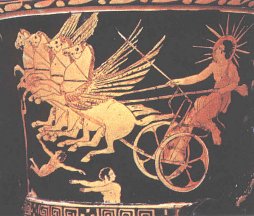
The sun is a great common factor for just about all cultures
on Earth or Mars. One can easily imagine some clever Tur priest
concluding that the sun god of a rival village or culture is simply Tur
wearing a slightly different guise. Whatever the theological
disputes between Sun God priests, the idea that they were all actually
worshipping something that was on some level, the same entity, seems logical
and attractive. So, it might have been quite easy for Tur to
subsume other Sun Gods and emerge as the common or universal Sun God.
And once this pattern has been established, it would have
been a logical step, eventually, to begin devouring other gods wholesale,
incorporating them as aspects of Tur, and incorporating their worshippers
in Tur’s ever growing flock.
For rival Cults, Tur’s approach presented insurmountable
problems. How could they fight over what might often seem to
be an obscure theological point? If they did fight and lose,
their choices were to continue their faith within Tur’s embrace, or to
reject Tur and be subject to slaughter.
Thus, in the many different effigies of Tur, we likely
have remnants of other Martian Gods. By this time, however,
it is probably all but impossible to tell whether any of the Gods of Tur’s
original pantheon survive, or whether they are all from rival pantheons
and monotheisms.
Of course, there was a downside for Tur, in that the theology
of Tur became ever more complex and unwieldy, accumulating avatars, aspects,
rituals in an ever more incoherent theology. The same mechanisms
were at work in the Catholic Church during its expansion through the middle
ages. Endless expansion made the religion endlessly unwieldy.
Time itself worked on the religion, since, over time, theologies inevitably
become more complex, rituals accumulate.
Tur’s followers eventually put together the Book of Tur,
or Turgan. Now, one assumes that when its just a local religion,
the rituals and devotions are transmitted orally. The Turgan as the
written word of Tur seems like a large development. It, or
versions of it, may date back to the early expansions or consolidations
of the Tur Cult. To a period when the Tur Cult was expanding dramatically
into many areas, accumulating ceremonies and rituals. At some point,
religious leaders would figure out that the Cult is flying apart through
centrifugal forces, that the Tur faith of this valley has no resemblance
to the Tur faith of that crater. At that point, there would
be an effort to make it all coherent by firming up some official doctrine,
and encapsulating it in the big book of Tur, Tur and nothing but Tur.
Of course, this effort to enshrine some homogeneity was
at best a mixed success. As the cult continued to expand and
evolve, it was revised, amended and appended. Both theological and
political developments would have altered the holy texts over time.
Worst of all, doctrinal disputes, as we see with the Christian bible, would
find fertile ground.
It is likely that Tur worship became the dominant Martian
religion. But that over time, the Tur religion experienced multiple
schisms and factions. Indeed, we see the same processes with
Christianity, which early broke into Catholic and Orthodox components,
and later broke further into a multitude of Protestant sects and even fringe
cults like the Mormon church, the Tai Ping, the Moonies and the Jehovah
Witnesses. The Islamic faith, while younger, has still produced
divergences between Sunni, Shia, Sufi and Bahai.
Political diversity, the break up of empires, emergence
of rival states, of city states, all of which would promote divergence
within the Tur Cult. There were probably religious wars, reformations,
purges and endless arguments about doctrinal purity. Even as
the Tur Cult accumulated complexity, priests and theologians would be continually
attempting to pare the faith back to some form of coherence, leading to
splits and schisms.
The fall of the Tur Cult probably accompanied the fall
of Barsoomian civilization. As the oceans dried up, as the
crops failed and cities fell, as the green hordes moved, the worshippers
of Tur found that their God was not responsive to their pleas, and their
faith weakened and fell away. It’s not good news for a Fertility/Agriculture
Sun God when you can’t keep the crops from drying up.
It is no surprise that the last major bastion of Tur worship
on Mars is in the City of Phundahl, whose climate and environment are as
close to pre-drought Mars as we are likely to come. This city,
isolated from outside influences, climactically protected, remained as
a final centre of the Tur Cult.
Indeed, it is likely that during the cataclysms, Phundahl
became a legendary holy city that the various sects of Tur worshippers
fled too. Eventually, the city would have become saturated
with a massive variety of Tur sects.
There could only be two possible results of such a profusion
of Tur sects in close proximity: First, devastating civil wars,
which may well have destroyed other surviving centres of Tur worship; or
Second, compromise.
Phundahl survived by embracing the traditions and rituals
of all sects. Rather than picking winners and losers, mixing or matching,
throwing out this or that, they let it all in. Contradictions
were just part of the greater mystery that was Tur. After all, who
can tell what Gods are thinking. The cult survived through
an ecumenical Tur movement which resulted in peace, but at the price of
an absolutely incoherent and unwieldy, superstition laden religion which
was incapable of expansion beyond its physical borders.
CULT OF ISS
Unlike the Tur faith, which appears to have been a primeval
faith which developed more or less coherently, the Iss Cult appears to
have emerged much later as a mystery cult incorporating radically disparate
theological concepts. Whereas the Tur Cult appears to have
always been an agrarian/life/fertility cult, the Iss Cult was probably
always a messianic movement.
The Iss Cult appears to rest on three great theological
myths, none of which quite link up. (1) An incomplete origin
myth centred around a tree of life. (2) A tradition of an afterlife,
including a physical journey to the afterlife on a sacred river.
(3) A belief in a monotheistic God-Queen, who rules the afterlife.
The origin myth is quite remarkable. Essentially,
the first life on Barsoom was the great tree of life at the mouth of a
sacred river. The tree produced plant men who hung as buds or growths,
as well three kinds of seeds, one containing primeval humans, another a
kind of sixteen legged worm, and a progenitor of the white apes.
The seeds fell and tumbled and rolled from the motions of the creatures
within, falling into the river and being carried to the four corners of
the planet. Countless generations lived and died within their seeds
before the first human broke out, and overwhelmed by curiousity, freed
other humans as well as the apes and worms. Thus was the beginning
of the human race, as well as the other races, and eventually, through
miscegeneation, all other animal life on Barsoom. Eventually
the tree of life died, but by this time, the various races had all managed
to propagate on their own.
As we’ve said, this is quite a remarkable origin myth
for several reasons. First, it is remarkably incomplete.
Where does the Tree of Life come from? The river? The world
itself? The sun and skies? As creation myths go,
this is quite limited in scope.
Second, note the complete absence of divine intervention.
There is no God or Gods in this creation myth, there is no intelligent
intervention. Indeed, by its very structure, this creation myth excludes
gods and intelligent intervention.
In other myths, humans are created by will or action of
Gods. Here we are merely the offspring of an insensate vegetable,
and merely one of the offspring at that. Even the ‘promethean moment’,
the emergence from the seed which is roughly equivalent in terrestrial
legendry to Eve’s eating from the tree of wisdom, or Prometheus’ gift of
fire to the first humans, has nothing to do with divine intervention, but
to the independent actions of the primeval man.
Of course, its been pointed out to me by a person far
wiser than myself, Bob Zeuschner, that many creation myths are ‘God
free.’ Even in the Judaic/Christian story of Genesis
God appears "brooding over the waters" BEFORE God says"let there be light."
Obviously, a world of sorts exists prior to the light. A number
of creation myths in our world place the world or a form of the world before
the advent of Gods.
Nevertheless, Gods do come along, and in most creation
myths, they set about shaping the protean world, raising mountains, carving
rivers, birthing monsters and natural phenomena, creating and/or civilizing
humanity, and setting the modern world in place. Not so with
the Iss Cult. Gods never sneak into the origin myths at all.
Rather, it’s remarkably god-free.
Third, this is almost a pre-science creation myth.
It is a proto-evolutionary theory. Consider the elements.
This myth suggests a common origin for both plants and animals, and offers
that animals have derived from a specific kind of plant. It
posits a common relationship or source for different classes of animals,
the distribution of animals, and even a mechanism for the emergence of
animal species. There is even a glimmer of natural selection
at work, since obviously, it is fitness and not divine meddling that prompts
the emergence from the shells.
All that is really missing here is a concept of mutation,
here replaced by a notion of miscegenation, and we would have an actual
working scientific theory. Thoroughly remarkable.
The weakness of the Tur Cult is that since Tur created
everything, there’s nothing new. Exploration, however, showed the
early Martians an endless variety of novelty, new plants, new animals,
new lands and even new peoples. They saw nature red in tooth and
claw, the world changing at every turn of day and season. The
relatively static world view of Tur was challenged by a worldview that
had to come to grips with transformation and diversity and had developed
a proto-science theory to explain it all.
So, where does this origin myth come from?
It’s possible that it may have existed or emerged in some form as an aspect
of the Tur creation myth. After all, what we know of the Tur
myth is that it is cosmic, concerned with the creation of the world.
So it may well be the second part of the myth, concerning the creation
of life and people. But this is unlikely. The Tur creation
myth is one of active and deliberate divine intervention, it seems atypical
that having physically shaped the world by hand, that Tur or his hypothetical
fellow gods, would then leave things up to blind nature.
No, this creation myth is not part of the Tur cosmology.
So then, where does it come from? Arguably, it is much later
in Martian history, and to be found during a period of rationality.
It clearly shows that someone was thinking hard about the relationships
of life in the existing world, and trying to work backwards to determine
how that life would have developed. The Iss creation myth then
is the product not of superstitious evolution, but of something closer
to platonic inquiry.
It is likely that the Iss Cult was only one of a number
of ‘transformation’ or ‘novelty’ cults which emerged at the fringes of
expanding Martian civilization. However, the Iss Cult probably
succeeded where others withered away because of its geographic particulars.
I believe that we can refine things even further by considering
the inclusion of Plant Men in the creation myth. Now it may be that
the Plant Men were added to the creation myth much later as a bit of tidying
up, in which case, it doesn’t help us to determine where or how the myth
developed.
But my own thinking is that the Plant Men were a seminal
component of the creation myth, particularly given the myth’s emphasis
on common origins of both animals and plants, and of the pre-eminence of
humanoid forms.
 There
is only one place on Barsoom that Plant Men were to be found.
The Valley Dor surrounding the Lost Sea of Korus, also known as the Argyre
Planitae, a large depression caused by an asteroid strike in the Southern
hemisphere of Mars.
There
is only one place on Barsoom that Plant Men were to be found.
The Valley Dor surrounding the Lost Sea of Korus, also known as the Argyre
Planitae, a large depression caused by an asteroid strike in the Southern
hemisphere of Mars.
The Dor/Korus complex of course, formed a biological island
in the Martian ecology. Isolated from the rest of Mars by fierce
deserts and rugged highlands, it was only erratically and infrequently
connected to the rest of the Martian ecosystem by a series of occasional
crater and valley wetlands. Consequently, Dor/Korus remained out
of the evolutionary mainstream of Martian life. Left on its
own, it was colonized by early plants who evolved for much of its history
without animals, and developed into a startling profusion of diversity.
Among the unique plants were mobile and carnivorous forms, including the
plant men. The few animals that did make it in earlier
were primitive hardy generalized forms, no match for the well established
ecology, and assuming subservient roles within it.
Martians of the early age of exploration would have been
astonished by what they discovered in the Dor/Korus region.
A profusion of wild and exotic plants that existed nowhere else on on the
planet, a veritable garden of eden largely unoccupied by animals.
And more, they would be astonished to find plants which, though clearly
vegetation, looked and behaved like Animals.
The presence of plant men, of mobile plants, and of various
kinds of plants, leads the Dor/Korus explorers to work backwards to the
primal ‘tree of life’, and from there, to hypothesize the parallel theory
of animal and human life.
As explorers and thinkers, settlers in new lands rather
than traditional inhabitants of the forefathers lands, they prized initiative
and activity. Thus the elevation of dynamic will in their religion.
There has to be a mechanism or pathway for transmission
of life into the rest of the world. The explorers would have
noted the broken sequence of valleys, canyons and craters, and perhaps
speculated that here was a link, perhaps an ancient long vanished river,
connecting Dor/Korus with the rest of Barsoom.
They might presume, with the rationalism that comes with
this early age of discovery, that animals by virtue of their mobility,
travel and propagate more swiftly than plants, and might spread over the
world quickly. Plants would spread more slowly.
This logic would lead inexorably to the conclusion that the area with the
greatest profusion and diversity of plants would be the area where life
originated. Hence, Dor/Korus would be the Barsoomian primeval
garden of eden. The hypothetical river would be the means of
transmission of life to the rest of the planet.
The absence of animals would be confusing, but not fatal
since they clearly traveled beyond the garden and were unable to return
when the river died. The existence of Plant Men
and plantanimal creatures would suggest a common origin.
Thus it is likely that this creation myth arose from the
discovery and exploration of the Dor/Korus complex.
And here, we may have a further window into the history
of Barsoom. The current priesthood of Iss and the current inhabitants
of Dor/Korus are the Therns. The Therns appear themselves to
be bald headed offshoots of the white skinned Orovars.
The Orovars appear to have colonized and emerged in the
other great Southern Hemisphere basin/sea, Hellas, also known as Horz.
Both southern basin seas would have originally been uninhabited, isolated
biological islands. The northern polar ocean and its
shores and borders would have been colonized first.
Thus, if we assume that the black First Born were really
the first humans. We can infer that the next race to develop
was the yellow skinned Okar who retreated to the poles and can still be
found there. The south would only have been explored
and colonized later, and the Orovars would have developed in Hellas.
This suggests that Dor/Korus was one of the last major regions to be discovered,
explored and colonized, by an offshoot of the Orovars who became the Therns.
It was likely the Therns who developed the philosophical
concepts that lead to the tree of life Myth, or at least the Therns who
institutionalized it into a systematic mythology and cult.
It is likely that the tree of life Myth, as both a myth or legend, and
as a proto-scientific theory found its way across Barsoom.
But to the Therns who were actually living in the ‘Garden
of Eden’, the myth took on new significance and became the basis for a
religious order, a spiritual movement and philosophy.
Of course, the life of the Garden of Eden needed a pathway,
now lost, to the rest of the world. Between the Equator and
Otz/Dor there was a winding network of valleys, canyons, cliffs and craters,
loosely connected. Obviously, seeds would find it difficult
to travel, but they could float. Thus, early explorers and philosophers
hypothesized a vast and mystical river, the Iss, along this jagged corridor.
In reality, this river had never existed. But it
too became a part of the myth and philosophical tradition, as the river
which was the gateway or pathway to life. Live began
at the head of the river and flowed out and down.
Over time, a mystical and messianic corollary arose.
If Life began and emerged from the River, then shouldn’t Life return and
end to the river.
At its most basic form, this is simply a mirroring of
the original idea. Life, existence, returns to the place it
began. The paradisical golden age had begun with the tree and
the river, and had ended when the tree died and the river had dried up.
A new golden age would come about when the river returned.
Or perhaps, more accurately, the end age, or paradise after life.
From the tree you were born, and in death, to the tree should you return.
Thus, Iss theology incorporated its first messianic thread.
The notion that the River would return and become the path back to heaven....
Both metaphorically and metaphysically, and physically.
Since the Iss Cult elevated dynamism, it was clear that
the duty of humans was to take the initiative and help to recreate the
river, literally rebuild it.
Thus, one of the early staples of the Iss faith would
have been to dig the river out again. To literally carve a canal
or channel halfway across the hemisphere to link all the valleys and lakes
of the corridor into a genuine connecting waterway.
Thus, the Therns became a messianic cult, preaching about
a future paradise awaiting in the future, when time was right.
Or better yet, preaching about the need to earn that Paradise by working
on the river. The corollary idea, the mirror idea, became
a prophecy. It was the other side of the origin myth, thus,
a kind of afterlife myth.
Of course, the Therns would find little success in venturing
out of their Idyllic valley to preach their new gospels to the hordes of
Barsoom. They might have found a relatively tolerant
welcome among their cousins, the Orovars.
During the golden age, as the Orovar civilization spread
north and came to dominate the polar ocean and three northen seas, its
likely that the Iss Cult spread right along with them, using the Orovars
trade and war as a vehicle for their own growth. It’s even
possible that the Therns may have become the theological or theocratic
wing of an Orovar Empire. More likely, however, whatever their
faith or attachment to the Iss cult, most Orovars probably felt no strong
need to promote the Iss cult against the Tur faiths. Nothing
is worse for business or better for rebellion than shitting on the local
gods, as the US is learning in Iraq. Hence, the Iss Cult spread across
the planet, though likely subservient to Tur Cults.
But for the most part, in the civilizations of Mars, the
endless variant cults of Tur thrived and dominated. Initially,
there would be no competition. The Tur cults were dominant,
and concerned with the day to day, the here and now.
The Iss Cult could only offer pretty pictures of the past and promise of
a glorious future, and perhaps a ‘neo-captialist’ get up and go philosophy
of dynamism and work for future rewards. The Tur Cult was all
about satisfaction now.
However, the Iss Cult had a couple of advantages which
allowed it to survive and even prosper within Barsoomian society.
First, the Iss Cult had a strong cultural and geographical
core among the Therns and in the Dor/Korus complex. The Therns
could look out over the valley and see in every blade of grass, the truth
of their faith and of their teachings. The Therns had become,
in fact, a theocratic state. How could they not be, living
in what they believed was the primeval garden of eden?
Hence, they always had a strong core, a root, a base,
a homeland, to which they could return. It was a homeland which could
provide support and sustenance to a root system, or a system of branches
and twigs which infiltrated out amongst the unbelievers.
Meanwhile, the Tur Cults, by this time, would have been
fractionated and divisive. A thousand separate catholic, orthodox,
protestant and fringe Tur sects, all competing and fighting among themselves.
In such an environment, there was room for an Iss Cult to survive, so long
as it kept it s head down and didn’t make too much trouble.
The other great advantage of the Iss Cult, was that it
was, or became a mystery cult.
Mystery Cults are religions based on mystery and ascending
to wisdom. In the Monotheistic Tur sects, it was pretty wide
open. It was actually quite democratic. There was
Tur, and there was everyone else. The mightiest king was as
a commoner before Tur. With Tur, everyone was on the same level,
the origin story, the theology was a great leveller. Tur was
almost democratic in his outlook. The animals may have been
created by Tur to be devoured by humans, and plants to be created to be
devoured by animals and humans, but at the end of the day, all were created
by Tur and all were part of his plan. Hierarchy was weak, and
at the will of Tur. Otherwise, if Tur willed it, plants could eat
men. Further, Tur’s mysteries were not hidden, but open to anyone
and everyone through his Turgan, or holy book.
With the Iss Cult, however, hierarchy was built in.
It was not a level playing field. There were highers and there
were lowers. Consider the origin story. Everything
begins with a Tree of Life. The Iss Cult doesn’t explain where
the tree of life came from, who made it, or how the world came to be.
By implication, there is some remote creator god (possibly Tur) who, upon
creation, has no further role and is not worshipped. The Tree
of Life produces four kinds of seeds. Hence, existence is divided
into three levels: 1) The Creator, 2) The Tree, and the 3) The seeds.
The seeds themselves are divided into three entities,
including the primeval man, who literally takes deity upon himself by breaking
out of the seed upon his own initiative. This is a remarkable
little twist on the creation myth, because in a sense, ‘Man’ in breaking
out of the seed on his own, literally creates himself. Thus,
‘Man’ is established as the fourth level in the hierarchy.
The black First Born consider themselves the direct descendants of this
primal man, and therefore descendants of the fourth level of creation.
The other two seeds contain a white ape, and a 16 legged
worm. But these are subsidiary beings, because they must be released
by the primeval man. They cannot ‘create’ themselves, but rather,
Man must help ‘create’ them. These then, constitute the fifth
level in the hierarchy of creation, or perhaps the fifth and sixth levels.
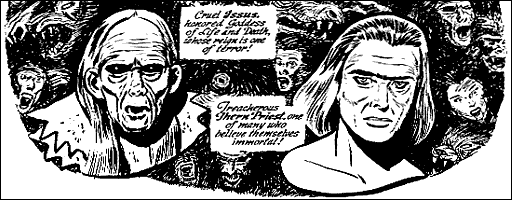
According to the First Born, the Therns are an ‘evolved’
version of the White Ape. It is not clear if they evolved with
intercession or coupling by the First Born. But clearly, they’re
derived from the fifth level of creation. The Therns probably
do not accept this notion, and consider themselves true First Born.
Irregardless of the possible special status of the Therns,
all other humans by the coupling of the First Born with these other two,
particularly, creating the remaining human races, as descendants of the
sixth level of creation. And all other animals are created
in the same way, as descendants of a seventh or final level of creation.
Meanwhile, the Tree of Life’s plant offspring becomes
a parallel level of creation, set off and away from the humans/animals,
which give rise to the various plants.
Conveniently, the Tree of Life dies, neatly taking itself
out of the equation, like the original creator God. This leaves the
Descendants of Primal Man as the rulers of an inherited universe, which
they rule by divine right of their own will and initiative.
This is fascinating. As origin stories go,
this is a stepladder myth, rather than a spontaneous creation myth.
It provides a descending order of divinity, and in particular, it reinforces
or supplies divine intermediaries. It is a myth designed to
devolve power and holiness upon a specific elite.
Thus, the tree of life origin myth contained within itself,
a kind of cosmic ladder of holiness, that was quite different from Tur’s
level playing field cosmos
And in fact, the Cult of Iss organizes society in precisely
this way. Thus at the top is the Goddess Iss, who becomes identified
with the creator. Beneath her are the Firstborn. Beneath the
Firstborn are the Therns, who divide themselves into levels of holiness,
but who are literally human cattle - subject to cannibalism. Beneath
the Therns are the other human races, themselves cattle to the Therns and
subject to cannibalism. Beneath the human races are the great apes,
the animals, and eventually sea creatures.
The Therns probably were the originators, developing on
this idea that was inherent in the myth. For reasons discussed
later, I suspect that the black First Born spins were post facto elaborations.
In any event, the Therns, oblivious to the First Born, naturally saw themselves
as the holiest of humans. Were they not the custodians of the
garden of eden? And when you began to divide up groups of humans,
it then becomes easy to divide within groups of humans. If
Therns were holier than other humans, were not some Therns holier than
other Therns?
This would have been part of the evolution of a theocratic
society. But it would also have been an idea that shaped that society.
There would be degrees of holiness. Obviously, the most powerful
and influential Therns would be the holiest of all. The most
common or low status the least holy. There would be room for advancement,
but the structure of holiness would be quite rigid.
Thus, the Therns became a rigourous, hierarchical society,
organized almost like a conspiracy. Their society, in merging with
its religion, would give the religion a degree of coherence and cohesiveness
that the Tur cults lacked, enabling it to survive and extend its tentacles
as a hidden minority religion.
And of course, the nature of a mystery cult is that its
revelations are secret. There is the faith or lore which everyone
has. But there are levels. The further you go up,
the more levels you ascend, the more secret lore or hidden knowledge you
receive access to. Various religions or groups on Earth operate
in this fashion. The scientologists are one, the masons are
another. Some large Christian groups, such as the Roman Catholics
have aspects of a mystery cult.
To be fair, since the tenet of the Iss Cult held that
just about everyone and everything else were varying levels of irrevocably
inferior beings, so inferior that they were fit only for cannibalism and
slavery, this was not exactly the sort of doctrine which, if publicly revealed,
would win friends and influence people. Particularly not among
the ‘lesser beings.’ So, a certain degree of circumspection
was in order. The Iss Cult’s expansion almost certainly dictated
its evolution as a mystery cult.
Historically, of course, mystery cults tend to do less
well in many circumstances than the more open and democratic cults.
Anyone can get down with Tur. To be an initiate of Iss meant years
of study and worship. On the other hand, within their society,
the Therns were a theocracy, and outside of their theocracy, they were
a covert minority religion. Mystery cults are very good at
surviving as hidden threads within larger societies, by their nature, they
are all about secrecy, hierarchy and organization.
What changed everything were the great droughts.
Suddenly, the oceans and seas were vanishing, the cities were falling.
Masses were starving. The green hordes had burst out overrunning
nation after nation. Entire populations had been reduced to
refugees fleeing or fighting for their lives.
In that situation, the Tur faith took a beating.
Tur was a god of here and now. And he obviously wasn’t doing
his job if his most devoted followers were being roasted on Green man spits.
The massive upheavals were beyond the abilities of the Tur faiths to cope
with or explain.
In contrast, the Iss Cult was suddenly doing great business.
It’s origin myth had always been a mildly interesting curiousity.
But suddenly, its ‘end myth’ the promise of a paradise in the future was
looking pretty good. Let’s face it: The present
was sucking big time, people needed hope for the future.
The Iss Cult had already infiltrated itself in many Barsoomian
societies as a covert messianic mystery cult. So as cataclysms
rocked peoples faiths in Tur, the Iss Religion was right there, literally
making converts overnight.
It was probably in response to the influx of millions
of new converts that the Iss Cult underwent its evolutions to its final
form.
Initially, as a messianic cult prophesying paradise with
the return of the sacred river, millions upon millions of new followers
offered both an opportunity and a demand. They wanted that
sacred river, and they wanted it right now, dammit!
The result was one of the many giant construction projects
of the cataclysmic age. The other great projects are well known
of course. The founding of the domed cities of Okar and Panar,
the creation of the Atmosphere Plant, the founding of Omean.
This was, perhaps, the single greatest project in Martian history:
The creation (or re-creation) of the River Iss! Essentially,
the construction of a gigantic, world spanning canal, along the course
of the mythological river.
Ultimately, of course, of the cataclysmic projects, the
most important was the Atmosphere Plant, which saved the world.
Okar, Panar and Omean were little more than island refuges which would
not save the world, but would shelter populations.
In this context, the River Iss project seems like pointless
and wasted folley. It’s completion would not save a single life.
But in a larger sense, the importance of the River Iss cannot be underestimated.
It was the beginning of the canal networks, and established the organizational,
social and technological structures needed to create the canals which were
to become the foundation of Martian life in the post-cataclysm era.
The Atmosphere Plant alone would have left only a dry
desert planet. It was the River Iss and the networks of canals
inspired by it that made life and civilization possible.
At this point, we should halt for a moment and consider
that as a further wrinkle, it appears that following the colonization and
occupation by the Therns of Dor/Korus, there was a tribe of the First Born
who traveled down the valleys and craters to Dor/Korus, were unable to
conquer and unable to return, and simply traveled along the outer rims
of the basin complex, ultimately reaching the southern polar region and
establishing themselves in the uninhabited underground sea that they found
there.
It’s clear that prior to or during the course of their
confrontation with the Therns, they themselves absorbed the mythology and
theology of the Iss cult, and incorporated it into their beliefs.
In fact, its most likely that the myth of the tree of
life and the Iss Cult took root among the First Born in their native lands,
and this lead to a messianic movement, a crusade, of true believers who
resolved to take the holy land.
After all, in the Tree of Life myth, the Dor/Korus complex
was the original Barsoomian Garden of Eden. The Therns were
the Custodians of the Garden of Eden. But if the First Born
truly considered or believed themselves to be the first and oldest race
on Barsoom, wouldn’t it make sense that they should consider themselves
the natural custodians of the Garden of Eden? And if the Therns
were not prepared to see the sense in this and hand it over, were not the
First Born entitled to raise up armies and crusades to take it from them?
We cannot be sure when this took place. Sometime
before the River Iss’s completion, and after between the occupation of
Dor/Korus by the Therns, the emergence of their theocratic society, and
their spread as a covert religion to the rest of Barsoom.
At a guess, we feel that the most likely period would be during the age
of cataclysm, during the early collapse of martian societies.
And of course, if they travelled south to take what they
saw as theirs, and were repulsed, would they be inclined to return home.
Or might not some of them decide to press on, seeking the original head
waters, the original source of the tree and of life, the land beyond the
Garden of Eden?
Ultimately, the First Born Crusade resulted in the establishment
a First Born civilization occupying the lost underground sea of Omean,
and of a second parallel Cults of Iss, unknown to the first cult.
The attempted invasion of the First Born came as a shock
to the Therns. As the entire planet turned to Iss worship,
they were hit with the realization that they might lose control not only
of their religion, but of their sacred land. This was clearly
unacceptable to them. They considered themselves a holy people,
after all. While they might consider other humans and human
races holy, they were *not as holy* as the Therns, if you get the drift.
That distinction soon translated to a finding or belief in the natural
inferiority of other races.
And if the other races and other peoples were inferior,
then perhaps they shouldn’t be allowed into the holy lands.
Or at least, not right away. Not until they were ready.
At this point, the Iss Cult was moving strongly away from
promises of an Earthly (or Barsoomian) Paradise, to a more abstract heavenly
Paradise. This had always been somewhat implicit in the mirror
myth, but circumstances demanded it be emphasized now. Luckily, the
hierarchical and ‘mystery cult’ nature of the Iss faith made this transition
somewhat easier.
And to be completely fair to the Therns, if their valley
had been swamped by tens of millions of hungry refugees, it soon enough
would have come to resemble the disastrous landscape that had become the
rest of Barsoom. To preserve their unique biological and geographic
sanctuary, they had to find a way to keep the millions of new followers
from overwhelming it.
Hence, the emphasis on the afterlife. The
Iss became a sacred river that could not be travelled in life, but could
only be used as the journey to an afterlife. The nature of
that afterlife, whether it was physical or spiritual might be a little
vague. But it was clear that the Iss was a one way trip.
People who wanted to live should look to their lives and not the journey.
This substantially cut down the numbers of pilgrims.
It also ensured that of the pilgrims, great numbers would be dead, dying
or easy to kill.
The Pilgrims journey, as far as the Therns were concerned,
was real. Ultimately, they would get to heaven, but there were simply
more intermediate steps to be taken. After all, the Therns were holier
than the Pilgrims, and they weren’t in heaven yet. Hence, the
religious/slave society of the Therns evolved. And in order to avoid
the notion that the Pilgrims might slip the hierarchy and sneak into heaven
before them, the Therns evolved a another hierarchical stepladder.
To reach heaven, the pilgrims needed to be reincarnated properly, or improperly,
as great apes, plant men, silurians, etc.
The other means of cutting down the number of pilgrims
was to give them something to live for. The Iss Cult, with
the lessons, tools and organisation developed from recreating their sacred
river, began to build the worldwide network of canals which saved life
and civilisation on Mars.
It may be a controversial assertion to attribute the salvation
of life on Barsoom to what was essentially a death cult, and one which,
by John Carter’s time had become an unsavoury conspiracy of cannibalism
and lies.
But the fact remains. During the cataclysmic days,
who else could have done it? What agency or entity could have
commissioned and managed such a vast worldwide undertaking.
Omean, Panar and Okar were the works of refugee nations, fleeing for their
lives. The Atmosphere Plant, as titanic an effort as it was,
was concentrated in a single location. The Empires, the Kingdoms,
City States, Races and Nations of Barsoom were fallen or in disarray.
Collapse and disaster was everywhere. Even the Tur faith was
being swept away.
Only the Cult of Iss was growing by leaps and bounds.
It’s network of tentacles became an organizational structure.
Only the Cult of Iss would have been able to organize the titanic canal
building effort across the planet, only they would have been able to plan
it on the vast scale necessary, and only they would have been able to motivate
the millions.
It is no surprise that the canal networks functioned as
gateways ultimately to the River Iss, so that from most of the planet (except
a handful of northern hemisphere regions), traveling the Canals would eventually
take you to the sacred River.
As a brief aside, we note that in Gulliver Jones, following
the River Iss took one to a realm of frozen corpses or preserved bodies,
not unlike that found around Panar. It is likely that in parts
of the northern hemisphere out of reach of the Iss Network, at least one
northern river or canal was, for political and theological reasons, named
Iss. Barsoomians were never really aware of this second Iss
as a separate river, and just assumed it was all one and the same.
That’s understandable since, no matter which Iss they traveled, no one
ever came back. We note that the Therns were active as far
north as Okar, within the Polar Ice. They were probably active in
Panar, and thus also probably supervised and maintained this nothern Iss.
However, with the passing of the crisis and the stabilization
of Barsoomian life and civilization at this new level, the Cult of Iss
passed its peak. Now the dominant faith on Barsoom, it
retained its mystery cult aspects.
Most Barsoomians believed in the ‘popular’ Cult of Iss,
the religion of the beginnings and ends of life. With existence
returning to normalcy, they returned to being concerned with life.
City states, Empires, Kingdoms, races and nation reasserted themselves.
If the Therns had ever hoped to transform all of Barsoom into a theocracy,
that opportunity had passed and faded.
The Therns returned to their operation of a covert religion.
The Therns saw themselves as a hidden priesthood of Barsoom, present in
every nation and town, guiding their faithful, shepherding them on their
journeys and maintaining their power covertly. They were,
effectively, a worldwide ruling conspiracy, and remained so until John
Carter’s time.
In defense of the Therns, it should be pointed out that
their rule was essentially passive, and most Barsoomians who did not fall
afoul of the faith, lived their lives happily enough. Apart
from defending their faith, the Therns may have even performed a service,
providing hidden avenues for city states to negotiate, brokering treaties
or truces, encouraging canal building and the preservation of essential
water sources.
It should be noted that after the destruction of the Thern
faith by John Carter, there was no longer any worldwide body capable of
wielding influence. Ultimately, this may well have been disastrous
for Barsoom in the long run.
Other aspects of the Thern’s Iss Cult evolved over time
and are understandable, if not excuseable. The continuing pilgrimage
of the dead and dying down the Iss posed a problem for the Therns.
Obviously, these people were generally not fit to be incorporated into
the society of the Dor/Korus region. Many were old, infirm,
depressed, morose, ill or ailing. The Therns would have exhausted
themselves pointlessly trying to provide hospitals and hospital care.
The alternative was murder on a massive scale for thousands
upon thousands of years. Of course, such atrocity must have
its psychic effect. The Therns increasingly saw other Barsoomians
as inferior, almost subhuman. The endless rafts of bodies
were food for the plant men and great apes, and eventually, the Therns
themselves. Thus, cannibalism entered their society.
The continual feeding of the dead to the wild denizens
probably inspired another theological wrinkle. The Therns,
already acquainted with holy hierarchy, decided that the dead would be
reborn into a new inhuman hierarchy, the holy beasts (holy because they
were directly from the tree of life and inhabitants of the garden of eden)
would embody the reincarnated souls. Souls would reincarnate and
rise or fall, depending. Unworthy souls would eventually reincarnate
as foul silurians at the bottom of the sea. Worthy ones would
eventually become Therns.
As religious tenets go, this one was almost a physical
gesture of moral self defense on the part of the Therns. On
the one hand, it justified their atrocities upon their innocent victims.
On the other hand, it promised that in the long run, these innocent victims
would be redeemed, so that it would be all right in the end.
It was a bit of ‘have your cake and eat it’ theology.
Those who survived the journey and were fit, became slaves.
Again, inexcuseable, though it should be noted that most of Mars was composed
of slaveholding societies. For those who were slaves
of the Therns, the true insult was not their slavery, but being gypped
out of the promised paradise.
Finally, let us now turn to the Iss Cult of Omean, the
last sanctuary of the First Born. It is clear that the Thern’s
lost complete control, and any sort of knowledge, of the Omean’s.
It could be said that there were three Iss Cult’s, each one hidden behind
the other. The popular day to day faith.
The Thern Cult of mysteries and secrets. And behind and unknown
to them, the First Born Cult.
We have already speculated on the origins of Omean and
the First Born Crusade which peopled that. This Crusade clearly purged
Thern influence or membership from its ranks, and left the First Born without
any covert Thern network. Nevertheless, they clearly maintained
their Thern derived belief in the Iss Myths.
By John Carter’s time, the Thern’s believed that the First
Born were devils who lived on the moon Thuria. They never suspected
that the First Born dwelled in a vast underground sea right behind them.
Nor did they suspect that the First Born were also parallel followers of
Iss.
For their part, the First Born were well aware of the
Thern beliefs, through their own observations and from captured slaves.
They regarded themselves as, being First Born, the true holy people.
They regarded the Therns as pretenders, hypocrites and neurotics.
But then, the First Born didn’t have to worry about running a worldwide
network, nor did they have to deal with hundreds of thousands of dying
pilgrims drifting into their sea.
At best, the First Born may have regarded the Therns as
being holier than other Barsoomians, while inferior to themselves.
This did not result in any great desire to reveal themselves to the Therns.
At most, it may have made Thern slaves a little more prized.
The evidence is that the First Born raided the Therns more frequently than
anyone else.
The First Born approach to the Iss Faith was just as hierarchical
as the Thern version. However, there was a fundamental difference.
The Therns believed in a series of ascending levels of holiness all the
way up to near divinity, and placed literally all humans, plants and animals
on this. The Thern hierarchy was one of stability, comfort
and slow ascension.
The First Born concept of hierarchy was far more predatory
and piratical. Essentially, it was all about the divine right
of the big fish to eat the little fish. In the Thern hierarchy,
there was at least a theoretical concept of duty owed to inferiors, a responsibility
of the higher levels to guide and oversee lower levels. Among
the First Born, a lower level was merely lunch. Absolutely
nothing was owed to those beneath you.
The First Born’s view of the Iss Faith, reinforced the
notions of dynamism and initiative which lay implicit in the origin story.
The highest form of life (after the now deceased tree), was Man, who took
the initiative to break out of his seed. For the First Born the lesson
was clear: Will, initiative, confidence, dynamism, whatever you call it,
could literally remake the world. Divinity was something to be seized.
Thus, the First Born Iss hierarchy was all about personal
elevation at all costs, and about subjugation of others, also at all costs.
Inferiors were simply fodder. According to John Carter’s
observations, slavery was common to all Martian societies, but the First
Born of Omean took enforced slavery to undreamt of heights, and applied
it with unrivalled thoroughness and cruelty.
The First Born even competed fiercely for status among
themselves. During his time among them, Carter noted the fierce
rivalry between Dators or Princes. The rapid elevation or fall,
and the cruelty accompanied by these sudden changes of fortune.
Status, religious holiness, was based on predatory prowess.
Thus, a Dator rose or fell based on his abilities to fight, to fly, to
raid, to capture slaves and booty, to sow fear among the Barsoomians.
It was a ruthless existence.
It was an existence which may have, in part, been dictated
by the circumstances of their environment. Omean as an underground
sea would have been extremely resource poor. There would be
an abundant supply of water, and perhaps fish and sea vegetation for food.
But beyond that, other necessities of life like wood, fabric, metal, tools,
etc., would have to be obtained elsewhere.
During the cataclysmic era in which Omean was probably
founded, trade would have been an impossibility. The necessities
of life could only have been obtained by raiding and war. Over
time, their evolution as a secret nation, the hidden holy people
behind the hidden holy people, would prevent them from coming out as a
trading nation. Their survival could only have been perpetuated
by constant war and raiding to obtain the necessities.
Thus, their social priorities would have been devoted
to war and raiding skills, to strength and prowess. Any other skill
or ability would simply have become the province of slaves.
Of course, a society as chaotically predatory as that
of the Omeans could not survive. Sooner or later it would tear
itself apart.
To prevent this, the Omean people created a final religious
twist on the Iss Faith. In order for their members to cohere
and work together, they all had to acknowledge someone above them, a higher
power.
In a sense, the First Born were returning to the egalitarianism
of the Tur Religion. They needed a God beneath whom they were
all equal. And their society developing the way it had,
they needed a God that good look them in the eye and make a ruling as to
who was going to be more equal and who was going to be less equal.
Thus, the Iss Faith of the First Born recreated a monotheistic
God. But unlike Tur, who was essentially a distant and abstract
God, this God would have to be up close and personal. A living
person, a God-King, or God-Queen. Thus, the ascension of Isis.
Isis, among the First Born, was an ultimately holy figure.
Alone among the First Born, she was immune from challenge or contest.
Everyone deferred to her, and everyone invested all their theological faith.
Because of this, Isis lived far longer than most Barsoomians.
She may have lived far longer than any Barsoomian.
As a living God she could not die. On the
positive side, this often meant that there were seldom scheming acolytes
pushing to kill her off so that they could take her place as the new living
God. But on the negative side, though this allowed Isis, or the Isis’
to live to great age, it also meant that provisions and mechanisms for
replacement were not well developed. The death of an Isis or
ascension of a new one was always a rocky time in Omean society.
The Tur Cult failed because, in truth, it congealed early
on. The Cult ossified and became unchanging, and its endless schisms
did not alter that underlying truth. It could not adapt itself to
changing conditions, it could only retreat and consolidate an increasingly
unwieldy mass of traditions and beliefs. The Iss Cult prospered
literally because it changed with times and circumstances, it took advantage
of events and developed new theology to meet changing needs.
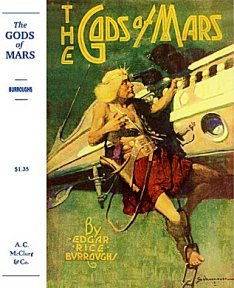
And thus, you have my tale of the Gods of Mars.
It is the story of faith, of the beginnings of Religion, of the elevation
of a God, and of that God’s fall from grace. It is the story
of the beginnings of science and reason, of new myths and new peoples,
of cataclysm and transformation, and of the processes that shaped the Barsoom
that John Carter came to love. We hope you have enjoyed this,
and that it gives you a little food for thought.