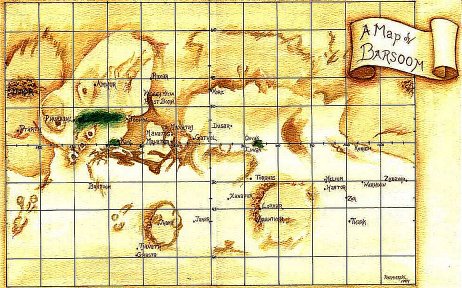
Click
for larger map image
On the positive side, John Carter unified Barsoom as no
other before or since. He lead Helium, a regional power, to
victory over its rival, Zodanga. Helium incorporated Zodanga
and other cities including Hastor within its Empire to become a planetary
superpower. The Heliumatic fleets ranged from Omean at the
South Pole to Okar at the North Pole, from the Toonolian Marshes in the
East to Jahar in the West.
Beyond that, John Carter created an empire of friendship
and loyalty which stretched across the planet. He could count
among his allies or subjects, the First Born of Omean, the subjugated Therns
of Korus, Ptarth and Gathol through Marriage, Toonol and Dusar through
alliances. His personal sway extended even to the Thark and
Warhoon Hordes, the dominant Green Martian nations. Jahar, the only
potential rival, was crushed.
Through alliance, personal loyalty, friendship and other
ties, the era of the Warlord was Barsoom’s final golden age, it was the
last time Mars could effectively have a planetary government.
Technologically, it was an age of advance and marvels.
Among the innovations were computers or electronic brains, interplanetary
travel, and new developments in flyers and navigation.
It was also an age of discovery. All over
Barsoom, lost civilizations and cultures were exposed. Invak and
Onvak, Kamtol, Panar and Okar, Omean, Korus, Ghasta, the Kaldanes.
But there were potential down sides to these advances.
Mars had existed for a long time with stable technology. Did
new technology, new tools and advances have the potential to destabilize
the delicate balances?
And what of the lost societies, many of them had survived
to the present on stealth, on being effectively invisible.
Now that they were revealed to the world at large, how would they fare?
Even within John Carter’s time, there were accumulating
signs of disaster. In the Synthetic Men of Mars, John Carter
is forced to literally incinerate a large swathe of the Toonolian Marshes
in order to stop Ras Thavas’ hormad monstrosity. The
Toonolian Marshes were the last great remnant of Barsoom’s once mighty
ocean. They represented a unique biological preserve, a delicate
climactic island which may well have been critical to the world.
And Carter firebombed the hell out of it?
Admittedly, he didn’t have much choice, but you have to wonder about the
long term effects, particularly in a planetary ecology as delicate and
close to the edge as Mars. Did the Toonolian Marshes recover,
was the firebombing small enough that the biology could regenerate.
Or did the damage remain? Was this the beginning of the drying
and dessicating of the Marsh?
What of Jahar. Again, this is not John Carter’s
fault. The sad state of Jahar is attributable solely to its
mad Jeddak Tul Axtar. But its fate must be pondered.
A rich but obscure south hemisphere Kingdom, Tul Axtar’s relentless quest
for power resulted in ecological devastation. Large provinces
were despoiled, there were runaway population increases, and the multitudes
were forced to cannibalism. A formerly rich productive territory
within Barsoom was now permanently despoiled. Could it ever
recover? Or was the planet now permanently the poorer for it?
What of Jahar’s neighbors. Were they plagued
by cannibal hordes and the destruction wrought. Were their fields
and canals less moist and bountiful as a result of the drought and desertification
wrought by their neighbor.
There had been an attack on the Atmosphere Plant, one
which had been narrowly averted. How safe and secure was it now?
How safe would it be in the future?
The Era of the Warlord, Barsoom’s final golden age, carried
within it the seeds of destruction.
Consider for instance, the likely political fallout which
would come about after the passing of the Warlord. John Carter’s
son, Carthoris, might hold things together for a while. But
eventually, the bonds of loyalty and friendship would pass.
The Greater Heliumatic Empire, which was based on personal
fealty to John Carter would come apart. Okar, Omean, Ptarth,
Toonol, Gathol would all go their separate ways, breaking away from Helium
and squabbling among themselves. Helium, in order to maintain
its dominance, might be forced into costly and ultimately unsuccessful
wars far from its borders. The result would be a Heliumatic
Empire exhausted and isolated, bloodied by former allies. Its
reach now bounded by enemies.
The Era of Peace imposed by the Warlord would be over.
Smaller cities, regional powers would break away from Helium’s influence.
There would be wars of influence, as other city states warred with Helium
for control.
The Green Man nations of Thark and Warhoon would also
return to their warlike ways. The sole lesson of John Carter’s
to endure would be teaching them to unite to sack the Red Man’s cities.
The Green Men would thus become even more of a threat than before Carter.
Ultimately, the rot would spread to Helium itself.
Zodanga, long Helium’s rival, would revolt, seeking to break away.
The resulting civil war would split the Empire. Tributary cities
would revolt, or be destroyed in the revolt.
Ultimately, Helium, exhausted, overextended, bled white
by endless wars beyond its borders, would fall, and the twin cities would
be sacked.
Mars would return to being a planet of constant warfare.
But the genius of Ras Thavas, Phor Tak, Fal Sivas, Carthoris and others
would mean these wars will become more violent and devastating.
Disintegrator rays, super fast flyers, all of it means that warfare would
become more intensive, casualties would become more plentiful.
Even the very infrastructure of canals and cities might come under attack
from incendiary bombs.
Mars was a world ecologically on the knife’s edge.
Thus, we have to wonder, how important were the remaining fertile and wet
areas to the Planet’s overall health. As I noted, Toonolian
Marshes had sustained a major attack under the Warlord, how viable were
they?
The Valley Dor, containing the Lost Sea of Korus, the
last great body of water on the surface of Barsoom, had been overrun.
It was probably the richest and most fertile territory on the planet.
With the religion of the Therns stripped away, without the protection of
their secret societies, the Valley was a prize ripe for competing City
states to war over? How much damage would those wars
do? How many bombs and weapons would fall upon those green
glades? What rapine would be inflicted by City States taking
of tenuous holds, would forest be stripped, groves be uprooted, the lands
harvested and looted for all they were worth. Would bitter
Jeddaks, forced out, pursue scorched earth and burn what they could not
hold? It strikes me that in the long run, there is a
good chance that the Valley Dor would be ruined and despoiled.
This same fate would befall other formerly sheltered areas.
The valleys of Kamtol and Ghast, the forest area of Invak and Onvak would
no longer be concealed. Would they then become prizes ripe
for plucking and rape? Smaller prizes, they would fall far
more quickly than Dor and be plundered much more thoroughly
Even the Underground Ocean of Omean might be in danger.
The First Born had also lived in secrecy, their economy based on raiding
and slavery was unlikely to survive exposure. The Omeans scarcely
had the skills to build a trading and manufacturing economy.
Thus, an increasingly weakened and impoverished nation, they would fall
easy prey to rival powers.
Ultimately, the race of the First Born might find its
strongholds in Kamtol and Omean shattered, and themselves spiralling away
to extinction. The Therns, scattered and bereft of a homeland,
might well accompany them. And the last remnants of the Orovars
in their tiny enclaves, such as Horz, might quickly follow them.
Apart from the cultural disaster and the extinction of
ethnic groups, the planet is likely in sorry shape. Barsoom
at this time is composed of deserts of varying aridity sustained only by
networks of canals, with a mere handful of rich fertile areas:
The Toonolian Marshes, the Valley Dor, some forests and marshes, a few
lush valleys. What happens when these fertile lush territories
are despoiled? Are the effects confined to these areas?
The very best we could hope for is a mass extinction of plants and animals,
and a further impoverishment of biological diversity.
Or are these areas critical to the ecological balance
of the planet? What about the climactic balance?
Without these areas to store and distribute water, to maintain the climate,
to generate oxygen and release carbon, to trap heat, what happens to the
rest of the planet? The effects are probably subtle.
Dry areas of the planet become dryer. The life giving mosses
of the ocean beds wither in many areas, fertile areas become desert, crops
in outlying areas. Life gets marginally worse, perhaps only
ten or fifteen per cent.
But that would be enough. The Green Men would be
forced to move by the failure of the moss that their Thoats depend on.
They would have to abandon old ranges and find new ones. This
would inevitably bring them into savage contact with each other as they
struggled for territory, and with the cities of the Red Men as they impinged
on agricultural territory. Following Carter’s example,
the desperate Green Men might be forced to unite in huge combined hordes
for attacks on Red Man cities and agriculture.
For their part, the Red Men would be facing desperation.
Their outlying crops failing, their water and food supplies diminished,
plagued by warfare and discord among the great powers, the smaller and
marginal cities would be hard pressed to survive the onsloughts of desperate
Green warriors. The great powers would be too wary of diverting
their resources to support their smaller allies, something that would make
them vulnerable to other great powers. As a result, support
would be slow in coming. Many cities would be besieged and
obliterated.
The fall of smaller cities, the attacks of starving Green
warriors and the constant battles between the great powers would put severe
strain on the canal networks. Some of the canals would be destroyed
or blocked. The delicate balance of the planet would steadily
deteriorate.
As the canal networks failed, as the dead deserts spread
and the moss continued to wither in sea bottoms, the Green martians would
have no choice but to push further and further, deeper into the areas formerly
reserved for Red martians.
Inevitably, more and more pressure would be put on the
surviving oasis, marshes, forests and fertile valleys. Sooner
or later, one by one, they would be ruthlessly despoiled and stripped bare,
and the planet’s slow spin into oblivion would gain speed.
Inevitably, the unified Green hordes, constantly pushed
by desperation and starvation, would confront the various great powers.
The great powers would be warring upon themselves. Would we
see temporary unification or alliances to wipe out the Green martians?
Before turning on each other again? Or would some of the Red
Cities ally with Green hordes to wipe out other Cities, as John Carter
united Tharks and Warhoons with Helium to defeat Zodanga? Again,
any victory would be temporary, since sooner or later, the victors would
turn on each other. The only guarantee would be massive casualties
and widespread devastation.
The great powers of the Red Martians would gradually shift
from fighting for supremacy to fighting for power to eventually fighting
for survival.
Sooner or later, the Atmosphere Plant would come under
attack as the last great prize. A city which controls the atmosphere
plant can at least assure its own survival by threatening the entire planet.
Of course, if the plant is destroyed, then it’s the end for everyone.
But even without the destruction of the atmosphere plant,
the deterioration of Barsoom’s environment is accelerating.
The deserts are becoming sterile, life is in retreat everywhere, the various
races and factions are unable to work together, everyone is fighting for
a piece of a constantly diminishing pie. The Martians are unable
to unite, the peace brought by the warlord is long gone, and the only other
organization of planetary scope, the Thern Cult has been shattered.
There are massive movements of refugees fleeing for their
lives, looking for sanctuary. Like locusts they overwhelm every
place that shelters them, stripping fertile territory down to rock.
Okar and Panar are dragged into the planetary war.
No longer invisible and hidden, the represent refuges and fall backs for
the great powers. If Helium can control Panar, or Ptarth occupy
Okar, then their rulers and populations have a safe haven to retreat to.
Meanwhile, these cities also represent storehouses of life support and
dome technology with their own atmosphere plants that may offer the only
hope for survival in the continually deteriorating Barsoomian climate.
Of course, both Okar and Panar will resist invasion.
There is a strong likelihood that the war of the great powers to invade
and take these arctic cities will result in their destruction.
There will be no opportunity to build new great domes.
Outside the polar areas, there is no sheltered secure area to build a dome,
and cities which waste their energy trying to build them will only find
themselves vulnerable to other cities and Green hordes, now desperate to
survive by rape and looting.
Barsoom becomes a relentlessly deteriorating series of
armed camps. Only by putting all resources into warfare can each
nation defend itself from its enemies. But by doing so, it sacrifices
its future. Any attempt to strive for that future means a diversion
of money, men, time and resources that leaves it a tempting target for
its enemies.
The situation continues to deteriorate, canals drying
up, forests and crops dying, the moss vanishing, dead deserts spreading
rapidly everywhere. The air become thinner and thinner, water
is scarce.
A crisis is reached where mass die offs begin to take
place. The remaining nations and tribes no longer have the
resources to make war on each other. Desperately, they turn
inward, trying to build domes and shelters to save even parts of their
populations. But it is too late, the process has gone too far,
and there is not enough time, money, manpower or resources.
Even then, in desperation, raiding and plunder continue to erupt.
Barsoom enters planetary death. Aridity and
thinning atmosphere reach cascade points that not even the atmosphere plant
can protect. There is a mass die off of life all over
the planet. The atmosphere fades to a whisp. The
world becomes a dead and sterile shell.
Now in the final stages, the only life left are a handful
of desperate enclaves in hidden shelters and domes, hastily constructed,
slowly breaking down, leaking steadily. They lack the resources
and time to build Panar or Okar level habitats. Life within
them is nasty, brutish and short. The surviving Martians continue
to raid each other where they can, constantly on the hunt of life giving
air and water, fertile females or functioning males.
Perhaps in isolated corners, eyes turn to the sky, and desperate plans
are made to cross space and make a new life of conquest on a little blue
world, third from the sun. Perhaps some even make the attempt.
One by one, sometimes with shouts, sometimes with whimpers,
these last lights go out. And when the final Martian
in the last makeshift shelter gasps his last breath, then Barsoom is finally
gone.
Click
for larger Whelan images of Barsoom