 Before
I start in on Jan of the Jungle, a few words about feral jungle
heroes. Tarzan was not the first.
Before
I start in on Jan of the Jungle, a few words about feral jungle
heroes. Tarzan was not the first.
Indeed, feral men go all the way back to Rudyard Kipling's
Mowgli, an Indian youth raised by wolves. Or further all the
way to Romulus and Romulus, suckled at a wolf's teats, or Gilgamesh's pal,
Enkidu, the wild man raised by beasts.
In history, there are endless records of foundling children
adopted by other cultures, or people who have gone native.
In North America for instance, there are tales of white children raised
by First Nation tribes, and vice versa. Going 'native' was an occupational
hazard of travellers and colonists. One minute you're a proper English
gentlemen,
and then the next thing you know, you're some East Indian Rajah or you're
potlaching your heart out in a Kwakiutl ceremony. Indeed, in Canada,
the Metis culture is a nation of half breeds, produced through the mixture
of native and western cultures.
Still, despite all the stories of children raised by wolves,
there's no verifiable record of a feral child raised by apes, monkeys,
wolves or whatever. There are records of children joining animal
packs or troops and being accepted, but these are pretty sad tales...
Usually tales of social disruption, civil war, famine or disaster, with
foundling children surviving as best they can. And usually, the foundlings
are not doing well. These are seriously messed up kids, not noble
savages.
There are big obstacles to a functioning human being successfully
raised by animals. One of them is malnutrition.
Both Tammy of the wolves and Ralph of the Impala are going to rapidly suffer
vitamin deficiencies and starvation because their bodies have different
nutritional requirements than their hosts. Even the mothers milk
varies from species to species, and there's no easy way around that.
Another problem is development. Humans don't automatically
develop in a straight line, rather, we go through a series of developmental
stages as our brains wire up and become increasingly complex. Things
like bipedalism requires both a certain level of motor skill and neural
wiring. There's a particular window where, if that skill isn't
learned, it may not develop. Language is a big one. From
an early age, say between 18 months and six years old, a lot of the neural
wiring for language starts up, but without the proper stimulation, it doesn't
form. Even among humans, it appears that the degree of stimulation
influences how it forms. After a certain period, the language
wiring seems to stabilize and it becomes harder for most people to learn
new languages (though abilities vary). All through the growing period,
the brain goes through developmental stages along with the body, both physically,
emotionally, sexually and intellectually. The result of not getting
or having the right stimulation available through normal human contact
during all these stages means they don't develop, or they don't develop
fully, or correctly, or they get weird. The result is not a
prince of the wilderness but some manic-depressive howling psycho, prone
to rages, dumb as a post, and with very inappropriate sexual responses.
So, even if you managed to get a child raised by wolves
or apes, the reality is that he's just going to be a bag of work.
The rare cases of semi-feral children are invariably seriously seriously
mentally disturbed, requiring years of work to become even borderline functional.
Let's face it, even Jane Goodall and Diane Fossey found
themselves getting a little weird hanging out with chimps and gorillas,
day in, day out, and they'd come to it as mature persons.
On the other hand, its not likely because humans develop
incredibly slowly compared to other animals. An antelope calf
is up and running within hours. A wolf cub is an adult wolf
in two years. A feral child is still a feral child in five
years, ten years, even fourteen years. Fifteen years to grow
into a functioning youth is a long, long time, if your average species
life span is fourteen. Most species have some expectation that
their cubs and young are not going to require lifetime attention, there
is life to get on with, roaming to do, more cubs to have... Its just
not viable. You might keep a human baby for a season, but in the
coming seasons, at some point, you need to relocate to new feeding and
hunting grounds, and its not as if the damn thing came with a carriage.
So at some point, the baby or child is eaten, or it's abandoned.
I suppose that an exception should be made for Tarzan
himself, in that he was not truly raised by animals, but by Great Apes.
Great Apes in Burroughs were distinguished from Gorillas, Chimps and Orangutans,
they were a fictional species with some humanlike qualities.
A lot of writers have argued, based on descriptions, that the Great Apes
were actually hominids or protohominids, perhaps Australopithecines or
Homo Erectus.
Whatever it was, it was a language-using tribe of primates,
with dietary requirements, long lifespans and at least enough of the social
and intellectual tools that Tarzan didn't grow up to be some mentally crippled
freak. Tarzan in that environment, probably would grow up to
be somewhat weird in human terms, but he'd also grow up functioning.
As it turns out, Tarzan really did grow up somewhat weird, and luck and
good genetics made him a savage superman.
Still, you have to figure with Lord Greystoke's natural
gifts, he was going to be a shock and wonder no matter how he was raised,
whether as an English Gentleman, an American style adventurer or even by
the merry kids from Trainspotting (although that might have turned out
more like William Burroughs).
The truth is that human raised by animals was never terribly
realistic. But there were enough instances of children being taken
and raised by radically different cultures and nations, there was such
a history of cross cultural and cross national foundlings (even Moses),
that tall tales and legends would naturally extend to children raised by
animals. And from there, it was only a matter of time before fiction
writers like Kipling and Burroughs would be playing with the concept.
Tarzan was not an original. But if you can't be
the first, you can still be the biggest. And by a huge margin, Tarzan
was the biggest ever, running through dozens of books, movies, television
series, comic strips, radio plays and every medium you can imagine.
And of course, a mountain casts shadows.
After Tarzan showed up and hit it big in books, comics and movies, there
was a wave of Tarzan clones - Ka-gar, Kazar, Bomba and many, many others.
They were raised by wolves, by apes, by ape-men, strange beasts of varying
sorts, crazy old jungle coots, lost tribes, you name it. Probably
the most ridiculous serious one was the Condor, a 1940s comic superhero
who was raised by, you guessed it, Condors, and went on to fly and fight
crime in one of the most homoerotic superhero costumes ever created.
There was an entire genre of jungle men and feral noble
savages, including several, like Ka-Zar, Bomba, and Ka-Gar who went on
to have their own series. There were even pulp magazines in the thirties
devoted to Jungle men.
Then for some reason, by the 1980s, the genre just petered
out for some reason, just like the western. Like the western, there
were a few high end productions... ‘Greystoke: Legend of Tarzan’
and Boorman's ‘The Emerald Forest’, and some low end ones, ‘George of the
Jungle.’ But for the most part, the genre went away.
Other genres die, seen many westerns lately? There were once thriving
genres of pirate stories, war stories and espionage stories. But
each has faded out and faded away.
It's tempting to wonder why the Jungle man genre faded.
Perhaps like the now fading Romantic Vampire genre, its simply that the
genre was built around the work of a single immensely influential writer,
Burroughs in one case, Anne Rice in the other.
I'm inclined to speculate that perhaps the growing knowledge
of the impossibility of feral humans that spread in the eighties is partly
to blame.
Or perhaps the myth of the noble savage had worn itself
out. That myth had been crystallized by Jean Jacque Rousseau before
the French revolution. He'd looked around at civilization and found
it a cesspool of slavery and corruption. “Man was born free,”
he said, “but is everywhere in chains.” Rousseau suggested that culture
and civilization was the cause of human degeneracy, and that man could
be freed or redeemed by being in the state of nature... A naked wild
man, in the bluntest versions, would be both free and superior.
Of course, Rousseau was writing in a pretty nasty and
toxic society. We are more complacent. But more than that,
there's now a lot of social science and research that shows that rather
than culture enslaving humans, that we are culture. Remove us from
culture, from society, from interactions with others, and we lose something
valuable. The notion of man as an Island has passed, and replaced
by man as part of a community. The idealized jungle savage has passed
with that notion.
Or perhaps it was simply that the world was growing smaller
and more complex, there were no more lost worlds, no more tractless and
uninhabited jungles, no more mysterious blank spaces on the map where anything
could happen.
Perhaps it was the racist overtones of a white superman
in Africa (and as to whether Tarzan was a racist fairy tale, I won't get
into. I'm not persuaded that it was, but at the same time, I acknowledge
the currency of this view. But at this point, I’ll leave it to some
other debate).
Or it may have been none of these things. Perhaps
the genre simply faded away, because that was its time, and the reasons
are no clearer and no more mysterious than the fading of so many of the
genres of our youth.
And so it goes...
Now, you'll notice that I've written a hell of a lot about
Burroughs and his imitators. But not Tarzan, his most famous creation.
Why not? Well, partly because although I enjoyed the
Tarzan series as a boy, I was always more interested in exotic planets
and lost worlds. It's true, Tarzan had his own lost worlds,
Pal-Ul-Don, Pellucidar, the land the Minunians, lost cities left and right.
Those were my favourites. And I've written about some of the
more exotic ones.
But for the most part, other writers have covered Tarzan
in far more detail and far more depth than I could ever hope.
Philip Jose Farmer wrote Tarzan Alive, what the hell could I possibly
have to say after something like that?
Indeed, Philip Jose Farmer took several of Tarzan's lost
cities, Opar, Athne and Cathne, Xuja, and a few dollops of H. Rider Haggard,
to work backwards to a primeval lost civilization that he chronicled in
his Ancient Opar novels. That was just lovely work, and there's nothing
I have to add to it.
I suppose that there's something to write about in terms
of the other Tarzan clones, many of whom encountered lost worlds and strange
races. I might turn my analytical bent, particularly to those
lost worlds and strange races. But sadly, I've not read most of those
adventures, and what with one thing and another, I probably never will
get around to it. So hopefully, there are chronicles for someone
else to record. I notice that the very worthy Steve Servello has
done a couple of very cool articles on Bomba the Jungle Boy.
But when it comes to Otis Adelbert Kline what we have
is a writer with a body of work, two Martian novels, three Venus novels,
a Moon novel that so closely parallels Burroughs in style and content that
it seems interchangeable. And Kline has not one, but two (or
technically maybe three) Tarzan clones, Jan and Tam, each with their own
lost world of prehistoric survivals and strange races. Not
only do Kline's jungle men make for interesting riffs on Tarzan but his
lost worlds and strange races, while distinct in their own right, mesh
up nicely with Burroughs.
So, without further ado, I offer you the two-part, Lost
Worlds and Jungle Tales of Otis Adelbert Kline....
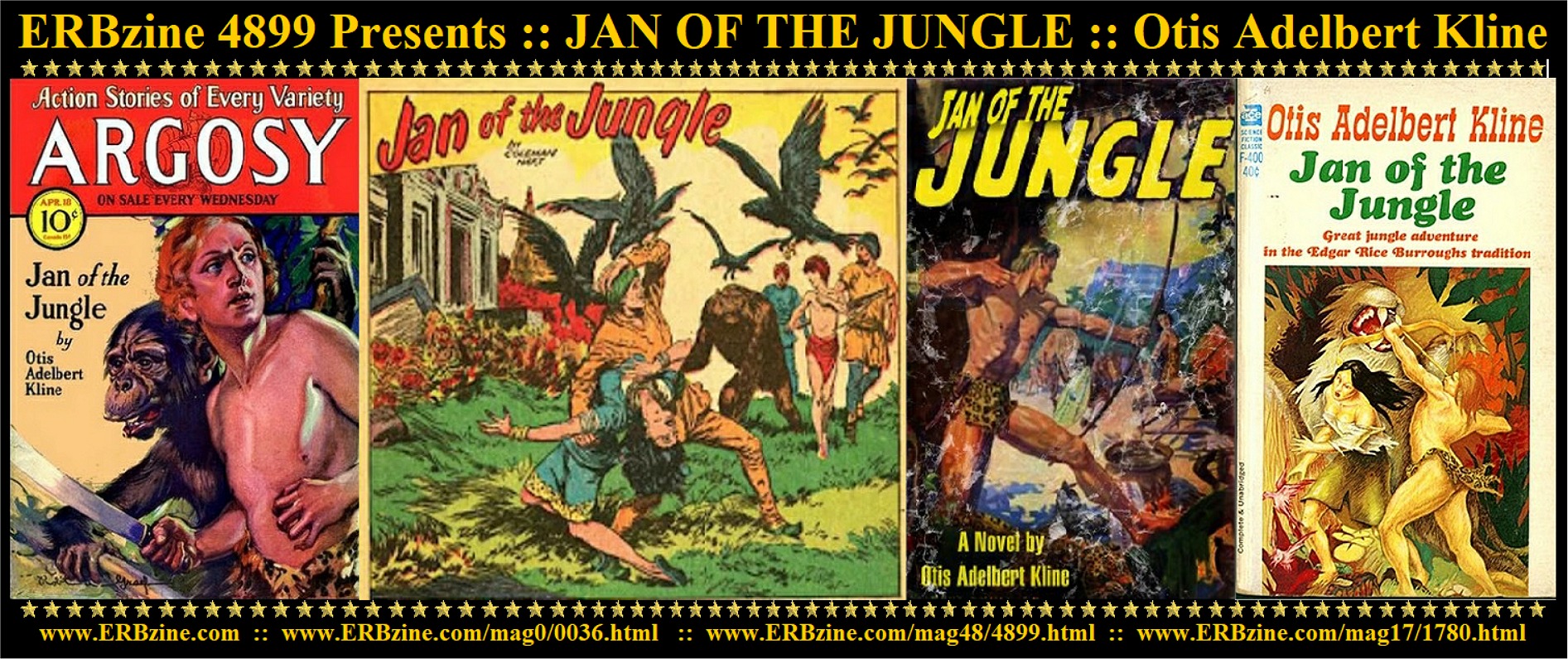
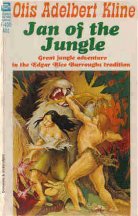
JAN OF
THE JUNGLE, also known as CALL OF THE SAVAGE
 Jan
isn't quite a Jungle man story, or at least not completely.
Oh it's definitely a rousing adventure, and it's definitely got a kitchen
sink approach. Not only do we have a Jungle Man, or sorts, but we've
got a revenge story, a romance, a lost world with two warring civilizations,
the whole nine yards. The book starts off well, moves along
briskly and is thoroughly readable.
Jan
isn't quite a Jungle man story, or at least not completely.
Oh it's definitely a rousing adventure, and it's definitely got a kitchen
sink approach. Not only do we have a Jungle Man, or sorts, but we've
got a revenge story, a romance, a lost world with two warring civilizations,
the whole nine yards. The book starts off well, moves along
briskly and is thoroughly readable.
The strength of the book, I think, lies with two principal
characters. There's Jan of course, who comes across as a likable
and friendly young man... When he's not being a serial killer.
But there's also a fascinating spin on the villain, Doctor Breck, who drives
the plot along for us.
Now, the story with Doctor Breck is that he was some brilliant,
upper class, but perhaps slightly shy guy. He'd pined away,
loving this woman from afar, and on the eve of a trip to Africa for unexplained
reasons, he confessed his love to her and won her hand in marriage.
Or so he thought. When he got back, he discovered that she had married
someone else. After that, he got a little nuts. Actually, that's
a bit of an understatement. You want an example?
Well, originally, he was just going to get his revenge on her by savagely
mutilating her boy, so she'd have to look at a helpless cripple for the
rest of her life... Okay, that's cold.
But then, while he's preparing to slice and dice a baby,
his chimps baby is killed by her crazy mate. So what does he do?
On a whim, he skins the baby chimp, sews the little boy inside the skin,
and gives it back to the Chimp mother. That's seriously, seriously
messed up. That's whacked.
And so begins his new plan: He's going to
raise the baby as an animal, teach it to be a savage killer, and then when
it turns sixteen, he'll have it murder his mother. Okay, now
that's just plain nuts. This is well beyond Hannibal Lector
territory. I mean, face it, Lector would have just eaten the baby,
with a nice red wine, and perhaps a salad. I mean, a
plot that would involve kidnapping a baby for the sole purpose of turning
him into a monster in order to kill his Mom twenty years later? Like
I said: Cold.
And he never wavers. Jan escapes, he's broke,
but he improvises, eventually tracking the Chimp-boy down, three years
later. Along the way, almost casually, he hands a teenage girl
over to a rapist, shoots a man in the back, lies, cheats and steals, all
without breaking a sweat. He's not really a likable character,
but apart from his obsession and the ruthlessness it breeds, he has no
unlikable traits. He isn't cruel or murderous out of whim or impulse,
but merely for the necessity of carrying his plans. In a way, his
singular and relentless focus is almost compelling. There's a horrible
sympathy that he accumulates, simply for his fixation, and the fact that
he's thrown away most of his life on this quest for revenge.
We don't understand Doctor Breck, and in fact, perhaps
we can't. He's truly a madman. But there's a fascinating, even
a tragic quality to him. His life is destroyed, and truthfully,
he chose for it to be destroyed, all for his quest. We have
the sense of wasted or misused gifts, of a person who could have been great,
even brilliant, but who has thrown it all away for the sake of a lifelong
obsessive revenge from which he never once wavers. All of which
goes to make him a fascinating villain.
All the more fascinating because no one else in the book
truly understands what he is. For two decades he stands behind
his lost love, their guardian, their closest confidant, their most trusted
advisor. All the while he's seething with hatred and revenge,
right up to the end and beyond, they never have a clue as to the nature
of the serpent they hold to their bosom. Jan is his enemy and
victim, but through the book, Jan never gives him a second thought.
Unless there's some specific reminder, Jan stops thinking of the Doctor
the minute he's out of sight.
It's a very odd thing, this monstrously malevolent person
resides within the novel, his mad schemes driving it forward, but no one
understands or appreciates him. Even Jan doesn't think about him
all that much, when he's not around. There's no sense of rivalry
between the hero and villain, no confrontation between them.
It's like Dracula was in a Woody Allen movie, and every now and then, Dracula
kills someone horribly, but none of the other characters notice or care,
and the plot almost goes on without him. I think it adds to
the tension, to the fascination to have this character who is an undiscovered
malignancy among the innocent. He's got endless opportunities
to do horrible things to people we like.
I suppose if Kline had set it up for the standard hero/villain
confrontation, it might be a much different, more conventional novel.
But the oddly passive ignorance of the true monster gives the novel a fascinating
quality that lifts it from being just another Tarzan clone.
Jan himself is an equally fascinating character.
It's impossible to equal Tarzan. Edgar Rice Burroughs did him first
and did him perfectly. And all that most of the clones can
do is simply imitate.
The thing with Jan is that we get to witness his progress
towards humanity. It goes like this: Due to the machinations
of Doctor Breck, he's raised in a cage by the Chimpanzee Chicma, and he's
trained as he grows up to be an automatic killing machine, directed at
his human mother. Doctor Breck's plan is that when Jan is old enough
and fully conditioned to attack and kill redheaded females, he'll be let
loose on his mother. Jan knows only two English words “Mother”
and “Kill.”
Luckily, although he's psychologically a young chimp,
he's flexible and curious. Seeing Doctor Breck unlock cage doors,
he imitates him, letting loose a lion. In the intervening confusion,
Chicma the chimp escapes, and Jan being a loyal son, follows.
From there, they make it into the swamps, and Jan has
his first taste of freedom, learning survival skills from his mother, and
fighting a crocodile and bear. Jan's not entirely happy with
freedom, he gets sunburned, scratched by branches and messed up.
He's so naive that when he goes into the water, the salt stings his scratches
and he decides that the sea must be angry with him for some reason.
Anyway, Jan and Chicma are captured by a Venezuelan tramp
steamer, who plan to exhibit them on tour as jungle man and ape.
The first trainer is a big blond jerk with a whip who Jan winds up killing.
The second trainer is an intelligent and compassionate Haitian, who begins
to teach Jan language and the rudiments of humanity. He even gets
Jan to start wearing a loincloth.
Luckily, or unluckily, Jan and Chicma are washed overboard
off the coast of Venezuela. Jan and his mom are happy there
in the jungle. Jan goes fully Tarzan at this point, but he's already
had his head start on humanity, so he winds up learning to use weapons
stolen by the Indians. A curious and gifted young man, he explores
the jungle. He hates the local Indians who try to hunt him,
and kills about thirty of them.... Which is a peculiar thing when you think
about it. Jan is a serial murderer.
Then two important things happen to Jan. He meets
a girl, Ramona (who it turns out eventually is a lost Lemurian Princess.
I wish I had a nickel for every time that happened to me) . Actually,
he rescues her from a Jaguar, which always makes a good impression.
They become secret pals and she helps to complete Jan's education, teaching
him to read and showing him books.
And he discovers a lost world. Originally, its just
a quick visit. But then Chicma gets terrified by a python attack,
and flees headlong into the jungle, straight into the lost world that Jan
has discovered. So there's nothing for him to do but follow her like
a dutiful son, which leads to a new round of adventures, just as the whole
Jungle man thing was beginning to flag.
Chicma gets captured by strange men. Jan runs
around and gets captured himself. While in prison, he makes
a friend, Kor Kan, prince of a rival city. Actually, and this
is a nice bit, Jan is pretty animalistic but Kor Kan befriends and cultivates
him. It's a subtle step towards his civilizing process, because
when you think about it, there are very few people that he's not prepared
to kill on sight. Remember that up to this time, Jan
has killed a few ape men, about thirty indians, and a ‘would be’ trainer.
That's a pretty respectable body count. He was raised up to
kill his mother, for Pete's sakes. Up to this time, the only
people he's been tolerant of have been black Haitian and Ramona, they're
basically it. Apart from that, his only emotional bond is to
a chimpanzee. Jan's stint in the prison of Set and his friendship
with Kor Kan is a critical humanizing step.
Anyway, he fights an Itchysaur (a giant shark or dolphin
like reptile), escapes, and tries to rescue his chimp mother, Chicma.
She doesn't want to be rescued. This just gets him captured again.
From there, it's a session in the royal gladiatorial games where, through
cleverness, courage and freakish luck, he wins big time, and becomes something
close to a Prince himself.
After that, things move to a climax, Jan returns to the
outside world, and falls into the clutches of Doctor Breck, who is finally
about to obtain his revenge. But hey, I'm not going to give
it all away...
But the point is that what we see with Jan is his evolution.
Starting from a chronological age of fifteen or sixteen, and an existence
of bestial savagery.... He's literally an ape, psychologically, Jan
slowly climbs up the evolutionary ladder, by painstaking steps becoming
a full human being. It's a believable process as Kline portrays
it, perhaps not in real life, but as written, there's lucky breaks and
drift. Fortune and coincidence favours Jan's development, but many
of the developments seem natural.
Jan's psychological and physical journeys are almost mirror
images. He starts off in a Doctor's home, in a lab, the height
of civilization, he escapes to the relatively domesticated Florida wilds.
From there he goes to a latin American tramp steamer, and winds up in the
jungle. He travels deeper and deeper into the jungle coming eventually
to a lost world and lost primeval civilization. Basically,
he's working his way backwards from Modern America to Dinosaurs and Lemurians.
It's an interesting contrast.
But what distinguishes Jan from many similar adventures
is that while he is literally travelling backwards through time, from civilization
to more and more primeval states, psychologically, he's moving from animal
to human. There's a surprisingly detailed and satisfying thematic
complexity here that transcends the regular pulp adventures of its day.
And fortunately, Jan turns out to be a genuinely likable
character. Even as an animalistic creature, he's likable, devoted
to his mother, fascinated and curious about the world around him, quick
to anger but just as responsive to affection and kindness.
He's terrified at points, but courageous, overcoming his fear to battle
everything from crocodiles to saber tooth tigers. Many of his
battles have an element of real drama, in part because he has no idea what
he's doing.... He just tries real hard, and if something works, he uses
it.
As he becomes human, his likable qualities develop.
There's a scene in which he's in prison and his food is stolen, he becomes
snarling and animalistic. Yet when someone else offers to share their
food, Jan releases his anger and accepts the gesture with gratitude and
friendship. When Jan and Kor Kan are about to be fed to the Itchysaur,
Jan is a cool customer, using his accumulated jungle smarts to make a plan
to both defeat the monster and escape with his friend, Kor Kan.
Later on, captured again, Jan is surly with a jailer, after all, he's in
prison and he doesn't like it. But given an opportunity to be helpful,
he becomes friendly. After all, its nothing personal to the
jailer, and Jan is fundamentally good natured. We end up liking
the kid.
Jan's Lost
World
Jan's lost world is similar to the one that Professor
Challenger discovered in South America, and it's similar to other lost
worlds we've seen.
For the record though, it doesn't seem to be the same
lost world that Professor Challenger finds. Challenger's land
seems to have been deep inland, in or near southern Brazil or Bolivia.
This place is, at best, only a couple of hundred miles inland from the
Caribbean coast of Venezuela.
Challenger's Lost World has ape men, as does Jan's, and
as do many other lost worlds, including Kline's Irimatri, Burroughs Pellucidar
and Caprona, and Carter's Zanthodon. (Interestingly, no genuine Ape-Men
on Skull Island or Pal-Ul-Don, so they're not universal). Although
Challenger's does have a culture of true humans, they're nowhere near the
levels of the two cities that Jan encounters. Finally, the
geography seems to be completely different.
Hey, my job is trying to fit these places together.
If I could make an argument that they were the same place or connected,
I'd be doing it.
Geographically, Jan's lost world appears to be an immense
oval or round valley, ringed by immensely high cliffs that separate it
from the outside world. The further into the valley you get, the
lower the elevation drops. The center of the valley is an immense
muddy swamp populated by fierce dinosaurs, with perhaps an inland sea or
big lake in the centre which supports creatures like giant Itschysaurs.
The Itschysaur is a bit of a problem. After all,
you can find some pretty big bass and catfish in a lake. But a forty
foot marine reptile? Come on. How does that species get
into a landlocked inland lake in the first place? And how does
a breeding population of creatures that big sustain itself?
We get the usual strange mixture. Saber tooth
tigers rub shoulders with triceratops, and giant sloths co-exist with giant
predator birds. There seems to be a Caprona-ish distribution
of species from innermost to outermost. Generally, dinosaurs
tend to become more common in the lower swampy sections. The further
away you get from the centre of the valley, the higher and dryer elevations,
the more that mammals and increasingly advanced mammals predominate.
The outermost regions, near the cliffs, seem to be populated by the Ape
Men.
But unlike Caprona, Kline isn't making any sort of point.
He's just going with a fairly superficial rule of thumb that the higher
and dryer areas are mammal friendly, and the lower and swampier areas are
reptile oriented. Or he probably isn't making any sort of point.
As I've noted with Jan's psychological and physical journeys, Kline is
repeatedly playing with ideas of progression and descent. So
the geography of the lost valley probably fits in with his literary themes.
There are exceptions of course. Triceratops seem
to range widely in mammal areas, and our lost world features, as usual,
two competing societies. Interestingly, as in Pal-Ul-Don, the triceratops
are domesticated critters, go figure. Like the triceratops
of Pal-Ul-Don, Pellucidar and Zanthodon, and like the Styracosaurs of Irimatri,
Jan's triceratops is an aggressive bad tempered beast, though in this case,
not apparently carnivorous.
Jan has some pretty cool encounters with prehistoric beasts
of various sorts. In addition to fighting the Itschysaur, he
faces off with a giant flightless predator bird and a saber toothed tiger.
He also gets to ride a triceratops. Basically, we're chock
full of prehistoricky goodness.
I've argued in other articles on Caprona, Zanthodon and
Tam that the dinosaur-inhabited lost worlds that we keep encountering in
these pulps, share a series of consistent traits: Ape men, true humans,
anomalous mixtures of prehistoric mammals and reptiles from different times
and continents, and the ecological problems of very large animals in relatively
small habitats. In this case, the Itschysaur compounds the
problem.... It's too large a sea animal for a population to endure
in the lake, and there's no good explanation for how it got there.
Basically, the way they're set up, they're pretty much
impossible and illogical. Or at least they're impossible on the terms
presented.
The fact that we keep encountering these lost worlds,
and the fact that there seems to be several, suggest that they are all
aspects or extensions of a single vast lost world... In short, they're
outliers from Pellucidar. Jan's lost world fits into this pattern.
As I've said, I've talked about it at length elsewhere,
so I don't feel the need to dwell on it. Instead, let's turn
for a moment to the three lost races that inhabit Jan's lost world....
The Hairy
Men
"Suddenly two great shaggy
creatures bounded out onto the sparsely grown avenue and closed in on him.
They were manlike and yet apelike in form, with long bushy beards and hairy
apelike bodies. One brandished a huge club menacingly, while the other
hurled a large rock fragment straight at the boy's head. Jan managed to
dodge the missile and turned to flee. But he had not taken more than a
dozen leaps, when a third hairy monster sprang in front of him, barring
his progress and swung for his head with a heavy cudgel." (Page 62, Chapter
10)
Okay. So the reference to beards is pretty unusual, but then
there are bearded and beardless human races, so there's no reason why that
variation should not occur among subhumans. Overall, there are strong non-humans.
They are described as apelike twice and as a monster and a creature once,
the word hairy is used twice and shaggy once, to indicate that they may
be furred like apes. On the other hand, there are also clear hominid attributes.
They're also described as manlike, and they're clearly tool users.
"As the first man-monster
struck at him with his cudgel, Jan ... easily eluded his clumsy swing.
The force of the blow turned the hairy one part way around... The monster
fell on his face without a sound." (Page 64, Chapter 11)
So, two more references to monster, and one to their being
hairy. The Ape-Men are humanlike, but they are definitely not human. The
reference to ‘clumsy swing' also suggests a more primitive creature. Jan
escapes. But on his second return to the hidden valley, he does not encounter
the ape-men, but he does note:
"He kept a lookout for
his enemies, the hairy men."
Hairiness is a principal attribute. These guys are definitely
furry. The reference ‘hairy men' however, suggests that they are not actually
apes. This is a fine distinction. Chicma is an ape. Jan knows what apes
are, he was raised by them, he considers himself one. Whatever these creatures
are, they are not apes to him. He considers man his enemy, and he knows
what men are. Thus, he considers the creatures ‘hairy men' in part because
they are both manlike and apelike, but more particularly because they're
his enemies.
The fact that they are not apes is reinforced with the
Lemurians capture Chicma. Clearly, although they're very familiar with
the ape-men (they capture them regularly and use them in their gladiatorial
games), they've never seen a chimpanzee or met anything quite like her.
This is why Chicma becomes a pampered pet in the imperial palace, with
rings on her fingers and toes and her own personal slave to groom her.
"In a cell on his right
was a hairy Man-monster like the one that had attacked him. This husky
creature was squatting in a corner, busily scratching himself. Jan could
see other hairy monsters squatting in the cells beyond. ....Looking across
the Arena, to the right and left of him, Jan could see hundreds of cells.
Those nearest him housed yellow men, white men and hairy men.... Like the
beast-men on one side of him, and the wild-looking white man on the other
side, Jan was fed raw meat."
Again, there are four references to hairy, two to ‘monster'
one to ‘beast' and one to ‘creature', all balancing off the three references
to ‘man'. Again, that's pretty much statement that this is a subhuman.
Note that they eat raw meat, another sign that they're not fully human.
Interestingly, there's a feral man among them. Yes, Kline has snuck in
a second 'Tarzan' as a supporting character, a white man who has gone wild
and become one with the apes... or at least, ape-men. The description of
this character and the comparison with the ape-men further reinforces that
they're not human.
"Another form paced back
and forth. There were a few scattered patches of hair on his body. (Implying
that the ape-men are completely hair covered, like apes), but the rest
was quite naked and as white as Jan's own skin. His beard and the hair
on his head were much longer than those of the hairy bodied creatures.
He stood more erect than these others, and was not nearly so heavily built
and muscular." Sadly, for the most part, that's all we get for description.
Subsequent descriptions amount to more of same. We don't get to see their
females, find out about their culture or ways. At one point we're told
that they live in Bands, and they appear to have been open enough to 'adopt'
an injured white man. But that's about all. Now, here's the really interesting
thing. The Ape-men have language. Jan never communicates with the ape-men,
who he hates. But the wild White-Man speaks it.
"What about you, Wild One? Can you
talk?" he asked.
"The bearded man looked at him blankly.
Then he began a series of guttural grunts and barks, very much like the
language of the Chimpanzees.
"Ha! So you speak like the
hairy ones. Well, no man can understand such noises, so I cannot instruct
you."
"I can tell you what he says," offered
Jan. "He asks what you want. Shall I interpret for you."
"No use," said the yellow clad one,
"he would not have the intelligence to understand."
Now this is just plain interesting. In our world,
Chimpanzees do not have language, although they can be taught forms of
language and develop small vocabularies (hundreds of words, rather than
thousands or tens of thousands). But apparently, in Jan's world, Chimpanzees
do have language. This is well established almost from the beginning, because
Jan speaks to Chicma constantly. It's clearly established several times
that the Chimpanzee is not the equivalent of Man, although Chicma has language,
she clearly acts and thinks like an animal. But she does have language.
And apparently, it's the same language as the Ape-Men.
Isn't that peculiar. Chicma's an African-Chimpanzee. The
Ape-Men are living fossils in a South American valley. But their language
is almost the same. So similar that Jan can easily understand and speak
it, or effectively identical. This implies that they're both speaking a
universal pre-human language, common to Chimps and Ape-Men, and probably
to Gorillas, Orangutans, and pre-humans. Possibly even monkeys speak it.
Although I find no reference anywhere to any monkey ever saying anything
that Jan cared to listen to.
Basically, they're speaking Mangani - Burroughs' universal
language of primates, that included his great apes, chimps, gorillas, orangutans,
sagoths, oparians, monkeys and baboons. A heavily evolved version of which
was spoken by the inhabitants of Pal-Ul-Don.
Of course, the question is: Is it really Mangani, or just
Kline's equivalent of Mangani. We have no way to know. Kline doesn't give
us in Jan's adventure, any ape or ape-man words at all. Still, the language
and universality seems so much like Mangani that there's no point in making
a distinction. Particularly if or when Kline avoids giving us any
details.
So, bottom line, we have Mangani speaking, tool using,
raw meat eating, hairy bodied hominids, not fully erect, heavy bodied and
muscular, with a mixture of ape and human features.
They're not equivalent to Burroughs' Great Apes, or the
Mangani themselves. They're too close to human for that.
But they are something very, very similar to Burroughs' Sagoths of Pellucidar,
or Kline's Zagr of Irimatri, in Tam, Son of the Tiger. Which may imply
that Jan's lost world is related to both of these other lost worlds. And
I'll leave that thought with you...
Temukan
, the lost city of the Khans?
We don't ever get to visit Temukan in Jan of the Jungle,
so all of our information on it is secondhand. It is
a city or city state on the opposite side of the valley from Setma.
The people there appear to be oriental or yellow skinned.
The indications are that Temukan's origins lie in the
orient. Temukan is evocative of Tamurlane, or Temu-lan, and
the Mongol Khan. Prince Kor Kan's name should or could perhaps
be rendered as Khan.
Oddly, the Temukan worship Quetzacoatl, a feathered serpent
god, which implies that they are actually Aztecs. Or perhaps
the Aztecs may be derived directly or indirectly from the Temukan.
The ancient Chinese worshipped or venerated sky dragons,
so Kline may have been drawing a connection here.
On the other hand, Kline's science fiction has some interesting
notions. In Maza of the Moon (as well as ‘The Man in
the Moon’ and Swordsman of Mars) we discover that the oriental race
is ethnically and linguistically descended from the inhabitants of the
moon, the Ma Gongi. And that the moon's fauna really does have
exotic feathered reptiles and creatures like chinese parade dragons.
In Port of Peril, Kline gives us a lost oriental
race called the Huitsen on Venus, who appear to have been a transplanted
colony of Ma Gongi, although this is never actually spelled out.
So it's tempting to assume that the anomalous oriental
race of Temukan might be another Ma Gongi colony, perhaps from the same
time as the founding of the Asian nations. In this case, it
was distinctly less successful, merging into the Indian population and
leaving behind only a few traces, like Quetzalcoatl worship with the Aztecs,
and the lost city in the hidden valley.
This would mean that the two Jan of the Jungle novels
fit into Kline's ‘Doctor Morgan’ Universe and are taking place in the same
reality that his Mars, Venus and Moon novels play in. It's
not a definite conclusion, but I think the evidence can support this.
Of course, in other articles, we argue that Kline's Mars and Venus stories
are in the same universe as Burroughs Barsoom and Amtor tales, which themselves
are in Tarzan's universe. Which would mean that Jan himself
is in the same universe as Tarzan.
There is actually a small indirect suggestion that this
is the case. The Latin American tramp steamer that grabs Jan
and Chicma, want to exhibit them as ‘ape-man and ape’, suggesting that
they're aware of and trading on Tarzan's legend. If Tarzan
or something like him didn't exist in Jan's world, would they have thought
to exhibit Jan as a jungle man?
But hey, I'm getting off topic, aren't I?
Alternately, Temukan might have been founded by the early
Asian oriental civilization after the Ma Gongi fell. But then
its pretty mysterious as to how they managed to get out there.
One oddity of Temukan is that it appears that they may
speak the same language as Setmu. Prince Kor Kan, who befriends
Jan, only teaches him the language of the Setmu. Normally,
I would have assumed that he would teach him his own language...
Unless the two speak the same language.
It's possible that Kor Kan and the Temukan do have a separate
language, and that for whatever reason, he didn't want to teach it to Jan.
Perhaps they don't like outsiders speaking it, or perhaps Kan figured that
Satmu was a simpler or more teachable language, or perhaps Kan felt that
Jan, being white, would take to it more easily.
But assuming that there is a common language, this implies
some contact. Were the Temukan originally a slave race to the
Satmu? A slave race that revolted and drove the Satmu out of
the Temu city, or crossed the valley and built their own? Perhaps
they were not a slave race, but merely a faction, perhaps an ethnic faction,
among the Satmu, worshippers of a fifth major god, who separated out of
a religious falling out? Or possibly the Temukan were the first race
or city, and they were conquered for a time by the Satmu?
There are enough questions here that you sort of wish
Kline had spent a little more time, or perhaps had developed the background
through additional sequels or stories.
Satmu,
the Last Remnant of Lemuria
Or perhaps more properly Sat-Mu. Okay, here's
the background, so far as we can tell.
Some Muan or Lemurian Prince was visiting Egypt when he
gets the news that Mu or Lemuria has sunk.
Distraught, he sails on from Egypt, through the Mediterranean,
across the Atlantic, floundering around on the coast of Venezuela, before
finally wandering around inland, discovering the cave to the lost valley
of dinosaurs, and then building a new city.
That just shows an amazing lack of any sense of direction.
Maybe the outpost was already existing and the Prince just headed there.
Maybe the whole thing about Mu sinking was a fabrication by the Prince
who couldn't find his way home. I don't know.
Mu, however, turns out to be a well documented historic
civilization in Jan's world. Henry Westgate, and English Explorer
and Adventurer. It turns out that Westgate not only is a knowledgeable
expert on Mu, but he can read its ancient writing.
Henry has a bit of bad luck. Trying to find his
way into the valley of Satmu, he has a fall, hits his head and gets adopted
by the Ape-Men. He's the third, and least prominent of Kline's
jungle men. He's also the most realistic in that when Jan meets him,
he's hairy, unshaven and a bit weird... Probably smelly too.
Anyway, the civilization of Satmu occupies one of the
two cities in the lost valley. Their home is the city nearest Jan's
cave entrance, and they're apparently responsible for the abandoned temple
and monuments which guard that entrance. Apparently, they've given
up on the outside world.
Their society is largely religious, being divided up among
four major gods or cults. These are Set, the black, a serpent
or sea monster god. The bird-like, or bird-headed Tehuti.
Hepr is the god of waters. Re, god of the sun, and the leading
god of Satmu. Each sect has its own priesthood, its own rites,
and its own independent authority, and politics in Satmu seems to be the
interactions of the different sects.
Over all of it is the royal family, lead by Emperor Mena
and his Empress Nefertre. They're hereditary, semi-divine royalty,
descended from Anpu and Heru. Their power is not unlimited,
and they have to treat with the priesthoods.
Indeed, there's considerable intrigue. Jan's girlfriend
Ramona Suarez turns out to be the long lost daughter of Mena and Nefertre.
The evil priest of Set, Samsu, kidnapped her as a baby and afraid to kill
her with his hands, put her in a basket and sent her down the river, where
she was found and adopted by the Suarez family. Conveniently,
Samsu wrote down a signed confession in Muan script, which he included
with the baby. When the Suarez's showed this to Westgate, he
deciphered it and headed straight for Satmu... and his date with
Jungle Man-hood.
By this time you've noticed that Satmu bears more than
a little resemblance to Egyptian culture, down to the names of royals and
gods. Laziness on Kline's part, perhaps? Who knows.
Perhaps ancient Egypt simply wasn't exotic enough for him.
Or perhaps, given the subliminal racism of the day, it wasn't white enough.
But let's not think those thoughts..
We do know that the Muans were visiting Egypt when the
news of catastrophe came, so maybe they just inadvertently took a bunch
of Egyptians with them, replacement rowers, mercenaries, whatever, and
over time, Egyptian religions and influences were incorporated into Satmu.
Which would make it a hybrid Mu/Egyptian culture.
Or perhaps the Egyptians themselves borrowed some of their
gods and culture from the Muans, which is why the two cultures were exchanging
visits. As a long shot, it might be the other way, with the
Muans being an offshoot of the Egyptians... though I regard that as pretty
unlikely.
Setting aside the quirks of their origins, the Satmu seem
to operate a pretty high level bronze/iron age civilization. They
have palaces, farms, woven cloth, metallurgy and indoor plumbing.
They've even adapted to the extent of domesticating the local triceratops.
As far as lost civilizations go, they seem to be a pretty
decent bunch, particularly when we recall some of the headcases like Opar
or Xuja or Athne that Tarzan stumbled over. And hey, if the
royal family was willing to adopt Jan as one of their own, they must have
something going for them.
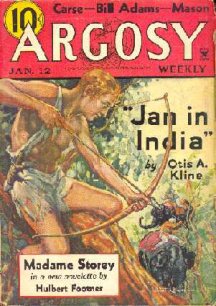
Jan in
India, Call of the Savage and Tam, Son of the Tiger
Jan in India is the sequel to Jan of the Jungle,
one of Kline's rare sequels. Honestly, I'm not sure why he
wrote it.
Here's the thing. Once the hero gets the girl, kills
the bad guy, becomes a prince of his tribe/lost city, and sorts out his
origins... What's left for a self respecting jungle hero to do?
Where do you go from there? And why?
Not so easy when you start to think about it, eh?
Sure, guys like Doc Savage and the Shadow went out and had thrilling adventures
every week. But let's face it, they were both psychopaths who went
looking for trouble. And their adventures didn't really resolve
much in their lives, it was basically kicking ass as a way of not thinking
too much about where your life is going.
You see this with Doc Savage particularly.
It's good for the rest of us, Doc saves a lot of lives. But as his
series goes on, he's slowly running out of money, his friends aren't showing
up as much, he still doesn't have a girlfriend and the cops are starting
to eye him suspiciously. Basically, he's slowly turning into Michael
Jackson with guns. Not even Michael Jackson wants to be Michael
Jackson any more.
Tarzan managed to have a pretty good run.
But let's face it, most of the emotionally satisfying stuff, his growing
up, his return to humanity, becoming Lord Greystoke, meeting Jane, meeting
La, becoming Chief of the Waziri all happens in the first few books.
By the time we get to son of Tarzan, its pretty clear that Burroughs has
no idea what to do with him any more. Tarzan got a shot in
the arm in the WWI storyline, where the Germans raided his estate and he
thought Jane was dead. He went a little nuts there, but it
made the character compulsively fascinating. And from there,
Burroughs lucked into a formula that would keep Tarzan going, warring lost
races, Tarzan getting curious, Tarzan losing his memory other people looking
for trouble... But a lot of it was just drift after that.
The truth is that once your hero has solved all his problems....
He has no problems. No reason to go anywhere or do anything.
Retire happy. It's a real problem.
We see this with Jan in India. Jan
of the Jungle is a damned good novel, it verges on being literary,
and it's a hell of an adventure ride. It's also extremely satisfying
in the way it charts Jan's personal growth from animal to human, gets him
a girlfriend, disposes of his great enemy, and reunites him with his parents.
In contrast, Jan in India doesn't really have anywhere
to go. There's a tenuous emotional subplot where Jan wonders
if Ramona is so tired of him she's trying to kill him, but its not terribly
persuasive. They still love each other. Jan's fully human,
his parents love him. There's no real emotional through line.
Perhaps that could have been concealed by adding supporting
characters who carry a romantic subplot, as Burroughs often did.
Or by upping the bizarre and outrageous factor, in order to make it colourful
enough to keep things going. When the tune gets a little thin,
crank up the volume it works. Still, Kline did neither of these
things. He simply delivers a straightforward and remarkably restrained
adventure.
Jan of the Jungle was published in 1931, the same
year, as Tam, Son of the Tiger. Jan in India
comes out in 1935, four years later. Why? Well, I suspect
that Kline was capitalizing on the production of Jan of the Jungle
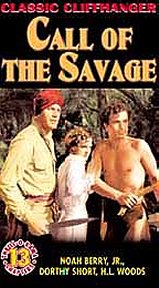
as Lew Landers Jungle Adventure serial called Call of the Savage.
As so often happened in these cases, the producers took a few liberties.
If I may quote from Bill Hillman's ERBzine
0442, the serial plot goes something like this:
Two scientific teams go up against each other in a race
to find a secret formula in the African jungle. The search leads them to
the lost city of Mu where they face a ruled by a bad-guy priest. who owns
a death-ray. The scientists have to overcome this mad priest and his dungeons
of fire and dangerous electrical rays. Noah Beery, Jr. played Jan the feral
orphan raised by monkeys. Jan, along with his faithful chimpanzee companion
"Chicma," joined in the quest for the lost kingdom of Mu. Assisted by Princess
Mona (Dorothy Short) they overcome the evil scientists (Walter Miller,
Frederic Mackaye), the priest, and many cliffhanging pitfalls, including
a mechanized room with a ceiling full of spikes heading straight for the
good guys. The serial was cut down for a feature film-length version called
Savage Fury (1956), likewise available on video.
Well, Jan's there. And Chicma. Ramona becomes
Princess Mona. But hey, we seem to have relocated to
Africa. And what's this with two teams of competing scientists?
Or the Death Ray? Mu, or Satmu is still there, but it seems its goodbye
dinosaurs (the accountants ate them), goodbye to the elaborate Doctor
Breck storyline and goodbye to Jan's psychological journey.
Instead, Jan appears to be a fully formed Tarzan clone, and there's a lot
of cliffhangers. Well, what can you expect? Tarzan didn't
get much better treatment in his movies. The serials weren't
about psychological nuance, they were about guys with funny hats getting
a good sock in the jaw from the hero.
I checked the IMDB, and there were two reviews for Call
of the Savage, one good, one bad. I've seen enough serials though,
to say that they're pretty much an acquired taste. Still, if
you ever get a chance, go ahead, check it out.
One hopes that Kline wasn't too disappointed.
The pulps and serials were both popular enough that he should have had
a good idea of what he was in for. Hopefully there was a decent
cheque attached, and he cashed it quick.
I think though, that one way or another, Jan in India
was inspired by the Jan of the Jungle/Call of the Savage serial.
Either Kline was cashing in on the serial, and I have no problem with mercenary
ambitions. Or perhaps he wrote Jan in India as
a revolt against the serial. Or dealing with the serial got
him interested in the character again... Or possibly, he'd
had Jan in India written a few years back, and the serial finally
allowed him to sell it to a magazine.
If I had to pick one, I'd go with the last.
Jan in India starts up barely six months after the end of Jan
of the Jungle. Jan and Ramona have gone on a pre-nuptial
world cruise with their parents. Probably not Jan's idea.
As much as he desperately wants to get to know his Mom and Dad, he is basically
a Prince of Sat-Mu and he's got a life there, and more than that, I can't
imagine he wants to wait six whole months to get laid.
The strain of parent enforced celibacy is telling on Ramona
too. So it's no surprise that the book starts with a spat by the
high strung pair. Jan stays on deck to get some air, and an
evil Indian throws him over the side.
It turns out, he's in the employ of an even more evil
Maharaja to kidnap Ramona and either marry her or sacrifice her to a big
cat who is the current incarnation of Kali. Jan survives and
makes it to shore, where he's chased around a bit by tigers and jaguars.
Eventually, however, he hooks up with a boy whose father has just been
eaten by tigers. Together, they join with a couple of friendly
elephants, and Jan bumbles around the jungle until he finally stumbles
over the bad guys. Meanwhile, the villains are engaged in some
complicated plot to ditch a rival Muslim Maharaja and to throw Jan's parents
off the trail. By this time, Ramona is kidnapped, apparently
by evil Muslims, and they think Jan is alive (which is what the evil Maharaja
wants them to think, because he thinks that Jan is dead, but really, it
turns out Jan is alive) so they're understandably confused.
Anyway, if you want to know how it turns out.
Jan rescued Ramona in the nick of time, evil is vanquished, ironic fates
are dished out, and Jan and Ramona live happily ever after.
As I've noted before, there's nothing particularly fantastic
in Jan in India. No lost worlds, no ape-men, no lost prehistoric
valleys, dinosaurs, mysterious races, super science or supernatural, no
monsters. None of the stuff that I like.
The secret Kali Cult that Jan encounters isn't far outside
the bounds of reality. The politics of Hindu and Muslim, the
Elephants and Tigers that Jan encounters, his adventures with man and beast
are all pretty much grounded in something approaching the plausible world.
So, basically, its all about a guy in a loincloth running
around beating people up. Okay, fine. I can live with
that. I'm not happy, but I can live with it.
But really, I do have to wonder. Both Jan and Tam
were pretty over the top. Did Kline just want to follow up with something
more realistic? Had bizarre adventures fallen out of favour
and more realistic derring do was in vogue? Or was Kline simply rebelling
against the serial. Sadly, I can't say.
It's just not as much fun.
Luckily, Ramona is still acknowledged to be a Lemurian
Princess. No retroactive continuity here. So Dinosaurs
and Ape-Men still exist in Jan in India, we just don't see them because
they're off in South America. And there is one very suggestive
passage, to suggest that there are remarkable things yet to be encountered:
At first she saw only a gigantic black idol of most hideous
aspect.
“It is the image of Kali,
the black one,” said the Maharaja.
The Black One was a most fearsome sight. Her eyes were
red and her breasts, face and four giant hands were smeared with blood.
One gory hand held a sword, one a trident, one a club, but one a shield.
Her hair was matted and unkempt, and the tongue which protruded between
her projecting fang like teeth, dripped blood. She wore a necklace
of skulls, earrings of dead bodies, and a girdle of serpents, and stood
upon the body of Siva.
“Can it be possible,” said
Ramona, “that human beings actually worship such hideous objects.”
“Some people, yes. They worship
the symbol instead of the reality. We enlightened ones worship the
great goddess herself and her genuine incarnations.”
“You believe then, that Kali once
lived in this horrible form?”
“That is right,” the Maharaja replied.
So, although we never see a live monster, there's a very
strong suggestion here. Certainly, the Maharaja believes that Kali
has lived in the form of a ferocious, black, four-armed giantess.
Possibly, its simply folklore and myth, and certainly we can take this
view given the events of Jan in India.
Or given that Jan of the Jungle has some pretty
remarkable stuff, its just possible that the Maharaja is not completely
out to lunch, and that a race of beings who inspired the statue did indeed
walk the Earth, or dwell beneath it.
In Tam, Son of the Tiger, Kline gives us the following
glimpse.
Pacing the wall, and armed
with tridents, bows and arrows, and tulwars were a number of gigantic,
four armed females, jet black in color.
“Amazon warriors of Kali, the Black
one,” Nina told Tam.
It seems that perhaps the Maharaja had it right after all.
Jan in India seems to provide us with some evidence to connect Jan's
world to Tam's world, and to connect Jan of the Jungle with its
lost world and ape men and universal primate language, to Tam's lost world
of Irimatri, with its ape men and universal primate language.
Given that Tam was written before Jan in India, it strikes
me that the most likely explanation is that Kline was giving us a little
wink.
It's not conclusive. But I think it's pretty persuasive.
Now, on to Tam,
Son of the Tiger.