Reaching home on April 15, 1892, Ed told his version of
conditions at the academy and the harsh treatment he believed he had suffered.
His father, indignant, wrote a letter to Colonel Rogers the same day. But the
arrival of a telegram the next day, with its terse, abrupt wording, made Ed's
behavior appear serious. The telegram from Commandant Charles King read:
"Your son deserted Thursday letter will follow."
That George Burroughs, a retired army major,
accustomed to military discipline, should protest about the treatment accorded
Ed indicates that matters can be different when one's own son is involved.
Commandant King's reply to Burroughs' letter, written on April 18, in the
absence of Superintendent Rogers, revealed also that King, while refusing to
budge an inch, was a master of tact and diplomacy:
That you should think, after hearing your son's side of the
story, that the commandant is too severe is most natural, and being a father
himself, the Commandant has every sympathy with your distress. Now, however,
let us look at the soldier side of the question.
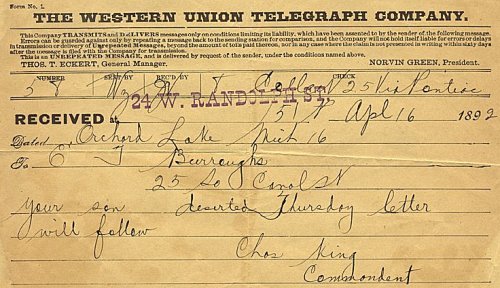
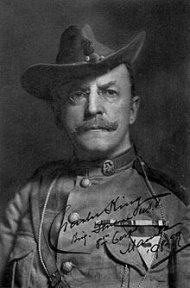 Young ERB's Desertion Telegram from Commandant Charles King
He then
proceeded to explain in detail the offenses that Ed had committed; George
Burroughs must have found the list painfully incredible. King wrote:
"Since his return
from vacation, a week or more behind time, Cadet
Burroughs has received an extraordinary number of reports for not one of which
has he tendered to the authorities the faintest explanation or excuse. They
include some of the most serious known to our records both in the Academic and
military departments, as you may see from the specimens enclosed
herewith."
Of the "specimens"
submitted for Burroughs' verification, King commented that the academy had
always had a "standard of punishments" for these — the penalties
Cadet Burroughs received were nothing new. King offered a mild reproof and reminder
to Burroughs:
The severity of which you complain may possibly exist in
these long established rules, but as an old soldier yourself, you should
understand that the Commandant is simply carrying out the orders in the case,
and although he might with propriety say that he feels no obligation to defend
his course, on the other hand he prefers to invite the better judgement of a
Companion of the Loyal Legion upon the facts in the case..
King remarked with some restraint
that "it is to be regretted that Cadet Burroughs for his own sake was not
willing to explain." By this time George Burroughs must have realized that
his son, to put it euphemistically, had been quite "unwilling" to
explain.
Other facts emerged, revealing a
debatable question of Ed's supposed "illness":
As to the accusation of harshness in not permitting the young man to
remain in bed and have his meals sent to his room, I will say that when one
doctor pronounces a Cadet able to be up and about, it is considered ill advised
on the part of the Commandant to interpose. In Cadet Burroughs' case, as stated
by himself, both doctors pronounced him able to get up and to go to meals.
King, continuing to write in his
objective third person, stated, "It was the severe Commandant who ventured
to oppose his judgement and permit the boy to go to bed again."
As to the confusion arising over
Ed's claims that he didn't consider himself "in confinement"
even though Professor Loveland had given him the order, following which he had reported for confinement, King offered a
comment that was a masterpiece of understatement. Ed's explanation "is
necessarily looked upon with much surprise, if not with grave doubt as to his
sincerity."
King gave further details of Ed's behavior. On the
morning of Wednesday, April 13, Ed, while in confinement by orders of Professor
Loveland, climbed through the window of the barracks to make his escape. He was
accompanied by another cadet "who has since deserted under still more
serious accusations." When questioned by the cadet officer, Ed
admitted that he was leaving for the depot. Taken before the commandant and
"invited to explain his extraordinary breach of orders and
discipline," he replied that "he had nothing to say." In the
letter King pointed out,
"As an old soldier you must know that the
Commandant had then no recourse but to administer the punishment required `by
the custom of war' in like cases, as he found it at this Academy."
Ed's attempt to escape, on this
morning, had evidently not been very determined. But on the next day, April 14,
he made a successful escape and returned to his home in Chicago where, shortly
afterward, King's "desertion" telegram was received.
King offered some consoling words
to George Burroughs in the letter:
Cadet Burroughs' offenses have been most serious, but not
irretrievably so. He has been reckless; not vicious. He has found friends here
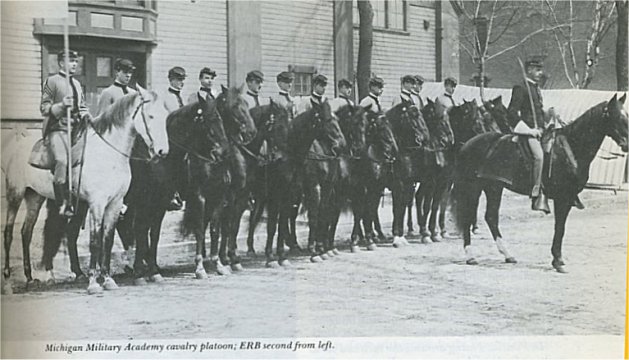
including the Commandant, who best knew the boy in the Cavalry squad and on
drill, and it is not impossible for him to return and wipe out his past.
Ed's father, displaying a most
unexpected reaction for a veteran army officer, made demands that King
considered unreasonable. They were firmly rejected:
... while I am unprepared to say what will be the action of
the faculty, this I can say that under no circumstances will your demand that
he be given a "clean sheet" and allowed to start in all free again
without any punishment whatsoever, be acceded to. If granted to him, it would
have to be granted, perhaps, to many another.
King went on to insist firmly that Ed would not be
relieved from duty merely because he complained of being sick, but only
"when having been examined by the doctor, he is pronounced sick." King added to this, with some
acidity, that "if cadets were relieved from duty and excused whensoever
they complained of feeling ill, at least half the battalion would be off duty
every day."
In closing, he referred to George Burroughs' complaint
that no boy could undergo the academy discipline without having his spirit
crushed. "Permit me to say," King wrote, "that as the result of
over thirty years observation of cadets here and elsewhere, I find that more
than nine-tenths of the corps take kindly to the discipline and are as spirited
and soldierly a lot of young fellows as one could ask to see."
Of the incident and his flight from Michigan Military
Academy, Ed noted, "I should have thought that my father would have been
about fed up with me by this time." He recalled how he had been received
"with open arms and with no reproaches when I was fired from Andover"
and added, "but I think that to him, a soldier, this was by far the
greater disgrace, yet he put it directly up to me to decide for myself whether
I should return or , not"
Ed was not long in making a decision.
"I think it
was the word `deserted' in the telegram that got me, and the next day I was
back at Orchard Lake walking punishment."
By the fall of 1892 Ed had begun to channel some of his
excess energies into sports. Football offered the kind of physical challenge
that was always important to him; he traveled with the team as they played
games away from home.
<>
In a letter of October 19, 1892, in which he explains
to his parents, "I owe you all letters I guess so I will write to all of
you at once," he discusses the games and school news:
"They are not going to send us to Chicago this week, we are
going to Pontiac though to march in their procession. The shin protectors came,
and I am much obliged to you for them. Do not be afraid of my getting hurt in
foot-ball. I dont play hard enough, besides its worth while when I can go
around to the different towns and play and wear a big M on my sweater and a
little MMA on my jacket..
Ed, amused by his parents' concern and their concept
of foot-ball as a rough and hazardous game, encloses some
"illustrations," presumably his typical cartoons, "for the
manner in which Foot-Ball is not played,
though you folks evidently imagined it was." Of the possibility of
promotion he notes that "appointments" could be announced within the
next two days; "I have been expecting them every day so have not written
you hoping to be able to tell you what the fellows whom you know got."
About his own prospects Ed wrote, "I won't get
anything, because I haven't been here a year yet." But he added, with some
pride, "I am treated by all the fellows that I like and by all the fellows who were old-boys last
year as if I had been here three or four years. I don't care anyway, so I guess
that is the reason."
As a boy away from home for a lengthy period, he was
evidently lonely, for he inquired about his brother Harry and Harry's wife Ella
(Nellie) Oldham, who had been married less than a year, remarking wistfully
that he wished he could see them:
When are some of you coming out?
Can't Harry leave his business one Saturday and bring Nell up here: they could
leave 8-15 P.M. Friday; spend Sat. here and be back 7 AM Sund. or leave Sat and
be back Mon. I will expect Frank most any day.
By the end of the year Ed appeared to be making some
adjustments to the academy routine and to be doing better in his studies. His
father, continuing an over-solicitous attitude, wrote regularly to
Superintendent Rogers about various matters. On December 14, 1892, Rogers
reported that "Cadet Burroughs has made excellent progress in his studies
during the last three months and is satisfactory in discipline. We hope for
still better results after Christmas." Possibly apprehensive, Rogers
tempered his praise with a cautionary reminder: "You will aid us
materially by him report [sic] promptly January 17th, so that he may have all
his lessons on the next day."
Rogers included a laudatory statement about the
academy's high reputation and the honor it had recently received:
After fifteen years of earnest effort we feel that we can
with becoming modesty claim that we have succeeded in establishing a model
school for the complete training of boys. In a list of forty "Leading
Secondary Schools in the United States" selected by President Eliot of
Harvard University, as President of a special committee of the National
Educational Association, this Academy is honored in being one of the number
chosen; and the only military school in this important list.
<>
In the letter he also told of plans to increase the
academy's attendance during the holiday vacation with a view to creating a
battalion of 180 cadets. This battalion would be taken to the World's Fair
Columbian Exposition in Chicago in June of the following year. The cadets would
camp "in close proximity to if not within, the Exposition Grounds,"
remaining there for about three weeks. The instructors would accompany the
cadets, and the objective was to make a careful and systematic study of the
exposition and of exhibits that illustrate and enforce work done at the
academy. Rogers explained, "By this plan we are convinced that we shall be
able in three weeks to obtain a better knowledge of the people and industries
of the World than would probably be acquired in several years' travel."
The change in dates of the Christmas holidays,
beginning on December 22 with an extension to January 17, was caused by a
decision to omit the Easter vacation. "We think that more satisfactory
work can be accomplished by following this plan," Rogers said. The cadets
were scheduled to leave about June 10 for the World's Fair, with a possibility
that the commencement exercises might be held in Chicago.
On the same date as Rogers' letter, and again on
December 16, George Burroughs had written about a problem Ed seemed to be
having with his eyes. The exchange of letters appeared to indicate that Ed's
father was somewhat annoyed at the fact that Rogers allowed an oculist to treat
his son. Burroughs had suggested that Ed be sent to the oculist, and what he
had in mind was not clear. Rogers wrote on December 17 with an evidence of
impatience:
<>
... would say that
in accordance with your suggestion in your first dispatch I sent Cadet
Burroughs to Detroit to an oculist of high standing to ascertain if his eyes
were in a condition to allow him to study. Had no idea that he was to give him
any treatment; and thought very likely that he could fit him with a pair of
glasses so that he could go on with his work until the vacation began. I do not
think that I exceeded my authority in any way.
The nature of the oculist's diagnosis is unknown, but
the result was an early vacation dismissal for the patient. Rogers ended his
letter with a curt comment, "He returned last night with the report of Dr.
Frothingham, and upon his recommendation I have this day sent him home. He will
explain the matter fully to you."
Whether Ed had a tendency to exaggerate his illnesses,
or even to malinger, is difficult to tell. The record of his early years and
the details contained in his brothers' letters from Yale reveal that he had
been a delicate child, not as sturdy as his brothers, and more susceptible to
common illnesses. That his health had caused both concern and worry to his
parents is quite evident.
On January 26, 1893, in a letter to his mother he
writes that he has been ill for some time. His complaints about the school are
quite bitter; the tone of the entire letter is one of gloom and resentment.
However, in this case, there is little doubt that his illness is severe:
Excuse me for not writing sooner but
I have been sick and didn't feel very much like writing. I am still in bed. I
have had a very sore throat and membraneous formation in my throat, headache,
pains all over my body and have been sick to my stomach for the last three
days. I am terrible sick at my stomach today but my head and throat are better.
He explained that the doctor had seen him yesterday,
and although he had asked them not to send him again, the doctor made a second
visit that day. ". . . I guess it was about as well," Edgar wrote,
"for if he hadn't called they would have made me get up at noon, as it was
he told me to stay in bed and keep quiet." After the vivid description of
his illness, he attempts to reassure his parents; "Dont worry as I am not
very sick; just thought I would write and let you know that I was still
alive," and he adds, "Excuse writing as I am lying down and am rather
weak. . . ." His P.S. offers more details and complaints:
To let you see what attention is
paid to a fellow on the sick report: There's a jar out in the hall that was
brought up yesterday morning and that I have used ever since and thrown up all
my meals into it and it has never been emptied; and it never would be if I
stayed here ten years with it".
I have lain on this hard bed for so
long that my right side is really raw, the bottom of my stomach is raw from
having the top sag down and up against it and my throat is raw from the extra
work of having each meal go through two ways."
Ed, as with most young people of his age, was not a
regular correspondent. He apologizes about his failure to write, and on April
25 offers as an excuse that he had hurt his finger with a sword. He remarks,
"I looked over some of my letters the other day and I find that I never
acknowledged the letter in which you sent that check I thought I had done so
and I am very much ashamed of myself consequently."
He tells of receiving perfume and candy from his
mother, adding, "it was fine and went to the right place." The
obvious reference is to a girl friend, unidentified, but probably Emma Hulbert.
He inquires, "How is the kid?" a
query about his nephew Studley, born only a month before on December 26, 1892,
and continues jokingly:
From all of your letters I will
expect to find him riding a bicycle and reading Caesar on my return in the
summer. Don't rush him too much, he may get brain fever. Just tell him to
follow after his uncle: — if he wants to be a blooming idiot.
From his early years, as part of a remarkable sense of
humor, Ed exhibited a delight in playing practical jokes. It almost seemed that
in devising little schemes at other people's expense he was satisfying some
need of his imagination. It was done without malice and no harm was ever
intended.
But the tendency to lapse into pranks and escapades, to yield to temptations
impulsively, was part of his character. He would retain this tendency in lesser
degree through his lifetime, and during his school years it would lead him into
trouble.
In his letter of April 25, 1893, to his father he
reports, with a customary glee, that "Lt. Reeder, who was cadet Capt. and
adjutant last year, is going to sleep over in Graves room tonight and Graves,
Cox and I were just in there folding up the under sheet in his bed and tying
knots in his night shirt. I hope he don't find out who did it."
After telling of this prank he turns to his favorite
subject — horses. He had always dreamed of owning one, and now approached the
matter obliquely, posing a question to his father with more than a hint of
guile:
Would you like to make some money or
help me make some? I have an elegant chance to buy Captain, the horse I told
you of that I think so much of, for about $150.00 or $125.00 — He is a fine
Kentucky horse perfectly sound, very showy and well gaited for a saddle horse;
he is broken to harness as well; he is a very fine and fast singlefooter; his
action is something superb.
<>
There
was of course a special reason why the colonel wanted to sell the horse:
". . . he is too fiery and too good a horse for a lot of boys to ride. I
am the only cadet that rides him." The story sounds familiar — a scene
from Ed's past in Idaho. And one can read between the lines. The fiery and
hard-to-handle ones, the outlaws — these were the horses whose beautiful
wildness Ed admired, that offered the challenge he couldn't resist. He used a
torrent of words to try to persuade his father:
<>
"If I had $200 and could buy a horse
to keep I would buy him in preferance to most any horse I ever rode; in Chicago
this year that horse would sell for a good $250.00, I am very sure. If I bought
him now for $125.00 or even $150.00 I could have him to ride and get a lot of
good out of him until school closes and then or before, ride him down to
Detroit and sell him so as to make from $25 to $75.00 off of him anyway.
<>
Carried away by his appeal to his father's practical
business instincts, he began to expand the money-making possibilities:
<>
"The money I have paid the Col. for
cavalry the rest of this term would pay for his board here and I could drop
cavalry — for having a horse of my own I would not need to take it as I could
do anything I wanted in the way of riding."
"I wish you could see the horse," he said,
"I know you would think it a bargain." Another idea occurred:
"You might loan me $150.00 for 3 months at 6%." The letter
ended on a humorous note: "Enclosed please find rough sketch of my room
mate and myself figuring out the interest on $150.00 for 3 months at 6%."
It appears that Ed's father, powerless to resist his
son's blandishments, or to withstand his barrage of dollars and percentages,
may have purchased the horse. Ed rode Captain later in exhibitions at the
Detroit Riding Club.