Official Edgar Rice Burroughs Tribute and Weekly Webzine Site Since 1996 ~ Over 15,000 Web Pages in Archive Volume 8244 |

EDGAR RICE BURROUGHS: THE EARLY YEARS
SCHOOLING ~ REBELLION ~ DISCIPLINE
|
Official Edgar Rice Burroughs Tribute and Weekly Webzine Site Since 1996 ~ Over 15,000 Web Pages in Archive Volume 8244 |
Ed's scrapbook, a bulky collection
of papers, cards, and clippings, all reminders of his school days, displays at
the beginning a page of the printed entrance examination to Phillips Academy,
Andover, Massachusetts, dated September 1891. The page contains problems in
mathematics, covering "Algebra to Simple Equations" and "Simple
Equations to Quadratics." Written in ink at the bottom is the notation
"Passed, Mark 20."
While
the Phillips catalog advised that "No age is prescribed for
admission," it offered more specific information in its statement that
"boys fourteen years of age usually possess sufficient maturity for the
responsibilities of school-life here."
Ed, just sixteen, and probably overage for a new student, was required to fill
out the school's entrance form containing eighteen questions. At the top he
listed himself as a candidate for the "Junior Middle E class"
(English), adding the projected date of graduation — class of 1894.
He answered the questions in a
clear, firm handwriting. Under question six, Father's
business or Profession, he wrote, "Vice Pres. Anglo American
Battery Co." The reason for his own version of the company name is not
clear. Under Father's Titles he
wrote "Major in late war." His mother's birthplace was listed only as
"State of Indiana." After Church
Denomination Ed drew a long line, indicating "none." He of
course gave his last school as "Harvard School, Chicago,"
and the "Chief Instructor" as "Prof. J. J. Schobinger."
Other answers revealed that he took room and board with Mrs. C. A. Morrill,
presumably in Andover, and that his brother Frank Coleman Burroughs had
attended the school in 1890 and 1891. To be exact, Frank was in the English
Department for two years, 1890-92, as a Junior Middler and Senior Middler.
Phillips Academy, already 113
years old, had first opened for instruction on April 30, 1778. It had been
founded by Samuel Phillips, his brother John, and Samuel Phillips, Jr., in that
year, although not incorporated until October 4, 1780. As part of the Academy's
remarkable history, a most distinguished visitor and speaker, George
Washington, on November 5, 1789, addressed the students assembled on the Old
Training Field.
The fourth principal was John Adams, and during his term the second schoolhouse
was burned in 1818, and a new brick Academy was built. This was the
"classic hall" described in Oliver Wendell Holmes' centennial poem,
"The School-Boy."
The principal at the time of Ed's
enrollment was Dr. Cecil F. P. Bancroft, in charge from 1873 until his death in
1901. He is described as "a man of foresight and clear vision, patience
and shrewd discrimination."
During his administration, attendance increased from 262 to more than 400
pupils. When Ed attended, 1891-92, the exact number was 440, with 184 in the
English department and 256 in the Classical department. The pupils came from
thirty-eight states and from Hawaii, Japan, Canada, and even Turkey. The
tuition for the fall term was $30, winter term, $25, and spring term, $20.
As a Junior Middler in the English department Ed would be required to follow the course of study emphasizing mathematics and the "Natural Sciences, with History, Latin, Modern Languages, and Literature." The catalog states that "The Course of Study is designed to furnish a broad and thorough preparation for the Sheffield Scientific School of Yale University, the Massachusetts Institute of Technology, and other scientific schools and colleges."
All Junior Middle Year students
were required to study Latin, but in the Middle Year, French or German was
substituted, with Latin becoming elective. The course of study for the Junior
Middlers in the Latin department included both Latin (notably Caesar's Gallic
Wars) and Greek, plus mathematics and English, in the first term. The second
term maintained a Latin sequence with selections from Ovid and part of the Aeneid of Virgil. Additional Greek,
mathematics, and English were required.
The serious scholastic atmosphere of Phillips
Academy must have been disconcerting to young Ed Burroughs. But as always he
was quick to make friends and was eagerly accepted by the other students. The
popularity he quickly achieved with his classmates may be explained, at least
partially, by the colorful anecdotes he probably told them about his Idaho
days. Since for some unexplained reason he arrived with a guitar in his
luggage, he was urged to join the Mandolin Club and given a further invitation
to the Glee Club.
In regard to the Mandolin Club, he
recalled that "I agreed with alacrity, although I cannot conceive that I
could have done so without misgivings, inasmuch as I had never played a guitar,
am totally devoid of any sense of music and did not know one note from
another."He further comments, "They must have been embarrassed when they
discovered that I could not play guitar. Anyhow my engagement with the glee
club was brief.''
Ed submitted material for the Mirror of Fall 1891 and Winter 1892. There
are no grinds printed with his name beneath, but some may have appeared under a
pseudonym, for in the issue of 1891 the editorial review contains an
acknowledgment stating, "We are also indebted for grinds and cuts to E. R.
Birroughs." A number of cuts or cartoons, mainly humorous in nature, are
Ed's work (they are initialed E.R.B. in his copy of the 1891 Mirror). The first illustration, on the
table of contents page, consists of eight human figures spaced about the
perimeter of the box that encloses the magazine's contents. These figures perch
there or are engaged in various climbing actions. A typical humorous example is
a drawing of an odd little machine titled The Mirror Grinding Machine,
described beneath as a "Head Reducer." Sketches of a boy are shown,
the head at first large and then reduced in size. A caption reads, "Before
and After Using."
Another page in the Mirror of fall 1891 displays cuts of
horses, Ed's favorite subject for drawing. The horses, although small, are
skillfully and realistically done.
In the Mirror of Winter 1892, the editorial comment refers to a
poetry contest and explains, "1st prize for Poem to S. A. Dickerson and in
connection with this we are obliged to state that the judges, on account of the
lack of competition in poems, deemed it best to award no second prize. . .
." But whether considered worthy of a prize or not, the poem printed in
this issue (author unnamed) bears the stamp of Ed's particular humor and style.
Titled "Possum et Coona," it stresses a clever distortion of Latin.
The poem tells the story of two
boys who go hunting with their dog. When they proudly bring a possum home,
displaying him to their parents, comparisons of their glory are made with
David, Samson, Caesar, and others. But when they wake in the morning they find
that the possum was not really dead, he was playing possum — "the possum
est ressurectum." He has fled and they are quite crestfallen. The poem
ends: "Pueri think non plus of Caesar, Coad urcum, Shalmeneser;/Take your
laurels, cum the honor, Since ista possum is a goner."
The Mirror of 1892, in its list of contributors, expresses
indebtedness to E. R. Burroughs for cuts only. None of these has been
identified. Ed is listed as a member of the Athletic Association and as
president of his class. This award of the highest honor by his fellow
classmates, presumably stemming from Ed's personal popularity, was also
announced on January 20, 1892, in The
Phillipian, the school newspaper. The brief note contains a
misspelling of the new president's name:
Elections. A class meeting of P.S. '94 was held Wednesday
noon and the following officers were elected: President, Burrows;
vice-president, Clark; secretary and treasurer, Finch.
Commenting on both his selection
as class president and the class colors of P.S. '94 — pale blue and orange — Ed
wrote, "when one considers their choice of a presiding officer the
selection of blue seems nothing short of an inspiration, but the fruit should
have been lemon."
In the passing days he devoted
much of his time to extracurricular activities.
A side interest in sports, but neither as a participant nor spectator, is
revealed in a letter pasted in his scrapbook. Dated November 23, 1891, the
letter, concerned with the placing of a bet, was addressed to him at Andover
and came from the office of Stoddard & Kendall in Boston. The firm,
according to the items printed on its letterhead, handled a large variety of
sports equipment. On the list are fishing tackle, skates, baseball supplies,
lawn tennis, and gymnasium goods. The miscellaneous merchandise includes
cutlery and hair clippers. The letter to Ed advises:
Though his annoyance and
disappointment were great, George Burroughs still exhibited unusual control and
managed to accept his son's return with an attitude of tolerance and
understanding.
But he had no intention of abandoning Ed's schooling. Perhaps a more
disciplined environment was the answer. Retired Major Burroughs turned to a
popular solution, often adopted by parents of problem sons: Ed would be sent to
a military school.
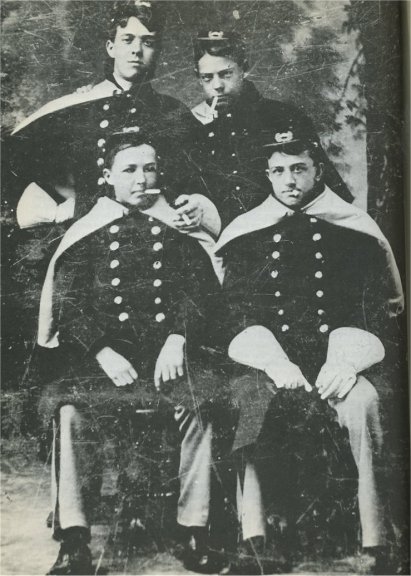
The chosen institution was
Michigan Military Academy, situated at Orchard Lake, twenty-six miles northwest
of Detroit. It had been in existence for fifteen years. Ed later wrote with wry
amusement that the academy had a "sub rosa reputation as a polite reform
school."
Whether the academy's requirements
were really stricter than those of similar schools is doubtful. Certainly, as
expected in a military school, the cadets' activities were severely regimented.
Emphasis was upon army routine, drilling, and above all discipline and
obedience. Physical development was an important goal, and to achieve it the
cadets led a hard, rough-and-tumble life.
At
the time Ed enrolled, Colonel
J. Sumner Rogers was the superintendent and Adelbert Cronkhite, the
commandant. Cronkhite's tenure was brief, as was that of Captain
Charles King who succeeded
him; and in the Michigan Military Academy catalog of 1893 Lieutenant
Frederick
S. Strong, 4th U.S. Artillery, is listed as commandant. The catalog's
register
of cadets for 1892-93 displays the name Edgar
Rice Burroughs, with the course identified as Sc. (scientific).
Preparatory studies required in the scientific course include English grammar,
civil government, arithmetic, and English composition. The curriculum for the
first year, divided under first and second terms, contains rhetoric and
composition as requirements in both terms. It appears, as far as the catalog is
concerned, that the academy did stress the study of grammar and composition.
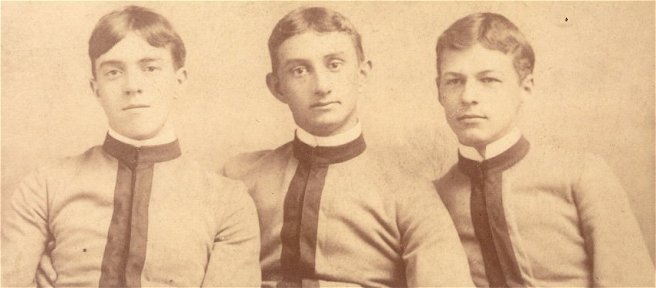
Among the cadets who entered the
academy at the same time as Ed were two who became close and long-lasting
friends, Robert D. Lay and Herbert (Bert) T. Weston. Lay's course was listed in
the catalog as Ac. (academy).
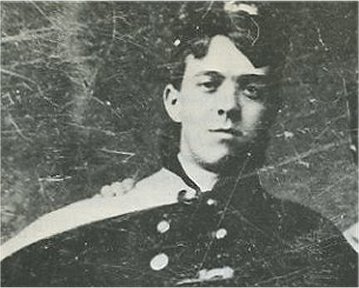
The beginning of Ed's life in a
military environment brought no change in his rebellious nature. He was
obviously not ready to settle down, and not ready to adapt himself to the
academy's strict discipline and regulation. His first semester at the school
(second term, 1892) found him in numerous difficulties. A natural
nonconformist, he seemed unable to follow school rules or to suppress impulsive
actions that usually led him into trouble.
One of Ed's early experiences at
the academy during his plebe year had to do with the popular pastime of hazing,
carried on by the "old boys" or upper classmen. In Ed's Autobiography, where the practice is
described as the "refined and unrefined torture of hazing," various
details are offered. For what occurred in one particular case, Ed can hardly be
blamed. The commandant at the start of the term, Adelbert Cronkhite, who was
far from being one of Ed's favorites, appeared to have a pet aversion to
plebes:
I think that he looked upon us with absolute contempt and
loathing. At noon one day, during the winter, he made a speech in the
mess-hall. It was to the effect that the plebes were too fresh and that it was
up to the old boys to put them in their place. This, coming from the high
authority of the commandant of cadets, brought immediate effects, one of which
was that immediately after the meal the entire plebe class scattered in all
directions, taking to the woods, not only figuratively, but literally. Several
of us, I recall, just beat it — whither, we did not know.
"Any place would have been
better than the Michigan Military Academy on that bleak Saturday
afternoon," Ed remarked. Although he was "as usual" under arrest
for "various and diverse infractions of discipline," under these emergency
circumstances the arrest became unimportant as did the regulations against
going off-limits and, more serious, going off off-limits.
After the panicky escape, Ed and
his friends walked twelve miles through the snow to a nearby town. There,
although he was wearing rubber boots, he attended a village dance that evening.
At a late hour, after the dancing was over, the boys reluctantly decided that
they must return to the barracks. This posed a problem:
"I do not recall how much
additional punishment I got for this escapade," Ed wrote, "but it
could not have meant anything to me as I already was undergoing a life
sentence."
Approximately two months after his
arrival at the Academy, the Easter vacation began, and all the cadets were
excused to return home. From Chicago, where Ed was spending the vacation with
his family, his father wrote to Colonel Rogers on March 23, 1892, requesting an
extension of Ed's leave. Two days later Rogers replied,
". . . Of course
we shall extend cadet Burroughs' permit, as you request, although it is to his
disadvantage to be absent from work at this time. School is moving along very
pleasantly under our new commandant."
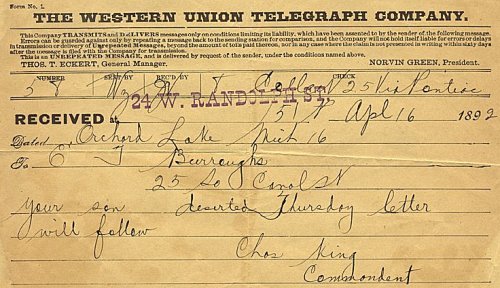
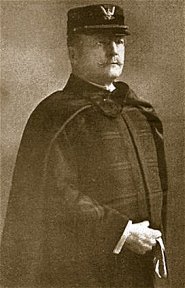
The new commandant, replacing
Adelbert Cronkhite, was Captain Charles King, a well-known author of novels
centered about army life in the West. Although he remained at the academy for
only a brief period, his firm attitude tempered with justice and consideration
and his numerous accomplishments created in Ed an intense admiration which was
close to worship.
Ed continued to find the
discipline and restrictions of a military life impossible to cope with; as
described in his Autobiography, the
penalties seemed endless:

MORE PORGE/ERB REFERINCES IN ERBzine
Foreword by Hulbert Burroughs
Preface by Irwin Porges
https://www.erbzine.com/mag64/6426.html
Introduction by Ray Bradbury
https://www.erbzine.com/mag35/3571.html
THE BURROUGHS / IDAHO CONNECTION
Links to our many related Webpages
www.ERBzine.com/idaho