Official Edgar Rice Burroughs Tribute and Weekly Webzine Site Since 1996 ~ Over 15,000 Web Pages in Archive Volume 8243 |

EDGAR RICE BURROUGHS
CHILDHOOD AND A FIRST ADVENTURE II
|
Official Edgar Rice Burroughs Tribute and Weekly Webzine Site Since 1996 ~ Over 15,000 Web Pages in Archive Volume 8243 |
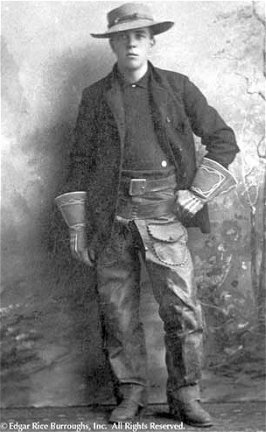
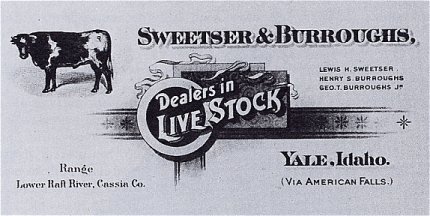
Located in Cassia County, Idaho, on a section of the extensive ranges
owned by "Cattle King" Jim Pierce, the Burroughs-Sweetser spread
occupied land along the lower Raft River, in the southeastern part of the
state. The ranch was about thirty miles from American Falls, the railway
station and shipping point for the cattle. To honor their alma mater the
brothers called their ranch the Bar Y, and after persuading the federal
government to establish a post office near the ranch, paid further tribute to
their college by naming the post office Yale.
It was to the state of Idaho, newly admitted to the Union on July 3,
1890, that Ed was sent by his father. To a big city boy the sudden removal to a
rough, primitive country was a thrilling adventure. From the strict discipline
of school and the close supervision of his father he now found himself in the
free-and-easy atmosphere of ranch life and under the indulgent care of brothers
George and Harry. His friends were rugged and sometimes wild cowboys and miners
who because of their vigor and individuality appeared like characters out of a
western adventure novel. In contrast, Ed was probably looked upon as a true
tenderfoot. His only practical experience, pony riding on city streets, was of
only, rudimentary value on the Bar Y Ranch.
The story of his Idaho cowboy days is colorfully narrated in his Autobiography:
No one in Idaho had ever before seen a penny. Two
drinks were "two-bits"; one drink was "two-bits"; a cigar
was "two-bits"; things were "two-bits,"
"four-bits," "six-bits." There were no pennies and there
was no paper money. Everything was silver or gold; at least I understand there
was gold there, though I never saw any of it.
The greenest of ranch hands, young Burroughs began to gain his
experience in the most painful ways.His brothers George and Harry were hard put to find some tasks he could do.
". . . as I had proven more or less of a flop as a chore boy," Ed
noted, "they appointed me mail carrier." He rode daily to the
railroad at American Falls, either on horseback or, if there was freight to
bring back, with a team and wagon. When he went on horseback, he made the round
trip of sixty miles in one day.
In another incident which demonstrated that naivete and good luck seemed
to go together, he was asked to go to the pasture and bring some horses back to
the corrals. They belonged to a newly arrived cow outfit. Everybody assumed
that Ed would take one of the ranch horses for the trip to the pasture, but
instead he chose a strange horse that was standing saddled and bridled. He was
unaware of its bad reputation and that it was being ridden by Hi Rice, a famous
bronco-buster. Neglecting also to look at the cinch, he climbed hastily aboard
and rode away.
As they approached a steep bank of the Raft River, the horse clambered
up and the saddle suddenly slipped off over his tail. Ed went head-over-heels,
landing on the ground behind the animal. "He should have killed me,"
Ed said, "but instead he stopped with the cinch around his hind feet and
turned an inquiring glance back at me." Later, when he had replaced the
saddle, rounded up the horses, and returned to the corrals, a "goggle-eyed
group of cowpunchers" was waiting for him, "including a couple of
terrified brothers." They all stared as he rode in, "safe and alive,
on the worst horse in Cassia County.".
These incidents, humorously exaggerated, do not give credit to Ed's
knack in handling horses, evident even at this early age. His love of horses
and riding — "when I got my leg over a horse I owned the world" — was
matched by a sensitive and understanding attitude toward almost all animals.
"At this time," he commented, "I learned . . . to take care of my
horses, especially their backs, and I became proud of the fact that I never
gave a horse a sore back, nor have I in my life." During a fall roundup he
was given two horses with sore backs and both of them were healed while he was
riding them.
Ed had noticed one horse, a beautiful black gelding, "fat as
butter, with a long mane and a tail that almost dragged the ground." The
condition of the tail indicated that the horse hadn't been ridden for some time
since it was the custom to thin out the tail hairs so that the tail would not
get full of burs and sagebrush
The significance of this and other revealing facts about the horse, Whisky
Jack, escaped Ed:
Eager to ride Whisky Jack, Ed
pleaded with Jim Pierce until he was given permission. The men had to throw and
hogtie the animal before they could saddle and bridle him. Then they put a
blind on the horse while Ed mounted. When they removed the blind, Whisky Jack
took two jumps, slipped, and fell, with Ed beneath him.
He didn't break
anything in me, but I certainly hurt. However, I had to hide it for fear the
boss wouldn't let me try it again. He was surprised when he found that I wanted
to; he even grew enthusiastic. It had now become a sporting proposition with
him and he offered to give me the horse if I could ride him.
Ed mounted the horse again,
doubtful himself that he would last very long. But Whisky Jack adopted a more
tractable attitude: "I stayed on him all that day because I was afraid if I got off I could
never get on again. . . ." He rode the horse as long as he remained in
Idaho, never bridling him but using a hackamore and a shoelace for a
head-stall. Kindness changed Whisky Jack remarkably; with Ed he was always
docile, but he would still refuse to allow any other man to handle him.
Whisky Jack's reaction was
violent, although not unexpected, the first time Ed used him to carry the mail:
The Government
furnished leather mail bags that went over the horse's rump behind the saddle
and hung down on either side. They were equipped with metal staples and
padlocks that rattled. I had to blindfold Jack to get them on him at all, then
I mounted and jerked off the blind. He took a few steps, felt the bags against
his sides, heard the rattle of the padlocks and started to leave the country.
The road wound through foothills and he ran for ten miles before he became
resigned to the fact that he couldn't leave the mail bags behind.
There
was a little gulley on the way out of town and some Chinamen lived in a dugout
there. . . . Whisky Jack elected to buck up onto the roof of this dugout. That
roof must have been constructed of railroad ties. If it had been of any lighter
construction, we should have gone through. I had a fleeting glimpse of a dozen
wild eyed Chinamen scurrying from the interior, and then Jack bucked off down
the road relieving me of considerable embarrassment.
Ed recalled those early Idaho
days with some nostalgia:
I slept on the
floor of a log cabin and in the winter time the snow drifted in under the door.
When I got up at four o'clock in the morning to do the chores, I had only two
garments to put on, my hat and my boots. The hat went on easy enough, but the
boots were always frozen. I wonder why we recall such hardships as among the
happiest experiences of our lives.
Texas Pete, a young cowpuncher
who arrived at the Burroughs' ranch dead broke, was another one whom Ed
remembered. Pete, given a job grubbing sagebrush at seventy-five cents an acre,
was charged, according to custom, the usual amount for his board. After working
for several weeks, he decided to leave. His earnings were totaled, his board
bill deducted, and he was paid the difference. Pete got the full amount —
"six-bits" — which Ed then won from him in a crap game.
Ed found Pete to be very likable,
"but like most Texans always ready to fight":
I saw him
fighting with another puncher one day during a roundup. They went into
a clinch on the ground and each one was spurring the other in the back with
long roweled Mexican spurs. The foreman used to take their guns away from them
in camp; so they had to use spurs.
About
Pete, Ed commented, "He had the reputation of being a bad man, but there
was nothing bad about him."
The events had a tragic outcome. Pete, wanted for some minor law violation,
attempted to evade arrest by rowing across the Snake River. He was shot by the
sheriff.
Although he was only sixteen,
Ed's imagination and powers of observation were stimulated by the colorful
characters who surrounded him. Their actions, attitudes, and mannerisms were
recorded in his memory. Of the sheriff, Gum Brown, he recalled:
Other memorable characters were
Hank Monk, a cook on the ranch, and Sam Lands, a garrulous cowpuncher who
specialized in tall stories. About Monk, Ed remarked, "I could always tell
when we were going to have baking powder biscuits: Monk would have flour in his
ears and nose. . . . The less one saw of Hank cooking, the better his appetite."
And Lands had an unforgettable
story about a bad horse he had ridden:
... the horse threw
him but his foot caught in the stirrup; and, he said, the horse
"drug" him for three days and three nights and that all he had to
drink was when he "drug" him through a river, and that all he had to
eat was when he "drug" him through a strawberry patch.
On one occasion Ed had a real scare. The enraged bull whirled about
suddenly to charge him. With the animal very close, Ed fired, hitting him right
between the eyes. The bull turned a "complete somersault." Ed rode
back to the ranch in a panic, convinced he had killed a three- or
four-thousand-dollar bull. Later he was relieved to discover that the animal
displayed no symptoms of pain or injury.
Those were the days of bitter
rivalry between the cattle and sheep ranches that led to violence and
shootings. Unaware at first when the spring roundup began, Ed soon discovered
that the man riding with him was a "very likable murderer." As they
were resting on a hillside, his friend described how he had killed a man named
Paxton and Ed took it in stride:
It was
perfectly all right because each of the two men had been hired to kill the
other and though Paxton got the drop on him across the dinner table, my friend
came out alive and Paxton didn't.
This brief Idaho period in 1891
had given Ed freedom and a touch of the kind of carefree, adventurous life he
would seek again. A restlessness and a need to express his masculinity remained
with him, governing some of his future actions. But now a summons from his
father brought him, regretfully, back to Chicago and a resumption of his
education.
In contrast to the exciting days he had spent with cowboys and badmen, and the
exhilarating physical challenge he had encountered, a program of classroom
studies could only appear dull and boring. Major George had already made
preparations for Ed's enrollment in school, but he found his son uninterested
in a return to books and exams — and even rebellious. The days ahead were to be
ones of tension at home, unhappiness for Ed, and disappointment and irritation
for his father.

MORE PORGE/ERB REFERINCES IN ERBzine
Foreword by Hulbert Burroughs
Preface by Irwin Porges
https://www.erbzine.com/mag64/6426.html
Introduction by Ray Bradbury
https://www.erbzine.com/mag35/3571.html
THE BURROUGHS / IDAHO CONNECTION
Links to our many related Webpages
www.ERBzine.com/idaho