Ed Burroughs grew up in a busy
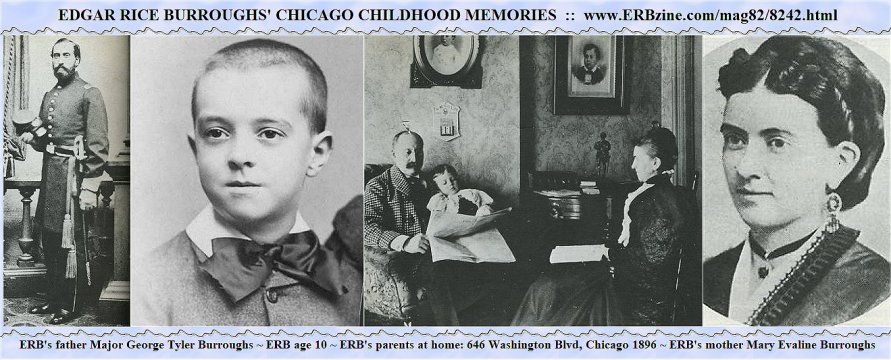
environment. The three-story brick house on Chicago's West Side,
Washington Boulevard between Lincoln and Robey Streets, solid and substantial,
was in itself a symbol of middle-class prosperity. With its many rooms (and the
customary basement) the house was well-designed for a large family. Ed, as the
youngest child, became a fascinated spectator of the numerous activities of his
father and three brothers. He was a sensitive child, observant, and eagerly
attentive. An impression of lightness — pale skin and golden-brown hair —
conveyed also the image of delicate health that concerned his parents.
Admiring
his older brothers, he wished to emulate them, but he was not at all like
brothers George, Harry, and Frank. His quick sense of humor was evident in
these earliest years, along with his search for creative expression. Curious
and imaginative, he liked to shape words and thoughts on paper, turning first,
at the age of five, to rhyme:
I'm Dr. Burroaghs come to town,
To see my patint Maria Browns
An account of his education refers jokingly to
"an advanced course in a private kindergarten," where the major
activity seemed to be "weaving mats from strips of colored paper.
But most memorable were the years spent at the old Brown School on the West
Side of Chicago, only a few blocks from the Burroughs home, the same school
that George, Harry, and Frank had attended.
Secure
within a close-knit circle of family and friends, Ed found this period a happy
one. Four blocks to the east was Union Park, a quiet, grassy oasis set in the
midst of busy city streets. One of the park's functions was to serve as a
grazing area for the neighborhood cows brought there each day by the herdsmen.
Major George was among those who kept a cow to supply fresh milk. In their
rambles around the neighborhood, Ed and his friends visited the park for
another reason: they enjoyed tossing peanuts to Old Bob, the grizzly bear.
The
Brown School friends who grew up with Ed were William (Billy) Carpenter Camp;
Alson Clark, the painter; Ben Marshall, a successful Chicago architect; and
Mancel T. Clark, a wealthy paint manufacturer. Florenz Ziegfeld, the celebrated
theatrical producer, was also a pupil at the Brown School. Here, Ed was
assigned to what he jokingly listed as his first army experience. Within a
list titled My Wonderful Military Career, he noted that he had been "Right
Guard, Brown School Cadets," and added in parentheses, "Wooden
gun.".
Near the Burroughs home on
Washington Boulevard resided Alvin Hulbert, his wife Emma Theresa, and their
children. For George's four sons the normal neighborly relationships were made
more attractive because of the four lively Hulbert sisters — Leila, the oldest,
Julia, Jessie, and Emma — who occupied the three-story family residence at 194
Park Avenue. Walking to and from the Brown School, young Ed and Emma often met
and formed an early habit of being together.
From the age of six Ed showed an interest and delight in
letter writing, enjoying opportunities to correspond with members of his family
when they were away from home. On February 19, 1882, his father, while staying
in Washington, D. C., received a letter from Ed, written in heavy capitals,
reading, "HOW ARE YOU. I MISS YOU VERY MUCH. WE ARE ALL WELL."
In 1885 George Jr. and Henry (Harry) were sent to Yale University by
their father, and they enrolled in the Sheffield Scientific School. George, the
older of the two, had his education delayed because of illness, and as a
result, the brothers entered Yale together.
Ed, in this first long separation from his brothers, missed them keenly. He
corresponded regularly, eager to hear of their activities and to tell about his. These letters
reveal much about the beginnings of his creativity, not only in his writing and
poetry, but also in his drawings and cartoons, which, often humorous, served as
illustrations for his comments, news items, or poems. The letters present an
intimate picture of the warm, sympathetic relationships between all of the
brothers.
On February 13, 1887, Ed sent his brother George a
valentine, and George responded on February 22 to thank him: ". . . it was the only one we received. Did you
get many?" Ed had evidently told of a burglary in the
neighborhood, for George wrote:
You must have had quite an exciting
time with Dr. Adolphus' burgular. I should think neither the doctor nor Mr.
Simington would feel very safe with vacant houses next to them which afford
burglars so easy an entrance.
George reveals Ed's interest in reading:
I am glad you are reading
"Tales of Ancient Greece" and am not surprised that you enjoy it. I
know I did when I read it. Now if you will take one of our
"Barnes General Histories" that I asked Mother to send to us, and
read up the history of Greece, which you will find some what closely related to
its Mythology, that is the early history, your reading will be more interesting
as well as instructive.
In continuing, George tells of an incident that might
have been serious:
About half the University & half
the freshman crew had a nice mud bath down at the boathouse Sat. A platform
broke, dropping us about six feet into the slimiest mud I ever saw. I landed
square on top of another fellows & so, fortunately, came off somewhat
better than I otherwise would, but I was a sight.
George explains about privileges at Yale:
There is still one saloon which we
cannot enter and unless our nine, that is the freshman nine defeat the Harvard
freshmen in the Spring we are not allowed to sit on the "fence." I
think you will find an account of this custom in that book I gave the folks
Christmas.
In a joint letter to Harry and George, dated March 27,
1887, Ed, age eleven and one-half, draws a picture, presumably of himself,
holding a telephone receiver to his ear while he addresses his brothers. He
tells of watching experiments of "crystalizing" under the
"microscope" which were "fine." Ed compliments Harry,
telling proudly that the man who performed the experiments said that "the
fly wing you mounted was mounted as well if not better than any he had. I saw
it too." At the close of his letter to Harry he says, "I will be glad
when the time comes for you boys to come home."
In the section intended for George, Ed begins:
As I wrote to Harry first I have
pretty near emptied my fertile brain but will try to think of some thing more,
For instance How are you getting along in your studies? I am getting along
first rate backwards. As I lose every letter I get I cant answer them atall. A
boy and I have gone into the yeast business x x x x x And broken up. "A
Boy" has offered me some pigeons (two) and I expect to get them some time
before I die.
At the top of the second page Ed has drawn a picture
of the American flag floating from the top of a pole that extends vertically
along the left margin of the sheet almost to the bottom. A man in a cowboy suit
and hat has climbed more than halfway up the pole. We see that he has dropped
his gun and that it is falling through the air. On the ground at the foot of
the pole an odd-appearing little animal is waiting. All of this is designed to
illustrate the poem which Edgar "made up . . . this morning....”
The lure of cartooning that drove him, even at this
early age, to drawing his small illustrations and comical figures in the
margins of his letters and poems was also evident in his school textbooks.
Within the covers and in the margins of the pages he drew his cartoons; their
presence creates the suspicion that his attention could stray from his school
work to an activity he found more stimulating.
A more significant part of his creativity was
demonstrated in the delight he took in making up stories. Because of his low
resistance to colds and infections, he was often confined to bed. At these
times he became impatient with the old fables that his mother told him,
preferring to create his own imaginative tales and tell them to her.
Ed's poetry writing as an outlet for his imagination
was just one part of his youthful development. Major George, always the
practical businessman, took the opportunity to provide his son with an
experience in the field of commerce. A note dated February 21, 1887, and signed
by George Burroughs was evidently used in a business transaction involving Ed.
George, using formal terminology, devised a legal form for his twelve-year old
son:
On or before March 1st 1888 for
value received I promise to pay Edgar R. Burroughs Twenty Seven & 50/100
($27 50/100) with interest at the rate of six percent per annum.
Whether George purchased something belonging to Ed, or
whether he borrowed some of his son's money has not been ascertained. The
transaction may have been part of a business game, and not viewed as a real
obligation, for George appears to have forgotten about it until years later.
But he did discover it and pay it off — with interest. Written across the note
is the statement "Paid March 31st 1898 $46.12."
Possibly because of the death of Ed's two infant brothers, his
parents became cautious about his health, and when the city was swept by an
epidemic of diphtheria, they decided to take him out of the public schools. He
was midway through the sixth grade, but his parents, unwilling to take chances,
began a search for a private school. The only one available on the West Side
was Mrs. K. S. Cooley's School for Girls.
To a
twelve-year-old boy the prospect was appalling. Ed reacted to the situation
with an attitude of extreme distaste. It was little consolation to him that the
parents of a half-dozen of his closest friends were following the Burroughs'
example. Billy Camp, Ben Marshall, Mancel Clark, and others were placed in Miss
Cooley's school. Ed spent only a brief period there, later
commenting, "I know that we all got out of Miss Cooley's Maplehurst School
for Girls as quickly as unfeeling parents would permit."
A report card issued by Miss Cooley, dated "April
9th to May 11th 1888, " reveals that Ed was a better-than-average student.
He received high marks of 98 in geography and 95 in reading. His lowest mark,
80, was in composition.
The Burroughs family had always stressed good health
habits and exercise, and this was evidenced in the letters written by brother
George while he was at Yale in 1887 and 1888.
Concerned about reports of illness, he wrote to his father on December 4, 1887:
I am sorry that Mother & Eddie
are not well. I am afraid that neither of them get enough outdoor exercise to
keep their systems in order. Plain food, regular habits, good
hours & plenty of exercise keep me in such perfect health that I want to
prescribe the same for every one who is not feeling well.
George was both firm and frank in emphasizing his
objections to a program of excessive studying at the expense of physical
fitness. He clearly had no patience with the student who turned himself into a
grind, and in a letter of January 9, 1887, commented:
... When I came
down here I had hopes that I might distinguish myself in my studies (in some
one), but I find that impossible
and when I look at those of my classmates who do the best, I feel thankful that
I am not like them, for with a few exceptions the "digs" are a poor,
sickly looking lot. I hope however that I will know as much as any of them at
the end for I will learn from them in recitations & when I get hold of a
thing once I remember it. I tell you this for I want you to understand that
even if I don't make a mark I am working and not wasting my time.
On April 8, 1888, again from Yale to his father,
George, concerned about Eddie's health, wrote:
.. . I am glad Eddie has a bicycle, & hope he will have some
inducement to keep him riding it.
<>I dont think any of us ever realized how much good our bicycles did
Harry & I how much time we spent on them out of doors when we would
otherwise have been in the house. Frank & Eddie are neither of them as strong & well
as they ought to be and I think it is because they do not take exercise enough
in the open air. Not that it would do either of them any good to force them to
do something distasteful to them.. .
<>
<>
As Eddie spent more time outdoors, his health
improved. Bicycle riding became a source of enjoyment, and on Chicago's Warren
Avenue, where a first stretch of experimental asphalt pavement had been laid,
running west from Ogden Avenue to Western, he rode his bike for many hours.'
Although it cannot be documented, it is assumed that
during this period the Hulbert and Burroughs families were probably in
neighborly association, and Ed found his attachment to Emma growing stronger. A
youthful romance was developing, and he soon preferred to devote most of his
attentions to her.
Emma's father, Alvin Hulbert, had acquired a
position of esteem in Chicago business circles; he was respected as a civic
leader, and his reputation in the community was comparable to that held by
George Burroughs. Alvin had shown an early interest in the hotel business and
had worked as a clerk in the old Sherman House in Chicago. He and W. S. Eden
later became owners of the Tremont and Great Northern Hotels. Alvin's ventures
were highly successful, and in October 1871, after the Sherman House was burned
to the ground, he made arrangements for the erection of a new hotel with 250 rooms. As its
genial landlord, known for his "urbanity and pleasant manners," he
received the enthusiastic approval of the hotel guests.
He was also associated with the Lindell Hotels in St. Louis.
Alvin's
entry into politics in the primary of March 26, 1880, resulted in his defeating
his opponent R. P. Williams and being elected Alderman of the Twelfth Ward. He
ran on the regular Republican ticket, and in a letter to the New York Times (date unknown) protested
about the Times' error in
referring to him as an independent Democrat. He maintained that he had al-ways
been a stalwart Republican.
While
Emma continued to attend the Brown School, Ed, happy to escape from Miss
Cooley's Maplehurst School for Girls, in the fall of 1888 entered the Harvard
School on 21st Street and Indiana Avenue. His brother Frank (called Coleman)
had been a student at Harvard for a year. Ed remarked, "I was never a
student — I just went to school there."
He had
vivid recollections of the period:
<>
<>
<>Benny Marshall, the Chicago architect, was one of my
class-mates. We used to sneak down to the lake and sit on the break-water and
smoke cubeb cigarettes, thinking that we were regular devils. While I was attending Harvard School, we lived on the west
side on Washington Boulevard, about four blocks west of Union Park; and I often
rode my pony to school, keeping it in a livery stable near Twenty-Second
Street. It would be difficult to imagine riding a pony from the west side to
Twenty-First and Indiana today.
He
explained that the West Side was "where everybody made his money in those
days and then moved to the South Side to show off." In good weather Ed
either drove or rode to school. He remembered other details clearly:
In inclement weather, I took the Madison Street horsecars to
Wabash, a cable-car to 18th Street, and another horse-car to school. Sometimes,
returning from school, I used to run down Madison Street from State Street to
Lincoln Street, a matter of some three miles, to see how many horsecars I could
beat in that direction. It tires me all out even to think of it now. I must
have been long on energy, if a trifle short on brains.
Of the
school staff young Burroughs never forgot Principal John C. Grant, of whom he
was "scared to death," and Professor John J. Schobinger, also listed
as principal, who was determined that the students should learn Greek and Latin
grammar before turning to a study of English. A
Harvard School report
card, issued on September 7, 1891, covers the period of September 1890 to
February 1891, and lists average marks on a scale of 100: Arithmetic, 62;
English, 67; Algebra, 79; Latin, 83.
Evidently because of the concentration on Latin, Ed was far stronger in
this subject than he was in English. The disparity between the marks on arithmetic and algebra is difficult to
explain. In a letter of September 3, 1891, addressed to "Whom this may
concern," and signed by both Schobinger and Grant, there is a statement
that "he [Ed] leaves the school of his own accord, in good standing."
Ed had left the school months earlier, and this certificate of moral character
was obviously issued at the request of his father, who needed it for Ed's next
school — Phillips Academy. A later combination of report card and character
reference, written on the seventh, explains that Ed is "of good moral
character and he left our school on account of ill-health." This new
version of the reasons for Ed's departure from Harvard may have been demanded
by George Burroughs, who was undoubtedly sensitive about his son's weak
achievement at the school. Burroughs may have removed his son because of a fear
of an epidemic of la grippe which had spread throughout Chicago. Another
possibility is that Harvard itself may have been temporarily closed, for a
later reference about this school period mentions that ". . . epidemics
had closed two schools that I had attended."
That Ed's departure was abrupt is indicated in the exchange of letters
(three in all) between Schobinger and Burroughs. On September 7 the Professor
wrote:
Your letter being dated Sept 6th and Edgar not having
called, I suppose he is gone by this time. I therefore send you the required
certificate by mail, as required.
<>
At any rate, when Ed left Harvard School in midsemester, some time after
February 1891, he must have done so with relief. The typical school studies,
the lessons in Greek and Latin, he found dreary tasks. Highly imaginative, he
could discover in these subjects nothing to motivate him. But the new plans for
the coming months created a feeling of joy and excitement. His destination, for
a fifteen-year-old boy, was like something out of his dreams. Awaiting him was
the high road to adventure.
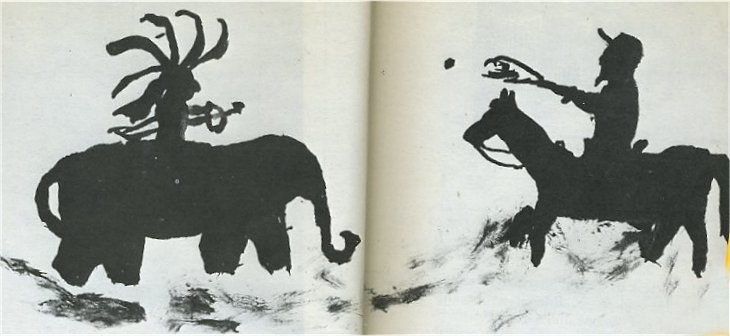
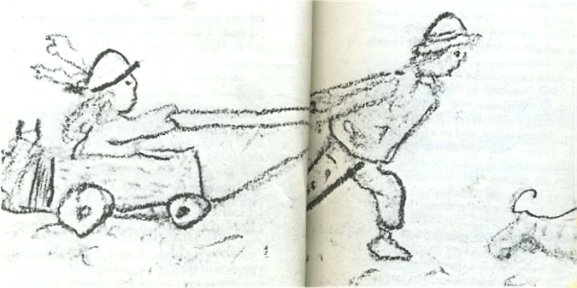
YOUNG ERB'S ART GALLERY
 CONTINUED IN PART II 8243 NEXT WEEK