
Official Edgar Rice Burroughs Tribute and Weekly Webzine Site Since 1996 ~ Over 15,000 Web Pages in Archive Volume 8241 |

|
Official Edgar Rice Burroughs Tribute and Weekly Webzine Site Since 1996 ~ Over 15,000 Web Pages in Archive Volume 8241 |
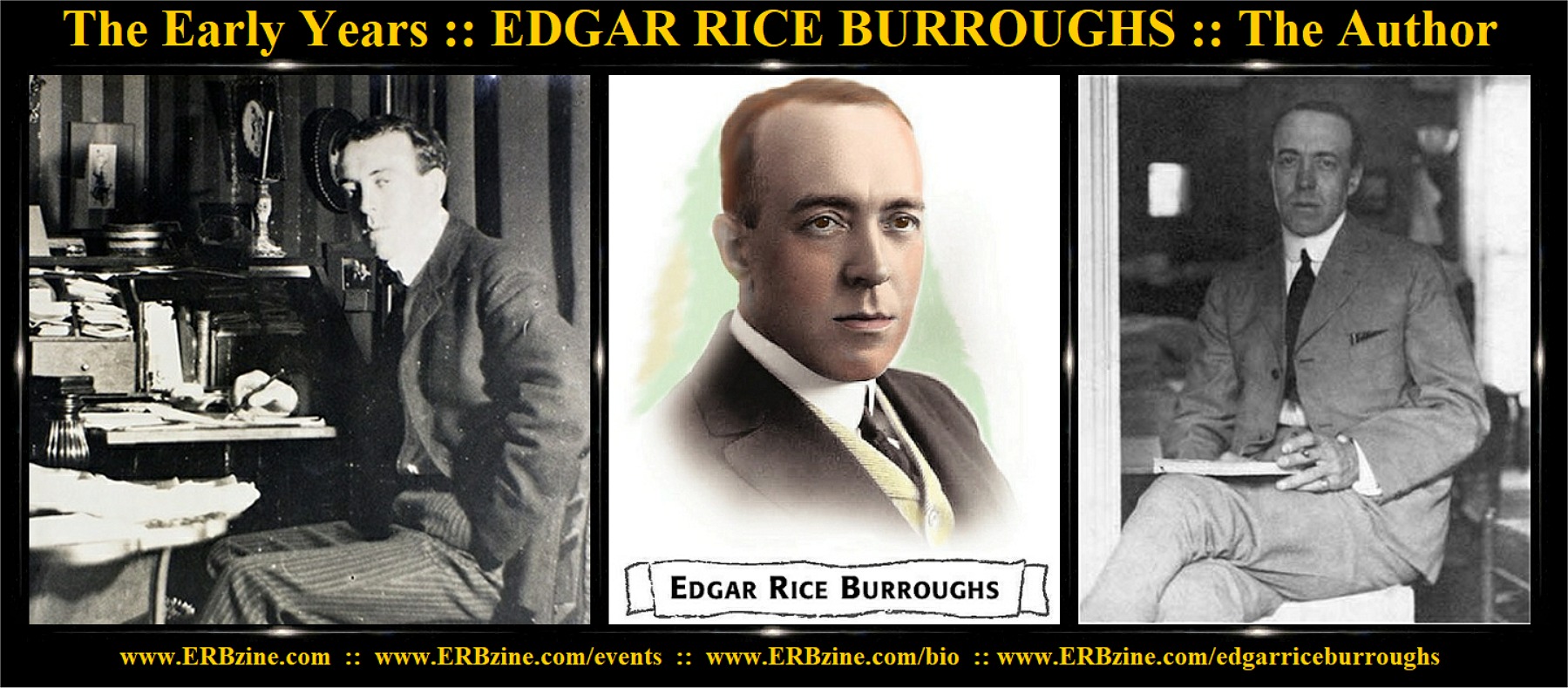
On a July day in 1911 Edgar Rice
Burroughs sat in a small office at the intersection of Market and Monroe
streets in Chicago. He had borrowed desk space from a friend in order to launch
his latest enterprise, an agency for the sale of pencil sharpeners. The
salesmen who responded to his ads were sent out on a commission basis.
"They did not sell any pencil sharpeners," he noted,
"but in the leisure moments, while I was waiting for them to come back to
tell me that they had not sold any.
What else was there to do? He began to write, the pen
seeming oddly small in his heavy fingers. He bore little resemblance to the
image of a writer, but there was even less in his appearance to suggest the
typical businessman. Since he would seldom draw upon real-life experiences,
where would he find the story plots that he needed? His search for excitement,
for high adventure in his early years had ended in disappointment. Whatever he
found fell far short of his expectations. His youthful spirit of adventure,
still unrealized, was temporarily thrust aside. At night, in a happy release
from the monotonous daytime routines, it returned to spur his imagination to
life. He often lay awake devising fantastic situations and creating his own
characters, superhumans who performed incredibly heroic feats in strange worlds
and on distant planets.
Now his instincts turned him to the freedom of imagination. His pen
swept across the only paper available — orange, blue, and yellow sheets were
mixed with white. The blue and yellow ones were old letterheads. He used the
backs, shaping words hastily so that they emerged with distinctive flattened or
unfinished letters. The u's, r's, m's
and n's rose in vague curves
above the line, the i's were
barely visible, and the crossbars of the t's
were dabbed in late beyond the line, out of place, like an afterthought.
Formed in his daydreams and imaginings, the
ingredients for many stories — strange encounters, daring rescues, hairbreadth
escapes, glorious battles — awaited his summons. As he wrote, the real world of
the commonplace became the unreal one; it vanished, and in its place he
conjured up a strange fierce civilization set in the midst of a dying planet.
The new world closed around him, all sounds of the old were gone, and he was a
man lost in a perilous land where science battled against savagery, beauty against
ugliness.
The reasons for his unplanned, helter-skelter life
were unclear to him. All he knew was that he had held on to nothing, that
nothing had become permanent. Even the experience he had gained, astonishing in
its variety, was of doubtful value. He had floundered about in the business
field, vacillating between being an employee and an entrepreneur.
What turned him to writing was not a sudden perception
but rather desperation. He wouldn't understand until some time later that a
career solely in the business world was not for him. But now, with all the
year's efforts adding up to zero, Burroughs was ready to concede that he was a
failure. The distinction, subtle but important — the difference between being a
failure and being simply a misplaced man — was beyond him. His mind, to
elaborate upon the old saw of the pegs, was designed for stretching a round
universe of elastic boundaries, for pushing the boundaries out; there was no
way he could exist or fit into the universe of square partitions, of offices,
of adding machines, sales, profits, and losses.
The turning point came at a time of bitter
realization. He had been involved in still another impossible project, hardly
knowing why, and with little faith left. Failure was inevitable. "My
business venture," he wrote, "went the way of all other enterprises
and I was left without money, without a job and with a wife and two babies.
Ironically, with thirty-five years gone and all else
tried, he was ready to put his ideas on paper. But strangely, the experiences
he had undergone, the colorful characters he had known — soldiers, cowboys,
Indians, and miners — these, the stuff of realism and the reminders of an
unstable past, he instinctively avoided. These experiences had physically
shaped him into what he was — a solid, muscular man, sturdily framed, with
broad shoulders and strong arms. His large hands, a family inheritance, with their
thick, powerful fingers drew immediate attention. A masseur in a Turkish bath
examined Burroughs' hands and remarked, "We get all kinds of people in
here, but this is the first time I ever massaged a blacksmith.
Athletics, a vigorous outdoor life, cowpunching and horseback riding — at
military school he had vaulted easily into the saddle from a standing position
— had combined to develop a physique that altered little through the years.
That was the key, the prayer of all escapists — not to be like other
men. Burroughs knew little about the techniques of writing but he
understood that those who read his story would have their own dreams and
fantasies, their own yearnings to get away from painful reality.
As he wrote he compiled a brief glossary of names and
of special words used in the story, to him a fascinating task. A man is true
master of a civilization when he can dictate its language, concocting such
words as Barsoom — Mars; Iss — River of Death; Woola — a
Barsoomian calot or dog; Dejah
Thoris — a Princess of Helium; and Helium
— the empire of the grandfather
of Dejah Thoris.
The list was short, nothing approaching a complete
vocabulary, but the words gave a genuine touch to the characters and scenes set
on a planet millions of miles distant. The paradox of attempting to weld
fantasy with reality and science with the wildest of fiction did not deter him.
It was here that Burroughs first demonstrated one of the secrets of his success
as a writer — he was able to make the most impossible tale seem as though it
were really happening. It had been plausible in his imagination; he was willing
to suspend disbelief and he presumed that the reader would respond the same
way.
The protagonist, John Carter, was a romantic hero in
the most glorious tradition. He was a chivalrous soldier of fortune, an
adventurer, a man whose "only means of livelihood" had been fighting.
In the foreword, a kind of prologue that is vital to the story, Burroughs
describes Carter as:
Burroughs created a character whose background and physical
accomplishments were a super version of his own. "His horsemanship,
especially after hounds," he wrote, "was a marvel and delight even in
that country of magnificent horsemen." Carter had been cautioned about his
"wild recklessness," but would respond with a laugh and say
"that the tumble that killed him would be from the back of a horse yet
unfoaled.".
While prospecting in Arizona,
Captain Carter strays into the dangerous territory of the Apaches, a situation
duplicated by Burroughs in his activities with the Seventh Cavalry. But Arizona
was selected as the briefest of settings; once Carter had faced the hostile
Indians, all realism was discarded. Mysteriously transported through space, he
finds himself among a race of huge green Martians whose young are hatched in
glass incubators from eggs two-and-one-half feet in diameter.
It was a beginning, a tentative release of the bonds
that had confined Ed's imagination. He wrote freely, all restraints overcome,
and by August of 1911 a substantial section of the Mars story was finished. He
had worked "very surreptitiously," commenting, "I was
very much ashamed of my new vocation and until the story was nearly half
completed I told no one about it, and then only my wife. It seemed a foolish
thing for a full grown man to be doing — much on a par with dressing myself in a
boy scout suit and running away from home to fight Indians."
Another, practical circumstance impelled him to secrecy. He still believed his
future awaited him in the business world. What would his associates and
prospective employers think of a man who
abandoned his sober surroundings and projected himself into unbelievable scenes
on another planet? Ed feared that both his reputation and his career would be
irreparably damaged.
Moreover, he was a novice to publishing; he knew
nothing about magazine editors or the procedures for sending a story to them.
When he had written twelve chapters, about 180 pages, he sat back to
contemplate his work, convinced he had produced enough to demonstrate that he
could write. He was pleased to realize that he still had a great deal of
material left. The matter of a title became a problem. Uncertain, he settled
for "My First Adventure on Mars," a title both weak and colorless.
Shortly afterward he lined it out and inserted "The Green Martians";
this too he found unsatisfactory. He was beginning to appreciate the difficulty
that all writers face in selecting titles.
Burroughs
considered and in the right corner of the manuscript jotted down "Dejah
Thoris Martian Princess," following it with question marks. Beneath the
title he wrote an odd nom de plume — By
Normal Bean. This choice was a measure of his own insecurity and of
his modestly humorous appraisal of his writing ability. He wished to stress his
ordinariness — that he had a very common head. But his adoption of a pen name
was also dictated by his fear of identification with so fantastic a work. The
solution was a refuge in anonymity.
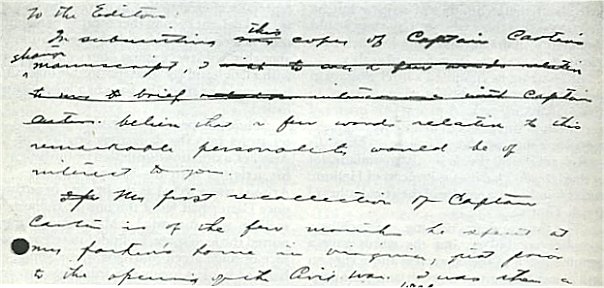
Impressed by the popular All-Story magazine, he submitted his story to the magazine's
editor and offered a brief summary of the plot:
On
August 24, 1911, the answering letter came from the Frank A. Munsey Company in
New York, carrying the signature of the managing editor of All-Story Magazine, Thomas Newell Metcalf.
An analyst par excellence and a man of succinct habits in writing, he mixed the
good news with the bad. "There are many things about the story which I
like," he said, "but on the other hand, there are points about which
I am not so keen. Undoubtedly the story shows a great deal of imagination and
ingenuity; but I am unable to judge . . . the total effect, on account of its
unfinished condition.".
Metcalf, with a dry humor, refers to the supposed
"taciturnity of the Martians" which Burroughs had emphasized. ".
. . yet you have one of the ladies tell a story of a couple of thousand words
and often the Tharks talk to a great extent. Somehow, it seems to me you are
hardly consistent." The lady was a young green-Martian woman assigned to
Carter with combined duties of guide, housekeeper, and tutor. Metcalf, after
some hesitation, eliminated the chapter titled "Sola Tells Me Her
Story," but Burroughs restored it later in the book form.
Setting a 70,000-word limit, Metcalf went on to end
the letter encouragingly: "If it would be possible for you to compress
into that length a story as ingenious as is the greater part of what I have
read, I should be . . . glad to consider it.".
When
Burroughs showed some confusion about the problem of the garrulous Tharks and
the long account given by Sola, Metcalf, struggling to balance a natural
asperity against a fear of being overblunt, fell into a style that was amusing
in its own longwindedness, ". . . may I say that it will be perfectly easy
to correct the inconsistency of which we have talked merely by neglecting to
say that the Tharks are a taciturn people? At the same time, I believe that you
can eliminate a good deal of their conversation.".
In the letter of August 26, Burroughs had also
outlined important sections of the last half of the story for Metcalf,
including a vague and unsatisfactory ending scene for his hero, John Carter:
Metcalf, two days later, had his own suggestion for
the ending, inquiring, "why would it not be possible to have the Martian
city attacked by some kind of a plague, or something of that sort?" The
Martian princess would then die, and afterward John Carter would contract the
illness and find himself dying; he would awaken in the cave in Arizona.
This suggestion for the last scene proved an
inspiration to Burroughs. On September 28 he commented, ". . . worked out
the ending along the line you suggested, which is much more satisfactory than
that I originally had in mind." But what he had devised far exceeded this
modest statement. He had invented an unresolved ending, with the reader
(protestingly, as it later developed) clutched and squirming in unbearable
suspense. From this first Mars story on, his specialty was to be the unfinished
ending and the inescapable sequel.
Burroughs'
elation was tempered by a businessman's cold analysis of the payment versus the
time consumed. On November 6, he evaluated a future writing profession with
considerable skepticism:
This story business is all new to
me, but I like the work provided I can make it pay. However, I know that it
would not be worth my while to devote all my time to it at this rate, as I
started this story in July, which makes the remuneration equivalent to about
$100.00 per month.
Annoyed, Burroughs indicated in his letter of February
2 that as a result of the printer's blunder he was discarding his
nom de plume. In sending a new manuscript he commented acidly:
You will also note that I have used
my own name as author. I have done this because what little value was attached
to my "trade" name was rendered nil by the inspired compositor who
misspelled it in the February '11 Story — or was it the artist? ['11 is an
obvious error.].
He finished by taking a humorous, more indulgent
attitude:
I liked his illustration so well,
however, that I easily forgave him; though I cannot forgive the printer who let
"animal" get by for "mammal" twice.



6 pulp
magazine issues February - July, 1912 <>
ERB C.H.A.S.E.R. ENCYCLOPEDIA/BIBLIOGRAPHY
MORE PORGES/ERB REFERENCES IN ERBzine
Foreword by Hulbert Burroughs
Preface by Irwin Porges
https://www.erbzine.com/mag64/6426.html
Introduction by Ray Bradbury
https://www.erbzine.com/mag35/3571.html



BILL
HILLMAN
Visit
our thousands of other sites at:
BILL
and SUE-ON HILLMAN ECLECTIC STUDIO
ERB
Text, ERB Images and Tarzan® John Carter® Priness of Mars®
are ©Edgar Rice Burroughs, Inc.- All Rights Reserved.
All
Original Work ©1996-2026 by Bill Hillman and/or Contributing Authors/Owners
No
part of this web site may be reproduced without permission from the respective
owners