
Official Edgar Rice Burroughs Tribute and Weekly Webzine Site Since 1996 ~ Over 15,000 Web Pages in Archive Volume 8240 |

Roy G. Krenkel Revisited
<><><>Thomas A. Simmons
I'll come right out
and say it: Roy G. Krenkel is my favorite Edgar Rice Burroughs artist. I'm
quite sure this is because his cover illustration for the Ace paperback Pirates
of Venus inspired a 13-year old kid back in the day to pull the book
off the rack, shell out the 40 cents for it, and armed thus to enter a world of
adventure and wonder I've never entirely left for the past six decades. A strong
case can be made that the Ace paperback covers by Krenkel were, per Danton
Burroughs, "a key factor in the 1960s revival of my grandfather's
writings." They also caused a new generation of readers to sit up and take
notice of the relatively obscure artist who created them. RGK, as he often
signed his work, would ultimately complete 21 covers for Ace during the period
1962 to 1964. When it became obvious his meticulous illustration techniques
were putting him behind schedule, Krenkel enlisted his pal Frank Frazetta to
take on part of the workload — which, as most fans
know, Frazetta proceeded to do with a vengeance.
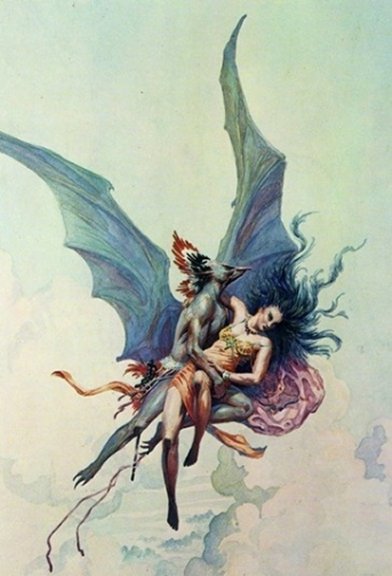
RGK’s Pirates
of Venus cover for
the Ace edition
By 1925, Fred and Louise Krenkel had moved
with their seven-year old son from the Bronx to a small house at 176-39, 133rd
Road in Springfield Gardens, Long Island, which at the time must have passed
for the suburbs in New York City. Both of Roy’s parents would die while living
in the house on 133rd, and eventually so would Roy. What we know
about him during his youth is centered on art: Roy “drew a lot,” sketching and “doodling”
incessantly. At age 10, he won a medal for a piece he submitted to an art exhibition
by New York City school children. Later, he collected art books, studied art
history, frequented art museums, and associated with others who were also
interested in art. Graduating high school in 1935-36, he attended classes in
1938 at the Art Students League in Manhattan taught by George Bridgman, an acknowledged
expert in human anatomy applied to art. But war was on the horizon: his 16 October
1940 draft card described Krenkel as six feet in height, weighing 175, with a light
complexion and brown eyes and hair.
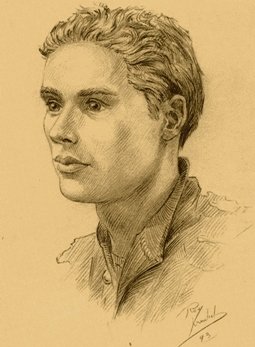
RGK self-portrait, 1943.
Roy G. Krenkel enlisted in the U.S. Army on
23 January 1942, part of a wave that followed closely on the 7 December 1941
Japanese attack upon Pearl Harbor which thrust the United States into war
against Imperial Japan. It is probable he was assigned to the 77th
"Statue of Liberty" Infantry Division, consisting of personnel from
New York City and the area. On enlistment, the 23-year old Krenkel gave his
marital status as single with no dependents, his occupation as "actor”, and
his education as four years of high school. While it isn’t clear if Private Krenkel
accompanied his unit when it left for Hawaii on 23 March 1944 (in December 1943
he was admitted to hospital suffering from neuritis and sciatica), it is known
that he was released for duty at some point during 1944 and served in the
liberation of the Philippines from 23 November 1944 through February, 1945
because he later made reference to having been there. The division also
participated in the invasion of Okinawa, but if Krenkel was present and
mentioned it afterward, the fact has not been recorded. He was discharged from
the Army on 11 May, 1946.
Returning stateside, Krenkel immersed
himself into drawing and studying. “I sold my first piece of art in the late
40s, say about 1949. I went to several schools, Hogarth’s, Artist’s League,
Cooper Union, but I didn’t learn too much from them. Just a little here and
there,” he said in 1964. RGK’s work at home routine may seem surprising to some:
“Everybody laughs when I tell them I work in the living room, sitting on the
couch, with the cat on the table and the TV on; the radio too if my father’ll let me. I don’t like to work in the quiet. I like
to have people talking and things going on. I usually start about 9 in the
morning, work till 10 at night, and watch both late late
shows, hit the pad, and start over [the next] morning. Some days when I’m hot,
I can whip something out, but that’s rare and most of my good stuff is
semi-accidental,” Krenkel said in his self-deprecating way. For some reason,
Roy didn’t seem particularly impressed by his art — but almost everyone else
was.
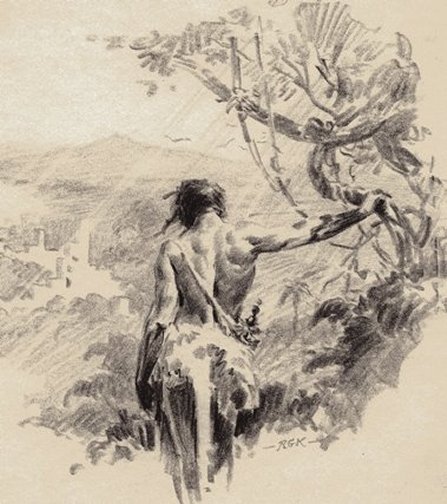
An RGK concept likely used by Frazetta
for Ace’s Tarzan and the Lost Empire cover.
In Burne Hogarth’s classes at the
Cartoonists and Illustrators School, Roy filled in by teaching art technique to
a group of artists who were mostly younger. Artist Michael W. Kaluta quotes a
Jesse Marinoff Reyes posting, “It was [in Hogarth’s class] that he met a group
of young cartoonists, Joe Orlando, and [Al] Williamson and Frazetta
— with whom he would later collaborate at EC
Comics in the early-1950s, as well as
inking Williamson for Atlas (Marvel)
and the American Comics Group. Krenkel would also share studio space with
another important EC artist, Wally
Wood, and you thusly have something of a ‘genius cluster’, or group of
immensely talented individuals working in and around one another, competing or
collaborating and sharing ideas. The extant roster of creatives coming in and
out of Bill Gaines’s EC offices can
also be tied into this, whether John Severin and Reed Crandall, or Bernard
Krigstein and Johnny Craig, not to mention Jack Davis, Al Feldstein, and Harvey
Kurtzman. One piece that is often cited in the history books is a splash page
done with Williamson in an issue of EC’s
Incredible Science Fiction (September-October 1955, issue #32) for a story,
‘Food for Thought’ in which Krenkel rendered an eerie alien landscape. Lush,
detailed and strange, it was a high water mark for illustration in comics up to
that time.”
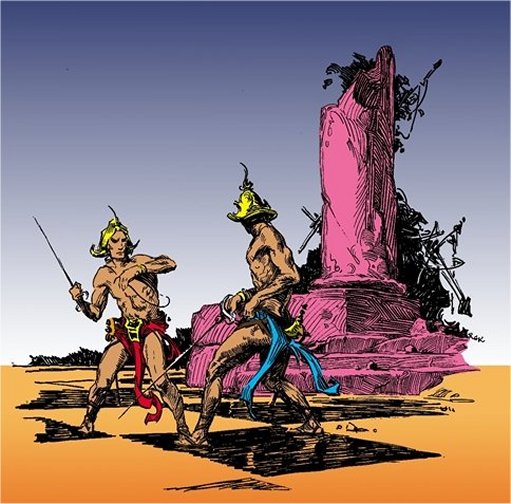
RGK illo for The
Chessmen of Mars colored by Bruce Bozarth.
<>
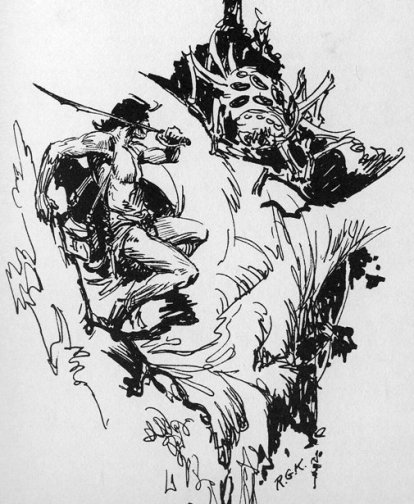
<>
<>
Long-time book dealer Bud Plant recalls Krenkel
as an avid, almost obsessively particular, collector. “I used to see Roy at the
1970s NY Comic Art Cons, when I was setting up there. He'd buy stuff like
Donald M. Grant books from me, such as the Robert E. Howard collections.
Contrary to most artists, he was super fussy about condition; he once
brought a small, minor hardcover book back to exchange it; it had a loose
thread in the sewn binding.” Mr. Plant further recalls, “Roy was the historian
out of all the Fleagle crew and his artist buddies: Frazetta,
Williamson, etc. He turned those guys on to the fathers of illustration such as
Howard Pyle, N.C. Wyeth, Maxfield Parrish, Joseph Clement Coll, Franklin Booth.
I think there may even be quotes from Bernie Wrightson and Kaluta about
Roy opening their eyes about the fine book and magazine illustrators of
the past. [RGK and I] shared that love of all the classic illustrators; I bet
he could have taught me quite a lot if we'd spent some time together. He was a
very nice man and a generous artist, doing [gratis] pieces for countless
fanzines.”
<>
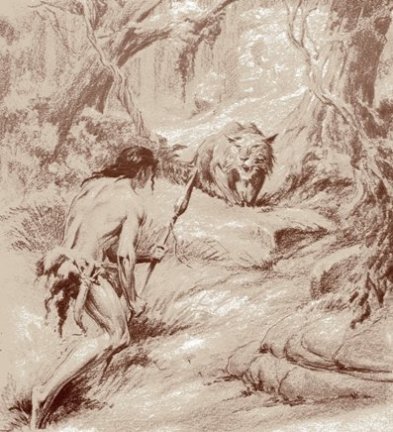
RGK cover art for Amra Vol. II, #15 (1961)
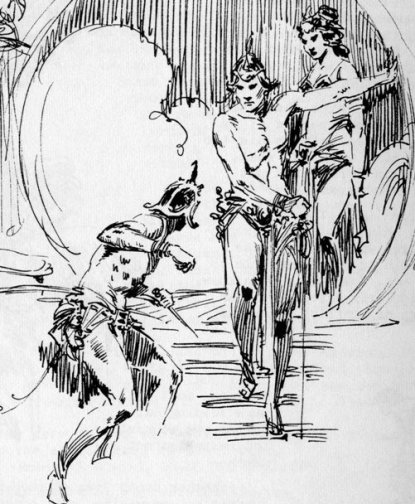
RGK illo scanned from Amra Vol. II, #48 (1968).
What universally stands out when culling
opinions about RGK is that people were in awe of the man’s talent — and yet,
writing in Qua Brot in 1985, Bhob Stewart noted that when their friend Ken Feduniewicz
called RGK “the spiritual godfather of us all,” Roy shot back, “Boy! I don’t
know! That sounds like a lot of crap to me!” Yes, he was a perfectionist and
yes, he was modest and unassuming to a fault, but he was also pleased people
liked his work. For many, RGK seemed to be a classic introverted homebody who
was somewhat nerdy and eccentric — but his friend Chuck Hoffman also noted he
could be “animated, energetic, [and] even boisterous,” while others recalled his
“barking” laugh: not the traits of an introvert.
Toward the end of his life, Krenkel became
increasingly “impoverished.” As he had done for others throughout his life, by
freely imparting his knowledge of art history and technique, giving away his
art or charging ridiculously low fees for it, lining up friends with art gigs or,
after he’d won the Hugo Award, by crumpling his sample sketches and tossing
them into the wastebasket for his School of Visual Arts students to salvage,
lovingly straighten out and save for posterity, so people stepped up for Roy:
Frank Frazetta found inking and set-up work for him, close friend and writer C.J.
Henderson provided sumptuous meals and bought him a new TV set when his old set
failed, and another “dear friend” offered him a burial plot — which he
accepted.
Roy was a lifelong smoker. Chuck Hoffman says that “the day he learned he was dying he did this drawing in black and blue ballpoint pen called ‘The Medusa’. It depicts a bulky androgynous figure, with a bulbous face and enveloped in a cloak, lurching forward with one arm extended. Instead of serpents for hair, there are these massive coils of what could be smoke flowing outward from the figure's head and filling the top of the illustration. Or, the coils might be flowing inward and attacking the figure.” Roy Gerard Krenkel passed away on 24 February, 1983 from complications of lung cancer. Just before he breathed his last, when a friend asked him why he was smiling Roy reportedly answered, “Why not?” Krenkel’s grave is located at Green-Wood Cemetery, Greenwood Heights, Brooklyn, New York. His long-time pal, supporter and associate Frank Frazetta was one of the pallbearers.
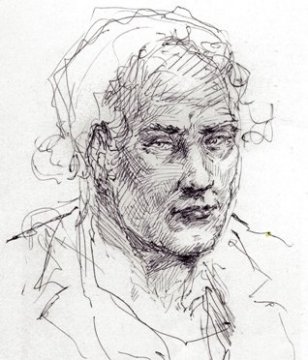
RGK self-portrait.
Michael Kaluta shares this story about RGK’s cat: “Roy claimed to keep his cat schooled in its natural
attitudes and graces, that, come feeding time, he’d set the cat’s food bowl on
the left waist high kitchen counter top… there was a counter top of equal
height and depth on the right hand side, the two counters being bisected by the
kitchen door… a span of at least three feet, or perhaps as many as four.
Between the two counter tops Roy would securely set a house broom, the tall
pole handle with the fan of sweeper straw on the other end. That delta of bound
straw would, laid onto the counter, firm up the broom as a viable ‘bridge’ with
no chance of tipping or rotating. The right hand counter was easily
cat-accessible, Roy having set a chair with a healthy stack of books up against
the drawers, making, in fact, a ladder from the kitchen floor to that right
hand counter top. Hence the only access the cat had to the food bowl on the
left hand counter top was across a round inch-wide broom handle between 3 and 4
feet across. Roy would preamble this story with the admonition, or perhaps
schooled information, that a cat needed to be challenged and that one should
endeavor to challenge one’s cat at every opportunity. There were natural feats
any cat could accomplish should it deigned to care to, and, even against the
feigned recalcitrance often noted in house cat behavior, a cat would take on
all challenges of balance and dexterity if so challenged with firm authority.
To be able to eat that evening, Roy’s cat would have to ’tightrope’ from one
counter top to the other in Indian Trail across the length of round broom
handle — and
Roy’s cat would ace it, not caring to note Roy’s
absolute delight in the performance. On rare occasions, when his cat felt he
was not to be trivialized, the cat would take one spring leap from kitchen
floor to the counter top on which his meal was waiting. This was, of course,
something that delighted Roy even more, and, could he figure a way where the
challenge was always to leap from floor to food, Roy would have definitely set
forward that challenge.”
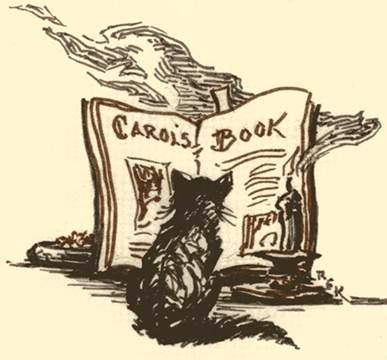
RGK’s (or someone’s) cat gets into the act:
a bookplate
for a friend.
Information on RGK is, quite literally,
scattered to the four figurative winds. There is no extant biography, and as
Krenkel himself said, “I’m no writer of autobiographies.” Snippets appear across
a wide spectra, from prefaces in printed books and online postings to archival
source records and input from those who knew or met him. I can’t express how
much I appreciate the testimony I received from new friends Michael W. Kaluta
and Charles “Chuck” Hoffman; together with those of pals Mark Wheatley and Bud
Plant, their recollections were the glue that held this piece together. In
addition, I used interviews and personal letters like those in Bhob Stewart’s fine piece in Qua Brot #1, Camille Cazedessus’ interview with the artist in ERB-dom, the
book Roy G. Krenkel, father of heroic
fantasy: A Centennial Celebration (2018) as well as ERBzine, Ancestry and
Wikipedia. People I whom I thank for comments, anecdotes and permission to use
their material include new friends Bruce “Tangor” Bozarth and Larry “Deuce”
Richardson as well as Scott Tracy Griffin and Bill Hillman. A recap of RGK’s
oeuvre (not including his countless “doodles”) is located here: https://isfdb.org/cgi-bin/ea.cgi?901
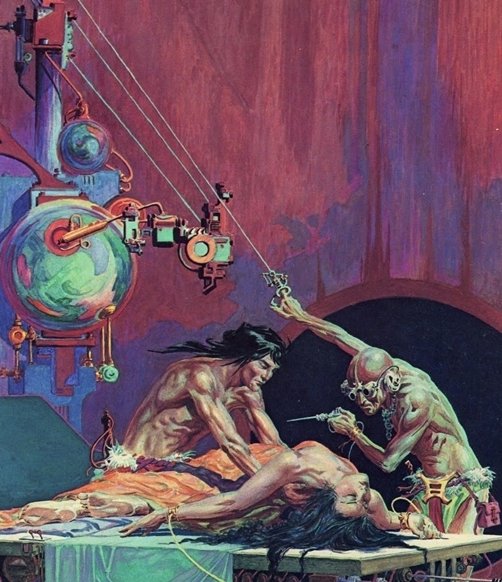
ROY G. KRENKEL FEATURES IN ERBzine.com
https://www.erbzine.com/krenkel/
BIOS ~ PHOTO GALLERIES ~ SKETCHES ~ ACE COVERS ~ 20 RGK ART COLLAGES
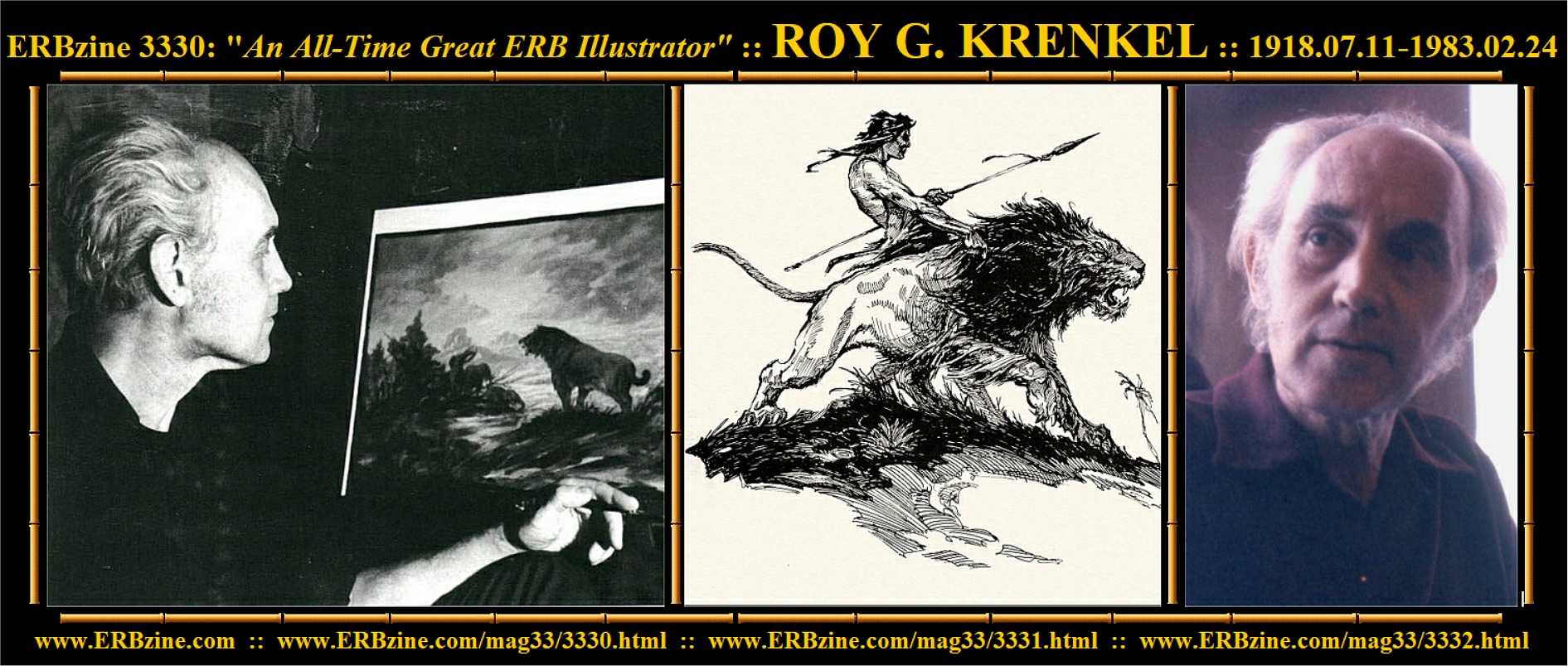
THOMAS A. SIMMONS
https://www.erbzine.com/mag55/5569.html



BILL
HILLMAN
Visit
our thousands of other sites at:
BILL
and SUE-ON HILLMAN ECLECTIC STUDIO
ERB
Text, ERB Images and Tarzan® John Carter® Priness of Mars®
are ©Edgar Rice Burroughs, Inc.- All Rights Reserved.
All
Original Work ©1996-2026 by Bill Hillman and/or Contributing Authors/Owners
No
part of this web site may be reproduced without permission from the respective
owners