
Volume 1809b
Georges Dodds'
The Ape-Man: his Kith and Kin
A collection of texts which prepared the
advent of Tarzan of the Apes by Edgar Rice Burroughs
Presents
http://www.erbzine.com/mag18/balaoo3.htm
Balaoo by Gaston Leroux
Book the Third
Balaoo Man-About-Town
TABLE OF CONTENTS
Book the First:
The Panic-striken Village
Book the Second:Balaoo
has the Time of his Life
Book the Third:
Balaoo Man-About-Town
The Wedding
When Patrice arrived in Paris, at 7.15 in the evening, there was no one
to meet him at the station. He was surprised at this, although, during
the three years since his future father-in-law had left Saint-Martin-des-Bois,
Coriolis' behaviour towards him was such that he need not have been surprised
at anything.
First of all, he was kept away from Madeleine. True, she and her father
paid two or three visits to Clermont; but the young man was never invited
to go to them in Paris. After two years, as Coriolis kept on postponing
the date of the marriage on inadequate pretexts, the Saint Aubins became
curious to know what could be happening at their relations'. They applied
to a private-enquiry office, which soon supplied them with information
of so absurd a character that they regretted paying for it in advance.
Nevertheless, in course of time, some of this information was confirmed.
For instance, it was quite correct that Coriolis never went out without
taking young Noël with him and that he appeared, somewhat late in
the day, to have acquired an insane liking for that shy and silent lad.
He was letting him study for the bar!
Noël studying for the bar! Upon my word! Noël was a law-student
and Coriolis accompanied him to all the lectures!
What did it mean? And what was hidden behind this last freak of the
ex-consul at Batavia? The Clermon Saint-Aubins were wondering, in consternation
and alarm, when, suddenly, the marriage between Patrice and Madeleine was
fixed.
Coriolis hurried things in a frenzied fashion. The wedding would be
in Paris, but the old eccentric did not allow Patrice any time for the
wooing. He considered that a ridiculous and antiquated custom. The young
man was not to come to Paris until forty-eight hours before the ceremony,
which would take place very quietly, especially as the Saint-Aubins were
detained at Clermont by the father's gout and could not be present. On
the evening of the wedding, the newly-married couple were to go to Auvergne
and embrace the old people before travelling on to Italy, where they would
spend the honeymoon.
So Patrice came to Paris by the 7.15 train, as Coriolis had suggested,
and found no one at the station.
He felt "hurt."
He had his trunk put on a cab and told the man to drive to the Rue de
Jussieu. Here the old eccentric had taken up his abode in an old-fashioned
house, on the confines of the Quartier des Écoles, bringing with
him his daughter, his old servant, his native "boy" and all his notes and
manuscripts on the bread-plant.
Through the windows of his cab, Patrice gazed sadly upon Paris, which
was charming to look at on this fine spring evening; but he did not care
for Paris. Paris had always frightened him. There were too many carriages.
And, even when you kept off the pavement, you were never at peace. Lots
of people, even ladies, whom he did not know from Adam or Eve, would accost
him and ask him things or offer him things which he did not understand
and did not wish to.
When he reached the Rue de Jussieu and the cab put him down outside
his uncle's house, the quiet of the neighbourhood appealed to him. It reminded
him of the country. The sparse lighting, the pavement echoing under the
feet of a distant wayfarer, the solitude around him: all these suggested
to his mind certain streets at Clermont where he used to go for a little
stroll between dinner and bed-time.
He rang the bell. Gertrude opened the door. She seemed neither surprised
nor pleased to see him. She simply said, in an indifferent voice:
"Oh, it's you? Mademoiselle will be so glad."
"Didn't they expect me this evening?" asked the bewildered young man.
"Oh, yes!" replied the old servant. "Your place is laid."
They were standing in a great, cold, flagged hall, ending in an enormous
staircase with a wrought-iron baluster. Gertrude pointed to the stairs
and a voice from above said:
"Is that you, Patrice?"
"Of course it is! Who else would it be?" replied the young man, somewhat
crossly, though he had recognized the voice of his intended.
But Madeleine ran down the stairs and threw herself into his arms. Patrice
kissed his cousin, whose demonstrations of affection struck him as being
a little put-on. She seemed rather anxious than pleased at seeing him.
He did not think her improved in her looks, because Paris had made her
lose her pretty colouring. True, she had developed other feminine attractions,
which Saint-Martin-des-Bois would never have given her; but, when you come
from the Rue de l'Écu, you don't shake it off easily.
Madeleine, on her side, thought that Patrice looked sulky:
"What's the matter with you?" she asked, pouting. "You seem displeased
at something. Is it because you weren't met at the station? You don't know
what papa's like. He's not overburdened with politeness and nothing would
make him depart from his regular habits. On the other hand, he would never
let Gertrude and me go across Paris alone, so late in the evening."
"I'm not complaining!" said Patrice, compressing his lips. "Where's
uncle?"
"You'll see him at dinner. Gertrude will show you your room. Be quick:
we dine at eight punctually; you have just five minutes."
Patrice' room was a great, bare room on the second floor. There was
a little bed, in between high walls and high, badly-closing windows. The
walls were covered with the most wonderful panelling, all chipped and worn:
he did not even look at it. There was nothing homely about the room, nothing
soft. Not a sign of forethought: not a flower; not a photograph; nothing.
He would have liked Madeleine to provide something to show that she was
interested in the man about to occupy that room. But not a thing! He sighed
and felt very lonely.
In what a hurry she had kissed him, pushing and hustling him to get
it over! And they were to be married in two days!
He sat down gloomily at the foot of his bed. Gertrude's voice outside
the door made him start up:
"Are you ready, M. Patrice? Mademoiselle would like to speak to you."
He paid no attention to his appearance, did not even look at himself
in the glass. He washed his hands and found Gertrude waiting for him impatiently:
"Come along, sir!" she grumbled.
And she took him downstairs and pushed him into the drawing-room.
It contained the old set of Empire furniture which he had known at Saint-Martin-des-Bois.
Here again there was not a flower in the vases. And the chairs had their
covers.
Madeleine was standing near the door. She took his hand and said to
him, speaking very quickly, in an undertone:
"Dear Patrice, when we are married, e shall do as we like, sha'n't we?
But here we are at papa's and we must not vex him. He has become crazier
than ever. We must not be angry with him, for he is very sorry at my going
away. He could never bear the thought of my marriage. He made up his mind
to it at last, as though he had decided to be operated on for appendicitis.
He is very unhappy and he wants to get it over and done with. But, until
it is over, he won't have it talked about! So there must be no question
of a wedding, at meals or anywhere in the house, That's settled. You will
act towards everybody as if you had come to Paris for two or three days
on important business which concerns no one but yourself. Is that understood?"
She did not even wait to hear his answer. As he stood there, dumbfoundered,
she opened the door of the dining room and went in. He followed her as
in a dream.
A young woman of fashionable appearance sat reading by the corner of
a window. She raised her head at their entrance. Patrice could not restrain
an exclamation: it was Zoé!
It was really true: he saw before him the little gadabout of the forest!
This pretty girl who got up and bowed so easily, so quietly, looking so
very Parisian in her simplicity and in the modest and assured taste that
distinguished her dress, was the Vautrins' sister, whom he had seen running
along the forest-paths like an untamed hind, with her hair streaming in
the wind or blowing over her forehead! By what miracle did he now find
her so greatly altered, looking so "proper"?
When he heard, at Clermont, that Zoé had gone to join Madeleine
in Paris, the young man did not conceal his views from his intended. And
he wrote to her all that he thought of this latest hobby of his uncle's.
But Madeleine replied curtly that she had not been consulted and that,
besides, she looked upon her father's treatment of the poor little orphan
--- Mother Vautrin was dead --- as a kind action. Later, Madeleine
again had occasion to write that Zoé was making herself very useful
in the house, now that Gertrude was getting old. She said that the child
had become quite sensible after breaking every link with the past; and
she added that Zoé's brothers must certainly be dead, or they would
have found means of letting their sister know to the contrary. That was
what Zoé thought.
Patrice, while failing to understand how anyone could feel inclined,
unless compelled, to be waited on by Mlle. Vautrin, that scion of a too-illustrious
family, was delighted with this last communication. The death of the Three
Brothers, doubtless slain by the bullets of Major de la Terrenoire's troopers,
reconciled him to the sister; for Patrice would still sometimes wake up
in bed, with his forehead bathed in perspiration, from a nightmare in which
a curious masked driver took him somewhat roughly by the throat and asked
him never again to set foot in Saint-Martin-des-Bois. And, as he had dropped
the idea of the intervention of a fourth miscreant, of the mysterious accomplice
whom the eloquence of the Clermont public-prosecutor had definitely relegated
to the realms of legend, he invariably ascribed to the albino the responsibility
for the terrible adventures that had nearly caused his death. It was a
good thing that Élie was no more; and Patrice had looked forward
to hearing the glad tidings repeated by Zoé's own lips.
But he expected to find her in the kitchen.
And he discovered her in the dining-room, where she seemed quite at
home, dressed like a young lady, smiling at him with the gracious condescension
of a woman of quality who wished to put him at his ease: Zoé, the
savage little sister of the three men sentenced to death!
He did not know if he ought to shake hands. But she held out hers to
him, very simply, and asked after his health.
He did not have time to indulge in further raptures of wonder. Uncle
Coriolis entered the room, followed by a tall and sturdily-built young
gentleman, who flung out his chest and displayed a pair of broad shoulders
under a well-cut jacket. Madeleine's sweetheart knew that simian face,
with the almond eyes, that Far-Eastern type which always surprises us when
it is modified by European fashions, such as the hair smoothly plastered
down, with a straight parting . . . and the single eye-glass. Yes, M. Noël
was wearing an eye-glass! Patrice, who had never seen him so near at hand,
considered that he had improved. The smart cut of his clothes and his frigid
bearing made him look almost distinguished. The peculiar ugliness of his
face was rather attractive than repulsive.
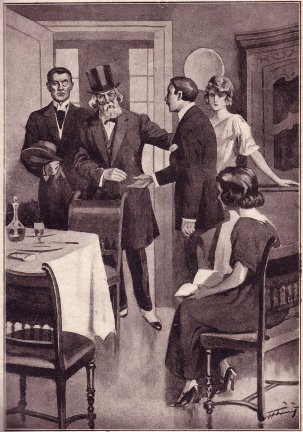
Uncle Coriolis entered the room, followed by a tall and sturdily-built
young gentleman.
"He may be quite good-looking in his own country," thought Patrice,
reflecting that, after all, looks are a matter of latitude and longitude.
Only he regretted, for that foreigner's sake, the exceptionally powerful
build of the animal jaws.
Patrice was astonished by Zoé, but the sight of Noël plunged
him into absolute stupefaction:
"He has changed immensely since he worked in the bread-plant orchard,"
he thought, bowing somewhat coldly in answer to the ex-gardener's curt
nod.
And they all sat down to table.
Coriolis had not been at all demonstrative with his nephew. He asked
casually after Patrice' parents and, without waiting for the reply, pointed
to his place, between Madeleine and Zoé. Noël sat between Zoé
and Coriolis.
The soup was followed by an embarrassing pause, which was broken by
Coriolis:
"Perhaps, my boy, when you've finished staring like a lunatic, you'll
tell us what you're surprised at?"
Patrice was ashamed to be spoken to like that before Madeleine. He had
the courage, however, to say, with his nose in his plate:
"What surprises me is M. Noël's eye-glass." Madeleine warned him,
with a little kick under the table, that he had made a blunder. But it
was too late . . . His uncle was already going for him:
"Your father wears spectacles; and I don't see why M. Noël, whose
left eye is weaker than the other, should not wear a concave glass. Astigmatism
is not a privilege of the white race, nor is the use of lenses, to correct
it."
This was said in so harsh and contemptuous a tone that. Patrice was
crushed. He tried to hide his confusion under a pleasant smile.
"What are you smiling at? You think yourself very witty, I suppose!
Don't be afraid: you're not the only one. They're all alike, the young
men of to-day who have not left their mother's apron-strings. If you had
been three times round the world, as I have, you wouldn't sit gibbering
at the sight of a Malay native who looks better in a reefer-suit and a
double-breasted waistcoat than you do --- you haven't seen him in
his dress-things, yet --- and who could give you points in Bandy-Lacantinerie,
(13)
solicitor's chief clerk though you may be!"
And, when Patrice, utterly confounded, kept silent: "Ask him questions!"
roared Coriolis. "Ask him anything you like!"
"Don't make such a show of the poor young man, sir!" said Gertrude's
whining voice, amid a clatter of plates and silver.
She was told, with due respect, to leave the room. Madeleine made the
mistake of protesting, whereupon Cariolis closed her mouth too:
"I won't have it, do you hear me, all of you? I won't have Noël
laughed at!"
"But, uncle, no one's laughing at him!" Patrice ended by exclaiming,
in his exasperation.
"Nonsense! The moment he entered the room, you looked at him like a
phenomenon! I won't have it, do you hear? I will not have him looked at
like a phenomenon! We can't all be born in the Rue de l'Écu at Clermont-Ferrand!"
"Papa! Patrice hasn't said anything to annoy you. You're exciting yourself
about nothing."
"Oh, you'll end by making me ill, among the lot of you: Noël as
well as the rest!"
Noël seemed not to hear and went on conscientiously gobbling up
a plate of Brussels sprouts.
"Good! Now it's Noël's turn!" said Madeleine, with a forced laugh.
"And Zoé too!" continued Coriolis, growling like anything.
"What have I done?" asked pretty little Zoe's innocent and mellifluous
voice.
"You've made four more big mistakes in dictation and you've got bad
marks for geography."
"Geography," said Zoé, "simply won't enter my head."
"And spelling? Won't spelling enter your head?"
"Yes, monsieur, but it takes time . . . "
"Time? What time? You're old enough to be married. You've got to know
spelling and geography. When I tell you, Patrice, that I've had more trouble
with that little minx than I've had with Noël, perhaps it'll
take down your exalted notion of the white race, eh, my boy?"
Patrice nodded his head. He wished his uncle to believe that he shared
his opinion; but he could not understand a word of the whole business.
So they were now making a blue-stocking of Zoé!
"I want you to understand, child," continued Corialis, turning to Zoé,
"that I'm not having you taught a word too much if you want to be happy
in your married life." Patrice thought:
"Madeleine put it badly when she forbade me to talk about marriage.
When all's said, they seem to talk about anybody's marriage here, except
mine."
"I shall never marry," Zoé answered, sadly, casting down her
eyes. "Who would have me?"
"That's my affair," growled Coriolis, in a great grumpy voice.
And, as he spoke, he glanced at Noël, who lifted his nose in the
air. His indifference to all that was said at that table was gorgeous;
and Patrice could not help admiring it.
His uncle grunted:
"It's very bad manners to pretend to be dreaming at table and never
to attend to the conversation. I say no more!"
Noël could not have heard, for he took no notice. He made up for
it by scratching himself. His sleeve must have felt uncomfortable; for
with his left hand he scratched himself vigorously under his right arm,
a thing which is not allowed in man's reception-rooms. Uncle Coriolis rapped
him smartly over the knuckles with a little ebony ruler which Patrice had
noticed on the table, without knowing what it was for. Tap! M. Noël
gave a yell, like an animal that is being punished, and let go his sleeve.
"It's disgraceful," said Coriolis. "You forget you're not at Hal-Nan
here. It's disgraceful behaviour for a Paris law-student."
"Is he entered?" asked Patrice, jokingly.
"He attends the lectures, with me."
"How far are you, uncle?"
"At the various manners of acquiring property," replied Coriolis. "Noël,
just tell us the various manners of acquiring property."
M. Noël, wondering all the time if Gertrude would soon bring the
nuts, put his long, aristocratic Hal-Nan hand to his mouth and coughed.
Then, in his rather hoarse voice and in the declamatory tone of a little
boy saying his catechism, he answered:
"The different manners of acquiring property are by succession, deeds
of gift and inheritance; contracts: contracts of sale and contracts of
. . . "
He stopped suddenly.
"Well?" said Coriolis, with a frown. "Contracts of . . . "
"You know, sir," said Balaoo, watching a fly, "that I dislike that word
before strangers."
This with a look of savage hatred at Patrice.
"Oh, indeed!" said Coriolis, putting out his hand for the little black
ruler.
Balaoo turned pale, which was his way of flushing, and, speaking very
quickly, in a low voice, said:
"And contracts of marriage . . . of marriage."
He raised his head, pleased at having mastered himself, and now tried
to look at Patrice with an indifferent air, like one of the Race who knows
how to conceal his private emotions.
"Well, Patrice," said Coriolis, delighted at the result, "what do you
think of that?"
Patrice thought:
"Certainly, for a native of Hal-Nan, there's an improvement, the improvement
of the little black ruler upon the common-or-garden cane."
But he took good care not to express his thoughts to his uncle, who
might have thrown him out of the window, and he said:
"It's wonderful!"
"And, you know, you can ask him anything you like," said Coriolis. "I
have given him the thorough education of a young man of family. He knows
his classics."
"Does he know Latin?"
"You have no right to make fun of your old uncle, Patrice. No, Noël
does not know Latin yet. But you can be sure that, when he does take it
up, he'll stump you in less than three months. Ask him about dates and
Roman history."
Patrice saw that there was no escape. He would have to "ask":
"Won't it bore you, monsieur, if I ask you it few questions?"
M. Noël, who had just cut himself a great chunk of Gruyere cheese,
proceeded to swallow it calmly and made no reply."
"Don't you hear?" said Coriolis. "My nephew Patrice wants to know if
he can ask you some questions. Show that you're not a fool."
By this time, Balaoo had cleared his mouth. He knew that he must not
speak with his mouth full. Carelessly:
"We should keep our qualities for use and not for show!"
And he dropped his glass from his eye, at the end of its cord.
"Well, that's an answer," said Patrice, grinning like a booby."
"Oh, he's seldom at a loss," said Madeleine. "But you're frightening
him, to-night."
Balaoo screwed his glass in his eye again, with a furious gesture.
"Are you vexed?" Coriolis asked Balaoo.
"I know why he's vexed," said Zoé, in a melting voice.
"Why?"
"Because Gertrude hasn't brought the nuts."
"Is M. Noël fond of nuts?" asked Patrice.
"Oh, they're his ideal!" said Madeleine.
"Is that so, monsieur?" asked Patrice, for the sake of saying something.
"Are nuts really your ideal?"
"Woe be to him," said Balaoo, "who does not bear himself according to
an ideal. He may still be pleased with himself, but he will always be far
removed from the good and the beautiful."
Having delivered himself of this aphorism, he looked at the door; but
Gertrude was not yet bringing the nuts.
"M. Noël is a great philosopher," said Patrice, with an important
air.
And he gave a silly smile.
"You needn't smile like an idiot when you make a statement like that!"
said Coriolis.
"Very well, uncle," said Patrice, in a nettled tone.
Balaoo seemed delighted and, of his own accord, remarked, with his eyes
still fixed on the door:
"Few men have the wisdom to prefer wholesome blame to fickle praise!"
"What can Gertrude be doing?" said Madeleine, to change the subject.
She rose, went to the kitchen and returned at once:
"I found Gertrude in tears. She made a nice tart for to-night and now
she can't find it anywhere."
Balaoo began to shake:
"General Captain must have taken it," he said.
You lie!" said Coriolis, severely. "General Captain has a broad back
and a broad beak. But he is a good and faithful servant. Did you only bring
him from the Black Woods to accuse him of your faults? Answer like a man!
And don't turn away your head! Why did you eat that tart? You knew that
you were doing wrong. Answer me."
"That's true," said Balaoo, swallowing his shame before Patrice and
vainly waiting for the nuts. "The clear sense which we possess of our faults
is a sure sign of the freedom which we have enjoyed to commit them!"
"Very well," said Coriolis, "you shall have no nuts."
At that very moment, Gertrude entered with the dish and put it on the
table. M. Noël's eyes gleamed like carbuncles. But Coriolis' hand
was already playing, as though casually, with the little black ruler.
"Papa!" said Madeleine, beseechingly.
Noël thanked her with a moist eye. The eye-glass had dropped out
again.
"Papa," continued Madeleine, "you were so pleased with him over the
Conference Bottier!"
"Does M. Noël attend conferences?" asked Patrice.
"Young man from the country," retorted Coriolis, "if you had read your
law in Paris, instead of in the outlandish parts where you come from, you
would know that the Conférence Bottier is a debating-society of
young men studying for the bar who meet in the evenings, at the law-courts,
to get used to practice and to accustom themselves to public speaking."
"Does M. Noël mean to become a barrister?"
"We'll see about that later. For the present, I am making him study
the art of speaking. He is doing pretty well. Oh, the man who cut his ligaments
did not waste his time and got good value for his money."
"Has he spoken at the Conférence Bottier?"
"Not yet. I don't want to draw attention to my pupil before I am quite
certain of success. But I go there with him; and he sees how a positive
is established and how it is met by a negative. The day on which he makes
his first speech will be a great day!"
Coriolis uttered this last sentence with such ardour and eagerness that
Patrice was struck by it. He felt really sorry for his uncle, who seemed
to him to be falling into his dotage.
"Meanwhile," said Coriolis, "by way of practice, I am having him taught
Cicero in French."
"Oh, monsieur," said Zoé, shyly, "do ask him to, recite us his
story about the Paladin!"
"Oh, yes, sir, the story about the Paladin!" said Gertrude, stuffing
Balaoo's pockets with nuts, unseen by Coriolis.
"Very well," said Coriolis, smiling. "Come, Noël, give us your
recitation about the Paladin."
Balaoo sulked and sat as still as a stone.
"Come on, you great silly!" said Coriolis, "You shall have some nuts
afterwards."
On hearing this, Balaoo stood up, moved behind his chair and rested
his left hand on the back, leaving, his right hand free for gesticulation.
Then, in his best chest-voice, he began:
"How far at length, O Catiline, wilt thou trifle with our patience?
How long still shall that frenzy of thine baffle us? To what limit shall
thy uncurbed effrontery boastfully display itself? Have in no degree the
mighty guard of the Palatine Hill . . . "
"Oh, the Palatine Hill!" said Patrice. "I didn't know what they meant
with their Paladin!"
"Hold your tongue, will you, you villain!"
This objurgation came from Coriolis, whose eyes were starting out of
his head, while his fist was almost raised to strike Patrice for interrupting
Mr. Noël in his exercise. Patrice instinctively shrank back, half-muttering
to himself that his uncle was qualifying for an asylum and promising not
to spare him once he was safely married and out of his reach.
Coriolis, a little ashamed at seeing how he had scared his nephew, calmed
himself:
"Let him go on," he said. "I wish you wouldn't interrupt him, or he'll
forget the whole thing."
"I must begin all over again," said Noël.
"Very well, do."
Standing behind his chair and waving his arms as though in the tribune,
Balaoo resumed his recitation:
"How far at length, O Catiline, wilt thou trifle with our patience?
How long still shall that frenzy of thine baffle us? To what limit shall
thy uncurbed effrontery boastfully display itself? Have in no degree the
mighty guard of the Palatine Hill, in no degree the watches of the city,
in no degree the fear of the people, in no degree the assemblage of all
good men, in no degree this most fortified place of holding the senate,
have the looks and countenances of these in no degree alarmed thee? Dost
thou not perceive that thy designs are disclosed? Dost thou not see that
thy conspiracy is already held bound by the knowledge of all these? What
thou hast done last night --- last night," thought Balaoo, "I went
quietly to bye-bye, to please Madeleine, who does not like me to be out
every evening --- what on the night before --- oh, well, old
chap, if you knew what I was doing the night before, wouldn't you just
pat me with your little black ruler! --- where thou wert ---
at Maxim's!" muttered the orator, between two breaths --- "whom,
thou didst assemble --- they were drunk as lords!" thought Balaoo,
--- " what plan thou didst adopt, which one of us dost thou think
to be ignorant of? O the times! O the manners! The senate understands these
things, the consul perceives them and yet this man lives."
"Bravo! Bravo! Bravo!" roared Patrice, anxious to recover Coriolis'
good graces, at least until after the wedding.
Madeleine applauded prettily, Zoé was pale with excitement, Gertrude
shed tears; but Gertrude nowadays shed tears on the slightest pretext.
"Yes, br-r-r—ravo!" spluttered Coriolis, choking with gleeful pride.
"Did you see how he recited it? The gestures? Weren't they well-felt, eh?
. . . Don't you hear it in the rostra? In the middle of the Forum!
. . . I must take him there. Yes, yes, yes! We'll go to Rome together .
. . The Forum! The rostra! . . . My Noël standing there, in
Cicero's place! Oh, I shall live to see it yet!;" cried Coriolis, raving.
"Does he really understand all he says?" asked Patrice, tactlessly.
He received a tremendous thump in the ribs from Uncle Coriolis, who
could have killed him:
"What's that? . . . What's that? . . . He undestands better
than you do!"
"Well, all the same, there are words . . . For instance, he never heard
of the Palatine Hill at Haï-Nan . . . "
"Perhaps you can tell us what there was on the Palatine!" bellowed Coriolis.
"There was . . . there was," stammered Patrice. "I don't know . . .
there were fortifications!"
Coriolis exploded:
"There was a temple, you idiot!"
The tears came to Patrice' eyes. Madeleine interposed:
"Really, papa!"
"Let me be!" said Coriolis. "My gentleman is trying to pull Noël's
leg: fortifications, indeed I . . . I tell you, there was a temple!
. . . And you know the name of the temple!"
"No, uncle, I don't," said Patrice, in a harrowing voice.
"Tell him, Noël."
"The Temple of Jupiter Stator," said Balaoo, without a moment's hesitation,
eyeing the nuts on the table and rattling those which Gertrude had put
in his pocket.
"It was round the Palatine Hill that Romulus traced the first boundaries
of the future capital of the world."
"Well, does that stump you?" asked Coriolis, beaming all over his face.
"Yes, uncle, that stumps me!" said Patrice, hanging his head.
Coriolis, gave Balaoo a friendly pat:
"There, you can eat your nuts!"
M. Noël did not wait to be told a second time. He flung himself
on the dish and, with extraordinary speed and dexterity, cracked the walnuts
with his teeth, picked them and swallowed them. Patrice had never seen
anything like it.
"He can't help that," said Coriolis, good-humouredly.
"I have cured him of any number of bad habits which he brought with
him from Haï-Nan; but I have never, no, never succeeded in making
him use nut-crackers."
"We all have our hobbies," said Patrice.
"He would sooner die. One would think that it gave him as much pleasure
to crack his nuts with his teeth as to eat them afterwards."
"I'll wager," said Patrice, "that M. Noël prefers nuts even to
Cicero's orations."
"Answer, Noël," said Coriolis.
Balaoo swallowed his last nut and said:
"We are surrounded by an infinity of real, simple, easy joys. We have
but to secure them!"
He screwed his glass into his eye and, after staring at Patrice with
a look of utter contempt, turned his head away, obviously unable to bear
the sight of the fellow.
Patrice bowed. They rose to go to the drawing-room. Coriolis told Noël
to give Zoé his arm, which he did with no great eagerness. On the
contrary, he kept his eyes fixed on Madeleine, who had taken Patrice' arm.
Then, as though unintentionally, he trod on her dress and tore it right
across. He apologized.
Coriolis had not the heart to upbraid him, for he knew the pithecanthrope
well and read an immeasurable sadness in his eyes.
Balaoo led Zoé to the tea-table and said:
"I am a little tired this evening, sir. May I ask leave to withdraw?"
Coriolis assented; and Balaoo, after quickly bowing to the company,
went up to his room without shaking hands with Madeleine.
Balaoo found Gertrude in his bedroom, putting out his evening-clothes and
his dress-boots:
"Go away," he said, roughly. "I'm not going out."
"No one will know," Gertrude answered, with a sigh, "and it will do
you good to take a little air. Look, here's twenty francs to enjoy yourself
with. I'll run down and serve the coffee and I'll come back again. Get
your things on."
She went downstairs and returned in five minutes.
Balaoo was lying on the rug by the bedside. He had not changed his clothes
and he was crying. Gertrude was terribly upset:
"What's the matter with you? What's the matter?"
"You know what's the matter well enough!" replied Balaoo, pressing his
clenched fists to his mouth to check his despair. "What did he come back
for?"
"One can't prevent his coming to Paris. He's the master's nephew. He's
here on business."
"Oh, I know that, sooner or later, he's bound to come and take Madeleine
away. It is man's law, but it will be my death." Craftily he continued,
"You may as well tell me if it's for to-day or to-morrow. I swear I won't
hurt him. I promised Patti Palang Raing. Man is man; and I have shoe-hands
instead of feet. I shall be quite good. I shall go straight to the Seine
and drown myself without a word."
"And what will become of me?" sobbed Gertrude.
"That's not what I was asking. Is it for to-day or to-morrow?"
"But I assure you there's no question of that!"
"Then tell me, you old vixen, why they wanted to send Zoé and
me to the man's house at Saint-Martin-des-Bois? It was the Bank of France
to a handful of nuts that I agreed. They knew what they were doing and
that I should love to see the Big Beech at Pierrefeu and the table-rock
at Mahon and the orchard of my youth . . . But I suspected. something
. . . and, true enough, 'he' came! . . . Give me your word that you
were not expecting him . . . You daren't give me your word, eh? .
. . Filth!"
At that moment, there was a tap-tap-tap at the door. Gertrude, flooding
her handkerchief with her tears, went and opened it; and General Captain
walked in:
"Hullo, Polly!" he said.
"Here's this dirty rotter," growled Balaoo. "What do you want, General
Captain?" General Captain gave vent to a whole array of guttural and cackling
sounds, that came from his throat as quickly as the words of any old woman
in a rage.
"What's he saying?" asked Gertrude.
"He says that he can't understand why we haven't started. I promised
to take him to Pierrefeu."
"Pierrefeu! Pierrefeu! Pierrefeu! Pierrefeu!" cried General Captain.
"He's deafening me," said Balaoo, turning over on his rug. "Go and fasten
him to his perch, in the kitchen."
"Let's start! Let's start! Let's start!" yelled General Captain, flapping
his wings.
"Oh, that's enough of it!" said the pithecanthrope, catching him a tremendous
box on the ear.
Gertrude, still weeping, put General Captain out of the room. They heard
him, for a moment, on the landing, indulging in a torrent of bad language.
Then he went downstairs very carefully, counting every step to the kitchen,
where he climbed up on his perch near the door and pretended to go to sleep.
As a matter of fact, he observed all that happened, for he was more inquisitive
than any man-porter. It was not long before he saw Gertrude and Balaoo
come down to the hall, taking endless precautions lest they should be heard.
Balaoo was dressed up to the nines. His light overcoat was open and
gave a glimpse of his gleaming shirt-front and the silk lapels of his dinner-jacket.
His patent leather boots shone like two black stars on the white flags
of the hall.
"He's off on the spree again," thought General Captain. "And the old
girl'll kill herself sitting up for him!"
Balaoo allowed Gertrude to kiss him, before he started, and to slip
some small change into his hand:
"Ah," he said, with a sigh, "if I had not promised to fetch Gabriel,
I should certainly have stayed at home!"
Gertrude pushed him gently out on the pavement and closed the heavy
hall-door more gently still. Then she returned to the kitchen and settled
down to spend the best part of the night dozing with her head on the table.
She rejoiced at having persuaded Balaoo to go out:
"It's a change for him," she thought.
And she congratulated herself on having laid out his things on the bed:
his dress-shirt, with the glittering front and the beautiful cuffs, as
stiff as steel; his tall stand-up collar: things which no pithecanthrope
can resist. (14)
"Good night, ma'am," said General Captain, in French.
"Good night, General Captain," said Gertrude, politely.
This politeness was too good to last. General Captain felt a need also
to treat old Gertrude as " filth!" But he learnt to his cost that what
was permissible in a Balaoo was not always permitted in a General Captain.
He got a beating with the tongs and raised such an outcry that Madeleine
came running downstairs:
"What's the matter?" she asked Gertrude, in an anxious voice. "Have
you been crying again?"
"Yes."
"Is it about Balaoo? Does he suspect anything?"
"Of course he suspects . . . It'll be terrible!"
"Terrible!" repeated Madeleine, pensively.
Meanwhile, the melancholy Balaoo, with his hands dug into the pockets
of his overcoat, his stick under his arm, his shoulders bent, his eyes
fixed on the ground, was gliding like a shadow through the deserted streets,
wrapped in his own thoughts.
He went down to the Seine by the back streets and turned up stream.
On his right were the gloomy buildings of the Halle aux Vins.
What was his dinner-jacket doing in that evil-looking desert?
Well, Balaoo's dinner-jacket was on its way to the Jardin des Plantes!
(15)
Coriolis had thought himself very clever in removing Balaoo from the
bad influence of the forest and transferring the pithecanthrope's abode
to the heart of the capital; but he had committed a gross imprudence in
taking a house only a few steps from the bears' pit, the monkey-house and
the lions' and tigers' cages. A man can't think of everything!
And it was always in this direction, towards his brother-animals, that
Balaoo's, dreams led him, almost unconsciously, when his heart was heavy
because of men.
On reaching the corner of the Pont d' Austerlitz, Balaoo leant over
the parapet and gazed at the rippling water and the shimmering reflections
of the gas-jets.
He heaved a deep sigh and felt a touch on his shoulder: he turned round.
"Move on!"
It was an anxious policeman, suspecting a coming tragedy.
"Tchsschwopp!" said Balaoo.
"Eh? What did you say?"
Balaoo shrugged his shoulders and moved away in the darkness.
"A foreigner," thought. the policeman. "A Russian prince, perhaps .
. . "
Tchsschwopp is east-monkey for something like, "Why can't they
leave one in peace?"
Balaoo had slanted towards the right and was now near the omnibus-office.
He quickened his pace, following the railings, in search of solitude.
He found it. Then he pressed his forehead against the railings, the
railings round the Jardin des Plantes, that huge cage in which men had
shut up his brothers, the animals. Tired and shaking with sorrow as he
was, the cold of the bars did him good; and he stood for a long time in
that position, with his head against the rails, while his eyes, from which
dropped two tears, round and heavy as marbles, glanced down his whole person
to the black stars that were his patent-leather boots. That was where the
mystery lay, the mystery of his infinite unhappiness, which turned him
into something worse than a pariah among men, something like a tamed animal,
that is to say, the lowest thing on earth. For the lion is still somebody
in his cage, in which timorous men have buried him alive; but Balaoo, what
was he, in his patent-leather shoes? A man's plaything, neither more nor
less! . . .
Facing him, beyond the dark clumps of the trees, were the railed dens
occupied by the great cats, whose heavy, alkaline scent reached him where
he stood. He pictured them, calm, fateful and quiet, with their heads on
their paws, sleeping peacefully in their houses. The crocodiles, stretched
in their coffin-shaped compartments made no more noise than if they had
been stuffed. Near them, under the blankets in which they wrapped their
digestive dreams, were the reptiles: the noble families of snakes and Cleopatra's
asps, silly little animals, whose fame did not keep them from sleeping.
For all these creatures were asleep. The very monkeys, who are never still
during the day, were snoring, now that night had come, like brutes: like
brutes, thought Balaoo, picturing to himself all that animal population
slumbering while he sobbed out his pithecanthrope anguish against the railings.
Even in their captivity, he envied those others behind their bars.
It hurt him dreadfully.
What bliss not to know! . . . To be ignorant of the "difference!"
. . . Oh, the difference was not so great: it was contained within those
patent-leather boots of his; and the passers-by who met that fine young
man in dinner-dress would never have guessed what he carried about with
him, inside his patent-leather boots! . . . But he, he, he thought
of nothing but that, but the difference . . . and it spoilt all his evenings.
Everywhere, at the café, at the, Conférence Bottier, even
when he went on to the theatre, his mind was obsessed by the horrible thought
of the difference . . . And his despair led him constantly to the cages
of the animal people . . . There were evenings when he felt so unhappy
that he could have longed to have the hard hoofs of the cab-horses in the
place of his shoe-hands! . . . Yes, he would rather have nothing
inside his shoes, like a cab-horse, than hide that disgrace there . . .
One day also, when Coriolis had taken him to see the great pictures
at the Louvre, he had come home quite upset. He escaped at the first opportunity
and ran to "his" Jardin des Plantes and there spent hours looking at the
horny little digits of the stags and hinds and gazelles. There were men
with feet like that! . . . Yes, he had seen them in the pictures
of men: men with little horny shoes and two horns on their heads, two pretty
horns peeping through their hair; men who played music and made the ladies
dance in the forest: beautiful, laughing ladies, in airy dresses . . .
He asked Coriolis if he could not have little horny shoes like those put
to his feet, instead of his shoe-fingers; and Coriolis explained that that
had not been done since the remote days of antiquity. Coriolis had made
fun of him again, of course. Yes, Balaoo was, really and truly, nothing
but a plaything for men, for Coriolis, for . . . for Madeleine!
There was nothing human about Balaoo's sighs that evening; and he had
best take care: he had already attracted a policeman's attention; and here
came a keeper, on the other side of the railings, going his rounds. The
man stopped, without seeing him, and listened to hear where those extraordinary
gasps came from. Was it the hippopotamus moaning in his sleep? The elephant
trumpeting? The panther bored to death? . . . No, keeper, resume
your rounds: it is Balaoo weeping. And Balaoo has nothing to do with you!
The keeper moved away; and Balaoo, under his breath, murmured the following
plaint, which was rather a complaint and which he always carried with him,
deep down in his sad heart:
"Patti Palang Kaing! Patti Palang Kaing!
Could not the God of Christian man
Say that these fingers bound should be,
The toes on the shoe-hands of me?
"Patti Palang Kaing! Patti Palang Kaing!
Why did the God of Christian man
Alter the language of my song
From my native Forest of Bandong
And teach me to weep at right or wrong,
If He could not also bring His mind
The toes of my shoe-hands to bind?
"Patti Palang Raing! Patti Palang Kaing!
Appeal to the God of Christian man
To restore the language of my song
From my native Forest of Bandong!
And give me back my mangrove-trees,
With my hands that were not as these!" (16)
Poor Balaoo! Luckily, he had Gabriel left to console him, Gabriel, who
was waiting for him now.
But it would not do to attempt anything before the time for the keeper
to finish his round. The clock struck. Balaoo wiped his wet eyes with his
handkerchief, spat in his hands --- a thing he never used to do before
he saw the acrobats at the music-halls --- and, with a very careful
movement of his loins, so as not to crease his shirt-front, jumped inside
the gardens.
Balaoo feared nothing on earth but dogs. He no longer dreaded the man's
rounds, the hour of which had passed; but he was afraid lest the dogs,
who could feel him coming even in their sleep, should wake. Fortunately,
they were tied up in the little yard near the lion house. Nevertheless,
there was the question of the scent to be grappled with. But Balaoo had
a capital trick, which always succeeded when he went to visit his friends,
at night. He used first to call on the polecats, in the rotunda by the
entrance, and would come out simply reeking of pole-cat. Then he was able
to walk about anywhere and to go as near as he pleased to the buildings
watched by the dags. The smell of polecat does not make them bark: it is
a natural smell in the Jardin des Plantes; whereas the smell of man and
the smell of pithecanthrope --- "The same thing," thought Balaoo
--- always makes dogs bark.
Balaoo knew where the keys of his friends' houses hung, in the man's
house, near a little fanlight which you had only to push open. Then you
just put in your hand. There was no danger.
He made no noise walking. He had learnt to walk silently even in his
patent-leather boots. Besides, no feathered animal on his road, sleeping
on one leg, would have been silly enough, even if wakened with a start,
to cry murder. It would have known at once that friend Balaoo was passing.
No animal wauld give the alarm: he could be easy, quite easy, as long as
the dogs smelt the scent of pole-cat.
The Abyssinian goats, in their sheds, bade him good evening with a little
beat of understanding which he alone took in and which he answered by just
breathing through his nostrils, without stopping in his walk. The great
waders, the tall herons played him a stealthy little tune on the castanets
of their long beaks.
But he would not go near the horrible tribe of low-class monkeys, otherwise
known as the monkeys with prehensile tails, who were the scum and the disgrace
of the animal world. Every race has its scandals. Among the members of
the Human Race are disreputable troglodytes, who live in stone caves, squatting
on their hams, with hair coming down to their heels, even as there are
astounding Esquimaux, with sealskin legs and thighs, and niggers, niggers
who absolutely dare to wear white shirt-collars. If Balaoo ever rose to
any sort of position among the members of the Race, if he woke up one morning
with proper shoe-feet, he would give lectures all over the world in favour
of forbidding niggers to wear other than black collars.
But the low-class monkeys with the prehensile tails were the greatest
disgrace of all! A pithecanthrape can mix with all creation, from the highest
to the lowest, without losing caste; but not with those! . . . If
he, a pithecanthrope from the Forest of Bandang, were to do such a thing
as that, no oriental anthropoid would ever forgive him; and Gabriel, if
he came to hear of would spit in his face . . . flatly!
Balaoo, after calling on the pole-cats, exploring the surroundings and
parading his pole-cat scent, returned to the lion-house. The inmates knew
that it was he, by the way in which he turned the key in the lock. And
there was a general commotion in the cages even before he set foot in the
corridor. However, if they expected, that evening, to have a good old palaver
with Balaoo, who always told them such extraordinary man-stories, they
were mistaken. His visit was brief. They had hardly time to say how-do-you-do
and good-bye. Balaoo walked out again, leading by the hand a companion
of almost his own size.
It was Gabriel, the great Asiatic ape.
At first there was not a word exchanged between them. Gabriel could
judge by Balaoo's attitude and silence that his friend was full of sorrow.
He squeezed Balaoo's hand gently, to convey to him that, without knowing
the cause, he felt for him in his grief. As they turned by the sea-lions'
pond, Gabriel tried to ask a question; but Balaoo closed his mouth with
a curt and impatient "Woop!" which means, "Please, I beg of you!"
And Gabriel, seeing his friend so upset, squeezed his hand once more, harder
this time.
"Tourôô! 'Tis good to feel the grasp of a friend's
hand," thought Balaoo.
Balaoo had no friends, no chums, among men. He dreaded familiarity as
the greatest danger that threatened him. He hid his shame under an uncompromising
pride.
Latterly, especially during the last two months, it had seemed to him
as though the time which he spent with Madeleine was being measured out
to him grudgingly.
When he was not with Coriolis, who was his master, with Gertrude, who
was his servant, or with Zoé, who was his little slave, he was all
alone . . . all alone with the thought of Madeleine and his own shame.
The nights were terribly hard. Once, when he had been finding consolation
in the company of the great cats in the lion-house, Gabriel, a new-comer
behind the bars of civilization, had lent a flattering ear to all that
Balaoo said; and the thought occurred to Balaoo to make a friend and comrade
of the ape. He got on well with him, had much less difficulty than with
the others in translating what he called his man-thoughts into animal language.
They had common turns of speech, common idioms that delighted them and
brought them within a mile of their Forest of Bandong. Java, their wild
and mysterious mother, had sent the same blood flowing through their veins.
Another thing that attracted Balaoo was that the pithecanthrope realized,
at the first glance, all that could be made of an ape, properly dressed
by a smart tailor. To begin with, there is a closer resemblance between
your anthropoid ape, with his straight nose and his long, oval face, and
a Western man than between a Chinese, for instance, and a gentleman from
Tunis. But this particular ape is found only in the Far East, near the
Forest of Bandong, and is a cousin of the pithecanthrope.
Of course, the pithecanthrope is his superior, for he unites within
himself the three greatest qualities in the world: the dexterity of the
Java ape, the strength of the gorilla and the intelligence of man.
"The pithecanthrope is as handy as the Java ape and as powerful as the
African gorilla, but not as clever as man," thought Balaoo, quite rightly.
"But he is cleverer than the Java ape."
Gabriel believed everything that Balaoo told him and accepted his lead
without question. This, moreover, was the only condition on which Balaoo
consented, occasionally, to take Gabriel out, in the night of men, to amuse
him. And Gabriel was not to growl when he got, back. Once, when Gabriel
did growl on returning to his cage, Balaoo gave him a good shaking and
swore that he should not see him again for two months.
Balaoo did not want to have any bothers. He could not take Gabriel to
Coriolis', could he? And Gabriel, once outside his cage, was helpless without
Balaoo. So no nonsense! Settled, once and for all. Tourôô!
All right!
Balaoo was still holding Gabriel by the hand. Together they stole to
the dead-butterfly-house. The two of them had spent hours here chatting,
sure of remaining undisturbed. It was here that Balaoo, before venturing
to let Gabriel take his first steps in the night of men, gave him his final
instructions and imparted his last lessons in behaviour before a pier-glass
that dated back to Mme. de Pompadour. And it was in an old wall-cupboard,
in which Cuvier, (17) as likely
as not, had kept his things, that Balaoo hung up the very smart suit of
clothes with which he had presented Gabriel and in which Gabriel proudly
arrayed himself before their escapades.
They made their way in by methods of their own, methods connected with
windows and gutter-pipes. And they came out again without soiling their
clothes.
Balaoo was no longer the scapegrace of the Big Beech at Pierrefeu, who
used to return to the man's house with the seat of his trousers torn. His
trousers, whatever the exercise in which he indulged, never had any other
crease than that which they were meant to have. And Balaoo was anxious
that Gabriel should take the same care of his things that he did.
They both wore the little soft, black-felt hats that were then the fashion.
Lastly, Balaoo had made Gabriel a present of a magnificent pair of spectacles.
The one with his eye-glass and the other with his spectacles could go where
they pleased, without fear of molestation. But they must mind the dogs.
Balaoo and Gabriel, dressed like smart man-youths, waited behind the
entrance at the corner of the Rue de Jussieu, without hurrying, for there
was no smell of keeper.
Suddenly:
"Now!" said Balaoo.
One, two, three and over the railings! But they did not loiter in the
Rue de Jussieu. Three bounds brought them to the Rue Lacépède,
where they stopped to take breath. And, staidly and sedately, they turned
up the well-lighted pavement of the Rue Monge.
They walked along very nicely, still holding each other by the hand,
and nothing particular happened until they reached the Rue des Écoles.
Here Balaoo said:
"Listen, Gabriel, I shall let go your hand now, because we are coming
to a swagger part where people of our age don't walk hand-in-hand. But
be very careful. Don't leave me. Do everything that I do; and none of your
tricks, mind!"
These injunctions were superfluous at the time when they first went
out together. Gabriel, trembling all over with anxiety, was then content
to imitate all Balaoo's movements; in fact this caused them to be noticed
one evening and taken for larking foreigners. But Gabriel was beginning
to acquire a certain freedom from restraint; and Balaoo dreaded his impulses:
"None of your tricks!" he repeated. "And mind the dogs!"
For, once mere, Balaoo feared nothing on earth but dogs. The word fear
is not strong enough: he was terrified of them. When he saw one, he would
turn pale and fly, jump into a tram, or fling himself into a passing cab
and tell the driver to go to the first address that came into his head:
Bandong, for instance! He lost all his presence of mind. The moment a dog
saw him, the first thing it did was to look at Balaoo's feet. One would
think that it knew, that it guessed what was inside Balaoo's boots; and,
however much that dog might respect the boots of anybody else, it knew
no peace, unless Balaoo was clever enough to retreat in time, until it
had tried its longing teeth on Balaoo's shoe leather.
"The fear of dogs," Balaoo explained to Gabriel, in quick and comprehensive
monkey-language, accompanied by a facial and manual pantomime which means
as much to monkeys as to men, who themselves emphasize their words with
gestures and grimaces, "the fear of dogs is the first stage of wisdom.
Patti Palang Kaing classes men and dogs together. He says, in his book
of the forest, 'Do not trust their animal appearance, their hanging tongues,
their arched tails, their whole air of being out for their own enjoyment,
sniffing the good smell of the earth. They work for men without seeming
to, like the traitors that they are, and they will dig their fangs into
your throat, straight away, for a mere "Thank-you" from man.' "
"Patti Palang Kaing speaks of the big sporting-dogs, not of the little
dogs you meet in the cafes," said Gabriel, scratching the tip of his nose.
"Don't do that!" said Balaoo, hitting him with his stick. "The little
dogs in the cafés, on the ladies' laps, are very troublesome too.
They never stop barking while one's in the room. I never sit down without
first looking round to see if there's a little dog about."
Just then, as they were passing the Brasserie Amédée,
a little dog, on the lap of a lady sitting outside in the street, began
to yelp like mad.
"Come away!" said Balaoo.
And he took Gabriel's hand to drag him to the opposite pavement.
But the little dog was too quick for them and, leaping from the lady's
lap, fastened its teeth in the calf of Gabriel's leg. Gabriel, in his irritation,
gave it a kick on the jaw and killed it.
The thing happened so rapidly that Balaoo had no time to interfere:
"And that's not the end of it!" he thought, as he realized the damage
done. "A pretty business, this is!"
A crowd gathered round them in a moment, while the lady uttered heart-rending
cries and stirred up the whole neighbourhood against them.
The customers outside the café had risen as one man and were
abusing them for wild beasts and savages. The girls on the students' arms
broke their sunshades and umbrellas over the two friends' backs. A gentleman
tried to hand Gabriel his card.
Balaoo did not let go of Gabriel's hand. Gabriel stood trembling and
chattering his teeth. He was especially terrified at the eyes of the gentleman
who was holding out his card.
"The dirty aliens!" cried somebody.
"Don't answer," said Balaoo, who seemed to have some experience of this
sort of riot, having no doubt more than once, quite unintentionally, provoked
the anger of the populace in the course of his nocturnal escapades. "Don't
answer. Fall back." He fell back step by step, dragging Gabriel with him.
"Fall back, without a word; and, whatever you do, don't touch them."
But the crowd followed their retreat. And the gentleman with the card
hung on to them and persisted in thrusting his pasteboard under Gabriel's
nose. Gabriel could not help breathing on the card, which tickled him ---
breathing through his nose --- and then there was the devil to pay.
The gentleman shouted that that villain, that murderer, that coward who
refused to fight had spat in his face!
The arrival of a number of students, marching down the Rue Champollion
in single file, added to the uproar and confusion. Balaoo, still retreating
--- for he knew where he was going --- and still dragging Gabriel
him, had the happy thought of taking the lunatic's and telling him that
he would hear from their seconds in the morning: he had seen this done
at the theatre in a play by M. Georges Ohnet. Still yielding before the
impact of the crowd, they soon found themselves with their backs against
the Musée de Cluny. This was was what Balaoo was waiting for:
"Hop!" he said. "Hop!"
"Hop" means "jump" in monkey- as well as man-language. Gabriel understood.
An ivy creeper hung from a gargoyle. Balaoo and the anthropoid ape were
in the museum garden before the others knew what had become of them. When
they understood, they redoubled their din. A window of the museum opened
and a poet, M. Haracourt, put out his head to declare that they were making
it impossible for him to work.
The people explained that there were two ruffians in his garden. Thereupon
he woke all the attendants, but no one was found hiding behind the stone
relics of Julian the Apostate; and the crowd, emitting a variety of opinions
on the event, went back to the Brasserie Amedée for more drinks.
Meanwhile, Balaoo and Gabriel were far away, sitting outside a café
at the corner of the Avenue Victoria and the Place du Châtelet, ensconced
in a dark corner where you can drink at your ease, that is to say, with
your fingers. And Balaoo said to Gabriel:
"You see what dogs can bring you to. I had a system with them at Saint-Martin-des-Bois.
To save bother, I hanged them all. The people believed in an epidemic of
dogs; no one in the neighbourhood ever kept a dog again; and I was left
in peace. But there are too many of them in Paris!"
"Last time we went out, you promised to take me to Maxim's. Are there
any dogs there?"
"No, but you won't be, able to drink with your fingers."
Balaoo, at the beginning, had intended to take Gabriel's education thoroughly
in hand; but this was only a momentary good-natured impulse. And, whenever
they were certain that they were alone, in the shade outside a cafe, with
their hats over their eyes, they would straightway, both of them, drink
their lager-beer with their fingers: you dip your fingers into the glass
and suck.
This relieved Balaoo of no little constraint. His excuse was that he
thought that no one saw him. And, before throwing a stone at him, we should
first make sure that we know a single member of the Race who never, in
the seclusion of his bachelor dining-room, thinking himself unobserved,
eats his fried potatoes with his fingers or rests his elbows on the table.
And we have all read how M. de Vigny (18)
used to take his meals in private, so as to eat more at his ease.
All went well on the Place du Châtelet until the man with the
pea-nuts arrived, when Balaoo had the mortification of seeing Gabriel leap
at that worthy merchant and rob him of his wares in the twinkling of an
eye.
The pea-nut vendor, mad with terror and thinking that his last hour
had struck, contented himself with picking himself out of the gutter into
which he had rolled and running away at full speed in search of a policeman.
He found one and brought him stalking to the café where the tragedy
had been enacted.
The scared and peaceable customers told the man that his assailant had
gone away with a gentleman who said that he would "make himself responsible."
They had tried to keep them back, so that they might offer some explanation,
but in vain. The brutal lover of pea-nuts had left without a word, on the
pretext that he did not speak French. Paris is full of foreigners who consider
that they can safely take any liberty.
Some members of the audience at the Théâtre Sarah Bernhardt,
who had come out during the interval for a drink and witnessed the attack,
had ventured under the emotions aroused by Angelo Tyrant of Padua,
to express the opinion that "it is not necessary to go to the theatre to
see dishonest people." Whereupon the gentleman who was with the lover of
pea-nuts and who had "made himself responsible" declared that "it is not
dishonest when you pay for things" and, before departing with his friend,
laid a penny on the table.
Then, as they had not settled for their bocks, the manager and the waiter
had run after them; but the one carrying the basket of pea-nuts under his
arm turned and showed two such formidable and threatening rows of white
teeth, under his spectacles --- you saw nothing but teeth and spectacles
in his face --- that the two men stopped, feeling sure that that
indelicate customer had meant to bite them.
While the policeman was taking notes in his little book and asking the
people to "speak in turns" and while the plaintiff was mourning the goods
which he would never see again, Balaoo and Gabriel had long been "moving
on," in the familiar phrase of the minions of the law. Seated on the top
of the tram-car that runs from Montrouge to the Gare de l'Est, they enjoyed
the mildness of the weather, the beauty of the young leaves on the trees
along the boulevard, the charm of that spring evening and the excellence
of the pea-nuts.
Balaoo waited to "remonstrate" with Gabriel until the basket was empty,
which was when they reached the Saint-Lazare prison. Gabriel was proposing
to get down and walk along the cafés in search of more pea-nut vendors;
and Balaoo felt that the time had come to enlarge upon the danger of his
conduct. He put on his severe voice to tell Gabriel that, if he went on
stealing pea-nuts, he would go to prison. And, pointing to the walls opposite,
he explained to him what a man's prison was.
Gabriel could not help shuddering at the sight of that horrible building.
He thought of his bright and airy cage in the Jardin des Plantes, among
the trees and the flowers, where he was visited daily by man-children's
nurses and by scarlet-legged warriors. He promised Balaoo anything and
everything, if Balaoo would only take him to Maxim's. Balaoo had told him
that it was the best cafe in Paris for pine-apples and bananas, only you
must behave properly there and keep quiet, because it is visited by the
best people. Balaoo himself had been there two or three times, having heard
it well spoken of, between the positive and the negative, at the Conférence
Bottier.
"I don't mind taking you to Maxim's," said Balaoo, "but you understand
that, if you go for the bananas and pine-apples as you went for the pea-nuts,
we shall be in for trouble. You must wait to be served and not imagine
that every dish that passes before your eyes is meant for you."
Gabriel swore by Patti Palang Kaing that he would keep his hands in
his pockets.
Half an hour later, they drove up in a taxi-cab and walked into Maxim's.
As the driver of the taxi had not been paid, he waited for them, as in
duty bound, outside the door.
Balaoo and Gabriel felt a little shy and had not the courage to disturb
all the fine people who blocked up the middle passage between the tables.
Moreover, Balaoo had his own little favourite corner, on the left, as you
go in, behind the door. You attract less notice there and can eat your
pine-apples and bananas in peace and comfort.
"Oh, here's the Hindu professor!" said Henry, the manager, as Balaoo
and his friend entered the restaurant. "Baptiste, take a pine-apple to
the Hindu professor. And some bananas."
In first-class establishments, a customer has but to visit the place
twice for the waiters to remember all his tastes and little ways. Baptiste
went to execute the order and returned almost at once:
"The Hindu professor wants to speak to you," he said. "I can't make
out what he's saying."
"But he speaks French."
"Yes, only he's asking for raw rice. I can't serve him with raw rice!"
"Raw rice?"
The manager walked to the table at which Balaoo and Gabriel were seated
and bowed:
"Have you given your order, gentlemen?"
"It's like this," said Balaoo, cutting up a pine-apple for Gabriel.
"I've brought a friend with me. My friend would like a little rice. Can
you give us some rice?"
"Certainly, sir," said Henry, with his usual perfect manner, which never
betrayed the least astonishment.
"How would you like it served? With milk? Or in a soup? Or rice-croquettes
or cakes? Would you care for gravy-rice?"
"We should like it raw," said Balaoo, giving one half of the pine-apple
to Gabriel, whose head was hidden under his soft felt hat.
"Quite raw?"
"Yes, quite raw, in a salad-bowl. It's very easy: you take a large salad-bowl
and, fill it with rice. You bring it to us; and we pour in some champagne."
"Ah, I see," said Henry, "an Indian dish! It ought to be delicious."
And he hurried off to give the order.
"Try and eat decently," said Balaoo to Gabriel, "They're staring at
us. It's not difficult to eat a pine-apple decently."
"There are no dogs here," said Gabriel, speaking with his mouth full,
"but lots of ladies."
"Be careful with the ladies," said Balaoo. "They're almost as big a
nuisance as the dogs. If they speak to you, don't kick them; leave it to
me to answer them."
Gabriel, who had finished his pine-apple, started eating the tooth-picks,
unseen by Balaoo:
"Tourôô!" he said. "Rely on me!"
At that moment, a "lady" passed and said: "Hullo, there's the Hindu
professor! He's brought his monkey with him!"
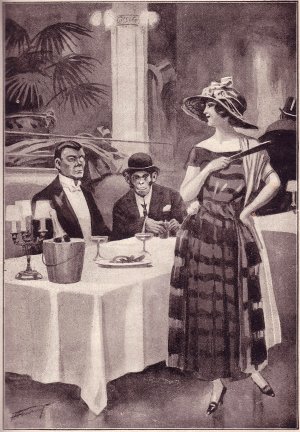
"Hullo, there's the Hindu professor! He's brought his monkey with him!"
Balaoo turned white with rage:
"Goek!" he said, following her with his eyes. "She smells of
buffalo-hump."
But the sight of that brazen woman who smelt so strong carried his thoughts
back, by a fatal contrast, to a young man-woman who smelt like the spring
when the violets sprouted among the mossy roots of the Big Beech at Pierrefeu.
In vain he tried to divert his mind with the incident of the pea-nuts,
the dead dog and all the comical situations caused by Gabriel's inexperience
and charming innocence: the sad and anxious thought of Madeleine seared
his inmost heart, even as his inside was scorched when he ate a whole jar
of pickles by himself.
Meanwhile, Gabriel had finished not only the pine-apple, but all the
bananas and all the tooth-picks:
"Is there nothing more to eat?" he asked.
"I'm out on the spree to-night," said Balaoo. "I'm standing you a bowl
of rice-and-champagne. It's coming." To the wine-waiter, "Bring a bottle
of champagne. A very light wine, please," he added, pointing to Gabriel,
"because of my young friend here."
"Is champagne nice? " asked Gabriel, who was now eating the matches.
"It pricks your nose and makes you walk crooked," said Balaoo, gloomily.
"How sad you are, Balaoo!" said Gabriel, finishing the matches and beginning
to eat the box.
"The man from Saint-Martin is back!" said Balaoo, ominously.
"Phoh! Phoh!" said Gabriel, sympathetically.
Balaoo discreetly wiped his eye with a corner of his napkin:
"Wonoup! Wonoup!" (19)
Gabriel, with lightning rapidity, seized upon the swizzle-sticks which
the waiter brought to free the champagne of its superfluous gas:
"I could see that you were sad," he said. "Phoh! Phoh!"
"Sweet is the warmth of your hand," said Balaoo, ready to burst into
tears. "Tourôô! Tourôô! (20)
I am very unhappy, Gabriel . . . What are you eating?"
"Nothing," said Gabriel, turning pale.
"Show me!" said Balaoo, opening Gabriel's mouth and closing it again.
"Oh, those swizzle-sticks! You're quite right. They're no good with champagne,
they take away all the prickly feeling in the nose. It's better to eat
them by themselves."
"Look at the things on that lady's hat," said Gabriel. "Are they good
to eat?"
"You must learn to exercise a little self-control," said Balaoo. "I
used to eat hats myself when I was a youngster: all Madeleine's summer-hats;
for winter hats are no good. And then I grew up and left her hats alone
. . . I used to wait until she fed me out of her hand . . . Wonoup!
. . . Where are the days when I ate out of Madeleine's hand, the days when
I saw her enter the orchard of my youth, looking like a rose-bud? She was
also like the partridge running to her brood; but the partridge has not
so shapely a figure, nor so light a gait. Her voice was as sweet as the
Bengal warbler's song."
"I don't understand all you say," said Gabriel, "but my heart is in
your breast."
"Tourôô! Thank you!" said Balaoo, pressing his hand
under the table. "What have you in your hand? . . . Where did you
get those cigars? "
"Out of the box, when the gentleman wasn't looking."
The waiter had taken the box and was walking away, discreetly counting
the cigars.
"What do you mean to do with them?"
"Eat them."
"Yes, for dessert. You must give me half. Ah, here comes our rice-and-champagne!"
Henry had made a point of bringing the salad-bowl himself :
"I've done as you wished, gentlemen," he said. "It's raw."
"That's right, Henry," said Balaoo. "Stir it as you would a salad, while
I pour in the wine."
And he stretched out his hand for the bottle of champagne which the
wine waiter was uncorking. Unfortunanately, the man was put out by Gabriel's
grimaces and allowed the cork to pop and strike the ceiling with a noise
like a gun. Gabriel, in his terror; leapt at one bound across the space
between the table where he was sitting and the bar opposite and hid himself
behind the bar, yelling:
"Brout! Brout! Wonoup! Brout!" (21)
"What's happened? What's happened?" cried a chorus of customers.
"Why, it's the monkey from the Folies Bergère!" said a lady.
"It's very like him," said different voices.
The lady went up to take a better look at Gabriel, whereupon the excited
ape suddenly snatched off her magnificent hat and, obeying his instincts,
began to devour it upon the spot. Seeing that masterpiece of the Rue de
la Paix disappearing between Gabriel's teeth, the lady, the lady's friend
and the waiter uttered piercing yells. But Balaoo shouted the war-cry,
the rallying-cry of the Forest of Bandong. One more bound; and Gabri joined
him. The two were outside on the pavement when Maxim's best customer arrived,
just in time to calm the bewildered staff :
"It's the Maharajah of Kalpurthagra," he said, "out for the night with
his monkey!"
Meanwhile, the taxi which had brought them was carrying them away. The
driver, who had hardly seen the faces of his fares, considered them a bit
"on."
On reaching the gate of the Jardin des Plantes, Balaoo made it clear
to the driver that the Maharajah of Kalpurthagra had painted the town so
very red that night that he had hardly a sou left in his pocket. The driver
was quite satisfied. He declared himself the maharajah's humble servant,
said he would call for his orders at eleven o'clock in the morning and
disappeared, after taking off his cap to his highness.
Had Balaoo been really merry that evening, he would, not have failed
to shout after the driver:
"Ask for M. Gabriel! Third cage on the left!"
But Balaoo was not really merry . . .
After climbing the railings with Gabriel, he walked with downcast head,
sadder than ever, in spite of their great evening. They came to the sea-lions'
pond at the moment when the dawn was beginning to dispel the darkness of
the night. Gabriel, who was afraid of being scolded, said nothing. But
Balaoo was not thinking of rating Gabriel. He made him sit on the ground
beside him, took his hand and shivered and sighed. And he spoke men's words
which Gabriel did not understand. But he spoke them so sadly that the tears
came to Gabriel's eyes:
"Listen, Gabriel," he said. "In the spring, I brought her the first
flowering branches. Then she looked at me and said, 'My poor Balaoo!' And
that was all. Yes, indeed, poor Balaoo!" And Balaoo began to weep. "Balaoo
is the most to be pitied of all Patti Palang Kaing's creatures."
"Woop!" (22) said Gabriel.
"There is none on earth that understands me but you," said Balaoo, pressing
Gabriel's hand. "I will tell you a thing, Gabriel, that I have never told
to any one, not even to her. But we weep together, you and I. Thus do the
feeblest plants entwine to resist the storm."
"Wonoup! Wonoup!" sighed Gabriel.
"It's a song which I have written. Listen. Put your ear closer. It is
a song in man-language. But you will understand it, merely by the beauty
of the words,"
"Wonoup! Wonoup!" said Gabriel. And Balaoo whispered into Gabriel's
ear:
"Patti Palang Kaing! Patti Palang Kaing!
Hear how my sorrows flow!
I roamed through the garden of man
Like one of the race in woe.
Not one of them saw my tears:
Not she whom I love the best,
Though she heard how I beat my breast
In a grief that none can know.
To the other, who strolled with his nose on high,
She said, 'It is thunder passing by.'
"Patti Palang Kaing! Patti Palang Kaing!
Hear how my sorrows flow!
If only there were bands
To the toes of my shoe-hands,
I should say, in accents low,
To Patti Palang Kaing:
Keep Thou, across the seas,
Thy plantains, mangroves, mango-trees,
Since Thou hast put me bands
To the toes of my shoe-hands!
Patti Palang Kaing!
Balaoo knows no pang!
"And I should say to Madeleine,
In the softest voice of men:
'Madeleine, my fair,
I fain would kiss thy hair!
If only there were bands
To the toes of my shoe-hands! '
"Alas, did not the other say:
'I would kiss her hair to-day!'
Silent I watch and stand,
Waiting to kiss her hand!'"
"Poor Balaoo! Poor Balaoo!" said Gabriel, wiping away Balaoo's tears.
Patrice, on his wedding-day, was garbed in evening dress, with a white
tie, by eight o'clock in the morning. As there was nothing more for him
to do in his bedroom, he left it; but, on the landing, he found Gertrude,
who very civilly begged him to go back to his room, as the master was coming
to see him.
Coriolis arrived soon after; and the first thing he did was to rail
bitterly at Patrice' attire. He told him that he looked "like a village
bridegroom" and asked him to put on a frock-coat or a jacket, unless he
wanted to have the Paris street-boys "chi-iking" after him. He added that
it was bad enough to have the stupid fashion that compelled girls in the
twentieth century to dress up for the altar like virgins of antiquity going
to the sacrifice. In short, he found a pretext for venting his temper,
which had been execrable during the last forty-eight hours. The young man
took off his dress-coat, but, like a good little solicitor's clerk from
the Rue de l'Écu, kept on his white tie. He had resolved never again
to be astonished at anything. He ascribed the odious snubbings which he
was constantly receiving at the hands of his future father-in-law to Coriolis'
excessive grief at the prospect of losing his daughter; and he explained
in the same way all the curious mystery, all the incredible reticence which
had hitherto surrounded the preparations for the ceremony."
During the two days which Patrice had spent at his uncle's house previous
to his wedding, he had not caught a glimpse of a ribbon, a parcel, a bandbox,
a dress, a flower. A nosegay which he had brought home from one of his
walks was seized, the moment he entered the hall, by the furious hands
of Gertrude, who flung it into the dustbin without a word of explanation.
He excused the old servant just as he excused the father:
"I am robbing them of a pearl," he said to himself. "It is easy to understand
that they can't forgive me."
In reality, knowing that he was improving his advantage hour by hour,
he took a secret and malicious pleasure in his humiliation and deliberately
made himself smaller and more insignificant at the thought of his coming
revenge.
All the formalities were settled. Patrice had seen the family-solicitor,
the mayor and the parish-priest. But he had seen very little of Madeleine,
on the day before, and nothing of Mlle. Zoé or of the formidable
law-student.
But the absence of Zoé and Noël from meals did not trouble
him unduly. He had gathered from a few sentences exchanged in a corner
between Gertrude and Madeleine that M. Noël had taken the liberty
of spending a whole night out and had not come home until ten o'clock in
the morning, in such a state that he had to be carried to his room, where
he had since been looked after like the prodigal son of the house.
This little escapade did, not seem to vex Madeleine particularly; but
Coriolis ,was like a bear with a sore head.
The civil marriage was fixed for ten o'clock and it was now a quarter
to ten. Patrice timidly mentioned the fact to his uncle, who was still
in his indoor jacket. Lastly, on looking out of the window, the young man
was astonished to see outside the door none of those extraordinary hired
landaus in which the felicity of newly-married couples is usually paraded
through the streets of the metropolis.
"A carriage? " asked Conolis. "What do you want a carriage for?"
Patrice turned pale:
"Why, isn't it time to go to the town-hall?"
"The town-hall's not so far as all that!" retorted his uncle. "We shall
walk."
The young man gave a start: was that how the old eccentric hoped to
escape observation? By walking along the pavement, with his daughter, in
white and orange-blossoms, on his arm?
Feeling half-stifled, Patrice opened his mouth, if not to utter a sound,
at least to breathe. Coriolis gave him a friendly push that sent him breathing
out on the landing:
"Come along," he said. "We're only waiting for you."
Nevertheless, he stopped at the top of the stairs and Patrice saw him
lean over the baluster to ask, in a hushed voice:
"Can we come down?"
Gertrude's voice replied, in the same key: "Yes, it's all right."
Then they went down one flight and entered the drawing-room. Madeleine
was there with Gertrude. Patrice stepped back in dismay: Madeleine was
in black!
He could not believe his eyes. There she stood before him, his young
bride, wrapped in a dark cloak, with a hood to it, which she wore when
she went shopping with Gertrude on rainy days.
Having stepped back, Patrice stepped forward. This time, he was trembling
with rage. He felt like tearing everything and everybody to pieces: the
uncle, the niece and Gertrude. But, even as a ray of sunshine will suddenly
appear in the darkest and stormiest of skies, so Madeleine's smile beamed
from under the hood, while the cloak parted to reveal the prettiest little
bride that Patrice could have imagined in his fondest dreams. At the same
time, a delicious smell of natural orange-blossoms --- a present
from Gertrude, who had crowned her young mistress brow with it ---
pervaded the whole room.
Patrice fell on his knees before Madeleine and kissed her dear little
feet, which, shod in white-satin slippers, were hidden in ugly rubber galoshes.
The poor young man sobbed aloud:
"Why," he asked, amid his tears, "why do you hurt me so? Will you ever
tell me why?"
Coriolis raised him and pressed him to his heart:
"Madeleine will tell you, my boy," said the old man, whose agitation
seemed to have reached its height. "Yes, Madeleine will tell you and you
will forgive us. Come, kiss your wife, Patrice, and let us hurry to the
mayor's. You are quite right, we are late. Let's get it over."
"Yes, yes, I want it over," whispered Madeleine, herself moistening
Patrice' kind cheeks with her tears. " I want it all over . . . "
"I quite agree with you," said Patrice, in all sincerity, blowing his
nose. And he added, lyrically, "It would have been over quicker with a
carriage!"
But already Madeleine was dragging him to the staircase. She had taken
his arm and, with a swift movement, wrapped herself once more in the folds
of her ill-fitting cloak.
His uncle slipped on an old, worn frock-coat which Gertrude handed him.
The old servant was the only one who appeared dressed for the occasion.
She had squeezed herself, with some difficulty, into a puce coloured silk
which she had had specially made and which not even a furious display of
anger on Coriolis' part had induced her to take off. The four of them were
going down the stairs, when a door above their heads opened and Patrice
heard hurried footsteps. He turned round and saw Mlle. Zoé standing
behind them, looking paler than a wax statue. She hardly had the strength,
in the excitement that fluttered her shapely breast, to utter words of
which Patrice vainly strove to discover the full dramatic sense:
"He is at the window!"
Coriolis, on the other hand, the moment he heard them, cried:
"Oh, dash it all, dash it all! Let's go by the back stairs."
For the house had a servants' staircase leading to a little door that
opened on an adjacent lane. Only, the doors of that staircase and the staircase
itself had remained unused for years without number and the descent by
this narrow and gloomy passage, as steep as a well, was a tragic enterprise.
They had to battle not only with rusty bolts and hinges, but also with
time honoured accumulations of dirt and dust. Fortunately, the antiquated
lock that fastened the door on the lane was almost falling to pieces, but
for which fact the wedding-party would never have emerged from that awful
pit of darkness.
When they were at last outside, they all looked at one another. The
two men were horribly dirty, but the two women had passed through all that
dust as by a miracle, without getting a speck of it on themselves. The
uncle shook his nephew, not to brush the dust off him, but to make him
hurry up. He took the lead and only turned to mutter:
"Come along! Come along!"
He walked with his back bent and hugged the wall as though he were trying
to hide from observation. But the extraordinary thing was that Madeleine
and Gertrude copied this curious attitude. The two women had gathered up
their skirts and were hurrying along with hunched shoulders. Patrice in
vain tried to obtain an explanation. It seemed that they had no time to
answer him; and if he stopped for a single instant, the uncle, or Madeleine
or Gertrude would pull him by the hand like a lazy child whom they were
afraid of leaving behind.
"What a funny wedding!" thought the young man." To look at us, people
would say that we were a pack of suspects under the Terror, trying to avoid
the agents of the Committee of Public Safety."
At last, they reached the town-hall, by strangely circuitous roads.
If Patrice had not taken care, on the previous day, to remember the mayor's
poor, that functionary would certainly never have waited for him so long.
The ceremony was rushed through, as they say, "in five secs."
Coriolis had told Patrice not to trouble about witnesses: that was all
arranged. And the cobbler, the porter and the commissionaire from the corner
duly put in an appearance. As soon as they arrived, Madeleine threw off
the dark outer garment that concealed her fresh and youthful charms; and
Patrice might have thought that she had dressed only for those rapscallions,
had he been capable of thinking of anything at so impressive a moment.
To go from the town-hall to the church, they took a closed cab. Their
ragamuffin friends followed in an open fly. Coriolis was beginning to do
things handsomely.
A low mass was quickly said; and, as soon as the register was signed
in the sacristy, the witnesses paid and the young couple lawfully married
in the sight of God and man, their thoughts turned to breakfast.
Coriolis took his party to a celebrated little riverside restaurant
which he used to visit in the days of his youth. The old servant had previously
taken a bag there, containing an ordinary walking-dress for Madeleine.
The trunks, it appeared, had been sent on to the station.
The uncle asked for a private room, took Patrice by the arm and tried
to lead him into the passage:
"Let's leave the women," he said. "Madeleine is going to change her
dress."
But Patrice kicked at the suggestion:
"Look here, uncle, you must admit that I have always done what you wanted;
but let me look at my dear Madeleine in her bridal dress for a few minutes
longer. It will be the brightest memory of my life."
Coriolis grunted a few words which Patrice did not catch; but he dared
not, thwart the young man; and Madeleine kept on her beautiful white dress
and her wreath of orange-blossoms for the wedding-breakfast.
Patrice sat beside his young wife:
"She's so pretty, one could eat her, uncle!" he said.
"Eat your radishes, in the meantime!" growled Coriolis to his lovelorn
solicitor's clerk of a nephew, while Gertrude, who was in a melting mood,
shed tears.
An unspeakable feeling of peace, tranquillity and calm was shed by that
deserted corner of the embankment and that out-of-date, neglected restaurant.
After all the tribulations of that memorable morning, Patrice felt entitled
to give a sigh of relief. He sighed with happiness over Madeleine's hand,
which he raised to his lips, and he was beginning to express the delight
which so sweet a moment gave him, when the waiter brought in "the shell-fish."
While handing round the oysters, he informed the gentlemen that there
was some one asking for them downstairs who seemed very eager to see them.
Coriolis rose, looking very pale:
"Who is it?"
"Oh, I don't know!" said the waiter, with a gesture which obviously
meant that the person's identity was a matter of supreme indifference to
him.
"But . . . but is it a man? A woman?"
"It's a woman."
"It's Zoé!" cried Madeleine, in a great state of excitement.
"Send her up! Send her up at once!" said Coriolis.
And, when the waiter had gone, the father and daughter exchanged anxious
glances that worried Patrice more than he could say.
"What can have happened since we went out? thought Gertrude, aloud.
"She must have her reasons for coming."
Then Zoé made her entrance. She was bare-headed; her hair had
come undone; and she tried in vain, with a feverish movement, to twist
and put it up again. Her face expressed the most intense anguish; the dark
rims round her eyes told of some great sorrow; and the corners of- her
mouth trembled.
"Goodness gracious, what's the matter?" asked Coriolis, Madeleine and
Gertrude, in one breath.
"He's looking for you"
"What!"
"He's escaped! . . . He knows everything! . . . He ran out
of the house like a madman! . . . Take care! . . . He is capable
of anything! . . . "
And Zoé, panting and exhausted, dropped intoGertrude's lap.
"But who, who?" shouted Patrice, failing to understand the terror of
those around him.
"Who? Noël, if you want to know! Noël!" roared Coriolis, who
was holding his head between his hands, as though he were afraid of its
dropping off.
"But perhaps he will come here," said Gertrude.
"Let us fly."
"But where, papa? Where are we to fly to ? " moaned Madeleine. "It would
be. better not to go down to the street, if he is on our track."
"He has lost the track," gasped Zoé, who was stifling, but who
dared not ask Gertrude to loosen her stays before Patrice.
"Aha, he has lost the track! " cried Coriolis. "But hasn't he followed
you? Are you quite sure of that?"
" I followed him . . . I took a cab . . . Oh, it's awful, awful!' .
. . He's quite mad! . . . "
"But mad about what? " asked Patrice, whose irritation was reaching
its height.
"Mad on Madeleine, if you insist on knowing! . . . Yes, he is
madly in love with your wife . . . He writes poetry to her . . . Now are
you satisfied?"
"And are you all in such a state because a gentleman chooses to write
poetry to Madeleine? Let the fellow come here; and I'll talk to him: a
pretty thing, indeed!"
And Patrice showed his fists. Coriolis' shrugged his shoulders and Gertrude
shook her sad and obstinate old pate:
"Poor Noël, he will never get over it!" she said. Patrice could
have torn her eyes from their sockets:
"But what do we care about Noël? " he kept on exclaiming in his
fury, bewildered by this inexplicable bomb which had burst in the midst
of his new-born happiness.
Alas, no one bothered about Patrice! Not knowing what decision to take,
after cautiously closing the doors and windows, the others feverishly questioned
Zoé, who, in short, abrupt sentences, broken by sobs, told so fantastic
a story that Patrice wondered if he was not dreaming that he had found
his way into a lunatic asylum where the words which you hear spoken have
no sense even to those who utter them. "I expect," sighed Zoé,"
that he was pretending to be dead-drunk for two days on purpose, so as
to be left alone: he was up so quick this morning, suddenly, and so soon
dressed. And the noise he made: bang, bang! A kick at the cupboard! A kick
at the chest of drawers! Kicks everywhere! Bang, bang, bang! A kick at
the door when I asked him, from outside, what the matter was. He answered
that man-women disgusted him and that Patti Palang Kaing had forbidden
him to marry a man-woman, but that the laws of the Forest of Bandong did
not forbid M. Noël from attending so fine a ceremony, as long as his
honour was not at stake! 'O rot, rot, rot!' was all he said. And that it
was no use my dressing in Paris fashions, that I should never be as nice-looking
as a female monkey in the huts on the swamps! However, the worst was that
he kept on going to the window, while he dressed --- I peeped through
the key-hole and saw him moving about --- as though he were watching
for something in the street . . . Oh, some one must have told him . . .
and yet it seems hardly possible! . . . What comforted me was that
you had already started . . . He went back to the looking-glass and knotted
his tie quite three times over, saying unpleasant things to me, all the
while, through the door . . . Then, when he wanted to put his boots on
his shoe-hands, he was seized with a fury that made me shake on the landing
where I stood . . . I heard him gnash his teeth and fling his boots all
over the room . . . Oh, I was sorry that we did not follow our first plan!
. . . But he deceived us by pretending to be dead-drunk . . . Yes, I ought
to have taken him at once to the Jardin d'Acclimation. (23)
He knows nobody and forgets everything when he is at the Jardin d'Acclimation.
We would have lunched there quietly, he and I together, and I would have
invited the giraffe."
"I beg your pardon, I beg your pardon," said Patrice, venturing to interrupt,
"but I don't quite under . . . " "Hold your tongue and listen! " shouted
Coriolis.
Coriolis was walking up and down the room, kicking the furniture as
angrily as M. Noël had done. He turned to Zoé:
"But, after all, what was the matter with him? He could not suspect
. . . "
"Nonsense!" said Zoé. "If he had not suspected something, would
he have made such a row? He threw a pair of boots into the street. I asked
him what was the matter. He answered, in an awful voice, which I shall
not forget, if I live to be a hundred, 'Don't you smell orange-blossom?'
. . . I could have dropped! I smelt nothing on that storey . . . no one
of the Race could have . . . and then it was long since Madeleine had run
down, ever so fast, and gone out . . . Well, he, with his nose from the
Forest of Bandong, smelt the orange-blossom through the floors, the stairs,
the doors and the walls! . . . "
"Excuse me, uncle," Patrice interrupted again, "excuse me if .
. . "
But Patrice was unable to continue. Coriolus had made a rush at Gertrude
and was shaking the charms and trinkets which she wore round her neck,
over her puce dress, until the young man and Madeleine had to interfere
to save that old friend of the family from being nearly throttled. Uncle
Coriolis could not forgive the servant for rousing M. Noël's scent
with a flower which would not have smelt at all, if Gertrude had not taken
it into her head to present Madeleine with a wreath of real blossoms. At
last, Patrice triumphantly took Gertrude in his arms. She promptly renewed
her expressions of pity for M. Noël; and the bridegroom as promptly
dropped her in a chair, where she sat, a poor, moaning thing.
No one had so much as touched the oysters. And, at Madeleine's request,
while Coriolis continued to kick at the walls --- without disturbing
the neighbours, for that once famous, but now neglected little restaurant
had no other customers but themselves --- Zoé resumed her
narrative in the face of the bewildered Patrice:
"So he must have smelt the wreath of orange-blossoms through the door.
Then he opened the door. I never saw him look so pale in my life. 'It's
a scent,' he said, 'which people wear on their wedding-day. I have read
that in men's books. Is anyone in the house being married to-day?' I must
have been very much upset, for he stared at me with a sad smile and said,
'Poor Zoé, you're looking none too well yourself!' And he went downstairs,
pushing me gently out of his way and lifting his nose in the air to sniff
the orange-blossom. He went straight to the drawing-room, where Madeleine
had sat waiting for Patrice. When he came out again, his face was terrible
to see. He had the strength to ask me a few questions with his trembling
lips: where was Madeleine? I said that she had gone out. Then he wanted
to know about M. Patrice and you, sir. I did not know what to answer and
was making up a story, saying you would all be home soon, when he put on
his terrible Bandong gong-voice: 'The scent of orange-blossoms is what
people wear at monsieur le maire's!' he said. And, with that; he rushed
down the stairs and into the street and I after him . . . At first, he
was rather at a loss. He hunted for the scent, without finding it. It was
not on the pavement. He sniffed the air in every direction. At last, he
walked round the house, went up the lane and picked up the scent near the
side-door . . . He took no notice of me at all, did not hear a word I said
to him . . . He was soon out of the lane and I had the greatest difficulty
in following him. He went along at a mad rate, with his nose still in the
air, pushing against the people, the horses, the carriages and even stopping
the omnibuses . . . I saw him, from the distance, go into the town-hall
and come out again almost at once . . . Knowing that you were going to
take a cab at the town-hall, I said to myself, 'Perhaps he'll lose the
scent-because of the cab . . . ' "
"I beg your pardon," Patrice broke in once more, "I beg your pardon.
I know the smell of orange-blossom is very strong, but I can't understand
. . . "
"That'll do!" shouted his uncle. " You will never understand anything
. . . Go on, Zoé. . . . He left the town-hall . . . "
"Yes, he left the town-hall and, still with his nose in the air, still
knocking up against the people in the street, he went to the church . .
. From there, he took the road that seemed to lead here . . . This time,
I
caught him up and tried to speak to him. He threw me at the foot of a wall,
like a bundle of washing, and started running, running, running . . . I
jumped into a cab, meaning to come and warn you in time, if I could, when
I saw him, at the corner of the Boulevard Saint-Germain, go straight ahead,
instead of turning down the street that leads to this place . . . I thought
I must find out where he was going . . . He ran along the boulevard, ran
on, with his nose in the air, jostling people aside, and, without a moment's
hesitation, walked into a very 'swagger' lunching place, the Restaurant
de Mouilly, I believe . . . 'What does he mean to do there?' said I to
myself . . . Suddenly, I understood: there was a whole row of landaus,
with a wedding brougham, drawn up along the pavement! . . . On leaving
the town-hall and the church Noël had smelt another wreath of orange-blossoms,
had pitched upon another wedding-party! . . . What he did to them
I do not know . . . I heard them screaming like mad . . . I saw people
rush to the windows and shout for help as if the house was on fire . .
. And that's all I can tell you . . . I came on here . . . You are safe,
for the moment . . . But the poor fellow is out of his senses . . . I never
saw him like it before . . . trembling from head to foot and rolling his
eyes . . . Oh, how they must have 'caught it' at the other wedding!"
Thus spoke pretty little Zoé, in her despair; and, when she had
done, she gave free play to her tears. "If only nothing happens to him
. . . at that wedding party!" muttered Coriolis, stopping his perambulations
for a minute.
Patrice bent over Madeleine, who appeared to be sadly and silently pursuing
some distant thought:
"What are you thinking of?"
"I think as papa does: if only nothing happens to him at that wedding-party!"
And so there was no thought, no care, in that room, for anyone except
the wild lunatic who had crossed the path of Patrice' happiness like a
dangerous beast!
"It's too bad!" he protested.
Zoé interrupted him:
"I don't think you need fear anything on that score; you know it's impossible
to catch him . . . He comes. and goes and disappears as he pleases!
. . . No, I am much more afraid that, when he discovers his mistake, he
will go back to the town-hall and the church and find the real scent. If
he keeps cool, he can do anything with his nose!"
"What do you mean, he can do anything with his nose?" yelled Patrice,
struggling against the state of stupefaction into which Zoé's queer
speeches were beginning to plunge him.
Zoé stared at him in amazement: why, didn't he know yet?
Patrice read both grief and mischief in her eyes.
"Ah," she said, without replying to his astonished outburst, "we none
of us look like people at a wedding, considering that this is a wedding-day!
. . . The best thing you could do would be to take the first train and
not to wait until the evening. That's my advice to you!"
"But why, why, why? I want something to eat!" protested Patrice, "I
want to eat in peace and quiet! Don't you want to eat in peace and quiet,
Madeleine? It's no reason, because a maniac . . . "
He did not finish his sentence.
"There he is!" cried Zoé, who was leaning out of the window.
Oh, what a flight! . . . Coriolis dragged or rather carried in
his arms the fainting Madeleine. Gertrude hustled Patrice, pushing him
in front of her, digging at him with her fists. At the corner of a little
staircase which Coriolis seemed to know of old, he turned and, tearing
the fatal wreath of orange-blossoms from Madeleine's forehead, in spite
of Patrice' yapping expostulations, flung it to Zoé:
"Here, stay here, you, and stop him! Lock him in!"
And, roughly thrusting Zoé back, he shoved the rest of the band
down the well of the little staircase.
Meanwhile, M. Noël, with quivering nostrils, was climbing the main
staircase of the once-famous little restaurant. Patrice and Madeleine,
accompanied by Coriolis and Gertrude, arrived at the Gare d'Austerlitz
in time to see the Auvergne express steam out of the station. The next
was a slow train, stopping at every suburb on the line. Patrice declared
that his wife and he would go by it. He was eager to leave Paris, to be
alone with Madeleine and question her and get rid of all the horrible thoughts
that oppressed his heart.
Then, suddenly, Madeleine, who had not spoken a word since their headlong
departure from the restaurant, closed her eyes and fell in a dead faint
on the platform.
An indescribable confusion and excitement ensued. Madeleine was still
wearing her wedding-dress. The sight of this bride swooning at a railway-station
attracted all the passengers and emptied the trains that stood waiting
to start. The guards and stokers left their posts, the porters dropped
their loads, the waiters came running out of the refreshment-room. Above
the stir of the crowd rose Gertrude's yells and the angry shouts of Coriolis,
who distributed kicks all round.
Soon the rumour ran that a girl had been married against her will and
poisoned herself, there, before everybody, on the railway-platform, rather
than accompany her husband. Men glared at Patrice, who, in his white tie,
was obviously the bridegroom, as though they could have murdered him.
Fortunately, Madeleine opened her eyes and gazed at the young man with
a look of fond affection which con tained as it were an entreaty that he
would pardon her for the outrageous wedding-day which they had given him.
And Madeleine's lips also parted to emit a word that gave poor Patrice
the shudders:
"Home!"
"Yes," growled Coriolis, who was as red in the face as his daughter
was pale and who seemed threatened with an apoplectic stroke, "let's go
home: I can't let you leave in this state of weakness."
"My poor young lady!. My poor young lady!" whined Gertrude. "It'll be
the death of her . . . Indeed it'll be the death of her . . . and of him
too!"
At these words, Patrice, who knew to whom that cry of pity referred,
lost control of himself and, going up to Gertrude from behind, bit with
all his teeth and all his might through the sleeve of puce-coloured silk
that covered the tough arm of the old friend of the family. Gertrude howled
with pain. Patrice assumed an air of innocence and begged her to moderate
her grief. As far as he was concerned, he said, he objected to Madeleine's
returning home. Thereupon, the crowd all went for him, threatened to do
for him, treated him as a savage and loudly pitied the young and charming
girl who had been "sacrificed to such a brute!"
A lady gave Madeleine her smelling-salts; a gentleman who declared himself
to be a doctor stooped down to unlace her stays. Patrice made up his mind
to die like a hero. Snatching his wife in his arms, he rushed through the
crowd and out of the station. He had the luck to find a taxi and put Madeleine
into it amid a chorus of execrations.
"Where to?" asked the driver.
"Down the Auvergne Road!" shouted Patrice. But Coriolis, running up,
ordered: "Rue de Jussieu!"
And he called Patrice' attention to Madeleine, who had closed her eyes
again.
Gertrude, before taking her seat, gave a last word of warning:
"Rue de Jussieu? . . . But suppose he's there, sir?"
To which Coriolis replied:
"If he is, you know there's no one like Madeleine to bring him to his
senses."
And Madeleine's lips opened once more:
"Yes, he will listen to me."
The taxi moved off. The crowd began to thin. Someone observed:
"They had much better drive to the nearest chemist! Marriages like that
ought not to be allowed!"
Patrice was fool enough to show his face at the window and was greeted
with boos and jeers:
"Ugh! . . . Bluebeard! Bluebeard!"
But Patrice bore the crowd no ill-will. The person for whom, at that moment,
he entertained a feeling devoid of all affection was his Uncle Coriolis.
The young man swore that he would make the crack-brained old rascal pay
for the wretched time which he had given him. The feeling aforesaid was
made up, first, of the hatred which any placid young gentleman cherishes
for the man who upsets his composure and, secondly, of the vague dread
that Madeleine and himself, Patrice, were about to become the victims of
some extraordinary and perhaps criminal machination on the part of that
dangerous eccentric. Whatever happened with Noël, Patrice had made
up his mind that Coriolis was responsible for the catastrophe.
The observations which he was able to make during the swift taxi-drive
only increased his grave and overwhelming anxiety. Coriolis held Madeleine's
drooping head on his breast. The young woman opened her eyes from time
to time, gazed silently at her father and then shut them again, retaining
the picture of the old man's face under her closed lids.
Coriolis had lost all his excitement of the morning. He wore an expression
of stern reflection, but his sternness seemed directed against himself,
for he uttered a strange sentence:
"Perhaps I am on the verge of punishment. God's will be done, if I have
offended Him."
Madeleine could not hear these words without shuddering; and her frail
arms hugged the speaker closer to her. As the cab turned into the Rue de
Jussieu, Madeleine said:
"Don't be frightened, papa. He is no longer a wild beast. I shall talk
to him; and he will understand. Our mistake was to run away from him as
though he were a wild beast; and that is certainly what he resents. But,
if I speak to him as one would to a man, he will behave like a man."
Gertrude said, simply:
"Yes, he will kill himself like a man!"
Madeleine, Gertrude and Coriolis sat and looked at one another. Patrice
saw that the same inexplicable anguish united them; and Noël began
to assume the figure of a monster in the young man's awe-struck brain.
But Patrice was still unable to understand; and that queer incapacity
to understand frightened him more than anything else. Now that the others
were talking freely before him of things relating to the mystery, the mystery
itself appeared to him all the more unfathomable, with dizzy depths of
gloom and horror into which he dared not peer.
They reached the house. It was almost incredible, but Madeleine seemed
to have recovered all her strength. She was the first to alight, entirely
unaided. Patrice stared at her in bewilderment : she was as white as her
dress, all the same.
Patrice insisted that the taxi should wait. They stood on the pavement
and examined the front of the house: everything was shut up. Coriolis had
his latch-key; they went in. The young man almost forced Madeleine to take
his arm. He felt it trembling under his own. She was afraid! She was afraid!
Then why had she cotne back? Why had she wanted to come back?
She said aloud, after listening to the silence of the house:
"He is not here!"
Then it was for "him" that she had returned. Patrice felt horribly hurt;
and yet he did not doubt Madeleine's love for him.
All three were straining their ears for the least sound. Madeleine said,
with a sigh:
"They have not come in. Perhaps Zoé has made him listen to reason.
Oh dear, if only Zoé has persuaded him to go for a stroll in the
Jardin d'Acclimatation!"
Coriolis had definitely forbidden Balaoo to go to the Jardin des Plantes,
which he considered too near. Gertrude said:
"It's funny, but I don't see General Captain."
As she spoke, General Captain appeared on the top stair of the first
flight. The bird-porter wore a very peculiar air. To begin with, he did
not say:
"Hullo, Polly!"
He said nothing at all, he did not speak, which was very unusual in
General Captain. And be kept on wagging his small green head in a most
distressful fashion.
"There's something the matter with General Captain," said Gertrude,
who knew him well.
Still silent, he went upstairs as they approached, hopping backwards,
constantly wagging his head, constantly keeping his eyes fixed upon the
party.
"There's something the matter, there's something the matter," Gertrude
repeated.
Patrice felt Madeleine's hand tremble still more violently on his arm.
She agreed with Gertrude:
"Let us follow him," she said. "You can see he's calling us."
The whole thing was childish and uncanny. That green bird, with the
mysterious backward gait and the incessantly wagging head, appeared to
them, in the middle of the great staircase which their anxious feet hesitated
to climb, as the evil spirit of that cold and echoing house.
He led them through the passages to the head of the servants' staircase
which they had taken that same morning to escape M. Noël's curiosity;
and there they discovered, lying at the top of the stairs, with her arms
outstretched and her face covered with blood, Zoé! They cried out
with terror. Coriolis flung himself upon the lifeless body and raised a
scared face:
"She has received a terrible blow on the head," he said, "but she is
not killed."
They carried her to her room and laid her on the bed. Coriolis held
some ether to her nostrils. She opened her eyes.
At the sight of the young woman in the bridal dress who was tending
her, she was convulsed as though with an electric shock:
"I'm not dreaming?" she cried. "It's you, Madeleine? You, here? Oh,
go away! Go away! Madeleine darling, go away!"
They tried to silence her, to calm her, but in vain. She seemed endowed
with an incredible strength to push Madeleine from her:
"Go away! . He's coming! . . . He's coming and he will kill you!"
They could see that she was delirious, but the words of her delirium
terrified them:
"Yes, he will kill you! . . . When he saw that you had gone off
with Patrice, that you had run away from the restaurant, there was no holding
him. I locked the door of the private room, the moment he was inside, and
hid the key. He struck me, dragged me by the hair, weeping all the time,
saying that he hated me, that he would kill me if I did not at once tell
him where you were . . . I gasped that you were at the Gare de Lyon . .
. Then he gave one bound to the window . . . He went out by the window
. . . But he will come back, he will come back! . . . And, as I have
told him a lie, he will kill me! . . . I don't mind: I only came
back for that . . . But my strength . . . my strength failed me at the
top of the stairs . . . and I fell on the stair . . . I thought I was going
to die . . . but I don't want to! . . . I want him to kill me
. . . himself; with his tremendous fist, because he will never, never love
me! . . . "
And Zoé, who had half-raised herself, fell back upon the pillow
and closed her pretty eyes.
Madeleine wiped the blood tenderly from her little friend's young and
sorrowful face, kissed her on the forehead and wept bitterly.
"Let us fly!" said Patrice. "Let us fly from that monster whom you have
taken. into your house and who has nothing human about him!"
"Yes, go," Coriolis' gloomy voice commanded. "Go, both of you . . .
You see, Madeleine, what he has done to Zoé . . . . Go."
"But, father, you know that he won't mind Zoé's voice, but that
he has always obeyed mine!"
"Patrice, take your wife away," commanded Coriolis.
"Then have you no faith left in your work, father?" asked Madeleine,
in her calm, harmonious voice.
Coriolis stalked across the room, a prey to some mysterious agitation;
but he stopped opposite Madeleine and, looking her straight in the eyes
:
"What if we have not killed the beast?" Madeleine did not lower her
eyes:
"I swear to you that the beast is dead! Why would you not believe me?
All this would never have happened. He has the right to be spoken to like
a man!" But Zoé's voice was raised in frenzied appeal:
"Go! Go!... He will come back and do murder! . . . He will commit
murder with his tremendous hand! . . . "
"No," said Madeleine, sitting down by Zoé's bedside, "he will
hot commit murder, because I shall remain and speak to him."
But Zoé, avoiding the arms that tried to restrain her, slipped
from the bed and, on her knees, entreated Madeleine and Patrice to flee
without delay:
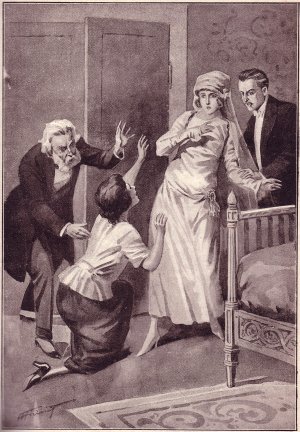
Zoé on her knees, entreated Madeleine and Patrice to flee without
delay
"He will murder you both!" she cried. "You don't know all, you don't
know all! . . . It is not his fault that Patrice is not dead already!
. . . He will kill you as he killed Blondel . . . as he killed Camus
. . . as he killed Lombard . . . and . . . and another . . . another whom
you know of! . . . It was he . . . it was he who killed them
all! . . . I lied to you, Madeleine; it was not Élie who cried
in the night, 'Pity! Pity in the man's house!' It was . . . it was Balaoo!
. . . "
Raving wildly, she dragged herself on her knees; and Madeleine retreated
before that awful voice, that voice which Coriolis was now trying to silence
by main force, yes, by main force, with his hands crushed against Zoé's
mouth:
"Hold your tongue! . . . Hold your tongue!" he railed, hoarsely.
Coriolis, with his white hair, looked a hundred. Madeleine, wild-eyed,
open-mouthed, horror-stricken, seemed mad. But there was no stopping Zoé's
mouth:
"He will kill you! . . . He will kill you all, all, all!" she
cried.
And Zoé's hands clutched Madeleine, drew her outside, pushed
her into the passage, flung a cloak over her shoulders:
"Kill you! Kill you! . . . Go! Go! . . . you have just time!
. . . Kill you!" screamed Zoé, clamouring for the others to assist
her.
And Zoé's hands, Patrice' hands, Gertrude's hands, Coriolis'
hands all pushed Madeleine out of the old house . . .
The newly-married couple fled, fled through the sullen night, through
the storm bursting over Paris. Leaning back in the taxi, Patrice seemed
to hold a dead woman in his arms, while, through the hum of the motor,
the throbbing engine seemed to repeat, everlastingly:
"Balaoo! . . . Balaoo! . . . Balaoo! . . . Balaoo!
. . . "
Those three syllables roused the utmost depths of his tragic memory.
He banged at the window: the cab pulled up outside a shop. Five minutes
later, Patrice stepped in again.
"Where have you been?" asked Madeleine, who had come to herself at the
sudden stop of the taxi.
"I have been to buy a revolver."
"What for?"
"To kill your Balaoo."
"That was quite unnecessary. You can't kill a pithecanthrope with what
you have bought!"
"A what?"
"A pithecanthrope."
Seated, alone with Madeleine at last, in the train that was hurrying
them southward, Patrice listened to her story. She told it to the end,
with a white, scared face, and Patrice now knew all. Stooping over his
hands, which clutched his poor head and hid the shame upon his face, he
let words slip through his fingers, words that came and struck at her heart
--- "Tack! Tack! Tack!" --- like tiny taps of a hammer:
"That comes," said Patrice, in a hard and metallic and ever-so-distant
voice, "that comes of having an uncle who thinks himself a genius."
Madeleine fell back on the seat, gasping for air, swooning. He did not
even see her, and finished saying what he had in mind:
"We shall all have to stand our trial . . . Your father is a murd .
. . "
Something rolled between his legs like a bag that might have fallen
from the rack. It was Madeleine's white body, tossed about by the jolting
Auvergne express.
"Dinner is served," said the restaurant-car attendant, fortunately without
looking into the compartment!
As the man had seen nothing; Patrice was able, without scandal, to proceed
with the various experiments calculated to restore her who, since that
morning, was his wife: air, salts, a window let down, a bodice unlaced,
kisses and tears. All Patrice' love returned as soon as he felt between
his arms the adorable and throbbing burden which it was his mission to
defend against the savage enterprises of a pithecanthrope. And, when Madeleine
began to return his kisses, he felt that there would yet be happiness for
them both on earth, despite that dire adventure. When he had yielded to
his first impulse and failed to control his temper, it was because he really
did not expect to find that sort of rival installed in a respectable family.
"Oh, Madeleine darling, why did you not tell me of those terrible things
earlier?"
"My love, my love, I swear that, if I could have dreamt for a moment
that that horrible Balaoo was capable of committing the crimes which Zoé
spoke of, I would have told you all before consenting to be your wife!
And, if I believed that he had committed them, I would have refused your
hand! But I do not believe it, no, I do not believe what Zoé said.
Zoé was trying to be revenged on Balaoo: I would never have thought
it of her!"
"But she said that he also killed some one whom you know of!"
"Oh, that was an accident! He squeezed a gentleman's neck too hard;
and the gentleman died of it. Balaoo does not realize the strength of his
hand. He has the hand of a murderer, without knowing it. We had to train
him to give up habits for which he was not morally responsible; and we
really thought we had succeeded . . . You mustn't believe all that Zoé
says, dear. Balaoo once committed manslaughter, through carelessness: that's
a thing that can happen to anybody. Now, since he has been in Paris, he
knows that he must not touch men's necks with his terrible hand: he knows
what it costs . . . Papa took him to see an execution and he came back
quite impressed, I assure you . . . Patrice, my own, what are you thinking
of now? . . . You look quite pensive!"
"I'm thinking that I've let myself in for a nice thing!" said Patrice,
brutally.
Madeleine's tears began to flow once more. Patrice made an attempt to
console her, but she pushed him away. No, no, he must not touch her: it
did her good to cry . . . And if Patrice regretted his marriage as
much as all that, the thing was easily remedied: he could divorce her!
. . . Then he would be quite happy, wouldn't he?
"I adore you!"
Oh, the power of love in the golden days of youth! . . .
Here are two young people, the victims of the most frightful adventure
that ever crossed what lovers call a honeymoon; and it is all forgotten
in a kiss! Patrice fears nothing now: he loves! . . . He is mightier
than the racial mysteries! . . . The placid little solicitor's clerk
from the Rue de l'Écu feels within himself the pride and courage
of an archangel wherewith to fight the monster.
"Second dinner, gentlemen."
The attendant's voice brought them back to earth again; and the two
young people exchanged a pleasant smile, a pleasant smile that expressed
their single thought: the two young people were hungry. They had not lunched.
It was eight o'clock in the evening. And there is nothing like excitement
to give you an appetite!
A quick wash and brush-up; and soon they were laughing at their rig-out,
at their appearance, at their swollen eyes, at that wedding-dress which
Madeleine had been obliged to wear all day, at that cloak of Zoé's
which was much too short for her and which covered the dress without concealing
it.
They laughed at everything, at everything; they laughed at their own
fears; and they went to the dining car to make a hearty meal.
They had to walk through the whole length of the train; and the jolting
knocked them about and set them giggling afresh: they were a little unnerved
since the morning. Right at the end of the car was a little table for two,
where they would be very comfortable and able to laugh, by themselves,
at all around them and at themselves and at everything, I tell you, at
everything, at Balaoo himself, yes, and at the veal and spinach and the
chicken and mushrooms: we all know what de-li-cious cooking we find in
railway dining-cars!
"Some more salad, sir?"
"Yes, please . . . Two dinners, darling; they have two dinners on this
line: such a lot of people travelling at this time of year . . . "
The second dinner had filled the two compartments of the restaurant-car,
which were separated by a sheet of ordinary plate-glass. The other was
the smoking compartment; but people were dining at all the tables.
"Oh, Madeleine . . . if you could only see . . . it's too funny!
. . . No, don't turn round . . . you can look presently . . . Over there,
at the end, there's a lady in a hat: such a hat! It would be just the thing
for General Captain! . . . You'll see her: it's a lady on the right,
sitting next to . . . next to . . . to . . . Oh . . .
Madeleine! . . . "
"What's the matter, Patrice, what is it? . . . Are you going to
faint now?"
Patrice was no longer laughing:
"Madeleine," he said, in a hollow voice, "I believe the person next
to the lady in the hat . . . is Balaoo ! "
"Ah!"
"Don't turn round! . . . Don't turn round! . . . He's bending
forward! . . . I can't see plainly . . . his felt hat is over his eyes
. . . Ah, he's raising them! . . . He's looking at us! . .
. It's he!"
Madeleine could not help turning round. Patrice was right. It was Balaoo.
He lowered his head as soon as he saw Madeleine look at him. She made a
sign to her husband to change seats with her. As he did so, her fingers
met his. Patrice' hand was moist and shaking. She tried to give him confidence:
"Don't be frightened," she said. "He is tamed now. His violent fit is
over, he is lowering his head, he dare not look at me."
Patrice, who had turned extremely pale, said:
"The reason I'm trembling is that I want to polish off that loathsome
brute for good and all."
"Hush, dear, and pass me the bill of fare."
But Patrice, who now had his back to Balaoo but could still see his
image in a glass behind Madeleine, continued:
"If he comes, I shall know what to do."
"If he comes, you will let him come," said Madeleine, in a curt tone
which the young man disliked exceedingly.
"A good bullet in the ear would settle his business as easily as anyone
else's."
" Patrice, if you love me, you will do what I say . . .
First of all, keep your revolver in your pocket."
"Well? And then?"
"Then, when dinner is finished, go back with the other passengers and
leave me alone with Balaoo."
"That, never! Have you forgotten what Zoé said?"
"Balaoo was mad this morning; he is perfectly quiet now."
"Why did he follow us here? Do you think it's with a good intention?
Zoé was perfectly right. We must be on our guard!"
"I am not taking my eyes off him and the poor fellow daren't even look
up at us . . . He does not know what to do: he is hiding his face behind
the bill of fare, putting it down, taking it up again. Now he's pretending
to give an order to the waiter. Now he's moving the bottles on the table.
It's pitiful . . . Listen, Patrice dear, you must leave me alone with him
for a moment and I'll scold him. He will get down at the first station,
I promise you."
"You can do as you please, but I sha'n't leave you."
"Oh!" exclaimed Madeleine, anxious but dignified.
"He's getting up, he's going, he'll escape us . . . You can see he's
afraid. Let's go after him. I must speak to him, at all costs, I must know
what he wants!"
"Yes," repeated Patrice, "we must know . . . know what he wants . .
. We can't continue this journey with that thing about us."
They stood up. Patrice tried to pass in front of Madeleine, but she
pushed him behind her with some violence and they hastened through the
two compartments of the dining-car with the staggering gait of tipsy people
quarrelling. They were the object of general curiosity and of some laughter.
Balaoo, who was on the foot-board joining the dining-car to the next coach,
turned round angrily, thinking that the people were laughing at him.
Patrice was almost blinded by those fierce and flashing eyes . . . and
he shuddered to the marrow of his bones. He had recognized the eyes of
the monster in the black mask who had nearly strangled him on the top of
the diligence, by the Wolf Stone.
Madeleine hurried after Balaoo, who had now reached the corridor. Patrice,
behind her, cocked his revolver; and the three ran one after the other,
in Indian file. Madeleine called, in a faint voice:
"Balaoo! . . . Balaoo! . . . "
The other must have heard, but no longer turned his head, seemed wholly
taken up with his flight along the corridor. He slipped like a shadow throllgh
the astonished passengers, who, with staring eyes, watched a pursuit that
looked to them like a game.
"Balaoo!" said Madeleine, in a voice of command.
But her voice in vain adopted a tone of authority, like that of a lion-tamer
preparing to lash his animals: the other no longer obeyed. Then, as he
was gaining ground, Madeleine's voice became gentle and beseeching and
she uttered the "Balaoo!" that had always brought him back, moaning, to
her feet, at the worst and most rebellious hours of his savage brain. But
Balaoo seemed not even to hear and rushed into the corridor of the third
carriage. When they arrived there, he was gone; and they ransacked the
whole train to no purpose, in a galloping anxiety. Balaoo had disappeared!
And this seemed to them even more terrifying than to have him in front
of them in the restaurant-car, stealthily dining at a little table, deceitfully
mimicking the actions of one of the Race ordering his dinner, while, underneath
the table, the sinewy thighs of one from the Forest of Bandong were preparing
for a murderous leap!
Patrice and Madeleine retreated half-dead to their compartment, locking
and bolting it, though that made but a poor defence against an enterprising
Balaoo. Since her voice was powerless, even when raised in entreaty, they
were at the monster's mercy. What was going to befall them, with that hateful
thought of the pithecanthrope around them? They realized that everyone
of their movements was spied upon, from some place, which they could not
discover, where the anthropoid's malice had found a refuge. And it was
only now that Zoé's voice, proclaiming all Balaoo's crimes, reached
Madeleine's ears with its full, dreadful force:
"He will kill you as he killed Blondel . . . as he killed Camus
. . . as he killed Lombard . . . and another whom you know of!"
Ah, yes; yes, yes, she knew! . . . She had seen him at work!
. . . She had seen his terrible hand at work! . . . She was forewarned,
she knew what he was capable of and, if he killed yet another ---
another who was sitting beside her, fingering the revolver in his pocket
with a trembling hand --- she could say to herself, with absolute
certainty, that that fine piece of business, the business of educating
a pithecanthrope, was hers! . . . Oh, the anarchists need not think
that reversible bombs alone are delicate and dangerous to handle; there
are other receptacles; such as brain-pans, which, when manipulated a little
too roughly by old professors or a little too heedlessly by young ladies,
also have a way of going off at a moment when you think them quite safe,
brain-pans of pithecanthropes and the like, which reverse of their own
accord upon the shoulders of thoughtless young persons! . . .
Patrice and Madeleine cast haggard eyes above, below and around them.
Where was he? It was frightful not to know where he was; for they could
feel his eyes!
The train was travelling at a speed which would have frightened them,
if they could have felt frightened, at that moment, of anything but the
eyes that watched them . . . Unconsciously, instinctively, they sat closer
together . . . They embraced each other with timid arms, shuddering under
the eyes that were slowly killing them . . . The train rushed through station
after station with a whistle that rent the black veils of the night like
silk. Sometimes, the train made a noise like thunder: that was when it
was passing through a tunnel. And here again came the noise of the thunder,
at the moment when they were most afraid. Then . . . then . . . they saw
the eyes watching them behind the glass, the glass of the carriage-window,
which was pitch dark in the tunnel and formed a black frame for the terrible
head of Balaoo watching them!
Patrice made the movement that would set them free. His hand darted
forward like a spring, his hand armed with the revolver, and Madeleine
uttered one last cry of pity and compassion:
"Don't shoot!"
And Patrice aimed between the two eyes and fired.
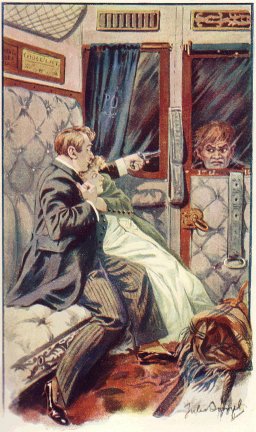
Patrice aimed between the two eyes and fired
The train made such a noise of thunder in that tunnel that they alone
heard the shot that was meant to kill Balaoo. No one, therefore, would
come to disturb them in their murder of a poor pithecanthrope who had strayed
from the Forest of Bandong. But had they murdered him as much as all that?
Did not Madeleine say that you can't kill a pithecanthrope with a revolver?
Madeleine looked out with every sign of despair. She made a rush at the
window, tried to open the door, at the risk of being dashed to pieces in
the tunnel. Patrice had to exert all his strength to hold her back. And
now, panting, they watched the drama enacted behind the pane.
The bullet had made a very clean' little hole in the window-pane and
another little hole, not so clean, because of the blood, at the root of
Balaoo's nose, behind the window, to which he was clinging desperately.
Balaoo gazed at Madeleine with, his fast-closing eyes; and never had Madeleine
seen a more human look, at the moment of death, even in the eyes of the
tamest animals, even in the eyes of sporting-dogs when they die in the
arms of their masters who have shot them through awkwardness . . . And
Balaoo let go the carriage-window and disappeared in the black rumbling
hole.
"Balaoo! Balaoo! Balaoo!" cried the despairing Madeleine, imprisoned
in Patrice' arms. "Balaoo ! Balaoo !"
Poor Balaoo must be in a thousand pieces by now. There is nothing like
a train in a tunnel to kill a pithecanthrope.
Madeleine was stifling. But Patrice began to breathe. Alas, how often
do we not find, at the moment when we think ourselves safe, at last, from
the pursuit of fate, that it turns against us with the most deadly cruelty!
Even so with Patrice Saint-Aubin. Seeing his dear little Madeleine for
the third time nearly expiring on that wretched wedding-day, he resolved
to shorten this first part of the journey. They left the train at Moulins
and drove to the old Hôtel de la Gare.
Here, Patrice engaged a suite of rooms of which he had not time to appreciate
the full comfort, for, when he went downstairs to give some orders to the
proprietor, he heard an appalling cry from Madeleine's lips:
"Help!"
All the terror that a cry can express was contained in that one cry.
The hotel-keeper and Patrice felt their hair stand up on end. They flew
to the unhappy girl's room. She was no longer there; but the window was
wide open on the night.
Madeleine must have made a supreme effort to defend herself. The marks
of her bloodstained fingers were found on the sheets torn from the bed.
And a trail of blood led from the bed to the window.
We shall now see the memorable circumstances in which the private misfortunes
of the Saint-Aubin family assumed the proportions of a public calamity.
Let me first quote two paragraphs which appeared in the Patrie en
danger and the Observateur impartial respectively and which
passed unnoticed at the time. It was not until later that people thought
of connecting them with the extraordinary incidents that upset the whole
existence of the capital. The Patrie en danger wrote, in its "Paris
Notes:"
"The impudence of foreigners knows no bounds. They treat Paris
like a conquered city. This is a fact which we have all observed for ourselves.
They expect the best seats at the theatres; and the tables outside the
cafes are theirs as though by right. Yesterday evening, two Roumanian students
stopped in front of the Brasserie Amédée in the Rue des Écoles
and, finding a little dog in their way as they were going to sit down,
calmly fired a revolver at it (24)
and killed it. They were pursued by the indignant crowd and only just had
time to climb a gutter pipe of the Musée de Cluny and thus escape
the punishment that awaited them. M. Haracourt, the genial keeper of our
national museum, in vain interrupted his work to look for the offenders,
who were able to make good their flight by means of a gargoyle from which
any respectable man would, nine times out of ten, have fallen and broken
his neck."(25)
On the same day, the Observateur impartial contained the following,
under the heading:
NOT EVERYBODY CARES
FOR PEA-NUTS
"If the long-suffering ratepayers who constitute the Paris
public would occasionally take the law into their own hands when tired
of the multitudinous annoyances thrust upon them, life in our much overrated
metropolis would perhaps become endurable. A few years ago, a man could
still sit outside a cafe without being pestered by peripatetic street-vendors,
hawkers of every kind, newspaper-boys and dealers in picture-postcards
and transparencies; he could take his cocktail without having his table
invaded by the latest thing in toys or by a keg of olives. Things, unfortunately,
have changed; and we can well understand that people suddenly lose their
tempers in the face of the obstinacy of a pea-nut vendor whose wares they
have already respectfully refused. Yesterday evening, at the Cafe Sara
Bernhardt, two young attaches of the Japanese Legation, weary of a torment
to which they had doubtless never been subjected in the streets of Nagasaki,
sent a too-enterprising dealer in pea-nuts flying into the gutter. The
incident occurred during the interval between the acts and caused some
little commotion; and the representatives of the prefect of police were
preparing to draw up a report, when the young Japanese were clever enough
to vanish with the agility of monkeys, clinging to a passing tram-car and
scrambling to the top by sheer force of muscle, without using the steps,
no doubt so as to show the passengers on the Montrouge-Gare de l'Est tram
that people are pretty resourceful in the Empire of the Rising Sun."
On the following Sunday, this paragraph appeared among the society-paragraphs
in the Gaulois des dimanches:
"H. H. the Maharajah of Kalpurthagra, who has come to France
to study our habits and customs and the advantages of wireless telegraphy,
sups every night at Maxim's. His Highness has brought with him, from his
own country, a recipe for raw rice in champagne which is highly appreciated
by the customers of an establishment where it is still the fashion for
a very 'Parisian' set to seek relaxation from the labours of the day. Henry,
the popular manager, recommends that this exotic, but succulent dish should
be prepared exclusively with the minimum brut of the well-known
Singsong brand."
My next quotation is from a very curious report that appeared in the theatrical
columns of the Bigarro on the day after the wedding of Mlle. Arlette
des Barrieres, the celebrated musical-comedy-actress, and M. Massepain,
the tenor:
"Contrary to the custom which has lately been introduced and
which entails the disappearance of the husband and wife immediately after
the light lunch that follows upon the marriage-ceremony, the newly-married
couple had resolved to spend their wedding-day among their friends. These
are many in number; and the large banqueting-room of the Restaurant de
Mailly was called into requisition to hold them all, or nearly all. For
every theatre and every branch of artistic talent was represented around
the charming Arlette, who looked perfectly exquisite in white and orange-blossoms.
The breakfast promised to be one of the most successful on record and a
general gaiety was arising round the tables spread with a Gargantuan banquet,
when a most grotesque and deplorable incident came and spoilt everything.
"A practical joker --- if that be the word, for I really do not
know how to describe the dismal wag --- whom no one was able to recognize
under his perfect make up as 'Prince Charles' of the Folies-Bergere, eye-glass
and all, appeared at the entrance to the reception-rooms and asked to speak
to the bride. His manner was so peculiar and his excited demeanour seemed
so threatening that the servants left him in the hall and went to inform
M. Massepain, who, at once, in great astonishment, quitted his seat in
search of further particulars.
"The popular tenor found himself confronted with a visitor who refused
to give his name and who, without for a second ceasing to swing, sway and
waddle from side to side, after the manner of 'Prince Charles,' the famous
chimpanzee aforesaid, declared that he would not go until he had spoken
a word to the bride. He added, to the intense amusement of all who heard
him, rudely sniffing the air as he spoke:
" 'Oh, I know she's here! It smells of orange blossoms!'
"M. Massepain, impatient of a sort of jest that threatened to be prolonged
indefinitely, tried to take his visitor by the arm, but was flung back
with such violence as to draw cries of indignation from the guests who
had gathered round him. Some of them wished to interfere and give the clown
a good hiding; but M. Massepain pushed them aside and, going up to the
man, who was slouching round and round the hall like a bear in its cage,
said:
" 'Sir, I don't know you.'
" 'Nor I you,' said the other, 'but I know that the bride is here and
I will not go away without speaking to her.'
" 'Sir,' retorted M. Massepain, quite calmly, 'my patience is nearly
exhausted.'
"The other replied, with unparalleled insolence, ceasing his sort of
dance:
" 'A man without patience is a lamp without oil!'
" 'Sir,' cried M. Massepain, angrily, 'this farce has lasted long enough.
Go away! You only excite our pity.'
"And the other, who seemed to grow cooler as M. Massepain became more
heated, replied:
" 'Pity is the finest and noblest passion of mankind!'
" 'That's enough of it! He's getting at us! Turn him out!' shouted the
guests, while the bride was surrounded by friends who prevented her from
going to see what was happening and who were determined to protect her
from that madman. 'What does he want? Who is he? Why doesn't he give his
name, at least? He has no courage!'
" 'Courage,' rejoined the irritating visitor, screwing his glass into
his eye, courage is the light of adversity!'
"The guests did not know what to do under this rain of apophthegms;
and the visitor held his ground. The waiters were sent for and tried to
force him down the stairs. He pushed them back with an incredible display
of strength and cried, in a voice of thunder that was heard all over the
establishment, from top to bottom:
" 'I will go when I have spoken to the bride. You need only say a word
to her, just one word, and she will see me at once.'
"The scandal was attaining such proportions that M. Massepain, to put
an end to it, asked the visitor:
" 'What word do you want said to her?'
" 'Say, "Bilbao." '
" 'Bilbao?'
" 'Yes, Bilbao, she will understand. Go on.'
" 'Bilbao!' repeated the guests, laughing and humming, 'You bet, he'll
grow, for he's a Spanish lad!' (26)
No sooner did the horrible fellow perceive that they were making fun
of Bilbao --- native place, no doubt --- than he went quite
mad. Pushing and overturning all who tried to oppose his progress, he entered
the banqueting-room. The bride had taken refuge in a private room, but
it was a useless precaution, for the intruder guessed where she was and,
while the others ran to the windows on the Boulevard Saint-Germain and
shouted for help, he made his way, upsetting the tables and chairs and
smashing the glass and crockery, to the door between himself and 'Our Own
Arlette' and broke the hinges with a tremendous kick. When he saw the bride
fainting in the arms of her bridesmaids, he seemed quite astonished. He
at once begged her pardon and said, aloud:
" 'I must have made a mistake!'
"Then he returned, with calm steps and knit brows, to the banqueting-room,
where, as is easily understood, disorder and uproar reigned. Some policemen,
who had hurried up the stairs, tried to take him by the collar; but he
gave one bound to the window and jumped into a tree. An enormous crowd,
attracted by the clamour that came from the restaurant, was standing on
the boulevard. Loud shouts greeted the appearance and flight of the man,
who sprang from branch to branch and tree to tree with a supernatural velocity
which enabled him soon to escape the policemen in pursuit.
"The general opinion is that the trouble was created by a sort of music-hall
acrobat --- as everybody knows, Mlle. Arlette des Barrieres began
her career on the variety stage --- or, at any rate, a low fellow
who thought that he had some reason to be revenged on our charming little
actress. M. Massepain has furnished the police with full particulars and
we shall soon know what is at the bottom of this unpleasant affair. Meanwhile,
we offer our sincere sympathy to Mlle. Arlette des Barrieres and her popular
husband."
Here is another note inserted in the Gaulois des dimanches of a
week later:
"H. H. the Maharajah of Kalpurthagra has written to us to say
that he has not been to Maxim's since his arrival in Paris and that he
has no connection with the person who introduced the fashion of raw rice
and champagne (minimum brut of the famous Singsong brand) into that
first-class establishment. We have telephoned to Henry, the well-known
manager, who regrets this usurpation of rank on his customer's part, all
the more as he has not seen him since and as no one has yet called to pay
the bill."
A few other papers copied these paragraphs and embellished them with more
or less witty comments, in the latest Boulevard style; and the various
incidents seemed wholly forgotten, until, one day, the Vie à
Paris published, in its evening edition, a paragraph headed, in large
capitals:
"THE SHAM MAHARAJAH AGAIN."
After reminding its readers of the first appearance of this worthy at Maxim's,
the newspaper went on to say:
"There was great excitement yesterday in the Rue Royale. A
taxi-cab driver who had been victimized by the sham Maharajah of Kalpurthagra
recognized him outside the Cafe Durand, where he was quietly drinking a
bock, with the serenity begotten of an easy conscience. The driver at once
pulled up beside the pavement and made a rush for his would-be Hindu Highness,
clamouring for his fare for driving him all night through the gayest streets
of the capital. However, the 'Maharajah' appears also to have recognized
his chauffeur; for he hastened to leave his table, relinquishing his beer
and of course forgetting to pay for it. The waiters joined the driver;
and their shouts soon collected the usual crowd of onlookers. The police
appeared upon the scene; and our 'Mahajarah' would undoubtedly have spent
the night in the cells if, by some mysterious feat of gymnastics, he had
not disappeared in the thick foliage of the trees on the boulevard, where
it became impossible to find him."
This peculiar manner of escaping pursuit resulted in establishing a natural
connection in the minds of M. Massepain and his friends between the sham
Maharajah of Kalpurthagra and the strange visitor to the Cafe de Mailly.
There are not so many people in Paris capable of running away through the
tree-tops! Lastly, a local paper published in the Quartier Latin suggested
that there must be a relation between the incidents on the Boulevard Saint-Germain,
those in the Rue Royale and the climbing of the walls, railings, gutter-pipes
and gargoyles of the Musée de Cluny.
The newspapers promptly jumped to the conclusion that all the queer
things that had happened in Paris for some months past must be put down
to the score of a mysterious acrobat whose eccentricities, pointing to
a mind tainted with madness, threatened to endanger the safety of the inhabitants.
And it was then that the press gave way to the panic to which I have
alluded at the head of this chapter and lost that presence of mind which
it should have communicated to the people of Paris, who were soon to be
driven mad by the fantastic and criminal enterprises of the elusive Maharajah.
But, between ourselves, it is no use protesting against the "scare-lines"
in the evening papers.
The first article to spread consternation was headed:
"GIRLS, DO NOT QUIT YOUR PARENTS' SIDE!"
This scare-line was followed by an account which stated that the mysterious
acrobat who walked in the trees had been seen in a chestnut-tree in the
Tuileries Gardens and that there was reason to believe that he was not
alone. Persons whose word could be trusted declared that they had seen
him carrying a young girl in his arms, like a savage.
But this first scare-line, which caused excitement, was nothing compared
with the second, which caused absolute terror:
"DISAPPEARANCE OF FOUR GIRLS.
"A monster, unworthy of the name of
man, drags them by the hair through
the trees and, carries them, like a
prey; over the roofs of the metropolis."
This was the alarming and tragic heading that appeared in the four o'clock
edition of the Patrie en danger. The newspaper-vendors who excited
the crowd with their mad rushing and shouting sold their copies up to five
sous apiece. The father and mothers, above all, wanted to be informed and
did not look at the cost, that day. People stopped drinking outside the
cafes, stopped walking on the pavements. They read instead. Everybody read,
or listened to others reading. The story was simple enough: since that
morning, four girls had disappeared, carried off by the monster. One had
vanished at the corner of the Rue de Médicis and the Rue de Vaugirard,
another in the middle of the Boulevard Saint-Germain, a third near the
Square Louvois, while the fourth was picked off the top of a tram-car going
along the Quai du Louvre. Note that all four had disappeared in places
where there were trees. The monster hid himself in the trees and suddenly
put out his hand, pulling the girl's hair with invincible force. The girl
followed, loudly screaming, and so rapidly that no one had time to hold
her-back. A young person who had just been discharged from hospital and
who was resting on a bench in the Square Montholon owed her safety to the
fact that her head had been shaved during her illness. Only her false chignon
remained in the monster's hands. As for the monster, he was endowed with
infernal speed; and people would still be looking for him in the trees;
when he appeared on the other side of the street or boulevard, on a roof,
to vanish then and there with his prey.
In conclusion, the Patrie en danger advised ladies and young
girls not to walk under the trees. And, in a moment, the pavements of the
boulevards were emptied and the roadways crammed with a crowd that blocked
the traffic, all walking with their noses in the air.
On the evening of that memorable afternoon, an unfortunate lamp-lighter,
who was cleaning a gas-lamp, standing on a ladder against the trunk of
a tree, was nearly torn to pieces by a wild mob that stupidly took him
for the mysterious acrobat who walked in the trees.
The prefecture of police was on tenterhooks.
The Municipal Council was called upon to take exceptional measures.
Certain idiots, of the class that always turns up at difficult moments
when people are not inclined to make fun of them or any one, certain idiots
contended that the only way to get rid of the mysterious acrobat who walked
in the trees was to cut down all the trees! The families of the girls who
had disappeared were interviewed by the newspapers and photographed down
to the fourth generation. The Ville Lumière was losing its head.
But the incredible scandal fell in all its horror on the panic-stricken
city with the famous head-lines in a late edition of the greatest paper
for news in the world: the Époque. Here is the gruesome heading:
PARIS A PREY TO THE MINOTAUR.
THE MONSTER IS KNOWN.
AN ANIMAL WITH A HUMAN BRAIN.
A TALKING PITHECANTHROPE.
FORMIDABLE INVENTION OF PROFESSOR CORIOLIS SAINT-AUBIN
And here is the article which was copied into every newspaper all over
the world:
"There are no mysteries to the Époque. Its news
service, which is unique in the journalistic world, has already enabled
it to render the most signal services to the cause of humanity.
"History repeats itself. At the critical hour, when the metropolis is
living in terror of the monster who seems to have established his empire
on the roofs of Paris, the Époque has succeeded in penetrating
the secret of the strange and formidable personality of the kidnapper of
young girls. And we can tell the mothers' to take comfort; for, the police
authorities, informed by the Époque as to the nature of the
enemy to be vanquished, will soon be able to rid us of this horror.
"It was by following step by step the fantastic appearances of the creature
who was long taken for a music-hall acrobat gone mad that we were enabled
gradually to ascertain the space to which the monster usually confined
his evolutions. We were thus led to the Quartier Latin and thence to the
Rue de Jussieu, where we knocked at the deserted house of his owner, a
man whose name will ring through the ages, M.Coriolis Boussac Saint-Aubin.
"In this house, which we entered by a window, everything was in the
greatest disorder. The building seemed to have been hastily abandoned.
We were received, however, by a parrot which, for more than an hour, never
ceased screaming out a word, or rather a name, which at first conveyed
nothing to us, but which also will remain famous in history. This word
was:
" 'Balaoo! Balaoo! Balaoo!'
" 'Balaoo is the animal-name of the monster who, in the life of Paris,
has his man-name: M. Noël. Balaoo is the name of the first monkey,
the first ape to speak the language of men.
"M. Noël is well known in the neighbourhood, where his odd ways,
his curious ugliness and his characteristic waddling gait did not pass
unperceived, while the faces which he was in the habit of pulling around
his eye-glass have more than once excited the laughter and witticisms of
the little ragamuffins in the streets. But no one ever suspected that this
somewhat eccentric, but, until recently, well-behaved person was a Javanese
pithecanthrope or ape-man. For M. Noël was a customer of the Café
Vachette and the Brasserie Amédée! M. Noël attended
the lectures at the law-courts! M. Noël belonged to the Conférence
Bottier! M. Noël dressed like a respectable man! M. Noël spoke
French like anybody else! And yet, O unfathomable mystery of the races,
M. Noël is not a man! M. Noël is only an anthropoid ape! He has
four hands! He is directly related to the orang-utan and the large ape
of the forests of Java, the archetype of which can be seen, at the Jardin
des Plantes, in the ape Gabriel!
"And now what is this mystery which will throw all our readers into
commotion? How did we succeed in discovering the secret? How did we find
Balaoo's master? It all happened very simply, but still it had to be thought
of! We began by seizing the files filled with papers in M. Coriolis Saint-Aubin's
study. Here we discovered the most curious documents imaginable, relating
to the transformation of Balaoo into M. Noël. These documents, we
admit, do not belong to us. Judging by their importance, we may say that
neither do they belong to M. Coriolis Saint-Aubin, their natural owner.
They belong to universal science; and it is to universal science that we
propose to dedicate them, day by day, by publishing them in our columns
from to-morrow onwards, changing nothing, adding nothing, respecting the
truth in accordance with the reputation which we have acquired among our
readers.
"From the moment when, in the empty house in the Rue de Jussieu, we
first glanced at those immortal notes, many incidents connected with the
famous acrobat who walked in the trees, incidents which had seemed incomprehensible,
became illumined with an unexpected and dazzling light; and we were able
to understand the most curious actions and observations which, until then,
had appeared to us, for the most part, to be invented by the maddened imagination
of the crowd.
"Our object thenceforth was to find, with the least possible delay,
the man whose scientific recklessness had let loose that monster upon humanity.
There was no doubt in our mind, judging by the objects surrounding us,
that this man, this gifted, but dangerous scholar, had fled, fled from
the hateful consequences of his daring, fled on hearing of the crimes committed
by his terrible pupil. He had to be found; he must, by fair means or foul,
be set on the track of the great Java pithecanthrope. He alone was perhaps
capable of instilling sense into that unique creature outlawed-by men and
animals alike; he alone could save us!
"We at once embarked upon a close enquiry into the last public acts
of M. Coriolis Saint-Aubin and we learnt that, a few days ago, he married
his daughter to his nephew, M. Patrice Saint-Aubin; that the ceremony was
performed in the strictest privacy and almost incognito; that M. Noël
was not present; and that the young couple hurriedly took the train for
Auvergne, while, almost at the same moment, the mysterious acrobat who
walks in the trees was creating a disturbance at the wedding-breakfast
of Mlle. Arlette des Barrieres and M. Massepain, the tenor.
"The coincidence between those two events, the flight of the newly-married
pair and the disturbance on the Boulevard Saint-Germain, gave us ample
food for reflection. The result of our reflections was not long in doubt.
It slightly altered our first view of M. Coriolis Saint-Aubin's flight.
As M. Noël was pursuing the bride, we considered that the father must
be chasing M. Noël, with a view to saving his daughter. He was bound
to fear a tragedy. Did he arrive in time? Had he come up with them? We
hastened on his tracks and we are now, unfortunately, in a position to
say that M. Coriolis Saint-Aubin arrived too late! He found only his son
in-law, under lamentable conditions which were certainly, so to speak,
the prelude to all the crimes, all the abductions under which the capital
is groaning to-day!
"The responsibility of that madman of genius is really terrible: terrible
in the eyes of history, in the eyes of science and in the eyes of the law.
We are not using this last word because we think that it behoves us to
draw down the vengeance of justice upon a man who believed that he was
accomplishing a great work: we are simply conveying a piece of news. M.
Coriolis Saint-Aubin is at this moment in custody! He gave himself up two
hours ago. We ourselves, at his own request, took him to our new prefect
of police, M. Mathieu Delafosse.
"All these incidents, occurring at the moment when we are about to go
to press, cannot be related with all the desired detail; but we shall publish
in a few hours a special edition in which we shall continue to expound
to our readers the formidable racial mystery in the Rue de Jussieu. For
the present, we shall consider that our work has not been in vain if we
have helped in any degree, however small, to dispel the morbid terror that
was beginning to overcome the bravest of us and if we have restored some
little peace to family-life. The wild beast is known; the tamer is known:
it is only a question, let us hope, of bringing them face to face. But
let the Cage be prepared, the cage in which to shut up the new minotaur,
who, since he speaks French, will perhaps consent to tell us what he has
done with his living prey.
"We will conclude by saying that we discovered M. Coriolis Saint-Aubin
on a Bourbonnais road, hunting, with his son-in-law, for the traces of
his child, who had been kidnapped by the monster. He thought that he was
his pupil's only victim. He did not know that there were other fathers
groaning, mothers in tears, sisters trembling, brothers thirsting for vengeance;
concerned only with his private tragedy, he knew nothing of all the tragedies
in Paris. When we informed him of what was happening in the capital, he
was thunderstruck, for he had no idea that the pithecanthrope, for whom
he was looking in the country, was back in town.
STOP-PRESS NEWS.
"Two of our reporters telephone that they have just found the
monster's tracks on the roof of the Hotel-de-Ville, where he is walking
about in all security. Our staff will organize a pursuit without delay."
This was the article that sent all the journalists of the capital flying
to the prefect of police, only to learn that M. Mathieu Delafosse, the
new prefect, whom the advent to power of an ultra-radical ministry had
relieved of his disgrace, was at the Place Beauveau, where the minister
of the interior had called an urgent meeting of the cabinet. I cannot do
better than publish the official statement dictated, after the cabinet-council,
to the journalists present:
"The prefect of police made a statement yesterday to the ministers
assembled in cabinet-council. He declared as follows:
" 'A man of whom I had never heard, M. Coriolis Boussac Saint-Aubin,
sent in his card to me, requesting me to see him at once. I sent to ask
his business, but he replied that he would only speak in my presence and
that there must be no delay, because it was a question of life and death.
I had him shown in.
"He did not strike me as mad. Before I had time to speak, he said in
a clear, deliberate and exceedingly sorrowful voice:
" ' "Monsieur le préfet de police, I am a wretched and unhappy
man. I have come to give myself up to the police. I alone am guilty of
the crimes which are horrifying Paris and for which it would be vain to
prosecute a poor creature to whom I have not succeeded in imparting a sense
of responsibility. I have been hideously punished for my pride and folly.
God is chastising me in my heart and in my brain, in the child of my flesh
and the work of my mind. It was I that made the mysterious acrobat who
walks in the trees. I made him out of an animal, for hatred of mankind.
The work of hatred can never be fruitful," my strange visitor continued,
"and the worker is the first victim. I am a wretched man and an unhappy
man. I have lost my daughter, who may be dead by now, herself kidnapped
by my pupil. And, in trying to turn an inferior creature into a civilized
being, I have only succeeded in inventing a monster, the horror and terror
of mankind. Yes, monsieur le prefet de police, I have done that, I have
made an ape talk! I have made an ape talk like a man, but, for all my efforts,
I have not succeeded in giving him a human conscience. Therefore, I have
not made a man; therefore, I have made a monster; therefore, convict me,
sentence me, imprison me, torture me: I deserve every form of punishment!
I am accurst! . . . God has smitten me as I deserved! . . .
I wanted to reform or to accelerate His work. To accelerate the work of
God is the pride and the crime of man; and it has caused my downfall. My
scalpel, by cutting a nerve under the tongue and allowing me to bring another
close to it, forestalled the work of the evolution of species by a hundred
thousand years; but, not possessing the requisite instruments, I could
not supply the hundred thousand years of consciousness necessary to enable
my pithecanthrope to move among men without danger . . . without
danger of his committing unconscious crimes; for, as regards the others,
monsieur le prefet de police, men see to that!" '
"After these words, which were accompanied by tears and every evidence
of despair, the prefect of police put a series of direct questions to M.
Coriolis Saint-Aubin, who replied in such a way as to leave no room for
doubt regarding the nature of the monster in question.
"Of course, if this declaration had not been preceded by all the incidents
that have been alarming the capital for some days past, it would only have
been received with the utmost reserve. But it is impossible to resist the
proofs, as the prefect of police impressed upon the council, after hearing
the evidence of certain persons acquainted with M. Coriolis Saint-Aubin
and his household.
"In the circumstances, it has been decided that every measure shall
be taken to capture the monster at all costs, alive or dead; and the instructions
on this point give full powers to the prefect of police. At the same time,
we may mention the desire expressed by both the minister of public instruction
and the minister of agriculture that the monster should, if possible, be
taken alive, as they consider the study of this phenomenon to be of the
highest value to universal science. But the prime minister's orders were
formal:
" 'There are too many mothers in tears. The capital must be rid of the
monster, at the earliest possible moment, by any and every means.' "
The town, pending the discovery of the mysterious hiding-place where the
new minotaur had secreted his collection of girls, the town, I say, lived,
more than ever, with its nose in the air. The monster was tracked over
the roofs of the Hotel-de-Ville by the journalists, the firemen, the clerks
and also by the members of the central division of police, which force
was called into requisition because of its celebrated physique. The police
had instructions to capture the monster alive; and, for a moment, they
thought that they had him.
As a-matter of fact, the chase was conducted with an energy that partook
of both anger and despair. The ape was hunted from garret-window to garret-window,
from chimney to chimney, to the roof of a little outhouse opposite the
Caserne Lobeau. The central police, equipped with ropes and lassoes that
seemed very much in their way, were ready to spring upon him, when Professor
Coriolis himself was brought out on the gutter and perceived that, in spite
of the horror of that tragic struggle, the monster had retained a little
of the veneer of civilization which he had been at such pains to bestow
upon him. The pithecanthrope, in fact, showed himself, for a second, between
two chimneys, leaping from one to the other, with an eye-glass in his eye!
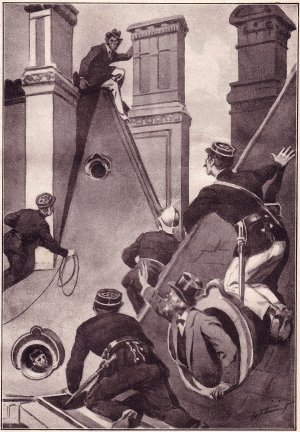
The pithecanthrope, in fact, showed himself, for a second, between two
chimneys.
"Balaoo! . . . Balaoo!" cried the professor, in a soft voice of
distress containing less anger and reproach than the despair that yearns
for consolation. "Balaoo ! . . . "
But, at the sound of this voice, this cry, the other, instead of replying
to the one who called to him, seemed to discover a fresh energy. The fear
which, but lately, had made him run away now turned into fury; and, rushing
like a meteor upon a group of policemen and town-hall clerks ---
the latter armed with their paper knives! --- he butted them out
of the gutter and sent three or four of them flying into space.
The luckless men crashed on the stones of the square below, in the midst
of the populace who came crowding up with a thousand cries of horror. Then
a score of shots were fired at the monster, who received them point blank,
without seeming to mind them, and re-entered the Hôtel-de-Ville by
a garret-window, after knocking down a stalwart policeman who had showed
his head at that window.
And the monster rushed down the corridors. He was seen to dart like
an arrow through every department. Ratepayers, who had been waiting for
hours to receive attention, fled howling and were never seen again.
For Balaoo was now no longer being pursued: everybody was fleeing before
him. He seemed to be everywhere at a time, on every floor. He reappeared
in every corner, bumping against groups that vanished like smoke.
He had a way of his own of descending a staircase, sliding down the
well, like an eel in its trap.
Through corridors and staircases, he made his way to the council-hall,
where M. Mathieu Delafosse was vainly striving to reassure a score of ædiles
who had not yet left the sitting, thinking, perhaps, in their hearts, that
they were safer there than elsewhere. Here too there was a general sauve-qui-peut,
but the other had passed and was out of sight long before their fright
was over.
For twenty-four hours, no one knew what had become of him. The police
hunted everywhere. They went to the length of burning straw in the cellars
of the Hotel-de- Ville, so as to smoke the monster out if he had found
a refuge there. A cordon of troops, with ammunitions of war, surrounded
the municipal buildings. Five detectives dragged Coriolis with them wherever
they went; and the professor, tangle-haired and wild-eyed, allowed himself
to be led from cellar to attic, calling:
" Balaoo! . . . Balaoo! . . . "
But Balaoo did not reply. Where was he? No more girls had disappeared
in Paris, through the agency of Balaoo or any other, and this was explained
by the fact that the girls were all kept carefully immured in their parents'
homes. The sittings of the municipal council were suspended until further
orders; and the anguish, increased by the mystery of that complete disappearance,
was greater than ever, when the monster suddenly reappeared on the top
of the Tour Saint-Jacques. The clerks of the meteorological office were
the first to see him and fled, after informing the police. This time, there
was little doubt that the end of the drama was at hand.
The Tour Saint-Jacques, which was at once isolated by a circle of police
and troops, was a very small and dangerous refuge for Balaoo. He himself
seemed to realize as much, for, seeing himself hard pressed by a crowd
of armed men and a mob of people loading him with curses, he worked himself
into an uncommon state of fury, even for a large Java ape. His prolonged,
rolling, rumbling cries were heard from the Place de la Bastille to the
Louvre. The traffic in the Rue de Rivoli was of course interrupted. The
tops of the omnibuses and tramcars were thronged with people shaking their
fists at the Tour Saint-Jacques and yelling for the death of the pithecanthrope.
Sometimes the monster's figure was seen dancing and turning somersauts
at the very top of the tower; but he would disappear at once, to reappear
swinging from a scaffolding. Already over fifty shots had been fired at
him, with no other result than to increase his rage. Sheltering himself
behind the scaffolding, he began to hurl blocks of stone at the crowd.
A regular hail of stones came down, striking, wounding and killing the
onlookers. The monster was not long in clearing the Rue de Rivoli and the
Square Saint Jacques. The troops and the police were driven back; and still
the square continued to rain with stones. The pithecanthrope was actually
demolishing the Tour Saint-Jacques in self-defence; and this so rapidly
that there were wags ready to suggest that, after three or four days of
that siege, there would be nothing left of the Tour Saint-Jacques but its
scaffoldings!
This, of course, was an exaggeration. But, all the same, it was manifest
that the most exquisite gargoyles were lying in fragments on the roadway
and that, taken all round, the monster was destroying the famous monument
faster than the city architect could hope to repair it. And this lasted
all the night through.
In the morning, M. Mathieu Delafosse arrived, together with the five
detectives who were still dragging M. Coriolis Saint-Aubin about with them.
The new prefect of police was in at least as deplorable a condition as
the ex-consul at Batavia himself. He was suffering from less despair and
grief, but greater exasperation. A sort of diabolical fatality seemed to
dog his career; and he could find no better comparison for his present
curious and tragic difficulties than the unprecedented incidents of the
siege of the Black Woods, at the time when he was prefect of the Puy-de-Dôme.
Had he been able to suspect the undoubted relation between those two
catastrophes and that Coriolis was the sole cause of both, he would certainly
not have deprived himself of the satisfaction of strangling that ill-omened
prisoner with his own hands. But the rapid. succession of events and the
quick action of the drama had not yet given the police time to institute
an enquiry which would have explained many things by referring them to
first principles in the shape of the French education of Master Balaoo.
M. Mathieu Delafosse came straight from the prime minister, who had
threatened him with his dismissal within twenty-four hours if the pithecanthrope's
business was not settled that same day. And it was with a view to settling
it that he arrived accompanied by Coriolis and the five detectives and
also by a colossal sportsman in a pair of yellow-leather leggings, with
a rifle over his shoulder.
The attention of the crowd was at once fixed upon this new figure. He
was a giant. He stood head and shoulders over everybody else. Soon, his
name passed from mouth to mouth, for the man was famous. He was the celebrated
lion-killer, Barthuiset.
If the legends told at certain cafe-tables were to be credited, that
man had killed more lions in Africa than the Atlas Mountains ever contained.
It is not a good thing, even for real heroes, without fear and without
reproach, that legend should exaggerate their exploits too lavishly. People
at certain other, more sceptical cafe-tables began to believe that Barthuiset
had never killed anything at all; and it was perhaps because of this that
M. Mathieu Delafosse had not at once applied to him in circumstances where
a first-class rifle-shot might render the most signal service.
Astonished and a little vexed at this neglect, Barthuiset might never
have offered to save the situation for monsieur le prefet de police, if
the lion-killer, whose heart was twice as big as that of ordinary men,
had not at last taken pity on the good city of Paris. Donning his trusty
hunting-leggings and his trusty hunting-belt and taking his trusty hunting-rifle
and his trusty cartridges with the explosive bullets, Barthuiset waited
on M. Mathieu Delafosse at the moment when M. Mathieu Delafosse returned
from the prime minister's, scared and dejected by the ultimatum of the
government.
The prefect of police, like everybody else, had heard of Barthuiset
the lion-killer. He looked hard at him. Barthuiset, in all the actions
and at every hour of his life, resembled a fat Dutchman digesting a first-rate
lunch. This phlegmatic attitude in the midst of the general excitement
rather pleased M. Delafosse than otherwise. He tapped Barthuiset on the
shoulder and said, simply:
"My dear M. Barthuiset, if you don't kill that pithecanthrope, I'm a
dead man myself."
Barthuiset replied, with a wink of his left eye:
"Show me your pithecanthrope, that's all I ask. There will be time enough
to make your will afterwards."
These words did not comfort the prefect of police particularly:
"You can't be sure of your shot," he said.
"If it were a lion, I should never forgive you for saying that, monsieur
le prefet de police. But I have never killed a pithecanthrope. There's
no harm in trying. There's a first time for everything."
The prefect, therefore, brought him with him, but took care also to
bring Coriolis. The little band entered the Square Saint-Jacques, amid
the silence of the throng, bravely, at the risk of being crushed by a projectile
broken from the historic pile. Balaoo had not given a sign of life that
morning; but people were wary and no one had yet ventured to approach the
scaffolding.
When they were within ten yards of the tower, M. Mathieu Delafosse said
to. Coriolis, who seemed to be wool-gathering and quite daft:
"Call him."
"What for?" asked Coriolis, looking more stupid than ever.
"To parley with him! . . . Understand, we sha'n't kill your pithecanthrope
except in the last extremity," explained the prefect, "though he's led
us no end of a dance. As you say that he listens to reason, speak to him,
coax him, say something to him, show us that he is not quite a savage."
Coriolis allowed himself to be taken in by these words. For, as the
prefect guessed, the terrible thing was that, in spite of Balaoo's crimes
and Madeleine's abduction, Coriolis instinctively wished to save Balaoo.
His hails on the roofs of the Hotel-de-Ville were, above all, warnings,
entreaties to fly!
The moment that it was no longer a question of killing Balaoo, Coriolis
would call to him in different terms; and, in fact, he ceased to address
him with a man's shout and cried, in monkey language:
"Tourôô! Tourôô! Tourôô!
. . . Gooot! . . . Woop!" (27)
Then and there, the monster was seen to put his head cautiously between
two planks of the scaffolding and anxiously to look down upon that numberless
and, for the moment, silent crowd.
This silence, after the late tumult, seemed to surprise and alarm him.
With a hesitating movement, he screwed his eye-glass into his eye and leant
still further forward, bending almost his whole body over the group whence
came the friendly words of his native tongue:
"Tourôô! . . . Gooot! . . . Woop!"
And bang! The shot was fired, the shot from the rifle with the explosive
bullets of Barthuiset the lion killer.
An immense, prodigious and prolonged shout, made up of thousands and
thousands of cries, rose up from the town, from the streets of the delivered
capital.
The pithecanthrope had toppled over and, in his turn, fell at the foot
of those walls of which he had been the terror. But he fell upon a mound
of soft earth and did not succumb for the first few minutes. And the citizens
of Paris were able to hear the dying agony of the monkey, of the great
anthropoid ape, of the great ancestor, as it is heard in the depths of
the equatorial forests and as it lingers in the expiring bodies of our
mysterious brothers the animals, even among those which are not exactly
pithecanthropes.
The citizens heard that despairing wail, of which Louis Jacolliot, the
traveller, has written:
"At the supreme moment of death, the terrible brute gives forth sounds
that are very nearly human . . . Its last wail gives you the impression
of something higher in the scale of nature; and you feel as though you
had committed a murder."
Coriolis, as that shot rang out, felt his heartbreak; and it was, for
a moment, as though he himself had been shot dead. He saw the great body
spin through the air, he rushed forward as if to catch it in his arms.
Fortunately, the creature crashed to the ground beside him, without touching
him. Coriolis flung himself upon those dying remains that lay groaning
like a man.
He bent over the body . . . and, suddenly, he rose to his feet, with
a mad yell of triumph: it was not Balaoo!
No, that big dead monkey, dressed as a man and wearing an eye-glass like
Balaoo, was not Balaoo. A few hours later, it was known that he was Gabriel,
the big Java ape from the Jardin des Plantes. As he had played many a prank
in his time and repeatedly shown signs of temper, his formidable vagary
was easily explained: he had made his escape by taking advantage of the
boozy negligence of the keeper, who was always slipping away to the wine-shop
round the corner.
Was there any reason to be surprised that, with his irresistible instinct
for mimicry and assimilation, he had prigged a suit of clothes and put
them on? No, from this point of view, we need be astonished at nothing,
in monkeys.
Gabriel's cage, like many others at the Jardin des Plantes, was a double
cage, with a railed open-air compartment and another railed compartment
inside the lion-house. The communicating-door was usually left open, so
that Gabriel could seek sun or shade according to the temperature and the
time of day. As the keeper or the visitor can see only one compartment
at a time, each must have thought that Gabriel was in the second when he
was looking into the first and vice versa. And this explained how Gabriel
was able, for several days and nights, to scour the roofs of the capital
and frighten the town with his sinister exploits before his absence from
the Jardin des Plantes was discovered.
But then where was the famous pithecanthrope, the monster, half man
and half brute, who spoke the language of men? What had become of Coriolis'
invention? The police were much too glad to be rid of one monster to saddle
themselves with another. They declared, with out delay, that Coriolis'
invention was a figment of that diseased brain, treated the professor as
a monomaniac and asked him to go and cloister his monomania in his house
in the Rue de Jussieu, holding himself meanwhile at the disposal of the
police.
The day that saw the deliverance of Paris saw also that of the missing
.girls. They were discovered by the greatest of accidents, at a moment
when people were despairing of ever learning what Gabriel had done with
them.
Maddened by the hue and cry, the great ape had ended by carrying the
poor things to the roof of the Louvre and had managed to fling them more
dead than alive into an attic, where he locked them up. They were all found
safe and sound, though obviously very ill. Nevertheless, the ape had done
them no harm.
The books written by travellers in the equatorial forests furnish us
with examples of this kind of rape in which the "wild men of the woods"
take a futile and childish pleasure and which can only be compared with
the passion of the thieving magpie for collecting objects which it accumulates
in hiding-places known to itself alone.
The girls owed their life to the scientific and naval curiosity of a
certain M. Benezebque, a schoolmaster in a small parish not far from Montauban;
for they would all have died of hunger and thirst in their sequestered
attic, if M. Benezecque, driven by a wish to inspect some models of ships,
had not climbed to the top floor of our famous old palace, where a long
series of dull blows informed him that some one was calling for help, blows
struck against a door near the thirteenth-century gallery which you can
see to this day, between the hours of eleven and four, on Mondays, Wednesdays
and Sundays.
Professor Coriolis was returning to his house in the Rue de Jussieu
when an evening edition of the Patrie en danger acquainted him with
the fortunate delivery of the victims of Gabriel's demoniacal freak; and
he was not at all astonished not to find Madeleine's name among those of
the missing girls. He well knew that Madeleine had not been carried off
by Gabriel.
When he entered his hall, feeling so despondent that he thought of suicide,
he saw a letter lying on the floor.
The letter bore the postmark of Saint-Martin-des-Bois and was worded:
"I am waiting for you at the Big Beech at Pierrefeu. "Balaoo."
For hours, Coriolis, with his clothes torn, his hands and face lacerated
by the thorns and brambles, pushed branch after branch aside in his vain
search for the Pierrefeu clearing, overtopped by the Big Beech which he
knew so well in his youth.
He was lost in the forest. He had come alone, not wishing to mix up
others in his terrible family-history and not knowing what last fatal surprise
might await him at the strange meeting-place fixed by Balaoo.
Besides, who was there to come with him? Was he not alone on the earth
from this day forth? Patrice, who was being nursed at Clermont, had refused
to see him and kept accusing him of every possible crime in a delirium
that threatened to destroy his reason for good. Little Zoé, whom
he had tried to make into a young lady for Balaoo, at the time when, in
his extraordinary madness, he hoped to obtain a civic status for the son
of the Forest of Bandong, little Zoé, struck to the heart by Balaoo's
criminal love for Madeleine, was dying in the arms of Gertrude. Both had
left his roof and would have nothing more to do with him.
And his daughter: where was his daughter? Was it true that the monster
had killed her rather than be parted from her? And was Coriolis on the
point of being faced with his child's corpse? Had Balaoo, bewildered with
remorse, sent for him to weep over a tomb? Why had he not mentioned Madeleine
in his letter? O tragic silence! O hateful uncertainty! O Madeleine! O
Balaoo! . . .
For hours, the unhappy Coriolis had flung those two dear names to the
echoes of the forest; and none but the echoes had replied.
Time after time, he seemed to recognize the paths that led to the Big
Beech of Pierrefeu; but his footsteps became involved and perhaps only
turned around themselves. The sun was now sinking in the sky and piercing
the tall trees with its slanting rays. The twilight was at hand: Balaoo!
Madeleine!
Balaoo, you who loved your little mistress so well, can it be true that
you carried her off as a wild beast would and lent a deaf ear to her voice?
Despite the horror of that murderous abduction, Coriolis did not yet
quite despair in the depths of his being. Certainly, Balaoo must have been
terrible at the first moment and, thinking of nothing but the hideous thing
that Madeleine's voluntary departure meant to him, he must have listened
only to his instinct to retain possession of the beloved object and carried
off the young woman in his arms with the same recklessness with which he
would have stolen a lifeless thing. But, afterwards, it was impossible
that Balaoo should not have yielded to Madeleine's voice, which for the
pithecanthrope had the same fascination that serpents find in the voices
of flutes.
Thus did Coriolis argue, or try to argue, as he continued to tear his
clothes and flesh against the brambles on his path. It was the last hope
that he built upon an hypothesis frail indeed, in the face of Balaoo's
prolonged silence in his Pierrefeu clearing. Alas, if the charm of Madeleine's
voice was so potent, the young woman would have ceased to be a prisoner
from the first day! Poor Coriolis! His thoughts strayed like his footsteps;
and, as the golden beams of the sun now reached him horizontally through
the leaves, he struck the lower branches with his crazy forehead and cried,
in the falling night:
"My daughter is dead! My daughter is dead! "
Then, dropping on his knees and lifting his hands to heaven in an attitude
that implored both pity and forgiveness, for the first time he regretted
his handiwork.
As his eyes, filled with an immense despair, rose to the sky, they encountered
a thick circle of crows, chattering horribly, as birds and men do after
a great banquet. The circle flew up, then down again and at last disappeared
into the forest, with a mad accompani ment of hoarse and strident cries,
like the hiccuping laughter of surfeited birds of prey.
Coriolis' heart turned icy cold. And suddenly his gaze fell upon a white
veil clinging to a young branch. He rose and staggered to that veil or
rather to that shred of material white as a bride's veil. He had not a
doubt but that it was Madeleine's veil. He recognized it. His terror told
him that he was not deceived. He snatched it from the forest with fevered
hands and, sobbing, raised it to his lips.
A few steps farther, he found a piece of the satin of the dress . .
. and then a little slipper . . . It was Madeleine's little white slipper
. . . He covered it with frenzied kisses . . .
And he called out, with all the strength of the sorrow that filled his
breast:
"Madeleine! . . . Madeleine! . . . "
He called in the way in which you call not upon a living, but upon a
dear dead woman, in the hope that she may appear to you. For there are
moments when human sorrow does not dread ghosts and when it conjures up
shades to press them to its heart, without trembling on the threshold of
the great mystery; moments when love would have the dead come forth from
the dark and when it is astonished --- so loud has been its call
--- that the spirits do not come and kiss its lips!
"Madeleine!..."
The cawing of the crows was his sole answer. And, guided by the cawing
of the crows, he continued his progress through the clustering branches.
When he had pushed aside the last from that corner of thick timber, it
was as though there had been a fire on the level of the ground and of the
holes in the ground and as though he had come upon the centre of the furnace.
He recognized the Moabit clearing. Over a thousand crows were there and
did not so much as turn their heads, being busily engaged in devouring
the carrion of three great men'.s corpses lying on the grass with outstretched
arms.
And, though their foreheads were smashed in and much of their flesh
eaten, Coriolis recognized the Three Brothers, who, for so many years,
had been the terror of the country-side. Their guns lay beside them; the
biggest of the three, red-bearded Hubert, still held his in his clenched
hand.
The ferns and bushes all around were torn and broken and trampled. The
struggle in which these had suffered and the three Vautrins met their death
had created a sort of circus, a sort of flat ring. It must have been a
terrible battle.
Who had been strong enough to defeat the Three Brothers, armed with
their three guns? And what all powerful weapon had laid low those three
huge bodies on the blood-soaked earth? Oh, it was simply a weapon made
of wood! It also lay there, resting on the grass, after performing its
work. It was a fine young tree, which might have reckoned on long years
of glorious forest-life and which, trusting in the future, had dug its
roots solidly into the fostering soil. And behold, a hand had torn it out
of the earth as though it were not fastened there; and it was this birch-trunk,
whose silvery whiteness was splashed and stained with the brown blood which
it had brought spouting from the three men's heads, it was this birch-trunk
that had done the killing.
What giant, what hero had waged battle here? What archangel's hand had
wielded this flaming sword of wood?
On a branch of that tree, Coriolis saw yet another strip of the white
veil that sent his heart beating in his chest like a drum; and also, after
disturbing the crows, which protested and staggered around him like a black,
drunkenband,
he saw yet another piece of the white dress clutched in the fingers of
one of the albinos.
And he no longer had a doubt but that his child was the coveted booty
of that wild men's battle. His troubled brain, burning redder than that
flaming forest at eve, pictured in a flash all the phases of that tourney
of blood and death.
It was here that Balaoo must have hurried with his prey, to this friendly
solitude of the forest where men would not come to rob him of her whose
presence was as necessary to his life as the air he breathed. And then,
no doubt, he had come upon the three men, the sole inhabitants of that
solitude and the sole masters of that corner of the forest. The brute men
had risen against the animal, on seeing him the possessor of so fair a
prey, and they, in their turn, had tried to snatch it from him.
They were dead; and Balaoo had carried elsewhither the sacred object
of that battle of the gods. Balaoo! . . . Balaoo! . . .
Moabit suddenly fell into pitch darkness; and Coriolis collided with
the living walls of the clearing, which closed their branchy arms and leafy
hands upon him. And, having reached the last stage of his despair, he sank
down to the ground, like a child in its cradle.
In the morning, he woke and thought that he must still be dreaming when
he saw Balaoo's sad and serious face bending over him.
He tried to cry out. Balaoo, with his finger to his mouth, enjoined
silence:
"Take care!" said the pithecanthrope, whose voice seemed to reach him
through a lake of tears. "Take care! . . . Don't wake her!
. . . "
"Is she dead or alive?"
"She is asleep . . . Hush! . . . "
"Is she dead or alive? "
"She is asleep and we must not wake her."
And, walking straight before him, with his finger to his mouth, looking
round from time to time to make sure that the other was following him,
Balaoo led the way, a very long way, through the forest. Everything was
silent as they passed. The birds interrupted their singing, the leaves
ceased to quiver with joy in the morning breeze. Balaoo's finger raised
to his mouth seemed to command all nature to hush and not disturb the rest
of her to whom they were going.
Was she dead?
Was she alive?
Was she at rest for all time?
Balaoo himself perhaps did not know.
They reached the Big Beech at Pierrefeu. Balaoo pointed to the upper
storey of branches and to the road which Coriolis was to take. Coriolis
went up it, obeying Balaoo as Balaoo had once obeyed him and not even wondering
whether he could resist the pithecanthrope's gesture of command, accompanied
by that extraordinarily human and divine look of sadness which he had not
yet seen in his eyes, having never seen anything there but childish looks.
They climbed into the tree, which was as large as a little wood that
might have surrounded Balaoo's private dwelling.
And they came to the private dwelling, to the hut built in the style
of the Forest of Bandong which Coriolus, remembering the huts built by
the pithecanthropes on the mangroves in the swamps, was not at all surprised
to find there. Only, this hut had a door, as in a man's house.
He opened the door, while Balaoo, more and more sad and more and more
polite, like any man inviting a stranger to cross his threshold, stood
modestly behind him.
He opened the door and found himself in the presence of Madeleine lying
on a bed of dry leaves and decently covered with a rug which he remembered
once missing from his pony-chaise.
Madeleine was pale as death, but not dead. At the noise which her father
made on entering, she opened her eyes; and two syllables came from her
bloodless lips:
"Papa!"
Coriolis fell on his knees' before his child, raised the dear head,
pressed it to his heart and bathed it with his tears:
"Forgive me! . . . Forgive me! . . . "
"Forgive you for what, papa? . . . Hasn't Balaoo told you? . .
Embrace him: he saved me!"
Coriolis' eyes wandered from Madeleine to Balaoo, who, standing in the
doorway, turned aside his head so that he might not be seen to weep:
"What! He saved you?"
Then Madeleine, putting her shapely, trembling arms around her father's
neck, told him the terrible story of her abduction from the room at Moulins
by Élie the albino. Mother Vautrin's son must have heard of the
marriage of her whom he had never ceased to love and of the contemplated
arrival of the newly-married pair at Clermont-Ferrand.
His sudden resolution to go and lie in wait for them, like an animal
lurking for its prey, spoke volumes for the mental attitude of the Three
Brothers, who, definitely outlawed from human society by their conviction
and sentence, had for years led the lives of wild animals in the depths
of the forest.
But, whereas Hubert and Siméon lived only to eat and breathe
in their lair, Élie's fierce heart was still, from time to time,
roused by the memory of a white figure that used to appear to him, in the
old days, when he returned of a morning from his clandestine hunting-expeditions,
at the edge of the dawn-swept fields. The image of Madeleine lingered deep
down in that brutal brain; and, if he had sunk so low as never to speak
a word, never to reply to his brothers' call, it was because he never ceased
to converse with Madeleine's image and to say things to her that could
be confided to none other.
When prowling with his brothers like a jackal around the villages which
they still terrorized, at intervals, with their plunderings, Élie
heard of Madeleine's approaching return to Clermont with her young husband.
He said nothing to his brothers, went to Clermont, made enquiries in the
neighbourhood of the Rue de l'Écu and went back to Moulins.
His aim was to kidnap Madeleine before her arrival at the capital of
the Puy-de-Dôme. There, he might have had to abandon his sinful plan;
whereas, if he carried off Madeleine in the open country, he could undertake,
by travelling only at night, to reach his haunt in the forest undisturbed.
To get into the train, take advantage of a stop at an intermediate station,
or even of the slowing down of the train at certain places on the line
of which he knew, and rush into the night with the young woman in his arms
: this was the exceedingly simple plan that suggested itself to his brute
brain.
Events turned out in such a way as to simplify things even more. At
Moulins, he saw Madeleine and Patrice alight from the train. It was all
that he could do to refrain from seizing her on the platform, in the midst
of the passengers. He might have made the attempt then and there, had she
not passed so quickly, on Patrice' arm. He felt his heart seething, his
brain afire, himself trembling with impatience to effect his rape.
At the hotel, he walked straight in behind them and then made his way,
with watchful eyes and ears, to the courtyard. A light appeared in a window;
and he saw Madeleine's shadow. Ten minutes later, Madeleine was in his
arms. He stopped her screams by thrusting his hand into her mouth and flung
her half-dead into a cart. He jumped on the box and did not stop until
the horse dropped between the shafts. By this time, he had covered a long
way on the Paris road, going in the opposite direction to the Cerdogne
country; and this, a few hours later, must have thrown first Patrice off
the scent and then Coriolis.
Lastly, the coincidence of the events for which Gabriel was responsible
completely restored his ease of mind and he proceeded to travel by short
and careful stages to the Moabit clearing.
He did not speak a word to Madeleine, but he terrorized her into eating
and drinking. She hoped, for a moment, that the pursuit of which she was
bound to be the active and desperate object would end by dicovering her
before she was imprisoned for good and all in one of the horrible Moabit
quarries for which they were making. She knew the terrible legend of those
quarries, all peopled with ghosts and corpses, lined with skeletons and
treasures. But the forest closed in upon them before help came; and they
arrived at Moabit.
The two brothers received the albino and his white prey in silence.
Élie said:
"This shall be my wife, the wife of Élie of Moabit."
The others stepped towards her with eyes of flame. She saw that they
were armed and that all the three looked at one another with a great hatred.
She realized that the Three Brothers were going to fight and that she would
be the victor's booty.
And, as the three were snatching her from one another with their terrible
arms, as she felt their monstrous fingers tearing her, she gave a loud
scream that echoed far through the forest:
"Balaoo! . . . Balaoo! . . . " And Balaoo appeared.
Oh, it was a battle of giants, a mythological contest, with the thunderbolt
of modern fire-arms superadded! But, whether because the pithecanthrope
gods watched with a jealous vigilance over their terrestrial hero, or because
nature had endowed him with a flesh impervious to the vulgar lead of men,
the human thunderbolt was powerless to stay the onslaught of those avenging
limbs.
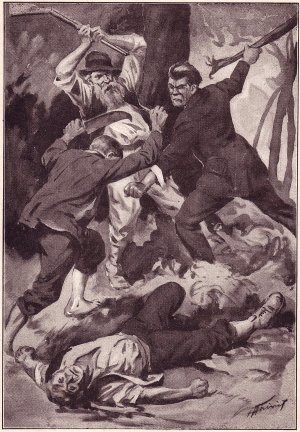
It was a battle of giants.
The forest itself armed him with its terrible weapon; and the weapon
whirled around their heads.
Balaoo! Balaoo! He had come! He was striking for her! For her he was
killing his three forest brothers!
She had called to men in vain: none had come. But she had only to utter
his name, for him to rush into the fray and come out victorious, the dear,
formidable, gentle, terrible Balaoo!
And all for her, for her who had seen Patrice fire at Balaoo nor sought
to divert his hand, for her who looked like a white lily, on her knees,
in the centre of Moabit, while the battle was raging around her.
Ah, did ever doughtier knight enter the lists? Cut, Balaoo, and thrust!
Use your hands and your shoe-hands! A Balaoo, a Balaoo! . . . Strike!
Fell! . . . Here's for Siméon! . . . And there's for
Élie! . . . As to Hubert, you must keep your hardest blow
for him.
They have danced around you with their empty guns, which they are now
using as clubs; but you have your trusty tree-club and you have shown them
all the colours of the rainbow: red above all!
Oh, what blood on cheeks and arms! . . . Hop, hop, Balaoo! She
had but to call your name and you came! Tourôô! Tourôô!
Bang! One more good blow in the ribs for Élie, who will never stand
on his feet again and who is dragging himself in the grass like a hare
with its hind-legs broken!
And their skulls are cracked and stream with blood; but they are sturdy
fellows, for all that, and not to be demolished with the first blow of
a tree-trunk! They are as tough as pithecanthrope flesh-and-bone itself!
Have at them again! Woop! Phch! Phch!... A blow here, a blow there!
. . .
The warriors are as though drunk, dancing round Balaoo like bears, and
it is you, Balaoo, who make them dance like that, as a gipsy does his bear.
Goek!
Goek! . . . Patti Palang Kaing's hell awaits them! . . . Oof!
They breathe no more! . . . They moan no more! . . . They move
no more! . . .
They are dead all three, with arms outflung on the red grass. But you,
you are in a sad plight too, my poor Balaoo! . . .
However, this is no time to coddle yourself, when the white lily of
Moabit sinks down softly to the ground, exhausted, after beholding your
victory. It is your turn now to carry the white lily in your arms, with
precautions worthy of a man-child's nurse, by the Lord Patti Palang Kaing!
. . .
And you laid the lily on the cool bed of leaves in your lonely dwelling
in the Big Beech at Pierrefeu! . . . Blessed be Patti Palang Kaing,
who watches over stout hearts from his throne in the Forest of Bandong
and who rewards brave forest battles; blessed be Patti Palang Kaing, inasmuch
as he has blessed your dwelling, O Balaoo! . . .
That is the story of this last episode: bloody, tragic, heroic and beautiful
as the fights of antiquity.
Madeleine, with her poor, faint voice and her pale breath, the breath
of an expiring lily, was not able to tell all these glorious feats of war
to the weeping Coriolis. But the few words which she whispered in his ear,
together with what he had seen —the corpses and his humble Balaoo's wounds
--- all this made him sob for joy, made his heart leap with pride;
for Madeleine was saved and Balaoo had acted like one of the Race in the
days of the blameless knights.
Balaoo was still turning away his head in the door way of his forest
dwelling, lest he should show his eyes full of tears.
Madeleine, sighing, said:
"We must beg his pardon, very earnestly. We were wrong not to treat
him as one of the Race. He said to me, 'I wanted to see you once more,
Madeleine, before you went away with a husband of your Race. What did you
think and of what were you afraid? One with fingers to his shoe-hands will
always be a true friend to the daughter of men; and, if you knew the law
of the forest, laid down by Patti Palang Kaing at the beginning of the
world, you would know that the daughter of men can walk without fear in
the forest; but it is not forbidden to touch the tracks of her footsteps
with one's lips, nor to lick her hand!' That was what Balaoo said, was
it not, my Balaoo? He told me all that, beside my bed of leaves, waiting
for you to come: he even told it me in immortal verse, for Balaoo is a
great poet, are you not, Balaoo?"
Balaoo, at the door, nodded his head in assent, but kept it still turned
away, for his pain was more than he could bear and threatened to burst
like an untimely storm . . . And he held himself in, lest he should seem
ridiculous, and tried to swallow his sobs and keep his thunder to himself
. . .
Poor Balaoo, who knew that Coriolis had come to take Madeleine away!
. . . Poor Balaoo, who had himself summoned his master, by order of his
little mistress, and who had himself gone, after himself writing the letter
--- for Madeleine was then too ill --- and posted it at night
in the box of Mme. Godefroy the postmistress and been very nearly recognized
by that confounded old mole of a gossip of a Mother Toussaint, who had
not yet forgiven him for his theft of the Empress' dress!
. . .
. . .
.
A few days passed; and it was over. Madeleine was gone. She had gone
to join her husband and Balaoo would never see her again. His master would
come back, but not she, because of the man's law that told her to follow
her husband. She had but just gone; and, after a leave taking that made
all who lived in the Cerdogne country believe that a great storm was raging
in the woods and on the mountain, he remained there, at the door of his
forest dwelling in the Big Beech at Pierrefeu, remained there motionless,
with his arms and legs hanging and his head on his chest, motionless as
a pithecanthrope of wood.
And he stayed like that while the tinkling carriage bells tinkled against
his heart, now dry and hollow as a drum; for he had nothing left in his
heart now, nothing: she had taken it all. At least, it produced that effect
upon him, a sense of emptiness; it was as though he had an empty box there,
which naught would ever replace: naught but memory, O Balaoo! . .
.
And you shall see, Balaoo, that memory does fill the heart, ay, even
to bursting-point! . . .
There was not a sound now under the greenwood. Balaoo went indoors and
lay at full length on the bed of leaves that had kept the shape of her
body . . . and, incredible to state, Balaoo still had tears to shed.
Then, when the last were spent, he lay for two days and two nights on
the bed of leaves, lying without movement, like a pithecanthrope of wood.
Old forest friends climbed up to him, peeped through the crack in the door;
and he did not move a limb. Old As, who now had a broken leg, looked in
and saw and went off without a word, shrugging his shoulders. Balaoo knew
none of them now.
At the end of the second day, when Coriolis returned, he found Balaoa
sitting at his door, with one shoulder in the sun and a consumptive look
in his face.
Coriolis had told his daughter that he was going to retire for good
to Saint-Martin-des-Bois; but he lied in his thought: it was to the Big
Beech at Pierrefeu that he meant to withdraw, far from a society that could
but curse him, alone with his divine masterpiece, with the man from Java
whom his genius had brought into the world. At any rate, he must see what
he could do. There were unpleasant rumours in the department, stories about
a pithecanthrope. Coriolis considered that he was best-off in the forest
guarded by the memory of the Three Brothers and of the battle in which
so many brave officers and soldiers were slain . . . It was a very nearly
safe and inviolable retreat, very nearly . . .
Coriolis' first thought was how to overcome Balaoo's sadness. He was
right, for the poor fellow was extremely ill and, if he went on moping
like that, without mov ing, at the top of his tree, would surely fall into
a decline.
Coriolis took him for walks in the forest. To divert his pupil's thoughts,
he told him of the pranks of a certain Gabriel, whom many people for a
moment believed to be Balaoo. In fact, Coriolis himself was taken in by
a trick which Gabriel had of wearing his jacket open and suddenly thrusting
his fingers into the pockets or arm-holes of his waistcoat; and, lastly,
because of an eye-glass.
"I knew Gabriel well," replied Balaoo, making an effort to follow his
master's train of thought. "He used to copy everything I had: my clothes
and even my way of wearing them. I once made him a present of a pair of
spectacles; and I see he managed to make an eyeglass out of them, because
I wore one. Those monkeys are never happy unless they are mimicking people!"
They walked for a time without speaking; and then Balaoo resumed:
"While all these horrors were being put down to me, I was on my way
to Pierrefeu, in despair. I merely wanted to see Madeleine once more. I
saw her through the window of the railway-carriage; but the other tried
to kill me; and I am very sorry that he did not succeed."
Coriolis fondly pressed Balaoo's arm. Balaoo humbly returned the pressure
and lowered his head, as he concluded:
"Yes, my only wish now is to die . . . to die in this forest which has
known her, which has heard her soft voice calling, 'Balaoo! . . .
Balaoo! . . . Balaoo! . . . ' My only joy henceforth will be
to see the trees at the foot of which we used to sit when she wished to
teach me some fresh story . . . Here I shall find her image everywhere
. . . Patti Palang Kaing is kind . . . He will let me die here . . . "
Coriolis tried in vain to silence him. Balaoo thought of nothing but
Madeleine and took a mournful pleasure in confiding his thoughts to all
the branches on the road. He was visibly pining away. He emerged from his
dreams only to speak of Paul and Virginia, which his master had read to
him. The story attracted him above all others because he found in it a
likeness to his own misfortunes. And, like Paul after Virginia's departure,
he visited all the spots where he had been with the companion of his childhood;
all the places that reminded him of their alarms, their games, their picnics
and the loving-kindness of his dear little sister; a young birch which
she had planted; the mossy carpets over which she loved to race; the open
spaces in the forest where she used to sing and where their two voices
had mingled their two names: Balaoo! . . . Madeleine!
In five days! time, he took to his bed; and Coriolis began to fear that
he would never leave it again. One morning, Balaoo woke from his coma and
saw Zoé and Gertrude standing by his side. He betrayed neither anger
nor the least ill-humour. Nay more, he let Gertrude kiss him tenderly and
begged Zoé's pardon for all the pain which he had caused her since
he first knew her. His voice was gentle and soft; he allowed himself to
be nursed and petted. He was as weak as a child at the point of death.
Coriolis, kneeling behind him and supporting him, though he was no stronger
himself, ventured to use the "word-remedy" which little Zoé, with
her fond heart and quick intelligence, had suggested of her own initiative.
He leant over and whispered two syllables in Balaoo's ear:
"Bandong!"
At once, Balaoo's eyes kindled, his frame stiffened, his chest breathed
more firmly and he repeated:
" Bandong ! "
Then Zoé asked:
"Would you like to go back to the Forest of Bandong, Balaoo?"
"Oh," said Balaoo, with a terrible sigh," oh, how I should love to see
it once again before I die!"
"Well, we will take you there, Balaoo! . . . We will all go together!
. . . "
Balaoo put his great, quivering fists to his lips, as was his habit
when he wished to restrain the too-noisy expressipn of his joy or grief:
"Let us go!" he said. "Oh, let us go! . . . Far from men's houses!
. . . Take me back to my Forest of Bandong! . . . "
There was no reason nor room for hesitation. It meant salvation not
only for Balaoo, but for all of them, especially Coriolus; for Zoé
had returned from Clermont with the most grievous news. M. Mathieu Delafosse
now knew for certain that the smart officers and brave men killed in the
attack on the forest had fallen under the blows of Coriolus' pithecanthrope.
The official enquiry had ended by clearing up that gruesome business; and
the police were once more hunting for the master and his terrible disciple.
There was only just time to fly.
They crossed the frontier and took ship for the East.
They fled to the Forest of Bandong.
Balaoo was saved on the day when he set eyes once more on the place where
he had seen his mother for the last time. It was three days' march from
Batavia, a few hundred yards from the mangroves which, for a thousand years
and more, had been digging their roots to the very heart of the earth.
He recognized the disposition of the glade and the thick leafy vaults that
cast the same shadow and the same light; for it takes hundreds of centuries
to alter those landscapes created by the last upheavals of the world and
the first vigour of the universal sap.
"This is it," he said, stopping his companions. "This is my Forest of
Bandong. These are the woods of my childhood. Here I played with my mother
and my little brother and sister. I was strong and lusty even then, though
still a baby, scarcely three or four years old. My little brother and sister
were only just beginning to walk, while I gambolled and frisked about and
called and beckoned to my little brother and sister and invited them to
come and share my sports . . . The little fellow tried a skip or two, to
follow me, but they were vain efforts. I can still see him tottering on
his little legs that were hardly strong enough to bear his weight. He fell;
and my little sister fell also; and our mother picked them up tenderly
and encouraged them with word and gesture . . . What followed I shall remember
to my dying day. My mother, seeing the little ones so clumsy and so tired,
took them in her arms and began to sing them to sleep, rocking them and
crooning a sweet lullaby of the swamps. O Patti Palang Kaing! Then they
of the Race arrived. And they threw a net over me, in which I struggled
while my mother fled to save my little brother and sister, flinging me
a cry of farewell, the cry of a pithecanthrope mother, which is like nothing
else in the world: it rings in my ears even now . . . It was lucky for
them of the Race that my father was engaged elsewhere in the forest that
day . . . Yes, this is it. This is my Forest of Bandong. O Patti Palang
Raing, shall I ever see them again: my father, who thundered so loud; and
my mother, who watched over our games; and my little brother and sister,
who rolled and tumbled in the grass, like awkward little kittens!"
Balaoo did not find his relations. And he came to the conclusion that
he had long since been forgotten by his friends. The village in the swamps
had disappeared. But Balaoo rebuilt the huts on the triangles formed by
the three roots of the giant mangroves. And all the four of them ---
Gertrude, Coriolis, Zoé and he --- lived at that spot in peace
and quietness.
Gertrude had grown very old and no longer budged from her seat, busied
eternally in knitting socks which Balaoo never wore, for he now went about
on his unshod finger-toes. Zoé had become the active and more and
more untamed servant of her two masters. She never addressed Balaoo except
in the third person of the monkey language. She had forgotten her Paris
fashions and dressed in leaves. And she was glad to learn no more geography.
Coriolis had lost the habit of talking man language and confined the expression
of his thoughts to a few anthropoid monosyllables. He took a keen delight
in returning to what he considered the starting point, the source of human
life, the monkey race. The unhappy man no longer had the cerebral force
to conceive that this set-back was perhaps sent to him as a punishment
from Heaven for daring to amuse himself with the sport forbidden by nature,
the sport of mixing the species!
Balaoo, who went to Batavia every six months to fetch a letter from
Madeleine at the poste restante and who was constantly reading Paul and
Virginia, Balaoo alone retained nearly all his acquired civilization. In
this he was greatly aided by the memory of Madeleine. He lived with the
thought of his young mistress ever before his mind.
She was now a solicitor's wife at Clermont-Ferrand and had two little
boys, who played in the house in the Rue de l'Écu with that contemptible
General Captain.
"If ever those two youngsters want anything in this life," said Balaoo,
"they have only to make a sign: I'm there! . . . Tourôô!
. . . Woop! . . . Tourôô!"
I have said that Balaoo retained nearly all his acquired civilization,
in his Forest of Bandong. But he did not become proud on that account.
And, when the denizens of the forest, the real wild brothers of Bandong,
gradually drew closer to the new family in the mangrove village and, on
spring evenings, formed a circle around Balaoo and listened to his tales
of men, Balaoo would say in their language, after a short prayer to Patti
Palang Raing:
"Animals are animals and gods are gods, but men are nothing at all!
. . . In short," Balaoo concluded, putting his fingers up his nose, after
the insulting fashion of pithecanthropes, "men are gods spoilt in the making!"
A PLAINTIVE HYMN TO PATTI PALANG KAING,
GOD OF ALL THE ANIMALS IN THE
FOREST OF BANDONG
By
BALAOO
(Dedicated to Mlle. Madeleine Coriolis Boussac Saint-Aubin.)
Voopwoooppwoooppwooopp! (28)
Patti Palang Kaing! Patti Palang Kaing!
Could not the God of Christian man
Say that these fingers bound should be,
The toes on the shoe-hands of me?
Patti Palang Kaing! Patti Palang Kaing!
Why change the language of my song
From my native Forest of Bandong
And teach me to weep at right and wrong,
If He could not also bring His mind
The toes of my shoe-hands to bind?
I roamed through the garden of man
Like one of the race in woe.
Not one of them saw my tears:
Not she whom I love the best,
Though she heard how I beat my breast
In a grief that none can know.
To the other, who strolled with his nose on high,
She said, "It is thunder passing by."
If only there were bands
To the toes of my shoe-hands,
I should say to Patti Palang Kaing:
"Patti Palang Kaing! Patti Palang Kaing!
Keep thou, across the seas,
Thy plantains, mangroves, mango-trees,
Since thou hast put me bands
To the toes of my shoe-hands!
Patti Palang Kaing!
Balaoo knows no pang!"
And I should say to Madeleine,
In the softest voice of men:
"Madeleine, my fair,
I fain would kiss thy hair!"
If only there were bands
To the toes of my shoe-hands!
Alas, did not the other say:
"I would kiss thy hair to-day!"
Silent I watch and stand,
Waiting to kiss her hand!
Patti Palang Kaing! Patti Palang Kaing!
Appeal to the God of Christian man
To restore the language of my song
From my native Forest of Bandong!
And give me back my mangrove-trees,
With my hands that were not as these!
THE END
Endnotes
(1). "The cellar-rat" is an inspector whose duty is to
superintend the manufacture of alcohol in the distiller's districts. He
examines private cellars and takes stock of the produce of the stills.
--- Author's Note
(2). Blood --- AUTHOR'S NOTE
(3). The coupé is a half-compartment in front
of the main body of a French coach or diligence and immediately behind
or under the driver's box. --- TRANSLATOR'S NOTE
(4). The usual French diligence is drawn by three
horses driven abreast. --- TRANSLATOR'S NOTE.
(5). The so-called bête du Gévaudan
was a ferocious animal, probably a very large wolf, which appeared in the
dense forests of Gévaudan, in Languedoc, about the year 1765, and
whose devastations occupied the attention of France for some considerable
time. --- TRANSLATOR NOTE.
(6). From the Greek pithekos, ape, and anthropos,
man: an animal half way between a monkey and a man and marking as it were
the transition between the former and the latter. Scientists, including
Gabriel de Mortillet in the first place, have discovered in the tertiary
strata the traces and the fossilized remains of these intelligent animals,
as well as the proofs of their intelligence. Others, relying on traveller's
tales, declare that this species of ape still exists and that a few specimens
can be found in the depths of the forests of Java. Dr. Coriolis is not
the only one who has hunted for them there. --- AUTHOR'S NOTE.
(7). This was a terrible thing for Balaoo. who did
not know that Camus and Lombard were lame and who believed that they made
fun of him by imitating his waddle as they walked along the street, which
was his reason for hanging them! --- AUTHOR'S NOTE.
(8). The mangroves. --- AUTHOR'S NOTE.
(9). La veuve, the slang term for the guillotine.
--- TRANSLATOR'S NOTE.
(10). A monkey-word expressing satisfaction and
equivalent to "All right!" --- AUTHOR'S NOTE.
(11). In the opinion of every traveller who has
heard the orang-utan in the virgin forest, its thunderous voice can be
compared only with that of the thunder itself. An angry orang-utan sends
the sound of a storm for many miles around, creating a noise that has deceived
more than one inexperienced hunter at the first hearing. --- AUTHOR'S
NOTE.
(12).Woonoup brout, in the language of the
larger apes, means "mercy," as Professor Garner tells us. --- AUTHOR'S
NOTE.
(13). The French law-students'
treatise on civil law. --- AUTHOR'S NOTE.
(14). Negroes also are mad
on well-starched white linen. --- AUTHOR'S NOTE.
(15). The Paris Botanical and
Zoological Gardens on the south side of the Seine. --- TRANSLATOR'S
NOTE.
(16). For the translation of
these and the other verses in the present volume I am indebted to the willing
assistance of Miss D. Eardley Wilmot. --- TRANSLATOR'S NOTE.
(17). Georges Cuvier (1769-1832),
the famous French naturalist. --- TRANSLATOR'S NOTE.
(18). Comte Alfred de Vigny
(1797-1863), the author of Cinq-Mars. He spent the last twenty years of
his life in retirement. --- TRANSLATOR'S NOTE.
(19). "Alas! Alas! " ---
AUTHOR'S NOTE.
(20).In the secondary sense
of "Thank you!" --- AUTHOR'S NOTE.
(21). "Mercy! Mercy! Alas!
Mercy!" --- AUTHOR'S NOTE.
(22). In the sense of "Please,
please, calm yourself!" --- AUTHOR'S NOTE.
(23). The Jardin d'Acclimatation,
which Zoé calls "the Jardin d'Acclimation," is the Zoological Garden
on the north side of the Seine, in the Bois de Boulogne; the Jardin des
Plantes is the Zoological Garden on the south side. --- TRANSLATOR'S NOTE.
(24). In spite of all the care
which the press, as a rule, takes to tell the precise truth, it is liable,
like all of us, to be mistaken; nor is anyone exactly to be blamed for
this. It is an inevitable result of the tendency to" pad" the news received.
--- AUTHOR'S NOTE.
(25). I am not quite sure that
it is necessary to point out to the English reader that, in this and the
following "cuttings," M. Leroux deliberately (and very skilfully) reproduces
the stilted journalese of the news-columns in the Paris papers. --- TRANSLATOR'S
NOTE.
(26). "Il grandira, car il
est espagnol:" the well-known duet in La Périchole (1868). --- TRANSLATOR'S
NOTE
(27). "All right! All right!
All right! . . . Come! . . . Please!" --- AUTHOR'S NOTE.
(28). This exclamation is equivalent
to the "Ororororoi!" of the Greek tragic author and means "Alas!" --- AUTHOR'S
NOTE.
BACK
TO COVER PAGE
BACK
TO INDEX
Comments/report typos to
Georges Dodds
and
William Hillman

BILL
HILLMAN
Visit
our thousands of other sites at:
BILL &
SUE-ON HILLMAN ECLECTIC STUDIO
ERB
Text, ERB Images and Tarzan® are ©Edgar Rice Burroughs, Inc.-
All Rights Reserved.
All
other Original Work ©1996-2007 by Bill Hillman and/or Contributing
Authors/Owners
No
part of this web site may be reproduced without permission from the respective
owners.