Volume 1809
Georges Dodds'
The Ape-Man: his Kith and Kin
A collection of texts which prepared the advent of Tarzan of the Apes by Edgar Rice Burroughs
Presents
http://www.erbzine.com/mag18/balaoo.htm
Alexander Teixeira de Mattos (1865-1921) was a prolific translator, the e-text of some of his works are given here. More biographical details here.
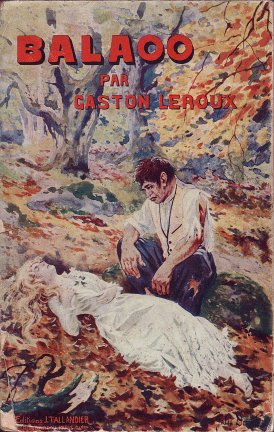 |
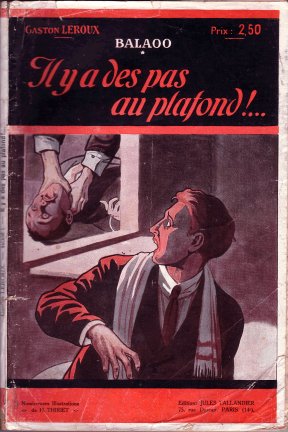 |
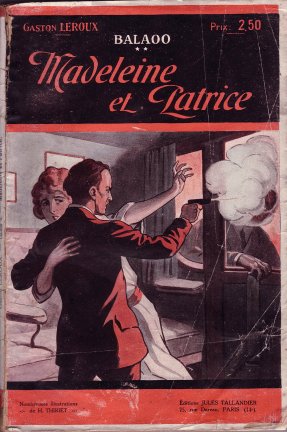 |
| Tallandier, 1st ed. | Tallandier 2nd ed. | |
| Book the First
The Panic-striken Village. |
|
| Chapter I. | The Murder at the "Black Sun" Inn |
| Chapter II. | Footprints on the Ceiling |
| Chapter III. | A Slap in the Street and a Kiss in the Storm |
| Chapter IV. | The Albino |
| Chapter V. | Two Shadows and a Conversation |
| Chapter VI. | The Whipseam |
| Chapter VII. | The Mystery of the Black Woods |
| Chapter VIII. | "Monsieur Noël, if you Please" |
Balaoo
BOOK THE FIRST
It was ten o'clock at night and it was hours since a living soul had appeared in the streets of Saint-Martin-des-Bois. Not a light showed in the windows, for the shutters were hermetically closed. The village lay as though deserted. The inhabitants had locked themselves in long before twilight; and nothing would induce them to unbolt their doors before dawn. Chapter I
One and all seemed to be asleep, when suddenly a great noise of galoshes and hob-nailed shoes sounded along the echoing pavements of the Rue Neuve. It was like the clatter of a hurrying crowd; and soon voices were heard, cries and shouts and discussions between people coming none knew whence. Not a door, not a shutter opened at the loud passing of this unexpected band; but more than one ear must have been slyly listening to the tumult out of doors, for the news of a fresh calamity soon spread from neighbour to neighbour.
And yet not one went to his doorstep to know exactly what was happening. It would be time enough to learn next morning. Everybody was still suffering under the shock produced by the murders of Lombard, the barber in the Cours National, and Camus, the tailor in the Rue Verte, which had followed upon a whole series of events at one time tragic, at another grimly comic and often impossible to explain.
People no longer dared linger an the roads, where well-to-do peasants returning from the big markets of Châteldon and Thiers had been attacked by masked highwaymen and obliged to part with all their money in order to save their lives. A number of burglaries marked by extraordinary boldness and perpetrated under the very noses of the victims, who did not dare protest, had formed the basis of police enquiries which were slackly conducted and led to no serious result. The public prosecutor's staff received very little information, was confronted on every side by affrighted silence and did not think it necessary to display more zeal in hunting down the malefactors than was shown by the sufferers themselves in assisting the authorities to perform a duty intended to restore the sense of public security.
Nevertheless, when nocturnal attacks, cases of arson and thefts of greater and lesser importance were followed by those two extraordinary murders of Camus and Lombard, the police were obliged to go to work more thoroughly. They threatened the more timid natures, with a view to forcing them to speak. But these would rather have had their tongues torn out by the roots! No doubt, the police knew by this time upon whom the suspicions of the whole district rested; but they had to give up all hope of receiving evidence tending to inculpate any one whomsoever. And this added strangely to the mystery of the later crimes. The worst of it was that, side by side with dreadful acts of violence, came jests, extravagant practical jokes, each as terrifying as an attempted murder. Respectable tradesmen, walking dawn the Rue Neuve at nightfall, had received a great slap in the face without being able to say where the blow came from. Mme. Toussaint, the old gossip who contracted for embroidery, was found lying in her back-yard, yelling at the top of her voice, with her clothes in over her head and her body showing the marks of a ruthless thrashing. No one knew who had entered the yard nor how. And there were minor incidents that smacked of witchcraft. Despite doors and locks, certain objects --- some light and unimportant and possessing no apparent value, others of considerable weight --- disappeared as though by magic. Good old Dr. Honorat opened his eyes, one morning, to find his chest of drawers and his pedestal cupboard gone from his bedroom. True, he slept with his window open. He did not inform the police, kept his fright to himself and merely mentioned the strange phenomenon to his friend M. Jules, the mayor, who advised him to shut his window in future when he went to bed.
Lastly, no one dared go through the forest, where more things happened than were ever told. Those who came back, after seeing these things, did not boast of it, but they never ventured in that direction again. It was what was called the Mystery of the Black Woods.
Really, these hardships ought to have been sufficient. What new terror was now making the poor people of the Cerdogne country run down the usually deserted thoroughfare of the Rue Neuve? The cause of all the fuss was an apparently commonplace thing, a railway accident. More correctly speaking, however, it was an attempt upon the lives of the passengers on the little local railway that connects the Belletable and Moulins lines, on the borders of the Bourbonnais.
Criminal hands had torn up the rails at the mouth of the tunnel which opens on the Cerdogne; and, if the train, which had to cross the river by a bridge that was under repair, had not, for that reason, reached the spot at a greatly reduced speed, the catastrophe could not have been avoided. As it was, the train had a narrow escape. The luggage-van alone was destroyed. As for the passengers, some twenty in number, they suffered more from excitement than anything else. And they fled across the fields to Saint-Martin-des-Bois, spreading consternation through the village, which had already locked and bolted its doors for the night.
With the exception of two or three who had their homes at Saint-Martin, all of them went to the Roubions, who keep the inn known as the Black Sun at the corner of the Place de la Mairie and the Rue Neuve. Here, confusion was at its height. While some called for rooms, or at least a bed or a mattress, others exchanged frenzied notes on the danger which they had run.
Fat Mme. Roubion tried to please everybody, but found the greatest difficulty in doing so. One paillasse was nearly torn to pieces. And, when everybody was at last more or less comfortably housed, yet another traveller appeared, with his head wrapped in a bandage. He was the only one injured.
"Why, M. Patrice! Are you hurt?" asked Mme. Roubion, solicitously, holding out her plump hand to the new-comer.
He was a young man of twenty-four or twenty-five, with a pleasant, gentle face, a pair of fine blue eyes and a little fair moustache carefully twisted at the tips.
"Oh, it's only a scratch!" he said. "Nothing serious: it won't show to-morrow . . . Have you a room for me?"
"A room, M. Patrice? . . . Yes, you can have the billiard-table!"
"I'll take the billiard-table," replied the young man, smiling.
Whereupon Mme. Roubion went to look after M. Gustave Blondel, a traveller for one of the big linen drapers of Clermont-Ferrand, who was making his bed on the table in the pantry and threatening to kill the landlady if she did not bring him a bolster then and there.
"I'm all right here, you see, my charmer, much better than on the billiard-table in the bar-room, where all those talkers would keep me from sleeping! What do they want to go on chattering like that for? What's the trouble with them? They know who did the business: why don't they say so?"
At the sound of these words, Mme. Roubion hastily vanished.
M. Sagnier, the chemist, had just entered the barroom. On hearing the news from the mayor, he had behaved like a hero, torn himself from the trembling arms of the beautiful Mme. Sagnier and come to offer his services. Finding no one in need of his aid, he immediately developed a very bad temper and mingled his aggressive remarks with those of the most irate of his hearers, declaring that, in the face of such outrages, it was no longer possible for a decent man to live at Saint-Martin-des-Bois or, for that matter, in any part of the Cerdogne country.
Meanwhile, M. Jules, the mayor, appeared, accompanied by good old Dr. Honorat. They came from the station, where they had received evidence from the lips of the railway-officials leaving no doubt whatever as to the nature of the outrage. They both looked as pale as if their own lives had been in danger.
"Another calamity, monsieur le maire!" said Roubion.
"Yes," replied M. Jules, in a shaking voice. "Fortunately, there have been no injuries for us to regret!"
The words were received in icy silence. And, suddenly, a voice exclaimed:
"And what about the murderers? When are they to be arrested?"
Then came an outburst. Words of applause and encouragement were flung at the speaker; but he --- a peasant --- had said what he had to say and remained silent. His face was crimson and his eyes avoided the mayor's.
"The police have been! If you know who the murderers are, Borel, why didn't you give up their names?" asked the mayor.
Old Borel was as clever as most people and had his answer ready:
"I've nothing to say to the police," he growled. "I'm no detective, nor no mayor neither. Everyone to his trade!"
That was what they all said: it was not their job. To the commissary of police, to the examining-magistrate, they invariably replied with the refrain:
"It's your business, not mine! . . . The government pays you to find out: see to it and earn your money!" with more gibes of the same sort.
They were still digesting old Borel's answer, when Gustave Blondel entered, pushing everybody aside. The commercial traveller sat down on the billiard-table, crossed his arms, looked the mayor straight in the face and said:
"What are you worrying about, monsieur le maire? What do you expect in a place where there are people whose name begins with the same syllable as vauriens?"
A murmur of assent and a few nasty chuckles followed, but the effect of Gustave Blondel's sally was interrupted by an unexpected incident. The chuckles suddenly ceased; and all now, nudging one another, stared at a new-comer who came forward while the others made way for him with astonishing unanimity.
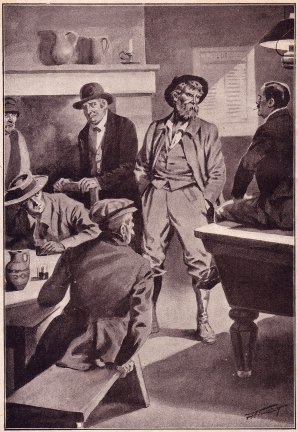
The man was dressed in a drab corduroy suit. Long leggings came up to his knees. His shirt-collar was loose and revealed a neck like a bull's. A soft hat, which had lost all semblance of colour, was thrust back on his head, showing a tangled mass of thick red hair. The face was extraordinarily powerful and calm. The green eyes contemplated those present with a cool, bored look. The man's limbs were short and thickset, the shoulders square, the back a little bent. He carried his hands in his pockets; and his whole person gave a striking impression of brute force, quiescent, but wide awake.
He walked across the room with his even step, amid death-like silence, until he was face to face with the commercial traveller, who watched him coming; and the man had certainly heard what Blondel had said to the mayor, for he barked at him, in his rough, dull voice, full of suppressed anger:
"Vautrins, vauriens! Is that what you mean, my beauty? You needn't mind me, you know: I'm not one to take offence!"
Vautrins, vauriens! Is that what you mean.
And he moved to the chimney-place, where the mayor was standing:"Good-evening, monsieur le maire."
"Good-evening, Hubert . . . "
And M. Jules had to press the hand held out to him.
The man sat down without ceremony beside the hearth, in which a fire of sticks had been lit, and called for "a glass of white," which Roubion hastened to bring him. He emptied the glass, wiped his mouth on his sleeve and, turning to Blondel, said:
"Monsieur le maire hasn't got over the last election yet! . . . Only, look you here, my beauty: it's all right to treat us like dirt at the meetings . . . but we ought to be left quiet now . . . What say you, monsieur le maire?"
M. Jules, feeling greatly embarrassed, gave an inarticulate grunt.
The commercial traveller had not stirred. He continued to fix an obstinate stare of dislike upon the red-haired, green-eyed man. Hubert rose and, offering Blondel his hand:
"Come," he said, "let's have no ill-feeling! Each does his best for his master: you for the King, I for the President of the Republic! If ever you want a billet . . . "
Blondel got down from the billiard-table leisurely, shrugged his shoulders, turned his back and went to the pantry.
"Monsieur le maire," said Hubert, in a hollow voice, "I call you to witness: that's how they treat good republicans in this place. But I'll pay him out for it at the next election, never fear! . . . I mark it all down on my little slips of paper, though I don't know how to write . . . Hear that, you others, who seemed to be enjoying yourselves, just now."
As he spoke, he cast his cold, metallic glance over all his hearers. In the depth of their being, they felt as uncomfortable as if they were before a magistrate.
His coolness in enlisting the mayor on his side with a word, as though, after the forced intimacy of the election, the mayor had necessarily become his accomplice and his friend, brought the beads of perspiration to M. Jules' bald forehead.
The man flung four sous on the table and walked back to the door with his calm gait. On the threshold, he stopped and turned:
"I'm going back to my brothers," he said. "By the way, I've been to the tunnel and seen the damage. The man's a damned blackguard who did that job. I shall tell Élie and Siméon as much, presently. What I say is, we shall have to find the beggar who plays us these tricks, or life won't be worth living for decent men."
And he disappeared under the black cavity of the archway.
The room at once emptied, as though the man's departure had restored everybody's liberty of movement; and they all took advantage of it to escape from a place where the visit might be repeated at any time.
Roubion and his wife, assisted by the servants, carefully locked the doors of the bar-room: the door into the archway and the door opening straight on the street.
No one remained in the room except young Patrice, to whom the landlord and his wife had said good-night. Nevertheless, though he was alone with his billiard-table, he heard a noise close beside him. He perceived that some one was undressing in the pantry. The door between the two rooms was closed, but a communication remained in the form of the little open window of the serving-hatch. And he at once recognized the voice of the commercial traveller, who, stooping to the opening, said:
"Good-night, M. Patrice. If you want anything, you can call to me through here . . . This is rather like a confessional-box, isn't it?"
These details were destined to be impressed on Patrice' mind for all time, though he did not suspect their importance at the moment. He answered Blondel politely and hoisted himself on to the mattress which had been laid over the billiard-table. When they were both lying down, they began to talk:
"Why didn't you go to your uncle's for a bed?" asked Blondel.
"I knocked at the door and called out. They were all asleep, I suppose, and I didn't like to wake them."
"Is Mlle. Madeleine well?"
"Thank you, I hope so."
"When is the wedding to be?"
"You had better ask my uncle."
Blondel saw that he had been indiscreet. He changed the subject; and they now started discussing the outrage and the recent murders, which the commercial traveller flatly put down to the score of the brothers Vautrin.
"Oh," said Patrice, "at Clermont-Ferrand, we think --- just as they do here --- that you can't explain everything with the Three Brothers."
"You can explain everything with the Three Brothers and the sister," said the commercial traveller.
"The incredible part of it is," Patrice insisted, "that no trace of the murderers was discovered in either Camus' or Lombard's case."
"Possibly," replied the other, "but one thing is certain, that, if Camus and Lombard had not opened the door on the night of their murder, when they heard the sound of moans in the street and the voice of that little savage of a Zoé . . . they would be alive now. It was the sister who lured them on . . . "
At that moment, the two men ceased talking, as though by a sudden accord. And each of them sat up in bed, pricking up his ears. Moans came from the street.
"Do you hear?" asked Blondel, in a husky voice.
Patrice had not even the strength to reply. He heard the commercial traveller get up, jump to the tiled floor of the pantry and enter the bar-room with every precaution.
"One would think they were murdering somebody outside the door!" said Blondel.
Patrice, whose occupation was that of first clerk to his father, a solicitor in the Rue de l'Écu at Clermont-Ferrand, had always been more or less timid by nature. He shuddered as he slipped down from his billiard-table. With a choking throat and a moist forehead, he admired the courage of Blondel, who walked up to the door of the bar-room that opened on the street whence the moans had come.
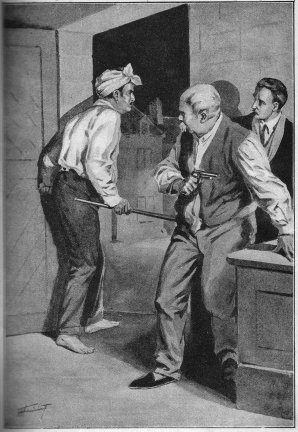
The traveller had pulled on his trousers, but kept his handkerchief knotted round his head by way of a night-cap. The great, fat fellow, with his bare feet, his night-shirt hanging loose round his waist and the two corners of his handkerchief sticking out above his forehead like horns, looked the picture of absurdity; yet Patrice did not think of laughing.
The moans had ceased abruptly. Blondel and Patrice looked at each other in silence, by the dismal light of a lamp over the billiard-table, the wick of which had been turned down. All the mysterious tragedy of which Camus and Lombard had been the victims passed before their eyes. The thing had, begun like that, with moans, in the case of both the unfortunate men.
And suddenly they turned their heads. The door of the staircase leading to the upper floor opened; and Roubion appeared, carrying a revolver in his hand:
"Did you hear?" he asked, in a whisper.
"Yes."
Roubion was a fine, big chap, built, like his wife, on huge lines. He was trembling like a leaf. All three remained for moment behind the street-door, listening to the silence of the village night, which nothing more disturbed.
"Perhaps we were mistaken!" said Roubion, with a sigh, after a good deal of hesitation.
Blondel, who had recovered all his composure, shook his head, by way of denial:
"We shall see about that!" he said.
"What!" protested the innkeeper. "You're not going to open the door, surely?"
Blondel did not answer and went and stirred the fire, which gave a little glow. It was a cold night, although summer was not far off. Soon, all three were sitting round the chimney, where Roubion warmed them some wine in a sauce-pan.
"All the same," said the commercial traveller, "if we could manage to catch the scoundrels here and now, it's a stroke of business that would be worth doing!"
"Hold your tongue, Blondel!" said Roubion, peremptorily. "Don't meddle with that . . . it would bring you bad luck!"
"Certainly," said Patrice, "it's none of our business."
"Remember Camus and Lombard! . . . If they had not opened their doors! . . . "
Blondel, who was on the road at the time of the two murders, asked for details.
Roubion went back to the door, listened and, hearing nothing, returned more or less tranquillized:
"This is exactly what happened," he explained. "Lombard and his old aunt had gone to bed after bolting all their doors and windows, as we now do every evening at Saint-Martin. Lombard's bedroom and his aunt's were both on the ground-floor. The barber was sound asleep, when he was awakened by the old lady standing at the foot of his bed and whispering to him to listen to what was going on. Lombard listened. Some one was wailing and lamenting in the street. It sounded like dying moans mixed with little plaintive cries. Lombard got up, lit his candle and took his revolver from the drawer of the table by his bedside. You know how careful we are at Saint-Martin; and we are right to be, unfortunately. The aunt whispered to Lombard, 'Whatever you do, for God's sake, don't open the door!' Lombard, without opening the door as yet, decided to speak: 'Who's there?' he asked. 'Who's that crying?' A voice answered, 'It's me, Zoé. Pity in the man's house!' "
"What does that mean: 'Pity in the man's house'?" asked Blondel, interrupting him.
"Oh, it's one of Zoé's expressions. The chit lives like an animal, either in her brothers' den or in the forest; and, as her brothers always talk slang among themselves, the result is that she speaks a language different from that of other people."
"So, you see, it was she," said Blondel. "There's no mistake about it."
"Wait! . . . It was only half-past ten. In spite of all that his aunt could say, Lombard opened the door. He looked out into the street. It was a bright night. He saw nothing and was very much astonished. The moans had stopped. Fearing a trap, he was careful to keep on the threshold, called Zoé, received no reply, closed his door again very cautiously and went back to bed, saying, 'It's another hoax. There's no sleeping in peace, these days, at Saint-Martin-des-Bois!' The aunt also went back to bed, but, after this disturbance, did not sleep. She lay awake all night."
"Oh," said Patrice, "she must have gone to sleep, or she would have heard!"
"She swears she never closed her eyes. And the door between their two rooms was left wide open. In the morning, she got up as usual and went to open Lombard's shutters. When she turned round, she was greatly surprised not to see him in the recess where the bed stands. The bed-clothes were flung back as if Lombard had just got up. Not knowing what to think, she opened the door leading to the hairdresser's shop and gave a terrible yell: the poor barber's body was swinging in the middle of the shop, hanging from the brass lyre that serves as a chandelier. They thought at first that it was suicide; but Dr. Honorat and the divisional surgeon agreed that the hanging had been preceded by a terrible strangling and all so suddenly that the unfortunate man had no time to say, 'Oh!' or the old woman would have heard. What seemed the great mystery from the very first was how the body could have been carried into the shop and hanged . . . It was found that there was not a trace of footsteps in the shop, which had been freshly sanded on the evening before. Lastly, a fact which proved from the start that Lombard had not hanged himself was that there was no chair or stool lying on the floor beside him."
"Ah, well!" said Blondel, jerking his head. "Men are tired of life have more than one trick in their bag! . . . What about Camus?"
"The same story. He too heard moans in the middle of the night and recognized Zoé's voice. Camus was a friend of Lombard's: they were the only two lame men in the parish; and this had brought them together. He thought it a good opportunity to discover the barber's murderer and avenge his death. He took a weapon, opened the door and, like the other, saw nothing and heard nothing more. But, when he had shut his door, he did not go to bed. He wisely lit all the lamps in his shop and, with his revolver by his side, sat down by his till and started doing his accounts. He then told his little assistant, the young lad whom you know, to go upstairs to bed. Well, the next morning, the assistant, on returning to the shop, uttered a piercing cry. His master was hanging from the iron bar from the ceiling that holds the yard-measure with which he used to measure the cloth for his customers. The revolver was lying on the till. The till had not been touched. Camus' throat showed the same marks of strangling which were found on Lombard. And, in the tailor's shop, as in the barber's, it was impossible to discover any marks of steps, any footprint allowing a plausible explanation of the method of the crime. People said and people are still saying, 'The Vautrins! The Vautrins!' Well, the Vautrins themselves took little Zoé to the examining-magistrate; and she had no difficulty in proving that she was far from the spot of the murder at the time when it was committed and that somebody must have imitated her voice."
"And where was she?" asked Blondel.
"She was helping monsieur le maire's servant to wash up her plates and dishes. There was a big dinner at M. Jules' that night."
"There's a fine alibi for you!" sneered the commercial traveller.
"M. Blondel, you are blinded by politics!"
And Roubion poured them out some more hot wine.
"And the Vautrins? Were they examined?"
The magistrate wanted to question them. Their answer was that little Zoé had spoken for all the family and that they were not going to have any dealings with the police at their time of life. Then they sent M. de Meyrentin, the examining-magistrate, an extract from their judicial record, which in fact is absolutely blank, and with it they enclosed a request that he would just kindly leave them alone!"
"What cheek!" exclaimed Blondel.
"Listen!" said Patrice.
The moans had begun again.
The three men all stood up. Patrice tottered on his legs and nearly dropped when he distinctly, most distinctly, heard the fatal phrase:
"It's me, it's Zoé. Pity in the man's house!"
Roubion, with his hand clutching his revolver; turned as white as a sheet. Blondel said, in a whisper:
"That's Zoé's voice, there's no mistake about it. I know it."
And he slipped behind the door.
The moans had come nearer still. It was as though the three men heard them in their ears, as though somebody quite close, quite close, had whispered the moans to them. They heard the sound of oppressed breathing and the strange phrase of despair:
"Pity! Pity in the man's house!"
Blondel sprang round and ran to the wall-rack. He seized a cue by the narrow end.
"Oh no!... Don't open the door! Don't open the door!" stammered the innkeeper. "It's the Lombard and Camus trick! . . . That's how they were murdered! .. . Don't open the door, or we're done for! . . . "
He rattled out his words and trembled so violently in his fright that he disgusted Blondel, who growled:
Oh, are you all cowards in these parts? It's one of two things: either they're murdering the child, or else they're getting at us! . . . Or it may be," he added, feverishly wiping the streaming perspiration from his forehead with his shirt-sleeves, "it may be Hubert coming to take his revenge . . . But there are three of us, what!& . . . And you have your revolver, Roubion!"
"Don't open! Don't open!" said Roubion again.
It was now as though Zoé were sobbing outside the door, or as though she were on the point of death.
"But we must find out what it is!" protested Blondel, still wielding his billiard-cue.
Then he asked, in a powerful voice:
"Who's there? Who's crying'?.. Is it you Zoé? . . . "
There was no reply but a hoarse groan.
Suddenly he drew back the bolt and turned the key of the door.
"Where are the ruffians?" he growled, putting his head outside.
"Where are the ruffians?" he growled . . . "
At last, he took up his stand on the threshold, with his billiard-cue in his hand.
This corner of the Rue Neuve was well lit by the light of the street-lamp at the corner of the Place de la Mairie. Nevertheless, Blondel distinguished nothing; and the moans had ceased. He beckoned Patrice and Roubion, who joined him, mastering the unendurable anguish of which they were now ashamed.
As a matter of fact, they felt angry with themselves for being such cowards. As Blondel had said, there were three of them, not to mention that the inn was full of visitors who would hasten at the first call; at least, it was to be hoped they would!
"Do you see anything?" asked the commercial traveller. "I can see nothing."
"No, nothing! . . . There is nothing! . . . There's nothing to see!"
"Here, wait a second till I go to the corner of the lane . . . over there . . . "
"M. Blondel, you mustn't! . . . You mustn't! . . . "
But, by this time, the other was in the street. He made no noise, walking barefoot on the cobbles, and thus slipped to the corner of the lane on the left, where he looked and listened, without venturing down it . . . The he came back and went off to the right, as far as the Place de la Mairie.
The light of the gas-jet flung the huge shadow of Blondel, still armed with his billiard-cue, upon the opposite wall. A silence that was incomprehensible, after those recent moans, hung over the village; and this seemed to Patrice more terrifying than the moans themselves. The moans must have been heard in the neighbouring houses: opposite at the Bouteillers'; next door, at Mme. Godefroy the postmistress'; but nothing had stirred on either side. The fear that reigned supreme at Saint-Martin-des-Bois allowed no doors to be opened to the voices of the night . . . And the moon might cast the dancing shadows of the three Brothers in the streets, or send sprawling the less formidable, but equally mysterious, shapes of lifeless things --- such as the shapes of the chimney-pots, for instance, which are more terrifying than any, with their caps upon their heads --- but people were not inquisitive enough to look at them at night! . . . No, no, there was nothing inquisitive about the people of Saint-Martin-des-Bois! . . .
The three men closed the inn-door just as Mme. Roubion, "feeling more dead than alive," joined them. She too had heard noises, but would never have thought that Roubion could have the imprudence to allow the door to be opened. And she dragged him away, pushed him up the staircase, beating him as she went and carrying with her the key of the street-door, to make sure that they did not open it again.
When Blondel no longer heard them, he turned to Patrice, who did not know what to say or do:
"You're too impressionable, my lad," he said, "you'll never get to sleep in here. I only laugh at this kind thing you see. One discovers all sorts of coincidences, once things are over; and the Vautrins are capable of anything: I saw the way they went to work at the last elections! The point is to know them. If they want to deal with me, let them come! I'll sleep behind the door, in your place, on the billiard-table. I'll wait for them."
Patrice, looking a little shamefaced, replied:
"Perhaps we had better not go to sleep at all!"
But the other had already caught up Patrice' blankets and was carrying them to the pantry. And he returned with his own things and threw them on the billiard table.
Patrice let him have his way and was not at all sorry to move farther from the street and from that door against which he still, at moments, seemed to hear a rustling.
They drank one last bowl of steaming wine, shook hands and wished each other good-night. Patrice tried to make some excuse for himself, could not find his words, was afraid of appearing a coward. The other pushed him along:
"Go on, my lad, go on!"
Then Blondel climbed on to the billiard-table, muttering:
"That's how boys are brought up nowadays; their parents make school-misses of them!"
When his head was on the pillow, he lit a cigarette and sent the smoke up to the ceiling.
Patrice could see him clearly through the little open door of the serving-hatch. The solicitor's clerk, on his mattress on the pantry-table, was lying with his head on the same level as the head of Blondel, on the billiard-table. And, suddenly, what Patrice saw through the little square of the hatch filled him with a horror so great that every hair on his head stood on end.
He continued merely to see Blondel's face; but what a face! Never was hideous terror printed on human countenance in features more atrociously distorted. With his eyes starting from their sockets, with his mouth open, but incapable of emitting a sound, with his whole face dreadfully convulsed, Blondel was staring fixedly at the ceiling.
Patrice could not see what Blondel saw; and, awed as he was, his terror was but the reflection of the other's terror.
Patrice tried to make a movement to rise . . . Yes, he had the strength and also the pluck, for he needed pluck to move; and something abominable must be happening on the ceiling of the other room; and the sense of his own safety was ordering him not to stir a limb . . .
Was the movement which he made perceived? . . . Were they trying to kill him with fright too? . . . For, from the ceiling of the other room, he heard a hoarse and formidable voice utter his name. . . yes. . . yes. . . his name. . . Patrice! . . . And that certainly was a frightful command, a threat that nailed him to his place!
This time, he stirred no more; and, with eyes full of horror he continued to gaze at the little square of the serving-hatch that framed the terror-stricken and apparently hypnotized face of Blondel . . .
And, all at once, the young man saw, in that little square. . . saw coming down from the ceiling, which he could not see. . . saw two clutching hands under two shirt-cuffs, which made two very clear white patches in the half light . . . saw two terrible arms which fell upon Blondel, which clutched him by the throat and which rose to the ceiling holding that throat captive.
And Blondel had not even said, "Oh!" Already his head was falling back, his head of which Patrice was never more to forget the eyes, starting, jutting, enormous, as though ready to slide from the sheath of their reversed lids.
Lifted by the murderous hands, the head and then the whole upper part of the body disappeared from the frame of the serving-hatch; and next came the legs, which left the billiard-table and rose, hanging side by side, towards the ceiling! . . .
Oh, horror! . . . Oh, horror! . . . Oh, to cry out! . . . To cry out! . . . Patrice can't. . . he can't. . . because he is too much afraid! . . . Yes. . . he's a coward. . . he's a coward! . . . Ah, to move. . . to run. . . to fly! . . . Patrice' legs are of lead, of lead! . . . Ah, he succeeds in stretching one of them out of bed. . . one alone, noiselessly. . . But what can he do with only one leg out of bed? . . . And he feels that he will never have the strength to put the other out. . . If he could only put the other out. . . and run away, run away on his legs of lead! . . . But, once more, in a hoarse whisper, over there, from the ceiling, comes a monstrous chuckle in which he distinctly hears his name:
"Patrice!"
The other leg has that moment come; and there he now stands, with his feet on the floor, on the tiled floor, but his back glued to his mattress. . . Yes, his name uttered up there, from the ceiling, has glued him irremediably against the improvised bed . . .
Why has his name been uttered? . . .
The man on the ceiling evidently knows, evidently, absolutely knows that he, Patrice, is there, since he calls him by his name and, very charitably, warns him not to move . . .
Thereupon, he does not move. . . He obeys . . .
And suddenly the breath ceases. . . the enormous breathing from the ceiling! . . . And he hears it no longer . . . he hears it no longer! . . .
And he no longer sees anything above the billiard table, through the little window of the serving-hatch . . .
Yes! Yes! . . . He does see something. He sees something coming back, coming a little lower: Blondel's two feet, which swing. . . and swing. . . and swing. . . and then, gradually, cease their swinging. . . and at last remain motionless, toes downwards . . .
There is nothing now in the bar-room of the Black Sun but a profound silence, those two motionless feet above the billiard-table and, in the pantry, Patrice Saint-Aubin, who has fallen into a dead faint . . .
And perhaps also the murderer.
For if he entered when the door was opened, he must needs now go out.
They are early risers in the village. That morning, the inhabitants of Saint-Martin-des-Bois put their noses out of their windows even earlier than usual. They were eager to know the exact reason of the disturbance during the night. They soon heard about the outrage at the Cerdogne Bridge and were already asking one another for details from door to door, when they saw big Roubion running like mad towards the Cours National. They tried in vain to stop and question him. Then they followed him to monsieur le maire's door, where he rang with all his might. M. Jules, still more than half asleep, came to the window. He saw Roubion standing utterly distraught and went down to let him in. Three minutes later, they both came out again and M. Jules looked as terribly flustered as big Roubion himself. They walked with great strides towards the Black Sun, without answering anybody who spoke to them. Ten or twelve persons came after them, recruiting others as they went along. But all had to wait outside the door of the inn, while the mayor and Roubion entered by the great archway. Chapter II
Almost at the same time, good old Dr. Honorat appeared upon the scene, having been fetched by an ostler from the Black Sun. Dr. Honorat went into the inn, but the ostler remained with the crowd and told them what had happened. That was how Saint-Martin-des-Bois learnt that Blondel, the commercial traveller, had been found hanged, like Lombard and Camus. And soon the whole village was standing in front of the inn, filling the Rue Neuve from one side to the other.
To avoid this crowd, which was kept outside the barroom door by the crier --- nicknamed Daddy Drum --- the visitors who were in a hurry to leave the inn and the village went out at the back, by the side of the Parish School; and this also was the means of exit adopted by the mayor and Roubion, who, three-quarters of an hour later, left by a roundabout road for the station, where they were to meet M. Herment de Meyrentin, the examining magistrate of Belle-Étable.
M. de Meyrentin, who had been informed during the night of the fresh outrage on the line between Saint-Martin and Moulins, was expected by the half-past six train. No trains would run beyond Saint-Martin until after the line had been repaired.
While waiting for the magistrate's arrival, the mayor and Roubion walked up and down the platform, with their heads sunk on their chests, their hands behind their backs, exchanging their thoughts in a low voice as though they feared that they might be spied upon and overheard. They were speaking of the Vautrins.
M. Jules admitted that the Three Brothers were not a credit to the district and that they might be held responsible for a good many minor misdeeds, but he maintained that they were incapable of murder. Big Roubion had a curious way of replying, in a hollow voice, "Mind what you're saying!. . . Mind what you're saying!" which gave the impression that he knew more than he could tell. This time, he abandoned his customary prudence. Had Mme. Roubion been there, she would have pinched his arm for him.
The mayor, nodding his head, contented himself with saying that those horrible crimes were becoming more difficult to explain. Lombard and Camus had never injured anybody. They had no enemies. They were on neither good terms nor bad with the Three Brothers. Lombard used to shave them for nothing, once a year; and Camus, with whom they had a small account, had never sent in his bill.
"May be!" said Roubion, after casting a glance round him. "But the Three Brothers were on very bad terms with poor Blondel!"
"Oh, politics!" growled the mayor.
"Well, believe me, monsieur le maire, you will see that you made a great mistake in bringing them into' your politics . . . "
"They brought themselves in without me," replied M. Jules, greatly incensed.
Meanwhile, Dr. Honorat arrived and joined them; telling them that he had sent Patrice, whose condition no longer gave cause for anxiety, to his uncle, old Coriolis Saint-Aubin. Patrice had remained as though stupefied and had merely shaken his head in reply to the questions put to him.
Blondel's body had been laid on the billiard-table; they were careful not to touch it more than could be helped. The doctor had refused to take any observations before the arrival of the magistrate. He had ordered rest for Patrice. Besides, it was the magistrate's business to question him; and nobody else's.
"'You did quite right," M. Jules agreed. "And then, from what I could gather out of his monosyllables and gestures, he did not see the murderer."
"Whether he recognized the murderers or not," said good old Dr. Bonarat, "I hope that, after what took place last night between Blondel and Hubert, they will not be spared . . . "
"The magistrate will please himself," retorted M. Jules, who was becoming more and more tetchy.
"The magistrate is in the hands of the deputy. You will see, they'll want to 'give them another chance' again!" moaned Honorat.
"Oh, but look here, my dear doctor, if you know anything, say so! Don't behave like the peasants! . . . "
"I have every reason to be at least as careful as they are. I am often on the roads at midnight, all by myself, in my gig, and am more exposed than anybody to the wicked attempts of wicked fellows."
Nevertheless, he could not refrain from saying that he had more than once come upon the Vautrins in suspicious circumstances, hiding themselves in order to drag to the Black Woods a cart covered with branches and containing "what they had chosen to put there!"
The mayor snarled:
You ought to have looked; it might have been your chest of drawers."
Honorat grabbed the mayor's hand:
"Come, come, M. Jules! ...You know as well as I do that they are the only people capable of such acts!. . . "
The mayor stopped both Honarat and Roubion and, taking each by a button of his overcoat:
"I tell you once more that I know nothing about it; and I do know nothing about it . . . You're beginning to annoy me! . . . One thing which you may as well know is that we have discovered marks that cannot have been made by the Three Brothers! . . . "
"Which are those?"
"The marks on the neck, to begin with . . . "
"Oh, tut!" growled Honorat. "You're trying to humbug me now. I've seen those marks on the neck myself . . . "
"You've seen nothing! . . . "
"What's that?"
"Oh, the magistrate is sure to speak to you about it to-day and Roubion can be trusted not to talk! I'm sick and tired of having 'The Vautrins! The Vautrins!' hurled at my head . . . No, doctor, you have seen nothing! . . . "
"But I was the first to examine the necks of Lombard and Camus."
The mayor interrupted him:
"If I may say so without offending you, if you had taken as long to examine them as the medical expert who was appointed afterwards, you would have perceived that the terrible marks of strangulation were made upside down!"
"What? Upside down?"
"It is so incredible," continued M. Jules, "that I am not surprised that you did not observe it. You saw the prints of the fingers and that was enough for you: 'Murder,' said you, 'strangulation.' How could you be expected to observe that the print of the thumb was at the bottom and that of the other fingers at the top? To do that, you would have to imagine that the crime was committed by a murderer working with his head downwards!"
The doctor and Roubion looked at the mayor as though he had suddenly gone mad. Honorat ended by shrugging his shoulders:
"If I did not make those observations, it must have been because I considered them superfluous. Strangulation with the fingers was a certainty. But it's true that I should never have imagined the crime to be committed by a murderer with his head downwards: it was easier and simpler to picture the murderer coming up from behind and dragging his victim's head down backwards."
"The enquiry has shown that position to be impossible," said M. Jules, roughly.
"Then what?" asked Roubion, timidly.
"Then don't come bothering me with the Three Brothers! Did you ever see them walk head downwards?"
Roubion and the doctor once more exchanged glances.
"Ah, but look here!" exclaimed good old Dr. Honorat, folding his arms. "What's your examining-magistrate after? And what does he think?"
"You had better ask him!" replied the mayor, as the train entered the station.
The first person to alight was M. Herment de Meyrentin. He jumped out on his short legs and seemed to come rolling towards the authorities waiting for him. He was as round as a top. He had a good-natured, genial face, brightened by a little turn-up nose and also by the sense of his high responsibility in all this criminal business at Saint-Martin-des-Bois. Behind him came his clerk, a tall, gawky, elderly man, dressed in a huge frock-coat, in which he limped along with difficulty.
The mayor, Roubion and the doctor made a rush for the magistrate, who spun round two or three times on his own axis before stopping. He did not give them time to say a word. He seized hold of the mayor:
"I say, M. Jules, you never told me that! It seems that, some years ago, all the dogs in your district were found hanged! . . . "
"Yes, monsieur le juge, but allow me . . . "
"Is it true? Yes or no?"
"We have serious news . . . "
"There is nothing more serious than that! . . . Is it true or not?"
"It is quite true . . . "
"And nobody ever knew how?"
"No, monsieur le juge."
"For, after all, those dogs did not hang themselves of their own accord!"
"No, monsieur le juge . . . Monsieur le juge, there has been a fresh murder! . . . "
"Eh? . . . "
"Yes, Blondel, the commercial traveller from Clermont-Ferrand, was found hanged last night, at Roubion's . . . "
The magistrate looked at them:
"The devil!" he said; and he began to spin round again. "Come!"
They followed him. All of them climbed into the omnibus of the Black Sun, which contained no other passengers. Here, before anything else, M. Herment de Meyrentin handed M. Jules a sheet of letter-paper and said:
"Read that aloud."
M. Jules read it. It was a last word from the divisional surgeon, who said:
"The wounds on the throats of Lombard and Camus look as if they had been made by some one walking upside down." And the note ended:
"Imagine the murderer coming towards his victim, not walking on the floor, but walking on the ceiling; and you will have those wounds."
"There! What did I tell you the other day? I didn't invent it, you see!" said M. Herment de Meyrentin, taking back his note with a little movement of pride.
M. Jules gave a sigh. The doctor and Roubion lowered their eyes, dumbfoundered, flabbergasted. The magistrate's clerk scratched the tip of his long, aggressive nose.
Five minutes later, all four entered the bar-room of the inn. The window-shutters were still closed; and the sound of an impatient crowd penetrated from the outside.
The two billiard-lamps had been lit. The first thing that M. de Meyrentin saw, on entering, was, lying on the billiard-table, the lifeless body of Gustave Blondel, the linen-draper's traveller from Clermont-Ferrand and one of the political agents of M. le Comte de Montancel, whom he knew well. He leant over the corpse.
M. de Meyrentin at once observed on the poor fellow's throat the terrible prints, the marks of "upside-down strangulation," of which Lombard and Camus had died.
He drew himself up, settled his double eye-glass on his little turn-up nose and looked up in the air.
What was he looking at? Every eye had followed the direction taken by his.
But there was nothing to be distinguished above the shaded lamps.
"Open the windows," ordered M. Herment de Meyrentin.
Roubion and the servants hastened to obey the instruction. The shutters were flung back. The daylight streamed in and a hundred heads pushed against the windows and the door to see. At first, there was nothing but cries of pity for the fate of Blondel, whose body the people saw covered with a sheet.
And then they noticed that the magistrate was looking up in the air. They did likewise. And everyone saw what M. de Meyrentin saw, as, with outstretched arms and open mouth, he continued to stare at the ceiling.
There was but one cry:
"Footprints on the ceiling!"
Yes, fully-outlined footprints showed on the white plaster of the ceiling. The feet went to and fro, returned to the point whence they started and went back to the metal stem supporting the billiard-lamps from which the unfortunate commercial traveller had been found hanging! Chapter III
The noises and cries were almost immediately succeeded by a stupefied silence. And then a few comments arose from the crowd peering through the windows, while M. de Meyrentin stood without moving and contemplated that trail, which was surely the strangest trail in the world.
"D'you mean to say the murderers walked like flies?" said one.
"As they never left any marks on the ground, they must walk somewhere!" said Mother Toussaint, that old gossip who was always the first to arrive when there was anything on hand.
"The footsteps are quite plain . . . that's because it was raining yesterday," said old Fajot, who always wanted to be cleverer than anybody else.
But some one remarked:
"Faith, that's a fine joke to play on the police!"
And at once there were spiteful, hostile laughs. It was obvious that the business of the footprints on the ceiling was assuming the appearance of a gruesome jest, almost an insult to M. de Meyrentin. And prudent allusions were made to "the others":
"Ah 'they' know their way about! 'They' know their way about! . . . "
"Seems Blondel told them what he thought of them, yesterday."
"He won't tell them so to-day . . . It's best to mind one's business . . . "
And they called out to the magistrate, who was still looking in the air, as they might to a dog:
"Go find! Go find!"
"Silence, all of you!" ordered Daddy Drum, in his voice husky with liquor.
At a sign from the magistrate, Daddy Drum closed the windows.
Then they shifted Blondel's body a little to one side and M. de Meyrentin climbed up on the billiard-table and made a careful and prolonged examination of the footprints on the ceiling. It was a long foot with a large heel and a well-developed great toe. These details were visible although the feet had been placed there not quite bare, but clad in socks. The man who had walked on the ceiling had taken the precaution to take off his shoes, so as not to make a noise; and he had certainly removed them before entering the house, for the footprints on the ceiling were still quite wet with the black mould in which he must have walked outside. Here and there, the socks showed the cross-work of the coarse wool and the darns. M. de Meyrentin pointed these out to M. Jules. The mending, instead of being correctly done, displayed a rough and very peculiar "whipseam," a sort of round patch, the size and shape of a five-franc piece, joined on to the heel and "whipped" anyhow, all round.
"Joke or no joke," said M. de Meyrentin, "with a clue like that for us to go upon, the man who played the joke will pay for it with his head!"
And he jumped down to the floor and spun upon his own axis several times to express his satisfaction.
"Gentlemen," he announced, in the most serious tone, "we must look for the man who walks upside down!"
"How does he manage when he takes a drink?" asked Michel, the driver of the Black Woods diligence, in an undertone.
Michel had just arrived and was poking his cap cautiously through the pantry-door. Fortunately, the magistrate did not hear him. He was asking Roubion if he knew of any black mould anywhere around the inn. Roubion took him to the back of the building; and there they were able to trace distinctly, in the middle of the lane, the same marks of footsteps which they had seen on the ceiling. The marks stopped suddenly, between two high walls without doors or windows. It was impossible to understand how those marks were not to be found anywhere else.
"The joke continues!" chuckled M. de Meyrentin, with a knowing little air. "And now let's go to M. Saint-Aubin."
The others had already given M. de Meyrentin a detailed account of how they had found Patrice in a faint in the pantry, though it was understood that he was to sleep on the billiard-table. This sort of transposition of bodies seemed to interest the examining magistrate greatly.
Patrice's uncle, M. Coriolis Boussac Saint-Aubin, owned the largest and oldest estate in that part of the country. It was also the most sequestered, standing at the end of the village, almost on the edge of the woods.
Roubion and the mayor took leave of M. de Meyrentin when he raised Coriolis' knocker. Old Gertrude came and opened the door. She said that M. Patrice was "resting." The good woman seemed quite upset. The doctor said a word to reassure her.
Then Coriolis appeared upon the scene, in the devil's own temper, shaking his long white locks, hardly civil to the magistrate, complaining at being bothered with all this business and bitterly regretting that his nephew had come to disturb him at Saint-Martin without his permission.
"I want to see your nephew, at once, please!" said M. de Meyrentin, incensed at this reception.
"He's asleep."
"Wake him up."
Thee uncle turned his back on him. But a young girl with a sweet, engaging face and eyes still red with weeping intervened:
"Come with me, monsieur le juge . . . "
When they entered the bedroom, they found Patrice tossing in a feverish sleep, waving his arm as though to ward off some frightful vision and uttering incoherent words. They arrived just in time to hear him cry:
"Pity in the man's house! Pity in the man's house! Why did you call me: 'Patrice!'"
M. de Meyrentin could not help giving a start.
The doctor said:
It will be better to wake him and let his mind recover its balance. Dreams like that can only do him harm."
M. de Meyrentin made a sign to the doctor to hush and once more listened to the sleeping witness. But Patrice now uttered none but unintelligible sounds.
The magistrate turned to Coriolis:
"You were not expecting your nephew?" he asked.
"He pretends that he sent me a telegram during the day. I did not receive it. That explains why nobody opened the door when he knocked last night."
"M. Bombarda," said M. de Meyrentin, to his clerk, "go and ask Mme. Godefroy, the postmistress, if she received a telegram for M. Boussac Saint-Aubin."
The clerk limped off in his long frock-coat.
And Patrice woke up.
M. de Meyrentin welcomed this awakening eagerly. At last, perhaps, they would know, know what the thing was that walked on the ceiling, with hands that strangled!
The first thing that the young man saw, on opening his eyes, was the sweet face of Madeleine.
Like himself, she was fair, with blue eyes. They had loved each other for many years, ever since the time when, quite young, they used to meet, during the holidays, at the house of Patrice' father in the Rue de l'Écu at Clermont-Ferrand; for Coriolis' daughter had been brought up in France while her father was doing business at the other end of the world, at Batavia, where he was French consul. Patrice was sorry when Uncle Coriolis returned from the Far East and retired to his estate at Saint-Martin-des-Bois, where he led the life of a bear. The uncle did not care for his nephew's visits and had told him as much. He accepted the engagement in principle and had spoken a word or two about it to old Saint-Aubin of Clermont; but, meantime, he insisted that they were not to "bother him."
Patrice was still looking at Madeleine, in fond admiration, when Dr. Honorat spoke, to introduce the magistrate to the young man. Then he recommended Patrice to be calm and, above all, to recover possession of his wits. In short, the time had come for him to act with courage and not to be afraid to tell the police all that he had seen and heard. The safety of the whole district depended on him.
The examining-magistrate was marking his approval of these last words by nodding his head, when the long, black, limping clerk returned from his errand. He was in a great state of fury. His raised fists threatened no one knew whom; and he spoke so fast that his hearers did not understand a word of what he was saying. They seemed to gather that he had received a slap!
"A slap?" asked M. de Meyrentin, astounded.
"Yes, a slap in the face!"
And the magistrate's clerk cut so queer a figure as he spoke that Mlle. Madeleine could not restrain a smile, while old Gertrude burst out laughing.
"There's nothing to laugh at!" declared the clerk, angrily. "A regular slap in the face! To me! But it won't end there, I can tell you!"
"Come, come, M. Bombarda, first tell us how it happened."
M. Bombarda rubbed his cheek, gave Gertrude a fierce look and said:
"I was coming back from the post-office and was just about to leave the Rue Neuve for the road. I was walking as fast as I could and, as I did so, brushed past a man in front of me who seemed to want the pavement for himself. I hardly touched him. I apologized and was going on my way when --- whoosh! --- I received a slap! . . . But such a slap! . . . Monsieur le juge d'instruction, it was a slap that hurled me against the wall and made me see stars! . . . I was just meaning to go for my assailant, when I saw that he had disappeared as if the earth had opened under his feet! . . . I could not make out where he had got to . . . I hunted for him, I shouted, I threatened him! . . . It was well for him that he did not show himself, for he would have had something to remember me by . . . But what a slap! . . . To me! . . . Look, my cheek is still quite red! . . . But I shall find my man all right; and, once again, I sha'n't let it end there!"
"Yes, yes, yes," said M. de Meyrentin. "A slap! I see! Well, we'll talk of it later! . . . For the moment, M. Bombarda, sit down and take out your note-book! . . . But, first, what did the postmistress say?"
"She said that she received a telegram for M. Coriolis yesterday and that she gave it to M. Coriolis' man-servant, who had just come into the office to stamp and post his master's letters."
"Then why didn't Noël give me the telegram?" exclaimed Coriolis. "I can't understand it. Go and ask him, Gertrude."
The old woman went out and returned almost at once, striking her forehead with one hand and waving the blue paper of a telegram in the other:
"Oh, my memory! & . . . My poor head!" she said. "I'm becoming good for nothing! You had better get rid of me, my dear master! . . . Noël gave me the telegram for you. I put it in my pocket and forgot all about it until this moment . . . Oh, it doesn't do to grow old! . . . "
"That'll do," said Coriolis, snatching the telegram from her. "Go away."
Gertrude made herself scarce. Coriolis read the telegram and the examining-magistrate asked to see it.
"My nephew's telegram seems to worry you?" asked Coriolis.
"Very much so, monsieur, and I will tell you why. The question of knowing whether your nephew was expected at Saint-Martin or not is particularly important because we have to solve the problem which of the two they meant to murder last night: the commercial traveller or M. Patrice!"
Madeleine gave a cry of horror and turned as pale as Patrice himself, who received the magistrate's supposition as he would a stunning blow. The blood buzzed in his ears and he thought that he was about to relapse into the state of coma from which he had just emerged. As for Coriolis, he scorned the idea that anyone could be sufficiently interested in his fool of a nephew to want to murder him. He shrugged his shoulders and uttered this scathing sentence:
"He has nothing to do with our local differences and never leaves his mother's apron-strings."
The doctor muttered his regret that M. de Meyrentin should behave so tactlessly towards an invalid and translated his thoughts by saying, aloud:
"Be gentle with him!"
This was not at all the intention of the magistrate, who had had to be gentle with everybody up to now and who thought this a good opportunity to make a powerful impression on the young man and to get something out of him at last.
He politely ordered everybody out of the room, except the clerk, and remained face to face with Patrice, who stammered:
"Kill me! . . . But I know nobody here . . . and I have no enemies, monsieur le juge!"
"We always think we have no enemies," retorted M. de Meyrentin, sententiously, "and it is at the moment when we think ourselves safest that we are hit in the dark. Tell me all that you know, all that you have seen, heard and . . . and suspected. Fear no reprisals of any kind: I shall act with the greatest prudence. Not a soul shall hear what must remain our secret until the moment when the criminal is punished and, therefore, made harmless. So trust me, M. Saint-Aubin, and speak out!"
Patrice described the incidents of the night as we know them, as circumstantially and accurately as possible. He felt a need to explain things to himself. Gradually, as he spoke, the magistrate's supposition appeared more and more plausible to him; and he shivered at the bare thought.
When he had finished, he looked at M. de Meyrentin with anxious eyes. The magistrate tugged nervously at his pepper-and-salt whiskers; and his little eyes glittered with anger through his gold-rimmed glasses.
"Is that all?" he asked, harshly.
"I have told you all that I saw and heard," sighed Patrice.
"So you saw nothing more? So you did not have, I will not say the courage, but the curiosity to drag yourself to the door of the hatch and look to see what was happening on the ceiling?"
"Monsieur, I was paralyzed; and, when all my pluck was gone, I had even less curiosity!"
M. de Meyrentin had the greatest difficulty in restraining the expression of his disappointment.
"And so you let the poor man die . . . "
"But, monsieur le juge . . . "
"In your stead!" continued the magistrate, fiercely. "Yes, in your stead! For the other thought that he had hanged you, monsieur, and that is all about it! . . . Wait now! Don't go and faint! . . . All hope is not lost . . . Answer my questions. It had been publicly understood that you were to sleep on the billiard-table?"
"Yes, monsieur."
"You entered the inn with your head bandaged; and Blondel, before going to bed, put a handkerchief round his head!"
"Yes, monsieur."
"Are you quite sure that you heard your name uttered from the ceiling?"
"Yes, monsieur, very plainly, worse luck!"
"Wait! . . . Wait! . . . In the state in which you were, you may not have been able quite to realize things . . . You speak of a huge breath, of a monstrous breathing in the midst of which you heard your name pronounced: 'Patrice!' . . . Are you quite sure that it was the breath that spoke? . . . For there was the breath on the ceiling and there was the hanged man . . . It may have been the hanged man, it may have been Gustave Blondel who, knowing that you were in the next room, gave a last groan: 'Patrice!'"
"Monsieur, it was unlikely. He would have called out, 'Help!' and not 'Patrice!' I did not know M. Blondel well. He would not have called to me by my Christian name."
"That's true enough," assented M. de Meyrentin, growing more and more irritable, for the witness' evidence seemed to contradict a theory on the murders at Saint-Martin-des-Bois which he had now entertained for some days.
"It's quite true!" he resumed, after a pause. "So it was the breath --- I give that name to the thing on the ceiling which you did not see, but heard --- it was the murderer who spoke! . . . And the murderer had a huge breath, which evidently came from his difficulty in breathing upside down . . . And the murderer spoke: 'Patrice!' In what tone did he say, 'Patrice!' ?"
"Oh, monsieur, I feel pretty certain that it was in a tone of hatred!"
"You see! And who is there that calls you by your name of Patrice?"
"No one, except my father, my mother, my Uncle Coriolis and my Cousin Madeleine!"
"I see."
A momentous pause, during which the magistrate reflected and bit his lips . . .
"And you are sure that, behind the door, you heard, 'Pity! Pity in the man's house!' ?"
"Yes, we heard those words plainly."
"And what do the words mean, in your opinion?"
"Why, monsieur, I don't know!"
"Nor I either, monsieur," said the magistrate. "And the murderer wore cuffs, you say? What sort of cuffs?"
"Oh, I can't tell you positively. I saw some white linen coming beyond the sleeves."
"What I want to know is what sort of idea you had when you saw what you did of the murderer coming down towards Blondel's throat."
"Oh, I did not have much of an idea at that moment, but, all the same, I realized that it was two arms that were coming to strangle Blondel."
"You saw those arms up to where?"
"Up to the elbows, at least."
"Would you know them again?"
"Upon my word, I can't say . . . the sleeves were dark . . . As you know, it was not very light on the other side of the hatch . . . "
"Which explains why he hanged the other in your stead: the fact is becoming more and more certain to my mind . . . Think it well over. Concentrate your thoughts upon it. Help me with all your might, with all your intelligence . . . "
"But, monsieur, I can't understand it, I can't under stand it at all! . . . "
"Nor I either, monsieur! . . . "
"But, when all is said and done, monsieur le juge, how did the murderer get in? How did he get out?"
"That's what I was going to ask you," said M. de Meyrentin, rising from his chair. "Well, as soon as you are able to get up --- and I hope that will be at once --- just stroll round to the inn and, in my name, ask Daddy Drum, who is keeping the door, to show you the footprints which the murderer left behind him."
"Oh, so he left footprints? . . . On the floor of the bar-room, I suppose?"
"No, monsieur! . . . On the ceiling!"
With these words, M. de Meyrentin took leave of the unfortunate Patrice, who began to cry like a child.
Luckily for the young man, old Coriolis and Madeleine soon succeeded in convincing him that M. de Meyrentin was the biggest fool living. The uncle, especially, was furious with the examining-magistrate. None of the Saint-Aubins, whether of Clermont or Saint-Martin-des-Bois, had ever been mixed up in the politics of which Blondel was, beyond a doubt, the latest victim. In the Rue de l'Écu, they went in for respectable law-practice and nothing more; and, on the other hand, Coriolis contended that, during all the years since his return from Batavia, he had no interest in anything beyond his absorbing study of the bread-plant, an uncommon, starchy vegetable which he had brought back from the Far East and of which he had the patriotic intention of giving his country the benefit. This way of living was not calculated to create mortal enmities; and Coriolis and his household passed almost tranquilly through that horrible period during which the Cerdogne country went in a state of constant terror. He was persuaded that "they" would never do him any harm.
"They," to Coriolis as to everybody else, stood, of course, for the Three Brothers. But he overwhelmed them with kindnesses, had never troubled them for the rent of the hovel which they occupied on the edge of the wood . . . and, as the manor-house in which he and Madeleine lived was situated in a rather lonely spot, he did not hesitate to have it guarded by the three good-for-nothings. Now this was a stroke of genius. Old Coriolis still chuckled when he thought of it. To be protected by thieves: there was an idea for you!
"They're safer than the gendarmes," he would say to people who were surprised that he had given the Vautrins the right to walk about his property with their guns on their shoulders.
The old man himself did not shoot. It was as though he had presented all his game to the Three Brothers, who otherwise would certainly have taken it without his permission. And he paid them into the bargain! But, at any rate, he enjoyed peace and quiet and was able to sleep soundly. And here was this fool of an examining-magistrate, who knew nothing of the habits of the district, pretending that they had tried to kill his nephew! . . .
He made the said nephew get out of bed . . . and briskly, at that, to change his train of thought. He sent him into the garden, where Madeleine was waiting for him. Coriolis, who was in a hurry to go back to his bread-plant, left them to themselves. Madeleine at once said:
"I have been thinking over what that silly man said to you. It's one of two things: either the murderer knew you, or he did not. He knew you, because he called you by your name, telling you not to move from where you were. And, as he knew you, how could he make so great a blunder, at the moment of strangling and hanging you, as he thought? Was it light enough to see in the room?"
"Certainly, it was pretty light . . . The proof is that I saw Blondel's face distinctly."
"Then he must have seen it too; so set your mind at ease, Patrice. And tell me how my aunt is. Don't think any more about this horrid business. It's all a matter of political revenge, which doesn't concern us."
"The Vautrins again, eh?"
They were passing by the railed gate that opened on the fields.
"Take care! Don't speak so loud. There's always one of the albinos prowling about near here. What a scourge for the district!"
They stood for a moment at the gate, looking at a little roof that rose out of the ground, on the other side of the road. It was where the Vautrins lived.
Hubert! Siméon! Élie! The triplets whom Mother Vautrin had brought into the world, at one birth, like a litter of wolves, the three who at first, as little chaps, had amused the country-side and who were now its terror. Everybody had long ago proclaimed himself their friend, so great was the fear which they inspired. And, even now, those who met them on the roads showed every eagerness to shake them by the hand. Only, people preferred not to run across them in the evening; and those who came to Saint-Martin-des-Bois avoided the way that led by the skirt of the forest, near the low-roofed roadside cabin where old Mother Vautrin lay paralyzed, dying by inches and telling horrible stories about the father, who had been to penal servitude.
This last detail had not prevented the Vautrins from cutting a figure in local politics. And it was no secret that, during the last three parliaments, by distributing prospectuses and professions of faith in all the villages in the division of Belle-Étable, creating disturbances at public meetings and making a stay in the district impossible to rival candidates, who considered their very lives in danger, the Three Brothers had contributed largely to securing the election of a deputy who was a credit to the constituency and the budding hope of the Chamber.
They themselves might have achieved respectable positions in the district. But they did not care about that. We must do them the justice to say that they had tried. They accepted posts under Government in reward for services rendered. They allowed themselves to be appointed telegraph-messengers. People still trembled at the recollection, at Saint-Martin and in the Cerdogne plains. The brothers used to put off until the middle of the night the delivery of a telegram received at six o'clock in the evening, waking people out of their beds, clamouring for supper and going away with a five-franc piece easily extorted from the pusillanimous ratepayers. Unfortunately, they took a dislike to the face of the inspector and they sent in their resignations after Hubert had promised that exalted functionary to get him sacked, a promise which was faithfully kept.
No, those fellows were born to work just as and when they pleased. They would take on a job when the fit seized them, at vintage-time, for instance, when they got blind drunk on the thin wine of the hill-side. The rest of the time they managed to occupy themselves in the "Black Woods," those great forests of firs, beeches and oaks, covering the whole bulk of the Montancel, where they reigned as uncontested masters.
Though their dwelling, on the edge of the road to the woods, was a wretched one, they were said to be well-off and to hoard the fruit of their robberies at the bottom of the mysterious quarries of Moabit, which explained the failure to find any traces of those robberies among the receivers of the neighbourhood. As for them, they let people talk. One would think that it amused them to be the terror of the country-side; and, in the tap-rooms, they sometimes went so far as to encourage the tattle:
"Well, what do you say of us? Have we been misbehaving again to-day? Done something fresh, eh?"
The people told them, joined in the joke, like cowards. The Three Brothers banged the counter with their great fists, declared that "that was a good 'un," swore that it would not prevent them from laying down their lives for the Republic and went out on the road, almost always shouldering a gun and grinning from ear to ear. At such times, they were so funny that they would have made a corpse laugh. But when, suddenly, they became serious, then they were terrible to behold. All three resembled one another, with the same gait and the same tricks of manner. Hubert, however, was the strongest and biggest. Siméon and Élie were of a much fairer red. These two were known as "the albinos."
Patrice drew Madeleine from this vision:
"How can you stay in such a part? Oh, how I long to take you away, my dear little Madeleine! Hasn't your father said anything to you yet? I never dare speak to him, he's always so cross."
"I'll tell you a secret: papa is tired of this part as well."
"I can understand that!" said Patrice, approvingly.
"And we are going away before long."
"Really?"
"Yes. We are going to settle in Paris. The wedding will be in Paris."
"I hope to goodness it will be soon . . . and I sha'n't bring you back to Saint-Martin in a hurry! . . . I don't know what your father means to do in Paris, but anything is better than staying here . . . What are you waiting for, before leaving?"
"Papa has still a few experiments to make with the bread-plant. He says it is not quite ready yet," said Madeleine, blushing slightly and turning away her head.
'Oh, I hate the very name of that bread-plant! My opinion is that your father's a bit cracked, like everybody who has a fixed idea in his head. He thinks he'll make his old plant take the place of everything else. He'll soon find out his mistake, like all inventors. However, he's not a bad sort; and that's the main thing."
They were walking along, leaning towards each other prettily, exchanging their confidences and feeling happy and at ease in that paradise of a neglected garden in which things grew anyhow; for Coriolis refused to keep a single servant to help old Gertrude look after his big manor, except his native "boy," a tall, very quiet lad, as gentle as a lamb, who did not speak twenty words a day and who had been brought from the Far East together with the bread-plant. He was known Noël.
Now, Noël had no time to attend to the garden. He spent s days with his master, at the far end of the property, in a corner where stood a rather weather-beaten building, with a conservatory in front of it. This was where the curious plant was tended which Patrice had only once or twice set his eyes on, without understanding the least thing of what his uncle was doing.
The building was surrounded by a wild orchard closed with a door through which no stranger was ever admitted. All this part of the domain was reserved for the experiments of which Coriolis kept a record from day to day, writing it up in the evening in his study and afterwards locking it carefully in his safe. Coriolis' study was right at the top of the manor-house, in the belvedere-turret. Here the old man would sit and write throughout the night, after devoting the daylight hours to his work in the orchard.
All this at first seemed very mysterious to Patrice, especially during the earlier period, when his uncle used to display such ill-humour at his visits to the manor, two or three times a year, and when he was absolutely forbidden to enter the orchard. During the last three years, however, this prohibition had been less strictly enforced; and, now that Patrice was able to walk with Madeleine where he pleased, anywhere in the grounds, including even the building in the orchard when his uncle had finished work, he consoled himself with a reflection that settled the matter:
"Madeleine's father is an old lunatic, with that bread-plant of his!"
The two young people had not yet kissed. They remembered it suddenly and called each other's attention to this lovers' omission; and Patrice, very properly, as behoves a good little solicitor's clerk from the Rue de l'Écu, imprinted a chaste salute on Madeleine's brow.
Forthwith, there was a clap of thunder!
Madeleine started visibly, turned a little pale and looked at her sweetheart with anxious eyes, while Patrice raised his to the sky, which was without a cloud.
"This is too much," he said. "That's the second time it's happened."
"What?" asked Madeleine, ingenuously, blushing all over her face without apparent reason.
"Why, that it thunders when I kiss you!"
I don't know what you mean, Patrice," she said. "It's a heat-storm," she added, "for there are no clouds in sight. Perhaps we had better go indoors." Chapter IV
"You remember the last time I came," he said. "I was saying good-bye in the porch. Your father said, 'Come, give her a kiss.' I stooped to kiss you, when bang! --- there came a clap of thunder as though the house had been struck by lightning. And I never gave you that kiss. Your father literally flung me out, shouting, 'Quick! Quick!... There's a storm coming . . . Run to the station!' And he slammed the front door in my face . . . Outside, there was no storm at all! . . . "
"Oh," said Madeleine, toying with a flower which she had picked, "we never mind that here! It often thunders, just like that, in the Black Woods. It's the forest that causes it. Papa says that it's 'forest electricity'"
"Forest electricity? I never heard of that sort of electricity."
"Papa tried to explain it to me, but I couldn't understand. It seems that, in Java, the forests thunder like that all the time . . . Listen, the storm is passing away. Can you hear it, Patrice?"
A very distant rolling was now coming from the forest, whereas, a little while ago, they could have almost thought that a thunderbolt had fallen close to where they stood. And they turned their heads towards the gate, through the railings of which they could see the edge of the Black Woods.
At that moment, they saw an unusually fair-haired face pressed against the railings, a face covered with patches of light-red hair, a motionless face with two pink eyes that stared at them with indecent persistency. The young man made an angry movement towards the gate, when the albino's voice rooted him to the spot:
"Don't move any nearer, M. Patrice!"
These words and the way in which his name was pronounced sounded fearsomely in the, young man's ears. He stopped, with a beating heart and the blood throbbing at his temples. Madeleine had taken his hand and did not move either, but stood watching the albino.
The man quietly inserted the barrel of his gun through the railings of the gate and fired in their direction. The two young people uttered a cry of terror. A thrush fell dead at their feet.
"Well, what's the matter?" asked the sportsman, coolly. "You're not hurt, are you?"
"No, but whoever heard of shooting like that under people's noses?" said Madeleine, angrily.
"Eh, I never missed my shot yet, Mlle. Madeleine. So what are you afraid of?"
Patrice, still trembling all over his body, had stooped to pick up the bird.
"Poor thing!" he muttered.
"I'll give it to you two sweethearts for your lunch . . . Good-bye, Mlle. Madeleine; good-bye, M. Patrice."
And, when Patrice made as though to fling the bird through the railings, the girl prudently stopped his violent impulse.
"Good-bye, M. Élie, and thank you!" she said, in a husky voice.
The albino had already disappeared behind the gate. Patrice was on the point of speaking, but Madeleine put her little hand on his mouth, a little hand that shook most terribly. She did not remove it until she no longer heard the other's footsteps on the pebbles of the path. The she said:
"Oh, how he frightened me with his gun!"
"And with the words he said!" whispered Patrice.
"I can still see his gun passing through the railings," said Madeleine. "You know, darling, if he had shot at us, he would have hit me first: I put myself in front of you . . . "
It was quite true. Patrice had not noticed this movement of heroism at the time. He took Madeleine in his arms. Some one gave a cough, behind them. It was Noël, whom Coriolis had sent for them.
"The master wants you," he said, in his rather hoarse voice.
And he turned back, with his hands in his pockets and bent mopishly. They followed him to the orchard.
And he turned back, with his hands in his pockets . . .
"What a life for you!" said Patrice. "Between your monomaniac of a father, that stupid old Gertrude and that lad whom I have never seen laugh." And he pointed to Noël's stooping figure. "The natives of Haï-Nan are a melancholy lot; and cultivating the bread -plant does not seem to raise this one's spirits."
"You don't know Noël," said Madeleine. "When he likes, he can be the best of company: ask Gertrude. There are days when he makes us laugh like mad."
"That's all right. But I've always seen him fit to die of weeping."
"He's like that when we have people here. He is shy."
"He is very fond of you . . . "
"Yes. He's particularly frightened of papa . . . "
"Does your father treat him harshly?"
"Very; he has to. It seems you have to act like that with those' boys' from the Far East; otherwise you get nothing out of them . . . "
"I have never been able to judge of his character," said Patrice. "We say, 'good-morning' and 'good evening'; but I come here so seldom . . . "
"Oh, he's becoming quite civilized now! He eats with Gertrude in the kitchen . . . But formerly papa had his meals sent in to him in his room, at the end of the orchard . . . because of the bread-plant, which couldn't be left, at that time . . . "
They had reached the door of the orchard. Noël, who seemed to be moping more and more, held it open for them, very humbly. They passed through.
"He hasn't improved in his looks!" said Patrice to Madeleine.
"Oh, do you think him ugly?" said Madeleine, quickly. "Have you looked at his eyes? I have seldom seen such intelligent eyes."
"That's true," Patrice acquiesced, not wishing to contradict her. Coriolis stood before them, at the door of the conservatory. He looked anything but pleased. He glanced at the two of them and then at Noël, whose attitude of utter dejection would certainly have provoked loud laughter in any whom it did not almost move to tears.
"I sent Noël to fetch you," said old Coriolis, knitting his brows-an habitual trick with him, which no longer frightened any one but Noël-" because I thought I heard a thunder-storm; but I may have been mistaken. A man can't trust his ears at my age . . . "
Patrice listened in amazement at the tone in which he spoke of the storm; and his surprise knew no bounds when he heard Coriolis ask him, roughly:
"Well, the two of you! . . . I don't suppose you'd tell me a lie !' . . . Has it been thundering, or has it not?"
"I didn't hear it," replied Madeleine, with the greatest effrontery.
And she shot a glance at Patrice that he was not to contradict her. Unfortunately, the young man was already saying, without disguising his astonishment:
"Thunder! . . . I should just think it did! . . . I thought a thunderbolt had struck the house!"
Madeleine had flushed to the roots of her hair. Coriolis wagged his forefinger at her, sternly:
"That's very wrong of you, Madeleine! . . . You know I don't like it! . . . What would become of us, if I went by what you said?"
"But, papa, I assure you I didn't notice it . . . It must have been because one of the albinos fired a gun and frightened me . . . "
"Élie again I suppose," growled Coriolis.
"Yes, papa, Élie . . . He had the impudence to shoot a thrush in the garden, while we were there!"
"Here it is," said Patrice, showing the bird which he had brought with him.
"The villain!" mumbled the uncle. "I shall have to tell him to do his 'game-keeping' a little farther off, if he doesn't mind . . . We've seen too much of his face lately . . . "
Madeleine, whose embarrassment continued, said:
"You are quite right, papa, but I have already sent him word by Zoé."
"What did you tell her to say?"
"That he must shoot a little farther away, that his gun frightened me. He answered, through his sister, that he was watching over us closer than usual because the district wasn't safe, since the murders."
"And what did you say in reply to that?"
"Nothing. I sent him a bottle of rum. He'd had nothing from us for a long time."
"You did quite right, Madeleine. We must have patience with those scamps for just a little longer. You haven't told Patrice? . . . "
"No, papa, I have told him nothing," said Madeleine, with the most delightful composure.
"How she can lie!" thought Patrice.
And he thought her all the more charming.
"Well, tell him that we are going to settle down in Paris. Yes, my dear Patrice, in Paris."
"Then you have finished your work on the bread-plant, uncle?"
"Yes, nephew, it has attained its majority! . . . Now go and take a turn, you two, before lunch. I have something to say to Noël."
The young people left the orchard. Patrice was astonished, on passing Noël, to see the poor fellow tremble like an aspen-leaf. Five minutes later, when Patrice and Madeleine went to Gertrude's kitchen to ask what there was for lunch, they heard terrible cries of distress in the distance.
"What's that?" asked Patrice, with a shudder.
"Nothing," said Madeleine, pinching her lips. "I expect Noël has done something silly again and papa is punishing him."
Patrice turned to old Gertrude, in his surprise, and saw that she was crying.
"Oh dear, he'll kill him! " she said, blowing her nose. "There's no sense in beating a grown-up lad like that."
"You know that papa is always angry when he hears the thunder!" said Madeleine, who seemed cross with Patrice and was almost as much upset as Gertrude.
"So that's why you made signs to me," said Patrice, "and why you told your father a fib about the thunder . . . "
"Yes, that was why, Patrice . . . "
Patrice was going to apologize, but he was interrupted by the arrival of a little girl of thirteen or fourteen, black as a mole, with a pair of glorious eyes. She was dressed in a wretched, short, patched skirt, which showed her skinny calves. Panting, she asked:
"Is that Noël screaming? Is the master beating him again?"
"Yes Zoé," said Gertrude. "It's a pity . . . "
"Oh, I thought there would be trouble, when I heard the thunder!" said Zoé.
"Come and help me scour my brasses," said Gertrude.
The housekeepers of Saint-Martin employed that chit of a Zoé at such jobs, from time to time, in order to curry favour with the Three Brothers.
Patrice was sent for, that afternoon, to attend the magistrate's enquiry. He was re-examined by M. de Meyrentin in the bar-room of the inn and stood staring long and stupidly at the marks of footprints on the ceiling, at the curious pattern of those socks and at their curious whipseam. Chapter V
Monsieur le juge seemed more and more puzzled, especially after a little incident, ludicrous enough in itself, which nevertheless kept his mind strangely busied. After lunch, while monsieur le juge was having forty winks in his bedroom at the Roubions' --- just half an hour's siesta, no more I --- somebody had stolen his watch. True, he declared that the watch was made of brass and that the thief had been sold; but the fact remained that he thought of nothing else, for, on the floor of the room in which he had gone to sleep, M. de Meyrentin had perceived the marks of the feet on the ceiling! . . . Who could that invisible person be, who hovered around them in the twofold guise of a criminal and a practical joker, making fools of one and all?
Patrice, on his side, returned to the manor-house, more terrified than ever at what he had seen and heard; and the evening-meal was very gloomy in consequence. He could not get rid of the sight of Blondel's corpse; and he was haunted, in his inner consciousness, by the constant refrain:
"It's you who ought to be in his place."
Gertrude waited on the party in silence. Suddenly, she resolved to address her master:
"Zoé's here, sir."
Coriolis deigned to wake from his dreams and to look at his old woman-of-all-work:
"Oh! . . . Well, have you spoken to her?"
"Yes. She says she would go to the ends of the earth with you, sir. Only she hasn't dared mention it to her brothers yet."
"You can leave her brothers to me . . . I'll grease their palms; and, anyhow, they won't be sorry to see the child make a move. The great thing is that she likes the idea . . . Did you tell her that she would be going to town? . . . "
"Yes, yes, she said she would go wherever you wished, sir. When I told her that we were leaving the country and that she would most likely never see us here again, she cried: she's not a bad sort of girl, in spite of the shocking example she's had set her. And she's not really lazy. She can work when she likes to and when she's not taking it into her head to go running about the woods. We should soon train her in town, especially if she saw no trees and as soon as she was away from the forest . . . Well, you'll speak to her yourself, sir. I've kept her to dinner . . . What do you think she asked me? She begs you to forgive Noël."
"Let Noël out," said Coriolis, giving Gertrude a key. "He's in the black hole. I think I hit him rather hard. But it's his own fault. He ought to have more sense, at his age."
"Oh, he takes it very much to heart, sir, when you're cross with him. Zoé will be so pleased. He always makes her laugh."
And she went off with the key. A few minutes later, Zoé was heard screaming with laughter in the kitchen. Coriolis looked at Patrice:
"Do you hear them? It's Noël amusing them," he said. "Oh, he never bears malice. He wouldn't hurt a fly! But he needs a beating from time to time."
"Aren't you afraid of his going and complaining to the village constable?" asked Patrice.
"He? He'd give his life for me! I saved his life, when he was a child, at Batavia. He'd have died of starvation, but for me."
"Does he never hanker after his country?"
"He does nothing but speak of it," said Gertrude, changing the plates.
"That's always the danger with those exotic servants," said Patrice, sententiously. "You can do what you like with them; they are regular slaves; but a time comes when there's no holding them. They must and will go home again."
"Where have you seen that?" asked Coriolis, with obvious annoyance.
"Well, at Clermont! Near us, there was a lady who had been to Russia and who brought a nana back with her for her children. It worked very well for a couple of years; and then, when the lady did not go back to Russia, the nana died."
"I dare say she was consumptive!" Coriolis burst out, with a loud, aggressive laugh. "But Noël's well and strong, you see."
"Oh, I didn't say it to annoy you, uncle, but just because I always see Noël looking so awfully sad!"
"That's a look he keeps for strangers, so now you know; and that's enough about it!"
"Very well, uncle."
At that moment, Zoé was heard yelling and screaming in the kitchen.
"What's up now? What's happening?" cried the uncle.
And they all rushed to the kitchen, where they found Zoé in tears, by herself.
"What's the matter? Where's Noël?" asked Gertrude.
"Oh, it's nothing!" said Zoé, between her sobs. "Noël pulled my hair!"
"What did he pull your hair for? Have you been teasing him again?"
"No, I told him that he was nice-looking and he thought I was poking fun at him . . . "
"He was quite right. You're always chaffing him. You'll end by making the boy's life a misery," said Coriolis emphatically, forgetting the drubbing which he himself had just administered to Noël.
They finished their dinner. It was now dark. Uncle Coriolis thought that Patrice must be feeling tired and told him to go to bed. The young man obeyed, said good-night and held out his hand to Madeleine.
"You can kiss her!" said Coriolis.
Patrice put his lips to Madeleine's forehead. And he could not help thinking to himself :
"It's sure to thunder!"
But Madeleine received Patrice' kiss and there was no thunder. The young man had tried, at the same time, to seize Madeleine's hand in the dark and to press it tenderly, in the manner of sweethearts, but the hand seemed to avoid his grasp. He felt much upset, thought Madeleine very unkind and went up to his room quite sadly.
"If you want anything," his uncle cried after him, "knock on the ceiling. Gertrude's room is above yours. Good-night! And mind you lock your door."
"That's all right, uncle . . . "
The first thing he did in fact, when he reached his room, was to lock the door. Then he looked under the bed, in the wardrobe, in the cupboards, everywhere. Lastly after putting out his lamp, he cautiously opened his window, peered into the outer darkness and listened to the shadow of the forest.
His bedroom was on the first floor, in the left wing of the house. On his right, in an angle of the building, he saw the belvedere-turret, the top room of which was already lighted for Coriolis, who had settled down to work, as usual.
In front of Patrice was the yard, with the outhouses, the stables, buildings that now served no purpose save for the household washing and for storing apples. A little to the left, almost beneath him, was another little building, the wood-shed, with its dark archway. It was a dusky night; and he was only just able to distinguish, in the distance, the shadow of the house in which the bread-plant lived, to the right of the garden, contained within its high walls. But suddenly the house lit up, a window gleamed. It was obviously Noël going to bed. And then, almost immediately, the light went out.
A gentle breeze, coming from across the fields, carried the haunting fragrance of the earth to Patrice' nostrils. Had Patrice been a poet, he would have revelled in the peaceful silence of nature and breathed the soul of the night with joy. But not only was he no poet: he was a lad who had every reason, for the moment, to be obsessed with other things. To begin with, there was the terrible adventure of the night before; and then there were the brutal suppositions of the examining magistrate, which kept on returning to his mind, in spite of all that Coriolis and Madeleine could say. Lastly, there was something which he was unable to define exactly and which was due to his general dissatisfaction with the day which he had passed.
The fact was that he was displeased with everybody here: with his uncle, with Gertrude, with Madeleine. After what had happened to him at the Black Sun and the hideous dangers which he had been through, he could not understand that he was not the constant, one and only object of their thoughts.
Now all of them --- Madeleine as well as the others --- seemed to be thinking of something else the whole time, in the orchard, in the garden, at table, or when amusing themselves for a moment with their poor butt of a Noël, whom Coriolis treated so savagely. And Madeleine seemed to him more distracted than ever, with her thoughts far from him, even when he was walking alone with her, talking of their future.
It was not the first time that, after spending a few hours at the manor-house, he had had this curious feeling that its occupants were thinking of something of which he could not even suspect the nature; but the feeling had never been so acute nor so painful as to-day.
These reflections passed through his mind as he stood at the window; and then, suddenly, he caught his breath. He had seen a white form, a form so light that its movement made no sound, glide quickly along the wall in the shadow of the outhouses. He had a fluttering at the heart which made him think that he was going to faint again. He managed to keep his feet, however, and leant back in a corner of the window, invisible from the outside. The 'white figure had disappeared under the arch of the wood shed and he distinctly heard Madeleine's voice answer, in a whisper:
"Are you there, Zoé?"
Then there followed, in the shadow of the wood-shed, a curious dialogue which Patrice, where he stood, could distinguish plainly and which was not exactly calculated to set his mind at rest. Zoé and Madeleine thought themselves safe from any eavesdropping; but the open arch of the woodshed sent their voices up to Patrice like the horn of a gramophone.
"You've got to tell me the truth," insisted Madeleine. "It was Élie who did it, was it not?"
"I assure you, miss, I don't know. I would tell you, if I did. I always tell you everything, but those are things I never know. They don't trust me. They tell me about their pranks, true enough, me and mother. But things like this nobody ever knows, not mother, I nor anybody . . . "
"I want to know, Zoé, I must know. I shall not be easy in my mind until I do . . . "
"Why, miss? They say it's politics . . . "
"Who says so?"
"Everybody."
"And your people at home, do they say it's politics?"
"They haven't spoken about it before me. Only, mother, when she heard of it, said to me, 'They say that Blondel's been killed like Camus and Lombard. You know, Zoé, I'm afraid your brothers are doing something silly . . . '"
"You see, Zoé? . . . Well, next?"
"Next . . . next . . . Listen, miss, you won't tell anyone, will you? This is for yourself alone."
"Yes, yes, go on . . . "
"Well, yesterday evening, yesterday evening, before the murder, Hubert came home in a rage. He was swearing, he threatened to set fire to the village to make people stop their tongues. He had been to the Black Sun and had words with Blondel. They had both insulted each other. It wasn't the first time either: they nearly fought at the elections . . . "
"Hubert is only too glad to fight with anybody. It means nothing . . . "
"Do you think so, miss? That's all right, then. He frightens me, though . . . When I heard him shouting like that, I went to bed . . . "
"Is that true? Did you go to bed?"
"I swear I did, miss. I told the magistrate so this afternoon . . . "
"Still, it was your voice that made them open the door . . . You must know who it is that imitates your voice . . . "
"How can I tell?"
"You must have a notion. It can't be difficult for your brothers to imitate your voice . . . "
"I don't know anything about it. I don't indeed."
"You went to bed, you say . . . And did Hubert go to bed too? "
"You must never tell . . . No, he spent the night out of doors, with his gun; he went poaching in the forest . . . Don't tell, or he'll kill me . . . "
"Are you sure that he went poaching?"
"I think so. He came home in the morning with a couple of hares and a roebuck. He certainly didn't buy them in the town."
The voices were silent for an instant and then Madeleine resumed:
"Did Hubert go poaching all by himself?"
"No, he met Siméon and they came back together."
"I see . . . Now, listen to me, Zoé . . . and don't tell me any lies . . . "
"Oh, Mlle. Madeleine!"
"What was Élie doing all that time?"
"I don't know! . . . "
"So you won't tell me the truth'! . . . Very well, we're going away and we'll leave you behind . . . I don't want to have anything more to do with you! . . . "
"Oh, please, miss! . . . "
"You're not such a dainty bit of goods as to make us want to take you. It's no use giving you clothes: you wear them once and then there's nothing left of them but rags . . . You're only a little forest gadabout . . . You're never happy except when you're climbing up the trees . . . I've no use for you . . . You'd better go back for good to your birds and your squirrels and don't let's talk about it any more . . . Good-bye, Zoé! . . . "
But Zoé's voice was raised in entreaty:
"Oh, miss, you wouldn't do that! . . . It would kill me! . . . I don't care a rap for the birds and the squirrels and, if it gives you any pleasure, I promise I'll never speak to them again or tear my dress either . . . if only you'll take me along with Noël!"
"Are you very fond of Noël?"
"Oh, yes! . . . "
"Well," said Madeleine's voice, slowly, "we will take you with us and Noël, if you tell me what Élie was doing last night while Blondel was being murdered at the Black Sun . . . Do you understand me, now? Do you quite understand?"
"Oh, yes, miss . . . but I swear to you . . . I don't know! . . . "
"Very well! . . . That'll do! . . . Good-bye, Zoé!"
"No, no, listen! . . . I don't know, because Élie did not come home last night! . . . "
"Ah, you see! . . . That's something, at any rate! . . . He did not come home last night! . . . And you don't know what he did during the night?"
"No, I swear I don't!"
"Well, you've got to know, that's all!"
"Then you think it was he who killed Blondel? . . . What does it matter to you, miss, seeing that it was politics?"
"I'll tell you one thing, Zoé: I don't believe it was politics."
"Tell me what you think, then, and perhaps I shall understand."
"I think that Élie made a mistake when he murdered Blondel and that he intended to murder M. Patrice!"
"Oh, oh, oh! . . . I understand, miss, I understand you now! . . . Oh, what a terrible thing! . . . Oh! Oh!"
"Have you quite understood?"
"Yes."
"Then what will you do?"
"There! I promise to find out what Élie was doing on the night of the murder and to tell you everything! . . . "
"Mind, you've got to know by to-morrow! You saw Élie to-day: what did he say to you?"
"He said I was to bring some more ribbons . . . "
"I knew it! My hair-ribbon has gone . . . I noticed it, Zoé! . . . Give me back my ribbon, you little thief!"
"He thrashes me, when I don't bring him what he asks for . . . "
"Give me back my ribbon!"
"Here! . . . But Noël and I have no luck, either of us: we're always being beaten!"
"You can't care much about your brothers then."
"That depends on the day. Sometimes I don't."
Patrice, pale as death, listened, but heard no more. Soon he saw the two shadows gliding out of the wood-shed, taking a thousand precautions not to be seen. High up, on the right, the lamp burnt in the belvedere, lighting the waking hours of the man who was to introduce the bread-plant into France . . .
Patrice closed his window and sank into a chair. He could no longer doubt the hideous fact: they had wanted, they still wanted to murder him! . . . And the reason was simple enough: he had a rival! . . .
It was a rude shock for a young man who had always dreamt of leading a calm, prosaic life. He found himself crushed under the weight of this romantic and dangerous position; and, though his love for Madeleine was greater than anything, greater even than his fright, he resolved to leave the district the very next day, the examining magistrate notwithstanding.
Fortified with this decision, he rose from his seat. He felt that he must speak to Madeleine at once. He went downstairs.
Patrice, hearing Zoé's voice in the kitchen, pushed open the door. Chapter VI
Gertrude was busy with her pots and pans. Zoé, sitting at the big round table, was darning stockings and socks, a pile of which lay in the basket beside her. Patrice looked into the basket without seeing. Suddenly, he saw!
It contained the sock of "the man who walked upside down!" He saw the piece of stuff, the size of a five franc piece, stitched to the sock with a whipseam.
And he flung out his hand to take it, thought he had taken it.
But he found Zoé in front of him, pale in the face; and, with a quick movement, she pushed the precious basket behind her.
Patrice was dumbfoundered by Zoé's attitude, but, above all, he regretted his own imprudence. Of course he was wrong to put the Vautrins' sister on the alert; but how could he imagine that she would know the value of the object that had suddenly attracted his attention? No, she could not possibly even suspect it; else would she have been foolish enough to darn those telltale socks, so to speak, in public? But then why had she leapt up in such a hurry, why had she moved the little work-basket out of Patrice' reach? Why was she so pale? And one more formidable question forced itself upon him: what were the socks of "the man who walked upside down" doing in Coriolis' house? . . .
All these questions, which remained unanswered, only heightened the importance of obtaining possession of the whipseam; and, pushing Zoé away, Patrice once more put out his hand to the basket. But the girl, nimble as a monkey, was by this time at the other side of the table, with the little basket in her hands.
"What's the matter with you, Zoé? Why won't you let me look at your work?" asked Patrice, in a panting voice, endeavouring to overcome, his agitation.
"My work's my own," said the girl, compressing her angry lips. "I don't like having my work touched. It makes me lose my stitches and then mademoiselle scolds me . . . "
"Whatever's the matter?" asked Gertrude, leaving off scouring her sauce-pans to interpose in a quarrel which she did not understand.
"The matter's this," said Patrice, in so threatening a tone that the cook, who at first thought that he was joking, began to shake on her old legs, "the matter's this, that I want to see what's in that basket!"
And he pointed with his excited finger to the work-basket in Zoé's hand.
Gertrude, who was standing behind Zoé, had only stretch out her arm to take the basket. The girl, who was not prepared for this move, screamed and let go the basket, but first, with her deft hand, snatched away the sock which Patrice wanted; and, as she still had the second sock of "the man who walked upside down" on her other hand, Patrice no longer coveted the basket itself. He chased Zoé, who ran round the table. Neither of them laughed; both rather glared at each other like enemies longing for each other's blood.
"Give that here!" he stormed.
"No!" yelled the girl. "It's mine! It's my work! It belongs to me! . . . Take what's left in the basket, if you want to! . . . I'll tell Mlle. Madeleine you took it!"
"Why won't you give me those? . . . The pair of socks you have in your hand: I'm not asking for the others . . . "
"Because I tell you this is my own work! . . . I won't have you go showing it to Mlle. Madeleine; so there! . . . She pays me to do the mending of the house and she'd give me the sack if she knew that I spent my time here darning my brothers' socks and stockings . . . "
"Ah, you see, the little baggage!" yelped Gertrude, unable to contain herself at this confession.
"Are those your brothers' socks?" asked Patrice, trying to steal up to Zoé.
But the other retreated:
"Of course, they're my brothers' socks! . . . "
"Well, give them to me and I sha'n't say a word to Madeleine."
But he received no reply. Zoé was in front of the kitchen-door to the yard. She darted out.
He flew after her. Zoé knew the way in the dark better than he did. He heard the quick patter of her wooden soles on the dry earth . . . She was still inside the grounds . . . He must prevent her from getting out. She was no doubt making for the little door, near the orchard, that opened on the woods.
Patrice ran across everything, without bothering about the path, trampling the plants under his winged feet, and he reached the little door just in time to see Zoé slam it in his face . . . But he pulled it open again; the child could not be far . . . And he saw her, twenty yards ahead of him; but to catch her was another matter . . .
She had taken off her clogs and was running barefoot. Now Zoé, barefooted, was a little bird. Patrice puffed and panted to no purpose; but he was determined to catch her: it was his one thought, his one object . . . He did not reflect that she would soon gain her lair, take refuge in her burrow, nor that this burrow was also that of the Vautrins, before which people generally passed --- and then only when absolutely necessary --- without making a sound or turning their heads.
Zoé was now near the dread hovel that squatted below the level of the road, with the eye of its window gleaming into the night. And Patrice did not notice that he was at the Vautrin's, until Zoé had opened the door of the cabin and flung herself inside, leaving him standing breathless on the bank, which she had leapt at a bound like a goat.
He now realized his imprudence. He had not even a weapon on him. And he had hunted the sister of the Three Brothers to her very lair. The child would, of course at once tell them of the incident of the whipseam. That amounted to informing them that Patrice no longer doubted the part which they had played in the murders at Saint-Martin-des-Bois, that he was following up the evidence by every means in his power, that, in any case, he had declared war against them . . . He felt that they would soon come out to look for him; and, if they found him . . . !
These swift reflections affected him all the more inasmuch as fitful sounds of voices now came from the cabin. Patrice turned from side to side, not knowing what to do nor where to conceal himself. He was standing against the house, at that moment; and the door had opened, casting a square patch of light upon the road. He had no time to reach the screen of poplars which surrounded the Vautrins' plot of ground at a few yards' distance. There was nothing but the house to hide him. If one of the brothers went round it on one side and another on the other, he was caught. Luckily there was the roof. It was a thatched roof, which, at the back, at the side opposite the road, sloped down almost to the ground. He hoisted himself upon it, lay flat and crawled up to the chimney. Soon, he heard Élie's the voice of one of the brothers replying to it. As he had feared, the two Vautrins were going round the house. He saw them, one coming along the road, the other taking a few steps within the allotment. Fortunately, the night was very dark. Zoé cried:
As he had feared, the two Vautrins were going round the house.
"He's gone back, let him be! . . . It's not worth while: leave it to me. I'll tell him a tale to-morrow."
And, suddenly, below him, a loud, rasping voice, obviously the mother's, grated:
"Come in! Come in! You can find him when you want him!"
The two men took a last glance around them and went in; the door was shut and the patch of light on the road disappeared.
Patrice was preparing to slide down from his roof, when he again plainly heard the rasping voice, saying: "But; Zoé, what made him run after you like that?"
And Zoé answered:
"He must have seen something, or he wouldn't have asked me for the sock!"
"Show it to me," said the gruff voice.
Surprised at hearing so distinctly what was said inside the cabin though the door was shut, Patrice examined the roof around him. A ray of light filtered through the thatch, almost under his elbow. It must be through this that the voices reached him. There was an opening where the thatch had worn away. He softly separated the old, rotten straw and was able not only to hear, but to see.
The ramshackle dwelling had no upper floor and no-ceiling. It was just a large cabin, divided into two rooms by a partition. Behind the partition, no doubt, was the room of the Three Brothers. What Patrice saw was the common living-room, with the chimney-place, a sort of recess, in which lay Mother Vautrin --- old Barbe --- impotent and helpless. A straw mattress on an iron frame, in a corner, must be Zoé's bed. He saw a rough table, some stools, a large, plain deal sideboard against the wall, a row of painted earthenware bowls on the mantelshelf. Guns and game-bags hung on the walls. There were no boards, or tiles: the floor was just beaten earth. On the table stood a big loaf of bread, some heavy, deep plates, pewter spoons and forks, a bottle and glasses. A stew-pan simmered noisily on the hearth.
Patrice recognized the two albinos, who had resumed their seats at the table, with a knife in one hand and a slice of bread and meat in the other. They had begun their supper; but the plates and spoons had not been used. They had obviously not touched the soup. And yet it was late; but Hubert had not come in and they must be waiting for Hubert.
The was a candle on the table. Its light did not reach as far as the recess, but the flame in the hearth at times lit up old Barbe's horrible face, which rose out of the darkness in ghastly relief. The fiendish brilliancy of that witch-like glance was not to be withstood; and everybody knew that it made even Hubert lower his head. Oh, that ugly mug of Barbe's! The face of an antique mask, with hollows and protuberances that were always on the move, dead flesh astir around the one tooth that lingered in the yawning cavity of the mouth. No one had ever seen Barbe with any other covering to her head than the tangled locks of her white, hempen hair, which with an unconscious action, she kept on pushing back behind her ears, where they refused to stay because she was constantly shaking her head and tossing herself about on the bed which she never left. Such movements as she made were livelier even than Zoé's. Only, her legs were no longer able to bear her. She always had a stick near her, which she flung at her offspring whenever the fit seized her, at random. And the boys tamely brought the stick back to her. Zoé did not love her mother, for she got the stick oftener than fell to her rightful share; but Hubert and the albinos respected her, because she told them stories of the penal settlement where the father had done time, stories of which they never wearied.
When Patrice put his eye to his improvised peep-hole, he at once saw the old woman bending over the sock which Zoé held out to her. He recognized the whipseam. Barbe's head and Zoé's were brought still closer together; and then came a spell of silence, during which the albinos, who were attentively watching the scene in the recess, hushed the sound of their jaws. Then Zoé asked if she should bring the candle, to which the old woman replied that it was not worth while. Thereupon Zoé stood away from Barbe. The old woman chuckled in so gruesome a fashion that Patrice, on his thatch, shivered to the very marrow of his bones. And the albinos also began to chuckle. Zoé was the only one not to laugh. She pocketed the sock, while Barbe yelped:
" 'Tain't yellow, it's red!"
Patrice was wondering what meaning to attach to this strange sentence accompanying the disappearance of the whipped sock in Zoé's pocket, when the door opened and Hubert walked in. He had his hat pulled over his eyes, carried a big cudgel and seemed very tired. He wore a smock-frock that came down to his knees.
He slammed the door to, with the heel of his boot, and stood before them, without moving, with his hat over his eyes:
Hubert stood before them, without moving.
"Good evening, mother," he said. "Come on, you others! What's the matter with giving me a hand?"The two albinos went up to him, slipped their huge hands under his smock and produced a number of packets of tobacco, which they found under the belt.
"That's the result of a glass on Mother Soupé's zinc counter," said Hubert, in explanation. "The shop had just got its stores in. I helped the old girl check them."
He spoke without stirring, his elbows glued to his body:
"Higher up," he instructed his brothers, who were still fumbling under the smock-frock for plunder.
Élie and Siméon pursued their quest up to the arm-pits and fished out two bottles of fine white wine, which they uncorked then and there in order to appreciate the aroma, giving their noses to the necks. They corked them up again and smacked their gluttonous tongues with the air of men who know a good thing when they see it. The old mother also asked for a smell:
"Where did you get that?" she asked, with sparkling eyes.
"It ought to be pretty good" replied Hubert. "I met the cellar-rat (1) and he knows."
"Did you show him your swag?" she asked, in astonishment.
"He showed me his," Hubert answered. "I met him at the corner of the Rue Verte. He was going along the wall, without stopping to ask his way of anybody. You know how he walks when he's going home at night: he keeps his fore-paws as stiff as if they were made of wood; and I'd said to myself before now, 'There's more in this than meets the eye: what does he hold his arms like that for?' So I went straight up to him, said good-evening, very politely, and shook him warmly by the hand. But he thought I shook it a bit too warmly and said, 'Not so hard!' I at once put my hand under his arm-pit. By gum! He had his bottle there . . . and one on the other side as well! Then I said, 'That's a nice thing, Mr. Inspector! Is that the way you look after the interests of the Republic! I'll bet you've taken a bribe from a reactionary! There's none but a rank monarchist would dare to buy the conscience of a decent man like yourself with two bottles of white! I'll tell our deputy, I will!' He handed me over the bottles and promised me two more like them, every month, to hold my tongue . . . And now let's have our soup, children."
He had flung his hat into a corner and Patrice obtained a close view of the terrible red head, with the green eyes, of which the cottagers dreamt at night. Hubert slid a stool between his legs and bent over the steaming plateful which Zoé handed him. Blowing upon it to cool it, he went on:
"Ay, that's all mug's talk! But I've a better yarn to tell you! To every dog his bone! Some coves spend their day in jawing: not me! I listen . . . and with both ears too! He learns most who lives longest! . . . How goes it, my birdlet? " he asked, catching Zoé a terrible clout, which set her whimpering. "Don't you like it? Why, I'm making kind enquiries after your health!"
"What are you knocking her about for?" asked Barbe. "She'll tell you. I saw her carrying on with Balaoo this afternoon, down Pierrefeu way."
"She's all right," said the mother, "and Balaoo wouldn't hurt a fly!"
"May be! But I've a sister and I want her to keep straight and do us credit! If not, we'll have a job of it getting her married!"
"That's true enough; but I tell you she's all right. Show Hubert your sock," yelped the old woman from the recess in which she lay.
The girl took out her sock and Patrice saw Hubert bend over it and examine even the other side of the wool. And Hubert gave the sock back to Zoé, who put it in her pocket, and Hubert said:
" 'Tain't yellow, it's red!"
And the others once more roared with laughter.
"Lucky that we're not reckoning on her for her dowry," said Hubert, after emptying his porringer, which he lifted up to his heavy animal jaws. "But never you mind, my birdlet: you look to your morals and your virtue; and we can take you to the notary for all that, before we go on to the priest . . . Gentlemen!" he said, solemnly, placing his elbows on the table. "I told you there was a stroke of work to be done. Who's in it? Who speaks first?"
"Yo know - the albinos aren't talkers," said the mother. "and they go where you go, like dogs. So fire away, cockie!"
Hubert turned to Zoé:
I'll thank you to go into the woods and count a hundred!"
The girl was frightened at Hubert's attitude and did not wait to be told twice. She opened the door of the cabin, went out and shut it behind her. Patrice thought of following her and was thanking his stars for giving him the opportunity of at last obtaining possession of the precious sock, when; thrusting his head forward, he caught sight of the child and saw that she did not move away from the house, but, on the contrary, remained by the door, with her ear to the latch. He stayed where hewas ans, puzzled by Hubert's last words, began once more to look and listen. Hubert had drawn himself up like an animal stretching itself, lifted his clenched fists to the rafters, and dropped back with his elbows on the table and his chin between his enormous hands:
"Two hundred thousand!" he said.
The albinos started; and old Barbe jumped with excite ment on her truckle-bed.
"Yes," continued Hubert, without waiting to enjoy the effect produced. "Yes, but there may be claret!"
"Pity!" muttered Barbe. "I think there's been too much bleeding in these parts lately! . . . You'll see it'll lead to trouble! . . . As your late lamented father said to me on his death bed, 'Don't you go in for claret! (2)"
"I know what you mean to say, mother," said Hubert, "but you express yourself badly. Camus, Lombard and Blondel were not bled, but nicely throttled and hanged, by one who knew his business. Struck me as quite uncalled for, all the same. Because you have a few words with a man on politics, that's no reason to wish him dead. Else, of course, one'd go cooking everybody's goose!"
"Well, Hubert," said Barbe, shaking her horrible pate, "no one's calling you to account, but remember that I couldn't live without the lot of you . . . You could be masters of the whole country if you chose, but there are ways and ways; and slanging Blondel in a public-house, just before his death, is not the way to ease your old mother's mind."
Hubert looked at the old woman and then leered at the two albinos, who gave him a leery look in return.
"I never laid a finger on him," he said. "But may be there are folk who are after revenging family-quarrels . . . In any case, it was pretty work. The beak can't make head or tail of it. And then the footmarks on the ceiling: that was funny, if you like!"
"Don't you be too funny, Hubert. Your late lamented father used to say that, if he'd always kept serious, he wouldn't have had to spend twenty years in quod before settling down respectably here!"
"That'll do, mother! You've no more sense than the hind-legs of the sergeant of gendarmes. You'd send me to the scaffold if anyone heard you! . . . I don't like unnecessary words . . . Listen to the albinos: they're not jawing!"
Siméon and Élie had not uttered a word since the three murders at Saint-Martin were first mentioned. They were satisfied to look at their brother with stealthy curiosity or to look at each other, exchanging quick glances that would have given cause for reflection to anyone who noticed them. The Three Brothers seemed mutually to suspect one another of those crimes, or else each wanted to make the others believe that he suspected them of crimes which he had perhaps committed himself. No one ever knew the whole truth with the two albinos, who were always silent and reserved; and there were a good many matters on which Hubert had long given up trying to make them open their lips. Nor did Hubert tell all that he himself did. There was a natural and indissoluble partnership between them, there were common interests that bound them together in life and death; but this did not prevent each of them from having his own little private affairs which had nothing to do with "Three Brothers Ltd."
The strange murders of Camus, Lombard and Blondel had formed the subject of more than one conversation and more than one silence among the Vautrins; and it was not at all surprising that the allusion to those astonishing and still quite recent crimes should stop the conversation for a moment, even when it promised to be as interesting as that which Hubert had started.
Old Barbe was the first to revert to it, for the three others seemed steeped in thought, filling and emptying their glasses silently. Hubert now appeared to be hesitating. He said, in answer to Barbe:
"It's a big risk, but nothing venture, nothing have."
"Tell us, anyway."
"Well listen . . . I was at Mother Soupé's, checking her fresh lot of tobacco with her."
"She sent for you, of course!" grinned Barbe.
"I don't think! . . . But she's too polite to refuse the Vautrins' services, that's certain sure!"
"If you'd only hold your tongue, mother," said Siméon, "we might get to learn something."
"We were at the counter, in the corner of the shop, when Switch came in and asked for half a noggin and there was another came in with him, a skinny little bloke whom I didn't know by sight. He took white wine, that one did. I soon grasped, from their bragging, that the little 'un was a clerk in the works t'other side of the Montancel, where they're driving a tunnel. D'ye twig? There's no railway there. Well, they're building one, you know. If you don't know, you can take it from me; and there are five hundred workmen, that's something, five hundred workmen who've got to be paid . . . in ready money, mind you! Here, Élie, you're good at figures: just tell me how much that makes, at six or seven francs a day."
"If they got ten francs, that'd be a hundred and fifty thousand francs a month."
"Well, old chap, what the contractors want at the end of the month is two hundred thousand . . . "
"Then there are more than five hundred . . . "
"Well, it seems there's important works over there: the little bloke who came in with Switch complained that they were miles from anywhere, that it was no catch, no getting there . . . "
"But," Siméon broke in, "those works were to have been done ten years ago . . . "
"Can't help that: they were started two months since. And, every month --- do you follow me, you two? Are you listening, mother? --- every month, the workmen have to be paid. To pay them, you want money; and where do you find money? . . . You find it in the banks . . . "
"Do you want to rob the bank at Clermont?" asked Barbe, whose face, fierce with greed, was now stretched towards the three men.
"What rot will you talk next, mother? There are times when you seem right off your chump," said Hubert. "Can't you let the bank be? The money's got to leave the bank, that's sure. The workmen aren't going to the bank for their money, are they? That'd cost too much in fares."
"Have you learnt the road the wages'll travel by?"
" Now you're asking questions."
"And how did you find out?"
"Well, I followed Switch and his pal without their knowing. They went to Mathieu's to take a glass. The little bloke had his back teeth well afloat. He did nothing but prate about the works and about everything. I listened to them, ay, in a corner where they couldn't see me . . . and I now know which way the wages go," Hubert concluded, lowering his voice in a sinister fashion.
The two others simply said:
"Ah!"
Barbe could stand the tension no longer: she beckoned to Hubert, to come nearer her bed; and the brothers went with him. And all four of them, mouth to ear and ear to mouth, said things which did not take long to tell, but which, unfortunately, Patrice could not hear.
When the secret palaver was over, Siméon drew himself up and asked:
"And what did Switch say to that?"
"Oh, Switch didn't seem to like it!" replied Hubert. "I think he'd have liked to be rid of the job. The little 'un stayed on and slept at Mathieu's. Switch said to him, 'and now, old man, you go to bed. You're drunk. To-morrow morning, you'll be glad to think that you've only been speaking to an honest man.' "
"Switch doesn't half fancy himself!" Élie spat out.
The three men had gone back to the table. There was a long pause. The old woman's head had withdrawn into the shadow, at the back of the recess, and was no longer visible. Everybody was thinking.
"Well, who speaks first?" Hubert said, at last. "I'm waiting to hear you."
And his green eyes wandered round those in the room, from the recess to the table.
"There's sure to be claret," said Barbe's voice, from the depths of her cave.
"And what about it?" asked Hubert, peevishly.
"What about it! What about it! It's much better not to lose our position in the country for a job that mayn't come . . . Our deputy would never forgive us . . . And we have Zoé's future to think of . . . We've all we want here," said Barbe. "And, if you lads got pinched, I should kick the bucket before the week was out!"
"You never think of anyone but yourself, mother," growled Hubert. "All right, we'll say no more about it!"
"I didn't say so!" Siméon declared, sententiously.
"Nor I," said Élie.
"And suppose there's claret?" the mother insisted.
"Well, there'll be claret, that's all!" concluded Hubert, lighting his pipe.
Zoé's voice was now heard at the door, asking leave to come in.
"Come in ! " cried the mother.
"Where were you?" asked Hubert.
"Behind the door," said the girl, "listening to you. Better me than the gendarmes!"
And, when they all raised their hands to clout her, she rapped out, hurriedly:
"P'raps there wouldn't be any claret with Balaoo! Remember Barrois' trunk!"
"The kid's right!" said Hubert. "We ought to see Balaoo at once."
"That's easy enough," said Zoé. "He's at his own place."
"Let's go there now."
"Yes, let's go."
"You're never going to leave me all alone!" whined Barbe.
"Business is business!" said Hubert. "No one'll eat you! Come along, Zoé."
"Oh, it's no use taking me!" said Zoé. "The porter has orders not to let me in. I'm not on the best of terms with General Captain!"
"Come on, all the same!"
They took down their guns, went out and crossed the road, with the girl. Zoé led the way over the fields. Patrice saw their dark outlines entering the forest.
He climbed down from his roof and returned to Coriolis'. That night, he was not disturbed by any sounds outside. He was so tired that he even dozed off from time to time.
Patrice was out of bed at four o'clock in the morning. He dressed in the dark, so as not to arouse the suspicions of anyone in the neighbourhood. Chapter VII
To see the magistrate and then be off: that was the great thing. The rest was mere politeness. And he continued to think that his safety depended on the swiftness of his departure.
The threat of the albinos, after his imprudent pursuit of Zoé, still rang in his ears:
"We'll find him to-morrow!"
Now to-morrow was to-day!
And he tied his neck-tie inside out.
Then he wrote a line to Coriolis and Madeleine and left it on his table, where it would be seen.
An ostler was opening the yard-gate when he reached the inn. At the same moment, Michel, the driver of the Chevalet diligence, came up, went straight to his little office in the yard and turned over the pages of the register containing the names of the passengers who had booked their seats. Patrice booked one for himself, inside. It would be time enough later to show himself on the top, when they were far away . . .
Having done this, he felt easier in his mind and asked for the magistrate.
A sleepy little scrub of a chambermaid, who was still rubbing her eyes, told him that M. de Meyrentin was already in the bar-room, which had been closed to all comers since the tragedy. Patrice went there, expecting to find the examining-magistrate at breakfast, instead of which he discovered him perched on all-fours on the top of a cupboard near the door that opened on the street.
Patrice did not waste time in astonishment at this very extraordinary position for a. magistrate:
"Monsieur!" he cried. "You were right! There's an accomplice!"
"I should think so, young man!" chuckled M. de Meyrentin, from the top of his cupboard. "Of course there's an accomplice! I'm following up his traces now. I told you that the murderer could only have come in through the door and that, as he could not have entered by the bottom of the door, he must have got in by the top . . . The murderer --- we'll call him the accomplice, if you like; any way, the man whom I believe to be the instrument of the Three Brothers --- climbed over your heads to this cupboard, where he crouched down . . . No wonder you couldn't make it out . . . You see, I am continuing my enquiry upside down and what I don't find down below I discover up above. There are traces of the murderer everywhere, on the top of the furniture. There are three big pieces of furniture, two cupboards and a sideboard, on which some strange individual has literally moved about, leaping from one to the other with amazing ease and agility . . . And now listen to me carefully . . . "
And M. de Meyrentin, to tell his story to Patrice more comfortably, invited him to stand on a chair, while he himself sat down on the top of the cupboard, with his legs swinging to and fro.
"But it's you I'm asking to listen to me ! " the young man ventured to sigh.
"Will you listen to me, or will you not?" roared M. de Meyrentin, giving two loud kicks with his impatient heels to the panels of the cupboard. "Listen, M. Saint-Aubin: you can't understand yet . . . and I dare say I look very queer to you on the top of my cupboard . . . but there's nothing queer in life: everything is natural, everything is linked up . . . Be quiet! Don't interrupt! Listen to me! . . . I'm going to put a momentous question to you . . . do you understand? Mo --- men --- tous!... Listen to me carefully, M. Saint-Aubin, and then answer me: are you sure, are you quite sure . . . that the murderer, yes, the murderer . . . Now, think! . . . Take your time! There's no hurry! . . . Are you quite sure that you heard him speak? . . . "
"Why, of course I heard him! . . . "
" Think! . . . Think! . . . Try and remember! . . . It may have been an illusion of your ears . . . And tell me, tell me carefully: you are sure that he spoke?"
"Why, yes, yes, yes! . . . "
"Oh, what a pity! . . . What a pity! . . . What a pity! . . . "
"But what do you think? . . . "
"Nothing, since you say that he spoke!"
"You are talking in riddles, monsieur le juge," said Patrice. "And I don't understand you. But I will tell you something that's quite clear: last night, I ran after the Vautrins' sister, who was mending a sock with a whip seam that bore a striking resemblance to the pattern which you were examining on the ceiling when I came in!"
"Oh, really? Very interesting, very interesting!" said M. de Meyrentin, fixing his eye-glasses on his nose and looking down at the young man at his feet. "And why was she running away? "
"Because I tried to take the sock from her."
"Then she knew the value of it ?"
"I doubt that, because she was mending it before people . . . But the fact is that she ran away to where she lives and showed the sock to her mother, who uttered a strange sentence which I have remembered because it was repeated by the Three Brothers: ' 'Tain't yellow, it's red!' "
" ' 'Tain't yellow, it's red!' " exclaimed the magistrate, jumping down to the floor like an india-rubber ball and bounding up again under Patrice' nose. '" 'Tain't yellow, it's red!' You heard that? And at the Vautrins'? . . . You've been to the Vautrins'? . . . And they let you get away alive? . . . "
"Monsieur, I was on the roof!"
"Aha! So you approve of my system! . . . Monsieur, there's nothing like conducting one's enquiries upside down! . . . But tell me everything, tell me all you saw, heard, thought, guessed, felt, everything . . . "
The other told him everything, in full detail. The magistrate took hurried notes. He did not interrupt Patrice once, until the young man began to talk of the job which the Three Brothers were preparing, the two hundred-thousand-franc job. Here, M. de Meyrentin could not refrain from displaying his delight and satisfaction . . . Ah, at last! . . . They would have them! . . . They would catch the Vautrins in the act! . . . And high time too! . . . And quite easy and simple! . . . They had only to make discreet enquiries from the Montancel railway-contractors about the road by which the wages would be conveyed . . . and to lay the trap . . . Not one of the villains would escape! . . . They'd bag them all: the Three Brothers and the accomplice . . . and the rest, if more there were . . . the whole gang of them! . . . They would purge the district, in short! M. de Meyrentin would have embraced Patrice, had his magisterial dignity not prevented him . . .
"And what do you say the accomplice' name is?" "Something like . . . something like Bilbao."
"Bilbao? That's a Spanish name . . . However, we'll see . . . But, above all, not a word, young man, not, a word to anybody! . . . Why, you're a hero! A hero on the housetop, on the Vautrins' housetop! . . . But there! Let's hope that that job is not meant to come off at once! . . . They must have time to prepare it . . . and I too! . . . You don't remember anything that could put me on the right track, I suppose?.."
"The fact of their going to see their accomplice in the forest last night proves . . . "
"Why, of course! Of course! It must be coming off to-day . . . It's a great pity you couldn't hear, all the conversation . . . What we must do is to find the little man . . . you know, 'the little bloke' at Mathieu's --- without a word to Mathieu himself --- the little bloke who was drunk and who told everything to the other one . . . It's unfortunate that you can't remember the name of the other one, the man to whom the little one told everything . . . "
"Oh, but I remember now!" said Patrice, suddenly. "Hubert called him Switch . . . "
"Switch?" said M. de Meyrentin, giving an emphatic start, while his expression grew more and, more quizzical. "That's capital . . . Switch! . . . I congratulate you . . . Switch! . . . "
"Do you know him? " asked Patrice.
"Ye-es, slightly," replied the magistrate, evasively.
"And now, young man, I must go; I have not a moment to lose."
"I am going too, monsieur le juge, and I have not a moment to lose either. I confess to you that, after my pursuit of Zoé, I don't care to stay in the Vautrins' neighbourhood. And, as the trains don't suit, I am taking the diligence . . . "
"Oh, is that settled?" asked M. de Meyrentin, with a certain surprise.
"I have just booked my seat."
The magistrate seemed to be turning something over in his mind. Then:
"Very well," he said. "Good-bye, monsieur."
And he gave him his hand. But Patrice held it for a moment:
"You appeared to understand that sentence, ' 'Tain't yellow, it's red,' and you have not told me what it means . . . "
"Oh, it's a private matter! Good-bye."
And he walked away, leaving Patrice to wonder whether the magistrate was not making fun 'of him.
Patrice called for a bowl of milk; and presently the time came when the diligence was due to start. But he perceived that it was not yet ready. It had been brought out into the yard, but the horses were not harnessed to it and it stood on three legs, or, properly speaking, three wheels: the place of the fourth was taken by a jack. And the young man learnt from the angry passengers that Michel, the driver, had discovered, at the last moment, that the fourth wheel had broken down. He had sent it to the wheelwright, who promised that it would be ready in an hour but no sooner, for it wanted three new spokes.
The driver walked across the yard. He was in a vile temper and only grunted in reply to the questions put to him by the passengers. Patrice asked him very politely if he really intended to start in an hour and received so surly and unintelligible an answer that he felt utterly cast down. His stay at Saint-Martin-des-Bois had proved unpleasant up to the very last moment. He would not forget his holiday in a hurry!
To while away the time, he tried to see M. de Meyrentin again; but Roubion told him that the magistrate had gone to wake up Mme. Godefroy, the postmistress.
The hour passed and the five disconsolate passengers grouped around the great motionless diligence were informed that the wheelwright wanted another hour to fix a piece of wood to the felloe. They thereupon decided to abandon their journey for that day.
Patrice, in spite of his reluctance to change his plans, seeing that the diligence was playing him false and more firmly decided than ever to get away, resolved to run to the station, where there was still time for him to take the train. On reaching the station, the first person he saw was Zoé, who seemed to be looking out for his arrival.
After what had happened the night before, he felt certain that she was there on his account and that, failing to see him at the manor-house, she had told her brothers, who had sent her to keep a watch on him. For aught he knew, they might at that moment be busy wrecking the line somewhere, with a view to causing his death. After all, the mystery of the former attempt had not yet been cleared up; and the most that the examining-magistrate allowed to leak out was that he had found a few footprints near the Cerdogne tunnel which were exactly like those on the ceiling in the Black Sun.
Clear-sighted as were Zoé's eyes, Patrice succeeded in eluding them and returned to the inn in an unspeakable state of collapse. Heavens, how he wished himself back in his dark and quiet little office, with its blotting-pad and its inkstand, in the Rue de l'Écu! He swore that he would never leave it again, except to get married; and even then . . . !
An hour elapsed, during which he did not catch a glimpse of M. de Meyrentin, look for him as he might. At last, the wheel arrived and, together with the wheel, a fresh array of passengers, newly alighted from the train, who were taking advantage of the delay of the diligence to make use of this unhoped-for connection with the Chevalet district.
There were fourteen of these new passengers. Never had the yard of the Black Sun contained such a crowd. It did not occur to Patrice to feel astonished at this rush of travellers nor at their curious demeanour. And yet, for common people who had done a journey together, was it not difficult to understand that they had nothing to say to one another? There were peasants among them who wore their smocks very clumsily: for instance, they did not know where to find their pockets, as though they had forgotten where they were put. Then again, these yokels were sad-looking men, with white faces or yellow, never red and wrinkled, like the ordinary faces of the Morvan peasants.
They asked no questions of Roubion. He, on the other hand, asked questions of them, but they only gave vague answers and turned their backs on him. Roubion felt so greatly puzzled that he went and woke up Mme. Roubion, who sat down at her window, in her night-gown, with her hair in curlers, to watch the departure of those extraordinary customers.
Patrice, who had retired to a corner of the room, left it only to take his seat in the diligence. When about to do so, he was alarmed at the crowd that filled the inside, especially as two more passengers appeared at that moment, carrying between them a small portmanteau which seemed to be very heavy. They packed themselves and the portmanteau into the coach and, strange to say, none of the occupants protested against the introduction of that luggage into a space already so well filled.
Patrice had come down from the step. Mme. Roubion called out to him:
"Why don't you go outside, M. Patrice? . . . The weather's fine! . . . "
The young man raised his flushed face. How loudly she had bawled his name! It must have been heard all over the village . . . as far as the Vautrins', at the end of the road . . .
He made a hasty reply, for politeness' sake, and, so as not to attract attention to himself, scrambled up to the top, which was empty, whereas the inside and the coupé (3) were crammed. And he flung himself into a corner of the tarpaulin, out of the way of the trunks which Michel, assisted by the ostler standing on a ladder, was strapping down.
The horses were put to and stood shaking their bells impatiently.
"It'll be a nice time to get there!" grumbled Michel, adding, between his teeth, "If we get there at all! . . . "
But Patrice did not hear him. He thought only of concealing himself, he wondered if he would pass unperceived when the diligence entered the forest near the, Three Brothers' cabin.
A start was made at last, amid much horn-blowing, whip-flourishing and jolting over the cobbles of the Rue Neuve, and the vehicle lumbered off at a slow trot.
Before they entered the forest, Patrice ventured to glance at the Vautrins' shanty: it was closed and there was nothing suspicious on that side; but his eyes, looking up higher, at the manor-house, saw the dainty figure of Madeleine waving her handkerchief from the little door that opened on the woods.
Patrice felt a pang at his heart: not that that organ swelled straightway with immoderate love, but rather with a sudden fear produced by this imprudent act.
"Well," he said to himself, "I don't call that at all clever of her. I should have thought that she knew better!"
However, he recovered his composure in the forest. Every yard that took him farther from Saint-Martin added a trifle to his peace of mind.
It was not to last. They had not gone much over a mile through the trees, when Michel gave an oath and pulled in his horses, one of which had suddenly shied:
"Oh, it's that Zoé!" snarled Michel through his toothless gums.
Zoé! . . . So she was everywhere . . . everywhere that he, Patrice, was! She was pursuing him . . . Perspiring with fright, he huddled under his tarpaulin, but she most certainly saw him, for she called out:
"Ah, good-morning, M. Patrice! . . . So you are off! . . . Where are you going? . . . "
And, when the other failed to reply, she yelled a "Good-bye!" to him, accompanying the salutation with a fit of laughter that sent a cold shiver down the young man's back. Long after Zoé had disappeared from sight, pursued by a parting cut of Michel's whip, Patrice beheld her ominous little figure skipping in the white dust of the road.
"Do you think that we shall reach Saint-Barthelemy before dark?" Patrice asked the driver.
"Not before ten o'clock to-night!" replied the other, ill-temperedly, cracking his whip. "We sha'n't be at Mongeron, for lunch, till two."
The prospect of travelling part of the night through the forest was far from delightful to Patrice, who relapsed into his very gloomiest thoughts.
Michel was clearly not a talkative person. He did not even turn his head when the young man spoke to him; he seemed very busy with his horses and also with the road, which he watched carefully and constantly with his little red lidded eyes. Patrice was surprised at being alone on the roof, when there were so many inside, and imparted this reflection to Michel, who replied, drily:
"That's their business!"
Most of the passengers stepped out when the diligence began to toil up hill. Only the two travellers with the portmanteau did not stir from their corner on the back seat, near the coupe. They had put the portmanteau under the seat. Michel remained on his box and Patrice did not get down either. He felt not the least inclination to stroll along the roadside and gather wild flowers.
The journey continued thus, monotonously and with out incident; until Mongeron, where they arrived at two o'clock and where a cold lunch was served.
Patrice had thought, for a moment, of sleeping at Mongeron and resuming his journey next morning in a hired carriage, so as to avoid going through the forest at night; but he ended by preferring the risk of travelling, even at night, as one of a numerous company to that of staying in that lonely inn right in the middle of the woods.
Nothing happened during lunch. When the diligence started, the passengers took the same seats as in the morning. They were chattier now and, when climbing the hills, began to talk to one another like old friends. They even looked as though they were exchanging confidences around the diligence, which they were careful to keep in sight.
Patrice more than ever regretted the fatal notion that had made him hit upon this way of escaping from Saint-Martin. The high-road, since he had seen Zoé, now appeared to him the most dangerous of all, especially since it was beginning to grow dark. They had long ago come to the tall, thick trees which gave this southern forest its gloomy name of the Black Woods. The daylight made its way with difficulty through the dense foliage. And, under the great trees, what a silence! The crack of Michel's whip alone from time to time awakened the echoes of that wilderness.
However, Michel was no longer so silent as in the morning. The Mongeron innkeeper had given him of his best and filled his drinking-can with good white wine. Patrice heard him talking to himself at intervals, with many a knowing head-shake. He seemed to have resigned himself to something known to himself alone and kept on saying:
"Go ahead! . . . Go ahead! . . . "
It might be six o'clock in the evening when they arrived at the Côte du Loup, so-called because the hill is overhung by a rock which, with a slight stretch of the imagination, almost resembles the shape of a wolf. The coach was once more emptied of its passengers; and Michel, dozing on his box, was letting the reins drag on the horses' cruppers, when he was suddenly roused from his slumbers by a voice that shouted to him from the road:
It might be six o'clock in the evening when they arrived at the Côte du Loup.
"Don't go to sleep, Switch!"
Patrice's own eyes were suddenly opened! . . . Switch! . . . Who had shouted, "Switch?" . . . And whom was it meant for? . . . He bent over the road and saw standing by the horses a man who, until then, had stayed inside the coach on all the hills, one of the two who had hustled him on the step, in the morning, as they were lifting in the small, heavy portmanteau. He was a little wizened chap, with a cap on his head, and his appearance corresponded pretty closely with the description which Hubert Vautrin had given when telling his brothers about "Switch and the little bloke."
The little wizened chap had his nose in the air and was looking up, half-jestingly, at the driver, who playfully gave him one with his whip between the legs.
Patrice moved his eyes from the road to the box of the diligence:
"What!" he said, with an agitation which he did not strive to conceal. "Are you Switch?"
Michel did not reply.
"Excuse me, monsieur," Patrice insisted, "but are you Switch?"
"What's that to do with you? My name's Michel Pottevin, but they can me Switch, in these parts, for fun. It's a nickname like, which Mother Vautrin gave me, as a lark, in the old days. We used to dance together, at Saint-Martin Fair, before she lost the use of her legs. She's no good at that now. Seems that, in her jargon, 'Switch' stands for 'the driver.' Perhaps it means that because of my whip: true enough, I always look as if I had a switch in my hand, same as a man who goes fishing. Is that all you want to know? Are you satisfied?"
Patrice was unable to reply at once. The wizened little fellow in the cap had scrambled up beside Michel and was whispering in his ear. The other shrugged his shoulders. The little chap got down again and Switch said:
"Well and good, if it suits you. I'm not keen on it, myself!".
A strange gleam suddenly lit up the situation in Patrice' bewildered brain. Was there ever such luck as his? Here was he taking the diligence to escape adventures and finding himself let in for one of the most dangerous affairs imaginable since the attack on the Lyons mail: a coach-robbery! How was it that he had seen nothing, guessed nothing since the morning? His brain must be full of past events, not to have noticed what was being plotted around him! Oh, he was sure of it now! The two-hundred-thousand-franc job" was to come off presently, at once, perhaps! . . . Yes, yes, it was quite simple, too simple! . . . The heavy little portmanteau contained the cash to pay the workmen; and it did not take much to guess the kind of cashiers that all those passengers were! . . . He understood it all: the two and a half hours' delay of the diligence; M. de Meyrentin's persistency in remaining with Mme. Godefroy, the postmistress, whom he had gone to pull out of bed, immediately after his conversation with Patrice! . . . Ah, the magistrate had taken all the time he wanted, after contriving the trick of the wheel, to arrange for the protection of the two hundred thousand francs! . . . It was he who had sent to the prefecture, by special train, for all these sham peasants, with the aid of whom he hoped to lay hold of the Vautrin gang, the whole gang, the Three Brothers and the mysterious accomplice! . . .
Patrice's only hope now was that the plan might prove too simple. He thought that the Three must already be warned and that it was not for nothing that Zoé had kept watch at the station and in the forest. They would never dare risk it. And Patrice was now crossing the Black Woods guarded by a whole regiment of detectives . . .
The poor lad tried to screw up his courage with these arguments, for he was utterly down-hearted. The last discovery had done for him. And, above all, he was angry with M. de Meyrentin for not warning him.
It grew darker and darker. It was not yet night, but the dank dusk that fell from the arch of gloomy verdure under which the coach was now driving was more impressive than night itself, for the darkness did not seem natural, but rather contrived with sinister intentions by the evil genii of the forest.
"Don't be silly, get back inside!" said Michel to the little wizened man, who was trotting along, cracking his jokes, under the horses' noses. "I don't like the Côte du Loup! . . . "
At these words, the passengers on the road manoeuvred so as to keep closer around the diligence, gradually, without any apparent order. It was easy fat Patrice to see that the approaches to the carriage were well guarded. Those gentry were ready for all eventualities, with their hands in their pockets or under their smocks, doubtless concealing their weapons.
"Mr. Switch," said Patrice, creeping nearer to the driver, "it was I who spoke to M. de Meyrentin, the magistrate, this morning!"
This time, the other turned right round on his seat: "Ah, it was you who discovered the job got up by the Three Brothers, was it? Well, you've done a pretty thing, my boy, you have! " said Switch, lighting his pipe. " I can't congratulate you."
"What makes you say that?" asked Patrice, taken aback.
"Why, you must be fond of whacks to mix yourself up with such things! . . . Well, there, you're a plucky one! . . . I don't care, after all . . . I'm all right with them; they won't hurt me . . . and I sha'n't do anything to make them, you take my word . . . . But, as for you, my lad, since you've chosen to prate, you'd be better off if you were safe at home!"
"Then I oughtn't to have said anything?" asked the young man, not knowing which of his saints to invoke and mechanically wiping the perspiration from his forehead.
"You'd have done wiser not to," said the other.
"Not as far as you're concerned, at any rate! If I'd said nothing, you would have been much more certain to be attacked and there would have been no one to protect you!"
"It's not me," replied Michel, logically enough, "it's not me they'd have attacked: it's the cash-box of those contractor-chaps; and a fat lot I care for the cash-box of those contractor-chaps! . . . There may be a million inside, for all I know! . . . It's not for me, is it? . . . The others would have taken it away quietly; and I should have gone my road, that's all, see? . . . Now, let's understand each other . . . I know nothing: it's you who know all about it . . . The judge says to me, the Vautrins are going to do so-and-so! . . . I, I don't say no, I say nothing! . . . It's the first time they've been informed against . . . and it's you who've had the cheek to do it! . . . Well, my lad, I hope it may bring you luck! . . . "
All these words of Michel's, while giving Patrice a sense of the magnitude of his courage and the immensity of his imprudence, filled him with the greatest confusion.
He felt a fool and bitterly regretted interfering in this matter of the two hundred thousand francs which might turn out so badly for him.
"But, when all is said," he sighed, "you surely don't believe that the Three Brothers will dare to attack us, protected as we are!"
"I don't say that they will," the driver retorted, obstinately, "but I don't see why they shouldn't, if they want to!"
"Do you think they won't realize that all this pack of sham peasants are only coming with us to protect the cash?"
"Oh, if it's they who are to do the job, you may be sure they know all about it by now! . . . They must have watched us from more than one corner of the road! . . . "
"Can they follow us as easily as all that?"
"Oh, they're as quick as quick can be! . . . There's not a quicker animal in the forest, that's sure . . . They'll have seen us from in front, from behind and from both sides; and they have cross-roads which take them all round is without our suspecting it for a minute! . . . Yes, my gentleman, you might almost say it was they that made the forest and not Providence!"
"I've heard a lot about what they do in the forest . . . "
"And about what they don't do, I expect! . . . I wasn't born yesterday --- you're so something more of a chicken --- and it's longer ago than yesterday since people began to speak of the Mystery of the Black Woods!"
"What's the Mystery of the Black Woods?"
"You'd better ask the people who sometimes travelfrom the Chevalet country to the Cerdogne country. They may answer . . . but there's not one who'll ever complain, you bet your boots!"
"Is it truee what they tell about travellers being stopped by a gang of masked highwaymen?"
"Oh, that's very old, very old! . . . That's a worn-out trick, the trick of the black masks . . . Nowadays, when people travel by diligence, they feel almost comfortable . . . provided they behave properly to the Wolf Stone."
"What do you mean by behaving properly to the Wolf Stone?"
"Have you a five-franc piece about you?"
"What for?"
"Give it to me!" said the other, taking the coin which Patrice produced from his pocket.
And he threw it to the little wizened man, who stood in the midst of the group, cap in hand. The little man picked up the five-franc piece, without asking for explanations, and climbed the bank a few steps away. This bank was surmounted by the enormous Wolf Stone which was seen so clearly from the bottom of the hill. He hung on to the slope and emptied the contents of his cap into a hollow in the stone, which emitted a silvery sound. Then he threw the five-franc piece in and scrambled down again.
Patrice watched this performance without understanding a bit of it. His eyes wandered from the Wolf Stone to the passengers and the driver. Michel chuckled with delight at seeing his mystification:
"What you have just seen, young gentlemen, is the wolf's pence" --- "Click, clack!" with the whip-" that's it: the wolf's pence" --- and he gave another "Click, clack!" for the wolf's pence. --- "Catch the idea? You don't? Well, when a traveller has paid his wolf' spence, he can feel more or less comfortable between Cerdogne and Chevalet, young gentleman! . . . Now that you have given your five francs, I could tell you to set your mind at rest, if this was an ordinary day. But to-day it's another pair of shoes: there's the matter of that wages chest downstairs, young gentleman!"
"Then is that the Mystery of the Black Woods?" "Part of it . . ."
"So they'll come presently and fetch the wolf's pence? The men below have paid so as not to rouse the Vautrins' suspicions, I suppose?" added Patrice, knowingly.
"No names, please: they don't like that! . . . They come and fetch the wolf's pence when they feel inclined. Sometimes, the pence remain in their hollow stone for a fortnight at a time . . . and nobody dares touch the money. Travellers go and look at it sometimes out of curiosity, on their way out and back again, before adding their own contribution . . . Oh, they've seen funny things, believe me, things which can't be explained and which prove that the forest does whatever those beggars want it to!"
"For instance?" asked Patrice, looking forward more confidently to the end of the journey, for, the more he saw of his fellow-passengers, the more he felt persuaded that they knew what they were about: he had watched them for some time moving among the bushes that lined the road, with an easy daring that reassured him where he sat, on the roof.
Old Switch stood up on his box, blinked his eyes and looked at something in the distance behind him. Then he sat down again and said:
"There, I expect it'll be all right, to-day! . . . I'm just as pleased, you know! . . . Well, what are you staring at me like that for? Perhaps you'd like me to tell you the story of Barrois' trunk? . . . "
"Barrois' trunk!" thought Patrice. "Why, that's what Zoé was talking about!" And he said, aloud, If you do, I sha'n't regret my five francs."
For Patrice, without being stingy --- far from it ---had a thrifty mind.
"The story's well known in the Chevalet country," said the other, nodding his head, "and in Cerdogne too, believe me; but the people are shy with strangers; and the story of Barrois' trunk is one which they tell among themselves, like all the stories of the Mystery of the Black Woods, which might put things into the heads of the police, see? . . . And there's no need of police. Who could do their work in the forest better than those who look after the wolf's pence? But they've got to be paid, that's only fair . . . Well, it's because of somebody who not only refused to pay, but stiared to steal the wolf's pence, that the trouble with Barrois' trunk came about! . . . Yes, young gentleman."
"But is it a real story, which really happened?"
"It happened just behind me, where you're sitting, young man . . . on the exact spot! . . . Well, there, you've heard speak of Blondel, the man who was murdered the other day at Roubion's?"
Had Patrice heard speak of Blonde! . . . He gave his name; and the driver knew his connection with the tragic adventure of the unfortunate commercial traveller.
"Well, this Blondel who was murdered --- I don't know by whom: it's none of my business --- had a friend on the road, like himself, who thought himself very clever and made fun of him because Blondel had told him that, each time the Chevalet people passed the Wolf Stone, they paid their wolf's pence, to bring them luck. Blondel himself gave his half a franc like the others, when he took the Chevalet diligence, and made no secret of it either . . . I must tell you that, at that time, he hadn't had any political troubles with the Three Brothers: between you and me, politics are enough to make the best of friends quarrel, aren't they? . . . Well, Blondel's friend, a certain Barrois, Désiré Barrois, started betting that he'd go past the Wolf Stone and never give his half a franc and that nothing would ever happen to him. Now this Barrois had just taken on the business of a firm at Cluse for the whole of the country-side. It was very rash of him to behave as he did, for he would often be wanting the diligence. And here's what happened to him, true as you're sitting there, my dear sir! --- Now then, Nestor, keep quiet, can't you? Did you ever see such a brute? Look at him! Look at him putting back his ears! You know I won't have it; Click, clack! --- The first time Barrois went past the Wolf Stone --- it was on the way back from Saint-Barthelemy; they were coming down the hill and the diligence had stopped for the passengers to go and put in their pence --- Barrois, seeing this, bellowed like a bull: it was a disgrace, he was in a hurry, coaches had no business to stop when going down hill and so on and so on! But he wasted his breath: the others had sent round the hat and emptied the collection in the hollow stone up there . . . Then Barrois climbs up to the stone and sees the treasure. There was quite twenty-five or thirty francs, which proved that the wolf hadn't passed for quite three days. Barrois picks it all up and puts the cash in his pocket: 'That'll cure you,' says he. 'Each time I come this way, I'll do the same. When you know that it's I who take it, you won't put any more in. So you've something to thank me for.' The others grumbled, but, as they had done their duty, as far as they were concerned, they washed their hands of it, see? . . . Next day, Barrois, who had put up at the Black Sun, received a note, signed 'The Wolf of the Black Woods,' saying that if he didn't put into the wolf's hollow as many pieces of gold as he had taken out coins of all sorts, he'd smart for it! ' . . . Barrois was obstinate and put in nothing; but, a little later, here's what happened, on my word of honour: going to Mongeron, on business, he opened his trunk of samples to show his goods to the innkeeper, a big trunk which had made the journey here, where you're sitting, sir . . . Well, the trunk, which was full when he put it on board, in front of all of us, at Saint-Barthelemy, was empty, oh, absolutely empty, not so much as a watch-chain left --- I forgot to tell you that he travelled in watches and jewellery ---and there may have been thirty thousand francs' worth when he started! What do you say to that? . . . Barrois went clean off his head, for it was a mystery, a real mystery of the Black Woods . . . and something more than an ordinary trick of the wolf! . . . When Blondel heard this at the Black Sun, he began to chaff Barrois and said, Well, what did I tell you? Now, there's nothing for it but to put your pieces of gold, as the wolf said, into the stones and put back your empty trunk on the top of the diligence: then perhaps it'll be full again. There's mercy for the repentant sinner!' . . . No sooner said than done. Next day, Barrois takes the diligence to go back to Saint-Barthelemy and puts his trunk there, where you are, and then sits down beside me. Then, when we're near the Wolf Stone, he scrambles down and goes and leaves his gold pieces: three hundred and sixty francs in ten-franc pieces --- the wolf didn't say in his note that they must be twenty-franc pieces --- after which he gets up beside me again; and, on reaching Saint-Barthelemy, we take down the trunk! . . . Oh, the excitement! . . . It was so heavy, there was no moving it; in fact, it was too heavy for jewellery . . . He opens it: what do you think's inside? Stones!... The stones they break on the roads! . . . We've seen the heap from which the wolf took the stones to fill the trunk . . . What do you think of that for a mystery? How did the wolf know when the time had come? No one ever knew; and that's what they call the story of Barrois' trunk . . . And believe me, ever since that day, everyone has paid his wolf's pence and never touched the money in the hollow of the Wolf Stone . . . Barrois' gold coins even stayed there for more than three months, yes, sir, as an example to everybody. . . and then the wolf took them, like the rest . . . and then Barrois, who had taken to his bed, died . . . There's the story of Barrois' trunk, as I saw it happen with my own eyes, sure as I'm called Switch! And, if you ask me, I should say the wolf has watches enough to tell him the time from now till doomsday!"
Patrice thought to himself:
"For all that, they stole the magistrate's watch as well! . . . "
The driver would have liked to sit and enjoy the effect produced by his story, but his horses were taking up a lot of his attention, though they were going at a foot's pace and he was not worrying them and they knew the hill. Nestor was particularly restive; and Michel flicked him over the ears with his whip.
Patrice was still pensive:
"Do you usually get down, when you're going up hill?"
"Yes, certainly."
"You and the outside passengers?"
"Nearly always."
"And, those two times, when that happened with the trunk, did you all get down, on the hills?"
"Yes, I'm sure we did, for, the second time, we chaffed Barrois when we saw that his trunk was still in its place. But, though we got down, we never lost sight of the coach and the women remained inside. Well, nobody saw anything."
"Very well," said Patrice, after turning the matter over in his mind, "very well, the trunk was taken from the top during the journey and put back without you noticing it, while you were climbing the hills. How could that have happened? There's only one thing I can think of, which is that, in certain parts of the forest, where the trees form an arch over the diligence, somebody bent down from the top of that arch and took the trunk and put it back again a little farther on: there's your whole miracle for you! But it would take a very clever, very strong and very active person and one who knew every inch of the forest . . . "
"Oh, as for that, sir, the wolf of whom I speak has all those qualities!"
"Mr. Switch, have you ever heard in the forest of a certain Bilbao?" asked Patrice, who, for some moments, had been thinking of the queer name mentioned by Zoé at the Vautrins', a name which he could not remember exactly.
"Bilbao? . . . Wait a bit! . . . Never . . . no, never . . . Bilbao? . . . Wait! . . . No, but sometimes one hears a call in the forest at dusk, near the Pierrefeu clearing --- yes, I've heard a call something like this: Baoo! . . . Baaoo! . . . Perhaps it was Bilbao."
"And you've never seen him!" asked Patrice. "I don't even know if he's flesh or fish!" replied Switch.
"Well, it may have been he who played the trick with Barrois' trunk," said Patrice. "And it's he the Three Brothers are relying on to lift the contractors' moneychest! It's a good thing, for them that they've put it inside and that it's guarded by fifteen detectives: Bilbao will have had his trouble for nothing."
Michel looked at Patrice as though all this was Greek to him:
"But who is this Bilbao?" he asked.
"He's the accomplice of the Three Brothers!"
The driver chuckled:
"They're quite smart enough to have invented that accomplice!" he said.
Patrice was struck by these words and by the tone of conviction in which they were uttered. It was not the first time that he heard this opinion expressed. As far as he could make out, the peasantry, from Saint-Martin to the Chevalet country, were all persuaded that the Three Brothers could do without accomplices of any sort.
Suddenly, the driver flung himself back, holding in his horses, which seemed ready to run away and were neighing madly:
"Oh, oh! " said Michel, in a low voice. "Look out! They're not far off now!"
"Hpw do you know?" asked Patrice, beginning to shake with fear.
"Look at my horses," said Switch. "I can't hold them. They always behave like that when the others are near: my horses sniff as if they smelt a wild animal! . . . "
Patrice, greatly alarmed by what Switch was saying, leant over the side of the coach to see what was happening on the road. The detectives, surprised at the disorderly conduct of the team, had run up beside the carriage. They too seemed impressed, as though they realized that the decisive moment was at hand and the attack about to be delivered. Perhaps they had seen or heard something. They exchanged swift words, in a low voice. Brief orders were given.
Other figures sprang up in the twilight, in front of a bush, and gave a faint whistle, to which the people of the diligence replied. Patrice thought they were a reinforcement from the Chevalet district who must have watched the roads throughout the day.
This fresh little band arrived without hurrying, like peasants returning home, though there was no such thing as a cottage within five or six miles.
Patrice' idea must have been correct, for, on coming up to the diligence, all these people mingled, in the dark. And the horses once again snorted and Switch found such difficulty in holding them that a voice from the road asked him what was the matter with the brutes to make them so very restive.
Michel did not reply.
At a given moment, Nestor reared and neighed and the two other horses (4) neighed in concert and gave every sign of the most intense terror. They swerved to one side and the diligence drew almost right across the road. Patrice, holding on to the hand-rail, peered at everything around, as well as the falling darkness would permit.
He was overcome with a terrible sense of fear when he saw the confusion that reigned below. A group of detectives, acting on the order of one of their number, were preparing to re-enter the conveyance; the little wizened man in the cap had put out his hand to seize the bridle of Nestor, who was neighing more and more intractably, when suddenly, with an incredible wild fury, the whole team darted forward, bounding, flying along the road amid shouts and cries of despair.
The horses carried the great jolting body of the diligence at full speed, as though it weighed no more than a feather, far, far from the detectives, who panted after it in vain and soon lost sight of it. . .
Patrice thought that his last hour had come. He had the greatest difficulty in keeping his seat on the top of the coach. Clutching the iron rail, he turned to Michel.
He saw the back of the driver sitting so still and straight and calm on his box that Patrice could not understand it, could not understand it. Michel was driving his horses on a light rein, not with the ludicrous effort of a coachman trying to master his animals and failing, but with the stately pride of a victorious competitor in an ancient chariot-race. What did it mean? What did it mean? Had Michel lost his head? And Patrice shouted:
"Michel! . . . Michel! . . . "
The driver turned round. It was not Michel!
And, in fact, it was hard to tell who it was, for he wore a black mask on his face. This was the crowning terror. Incapable even of yelling out in fright, Patrice, jolted to and fro by the demon chariot, fell upon his knees.
"Don't move, Patrice!" said the black mask, in the voice of Blondel's murderer.
Patrice was bereft of the strength to make the slightest movement save those enforced upon him by the alarming bounds of the diligence. A jerk more powerful than the rest sent him rolling to the feet of that hell's own coachman, who now was standing straight up above the runaway team. The driver must have hands of iron to make animals mad with terror keep the road at such a pace.
. . . And Patrice could see that that devil of a driver used only one hand, only one, to his three horses . . . where as the other . . .the other hand descended . . . descended slowly --- while the driver calmly resumed his seat --- descended slowly --- ah, it was the same long arm at the end of which appeared the dazzling white cuff, the cuff that made that arm appear so much longer, through the little serving-hatch of the bar-room --- slowly but surely the hand descended to Patrice' throat, even as he had seen it descend to Blondel's throat through the little aperture of the serving-hatch. . .And Patrice felt a grip of iron clutch his throat. . .
And Patrice felt a grip of iron clutch his throat. . .
And he gurgled . . .and his eyes almost burst from his head, from his head which was now raised to the level of the head with the black mask . . .
O hideous, O hideous death-agony, during which he still had just time to shrink before the fiery glance of hatred that gleamed through the eye-holes of the black mask . . .
And he heard, he could just hear, he heard a voice from under the black mask --- the same voice that had murdered Blondel --- ask:
"Shall you go back to the man's house?"
And, as the grip round his throat was slightly released, Patrice was just able to gasp out a single word:
"Never!"
But this word which he gasped out to the man in the black mask was marked with such an accent of sincerity that it saved Patrice' life. The terrible driver ceased strangling him --- there was just time and the eyes veiled their terrible glitter. It even seemed to Patrice, for so far as one can realize such a thing at such a moment, that the terrible driver was chuckling, under his mask.
In any case, what Patrice did see was that the demon driver took off his cap to him, very politely, and put it on again at once.
Then, as the diligence slackened its pace, for the horses were out of breath, and skirted the tall forest trees, the man in the mask grasped a branch, hooked himself onto it as though by magic, swung his heels, turned an astounding somersault and disappeared in the dark leafage above.
The diligence stopped almost at once. Patrice was saved. But the heavy little portmanteau with the two hundred thousand francs was gone. There was nothing left in the coach but Patrice, half-swooning, on the top and, inside, the contractors' agent, who, when M. de Meyrentin's detectives at last joined the phantom diligence, had just enough strength left to tell them how he had been robbed in the simplest fashion by a gentleman in a black mask who had sprung upon him and calmly placed the muzzle of a revolver to his forehead. The agent had not had the pluck to resist him. Besides, the man had already flung the portmanteau on the road and jumped out after it. Chapter VIII
The clerk had hardly finished his short and distressful tale, when old Switch came running up. The driver was safe and sound. He related, with great excitement, how he had suddenly felt himself lifted from his box by an irresistible force. And, before he could say a word, he was up in the trees, in the arms of a masked gentleman, who had let him down without ceremony, but very carefully, in the road and, taking off his hat, had wished him a good journey, whereupon Switch had hurried to take a cross-road and catch the diligence at the top of the hill. As for the detectives, they were in dismay. They declared that they would never dare return to duty nor even go back to the prefecture. They were condemned to, public ridicule for all time.
The reader will not be surprised to hear that, on learning of the failure of his expedition, M. de Meyrentin was so much upset that he was promptly laid up with jaundice. And it was while he was keeping his room that, by the irony of fate, the Three Brothers were arrested!
The thing happened in the stupidest fashion. The most monstrous and also the most mysterious tyranny that a small district was ever doomed to undergo seemed --- I say, "seemed " --- to have come to an end because two gendarmes happened to pass along the road at the moment when the Messieurs Vautrin were sending the dirty soul of Bazin the process-server to the great hereafter. . . Say what you will, there was nothing ill-natured about the Three Brothers; and, as long as you did not resist them, they did you no harm! But you mustn't resist them! That fool of a process-server would have been living to this day if he had handed over his money-bag nicely and quietly. A blow is so soon given. They had not measured the consequences. And Bazin the process-server died of the blow.
It was very unlucky for him that the Three Brothers were not carrying their guns that day when he met them. He would have given them anything without protest and would still be serving his writs. It was unlucky for the Vautrins too, who had to yield before the threat of the gendarmes' revolvers without making the least show of a fight.
The Three Brothers were sent to Riom for trial; and the proceedings were hastened. Now that they were no longer feared, everybody rose up against them and they were charged with all the crimes committed in the department during the past ten years, all the crimes that had not been brought home to their authors. The murders of Lombard, Camus and Blondel were ascribed to them, of course. And it was partly their own, doing, for they defended themselves slackly, not feeling at all sure that one of them was not the culprit and refusing at any cost to accuse one another.
For the rest, they adopted an heroic and cynical attitude, boasting of the misdemeanours which they had committed beyond a doubt and parading their contempt for humanity in general and the government in particular. They could not forgive the government for not finding some quibble to save them from the assizes; and they loudly proclaimed that, if ever they recovered their liberty, they would not be such fools again and would vote for the King. And so they were closely watched.
The question of an accomplice was raised at the trial. The public prosecutor would not hear of it, the presiding judge neither, both of these luminaries considering that the case was quite clear without an accomplice and both agreeing with the prisoners, who themselves swore that they had never had an accomplice.
But M. de Meyrentin urged the other point of view. And he spoke of a certain Bilbao.
Patrice also, who of course was called as a witness, timidly mentioned the name of Bilbao, without, however, insisting when the prosecuting counsel strongly suggested that he must have dreamt it or made some mistake.
Zoé was called and, like her brothers, replied that she had never heard the name in her life. She would have been implicated in the charge but for the mayor, who repeatedly declared that she was employed at his house on the nights when the crimes were committed. She was left at liberty out of pity for old Barbe.
And the Three Brothers were sentenced to death without further ado . . .
But they were not yet executed . . .
M. de Meyrentin remained persuaded of Bilbao's existence; and the reader who is curious to know all that he was thinking will accompany the worthy magistrate to Saint-Martin-des-Bois, to a little road-labourer's cottage standing on the bank of the road that runs at the back of Coriolis' property.
He has been there since last night, in hiding, simply waiting for M. Noël to return home . . .
The reason why M. de Meyrentin did not take upon himself to contradict the public prosecutor too openly on the question of the accomplice was that, to his mind, the question was still too far from being solved.
To-day, it is solved; at least, so he thinks.
It is solved, thanks to his patience, thanks to a number of nights spent in the little labourer's cottage, with one eye on the Vautrins' cabin and the other on Coriolis' manor-house, while the magistrate kept repeating to himself, " 'Tain't yellow, it's red!" which is pure slang for "It's not gold, it's copper!" a phrase which corresponded curiously with something at the back of M. de Meyrentin's mind when Patrice came and reported it to him. Had the magistrate not been robbed of a watch which was not entirely free from alloy?
How easy it now was to understand Zoé's flight with the sock in which she had hidden the watch! Well, this watch could only have been given to her by "the man who walked with his head down," by the mysterious accomplice.
Zoé, therefore, was the friend of the accomplice, so much his friend that she mended his socks. It was Zoé therefore that he must keep his eye on. And he kept his eye on her, while his heart beat at the thought of what he was about to discover . . .
M. de Meyrentin was inclined, for a time, to believe that the extraordinary accomplice was neither more nor less than some animal trained by the Three Brothers, hidden by them in the forest and serving them blindly in their comic or tragic enterprises. This, moreover, seemed to correspond pretty closely with what people ventured, from time to time, to reveal to him about the mysteries of the Black Woods.
Throughout the district, the legend of destructive and bloodthirsty animals, werewolves, monsters that devoured children and cattle, had never entirely died out. At the time of the wholesale hanging of the dogs, all the peasants had agreed in contending that it was a trick of the "Pierrefeu Beast," which did not want to have the dogs barking at it when it came walking into the village to perpetrate same villainy. M. de Meyrentin, on the other hand, at once, an learning the facts, imagined that it was a trick of the Three Brothers, who had thus rid their animal of the scent and barking of the dogs.
But what manner of animal was it? It could barely be built simply on the lines of the famous Gévaudan Beast? (5) M. de Meyrentin had scarcely dared reply to his own question, after a great deal of hesitation:
"It must be a monkey!"
For at least four hands were needed by the individual who, hanging to the roof, found means, by clinging to the top of an open door or cupbaard, to make his way into Lombard's or Camus' or Roubion's premises. He would need four hands to hold on to iron supports or rails or lyre-shaped gas-brackets, with his head dawn, while strangling his unfortunate victims who were too much terrified to utter a cry!
Lastly, it was on the top of the furniture where Patrice had discovered him that M. de Meyrentin thought he had traced the whole course taken by the murderer along the ceiling. Springing with absolute precision on his fore-hands, the marks of which had remained in the dust on the furniture, he had flung his hind-hands on the ceiling to obtain a fresh impetus; and those hind-hands were clad in socks which, in their turn, left their prints on the ceiling, the footprints of the man who walked upside down!
The man who walked upside down was therefore a monkey!
But Patrice had said:
"He speaks!"
And the whole theory had fallen to the ground, all the more so as M. de Meyrentin could not conceal from himself the difficulty of having his monkey version accepted, short of producing the monkey in a cage in the public prosecutor's office at Belle-Étable! . . .
He looked upon all these inferences as admirable in principle, but so exceptional in practice that he dared not state them plainly to a soul. And he himself put them on one side, to hunt about nearer at hand, among mankind, for the exceptional sort of acrobat who could take the place of the monkey in his mind.
Meanwhile, to keep a watch on Zoé, he hit upon devices worthy of a Red Indian. But Zoé went hardly anywhere, except to Coriolis', and home again. She was seen now and then with M. Noël, Coriolis' man-servant, a tall, quiet fellow who ran his master's errands, without loitering to talk to the village-gossips, and who took off his hat politely to the people in the street. This M. Noël was also the only person who sometimes crossed the Vautrins' threshold, no doubt out of charity for old Barbe, now that her sons were sentenced to death.
Well, one day M. Noël appeared to have been in the forest, for, on the skirt of it, he met Zoé leaving Coriolis' place; and M. de Meyrentin, who was in his little cottage, clearly heard Zoé say to M. Noël:
"Madeleine's been asking for you, Balaoo!"
Balaoo! . . . Bilbao! . . .
A great light, a first-class illumination blazed up in the examining-magistrate's heated brain! . . . He reflected that Noël had been brought from the Far East: what nimbler, more active, more acrobatic person could you hope to find than a Chinese or Japanese? ...
One day, the magistrate was lucky enough to discover some prints left by M. Noël's shoes and corresponding exactly with the prints of soles which he had found on Lombard's roof, near the chimney, in the soot --- on the lot where the murderer, no doubt, had gone to put on his shoes after the crime --- and corresponding also, as far as possible, with the footprints on the ceiling&helli...
There was no doubt left...
Ah, Noël, with his sly, melancholy airs: what an impostor! Coriolis must be as ignorant of M. Noël's crimes as Patrice himself. And Patrice, on his side, could know nothingof the hatred with which he had inspired M. Noël.
Well, M. de Meyrentin would deliver all those people from a danger. He would make a scoop which would very much annoy Mr. Public Prosecutor, but which would cover him, M. de Meyrentin, with glory: he would arrest the accomplice of the Three Brothers...
He remained two days at Belle-Etable, to make all his preparations, without a word to a soul, and returned to Saint-Martin, accompanied by two gendarmes who were to await his orders, at the corner of the forest and the Riom Road.
And he went off to ensconce himself, for the last time, in his labourer's cottage, waiting until he was sure that M. Noël was at Coriolus' before performing his duty as a magistrate.
Now M. Noël did not give a sign of life. And it was beginning to grow dark.
Perhaps Noël had not left the manor-house.
M. de Meyrentin walked out of his cottage and deliberately went and rang the bell of the little door that opened on the woods.
Coriolis came and opened the door himself.
"M. Noël, if you please," said the magistrate, raising his hat.
"Come in, M. de Meyrentin," said Coriolus, crimson in the face.
And he closed the door.
(1). "The cellar-rat" is an inspector whose duty is to superintend the manufacture of alcohol in the distiller's districts. He examines private cellars and takes stock of the produce of the stills. --- Author's Note
Endnotes for Book the First
(2). Blood --- AUTHOR'S NOTE
(3). The coupé is a half-compartment in front of the main body of a French coach or diligence and immediately behind or under the driver's box. --- TRANSLATOR'S NOTE
(4). The usual French diligence is drawn by three horses driven abreast. --- TRANSLATOR'S NOTE.
(5). The so-called bête du Gévaudan was a ferocious animal, probably a very large wolf, which appeared in the dense forests of Gévaudan, in Languedoc, about the year 1765, and whose devastations occupied the attention of France for some considerable time. --- TRANSLATOR NOTE.
CONTINUED IN BOOK THE SECOND
|
Book the Second: Balaoo has the Time of his Life Book the Third: Balaoo Man-About-Town |
Comments/report typos to
Georges Dodds
and
William Hillman

BILL
HILLMAN
Visit
our thousands of other sites at:
BILL &
SUE-ON HILLMAN ECLECTIC STUDIO
ERB
Text, ERB Images and Tarzan® are ©Edgar Rice Burroughs, Inc.-
All Rights Reserved.
All
other Original Work ©1996-2007 by Bill Hillman and/or Contributing
Authors/Owners
No
part of this web site may be reproduced without permission from the respective
owners.