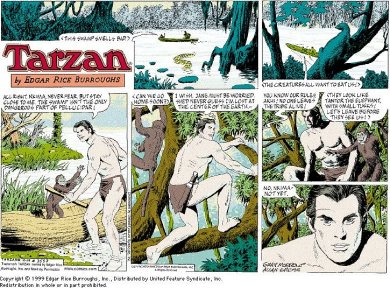
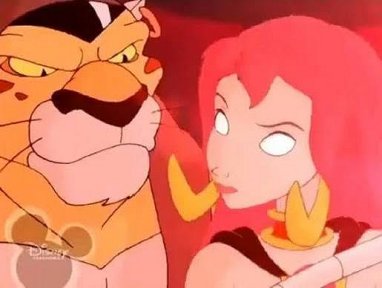
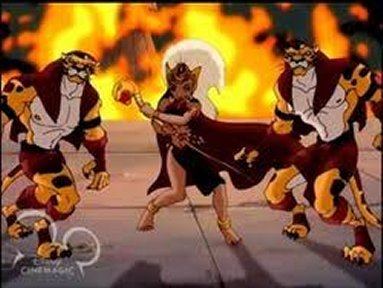
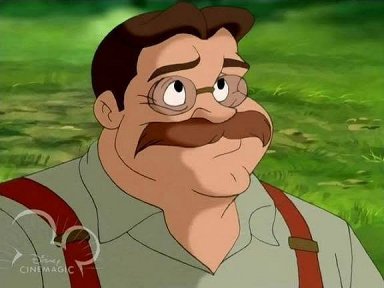
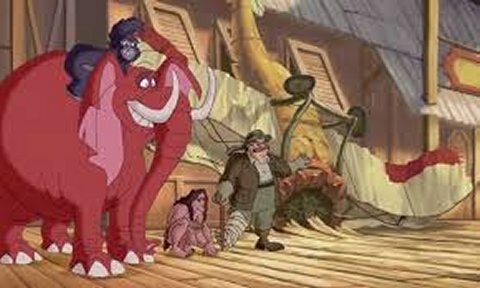
When
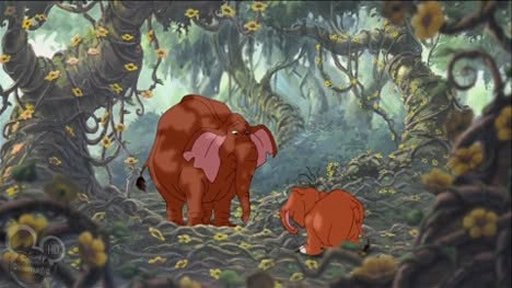
the elephant lagoon turns smelly because of decaying vegetation after
heavy rains, Jane plants a sweet-smelling (albeit non-native) flowery
vine from her home country England. But the vine grows out of control,
causing an ecological disaster that leads to all-out war between the
elephants (whom the vine has driven out of their feeding territory) and
the gorillas (whom Tarzan persuades to let them share their own
territory with the elephants). Despite Jane and the Professor's best
efforts to get rid of the vines using aphids, frogs, and snakes,
matters only turn worse, and it is up to Jane - with help from Tarzan -
to undo her mistake.
“Something quickly, the vine isn’t just growing, it’s actively plotting real estate acquisition.”
THE RIGHT GLOVE FOR THE JOB

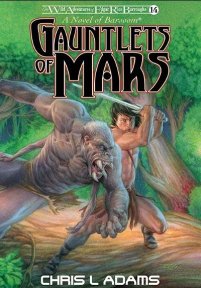
September 24: Happy birthday to me and on this day in 2025, ERB, Inc. began shipping copies of the novel, “Gauntlets of Mars,” by Chris L. Adams. The book is available in three formats, paperback, hardcover, and a signed hardcover edition. Here’s the link: https://edgarriceburroughs.com/.../gauntlets-of-mars-a.../ The novel is wonderfully well written, absolutely faithful to the original novels. Great artwork by Doug Klauba.
Stranded one million years ago in the glory days of Barsoom, when great
oceans spanned the planet’s now-barren deserts, warrior-scientist Dat
Voga has faced some serious obstacles since he and his companion
arrived in the middle of a hurricane. But the most serious challenge is
yet to be overcome.
The drabble for today, “The Right Glove for the Job,” was inspired the novel and by the word, gauntlet. Chris would never stoop to writing anything this silly.
THE RIGHT GLOVE FOR THE JOB
“Good morning. Those are really big gloves that you have on.”
Clenching his fists, Dal Voga growled, “Gauntlets, not gloves. The be better to hit you with.”
“I’m a mitten man, myself. The fingers on those gloves are really long.”
“Gauntlets, not gloves. The better to grab you with.”
“I’ve
seen leather gloves, black gloves, white gloves, and baseball gloves.
Isn’t a gauntlet something you run while folks beat you. Are you going
to say, ‘Gauntlets, not gloves. The better to eat you with.’”
“No, the last time I tried to eat wearing these, I punched myself in the nose.”
BURKE AND HARE
September
25: On this day in 1932, the
Hal Foster illustrated and George Carlin Tarzan Sunday story arc, The
Elephants’ Graveyard, concluded. The first written account of the
phrase, “The Elephants’ Graveyard” appeared in the Alan Quatermain
novel, “The Ivory Child,” by H. Rider Haggard. The legend reported
therein was repeated in the film, “Trader Horn,” and in the Tarzan
novels. While concentrations of elephant bones are found near water
sources, where injured elephants would likely be drawn, the idea of a
deliberate, instinctive, collective burial site is a myth.
In
the story arc, Erich von Harben is injured and left for dead near a
fabled elephant graveyard. Nkima carries his written request for help
to Tarzan, who during the rescue encounters flying dinosaurs and the
GIGANTOSAURUS.
The
drabble for today, “Burke and Hare,” was inspired by the myth of the
elephant’s graveyard and the two most famous graverobbers in British
history.
BURKE AND HARE
Tarzan
followed monkey, Nkima, to where Erich von Harben was left for dead.
Avoiding the flying dinosaurs, the men fled through a hidden field
covered with thousands of elephant skeletons.
Von Harben said, “Look at all the ivory. We’ll be rich.”
Tarzan said, “No. You’re to weak to carry anything and I’m almost carrying you.”
“No, I won’t and you can’t find it.”
“Seriously, this ivory is being wasted.”
“Every
graveyard is filled with riches, ivory, here, and gold and jewelry
where people are buried. Leave the dead in peace. Robbing the dead is
not crypto-currency”
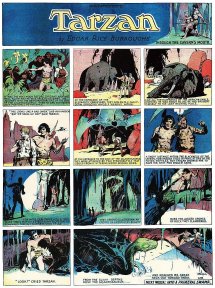
I REMEMBER MAMA
September
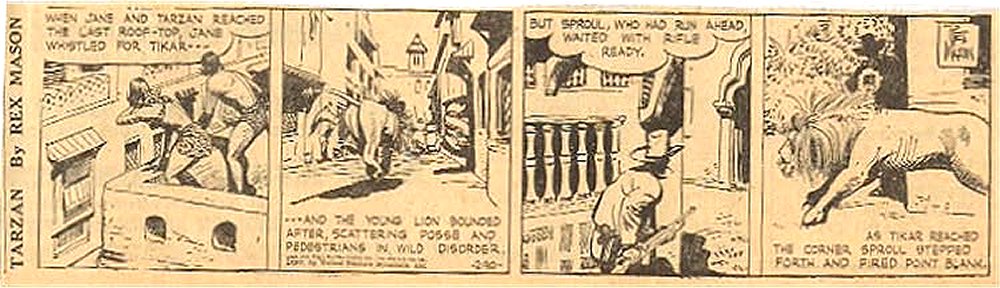
26: On this day in 1946, the Rex Maxon
written and illustrated Tarzan daily newspaper comic strip story,
“Tikar the Lion,” concluded after a run of 64 days. The lion first
appeared in the story arc, ‘Tarzan and the Lion Cub,” and also in “The
Imposter.” Tikar was found by Tarzan and Jane after the cub was
abandoned. Jane was primarily responsible for raising the lion. Tikar
remembered Tarzan and Jane, and would help them on occasion. Androcles
would be proud.
The drabble for today, “I Remember Mama,” was inspired by the story arc, “Tikar the Lion.”
I REMEMBER MAMA
Tarzan and Jane had been captured by cannibals. The jungle lord and his wife were tied.
The stew pot was boiling. Suddenly a ferocious lion leaped into the village and scattered the natives.
The lion sniffed Tarzan and Jane. It licked Jane and purred.
Jane said, “It’s Tikar. He’s come to save us.”
The lion turned the stewpot over, bit through Jane’s bonds and ignoring Tarzan, nudged her out of the village.
Tarzan shouted, “Hey, what about me? Is he going to leave me.”
Jane said, “Maybe he’ll come back for you. You know that he always liked me best.”
ALL I KNOW IS WHAT I LEARNED AT THE MOVIES
<>
September
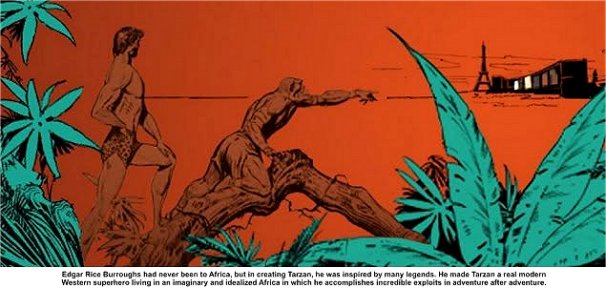
27: On this day in 2009, The Tarzan
exhibit, Tarzan! Tarzan! at the Musée du Quai Branly in Paris,
closed. It had opened on June 16, 2009. The exhibit explored the
evolution of Tarzan focusing on how pop culture shaped western
perception and sereotypes of Africa. Subtitled “Rosseau Chez les Waziri,” linking Tarzan to the
concept of the noble savage. The exhibit included real tribal
artifacts, stuffed animals, and vintage comic strips, movie posters,
television footage, film clips, and ethnographic objects. The
drabble for today, “All I Kow is What I Learned at the Movies,” is
excerpted from a review by Katrina Manson published in Agence-France
Presse update on May 30, 2010.
ALL I KNOW IS WHAT I LEARNED AT THE MOVIES
Edgar Rice Burroughs never
visited Africa, but he created one of the continentf's most enduring
myths: Tarzan. We only know Africa badly. It’s not clear how much the
exhibition, filled with comic strips, film, and Tarzan memorabilia,
helps rethink Tarzan’s Africa. Spears, fetishes, and animal skins line
the walls and fill the showcases. The exhibition maintains that the
Tarzan movies have humiliated the first books, replacing a man of
twelve languages, including ape and Latin, with a grunting man-ape.
Burroughs originally created a more thinking hero, representative of
the rejection of modern society and the call of a wilder nature.
VIRULENT BUGGISHNESS
September
28: On this day in 1911, the
ERB poem, Virulent Buggishness, was published in the Chicago Tribune.
The term, Buggishness, is defined as overbearing pompousness and
arrogance. I know a few folks who fit that description and that’s
without looking in a mirror:
<>
The drabble today. Virulent Buggishness, is the poem written by Edgar Rice Burroughs. Enjoy.
VIRULENT BUGGISHNESS
Our friend the Good Game Loser is the guy who doesn't care,
He's too doggone indifferent to paw the air and swear;
But wops who take their baseball, or their football , or their mills
As one might take a toothache keep the same upon the bills.
Subtract the bug gazimbo from the games that draw the crowd,
Then telephone the coroner and measure for the shroud.
Although this dope is bully in the abstract, so to speak,
God save us from the flannel mouth whose gas tank's sprung a leak.
ALONG THE WATCHTOWER
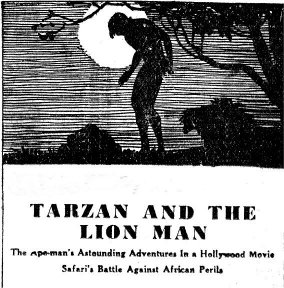
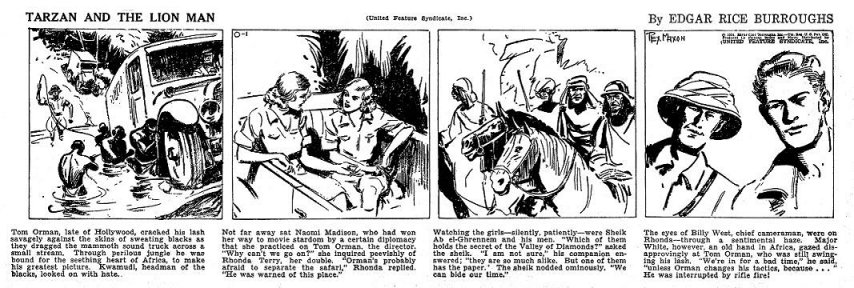
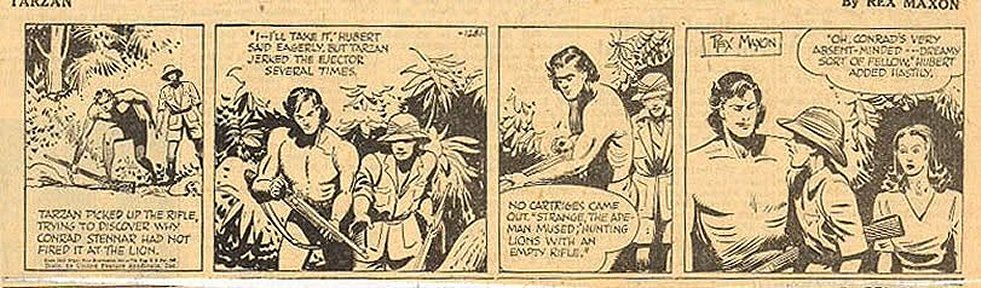
September 29: On this day in 1943, the Rex Maxon illustrated and/Don Garden scripted Tarzan daily newspaper comic strip, The Infernal Castle,
began. The story arc ran for fifty-two episodes. World War II dominated
the world. The 'master’ of the castle is Ceasar Stenner. While the lord
of the castle is not specifically identified as a German, Stenner is a
Germanic surname that means stonemason, stonecutter, or someone who
lives on stony ground. It comes from the Middle High German word stein,
which means "stone" or "rock.”
In the story, Tarzan and Jane carry an injured explorer to a mysterious
stone castle located in the heart of Africa. The castle is ruled by a
ruthless owner, who rather than offering help, offers only death if
Tarzan and Jane don’t leave at once.
The 100- word drabble for today, “Along the Watchtower,”
was inspired by the story, “The Infernal Castle” and it incorporates
what Tarzan said after killing the evil Stenner and freeing the natives
that Stenner had kept as virtual slaves.
ALONG THE WATCHTOWER
“Before leaving,” said Tarzan, “I will deal with the castle’s evil overlord.”
Tarzan
killed Stenner. He shouted from the ramparts. “He who called himself
the Great White Lord is dead. All who were his slaves, go in freedom.”
Soon,
the estate stood empty. Tarzan said, “Soon the jungle will march again
across the lands and the game will return and once more the hunters of
the tribes will bring meat to their people.”
Jane smiled, “And we will be safe at home.”
“Only for as long as brave men and women are willing to confront evil in all it’s forms.
BUY LOW, SELL HIGH
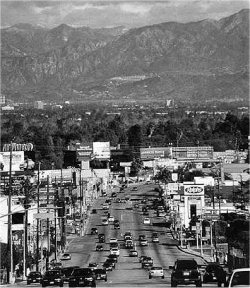
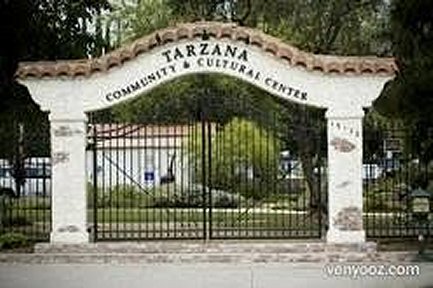
September 30: On this day in 1927, the Van
Nuys News, published the article, “EDGAR RICE BURROUGHS, FAMED
NOVELIST, IS REAL ESTATE OPERATOR ON VENTURA BOULEVARD; LAUDS ITS
ADVANTAGE." The article was written by Edgar Rice Burroughs.
The drabble for today, “Buy Low, Sell High,”
is excerpted from that article written by Edgar Rice Burroughs. ERB was
right about one thing, the sales price of the property would never be
as low again as it was in 1927.
BUY LOW, SELL HIGH
The
future of this district is the brightest of any section of the city of
Los Angeles for the reason that we are blessed with marvelous climate,
rich soil and a delightful outlook regardless of location.
The only logical line of growth
for a high-class residential district is along the Santa Monica
Mountains. The Ventura boulevard side of the hills, offering freedom
from fogs and continuous winds. must prove highly desirable in the eyes
of those who are looking for locations for pleasantly situated,
delightful home sites. The values, too, will never again be as low as
they are today.