Official Edgar Rice Burroughs Tribute and Weekly Webzine Site Since 1996 ~ Over 15,000 Web Pages in Archive Volume 8246 |

EDGAR RICE BURROUGHS: THE EARLY YEARS
SCHOOLING ~ REBELLION ~ DISCIPLINE
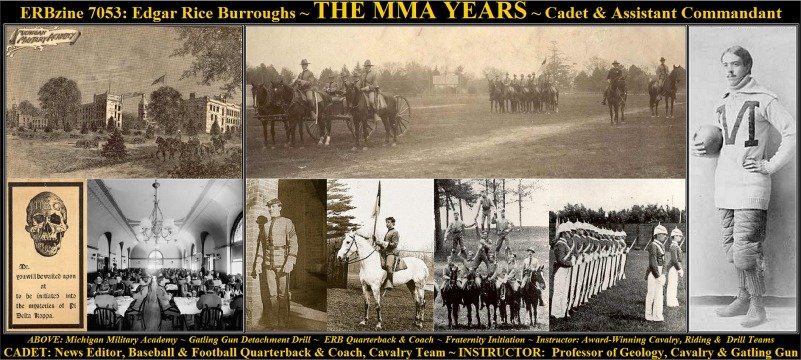
As a member of the cavalry troop at Michigan Military
Academy Ed had the opportunity to develop a remarkable skill in riding. In
recollection, he wrote, "We did a great deal of trick riding in
those days — bareback, Cossack, Graeco-Roman and all the rest of it. It was
known as `monkey drill,' and if a man did not lose his nerve and quit, he had
to become a good horseman.
News of the astonishing ability of the academy cavalry
had reached the ears of the Detroit Riding Club, and a selected group of riders
was chosen to appear for an exhibition. A souvenir program of the Columbian
Saddle Horse Show describes the events of Tuesday, April 4, through Thursday,
April 6, 1893. The Orchard Lake Cadets' exhibition drill, with saddle and full
equipment on the first night, was listed as "Event No. 5" on the
program. The Drill Master was Hugh Thomason, and of the fourteen cadets in the platoon,
Cadet Private E. R. Burroughs is listed as number seven; his friend Robert Lay
was number twelve and the color bearer.
On Wednesday April 5 the cadets presented an
exhibition drill "with blankets, without equipments." On
the final evening, April 6, a newspaper reported the results: "The
Orchard Lake cadets took part in a competitive drill, which was an exciting
affair. Their vaulting and dismounting and mounting drew applause, and the
judges had a hard time picking the winners."
The decision was made: "They finally had T. T.
Harker, Ed R. Burroughs and F. R. Graves step out, and after an exhibition by
each of them gave the prizes in the order named. . . ."
Ed's second prize was a gentleman's riding crop, while his horse, Captain,
received a red ribbon. In the newspaper accounts of the exhibition, (April 4-7,
1893) the cadets' riding drew a eulogy:
The dashing cavalry from Orchard Lake gave one of the most
attractive exhibits of the evening, commanded by Hugh Thomason, first sergeant
troop F, U.S. cavalry. Hard riding and difficult evolutions, sweep of flashing
sabres through the air and a volley of shots as a wind up, wrought the audience
up to a pitch of applause that was deafening... .
The drill wound up in the manner of
the wild west show. Drawing their revolvers the cadets dashed madly around the
ring, firing in all directions, and then rallied in the center, after which
they left the ring.
These horrid cavalry horses did not have the fashionable English trot or gallop, nor did the rider sit in the English way, but they were plain Americans. The cadets ride like the vaqueros dash through the chapparel, ride like the fleet South American gauchos, the most skillful and daring riders in the world. But the cadets are not fashionable riders.
The cadets are what might be called
strong riders. Their stirrups are long, their seats are firm, they never
forsake the motion of the horse. There is an abandon, a smoothness, a
naturalness, a spirit to their horsemanship, that breathes forth the wild wind,
the long road, the cheerfulness of outdoors... .
It is not military horsemanship. It
is American horsemanship, it is Mexican horsemanship, it is South American
horsemanship. It is riding of men who live in the saddle.
The fashionable rider is not part of his horse, he is perched on his horse; he is bobbing, he is making an art of riding, his horse is giving an exhibition of what a saddler should be, and is showing how a rider should retain his seat... .
The cadets' type of horsemanship, as reported in a story of April 6, included bareback riding feats that "recalled the exhibitions by Buffalo Bill's cowboys." This riding skill and love of horses developed by Ed in his academy years would always remain with him.
The
summer of 1893 saw the start of Ed's lifelong fascination with the automobile
when he became involved in the exhibition staged by his father's American
Battery Company at the World's Columbian Exposition in Chicago. He was given
the enviable assignment of driving an electric automobile around the
fairgrounds. George Burroughs had installed the auto at the World's Fair to
demonstrate the company's storage batteries. One writer, in calling the vehicle
an "electrical horseless carriage," goes on to report that Ed drove
"a nineseater horseless surrey about the fairgrounds, starting runaways
every hundred feet or so.
In another account the writer claims that Ed drove the first automobile in
Chicago, and describes how "at night, circling about the Fair grounds, it
threw off sparks and flashes of blue flame.
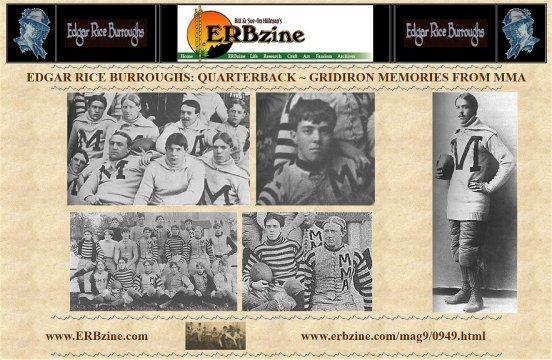
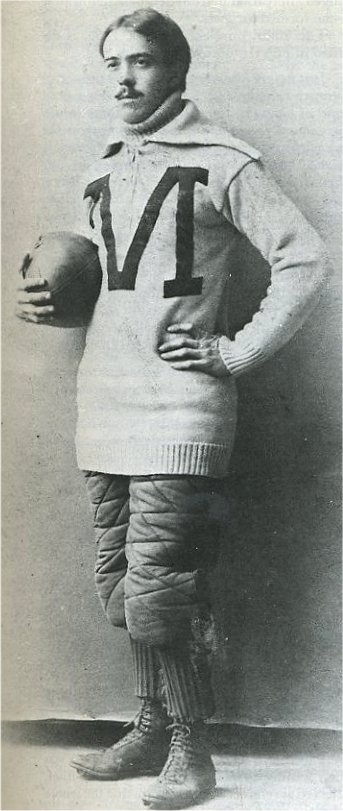
The Adjutant, the academy's monthly magazine, reports Ed playing
mainly quarterback and on one occasion right end. An article about the games in
The Adjutant tells of the contest
between the school and Ypsilanti Normal, with
the final score "Academy 24; Normals, 10." Ed is given credit for
making one touchdown.
In The Adjutant, Senior
Number, June 1895, Ed is placed on the Champion Prep School Team of the West,
1894. Statistics show him as "Captain, age 19, weight 169,
height 5 feet, 10 ½ in., position Quarter Back." In the December 1895
issue, a listing is again made of a championship team of the year; Ed is shown
as "Captain-Quarterback, Height 5-10, Weight 165, Age 20 years, 4 mos."
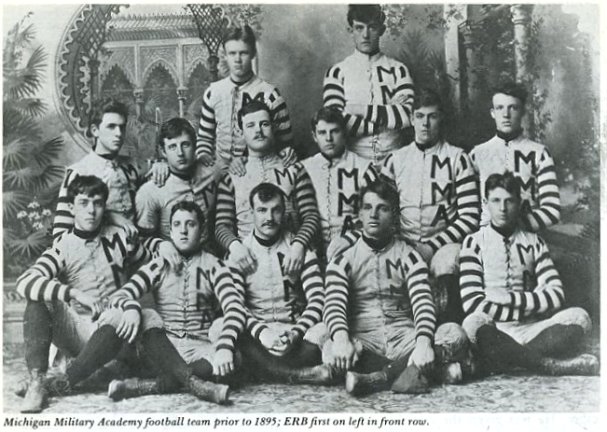
I made the football team, which I
captained the last two years. We had an unusually good prep school team,
cleaning up everything in our class and a number of teams that were out of our
class. About the only teams that could beat us were such teamsas Notre Dame and
the University of Michigan, and at that we once held to a tie score the
University of Michigan team that had held Harvard 4 to 0.
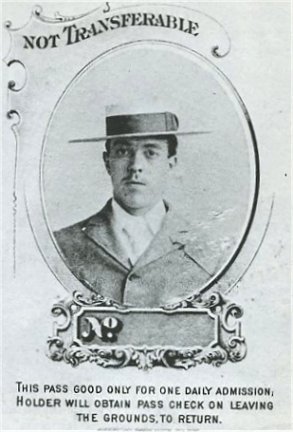
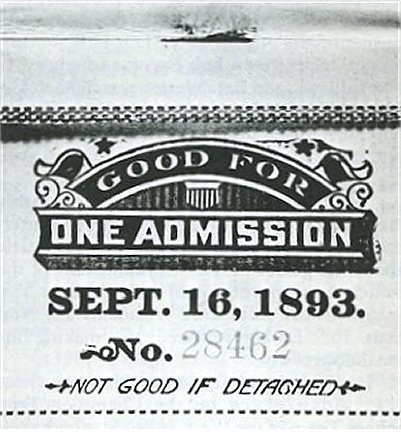
< style="font-weight: bold;"> ERB passbook to World's Columbian Exposition, Chicago, 1893,
<>where he drove an electric auto powered by batteries.
"... In those days," Ed noted, "it was a national
football upset of the first magnitude, and our showing against this great
Michigan team was equally as remarkable. I know that one of the results was
that I was offered flattering inducements to come to Michigan after I graduated
from Orchard Lake." Because his brothers George and Harry were graduates
of Yale, he had made that college his first choice; as a result, he rejected
the Michigan offer.
But his interests were not limited to sports. He would
always find a fascination in drawing, even if his sketches and humorous figures
were done only occasionally in letters or in moments of relaxation.
In addition, as at Phillips Academy, he
could not resist the lure of the school magazine. In The Adjutant for October, November, and December 1895, Ed,
now a second lieutenant, headed the list of ten editors. It is assumed that he
was editorin-chief or managing editor. The
Adjutant for January, February, and March of 1896 again displays the
name "Lieutenant E. R. Burroughs" above a group of ten
other editors. He had returned, to the academy after graduation.
The launching of a newspaper, The Military Mirror, may have been one of
Ed's projects. Volume 1, number 1, is dated January 30, 1894, and on the
editorial page the paper is described as "a journal devoted to the
Interests of Cadets and ex-Cadets of the Michigan Military Academy."
Printed beneath are the names Lt. Burt Barry, Lt. Chas. H. Campbell, Lt. Ed. R.
Burroughs, editors. Of interest is the fact that the paper was called The Mirror, reminiscent of the Phillips
Academy publication to which he had contributed.
By the end of 1893 a continuing improvement in his
studies was evident. On December 20 a faculty member, C. Leslie Lewis, wrote a
letter of commendation to Ed's father:
<>
Lewis reported Ed's marks: "Physics 87; French 86; Rhetoric 92; Military Science 90; Junior Rhetoricals 92; giving him an average of 89.4 % . His deportment marks show that he has 16 merits to his credit. We look upon him as one of our best boys."
Ed's marks were in the 60s and 70s at Harvard School,
but only three years later show remarkable improvement. He had not, however,
become totally angelic. He couldn't resist the temptation to indulge in wild
pranks. The wildest of all escapades, one which Ed described amusedly as "the
means for breaking the monotony of the long Michigan winters in barracks,"
was a contrived incident involving Ed and First Lieutenant Charles H. Campbell.
"We had quarreled," Ed wrote, "and were not on speaking terms.
It occurred to one of us that we might make capital out of our well known
dislike for one another. . . ."
There is little question about the identity of the "one of us" to
whom the idea occurred. On an evening when Ed was officer of the day there was
a "prearranged altercation in front of the battalion after it had formed
for mess."
. . . Just before assembly sounded for supper, at a time when the entire corps of cadets was in front of barracks, Campbell made some insulting remark to me and I struck him across the face with my glove, whereupon we immediately mixed, but were presently separated by our friends, one of whom, First Lieutenant Barry, took me into his room until assembly had sounded.
The plan had been for some of the cadets to break up the fight, ". . . but unfortunately for us," Ed wrote, "they were more interested in watching the scrap than in stopping it. Someone finally interfered, much to our relief. ..."
Later that evening Campbell's second, Captain Risser,
delivered the expected challenge:
Yours Very Respect. Charles H.
Campbell"
<>
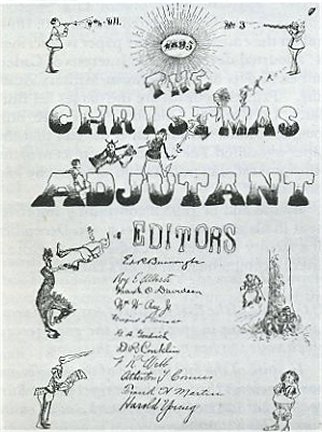
<>1895 Christmas Adjutant listing ERB as editor in chief;
<> pen and ink drawings were probably ERB's work.
<>
At 4:00 p.m. Ed had jumped out of the back window of
his barracks, and accompanied by his second, started for the "field of
honor." Ahead of them, several cadets were carrying the guns. As Ed turned
to look at the school, he observed, with satisfaction, that there was a string
of cadets "a mile long" following him. The important details of the
duel were taken care of: the cartridges were blanks and Ed carried a
"bloodied" handkerchief in his blouse.
Shortly afterward some of Campbell's group could be
seen hurrying toward the chosen spot. Ed's friends began to shake hands with
him and bid him goodbye; overcome at the prospect of his death, several burst
into tears. But when the group arrived, headed by Captain Risser, Campbell's
second, it was evident that Ed's opponent was not among them. Risser reported
that someone had blabbed to the commandant, that Campbell had been placed under
arrest and locked up. The commandant, Lieutenant Frederick F. Strong of the 4th
Artillery, a West Pointer, sent a very peremptory order to Ed: he was to report
to the office immediately. "It was a long, cold walk back to school,"
Ed wrote. "I would much sooner have faced Campbell with Springfields at
twenty paces than to have faced the Commandant, and when I entered his office
and saw his face I realized that my judgment was still perfectly good."
Ed never forgot Strong's reaction:
I could see that he was laboring
under a great nervous strain and it was with difficulty that he controlled his
natural feelings, which I imagine would have prompted him to turn me over his
knee and spank me, but as was his custom, he asked me for my story and listened
to it, though somewhat impatiently when I told him that the whole thing had
been a joke.
On December 15, 1893, soon after the "duel,"
he wrote a letter to his mother. Both she and his father had evidently written
to mention their concern about him and the absence of any news from him. He
expressed his regret and said he was in good health, except for "that
tired feeling." Then, with pride, he proceeded to give the details of the
hoax, telling the story gleefully.
"Campbell, Barry and I started the joke and made
all the arrangements before hand, practiced our parts, faked some cartridges
etc.," he wrote. Toward the end of the letter he admitted that when the
hoax was revealed, "the fellows wanted to kill us both." But he added
that "The Lieut. [Commandant Strong] thought it was the best
joke he had ever heard of and laughed as much as any one."
At Orchard Lake he had what he described as his
"first, last and only stage experience." The cadets formed a company
to present a play titled "The End of His Tether." After a
school performance the company went on the road during the Easter vacation. The
only impression that remained with him, outside of the fact that the play was a
"terrible flop," was a most vivid one about the incredible whiskers
he wore:
Of the towns where the cadet actors appeared, Flint, Michigan, was especially memorable. ". . . we played to an audience consisting of the owner of the theater and a couple of members of his family. There was not a paid admission and the only reason the owner was there was because he had to be in order to turn out the lights and lock the doors when we had departed."
When financial matters reached a crisis, the familiar
telegram, a duplicate of numerous others sent home by unsuccessful thespians,
was dispatched to George Burroughs: "Wire five show busted Hotel Vincent
Saginaw."
<>For gross neglect of duty as Officer of the Day on the 11th Inst. Cadet 2nd Lieut. Burroughs is hereby reduced to the ranks and confined to "Reduced Limits" until June 10, 1894.
By order of Col. Rogers
R. S. Spilman 2nd Lieut. M.M.A.
Adjutant
Ed's father was undoubtedly notified of this; but he
received a further shock when Rogers' letter of April 17 referred to
"Special Orders No. 52." It was Rogers' "unpleasant duty"
to forward an extract of these orders to Burroughs. The Colonel stated, "Your
son has doubtless written you the particulars of his offense. If not, I will
write you fully, explaining to you his breach of discipline."
In a reply to Rogers, dated April 20, George Burroughs
exhibited mixed emotions of anguish and helplessness. He refers to the
"Special Orders" enclosed in Rogers' letter:
I need not tell you that its
contents brought to me humiliation and pain. What more can I say? My Son knows
what I expect of him, his sense of duty to his school and his parents should
guide all his actions, and make him obedient to every rule. I do not know what,
if anything, I can do in the premises? If he will not obey, he must take the
consequences, and his parents must suffer with him.
But he could not conceal a fear about the extent of
his son's punishment:
He has not written home about the
matter, and I will thank you to explain fully to me in what his "neglect
of duty" consisted, and also what you mean in "Orders" when you
say "Confined to reduced limits". I hope it does not mean confinement
in his room for such a long time when we are likely to have hot weather. His
offense must have been great, if a reduction to the ranks would not be regarded
sufficient punishment.
Ed's offense, as described by Rogers on April 23, was
almost beyond the bounds of any that the colonel had ever encountered at the
academy. While on duty as officer-of-the-day, Ed had "not only permitted
but encouraged one of the cadets to assault one of the cadet officers whom he
relieved but a few moments before for official acts done in the performance of
his duty and in accordance with the commands of the Commandant; i.e., he
reported this man for smoking."
Rogers stressed that he found it very humiliating to
even admit that "such a disgraceful breach of discipline could take place
in this Academy." He ended with a softer note, adding that
"while it is a severe lesson for your son, I am pleased to say that he
seems to consider the punishment merited and is faithfully attending to his
duties."
The colonel's belief that Ed, considering himself at
fault, had turned contrite, was clearly contradicted in the indignant letter
George Burroughs received from his son. On April 20 Ed wrote to explain that he
had hesitated to tell his side of the story because he didn't wish to upset
them. After reflection he had decided that they would feel much worse if they
heard the story from "some other source and without knowing the
details."
The next day, Ed explained, when he was O.D., he saw
Rohrbaugh follow Ward up to his room, and, alerted to possible trouble between
the two, hurried upstairs after them. It seems plain that Rohrbaugh and Ward
were quarreling, and that Rohrbaugh, angry at being reported, made some
threats. Ward said he would tell the colonel if "anyone did anything to
him." Rohrbaugh then lost his temper and struck Ward in the chest.
Ed, as officer-of-the-day and peacemaker, stepped in
to prevent any more blows, and the two men "appeared to cool off."
Carrying out his duty, Ed claimed, he reported Rohrbaugh for striking Ward. But
unfortunately he couldn't refrain from taking his friend's side and in telling
Ward off, including some threats of his own, that Ward "would have to
settle with me for some things he had said. . . ." The reference was
obviously to some four-letter words which Ed said he couldn't write.
In the meetings with the faculty and administration
after the incident, Ed explained to his father that he talked to them "the
way I would to you if I were in trouble." He told them not only what he
"honestly thought" but also that he despised Ward. "I didn't use
any tact," he confessed. "I didn't think I had to, I believed that
justice would be given by them, the same way that you would see justice done.
It turned out however that I was running down a favorite of the Colonel and Lt.
Strong. . . ." Ed said that later Colonel Rogers called him a liar and
Rohrbaugh a bully and coward.
In continuing his story, Ed told how all the other
cadets gave their support to him. When the order reducing him to the ranks was
read in the mess hall, there was a commotion, and "the whole battalion . .
. began to hiss and cry `Lynch him', and `Kill him,' meaning Ward." Later,
when Ward was Officer-of-the-Guard, "the men cut pillows up and threw them
at him and spit on him and stepped on him and cryed, `Drag him out' and `Lynch
him.' It was because the Col. and Comm't liked that . . . man better than they
did me that I was reduced."
The faculty appeared to be on Ed's side:
Rohrbaugh and I came very nearly
being fired, the Col. and Lieut Strong wanted to but most of the younger profs
didn't so they compromised. A man said to one of the profs the day I went down
that he didn't see why I was reduced and the Prof said. "I'll be darned if
I do either."
Ed devoted a section of his letter to urging his
parents not to get discouraged, while at the same time making no attempt to
conceal his own gloomy attitude:
Please don't feel sorry
for me. I have enough sand in me to take my punishment, however unjust without
grumbling (too much) but if I could only feel that you and mother hadn't lost
confidence in me again on acct of
this; it wouldn't be so hard. I have not shown that I felt injured by my
reductions. I have done what I thought you would want me to do, braced up and
done what I thought would put me on the road to work up all over again. I have
been on guard twice and rec'd orderly to the commanding Officer for being the
neatest man and having the cleanest gun in the guard.
Toward the end of the letter he found it difficult to
control his emotions:
I think I have rec'd no demerits
since my reductions, I have studied just as hard if not harder. And I tell you
Father its not for myself I am doing it, either, as far as I am concerned I
don't give two whoops in hades whether school keeps or not. I am both home-sick
and discouraged, because it looks as though a fellow never could get up again,
when he had all headquarters to buck against ...
He signed himself "Your affect. son,"
using his full name, Ed R. Burroughs, and placing his new, reduced rank beneath
in a kind of bitter defiance: "Cadet Private Co. A."
Obviously, his reduction to ranks affected him very
deeply; his hurt and resentment were strong because he believed that the
punishment was unjustified and that prejudice was involved. Unable to find a
release for his anger and frustration, he turned to one of his favorite
pastimes — cartooning. On a piece of cardboard he drew a tombstone in a
pyramidal shape. In the center he printed his own version of his sentence,
giving it the appearance of an epitaph:
April 12, 1894 — Cadet 2nd Lieut.
Ed. R. Burroughs, Company "A", is hereby reduced to the ranks and
confined to reduced limits until the 10th of June 1894, for "Alleged"
gross neglect of duty while Officer of the Day. By Col J. S. Rogers and Lt. F.
S. Strong without the sanction of the Faculty of M.M.A. . .