Official Edgar Rice Burroughs Tribute and Weekly Webzine Site
Since 1996 ~ Over 15,000 Webpages in Archive
Volume 8311

MOON MAID AT THE EARTH'S CORE
A NOVEL IN 14 CHAPTERS by ANDY NUNEZ
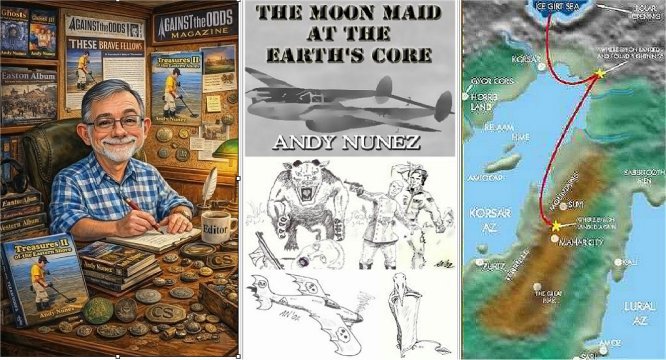
CHAPTER ONE - HOW THE WAR ENDED FOR ME
My name is Byron Jasper Wells. I joined the U.S. Navy in December of 1941, right after Pearl Harbor. As a kid, I had devoured all those old pulp science fiction and adventure magazines, so when it came time to fight the Japanese, I felt that I was stepping into the shoes of my fictional heroes, Doc Savage, the Shadow, G-8, John Carter, and David Innes. I saw myself as a man of action, like them.
I saw the elephant right after training. I was not assigned to fight in the Pacific, but became a P-38J pilot operating from Canada, Greenland, and Iceland, protecting sub-hunters from what, I wasn't sure. The Nazis had no carriers, but you never knew when they were going to try to slip a battleship or cruiser out of Norway to get at the convoys. These heavy ships usually carried a couple of seaplanes, and I knew that my fighter could make short work of them.
For the most part, I circled around some of the most god-forsaken territory on the planet. Nothing but gray seas, frozen tundra and rocky coasts passed beneath my "forked tailed-devil" while I was on patrol. My fighter was a good plane, with two powerful engines, and I could stay up for 12 hours with wing tanks if I didn't get into combat. Otherwise, it was dependent on how much action. Of course up here in the icebox at the top of the world, there wasn't much of that. My greatest threat was the cold.
I did worry about that. Ice could form in my gas line, or on my wings, and it could spell disaster for me. Crash landing in Arctic regions meant certain death if help didn't arrive soon. I wore a heavy flying suit, but carried a lightweight paratroop carbine just in case I crashed. I knew that my standard issue .45 wouldn't help if I had to bring down a moose to stay alive. I stayed on patrol through the invasion of North Africa, Sicily, and Italy. In the spring of '44, though, everything changed for me. My routine was pretty much the same. At the time, I was based in Reykjavik, Iceland, where I spent a lot of time making sure my plane wasn't freezing solid and reading old pulps that sailors dropped off when they brought in supplies.
I remember it was a normal patrol between Iceland and Greenland, when I got a flash traffic message instructing me to vector north where a distress call was coming in from a fishing trawler. The ice was starting to break up, so the fishermen were ranging farther and farther north. I checked my compass and headed for the location. I had only been up for less than 30 minutes, so I had plenty of fuel. I found the fishing trawler with no problem. It made a nice black spot amid the steel-colored waves.
She wasn't alone, though. Just a few hundred yards off her bow was a sleek black shape. I recognized it right away as a Nazi type XXI U-boat. I radioed base for a PBY Catalina to come out and get this baby when I saw her deck gun was unlimbering. I dove down for a closer look, seeing with horror a puff of smoke coming from her. The next second, a geyser of water erupted off the trawler's bow. I knew that the next shot would probably sink her.
I checked my guns and zoomed in. Lockheed gave the P-38 lots of teeth, and I had them all gnashing at the U-boat's deck. Fifty caliber slugs and 37mm cannon shells chewed up the area around the deck gun, sending its crew spinning from her slippery sides. I didn't know if I could penetrate the ship's hull with my guns, but I figured it wouldn't hurt to try. I swung up and then around for another pass. I wasn't sure how long it would be before the PBY showed up, so I thought I'd keep the Nazis busy until it did.
I sent another stream down at the deck gun, noticing that a crew was manning a pair of machine guns at the rear of the conning tower. I tried to angle and hose them, too, but my pass was too fast and I was over the ship and off almost before I saw them. They had a good look at me, though, and a staccato drumbeat rattled through my hull. I yanked back on the stick to get some altitude, then two slugs passed through my seat to smash into the instrument panel. How they missed me, I'll never know, but they scared me so bad, I forgot how fast I was pulling up and I started to black out. I leveled out at 10,000 feet, but the G-force was too much. My head felt like it was going to explode, and I went unconscious.
* * * * * * * *
I don't know how long I was out, but it must have been a while, because when I woke up, there was nothing below me but ice fields. I checked my compass, but it was shot, along with my fuel gauge. So, I had no idea which direction I was going, and couldn't tell how much fuel I had left. I checked my watch and tried to get some idea how long it had been. I figured that I had been out for nearly an hour, but the plane had stayed level with my hands still on the controls. I tried the radio, but all I got was static. I was in big trouble.
I checked behind me to see that my tail was chewed a little bit. I tried the controls and found them stiff. I wondered at the time if that hadn't helped me stay in the air while I was out. I had heard of people falling asleep or blacking out, but never for very long. The sky was nothing but a dome of mottled clouds, so I was without direction, flying a plane that would eventually run out of fuel. Since one direction seemed as good as another, I stayed my course.
After about another two hours, I noticed a strange phenomenon. My altimeter suddenly changed radically. It shot from 10,000 to 20,000 feet and kept climbing. The air pressure didn't differ, however. I looked down, and saw that the frozen waste seemed to be dipping, almost precipitously. What was I flying into? I remembered the stories of my youth, of Edgar Rice Burroughs land at the earth's core, but I had put it all down as just that, a story. There was no Iron Mole, no Pellucidar. If anything, the center of the earth should have been hot lava, or something like that. Inner worlds were for Jules Verne, Roy Rockwood, and Burroughs.
It wasn't much later that I saw another phenomenon. Bare ground appeared. It had the frozen look of Greenland's tundra, but it was unmistakably land. I wondered if I was making a semi-circle and was now heading south along Greenland's interior. I decided to be prudent and drop down to 10,000 feet in case the air pressure changed, but staying at that altitude meant constantly dropping, and dropping, until the gray sky above me became lost in a rising mist from below.
For a time, I flew by instrument, hoping the fog would lift, and it did, but what I saw when I came through that gauzy curtain was beyond my wildest imaginings. Open water again greeted me, but it was fanged with jutting rocks and chunks of ice. I saw several hulks of ships jammed in these shoals, but that was tame compared to the real shocker.
Ahead of me was a sun.
I knew it wasn't the sun of earth, because the clouds had covered that. This was another sun, and it was pulsing with heat enough to evaporate the ice from my wings. Below me I could see valleys fringed with green, and plains beyond that, and mountains beyond that. In fact, the horizon didn't curve down, but seemed to curve upward, lost in the distant haze and glare of the sun.
Had I been a cautious fellow, I would have turned around and flew back the way I came, but I was too fascinated by what I saw. Here was another world, a world nobody had ever seen from the surface, at least as far as I knew. I remembered Burroughs' tales of Pellucidar. He talked about a fellow named Jason Gridley who took a dirigible down through an opening in the North Pole, but I always figured it was hogwash. Dirigibles didn't fare too well in the arctic, and the Norge was lost with five people, never to be seen again.
So, here I was, a naval officer, flying a shot-up plane through what had to have been a hole in the arctic to - where? Were there any inhabitants? The shipwrecks I had passed indicated that humans had traveled this way before, but had any survivors penetrated this land? I flew on for perhaps two more precious hours, looking for a likely spot to land. I crossed a large bay, seeing something that looked like a city off to my right. I circled over, and was surprised to see a bustling metropolis, though it appeared to be one left over from two centuries ago, full of red tiled roofs and minaret spires. Ships like ancient wooden frigates and galleons plied the bay. I swung in closer, and I saw people in the streets running in fear and pointing up at me.
Their dress was something straight out of Treasure Island. When a group of men formed up carrying some muskets, I decided I wasn't welcome and went back out over the bay, which led into a sea that stretched for a considerable distance south. So, man had penetrated this land, and had not only settled, but prospered, after a fashion. This was something straight out of the pulps.
I found a nice flat grassy area to set the plane down some distance along the rim of the sea from the strange town. Since they were toting muskets that meant they knew something about chemistry and metal refining, so I was hoping that civilization here was at a level that, if I could make some friends, I could fix my plane and fly back out. The fact that these denizens still traveled in sailing ships did not bode well for gasoline production. For the time being, though, the war was over for me, and I had another battle to fight, this time for survival.
I opened the plane's cockpit after shutting her off and was immediately struck by the warmth of the air about me. It felt like summer time back home. I shucked off the heavy flying suit and got out my emergency supplies. In the kit was the usual stuff, including a compass and knife, a flare gun, and some medical items. I buckled on my .45 and slung the carbine over my back. I only had four spare clips for the carbine, so I was hoping that I could find some friendly natives soon. There were some emergency rations that I knew wouldn't last too long, either. I consumed a couple of tins while I surveyed my surroundings.