Official Edgar Rice Burroughs Tribute and Weekly Webzine Site
Since 1996 ~ Over 15,000 Web Pages in Archive
Volume 8310

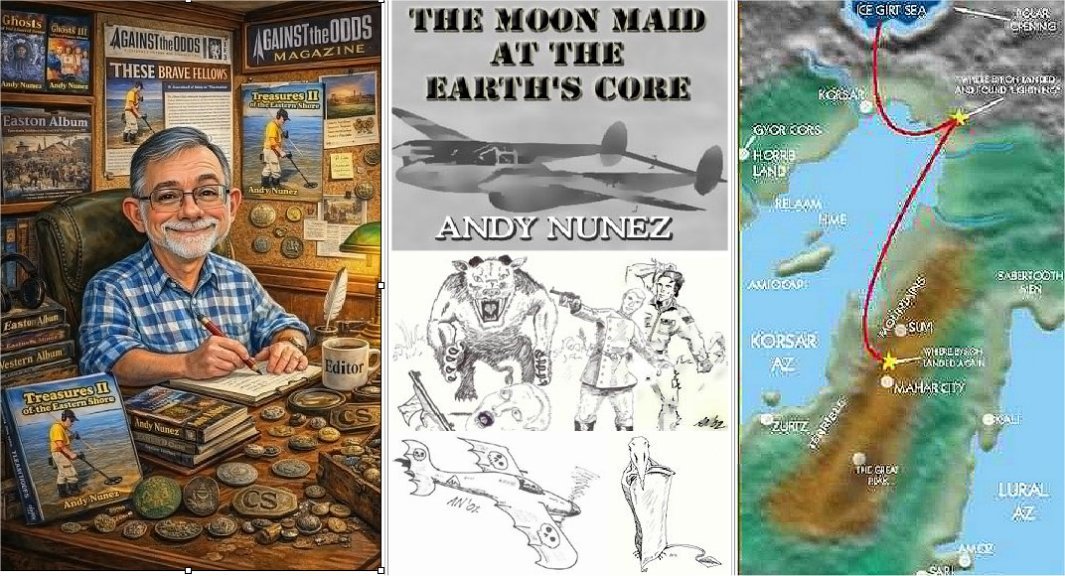
MOON MAID AT THE EARTH'S CORE
A NOVEL IN 14 CHAPTERS by ANDY NUNEZ
Text amd Art by Andy Nunez
It should be safe enough
to tell this now. I am an old man,
having lived far longer than the Biblical three score and ten. Perhaps it was in part to clean living, or
perhaps to a synthesis of a pill given to me by a good friend of mine;
nevertheless, as I approach the century mark, my mind remains as clear as ever,
and it easily goes back to that time some fifty years ago, when I lived in
Encino, California, and was a good friend to the writer Edgar Rice Burroughs.
I am gratified that the
world still knows his name, though my own has long been forgotten. Had I patented my discoveries, I suppose they
would have marked me as one of the fathers not only of communication, but of lighter
than air design, but for reasons of my own, I kept my discoveries secret. Airship construction was virtually
non-existent after the Hindenburg disaster, and people became more interested
in television than radio. Still, I
tinkered with my set, upgrading it from a simple wireless with a sending key to
one capable of transmitting sounds across the void.
Ed was kind enough to
mention me in several of his stories, embellishing my abilities to fit the
needs of his tale. Usually, he only
referred to my radio, with which I had been able to communicate not only with
the planet Barsoom, but also with Abner Perry at the Earth’s Core. From time to time I communicated not only
with such well-known characters as John Carter of Mars and Ulysses Paxton, but
also Abner Perry and his friend David Innes, the Emperor of Pellucidar, as the
world beneath our crust is known. Some
time had passed since I last heard from Perry, when one day I returned from
horseback riding with my wife to hear Perry’s thin voice coming from the
speaker of the radio.
I remember that day
well. It was a lovely Saturday evening
in March, the year being 1950. I rushed
over to the radio and snatched up the microphone.
“Here I am, Perry,” I
said. “What’s up? Nothing wrong, I hope.”
“Nothing earth-shattering,
my boy,” came his voice, crackling through the ether. “I have just received a story from someone
and it is so extraordinary, that I had to convey it to you and Ed. Are you ready to write?”
“Better than that,” I told
him. “We now have tape recorders up here
so that I can record your message on magnetic tape and transcribe it later.”
“I really must come back
and take a look at your marvels topside,” he said. “Well, here goes . . . “
Perry had obviously
received this story first-hand, or its teller had written the manuscript
himself, since he read it to me in first person. He paused only to drink some water, or if I
had to stop him to change reels on the tape recorder. By the time he had finished, it was late into
the night, and Jana had been kind enough to bring me a sandwich and some iced
tea between tending to our children. I
had to agree with Perry. The story was
extraordinary, and it needed to be told.
I could think of no better person to do it than the Admiral himself,
Edgar Rice Burroughs. Signing off from
Perry, I snatched a few hours sleep, determined to lay the story in Ed’s lap
right after breakfast.
Sunday, March 19, 1950,
was a pleasant day in California. I
placed the tape recorder and the reels of tape on the front seat of my Willys
Jeep and sped over to Ed’s home on Zelzah.
There was no answer to my knock, but the door was unlocked, and I nudged
it open, calling Ed’s name. There was
still no answer. I found the living room
empty, and thinking Ed asleep, I went into his bedroom. To my horror, he lay prostrate upon the bed,
Sunday paper spread before him. Death
had found him, and by the peaceful expression on his face, Ed had not put up a
struggle. I took up his hand, finding it
cool to my touch. Tears started, tracing
down my cheeks as grief overcame me. I
turned away from Ed, distraught in the knowledge that so great a heart had been
stilled forever. A scrape of leather
wrenched me from my anguish and I saw Ed’s housekeeper before me, her face
likewise a mask of pain.
“Oh, my God,” she stumbled. “The family.
I must call them.”
I brushed past her, my
plans aborted, turning to look back at him, lying so still, and voiced aloud
the only fitting phrase that sprang to mind, that of Edwin Stanton over the
death of Lincoln: “Now he belongs to the
ages.”
On the way back home, I
pondered over what to do with this manuscript.
Here would be evidence, on tape, that Pellucidar existed. The world at large would know that a vast,
virtually unsullied world lay beneath their feet. The narrative would galvanize every explorer
and fortune hunter in the world, every huckster and circus ringmaster. No, I could not let it out. Men such as the noble Admiral Byrd were one
thing, but there were dozens more who would pillage and destroy one of the last
untouched places on, or in, the earth.
Now, I am old, and I have
decided that it is safe to release a transcript of the narrative. I destroyed the tapes some years ago, so that
there no longer is even this shred of concrete evidence. The modern reader will no doubt consider it
too fantastic to be believed, but I can vouch for the veracity of its sender,
Abner Perry, who, at the ripe old age of one hundred and sixty, still calls me
from time to time. I have discussed this
long enough. Here is the story of Byron
Wells, late of the United States Navy.
You will find within it a
story that answers some questions that readers of the Inner World stories have
long pondered, and I hope they please and entertain you.
--Jason
Gridley