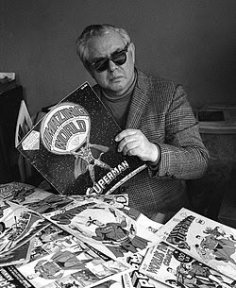
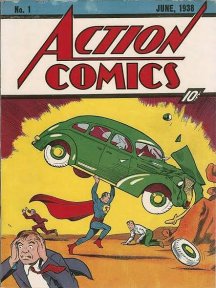
July 10: On this day in 1914, Superman co-creator and artist, Joseph Shuster,
who was perhaps inspired by John Carter’s ability to leap tall
buildings, was born in Toronto, Canada. Shuster was involved in a
number of legal battles over ownership of the Superman character. His
comic book career after Superman was relatively unsuccessful, and by
the mid-1970s, Shuster had left the field completely due to partial
blindness.
He was inducted into both the comic book industry's Will Eisner Comic Book Hall of Fame in 1992 and the Jack Kirby Hall of Fame in 1993. In 2005, the Canadian Comic Book Creator Awards Association instituted the Joe Shuster Awards, named to honor the Canada-born artist.
Think about Superman and then think about John Carter. John Carter came
to Mars from a planet with more gravity and had super strength, speed,
and the ability to leap tall buildings. Same for Superman. John Carter
had strong mental powers. So did Superman, especially if you are of the
school of thought that Superman’s powers, unrelated to lower gravity,
were actually mental powers. Superman and John Carter are both
"strangers in a strange land" who gain god-like abilities due to a
shift in gravity. Carter's 1912 adventures paved the way for the Man of
Steel in 1938. Both are heroic outsiders who fight for justice on a
world not their own. A quick note is that the 1938 incarnation of
Superman was much closer to John Carter in his range of powers than is
the Superman of today. Kal-El’s powers grew as the years went by.
The fictional drabble for today, “Different in the Same Way,” was inspired by the creation of Superman.
DIFFERENT IS THE SAME WAY
Jerry
Siegel and Joe Shuster submitted Superman to National Allied
Publications. The editor, Vin Sullivan, said, “I know this story. A man
from one planet goes to another where he has super strength, can jump
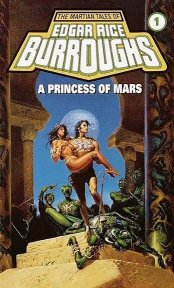
amazingly high, and is fast. It was A PRINCESS OF MARS.”
Shuster said, “Not the same. Earth, not Barsoom. Tights, not a fighting harness.”
“Curses, foiled again. Okay, I’ll buy it.”
UP A TREE WITHOUT A PADDLE

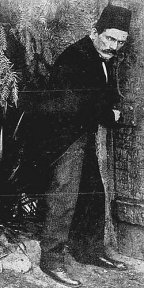
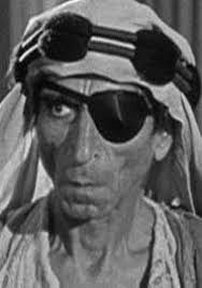
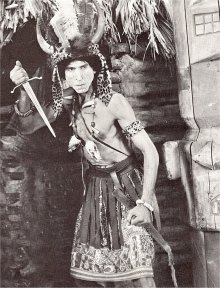
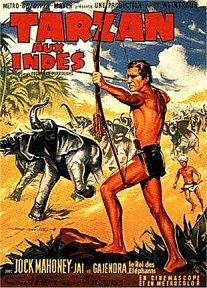
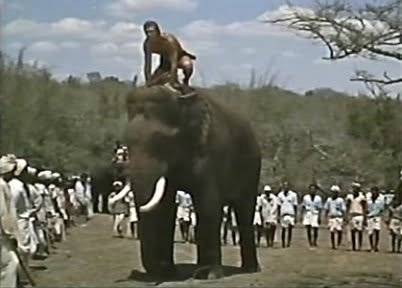
July 11: On this day in 1962, the film, TARZAN GOES TO INDIA, was released. The film starred Yancy Derringer, I mean, Jock Mahoney,
as Tarzan. The film also stars Indian Bollywood actors Feroz Khan, Simi
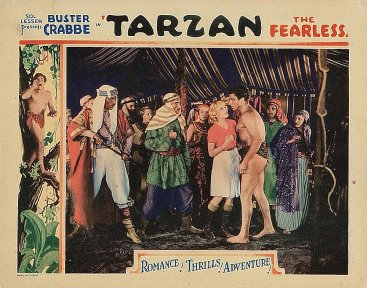
Garewal and Murad in pivotal roles. Over the years, an number of the
actors who’d played Tarzan returned in cameo roles in subsequent Tarzan
films or in one of the television series. Mahoney appeared as the
villain in Tarzan the Magnificent, played Tarzan in two films, and then
appeared three times on the Ron Ely Tarzan television series. He was
the stunt coordinator on Bo Derek’s TARZAN, THE APE-MAN, for which he used an assumed name, Jack O'Mahoney.
Tarzan Goes To India, the highest grossing Tarzan film at the time, was only one of the Tarzan films made in India. Bollywood produced several unauthorized Tarzan films over the years, many more than were produced in the United States. Articles about several of those films may be read at: https://www.erbzine.com/lupton/. You don’t want to miss ROCKET TARZAN or TARZAN AND HERCULES. The 100-word drabble for today, “Up a Tree Without a Paddle,” is a quotation attributed to Jock Mahoney, he who played Tarzan in TARZAN GOES TO INDIA.
UP A TREE WITHOUT A PADDLE
I
loved the role of Tarzan because it was such a distinct challenge. I
remember being 40 feet up in a tree, sunburned as hell. And I thought
to myself, "What is a 42-year-old man doing 40 feet up in a tree,
getting ready to swing out over a bunch of thorn bushes that if you
ever fell into you would be cut to ribbons and damned near killing
myself to get up there?" So I laughed and thought, "Well now, who
wouldn't want to play Tarzan? Neglect, carelessness and not clearing
the stunt area are usually what causes accidents.
BEEP CALM, CARRY ON
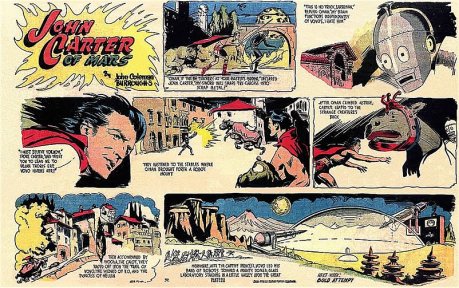
July 12: On this day in 1942, Episode #32, Grim Experiment, John Carter of Mars Sunday comic
was published in the four, that’s right, four, newspapers that carried
the comic. The story goes that since the comic strip debuted on the day
of the Pearl Harbor attack, it never got the attention it deserved.
Also, war coverage limited newspaper resources at the time. UNITED
FEATURES SYNDICATE handled marketing and distribution. The flagship
newspaper was THE CHICAGO SUN.
In episode thirty-two, John Carter encountered a robotic swordsman
named Oman. I must have slept through that encounter every time I read
A Princess of Mars. Carter demanded that the robot take him to Dejah
Thoris and the robot promised to comply. Carter said, “Oman, if this be
trickery at your master's bidding," declared John Carter, "my sword
will shape thy carcass into scrap metal!"
I’m
sure I would have remembered that line. The word "robot" was first used
in 1920 in the science fiction play R.U.R. (Rossum's Universal Robots)
by Czech author Karel Čapek, about ten years after the time when ERB
was writing A Princess of Mars. Literary inaccuracies aside, the art is outstanding and the strip deserved to be in more than four newspapers.
<> The drabble for today, “Beep Calm, Carry On,” was inspired by “Grim Experiment,” and a little Shakespeare and just a touch of British resolve.
BEEP CALM, CARRY ON
John Carter drew his longsword and threatened the mechanical man. “My sword will shape thy carcass into scrap metal.”
“I will help you save Dejah Thoris. Don’t kill me.”
“Kill you? You don’t live. You’re only an oversized windup toy?”
“Not live, you say? If you prick me, do I not bleed. If you tickle me, do not scratches mar my shiny torso?”
“Bleed,
no! Leak oil, yes. No tickling. Help me and live. Wait a second - are
you crying? I didn’t think robots were emotional.”
“I’m not emotional. I’m just low on battery.”
“Get over it, robot. Beep happens.”
TRUTH IN FICTION
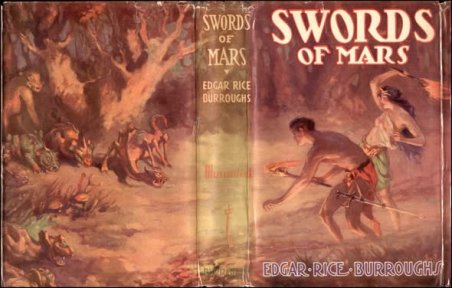
July 13: On this day in 1935, Ed began vacationed solo in the White Mountains, near Springerville, AZ. In SWORDS OF MARS,
ERB revealed that the cave where John Carter lay in “suspended
animation” was in the White Mountains of Arizona. Burroughs was
stationed in southern Arizona at Fort Grant and it’s doubtful that his
assignments every took him as far north as the White Mountains, but we
don’t really know.
The drabble for today, “Truth in Fiction,”
was inspired by Ed’s trip to the White Mountains and in a small amount
to an uncle of mine, who shall go unnamed, but who my father “the most
successful liar who ever lived,” because after he told a story twice,
he believed it himself.
TRUTH IN FICTION
Hulbert Burroughs helped his dad unpack. “How was your trip to Northern Arizona?”
“I enjoyed it. Most of Arizona hasn’t changed all that much in the last forty years.”
“Did you find what you were looking for?”
‘You
remember I always told you that the cave where John Carter hid was near
the little Colorado River in the White Mountains of Arizona.”
“I finally wrote it in Swords of Mars. I’ve told that story so many times that I’ve begun to believe it myself.”
“I’ll be damned if that cave wasn’t exactly where I said it was.”
July 14: On this day in 1930, Edgar Rice Burroughs Incorporated moved into their new offices in Tarzana, offices that they still occupy to this day. To put that in perspective, ERB, Inc.
is possibly the longest-lived continuous publishing company still in
its original form in the United States. The ‘big’ publishers have
undergone a merry-go- round of mergers, takeovers, sales, and closings.
The only exception I can think of is John Wiley and Sons, established
1807, which is still surviving as a family-owned business. ERB, Inc.
seems to continue to follow a simple, but effective, business policy, “Do one thing and do it well.” Promote and publish the works of Edgar Rice Burroughs. Thanks folks.
The FICTIONAL one hundred word drabble for today, “Do What You Do Best,” was inspired by ERB, Inc.’s successful business strategy. While the drabble is fictional, the message for success isn’t.
DO WHAT YOU DO BEST
Danton
Burroughs addressed the board of directors. “We’ve been asked to begin
publishing novels and stories unrelated to Grandpa’s works. I told them
no.”
“Why would you do that. We’ve had Tarzan ice cream and Tarzan toys.”
“We didn’t invest in those. We got paid to let others use the name.”
It’s
outside of our core business. The bankruptcy courts are filled with
companies that tried to be too many things to too many people. "We
focus on our work, on what we know and we do it exceedingly well.
Everything else is just distracting noise.”
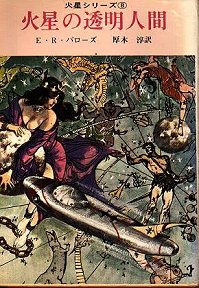
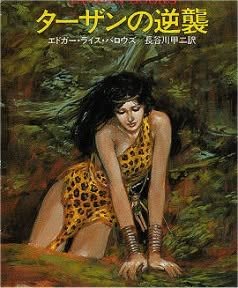
July 15: On this day in 1982, a Japanese version of “The Son of Tarzan, was released by Hayakawa SF Books. The cover artist was Naoyuki Kato. Released on July 15, 1982, the Japanese title was “Tarzan no Gyakushu,” meaning “The Counterattack of Tarzan.”
Details about Japanese editions of ERB’s books, along with several covers, may be viewed at:
The drabble for today doesn’t have anything to do with Japanese
editions, instead it explores blame-shifters, people who actively blame
others for problems that they themselves have created. In psychology,
blaming is classified as a cognitive distortion in which a person
assigns the responsibility for their own problems or feelings entirely
to others. In simple terms, they be crazy.
BLAME SHIFTERS
Jane
read the poster in Major Bouncingbutt’s Bookstore. It advertised the
Major’s new magazine and a book convention to be held in the fall.
“Major, you’re hosting the annual Publishers and Booksellers
Convention?”
“Jane, don’t be a dumb-dumb. I’m hosting my own convention.”
“I
see. You publish your own books, opened your own bookstore, and created
your own magazine, because no one will publish or sell your books and
articles. And now you’ll hold your own convention.”
“They hate my awesomeness. They’re jealous and conspire against me. Morons, liars, and fools, every one of them.”
“Well, I can’t imagine why.”