Erbzine.com Homepage
Official Edgar Rice Burroughs Tribute and Weekly Webzine Site
Since 1996 ~ Over 15,000 Web Pages in Archive

The Sacrificial Knives of the Flaming God: Part I
By Alan Hanson
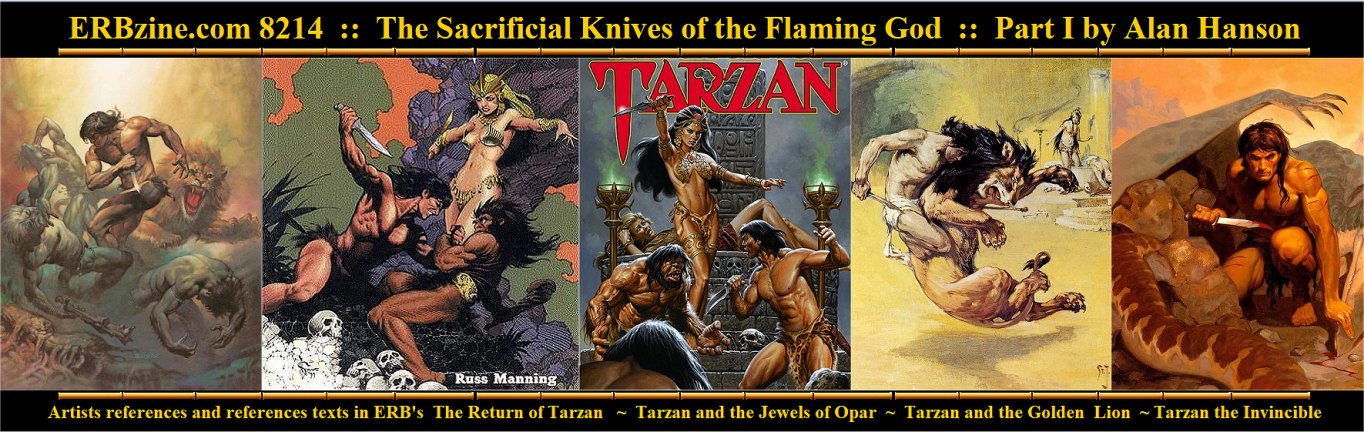
Sacrificial knives are wielded in five separate ancient societies Edger Rice Burroughs’ created in his Tarzan stories. The first, and most memorable, is the sacred sacrificial knife of Opar, which first appears in The Return of Tarzan and later again in Tarzan and the Jewels of Opar, Tarzan and the Golden Lion, and Tarzan the Invincible.  

Burroughs usually portrays such knives as being embedded in the ancient religious customs of “lost” societies. At other times, though, he fashions their use as weapons of fear used to control the followers of fanatical religious leaders. Over the decades of Tarzan’s connections with Opar, the city’s sacrificial knife serves all those purposes at various times.

Tarzan first sees the Oparians’ sacrificial knife during his initial trip to Opar in The Return of Tarzan. Captured, securely bound, and laid upon a stone altar in an Oparian courtyard, Tarzan turns his head and sees a woman entering the open-air enclosure. As she approaches the altar, Tarzan notices she a “jeweled knife” in her girdle. Lesser priests and priestesses, all with small golden cups in their hands, form two lines, ready to capture his lifeblood after the sacrificial service. 

“Then the priestess, standing above him, began reciting what Tarzan took to be an invocation, the while she slowly raised her thin, sharp knife aloft. It seemed ages to the ape-man before her arm ceased its upward progress and the knife halted high above his unprotected breast. Then it started downward, slowly at first, but as the incantation increased in rapidity, with greater speed.” 

A disturbance in the courtyard allows Tarzan time to break his bonds, and, with the assistance of La, the High Priestess, he escapes from Opar. Two months, later, though, after learning Oparians have captured Jane Clayton, Tarzan rushes back to Opar, hoping to arrive in time to save her from the sacrificial knife. 

Sure enough, an unsuspecting Jane is led into the same courtyard that Tarzan had escaped. 

“ … when she saw a stone altar in the center of the courtyard, and dark-brown stains upon it and the nearby concrete of the floor, she began to wonder and to doubt. And as they stooped and bound her ankles, and secured her wrists behind her, her doubts were turned to fear. A moment later, as she was lifted and placed supine across the altar’s top, hope left her entirely, and she trembled in an agony of fright.

“During the grotesque dance of the votaries which followed, she lay frozen in horror, nor did she require the sight of the thin blade in the hands of the high priestess as it rose slowly above her to enlighten her further as to her doom.

“As the hand began its descent, Jane Porter closed her eyes and sent up a silent prayer to the Maker she was so soon to face — then she succumbed to the strain upon her tired nerves, and swooned.” 

 Tarzan arrives just in time to save Jane and carry her away from Opar. Later that day, when she regains consciousness, she slowly recalls her near-death experience beneath the sacrificial knife at Opar. 

“Ah, she remembered now. The altar, the terrible priestess, the descending knife. She gave a little shudder, for she thought that either this was death or that the knife had buried itself in her heart and she was experiencing the brief delirium preceding death.”  <>

Jane had good reason to fear the sacred knife of Opar. Long, thin, and sharp, the sacred jeweled, sacrificial knife had been handed down through the ages to untold generations of High Priestesses of the Flaming God. When, sometime in the outer world’s 20th Century, it passed to the young High Priestess La, it was to her a “heritage and an insignia of her religious office and regal authority from some long-dead progenitor of lost and forgotten Atlantis.” It had already plunged into the hearts of untold sacrifices to the Flaming God. Blood from the hearts of recent victims left dark-brown stains on the altar and surrounding concrete floor of Opar’s sacrificial courtyard. No stains marred the knife, thou, it was polished to its original brightness after each sacrifice to the Flaming God. 

Over three years passed before Tarzan returns to the lost city in Tarzan and the Jewels of Opar. Intending only to raid Opar’s forgotten gold cache, he had no plans to visit the sacrificial courtyard, but after a bump on the head and some wandering around in the bowels of the city, that’s where he finds himself. Just before La is about to plunge the sacrificial knife into the chest of Albert Werper, a Belgian villain, Tarzan comes upon the scene. Stepping quickly to her side, the ape-man seizes La in his strong arms. Though she fights with all the “mad savagery of a demon,” he disarms her and hands her long, sacrificial knife to Werper. 

“Tarzan made his way slowly toward the doorway. Werper pressed close behind … He held the sacrificial knife ready to strike whoever might come within its reach; but none came. For a time he wondered that they should so bravely battle with the giant ape-man, yet hesitate to rush upon him … Werper guessed at the reason for his immunity. The priests feared the sacrificial knife! Willingly would they face death and welcome it if it came while they defended their High Priestess and her alter; but evidently there were deaths, and deaths. Some strange superstition must surround that polished blade, that no Oparian dared to chance a death thrust from it, yet gladly rushed to the slaughter of the ape-man’s flaying spear.” 

With Werper leading the way, swinging the knife in all directions, the Oparians retreat, and the two men find their way through the ancient temples’ corridors and chambers to freedom outside the city’s walls. His memory damaged, Tarzan knows neither his way home nor the value of the “pretty pebbles” he had taken from Opar’s lost jewel room. One night, while the ape-man sleeps, Werper uses the Opar’s sacrificial knife to dig up the jewel pouch he had seen Tarzan bury. Before fleeing into the forest, Werper is tempted to use the knife to make sure Tarzan can’t follow him. “For a moment Werper had stood above the sleeping ape-man, his murderous knife poised for the fatal thrust, but fear stayed his hand.” Werper then slips away with both the jewels and Opar’s sacrificial knife. (The jewels would later be recovered by Tarzan, but the knife was lost forever.)  <>

Meanwhile, La, accompanied by 50 of her frightful priests, leaves Opar in search of “the purloiner of the sacred sacrificial knife.” La had never left Opar, but now the need to retrieve the knife drives her to do so. Burroughs explains, “The sacred knife was gone! Handed down through countless ages it had come to her as a heritage and an insignia of her religious office and regal authority from some long-dead progenitor of lost and forgotten Atlantis.” 

Although Werper was last seen wielding the stolen knife, La searches foremost for Tarzan. Of course, Werper would be killed when found, but La nurses far greater revenge on Tarzan.   <>

“He should be tortured. His should be a slow and frightful death. His punishment should be adequate to the immensity of his crime. He had wrested the sacred knife from La; he had lain sacrilegious hands upon the High Priestess of the Flaming God; he had desecrated the altar and the temple.” 

When the Oparians find Tarzan still asleep where Werper had left him the night before, La immediately announces, “We shall stop here tonight and tomorrow in the face of the Flaming God, La will offer up the heart of this defiler of the temple.” Although she had not retrieved the sacred knife, La’s personal revenge against Tarzan was foremost at the moment. 

“In the darkness La stooped above him. In her hand was a sharp knife and in her mind was to initiate his torture without delay. The knife was pressed against his side and La’s face was close to his … Dagger in hand, La, the High Priestess, towered above the helpless creature that had dared to violate the sanctuary of her diety. “There should be no torture — there should be instant death. No longer should the defiler of the temple pollute the sight of the lord god almighty. A single stroke of the heavy blade and then the corpse to the flaming pyre without. The knife arm stiffened ready for the downward plunge, and then La, the woman, collapsed weakly upon the body of the man she loved.”

The next day, Tantor arrives to rescue Tarzan, who admonished La and her Oparian priests, “If you are not all fools you will let me go my way in peace and you will return to Opar with La. I know not where the sacred knife is; but you can fashion another.” 

After La and the Oparians return to Opar, they must have taken Tarzan’s advice and fashioned a new sacred sacrificial knife, for months later, when Tarzan, Jane, and Mugambi find Werper’s whitened bones in a grassy spot in the forest, the bag with the jewels of Opar is nearby, but the sacrificial knife of Opar is nowhere to be seen.

 Continued in Part II 8215


photo2026h8.jpg
Alan Hanson
Alan Hanson has been an Edgar Rice Burroughs fan since he first read Tarzan of the Apes at age 14 in 1963.
 Starting in 1977, his articles have appeared in numerous Burroughs fanzines and online platforms.
 He is a charter member and past editor of The Edgar Rice Burroughs Amateur Press Association.
Under his "Waziri Publications" imprint, he published Heritage of the Flaming God (1984),
A Tarzan Chrono-log (1988), and Exploring Tarzan's Africa (2022).
In 2006, he was recognized by The Burroughs Bibliophiles literary and educational society for
"Outstanding Achievement and Dedication to the Memory of Edgar Rice Burroughs."


ENJOY 90 IN-DEPTH, ILLUSTRATED ERB-RELATED ARTICLES BY ALAN AT
https://www.ERBzine.com/hanson

Back to 8002nextbam6.jpg

BILL HILLMAN
Visit our thousands of other sites at:
BILL and SUE-ON HILLMAN ECLECTIC STUDIO
ERB Text, ERB Images and Tarzan® John Carter® Priness of Mars® are ©Edgar Rice Burroughs, Inc.- All Rights Reserved.
All Original Work ©1996-2025 by Bill Hillman and/or Contributing Authors/Owners
No part of this web site may be reproduced without permission from the respective owners