Celebrating 100 years of
Tarzan
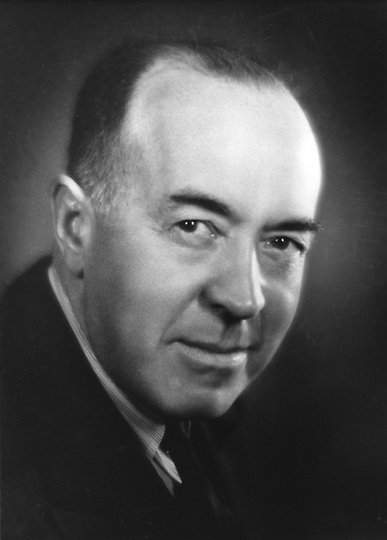
Edgar Rice Burroughs' legacy
-- and namesake of Tarzana
By Dana Bartholomew, Staff Writer
LA Daily News ~ August 13, 2012
It wasn't the screech of chimpanzees that lured famed
researcher Jane Goodall to dream of the wilds of Tanzania. It was Tarzan
of the Apes, Lord of the Jungle. "The more I read, the more passionately
I fell in love with Tarzan," said Goodall, recalling her preteen crush
in an email to the Daily News. "I took whichever book I was reading at
the time up to the top of my favourite tree in the garden -- a beech tree.
There, I imagined myself living in the forest, living with and helping
Tarzan."
As the burly ape-man turns 100, Goodall will join hundreds
of fans in Woodland Hills this week (Aug. 15-18, 2012) for a Tarzan/John
Carter Centennial Celebration. They'll yodel the famous Tarzan yell. They'll
go ape during Tarzan "dum-dum" dancing. And they'll swap every kind of
Tarzan book, knife and loincloth. The four-day junglethon at the Warner
Center Marriott will celebrate the life and work of San Fernando Valley
author-cum-marketing genius Edgar Rice Burroughs, father of the City of
Tarzana and a pioneer of serial fantasy and science fiction.
In a separate ceremony at 11:30 a.m. Friday, the U.S. Postal
Service will unveil a Burroughs-Tarzan stamp at the Tarzana Cultural and
Community Center.
At 11:30 a.m. Saturday, developer and historian Ralph J.
Herman will recount the swinging roots of Tarzana at the Encino-Tarzana
Branch Library.
Then at 11 a.m. Sunday a Tarzana Sidewalk Fair, including
African drums and a Tarzan and Jane look-alike contest, will take place
along Ventura Boulevard's Tarzana Safari Walk.
"I feel awestruck by it. I feel humbled," said John Burroughs,
70, of Malibu, grandson of the late author. "I feel my grandfather would
feel the same."
A jack-of-all-trades from Chicago, the young Burroughs
had become a self-described flop at nearly everything -- cowboy, gold miner,
shopkeeper, railroad cop, Sears and Roebuck manager. He'd even joined the
U.S. Cavalry in Arizona to chase Apaches, "but fortunately for me," he
once said, "I never caught up with any of them."
But at 37 Burroughs was broke, with a wife and two children
and a third on the way. So he took a job managing sales of pencil sharpeners.
In desperation between slack sales, he tried his hand at pulp fiction,
scribbling on office scraps. His first story, "Under the Moons of Mars,"
sold in 1911 and was serialized to July 1912.
 But
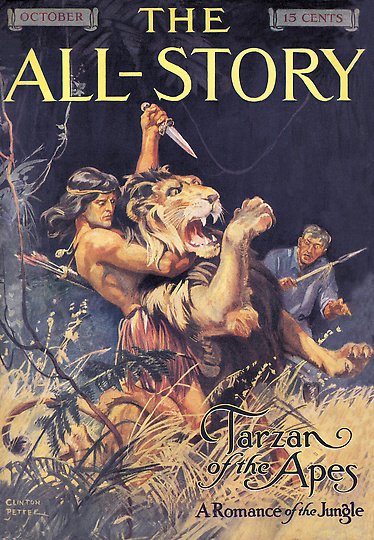
it was his second, Tarzan of the Apes: A Romance of the Jungle,
published in the 15-cent "The All-Story" magazine of October 1912, that
would launch the Burroughs' Tarzan business empire. Its lurid cover depicted
the ape-man about to plunge his dagger into a roaring lion. And its 131
pages told of an Africa still wild, undiscovered and mysterious. And of
Tarzan its true noble savage -- born of a marooned British lord and lady
and raised by a new tribe of apes.
But
it was his second, Tarzan of the Apes: A Romance of the Jungle,
published in the 15-cent "The All-Story" magazine of October 1912, that
would launch the Burroughs' Tarzan business empire. Its lurid cover depicted
the ape-man about to plunge his dagger into a roaring lion. And its 131
pages told of an Africa still wild, undiscovered and mysterious. And of
Tarzan its true noble savage -- born of a marooned British lord and lady
and raised by a new tribe of apes.
The brawny ape king falls in love with a castaway, Jane.
And over the next 26 Tarzan books, he leaps across the jungle canopy, and
battles natives, jungle crocodiles and even center-of-the-Earth dinosaurs.
All the while, Tarzan manages to perform his heroic exploits while managing
to speak Mangani ape, grammatically perfect English, and a host of other
languages from French to Dutch, German, Swahili, Arabic, ancient Greek,
ancient Latin, Mayan and more.
The buff polymath returns to jolly England, becomes disenchanted
with civilization, then whisks Jane back to his beloved jungle. And he
would became protector -- over the next 100 years -- of everything that
was good.
"We need heroes," said Bill Hillman, founder of ERBzine.com,
an official fanzine with more than 10,000 Burroughs and Tarzan pages. Hillman
fell in love with Tarzan as a farm kid on the prairie of Manitoba, Canada,
where he became hooked on actor Lex Barker's movie screen ape-man. Then
he discovered color Tarzan comics and Tarzan radio adventures. And became
an expert on everything Tarzan.
"He was one of the first greenies," said Hillman, 69,
a musician and retired professor. "The bad guys were mostly white guys
trying to destroy the jungle. My god, he was ahead of his time -- with
environmentalists, women's rights and being a hero with high morals."
In 1918, "Tarzan the Apes" starring Elmo Lincoln
became the first film to gross $1 million. Five years later, Burroughs
became one of the first authors to incorporate and be a pioneer for marketing
books, films, radio segments, comics and merchandise. Since then, 50 Tarzan
movies have captivated the big screen, and 65 Tarzan episodes and 32 cartoons
have regaled TV watchers. Tarzan has been featured in 450 comic books,
with comics syndicated in 250 newspapers. Tarzan books have sold 100 million
copies around the world -- reaching an estimated 1 billion fans.
A hundred years after his birth, the Tarzan brand is worth
"millions," according to his estate. Three Tarzan books are in the works,
including a new novel by Robin Maxwell as told by Jane. A Tarzan video
slot machine released two years ago with $5 million payouts is one of the
most popular in Las Vegas. And a new 3-D Tarzan animation movie by the
German Constantin Films is in the works for possible release next year.
"Tarzan lives," said Jim Sullos, president of Edgar Rice
Burroughs, Inc., now controlled by his heirs at his original 1927 office-studio
in Tarzana. "Why? Because he represents someone who couldn't be corrupted.
He learned self-preservation as a baby. He learned not to be dependent
on anyone except his ape family. All he needed was his knife."
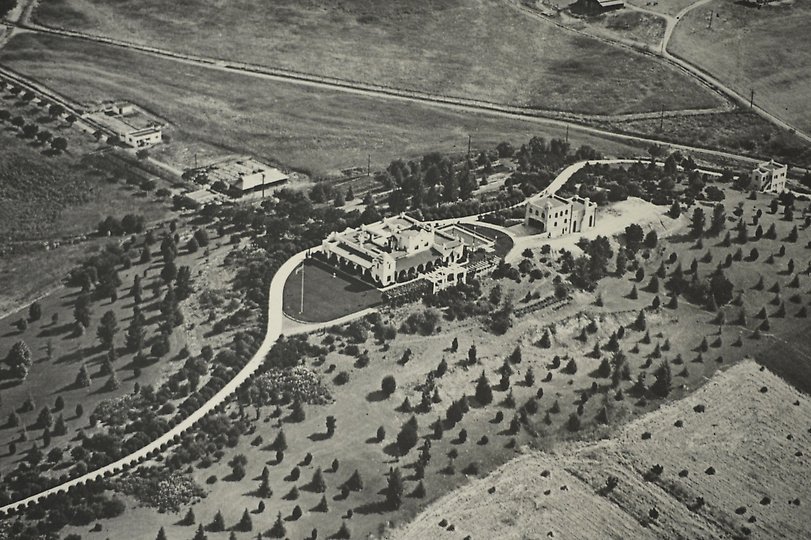
This is a vintage aerial photo of the estate in Tarzana
that once belonged to Edgar Rice Burroughs, creator of the "Tarzan" books.
All Burroughs needed was his pen. In 1919, he bought the
San Fernando Valley estate of Gen. Harrison Gray Otis and renamed it Tarzana
Ranch. An advocate for wildlife, he became a game warden to ward off hunters.
Then rode his horse down to his Ventura Boulevard office to spin tales
of adventure. He penned 70 novels and 40 short stories.
In 1927, his partially developed estate was renamed the
community of Tarzana, where residents remained thrilled by the Tarzan centennial.
"I think it's really exciting," said Jon Tsuchiyama, owner of West Valley
Nursery in Tarzana. who sits on the cultural center board. "It was years
in the making. It puts (us) on the map."
During World War II, Burroughs witnessed the Japanese
attack on Pearl Harbor, and became the world's oldest war correspondent.
When the war ended he moved to Encino, where he developed Parkinson's Disease
and became a curmudgeon like Andy Rooney, according to his grandson John.
Shortly before his grandfather died on March 19, 1950, John remembers the
writer lying in bed as rain pattered against the window. "He put his finger
on a drop of rain, as it hit the mullion," Burroughs recalled. "And he
said, `I shall not pass this way again."' Burroughs' ashes now lie beneath
a giant mulberry tree outside his former Ventura Boulevard office, family
members say.
And Tarzan will forever be the heartthrob who changed
her life, said Goodall, one of the keynote speakers at the Tarzan conference
hosted by Edgar Rice Burroughs, Inc. and the Edgar Rice Burroughs Bibliophiles
Literary Society. "I was really jealous when he married that other Jane,"
she said, saying she herself would have been a far better mate. "I would
not have been afraid to go anywhere with Tarzan. I would not have been
afraid of any wild animals," she said. "I would have willingly risked my
life to help him when he was in any kind of danger. The more I read, the
more jealous I became."
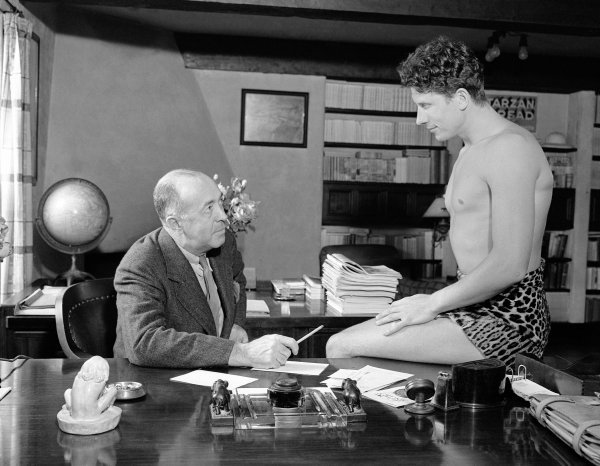
Edgar Rice Burroughs, left, author of the Tarzan
stories,
is seen with Glenn Morris, the 1936 Olympic decathlon champion who
played Tarzan in a 1937 movie.
(AP Photo)