
Volume 1868
Georges Dodds'
The Ape-Man: his Kith and Kin
A collection of texts which prepared the
advent of Tarzan of the Apes by Edgar Rice Burroughs
Presents
http://www.erbzine.com/mag18/yaqzan.htm
Hayy Ibn Yaqzân
Ibn Tufail
Rev. Simon Ockley, translator
Author(s)
Ibn Tufail, a.k.a. Abubacer (before 1110 to 1185 C.E.): 1,
2,
3
Simon Ockley (translator; 1678-1720): 1,
2
Link to Tarzan of the Apes
Altrocchi, Rudolph. 1944. "Ancestors of Tarzan." p. 74-124. Sleuthing
in the Stacks. Cambridge, MA: Harvard Univ. Press.
Edition(s) used
-
Ockley, Simon (transl.). 1708. The Improvement of Human Reason, Exhibited
in the Life of Hai Ebn Yokdhan: Written in Arabick above 500 Years ago,
by Abu Jaafar Ebn Tophail [...]. LONDON: Printed and sold by Edm. Powell
in Black-friars, and J. Morphew near Stationers-hall.

-
Ockley, Simon (transl.). 1929. The History of Hayy ibn Yaqzân,
by Abu Bakr ibn Tufail. A.S. Fulton, ed. New York : Frederick A. Stokes
Company.
Modifications to the text
-
Some spelling and capitalization modernized.
-
Spelling of characters' names unified throughout.
-
Accents not included for words in Greek script.
-
Illustrations courtesy of Osler Library, McGill University.
-
Footnotes given as endnotes, references to the Koran refer to the Sale
edition:
Sale, G. 1881. The Koran: Commonly Called the Alkoran of Mohammed.
New York: American Book Exchange.

§ 1
Our virtuous ancestors (may God be gracious to them!) tell us, that there
is an Indian island, situate under the Equinoctial, where men come into
the world spontaneously without the help of father and mother. For this
island enjoys the most equable and perfect temperature of all places on
the Earth, because it receives its light from the highest possible point
in the heavens; though it must be confessed that such an assertion is contrary
to the opinion of the majority of philosophers and the most celebrated
physicians, who affirm that the fourth clime has the most equable temperature
of all inhabited regions. Now if they say this because they are convinced
that there are no inhabited regions under the Equinoctial, by reason of
some terrestrial impediment, their assertion that the fourth clime is the
most equable of all places on the rest of the earth would have some appearance
of reason. But if their reason be, because of the intense heat of those
lands situate under the Equinoctial (which is that which most of them assign)
it is absolutely false, and the contrary is proved by undeniable demonstration.
For it is demonstrated in Natural Philosophy, that there is no other cause
of heat than motion, or else the contact of hot bodies, or light. It is
also proved that the Sun, in itself, is not hot, nor partakes of any quality
of temperature: it is proved moreover, that the opaque and polished bodies
receive light in the greatest degree of perfection; and next to them, the
opaque which are not polished, and those which are entirely without opacity
receive no light at all. (This was first demonstrated by Avicenna, never
mentioned before by any of the Ancients.) From these premises, this consequence
will necessarily follow, viz. that the Sun does not communicate
his heat to the Earth, after the same manner as hot bodies heat those other
bodies which are near them; because the Sun is not hot in itself. Nor can
it be said that the Earth is heated by motion, because it stands still,
and remains in the same posture, both when the Sun shines upon it, and
when it does not, and yet it is evident to sense that there is a vast difference
in it, in respect of heat and cold, at those several times. Nor does the
Sun first heat the air, and so the Earth; because we may observe in hot
weather, that the air which is nearest the Earth is hotter by much than
that which is higher and more remote. It remains therefore that the Sun
has no other way of heating the Earth but by its light, for heat always
follows light, so that when its beams are collected, as in burning-glasses
for instance, it fires all before it. Now it is established in the exact
sciences by precise demonstration, that the Sun is a spherical body, and
so is the Earth; and that the Sun is much greater than the Earth; and that
part of the Earth which is at all times illuminated by the Sun is above
half of it; and that in that half which is illuminated, the light is most
intense in the midst, both because that part is the most remote from darkness,
as also, because it offers a greater surface to the Sun; and that those
parts which are nearer the circumference of the circle, have less light;
and so gradually, till the circumference of the circle, which encompasses
the illuminated part of the Earth, ends in darkness.
§ 2
Now that is the center of the circle of light, where the Sun is vertical
to the inhabitants, and then in that place the heat is most extremely intense;
and so those countries are the coldest, where the Sun is farthest from
being vertical. And if there were any such place where the Sun was always
vertical, it must needs be extreme hot. Now it is demonstrated in astronomy,
that the Sun is vertical twice a year only, to those which live under the
Equinoctial, viz. when he enters into Aries and Libra;
and all the rest of the year he declines from them, six months northward,
and six months southward; and for that reason they are neither too hot
nor too cold, but of a moderate temper between both. There’s much more
to be said about this argument, in order to the explaining it fully, but
it is not suitable to our purpose; I have only hinted it to you, because
it makes it something more probable that a man might in that region be
formed without the help of father and mother; and there are some which
affirm positively that Hayy Ibn Yaqzân was so, others deny it, and
tell the story thus:
§ 3
They say, that there lay, not far from this our island, another great island
very fertile and well peopled; which was then governed by a prince of a
proud and jealous disposition: he had a sister of exquisite beauty, which
he confined and restrained from marriage, because he could not match her
to one suitable to her quality. He had a near relation whose name was Yaqzân,
that married her privately, according to a rite of matrimony then in use
among them: it was not long before she proved with child, and was brought
to bed of a son; and being afraid that it should be discovered, she took
him in the evening, and when she had suckled him she put him into a little
ark which she closed up fast, and so conveys him to the sea shore, with
some of her servants and friends as she could trust; and there with an
heart equally affected with love and fear, she takes her last leave of
him in these words: "O God, you formed this child out of nothing,(1)
and did cherish him in the dark recesses of my womb, till he was complete
in all his parts; I, fearing the cruelty of this proud and unjust king,
commit him to thy goodness, hoping that thou who art infinitely merciful
will be pleased to protect him, and never leave him destitute of thy care."

§ 4
Then she set him afloat, and that very night the strong tide carried him
ashore on that island we just now mentioned. It fortuned that the water,
being high, carried the ark a great way on shore, farther than it would
have done at another time (for it rises so high but once a year) and cast
the ark into a grove, thick set with trees, a pleasant place, shielded
from wind and rain and veiled from the Sun, which could not penetrate there
neither when it rose nor when it set.(2)
When the tide ebbed, the ark was left there, and the wind rising blew an
heap of sand together between the ark and the sea, sufficient to secure
him from any future danger of such another flood.
§ 5
The nails and timbers of the ark had been loosened when the waves cast
it into that thicket; the child being very hungry wept and cried for help
and struggled. It happened that a roe which had lost her fawn, heard the
child cry, and following the voice (imagining it to have been her fawn)
came up to the ark, and what with her digging with her hoofs from without,
and the child’s thrusting from within, at last between them both they burst
open a board of the lid. Thereupon she was moved with pity and affection
for him, and freely gave him suck; and she visited and tended him continually,
protecting him from all harm. This is the account which they give of his
origin, who are not willing to believe that a man can be produced without
father or mother. We shall tell anon how he grew up and rose from one state
to another, till at last he attained the state of highest perfection.
§ 6
On the other hand, those who affirm that Hayy Ibn Yaqzân was produced
without father and mother, tell us, that in that island, in a piece of
low ground, it chanced that a certain mass of earth was so fermented in
some period of years, that the hot was so equally mixed with the
cold,
and the moist with the dry, that none of them prevailed over
the other; and that this mass was of a very great bulk, in which, some
parts were better and more equally tempered than others, and fitter to
form the seminal humors; the middle part especially, which came nearest
to the temper of man’s body. This matter being in a fermentation, there
arose some bubbles by reason of its viscousness, and it chanced that in
the midst of it there was formed a very little bubble, which was divided
into two with a thin partition, full of spirituous and aerial substance,
and of the most exact temperature imaginable. The matter being thus disposed,
there was, by the command of god, a spirit infused into it, which was joined
so closely to it, that it can scarce be separated from it even so much
as in thought. For this spirit emanates continually and abundantly from
the most high and glorious God, and may be compared to the light of the
Sun which is sent forth continually and abundantly over the world. Now
there are some bodies from whence we perceive no reflection of this light,
as the thin air: others from which we do but imperfectly; such are opaque
bodies which are not polished (but there is a difference in these, and
the difference of their colours arises from the different manner of their
reception of the light); and others reflect the light in the highest degree,
as bodies which are smooth and polished, such as looking-glasses and the
like; so that those glasses when hollowed out after a particular manner
will collect so much light as to produce fire. So that spirit which comes
by the command of God, does at all times act upon all creatures, in some
of which notwithstanding, there appears no impression of it, but the reason
of that is because of their incapacity into whom it is infused; of which
kind are things inanimate which are fitly represented in this similitude
by the thin air. There is another sort again, in which there does appear
something of it, as vegetables and the like, which are represented by the
opaque bodies we mentioned, which are not polished. And then lastly, there
are others, (represented by those polished bodies in our comparison) in
which the influence of this spirit is very visible, and such we reckon
all sorts of animals. Now, among those polished bodies, some besides having
the eminent faculty of receiving the Sun’s light, give an image resembling
the Sun; so also among the animals, some not only have the eminent faculty
of receiving the spirit, but resemble it and are formed in its image. Such
is man particularly, and to him did the Prophet allude when he said, God
created Adam in his own image.
§ 7
Now, when this image in Man prevails to such a degree that all others are
nothing before it, but it remains alone, so as to consume, with the glory
of its light, whatsoever stands in its way; then it is properly compared
to those glasses, which reflect light upon themselves, and burn everything
else; but this is a degree which is peculiar to the Prophets (the blessing
of God be upon them!).
§ 8
But to return, and finish the account of those who describe this kind of
generation: they tell us, that as soon as this spirit was joined to the
receptacle, all the other faculties immediately, by the command of God,
submitted themselves to it. Now, opposite to this receptacle, there arose
another bubble divided into three ventricles by thin membranes, with passages
from one to the other, which were filled with an aerial substance, not
much unlike that which was in the first receptacle, only something finer
than the first; and in each of these three ventricles, which were all taken
out of one, were placed some of those faculties, which were subject to
this governing spirit, and were appointed to take care of their respective
stations, and to communicate everything, both great and small, to that
spirit, which, we told you before was placed in the first receptacle. Right
against this first receptacle, and opposite to the second, there arose
another third bubble, filled with an aerial substance, which as grosser
than that which was in the other two. This receptacle was made for the
entertainment of some other of the inferior faculties.
§ 9
Thus these three receptacles were made in the same order which we have
described, and these were the first part of that great mass which was formed.
Now they stood in need of one another’s assistance; the first wanted the
other two as servants, and they again the assistance and guidance of the
first, as their master and director; but both these receptacles (the former
of which had more authority than the latter), though inferior to the first,
were nevertheless superior to all those organs which were formed afterwards.
The first receptacle of all, by the power of that spirit which was joined
to it and its continual flaming heat, was formed into a conical figure,
like that of fire, and by this means that thick body, which was about it,
became of the same figure, being solid flesh covered with a thick protecting
membrane. The whole of this organ is what we call the heart. Now considering
the great destruction and dissolution of humours, which must needs be where
there is so much heat, it was absolutely necessary that there should be
some part formed, whose office it should be continually to supply this
defect; otherwise it would have been impossible to have subsisted long.
It was also necessary that this forming spirit should have a sense both
of what was convenient for him, and what was hurtful, and accordingly attract
the one and repel the other. For these services there were two parts formed,
with their respective faculties, viz. the brain and the liver: the
first of these presided over all things relating to sense, the latter over
such things as belonged to nutrition: both of these depended upon the heart
for a supply of heat, and the recruiting of their proper faculties. To
supply these divers needs, there were ducts and passages interwoven, some
bigger, some lesser, according as necessity required; and these are the
arteries and veins.
Thus much for a taste; they that tell the story go on farther, and give
you a particular account of the formation of all the parts, as the physicians
do of the formation of the foetus in the womb, omitting nothing till he
was completely formed, and just like an embryo ready for the birth. In
this account they are forced to be beholding to this vast mass of fermented
earth, which you are to suppose contained in it all manner of materials
proper for the making man’s body, those skins which cover it &c.; till
at last, when he was complete in all his parts, as if the mass had been
in labour, those coverings, which he was wrapped up in, burst asunder,
and the rest of the dirt dried and cracked in pieces. The infant being
thus brought into the world, and finding his nourishment fail him, cried
for want of victuals, till the roe which had lost her fawn heard him. Now,
both those who are of the other opinion and those who are for this kind
of generation, agree in all the other particulars of his education: and
what they tell us is this.
§ 10
They say that this roe lived in good and abundant pasture so that she was
fat, and had such plenty of milk, that she was very well able to maintain
the little child; she stayed by him and never left him, but when hunger
forced her; and he grew so well acquainted with her, that if at any time
she staid away from him a little longer than ordinary, he would cry pitifully,
and she, as soon as she heard him; came running instantly; besides all
this, he enjoyed this happiness, that there was no beast of prey in the
whole island.
§ 11
Thus he went on, living only upon what he sucked till he was two years
old, and then he began to step a little and breed his teeth. He always
followed the roe, and she showed all the tenderness to him imaginable;
and used to carry him to places where fruit trees grew, and fed him with
the ripest and sweetest fruits which fell from the trees; and if they had
hard shells, she used to break them for him with her teeth; still suckling
him, as often as he pleased, and when he was thirsty she showed him the
way to the water. If the Sun shined too hot, she shaded him; if he was
cold she cherished him and kept him warm; and when night came she brought
him home to his old place, and covered him partly with her own body, and
partly with some feathers taken from the ark, which had been put in with
him when he was first exposed. Now, when they went out in the morning,
and when they came home again at night, there always went with them an
herd of deer, which lay in the same place where they did, so that the boy
being always amongst them learned their voice by degrees, and imitated
it so exactly that there was scarce any sensible difference; nay, when
he heard the voice of any bird or beast, he would come very near it. But
of all the voices which he imitated, he made most use of the deers', and
could express himself as they do, either when they want help, call their
mates, when they would have them come nearer, or go farther off. (for you
must know that the brute beasts have different sounds to express these
different things.) Thus he contracted such an acquaintance with the wild
beasts, that they were not afraid of him, nor he of them.
§ 12
12 By this time he began to have the ideas of a great many things fixed
in his mind, so as to have a desire to some, and an aversion to others,
even when they were absent. In the meanwhile he considered all the several
sorts of animals, and saw that they were all clothed either with hair,
wool, or feathers; he considered their great swiftness and strength, and
that they were all armed with weapons defensive, as horns, teeth, hoofs,
spurs, and nails; but that he himself was naked and defenceless, slow and
weak, in respect of them. For whenever there happened any controversy about
gathering of fruits, he always came off by the worst, for they could both
keep their own, and take away his, and he could neither beat them off nor
run away from them.
§ 13
He observed besides that his fellow-fawns, though their foreheads were
smooth at first, yet afterwards had horns bud out, and though they were
feeble at first, yet afterwards grew very vigorous and swift. All these
things he perceived in them, which were not in himself; and when he had
considered the matter, he could not imagine what should be the reason of
this difference. Then he considered such animals as had any defect or natural
imperfection, but amongst them all he could find none like himself. He
took notice that the passages of the excrements were protected in all other
creatures besides himself: that by which they voided their grosser excrements,
with a tail; and that which served for the voiding of their urine, with
hair or some such like thing. Besides, he observed that their genital organs
were more concealed than his own were.
§ 14
All these things were matter of great grief to him, and when he had perplexed
himself very much with the thoughts of them, and was now near seven years
old, he despaired utterly of having those things grow upon him, the want
of which made him so uneasy. He therefore got him some broad leaves of
trees, of which he made two coverings, one to wear behind, the other before;
and made a girdle of palm leaves and rushes, to hang his covering upon,
and tied it about his waist. But alas it would not last long, for the leaves
withered and dropt away; so that he was forced to get more, which he plaited
in Layers one upon another, which made it a little more durable, but not
much. Then having broke branches from a tree and fitted the ends of them
to his mind, he stripped off the twigs and made them smooth; with these
he began to attack the wild beasts, assaulting the weaker, and defending
himself against the stronger. By this means he began a little to know his
own powers, and perceived that his hands were better than their fore-feet;
because by the help of them, he had provided wherewithal to cover his nakedness,
and also gotten him a defensive weapon, so that now he had no need of a
tail, nor of those natural weapons which he had so wished for at first.
§ 15
Meanwhile he was growing up and had passed his seventh year, and because
the repairing of his covering of leaves so often, was very troublesome
to him, he had a design of taking the tail of some dead beast, and wearing
it himself; but when he perceived that all beasts did constantly avoid
those which were dead of the same kind, it made him doubt whether it might
be safe or not. At last, by chance he found a dead eagle, and observing
that none of the beasts showed any aversion to that carcass, he concluded
that this would suit his purpose: and in the first place, he cuts off the
wings and the tail whole, and spreads the feathers open; then he drew off
the skin, and divided it into two equal parts, one of which he wore upon
his back, with the other he covered his navel and secrets: the tail he
wore behind, and the wings were fixed upon each arm. This dress of his
answered several ends; for in the first place it covered his nakedness,
and kept him warm, and then it made him so frightful to the beasts, that
none of them cared to meddle with him, or come near him; only the roe his
nurse, which never left him, nor he, her; and when she grew old and feeble,
he used to lead her where there was the best pasture, and pluck the sweetest
fruits for her, and give her them to eat.
§ 16
Notwithstanding this she grew lean and weak, and continued a while in a
languishing condition, till at last she dyed, and then all her motions
and actions ceased. When the boy perceived her in this condition, he was
ready to dye for grief. He called her with the same voice which she used
to answer to, and made what noise he could, but there was no motion, no
alteration. Then he began to peep into her ears and eyes, but could perceive
no visible defect in either; in like manner he examined all the parts of
her Body, and found nothing amiss, but every thing as it should be. He
had a vehement desire to find that part where the defect was, that he might
remove it, and she return to her former state. But he was altogether at
a loss how to compass his design, nor could he possibly bring it about.
§ 17
That which put him upon this search, was what he had observed in himself.
He had noticed that when he shut his eyes, or held anything before them,
he could see nothing at all, till that obstacle was removed; and so when
he put his fingers into his ears, that he could not hear, till he took
them out again; and when he closed his nostrils together, he smelt nothing
till they were opened; from whence he concluded that all his perceptive
and active faculties were liable to impediments, upon the removal of which,
their operations returned to their former course. Therefore, when he had
examined every external part of her, and found no visible defect and yet
at the same time perceived an universal cessation of motion in the whole
body, not peculiar to one member but common to them all, he began to imagine
that the hurt was in some organ which was remote from the sight and hidden
in the inward part of the body; and that this organ was of such nature
and use, that without its help, none of the other external organs could
exercise their proper functions; and that if this organ suffer any hurt,
the damage was general, and a cessation of the whole ensued.
§ 18
18 This made him very desirous to find that organ if possible, that he
might remove the defect from it, that so it might be as it used to be,
and the whole body might enjoy the benefit of it, and the functions return
to their former course. He had before observed, in the bodies of wild beasts
and other animals, that all their members were solid, and that there were
only three cavities, viz. the skull, the breast, and the belly;
he imagined therefore that this organ which he wanted must needs be in
one of these cavities, and above all, he had a strong persuasion that it
was in the middlemost of them. For he verily believed that all the members
stood in need of this organ, and that from thence it must necessarily follow
that the seat of it must be in the centre. And when he reflected upon his
own body, he felt the presence of such an organ in his breast. Now since
he was able to hinder the action of all his other organs, such as hands,
feet, ears, nose and eyes, and deprive himself of it, he conceived that
it might be possible to subsist without them; but when he considered this
organ within his breast he could not conceive the possibility of subsisting
without it, so much as the twinkling of an eye. And upon this account,
whenever he fought with any wild beast, he always took particular care
to protect his breast from being pierced by its horns, because of the apprehension
which he had of that organ which was contained in it.
§ 19
Having, by this way of reasoning, assured himself that the disaffected
organ lay in the breast; he was resolved to make a search in order to examine
it, that whatsoever the impediment was, he might remove it if possible;
but then again, he was afraid on the other side, lest his undertaking should
be worse than the disease, and prove prejudicial. He began to consider
next, whether or no he had ever remembered any wild beasts or other animals
which he had seen in that condition, recover again, and return to the same
state which they were in before, but he could call to mind no such instance;
from whence he concluded that if she was let alone there would be no hopes
at all, but if he should be so fortunate as to find that organ and remove
the impediment, there might be some hope. Upon this he resolved to open
her breast and make enquiry; in order to which he provided himself with
fragments of flint, and splinters of dry cane almost like knives, with
which he made an incision between the ribs, and cutting through the flesh,
came to the diaphragma; which he finding very tough, assured himself
that such a covering must needs belong to that organ which he looked for,
and that if he could once get through that, he should find it. He met with
some difficulty in his work, because his instruments were none of the best,
for he had none but such as were made either of flint or cane.
§ 20
However, he sharpened them again and renewed his attempt with all the skill
he was master of. At last he broke through, and the first part he met with
was the lungs, which he at first sight mistook for that which he searched
for, and turned them about this way and that way to see if he could find
in them the seat of the disease. He first happened upon that lobe which
lay next the side which he had opened and when he perceived that it did
lean sideways, he was satisfied that it was not the organ he looked for,
because he was fully persuaded that that must needs be in the midst of
the body, as well in regard of latitude as longitude. He proceeded in his
search, till at last he found the heart, which when he saw closed with
a very strong cover, and fastened with stout ligaments, and covered by
the lungs on that side which he had opened, he began to say to himself:
"If this organ be so on the other side as it is on this which I have opened,
then it is certainly in the midst, and without doubt the same I look for;
especially considering the convenience of the situation, the comeliness
and regularity of its figure, the firmness of the flesh, and besides, its
being guarded with such a membrane as I have not observed in any other
part." Upon this he searches the other side, and finding the same membrane
on the inside of the ribs, and the lungs in the same posture which he had
observed on that side which he had opened first, he concluded this organ
to be the part which he looked for.
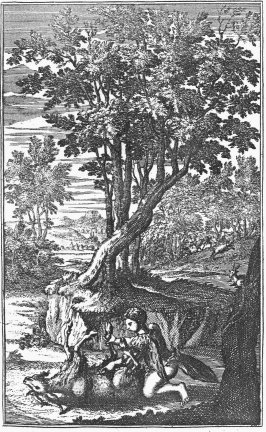
§ 21
Therefore he first attacks the pericardium, which, after a long
trial and a great deal of pains, he made shift to tear; and when he had
laid the heart bare, and perceived that it was solid on every side, he
began to examine it, to see if he could find any apparent hurt in it; but
finding none, he squeezed it with his hand, and perceived that it was hollow.
He began then to think that what he looked for might possibly be contained
in that cavity. When he came to open it, he found in it two cavities, one
on the right side, the other on the left. That on the right side was full
of clotted blood, that on the left quite empty. "Then (says he) without
all doubt, one of those two cavities must needs be the receptacle of what
I look for; as for that on this right side there’s nothing in it but congealed
blood, which was not so, be sure, till the whole body was in that condition
in which it now is" (for he had observed that all blood congeals when it
flows from the body). "This blood does not differ in the least from any
other; and I find it common to all the organs. What I look for cannot by
any means be such a matter as this; for that which I seek is something
which is peculiar to this place, which I find I could not subsist without,
so much as the twinkling of an eye. And this is that which I looked for
at first. As for this blood, how often have I lost a great deal of it in
my skirmishes with the wild beasts, and yet it never did me any considerable
harm, nor rendered me incapable of performing any action of life, and therefore
what I look for is not in this cavity. Now as for the cavity on the left
side, I find it is altogether empty, and I have no reason in the world
to think that it was made in vain, because I find every organ appointed
for such and such particular functions. How then can this ventricle of
the heart, which I see is of so excellent a frame, serve for no use at
all? I cannot think but that the same thing which I am in search of, once
dwelt here, but has now deserted his habitation and left it empty, and
that the absence of that thing has occasioned this privation of sense and
cessation of motion which happened to the body." Now when he perceived
that the being which had inhabited there before had left its house before
it fell to ruin, and forsaken it when as yet it continued whole and entire,
he concluded that it was highly probable that it would never return to
it any more, after its being so cut and mangled.
§ 22
Upon this the whole body seemed to him a very inconsiderable thing, and
worth nothing in respect of that being he believed once inhabited, and
now had left it. Therefore he applied himself wholly to the consideration
of that being. What it was and how it subsisted? What joined it to this
body? Whither it went, and by what passage, when it left the body? What
was the cause of its departure, whether it were forced to leave its mansion,
or left the body of its own accord? And in case it went away voluntarily,
what it was that rendered the body so disagreeable to it, as to make it
forsake it? And whilst he was perplexed with such variety of thoughts,
he laid aside all concern for the carcass, and banished it from his mind;
for now he perceived that his mother, which had nursed him so tenderly
and had suckled him, was that something which was departed; and from it
proceeded all her actions, and not from this inactive body; but that all
this body was to it only as an instrument, like his cudgel which he had
made for himself, with which he used to fight with the wild beasts. So
that now, all his regard to the body was removed, and transferred to that
by which the body is governed, and by whose power it moves. Nor had he
any other desire but to make enquiry after that.
§ 23
In the meantime the carcass of the roe began to putrefy and emit noisome
vapours, which still increased his aversion to it, so that he did not care
to see it. It was not long after that he chanced to see two ravens engaged
so furiously, that one of them struck down the other stark dead; and when
he had done, he began to scrape with his claws till he had dug a pit, in
which he buried the carcass of his adversary. The boy observing this, said
to himself: "How well has this raven done in burying the body of his companion,
though he did ill in killing him! How much greater reason was there for
me to have been forward in performing this office to my mother?" Upon this
he digs a pit, and lays the body of his mother into it, and buries her.
He proceeded in his enquiry concerning what that should be by which the
body was governed, but could not apprehend what it was. When he looked
upon the rest of the roes and perceived that they were of the same form
and figure with his mother, he could not resist the belief that there was
in every one of them something which moved and directed them, like that
which had moved and directed his mother formerly; and for the sake of that
likeness he used to keep in their company and show affection towards them.
He continued a while in this condition, contemplating the various kinds
of animals and plants, and walking about the coast of his island, to see
if he could find any being like himself (as he observed that every individual
animal and plant had a great many more like it). But all his search was
in vain. And when he perceived that his island was encompassed by the sea,
he thought that there was no other land in the world but only that island.
§ 24
It happened that by friction a fire was kindled among a thicket of canes,
which scared him at first, as being a sight which he was altogether a stranger
to, so that he stood at a distance a good while, strangely surprised. At
last he came nearer and nearer by degrees, still observing the brightness
of its light and marvellous efficacy in consuming every thing it touched
and changing it into its own nature; till at last his admiration of it
and that innate boldness and fortitude which God had implanted in his nature
prompted him on, that he stretched out his hand to take some of it. But
when it burnt his fingers and he found there was no dealing with it that
way, he thought to take a stick which the fire had not as yet wholly seized
upon; so taking hold on that end which was untouched he easily gained his
purpose, and carried it home to his lodging (for he had found a cave which
served as a convenient abode). There he kept this fire and added fuel to
it, of dry grass and wood, admired it wonderfully, and tended it night
and day; at night especially, because its light and heat supplied the absence
of the Sun; so that he was extremely delighted with it and reckoned it
the most excellent of all those things which he had about him. And when
he observed that it always moved upwards, he persuaded himself that it
was one of those celestial substances which he saw shining in the firmament,
and he was continually trying of its power, by throwing all manner of things
into it, which he perceived it always vanquished, sometimes sooner, sometimes
slower, according as the bodies which he put into it were more or less
combustible.
§ 25
Amongst other things which he put in to try its strength, he once flung
in some sea animals which had been thrown ashore by the water, and as soon
as ever he smelt the steam, it raised his appetite, so that he had a mind
to taste of them; which he did, and found them very agreeable, and from
that time he began to use himself to the eating of flesh, and applied himself
to fishing and hunting till he understood those sports very well: upon
this account he admired his fire more and more, because it helped him to
several sorts of excellent provision which he was altogether unacquainted
with before.
§ 26
And now when his affection towards it was increased to the highest degree,
both upon the account of its beneficial effects and its extraordinary power,
he began to think that the substance which was departed from the heart
of his mother the roe, was, if not the very same with it, yet at least
of a nature very much like it. He was confirmed in his opinion because
he had observed in all animals, that as long as they lived, they were constantly
warm without any intermission, and as constantly cold after death. Besides
he found in himself, that there was a greater degree of heat by much in
his breast, near that place where he had made the incision in the roe.
This made him think that if he could dissect any animal alive, and look
into that ventricle which he had found empty when he dissected his dam
the roe, he might possibly find it full of that substance which inhabited
it, and so inform himself whether it were of the same substance with the
fire, and whether it had any light and heat in it or not. In order to this
he took a wild beast and tied him down, and dissected him after the same
manner he had dissected the roe, till he came to the heart; and essaying
the left ventricle first, and opening it, he perceived it was full of an
airy vapour which looked like a little mist or white cloud, and putting
in his finger, he found it hotter than he could well endure it, and immediately
the creature dyed. From whence he assuredly concluded that it was that
hot vapour which communicated motion to that animal, and that there was
accordingly in every animal of what kind soever, something like it upon
the departure of which death followed.
§ 27
He was then moved by a great desire to enquire into the other parts of
animals, to find out their order and situation, their quantity and the
manner of their connexion one with another and by what means of communication
they enjoy the benefit of that hot vapour, so as to live by it, how that
vapour is continued the time it remains, from whence it has its supplies,
and by what means its heat is preserved. The way which he used in this
enquiry was the dissection of all sorts of animals, as well living as dead,
neither did he leave off to make an accurate enquiry into them, till at
length he arrived to the highest degree of knowledge in this kind which
the most learned naturalists ever attained to.
§ 28
And now he apprehended plainly that every particular animal, though it
had a great many limbs, and variety of senses and motions, was nevertheless
one in respect of that spirit, whose original was from one firm mansion,
viz.
the heart, from whence its influence was diffused among all the members,
which were merely its servants or instruments. And that this spirit made
use of the body in the same manner as he himself did of his weapons; with
some he fought with wild beasts, with others captured them, and with others
cut them up; the first kind of weapons were either defensive or offensive;
the second kind for the capture either of land or water animals; the third,
his dissecting instruments, were some for fission, others for fraction,
and others for perforation. His body, which was one, wielded those diverse
instruments according to the respective uses of each, and the several ends
which it proposed to obtain.
§ 29
Likewise he perceived that this animal spirit was one, whose action when
it made use of the eye, was sight; when of the ear, hearing; when of the
nose, smelling; when of the tongue, tasting; and when of the skin and flesh,
feeling. When it employed any limb, then its operation was motion; and
when it made use of the liver, nutrition and concoction. And that though
there were members fitted to every one of these uses, yet none of them
could perform their respective offices without having correspondence with
that spirit by means of passages called nerves; and that if at any time
it chanced that these passages were either broken off or obstructed, the
action of the corresponding member would cease. Now these nerves derive
this spirit from the cavities of the brain, which has it from the heart
(and contains abundance of spirit, because it is divided into a great many
partitions) and by what means soever any limb is deprived of this spirit,
its action ceases and it is like a cast off tool, not fit for use. And
if this spirit depart wholly from the body, or is consumed or dissolved
by any means whatsoever, then the whole body is deprived of motion and
reduced to that state which is death.
§ 30
Thus far had his observations brought him about the end of the third seventh
year of his age, viz. when he was one and twenty years old. In which
time he had made abundance of pretty contrivances. He made himself both
clothes and shoes of the skins of such wild beasts as he had dissected.
His thread was made of hair, and of the bark of the stalks of althwa, mallows,
or hemp, or any other plants which afforded such strings as were fit for
that purpose. He learned the making of these threads from the use which
he had made of the rushes, before. He made awls of sharp thorns, and splinters
of cane sharpened with flints. He learned the art of building from the
observations he made upon the swallows' nests. He had built himself a store-house
and a pantry, to lay up the remainder of his provision in, and made a door
to it of canes bound together, to prevent any of the beasts getting in
during his absence. He took birds of prey and brought them up to help him
in his hunting, and kept tame poultry for their eggs and chickens. He took
the tips of the buffalo’s horns and fastened them upon the strongest canes
he could get, and staves of the tree al-Zân and others; and
so, partly by the help of the fire, and partly of sharp edged stones, he
so fitted them that they served him instead of so many spears. He made
him a shield of hides folded together. All this pains he took to furnish
himself with artificial weapons, because he found himself destitute of
natural ones.
§ 31
Now when he perceived that his hand supplied all these defects very well,
and that none of all the various kinds of wild beasts durst stand against
him, but ran away from him and were too nimble for him, he began to contrive
how to be even with them, and thought there would be no way so proper as
to chose out some of the swiftest beasts of the island, and bring them
up tame, and feed them with proper food, till they would let him back them
and then he might pursue the other kinds of Wild beasts. There were in
that island both wild horses and asses; he chose of both sorts such as
seemed fittest for his purpose, and by training he made them wholly obedient
to his Wishes. And when he had made out of strips of skin and the hides
of beasts such things as served him competently well in the room of bridles
and saddles, he could very easily then overtake such beasts as he could
scarce ever have been able to have caught any other manner of way. He made
all these discoveries whilst he was employed in the study of anatomy, and
the searching out of the properties peculiar to each part, and the difference
between them; and all this before the end of that time I speak of, viz.
of the age of 21 years.

§ 32
He then proceeded further to examine the nature of bodies in this world
of generation and corruption, viz. the different kinds of animals,
plants, minerals, and the several sorts of stones, and earth, water, vapour,
ice, snow, hail, smoke, flame, and glowing heat; in which he observed many
qualities and different actions, and that their motions agreed in some
respects, and differed in others. And considering these things with great
application, he perceived that their qualities also agreed in some things,
and differed in others; and that so far as they agreed, they were one;
but when considered with relation to their differences, a great many: so
that when he came to consider the properties of things by which they were
distinguished one from another, he found that they were innumerable and
existence seemed to multiply itself beyond his comprehension. Nay, when
he considered the difference of his own organs, which he perceived were
all distinct from one another by some property and action peculiar to each,
it seemed to him that there was a plurality in himself. And when he regarded
any one organ, he found that it might be divided into a great many parts,
from whence he concluded, that there must needs be a plurality not only
in himself but in every other thing also.
§ 33
Then viewing the matter from another side, he perceived that though his
organs were many, yet they were conjoined and compacted together so as
to make one Whole, and that what difference there was between them consisted
only in the difference of their actions, which diversity proceeded from
the power of that animal spirit, the nature of which he had before searched
into and found out. Now he remembered that that spirit was one in essence,
and the true essence, and that all the organs serve that spirit as instruments;
and so, viewing the matter from this side, he perceived himself to be one.
§ 34
He proceeded from hence to the consideration of all the species of animals
and found that every individual of them was one. Next he considered them
with regard to their different species, viz. as roes, horses, asses
and all sorts of birds according to their kinds, and he perceived that
all the individuals of every species were exactly like one another in the
shape of their organs, both within and without, that their apprehensions,
motions, and inclinations were alike, and that those little differences
which were visible amongst them were inconsiderable in respect of those
many things in which they agreed. From whence he concluded that the spirit
which actuated any species was one and the same, only distributed among
so many hearts as there were individuals in that species; so that if it
were possible for all that spirit which is so divided among so many hearts
to be collected into one receptacle, it would be all the same thing, just
as if any one liquor should be poured out into several dishes and afterwards
put all together again in one Vessel, this liquor would still be the same,
as well when it was divided as when it was altogether, only in respect
of that division it may be said in some sort to be multiplied. By this
way of contemplation he perceived that a whole species was one and the
same thing, and that the multiplicity of individuals in the same species
is like the multiplicity of parts in the same person, which indeed is not
a real multiplicity.
§ 35
Then he represented in his mind all the several kinds of animals, and perceived
that sensation, and nutrition, and the power of moving freely where they
pleased, were common to them all; which actions he was assured before,
were all very proper to the animal spirit, and that those lesser things
in which they differed (notwithstanding their agreement in these greater)
were not so proper to that spirit. From this consideration he concluded
that it was only one and the same animal spirit which actuated all living
creatures whatsoever, though there was in it a little difference which
each species claimed as peculiar to itself. For instance, suppose the same
water be poured out into different vessels, that which is in this vessel
may possibly be something colder than that which is in another, though
it is the same Water still, and so all the portions of this water which
are at the same degree of cold will represent the peculiar state of the
animal spirit which is in all the animals of one species. And as that water
is all one and the same, so is that animal spirit one, though there has
occurred in it an accidental multiplicity. And so under this notion he
looked upon the whole animal kingdom to be all One.
§ 36
Afterwards Contemplating the different Species of Plants, he perceived
that the Individuals of every Species were alike, both in their Boughs,
Leaves, Flowers, Fruits, and manner of Growing. And comparing them with
Animals he found that there must needs be some one thing which they did
all of them partake of, which was the same to them that the Animal Spirit
was to the living Creature, and that in respect of That they were all One.
Whereupon, taking a view of the Vegetable Kingdom, he concluded that it
was One, by reason of that Agreement which he found in the Functions of
Plants, viz. their Nourishment and Growing.
§ 37
Then he associated in his mind, the kingdoms of animals and plants together,
and found that they were both alike in their nutrition and growing, only
the animals excelled the plants in sensation and apprehension and movement,
and yet he had sometimes observed something like it in plants, viz.
that some flowers do turn themselves towards the sun, and that the plants
extend their roots that way the nourishment comes, and some other such
like things. From whence it appeared to him that plants and animals were
one and the same, in respect of that one thing which was common to them
both; which was indeed more perfect in the one, and more obstructed and
restrained in the other; like water that is partly running and partly frozen.
So that he concluded that plants and animals were all one.
§ 38
He next considered those bodies which have neither sense, nutrition nor
growth, such as stones, earth, water, air, and flame, which he perceived
had all of them three dimensions, viz. length, breadth, and thickness,
and that their differences consisted only in this, that some of them were
Coloured, others not, some were warm, others cold, and the like. He observed
that those bodies which were Warm grew cold, and on the contrary, that
those which were cold grew warm. He saw that water was rarefied into vapour,
and vapour again condensed into water; and that such things as were burnt
were turned into coals, ashes, flame and smoke, and if in its ascent smoke
were intercepted by an arch of stone, it thickened there and became like
certain earthy substances. From whence it appeared to him that all these
things were in reality one, though multiplied and diversified accidentally
as the plants and animals were.
§ 39
Then considering with himself what that thing must be which constituted
the unity of plants and animals, he saw that it must be some body, like
those bodies, which had a threefold dimension, viz. length, breadth,
and thickness; and that whether it were hot or cold, it was like any of
those other bodies which have neither sense nor nutrition, and differed
from them only in those acts which proceeded from it by means of animal
or vegetable organs. And that perchance those acts were not essential,
but derived from something else, so that if those acts were to be produced
in those other bodies, they would be like this body. Considering it therefore
abstractedly, with regard to its essence only, as stripped of those acts
which at first sight seemed to emanate from it, he perceived that it was
a body, of the same kind, with those other bodies; upon which contemplation
it appeared to him that, all bodies, as well those that had life, as those
that had not, as well those that moved, as those that rested in their natural
places were one; only there were some from which acts proceeded by means
of organs; concerning which acts he could not yet determine whether they
were essential, or derived from something without. Thus he continued, considering
nothing but the nature of bodies, and by this means he perceived that whereas
at first sight, things had appeared to him innumerable and not to be comprehended;
Now, he discovered the whole mass and bulk of creatures were in reality
only one.
§ 40
He continued in this State a considerable time. Then he considered all
sorts of bodies, both animate and inanimate, which one while seemed to
him to be One; and another, a great many. And he found that all of them
had a tendency either upward, as smoke, flame, and air when detained under
water; or else downward, as water, pieces of earth, or parts of animals
and plants; and that none of these bodies were free from one or other of
these tendencies, or would ever lie still unless hindered by some other
body, and interrupted in their course; as when, for instance, a stone in
its fall is stopped by the solidity and hardness of the Earth, when it
is plain it would otherwise continue still descending; and if you lift
it, you feel that it presses upon you by its tendency toward the lower
place to which it seeks to descend. So smoke still continues going upwards,
and if it should be intercepted by a solid arch, it would divide both to
the right and left, and so soon as it was freed from the arch, would still
continue ascending and pass through the air, which is not solid enough
to restrain it. He perceived also that when a leathern bottle is filled
with air and its neck tightly bound, if you hold it under Water it will
still strive to get up till it returns to its place of air, and then it
rests, and its resistance and its propensity to ascend ceases.
§ 41
He then enquired whether or no he could find any body that was at any time
destitute of both these motions, or a tendency toward them, but he could
find none such among all bodies which he had about him. The reason of this
enquiry was, because he was very desirous to know the nature of body, as
such, abstracted from all manner of properties, from whence arises multiplicity.
But when he found this too difficult a task for him, and he had examined
those bodies which had the fewest properties, and could find none of them
void of one of these two, viz. Heaviness or lightness; he proceeded
to consider the nature of these two properties, and to examine whether
they did belong to body quatenus body, or else by reason of some
property superadded to corporeity. It seemed to him that gravity and levity
did not belong to body as such; for if so, then no body could subsist without
them both: whereas on the contrary, we find that the heavy bodies are void
of all lightness and the light bodies are void of all heaviness. Without
doubt they are two Sorts of bodies, and each possesses an attribute which
distinguishes it from the other, and which is superadded to its corporeity,
otherwise they would be both one and the same thing, in every respect.
From whence it appeared plainly that the essence both of an heavy and light
body was composed of two attributes; one, which was common to them both,
viz.
corporeity; the other, by which they are distinguished one from the other,
viz.
gravity in the one, and levity in the other, which were superadded to corporeity.
§ 42
In like manner he considered other bodies, both animate and inanimate)
and found their essence was composed of corporeity, and some thing or more
superadded to it. And thus he attained a notion of the forms of bodies,
according to their differences. these were the first things he found out,
belonging to the spiritual world; for these forms are not the objects of
sense, but are apprehended by intellectual speculation. Now among other
things of this kind which he discovered, it appeared to him that the animal
spirit which is lodged in the heart (as we have mentioned before) must
necessarily have some attribute superadded to its corporeity, which rendered
it capable of those wonderful actions, different sensations and ways of
apprehending things, and various sorts of motions; and that this attribute
must be its form, by which it is distinguished from other Bodies, which
is the same that the philosophers call the animal soul. And so in plants,
that which was in them the same that natural heat was in beasts, must have
something proper to it, which was its form, which the philosophers call
the vegetative soul And that there was also in inanimate things (viz.
all rocks, besides plants and animals, which are in this sublunary world)
something peculiar to them, by the power of which every one of them performed
such actions as were proper to it, the form of every one of them, and this
is the same which the philosophers call Nature.
§ 43
And when by this contemplation it appeared to him plainly that the true
essence of that animal spirit on which he had been so intent, was compounded
of corporeity and some other attribute superadded to that corporeity, and
that it had its corporeity in common with other bodies; but that this other
attribute which was superadded was peculiar to itself: immediately he despised
and rejected the notion of corporeity, and applied himself wholly to that
other superadded attribute (which is the same that we call the soul) the
nature of which he earnestly desired to know. Therefore he fixed all his
thoughts upon it, and began his contemplation with considering all bodies,
not as bodies, but as endued with forms, from whence necessarily flow these
properties by which they are distinguished one from another.
§ 44
Now by following up this notion and comprehending it in his mind, he perceived
that all the bodies of a certain category had one form in common, from
whence one or more actions did proceed. And that there was in this category
a class whose members, though they agreed with all the rest in that one
common form, had another form besides superadded to it, from whence some
actions proceeded. And further, that there was in this class a group, which
agreeing with the rest in those two forms which they had, was still distinguished
from them by a third form, superadded to those other two, from whence also
proceeded some actions. For instance, all terrestrial bodies, as earth,
stones, minerals, plants, animals, and all other heavy bodies, do make
up one category, and possess in common the same form, from whence flows
downward movement, whilst there is nothing to hinder their descent; and
whensoever they are forced to move upwards, if they are left to themselves,
they immediately by virtue of their form tend downwards again. Now a class
of this category, viz. plants and animals, though they do agree
with all that multitude before mentioned, in that form, yet still have
another form superadded to it, from whence flow nutrition and accretion.
Now the meaning of nutrition is, when the body that is nourished, substitutes
in the room of that which is consumed and wasted from itself, something
of the like kind, which it draws to itself, and then converts into its
own substance. Accretion, or growing, is a motion according to the three
dimensions, viz. length, breadth, and thickness in a due proportion.
And these two actions are common to plants and animals, and do without
doubt spring from that form which is common to them both, which is what
we call the vegetative soul. Now a group of this class, viz. animals,
though they have the first and second Forms in common with the rest, have
still a third form superadded, from which arise sensations and local motion.
Besides, he perceived that every particular species of animals had some
property which distinguished it and made it quite different from the rest,
and he knew that this difference must arise from some form peculiar to
that species, which was superadded to the notion of that form which it
had in common with the rest of animals. And the like he saw happened to
the several kinds of plants.
§ 45
And it was evident to him that the essences of those sensible bodies, which
are in this sublunary world, had some of them more attributes superadded
to their corporeity, and others, fewer. Now he knew that the Understanding
of the fewer must needs be more easy to him than the understanding of those
which were more in number. And therefore he endeavoured to get a true notion
of the essence of some one thing which had the fewest essential attributes.
Now he perceived that the essences of animals and plants were composed
of a great many attributes, because of the great variety of their actions;
for which reason he deferred the enquiring into their forms. As for the
parts of the Earth, he saw that some of them were more simple than others,
and therefore resolved to begin his enquiry with the most simple of all.
So he perceived that Water was a thing far from complex, which appeared
from the paucity of those actions which arise from its form. The same he
likewise observed in the fire and air.
§ 46
Now he had already perceived that all these four might be changed one into
another; and that there must be some one thing which they jointly participated
of, and that this thing was corporeity. Now it was necessary that this
one thing which was common to them all should be altogether free from those
attributes by which these four were distinguished one from the other, and
be neither heavy nor light; hot nor cold; moist nor dry; because none of
these qualities were common to all bodies, and therefore could not appertain
to body as such. And that if it were possible to find any such body, in
which there was no other form superadded to corporeity, it would have none
of these qualities, nor indeed any other but what were common to all bodies,
with what form soever endued. He considered therefore with himself, to
see if he could find any one adjunct or property which was common to all
bodies, both animate and inanimate; but he found nothing of that nature,
but only the notion of extension, and that he perceived was common to all
bodies, viz. that they had all of them length, breadth, and thickness.
Whence he gathered, that this notion belonged to body, as body. However,
his sense could not represent to him any body existent in Nature, which
had this only property, and was void of all other forms: For he saw that
every one of them had some other notion superadded to the said extension.
§ 47
Then he considered further, whether this three-fold extension was the very
Notion of Body, without the addition of another Notion; and quickly found
that behind this Extension there was another Notion, in which this Extension
did exist, and that Extension could not subsist by itself, as also the
thing which was extended could not subsist by itself without extension.
This he experimented in some of those sensible bodies which are endued
with forms; for example, in clay: which he perceived, when moulded into
any figure, (spherical suppose) had in it a certain proportion, length,
breadth, and thickness. But then if you took that very same ball, and reduced
it into a cubical or oval figure, the dimensions were changed, and did
not retain the same proportion which they had before, and yet the clay
still remained the same, without any change, only that it must always have
a length, breadth, and thickness, in some proportion or other, and could
not be deprived of these dimensions: Yet it was plain to him from the successive
alterations of them in the same body, that they constituted a notion distinct
from the clay itself; as also, that because the clay could not be altogether
without them, it appeared to him that they belonged to its essence. And
thus from this consideration it appeared to him that body regarded as body,
was composed in reality of two notions: The one of which represents the
clay, of which the sphere was made; the other, the threefold extension
of it, when formed into a sphere, cube, or what other figure soever. Nor
was it possible to conceive body, but as consisting of these two notions,
neither of which could subsist without the other. But that one, (namely,
that of extension) which was liable to change. and could successively put
on different figures, did represent the form in all those bodies which
had forms. And that other which still abode in the same state, (which corresponded
to the clay, in our last Instance) did represent the notion of corporeity,
which is in all bodies, of what forms soever. Now that thing which is represented
by clay in the foregoing instance, is the same which the philosophers call
matter, and ???, which is wholly destitute of all manner of forms.
§ 48
When his contemplation hid proceeded thus far, and he was got to some distance
from sensible objects, and was now just upon the confines of the intellectual
world, he was diffident, and inclined rather to the sensible world, which
he was more used to. Therefore he retreated a little and left the consideration
of abstracted body (since he found that his senses could by no means reach
it, neither could he comprehend it) and applied himself to the consideration
of the most simple sensible bodies he could find, which were those four
about which he had been exercised. And first of all he considered the water,
which he found, if let alone in that condition which its form required,
had these two things in it, viz. sensible cold, and a propension
to move downwards: But if heated by the fire or the sun, its coldness was
removed, but its propension to move downwards still remained: But afterwards,
when it came to be more vehemently heated, it lost its tendency downwards,
and mounted upwards; and so it was wholly deprived of both those properties
which used constantly to emanate from its form. Nor did he know any thing
more of its form, but only that these two actions proceeded from thence;
and when these two ceased, the nature of the form was altered, and the
watery form was removed from that body, as soon as it manifested actions
whose nature is to emanate from another form; and it received another form
which had not been there before, from which arose those actions, which
never used to appear in it whilst it had the first form.
§ 49
Now he knew that every thing that was produced anew must needs have some
producer. And from this contemplation, there arose in his mind a sort of
impression of the maker of that form, though his notion of him as yet was
general and indistinct. Then he paused on the examining of these forms
which he knew before, one by one, and found that they were produced anew,
and that they must of necessity be beholden to some efficient cause. Then
he considered the essences of forms, and found that they were nothing else,
but only a disposition of body to produce such or such actions. For instance,
water, when very much heated, is disposed to rise upwards, and that disposition
is its form. For there is nothing present in all this, but a body, and
some things which are observed to arise from it, which were not in it before
(such as qualities and motions) and an efficient cause which produces them.
And the fitness of a body for one motion rather than another, is its disposition
and form. The same he concluded of all other forms, and it appeared to
him that those actions which emanated from them were not in reality owing
to them, but to the efficient cause which produced in them those actions
which are attributed to them. Which notion of his is exactly the same with
what the apostle of God says (may God bless him and grant him peace!):
I
am his Hearing by which he hears, and his seeing by which he sees;
and in the Clear Book of Revelation: You did not kill them, but God
killed them; when you threw the darts, it was not you that threw them,
but God.(3)
§ 50
Now, when he had attained thus far, so as to have a general and indistinct
notion of this agent, he had a most earnest desire to know it distinctly.
And because he had not as yet withdrawn himself from the sensible world,
he began to look for this agent among sensible things; nor did he as yet
know whether it was one agent or many. Therefore he enquired strictly into
all such bodies as he had about him, viz. those which he had been
employed about all along, and he found that they were all liable to generation
and corruption. And if there were any which did not suffer a total corruption,
yet they were liable to a partial one, as water and earth, the parts of
which, he observed, were consumed by fire. Likewise among all the rest
of the bodies which he was conversant with, he could find none which were
not produced anew and therefore dependent upon some agent. Upon which account
he laid them all aside, and transferred his thoughts to the consideration
of the heavenly bodies. And thus far he reached in his contemplations,
about the end of the fourth septenary of his age, viz. when he was
now eight and twenty years old.
§ 51
Now he knew very well that the heavens, and all the luminaries in them,
were bodies, because they were all extended according to the three dimensions,
length, breadth and thickness, without any exception; and that every thing
that was so extended, was body; ergo, they were all bodies. Then
he considered next, whether they were extended infinitely, as to stretch
themselves to an endless length, breadth and thickness; or, whether they
were circumscribed by any limits, and terminated by some certain bounds
beyond which there could be no extension. But here he stopped a while,
as in a kind of amazement.
§ 52
At last, by the strength of his apprehension and sagacity of his understanding,
he perceived that the notion of infinite body was absurd and impossible,
and a notion wholly unintelligible. He confirmed himself in this judgment
of his by a great many arguments which occurred to him, and he thus argued
with himself: That this heavenly body is terminated on this side which
is next to me, is evident to my sight; and that it cannot be infinitely
extended on that opposite side, which raised this scruple in me, I prove
thus. Suppose two lines drawn from the extremity of this heavenly body,
on that terminated side which is next to me, which lines should be produced
quite through this body, in infinitum, according to the extension
of the body; then suppose a long part of one of these lines cut off at
this end which is next to me; then take the remainder of what was cut off,
and draw down that end of it where it was cut off, and lay it even with
the end of the other line from which there was nothing cut off; and let
that line which was shortened lie parallel with the other; then follow
these two lines in the direction in which we supposed them to be infinite.
Either you will find both these lines infinitely extended, and then one
of them cannot be shorter than the other, but that which had a part of
it cut off will be as long as that which had not, which is absurd: Or else
the line which was cut will not go on for ever like that other, but will
stop and consequently be finite. Therefore if you add that part to it which
was cut off from it at first, which was finite, the whole will be finite;
and it will be no longer or shorter than that line which had nothing cut
off from it, but equal to it. But this is finite, therefore the other is
finite. And the body in which such lines are drawn is finite. But such
lines may be drawn in all bodies. Therefore if we suppose an infinite body,
we suppose an absurdity and impossibility.

§ 53
When by the singular strength of his genius (which he exerted in the finding
out such a demonstration) he had satisfied himself that the body of Heaven
was finite, he desired, in the next place, to know what figure it was of,
and how it was limited by the circumambient superficies. And first he observed
the Sun, Moon and stars, and saw that they all rose in the East, and set
in the West; and those which went right over his head described a great
circle, but those at a greater distance from the vertical point, either
northward or southward, described a lesser circle. So that the least circles
which were described by any of the stars, were those two which went round
the two poles, the one North, the other South; the last of which is the
Circle of Sohail or Canopus; the first, the Circle of those
two Stars which are called Alpherkadâni. Now because he lived
under the equinoctial line (as we showed before) all those circles did
cut the horizon at right angles, and both North and South were alike to
him, and he could see both the pole-stars. He observed that if a star arose
at any time in a great circle, and another star at the same in a lesser
circle, yet nevertheless, as they rose together, so they set together:
and he observed it of all the stars, and at all times. From whence he concluded
that the Heaven was of a spherical figure; in which opinion he was confirmed,
by observing the return of the Sun, Moon and stars to the East, after their
setting; and also, because they always appeared to him of the same bigness,
both when they rose, and when they were in the midst of Heaven, and at
the time of their setting; whereas, if their motions had not been circular,
they must have been nearer to sight at some times than others, and consequently
their dimensions would have appeared proportionally greater or lesser;
but since there was no such appearance, he concluded that the Heaven was
spherical. Then he considered the motion of the Moon and the planets from
West to East, till at last he understood a great part of astronomy. Besides,
he apprehended that their motions must be in different spheres, all which
were comprehended in another which was above them all, and which turned
about all the rest from East to West in the space of a day and a night.
But it were too tedious to explain particularly how he advanced in this
science; besides, it is taught in other books; and what we have already
said is as much as is requisite for our present purpose.
§ 54
When he had attained to this degree of knowledge, he found that the whole
orb of the heavens and whatsoever was contained in it was as one thing
compacted and joined together; and that all those bodies which he used
to consider before, as earth, water, air, plants, animals and the like,
were all of them so contained in it, as never to go out of its bounds:
and that the whole was like one animal, in which the luminaries represented
the senses; the spheres so joined and compacted together, answered to the
limbs; and in the midst, the world of generation and corruption, to the
belly, in which the excrements and humours are contained, and which oftentimes
breeds animals, as the greater world.
§ 55
Now when it appeared to him that the whole World was as one individual,
and he had united all the parts of it by the same way of thinking which
he had before made use of in considering the world of generation and corruption;
he proposed to his consideration the world in general, and debated with
himself whether it did exist in time, after it had not been; and came to
be out of nothing; or whether it had been from eternity, without any privation
preceding it. Concerning this matter he had very many and great doubts,
so that neither of these two opinions did prevail over the other. For when
he proposed to himself the belief of its eternity, there arose a great
many objections in his mind; because he thought that the notion of infinite
existence was pressed with no less difficulties than that of infinite extension:
And that such a being as was not free from accidents produced a-new, must
also itself be produced a-new, because it cannot be said to be more ancient
than those accidents: And that which cannot exist before accidents produced
in time, must needs itself be produced in time. Then on the other hand,
when he proposed to himself the belief of its being produced a-new, other
objections occurred to him; for he perceived that it was impossible to
conceive any notion of its being produced a-new, unless it was supposed
that there was time before it; whereas time was one of those things which
belonged to the world, and was, inseparable from it; and therefore the
world could not be supposed to be later than time. Then he considered,
that a thing produced must needs have a producer: And if so, Why did this
producer make the world now, and not as well before? Was it because of
any new chance which happened to him? That could not be, for there was
nothing existent besides himself. Was it then upon the account of any change
in his own nature? But what should produce that change? Thus he continued
for several Years, arguing pro and con about this matter; and a great many
arguments offered themselves on both sides, so that neither of these two
Opinions in his judgment over-balanced the other.
§ 56
This put him to a great deal of trouble, which made him begin to consider
with himself what were the consequences which did follow from each of these
Opinions, and that perhaps they might be both alike. And he perceived that
if he held that the World was created in time, and had come into existence
after a total privation, it would necessarily follow from thence that it
could not have come into existence of itself, without the help of some
agent to produce it. And that this agent must needs be such an one as cannot
be apprehended by our senses; for if he should be the Object of sense,
he must be body, and if body, then a part of the world, and consequently
a created being; such an one as would have stood in need of some other
cause to create him; and if that second creator was body, he would depend
upon a third, and that third upon a fourth, and so ad infinitum,
which is absurd. Therefore the world stands in need of an incorporeal creator:
And if the creator thereof is incorporeal, it is impossible for us to apprehend
him by any of our senses; for we perceive nothing by the help of them but
body, or such accidents as adhere to bodies: And if he cannot be perceived
by the senses, it is impossible he should be apprehended by the imagination;
for the imagination does only represent to us the forms of things in their
absence, which we have before learned by our senses. And if he is not body,
we must not attribute to him any of the properties of body; the first of
which is extension, from which he is free, as also from all those properties
of bodies which flow from it. And if he is the maker of the world, doubtless
he has the sovereign command and knowledge of it. Shall not he know
it, that created it? He is wise, omniscient!(4)
§ 57
Furthermore, he saw that if he held the eternity of the world, and that
it always was as it now is, without any privation before it; then it would
follow that its motion must be eternal too; because there could be no rest
before it, from whence it might commence its motion. Now all motion necessarily
requires a mover; and this mover must be either a power diffused through
some body, that is through the body of a being which moves itself, or through
some other body without it, or else a certain power not diffused or dispersed
through any body at all. Now every power which passes, or is diffused,
through any body, is divided or doubled according as the body is divided
or doubled. For instance; the gravity in a stone, by which it tends downwards,
if you divide the stone into two parts, is divided into two parts also;
and if you add to it another like it, the gravity is doubled. And if it
were possible to add stones in infinitum, the gravity would increase
in
infinitum too. And if a stone should grow to a certain size and stop
there, the gravity would also increase to such a pitch, and no farther.
Now it is demonstrated that all body must necessarily be finite; and consequently,
that power which is in body is finite too. If therefore we can find any
power which produces an infinite effect, it is plain that it is not in
body. Now we find that the Heaven is moved about with a perpetual motion,
without any cessation, since we admit the Heaven to be eternal. Whence
it necessarily follows that the power which moves it is not in its own
body, nor in any other exterior body; but proceeds from something altogether
abstracted from body, and which cannot be described by corporeal adjuncts
or properties. Now he had learned from his first contemplation of the world
of generation and corruption, that the true reality of body consisted in
its form, which is its disposition to several sorts of motion; but that
the reality which consisted in its matter was very mean, and scarce possible
to be conceived. Therefore the reality of the whole world consists in its
disposition to be moved by this mover, who is free from matter and the
properties of body, abstracted from every thing which. we can either perceive
by our senses or reach by our imagination. And if he is the efficient cause
of the divers motions of the heavens, which he produces by an action in
which there is no irregularity, no abatement, no cessation; without doubt
he has power over them, and a knowledge of them.
§ 58
Thus his contemplation this way brought him to the same conclusion it did
the other Way. So that doubting concerning the eternity of the world, and
its existence de novo, did him no harm at all. For it was plain
to him both ways, that there was an agent, which was not body, nor joined
to body, nor separated from it, nor within it, nor without it, because
conjunction and separation, and being within any thing, or without it,
are all properties of body, from which that agent is altogether abstracted.
And because the matter in all bodies stands in need of a form, as not being
able to subsist without it, nor exist really, and the form itself cannot
exist but by this agent; it appeared to him that all things owed their
existence to this agent, and that none of them could subsist but through
him: and consequently, that he was the cause, and they the effects, (whether
they were newly created after a privation, or whether they had no beginning
in time ‘twas all one) and creatures whose existence depended upon that
agent; and that without his continuance they could not continue, nor exist
without his existing, nor have been eternal without his being eternal,
but that he was essentially independent of them, and free from them. And
how should it be otherwise, when it is demonstrated that his power and
might are infinite, and that all bodies and whatsoever belongs to them
are finite? Consequently, that the whole world and whatsoever was in it,
the heavens, the Earth, the stars, and whatsoever was between them, above
them, or beneath them, was all his Work and creation, and posterior to
him in Nature, if not in time. As, if you take anybody whatsoever in your
hand, and then move your hand, the body will without doubt follow the motion
of your hand, with such a motion as shall be posterior to it in nature,
though not in time, because they both began together. So all this World
is caused and created by this agent, out of time, whose command is,
when he would have anything done, be, and it is.
(5)
§ 59
And when he perceived that all things which did exist were his workmanship,
he looked them over again, considering in them attentively the power of
their author, and admiring the Wonderfulness of the Workmanship, and such
accurate Wisdom and subtle knowledge. And there appeared to him in the
most minute creatures (much more in the greater) such footsteps of wisdom,
and wonders of the work of creation, that he was swallowed up with admiration,
and fully assured that these things could not proceed from any other than
an agent of infinite perfection, nay, that was above all perfection; such
an one " to whom the Weight of the least atom was not unknown, whether
in Heaven or Earth; no, nor any other thing, whether lesser or greater
than it."
(6)
§ 60
Then he considered all the kinds of animals, and how this agent had given
such a fabric of body to every one of them, and then taught them how to
use it. For if he had not directed them to apply those members which he
had given them, to those respective uses for which they were designed,
they would have been so far from being of any service that they would rather
have been a burden. From whence he knew that the creator of the world was
supereminently bountiful and exceedingly gracious. And then when he perceived
among the creatures, any that had beauty, elegance, perfection, strength,
or excellence of any kind whatever, he considered with himself, and knew
that it all emanated from that agent, and from his existence and operation.
And he knew that what the agent had in his own nature, was greater than
that which he saw in the creatures, more perfect and complete, more beautiful
and glorious, and more lasting; and that there was no proportion between
the one and the other. Neither did he cease to prosecute this search, till
he had run through all the attributes of perfection, and found that they
were all in this agent, and all flowed from him; and that he was most worthy
to have them all ascribed to him, above all the creatures which were described
by them.
§ 61
61 In like manner he enquired into all the attributes of imperfection,
and perceived that the maker of the world was free from them all. And how
was it possible for him to be otherwise, since the notion of imperfection
is nothing but mere non-existence, or what depends upon it? And how can
he any way partake of non-existence, who is the pure existence, necessarily
by his essence; who gives being to every thing that exists, and besides
whom there is no existence; but He is the being, He the perfection, He
the plenitude, He the beauty, He the glory, He the power, He the knowledge?
He is He, and besides Him all things are subject to perishing.
(7)
§ 62
Thus far his Knowledge had brought him towards the end of the fifth septenary
from his birth, viz. when he was 35 years old. And the consideration
of this supreme agent was then so rooted in his heart, that it diverted
him from thinking upon any thing else: and he so far forgot the consideration
of the creatures, and the enquiring into their natures, that as soon as
ever he cast his eyes upon anything of what kind soever, he immediately
perceived in it the work of this agent; and in an instant his thoughts
were taken off from the work, and transferred to the worker. So that he
was inflamed with the desire of him, and his heart was altogether withdrawn
from thinking upon this inferior world, which contains the objects of sense,
and wholly taken up with the contemplation of the upper, intellectual world.
§ 63
Having now attained to the knowledge of this supreme being, which has no
cause of his own existence, but is the cause why all things else exist;
he was desirous to know by what means he had attained this Knowledge, and
by which of his faculties he had apprehended this being. And first he examined
all his senses, viz. his hearing, sight, smelling, tasting and feeling,
and perceived that all these apprehended nothing but body, or what was
in body. For the hearing apprehended nothing but sounds, and these came
from the undulation of the air, when bodies are struck one against another;
the sight apprehends colours; the smelling, odours; the taste, savours;
and the touch, the temperatures and dispositions of bodies, such as hardness,
softness, roughness and smoothness. Nor does the imagination apprehend
anything but as it has length, breadth, and thickness. Now all these things
which are thus apprehended are the adjuncts of bodies; nor can these senses
apprehend anything else, because they are faculties diffused through bodies,
and divided according to the division of bodies, and for that reason cannot
apprehend anything else but divisible body. For such a faculty being diffused
through something divisible, it is impossible, but that when it apprehends
any thing whatsoever, that thing so apprehended must be divided as the
faculty is divided. For which reason, no faculty which is seated in body
can apprehend anything but what is body, or in it. Now it was already demonstrated
that this necessarily existent being is free in every respect from all
properties of body; and consequently not to be apprehended but by something
which is neither body, nor any faculty inherent in body, nor has any manner
of dependence upon it, nor is either within it, or without it, nor joined
to it, nor separated from it. From whence it appeared to him that he had
apprehended this being by that which was his essence, and that the notion
of this being was grounded in him. And from hence he concluded that this
essence wherewith he perceived this being was incorporeal, and free from
all the properties of body; and that all the external and corporeal part
which he perceived in his being, was not in reality his essence; but that
his true essence was that, by which he apprehended that being of necessary
existence.
§ 64
Having thus learned that his essence was not that corporeal mass which
he perceived with his senses and was clothed with his skin, he began to
entertain mean thoughts of his body, and set himself to contemplate that
noble essence, by which he had reached the knowledge of that superexcellent
and necessarily existent being; and began to consider whether this noble
essence of his could possibly perish, or become corrupt and dissolve; or
whether it were of perpetual duration. Now he knew that corruption and
dissolution were accidents of body, and consisted in the putting off one
form, and putting on another. As for instance: when water is changed into
air, and air into water; or when plants are turned into earth or ashes,
and earth again into plants (for this is the true notion of corruption).
But an incorporeal thing, which has no dependence upon body, but is altogether
free from the accidents proper to body, cannot be supposed to be liable
to corruption.
§ 65
Having thus secured himself in this belief that his real essence
could not be dissolved, he had a mind to know what condition it should
be in when it had laid aside the body and was freed from it; which he already
knew would not be, till the body ceased to continue a fit instrument for
its use. Therefore he considered all his apprehensive faculties, and perceived
that every one of them did sometimes apprehend potentially, and sometimes
actually; as the eye when it is shut, or turned away from the object, sees
potentially (for the meaning of apprehending potentially is, when it does
not apprehend now, yet can do it for the time to come). And when the eye
is open, and turned toward the object, it sees actually (for that is called
actual, which is present). And so every one of these faculties is sometimes
in power, and sometimes in act. And if any of them did never actually apprehend
its proper Object, so long as it remains in power it has no desire to its
particular object; because it knows nothing of it (as a man that is born
blind). But if it did ever actually apprehend, and then be reduced to the
power only: so long as it remains in that condition, it will desire to
apprehend in act; because it has been acquainted with the Object, and is
intent upon it, and lingers after it; as a man who could once see, and
after is blind, continually desires visible Objects. And according as the
object which he has seen is more perfect and glorious and beautiful, his
desire towards it is proportionally increased, and his grief for the loss
of it so much the greater. Hence it is that the grief of him who is deprived
of that sight he once had, is greater than his who is deprived of smelling;
because the objects of sight are more perfect and beautiful than those
of smelling. And if there be any thing of boundless perfection, infinite
beauty, glory and splendour, that is above all splendour and beauty, so
that there exists no perfection, beauty, brightness, or comeliness, but
flows from it; then certainly he that shall be deprived of the sight and
knowledge of that thing, after he has once been acquainted with it, must
necessarily, so long as he continues in that state, suffer inexpressible
anguish; as on the contrary, he that continually has it present to him
must needs enjoy uninterrupted delight, boundless felicity, and infinite
joy and gladness.
§ 66
Now it had been already made plain to him that all the attributes of perfection
belonged to that being which did necessarily self-exist, and that he was
far from all manner of imperfection. He was certain withal, that the faculty
by which he attained to the apprehension of this being was not like to
bodies, nor subject to corruption, as they are. And from hence it appeared
to him that whosoever had such an essence as was capable of apprehending
this noble being, must, when he put off the body as the time of his death,
have been formerly, during his governorship of the body, first, either
one who was not acquainted with this necessarily self-existent being, nor
ever was joined to him, nor ever heard any thing of him; and so would,
at the separating with the body, never desire him, nor be concerned at
the want of him; because all the corporeal faculties cease when the body
dies, nor do they any longer desire or linger after their proper objects,
nor are in any trouble or pain for their absence. (This is the condition
of all animals deprived of reason, whether they be of human shape or no.)
Or else, secondly, such an one, who during his governorship of the body,
did acquire a notion of this being, and had a sense of his perfection,
greatness, dominion, and power; but afterwards declined from him, and followed
his carnal desires, till at length death overtook him whilst in this state;
he shall be deprived of that vision, and yet be afflicted with the desire
of enjoying it, and so remain in lasting punishment and inexpressible torture;
whether he be to be delivered from his misery after long pain, and enjoy
that vision which he used to desire, or, everlastingly to abide in the
same torments, according as he was fitted and disposed for either of these
two, during his continuance in the body. Or lastly, he were such an one,
who while in the body acquired the notion of this necessarily self-existent
being, and applied himself to it with the utmost of his ability, and has
all his thoughts continually intent upon his glory, beauty, and splendour,
and never turns from him, not forsakes him, till death seizes him in the
act of contemplation and intuition: such a man as this shall, when separated
from body, remain in everlasting pleasure and delight and joy and gladness,
by reason of the uninterrupted vision of that self-existent being, and
its entire freedom from all impurity and mixture; and because all those
sensible things shall be removed from him, which are the proper objects
of the corporeal faculties, and which, in regard of his present state,
are no better than torments, evils and hindrances.
§ 67
Being thus satisfied that the perfection and happiness of his own being
consisted in the actually beholding that necessarily self-existent being
perpetually, so as not to be diverted from it so much as the twinkling
of an eye, that death might find him actually employed in that vision,
and so his pleasure might be continued, without being interrupted by any
pain; he began to consider with himself by what means this vision might
actually be continued, without interruption. So he was very intent for
a time upon that being; but he could not stay there long, before some sensible
object or other would present itself to his view, or the voice of some
wild beast would rend his ears, or some fantasy affected his imagination,
or he was touched with some pain in some part or other, or he was hungry,
or dry, or too cold, or too hot, or was forced to rise to ease Nature;
so that his contemplation was interrupted, and he removed from that state
of mind; and then he could not, without a great deal of difficulty, recover
himself to that state he was in before; and he was afraid that death should
overtake him at such a time as his thoughts were diverted from the vision,
and so he should fall into everlasting misery and the pain of separation.
§ 68
This put him into a great deal of anxiety, and when he could find no remedy,
he began to consider all the several sorts of animals, and observe their
actions, and what they were employed about; in hopes of finding some of
them that might possibly have a notion of this being and an endeavour after
him; that so he might learn of them which way to be saved. But he found
that they were all wholly taken up in getting their provision, and satisfying
their desires of eating and drinking and copulation, and choosing the shady
places in hot weather, and the sunny ones in cold; and that all their life-time,
both day and night, till they died, was spent after this manner, without
any variation, or minding anything else at any time. From whence it appeared
to him that they knew nothing of this being, nor had any desire towards
it, nor became acquainted with it by any means whatsoever; and that they
all tended toward a state of privation, or something very near a-kin to
it. Having passed this judgment upon the animals, he knew that it was much
more reasonable to conclude so of vegetables, which had but few of those
apprehensions which the animals had; for if that whose apprehension was
more perfect did not attain to this knowledge, much less could it be expected
from that whose apprehension was less perfect; especially when he saw that
all the actions of plants reached no farther than nutrition and generation.
§ 69
He next considered the stars and spheres, and saw that they had all regular
motions, and went round in a due order, and that they were pellucid and
shining, and remote from any approach to change or corruption. Which made
him have a strong suspicion that they had essences distinct from their
bodies, which were acquainted with this necessarily self-existent being;
and that these understanding essences were neither bodies nor imprinted
in bodies. And why might it not be supposed that they might have incorporeal
essences, when he himself had, notwithstanding his weakness and extreme
need of sensible things? For he partook of corruptible body, and yet nevertheless,
all his defects did not hinder him from having an incorporeal incorruptible
essence. From whence he concluded that the celestial bodies were much more
likely to have it; and he was assured that they had a knowledge of that
necessarily self-existent being, and did actually behold it at all times,
because they were not at all encumbered with those hindrances, arising
from the intervention of sensible things, which debarred him from enjoying
the vision without interruption.
§ 70
Then he began to consider with himself, what should be the reason why he
alone, above all the rest of living creatures, should be endued with such
an essence as made him like the heavenly bodies. Now he understood before
the nature of the elements, and how one of them used to be changed into
another, and that there was nothing upon the face of the Earth which always
remained in the same form, but that generation and corruption followed
one another perpetually in a mutual succession; and that most of these
bodies were mixed and compounded of contrary things, and were for that
reason the more disposed to corruption; and that there could not be found
among them all anything pure, but that such bodies as came nearest to purity,
and had least mixture, are least subject to corruption, as gold and jacinth;
and that the heavenly bodies were simple and pure, and for that reason
far removed from corruption, and not subject to a succession of forms.
Furthermore it was clear to him that the real essence of those bodies,
which are in this sublunary world, consisted in some, of one single form
added to the notion of corporeity, as the four elements; in others of more,
as animals and plants; and that those, whose essence consisted of the fewest
forms, had fewest actions, and were farther distant from life. And that
if there were any body to be found, that was destitute of all form, it
was impossible that it should live, but was next to nothing at all; also
that those whose essence most forms, had the most operations, and had more
ready and easy entrance to the state of life. And if this form were so
disposed, that there were no way of separating it from the matter to which
it properly belonged, then the life would be manifest, permanent and vigorous
to the utmost degree; but on the contrary, whatsoever body was altogether
destitute of a form, was ???, matter without life, and near a-kin to nothing.
And that the four elements subsisted with one single form only, and are
of the lowest rank of existence in the sublunary world, out of which other
things endued with more forms are compounded. And that the life of these
elements is very weak, both because they have no variety of motion, but
always tend the same way; and because every one of them has an adversary
which manifestly opposes the tendency of its nature, and endeavours to
deprive it of its form; and therefore its existence lacks stability, and
its life is weak. But that plants had a stronger life, and animals a life
more manifest than the plants: the reason of which is, because that whenever
it happened that in any of these compound bodies, the nature of one element
prevailed, that predominant element would overcome the natures of the rest,
and destroy their power, so that the compounded body would be of the same
nature with that prevailing element, and consequently partake but of a
small portion of life, because the element itself does so.
§ 71
On the contrary, if there were any of these compounded bodies, in which
the nature of one element did not prevail over the rest, but they were
all equally mixed, and a match one for the other; then one of them would
not abate the force of the other, any more than its own force is abated
by it, but they would work upon one another with equal power, and the operation
of any one of them would not be more conspicuous than that of the rest;
and this body would be far from being like to any one of the elements,
but would be as if it had nothing contrary to its form, and consequently
the more disposed for life; and the greater this equality of temperature
was, and by how much the more perfect, and further distant from inclining
one way or other, by so much the farther it is distant from having any
contrary to it, and its life is the more perfect. Now since that animal
spirit which is seated in the heart is of a most even temperature, as being
finer than earth and water, and grosser than fire and air, it has the nature
of a mean between them all, and which has no manifest opposition to any
of the elements, and by this means is capable of the form of animality.
And he saw that it followed from hence, that those animal spirits which
were of the most even temperature, were the best disposed for the most
perfect life in this world of generation and corruption, and that this
spirit was very near having no opposite to its form, and did in this respect
resemble the heavenly bodies which have no opposite to their forms; and
that the spirit of such an animal, because it was a mean between all the
elements, had no absolute tendency, either upwards or downwards; but that,
if it were possible it should be placed in the middle space, between the
centre and the highest bounds of the region of fire, and not be destroyed,
it would continue in the same place, and move neither upwards nor downwards;
but if it should be locally moved, it would move in a round, as the heavenly
bodies do, and if it moved in its place, it would be round its own centre;
and that it was impossible for it to be of any other figure but spherical,
and for that reason it is very much like to the heavenly bodies.
§ 72
And when he had considered the properties of animals, and could not see
any one among them, concerning which he could in the least suspect that
it had any Knowledge of this necessarily self-existent Being; but he knew
that his own Essence had the Knowledge of it; he concluded from hence that
he was an animal, endued with a spirit of an equal temperature, as all
the heavenly bodies are, and that he was of a distinct species from the
rest of animals, and that he was created for another end, and designed
for something greater than what they were capable of. And this was enough
to satisfy him of the nobility of his nature, namely, that his viler part,
i.e. the corporeal, was most like of all to the heavenly substances, which
are without this world of generation and corruption, and free from all
accidents that cause any defect, change or alteration; and that his nobler
part, viz. that by which he attained the Knowledge of the necessarily
self-existent being, was something sovereign and divine, not subject to
corruption, nor capable of being described by any of the properties or
attributes of bodies; not to be apprehended by any of the senses or by
the imagination, nor to be known by the means of any other instrument but
itself alone; and that it attained the knowledge of itself by it self,
and was at once the knower, the knowledge, and the thing known; the faculty
and the object. Neither was there any difference between any of these,
because diversity and separation are properties and adjuncts of bodies;
but body was no way concerned here, nor any property or adjunct of body.
§ 73
Having apprehended the manner by which the being like the heavenly bodies
was peculiar to him above all other kinds of animals whatever, he perceived
that it was a duty necessarily incumbent upon him to resemble them, and
imitate their actions, and endeavour to the utmost to become like them.
He perceived also that in respect of his nobler part, by which he had attained
the Knowledge of that necessarily self-existent being he did in some measure
resemble it, because he was separated from the attributes of bodies, as
the necessarily selfexistent being is separated from them. He saw also
that it was his duty to endeavour to make himself master of the properties
of that being by all possible means, and put on his qualities, and imitate
his actions, and labour in the doing his will, and resign himself wholly
to him, and submit to his dispensations heartily and unfeignedly, so as
to rejoice in him, though he should lay afflictions upon his body, and
hurt, or even totally destroy it.
§ 74
He also perceived that he resembled the beasts in his viler part, which
belonged to this generable and corruptible world, viz. this dark,
gross body, which sought from that world a variety of sensible things,
such as food, drink, and copulation. And he knew that his body was not
created and joined to him in vain, but that he was obliged to preserve
it and take care of it, which he saw could not be done without some of
those actions which are common to the rest of the animals. Thus it was
plain to him that there were three sorts of actions which he was obliged
to, namely 1. those by which he resembled the irrational animals; or, 2.
those by which he resembled the heavenly bodies; or, 3. those by which
he resembled the necessarily self-existent being. And that he was obliged
to the first, as having a gross body, consisting of several parts, and
different faculties, and variety of motions; to the second, as having an
animal spirit, which had its seat in the heart, and was the first beginning
of the body and all its faculties; to the third, as he was what he was,
viz.
as he was that essence, by which he knew the necessarily self-existent
being. And he was very well assured before, that his happiness and freedom
from misery consisted in the perpetual vision of that necessarily self-existent
being, without being averted from it so much as the twinkling of an eye.
§ 75
Then he weighed with himself, by what means a continuation of this vision
might be attained, and the result of his contemplation was this,
viz.
That he was obliged to keep himself constantly exercised in these three
kinds of assimilation. Not that the first of them did any way contribute
to the helping him to the vision (but was rather an impediment and hindrance,
because it was concerned only in sensible objects, which are all of them
a sort of veil or curtain interposed between us and it) but because it
was necessary for the preservation of the animal spirit, whereby the second
assimilation, i.e. the assimilation to the heavenly bodies was acquired,
and was for this reason necessary, though encumbered with those inconveniences.
But as to the second assimilation, he saw indeed that a great share of
that continued vision was attained by it, but that it was not without mixture;
because, whatsoever contemplates the vision after this manner continually,
does, together with it, have regard to, and cast a look upon his own essence,
as shall be shown hereafter. But that the third assimilation was that by
which he obtained the pure vision, and absolute absorption, without being
diverted from it one way or other by any means whatsoever, but being still
intent upon that necessarily self-existent being; which whosoever enjoys,
has no regard to any thing else, and his own essence is altogether neglected,
and vanished out of sight, and become as nothing; and so are all other
essences both great and small, except only the essence of that one,
true, necessarily self-existent, highest and all-powerful being.
§ 76
Now when he was assured that the utmost bound of all his desires consisted
in this third assimilation, and that it was not to be attained without
being a long time exercised in the second, and that there was no continuing
so long as was necessary for that purpose, but by means of the first (which,
how necessary soever, he knew was an hindrance in itself, and an help only
by accident), he resolved to allow himself no more of that first assimilation
than needs must, which was only just so much as would keep the animal spirit
alive. Now, in order to this, he found there were two things necessary;
the former, to help it inwardly, and supply the defect of that nourishment
which was wasted; the latter, to preserve it from without, against the
extremities of heat and cold, rain and sun, hurtful animals, and such like.
And he perceived that if he should allow himself to use these things, though
necessary, unadvisedly and at adventure, it might chance to expose him
to excess, and by that means he might do himself an injury unawares. Whereupon
he concluded it the safest way to set bounds to himself, which he resolved
not to pass; both as to the kind of meat which he was to eat, and the quantity
and quality of it, and the times of returning to it.
§ 77
And first he considered the several kinds of those things which were fit
to eat, and found that there were three sorts, viz. either such
plants as were not yet come to their full growth, nor attained to perfection,
such as are several sorts of green herbs: or secondly, the fruits of plants
which were fully ripe, and had seed fit for the production of more of the
same kind (and such were the kinds of fruits that were newly gathered and
dry): or lastly, living creatures, both fish and flesh. Now he knew very
well that all these things were created by that necessarily self-existent
being, in approaching to whom he was assured that his happiness did consist,
and in desiring to resemble him. Now the eating of these things must needs
hinder their attaining to their perfection, and deprive them of that end
for which they were designed; and this would be an opposition to the working
of the supreme agent, and such an opposition would hinder that nearness
and conformity to him which he so much desired. Upon this he thought it
the best way to abstain from eating altogether, if possible; but when he
saw that this would not do, and that such an abstinence tended to the dissolution
of his body, which was so much a greater opposition to the agent than the
former, by how much he was of a more excellent nature than those things,
whose destruction was the cause of his preservation; of two evils he resolved
to choose the least, and do that which contained in it the least opposition
to the creator; and resolved to partake of any of these sorts, if those
he had most mind to were not at hand, in such quantity as he should conclude
upon hereafter; and if it so happened that he had them all at hand, then
he would consider with himself, and choose that in the partaking of which
there would be the least opposition to the Work of the creator: such as
the pulp of those fruits which were full ripe, and had seeds in them fit
to produce others of the like kind, always taking care to preserve the
seeds, and neither eat them, nor spoil them, nor throw them in such places
as were not fit for plants to grow in, as on rocks, salt earth, and the
like. And if such eatable pulpy fruits as apples, pears, plums, &c.
could not easily be come at, he would then take such as had nothing in
them fit to eat but only the seed, as walnuts and chestnuts, or such green
herbs as were not fully grown; always observing this rule, that let him
take of which sort he would, he still chose those that there was greatest
plenty of, and which increased fastest, but so as to pull up nothing by
the roots, nor spoil the seed. And if none of these things could be had,
he would then take some living creature, or its eggs; but when he took
any animal, he must choose that sort of which there was the greatest plenty,
so as not totally to destroy any species.
§ 78
These were the rules which he prescribed to himself as to the kinds of
his provision. As to the quantity, his rule was to eat no more than just
what would satisfy his hunger; and as for the time of his meals, he designed,
when he was once satisfied, not to seek any more till he found some disability
in himself which hindered his exercise in the second assimilation (of which
we are now going to speak). As for those things which necessity required
of him towards the conservation of his animal spirit, in regard of defending
it from external injuries, he was not much troubled about them, for he
was clothed with skins, and had a house sufficient to secure him from those
inconveniences from without, which was enough for him; and he thought it
superfluous to take any further care about those things; and as for his
diet, he observed those rules which he had prescribed to himself, namely,
those which we have just now set down.
§ 79
After this he applied himself to the second operation, viz. the
imitation of the heavenly bodies, and expressing their proper qualities
in himself; which when he had considered, he found to be of three sorts.
The first were such as had relation to those inferior bodies which are
placed in this world of generation and corruption, as heat, which they
impart by their essence, and cold by accident, illumination, rarefaction,
and condensation, and all those other, things by which they influence these
inferior bodies, whereby these bodies are disposed for the reception of
spiritual forms from the necessarily self-existent agent. The second sort
of properties which they had were such as concerned their own being, as
that they were clear, bright and pure, free from all manner of turbidness,
and whatsoever kinds of pollution; that their motion was circular, some
of them moving round their own centre, and some again round the centre
of another. The third kind of their properties were such as had relation
to the necessarily self-existent agent, as their continually beholding
him without any interruption, and having a desire towards him, being busied
in his service, and moving agreeable to his will, and not otherwise, but
as he pleased, and by his power. So he began to resemble them in every
one of these three kinds to the utmost of his power.
§ 80
And as for his first conformity, his imitation of them consisted in removing
all things that were obstructive or hurtful, either from animals or plants,
if they could be removed. So that if he saw any plant which was deprived
of the benefit of the sun by the interposition of any other body, or that
its growth was hindered by its being twisted with any other plant, he would
remove that which hindered it if possible, yet so as not to hurt either;
or if it was in danger of dying for want of moisture, he took what care
he could to water it constantly. Or if he saw any creature pursued by any
wild beast, or entangled in a snare, or pricked with thorns, or that had
gotten any thing hurtful into its eyes or ears, or was hungry or thirsty,
he took all possible care to relieve it. And when he saw any watercourse
stopped by any stone, or any thing brought down by the stream, so that
any plant or animal was hindered of it, he took care to remove it. And
thus he continued in this first kind of imitation of the heavenly bodies,
till he had attained it to the very height of perfection.
§ 81
The second sort of imitation consisted in his continually obliging himself
to keep his body clean from of manner of dirt and nastiness, and washing
himself often, keeping his nails and his teeth clean, and the secret parts
of his body, which he used to rub whenever possible with sweet herbs and
perfume with odours. He used frequently to make clean his clothes, and
perfume them, so that he was all over resplendent with beauty, cleanliness
and fragrance, Besides this, he used different sorts of circular motion,
sometimes walking round the island, compassing the shore and going round
the utmost bounds of it; sometimes walking or running a certain number
of times round about his house or some stone, at other times turning himself
round so often that he was dizzy.
§ 82
The third sort of imitation consisted in confining his thoughts to the
contemplation of that necessarily self-existent being. And in order to
this, he removed all his affections from sensible things, shut his eyes,
stopped his ears, and refrained himself as much as possible from following
his imagination, endeavouring to the utmost to think of nothing besides
him, nor to admit together with him any other object of contemplation.
And he used to help himself in this by rapidly turning himself round, in
which when he was very violently exercised, all manner of sensible Objects
vanished out of his sight, and the imagination and all the other faculties
which make any use of the organs of the body grew weak; and on the other
side, the operations of his essence, which depended not on the body, grew
strong, so that at some times his meditation was pure and free from any
mixture, and he beheld by it the necessarily self-existent being. But then
again the corporeal faculties would return upon him and spoil his contemplation,
and bring him down to the lowest degree
(8) where he was before. Now, when he had any infirmity upon him which
interrupted his design, he partook of some food, but still according to
the aforementioned rules; and then removed again to that state of imitation
of the heavenly bodies, in these three respects which we have mentioned.
And thus he continued for some time opposing his corporeal faculties, and
they opposing him, and mutually struggling one against another; and at
such times as he got the better of them, and his thoughts were free from
mixture, he did apprehend something of the state of those who have attained
to the third assimilation.
§ 83
Then he began to seek after this third assimilation, and took pains in
the attaining it. And first he considered the attributes of the necessarily
self-existent being. Now it had appeared to him during the time of his
theoretical speculation, before he entered upon the practical part, that
there were two sorts of them, viz. positive, as knowledge, power
and wisdom; and negative, as immateriality, not only such as consisted
in the not being body, but in being altogether removed from anything that
had the least relation to body, though at never so great a distance. And
that this was a condition not only required in the negative attributes,
but in the positive too, viz. that they should be free from all
attributes of body, of which multiplicity is one. Now the divine essence
is not multiplied by these positive attributes, but all of them together
are one and the same thing, viz. his real essence. Then he began
to consider how he might imitate him in both these kinds; and as for the
positive attributes, when he considered that they were nothing else but
his real essence, and that by no means it could be said of them that they
are many (because multiplicity is an attribute of body), and that the knowledge
which he has of his essence is his essence; it appeared to him, that if
he would know the divine essence, this knowledge would not be a notion
superadded to the divine essence, but be the very being itself. And he
perceived that his way to make himself like to him, as to what concerned
his positive attributes, would be to know him alone, abstracted wholly
from all attributes of body.
§ 84
This he applied himself to; and as for the negative attributes, they all
consisted in the exemption from corporeity. He began therefore to strip
himself of all bodily properties. This he had made some progress in before,
during the time of the former exercise, when he was employed in the imitation
of the heavenly bodies; but there still remained a great many relics, as
his circular motion (motion being one of the most proper attributes of
body) and his care of animals and plants, compassion upon them, and industry
in removing whatever inconvenienced them (for this too belonged to corporeal
attributes, since in the first place it was by a corporeal faculty that
he saw them, and then by a corporeal faculty that he laboured to serve
them). Therefore he began to reject and remove all those things from himself,
as being in no wise consistent with that state which he was now in search
of. So he continued, confining himself to rest in the bottom of his cave,
with his head bowed down, and his eyes shut, and turning himself altogether
from all sensible things and the corporeal faculties, and bending all his
thoughts and meditations upon the necessarily self-existent being, without
admitting any thing else besides him; and if any other object presented
itself to his imagination, he rejected it with his utmost force, and exercised
himself in this, and persisted in it to that degree, that sometimes he
did neither eat nor stir for a great many days together. And whilst he
was thus earnestly taken up in contemplation, sometimes all manner of beings
whatsoever would be quite out of his mind and thoughts, except his own
essence only.
§ 85
But he found that his own essence was not excluded his thoughts, no not
at such times when he was most deeply immersed in the contemplation of
the true, necessarily self-existent being. Which concerned him very much,
for he knew that even this was a mixture in the pure vision and the admission
of an extraneous object in that contemplation. Upon which he endeavoured
to disappear from himself and be wholly taken up in the vision of that
true being; till at last he attained it; and then both the heavens and
the earth, and whatsoever is between them, and all spiritual forms, and
corporeal faculties, and all those faculties which are separate from matter
(namely the essences which know the necessarily self-existent being) all
disappeared and vanished " like "scattered dust" (9)and
amongst these his own Essence disappeared too, and there remained nothing
but this One, True, Perpetually Selfexistent Being, who spoke thus in that
Saying of his (which is not a Notion superadded to his Essence) To whom
now belongs the Kingdom? To God, the One, the Almighty.
(10) Which words of his Hayy Ibn Yaqzân understood, nor was his
being unacquainted with words, and not being able to speak, any hindrance
at all to the understanding them. Wherefore he deeply immersed himself
into this state, and witnessed that which neither eye hath seen, nor ear
heard, nor hath it ever entered into the heart of Man to conceive.
§ 86
And now, let not thy heart crave a description of that which the heart
of man cannot conceive. For if a great many of those things which the heart
doth conceive are nevertheless hard to be explained, how much more difficult
must those be which cannot be conceived by the heart, nor are circumscribed
in the limits of that world in which it converses. Now, when I say the
heart, I don’t mean the substance of it, nor that spirit which is contained
in the cavity of it; but I mean by it, the form of that spirit which is
diffused by its faculties through the whole body of man. Now every one
of these three is sometimes called the heart, but it is impossible that
this thing which I mean should be comprehended by any of these three, neither
can we express any thing by words, which is not first conceived in the
heart. And whosoever asks to have that state explained, asks an impossibility;
for it is just as if a man should have a mind to taste colours, quatenus
colours, and desire that black should be either sweet or sour. However,
I shall not dismiss you without some indications whereby I shall convey
to you in some measure what wonderful things he saw when in that station,
but all figuratively and by way of parable, without knocking upon the door
of truth; for there is no means to the knowledge of that station, but by
coming thither. Attend therefore with the ears of thy heart and look sharply
with the eyes of thy understanding upon that which I shall show you; it
may be you may'st find so much in it as may serve to lead you into the
right way. But I make this bargain, that you shall not at present require
any further explication of it by word of mouth, but rest thy self contented
with what I shall commit to these leaves. For it is a narrow field, and
it is dangerous to attempt the explaining of that with words, the nature
of which admits no explication.
§ 87
I say then, when he had abstracted himself from his own and all other essences,
and beheld nothing existing but only that one, permanent being: when he
saw what he saw, and then afterwards returned to the beholding of other
things; upon thus coming to himself from that state,(which was like drunkenness)
he began to think that his own essence did not at all differ from the essence
of that true being, but that they were both one and the same thing, and
that the thing which he had taken before for his own essence, distinct
from the essence of the true one, was in reality nothing at all, and that
nothing existed but the essence of this true one. And that this was like
the light of the Sun, which, when it falls upon solid bodies, shines there;
and though it be attributed, or may seem to belong to that body upon which
it appears, yet it is nothing else in reality but the light of the sun.
And if that body disappear, its light also disappears; but the light of
the sun remains in its integrity and is neither diminished by the presence
of that body nor increased by its absence. Now when there happens to be
a body which is fitted for such a reception of light, it receives it; if
such a body be absent, then there is no such reception, and it signifies
nothing at all.
§ 88
He was the more confirmed in this opinion, because it had appeared to him
before that the essence of this true, powerful and glorious being was not
by any means capable of multiplicity, and that his knowledge of his essence
was his very essence; from whence he argued thus:
He that has the knowledge of this essence, has the essence itself,
but I have the knowledge of this essence. Ergo, I have the essence
itself.
Now this essence can be present nowhere but with itself, and its very
presence is the essence, and therefore he concluded that he was that very
essence. And so all other essences which were separate from matter, which
had the knowledge of that true essence, though before he had looked upon
them as many, by this way of thinking, appeared to him to be only one thing.
And this misgrounded conceit of his had like to have firmly rooted itself
in his mind, unless God had pursued him with his mercy and directed him
by his gracious guidance; and then he perceived that it arose from the
relics of that obscurity which is natural to body and the dregs of sensible
objects. Because that much and little, unity and multiplicity, collection
and separation, are all of them attributes of body. But we cannot say of
these separate essences which know the essence of this true one, that they
are many or one, because they are immaterial. For multiplicity is because
of the separation of one essence from another, and there can be no unity
but by conjunction, and none of these can be understood without compound
notions which are mixed with matter. But the explication of things in this
place is very straight and difficult; because if you go about to express
what belongs to these separate essences, by way of multitude, or in the
plural, according to our present way of speaking, this insinuates a notion
of multiplicity, whereas they are far from being many; and if you speak
of them by way of separation, or in the singular, this insinuates a notion
of unity, whereas they are far from being one.
§ 89
And here methinks I see one of those bats, whose eyes the Sun dazzles,
moving himself in the chain of his folly, and saying, "This subtlety of
yours exceeds all bounds, for you have withdrawn yourself from the state
and condition of understanding men, and indeed rejected the authority of
reason, for this is a decree of reason, that a thing must be either one
or more than one." Soft and fair; let that gentleman be pleased to consider
with himself, and contemplate this vile, sensible world, whereof he is
a part, after the same manner which Hayy Ibn Yaqzân did, who, when
he considered it one way, found such a multiplicity in it, as was incomprehensible;
and then again considering it another way, perceived that it was only one
thing; and thus he continued fluctuating and could not determine on one
side more than another. Now if it were so in this sensible world, which
is the home of multiplicity and singularity, and the place where the true
nature of them is understood, and in which are separation and union, aggregation
and distinction, agreement and difference, what would he think of the divine
world, concerning which we cannot justly say, all, nor some, nor express
any thing belonging to it by such words as our ears are used to, without
insinuating some notion which is contrary to the truth of the thing, which
no man knows but he that has had the vision of it, nor truly understands,
but he that has attained to it.
§ 90
And as for his saying, "That I have withdrawn myself from the state and
condition of understanding men, and rejected the authority of reason":
I grant it, and leave him to his understanding, and his understanding men
he speaks of. For that understanding which he, and such as he, mean, is
nothing else but that logical faculty which examines the individuals of
sensible things, and from thence gets an universal notion; and those understanding
men he means, are those which make use of this sort of speculation. But
that kind, which we are now speaking of, is above all this; and therefore
let every one that knows nothing but sensible things and their universals,
shut his ears, and pack away to his company, who know the outside of the
things of this world, but take no care of the next.
(11) But if thou art one of them to whom these allusions and signs
by which we describe the divine world are sufficient, and dost not put
that sense upon my words, in which they are commonly used, I shall give
thee some farther account of what Hayy Ibn Yaqzân saw, when he was
in the state of those who have attained to the truth, of which we have
made mention before, and it is thus:
§ 91
Having attained this total absorption, this complete annihilation, this
veritable union, he saw that the highest sphere, beyond which there is
no body, had an essence free from matter, which was not the essence of
that one, true one, nor the sphere itself, nor yet anything different from
them both; but was like the image of the Sun which appears in a well polished
looking-glass, which is neither the Sun nor the looking-glass, and yet
not distinct from them. And he saw in the essence of that sphere, such
perfection, splendour and beauty, as is too great to be expressed by any
tongue, and too subtle to be clothed in words; and he perceived that it
was in the utmost perfection of delight and joy, exultation and gladness,
by reason of its beholding the essence of that true one, whose glory be
exalted.
§ 92
He saw also that the next sphere to it, which is that of the fixed stars,
had an immaterial essence, which was not the essence of that true one,
nor the essence of that highest sphere, nor the sphere itself, and yet
not different from these; but is like the image of the Sun which is reflected
upon a looking-glass from another glass placed opposite to the Sun; and
he observed in this essence also the like splendour, beauty, and felicity,
which he had observed in the essence of the other highest sphere. He saw
likewise that the next sphere, which is the sphere of Saturn, had an immaterial
essence, which was none of those essences he had seen before, nor yet different
from them; but was like the image of the Sun, which appears in a glass,
upon which it is reflected from a glass which received that reflection
from another glass placed opposite to the Sun. And he saw in this essence
too, the same splendour and delight which he had observed in the former.
And so in all the spheres he observed distinct, immaterial essences, every
one of which was not any of those which went before it, nor yet different
from them; but was like the image of the Sun reflected from one glass to
another, according to the order of the spheres. And he saw in every one
of these essences, such beauty, splendour, felicity and joy, as eye hath
not seen nor ear heard, nor hath it entered into the heart of man to conceive;
and so downwards, till he came to the lower world, subject to generation
and corruption, which comprehends all that which is contained within the
sphere of the Moon.
§ 93
This World he perceived had an immaterial essence, as well as the rest;
not the same with any of those which he had seen before, nor different
from them; and that this essence had seventy thousand faces, and every
face seventy thousand mouths, and every mouth seventy thousand tongues,
with which it praised, sanctified and glorified incessantly the essence
of that one, true being. And he saw that this essence (which seemed to
be many, though it was not) had the same perfection and felicity, which
he had seen in the others; and that this essence was like the image of
the Sun, which appears in fluctuating water, which has that image reflected
upon it from the last and lowermost of those glasses, to which the reflection
came, according to the forementioned order, from the first glass which
was set opposite to the Sun. Then he perceived that he himself had a separate
essence, which one might call a part of that essence which had seventy
thousand faces, if that essence had been capable of division; and if that
essence had not been created in time, one might say it was the very same;
and had it not been joined to its body so soon as it was created, we should
have thought that it had not been created. And in this order he saw essences
like his own, which had belonged to bodies existing heretofore but since
dissolved, and essences belonging to bodies which existed together with
himself; and that they were so many as could not be numbered, if we might
call them many; or that they were all one, if we might call them one. And
he perceived both in his own essence, and in those other essences which
were in the same order with him, infinite beauty, splendour and felicity,
such as neither eye hath seen, nor ear heard, nor hath it entered into
the heart of man; and which none can describe nor understand, but those
which have attained to it, and experimentally know it.
§ 94
Then he saw a great many other immaterial essences, which resembled rusty
looking glasses, covered over with filth, and besides, turned their backs
upon, and had their faces averted from those polished looking-glasses that
had the image of the Sun imprinted upon them; and he saw that these essences
had so much filthiness adhering to them, and such manifold defects as he
could not have conceived. And he saw that they were afflicted with infinite
pains, which caused incessant sighs and groans, and that they were compassed
about with torments, as those who lie in a bed are with curtains; and that
they were scorched with the fiery veil of separation, and sawn asunder
by the saws of repulsion and attraction. And besides these essences which
suffered torment, he beheld others there which appeared and straightway
vanished, which: took form and soon dissolved. And he stayed a while regarding
them intently, and he beheld an immensity of fear and vastness of operation,
an incessant creation and ordaining wisdom, construction, and inspiration,
production and dissolution. But after a very little while his senses returned
to him again, and he came to himself out of this state, as out of a swoon;
and his foot sliding out of this place, he came within sight of this sensible
world, and lost the sight of the divine world, for there is no joining
them both together in the same state. For this world in which we live,
and that other are like two wives belonging to the same husband; if you
please one, you displease the other.
§ 95
Now, if you should object, that it appears from what I have said concerning
this vision that these separated essences, if they chance to be united
to bodies of perpetual duration, a the heavenly bodies are, shall also
remain perpetually, but if they be united to a body which is liable to
corruption (such an one as belongs to us reasonable creatures) that then
they must perish too, and vanish away, as appears from the similitude of
the looking-glasses which I have used to explain it; because the Image
there has no duration of itself, but what depends upon the duration of
the looking-glass; and if you break the glass, the image is most certainly
destroyed and vanishes. In answer to this I must tell you that you have
soon forgot the bargain I made with you. For did not I tell you before
that it was a narrow field, and that we had but little room for explication;
and that words however used, would occasion men to think otherwise of the
thing than really it was? Now that which has made you imagine this, is,
because you thought that the similitude must answer the thing represented
in every respect. But that will not hold in any common discourse; how much
less in this, where the Sun and its light, and its image, and the representation
of it, and the glasses, and the forms which appear in them, are all of
them things which are inseparable from body, and which cannot subsist but
by it and in it, and therefore depend upon Body, and perish together with
it.
§ 96
But as for the divine wssences and sovereign spirits, they are all free
from body and all its adherents, and removed from them at the utmost distance,
nor have they any connection or dependence upon them. And the existing
or not existing of body is all one to them, for their sole connection and
dependence is upon the essence of that one true necessary self-existent
being, who is the first of them, and the beginning of them, and the cause
of their existence, and he perpetuates them and continues them for ever;
nor do they want the bodies, but the bodies want them; for if they should
perish, the bodies would perish, because these essences are the principles
of these bodies. In like manner, if a privation of the essence of that
one true being could be supposed (far be it from him, for there is no God
but him (12)) all these essences
would be removed together with him, and the Bodies too, and all the sensible
World, because all these have a mutual Connection.
§ 97
Now, though the sensible world follows the divine world, as a shadow does
the body, and the divine world stands in no need of it, but is free from
it and independent of it, yet notwithstanding this, it is absurd to suppose
a possibility of its being annihilated, because it follows the divine world:
but the corruption of this world consists in its being changed, not annihilated.
It is this that the glorious book expresses where it speaks of moving
the mountains and making them like tufts of wool, and men like moths, and
darkening the Sun and Moon; and eruption of the sea, in that day when the
Earth, shall be changed into another Earth, and the Heavens likewise.
(13) And this is the sum of what I can hint to you at present, concerning
what Hayy Ibn Yaqzân saw, when in that glorious state. Don’t expect
that I should explain it any farther with words, for that is even impossible.
§ 98
But as for what concerns the finishing his history, that I shall tell you,
God willing. After his return to the sensible world from the excursion
which he had made, he loathed this present life, and most earnestly longed
for the life beyond; and he endeavoured to return to the same state, by
the same means he had sought it at first, till he attained to it with less
trouble than he did at first, and continued in it the second time longer
than at the first. Then he returned to the sensible world; and then again
endeavoured to recover his station, which he found easier than at the first
and second time, and that he continued in it longer; and thus it grew easier
and easier, and his continuance in it longer and longer, time after time,
till at last he could attain it when he pleased, and stay in it as long
as he pleased. In this state he firmly kept himself, and never retired
from it, but when the necessities of his body required it, which he had
brought into as narrow a compass as was possible. And whilst he was thus
exercised, he used to wish that it would please God to deliver him altogether
from this body of his, which detained him from that state; that he might
have nothing to do but to give himself up wholly and perpetually to his
delight, and be freed from all that torment with which he was afflicted
as often as he was forced to avert his mind from that state by attending
on the necessities of the body. And thus he continued, till he was past
the seventh septenary of his age, that is, till he was about fifty years
of age. And then he happened to be acquainted with Asâl, the narrative
of which meeting of theirs, we shall now (God willing) relate.
§ 99
They say that in that island where Hayy Ibn Yaqzân was born (according
to one of the two different accounts of his birth) there had arrived one
of those good sects founded by some one of the ancient prophets (upon whom
be the blessings of God!). A sect which used to discourse of all the true
realities by way of parable and similitude, and by that means represent
the images of them to the imagination, and fix the impressions of them
in men’s souls, as is customary in such discourses as are made to the vulgar.
This sect so spread itself in this island, and prevailed and grew so eminent,
that at last the king not only embraced it himself, but induced his subjects
to do so too.
§ 100
Now there were born in this Island two Men of extraordinary Endowments
and Lovers of that which is Good; the Name of the one was Asâl, and
the other Salâmân, who meeting with this sect, embraced it
heartily, and obliged themselves to the punctual observance of all its
ordinances, and the daily exercise of what was practised in it; and to
this end they entered into a league of friendship with each other. Now
among other passages contained the law of that sect, they sometimes made
enquiry into these words, wherein it treats of the description of the most
high and glorious God, and his angels, and the resurrection, and the rewards
and punishments of a future. Now Asâl used to make a deeper search
into the inside of things, and was more inclined to study mystical meanings
and interpretations. But as for his friend Salâmân, he kept
close to the literal sense, and never troubled himself such interpretations,
but refrained from such free examination and speculation of things. However,
notwithstanding this difference, they both were constant in performing
those ceremonies required, and in calling themselves to an account, and
in opposing their passions.
§ 101
Now there were in this law some passages which seemed to exhort men to
retirement and a solitary life, intimating that happiness and salvation
were to be attained by it; and others which seemed to encourage men to
conversation, and the embracing human society. Asâl gave himself
up wholly to retirement, and those expressions which favoured it were of
most weight with him, because he was naturally inclined to contemplation,
and searching into the meanings of things; and his greatest hope was, that
he should best attain his end by a solitary life. Salâmân,
on the other side, applied himself to conversation, and those sayings of
the law which tended that way, went the farthest with him; because he had
a natural aversion to contemplation and free examination of things. And
"he thought that conversation did drive away temptation, and banished evil
thoughts, and afforded a refuge from the promptings of devils. In short,
their disagreement in this particular was the occasion of their parting.
§ 102
Now Asâl had heard of that island, in which we have told you that
Hayy Ibn Yaqzân had his breeding. He knew also its fertility and
conveniences, and the healthful temper of the air, so that it would afford
him such a retirement as would serve the fulfilment of his wishes. Thither
he resolved to go, and withdraw himself from mankind the remaining part
of his days. So he took what substance he had, and with part of it he hired
a ship to convey him thither, the rest he distributed among the poor people,
and took his leave of his friend Salâmân, and went aboard.
The mariners transported him to the island, and set him ashore and left
him. There he continued serving God, and magnifying him, and sanctifying
him, and meditating upon his glorious names and attributes, without any
interruption or disturbance. And when he was hungry, he took what he had
occasion for to satisfy his hunger, of such fruits as the island afforded,
or what he could hunt. And in this state he continued a while, in the mean
time enjoying the greatest pleasure imaginable, and the most entire tranquillity
of mind, arising from the converse and communication which he had with
his lord; and every day experiencing his benefits and precious gifts, and
his bringing easily to his hand such things as he wanted and were necessary
for his support, which confirmed his belief in him, and refreshed his heart.
§ 103
Hayy Ibn Yaqzân, in the mean time, was wholly immersed in his sublime
ecstasies, and never stirred out of his cave but once a week, to take such
provision as first came to hand. So that Asâl did not light upon
him at first, but walked round the island, and explored its various parts,
without seeing any man, or so much as the footsteps of any: upon which
account his joy was increased, and his mind exceedingly pleased, in regard
of his compassing that which he had proposed to himself, namely, to lead
the most retired life that was possible.
§ 104
At last it happened, one time that Hayy Ibn Yaqzân coming out to
look for provision in the same place whither Asâl was retired, they
spied one another. Asâl, for his part, did not question but that
it was some religious person, who for the sake of a solitary life, had
retired into that island, as he had done himself, and was afraid, lest
if he should come up to him and make himself known, it might spoil his
meditation, and hinder his attaining what he hoped for. Hayy Ibn Yaqzân
on the other side could not imagine what it was, for of all the animals
he had ever beheld in his whole life, he had never seen any thing like
it. Now Asâl had a black coat on, made with hair and wool, which
Hayy Ibn Yaqzân fancied was natural, and stood wondering at it a
long time. Asâl turned and fled, for fear he should disturb his meditation;
Hayy Ibn Yaqzân ran after him, out of an innate desire he had to
know the truth of things. But when he perceived Asâl make so much
haste, he retired a little and hid himself from him; so that Asâl
thought he had been quite gone off, and then he fell to his prayers, and
reading, and invocation, and weeping, and supplication, and lamenting,
till he was altogether taken up, so as to mind nothing else.

§ 105
In the mean time Hayy Ibn Yaqzân stole upon him by degrees, and Asâl
was unaware of him, till he came so near as to hear him read and praise
God, and observed his humble behaviour, and his weeping, and heard a pleasant
voice and measured words, such as he had never observed before in any kind
of animals. Then he looked upon his shape and lineaments, and perceived
that he was of the same form with himself, and was satisfied that the coat
he had on was not a natural skin, but an artificial habit like his own.
And when he observed the decency of his humble behaviour, and his supplication
and weeping, he did not at all question but that he was one of those essences
which had the knowledge of the true one; and for that reason he had a desire
to be acquainted with him, and to know what was the matter with him, and
what caused this weeping and supplication. Whereupon he drew nearer to
him, till Asâl perceiving it, betook himself to his heels again,
and Hayy Ibn Yaqzân (answerably to his vigour and power both of knowledge
and body, which God had bestowed upon him) pursued him with all his might,
till at last he overtook him and seized on him, and held him fast, so that
he could not get away.
§ 106
When Asâl looked upon him, and saw him clothed with the skins of
wild beasts with the hair on, and his own hair so long as to cover a great
part of his body, and observed his great swiftness and strength, he was
very much afraid of him, and began to pacify and entreat him. But Hayy
Ibn Yaqzân did not understand one word he said, nor knew any thing
of his meaning, only he perceived that he was afraid, and endeavoured to
allay his fear with such voices as he had learned of some of the beasts,
and stroked his head, and both sides of his neck, and showed kindness to
him, and expressed a great deal of gladness and joy; till at last Asâl’s
fear was laid aside, and he knew that he meant him no harm.
§ 107
Now Asâl long before, out of his earnest desire of searching into
the meaning of things, had studied most languages, and was well skilled
in them. So he began to speak to Hayy Ibn Yaqzân in all the languages
which he understood, and ask him questions concerning his way of life,
and took pains to make him understand him; but all in vain, for Hayy Ibn
Yaqzân stood all the while wondering at what he heard, and did not
know that was the meaning of it, only he perceived that Asâl was
pleased and well-affected towards him. And thus they stood wondering one
at another.
§ 108
Now Asâl had by him some remainder of the provision which he had
brought along with him from the inhabited island from whence he came; and
he offered it to Hayy Ibn Yaqzân, who did not know what to make on
it, for he had never seen any such before. Then Asâl ate some of
it himself, and invited Hayy Ibn Yaqzân by signs to eat too. But
Hayy Ibn Yaqzân bethought himself of those rules which he had prescribed
to himself, as to matter of diet; and not knowing the nature of that which
he offered him, nor whether it was lawful for him to partake of it or not,
he refused it. Asâl still continued urgent, and invited him kindly:
Now Hayy Ibn Yaqzân had a great desire to be acquainted with him,
and was afraid that his continuing too stiff in his refusal, might vex
him; so he ventured upon it, and ate some. And when he had tasted of it,
and liked it, he perceived that he had done amiss, in breaking those promises
which he had made to himself concerning diet. And he repented himself of
what he had done, and had thoughts of withdrawing himself from Asâl,
and retreating to his former state of sublime contemplation.
§ 109
But the vision did not easily appear to him at first, upon which he resolved
to continue with Asâl in the sensible world, till he had thoroughly
satisfied himself concerning him, that so when he had no further desire
towards him, he might apply himself to his former contemplations without
any interruption. Wherefore he applied himself to the society of Asâl,
who perceiving that he could not speak, was secure of any damage that might
come to his religion by keeping company with him; and besides, had hopes
of teaching him speech, knowledge and religion, and by that means, of obtaining
a great reward, and a nearer approach to God. He began therefore to teach
him how to speak; first, by showing him particular things, and pronouncing
their names, and repeating them often, and persuading him to speak them;
which he did, pointing to each object as he spoke the word. Thus he continued
till he had taught him all the nouns, and so improved him by degrees, that
he could speak in a very short time.
§ 110
Then Asâl began to enquire of him concerning his way of living, and
from whence he came into that island. And Hayy Ibn Yaqzân told him
that he knew nothing of his own original, nor any father or mother that
he had, but only that roe which brought him up. Then he described to him
his manner of Living, from first to last, and by what degrees he advanced
in knowledge, till he attained the union with God. When Asâl heard
him give an account of those truths, and those essences which are separate
from the sensible world, and which have the knowledge of the essence of
that true one, (whose name be praised); and heard him give an account of
the essence of that true one with its sublime attributes, and describe,
as far as was possible, what he witnessed (when he had attained to that
union) of the joys of those who are near united to God, and the torments
of those whom the veil separates from him; he made no doubt but that all
those things which are contained in the religious law concerning God, his
angels, books and messengers, the Day of Judgment, Paradise and Hell, were
symbols of what Hayy Ibn Yaqzân had seen. The eyes of his heart were
opened, the fire of his mind was kindled, and he found that the teaching
of reason and tradition did exactly agree together. And the ways of mystical
interpretation became easy to him, and there remained nothing difficult
to him in the divine law, but all was clear; nor any thing shut up, but
all was open; nor any thing obscure, but all was plain; and he began to
be of those who truly understand. Thenceforth he looked upon Hayy Ibn Yaqzân
with admiration and respect, and assured himself that he was one of the
saints of God, which have no fear upon them, neither shall they suffer
Pain. (14) Upon which he addressed
himself to wait upon him, and imitate him, and to follow his Direction
in the Performance of those Works ordained by the revealed Law which he
had occasion to make use of, and which he had formerly learned from his
Religion.
§ 111
Then Hayy Ibn Yaqzân began to enquire of him concerning his condition
and manner of living, and Asâl gave him an account of the island
from whence he came, and what manner of people inhabited it, and what sort
of life they led before that religious sect, which we mentioned, came among
them, and how it was now, since the coming of that sect. He also gave him
an account of what was delivered in the law relating to the description
of the divine world, Paradise and Hell, and the awakening and resurrection
of mankind, and their gathering together to judgment, and the balance and
the bridge. All which things Hayy Ibn Yaqzân understood very well,
and did not find any of them disagreeable to what he had seen when in that
sublime station; and he recognised that the describer of these things was
true in his description and sincere in his words, and was a messenger sent
from his Lord; and he believed him and affirmed his veracity and bore witness
to his divine mission.
§ 112
Then he began to ask him concerning the precepts which the messenger of
God had delivered, and the rites of worship which he had ordained. And
Asâl told him of prayer, alms, fasting and pilgrimage, and such other
external observances. These Hayy Ibn Yaqzân accepted and took upon
himself and practised, in obedience to his command, of whose veracity he
was very well assured. Only there were two things stuck in his mind, which
he wondered at, and could not comprehend wherein the wisdom of them did
consist. The one was, why this messenger of God, in describing most things
which relate to the divine world, used to express them to men by parables
or similitudes, and waived a clearer revelation of them; which occasioned
men to fall into that grave error of asserting a corporeity in God, and
attributing to the essence of that true one things from which it is absolutely
free; and so in like manner, concerning those things which relate to the
rewards and punishments of a future state. The other was, why he went no
farther than these precepts and rites of worship, but gave men leave to
gather riches, and allowed them a liberty as to matter of food; by which
means they employed themselves about vain things, and turned away from
the truth. Whereas his judgment was, that nobody ought to eat any thing,
but only just to keep him alive; and as for riches, he had no opinion of
them at all. And when he saw what was set down and prescribed in the law
with relation to wealth, as alms, and the distribution of them, and trading
and usury, restrictions and punishments, these things seemed all very odd
to him, and he judged them superfluous; and said that if men understood
things aright, they would lay aside all these vain things and follow the
truth, and content themselves without any thing of all this; and that no
man would challenge such a propriety in riches as to have alms asked of
him, or to cause his hands to be cut off who privily stole them, or their
lives to be taken away who had openly robbed him.
§ 113
Now that which prompted him to this persuasion, was this, that he thought
all men were endued with an ingenuous temper, and penetrating understanding,
and a mind constant to itself; and was not aware how stupid and deficient
they were, how ill-advised, and inconstant in their resolutions, insomuch
that they are like brute cattle, nay, more apt to wander out of the way.
Since therefore he was greatly affected with pity towards mankind, and
desired that he might be an instrument of their salvation; a resolution
came into his mind of going over to them, to declare and lay before them
the truth. This intention of his he communicated to his friend Asâl,
and asked him if there could possibly be any way contrived to come at them.
§ 114
But Asâl told him what sort of people they were, and how far from
an ingenuous temper, and how averse from obeying the commands of God; but
this he could not fully comprehend, and his mind was still intent upon
that which he hoped to compass. So Asâl, being desirous that it might
please God, by his means, to direct some of his acquaintance which were
of a more pliable temper than the rest, and more capable of salvation,
into the right way, at last agreed to further the design of Hayy Ibn Yaqzân.
Upon which they resolved to keep close to the seashore, without stirring
from it either day or night, till God should please to afford them an opportunity
of crossing the sea. And all the while they were intent upon this, they
continued praying to God to direct them in this their business.
§ 115
At last, as God (whose name be praised) would have it, it happened that
a ship which had lost her course was driven by the wind and water upon
the shore of that island; and as it drew nearer to land, they who were
in it, seeing two men upon the shore, made towards them. Then Asâl
spoke to them, and desired them to carry him and his companion along with
them in the ship; to which they consented and took them into the ship,
and it pleased God to send them a fair wind, which, in a short time, carried
them to the isle which they desired. There they landed, and went into the
city; and Asâl’s friends came all about him, and he gave them an
account of Hayy Ibn Yaqzân, and his manner of living; so that people
flocked to him from every side, and admired and reverenced him. Then Asâl
told him that this class was superior to all other sorts of men in knowledge
and sagacity; and that if he could not work upon them, there were much
lesser hopes of doing any good upon the vulgar.
§ 116
116 Now Salâmân (Asâl’s friend, who we told you chose
conversation, rather than solitude and retirement which he judged unlawful)
was prince and sovereign of this island. So Hayy Ibn Yaqzân began
to teach them, and explain the mysteries of wisdom to them; but so soon
as ever he began to raise his discourse above external things a little,
and to inculcate that, the contrary whereof had been settled in their minds;
they began to withdraw themselves from him, and their minds had an abhorrence
for what he spoke. And though they carried themselves civilly to him, both
because he was a stranger, and out of the observance which they thought
due to their friend Asâl, yet they were angry with him inwardly in
their hearts. However, he continued reasoning with them mildly night and
day, and teaching them the truth, both in private and public; which only
increased their hatred towards him, and made them avoid his company, though
otherwise they were lovers of goodness and desirous of truth. However,
through the defect of their nature, they did not pursue it by the right
path, nor ask for it at the right door, nor take it in the right manner;
but sought the knowledge of it after the common way, like the rest of the
world. So that he despaired of doing any good upon them, and all his hopes
of amending them were defeated, because they were not willing to receive
what he taught them.
§ 117
And afterwards, taking a view of the several ranks and orders of men, he
perceived that every sort of them placed their delight in those things
which they possessed at present, (15)
and that their appetites were their God,
(16) and that they lost themselves in gathering up the crumbs of this
world; and that the desire of getting more kept them employed till they
came to their graves; (17) and
that all good counsel was lost upon them; and that disputing with them
had only this effect, that it made them the more obstinate. And as for
wisdom, there was no way for them to attain it, neither had they any share
in it. For folly had overwhelmed them, and what they have sought after
has covered their hearts like rust;
(18) God has sealed up their hearts and their ears, and a dimness
covers their eyes, and a sore punishment awaits them,
(19)
§ 118
When therefore he saw them compassed about with the curtains of punishment,
and covered with the darkness of the veil; and that all of them (a few
only excepted) minded their religion no otherwise, but with regard to this
present world; and cast the observance of religious performances behind
their backs, notwithstanding the easiness of them, and sold them for a
small Price; (20) and that their
Merchandize and Trading diverted them from thinking upon God, so that they
had no fear of that day in which both their hearts and eyes shall be turned
round; (21) he was fully satisfied
that it was to no purpose to speak to them of the pure truth, neither that
it was expedient any works should be enjoined them beyond. this measure;
and that the greatest benefit which accrued to the generality of men by
the law, was wholly placed in relation to things of this world, viz.
that they might be in a comfortable way of living, and that no man might
invade another’s property; and that there was but here and there one that
attained to happiness hereafter, namely, such an one as had a longing for
that future life and laboured earnestly to obtain it, and was a believer;
(22) but that Hell would be the habitation of the impious who preferred
the life of this present world. (23)
And what weariness can be greater, or what misery more complete than his,
among whose works, if you observe, from the time he awakes, till he goes
to sleep again, you will find nothing but what tends to the attaining of
some one or other of these vile sensible things; namely, either riches,
to heap them up; or pleasure, which he may take; or lust, which he may
satisfy; or revenge, whereby he may pacify his mind; or power, to defend
himself; or some outward work commanded by the law, whereof he may make
a vain-glorious show, or whereby he may save his own neck? Now all these
things are darkness upon darkness in the depth of the sea,
(24) neither is there any of you that doth not enter in thither,
for such is the unchangeable decree of your Lord.
(25)
§ 119
And when he understood the condition of mankind, and that the greatest
part of them were like brute beasts, he knew that all wisdom, direction
and good success, consisted in what the messengers of God had spoken, and
the divine Law delivered; and that there was no other way besides this,
and that there could be nothing added to it; and that there were men appointed
to every work, and that every one was best capable of doing that unto which
he was appointed by Nature; that this was God’s way of dealing with
those which were gone before, and you shall find no change in his way.
(26) Whereupon returning to Salâmân
and his Friends, he made Excuses for what he had said to them, and desired
to be forgiven, and told them that he had come to the same opinion with
them, and had adopted their rule of conduct. And he exhorted them to stick
firmly to their resolution of keeping within the bounds of the law, and
the performance of the external rites; and that they should not much dive
into the things that did not concern them, but that in obscure matters
they should give credit and yield their assent readily; and that they should
abstain from novel opinions, and from their appetites, and follow the examples
of their pious ancestors and forsake novelties; and that they should avoid
that neglect of religious performances which was seen in the vulgar sort
of men, and the love of the world, which he principally cautioned them
against. For both he and his friend Asâl knew that this tractable,
but defective sort of men, had no other way of salvation; and that if they
should be raised above this to the realms of speculation, it would be worse
with them, and they would not be able to attain to the degree of the blessed,
but would waver and fall headlong, and make a bad end. But on the contrary,
if they continued in that state in which they were till death overtook
them, they should find safety, and stand on the right hand: but as for
those that out-went them, they should also take place of them, and be the
nearest to God.
§ 120
So they took their leave and left them, and sought for an opportunity of
returning to their island, till it pleased God to help them to a convenience
of passing. And Hayy Ibn Yaqzân endeavoured to attain to his lofty
station by the same means he had sought it at first, till he recovered
it; and Asâl followed his steps, till he came up with him, or wanted
but very little of it; and thus they continued serving God in this island
till they died.
§ 121
And this is that (God assist thee and us by his spirit) which we have received
of the history of Hayy Ibn Yaqzân, Asâl and Salâmân;
which comprehends such choice of words as are not found in any other book,
nor heard in common discourse. And it is a piece of hidden knowledge which
none can receive, but those which have the knowledge of God, nor can any
be ignorant of it, but those which have not. Now we have taken a contrary
method to our pious ancestors as to their reservedness in this matter,
and sparingness of speech. And the reason which did the more easily persuade
us to divulge this secret, and tear the veil, was, because of the corrupt
notions which some pretenders to philosophy in our age have broached and
scattered, so that they are diffused through several countries, and the
mischief which arises from thence is become epidemical. Fearing therefore
lest those weak ones, who reject the authority of the prophets (of blessed
memory) and make choice of that which is delivered them by fools, should
imagine those corrupt notions to be that secret which ought to be hidden
from the unworthy, and so should the more eagerly incline toward them;
we have thought good to give them a glimpse of the secret of secrets, that
we might draw them into the way of truth, and avert them from this other.
Nevertheless, we have not so delivered the secrets which are comprehended
in these few leaves, as to leave them without a thin veil or cover over
them, which will be easily rent by those who are worthy of it, but will
be so thick to him that is unworthy to pass beyond it, that he shall not
be able to get through it. And I desire of those my brethren who shall
see this discourse, that they would excuse me from being so careless in
my exposition and so free in my demonstration; seeing I had not done so,
if I had not been elevated to such heights as transcend the reach of human
sight, and wished to express the matter in easy terms that I might dispose
men and raise a desire in them to enter into the right way. And I beg of
God mercy and forgiveness, and that he would please to lead us to the well
of the pure knowledge of himself, for he is gracious and liberal of his
favours. Peace be to thee, my brother, whom it is my duty to assist, and
the mercy and blessing of God be upon thee.
The End
Endnotes
(1)
Koran lxxvi, 1.
(2)
cf. Koran xviii, 16.
(3)
Koran viii, 17.
(4)
Koran lxvii, 14.
(5)
Koran xxxvii, 82.
(6)
Koran xxxiv, 3.
(7)
Koran xxviii, 88.
(8)
cf. Koran xcv, 5.
(9)
Koran lvi, 6.
(10)
Koran xl, 16.
(11)
Koran xxx, 6.
(12)
Koran ii, 256.
(13)
cf Koran ci, 4, 5; lxxxi, 1; lxxxii, 3; xiv, 49.
(14)
Koran ii, 36.
(15)
Koran xxiii, 55; xxx, 31.
(16)
cf. Koran xxv, 45.
(17)
cf. Koran cii, 1, 2.
(18)
Koran lxxxiii, 14.
(19)
Koran ii, 6.
(20)
cf. Koran iii, 184.
(21)
cf. Koran xxiv, 37.
(22)
Koran xvii, 20.
(23)
Koran lxxix, 37-39.
(24)
Koran lxxix, 37-39.
(25)
Koran lxxix, 37-39.
(26)
Koran lxxix, 37-39.
BACK
TO COVER PAGE
BACK
TO INDEX
Comments/report typos to
Georges
Dodds
and
William Hillman

BILL
HILLMAN
Visit
our thousands of other sites at:
BILL &
SUE-ON HILLMAN ECLECTIC STUDIO
ERB
Text, ERB Images and Tarzan® are ©Edgar Rice Burroughs, Inc.-
All Rights Reserved.
All
other Original Work ©1996-2007 by Bill Hillman and/or Contributing
Authors/Owners
No
part of this web site may be reproduced without permission from the respective
owners.