Volume 1867a
Georges Dodds'
The Ape-Man: his Kith and Kin
A collection of texts which prepared the advent of Tarzan of the Apes by Edgar Rice Burroughs
Presents
http://www.erbzine.com/mag18/white2.htm
With a frightened cry Arthur blew out the match. Chapter XXI
"The light has betrayed us," he said hoarsely.
"We should have known better," replied Godfrey; "though I had no idea that the negroes could be so near. One must have been far in advance of the others, and his sharp eyes caught the gleam."
"There, he is shouting to his companions again," exclaimed Arthur. "How far away do you suppose he is?"
"About a quarter of a mile," Godfrey answered, "and the rest are that far behind him. They will speedily join, and make a rush for the cavern. But we'll outwit them yet, lad."
"How, Godfrey?"
"Why, by pushing clear through to the outlet, as I told you before. The advantage is all on our side, because we have matches. Come on."
Without hesitation the fugitives crawled on hands and knees into the dark hole, and as soon as they had gone a dozen feet, the shouts of the savages faded to a low murmur.
They crept on and on, brushing frequently against the rocky sides of the passage. They did not stop to reflect that the cavern might not have an outlet, after all, or that other perils might lurk, in the underground recesses.
"Ouch!" exclaimed Arthur, as he bumped his elbow severely. "Shan't I strike a match?"
"Not yet," was the reply. "Wait until the passage makes a turn, or ascends high enough to conceal the entrance. We don't want to give the negroes any more guidance than we can help."
Arthur saw the wisdom of this course, and without further remonstrance, he crept slowly forward by his companion's side.
Five minutes later they encountered a solid wall in front of them, and on the left hand side. Turning to the right, they speedily found the continuation of the cavern, and followed it for a dozen yards.
Then, at Godfrey's suggestion, Arthur struck a vesta. The steady, glowing flame showed that the passage was about six feet wide, and of the same height. It led straight upward, at a sharp angle.
"You can keep, the matches going now, lad," said Godfrey. "But don't waste them, for I fancy we have a long journey ahead of us. The exit of the cavern is likely on the top of the mountain, or on the far side. Can you hold out?"
"I think so," Arthur replied. "The cool air in here is bracing. I feel stronger than when we were racing along the river."
They pushed on for half an hour, mounting steadily upward and in a zigzag course. The dimensions of the passage continued the same.
Then they began to hear occasional shouts ringing in weird echoes through the darkness behind.
"The negroes are in the cavern," exclaimed Arthur.
"Don't let that worry you, lad," Godfrey whispered. "They can't make much speed in the dark. We'll try to keep so far ahead of them that they won't get even a glimpse of our light."
For a time there was every reason to believe that this could be done. The outcry seemed to grow no louder.
The fugitives pressed on as rapidly as possible, and as fast as one match was burned Arthur lit another.
Suddenly the passage terminated in a low, semi circular hole, about two feet high. Without hesitation Godfrey threw himself on his stomach and crawled in.
As soon as Arthur followed he had to drop the match, since the use of both hands was needed.
They crept on for a dozen feet, jammed uncomfort ably by rocky walls overhead, and to right and left.
Then, to their immense relief, they emerged in a big, roomy space.
"I fancied this might be the exit of the cavern," said Godfrey, "but it seems I'm wrong. Strike a match, lad, and we'll see what's ahead."
But before Arthur could obey, the darkness echoed with an angry, blood-curdling roar, close at hand.
"Heaven help us," cried' Godfrey; "there are wild beasts in here."
"And we haven't a weapon," Arthur whispered hoarsely.
"Yes, I've got a pistol with one shell in it, lad. If that misses --- Oh! look! look!"
A pair of yellow, fiery eyes had suddenly appeared a short distance in front of the fugitives. A low snarl was heard, and the dull flap of a lashing tail.
At the same instant a muffled shout came echoing through the narrow passage behind them they were caught between two deadly perils.
"Fire! quick!" cried Arthur, in an agony of terror. "The negroes are coming. I hear their spears rattling."
"I'm afraid to risk a shot in the dark," muttered Godfrey. "Scrape me a match, lad. Hurry, the snarling brute is going to spring."
How Arthur got that vesta out of the box and lit it he never knew. But somehow or other he did it, and as soon as the flame leaped up, a huge panther was seen crouching on the floor, less than ten feet away.
The light caused the brute to hesitate in the very act of springing, and that quickly Godfrey took aim with his revolver and pulled the trigger.
There was a sharp report --- magnified tenfold by the pent-in air --- a scream of agony, and then a great, rumbling crash that died away in thunderous echoes.
The match went out, and Godfrey and Arthur were dimly conscious of a shower of fine earth and stones, that pelted them from head to foot.
By and by their stunned senses revived, and they rose, slowly and wonderingly, to their feet --- for they had boon thrown flat.
The gleaming eyes were no longer to be seen, but they heard a pattering noise, and a succession of screeching cries, that seemed to grow fainter and fainter.
"I've missed the brute," said Godfrey in a husky voice, "but the report scared him, and now he's making for the open air as fast as he can."
"Yes; I barely hear him now," assented Arthur. "But what do you suppose has happened? That explosion was awful. I'm covered with dust and dirt, and the air is so thick I can hardly breathe."
"And my ears are ringing like a chime of bells," replied Godfrey. "Strike a match, lad. That will clear the mystery. These black rascals must be close at band; though I don't hear them shouting any more."
As the vesta flared up between Arthur's fingers, an unexpected sight was revealed. On the floor of the passage --- which was now it's normal width again --- the panther lay stretched out, dead. A brief inspection showed that the thirty-two-caliber bullet had pierced the brain.
"There was a pair of the brutes," cried Godfrey.
"This is the male panther. We needn't fear the dam, for she won't stop until she's out of the cavern."
The fugitives suddenly remembered the danger that threatened from another quarter. They turned around, and instantly saw the cause of the rumbling crash.
The concussion of the pistol shot had brought down a great fall of rocks and earth. The mouth of the nar row crevice through which the fugitives had crept several minutes before, was now buried under tons of débris.
"This is what I call luck," exclaimed Arthur. "No wonder we don't hear the negroes shouting. They are cut completely off from us."
"Yes, we are safe," assented Godfrey, in a thankful tone. "Come, my boy, let us push ahead without delay, I am anxious to reach the open air."
"Is there no danger that the negroes will dig through this rubbish?" asked Arthur.
"Not much," was the reply. "That would he a labor of many hours --- if it is possible at all. They will more likely go back and cross the mountain to the exit of the cave. That is why we should waste no time."
So they hurried forward into the winding passage, burning match after match, as they mounted upward at a constantly increasing angle, stumbling and slipping on the rough path.
At the end of an hour's toil they were ready to drop with exhaustion. Their clothes were torn half off their bodies, and their hands were bleeding and lacerated.
But they persevered a little longer, and it was a glad moment when they pulled themselves through a jagged hole straight overhead, and fell forward in the pure, cool night air.
For some minutes they could only lie still and rest, and draw long breaths. It was satisfaction enough to see the starry sky and the moon overhead.
At length they realized the necessity of moving on, and as they rose to their feet there was a screech and a scurry of footsteps, and a tawny object shot by Arthur and vanished in the flat mouth of the cavern. It was the she panther.
"What the deuce did the creature mean by diving back there?" exclaimed Godfrey. "She was badly scared, too."
A moment later the mystery was made clear. On looking keenly about the fugitives made a discovery that filled them with horror and despair.
In the first place, they were on the summit of a great, rocky peak. The surface was flat and circular, and was about fifty yards in diameter. It was covered with loose stones, patches of dry bushes, and a few fallen, rotted trees. The mouth of the cavern was in the very center.
But the worst was this: At every point the gigantic rock fell sheerly and smoothly downward, for at least five hundred feet, to the wooded part of the mountain.
Round and round the fugitives crept, peering over the brink at the risk of losing their balance. Then they crept back a little, and sank hopelessly down on a heap of loose stones.
"This is an awful trap to be in," said Arthur. "The only way out is back through the cavern. And there the passage is blocked."
"We might dig, through the rubbish," replied Godfrey, "and take the chances of finding the negroes gone. But the panther is in the road, lad."
There was silence for a little while.
"Well, what are we going to do about it?" Arthur asked wearily. "We have no weapons --- no food. We can't stay here long."
"True," admitted Godfrey. "I see only one way."
"What's that?"
"To intrench [sic] ourselves behind a sort of stone parapet, and build a fire to attract attention in case the balloon should drift into the vicinity By and by, when the panther finds her way out is blocked, and when she becomes ravenously hungry, she will return to attack us. Then we must disable her with stones, or trick her into leaping off the precipice. If we succeed, the avenue to escape will be open."
"It's a poor prospect," said Arthur.
"Yes, it is," Godfrey admitted, "but there is simply nothing else to do."
So they built the parapet a few feet in front of a rock that had a deep crevice under it, and started a fire, and gathered a big supply of fuel. It was now, as nearly as they could judge, an hour after midnight.
They shared the flask of water, and greedily drank every drop. Then they sat down to watch for the panther, and in a few minutes sleep had overpowered their weary bodies.
Godfrey awoke just as dawn was breaking on the far-off eastern horizon. He was too drowsy to think of anything but more rest. He replenished the fire, and pulled Arthur into the crevice under the rock. There he laid down beside him, and went to sleep again.
Hours later both awoke at the same time, with a queer noise ringing in their ears. They crept away from the shelter of the rock, and as soon as they saw and felt the scorching sun that was directly overhead, they remembered all.
A screeching cry drew their eyes to the mouth of the cavern just as the she-panther scrambled out and crouched a few feet to one side, snarling and lashing her tail. An instant later a hand, grasping a spear, rose from the hole, and was followed by the head and shoulders of a hideous negro.
The sudden appearance of the panther and the negro upon the dizzy plateau was a rude shock to Godfrey and Arthur. They were prepared for the beast, but they would as soon have expected to see their lost friends emerge from the cavern as the negro. Chapter XXII
The worst of it was that more savages must be at hand, and this conviction had hardly flashed into the minds of the fugitives when they became reluctant witnesses of a most thrilling encounter.
It happened in this wise. The negro, as soon as he was fairly out of the cavern, looked warily around for the panther. But he looked first in the wrong direction, and quickly the enraged brute was upon him from behind by a single spring. .
They went down together, both screeching like demons. Over and over they rolled, marking every inch of the course with ruddy stains.
The negro had lost his spears and club, and his only weapon was a rude knife, which he tried hard to drive into a vital part of his antagonist. The panther was making fearful use of teeth and claws.
For two or three minutes the desperate struggle went on, finally, bringing the combatants to a point midway between the mouth of the cave and the barricade of stones.
Now the negro gained a slight advantage, and twisted partly free of the maddened beast. A brawny arm rose on high, holding the knife.
Then there was a sudden flash, a scream of mortal agony, and the panther rolled over on its back, showing the knife buried to the hilt in the tawny breast. A few spasmodic struggles and the brute was dead.
With a wailing cry the savage rose on hands and knees. His victory had cost him dear, for he was fearfully bitten and lacerated. He glanced toward the parapet, and when he saw the two white faces peering at him, he crawled with painful haste in the direction of the cavern.
But the effort was too much for him. After going a few feet he dropped on his face and lay quite still. He had evidently fainted from loss of blood.
"Both knocked out," said Arthur. "I really hope the fellow ain't dead. He made a plucky fight for life."
"A chance that will be denied us," was Godfrey's bitter reply. "The rest of the fiends will be swarming out here in a moment. This fellow must have been far ahead of his companions."
"Do you suppose they dug their way through all those tons of rubbish?" said Arthur.
"Of course, lad, and that only shows how determined they are to get hold of us. There's no hope."
"Do you mean to say that they won't take us prisoners --- that they will overpower us and kill us?"
'Yes; that's it," replied Godfrey, in a husky tone.
"Then we'll die fighting," cried Arthur, "and not like rats in a trap."
Before Godfrey could divine his purpose or lift a finger to check him, the lad had sprung over the barri cade. He was back in less than a minute, with two long spears and a club --- the weapons which the negro had dropped.
A tear glistened in each of Godfrey's eyes as he silently shook Arthur's hand. The pressure was returned. They understood each other.
"It's not like sitting still to be butchered," Godfrey whispered. "We'll give a good account of ourselves."
"We ought to hold out a long while," replied Arthur, "unless they take the barricade with a rush."
As he spoke a scraping noise was heard, and the next instant a huge, scowling savage crawled out of the cave.
Then came another, and another, until ten of the evil wretches stood grouped on the plateau, all armed to the teeth.
Their black hair was full of dust, and their naked bodies were streaked with clay --- clear proof that they had tunneled through the fallen débris.
First they caught sight of the barricade, and set up a hideous yelling. Then they chanced to espy their comrade and the dead panther.
They gathered about the spot with much guttural clamor and talking. The unconscious negro was lifted, and propped against a stone.
Meanwhile, the fugitives watched the scene intently through the crevices of the parapet. They felt a little dazed and stupefied. It was hard to realize that death was so very near.
Strange to say, they felt acutely the discomfort of what were trifles at such a time --- the pang of hunger and of furious thirst, the awful, burning heat that radiated straight down from the furnace-like African sun.
"It won't be long," whispered Godfrey. "Heaven grant us an easy end! We may. beat off the first rush, and then----"
His voice was drowned by a burst of angry yells as the negroes started to advance, waving spears and clubs.
When they had come within twenty feet, one of their number, a powerful fellow, who was burning to distinguish himself, made a swift rush forward.
He poked his ugly head over the barricade, and quickly received a tap on the nose from Godfrey's club that sent him reeling backward, howling with pain.
This inflamed the rest, and incited them to bloodthirsty yells. A volley of spears was thrown, and though the fugitives escaped harm, one end of the barricade was knocked into ruins."
Godfrey dodged behind the portion yet standing, and pulled Arthur after him.
"Be brave, lad," he muttered. "The end is near. Sell your life dearly."
But just then a marvelous thing happened --- an interposition that was nothing less than providential.
Two of the foremost negroes glanced to one side, and instantly they dropped their weapons, and threw them selves flat on their faces.
The rest were affected in even a stranger way. Some fell on their knees; some stood upright, and lifted their hands in the air; others edged timidly toward the cavern. All cried out, in a weird, wailing tone that was enough to make one's flesh creep.
For a moment, Godfrey and Arthur were at a loss to know what such a remarkable change in the situation meant.
Then, instinctively, they glanced to the east --- the direction in which the negroes were gazing.
"The balloon! the balloon!" they cried, and in a mad transport of joy, they sprang fearlessly to their feet, and waved their arms and shouted.
Nor was it a delusion of their dizzy and sun- scorched brains.
The majestic Queen of Africa was sweeping rapidly toward the rock, and at only a slightly higher altitude. She seemed likely to pass right over the barricade.
To the first emotion of joy there succeeded a feeling of bitter despair when the fugitives realized that the situation was not much changed for the better.
"The balloon can't descend here," said Godfrey. "The negroes take it for a supernatural being of some sort, but as soon as they discover that it has human occupants, they will become enraged and attack it."
"If it would only drop low enough to let us catch hold," replied Arthur. "I wonder if they see us."
Just then, as if in answer, a white handkerchief was waved above the car. It vanished as quickly, and no other sign followed.
Godfrey and Arthur were puzzled. They could not dismiss the hope that their friends had some means of rescue in contemplation.
The balloon was now a quarter of a mile distant, and coming on swiftly.
"At her present course, she seems likely to pass about twenty feet straight overhead," muttered Godfrey.
"They may throw out a grapnel."
"If they do, we'll snatch it," replied Arthur.
The negroes paid no attention to the fugitives. They kept their eyes steadfastly on the strange monster, still groveling and flinging their arms about, and uttering howls of fear and veneration.
Yet, as Godfrey had predicted, they would certainly be transformed again into bloodthirsty fiends should they discover that the object of their superstitious awe was merely a human agency.
"She'll be over the rock in a few seconds," exclaimed Godfrey. "Hulloo! there's the handkerchief waving again. It must mean something."
"They've cut a little hole in the side of the car," said Arthur. "It shows black against the wicker-work."
"Right, lad. And Bunbury and Roden are doubtless watching the situation through it. They know better than to show themselves. There's rescue in the wind, though I don't catch the drift of it yet. Watch sharp!"
Now the thrilling moment was at hand. The balloon swept directly over the rock, and scarcely twenty feet above the surface. The negroes uttered a prolonged howl of terror, believing that their last moment had come.
There was no sign of life in the car until it was nearly over the heads of the fugitives. Then the rope ladder suddenly dropped to the left of the barricade, and instantly Bunbury's familiar voice shouted hoarsely:
"Catch hold, below there. Grab for your lives!"
It was a terrible moment, and a fearful thing to contemplate --- but there was no alternative.
As the ladder dangled in his face, Arthur caught it, and pulled himself up a few feet; when Godfrey took hold below.
What followed was like a dream to them. They bumped against the barricade, and felt it give way with a crash. They heard the yelling of the negroes as sand-bag after sand-bag burst on their naked bodies. They felt themselves jerked and pitched through space, and saw the surface of the rock vanishing under them.
Then they realized, with a thrill of horror, that they were dangling in mid-air over the awful gulf, with only the frail rope ladder between them and a frightful death.
Indeed, no more frightful situation can be con ceived, and the worst of it was that the rope swung and pitched in every direction with its human burden. Chapter XXIII
Arthur was about twenty feet under the bottom of the car, and Godfrey was immediately below him.
A fascination that was irresistible compelled both to glance downward, and at sight of the fleeting land scape, thousands of feet away, they nearly lost their hold from dizziness.
With swimming brains and clinched teeth, and hard, panting breaths, they clung to the rungs of the ladder --- clung blindly and desperately, as they spun round and round in the air.
For a time all seemed a blank to their dazed minds. Then they heard a voice ring loud and clear:
"Climb up from rung to rung, and keep your eyes shut. Use both hands and feet!"
The message roused Godfrey to action, and gave him hope and courage.
"Do you understand, lad?" he exclaimed. "There is safety overhead, and we must climb up to it. But you must go first; I can't get by you."
"All right," Arthur replied. "I'll try."
With tightly-closed eyes, he worked his way up the frisky ladder, shifting hands and feet from one rung to another.
The journey seemed endless, but he was spurred on by words of encouragement, both from above and below. To those in the balloon the situation must have been hardly less trying.
At last, when strength and courage were nearly spent, Arthur felt himself bumping against the side of the car. Then strong arms caught him, and dragged him over the edge.
He remembered Roden's cry of joy and frantic em braces and Bunbury's hearty hand-clasp; he remembered seeing Godfrey helped into the car, white and trembling.
After that all was a blank, until he came to his full senses, and found his companions around him, eagerly offering him food and drink.
The balloon was high in air, and the great rock of the cavern was only a black stain on the distant hori [zon].
So thrilling and intense was their joy at being united again, that the four friends gave but little thought to the future as they drifted on and on in the teeth of a brisk wind, under the fiery noonday sun.
When Godfrey and Arthur had eaten and drank to their heart's content, and felt thoroughly restored, they told the bloodcurdling story of their adventures singly and separately.
Then came the turn of Bunbury and Roden, and they narrated the long and anxious night's journey, and the thrilling early-morning discovery at the junction of the two rivers.
"After giving the Arabs the slip," concluded Bunbury, "we came straight on until about midday. Then the rocky peak hove in sight, and this lad here declared he saw your figures moving on it."
"I was sure of it from the first," interrupted Roden.
"Yes; your eyes were keener than mine," said Bunbury. "I thought it was only imagination, but I knew better when I got out a pair of field-glasses that happened to be stored away with the luggage. Then I saw everything clearly, and we had just time enough to decide on a plan of rescue."
"There wasn't one chance in ten of its succeeding, added Roden. "We knew that we didn't dare show ourselves as soon as we saw that the negroes were afraid of the balloon."
"It was his idea to cut the hole in the car," said Bunbury. "He kept watch while I made signals, and held the ladder ready for the word to drop it."
"That was the critical time -- when the ladder fell," exclaimed Roden. "I held my breath for fear you would miss it."
"We could hardly have done that," replied Godfrey, "for it was cleverly thrown. Most wonderful of all is the fact that the balloon should have passed straight in line with our barricade."
"Yes," assented Bunbury," had she gone a few yards to right or left no earthly power could have saved you."
"What happened after we caught the ladder?" asked Arthur. "I can only remember that I felt as though I was tied at the heels of a runaway horse."
"That's not a bad description," said Roden. "I wish you two could have seen yourselves hanging to the rungs. You went through the barricade as though it were a sheet of paper."
"I have evidence that it was harder than that," declared Godfrey, showing a couple of ugly bruises on his elbow. "I wondered what made them, but I know now."
"You were lucky to get off so well," said Bunbury.
"Of course, the moment you two caught hold of the ladder it was necessary to pitch overboard an equal weight of ballast. But that could not be done rapidly enough, and you were dragged almost to the edge of the rock before the balloon lifted you off your feet."
"You should have seen the sand-bags and other stuff pelting the blacks," exclaimed Roden, laughing at the recollection. "Half a dozen of them were bowled clean over. They didn't have a chance to use their spears.
"The last we saw of them," added Bunbury, "they were scrambling like mad for the mouth of the cavern. To their dying day they will believe that you were snatched from them by some living monster of the air."
"We've all had adventures enough in the last twenty four hours to fill a big book," replied Godfrey, "and I hope we'll continue to light right side up -- why, hello! Bunbury, what's become of all the stuff? the car looks nearly empty."
"I told you we had to lose nearly three hundred pounds of ballast," was the reply. "The sand-bags were not half enough, and most of the supplies had to go. We've got a few provisions yet, and our weapons and ammunition -- and the box of bombs. I was afraid to toss that over."
"I don't wonder," said Godfrey. "You would have blown Arthur and me to bits. How is the gas holding out? And where are we?"
"We are moving very slowly to the southwest," answered Bunbury, "at the rate of nine or ten miles an hour. You see there is very little wind. I must admit that the gas is getting low, and by and by we will begin to drop."
"That's pleasant," muttered Roden. "And we can't afford to lose any more ballast, surely."
"I don't propose to lose any more," replied Bun bury, in a tone that seemed peculiar to his companions. "If Captain Benstone was right, and my chart and compass are infallible our supply of gas will just about carry us, in the present state of the wind -- to the country of the Karibegs."
Bunbury's announcement was hailed with wonder and delight -- and a little incredulity. But it did not take him long to convince his companions that they were now in the neighborhood of two hundred and fifty mile to the southwest of the junction of the Sobat River and the Nile.
Roden and Arthur began to look eagerly forward to a meeting with their father, and Bunbury spoke hopefully of finding Captain Benstone at the same time.
It was now about five o'clock in the afternoon, and from then until sunset the balloon hovered slowly over a lonely and rugged country, at an altitude of two thousand feet.
Shortly after the aeronauts had finished supper, the short twilight was succeeded by utter darkness. They drifted on for several hours, still in the right direction, as the compass indicated.
"We are beginning to drop a little," said Bunbury.
"The supply of gas is lowly exhausting itself."
There was silence for a moment, and then Arthur, who had happened to glance over the edge of the car, suddenly uttered an exclamation of wonder.
"What's wrong?" he cried. "Are we standing on our heads -- or has the balloon turned upside down? I can see the stars below me."
Arthur's companions looked hastily down, and they were no less surprised than he, to behold a perfect mirrored reflection of the starry sky.
"We must have risen above the clouds," exclaimed Godfrey. "In that case the delusion could be accounted for."
"Not a bit of it," replied Bunbury. "We are passing over a big river. That is evident."
The others shared this view, and they wondered how they could have been so stupid as not to see it at first.
But twenty minutes later the balloon was still passing over the stream. With growing wonder and uneasiness, the aeronauts saw the starry sky reflected beneath them, as far as their eyes could reach.
"Are we going down fast?" asked Roden.
"Very rapidly," Bunbury replied. "We are less than eight hundred feet from the earth."
"At this rate we are likely to drop into the river," exclaimed Godfrey. "There are no signs of the other shore yet. By the way, it's the widest stream ever I saw."
Bunbury turned away from the edge of the car.
"It is not a river, my friends," he said, in a grave tone. "Since we first made the discovery, we have traveled no less than four miles. We are rapidly descending to the surface of a great lake!"
Bunbury's deliberate statement produced great con sternation and alarm. It was only too evident that he was right. Chapter XXIV
"What lake lies in this neighborhood?" asked Arthur.
"None that I know of," replied Godfrey, "and I was always was a good scholar in geography."
"I can find no trace of it," said Bunbury, who was consulting his chart and compass, by the aid of a small lantern.
"But that is very natural, since we are now in a totally unknown and unexplored part of Africa. It is impossible to tell whether the lake is large or small."
"What are we going to do?" muttered Godfrey. "If we drop into the water, we are lost. The car will fill and sink like a sieve."
"Look! there is a storm coming," suddenly cried Roden.
The lad was right. All unperceived, a canopy of black clouds had rolled across the starry sky. There was a dead, shuddering calm on the air, and a faint growling of thunder was heard.
A moment later a puff of wind sprang up, extinguishing the lantern, and driving the balloon briskly onward.
"Hurrah!" cried Godfrey; "if this continues, we're almost sure to clear the lake."
"It won't last," declared Bunbury, and he had hardly spoken when the prediction came true.
"The breeze dropped again, and a heavy drenching shower of rain fell suddenly from the clouds. Then came a vivid flash of lightning, and in the brief purple glare, the aeronauts saw, far ahead, only a waste of dark, heaving waters. There was no sign of land.
A second flash followed a minute later, and now it was seen that the balloon was perilously near the surface of the lake.
"Heaven help us!" cried Bunbury. "There is hardly a hundred feet of air beneath."
" We'll help ourselves first," exclaimed Godfrey. "Over with the stuff -- all that can be spared."
"And that's none at all," muttered Bunbury, with a groan. "We need everything."
"We won't need anything at the bottom of the lake," said Godfrey, rapidly tossing over half of the provisions.
"That's only a drop in the bucket. What else, now?"
He was about to gather the rest of the supplies in his arms when Bunbury interfered.
" Wait; I'll sacrifice this," he said "taking the lid off the box of bombs.
He wrapped two of the canisters in cotton, and put them in his pocket.
Then he softly dropped the box from the car. For a wonder it did not explode as it struck the water with audible splash.
The balloon now rose a little, and went slowly on amid the driving rain. But it soon began to fall again. The store of gas was evidently very low.
At Godfrey's suggestion, all of the party filled their pockets with food, and their ammunition belts with shells.
Then what was left of the provisions and ammuni tion was reluctantly flung overboard.
But this was not enough, and the blankets had to go. Next Bunbury parted with the scientific instruments -- a sign that he now realized the desperate nature of the situation.
The result was that the balloon took an upward spurt, much to the joy of the aeronauts. Ten minutes later it dropped rapidly, and a flash of lightning showed the surface of the lake to be scarcely fifty feet away.
"This is the end," exclaimed Bunbury, in a hopeless tone. "We have nothing else to lose. We are doomed."
"We have our weapons," cried Arthur. "I would rather live without them than die with them."
"I doubt if anything can save us now," replied Godfrey, "but the attempt is worth trying. Keep your belts and one revolver apiece. Throw the other arms overboard."
This was hastily done, and the valuable weapons disappeared with a splash. The advantage thus gained was only momentarily. The balloon settled lower and lower, until the car hovered within six feet of the water.
At that altitude it bounded forward; under the pressure of a light breeze, occasionally dipping so low as to slap the tops of the waves.
It was a terrible moment for the hapless aeronauts. Certain death stared them in the face, and they saw no way to avert it. It was hard to perish after having come safely through so many dangers; it was doubly hard at a time when their destination was so near at hand.
The rain still poured and the thunder crashed at intervals. Suddenly a long, zigzag flash of lightning revealed four ghastly white faces, stamped with horror and despair.
It also revealed something else -- a blur of timbered land, lying a mile ahead, against the horizon.
"The shore! the shore!" cried Godfrey, rising to his feet.
"The shore!" echoed his companions, in eager, husky voices.
"But we can't reach it," added Bunbury. "We must die in sight of safety."
As he spoke the car gave a lurch, and struck the waves with such force that a shower of spray splashed in.
The occupants believed that their last moment had come and cried out with terror. But the car managed to rise again, and went skimming along a foot or two above the surface.
"The next time will surely be the end," cried Bunbury. "Prepare, my friends. It is the will of Heaven."
"My poor father!" exclaimed Roden, in a tone of anguish. "He will never know how near we were to him. If I could only see him once."
Arthur groaned and took hold of his brother's hand.
There was silence for a moment, save for the dull patter of the rain. The car seemed to be settling squarely down on the surface of the lake. There was very little wind stirring.
Suddenly Godfrey stood up, and with incredible swiftness, he kicked off his heavy boots.
"There are too many of us here," he said, in a strangely calm tone. "It is not necessary that all should perish. Good-by, boys; good-by, Bunbury. I think you will be saved. If it is God's will that we shall never meet again, I die resigned. Always remember that."
Then, before his companions could prevent it, Godfrey sprang lightly overboard.
As the balloon soared upward, away from the hungry waves, Bunbury and the boys leaned over the car, with hoarse cries. A flash of lightning showed Godfrey struggling in the water.
Then all was darkness and silence, and the saved balloon sped lightly away from the scene of so noble and heroic a self-sacrifice.
In vain the aeronauts called and called. The patter of the rain mocked them. They heard nothing else.
"Oh! Godfrey, Godfrey!" cried Roden. "Will we never see you again? You died to save us."
He burst into tears, and could say no more.
"No braver deed was ever done," declared Bunbury, in a husky voice. "The man who gives his life for his friends is a true hero."
"Is there no chance for him?" asked Arthur, choking at the words.
"I fear not, lad," Bunbury replied. "He can hardly swim to shore. The distance is too great, and the lake is likely to be infested with crocodiles."
A little later a flash of lightning showed the shore to be about half a mile away, and at the same time the balloon began to descend again. It was soon within six feet of the water.
"Poor Godfrey has sacrificed himself in vain," cried Arthur. "We will soon share his fate."
"That's true, lad," assented Bunbury. "If we could hold out for ten minutes longer we would be safe. But it is useless to talk of it."
The boys said nothing. They were thinking of the parent whom they believed to be so near, and whom they were fated never to see.
There was a brief period of silence, while the balloon sank still lower, and then Bunbury sprang suddenly to his feet in great excitement.
"Fools and blockheads that we are!" he cried.
"Why did we not think of it before? Godfrey might have been spared to us. We possess an almost certain means of escape."
"What is it?" the boys eagerly demanded.
"Climb into the network, quick!" was the reply. "there is no time to lose!"
Now Arthur and Roden understood, and their hearts were thrilled with hope. They pulled themselves hastily into the ropes, and climbed past the hoop, to the strong network that covered the balloon.
Bunbury followed them part way. Fixing himself securely in the cordage, he reached down with his knife and severed all but two of the ropes that held the car fast.
The next instant there was a heavy splash. The car broke loose of its own weight, and slowly vanished under the waves.
The body of the balloon, with the three terrified figures clinging to it, rose lightly to a height of twenty feet, and skimmed rapidly shoreward..
Bunbury climbed up to a safer place beside his companions, and for the next ten minutes hardly a word was spoken.
Then, through the beating rainstorm, the black outline of the shore was visible underneath. The balloon soared on for a minute or two, then took a sudden dive downward, into the misty darkness.
That quickly there was a crash and a jerk, followed by the hiss of escaping gas, the ropes snapped in Arthur's hands, and he fell through empty space, landing on something soft, that gave way with a crack.
He dropped still farther, and this time he was stopped by a warm, greasy object, that squirmed under him with a muffled yell, and then caught him by the throat.
Arthur was not in the least injured by the fall, but he was horribly scared by the uncouth cry that rang in his ears, and by the painful grip on his throat. Chapter XXV
However, he did not lose his self-possession. With the instinct of preservation he immediately began to struggle desperately with his unknown and unseen antagonist.
For an instant he was uncertain whether the creature was brute or human, but all doubt fled when he felt the greasy body, and the long, brawny arms.
He managed to break the hold on his throat, and then ensued a short scrum in the pitchy, foul-smelling darkness.
The lad's foe continued to yell like a stuck pig, and presently other cries rose on all sides.
This was too much for Arthur's courage. With the madness of despair, he fought so furiously that he succeeded in breaking loose.
With a bound he was on his feet, trembling like a leaf. He dashed straight forward, bent only on escaping from the horrible place.
His feet trod on soft, slippery objects, and at every step he heard a bloodcurdling yell. Twice his ankles were clutched by invisible hands, but he kicked frantically loose.
Then -- crash! he plunged into a soft barrier, that crackled and snapped under the weight of his body. He tore his way through, catching a gleam of light, and smelling a current of pure air, and finally he rolled in a heap on the outer side of the obstruction.
He staggered to his feet, feeling a little dazed and stunned. A single glance around revealed the truth. On all sides were conical, thatched huts, with here and there the still ruddy embers of camp fires.
"It's a native village," he exclaimed, aloud. "I've tumbled into a nice mess. I'd like to know what has become of Bunbury and Roden."
At that instant a group of negroes swarmed from the hut into which Arthur had fallen and out of which he had broken his way.
They surrounded the lad, with fierce yells, and seeing that resistance was useless, he held up his arms in token of surrender. His captors offered no violence, but regarded him with evident wonder and delight.
By this time the whole village had been aroused, and countless negroes -- men, women and children -- came flocking to the scene, making the night ring with their hideous yells.
The village was protected from the rain by numerous bushy trees, and as soon as fresh fuel was thrown upon the dying fires, they blazed up fiercely, making the scene as light as day.
Almost instantly, the attention of the negroes was diverted from their prisoner to a new discovery over head. They howled and pointed upward, and capered about like monkeys.
Arthur quickly saw the cause of their excitement, and he was fairly tempted to laugh.
From the branches of a tall euphorbia tree, fifteen feet from the ground, swung the now collapsed and torn balloon. Bunbury and Roden were clinging fast to the cords, and looking down on the animated scene with woebegone countenances.
"Hullo!" Arthur cried. "Are you going to stay there all night?"
"Not if we can help it," replied Bunbury. "It's pretty hard on our muscles. But the distance is too far to drop. "
"Tell those black monkeys to stand under and catch us," added Roden.
"Tell them yourself," retorted Arthur, "if you think they can understand English."
But the negroes were keen-witted enough to see what was wanted without any telling. A dozen of them brought big bundles of straw and thatch, which they piled directly under the tree.
Bunbury dropped first and alighted without injury. Roden was equally fortunate, and both pushed through the crowd to Arthur's side.
The prisoners were robbed of their revolvers, and then for nearly an hour they were kept on exhibition, while every man, woman and child in the village came forward and inspected them curiously.
It was not a pleasant ordeal, for there was a sort of wolfish, hungry look on every face. The negroes were of medium size, and their greasy bodies were naked, except for waist-clouts of untanned skins.
Their hair was very black and long and straight; their features were of the lowest and most degraded type, and each man wore a huge copper ring either in his nose or underlip.
Finally, to their great relief, the prisoners were thrust into an empty hut, and left to themselves. Through the narrow door, which was left open, they saw the crowd gradually disperse.
All the fires were permitted to die out except one before the hut, and around this squatted guards.
"Well, our voyage has come to an end at last," said Bunbury, "and unless I am greatly mistaken, we are at the very place we wanted to reach."
"Do you mean that this is the tribe of cannibals -- the Karibegs?" exclaimed Arthur.
"I think so, lad, but of course we can't be sure."
"I don't believe it," said Roden. "If our father was the king we would have seen him."
"Not necessarily," replied Bunbury. "An African tribe always has many villages, and this is certainly not the royal kraal. It may lie many miles away."
The boys were put in better spirits by this explanation, which was very plausible. They easily reasoned themselves into the belief that their captors were the Karibegs, and that the king of the tribe would prove to be their long-lost father.
"I don't believe we will be prisoners for more than a few hours," said Arthur. "We will either be taken to the king, or he will hear of our capture and send for us."
"I hope so," replied Bunbury, in a peculiar tone.
"One thing is certain -- that these negroes are really cannibals. There's no mistaking the greedy way in which they eyed us."
The boys shuddered at the thought, and began to feel rather less secure and confident.
"We won't borrow trouble," said Bunbury. "Let's eat what food we've got, and then try to sleep. The situation may look brighter in the morning."
They emptied their pockets of the hard biscuits and after sharing them equally, they devoured every crumb. Then they stretched themselves side by side on the straw- covered floor of the hut.
"If Godfrey were only with us," said Arthur sadly. "Do you think he could possibly have escaped?"
Bunbury slowly shook his head.
"The brave fellow is dead," he replied. "There is no hope."
After that there was silence, and presently; the weary prisoners were wrapped in deep and merciful slumber.
The long hours of the night slipped by, and at the first flush of dawn the village was astir. Some one screened the door of the hut with a leopard skin, so that the prisoners could see nothing of what was taking place out side.
Soon after they awoke, food was shoved in -- plantains, rice and strips of dried meat. They ate all but the meat; that they shrank from with loathing, since they could not tell what it was.
For the next hour they heard footsteps passing and repassing, and the sound of many voices.
"I hope they won't keep us here all day," said Arthur impatiently. "I have half a mind to crawl out."
"Don't do it," warned Roden. "You can't tell what will happen."
Bunbury crawled across the floor, and lifted the leopard skin sufficiently to let him peep under. He dropped it quickly, and came back to his companions.
"Have patience," he said. "The negroes are assembling, and it looks as though they were going to take us somewhere."
"To the king, of course," cried Roden eagerly.
"Very likely," assented Bunbury. "Before we start I ought to dig a hole here, and bury these two bombs. They will possibly explode if I am roughly handled."
"I forgot you had them," said Arthur. "It's a wonder they didn't blowup when you dropped from the balloon last night."
Just then the leopard skin was roughly jerked away, admitting a flood of light, and Bunbury hastily stuffed the deadly canisters back into his pocket.
The next instant four burly negroes entered the hut.
After binding Bunbury's hands behind his back with cords made of woven palm-husks, the negroes turned to Arthur and Roden, and served them in the same way. Chapter XXVI
The prisoners submitted quietly, believing that these precautions were merely to prevent them from escaping while on the journey.
Then they were taken outside, where they found a great crowd assembled. The sun shone brightly down on the village, and monkeys and parrots were chattering in the surrounding jungle.
The balloon swayed to and fro from the branches of the euphorbia tree, and Arthur remarked that it did not appear to be much torn.
"It is not," replied Bunbury. "The foliage has only ripped it a little. It is made of stout material, and in its present situation it can defy the elements for several months. It may do us good service in the future."
"Yes; if the natives let it alone," said Roden.
"I am satisfied that they will," Bunbury answered. "They evidently regard it with veneration and fear."
Here the conversation ended, for the captives were marched forward in single file, guarded front and rear, by a dozen of the largest and strongest negroes in the village. Each carried a long knife and a huge "knob- kerry," or knotted club.
With clamorous shouting, a horde of men, women and children followed the procession, pressing closely on both sides, in spite of the angry gestures of the guards.
"I suppose they intend to accompany us part of the way," remarked Arthur.
"Yes," assented Roden; "it's a guard of honor."
Bunbury said nothing, nor did his companions notice the look of frozen horror that had suddenly appeared on his face.
On and on went the noisy crowd, winding through narrow avenues, lined with conical huts. The village was an extensive one, but they came at last to a broad gateway in a wall of prickly thorn bushes.
Passing through, they entered a jungle path, and after traversing it for fifty yards, the vegetation fell suddenly away.
It was a glorious scene that burst upon the view of the prisoners -- a level plateau of hard, bare rock, that terminated on the verge of the lake.
For miles straight ahead extended this inland sea of blue waters, gleaming like molten silver in the sun light. The opposite shore was only a faint purplish streak on the horizon.
To right and left, the view along the beach was cut off by jutting headlands, covered with vegetation of the most vivid green.
The peaceful beauty of the lake reminded the boys that Godfrey was buried in the blue depths. The thought dimmed their eyes with tears, and they stumbled blindly forward over the rock.
"The king's kraal must be somewhere along the shore," said Roden. "I suppose they are going to take us there by water."
"But I don't see any boats," replied Arthur, pointing ahead to where the sloping base of the rock met the water.
Just then the guards turned to one side, and led the prisoners to a higher part of the plateau, that dropped almost sheerly into the lake, from a height of ten feet. The boys were still looking out on the water with tearful eyes, and consequently they saw nothing else, until Bunbury uttered a low, sharp cry.
Then, when they looked about them; the blood almost congealed in their veins with horror.
They saw in front of them a great, square slab of stone stained a deep red; they saw blotches and dried pools of the same color all over the surrounding rock; they saw heaps of firewood, and a great number of skulls and other bones lying here and there in heaps.
They saw all in a quick glance, and swiftly the awful truth flashed upon them. They had been brought here to be butchered and eaten -- to provide a human feast for their cannibal captors!
They tried to speak, but their tongues stuck fast; no sound came from their parched throats. Their feet trembled under them, and Arthur leaned heavily against his brother.
"God help us!" cried Bunbury. "We had better have perished in the lake last night."
Then, in a fit of desperation and rage, he struggled hard to free his arms. Failing in this, he tried to throw himself into the lake, but he was quickly seized and overpowered.
The boys looked mutely on, knowing that resistance or appeal would alike be useless. They were sick and faint with horror, and their blood ran cold when the hungry cannibals swarmed close around them, yelling and hallooing, and showing their keen white teeth.
The guards made forcible use of their clubs to drive the mob back, and when a little circle was cleared about the slab, they lit two fires, and piled on wood until the flames and smoke rose high toward the heavens.
Then there was a brief and awful pause. The prisoners looked at one another's ghastly faces, not observing that they themselves were being keenly scrutinized by the guards.
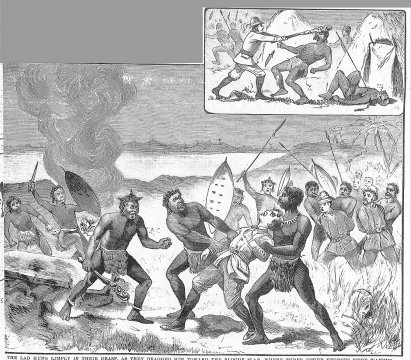
The ravenous crowd lost patience, and began to hoot angrily. An instant later they were screeching like exultant fiends, for two huge negroes had pounced upon Arthur, and taken him by each arm.
The lad hung limply in their grasp, as they dragged him toward the bloody slab, where three other negroes were waiting with drawn knives and clubs.
For the moment he was stupid with fear of the terrible fate that awaited him. He glanced back, and saw his companions struggling to get to him.
"Good-by, lad," cried Bunbury. "It will be painless -- only one blow."
Roden tried to speak, but could utter only a hoarse, inarticulate sound. He fought like a madman with the negroes who had hold of him.
Now Arthur was at the slab, and for an instant his captors straightened him up preparatory to putting him into position for the deathblow from the knob-kerry and the cut of the knife.
In that brief second the lad made a discovery that brought back his nerve and courage with a rush, and spurred him to a mad determination to escape his fate.
The cord about his wrists had become unknotted!
"I must do it," he reflected, setting his teeth hard. "If I get a little headway perhaps the whole crowd will pursue me, and give Bunbury and Roden a chance to slip away. And if I fail -- well, I'll have a chance to die fighting."
Like a flash, the words passed through his mind, and that quickly he jerked his hands out of the loose cords.
A second jerk freed him from his captors, and at the same time he intercepted and grabbed a knob-kerry that was about to descend on his head.
With a hoarse cry he mounted the slab, sprang down on the other side, and dashed at the crowd of negroes, singling out a point where the line was thinnest.
At sight of the frenzied lad, swinging his club, there was a panic and stampede. Men, women and children bolted right and left, and one plucky negro who tried to rip open the fugitive with a knife, was rewarded by a blow from the knob-kerry that bowled him over with a cracked skull.
It was Arthur's intention to swerve to one side or the other, but he quickly saw that the cannibals were running in both directions to intercept him.
This left him no choice but to take to the lake, where he knew that he must eventually be drowned.
"Better that than to be butchered and eaten," he muttered.
A quick, backward glance gave him a glimpse of his companions, and showed him also that the negroes were almost at his heels.
"Good-by, Roden!" he cried, and dropping the club, he ran forward a few feet, and dived head first off the sheer brink of the rock...
The water was fortunately deep, and he went far under. When he came to the surface his first act was to squirm out of his boots, which proved less difficult than he had anticipated.
Then he swam desperately on, without looking back. Behind him he heard splash after splash, and a blended yell from scores of throats.
The nearest jutting headland was less than a quarter of a mile to the right, and it occurred to him that he might reach it, and find safe shelter there.
But on glancing over his shoulder, he saw that which compelled him to abandon the intention. A dozen of the cannibals were running alongshore toward the headland, meaning to cut him off if he landed. A dozen more were swimming after him, with lusty strokes, and with gleaming knives between their teeth. So Arthur swam straight on, knowing that the only goal awaiting him was a grave on the bottom of the lake.
He thought of many things in that brief time. All the events of his life seemed to pass in review before him -- long-forgotten incidents of childhood and youth.
His breath came shorter and faster, and strength began to fail him. He could hardly lift one arm above the other. There was water in his ears and throat, and the yelling of the cannibals was like a faint, far-away murmur.
He looked weakly back, and saw the bobbing black heads within ten feet of him. A tremor ran through him as he saw, in imagination, the knives sinking deep in his body -- the gory feast that would follow.
With a hope of sinking beyond the reach of his pursuers, he concluded to give up the struggle. He stopped swimming, and was just about to go under when an unexpected thing happened.
Looking toward the headland he saw a long narrow canoe shoot suddenly into view -- then a second, and third. Each contained a dozen negroes, and each man was paddling with eager haste.
It was a noise behind him that gave Arthur the first clew to the situation. Gazing back he saw the canni bals swimming madly for the shore, where also there was visible excitement and alarm.
The lad comprehended that the strangers were com ing with hostile intent. That meant either safety or a reprieve for him and his companions, provided the latter were not slain in the meantime.
A determination to live took the place of his despair, and infused fresh strength into his tired limbs. In stead of sinking, he swam, slowly and painfully, toward the canoes.
Just in time the foremost one -- whose occupants saw him -- slackened speed and hove alongside. Willing arms pulled the lad over the gunwale, and then the canoe went swiftly on with the others.
Arthur drew a long breath, and looked curiously at his rescuers. They paid no attention to him, but kept their eyes steadily on the shore.
They were plainly of the same race as the negroes among whom the aeronauts had fallen, but they differed from them in being of a far larger and stronger build. They were of one size, and wore a sort of a distinctive uniform -- waist-clouts of lion skin, from each of which dangled a tail of the same animal.
By the side of every man lay a gigantic club and a long spear.
Arthur's immediate conviction was that the white king of the Karibegs had heard of the prisoners, and had sent these negroes to demand them. The uniform indicated that they were probably the royal bodyguard.
But the lad did not ponder long over the question, for there were more thrilling things to occupy his eyes and mind.
Evidently, there was going to be a lively scrimmage in a short time. Along the rocky shore the cannibals were gathering with defiant yells. The women and children had been sent to the rear, and there was no trace of Roden or Bunbury.
Arthur's heart was torn with dread. In one instant he was sure that his companions were yet alive; in the next he believed them to have perished by the knob- kerry.
Now he trembled with excitement, for the critical moment was at hand. All three canoes swung around, and grated at the base of the steep, rocky slope.
In spite of a hail of weapons from above, the gigantic negroes tumbled out and went up hand over hand, yelling what was evidently the tribal battle-cry.
They were soon at the top, and here a brief struggle ensued, while Arthur looked on from his seat in the canoe.
The cannibals were either overmatched by the weapons and heavier weight of their foes, or else they feared the king's displeasure.
At all events, they fought in a half-hearted way, and after losing half a dozen men, killed or wounded, they turned and fled ignominiously.
As soon as the rout began, Arthur left the canoe, and clambered to the top of the rock.
He saw the last of the cannibals just entering the forest, with the yelling pursuers close at their heels. Then he gazed in every direction for Roden and Bunbury, and his heart sickened when he found no trace of either, dead or alive.
Arthur started rapidly in the direction of the vil lage, and when he was nearly across the plateau, two negroes, wearing the lion skins, suddenly confronted him on the edge of the timber. Chapter XXVII
He was startled for an instant, but he quickly concluded that the negroes had come to look after him. He examined them more closely as he drew near.
The one differed from his companion in having woolly hair, and being of a blacker color. His features were also different, and his whole bearing reminded the lad of a Zanzibar porter.
It was this fellow who, to Arthur's intense amazement, addressed him with:
"White boy make hurry; go help find him friends."
Arthur stood still, rooted to the spot.
"You speak English!" he cried hoarsely. "Who are you? What are you doing here?"
"My name Tombo," replied the negro. "Me spike good Inglis. White king's kraal way up lake. He tell me go save white mens from cannibals -- bring ums back. "
"Who is the white king?" exclaimed Arthur in great excitement. "What is his name?"
"White king," muttered the negro. "He rule over many peoples -- live in big stone kraal. Me head man of white king's army."
This was plain information, but it was not what Arthur wanted. Before he could ask more questions, however, a loud and angry tumult was heard in the direction of the village.
Tombo and his companion bolted off at full speed, making signs to the lad to stick with them.
They dashed through the brief strip of forest, and at the farther end Arthur slipped on the dead body of a cannibal, and sprawled headlong. As he rose to his feet, he picked up a knob-kerry that was lying near.
Then he looked for his companions, and found them missing. Before him was the open gate of the village, and from an invisible point within came horrid yells and shouts, and the crashing of blows.
The lad's blood grew hot with excitement, and he sped through the winding street of huts until a bend brought the whole scene into view.
He was able to single out the king's bodyguard by their lion skins, and he was soon in the thick of the fight, and wielding his knob-kerry in close proximity to Tombo.
It seemed that the cannibals had offered a stubborn resistance as soon as they found themselves within the village walls. So they stood at bay, all the blood-lust and evil of their natures stirred up.
Already, they had been driven back beyond the center of the village, and were still receding before their terrible antagonists.
As spears and clubs were the only weapons, more men were disabled than killed. The king's party suffered little. They tramped ruthlessly on over the fallen foes, yelling like a pack of bloodhounds.
Arthur was imprudently brave, and it seemed as though he bore a charmed life. In the hot excitement of the fight he hit right and left at the savage faces of the cannibals.
But he had not forgotten his brother and Bunbury, and it was the fear of never seeing them again that kept his rage and thirst for vengeance at fever heat.
His eyes were on the alert as he advanced, step by step, with Tombo and his men, but what he dreaded to see did not appear.
In a short time the cannibals had been beaten back to within twenty feet of the hut in which the three prisoners had spent the night.
Arthur caught a glimpse of the doorway, and as soon as he saw that two guards were posted in front of it, the conviction flashed upon him that Roden and Bunbury were confined inside.
Tombo evidently reached the same conclusion at the same time. He gave a loud command, and pointed forward with his club.
That quickly the king's men charged like angry bulls, and the cannibals were rolled helplessly back by the terrible wave.
In the brief struggle that ensued, Arthur was fairly lifted off his feet. Somehow or other he found himself in the front line, wielding his knob-kerry like a flail.
He saw the guarded hut but a few feet away, and was about to plunge toward it, when two bodies of cannibals swarmed suddenly out of the huts to right and left, and let fly a thick volley of spears.
The king's men had been drawn into an ambuscade, and after a feeble attempt to hold their ground, they fled back in confusion, leaving half a dozen dead and wounded behind.
But Arthur did not go with them, for the simple reason that a spear struck him broadside on the neck and toppled him over.
He was on his feet almost instantly, unhurt, except for a painful bruise. The hut was only six feet away, and the first thing he saw was one of the guards lying dead --transfixed by a spear, that had evidently come from his friends.
But the second guard was very much alive. In fact, he was making for the lad with a wicked-looking knife in his fist.
Quick action was all that saved Arthur's life. He whirled his knob-kerry overhead, and struck the negro a blow on the temple that completely stunned and disabled him.
Just at that time, the cannibals were following up their advantage by pressing hotly after the king's retreating men. They did not observe Arthur, nor he them.
On the spur of the moment the lad dropped on his knees and slipped through the tiny doorway of the hut. He shouted for joy when he saw Roden and Bunbury crouched in the far corner.
It was a thrilling and affecting meeting, but there was no time to be lost in congratulations or emotion.
The arms of the prisoner[s] were still bound behind them, and Arthur's first act was to untie the cords.
"Thank God!" cried Bunbury. "We are saved. I never expected to see you again, my lad."
"Is the coast clear?" demanded Roden, as he clasped his brother's hand. "Have the cannibals been driven out of the village?"
"Not yet," replied Arthur. "In fact, they've got the advantage just now. It won't do to stay here. We must get away as quickly as possible."
They hastened to the door, and on peeping out they were horrified to see a score of the enemy approaching the hut. The fight was still waging at a distance, to judge from the loud outcry.
"We're trapped!" cried Arthur in a tone of despair.
"Perhaps we can break our way out at the back," suggested Bunbury. "It's worth trying, lads."
Just then a crackling noise was heard, and flames and yellow smoke curled up around the doorway. The hut was on fire!
As the angry flames took a firmer hold on the dry thatch and wattle-work of the hut, Arthur and his companions rushed madly to the rear and began to tear at the wall.' Chapter XXVIII
The dread of being burned alive gave them almost superhuman strength, and in less than a minute they had broken a hole nearly a foot in diameter.
Bunbury incautiously poked his head out, and then he jerked it back barely in time to dodge a furious blow from a club, dealt by some invisible enemy.
A burst of savage cries was heard, and an instant later a negro thrust his head and shoulders into the opening.
His scrutiny proved less fortunate than Bunbury's, for Arthur brought the knob-kerry down on the fellow's skull, and after a kick or two he became quiet.
He lay there for a moment, completely blocking up the hole, until his friends jerked him outside.
Arthur waited for another invasion, club in hand, but instead of that the gap was suddenly stopped by a huge bunch of thatch and straw.
Through this curls of stifling smoke began to ooze, and the ruddy glare of flames was seen. The hut was now burning at both ends.
The prisoners were almost frantic with horror. They saw no hope of escape. They were trapped like helpless rats.
"Heaven be merciful," cried Bunbury, "and send us an easy death. The fiends are trying to roast us alive."
"The smoke will suffocate us," said Roden. '" I can hardly breathe now."
"Lie flat!" shouted Arthur. "We'll fight for our lives as long as we can. There's a chance yet, for the king's men may rally and rescue us."
It was a very slim chance at best, but the instinct of preservation was still strong in the hearts of all three.
They threw themselves flat on the ground, faces downward, and fought hard for breath, while the smoke eddied thicker around them, and the flames devoured the crackling thatch.
Close outside there was frenzied yelling and screeching, and from a distance came fainter and more con fused sounds, that seemed to indicate that the battle was still going on.
It was easy to understand the situation. In anticipation of defeat, and by way of revenge on the king's party, the cannibals had fired the hut with the intention of burning the prisoners to death.
It was a truly fiendish device, and it seemed sure to succeed.
As the suffocating smoke came in dense clouds, and the flames crept up toward the roof, the boys lost all hope. A prayer for a speedy death was already on their lips when Bunbury struggled to his feet with a hoarse cry.
"I've tried to suffocate, and I can't!" he yelled. "We will die by lingering tortures if we stay here. Come, lads, let us break out before it is too late. It is better to perish by the spear and club."
Arthur and Roden rose stupidly, only half compre hending Bunbury's words. The smoke hid everything, and they groped blindly forward a few steps. The heat of the flames was scorching their limbs, and the struggle for breath was awful.
Roden fell weakly on his knees, and Arthur stooped down, and tried to raise him..
"Bunbury!" he cried, "where are you?"
There was a husky response from close by, and just then a terrific turmoil and din arose outside -- shrieks of rage and pain, yells of triumph, and the dull smash of blows and falling bodies.
After a brief interval, that seemed all eternity to the suffering lads, they heard a hacking, ripping noise, and an instant later a gleam of dusky light pierced the darkness.
"Saved! saved!" cried Arthur, and with Roden clinging limply to him, he reeled across the hut, and through the jagged gap in the burning wall, and fell down in the cool, open air.
After that, the boys remembered nothing until they came to their senses and found themselves lying in the shade of a tree, a few yards away from the still blazing hut, which had so nearly been their tomb.
Bunbury was bending over them, bathing their faces with water, and pouring a little down their parched and burning throats.
"Lie still," he urged. "Don't try to rise. The danger is over."
But the boys insisted upon sitting up, and when they had propped their backs against the tree, they declared that they felt quite strong.
At first they could scarcely see, for the smoke had made their eyes sore and inflamed.
But gradually they made out nearby objects -- the groups of stalwart negroes wearing the lion-skin waistclouts, and the dead bodies of the cannibals, that were sprinkled here and there on the ground.
Then it dawned upon them that the village was in possession of the king's men, and that the enemy had fled to the jungle.
Bunbury confirmed this belief.
"The fight is over," he said, "and there's not a cannibal in sight. It looks as though there was plain sailing ahead, lads."
"They are going to take us to the king," Arthur exclaimed eagerly.
He went on to tell his companions about his meeting and brief interview with Tombo.
"This white king must surely be our father!" cried Roden. "I can hardly wait to see him."
"It's more than possible, lads," said Bunbury; "but don't count on it too strongly, lest you should be disappointed. More than one traveler has been lost in Africa during the past ten years."
Just then Tombo hurried to the spot. There were red stains on his brawny limbs and lion skin, and his knob- kerry was a hideous sight.
"White mens feel better?" he said. "You walk out to big water?"
"Yes, we're all right," replied Arthur. "We can easily get to the lake."
"Much good," declared Tombo. "Me take you soon to king's kraal. First get white men's airship -- burn bad cannibals' village."
With this he stalked quickly away, and gave a shout that brought his men to him. Bunbury and the boys were puzzled for a moment by the reference to the airship, but they soon understood what it meant.
A dozen negroes swarmed up the euphorbia tree, and with a delicacy and skill that was remarkable, they detached the balloon from the branches on which it was caught, and let it drop lightly to the ground.
Then, under Tombo's personal supervision, it was rolled up in a tight bundle, and tied with its own ropes.
Meanwhile, the other negroes had been preparing litters and placing their wounded friends upon them. These numbered half a dozen, and did not include four who had been killed.
The village was now fired in score of places, and as the flames leaped ravenously from hut to hut, the vic tors marched out with exultant shouts, taking with them the balloon and the three rescued prisoners.
On reaching the canoes, they embarked without de lay, and the jutting headland quickly hid from view the rocky plateau where the cannibals had so nearly banqueted on human flesh.
The journey that followed was a severe trial to the patience of the boys. They wavered between certainty and doubt, convinced one moment that the mysterious white king would turn out [to] be their father, and disbelieving it the next.
They had no opportunity of questioning Tombo, since he was in the canoe ahead of them.
Under other circumstances they would have keenly enjoyed the ride. For hour after hour the strong-limbed negroes drove the long, narrow canoes through the blue waters of the lake. They kept constantly within a short distance of the shore, following all its curves and indentations.
The scenery was grand beyond description. For the most part the dense and lofty forest came to the water's edge, while hills and rugged mountains loomed up beyond.
But here and there great towering cliffs fell sheerly into the lake, and from clefts between them poured madly-roaring torrents.
Half a dozen times a village was seen nestled in a fertile arm of the lake, and groups of dusky figures looked silently out at the voyagers.
On each occasion the boys thought that a stop was intended, and their hearts beat with anxiety and hope. Each successive village was to them the royal kraal.
But the canoes passed by all -- passed swiftly by, and went on until an hour after midday.
Then, a mile ahead, a rocky arm of mountain jutted far into the lake, and towered thousands of feet toward the blue sky.
The negroes began to paddle more rapidly, and as the canoes glided by the face of the mighty stone rampart, they were swung sharply to the right, and driven into a black, semicircular archway, about twenty feet high.
On and on they went, through darkness that was intense and cold, rushing airs. There was no sound but the splash of the paddles, and the weird murmur of the pent-in waters.
Arthur shivered, and held fast to Roden. They looked back, and saw that the entrance was already concealed by a curve.
"I'd rather face the cannibals than this," muttered Bunbury. "We're going into the very bowels of the earth."
In truth, he seemed to be right. The canoes glided on and on amid the ghastly shades. Long practice must have given the negroes power to see in the dark, for they paddled swiftly and with unerring skill.
Not once did the canoes bump one another, or strike the rocky walls, which could not be very wide apart. The cruise on this subterranean channel lasted for an hour at least, and then a streak of gray light suddenly appeared ahead.
It expanded rapidly, and it was a glad moment to Bunbury and the boys when the canoes passed through an archway rather smaller than the one by which they had entered the underground stream.
At first the glare of sunlight was blinding and stupefying, but after a few seconds they were able to see clearly.
The boys burst into cries of wonder, which were echoed by Bunbury.
The canoes were about to swing alongside a strip of sandy beach, and beyond it was a wide spreading cluster of huts, nestled amid green trees and bushes.
From the center of the kraal, a square-shaped erection, built apparently of stone, and bearing a strong resemblance to a fort. It was nearly a hundred feet .high, and twice that long. ""
But the most marvelous of all was this: The village occupied no circle about half a mile in diameter, and that circle was completely barred in from the outer world by a continuous wall of sheer rock, that rose several thousand feet in the air. It was like the scooped out crater of a mighty volcano.
The only possible exit was through the subterranean stream, which was simply a volume of back water from the lake.
The canoes were now aground on the beach, and all their occupants disembarked. Tombo headed the way forward, and the prisoners -- for such they virtually were --came close behind him. Chapter XXIX
As yet the arrival of the party had not been discovered, but as soon as they passed through a belt of tim ber and bushes they were spied by hordes of villagers, who swarmed around them to the number of several hundred.
It was a slow and triumphant progress though the royal kraal.
The huts, strange to say, were not of the customary thatch and wattle-work; they were made of rudely cut blocks of stone, plastered together.
Bunbury noted, with secret uneasiness, that the natives were of the same type as those in the other village, and that they regarded the prisoners with pretty much the same hungry look.
The boys had other things to think about. With hearts alternating between hope and fear, they trudged impatiently after Tombo.
In vain they glanced keenly in all directions. Only, a sea of hideous faces met their view. Were they doomed to disappointment? or were their trials about to be crowned by a glorious reward?
Now they were nearly in the center of the crater- like valley, and just ahead was what they had taken for a fort.
On closer inspection the resemblance was stronger than ever. It surely was a fortification of some kind, and just as surely, it was not the work of uncouth African negroes.
It was built of irregular blocks and slabs of stone, and was pierced here and there by loop-holes. Down the face of it, from top to bottom, ran a straight, narrow slit, or cleft, very dark and gloomy.
Bunbury and his companions noted these things during the brief time in which they were passing through the maze of huts that clustered thickly around the fort.
At the entrance of the cleft, Tombo waved his knob-kerry, and the procession halted. Here there was a brief delay. People and soldiers mingled together, and the wounded negroes were borne into the neighboring huts.
Then Tombo led the prisoners into the cleft, and at their heel scame [sic] six of the royal bodyguard, bearing between them the heavy balloon.
It was a long and wearisome climb that followed. The passage was barely three feet wide, and the path led steeply upward over what had once been a flight of massive steps.
Now many of them had disappeared, and others were out of place. Great caution was necessary to avoid falling back.
The towering walls on each side were green with age, and showed traces of decay. The wonder and mystification of the boys increased as they mounted higher.
"This place must be hundreds of years old," said Roden. "Who could have built it, and for what purpose was it intended?"
"There's no telling," replied Bunbury. "It belongs to a remote age, though. It is certainly older than the tower of London -- perhaps older than the ruins of ancient Rome."
A moment later the cleft made an abrupt turn, and the party mounted the last half-dozen steps amid a welcome flood of sunlight.
This brought them to the level top of the fort, where they encountered four tall negroes, standing guard, with spears and clubs.
Tombo and the prisoners advanced unchallenged. The six balloon bearers threw down their burden, and slowly vanished into the cleft again.
With trembling limbs and fast beating hearts the boys followed Bunbury and Tombo.
Even in this moment of thrilling expectation, they observed what was around them -- the tall battlements, eight or ten feet high, to right and left, and behind; the blue sky and the fierce African sun overhead; un der foot the pavement of broad flagstones, worn smooth and shiny by the tread of centuries.
A short distance ahead was a square tower, probably twenty feet high, with a flat, battlemented top. It was of wonderfully massive construction, and its huge stone blocks, though scarred by age, showed no trace of [sic]
A lion skin hung before what was probably the entrance. Tombo lifted this, and then stood one side, while he made signs to the prisoners to enter.
Bun bury went first, and Roden and Arthur followed, breathing sharp and fast.
When they were fairly within the tower they stood still. Their eyes were yet dazzled by the outer sun light, and for a moment they could see only deep gloom.
Then, gradually, they made out a square apartment lighted by two narrow windows slits. On one side was a dark, circular hole in the floor, down which a flight of crumbling steps could be seen to disappear.
At the far end of the room was a stone couch, partly covered with a lion's skin. From this suddenly rose the figure of a tall, broad-shouldered man. He came slowly forward, shading his eyes with his hands.
He wore rude garments of untanned skins, and his hair and beard were almost snow-white. His eyes were keen and black.
A low, angry whine was heard, and a tawny, yel lowish beast leaped lightly from behind the couch. At sight of the strangers it squatted, and roared loudly. It was a huge, living lion.
"Back, Nero, back!" cried the man, in a clear, commanding voice.
The lion obediently turned and crept out of sight behind the couch.
The man advanced a little more, and as the light shone full upon his bronzed face, Arthur and Roden staggered forward, weak and almost speechless with frantic joy.
"Father! father!" they shouted hoarsely.
The man reeled with the shock, and his cheeks paled under the ruddy skin. For an instant it seemed that he would fall.
Then he understood; and with a cry that was wrung from the depths of his heart, he clasped the boys to his arms.
Bunbury's face shone with delight, and Tombo, who had followed the party into the tower, stood like a carved statue of black marble.
The White King of the Karibegs was Lucius Fan shawe, and the perilous quest of his brave sons had succeeded. The one sad shadow that marred this joyful meeting was the absence of Godfrey Congdon -- the hero who had died to save his friends.
It was long before father or sons could realize or fully grasp the almost incredible truth; still longer before they could sit calmly down to talk.
It was happiness enough for the boys to look at the still familiar and remembered features of their parent; happiness enough for the father to know that these sturdy lads were the same little chaps from whom he had tearfully parted so many long years ago.
As the sun was drooping behind the circle of mountain walls, they all sat out before the tower, enjoying the cool evening air -- Lucius Fanshawe and his sons, Bunbury and Tombo.
Close by lay. Nero, and over by the head of the cleft the dusky guards reclined in picturesque attitudes.
From the kraal far below came the faint voices of the Karibegs.
The boys and Bunbury had told their thrilling tale from beginning to end, and Lucius Fanshawe had listen[e]d with rapt attention, dropping a tear at the part which described poor Godfrey's death.
Then, in turn, he narrated the history of his own past -- of the long years since 1879. It was a chain of wonderful and harrowing events, but they need not be told here, except in so far as they relate to the story.
The sum and substance of it all was that after the massacre of his companions by natives, he and his faithful Zanzibari porter, Tombo, had been carried off as prisoners.
After three years of slavery amid various tribes they fell into the hands of the Karibegs, and in course of time, Fanshawe was made king, owing to his having twice taken advantage of his scientific knowledge to predict an eclipse of the sun.
"Since then," he concluded, "my life has been more monotonous and dreary than words can tell. Knowing that escape was impossible, I sought to benefit these ignorant and bloodthirsty people. I found them all cannibals, but now the terrible habit has been almost abolished.
"This has always been the royal kraal, and, as you probably know, it can be entered only by the water passage. But within a radius of twenty miles there are as many villages under my rule.
"I have a bodyguard of one hundred picked men, who are commanded by my faithful Tombo. And Nero has helped me to pass many a weary hour. I got him when he was only a cub, and he is perfectly harmless."
"I am anxious to hear the story of our rescue," said Bunbury. "How was it accomplished so speedily.["]
"It was an interposition of Providence that saved you," remarked Mr. Fanshawe. "The cannibals among whom you fell have always resisted my authority, but there happened to be one loyal fellow among them. He came here post-haste in a canoe to tell me that three white men had arrived at his village in an airship, and that they were to be eaten in the morning.
"I suspected that the airship might be a balloon, and without delay I sent off my bodyguard to rescue the prisoners and punish the cannibals. Little did I think that my own sons were in peril. God has been very merciful."
There were tears in Lucius Fanshawe's eyes as he glanced at Roden and Arthur.
There was silence for a time, while the shadows of night swiftly deepened. Then food and drink were brought up the cleft by female servants, and after the meal was eaten, Lucius Fanshawe and his companions entered the tower. Chapter XXX
A rude lamp was lighted, and the burning palm- oil threw a dull, smoky light on the scene.
"This is a queer place," said Bunbury. "Do you know the history of, it?"
Mr. Fanshawe shook his head.
"No," he replied; "it is a mystery that will never be unraveled. Hundreds of years ago a superior race of people must have penetrated to this hidden place They opened mines over by the base of the rocks, though what they dug out of them I do not know.
"They no doubt built the fort for protection, The cleft is the only way in and out, but this hole you see in the floor leads to the level of the ground, through numerous chambers, connected by stone steps.
"Have you explored them all?" asked Roden.
"I believe I have," answered his father; "but I never found anything more valuable than rude arms and dishware. I used to amuse myself in that way. You may imagine how heavily the time has hung, for I have rarely stirred from the fort. For years I have lived in this tower, ruling and directing my subjects by means of Tombo."
"But you won't live here any longer," exclaimed Arthur. "You are going home now -- back to the world that believes you dead."
"That's easier said than done," muttered Bunbury[.] "Still, escape ought to be possible. "
"God grant. that it be so," said Lucius Fanshawe, in a fervent tone. "The news of the white men and their airship was the first ray of hope that I have known in years. That is why I gave orders to have the balloon brought here. It must take us over the mountain bar rier, otherwise there is no escape."
"Ah! I forget that you are a scientist," exclaimed Bunbury. "You know the secret of making gas without chemicals?"
"Yes, I propose to use palm-oil and straw. I can have them brought to this spot in sufficiently large quantities."
"Then escape is indeed sure," said Bunbury. "I have materials in my pocket for mending the tears in the silk. We will inflate the balloon just outside the tower, and when it is really to ascend, we will fasten ourselves in the ropes."
"Will gas of that kind carry us far?" asked Arthur.
"And will it lift the balloon above the mountains?" added Roden.
"Yes, to both questions;" replied Bunbury. "The gas is of inferior quality, but it will take us fifty or a hundred miles."
"And that is the main thing -- to get clear of the country of the Karibegs," exclaimed Lucius Fanshawe. "Once that is accomplished, we can travel by water, and ultimately reach the Congo regions, where we will be safe.
"Moreover, I intend to have a basket made, large enough to hold us all. My negroes are expert at weav ing, and there is plenty of material at hand,"
"It won't be necessary," said Bunbury.
"Not if we leave Nemo behind," said Lucius Fanshawe; "but that I will never do. The lion has been devoted to me for three years, and I cannot part with him."
"Yes, I understand," replied Bunbury. "It is a worthy resolve. But can the basket be made in a short time?"
"In a day and a half, the basket, straw and oil will be on the spot," was the confident answer, "and twenty four hours later we can start."
"Won't the negroes interfere?" asked Roden.
"They would if they suspected our purpose, my boy, but I shall guard against that. I will announce that I am going to perform a great miracle, and when the manufacture of gas begins, I will send yonder guards down to the village.
"That's the way to do it," approved Bunbury. "There will be no spying eyes around. How about Tombo?"
"He will go with us, of course," replied Mr. Fanshawe. "The faithful fellow has stuck to me through thick and thin, and he is just as homesick as I am. I shall do all in my power to get him back to Zanzibar."
On hearing this Tombo grinned, and crept a little closer to his royal master. He evidently understood all that had been said.
"It is important that we should lose no time," resumed Lucius Fanshawe, after a thoughtful pause; "for a storm is brewing, and it may burst at any time. I did not intend to speak of the matter, but it is best that you should know it.
"I have learned through spies that the neighboring Karibeg villages are contemplating a united attack on the royal kraal. They are angry and dissatisfied because I have forbidden the eating of human flesh."
"How can they storm a place like this?" asked Arthur. "There is only one entrance -- by the water passage."
"They can command plenty of canoes," replied his father. "At least a dozen of the kraals lie along the east and west shores of the lake."
"How about your own kraal here?" questioned Bunbury. "Are the negroes to be relied upon?"
"Implicitly," declared Lucius Fanshawe. "They are less bloodthirsty than the rest of the tribe, and from the fact that I have lived among them so long, they fear and reverence me. You know how, bravely they rescued you from the cannibals?"
"True," replied Bunbury. "They fought as though they were battling with their worst enemies."
"And so they will fight in case of an attack on the kraal," said Mr. Fanshawe. "However, I don't think there is any present danger. My spies have brought me news for a week. If the revolt occurs, it will not be until after our departures. And now, my friends, we will fortify ourselves for the events of the morrow by a refreshing sleep. Tombo, prepare the beds."
From a recess in the wall the negro brought a dozen skins, and spread them upon the floor.
He then departed, and a little later the occupants of the tower were sound asleep, Nero lying at the feet of his master.
The following day proved a busy one, nor was the bustle and activity interrupted by bad news from the king's spies.
Indeed, the spies had not reported one way or another for nearly a week, which would have seemed a suspi cious circumstance to Lucius Fanshawe had he taken time to think over it.
But there was too much else to occupy his mind. Early in the morning a dozen negroes, men and women, ascended the cleft to the top of the fort. They brought an abundance of pliable material, with which they began to shape the required basket.
From sunrise to sunset a procession of strong- limbed men passed up and down, leaving bales of thatch and firkins of palm-oil behind them at every trip.
It was a pleasant and welcome surprise when Tombo presented Bunbury and the boys with their revolvers. He had found them in the possession of the king's bodyguard, who had captured them from the cannibals during the fight.
Lucius Fanshawe was highly elated.. "With weapons and ammunition," he said, "we stand a ten times better chance of reaching the Congo region. "
By evening the basket was two-thirds done, and a sufficient supply of thatch and palm-oil was left on the top of the fort.
Bunbury's skillful fingers had prepared the balloon, and he declared that the mended places were as good as new.
The night passed without alarm, and the party were astir at early dawn. It was to be a momentous day, and they could scarcely conceal their impatience and anxiety.
There was but little for them to do and the hours dragged by with provoking slowness.
About three o'clock in the afternoon the basket was finished, and the clever weavers went down into the village. The guards were also sent below, leaving the king and his companions alone.
Without delay, they set about the final task. Their hearts beat high with hope, for so far all had gone as well as they could have wished. There was no cloud or shadow to mar their anticipations for the future
First, by means of a rope stretched from the tower to the parapet, they rigged the balloon ten feet in the air, with the opening downward.
Then a dozen shallow earthen vessels, filled with palm-oil, were arranged underneath and ignited.
Over these bundles of thatch were burned, a little at a time. The inferior sort of gas thus generated, mounted slowly into the balloon, while the heavier smoke was blown aside.
By a somewhat similar process balloons were filled in the early days of aeronautics, as Bunbury and Fanshawe well knew.
Through the afternoon and early evening the work went on, keeping all hands busy. The supply of oil and thatch grew less while the balloon expanded more and more.
Tombo had been sent down to the village to keep eyes and ears open for danger, and from time to time he came up to report that all was well, and that the negroes were eagerly waiting for the promised manifestation of the white king's powers.
It was evident that they had not a suspicion of the truth.
Three hours after dark the balloon was two- thirds inflated, and was chafing at the cords that held it captive.
The basket-car, containing a store of provisions, lay at one side ready to be attached to the ropes.
Overhead the stars were gleaming brightly, and down in the village all was still and peaceful. The negroes had been told that the manifestation would be revealed to them at daybreak, and they were probably discussing the event around the camp-fires.
Tombo had not been up the cleft since sunset, but he was momentarily expected.
Lucius Fanshawe and his companions continued to feed the burning oil with bunches of damp thatch. The flames shone on their flushed and hopeful faces.
"In three hours more the balloon will be ready," said Bunbury. "God willing, we shall be far beyond the Karibeg country when to morrow's sun rises."
He had hardly spoken, when Nero, who was lying asleep by the entrance of the tower, rose suddenly with bristling fur and ears, and uttered a quavering, mournful roar.
As the echoes died away a burst of shrill, angry cries rose from far down in the kraal, and an indescribable din and tu[r]moil followed.
With sickened hearts, Fanshawe and his companions ran to the nearest loop-hole in the parapet, and the sight that instantly met their eyes was a deathblow to their hopes of escape and freedom.
The loop-hole commanded a view across the valley in the direction of the lake, and the light of moon and stars would have sufficed to make far-away objects visible without artificial help. Chapter XXXI
Out from the black hole in the rocky cliff -- the exit of the water passage -- a procession of flashing, flaming torches was streaming.
Already several score were visible, and the number was fast increasing.
And by the torchlight, the narrow sheet of black water was seen to be jammed with canoes, many of which were discharging their swarms of bloodthirsty negroes on the sandy beach.
Lights were flashing in the village, too, and the startled Karibegs were rushing, with fierce yells, to meet the invaders.
To the little party far up on the fort it was a thrilling and terrible scene, and for a minute they could only gaze in mute despair.
Then Lucius Fanshawe staggered back, and wrung his hands in helpless grief.
"God help us!" he groaned. "We are lost -- lost. .Oh! why could not this blow have been delayed a little longer?"
"There is still hope!" cried Bunbury. "Your plucky fellows will fight like fiends. Hark! they are at it now. They may beat the enemy back."
"Impossible!" exclaimed Fanshawe. "It is a general revolt. Hundreds of cannibals have already got a foothold in the valley, and hundreds more are probably coming through the passage. They will butcher every man, woman and child, and then attack the fort."
"If there had only been time to prepare," muttered Bunbury. "With the aid of your body-guard, we could have held the passage-mouth against an army."
"Too late to think of that now," said Fanshawe. "There has been treachery somewhere -- foul treachery. Every man of my spies must have turned traitor."
"Or else they were found out and killed," suggested Bunbury.
"Yes, that is more likely," Fanshawe admitted. "At all events, the storm has burst from a clear sky, and it means ruin to our hopes."
As he spoke the tumult below assumed a change that admitted of no misconstruction. Clash of arms and yells of rage and hate mingled with the frightened screams of women and children.
The cannibal invaders were storming the kraal, and the slaughter had begun.
Nero paced restlessly up and down, roaring furiously at intervals. He seemed to understand that his mas ter and his master's friends were in danger.
"Can't we cut the balloon loose now?" cried Roden. "Look how inflated it is."
"There ought to be enough gas in it to last for several hours," added Arthur.
"We will make the atttempt [sic], my boys," exclaimed their father, hastening toward the spot. "It is the last chance. Anything is preferable to staying here to die. Here, help me with the basket," he added. "We must attach it to the ropes at once."
Bunbury had been looking critically up at the balloon, and now he made a dissenting motion to Arthur and Roden.
"My friend," he said, laying his hand on Fanshawe's shoulder, "what you propose to do is impossible just yet. We must continue the manufacture of gas for at least an hour longer."
"But the balloon is nearly full," cried Fanshawe. "Do you see how it bulges out? And there is scarcely a wrinkle visible."
"The car is quite a weight in itself," Bunbury calmly replied, "and there are four of us here -- four able-bodied men. The lion is full-grown and heavy, and Tombo may arrive at any moment."
"Tombo is dead!" cried Fanshawe. "If he were alive, he would have been here by this time. And Nero shall be left behind if necessary. I will gladly sacrifice the poor brute to save my boys -- my own flesh and blood."
"But even then the gas is insufficient," said Bunbury, in a compassionate tone. "Even if we should abandon Nero and the car, and stick to the ropes, the balloon could not rise above the high circle of mountains. It would drift against the rocks and dash us to the ground."
Fanshawe reluctantly let go of the basket, and stared up at the swaying balloon for a moment.
"Yes, you are right!" he cried, in a hoarse tone of agony. "We must have more gas -- more gas. Quick! every second is precious. They are still fighting down below. God grant that they keep it up for an hour yet."
With feverish energy, he seized a bunch of thatch in each hand, and held them over the still burning vessels of oil.
His companions did the same, and for nearly ten minutes the smoke and flames generated small quantities of the sorely-needed gas.
Meanwhile; the battle raged fiercely down in the kraal, and the shrill sounds of deadly conflict drifted nearer and nearer the fort.
But as yet, strange to say, no fugitives had come up the cleft -- no messengers to tell the white king what was happening, or to summon his aid to drive back the cannibal invaders.
Gradually, and almost imperceptibly, the sound changed, until the agonized cries of stricken men and the clash of weapons was no longer heard.
Instead, there rose a hoarse, continuous roar from hundreds of throats. The sound swelled on the night air, and grew louder and louder. Now it seemed to be under the very walls of the fort.
"Can it be possible that your fellows have driven the cannibals back?" exclaimed Bunbury. "The fighting is certainly over."
"It seems so," replied Fanshawe. "I don't know what to make of it."
"If they had won a victory they would be shouting with triumph," said Arthur; "but they are yelling now as though they were angry."
Roden dashed to the loop-hole, and returned almost instantly breathless and frightened.
"The space in front of the fort is black with negroes," be panted. "They are screeching like wild cats, and I believe they are coming up."
An instant of alarmed silence followed these words and then a scuffling, rattling noise close by ended in the sudden appearance of Tombo's head and shoulders in the mouth of the cleft. It required an evidently painful effort for him to climb the last couple of steps. Then he fell forward on hands and knees, rose slowly to his feet, and staggered toward the anxious little group.
They stopped feeding the oil vessels, and shrank back in horror of his appearance.
The negro was breathing heavily, and with a rasp ing sound. His face was hideous with clotted blood from a knife-slash across his forehead, and his lion-skin tunic hung in tatters. Here and there on his abdomen and lower limbs were bleeding cuts, and in one hand he grasped a broken spear.
"You are badly hurt, my poor fellow," exclaimed Fanshawe. "What news do you bring? Quick!"
"Much bad," Tombo answered hoarsely. "Cannibals come plenty -- fight hard --kill many people. Den king's men go mad because white king no come help -- no put evil spell on cannibals. They say white king no more be good -- they stop fight -- good Karibegs be friends with cannibal Karibegs ----"
"Jove! that's terrible," exclaimed Bunbury.
"They've all fraternized together. The game is up, comrades. We're bound to be cooked and eaten."
"Him speak true," added Tombo, nodding at Bunbury. "Karibegs come quick up fort -- no more believe miracle -- they say white king means go off in airship."
Fanshawe uttered a deep groan, and wrung his hands in agony.
"So they have discovered our purpose," he cried. "It is terrible -- terrible. But we won't give up yet. We must defend the deft. We must hold out long enough to inflate the balloon."
He ran into the tower, and brought out two long, heavy spears. He kept one himself, and gave the other to Tombo.
"You are armed," he said to his companions. "Your weapons are worth a score of spears."
"And we know how to use them, father," was Roden's grim reply.
He and Arthur pulled out their revolvers, and hastily loaded every chamber .
It was a thrilling and fearful moment. The howl ing of the Karibegs indicated that they had begun the ascent of the cleft. They were inflamed with rage and bloodshed, and their long-dormant appetites for human flesh were once more whetted.
"Be ready!" cried Fanshawe. "They will be here in two or three minutes. And no mercy need be expected if they once gain a foothold on top of the fort."
"There are plenty of loose blocks of masonry here," said Arthur. "We might roll them down the steps."
"That is worth trying," cried his father. "Yonder is one that must weigh a hundred pounds. Let us start it at once, and ----"
"Hold on!" interrupted Bunbury. "It is madness to fight against such odds. We will try the balloon, comrades. There is a faint hope of its rising to a level with the mountain tops. If not, we can't be worse off."
He had scarcely laid hold of the ropes to haul the balloon down when half a score of the cannibals swarmed out of the cleft uttering exultant cries.
They must have noiselessly preceded the main body, for the shouting indicated that the first were yet some distance down.
It was a trying blow to come just as Bunbury's words had given his companions fresh hope, but the little band grappled nobly and speedily with the emergency.
With Fanshawe and Tombo in the lead, they dashed forward and attacked the foe.
Every man of the Karibegs belonged to the royal body-guard, and even hatred could not overcome their superstitious fear of the white king.
They halted and wavered when they saw his great bulk charging upon them, and before they could rally one of their number had been run through the heart by Fanshawe's spear.
Tombo transfixed another, and then Bunbury and Roden each brought down a man. Arthur fired too high and missed.
The sharp reports of the revolver terrified the remaining six cannibals, and they fell back to the edge of the cleft.
Here Fanshawe and Tombo engaged in a hand-to- hand struggle, and quickly compelled three of the wretches to leap down upon the path.
The other three fought like demons, parrying every blow with wonderful skill.
For the time being Bunbury and the boys were helpless; they dared not fire for fear of hitting their friends.
It was a critical moment, and worse was to come. When the little handful of defenders saw a line of black heads mounting into view at the top of the cleft, and heard the ferocious yells of those who were pressing up from behind, they abandoned hope.
The knowledge that their friends were at hand incited the three cannibals on top of the fort to still more desperate valor.
By a quick upward thrust one of the ruffians broke Fanshawe's guard, and knocked the weapon out of his hand.
He was about to transfix the defenseless white king, when Tombo, who had seen all, rushed between the two, and the faithful negro received the deadly blow in his breast.
Fanshawe uttered a cry of agony as he saw Tombo stagger. The latter quickly recovered himself, and tore the spear from the gaping wound.
Then, with his last strength, he sprang at the Karibeg assassin, and clutched him by the throat. They staggered for an instant on the brink, and then they reeled down into the cleft, locked fast together.
This tragedy was followed by another, so swift and terrible, that it seemed as though Providence had chosen to avenge poor Tombo's death.
Above the yelling of the cannibals, a dull, sliding noise was heard. It grew rapidly, like the roar of an avalanche, and finally ended in one awful crash, ac companied by heartrending cries of agony.
A brief and thrilling silence succeeded. The two Karibegs remaining on the fort were overcome with terror.
They dropped their spears, and crouched tremblingly on the flagging, evidently believing that what they had just heard was a manifestation of the white king's supernatural powers.
Fanshawe and his companions knew better. When they saw that the swarm of black heads which had been in sight but a moment before had now vanished, a glimmer of the truth dawned upon them.
Timidly they crept to the side of the cleft and looked down. One glance told them all -- showed them how miraculously they had been saved.
The pathway of steps had utterly vanished. The earth and masonry, weakened and decayed by the lapse of centuries, had given way under the tread of the climbing cannibals, and gone grinding down in a swift and mighty avalanche.
The victims that lay buried under it were probably to be numbered by the score, and among them was Tombo. It was a fitting tomb for the brave and unselfish Zanzibari, who had given his life to save his beloved master.
The effect of the catastrophe upon the surviving can nibals was one of pure rage. Chapter XXXII
After the first shock was over, and they realized what had happened, they screeched and yelled so loudly as to drown the cries and groans of the mangled and yet living victims, who were only partly buried in the débris.
It was a blood-curdling volume of sound, but it no longer had power to terrify the little party upon the fort, as they looked down the cleft at the sea of savage faces, gleaming in the torchlight.
"Thank God!" cried Lucius Fanshawe, lifting his hands toward the sky. "He has saved us in time of need."
"Ay, it was a Providential accident," said Bunbury. "It can't be accounted for otherwise. And the slide has destroyed all means of communication. Yonder, where the last step came up, is now a sheer drop of fifty feet down to where the pile of ruins begins."
"It is unscalable," said Arthur. "The walls are smooth and straight."
"I'm sorry for the poor wretches who were killed," exclaimed Roden. "Many must have perished."
"Served them right," muttered his father. "It was a just penalty. They have murdered Tombo -- the dear, good fellow who has served me all these years; and now he is dead -- dead. He purposely intercepted that spear."
With a bitter groan Lucius Fanshawe sat down upon a block of stone, and covered his face with his hands.
His companions sympathized with him. They, too, were deeply moved by the vivid recollection of Tombo's tragic death.
"We should be thankful that his sacrifice was not in vain," said Bunbury. "We are as safe as though we were miles away from that bloodthirsty rabble below. They can't reach us without wings, for the fort is a sheer wall on all sides."
"That's true," replied Roden; "and the cleft is impassable. We can go quietly on with the gas-making now."
"And cut the balloon loose in an hour, or two, at the most," added Bunbury. "Howl, you bloody cannibals, howl till your throats split. You can't do any more!"
He leaned forward, and shook his clinched fist at the yelling mob far below.
Little did Bunbury and his companions dream of the fearful blow that fate had in store for them -- which was even now about to fall, and change their fond hopes to the bitterest dregs of despair.
They had failed to reckon with an element that was close by -- an element that they had forgotten, in fact.
During the past couple of minutes -- for no greater time had elapsed since the fall of the avalanche -- the two cannibals had been crouching, in a sort of frightened stupor, on the brink of the cleft.
Slowly it dawned upon them that they were cut off from their friends -- that they were isolated beyond help, on the top of the fort, in the power of four enemies.
First they peered into the dizzy chasm, and drew back shuddering. Then, after exchanging a few low-spoken words, they sprang suddenly to their feet, uttering horrible cries.
This was the first intimation to the white men of the danger they had blindly overlooked, and it found them unprepared.
It was more by chance than skill that they were enabled to meet successfully the murderous attack of the two Karibegs.
One ruffian cast his spear straight at Fanshawe's stooping figure. Furious rage must have impaired his aim, for though the distance was but ten feet, the weapon merely grazed the white king's shoulder.
Fanshawe sprang up with a startled cry, and at the same instant Bunbury lifted his revolver and took a snap- shot at the would-be assassin.
It hit the fellow, but not in a vital part. He stopped short, with a screech of agony, and spun round several times, clawing at his left shoulder, from which blood was dripping.
The second cannibal meanwhile had dashed straight at Arthur and Roden, with his spear poised in one hand.
The boys were in imminent danger, being taken quite by surprise; they had no time to even whip out their revolvers.
With the instinct of preservation uppermost in their minds they tried to get out of the way. Arthur dodged, to one side, and Roden to the other.
The Karibegs swerved after the latter, and was just about to make the fatal thrust when Roden tripped on a projecting flagstone, and sprawled on hands and knees.
It was a lucky accident. The spear hit only empty air, and the madly-rushing negro was unable to avoid Roden's body. He struck it with a violence that pitched him over head first, and landed him in a heap.
By this time Arthur had wheeled around, and Bun bury, with his smoking revolver still in his hand, had turned to see what was going on.
Their help was sorely needed, for the fallen Karibeg quickly jerked himself to his feet, and snatched his spear, which was lying close by.
Then he limped toward Roden, as murderously in clined as ever. The lad had just begun to rise, and was evidently a little dazed and dizzy.
Bunbury took a quick, keen aim, and pulled the trigger. But only a dull snap followed; the cartridge had missed fire.
Then Arthur shot, but his trembling hand caused him to miss.
He uttered a cry of horror, which was echoed by Fanshawe and Bunbury. They expected to see Roden killed before their eyes.
And just that would have happened but for a most unforeseen and unexpected circumstance.
Nero, whose presence had been overlooked during the fight and its excitement, suddenly came to the conclu sion that help was urgently needed.
With an angry roar the lion shot through eight feet of space, and landed squarely upon the Karibeg just as the latter was about to drive his spear into Roden's back.
Man and beast went down together, and for an in stant there was a lively scuffle, accompanied by heart rending screams and ferocious snarls.
Then the lion seized the still struggling and yelling negro by the neck, and bounded with him across the fort to the deep shadow of the parapet.
The pitiful cries were heard for a few seconds longer. Then there was a fearful roar, and one agonizing scream -- and all became still.
The spectators of the little tragedy were stirred to sympathy for the victim, but it had all transpired so quickly that they had no chance to help him.
Now it mattered little that another episode claimed their attention -- since the unfortunate fellow had only too plainly received a finishing stroke from Nero.
This other episode was to prove the last and final part of Fate's crushing blow, and it came about in, this wise:
The surviving Karibeg, whose shoulder was broken by Bunbury's pistol ball, had fallen down in a quiver of agony.
Now, after witnessing the fate of his comrade, he staggered to his feet, and reeled toward his spear, which lay several yards off. His brutal face was distorted with rage and hate.
Bunbury saw the movement, and by a swift dash, he grabbed the weapon just as the negro was in the act of stooping for it.
Thereupon the baffled wretch gave a ferocious yell, dodged to one side, and sped like a deer toward the tower, evidently bent on seeking refuge in the interior chambers and passages of the fort.
Bunbury did not think of this. He scented danger to the balloon, and plunged instantly after the fugitive, followed closely by Fanshawe and the boys.
Then happened a terrible thing. The Karibeg, run ning blindly, did not observe the vessels of burning palm oil until he was right on top of them.
He jumped across two, and landed on the edge of the third, tipping it over, and falling down flat in the midst of the fiercely blazing fluid, which was spreading its fiery trail in all directions.
With screams of agony that made his hearers' blood run cold, the luckless negro rolled and squirmed like a snake, upsetting the contents of three more vessels.
Twice he struggled to his knees, and twice he fell over again in the fiery lake.
The third time he got to his feet, completely soaked with oil, and blazing like a torch from his ankles to his bushy mop of hair.
With maddened cries, and with the flames streaming behind him, the tortured wretch danced straight forward -- which, as he had turned about, happened to be toward his pursuers.
They jumped aside in mute horror, and as they followed the human pillar of fire with their eyes, they saw it reel on the brink of the cleft, and then vanish from sight. A wail of agony, a crash and the awful tragedy was over.
The brief and shuddering stillness that came next was broken by a hoarse cry from Fanshawe, and when his startled companion[s] turned their heads they were tongue- tied and rooted to the spot with the appalling shock of what was before them.
They saw the lake of burning oil spread to the great stack of dried thatch, and wrap it in a volume of dense smoke and flame; they saw the basket-car take fire, and burn with a snapping, crackling noise; they saw the red tongues of flame leap up the ropes.
Then, as the blazing column mounted higher, they saw the balloon take fire, and burst open with a stifled report, and fall in flaming fragments of silk into the hissing pool of oil.
It was a short-lived conflagration; a quick transition from hope to despair. Chapter XXXIII
The oil burned itself out, leaving charred bits of the basket and balloon here and there on the blackened flagstones.
The curls of murky smoke drifted away, and the red glare of the thatch pile faded in a heap of smoldering ashes.
And even when it was all over, the little group still stood looking at the ruins, with hopeless despair stamped on their faces.
They were stunned and broken-hearted by this last blow, the consequences of which they shrank from con templating. They knew that it was irremediable; that no valor, or daring, no patience, or hard work could mend the misfortune.
"We've got to face the worst," said Bunbury, with his usual philosophic resignation. "No use to make any bones about it. Here we are, cut off from those howling fiends below, and with no way to get down to them if we wanted to."
"Better if there were," replied Fanshawe. "Better if we could face the enemy, and die fighting. We are doomed to suffer the lingering torments of starvation."
"Is there no food up here?" asked Bunbury.
"Not a scrap," Fanshawe answered. "Not even a drop of water. Under to-morrow's hot sun we will feel the tortures of maddening thirst.
"My poor boys," he added, with a bitter groan. "It is for you my heart aches -- not for myself. I would gladly die to save you. But I am helpless -- helpless."
The boys came closer to him, and he put an arm around each.
"We don't want to live without you, father," said Roden huskily. "We came to Africa to find you."
"And we do not regret it," said Arthur. "If we had a chance to escape, and that chance did not include you, we would stay here."
Lucius Fanshawe tried to speak, but his voice choked. He drew the boys closer to his breast.
Bunbury turned quickly away to hide suspicious moisture in his eyes. He walked over to the cleft, and peered down for a moment.
"All seems quiet below," he said, when he returned to his companions. "Either there's some deviltry brewing, or the negroes have made up their minds that we are out of reach."
"The latter, most likely," replied Fanshawe, and as he spoke Nero came crawling over to him, with a half-penitent, half-triumphant air.
He stroked and caressed the lion for a little while.
"Good old fellow," he said. "You did right, Nero. You saved my boy's life. But you might have been more merciful with your victim. Is he dead?"
Nero only whined, and crouched down by his master.
"Let's look at the fellow," suggested Bunbury.
"I'd hate to see even an enemy suffer when any relief could be given him."
Fanshawe nodded, and went over to the tower, where he lit the rude lamp, and brought it out.
Then he led the way over to the parapet, and they found Nero's victim lying stone dead. His neck had been broken by a blow from the lion's paw, but he was very little mangled.
The Karibeg was of herculean build, and had evi dently been something of a dandy in his way. He wore armlets and anklets of a copperish metal, and suspended around his neck was a small oval object, crusted with dirt, and of a dull, yellowish color.
Arthur took hold of' it, and the cord snapped at the pull.
"This is a queer-looking ornament!" he said, turning it over in his hand.
"It appears to be a chunk of virgin gold," replied his father, indifferently. "It was probably taken from the mines over yonder."
Arthur mechanically put the thing in his pocket, as he followed his companions toward the tower.
In front of the entrance they all sat down, and the lamp, standing near on a block of stone, illumined their hopeless and despondent faces.
It seemed a ghastly mockery that they should be sitting here alive and well, with no signs of an enemy near, and yet be as surely doomed to death as though they were in it[s] last agonies.
Bunbury put his hands in his pockets, and produced the two bombs which he had kept when the box was pitched into the lake.
"I don't suppose these could be made of any service to us," he said reflectively. "Yet a spark or a concussion put to one of them would end our misery. How ever; that would be a cowardly deed."
"They might serve a better purpose," exclaimed Arthur, with sudden energy. "Why can't we descend to the lower floor of the fort, and take refuge in one end while we blow the other end up?"
"And then rush out through the breach," cried Roden, and try to gain the water- passage. It looks promising, and, besides, I would rather die fighting than starve to death up here. "
"Such an attempt would be simple suicide," replied Lucius Fanshawe, with a bitter smile. "The fort is so old and shaky that an explosion at one end would bring the whole structure down in ruins. We would be crushed under tons and tons of rock."
"I'd risk the chances on that," said Bunbury, as he put the bombs back into his pockets, "and even if the odds were ninety-nine to one----"
He stopped, and looked sharply around.
"Hark! what's that?" he added.
"That" was a curious rasping noise, and it was instantly followed by the simultaneous appearance on top of the parapet of five armed cannibals. As these leaped down upon the stone floor, yelling shrilly, their places were taken by twice the number.
Indeed, along the whole line of the parapet that faced the water-passage black heads and naked bodies were swarming.
It was a stunning surprise, and before the refugees could prepare for resistance nearly a score of Karibegs had a foothold on the roof of the fort.
Nero roared furiously, and Fanshawe made a grab for his spear.
"The daring ruffians!" he cried. "The wall slopes a little, and they have scrambled up it like cats, clinging to the crevices and projections. Fire! The flash of powder may scare them back."
"Little hope of that," muttered Bunbury, as he emptied three chambers of his revolver into the yelling horde.
Then Roden and Arthur fired. They were sufficiently cool-headed to take good aim, and in the intervals of the sharp explosions screeches of agony were heard.
But the cannibals did not waver or lose heart before the deadly fusillade, nor did they give it a chance to take much effect.
They had now mustered nearly two score strong un der the shadow of the parapet, and with frantic yells they advanced.
"Come on!" cried Fanshawe, as the spears began to whizz; "we won't die unavenged. We'll blow ourselves and the fort, and these bloody fiends, to fragments."
Lantern in hand, be led the way into the tower, and then down the steps that vanished through the yawning hole in the floor.
Nero slipped after his master, and Roden and Arthur followed the lion.
Bunbury came last, stopping to empty his revolver at the foe.
The yellow light flashed through the gloom of walls and floors of time-worn masonry, as Fanshawe guided his companions down the first flight of steps, through a big empty apartment, and then down more steps to a long narrow corridor. Chapter XXXIV
After traversing this for twenty feet they halted. They could hear far-away noise, like the roar of a storm or of ocean billows, but that was the only indication of danger or pursuit.
"I think I understand the situation," said Bunbury. "Those last shots of mine checked the cowardly rascals. They think we are still in the tower, and they don't like the idea of storming it."
"More likely they are afraid to venture down the hole for fear of an ambuscade," replied Fanshawe. "They have no light with them."
Before any further opinions could be expressed, a shrill yelling and hallooing rang through the pent-in chambers of the fort, and at the same instant a flashing ray of light was seen overhead.
Nero roared savagely, and started forward. It was with great reluctance that he obeyed his master's com mand to turn back.
"There's no mistaking that sound!" cried Bunbury. "The cannibals are coming down the first steps."
"And they've got lights with them," added Roden.
"So much the worse," Bunbury muttered. "They'll soon find us. We may as well make a stand here, and have it over."
"No, this is not the place," cried Fanshawe. "We have come scarcely one-third of the distance to the bottom. Here a bomb would have little effect. We want to blow the whole fort to pieces."
Holding the lamp overhead, he dashed on at a pace that his companions found hard to equal.
In their haste and anxiety they scarcely noticed their surroundings. They turned angle after angle, sped along chambers and corridors, and descended innumerable stone steps.
Closer and louder behind them rang the shouts of the pursuing Karibegs; nearer came the flare and flash of torches.
Nero roared incessantly as he bounded alongside the party. A chance to tear and rend his master's enemies would have evidently been more to his liking.
Another turn, a dash down a flight of steps, a rush along a corridor, and into an open door at the end.
Then Fanshawe stopped, wheeled around, and put the lamp on the floor. He was weak from exertion, and too badly winded to talk. He made eager gestures, and his companions understood.
They sprang at the door, which was of heavy timber, massively put together. With their united strength, they swung it around on its hinges, and slammed it shut in the very faces of the Karibegs, who were swarming along the corridor with blazing torches.
Two heavy bars stood against the wall, and Bunbury quickly dropped these into the sockets on each side of the doorway.
Then the boys caught sight of three or four blocks of stone. They lifted them one at a time, and piled them against the door.
On the outer side, a rush of naked feet was hear[d], and yells of baffled rage penetrated the chamber.
"We're safe for the present," panted Fanshawe. "We have gained a breathing spell. But it will be only a brief one."
"Ay, that's right," muttered Bunbury. "With their clubs and spears the fiends will soon beat the door down. The hinges are none too strong, and the wood looks to be rotten."
"Where are we?" exclaimed Arthur. "Is this the bottom of the fort?"
"Yes, it's the lower floor," replied his father. "It was evidently intended to be used for a last stand in case of an attack. All the rooms to right and left have barred doors."
"And are we really on a level with the ground?" cried Roden. "Only these walls separate us! It is maddening to think that we must die so near to freedom. Is there no way to get out?"
"None, my boy," was the sorrowful response. "The walls are immensely thick. Even with proper tools, it would be a day's work to dig through."
"And what could we accomplish by breaking out?" chimed in Bunbury. "The valley is alive with cannibals, and we would be instantly cut to pieces.
"There's one thing that I can't quite understand, though. That's why the dead and gone people who built this fort didn't provide an outlet of some sort at the bottom. I don't suppose there's a chance of one existing."
Fanshawe shook his head.
"I've been all over the place time and again," he answered, "prying into every nook and corner. If there was an outlet ----"
The rest of the sentence was not heard. It was drowned in a furious and deafening rain of blows on the door, accompanied by bloodcurdling cries.
"They mean business," exclaimed Bunbury. "This is the beginning of the end. When they break the door in I shall hurl this against the wall," drawing one of the bombs from his pocket, and what happens afterward won't matter to us. It will be a revenge like that of Samson, when he pulled down the pillars of the temple!"
"No, no," cried Fanshawe, in a hoarse tone of entreaty. Put that terrible thing away. I have changed my mind. Such a deed of vengeance will be a bad preparation for the other world. Let us wait until the savages have broken in, and then die like men, fighting to the last."
He looked at Arthur, and Roden, and they bravely declared that they were of the same mind.
"I agree with you, comrades," said Bunbury, as he put the deadly canister into his pocket. "I think the more of you for your resolve. Such wholesale slaughter is not to my mind. God will avenge our deaths if need be."
The lamp flickered and hissed, sending a sickly glare about the gloomy apartment. The yelling of the savage foes penetrated the massive walls.
The fusillade of blows came harder and faster than ever. The door bent and quivered as the planks yielded to the crash of clubs and the ripping thrust of spears.
Bits of mortar were dropping from the masonry on each side of the doorway, and one hinge had already parted from its hold.
The doomed little band waited in silence. Except for the pallor of their faces, they showed no sign of fear. Their revolvers were loaded and drawn, and they were ready for the final struggle.
Fanshawe stood between the boys with an arm rest ing affectionately on each.
"Five minutes more," said Bunbury, in a calm tone, "and that's a good limit."
The beads of perspiration on Arthur's forehead began to roll down into his eyes. He mechanically pulled out his handkerchief, and with it came the oval chunk of gold.
As the latter struck the hard floor, it burst in two, and a twisted bit of paper fell out.
What followed showed how men in the very shadow of death can be diverted by a trivial incident.
While the door was fast giving way under the attack, Bunbury picked up the two pieces of gold and exam ined them curiously.
"They are hollowed out and polished," he said. "Do you see how they shine? They must have formed a rude sort of a locket."
"There was something inside," cried Roden. "It looked like a crumpled wad of paper."
"Where is it?" said Arthur, beginning to search over the floor.
But Lucius Fanshawe had picked up the missing ob ject as soon as it fell. Already be had unrolled it, and was gazing at it in the light of the lamp with a puzzled expression on his face.
It appeared to be a bit of yellowish paper about four inches square, with faded marks scrawled upon it.
"A document?" exclaimed Bunbury, in a tone of wonder. "But no, that can't be -- here in the heart of Africa."
"Nevertheless, it is a document," replied Fanshawe; "a parchment document, yellow with age. It contains a rude drawing or diagram. There was once writing in one corner, but it is illegible now. I can't even make out the language in which it was written."
He held the paper still closer to the light, wrinkling is brows with perplexity. Out in the corridor the enraged Karibegs continued to thunder and pound at the quivering door.
"What matters the secret of that bit of parchment at such a time?" muttered Bunbury. "The great secret will soon be revealed to us. The door can't holdout much longer."
He cocked his pistol, and took a step forward. Just then Fanshawe uttered a loud cry, and fell on his knees. His face was flushed, and his eyes rolled wildly. The parchment shook in his trembling hands.
"Thank God!" he said, hoarsely. "Oh! thank God for His wonderful mercy!"
"Poor fellow, the strain has affected his mind," muttered Bunbury. "He has gone daft." Chapter XXXV
"What is it, father?" cried Roden. "What do you mean?"
Lucius Fanshawe rose to his feet, pale and trem bling.
"I mean that in all probability our lives are saved," he said, calmly. "The drawing on this parchment is the plan of a secret exit from the fort -- an exit that will lead us to. freedom."
The boys uttered exclamations of joy, and Bunbury snatched the document greedily.
"Are you sure?" he demanded. "These lines are a tangled puzzle to me."
"But to me they represent the lower floor of the fort, every apartment of which I know well," replied Fanshawe, taking the paper back. "Look; this cross is in the center of the chamber nearest the water- passage, and it marks the beginning of the exit. Those winding lines show what is evidently a tunnel."
"God grant that you are right," exclaimed Bunbury. "The door is holding out better than I expected, but there is no time to lose if we would put your discovery to the test."
"We will start at once," replied Fanshawe, picking up the lamp. "Here is a supply of oil sufficient to last us for an hour at least."
He led his companions to the left-hand wall of the room, where was a small doorway which they had not observed before. They crept through into another and larger apartment, and in[st]antly stthe [sic] yelling and pounding of the cannibals faded to a low murmur.
Then they rapidly threaded four more rooms, con nected by mere slits in the walls.
"I don't want to put a damper on this hunt, comrades," said Bunbury, "but I must warn you not to feel too confident of escape. Remember that the document is hundreds of years old. In that time the secret exit may have vanished."
"True," admitted Fanshawe, "but it may also have lasted with the fort. Surely the guidance of Providence put that parchment into my hands. W e will hope for the best, and trust in God.
"Here we are at last," he added, as he and his companions entered a small apartment through a good- sized doorway. "This is a corner room, and the one designated on the plan."
A door that had once been massive and strong, but was now falling to pieces, swung half-open on one hinge.
Bunbury pushed it shut, and dropped its two bars into the sockets.
"It won't hold out long against an attack," he said; "but it may give us a valuable respite."
"The other door has not been broken in yet," exclaimed Arthur.
All listened for a moment, and they could plainly hear a dull, far-away pounding.
Then Fanshawe eagerly searched the floor, lamp in hand, and he quickly settled upon a block of masonry about two feet square. It was in the center of the room, and differed from the surrounding slabs in size and shape.
"If that's the stone, I don't see that we're any better off," muttered Bunbury. "There's no way to lift it or pry it up."
This seemed true, and for a moment the little group looked at one another in sadness and despair.
Fanshawe tapped the block with his heel, and it gave forth an unmistakably hollow sound.
"This is the right place," he cried. "The parchment has not deceived us. The secret passage begins here."
He, fell on his knees, and began to tear madly at the stone.
"You have pocket knives, my boys," he added. "No? Then you surely have one, Bunbury. Give it to, me."
Bunbury shook his head hopelessly, and Fanshawe uttered a groan of despair.
Suddenly Arthur dropped down beside his father, and eagerly examined a circular brownish spot that had just attracted his attention in the center of the gray stone.
He attacked it with his finger-nails, and it proved to be hard, crusted dirt.
He dug it out to the depth of several inches, and then he shouted with delight. He had uncovered a massive iron ring, corroded with rust!
"Hurrah! good for you, Arthur," cried Roden.
"The lad has saved us," exclaimed Bunbury.
"Yes, God be thanked!" said Fanshawe, in a fervent tone. "A score of times I have walked over this stone and never suspected its secret."
"No time to lose if we intend to take advantage of it," muttered Bunbury. "Out of the way lads."
He bent down, and thrust his revolver through the iron ring. Fanshawe took hold of the weapon with him, and after bracing themselves, they began to pull hard.
Arthur and Roden looked on in mute and terrible suspense. Their hearts leaped up into their throats at the thought that the ring might break.
For a moment there was no certain indication of success or failure. In spite of the desperate strength ex erted, the stone and the ring held fast.
Bunbury set his teeth hard, and great beads of perspiration rolled down Fanshawe's cheeks.
They pulled still harder, and suddenly the stone moved a little. It came slowly up, creaking and rasping, and all at once it flew clear out of its bed with a jerk that nearly upset the tuggers.
At the same instant the sorely-tried ring snapped, and the boys cried out with horror as the stone dropped back with a crash.
But it fell a little short of its original place, and as it was a very thin slab, Bunbury quickly lifted it in both hands, and dashed it to the floor with a violence that shattered it to fragments.
"Look! look!" he cried, pointing to the dark, square hole that now promised hope and safety to the well-nigh exhausted fugitives. A flight of narrow steps could be seen to vanish downward at a sharp angle.
"The fiends will soon be on our track," exclaimed Arthur, "and they will have a clear trail."
''It's a pity the stone is broken," Roden added. "What's the difference?" said Bunbury. "We couldn't have concealed our course by pulling the stone into place behind us. The cannibals would have ferreted us out just as readily."
"Yes, that's true," broke in Fanshawe. "Stick close now. I'm going down. Every second is of priceless value."
With the lamp held carefully in one hand, he de scended into the hole, followed by the others. They went down and down for fully thirty feet, and finally reached the bottom.
For a moment they looked curiously at their sur roundings. Straight ahead stretched a tunnel seven feet high and three feet wide. The floor and ceiling were of hard earth, and the walls of solid masonry.
The brief examination was cut short by a muffled crash and the sound of far away yelling. What this meant was too clear for doubt.
"The Karibegs have broken down the first door!" cried Bunbury.
"And they will soon be at the second," added Fanshawe. "Now is the time for rapid traveling. We must reach the open air, and seek shelter in the forest."
He plunged along the passage on a trot, and after running on for two or three minutes, he suddenly stopped and checked his companions.
"Something must be done," he said, hoarsely. "We are worn out and exhausted. The cannibals are fresh and fleet-footed. They are sure to overtake us in the tunnel, or track us in the open. We are lost unless ----"
"Unless what?" interrupted Bunbury. "I see no alternative. We are doomed."
"Unless we can insure our safety," went on Fanshawe. "I see a possible way. We are at least thirty feet underground. If we explode a bomb, what will be the effect?"
"A tremendous fall of earth will block the tunnel," replied Bunbury.
"And without injury to ourselves?"
"The chances are in our favor," was the dubious admission.
"And how about the cannibals?" pursued Fanshawe. "I don't want the responsibility of a wholesale slaughter."
"They are now hammering at the second door," Bunbury answered. It will hold out for two or three minutes. A bomb will explode in a minute and a half at most after it is lit."
"Then light it. It is our only chance, and we must take the consequences."
Bunbury looked at the boys. Their faces were pale, but they nodded him to go ahead.
He drew one of the bombs from his pocket, unscrewed the lid and touched a match to the fuse.
"Run!" he shouted, putting the canister gingerly on the floor.
Instantly the four were off, dashing like mad along the tunnel. In their fright the time seemed greatly magnified, but it was really scarcely a minute until the explosion came.
It was a tremendous and stunning shock. The lamp was blown out, but Fanshawe held fast to it as he reeled against the wall. Arthur was sent sprawling on the ground, and Bunbury and Roden tripped over him. No one was hurt. They struck matches and re-lit the lamp.
Then, with one impulse they hurried back over the little heaps of fallen rubbish to the scene of the explosion. It had succeeded beyond their expectations. The passage was completely choked by a solid mass of earth and rock.
"Safe, thank God!" cried Bunbury.
"Yes, we have been delivered from our enemies," said Fanshawe. "There is no longer any danger to be feared from behind."
All examined the drawing with a view to tracing the farther progress of the tunnel, but they could get no meaning out of the faint lines.
"I don't believe we have far to go," said Fanshawe. "The pure air proves that the passage has an exit. But we must lose no time, as the oil in the lamp may give out."
As they started forward again, Arthur, who had possessed himself of the parchment and the pieces of the rude gold locket, put them together, and tied them with a bit of cord.
"I'm going to keep this in memory of how we were saved," he said. "I'd like to know the history of it."
"That is a mystery beyond revelation," replied his father; "but no doubt the locket belonged to one of the strange people, who built the fort ages ago. Later on it came into the hands of the negro from whom you took it, and he reserved and wore it as an amulet."
The lamp continued to burn dimly, and by its yellow glow the fugitives pressed on through the tunnel. Chapter XXXVI
They went as fast as their weary limbs would permit. With the prospect of almost certain freedom ahead, they cared little for hunger or exhaustion.
Already the horror of the night's bloody and tragic events had begun to wear off. It all seemed far away and unreal, except when they remembered Tombo.
The dimensions of the tunnel remained the same.
Its course was torturous, for it was constantly diverging to right or left.
The tooth of time had apparently made no impression on the walls. They had seen centuries roll by; they were good for centuries more.
It was a weird place, and it cast a spell upon the daring little band as they penetrated its winding shadows. They thought of the mysterious fort-builders who had trodden this same road ages before. They wondered who they were and when they had lived -- whence they had come and gone.
"We have put at least a mile between us and the spot where the bomb was exploded," said Bunbury at length. "It's queer we don't reach the end. How is the lamp holding out?"
"I think it will burn for fifteen minutes yet," replied Fanshawe. "Hardly more than that."
"We won't need it that long," declared Roden. "That's my opinion, anyway. The air is purer and fresher than it was, and I can feel it drifting stronger against my face."
"Right, lad," said Bunbury. "I've noticed the same indications. I wonder where we'll strike the outer world?"
"That's hard to tell, since we've lost our bearings with all this twisting about," replied Fanshawe. "But it will certainly be outside of the mountains that encircle the village. It is a little more than midnight now, and we will probably have time to seek a safe shelter before daylight."
Just five minutes later all doubt on the matter was removed. The tunnel came to an abrupt ending, and so did the hopes of the fugitives.
They checked themselves on a bar of sand that terminated amid lapping wave and creamy foam.
Straight ahead, as far as the gleam of the lamp would reach, was black, empty air, and blacker water.
To right and left, the sides of the tunnel, now walls of natural rock, ran out a yard or two, and then fell sheer into the water. A cat could not have scrambled around either extremity.
In bitter and silent despair, the little group stood for some time, looking sadly out on the grave of their hopes.
It was a stunning blow, and it had fallen like a thunderbolt from a clear sky.
"Fate is against us," said Bun bury, in a hollow voice. "After all we have suffered and endured, we must die in the end. From here there is no escape."
"I won't believe it!" Arthur cried hotly. "We found a way before, and we will do it again."
"We can swim," added Roden.. "You forget that, Bunbury."
"I fear swimming will be of little avail, my poor boys," said Fanshawe. "What lies before us is the subterranean water-passage. We have struck it, as nearly as I can calculate, about a half-mile from the village. The outlet to the lake is three or four miles distant in the opposite direction."
"I'm sure I can swim it," exclaimed Roden.
"And so am I," Arthur added.
"Under ordinary circum[s]tances you might," said their father, "but in this case the attempt would be suicide. There is no current to aid you, and the water is icily cold. The subterranean channel is infested with large and ferocious water-serpents, and out in the lake there are crocodiles. No, my boys, we must face the worst."
"And that means death by starvation," muttered Bunbury. "It's hard -- bitterly hard."
For a moment there was silence, except for the soft splash of the waves on the sand. Then Fanshawe turned, staggered back a few feet, and put the lamp down on a bit of rock.
The fast-fading radius of dull light revealed a small square box, rotten and falling apart with age, that lay close under the right-hand wall of the tunnel.
Arthur was the first to see it, and as he dropped on his knees and eagerly clutched the box, it crumbled to dust in his hands, letting out upon the sand a shower of dully-gleaming stones of all sizes and colors.
The lad uttered a cry of amazement, which was echoed by his companions. All plunged their hands into the shining heap.
"Jewels of priceless value," gasped Bunbury. "Here is a king's ransom -- diamonds, rubies, carbuncles, sapphires."
"And more than a quart of them!" shouted Roden.
"How could they have come here?"
"It is the secret of the fort- builders," declared Fanshawe. "They left the stones here ages ago. They were dug from the mines beyond the kraal. What a mockery that we should find them at such a time! They cannot purchase us one scrap of food -- not one moment of life!"
These words broke the spell -- shattered the dream of wealth. It was bitterly true. To the little group who were in the shadow of death the precious stones were so much dirt.
Bunbury muttered a few hoarse words under his breath, and after that there was silence.
The flame of the lamp-wick faded to a smoking spark, and then went entirely out, leaving the scene in black darkness.
A little later a strange noise suddenly rose above the stillness --a soft, steady, splashing sound that seemed to be coming nearer and nearer.
"What's that?" exclaimed Roden, in a frightened tone.
"One of those big water-serpents, most likely," whispered Bunbury.
"No, it's a canoe, Fanshawe declared, in a low, eager voice. "More Karibegs are on their way to the kraal, for the sound comes from the direction of the lake."
"If we could only capture the craft," Bunbury muttered longingly.
"Hush! not so loud," whispered Fanshawe. "We'll try to do it, I hear but two paddles, so the canoe can't have many occupants. It will pass close to this shore, and when it comes opposite us we will attack it."
"In the dark?" questioned Arthur.
"Do you mean that we shall swim out?" added Bunbury.
"Have your pistols ready," was Fanshawe's reply. "When the canoe is straight out from us I will give the signal by striking a match. You must fire at once, and aim to kill. Then we will dash at the canoe, and capture it."
"It's a daring plan," said Bunbury.
"But the only chance of saving our lives," answered Fanshawe. "It must succeed, Now you understand. No more talking or we will spoil the plot. Be ready for the signal."
The steady dip of paddles was indeed coming nearer as Bunbury and the boys ranged themselves in a line at the water's edge.
Each had his revolver in his hand, cocked and loaded for the anticipated struggle.
A sudden idea occurred to Fanshawe. He groped for the lamp, picked it up, and shook it at his ear. As he had surmised, a quantity of oil yet remained. The wick was evidently too short to reach.
He hastily tore a strip from the ragged flannel shirt that be wore under his skins, and pulling out the wick he tied the addition to it.
He squeezed the wick back, and took up his position at the right of his companions. In one hand he held the lamp, and in the other he grasped a couple of matches.
Closer and closer came the splash of the paddles, the intervals between showing that the canoe was moving slowly and leisurely. Moreover, it was evidently going to pass within a short distance of the mouth of the tunnel.
The occupants, whether many or few, were strangely silent. Not the faintest whisper of a human voice floated through the subterranean water-passage.
When the nerves of the waiting and listening group were strained to their utmost tension, the dip of the paddles suddenly sounded twice as loud.
"Ready now," whispered Fanshawe, and that quickly be scraped a match, and touched it to the wick of the lamp, which flared up brightly.
The canoe was instantly seen, ten feet out from the beach. Bunbury and the boys took hasty aim. They hesitated a brief moment, for their eyes were dazzled by the sudden light.
It was well that they did so. Just as they were in the act of pulling trigger they were amazed to see that the occupants of the canoe were only two in number, and that they were white men!
There was a sharp cry from Fanshawe, and a loud shout rang over the water.
"Stop! stop!" yelled Arthur, lowering his own weapon, and striking Roden's down.
Bunbury's pistol went harmlessly off in the air, and amid the smoke and confusion that followed the canoe was veered around and driven hard against the beach.
Two bronzed and bearded men leaped out. The fore most was none other than Godfrey Congdon, and with a hoarse cry of joy he clasped the outstretched hands of Arthur and Roden.
It was like the coming back to life of the dead, and the scene that ensued was assuredly the most thrilling that had ever taken place under the mighty vault of the subterranean stream.
It was a long while before the little band could realize their great happiness. They could only clasp hands, and look at one another in the yellow lamplight.
It was another joyful surprise when Godfrey introduced his companion as Captain Hugh Benstone, the long- lost explorer.
There was no time now for explanations. The lamp could not be depended upon much longer, and at any moment a fleet of Karibegs might come along from either direction.
After carefully gathering up the precious stones, the party embarked in the canoe, which was amply large enough, and was provided with three extra paddles.
A journey of little more than an hour brought them safely to the outlet of the passage about three o'clock in the morning, and they struck directly across the lake.
Late in the afternoon they stopped on a small island, from which land was faintly visible far to the west ward.
Here they concluded to spend the night, since Godfrey and Captain Benstone had a supply of food sufficient for several meals.
While they ate a hearty supper under the soft rays of the setting sun, Bunbury and the boys told the thrilling story of their meeting with the white king, and how they had escaped from the fort.
Then Captain Benstone narrated a woful [sic] tale of suffering and adventure, and Godfrey followed with the stirring recital of his struggle with the waves after plunging from the balloon.
He was picked up by Captain Benstone, who himself had just escaped in a canoe from a month's captivity among a portion of the Karibegs. As he was a thin man, they had prolonged his life that long in order to fatten him up.
"We didn't expect ever to see you again," concluded Godfrey, nodding at Bunbury and the boys. "Benstone knew about the white king and the water- passage to the kraal, and we were bound there on a spying ex pedition when we ran against you at the mouth of the tunnel. And now I think our troubles are over. Tomorrow, God willing, we'll strike for the Congo, which Benstone says is within easy reach by water."
Godfrey was not quite right, for numerous adven tures and perils befell the little band after that night's camp on the island.
In their trusty canoe they traveled by water for week after week, often stopping to portage around a course of falls or rapids.
From the outlet of the lake they came finally to the Mabongo River, a tributary of the Congo, and then to the mighty Congo itself.
And one never-to-be-forgotten day they reached the sea in safety and health, and after a tedious wait at a Belgian settlement they took steamer for England.
In London, where their arrival made a great sensation, the party split in two, for Bunbury, Godfrey and Captain Benstone were now on their native soil.
Here the mystery that had always attached to Godfrey was cleared up. He came to his friends with a letter in his hands.
"It's a summons to come home," he said. "I went to exile in America with the shadow of dishonor on my name. I was innocent, but I couldn't prove it without implicating a friend. He died two months ago, and left a written confession. My people live in Yorkshire, and I'm going there at once."
He wanted Lucius Fanshawe and he boys to accom pany him, but they were too anxious to see their native land. They waited only long enough to dispose of the jewels, which realized a large amount of money.
As Godfrey and Captain Benstone had independent means, they refused to accept a penny, and with great difficulty Bunbury was induced to take his share.
Lucius Fanshawe and his brave sons returned to the United States in possession of an ample fortune, and here we must leave them, assured of a happy and prosperous future.
Some day, perhaps the fever of unrest will enter into their veins, and urge them to revisit the Dark Continent. But assuredly they will never venture back to the land of the cannibal Karibegs, and the mystery of the ancient fort-builders will remain a mystery until the end of time.
THE END

BILL
HILLMAN
Visit
our thousands of other sites at:
BILL &
SUE-ON HILLMAN ECLECTIC STUDIO
ERB
Text, ERB Images and Tarzan® are ©Edgar Rice Burroughs, Inc.-
All Rights Reserved.
All
other Original Work ©1996-2007 by Bill Hillman and/or Contributing
Authors/Owners
No
part of this web site may be reproduced without permission from the respective
owners.