
Volume 1836
Georges Dodds'
The Ape-Man: his Kith and Kin
A collection of texts which prepared the advent of Tarzan of the Apes by Edgar Rice Burroughs
Presents
http://www.erbzine.com/mag18/jungleboy.htm
| Chapter I. | Prince Nasrullah Khan -- At Wargrave Hall -- The Family Skeleton. |
| Chapter II. | Sexton Blake's Vigil -- The Cord of Thuggee -- Lord Wargrave Explains. |
| Chapter III. | An Abrupt Dismissal -- A Telegram -- The Murder at West Kensington. |
| Chapter IV. | Sexton Blake's Discovery -- A Conspiracy of Silence. |
| Chapter V. | At Baker Street -- Chester Carton's Story -- Sexton Blake's Commission. |
| Chapter VI. | A Futile Fortnight -- The Coming of Govind -- The Man in the Bushes. |
| Chapter VII. | The Dak-Bungalow -- The Shots from the Window -- On to Narpur. |
| Chapter VIII. | The Jungle Village -- The Zemindar's Queer Tale -- The Night Alarm. |
| Chapter IX. | The Way to Talnagore -- The Wizard of the Jungle -- The Fiendishness of Amar Singh. |
| Chapter X. | Jammu's Confession -- The Passing Elephant -- A Summons to the Palace. |
| Chapter XI. | The Flag of Britain -- The Hope that Failed. |
| Chapter XII. | The Interview with the Nawab --Trapped -- Bala Sahib's Temptation. |
| Chapter XIII. | The Truth Revealed -- A Fortunate Visit -- The Escape from the Palace. |
| Chapter XIV. | The Secret of the Desk -- A Strange Alarm -- Off to the Jungle. |
| Chapter XV. | The Coming of Amar Singh -- Murder Foiled -- The Fight with the Sowars. |
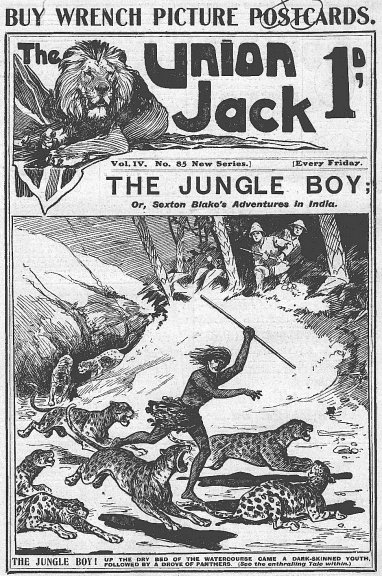
| Chapter XVI. | Bala Sahib is Convinced -- The Attack -- The Fight with the Panthers -- Carnac Sahib. |
| Chapter XVII. | The Ride to Talnagore -- The Burning Palace -- The End of the Nawab. |
| Chapter XVIII. | Home Again! -- Chester Carton's Greeting -- Retribution. |
"It will make a fine newspaper story," said Chester Carton, putting his notebook into his pocket, "and I am sure to get five or six guineas for it, which is a sum not to be despised. Such a windfall does not often come my way."
"Nor am I often tempted to speak so freely. But your fine old Burgundy, Carton, seems to have loosed my tongue."
It was between eight and nine o'clock of a February night, in the year 1904, and the scene was Martinetti's well-known restaurant in the Haymarket. Waiters moved to and from between exotic plants in pots, bearing covered dishes. Corks were popping, and gold-necked bottles tinkled in ice-pails. At the little tables, with their crimson-shaded electric lamps, sat groups of well-dressed people, many of them foreigners, laughing and chatting as they ate, drank and smoked. The detective had been dining here with his friend by appointment, and the two had reached the coffee and liqueur stage. Chester Carton, author and journalist, was a man who looked as if he might be anywhere between forty and fifty, a tall, slim man, with perfectly shaped hands, tawny moustache and pointed beard, brown eyes, and features that were always grave and sad, as if he found the burden of life a heavy one. Sexton Blake had first made his acquaintance several years before.
"Are you very busy?" inquired the detective.
"Much as usual," was the reply. "And you?"
"I have no work at present. For a month or so, my dear fellow, I hope to enjoy luxurious ease."
"You won't," declared Carton. "In a few days, I'll wager, you will be in harness again, delving into some deep mystery. Crime never ceases; wickedness is ever active. Even as we sit here, perhaps, Fate is spinning a tangled web for you to --"
There was an abrupt pause. A man, who had been dining in an adjoining room, was passing down the main restaurant, and Chester Carton was staring at him breathlessly with parted lips. The stranger wore ill-fitting European clothes, and carried on his arm a tweed overcoat and an ivory-mounted stick; but his turban of spotless white, his dark complexion, and black beard --- split in the middle --- proclaimed him unmistakably to be a native of India --- a Hindoo or a Mohammedan. He went on, glancing neither to right nor left, and the street door closed behind him.
"What's the matter?" exclaimed Sexton Blake. "You look as if you had seen a ghost."
"I have," muttered the journalist. "Yes, a ghost from the past!" He was on his feet, his face flushed and excited, pressing a hand to his brow. "Waiter!" he added. "That man who just left, who is he? Do you know anything about him?"
"Very little, sir," was the reply. "He calls himself Prince Nasrulla Khan, and this is the third evening he has dined here."
"Nasrulla Khan?" echoed Chester Carton. "I hope you won't mind my rushing off, Blake; professional zeal, you know. I want to interview this prince. I'll drop you a line to-morrow!"
And with that, seizing his hat and coat, he made a hasty exit.
"Queer," reflected Sexton Blake, as he lit another cigarette and watched the curling smoke. "I wouldn't mind betting that there is more than an interview in the wind. Come to think of it, Carton spent some years in India, from what he told me."
The detective was interested, and when he returned to his chambers in Baker Street that night the scene he had witnessed in Martinetti's restaurant was still in his mind. Before going to bed, he ran through a little book that was to India what Burke and Devrett are to Great Britain, but he failed to find the name or title of Nasrulla Khan.
The sun was shining, and the table was temptingly laid for breakfast, when Sexton Blake emerged from his dressing room fresh and ruddy after a cold tub.
"Any letters, Tinker?" he inquired of the lad who lived with him as a sort of adopted son, and was useful to him in many ways.
"Yes sir; five letters and a telegram," was the reply.
"Any news in the papers?"
"Nothing in your line, sir."
Sexton Blake opened the letters between bites of toast and sips of tea, and put four aside that were of no importance. The fifth was a brief scrawl from Chester Carton, saying that he would probably call at Baker Street that evening, and the telegram, which the detective read aloud, ran as follows:
"Wargrave Hall, Berks.
"Lord Wargrave presents his compliments to Mr. Sexton Blake, and begs that he come down as soon as possible to investigate a case of burglary."
"The papers don't mention it," said Tinker.
"No, they couldn't have heard of it yet," replied the detective. "This puts an end to my intended holiday," he added. "You can pack a small bag for me, my boy. I shall go as an expected guest."
"Do you know Lord Walgrave?"
"I have never seen him to the best of my knowledge, but I hope to make his acquaintance very soon. By the by, Tinker, drop Mr. Carton a line -- you know his address in Chancery Lane -- and tell him that I have been called out of town for a day or two."
The journalist's prophecy had already come true, and the crested missive from an English noble man was to lead to amazing and perilous adventures. But little did Sexton Blake imagine what the future held in store for him, little did he dream of the links that Fate was forging for himself and Chester Carton, for Lord Wargrave and Prince Nasrulla Khan, as he consulted a Bradshaw and made brief preparations for the journey.
Attired in stylish morning-dress, looking like a gentleman of leisure, he took a cab to Paddington and travelled down to a station not a great distance beyond Henley. Here a closed carriage was waiting for him --- he had sent a wire from Baker Street before he left --- and a drive of three miles along the pretty Berkshire roads to the village of Hertsey, and a quarter of a mile beyond, brought him to the lodge gates of the Wargrave estate, where a pair of griffins squatted on their granite pedestals.
Another half mile, through wooded grounds, and the house was reached. It was an ancient, ivy-covered mansion of three storeys, and from the front two wings abutted right and left, forming a three-sided court. To Sexton Blake's surprise a Hindoo servant appeared --- a middle-aged, clean-shaven man in white linen and turban. He opened the carriage and took the bag from the detective, who, a moment later, stood in a luxuriously furnished library, in the presence of Lord Wargrave. The latter was a tall and handsome man, looking under forty, with a bronzed complexion and a heavy brown moustache.
"I see you have a Hindoo servant, my lord," was Sexton Blake's first remark.
"Yes; Amar Singh," said Lord Wargrave. "He was in my service in India years ago, when I held a civil position at Madras, and I brought him to England after I succeeded my father. I am obliged to you for coming so promptly, Mr. Blake," he went on, lowering his voice. "A burglary was committed here last night, and I wired to you on the impulse of the moment. From your point of view, however, it may be too trivial a case for you to undertake."
"I am at your lordship's service."
"Thank you. The facts are simply these. One or more daring thieves entered the house by a French window, broke into the butler's pantry, and went off with a service of silver plate. The discovery was made by the cook when she came downstairs early this morning. The butler heard nothing, though he slept on the ground floor; and that is easily accounted for, since he admits that he accepted a glass of ale from a stranger at the Blue Lion in the village between ten and eleven o'clock last night. I have no doubt that the drink was drugged,"
The detective nodded assent.
"You don't suspect any of the servants of complicity?" he inquired.
"No, we can leave them out of the question. The plate is of no great value, but I prize it highly because it has been in the family for generations."
"I will do my best to recover it for you, and I think I shall begin by searching for a clue in the neighbourhood."
"Very well," said Lord Wargrave. "For the present, then, you will remain here ostensibly as my guest. And now let us go to lunch."
The case was, indeed, of a commonplace nature, and better suited to an ordinary detective. But Sexton Blake had promised his assistance, and he set to work as earnestly as if he had the biggest kind of a mystery to solve. After lunch he put on a tweed suit, questioned the butler and the cook, carefully examined the grounds in the neighbourhood of the hall, and then walked into the village, where he made inquiries at the Blue Lion Inn, and other places.
It was dark when he returned, entering the house unseen by a side door, and passing on to the smoking- room, which as yet was not lighted. He had been sitting here for a few moments, disappointed by the failure of his quest, when he heard footsteps in the adjoining library, and then something else that checked his quick impulse to reveal his presence.
"By heavens, I am getting tired of this!" muttered a familiar voice. "I feel that I can endure it no longer! Yet I am helpless in the power of a rapacious scoundrel! And as long as the boy lives --"
The rest of the sentence was inaudible. Sexton Blake rose noiselessly, and two steps brought him to where he could see through the curtained doorway. Lord Wargarve had thrown himself into a padded chair in the library, with an envelope in one hand and a letter in the other. The firelight played on his face, which wore a haggard expression of anxiety and anger. Tearing envelope and letter into fragments, he rose and threw them into the fire, watching until they had faded to ashes. Then he left the room, closing the door behind him.
A moment later, Sexton Blake was in the library, his eyes scanning the floor, and by the edge of the grate he found a small fragment of the destroyed envelope. Having seen that it bore part of an Indian stamp, but no trace of a postmark, he put it into his pocket. Then he beat a retreat, back through the smoking-room, and slipped upstairs to his own chamber, where his evening clothes were laid out.
"The old story!" he told himself. "The family skeleton! Lord Wargrave is being blackmailed by somebody in India. A native marriage perhaps, and he daren't acknowledge the child in India. It is not a case in which I could be of any service, nor is it likely to offer me his confidence.
"That you have accomplished nothing so far is no disappointment to me," said Lord Wargrave, "for I did not expect you to succeed in so short a time. I am afraid you will have to look for the thieves in London. They are evidently experienced cracksmen."
"I think so," replied Sexton Blake. "Yes, I shall have to search for a clue in town. But I wish to remain here for another day, in order to make a more complete examination of the grounds, and to continue my inquiries in the village. Meanwhile, my lord, your silver is quite safe if it belongs to the Queen Anne period."
"It does," said Lord Wargrave. "I follow your meaning. The plate is worth ten times more intact than melted down, and the thieves are likely to keep it as it is until they can --"
He suddenly paused. The door had opened, and Amar Singh entered the room. His brown face was a shade paler and there was a worried look in his eyes. He stepped over to his master, stooped down, and whispered a few words in this ear. Lord Wargrave turned white to the lips, but instantly recovered his self-control.
"My steward," he said calmly, as he rose. "He has come with some poaching complaint, no doubt. Tell him that I will see him, Amar Singh. Will you excuse me, Mr. Blake?"
"Certainly," replied the detective, "I feel rather tired, so I shall go to bed." And he departed at once, leaving the two alone.
The smoking-room was at the rear of the house, and Sexton Blake did not get a glimpse of the visitor as he passed along the hall and ascended the staircase. He entered his bed-chamber and closed the door, but he had no intention whatever of retiring for the night. His professional instinct had been roused, and that was sufficient excuse for what would have been gross impertinence in an ordinary guest.
"It is not the steward," he reflected. "It is someone who is dreaded by both Lord Wargrave and Amar Singh, and I am anxious to have a peep at the man, whoever he may be."
The room was in the left wing, opening on the court, and one of the three windows that, towards the angle of the wall, commanded the nearest view of the entrance to the house. It was a clear and frosty night, and the moon was shining brightly on the old grey stonework and the tangle of ivy. Himself in darkness -- he had not turned on the light -- Sexton Blake posted himself behind the window- curtain.
It was a long a tiresome vigil. For more than an hour he waited and watched, until he was numbed with cold, and then his patience was rewarded. He had looked up for a moment, and when he lowered his gaze, he saw Lord Wargrave's visitor standing outside the front door, which had already been shut behind him. The man wore dark clothing and a tweed cap, and the next instant, as he stepped forward, the moonlight shone on his brown skin and split beard -- revealing to the amazed detective the features of Prince Nasrulla Khan, whom he had seen on the previous night in Martinetti's restaurant in the Haymarket.
"By Jove! This is getting interesting!" muttered Sexton Blake. "No doubt Nasrulla Khan is the blackmailer! He must have written from India to announce his coming, and arrived in England before the letter. But that don't fit in, unless Lord Wargrave received the letter several days ago. At all events, this unwelcome visitor was not expected at the Hall to-night, so much is certain."
The Hindoo walked rapidly away, without looking back, until he vanished from sight around the curve of the gravelled drive. And not three seconds later, as the detective was still at his post, a white-robed form slipped into view from behind the opposite wing of the house. It was Amar Singh, and something glittered at his waist. He glided on like a cat, following the edge of the drive until he came to the turn, and then he swerved aside and crept into the shrubbery.
"By heavens, I know what that means!" Sexton Blake told himself. "There will be murder done unless I can prevent it!"
He did not hesitate an instant. Noiselessly hoisting the window-casement, he swung over the sill, gripped the ivy with hands and feet, and lowered himself by the tough roots. He safely reached the ground, sped across the court, and was soon in the deep shadow of the trees and bushes. He hastened on as fast as he dared, keeping parallel with the drive, and had gone for a hundred yards when he heard a gurgling cry and the sound of a fall at no great distance ahead.
"Too late!" he thought. "The deed is done!"
But with that came the noise of a scuffle. Quickening his steps to a run, and the next instant bursting into a moonlit glade, he saw two men struggling in the frosted grass. Amar Singh was underneath, however, and his assailant was kneeling on top of him, holding him down with one hand and apparently pulling at something with the other. The truth immediately occurred to the detective. He understood the fiendish act.
"Enough of that, you scoundrel!" he cried.
Prince Nasrulla Khan sprang to his feet with a yell of surprise and terror, and bounded away like a deer, tearing through the thickets of evergreen timber. Sexton Blake had levelled a pistol, but he did not fire. He lowered the weapon, and then turned his attention to Amar Singh, who was writhing feebly on the ground, and uttering stifled, inarticulate sounds. And little wonder, for drawn tightly about his neck was a slender, silken cord, on which the would-be assassin had been pulling. The detective removed the noose, and after a brief struggle for breath --- he had been nearly suffocated --- the Hindoo was able to rise and speak.
"That was a close call for you, my friend." Said Sexton Blake.
"Very close, sahib," replied Amar Singh. "I should shortly have been dead. Where is my enemy?"
"The scoundrel fled in that direction. Come, we had better try to catch him!"
"It is useless. He is as cunning as a serpent. We should never find him in these deep woods."
Sexton Blake realised that this was true, and knew also that Amar Singh did not want the man to be caught. He picked up the rope and examined it intently. He was closely watched by the Hindoo, who had not uttered a word of gratitude to the rescuer.
"Ah, I thought so!" exclaimed Sexton Blake. "I cannot be mistaken! I have been in India, where this came from. It is a cord of Thuggee, used by that murderous brotherhood for strangling their victims; and the man who tried to take your life, Amar Singh, was himself a Thug."
"The sahib may be right. How should I know?"
"I don't say that you do," the detective answered cautiously. "But I am naturally puzzled by this incident. How did the fellow come to trap you?"
"When I open my lips," the Hindoo replied, "it will be in the presence of my master. Shall we go to him, sahib?"
"Yes I am ready. There is nothing to be done here."
No more was said. The two silently retraced their steps, following the drive, and on the way Sexton Blake mentally reconstructed the affair in the wood. To do so was easy. While stealthily seeking to overtake Lord Wargrave's visitor, with murderous intent, Amar Singh has either been heard, or else Prince Nasrulla Khan had suspected danger when he left, and guarded against it by lying in wait for the Hindoo and throwing the deadly noose over his head from behind.
"A true Thug, undoubtedly!" vowed the detective. "I wonder what will come of this?"
Lord Wargarve must have heard the cry, for he was standing outside the Hall, and the moonlight showed his startled and worried expression. A glance at Sexton Blake seemed to disconcert him still more. Without a word, he led the way to the smoking-room and closed the door.
"What does this mean?" he asked coldly. "Speak Amar Singh! You followed my instructions?"
"I did as you told me, my lord," replied the Hindoo, "and it is not my fault that I failed. I would have kept at a distance from your visitor, but he must have heard my footsteps, for he hid himself behind a tree, and as I passed he threw a rope over my head and drew it tight. I was about to be strangled when this sahib came to my rescue and frightened the assassin off."
"Well done, Mr. Blake!" said Lord Wargrave, eyeing the detective narrowly. "I am indeed grateful to you, for I value Amar Singh's life highly. You shall have a full explanation, but first ---"
"My own explanation, of course," broke in Sexton Blake. "It is perfectly simple. I no longer felt sleepy when I went upstairs, so I lit a cigar and sat for an hour or more thinking about the burglary. Then, as I was about to go to bed, I fancied I heard a footstep outside. I looked from the window, and saw a man on the drive, and a moment later, when he had disappeared, I saw your servant creeping in the same direction. Believing that a burglar had been prowling about, and that the Hindoo had discovered him, I hastily lowered myself to the ground by the ivy, ran across the park and reached the spot in time to prevent a tragedy. Here is the rope."
Convinced that the detective's story was true, Lord Wargrave's expression of relief was obvious. He took the silken cord, glanced at it carelessly, and threw it on the table.
"I deceived you when I told you that my visitor was the steward," he said, "but you will pardon me when you have heard the circumstances. Briefly, they are these.
"Years ago, when I was in India, the neighbourhood of Madras was infested by a gang of Thugs, and I succeeded in having a number of them caught and convicted. My native servant helped me in this, and partly for that reason I brought him to England with me, for a number of the gang were still at large, and a Thug, as you may know, will track a man the world over to be revenged.
"Years passed, and until to-night Amar Singh and I believed ourselves to be safe. Then came this mysterious visitor, whom I received. He proved to be one of the old band of Thugs, Ram Das by name, and his object was blackmail. He had been sent to England to find me, but he offered to keep my secret, and to reprt to his companions that he has failed, if I would pay him a large sum of money. I gave him twenty pounds in gold, promising to send him more, and when he had gone I bade Amar Singh follow him secretly and learn where he was stopping in the neighbourhood, that I might have him arrested in the morning.
"That is my explanation, Mr. Blake, and I trust that you will regard what I have told you as in confidence. The incident is closed for the present, since, after his murderous attempt on my servant, Ram Das will lose no time in escaping from England."
"It would be unwise to let him return to India," said Sexton Blake, who did not know how much of the story to believe. "I might be able to catch the fellow."
"No, I don't wish you to. I am anxious to avoid publicity."
"But the band will send others to murder you."
"I am not afraid," declared Lord Wargrave. "I shall cable the authorities at Madras, who will keep a lookout for Ram Das, and no doubt succeed in arresting him and his companions. Should I be threatened by any danger in the future, however, I will be glad to call in your assistance."
"And I shall be at your service."
"Meanwhile, Mr. Blake, you will respect my wishes?"
"In regard to Ran Das? I assure you that I have not the slightest idea of trying to bring him to justice. Good night, my lord!"
And with that Sexton Blake went off to bed, but not to sleep. For several hours he lay awake, pondering the strange events of the evening.
"Is it a very serious thing to compound a felony?" he asked.
"The law so regards it."
"Nevertheless, Mr. Blake, I want you to connive at one. It is often done, I believe, and in quarters not a thousand miles from Scotland Yard."
"What do you mean, my lord?"
"To come to the point, I have received a letter from the burglars, who appear to be aware how highly I value the stolen plate. They offer to restore it to me for a sum that is slightly in excess of its value as ordinary silver, and they declare that they will melt it down if I refuse."
"You think of accepting the offer?" asked the detective, who considered the statement to be quite plausible.
"I am most anxious to do so, naturally."
"You had better be guided by me, or you may lose both money and plate. Suppose you let me see the letter?"
"I am pledged not to show it to anyone," was the reply.
For an instant the eyes of the two men met, and Sexton Blake knew that Lord Wargrave was telling a deliberate lie --- knew that the whole story was a fabrication. Moreover, he knew in part the object of it.
"A clever scheme for getting rid of me," he thought. "Very well, my lord," he said, "you can manage this yourself. This is a case in which compounding a felony is at least excusable, and I sha'n't interfere. As there is nothing more for me to do here, I will go back to town at once."
"You have been put to considerable trouble," said Lord Wargrave, taking a cheque book from his desk, "not to mention loss of time, and I beg that you will ---"
"You owe me nothing," interrupted Sexton Blake.
"Surely you will let me pay you for your services?"
"No, my lord, I cannot accept a penny. I have been practically your guest for a day and a night. I have benefited by the change of air, and you have afforded me some pleasing excitement. That is compensation enough."
"As you will."
Lord Wargrave shrugged his shoulders, and put the cheque-book aside. Half an hour later he and the detective parted on the best of terms, and a small trap drove Sexton Blake from Wargrave Hall to the railway-station, where he caught a train before noon. Alone in a first-class compartment, he lit his pipe and sat with eyes half-closed, meditating on the strange events that had come to his knowledge.
"It is not all as clear as I could wish," he told himself. "There may be two intrigues going on. The tale about the Thug is possibly true in every respect -- I have known of such things -- and the letter that caused his lordship such annoyance refers to another unpleasant affair in India, concerning a child. But whether there are two blackmailers or only this one, it is certain that Lord Wargrave wanted to get me out of the way so that he might have a free hand; and he accomplished that at the sacrifice of his silver plate, which he will now never recover. No doubt he got a letter from the bogus Prince Nasrulla Khan by this morning's post -- a letter of defiance and threat -- and he means to purchase his safety by paying the whole sum that the scoundrel demands."
Thus the detective reasoned, mainly from idle curiosity; and on other points he worked out theories that equally satisfied him.
"After what happened last night," he thought, "the Hindoo won't trust himself at Wargrave Hall again, nor will he consent to a meeting anywhere in the vicinity. He has probably arranged in writing for an interview in town, among the crowds of London, and Lord Wargrave will ultimately meet him and pay over the money. On second thoughts, he may be hopeful of making the appointment at or near the Hall, and should the Hindoo consent to that -- which is more than doubtful -- he will be in no danger; for neither Lord Wargarve nor Amar Singh would dare to harm him, since they must know that I would be the first to suspect them of the crime. They meant to murder him last night, but they won't attempt that again.
"It is not an affair for me to meddle in. It is a case of blackmail, pure and simple, in which the victim intends to pay. I offered my assistance to Lord Wargrave, and he refused it. He is a rich man, and can afford to be bled, so I shall let him alone. On the other hand, however, it is just possible that there is something deeper than I imagine. Chester Carton, for instance, evidently knows something of Prince Nasrulla Khan's past. I shall look him up, and hear what he has to say about the matter. And it can do no harm to keep an eye on the Hindoo, if I can get on his track. I am pretty well convinced that he made his way back to town last night."
The train was gliding into Paddington Station, and Sexton Blake found himself looking forward with keen interest to pursuing his investigations, even while he felt they could lead to nothing more than he already knew.
He took a cab to Baker Street, ate his lunch, and started out in quest of the journalist, who had neither written to him nor left any message. But Chester Carton was not at rooms in Chancery Lane, and he could not be found in any of his usual haunts. The detective paid a second visit to Chancery Lane, drove west to the Anglo-Indian Club to make some inquiries about Lord Wargrave, and them went to Martinetti's restaurant in the Haymarket.
But Prince Nasrulla Khan was not dining there that night, which suggested that he has an appointment elsewhere, and, after waiting till past ten o'clock, Sexton Blake paid a third and fruitless visit to Chancery Lane. Then he drove home to Baker Street, and as he entered his sitting room Tinker appeared and handed him a telegram.
"It just came, sir," said the lad -- "not ten minutes ago."
Sexton Blake tore open the brown envelope, and an expression of puzzled bewilderment grew on his face as he read the following message, which had been sent from the night office at Hammersmith:
"I want your opinion in a mysterious affair. It is quite in your line. Come at once, if you can, to No. 483, Castletown Road, West Kensington. -- Dart."
The detective studied the signature with knitted brows.
"Dart? Dart?" he muttered. "Ah, I have it! My old friend Georges Dart, of course. How could I have forgotten him? But what could have brought him back to England?"
George Dart had served in India as a soldier in his early days, and after his discharge, while still a young man, he had joined the police force, and shown such a talent for detective work that he was speedily attached to Scotland Yard. Seven years ago he had gone out to India again, but this time to fill a post in the Secret Service, with headquarters at Madras. All this flashed upon the detective with the recognition of the name.
"Is it more than a coincidence?" he asked himself. "India has been buzzing in my brain all day, and now comes a message from Dart, whom I supposed to be thousands of miles away at Madras! What can he want with me?"
"Are you off again, sir?" inquired Tinker.
"Yes immediately! Run down and hail a cab, my boy, while I make a few quick changes. This may be a case for disguise."
Five minutes later -- it was now shortly past eleven o'clock -- Sexton Blake was driving rapidly through the gaslit streets of London, by the way of Park Lane, Knightsbridge, and Kensington High Street. The cab whipped through by a short cut to the North End Road, and turned off into the residential quarter of West Kensington --- a quarter that has seen better days -- where are imposing streets of brown stucco mansions, similar to those in Portland Place, though smaller in size.
No. 483, Castledown Road was such a house, with a wide portico and round columns supporting a heavy balcony. The nearest street-lamp was some distance off, and the detective could but vaguely see the faces of the little crowd who pressed about him curiously as he sprang to the pavement and mounted the steps. Here two constables were on guard, but at a word one of them opened the door.
"First floor back, sir," he said, touching his helmet.
All had been quiet and mysterious, and Sexton Blake felt a thrill of unwonted excitement as he mounted the staircase, at the top of which he was met by two men, one with black beard and eyeglasses, the other with a brick-dust complexion and a ragged, sandy moustache.
"My dear Blake," said the latter, in a subdued tone.
"My dear Dart! You look as young as ever!"
They clasped hands warmly, each scrutinising the other.
"This is Dr. Parry, whom I called in," said Inspector Dart.
"Glad to meet you," said Sexton Blake. "But may I ask what --"
"Come, I will show you," replied the inspector.
Sexton Blake pulled off his false moustache and slipped it into his pocket, as he followed his companions into an apartment that was bed-room and sitting-room combined. A triple gas-jet was burning, and the light shone on a man stretched full-length on a couch --- a dark- skinned man, with a black beard parted in the middle, whose eyes were closed, and whose limbs had a rigid appearance. For nearly a minute the detective gazed at the motionless figure, so absorbed that he did not hear voices in the hall or footsteps on the stairs.
"By heavens, it is Prince Nasrulla Khan!" he exclaimed.
"He called himself that," interposed the quiet voice of Chester Carton, as he entered the room and stood by the couch; "but his real name is Lalaje Ram!"
"You are quite right, sir, whoever you are," declared Inspector Dart. "The man you see before you is Lalaje Ram, the convict, and a pretty chase he has led me."
"I must apologise for intruding," said Chester Carton. "I am a journalist, and I am interested in this affair. I happened to know one of the constables at the door, and he allowed me to come in. Mt friend, Mr. Blake, will vouch for me. But is this man dead?" he added.
"He has been dead for more than an hour," replied Inspector Dart.
"Of heart disease," stated Dr. Parry.
"I take the liberty of doubting that," put in Sexton Blake.
"Ah, I thought you would!" said the inspector. "And yet there is no evidence to show that Dr. Parry is wrong."
"Not yet, perhaps," said Sexton Blake, in a peculiar tone, as he bent over the corpse. "What are the circumstances, Dart?"
"I will tell you all in a few words," replied Inspector Dart. "The dead man, Lalaje Ram, was at one time a havildar in the 2nd Indian Rifles, stationed at Dindigal, near Madras, and he also belonged to the infamous sect of Thugs. Thirteen years ago, in 1891, he was convicted of murder, and sentenced to imprisonment for life at the penal settlement on the Andaman Islands, in the Bay of Bengal. Six months ago he escaped, reached the mainland by hiding himself in a vessel that had brought supplies to the island, and the Indian Government instructed me to recapture him. I traced him across country to Madras and from there to Dindigal, where he made inquiries concerning a shikaree known as Jammu, who had disappeared shortly before Lalaje Ram's arrest --"
"Jammu?" interrupted Chester Carton, with an eager flush on his face. "Did you say Jammu?"
"Yes, that was the name," replied Inspector Dart. "At Dindigal I completely lost track of my man," he went on; "and not until weeks afterwards did it come to my knowledge that he had returned to Madras, and sailed from there in a vessel bound for England."
"You don't know where he spent those intervening weeks?" asked the journalist.
"I do not," declared Inspector Dart, who was surprised by the interruptions. "I haven't the slightest idea. As I was about to say, this new move on the part of Lalaje Ram puzzled the authorities, and instead of cabling to have the fugitive arrested --- they were curious to know why he had gone to England -- they ordered me to follow him. I took a faster steamer, and arrived in London a day or so earlier that the slow-sailing vessel. I spotted Lalaje Ram at the docks, and traced him to this house, where he took a room under the name of Prince Nasrulla Khan. That was five days ago. Yesterday I lost my man, but this afternoon I got on his track again, and this evening I shadowed him to a spot in Hyde Park near the Albert Memorial, where he waited for a couple of hours as if expecting someone."
"And nobody came?" put in Sexton Blake.
"Nobody came," replied Inspector Dart. "When the Hindoo finally left I followed him, but as I judged that he was going straight home I did not stick very close to him. In view of what happened afterwards, I regret that I kept so far behind. It may mean nothing, though I can hardly think so. But the facts are these, Blake. As I turned off the North End Road a man whizzed past me on a bicycle, and I got only a vague glimpse of him. I had then lost sight of my quarry. A minute later, as I turned into the Castletown Road, I heard the sound of a dull fall, and saw a dusky figure spring upon a bicycle. The man pedalled away as fast as he could go, down the street, and vanished in the darkness. I hurried forward to this house, which was twenty yards away, and on the upper step I found Lalaje Ram. He was lying partly against the door, and was already dead. It was from the front of the same house, or thereabouts, I may add, that the mysterious man jumped on his bicycle."
"It was a coincidence," suggested Dr. Parry.
"A very curious one, then," said Chester Carton.
"It was more than a coincidence," the inspector answered drily. "The cyclist had not been to any of the adjacent houses, for I took the trouble to inquire."
The doctor shrugged his shoulders. "Heart disease, Gentlemen," he said. "That is what killed the Hindoo."
"Look!" he exclaimed, in a tone of triumph.
"There is hardly anything to see," muttered Inspector Dart, as he bent over the arm. "What do you make of it?"
"It is a mere pin-prick," said Dr. Parry. "It amounts to nothing."
"On the contrary, it means everything!" declared Sexton Blake. "It means that this man was murdered by poison. I have been in India, and I know the signs. I amsatisfied, beyond a doubt, that the poison was derived from that most deadly and terrible of serpents known as the Echys Carinata. A single prick -- such as a puncture as you see -- would have been quite enough."
"You may be right, sir" said Dr. Parry. "I confess that I am not an expert in toxicology. I thought it curious that the body should have become so rigid so soon after --"
"He is right," broke in Inspector Dart. "I am sure of it. But what is your theory, Blake?"
"It is very simple," replied the detective. "This mysterious cyclist had an appointment in Hyde Park with Prince Nasrulla Khan -- or Lalaje Ram, I should say -- and he probably meant to murder him there. But he changed his mind --- I suggest that he saw you lurking about the vicinity -- and when the Hindoo left he followed him at a distance. He was, no doubt, provided with a short cane, which was fitted with a hollow needle that worked by a secret spring, and contained a few drops of the fatal venom. You can imagine the rest. As Lalaje Ram mounted the steps the cyclist darted at him, jabbed him in the arm, then sprang on his machine and fled. The prick of the needle would have produced instant paralysis of the throat and other muscles, as well as the heart, and the Hindoo must have died within a half dozen seconds."
"But what is the meaning of it all?" exclaimed Inspector Dart. "What brought Lalaje Ram to England? Why was he murdered in such a dastardly manner? This promises to be a most mysterious case."
"I think I can throw some light upon it." said the detective. "Lalaje Ram was killed by another Hindoo, and the assassin was urged to the deed by a third person. The two naturally believed that the cause of the man's death would not be discovered. I have a strong clue, which I obtained by accident. I have just returned from a big house in Berkshire, where I was summoned on professional business, and while there I happened to ---"
He was interrupted at that point by Chester Carton, who, with a sharp gesture, seized him by the arm and drew him aside.
"You have been to Wargrave Hall?" the journalist demanded, in an eager whisper.
"Yes, I have," Sexton Blake admitted.
"Then say no more! Drop the matter for the present! I want a quiet talk with you at the first opportunity."
"I am curious to hear the rest, Blake," interposed Inspector Dart. "This is my case, but I shall be glad of your assistance."
"I shall finish my story another time," replied the detective. "Where can I find you?"
"I am stopping at Scotland Yard."
"Very good!"
With that, Sexton Blake proceeded to thoroughly search the dead man, and then the room. On the body was a leather pouch containing English gold and a number of jewels, and under the bed he found a small box that contained some clothing purchased in London. That was all; there was nothing in the way of papers or writing.
"There is a matter I must speak of." Chester Carton said nervously, turning to the doctor and the inspector. "It is important that the true cause of the Hindoo's death should not be made known public, at least for a time. I want you to let the authorities believe that he died of heart disease. I hope that Mr. Blake will --"
"I am of the same opinion," interrupted the detective, who knew that the journalist must have a sound reason for the request. "I quite agree with my friend. So, for the present, gentlemen, let us hush this affair up."
"You think it best, Blake?" inquired the inspector, who was not a little mystified.
"I do. In the interests of justice."
"Yes; that the assassin may be thrown off his guard," said Chester Carton.
"That is understood between us, then," continued Sexton Blake. "I think I have finished here," he added. "You shall hear from me in the morning, Dart -- I promise you that. Good-night."
And he left the room in company with the journalist.
"Sit down!" urged the detective. "Have a drink and a cigar. They will help you to decide whether on not to take me into your confidence."
"No; I can't sit down," was the reply. "I am too nervous, too excited. As for my confidence, I have no intention of withholding that. You remember the episode at Martinelli's restaurant? Since then I have ben keeping an eye on Lalaje Ram, though I lost track of him yesterday. When I first saw him I suspected why he had come to England, and now, since I have learned what happened at Wargrave Hall, I know that I was not only right, but that there was much more in the Hindoo's visit than I dreamed of."
"You rouse my curiosity," said Sexton Blake.
"And I will satisfy it, for I want your help."
Chester Carton helped himself to a drink, lit a cigar, and sat down opposite to his companion. There was a reminiscent look in his eyes, which glowed with a strange, feverish light.
"I will begin with a little narrative that you have probably never heard of," he said. "At the time of which I am going to speak the late Lord Wargrave was a comparatively poor man. He had left Wargarve Hall to a rich American, and was living in chambers in London. He had been married twice, and had a son by each wife, both of whom were dead. The sons, who bore the family name of Haviland, were, of course, half-brothers, and had been in India for years. In the year 1891, which is the date of the story, Guy Haviland, the elder, was aged twenty-seven. He was a captain of the 2nd Native Rifles, stationed at Dindigal, in the province of Madras. Arthur Haviland, who was younger by three years, was private secretary to the Commissioner of Madras. I myself was living at Dindigal at the time, and Guy Haviland and I were bosom friends.
"To continue, my dear Blake, an insurrection broke out among the hill tribes up in the neighbourhood of Coorg, and Captain Haviland was sent against them with a small force. He left his wife and child behind him; and his body servant, I may add, was Lalaje Ram, who was a havildar in one of the companies of the regiment. One night the force encamped close to the stronghold of the enemy, and it was known that they meant to attack in the morning. They came at daybreak, and when the alarm was given Captain Haviland was lying in a stupor in his tent, utterly helpless. Deprived of their leader, the soldiers were beaten and compelled to retreat, and it was with great difficulty that they carried the young officer off with them. Captain Haviland was relieved of the command, and returned to Dindigal in disgrace, to learn that he was believed to have been intoxicated, returned to find that during his absence his wife had died of fever, and that his child, a little boy of three years old, had wandered into the jungle and fallen victim to a panther that was prowling about. Then came an order for the unhappy man to reprt himself for arrest, and this proved the last straw. A few hours later his clothes were found on the bank of a deep and sluggish river a mile away. He had committed suicide, and his body was never recovered, for the stream swarmed with crocodiles."
The journalist paused, and for a little time he was too deeply moved to speak. It was evident that he was still grieved for his friend, though many years had elapsed.
"I am deeply interested," said Sexton Blake. "From what you have already told me, and from what I learned at Wargrave Hall, I can see what is coming. His brother's death, of course, made the Honourable Arthur Haviland the heir to the title!"
"Certainly!"
"And to what else? To an empoverished estate?"
"No, far from it. A distant kinswoman, who had always been on bad terms with Lord Wargrave, had just died and left him property worth œ20,000 a year."
"Captain Haviland knew of this?"
"He did not," replied Chester Carton," for it was seldom that he heard from his father. But I am convinced that his half-brother, who was the favourite son, had been aware of the fact at some time. Do you see the drift? There was treachery and crime, so sure as there is a heaven above us. I never doubted my friend's innocence, nor, on the other hand, did I have any suspicions until a short time after his death, when I learned that Amar Singh, Arthur Haviland's servant, had been seen in Dindigal a day or two before the expedition started. He was devoted to his master, who had once saved him from a tiger. I put two and two together, and the truth flashed upon me. I firmly believe that Arthur Haviland sent Amar Singh to Dindigal, and that the latter bribed Lalaje Ram to drug Captain Haviland on the eve of the battle. Arthur Haviland, wanted the title and the estates. He hoped that his half- brother would perish in the fight, and later he would probably have disposed of the child who stood in his way had it not been carried off by a panther. You follow me?
"Go on," said Sexton Blake.
"I had no proofs," resumed the journalist, "so I could do nothing. Lalaje Ram, as you know, was a Thug, and not long after this affair he was arrested and taken to Madras. He was convicted on evidence raked up by Arthur Haviland -- who wanted to get rid of him -- and was sentenced to the Andaman Islands for life. Arthur Haviland resigned and went home, accompanied by Amar Singh, and for thirteen years -- his father died about the time of his return -- he has been the wealthy Lord Wargrave, enjoying life on the profits of a dastardly crime. I have been in England myself for ten years, longing to punish this guilty man, and now I see my way to do it. You remember what Inspector Dart told us to-night. Directly he spoke of Jammu --"
"Suppose you let me finish the story for you, "Interrupted Sexton Blake. "I think I can hardly go wrong. Lalaje Ram knew that he owed his conviction to Arthur Haviland, and knew the motive of it. He lived in the hope of escaping from the Andaman Islands, and at last he succeeded. He thirsted for vengeance, but he was influenced by a motive of a different kind ---namely, the suspicion that Captain Haviland's son was not dead. He made his way to Dindigal, and there learned that the child was indeed alive -- the child who is the real Lord Wargrave. He then came to England, went to Wargrave Hall, and offered to keep the secret in consideration of a large sum of money. Lord Wargrave and Amar Singh planned to kill him, and after the first attempt failed, not daring to pay a second visit to the Hall, Lalaje Ram appointed an interview in Hyde Park to-night. We know what happened. He waited in vain for Lord Wargrave, returned to West Kensington, and was followed and murdered by Amar Singh."
"You are right!" cried Chester Carton, rising excitedly to his feet. "There is not a shadow of doubt! What you learned at the Hall is the absolute proof of my suspicions! Had revenge brought Lalaje Ram to England he would have killed Lord Wargrave last night. But it was money he wanted. He chose blackmail instead of revenge. He knew that Captain Haviland's son was alive, knew where he could be found. And the clue is in my possession. There was never a certainty about the panther. The footprints of the beast were seen near the bungalow, that was all. Jammu, the shikaree, had a fondness for English children. He found the boy wandering in the jungle, yielded to the temptation to carry him off, and then suddenly vanished -- as I now remember -- from his little hut in the foothills. I have hardly thought of these things since, but the murder of Lalaje Ram has opened my eyes to the truth. The real Lord Wargrave is alive and with Jammu somewhere in that wild country!"
"I believe it, my dear fellow."
"Could you believe otherwise! Blake, you must go out to India! You must bring the heir back, restore him to his rights, and punish the false Lord Wargrave and Amar Singh! I employ you for this service! I will see it through at any cost!"
"I admire you, Carton. You are willing to spend all for the sake of a friend who has been dead for thirteen years!"
Chester Carton's face flushed. He turned his head for a moment, and rested his elbows on the mantel.
"You don't understand," he said. "Guy Haviland was more than my friend -- he was almost a brother. We were inseparable, and his terrible end spoilt my life. I want you to clear his name before the world. I want that guilty half-brother and his confederate brought to justice. And the boy -- the boy ---- "
He picked up his whisky-glass, and it fell to fragments to the floor, crushed by the pressure of his hand.
"Take another," said Sexton Blake, who was watching his friend narrowly. "By the way," he added, "I suppose you were doing journalistic work at Dindigal in 1891?"
"Yes," replied Chester Carton, as he poured out a drink. "Yes; I -- I was the correspondent of a Calcutta newspaper. I had to give up on account of the climate. I suffered from fever, and I never got rid of it. It is still in my bones, and it often sends me to bed for a day or two. That is why I dare not return to India; it would mean death! But I will provide the money, up to any amount. I could raise œ10,000, if necessary, within twenty-four hours."
Sexton Blake looked at the journalist in surprise.
"œ500 would be nearer the mark," he said. "But I am not thinking of the money. This will be no easy task. If the boy has been brought up by Jammu, the shikaree, he will be a young barbarian, I fear."
"Ah, that is the pity of it!"
"And it may be hard to trace him. It will be far more difficult -- nay, impossible -- to obtain evidence of guilt against Lord Wargrave and Amar Singh, since Lalaje Ram is dead."
"Yes, yes -- you are right. However, it will be punishment enough for Lord Wargrave to lose title and riches. Bring the boy back; that is all I ask. If Lalaje Ram was able to find him, why should you not do the same? Don't refuse, Blake! Promise me that you will go!"
"I will," replied Sexton Blake. "This is a case that strongly appeals to me -- it draws me like a magnet. Yes, I will go -- that is settled. But hadn't I better employ Inspector Dart to help me?"
"By all means! That is a good idea!" exclaimed Chester Carton. "The two of you can hardly fail to succeed."
"We will do our best, at all events," declared the detective. "But you are looking utterly fagged out, my dear Carton! Go home and sleep, and come back here to-morrow, when we will have a further talk over the matter."
"I will come in the afternoon; and, meanwhile, you can hunt up Inspector Dart and take him into your confidence. I hope the cause of Lalaje Ram's death can be kept a secret, for otherwise, should Lord Wargrave and Amar Singh have reason to fear that you suspect them of the crime, they might be a source of danger."
"That is true," assented Sexton Blake. "However, I don't think we need worry ourselves about it. Dart will know what to do. Good-night, my dear fellow!"
"Good-night!" said Chester Carton. "I am deeply grateful to you, Blake, and I have perfect confidence in your skill. Find Captain Haviland's son and it will be worth more to you than all the cases you have handled in the past."
At the end of the week Lalaje Ram was buried, after a coroner's jury had agreed that he had died a natural death, and, several days later, Sexton Blake and Inspector Dart sailed for India on a P. and O. liner. At Marseilles a wizened, grey-bearded old-Hindoo came aboard the vessel, but the detective and his companion did not observe the furtive scrutiny he gave them in passing, nor did they see him again during the voyage. Little did they imagine under what circumstances they were to meet him in the future.
"We shall not give up yet," vowed Inspector Dart.
"No; we are far from discouraged," declared Sexton Blake, "though I admit that the task has proved far more difficult than I expected it would. There are persons here -- or, at least, one person -- who can tell us what we want to know. It is certain that Lalaje Ram succeeded in getting the information, and I intend to do the same, no matter how long it may take."
There was a pause. It was an April night in India, more than seven weeks after the murder of the Hindoo in West Kensington, and the three men were sitting after dinner on the outskirts of Dindigal, which is a long distance from Madras, and far in the south of the vast province of that name. Mr. Lawrence was the assistant commissioner of the district, and Sexton Blake and the inspector had gladly accepted his offered hospitality while they engaged in the task that had brought them so many thousands of miles. So far, they had accomplished nothing, though they had been at Dindigal, working quietly and incessantly, for more than a fortnight. Natives in bazaars and suburbs, in neighbouring villages, had been questioned in vain. Many remembered Jammu and his mysterious disappearance, but not one would admit that he had seen Lalaje Ram on the occasion of his recent visit, or had given him any information. Yet somebody held the secret -- somebody who could not be bribed to open his lips.
"I recollect seeing you when you were here three or four months ago, Dart," said the commissioner. "I passed you in the street. You are sure of your facts, I suppose?"
"Quite sure," replied the inspector. "Half a dozen natives told me that they had seen Lalaje Ram, and that he had made inquiries of them concerning the old shikaree. I should have arrested the fellow at once, but I was keen on learning what he was up to, and that is how I lost him. He took alarm, and gave me the slip, and I heard nothing of his afterwards -- except that he had gone to the south . . . until it came to my knowledge weeks later that he had sailed from Madras to London."
"Well, there is still hope," said Mr. Lawrence. "The natives are a queer lot, and very reticent, though I see no reason for silence in this case. Perhaps the increased reward will induce the right man to come forward and speak."
Sexton Blake thoughtfully smoked his pipe for a moment, gazing into the tropical night, where the moon shone on field and jungle and distant hills.
"By the way, Mr. Lawrence," he said, "I think you told me that you were not living in Dindigal at the time of Captain Haviland's death?"
"No; I came here a year afterwards, while the sad affair was comparatively fresh."
"Captain Haviland had a very dear and intimate friend, a journalist by profession. His name was Carton -- Chester Carton. Did you ever hear of him, or meet him?"
"I never did," replied the commissioner. "The name is unfamiliar to me."
"That seems rather curious," said Sexton Blake. "I should have supposed that in so small a place --"
"What's that yonder?" interrupted Inspector Dart." Do you see it? I can't tell whether it is man or beast."
A vague, dusky object was moving slowly up the compound, following the edge of the path, and avoiding the moonlight by keeping in the shadow of the luxuriant plants and flowers. The shape soon resolved itself into a man. He crept warily nearer, occasionally turning his head to look back towards the gate.
"It is a native," muttered Mr. Lawrence. "But why does he behave so oddly?"
"He fears something," declared Sexton Blake. "This is the very man we want. You will see that I am right."
The mysterious person was now crouching at the foot of the verandah, between the steps and a clump of orange-bushes. He was an elderly Hindoo, scantily clad and without a turban.
"Who are you?" inquired the commissioner, "and what do you want?"
"My name is Govind, Lawrence sahib," was the reply. "I have come to speak with these sahibs, and to claim the reward of two hundred rupees. I can tell them what I told to Lalaje Ram."
"About the shikaree Jammu?" put in Sexton Blake. "Let us hear the story, and the money is yours."
"I am the sahib's servant," said the Hindoo, "and I will speak truthfully. Thirteen years ago, on the day that Jammu disappeared, I was cutting wood in the jungle, early in the morning, along the trail that goes south. At sunrise a cart passed by, drawn by a single bullock. The shikaree was walking alongside, and he did not see me, as I was hidden by the trees. From within the cart I heard the voices of two children, and I thought this was very strange, because I knew that Jammu had but one child of his own, a little boy called Vashti. But it was not my business, and I soon forgot the matter. Five years afterward, a fakir came through Dindigal -; he had once lived here -- and he told me that he had seen Jammu at the jungle village of Narpur, which is far to the south, and on the borders of the State of Kossa. More years passed, and a few months ago there came to my hut an old friend, Lalaje Ram, the havildar, who had escaped from the Andaman Islands. He questioned me about Jammu, and I told him what I have told you. Then he went away, after swearing that he would certainly kill me if I should ever reveal this information to anubody else. But I am very poor, and for a fortnight I have been tempted by the reward. Now I am here to claim it."
"You have done well," Inspector Dart told him. "But why did you crawl up the path like a skulking jackal?"
"Because I saw a man step into the bushes by the roadside as I approached, and I feared it might be Lalaje Ram. So I turned back, and went around by the fields, and when I came to the compound, I crept in on hands and knees that I might not be seen."
"You were mistaken," said Sexton Blake. "Lalaje Ram can do you no harm, for he is dead."
"Is this true, Lawrence sahib?" inquired the Hindoo.
"Yes; I can vouch for it," answered the commissioner. "Lalaje Ram is indeed dead."
Govind doubted no longer. He trembled with happiness as the two hundred rupees were given to him in a bag, and then, with profuse expressions of gratitude, he went off, striding boldly down the path and into the road.
"Gentlemen, I congratulate you," said Mr. Lawrence. "You have obtained the information that you wanted, and it can be relied upon."
"I am satisfied of that," assented Sexton Blake. "We are near the end of our quest, for one of the children in the cart was certainly Captain Haviland's son -- the real Lord Wargrave. As to whether the boy is alive or not, that is a far different matter. But we will hope for the best. How far is this village of Narpur, Mr. Lawrence?"
"Nearly a hundred miles, straight to the south, and by a rough and lonely jungle trail, which is seldom used. However, there are one or two dak-bungalows on the way. The village is just outside the territory of the Nawab Pershad Jung, who rules over the little native state of Kossa. He is a poor sort of a ruler, though. His revenues are small, and he squanders every rupee in riotous living."
"Well, a hundred miles is not much of a journey," said Inspector Dart. "But what about that man in the bushes?" he inquired uneasily.
"I don't believe he existed," replied the commissioner. "The Hindoo was thinking with terror of Lalaje Ram at the time, and his imagination deceived him."
"I agree with you," said Sexton Blake, as he rose and knocked the ashes from his pipe. "We had better go to bed," he added, "for I want to start for Narpur as early as possible to-morrow morning, and there are arrangements to be made first."
"I don't like this," said the inspector. "It will soon be too dark to see a yard in front of us. I once camped out with a surveyor, up in Bengal, and during the night the poor fellow was carried off by a tiger from my very side. I wonder if our guide knows what he is doing?"
"He seems positive about it," Sexton Blake answered. "Have we far to go yet, Shahvani?"
"Not far, sahib," was the reply. "We shall soon be there."
The guide had said the same thing more than once during the last half-hour, but this time he proved to be right. A few minutes later, to their relief, the travellers came to a little building of bamboo, with a thatched roof, that stood by the side of the trail. It was a dak-bungalow, a shelter-house such as the Indian Government thoughtfully provide in lonely parts of the country, and at one end of it was a sort of a shed for horses.
The ponies were put up for the night and fed, and then, twilight having already fallen, the three men entered the bungalow. It was so little used that no caretaker was employed, as is often the case; but when a clay lamp had been found and lighted -- it was half-full of oil -- the place was seen to be quite dry and in fairly good preservation. There was a small table, a mat on the floor, and in one corner a large mattress stuffed with dried grass.
"This is snug enough," declared Sexton Blake. "We must see that there are no venomous snakes about, though."
None having been found, the door was closed, and supper was prepared and eaten. Then Shahvani curled himself up on the mat and fell asleep, while the Englishmen, who were not drowsy, settled themselves on the mattress, with their backs to the wall, and lit their pipes. They had left the lamp burning, and their rifles lay within reach. On the opposite side of the room, and near to the farther end, was a narrow window with a blind of rice matting. The cries of wild animals could be heard far off, but none appeared to be anywhere near the bungalow.
"This is one of the strangest cases I have ever undertaken," said Sexton Blake. "Yesterday it promised to drag out interminably, but now I think the end is in sight. That Lalaje Ram went to Narpur, and found the boy there, can hardly be doubted. A long interval elapsed before he sailed to England, but we must remember that he had to go hundreds of miles to Madras, and probably on foot."
"If the boy has been with Jammu all these years," replied Inspector Dart, "he will be little better than a native. And to think of his being Lord Wargrave!"
"He will have to be educated," said the detective, "and as he is only sixteen, he will be quick to learn. There is one thing that puzzles me," he added. "I mean the letter that Lord Wargrave received from India. If it only arrived that night, four or five days after Lalaje Ram reached England----"
He was interrupted by the sharp report of a firearm, and with that, uttering a gasping cry and clapping his hand to his breast, Inspector Dart toppled over on his side. Up jumped Shahvani with a yell of terror, and for an instant Sexton Blake saw the gleam of a weapon and a swarthy face at the window. Then the Hindoo knocked over the table and extinguished the lamp, and to that fortunate circumstance the detective undoubtedly owed his life; for, as the room was plunged in darkness, he heard the hum of a bullet by his ear. Another shot barely missed him as he sprang to his feet, and, drawing a revolver from his belt, he emptied three chambers in the direction of the window. Silence followed, save for the wailing of the frightened native.
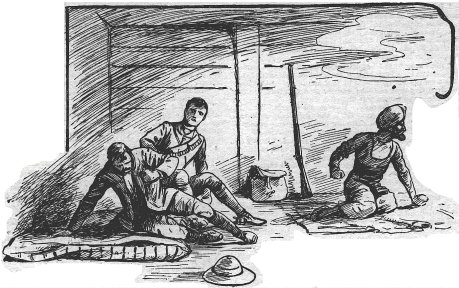
There was no reply. Sexton Blake groped for his rifle and found it. He crept to the door, threw it open and ran fearlessly around to the rear of the bungalow. The moon was shining, and there was nobody there; but he could hear crashing footsteps tearing through the jungle, telling him that the assassin was in headlong flight. He listened for a moment, and then, hurrying back, he struck a match and relit the lamp, which had not been damaged.
He was relieved by what he saw. The Hindoo -- he was a brave enough fellow -- had recovered from the fright caused by the sudden awakening, and was holding a flask of water to the lips of Inspector Dart, who was sitting upright on the mattress. He took a long pull, and then rose unsteadily to his feet, breathing heavily in short, quick gasps.
"Where are you hit?" exclaimed Sexton Blake.
"I don't believe I'm hit at all!" declared the inspector, as he opened his coat, "though I feel as if my chest was caved in. Ah, look at this!"
And he produced from an inner pocket a square tobacco-box of thick metal. The bullet had torn through the lid of it, glanced off the bottom, and ripped its way out at one end.
"By Jove, that saved your life!" said Sexton Blake.
"It certainly did, old man. I had a narrow escape. The shock bowled me over, and I was stunned for a few seconds. I'm none the worse, however, except for a soreness about the rubs. But who the deuce could have tried to murder me?"
"I had only a glimpse of the man -- a glimpse of a brown face and a pair of wicked eyes. When I rushed out he made off like a deer."
"He was a dacoit, or a Thug," suggested Shahvani. "Evil budmashes sometimes prowl in the jungle to kill and rob sahib travellers."
Sexton Blake shrugged his shoulders.
"The fellow may come back," he replied, "and if so we must be ready for him. Shahvani, you take the first watch here by the window. Call us at once if you hear any suspicious noise outside, and in any event waken one of us in a couple of hours."
That the Hindoo was right, and that travellers in these desolate parts were subject to peril, seemed likely from the means of security that had been provided. The ponies had been locked in the shed from the first, and now the door of the bungalow was fastened with two stout bars. The lamp having been extinguished, the detective and his friend moved the mattress to the opposite corner of the room and stretched themselves upon it, while Shahvani squatted on the floor close beneath the window, through which streamed a pale ray of moonlight.
"Do you hear that?" said Inspector Dart, as the roar of a tiger echoed across the solitude of the forest. "Our murderous visitor will probably make a meal for Mr. Stripes."
"I hope he will. I should like to feel that we were rid of him. The scoundrel meant to kill us both, Dart, and he very nearly succeeded. The tobacco-box saved you from the first shot, and the second shot would have certainly struck me if Shahvani hadn't knocked the lamp over. It was a bold piece of work."
"Too bold," replied the inspector. "I don't quite understand it. I've had some experience with dacoits and Thugs, and prowling rogues of all sorts, but I've never known any of them to show such daring. They usually attack in the dark, and use a dagger or a sword."
"I agree with you," said Sexton Blake. "Of course, the fellow may have been an ordinary jungle rogue, but I strongly doubt it. In fact, I have an ugly suspicion in my head, and can't get it out."
"What is it?"
"That our late visitor was none other than Amar Singh."
"Amar Singh?" gasped the inspector. "Lord Wargrave's servant? He is thousands of miles away! It is impossible that he could be here."
"Not at all, my dear fellow. Lord Wargrave would naturally have been alarmed after my visit to the Hall. He might have learned that you and I were going to India, and suspected for what purpose. Suppose that Amar Singh was sent after us, that he travelled overland to Marseilles and joined our boat there, that he shadowed us to Dindigal, and that he followed us on horsebakc to-day at a safe distance? You remember the old Hindoo at Marseilles?"
"Distinctly. Yes, he may have been Amar Singh. But if so, he was wonderfully disguised."
"And the man whom Govind saw in the bushes last night."
"Amar Singh again! He must have been watching the commissioner's bungalow on the chance of learning if we had discovered anything. You have proved your case, Blake."
"No, I am not sure of all this!" replied Sexton Blake. "I am only theorising, and I may be wrong. But the circumstances look suspicious, to say the least, and hereafter we must be constantly on our guard. If Amar Singh is tracking us he will be a terribly dangerous foe, for he will do his best to kill us."
"He will hardly come back to-night," said the inspector.
"No, not after his failure. He will wait for another opportunity."
The subject was discussed until the two men fell asleep, and they knew nothing more until they woke in the early dawn, to find Shahvani slumbering soundly on his mat by the window, which carelessness gained him a severe scolding. The ponies were safe, and, after a hurried breakfast, the three mounted and set forth.
That night they reached another dak-bungalow, where they kept watch by turns until morning. Then they resumed their journey through the dense jungle, and when they came in sight of Narpur towards evening of the same day, they regarded their adventure of the first night with less apprehension.
"I begin to think you were wrong, Blake," said inspector Dart.
"It looks rather like it," replied the detective. "However, we'll not relax our vigilance."
Here dwelt a small community of perhaps a hundred souls, far from any habitation, and in the heart of a dense jungle that stretched for many miles in every direction. An ancient wall enclosed the village as a protection from wild beasts and dacoits, and in this was set a massive wooden gate.
Sexton Blake rapped upon it with the butt of a pistol, and it was opened by a native who, after some questions, reluctantly permitted the party to enter. Passing through, they beheld a narrow street that led to another gate. On both sides were rows of huts, and in the middle was the usual water-tank, covered with lotus blossoms.
As the travellers dismounted, men, women and children gathered about them, and presently appeared the zemindar or head man --- an elderly, dignified Hindoo, in a calico turban and a white robe,
"I am Gamesh," he said, "and these are my people. If you mean us no harm you are welcome."
"The sahibs are friendly," the guide told him. "They would speak with you on a certain matter."
No more was said for the present. Shahvani led the ponies away, and a few moments later, as the sun was sinking behind the jungle, Sexton Blake and Inspector Dart sat outside the zemindar's little house under a canopy of leaves. The host handed around a tray of betel-nuts, which were refused with thanks. He took one himself, and his lips were soon stained with the pink juice.
"We have come a long distance," began the detective, "and hope that you may be of service to us. We seek a shikaree named Jammu, and we were told that we should find him at Narpur. Is this true?"
"It is true no longer, sahib," was the disappointing reply that Gamesh gave. "Well do I know Jammu, the shikaree, though he was not one of us. Thirteen years ago he came here, but he would not dwell within the village. He built himself a little hut in the jungle, and there he lived with his two sons, now in the State of Kossa, from what I have heard."
"And the two children were alive?" inquired Inspector Dart. "He took them with him when he left here?"
"He took the boy Bala," replied the zemindar, "but I am not sure about the other son. Vashti had already fled from his father's care, and yet he was but ten years old. Is it possible, sahibs, that you have not heard of Vashti, the panther boy?"
"No," said Sexton Blake. "What of him?"
"It is a strange story," was the answer. "From an early age the young Vashti showed no fear of wild animals. Indeed, he had a wonderful power over them, and they seemed to be attracted by him in the same way. Once he boldly stroked a tiger that came close to our walls, and another time he was seen fondling a great leopard. For days he would disappear, returning frequently to his father's hut; and it is possible that he went with Jammu to the south. Of that I am uncertain, but this much I know. Time and again, during the last six years, men from my village who have gone towards Kossa, have seen Vashti tearing like the wind through the jungle accompanied by a pack of a dozen fierce panthers. For that reason he is called the panther boy, and he is shunned and dreaded by all. What I have told you is the truth, sahibs."
The detective and his friend glanced at each other incredulously. To accept this amazing tale was to great a strain for their imagination, though they could well believe that the boy had wandered into the jungle and been lost. But which of the two was it?
"Did these sons of the shikaree look alike?" inquired Sexton Blake.
Gamesh shook his head.
"They were very unlike," he replied, "and some have said that they could not have been brothers. They were the same in age and height, but while Vashti was the image of his father, the young Bala was not so dark of skin, and had blue eyes."
"That settles it," murmured Inspector Dart.
"You think that the boy Bala is now with his father?" asked Sexton Blake, whose anxiety had been relieved.
"How should I know that?" replied the zemindar. "The boy went away from here with his father six years ago. Of Bala I am ignorant, but I have been told that Jammu took service as a shikaree with the Nawab of Kossa, and that he dwells in the jungle near to the palace, and to the village of Talnagore."
"And how far must we go to reach there?" asked the inspector.
"The distance is about thirty miles," said Gamesh, "buy you may be turned back from the frontier if you meet any of his Highness's soldiers, who are always on the watch. The Nawab Pershad Jung dislikes strangers, and he will not allow them to shoot in his territory, even if they ask for a permit."
"That won't keep us away!" vowed Sexton Blake.
"It is none of my concern," said Gamesh. "The sahibs are their own masters. There was another man -- a Hindoo -- who asked these same questions of me some time ago. He also went down into Kossa, and he has not returned."
"Well, we'll take the risk," said the detective, with a glance at the inspector. "We shall start for Talganore at day-break," he added, "and we will be grateful if you can offer us shelter for the night."
"You are welcome to that, sahibs," replied the zemindar. "You shall have food and a bed."
Darkness had now fallen, and presently a tempting repast was served to the two Englishmen, including delicious fruits and curried rice. When they had finished the meal -- Gamesh's caste forbade him to share it with them -- they were escorted to a small hut near the south gate. Here their saddle-bags had already been brought, and on the floor were beds of dried grass. They sat down in the doorway and lit their pipes, enjoying the cool air of the evening.
"I rather counted on finding our young lord here," said Inspector Dart.
"No more than I did," replied Sexton Blake. "However, we have nothing to complain of. We are on the right track, and we have only thirty more miles to go. By this time to-morrow our search ought to be ended. The boy, Bala, is certainly Captain Haviland's son, and I trust we shall find him with the old shikaree at Talnagore. A few rupees, and a promise of immunity, will no doubt induce Jammu to make a full confession. As for the Nawab Pershad Jung, I don't think he will interfere with us."
"He wouldn't dare to," said Dart. "I suppose he is held in check by a British resident."
"I fancy not. Kossa is too insignificant a State for a resident, though there is probably a political agent attached to the Court,"
"We'll have to hunt him up, then, so that our business may be done ship-shape and legally. By the by, what of the pretty yarn the zemindar told us about Vashti, the panther boy? There isn't a world of truth in it, of course."
"It is hard to credit, I admit," replied Sexton Blake; "but strange things happen in India, and our friend Gamesh seemed to be very much in earnest."
"When I see this panther boy with my own eyes," said Dart, "then I'll believe the tale."
An hour passed, and from the surrounding jungle came cries of prowling wild beasts. Within the village all was peace and quiet. One by one the little clay lamps were snuffed out, and finally the zemindar's house was darkened. Near the water-tank a native was huddled by a fire of blazing wood, which was doubtlessly intended to frighten off any hungry tiger or leopard that might otherwise leap the walls.
"We had better follow the general example, and turn in," suggested Sexton Blake. "These are snugger quarters than a dak-bungalow."
"And safer," said Dart, rising with a yawn. "No prowling dacoit will bother us here."
They emptied their pipes, entered the hut, and were soon sleeping side by side on the beds of sweet-scented grass.
The tropical night crept on. The fire by the tank burnt low, and the sentry --- his head sunk on his shoulders --- was slumbering at his post.
It was between two and three in the morning when Sexton Blake suddenly woke as if something had startled him. He heard a faint rustling noise, which put his senses on the alert, and the next instant, before he could realise that danger was near, he saw a dim form bending over him, and caught the dull gleam of steel.
As he threw himself to one side, there was the sound of a blow striking the bed on the spot where he had been lying. He sprang up, reached for the startled intruder, and, by good luck, seized a wrist that was descending with murderous intent, giving it such a jerk that a weapon flew against the wall.
"Dart! Dart!" he cried.
With that, a brawny hand fastened on his throat, and he tried to tear it away. Locked together, the two began a desperate struggle. They fell, rolling over and over, while Inspector Dart, calling at the top of his voice, groped about in the gloom and tripped over the unseen combatants before he could strike a light.
"What is it Blake?" he cried. "What's wrong?"
"Lend a hand, quick!" was the husky reply.
The fight was over in less time than it takes to tell, for the detective's assailant was half naked, and his greased body was as slippery as an eel. Wriggling free, he rose to his feet and took to his heels, and after him went Sexton Blake; out into the little street, where the watch- fire shed a flickering glow, and the sentry's shouts of alarm were waking responses from all the huts.
"Stop him!" yelled the detective. "Head him off! Catch him!"
But the south gate was very close, and the fugitive reached it half a dozen yards ahead of his pursuer. He whipped round with a snarling threat, turning a passion- distorted face to the glimmer of the flames.
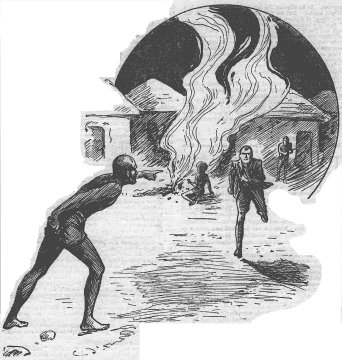
Then, with the agility of a cat, he went up the wall and over, vanished on the far side. He could be heard crashing away through the jungle as Inspector Dart arrived breathlessly on the scene.
"Who was it?" he panted. "Who was the scoundrel?"
"It was Amar Singh!" declared Sexton Blake, who was fumbling with the bars of the gate.
"By heavens, Blake, you don't mean it?"
"Yes, I'll swear to him. I saw him plainly, and he threatened me in words. I was right Dart. I told you so!"
"If we could get hold of the rascal."
"Impossible! We might as well hunt for a needle in a hay-rick. By the by, it will be as well not to reveal what we know."
Natives were now hastening forward armed with spears, tulwars, and old-fashioned matchlocks, and in a brief time the whole population of the village were gathered on the spot. The zemindar was with them, and he listened with a puzzled expression to the detective's story of his fight for life.
"Describe this wicked rogue," he said.
"It was too dark to see much of him," Sexton Blake replied. "He was half-naked, and his body was greased. He must have been a dacoit."
"I fear he has escaped," said Gamesh. "It would be useless to search for him now. There are dacoits in the jungle, it is true, but that a single one should be so bold that he should climb over the wall at night, is indeed a strange thing."
"Not if he was tempted by gain. He knew that we were here, and he doubtless believed that there was gold to be had by killing and robbing us."
"It is strange, sahim," the zemindar repeated.
"Come, and I will show you the weapon," Sexton Blake told him.
The detective took a lamp from one of the natives, and led the way to the hut, where, after a short search, he picked up a dagger of peculiar shape and costly workmanship.
"I tore this from the scoundrel's grasp," he said to the zemindar; and to Inspector Dart he added in English, "I know that weapon. I saw it in Lord Wargrave's library hanging with a collection of Eastern arms."
"That settles it, then," muttered the inspector.
If Gamesh had at first suspected that something was being kept from him, that the murderous assault might have had something to do with the strange quest that had brought the Englishmen to Narpur, he was now apparently satisfied.
"The dacoits carry such weapons," he said, "which are usually stolen from travellers. I am sorry that the sahibs should have suffered this peril while they were in my village under my protection," he added. "It shall not happen again. For the rest of the night you shall be well guarded."
The people dispersed, and the sentry piled wood on the fire, fanning it to a blaze. A few minutes Sexton Blake and Dart were sleeping as peacefully as if nothing had occurred, while in the doorway of the hut squatted two armed natives.
"We've got to consider what that affair of last night may mean to us," said Sexton Blake, after bidding Shahvani ride a little ahead and keep a sharp look- out. "I didn't say much about it at the time, for I knew that we both wanted plenty of rest for to-day's journey. There is no longer any doubt as to the facts. Amar Singh has shadowed us to India, and his instructions from Lord Wargrave are to prevent us at any cost from finding Captain Haviland's son, the real heir to the title and estates."
"Yes that's the situation," Inspector Dart assented gloomily. "and the scoundrel has made a good beginning by two attempts to murder us. What will happen next? I confess that I feel a bit nervous, Blake/ We may be shot at from ambush any minute, if the man should be lurking about. But how has he followed us from Dindigal? On horseback or on foot?"
"Most likely on foot. We have had to travel so slowly owing to the rugged nature of the country -- at the rate, of thirty miles a day -- that Amar Singh could easily have kept pace with us.Hindoos are trained to be good runners, and are capable of long endurance. But it is not that question, not our personal danger, that worries me now. Suppose the fellow is aware of all that we have learned? Suppose he could reach Talnagore ahead of us, find Jammu, and either kill or carry off the boy?"
"That didn't pccur to me," said Dart. "Come to think of it, though, I imagine you are wrong. Otherwise Amar Singh would have hastened to Narpur, made inquiries there, and then pushed on to Talnagore. The fact that he tried to shoot us in the dak-bungalow, and to stab us in Narpur, suggests that he was ignorant both of what Govind old us at Dindigal and of what we learned from the zemindar of Narpur."
"Well reasoned, I admit. But you overlook one thing, my dear fellow. Amer Singh would naturally have preferred to murder us in these lonely parts if he could, instead of resorting to the more dangerous hazard of killing Jammu's son in a populous neighbourhood."
"Then what is you opinion, Blake?"
"I believe that, after the failure of his two desperate attempts, the Hindoo is now travelling towards Talnagore as fast as he can."
"In that case we have nothing to fear for ourselves."
"Nothing. Nor should we be in any peril even if my theory is wrong, for Amar Singh is afraid to attack us in day-light. He has had plenty of chances to do so since we left Dindigal, but did not take advantage of them. I am certain that he has altered his plans, and, therefore, I am seriously alarmed for the safety of Jammu's adopted son."
"We must lose no time in getting on to Talnagore," said Inspector Dart.
"We may be too late," replied Sexton Blake, "The Hindoo is bound to reach there before us. When do we cross into Kossa?" he called to the guide.
"In another hour, sahib," declared Shahvani.
As the day wore on the Englishmen rode for the most part in silence, rarely speaking, which showed how gravely they regarded the situation.
They forded streams, beat through thickets that had overgrown the trail, and toiled slowly over the steep hills. It was aggravating to contend with these delays, to feel that Amar Singh might accomplish his dastardly purpose, but there was no help for it/
In the province of Madras, where sportsmen with government permits often camped near the Dindigal-Narpur road, no big game had been seen. But when the frontier of the State of Kossa had been crossed, a difference was noted almost at once. Here was proof that the Nawab Pershad Jung was unfriendly to strangers, and kept the shooting rights for his own use. Deer flashed through the jungle, and a leopard, roused from his sleep, showed a tawny head and a pair of burning eyes ere it vanished. A herd of invisible elephants went by with loud trumpeting, and the spoor of these mighty beasts, and of buffalo and rhinoceri as well, often attracted the attention of Dart and the detective.
The travellers encountered none of the Nawab's soldiers, nor had they expected to meet any in such wild conditions. They found the riding more difficult than on the previous day, and by the middle of the afternoon --- they had eaten their lunch in the saddle --- they judged that they were still ten miles from Talnagore. Big game grew more plentiful, instead of less, and there were many tempting chances of a shot.
"It looks as if the Nawab doesn't do much shooting," said Inspector Dart.
"I don't believe he does," replied Sexton Blake. "He is like the dog in the manger. He won't let others enjoy what he doesn't want himself."
"It strikes me as queer, Blake, that he would be so averse to allowing Englishmen in his territory."
The detective nodded. A vague suspicion had entered his mind, and though it was quickly forgotten, he was to remember it afterwards.
Another mile was put behind. Shahvani was riding with his companions, and the three had been trotting side by side over a plateau of high ground. Coming to where the trail dipped down at a sharp angle, they dismounted, with the intention of taking the hillside on foot. Far below them was a barren nullah, or ravine, through which ran the dry bed of a water-course, and just as they started to descent a faint noise caused them to wait. The noise came nearer and louder -- a harsh volume of sound that seemed to be half human and half beastly. The ponies sniffed the air and began to tremble.
"What the deuce can that be?" muttered Inspector Dart. "I've never heard anything like it."
"Something coming this way," said Sexton Blake.
"Sahibs, sahibs, it is the panther boy!" declared Shahvani, who was shaking like a leaf.
"Don't run," the detective bade him sternly. "We will remain quietly where we are. If there is any truth in the zemindar's weird tale, I want to . . . . . . "
"By heavens, look!" interrupted Dart, pointing. "Do you see, Blake?"
The guide uttered a moan of terror, and the two Englishmen stared with incredulous eyes. To the right, up the bed of the nullah, a human figure had burst from a copse of tall grass by the edge of the dry water-course. It was a dark-skinned youth, naked save for a girdle of plaited leaves, with a mop of black hair hanging over his face and down his shoulders; and close on his heels followed a drove of panthers that could not have numbered less than a dozen.
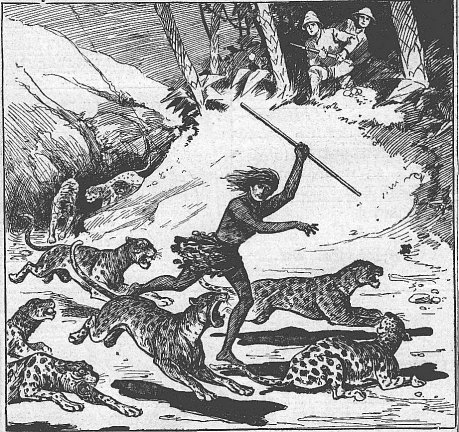
"They are coming to attack us!" exclaimed Dart, as he unslung his rifle. "Be ready!"
"We can't shoot them all," declared Sexton Blake. "This is a bad business!"
But the peril was happily and promptly averted. Putting his hands to his mouth, the lad gave a peculiar cry, which the panthers reluctantly obeyed. They scurried back to where he stood, fawning upon him with marks of affection. Then off they went again, racing like the wind down the ravine, and a few moments later the panther boy and his savage retinue had disappeared in the thickets. The clamour faded into silence. The ponies ceased to struggle, and Shahvani wiped beads of perspiration from his brow.
"By Brahma, may I never behold the like again!" he muttered.
"I would never have believed it!" gasped Dart.
"The zemindar told us the truth," said Sexton Blake. "We have seen this uncanny thing with our own eyes! That was Jammu's son Vashti, who has taken to the free life of the forest, and he is well called the panther boy. What a wonderful and magic power he must have over wild animals."
"He bewitches them!" declared Inspector Dart. "India is a land of mystery, but this beats all I have ever heard of!"
"Come!" urged the detective. "We are forgetting Amar Singh and the peril that threatens Jammu's other son."
They led their steeds down the hillside, across the nullah, and up the farther slope, and then mounted and pressed on by the jungle-girt trail. They had been riding for a couple of miles, discussing the amazing thing they had seen, when Shahvani suddenly drew rein.
"Sahibs, I smell fire," he said.
His companions turned in the saddle, and with no little alarm they saw a bluish haze curling behind them. They listened for a moment until they could detect a hissing crackling noise. They could not account for it, since they had not been smoking, and therefore had dropped no matches.
"The jungle is certainly on fire," said Dart.
"And we are in danger of being burnt to death," declared Sexton Blake. "The trees will not catch, but the undergrowth and grass are as dry as tinder. We must ride for our lives!"
"Quick, sahibs!" urged Shahvani. "Be quick, or we are lost!"
The three tore on, the guide a little in the lead. They knew that they must stick to the trail, come what may, for they could make no progress through the dense fastnesses to right and left. The dread crackling was in their ears, swelling in volume as it approached.
"There is something suspicious in this," said Dart. "I believe the fire was started purposely."
"I am sure of it!" cried Sexton Blake. "That fiend Amar Singh has done this! He has been tracking us all day, waiting for a chance, and now the devil has put this idea into his head."
"We'll baffle him, Blake!"
"We'll do our best! There must be open country between here and Talnagore!"
The race for life began in earnest --- a race against fearful odds. The path was fortunately level, fairly open, and at first there seemed to be hope. A mile slipped behind, another and another. But the wind was blowing to the south, and now the flames were very near. Smoke drifted by the fugitives, and as they looked back they saw the red tongues leaping and darting, saw them devouring the parched grass and scrub with incredible swiftness, and licking the lower branches of the trees. The conflagration must have been started in several places, for it appeared to extend in a fairly wide belt.
"Amar Singh has done his work well," vowed Inspector Dart. "We'll never get to Talnagore!"
The detective's answer was drowned in the swelling roar. The peril grew worse as the three galloped madly, desperately on. Monkeys and parrots screamed with terror, and the big animals of the jungle were in a panic. They had sense enough, however, to choose the safest course. A leopard dashed to right and left, and a buffalo and a rhinoceros lumbered across the trail within twenty yards. A trumpeting elephant appeared, and for a short distance it kept close ahead of the guide before it swerved and vanished.
"By heavens, this is awful!" gasped Dart.
"Faster!" urged the detective. "We must go faster!"
As he spoke, Dhahvani's pony took fright at a monstrous serpent in the way, and became unmanageable. It plunged into the jungle, crashing through the underbrush, and steed and rider were lost to sight.
"That's the last of the poor fellow!" cried Dart.
"I'm afraid it is," declared Sexton Blake.
The two pulled up, and for a moment they called to Shahvani, shouting in vain. Then, knowing that they could do nothing for the luckless guide, they began again the race for life --- a race which both now feared must end in a ghastly death.
Spurring their terrified ponies, they tore at a gallop along the narrow trail, stooping to avoid the overhanging trees. The flames were all around them, roaring fiercely and angrily. They dared not look back, and in front they could see only the matted curtain of the forest. Over their heads danced a lurid glow. They were enveloped in a whirl of pungent smoke and flame, and they could feel the scorching heat. Death was striding nearer and nearer, and must soon overtake them.
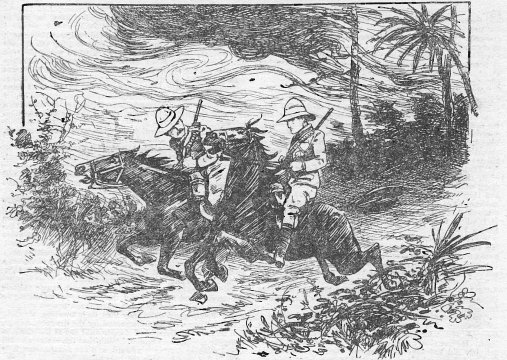
"Don't give up!" cried Sexton Blake. "Stick to your saddle, man! There's a glimmer ahead --- a streak of light --- and it may mean safety! Ride, ride, Dart!"
Another twenty yards, and then the trail, circling abrupty round a large rock, led for a short distance through a copse of reeds, and ended on the bank of a river an eighth of a mile wide --- a sparkling stream that flowed over shoals and sand-bars. Spurring into the water, the delighted fugitives splashed across the shallow channel, nor drew rein until they reached the opposite shore, where they dismounted and slaked their thirst.
"Fifty yards more." Sexton Blake said thoughtfully, "and we should have been burnt to cinders!"
Scorched and perspiring, with tingling eyes and parched throats, the two rescued men stood in silence for a few moments, gazing over the silvery tide. Volumes of smoke were hurrying overhead, and showers of sparks were hissing as they fell into the stream. Flames had burst from the jungle on the opposite bank, and for a time they roared and raged impotently at the water's edge, shrivelling the foliage of the trees, and stretching for a long distance to right and left. But they could come no farther; the river was a barrier not to be passed.
"Poor Shahvani!" said Dart. "He has perished, of course! He could not have escaped!"
"Not a chance of it," replied Sexton Blake. "The trees must have swept him from the saddle, and he was probably stunned. That is why he did not answer us when we called."
"And Amar Singh?"
"He is safe enough, for he was behind the fire. But he will have to make a long detour to get to Talnagore."
"He may abandon his purpose now. He believes that we are dead."
"He will want to make certain of that, Dart."
"At least, we have nothing more to fear from him."
"I hope not," said the detective. "Come, let us be moving on," he added.
The flames were dying away as the two Englishmen remounted and struck into the continuation of the trail, which they found close to where they had come ashore. For an hour they spurred on through a sombre forest, saddened by the loss of their faithful guide, and then, as the sun was drooping towards the horizon in a sky of gold and amethyst, they came out from the leafy solitudes and saw cultivated fields stretching before them, dotted here and there with huts.
Another mile across the open, and they reached a white and dusty road running east and west. To the right it dwindled to a mere thread, and to the left, less than a mile away, it merged into what was certainly the little town of Talnagore --- a cluster of white-walled houses perched on rising ground, and half buried amid the green foliage of mango and peepul-trees. Not far beyond, proudly dominating the twon, towered a lofty and beautiful building of a rose- pink colour, with turrets and balconies.
"That, of course, is the palace of his Highness Pershad Jung," said Sexton Blake.
"With dungeons underneath it," said Inspector Dart. "And we are likely to be thrown into them," he added jestingly, "from what we have heard of the Nawab's character."
"I don't propose to make his acquaintance, if we can help it," replied the detective. "If all goes well, we ought to be on our way back to Dindigal to- morrow morning."
"And the boy with us?"
"We should certainly not start without him, my dear fellow."
"Then we must find the shikaree without loss of time."
"Yes, at once!"
Tinkling, brazen sounds suddenly rang on the air --- a metal ghurry striking the evening hour from the watch tower of Talnagore; and as it ceased another began at the palace. Moving figures were visible at a distance, but the only person near by was an elderly native, who was cutting grass by the roadside. The detectives rode up to him, and he greeted them with a respectful "salaam," though his expression was cold and suspicious.
"We are seeking a shikaree named Jammu," said Sexton Blake, "and we have heard that he lives near here. Can you tell us where to find him?"
"Yonder is the abode of Jammu," was the reply; and the Hindoo pointed to a low roof a quarter of a mile away, in the direction of the town.
With that, he resumed his work, and the detective hesitated for a moment.
"Is there a British resident at the Court of your Nawab?" he asked.
"None, sahib," the man answered.
"A political agent, then?"
"Yes, sahib. If you wish to see him, go straight on for half a mile, and then take the turn to the right. It will lead you to the bungalow of Carnac sahib, the agent."
"Thank you!"
Sexton Blake flung a rupee to the ground, and the next instant, as he and the inspector urged their ponies forward, the coin whizzed past them and fell in the dust. The grass-cutter was gazing after them half angrily, half curiously, as if he was surprised that they should be here.
"That's the first native of India I ever knew to refuse money," declared Sexton Blake, with a laugh.
"He insulted us," said Dart. "The Nawab seems to have brought his people up to his own way of thinking. I'll be glad to get away from Kossa."
The detective did not reply. His eyes were fixed on the little thatched roof, from which a curl of smoke was ascending. It rapidly approached as the men galloped on, and soon they checked their steeds by a small structure that was better than a hut, but too insignificant to be called a bungalow. It was built of teakwood, and in front of the open doorway was a slab of stone. Within, cross-legged on a rug, an old man sat repairing a matchlock --- a man with a long white beard and a face like wrinkled leather, whose lean frame, however, appeared to be still capable of strength and endurance.
"Salaam, sahins!" he said calmly, lifting his dark and sombre eyes.
"Salaam!" Sexton Blake answered. "You are Jammu the shikaree?"
"I am Jammu," was the reply. "What is the will of the sahibs?"
The riders dismounted, and having tied their ponies to a tree, they entered the little cottage which was furnished with more comfort that they could have expected to find in the abode of any shikaree. At a quick glance they swept the interior, and as they observed but a single bed, they looked at each other with anxious significance.
"You do not dwell here alone?" Inspector Dart inquired of the old Hindoo.
"Quite alone, sahibs."
"But you had two sons, Vashti and Bala," said Sexton Blake. "The one you lost while you were at Narpur, and this day we have seen Vashti the panther boy in the jungle. But the boy Bala, you brought with you when you came down to Kossa. Where is he now?"
"He is dead."
"Dead?"
"It is the truth, sahib," declared the shikaree. "Why should I deceive you? The boy died of a fever five years ago, soon after I came to Talnagore."
He spoke gravely, meeting the steady gaze of his visitors, but Sexton Blake had been reading the man's countenance, and was absolutely certain that he was telling a bold lie.
"These are strange questions," Jammu continued. "What difference can it make to the sahibs whether or not I have a child?"
"It makes a great difference," the detective told him, "for the boy we seek was not your own."
The shikaree winced.
"You speak in riddles," he said, as he plucked nervously at his beard.
"Then I will answer the riddle," Sexton Blake replied sternly. "Know first, old man, that I am a tracker of evil-doers from over the sea, and that my companion belongs to the Indian Secret Service. Thirteen years ago a little child three years old, the son of Captain Guy Haviland, wandered away from his father's bungalow at Dindigal. He was believed to have been slain by a panther, but it was not so. You found that boy, and stole him. For a time you hid him, and then you took him away with your own son to Narpur. He lived with you there, and he was with you when you went to Talnagore. Where is he now?"
"I had naught to do with the son of Haviland sahib," vowed Jammu. "The two children that I brought to Narpur were of my own blood. Vashti has left me, and Bala died of a fever."
"That is untrue. I know that you are lying."
"I have spoken, sahib. Bala is dead."
"He is alive," declared Sexton Blake. "Come, you cannot hope to deceive us. You have committed a wicked crime, and you would be severely punished if we should deliver you up to the law. But we have no wish to do that, for you are an old man. The lost child has friends across the great water, and they have sent us to find him. Give us the boy Bala, and I swear that you shall go free. Moreover, there may be gold for you."
"Bala is dead," the shikaree doggedly persisted.
"That is false," declared the detective. "Where is the boy?"
There was silence for a moment, and then a strange noise at a distance drew the Britishers to the doorway of the hut. They saw a cloud of dust a hundred yards to the right, and out of it quickly emerged an elephant gorgeously caparisoned. Strings of silver bells tinkled to every ponderous stride of the creature, and its tusks were tipped with gold. Between its flapping ears was perched a mahout with a goad, on its back was a howdah canopied with cloth of purple and silver, and hanging over its one flank were a spotted buck, a small leopard, and a bunch of jungle- fowl.
"By Jove! This must be the Nawab himself!" muttered Inspector Dart. "He has been on a shooting trip."
"Evidently," said Sexton Blake. "Look! Look!" he added, in an eager tone, as he gripped hs companion by the arm.
The elephant was now directly opposite the spot, and two persons could be seen in the howdah. One was a grim and haughty Hindoo, with an iron-grey beard parted Sikh- fashion in the middle, who threw a keen glance at the Englishmen in passing. The other was a handsome, brown- skinned lad of perhaps sixteen, richly dressed, who was fanning himself with his turban. But his eyes were blue, and his hair was the colour of yellow flax. He stared curiously at the strangers in the doorway, and then, shouting something unintelligible, he waved a hand to the old shikaree.
The elephant lumbered rapidly on, in the direction of Talnagore, kicking up a reek of dust that slowly settled.
"Well, by all that's wonderful!" exclaimed Inspector Dart. "Did you see that, Blake? I'll take my oath . . . . . . "
"Hush! Hush!" bade the detective. "Leave the matter to me."
The two re-entered the cottage and confronted Jammu, whose features, they imagined, wore a snug and cunning expression of triumph. It would have warned them had they not been thinking of something else.
"We have learned what you refused to tell us," Sexton Blake said quietly. "We have seen the boy Bala. He just passed in that howdah!"
"You are wrong, sahibs. That was not Bala. It was the young prince, the son of his Highness, Pershad Jung,"
"Dog, will you persist in lying to us?" cried the detective. "The truth! Speak! Out with it!"
"Bala is dead!" was the calm and obstinate reply.
"You'll get nothing out of the old rascal," murmured Dart.
"Won't I?" snapped Sexton Blake. "You'll see! Jammu, my patience is at an end," he added. "Tell us the whole truth about the boy, and at once. Refuse, and we will put you into the saddle, behind one of us, and hurry you away from Kossa. We will ride all night to Narpur, and thence on to Dindigal, where you will be thrown into prison to await your trial. And you know what that means. Govind will be a witness against you. Now will you be wise and speak?"
The shikaree hesitated for an instant. The mask was off, and terror gleamed in his sunken eyes. No help was near and he knew that the detectives could easily carry out their threat.
"So beit," he said, with a shrug of the shoulders. "I will confess all, sahibs. It is true that I found the child of Haviland sahib in the forest, and that I was tempted to carry him off. I brought him to Narpur with my own son, and there they grew up together until they were ten years old, when Vashti, who had shown a magic power in subduing wild animals went off to roam the jungle with a band of fierce panthers. Then I came south to Kossa, and I had been here but a few months when the Nawab of this state saw and admired the boy Bala. He had no child of his own, his wife being dead, so he begged me to let him have Bala, and at last I consented."
"He adopted the boy, then?" asked Inspector Dart.
"It is even so, sahib. Bala is the adopted son of Pershad Jung, who taught him to speak the Feringhee tongue, and gave him servants to wait upon him, and silks and jewels. For five years he had dwelt at the palace yonder, and what more could one desire in this world? He is happy and contented."
"Does the Nawab know the history of the boy's parentage?" inquired Sexton Blake.
"No; he believes the child to be mine."
"You are sure of that?"
"I swear it, sahib. Would I have betrayed my guilty secret?"
Jammu shook his head.
"The man you saw," he replied, "was the Subahdar Balwan, who commands the soldiers of his Highness. He is a favourite with the young prince."
"The boy has forgotten you, I suppose?" said the detective.
"Not so! Often he comes to see me, bringing fruits. And sometimes, by night, Vashti creeps up to my little dwelling with the fierce-eyed panthers at his heels. They love him dearly, and do his bidding. Also the two lads meet now and then in the forest behind the palace. They were devoted to each other in their early years, and Vashti, I think, would like Bala to join his wild, free life in the jungle. And now, sahibs, I have told you all. I trust to your word that no harm will come to me for confessing. As for the young prince --- he is known as Bala sahib --- if you wish to speak with him you must seek consent of the Nawab."
"And you think he will grant it?" asked Inspector Dart.
"How should I know that?" muttered Jammu.
"This upsets my plans, Dart," Sexton Blake said in English --- the conversation had hitherto been conducted in Hindoostanee. "I have no intention of visiting the palace at present --- far from it --- nor do I wish the shikaree to go there. So you stop here, and keep an eye on him until I return. I shall not be absent long."
"Where are you off to, Blake?"
"To hunt up the political agent, and I shall probably bring him back with me. Meanwhile, if anything unpleasant happens, take it coolly, and say nothing."
"Anything unpleasant? What the deuce do you mean?"
"I can't tell you now. But matters have taken a serious turn, and there is not a moment to lose."
When Jammu was informed that the inspector would remain with him for a short time he merely shrugged his shoulders; but the sinister, cunning look crept into his eyes again, and the detective did not fail to observe it. He guessed what it meant, and guessed rightly, as he hurried outside and swung to the saddle.
"All depends on the political agent," he reflected, as he rode away from the shikaree's cottage.
The sun --- a crimson globe swimming in an amber and purple sky --- was just about to touch the rim of the western jungle. The stretch of white road, leading straight for three-quarters of a mile to the edge of Talnagore, was at the time deserted; nor was single person in sight, to the detective's relief, when he drew rain [sic] at the side-road, within half a mile of the town. He listened for a minute, hearing faint sounds that he could not distinguish. Then he bore into the turning, and went at a trot along a narrow, shaded avenue, between groves of peepul and mango and fragrant orange-trees.
This road ended abruptly rather more than half a mile from the highway, at a low compound wall. Beyond was a well-kept garden, and in the middle of it a pretty bungalow, with striped awnings at the windows. From a flagstaff the standard of Great Britain fluttered in the breeze, and Sexton Blake saw it with a thrill of pride and joy. As he dismounted a young syce appeared and took charge of his pony, and with that an elderly Hindoo came down the garden- walk to the gate.
"I wish to see the Political Agent of Kossa," said the detective. "Will you give my name to Carnac sahib?"
"I am Carnac sahib's kitmutgar," replied the servant, "and I am sorry to tell you that my master is not at home."
"Where can I find him, then? Perhaps he is at the palace?"
"No, sahib; he is at Madras."
At Madras, hundreds of miles away! For an instant Sexton Blake was staggered. He felt as if he was losing his grip of everything. He recovered his composure, and by questioning soon learned all there was to know. The political agent had obtained leave of absence from his post, and had gone to Madras by sea --- for a mere holiday, it seemed --- more than a month ago. It was uncertain when he would return. He might be back to-morrow, perhaps not for weeks.
"He has left no one to act for him?" inquired the detective, with a ray of hope.
The servant shook his head.
"There is little business to be done at the Court of Talnagore," he said, with a smile. "The world sleeps in Kosaa. Will the sahib be pleased to come in and rest?" he added. "I can offer hospitality in the name of my master."
"No, no, I won't come in."
With that Sexton Blake flung a coin to the kitmutgar and another to the syce, sprang to the saddle, and was off like the wind. At first his brain was in a whirl, and he has no idea what he should do.
"The one man who could have helped me is hundreds of miles away," he thought. "Nothing more unfortunate could have happened. There is danger in the air --- danger and treachery! If I am right, the Nawab will never give up the young heir of the Wargraves. But I will risk all in one desperate stake. It is the only plan."
Down the shaded avenue the pony flew at a gallop, faster and faster, and as it drew near to the main road Sexton Blake heard the quick clatter of hoofs. He checked his lathered steed to a trot, and a moment later, as he turned into the highway, he saw what he had expected to see --- a force of cavalry approaching on the left from the direction of the shikaree's cottage.
They were irregular native sowars, wearing chain- mail and carrying tulwars and matchlocks, and in command of them was a man who had been riding in the howdah with Bala sahib. Inspector Dart and Jammu were of the party, the former on his pony, and the latter mounted behind one of the soldiers. The detective drew rein and waited, while the fierce-looking sowars closed around him.
"Sahib, you must come with me," said the Subahdar Balwan. "It is by command of the Nawab Pershad Jung."
"I am British, and so is my friend," replied Sexton Blake. "Why should we recognize the authority of your master?"
"Had you permission to enter the territory of Kossa bearing firearms?"
"No, we had not."
"Then you have broken the law. However, his Highness will, no doubt, overlook so slight and offence when he has heard your explanation. But meanwhile, I must ask you to accompany me to the palace."
"Under arrest?"
"No, certainly not," said the Subahdar Balwan, with a cunning twinkle in his eyes. "That would be too great an indignity."
No more was said, nor did Sexton Blake get a chance of speaking to Dart, since sowars rode between the two.
The party set off at a trot, and in the purple dusk of evening, when bats were flying and fireflies were glowing, they entered Talnagore. Here lights were beginning to gleam. Crowds of people lined the narrow streets, and from the lattice windows of tall old houses veiled women looked down curiously. The escort of sowars clattered through the town and out of it at the farther side, where a wide avenue led for five hundred yards to a walled court. Gates were thrown open, and the cavalcade halted in front of the Nawab's palace, which rose in barbaric splendour, turning to the silvering moon its beautiful fa‡ade of carved woods and marbles.
A bugler sounded his trumpet, and in the brief silence that followed the sweet notes a weird, snarling noise swelled out of the neighbouring jungle, at a considerable distance. It was very faint and low, like an echo. It rose and ebbed, moving swiftly, and was heard no more. There was an uneasy stir among the sowars.
"Vashti, the panther boy!" muttered one.
"Ay, brother, he is abroad to-night!" replied another.
Sexton Blake and Inspector Dart glanced at each other, for they, too, had recognised the uncanny sound --- the "hark away" of the jungle rovers. High up in the palace a head was seen for an instant framed in a lighted window. Then a curtain dropped, and with that the big gilded doors swung open. On the threshold appeared a white-robed group of servants.
"Come, sahibs," said the Subahdar Balwan, "dismount!"
The two prisoners --- they well knew that they were nothing else --- lowered themselves to the ground. They followed the commander of the guard up the terrace, and as they entered the stately building the doors closed behind them with a dull clash that sounded to Sexton Blake like the knell of doom. They trod on velvety carpets, into which their feet sank deeply, and went silently on, from passage to passage, until they were ushered into an audience-chamber. Jammu was not with them, but they did not doubt that he also had been admitted to the palace.
"They have not disarmed us," Inspector Dart said cheerfully. "We are under British protection, and there is nothing to fear."
"The loss of our heads, that is all!" Sexton Blake replied grimly. "A word of warning, Dart. Keep your mouth shut, and let me do the talking. Our lives hang by a ---"
"Sahibs, it is forbidden to speak," interrupted the Subahdar Balwan; and he rattled his tulwar menacingly.
Sexton Blake and Dart had plenty of time to observe these details, for they were kept waiting for full half an hour before a servant announced the coming of his Royal master. Crimson curtains were drawn apart, and Pershad Jung stepped into the room. He was a short, stoutly-built man of perhaps forty, handsome in a sinister sort of way, with pendulous balls under the eyes that told of unbridled indulgence in dissipation. His long black moustaches were twisted Tartar-fashion. He wore patent-leather shoes, silk trousers and tunic, and a turban set with a score of glittering gems.
"Be seated!" he bade the two men in their own tongue, with a wave of the hand. "I am honoured by your presence."
"Your highness is very good," Sexton Blake said suavely. "We regret that we have broken your laws."
"Pray do not speak of it!" replied the Nawab, showing his white teeth in a genial smile. "I summoned you hither not for that slight fault, but to offer you my hospitality. You are welcome! You shall go where you will, and shoot my big game."
"We have little time to shoot," the detective told him. "It is business, not pleasure, that brings us to Kossa."
"Ah, I had forgotten that! Jammu, my trusty shikaree, has been telling me a strange story. It seems that your visit concerns in some way my adopted son, the young Prince Bala sahib."
"It does, your Highness. Are you aware, may I ask, that the shikaree is not the true father of the boy?"
"Jammu not his father?" exclaimed Pershad Jung, raising his eyebrows in either real or feigned surprised. "How can this be? And yet I confess that I have always had my suspicions. Will you kindly explain, sahibs?"
Sexton Blake did so, narrating in a few words how the child of Captain Haviland had been kidnapped by Jammu, and had lived with him for many years. The Nawab listened intently, and just as the tale was concluded a servant entered the room and spoke a few words in his ear, at which he rose and excused himself. He was gone for a quarter of an hour, and when he returned his features were calm and unruffled, betraying no sign of the startling things he has learned during his absence. Little did the detectives suspect what guest was now under the same roof with them.
"I fear I have been discourteous, sahibs," Pershad Jung said carelessly. "I had forgotten an appointment made for this hour with a zemindar from one of my villages, who comes to complain of a man- eating tiger that has been devouring his people. But we were talking about my adopted son. You are satisfied that this story is true?"
"There can be no doubt of it, your Highness," declared Sexton Blake.
"And you have been sent from England to find the boy?"
"Yes, your Highness."
"By whose bidding?" inquired the Nawab, as he toyed with a diamond ring on his finger.
"At the request of a man who was Captain Haviland's dearest friend," replied the detective, meeting Pershad Jung's steady gaze. "It has lately come to the knowledge of this man, whose name is Carton, that the boy is alive."
"Why does he wish to find him?"
"For the sake of his old friend."
There was silence for a few seconds. Sexton Blake had played his one and only card --- played for life and death --- and, with all his astuteness, he could not read beneath the Nawab's mask. Were his suspicions right or wrong? He could not tell.
"I shall inquire into this matter," said Pershad Jung. "Of course, proofs will be needed."
"Jammu has already confessed to us," replied Sexton Blake.
"Then he shall confess to me as well. The old rogue deserves to be severely punished. As for the boy, I am very fond of him, and I regard him as my own son. I shall not detain him, however, if he wishes to accompany you to England."
"You will let us have him, then?"
"Bala sahib must speak for himself. You shall see him to-morrow."
"Meanwhile, your Highness, I neg that you will have the boy well guarded," urged the detective. "His life is in danger from a native who has followed us here from Dindigal."
"No harm can come to the boy within the palace," declared the Nawab; and, as he spoke, a cunning smile hovered about his lips. "But why should this man seek the life of Bala sahib?" he asked.
"Because, during all these years, he has nursed a bitter hatred of Captain Haviland, who caused him to be flogged for theft," Sexton Blake answered on the spur of the moment; "and now, having learned of our quest, he would take vengeance on the son. I assure your Highness that my warning is not to be . . . . . . "
"We will talk of these things again," Pershad Jung interrupted, as the muffled beating of a brass gong was heard. "Dinner is served, sahibs, and you shall eat and drink with me."
"We are hardly fit for such a ceremony," demurred Sexton Blake. |If you will first allow us to wash . . . . . . "
"But dinner will not wait. Come, sahibs. You can leave your firearms here, if you wish."
To refuse this suggestion would have been awkward. The Britishers retained the pistols that were in their belts, but they unstrapped their rifles and handed them to the Subahdar Balwan, who stood them against the wall. Then they followed their host from the room, and entered a long passage that was lighted by rose-coloured lamps at intervals, and hung on both sides with crimson draperies.
An ugly doubt was still in the detective's mind, though, at the worst, he anticipated no more than a difficulty in getting possession of the boy. Neither he nor Inspector Dart knew that Balwan was treading noiselessly at their heels, nor did they dream of danger until, at a signal from the Nawab, seven or eight man sprang suddenly from the red curtains to right and left. They threw themselves upon the startled detective, who had no chance against such odds.
A brief and desperate struggle followed, in which pershad Jung took no part. Again and again the detective and Dart shook themselves free, dealing heavy blows that felled their assailants to the floor. They were finally dragged down, resisting to the last, and then, helpless from force of numbers, the weapons were snatched from their belts, and their wrists were bound behind them. When lifted to their feet, panting and breathless, they saw with hot rage that among their captors was Jammu, the shikaree. And there, also, was Amar Singh.
Sexton Blake was a brave man, and his courage did not desert him. But well he knew that he had walked into a death-trap, and that no mercy would be shown, His suspicions had been correct, after all
"You treacherous cur!" he said fiercely to the Nawab. "You must be mad, to commit such an outrage! Are you blind to the inevitable consequences? I defy you to harm us! You have our friends at Dindigal to reckon with, and the political agent at your court! An army will be sent to destroy you!"
"I am not afraid," scoffed Pershad Jung. "Why should I fear? The political agent is far away at Madras, and I am as much lord here as was my father was before the Great Mutiny. As for your friends, they may learn that you left Narpur for the south, but if they seek farther, they will believe that you perished in the jungle fire. My people are devoted to me, and not a man, woman, or child in Talnagore will ever admit that they have seen you. The servants of Carnac sahib, to whom you spoke yesterday, do not belong to Kossa, and cannot be trusted; but they will be disposed of in a manner that will cause no suspicion when their master returns."
"You mean to murder them?" cried Sexton Blake. "And what of ourselves?"
"You shall die to-morrow morning, sahibs," the Nawab calmly told them, "when my jungle pets are hungry for their breakfast. And well you know why I cannot spare you," he added, nodding his head towards Amar Singh.
With that the Englishmen were hustled off, Pershad Jung laughing at their threats. They were dragged from corridor to corridor, turning several times, until they reached a narrow staircase, down which Balwan led the way with a lamp. At the bottom was an open door, and, a moment later, it had been closed and locked behind the prisoners, leaving them in pitch darkness.
"May you have pleasant dreams, sahibs!"
Amar Singh's mocking voice came to them faintly, as if from a distance and then the tramp of feet died into silence.
* * * * *
The head seen at the upper window, when the sowars were trembling at the weird sounds from the forest, had been that of the Nawab's adopted son. He had heard the call of the wild --- the voice of his brother --- and he prepared to obey the summons. Pershad Jung had ordered European clothing for him, and, without delay, he got into riding-breeches and boots, and a tweed jacket. He put a turban on his head, and was ready to start.
Shortly after, Sexton Blake and Inspector Dart entered the palace, and while they were waiting in the audience-chamber, young Bala sahib, who had been born and christened Richard Haviland, stole, unobserved, from the stately building. He crossed the beautiful garden at one side, with its fountains and flowers and shrubs, and, by a small gate set in a wall, he passed into the jungle, which began immediately and reached eastward to the coast. Fearing nothing, though he was unarmed, he pushed on for half a mile through the dense and gloomy fastnesses. He halted at length by a grassy glade bathed in moonlight --- he had often been here before for the same purpose --- and, clapping a hand to his mouth, he uttered a peculiar cry.
He had not long to wait. The signal was soon answered, and a rustle in the thickets grew to the scurry of pattering feet. Then Vashti, the panther boy, darted into the open followed by his savage escort, and the two lads warmly embraced. They believed themselves to be brothers, and they still retained the mutual affection that had grown with their years of childhood. For a moment they were silent; while the great, burning-eyed panthers trotted round and round, leaping playfully at one another, whimpering and sanrling. One fawned upon Bala sahib, and he stroked the creature's head.
"Has my brother no words?" asked vashti, in the native tongue that he had not forgotten. "You heard the call to the jungle?"
"I heard, Vashti, and I am here. It is always a pleasure to meet you, and I wish it were oftener."
"Yet you leave me to my lonely life! Come, Bala, and share it with me --- share the freedom that is better than all the Nawab's luxury and gifts! Again and again I have pleaded! Do not say no this time! Should not brothers be together?"
Bala sahib hesitated. The love of the wild was in his blood, perhaps from the strain of some early Briton, yet hitherto it had not been strong enough to bid him forsake the comforts of civilisation; each time he has resisted his brother's persuasion. But to-night he felt strangely tempted, and there was a reason, as well, that made him the more will to yield.
"You are troubled," said Vashti. "What is it?"
"There are strangers at the palace . . . two Feringhees, who arrived a short time ago, with a company of sowars. What they want I do not know, but I fear them, Vashti, and I will tell you why. The Nawab once bade me be on my guard against English sahibs, warning me to avoid any who might visit Kossa, lest they should carry me away. Even Carnac sahib, the political agent, I have seen but twice."
"Then do not go back," urged Vashti. "Flee from the danger! I will protect you, and the wild beasts will do you no harm. They all know me and love me, and I love them. There are caves to sleep in, and fruits when we are hungry! Ah, the wonderful things I will show you! The tiger who sleeps in the tall grass, and the leopards and their cubs by the rocky hill of Tera Doon, the great elephants who come to the streams to drink, and the buffalo that lets me ride on his back . . . all will welcome you. Come, my brother, come! Do not refuse!"
"I . . . I should like to," faltered Bala sahib, "but the Nawab will be angry if I . . . . . . "
"You will come!" cried Vashti. "See, my pets want you as badly as I do!"
He spoke a few words to the panthers, and at once, as if they understood, they gathered around Bala sahib with low whimpers, some licking his hands, and others reaching up to touch his face with their damp muzzles.
"Come, my brother! The jungle calls you!"
Bala sahib hesitated no longer. The next instant the moon-lit glade was deserted, and the two lads . . . tempter and tempted . . . and plunged into the dark depths of the forest. They ran on and on, with the tawny panthers bounding at their heels, and the noise of their flight faded away into the murmur of the breeze.
"This is the most infamous thing I ever heard of," Inspector Dart said presently. "Do you suppose that scoundrel will dare to carry out his treat?"
"Can you doubt it, my dear fellow?" asked Sexton Blake.
"But what is the motive? Why does he want to kill us?"
"You have not guessed that?"
"No; I can't say that I have."
"Yet it is perfectly simple, Dart. It is what I feared and suspected from the first . . . from the moment I saw Bala sahib pass on the elephant. You remember what occurred at Wargrave Hall, how I discovered Lord Wargrave in a state of agitation and anger after reading a letter that bore an Indian stamp? I suppose at the time that it had been written by Lalaje Ram, but I was wrong. That letter came from the Nawab Pershad Jung."
"What do you mean, Blake? I don't quite follow you."
"Where are your wits? I mean that the Nawab was aware of the lad's identity when he adopted him, having wrung the secret from Jammu; that he was acquainted with Guy and Arthur Haviland, and that he knew the lost boy to be real heir; I mean that for six years he has been putting the screw on Lord Wargrave, compelling him to pay large sums of money in order to retain the title and estates. That is what Lalaje Ram discovered when he came to Talnagore, the secret that took him to England in the hope of forcing Lord Wargrave to buy his silence. He may not have known what game the Nawab was playing, but he knew that the lad was his adopted son. Lalaje Ram was murdered, and, for the same reason, Amar Singh was sent to India to dispose of us. I amabsolutely certain of all this."
"By Jove, I see it now!" muttered Inspector Dart.
"And do you see what a terrible plight we are in? Look at it from Pershad Jung's point of view. He knows that if he were to set us free, if he were to let us get away from Kossa, he would lose his fat income from Lord Wargrave, and be deposed and punished for his sins. That is why he enticed us to the palace, and that is why we must die to-morrow."
"And he is mad enough to believe that he can commit such a crime without detection?"
"What has he to fear, Dart? You heard what he said. Every man, woman, and child in Talnagore will swear that they never saw us. The commissioner of Dindigal will search for us in vain. Our disappearance will be an unsolved mystery. The political agent will know nothing, for when he returns, he will find that his servants have vanished. The Nawab will kill them and pillage the bungalow to suggest robbery and flight."
"And the boy Bala sahib will grow up the son of Pershad Jung, never knowing that he is the heir of the Wargraves?"
"I imagine he won't live much longer. If he gets an opportunity, Amar Singh will certainly murder the boy and escape, and thus break the Nawab's hold over Lord Wargrave. He will have to be quick, though, or he himself may receive a few inches of cold steel from the Nawab's retainers. And there is Chester Carton to be reckoned with. When he learns of our disappearance, he may start an agitation in India that will lead to the lost heir being traced to Talnagore. But, buy then, Dart, we shall be dry bones."
Inspector Dart shivered.
"There is no chance for us, then?" he groaned.
"About one in a thousand," replied Sexton Blake. "I have not entirely lost hope, though it will be a miracle if we pull through. But if we can get our arms free, and manage to open that door, we many [sic] be able to escape through the palace."
"Precious little chance of it."
"It is worth trying. Now for the attempt!"
For a time the two twisted and strained, but they had been securely bound, and they could neither break nor loosen their fetters. Suddenly a happy thought occurred to the detective. Bidding his companion lie over on one side, he crept close to him and attacked the ropes that held his wrists together, fastening his strong teeth in them. For a quarter of an hour he bit and chewed, and then the frayed strands parted. Inspector Dart's arms were free, and in a few moments he had released Sexton Blake.
To draw a silver vesta-box from his pocket and strike a light was the detective's first act. The yellow flame revealed a small, unfurnished room, with plastered walls, and a floor of heavy timbers, in the middle of which was a square trap-door with an iron ring in it.
"By Jove, that may lead to freedom!" exclaimed Dart.
"On the contrary, it leads to death. Have you forgotten Pershad Jung's pleasant intimation of our fate?"
As he spoke, Sexton Blake knelt and lifted the trapdoor half-way up, and as the two men gazed into the black depths, they heard a rustling, thumping noise, followed by the patter of many feet. Then eyes of greenish fire looked up; there was a chorus of low, blood-curdling snarls. The match had burnt out, and the detective hastily lowered the trap.
"You see, I was right," he said. "There is a den of tigers below us in some underground chamber of the palace. Those are the jungle pets the Nawab spoke of."
"And we are to be flung down to them in the morning?"
"Undoubtedly; if we are still here."
"It is too terrible to think of! I am no coward, Blake, but when it comes to being torn limb from limb by a pack of . . . . . . "
"Hark! What is that?"
A faint sound grew out of the silence. Footsteps were descending the stairs, and they drew nearer and louder.
"Somebody is coming," declared Inspector Dart. "Perhaps to bring us food."
"Hush, hush!" whispered Sexton Blake. "What luck! Now is our chance, and we must make the most of it! Pick up those bits of rope, Dart. And your handkerchief --- roll it into a wad. Be quick! I'll throttle the fellow while you tie him!"
"But if there should be several of them?"
"There is only one, I believe."
The two groped across the floor, and in a few seconds, as they waited, they could hear the rapid thumping of their hearts. The footsteps ceased. A bolt was drawn, and a key turned harshly in the lock.
"Be ready!" breathed the detective. "Watch sharp!"
The man without, whoever he was, evidently believed that the prisoners were still helplessly bound; but to make certain he put down what he was carrying --- that was indicated by the clatter of dishes . . . and then he slowly opened the door half a dozen inches. The flood of light showed a white-clad Hindoo, and as he peered through the aperture, Sexton Blake's hands clutched his throat in a grip like steel, and the next instant he was dragged bodily into the room. Unable to utter more than a stifling gasp, he was borne backward to the floor.
"Now then," bade the detective, "hurry up, Dart! Every second is precious!"
A lamp stood at the foot of the staircase, and the light made the task easier. It was almost a noiseless struggle, though the man kicked and writhed. But Sexton Blake's merciless fingers were pressing his windpipe, and he was half choked by the time Inspector Dart had tied his wrists and ankles, and thrust a gag between his teeth.
"That's all right!" panted the detective, as he rose to his feet. "It was neatly done! I wonder if the fellow is armed? No, he hasn't a weapon of any sort."
"I wish he was Amar Singh, or the Nawab himself!" muttered Dart. "I'd drop him to the tigers!"
"Come, Dart!"
The two men stepped from the room and closed the door on the helpless captive. They listened for a moment, but could hear nothing. Parched with thirst, they stopped long enough to empty a jug of sangaree that stood by a platter of food, and to stuff their pockets with chupatty cakes.
"This was meant to be our last meal," said Sexton Blake. "The Nawab sent it in the hope that we would die the harder in the morning for being fed. Now for freedom!" he added. "It will be desperate work, and the odds are terribly against us; but if once we gain the jungle, I'll defy all Talnagore to catch us."
"What will we do then?"
"The only thing that is possible. We'll strike for the nearest point on the east coast, travel up to Madras by rail or sea, demand a warrant for the arrest of Pershad Jung, and return to Kossa with a force of soldiers."
"To find the boy and the Nawab gone!"
"That's what worries me, Dart. But what else can we do?"
"Nothing," said the inspector; "however, we'll talk of that again. The first thing is to get away from here, and if we succeed it will be by the skin of our teeth. Shall we take the lamp?"
"No; we must manage without that."
The lamp was extinguished, and the two men crept softly to the top of the staircase, where was another door . . . that they closed. Various corridors stretched before them, dimly lighted, but they were now utterly at fault, for they did not remember how they had been brought here, and had no idea what direction to take. The palace was a large building, and as confusing as a rabbit warren.
"That servant is sure to be missed," said Inspector Dart. "We have mighty little time to spare."
"We'll have to do it blindly," whispered Sexton Blake, "and trust to luck."
They started off, moving with the stealth of cats, ready at any instant to dodge behind the drapery that covered the walls. But this part of the building was deserted, an dthey neither met nor heard anybody until they had been groping about for five minutes, when, from the left they caught the sound of voices and the rattle of dishes.
"The Nawab is dining with some of his fellow- conspirators," said the detective.
"At this hour?"
"Why not? The night is still young. It cannot be more than ten o'clock, if it is that. Come, Dart, this way."
They bore to the right, made several turns, and found themselves unexpectedly in the audience-chamber, where they had parted with their rifles. These were gone, but on a table they saw, to their great delight, the two brace of revolvers that had been taken from them after their capture. They seized the loaded weapons, for which they had a spare supply of cartrudges, their bandoliers not having been taken from them.
"This is most fortunate!" whispered Inspector Dart. "And where now, Blake?"
"That door leads to the main entrance of the palace." Replied Sexton Blake, "and that to the place where we were trapped." He pointed to a third at the end of the room. "We will try that," he added.
A moment later the two were treading a richly- carpeted passage, which brought them to a heavy curtain. They drew it aside a few inches, took a furtive survey, and then glided into a small and luxurious apartment, where a shaded lamp was burning. This was evidently the Nawab's private room. It was most luxuriously furnished, with couches and chairs of red leather, large European paintings, jewelled ornaments of Hindoo workmanship, and a modern French writing-desk. On one side was a lattice-window, and on the other a curtained doorway. Inspector Dart opened the window slightly and looked out.
"There is a terrace below, not a dozen feet down," he said, in a low tone, "and beyond that lies the garden. I can see the black mass of the jungle, and by the stars we are facing the east. Nothing could be better. Come, Blake, now is our chance!"
"There is no hurry," replied the detective.
"But the coast is clear."
"Exactly, which gives us an opportunity that I don't want to miss."
"It is madness to delay."
"Wait, my dear fellow. If our escape should be discovered while we are here, we still have plenty of time to reach the jungle."
"It comes from the stables and the men's quarters," Sexton Blake said calmly. "The sowars are making merry."
With that, stepping to the curtained doorway, he disclosed a staircase that mounted upward. Then he took a knife from his pocket, and almost noiselessly broke open the French desk. He raised the lid, hurriedly examined the contents of a row of pigeon-holes, and, with a gesture of triumph showed to his companion a little packet of letters tied with green silk.
"This is what I hoped to find," he whispered eagerly. "See, they all bear the Nawab's name, and they are certainly written by Lord Wargrave. The stamps are English, and the postmarks are the same --- a little Berkshire village near Wargrave Hall! And here is another letter on the blotting pad, just written by the Nawab! It is sealed and stamped, addressed to Lord Wargrave! What do you think of this for proof of my theory?"
"It will be convincing evidence. You are right, of course. But come, Blake, for Heaven's sake! We are throwing our chancs away."
"How are your nerves, Dart?"
"Steady enough. I am as cool as you are. Only I am afraid . . . "
"Liusten to me! If we leave here without the boy, it is certain that he and the Nawab will have disappeared when we return with soldiers and a warrant. Moreover, Amar Singh's treachery has to be reckoned with. That staircase leads up into the palace, and I believe we can find the boy without difficulty. If we can persuade him to accompany us -----"
"He is dining with Pershad Jung," broke in Dart.
"I am sure he is not. The Nawab would not allow him to be present, for our capture is being discussed at dinner."
"But at any moment they may learn of our escape."
"We must risk that."
"By Jove, that is the most daring thing I have ever heard of!" vowed Inspector Dart. "Fire away, Blake! I'm with you!"
But it was too late. There was a sudden tumult overhead, shouts, and the running of feet. Sexton Blake thrust the letters into his pocket, and closed the desk.
"Come, come!" urged Dart.
"Wait! That can nothing to do with us! I'm afraid it concerns the boy!"
The noise faded and ceased, but soon it swelled nearer at hand on the lower floor. There was a babel of shrill voices, and one cried distinctly:
"Bala sahib is gone. The young prince is missing, your Highness. He is not in his room!"
"Find him!" roared Pershad Jung in tones that echoed through the palace. "Find him, you dogs!"
Dart tried to drag his companion to the window, but the detective hung back, reckless of the peril.
"You heard?" he muttered. "The boy has disappeared, and I'll swear Amar Singh is at the bottom of it!"
"But we can do nothing!" exclaimed the inspector. "Are you mad, Blake? Come, or we are lost!|
As he spoke the curtain at the mouth of the passage was drawn aside, and in the opening was seen the bearded face of old Jammu, who must have been prowling about the palace, and had stumbled on the escaped prisoners by chance. With a loud cry, bawling that the sahibs were free, he sprang into the room with uplifted tulwar. As quickly a heavy brass vase, hurled by the detective, struck him on the forehead. He fell with a crash, stunned and bleeding.
"Now for it!" said Sexton Blake. "Here goes, Dart!"
They jumped to the window and flung it open, swung over the sill, and dropped lightly to the terrace below. Then away they went at full speed across the garden, tearing through flowers and shrubs, while in their ears dinned a mad clamour from the palace and another from the direction of the stables. No one appeared to stop them. They reached a narrow gate set in a high wall, and found it open. A few more strides carried them into the verge of the jungle, and they dashed on and on, amid the gloomy fastnesses, until they had gone so far that not a sound could be heard behind them. Then they pulled up, panting and breathless, and before they could speak, they caught the light, rapid patter of foorsteps, and saw a shadowy form loom out of the darkness in the rear.
Sexton Blake levelled a pistol, and the pursuer, is such he was, saw the gleam of the wagon.
"Don't shoot, sahibs!" begged an anxious voice. "I am a friend!"
"Who are you?" demande Dart.
"I am Shahvani!" was the startling reply.
It was indeed so. Almost incredulous with joy and wonder the Englishmen greeted their faithful guide whom they had believed to be dead. In a few words he told his story.
"When my pony took fright, and plunged away from the trail," he said, "I held on for a time, and then was thrown to the ground by the limb of a tree. There was water close by --- a wide and shallow pool --- and in that I took refuge until the flames had swept by, keeping my head under as long as I could hold my breath. I waited until the jungle had cooled, an d then I pushed on to the river, where I saw the marks of your horses, and knew that you had escaped. Having crossed the stream, and the strip of forest beyond it, I crept over the fields to the highway, and there, as night was falling, I saw you enter Talnagore with the Nawab's sowars. I knew that you were prisoners, and I feared for your lives. I did not know what to do, but I made my way round to the other side of the palace, and lay hidden in the garden until you leapt from the window. I followed you as quickly as I could, but you ran very fast, and I should have lost you in the jungle but for the sound of your steps."
"You are a noble fellow, Shahvani," said Sexton Blake, as the three went on rapidly. "We have escaped from deadly peril, and you shall share our flight and guide us to the coast. Our plans are ruined," he added to Dart. "Amar Singh must have kidnapped or murdered the boy. Vengeance is all that we can work for now."
"You mean the boy whom you came to Kossa to find?" asked Shahvani, who had been in the confidence of the Englishmen from the first.
"Yes; he has been living at Talnagore as the Nawab's adopted son."
"Then I have seen him this night, Blake sahib."
"Seen him? Where? How do you know it was the boy we seek?"
"He left the palace by a window -- the same from which you jumped," replied the Hindoo, "and then he passes in the moonlight close to where I lay concealed. He wore a turban, but his clothing was such as the sahibs wear, and his skin was not so dark as a native's. Also his hair was the colour of flax. He crept across the garden and out by the little gate."
"By Jove, I think I understand thus!" exclaimed Sexton Blake. "Amar Singh has nothing to do with it," he went on, as he remembered the weird sound that had frightened the sowars, and what Jammu had told him. Vashti, the panther boy, was calling in the jungle this evening, and Bala sahib slipped away to meet him. Did the boy return, Shahvari?"
"No, sahib, he did not. But I heard the cry of the panther boy, growing fainter and fainter, and I seemed to hear another voice as well."
"That settles it!" vowed the detective. "Vashti has no doubt persuaded his brother, as he believes him to be, to join his wild life. This may be for the best in the end, if Bala sahib eludes capture for a time, as I imagine he will. It is useless for us to search for him now, of course. We will make all haste to the coast, and perhaps we shall find help nearer than Madras."
"There is a garrison of Feringhee soldiers at the port of Tritchindur," put in Shahvani.
"Where is that?" Sexton Blake asked eagerly.
"It is a seaport, sahib. It lies about sixty miles from here, and to the south-east."
"That sounds all right," said Inspector Dart. "But how the deuce are we going to get there? The Nawab will pursue us hotly."
"We must keep ahead of him. It will be a chase on foot, for the sowars won't be able to use their horses."
"But they will track us. They are sure to be fleet runners, and we stand a poor chance of ----"
"The sahibs need not fear, interrupted the Hindoo. "Let them trust to me, and I will hide their tracks."
"That's a good idea, Shahvani," Sexton Blake told him. "Go ahead, and do your best. But I think we had better circle around a little towards the north, for the Nawab will suspect that we are trying to reach the port of Trichindur."
The fugitives had been moving while they spoke. The silence continued behind them as they pressed on, and they were further encouraged by the cunning precautions of their guide. Several miles brought them to a shallow stream, and when they had waded up the channel to the right for a considerable distance, they left the water at the base of a rugged hill that was cumbered with scrubby bushes and loose rocks.
They mounted this and climbed down on the otherside, taking care to tread only on the stones. Then they travelled on for mile after mile, through the dense and pathless jungle. They heard wild beasts on all sides, but none molested them, and they had no occasion to use their firearms. Thus the night wore on, and the approach of morning found the three wading knee-deep down the channel of another stream, through a nullah that was heavily timbered. They had shared and eaten the chupatty cakes, but they were still hungry, and were utterly exhausted as well, since they had had no sleep since they left the village of Narpur.
"I am completely knocked up," Inspector Dart said at length.
"So am I," Sexton Blake admitted. "We'll have to take a rest, Shahvani. It will be safe to do so, I suppose?"
"The sahibs speak wisely," replied the Hindoo. "To follow our trail would puzzle any shikaree. It will be far safer to travel by night, so let us wait until the close of another day, and then continue our journey to the sea."
A suitable place was found a moment later. The three climbed upon a flat boulder by the edge of the stream, and from that pulled themselves into the heart of a thick and bushy tree. With a short, curved knife that he carried, shaped like a Nepaulese kookrie, Shahvani looped off a large number of leafy boughs, and by placing these across three stout limbs which jutted out from the trunk at the same level, he constructed a platform large and strong enough to support himself and his companions.
"Now the sahibs can rest well," he said. "I will keep watch for a little time until the day has dawned."
Sexton Blake and Dart threw themselves upon the soft and fragrant bed, and they were so tired that they fell asleep at once.
"By Jove, look at the sun!" exclaimed Inspector Dart, as he peered into the matted foliage overhead.
"What is the time, I wonder?" said Sexton Blake.
"It is past noon, sahibs," replied the Hindoo. "You have indeed slept well."
The three were silent for a moment. The Englishmen were thinking of the thrilling things that had happened to them yesterday, and of their subsequent flight. Now they were fugitives, being sought for so hotly that they might never reach the coast. And they had lost the boy; that was the worst of it. Captain Haviland's son, the child adopted by Jammu, was roaming the jungle with Vashti, the panther boy.
"I am starving!" declared Dart at length. "We must find something to eat, if it is only fruit."
"I must have a drink first of all," vowed the detective.
"It will not be wise to leave here until nightfall," the guide told them; "for we should make footprints on the ground."
"He is right, Dart," said Sexton Blake. We'll have to solace ourselves with tobacco. The Nawab and his retainers are hunting for our trail like bloodhounds, you may be sure. Pershad Jung's throne, his revenues, his life --- all are at stake; and he will lose all unless he recaptures us. But we appear to be safe so far, and it will never do to run any risk of ----"
"Hist!| broke in Shahvani. "I hear something!"
At first his companions heard nothing, but soon their ears caught a faint, rustling noise. The three noiselessly flattened themselves on the platform of boughs, and peered over the edge, down through the fretwork of foliage. To the left they now saw a man approaching --- a tall, lightly-clad Hindoo, with a tulwar in his hand, and a pistol in his kummerband. He was walking slowly and warily, pushing through the tall grass with his eyes lowered. He lifted his head, to glance towards the stream, and with that Sexton Blake gave a start of surprise.
"Amar Singh!" he whispered.
"By Jove, so it is!" breathed Inspector Dart. "He must have tracked us to where we took to the water, and now he is searching for the spot where we left it. Hush, let him pass by!"
Thus well-trained Hindoo servant, who had dwelt for years in a nobleman's mansion in England, had reverted to the instincts of his early life, and it was probable that at one time he had been a shikaree himself. He came on until he was directly beneath the tree. Here he paused, listened, and dropped down in the grass.
"What does he see?" murmured Dart.
The silence was broken by a vague tread in the thickets back from the stream, by the swishing of bushes thrust aside. Then suddenly appeared a fair-haired youth with a turban on his head, clad in a tweed jacket, riding- breeches, and boots. It was Bala sahib, the heir of the Wargraves. He stopped within a few feet of the crouching native, as if he scented danger; and the next instant, before those above could utter a word of warning, Amar Singh leapt into view and raised his tulwar.
But the lad sprang aside, dodging the murderous stroke, and as quickly he caught the brown hand that clutched the gleaming blade. A fierce struggle negan, and with that, not hesitating a second, Sexton Blake jumped off the platform and landed on the head and shoulders of the Hindoo, bearing him heavily to earth.
The two rolled apart, and in a trice Amar Singh was up and running, leaving his tulwar behind. Almost at once he disappeared in the dense cover, and the detective, who had plunged after him, reluctantly abandoned the chase and returned. By then Shahvani and Inspector Dart had swung themselves to the ground, and the latter had seized Bala sahib by the arm.
"Let me go!" he cried loudly and angrily, as he struggled to free himself. "Let me go, sahib!"
"My boy, we mean you no harm,: Sexton Blake assured him. "Have I not just saved your life?"
"It is true," sullenly admitted Bala sahib, as he ceased to struggle. "But I am afraid of you. My father, the Nawab Pershad Jung, warned me to beware of all sahibs, lest they should carry me off."
"I don't doubt it, my boy. He had evil reasons for that. But we are your friends. Listen to what I have to say. That ruffian who has just fled was sent to Kossa, to the Nawab's palace, on purpose to murder you. But we knew of this, and so we followed him to Talnagore, where, after learning that you had disappeared, we came into the jungle to find you and save your life."
"This is a strange story, sahibs," the lad said incredulously.
"It is a true one," replied Sexton Blake, "and there is much more to tell you. The Nawab was your adopted father, and Jammu the shikaree was the same. You are the son of an Englishman, of a sahib like ourselves. Can you doubt it? Had ever a native hair the colour of yours? And your skin-----"
"Hark!" interrupted Inspector Dart. "Do you hear?"
Shahvani shook with terror. A confused noise was drawing near, swelling louder and louder. There was weird, uncouth yells, mingled with a snarling, blood-curdling chorus. Al knew what it meant. Vashti the panther boy was coming with his savage pack.
"It is my brother," said Bala sahib.
"By heavens, we'll be torn to pieces!" cried Dark. "Our revolvers are of little use. Up to the platform --- quick! That is our only chance!"
"Then the boy must go with us!" vowed the detective.
But Bala sahib had already darted out of reach, ready for flight.
"Nay, sahibs, do not fear," he told them. "You saved my life, and I will do the same for you. You shall not be harmed. You can trust to my word." With that he shouted loudly, in Hindostanee, in a voice that rang above the tumult: "Be careful, Vashti! I am with friends! Hold the panthers back, and come forward alone!"
"Stand your ground!" Sexton Blake bade his nervous companions. "I believe it will be alright. If we climb into the tree we may lose the lad for ever."
There was a brief interval of suspense. The two Englishmen had their hands on their revolvers, while Shahvani crouched shivering at their feet. Then the edge of the thickets parted, and forth stepped the slender, half- naked figure of Vashti, with his girdle of leaves and his matted hair streaming about his face and hanging down his shoulders. Behind him, in the foliage, could be seen burning eyes and the stir of tawny limbs.
"Has my brother lied to me?" the wild boy demanded scornfully. "Do you call these your friends? Are they not the same from whom you fled last night?"
"They are the same," replied Bala sahib; "but I no longer fear them. It is true that they are my friends, Vashti, for they saved me from a Hindoo who would have cut me to the ground with a tulwar. They have a strange story to tell me, and I must hear it."
"You are foolish to trust the sahibs, my brother."
"What has he to fear?" broke in Sexton Blake. "Are we not in your power? Give us something to eat, if you have it, and then let us talk."
As he spoke, with hideous and angry roars the whole pack of panthers tore from cover into the open. The next instant they would have leapt upon the three terrified strangers, but just in time Vashti sprang among them, beating them fearlessly with his fists, and shouting fierce and unintelligible words of command.
"Don't shoot, Dart!" the detective cried anxiously.
The danger was over, The savage beasts crouched flat, lashing their tails and wriggling about their young master, trying to lick his hand. One of them sniffed at Inspector Dart's legs, and he jumped in the air with a yell of fright. Sexton Blake could not help laughing.
"They will not hurt you," declared Bala sahib. "They dare not. Come, sahibs, and when you have eaten, I will hear your story."
Vashti gave consent by silence, and at once the little party struck away from the stream, the two lads taking the lead. They slowly threaded the tangled thickets, bearing across the nullah, while the panthers bounded along to right and left, ranging in a circle.
"Sahibs, we are in danger from the Nawab's sowars," Shahvani presently said. "They must be on our track."
"I was just thinking the same," Inspector Dart replied in a low tone. "That scoundrel, Amar Singh, could not have been alone; he had merely pushed ahead of the others."
"But his companions were far behind him -- perhaps a mile or so -- else he would have shouted when he fled," whispered Sexton Blake. "We have some time to spare, therefore, but not much. If I can prsuade the boy to accompany us ----"
"I'm afraid you won't be able to do that," interrupted Dart.
"It is very doubtful, I admit," was the detective's reply. "However, we'll do our best. If we fail we'll have to strike for the coast and make a fresh search for the boy on our return. Omly so he won't fall into the clutches of the Nawab or Amar Singh in the meanwhile."
The party had now gone nearly a quarter of a mile, and had reached the steep side of the nullah. They climbed a few yards among stones and bushes, and entered a low and shallow cavern, across the front of which lay the trunk of a fallen tree, white and rotting. Various fruits were offered to the detective and his companions, and water in a gourd. They ate and drank hurriedly, while the panthers crouched in the gloom behind them, and Bala sahib watched them until they had finished.
"Now, sahibs," he said, "tell me the rest of this strange story."
Bala sahib had listened intently.
"What am I to think?" he said. "You may be deceiving me for a purpose of your own."
"It is the truth, I swear it," vowed the detective.
"The sahibs lie," muttered Vashti. "Their words are false. This is my real brother, and you shall not take him from me."
"He is the son of an English officer," replied Sexton Blake, "and in his own country he will be a great Lord. You must decide quickly, Bala sahib," he added, "for the Nawab's sowars are on our track, and they may come at any moment. If you are taken back to the palace it will be your death, for sooner or later Amar Singh will contrive to murder you, so that your uncle will no longer have to pay money to Pershad Jung. Will you come with us?"
"Feringhees, be off with you!" cried Vashti, his eyes flashing with rage. "Go, or I will have my panthers tear you limb from limb!"
"Not so, my brother; give me time to think," urged Bala sahib. "Let us wait until the sowars come, sahibs, and then if I see among them the man who tried to slay me with a tulwar, I will believe your story."
"It will be too late then, you must believe now and flee with us," said Sexton Blake, as a sudden idea occurred to him. "My boy, you surely cannot have forgotten the past! Do you remember nothing of your early life, when you lived at Dindigal, and were three years old? There was a bungalow with a verandah covered with vines, and many native sevants, and a Feringhee woman who nursed you and sang you to sleep, and a handsome soldier in a red jacket. Do you recall none of these things?"
Bala sahib's face was flushed, and there was a vague, far-away look in his eyes. He pressed his hands to his forehead.
"Sahib, sahib, it all comes back to me!" he cried. "There was a Ferenghee woman who sang by my bedside, and I remember seeing her lying white and still. They told me she was dead. And there was a tall soldier who used to take me on his knee, and let me play with his sword. Yes, you have spoken the truth. Jammu was not my father!"
"It is a lie!" wailed Vashti. "Do not leave me, Bala, my brother! Do not go away with these sahibs!"
As he spoke the panthers suddenly growled, and all eyes were turned beyond the cavern. At the foot of the bushy slope, where the higher thickets began a number of swarthy faces were peering from the cover, and one of them was the sinister countenance of Amar Singh.
"There he is!" exclaimed Bala sahib. "That is the man who tried to slay me! Protect me sahibs! Do not let me be taken back to the palace."
There was the crack of a pistol. Inspector Dart had fired, and with the report Amar Singh had vanished, followed by the others. There was a sound of angry voices and crashing footsteps.
"I believe I hit that scoundrel," yowed Dart.
"We are trapped!" cried Sexton Blake. "I was afraid of this! Down with you, and be ready for an attack. Keep behind the rocks, Bala sahib --- you and Vashti. We will do the fighting!"
No longer doubting that his life would be in danger if he was taken back to Talnagore, Bala sahib was as anxious to resist as those who wished to save him. The panthers were fretting and trotting about, alarmed by the shot, but Vashti quieted them with a few words.
"Shall I send them forth, sahib, to devour our enemies?" he asked.
"No, not now," replied the detective. "They may serve us later on, however,"
Hushed silence fell for a time, while the brazen sun dropped lower towards the West. Even the birds were strangely quiet, which meant that the enemy were lurking in the neighbourhood. Above the cavern, and for a considerable distance to right and left, the side of the nullah was too steep to be scaled, so that the fugitives had no alternative but to remain where they were. To attempt to escape would be to court death if the sowars were on the watch. It was a gloomy prospect, and Sexton Blake felt that in the end he and his two companions would be shot down, probably Vashti as well, and that Bala sahib would be carried off in triumph.
"There can't be many of the rascals," said Dart, when half an hour had passed, "and I don't believe the Nawab is with them. No doubt some have gone to Talnagore to fetch assistance, and if so they can't return much before morning. That may give us a chance to slip away during the night,"
"They come now, sahibs," whispered Shahvani, whose keen ears had caught some noise.
"Yes, they are coming," declared Sexton Blake, as he saw a gleam of steel in the thickets. "They mean to rush us, so they must be pretty sure of themselves. And they must have firearms. Keep your revolver on the jump, Dart. Unless we can keep them back it will be all up with us. Don't expose yourself, Bala sahib."
He had hardly spoke when the foe broke suddenly from cover, all armed with matchlocks and tulwars, and numbering nearly a score. Amar Singh was among them, skulking rearward, and in the front was the native officer, the Subahdar Balwan.
"Kill all but the young prince!" he shouted. "Slay the Ferringhee dogs; but spare Bala sahib! If a hair of his head be harmed you will suffer the Nawab's wrath. So look before you fire!"
"Let them have it hot, Dart!" cried Sexton Blake.
Fiercely and impetuously, with angry yells, the sowars plunged up the rocky slope, waist-deep in scrub and grass. They were met with a hail of lead, the revolvers cracking as fast as the Englishmen could pull trigger. Some fell dead, and some wounded. Amar Singh being the first to drop, as he was aiming at the detective. The rest came on, and as they could see nothing of Bala sahib, they began to discharge their matchlocks.
The bullets whistled thickly, perforating the rotten trunk, and splashing on the wall at the back of the cavern, while Sexton Blake and Dart, crouching low, with Shahvani by their side, continued to fire. The tree sheltered them, and also the panthers, who were wild with excitement, and could scarcely be restrained by their young master's voice. From behind a spur of rock Bala sahib and Vashti watched anxiously.
"Give it to them faster!" cried Sexton Blake, as he paused to cram a cartridge into his weapon. "Blaze away while I load!"
"It's no use!" panted Dart. "The devils won't stop. They're bound to get us."
The rush could not be checked. Still the dusky figures advanced in open order, and now, out of the curtain of smoke, Blawan and his followers loomed at close quarters. A bullet grazed the detective's head. One drove a shower of splinters into Dart's face, and another struck poor Shahvani between the eyes, killing him instantly. The matchlocks spluttered in a volley, and Vashti, partly exposing himself in his excitement, reeled and fell, clutching at his breast.
"They have slain him!" cried Bala sahib, in rage and distress.
Though he was writhing with pain, and blood was trickling from a bullet-hole over his heart, Vashti raised himself on one elbow. In a choking voice, by a supreme effort, he shouted a few words to his faithful panthers, who were trying to lick his wound. The command was understood. With one accord, with thunderous roars, the whole pack leapt over the tree, and into the midst of the startled enemy, who, though they knew that they had to reckon with the savage beasts, had deluded themselves into the belief that they would be cowed and terrorised by the exploding firearms.
The scene that followed, while the detective and Dart looked on with curdled blood, was too frightful to describe. The Subahdar Balwan was the first to fall. A tawny form hurled him to the ground, biting him through the throat. The ragged slope quickly became a shambles. Some of the other sowars fired, and others, whose weapons were empty, struck with tulwars and clubbed matchlocks at their four-footed assailants. Yells of agony rang above the horrid snarling and growling. The rabid brutes dragged down man after man, mangling and harrying them, and then sprang at fresh victims. Dripping jaws and writhing brown limbs threshed about in wild contortions in the stones and grass.
"By heavens, there won't be one of them left alive!" gasped Inspector Dart. "Did you ever see such a slaughter?"
But now the surviving sowars took to their heels, plunged into the thickets, with half of the panthers in hot pursuit; and the next instant, from the high undergrowth at one side, burst half a score of men. They were British soldiers, bronzed and khaki-clad, and leading them was a civilian in solar-topee and grey flannels. Half a dozen of the panthers were still on the spot, worrying the dead or dying sowars, and as a rifle-volley crashed, three of them fell. With mournful wails, as if they knew that they had lost their young master for ever, the remaining three bounded lightly into the jungle and vanished. The fight was over.
The civilian, a middle-aged man with a heavy, military moustache, climbed the hillside to the mouth of the cavern. His keen eyes scanned the powder-grimed Englishman, rested on the dead Hindoo, and turned to the lifeless body of Vashti, by which Bala sahib was kneeling and weeping.
"Who are you?" he demanded sharply. "What the deuce does all this mean?"
"I am an English detective," said Sexton Blake, "and my companion is Inspector Dart, of the Indian Secret Service. May I ask, sir, who you are?"
"You won't like my name," was the grim reply. "But if you want to know, I am Major James Carnac, the political agent of the State of Kossa,"
"So I imagined," said the detective. "I am glad to meet you, Major Carnac! You could not have arrived at a more opportune time."
"There has been bloodshed, Mr. Blake, and I require an explanation."
"You shall have it. This would not have happened had you been at your post at Talnagore where I sought you yesterday. Pershad Jung is at the bottom of the trouble!"
"Confound that Nawab!" cried Major Carnac. "I was afraid he was going to break out in one way or another. But have a cigar, Mr. Blake, and then we'll talk business.
"By Jove, I never knew anything to equal it!" he exclaimed. "It's the most amazing tale I ever heard! Why, it's like an Adelphi drama in real life, Mr. Blake! I knew Captain Guy Haviland, and I knew his brother Arthur at Madras. I remember Guy's sad end thirteen years ago, and the supposed death of his child at Dindigal. I was in England when old Lord Wargrave died, and I congratulated Arthur at his club one night. And this lad here is the real Lord Wargrave?"
"He undoubtedly is."
"Well, this explains much," said Major Carnac. "I might have suspected something long ago if I had seen the boy at close quarters, but I never got more than a glimpse of him. As for the Nawab, his insolence and high-handed actions have grown so intolerable during the last few months -- he actually insulted me on several occasions -- that I went off to Madras ostensibly on a holiday, but, in reality, to make a complaint, and ask that a British garrison be sent to Kossa. And my request was granted. I left Tritchindur with a squadron of cavalry, and they are now waiting within a quarter of a mile of us, on a jungle road that leads to Talnagore. As soon as the firing began I bade these fellows dismount --- to use the horses was impossible --- and we pushed in this direction as fast as we could."
"This is good news," said Sexton Blake. "Can you take us with you?"
"Yes, we have spare horses."
"Then we shall trap the Nawab neatly," answered the detective, "for the surviving sowars are on foot, and we shall arrive at Talnagore ahead of them. Cheer up, Bala sahib," he added, touching him on the arm. "Do not grieve!"
The lad lifted a tear-stained face. "Vashti is dead," he said bitterly. "I could not have loved him more had he been my real brother. You must bury him, sahib and then I will come with you."
"He was well avenged," replied Sexton Blake, "and his last words were our salvation. His grave shall be here in the jungle, among the wild beasts he was so fond of."
The escaped panthers had not returned, nor was it likely that any of them would venture back. Five of the beautiful animals lay dead on the hillside among the bodies of the Nawab's sowars, of whom eleven had been slain, some by their four-footed assailants, and some by the revolver- fire of the two Englishmen. One still lived, with a bullet in his chest, and that was Amar Singh. He was carried up to the mouth of the cavern, and when water had been given to him, and he realised that his life was ebbing away, the ferocious glare in his eyes softened.
"We can do nothing for you," Sexton Blake told him. "Your wickedness has failed. Pershad Jung will be punished, and so will Lord Wargrave, who will lose his title and riches when we take the boy to England. You have served your master to the end, and it is not in your power to help him further, But one thing you can do, Amar Singh, before you die. You can clear the good name of Captain Haviland. You know that he was innocent of the charge that ruined him. Confess, therefore, and speak the truth with your last breath,"
The Hindoo was silent, and his expression showed that he was wavering. At a whispered word from the detective, Major Carnac took out a notebook and pencil.
"Why should I not confess?" Amar Singh said huskily. "I had no grudge against Haviland sahib -- what I did was at my master's bidding. Yes, I will tell all that happened thirteen years ago. I came secretly to Dindigal and sought for the officer sahib's servant, Lalaje Ram, to whom I gave a bag of gold and a bottle containing a certain drug, And afterwards Lalaje Ram kept his sworn word. When the wild tribesmen attacked that morning, up in the hills, Haviland sahib was helpless, and in a stupor. But he was not intoxicated; it was the drug that his servant had given him. He killed himself in disgrace, and his child was believed to have been devoured by a panther. So it was that my master became in time a great English Lord. It is the truth I have spoken."
The confession that lifted the stain from Captain Haviland's honour thirteen years too late, had been written down, and the detective and Major Carnac -- the latter in his capacity as magistrate -- put their names to it as witnessed, as did Inspector Dart, By then Amar Singh was unconscious, and shortly after he was dead.
There was no time to be lost, none to spare for the burial of the sowars, lest the survivors should be the first to reach Talnagore. A hole was dug in the soft clay at one end of the cavern, and Vashti and Shahvani were placed in it. The earth was heaped over them, and a large, flat stone was put on top.
"The other bodies must lie here," said Major Carnac. "I'll see that they are buried later, if they have not been devoured by wild beasts,"
"Come, my boy!" urged Sexton Blake.
Bala sahib lingered for a moment by the grave of Vashti, and then, with a last look, he followed his friends and the soldiers. They hastened to the jungle path, where the troopers were waiting impatiently, and soon the whole party were riding as fast as they could towards Talnagore, little dreaming of what they were to find at the journey's end.
Night had fallen, and the hour was about ten o'clock, when the column drew near to the borders of the great forest that they had been traversing from east to west. Presently they saw a red glare shining through the matted foliage, and heard a vague, swelling tumult of voices. They galloped on, wondering what could be on fire; and a few minutes later, emerging into the open, they gazed on a scene that was as light as day.
"By Heavens, it is the palace!" cried Sexton Blake.
It was evident that the stately and beautiful building was doomed, for already the lower floors were blazing fiercely. Much of it was wood; which was crumbling and melting. In the wide open space in front, where the road led up from the town, all the inhabitants of Talnagore were assembled. They were dazed and terror-stricken, and paid scarcely any heed to the arrival of the squadron of British cavalry, which, under other circumstances, would have roused them to anger and fear. Among them was old Jammu, but he offered no resistance when, at a word from the political agent, two of the soldiers seized him and bound his arms.
"Where is the Nawab?" eagerly demanded Sexton Blake.
"Where is he?" cried Major Carnac.
"We have not seen his Highness," replied one of the servants. "There was no time to warn him, for we had to flee for our lives."
"He must have perished," declared another; and from all the crowd burst a wailing clamour.
"I doubt it," said Sexton Blake. "He has probably escaped to the jungle, knowing that we are here to arrest him."
The fire must have been accidental, though the servants did not know how it had started. There was nothing to do but look on. Higher and higher swept the flames, from storey to storey, devouring the painted wood and the carved balconies, roaring and crackling horribly. Cinders fell here and there, carried on the breeze, and myriads of sparks swam in the billows of smoke that hid the sky. Snorting horses and trumpeting elephants, that had broken out of the stables, dashed wildly to and fro. For a little time troopers and natives, mingled together, watched the scene of destruction; and then, of a sudden, a great and shrill cry went up.
"The Nawab! The Nawab! There he is!"
"By heavens, look! gasped Major Carnac.
Pershad Jung had appeared at a window on the top floor, where the raging element must have driven him. The flames were leaping towards him from below, and there was a lurid glare in the room behind him. Now he was visible, now he was hidden by the drifting smoke, as he looked into the dizzy gulf below, and stretched forth his hands appealingly. He shouted in frantic distress, calling in vain for aid.
"Save him, save him! Implored Bala sahib. "He was always good to me!"
"He is lost," declared Sexton Blake.
"That's right," assented Inspector Dart. "He hasn't the ghost of a chance! What a terrible punishment for his sins!"
The flames were licking the window-sill, reaching hungrily for the doomed man. One fearful shriek of agony burst from the lips of the Nawab, ringing above the tumult, and then he reeled back and fell into the fiery furnace --- vanished to be seen no more!
"That's the end of him!" Major Carnac said hoarsely.
The tragedy was over, and a deep, hushed silence, a thrill of horror, gripped the people. None stirred. The flames surged on, wrapping the stately edifice from top to bottom, and soon the walls fell inwards with a mighty crash and a shooting volcano of fire and sparks. By midnight a pile of smouldering ruins was all that was left of the Nawab's palace. Then the natives slowly dispersed, knowing that the British regiment would henceforth hold them in firm thrall; while Major Carnac and the soldiers, accompanied by sexton lake and his little party, rode through the town and on to the residence of the political agent, taking Jammu, the shikaree, with them. The troopers bivouacked in a grove near by -- no barracks were ready for them -- and the others found sleeping-quarters in the bungalow.
Early the next morning a cavalry patrol was sent into the town, and they returned to report that all was quiet. After breakfast Jammu was summoned, and when he had dictated and signed a paper concerning Bala sahib, he was allowed to go free, with the understanding that he should not leave Talnagore.
"So far, so good," said Sexton Blake, as he put the document into the pocket that held Amar Singh's confession and the letters taken from the palace. "I have all the evidence that is necessary to establish the boy's claim. But Lord Wargrave must not escape punishment. I don't believe that any London magistrate will commit him, or at least refuse bail, on cabled evidence. Moreover, if he learns of this affair from the newspapers he will take alarm and disappear. So the important thing is to keep the matter dark until I can reach England with the real young lord. But how is that to be done? Can you help me?"
"I have no doubt that I can," replied Major Carnac. "Yes, it can be easily managed. You must go at once to Madras, and you will take with you my report to the authorities, which I will urge them to suppress for five or six weeks, stating the reasons. I will also give you a letter of introduction to the editor of the Madras 'Courier.' Relate to him your own version of what happened at Talnagore, and let him publish an account in which it will appear that three persons perished in the burning of the palace -- the Nawab, his adopted son, and a Hindoo named Amar Singh. How does that strike you?"
"By Jove, splendid!" exclaimed Sexton Blake. "Nothing could be better! The story will be briefly cabled to England, no doubt, and Lord Wargrave will read it and be deceived. When can I start?" he added.
"I would suggest to-morrow," said Major Carnac. "You will be rested by then."
* * * * *
On the following morning, accompanied by Bala sahib and Inspector Dart, and escorted by a small force of soldiers, the detective set out for Tritchindur. From that port he travelled by rail to Madras, where he delivered Major Carnac's two letters, and had the satisfaction of seeing the misleading story appear in the columns of the "Courier." Meanwhile immediately on arriving at Madras, he had despatched a lengthy cablegram to Chester Carton, announcing his success and urging secrecy.
Two days later Sexton Blake and Bala sahib, otherwise Richard Haviland, Lord Wargrave, were on board a fast steamer bound for England. They had sorrowfully parted form Inspector Dart, whose duties compelled him to remain in India.
"I am waiting for you at your rooms."
Sexton Blake pondered the message, with a smile at the corners of his lips.
"I think I understand it," he told himself. "He don't want to meet us in a public place. I may be wrong, but I had my suspicions from the first."
Bala sahib was in high spirits. The journey up to Fenchurch Street, and the drive in a cab through the roaring traffic of London kept him in a constant state of excitement and rapture. Baker Street was reached, and Chester Carton was there, waiting in the detective's sitting- room. But it was not the same man Sexton Blake had known. The journalist had shaved off his beard, which made him look years younger and completely altered him.
"My dear Blake," he cried, springing forward, "you are here at last! I wonder that I have lived through these days of impatience! And it is all true? You have succeeded?"
"Yes, I have accomplished far more than I hoped to do," replied the detective. "I have cleared Captain Haviland's name, and his honour will be vindicated before the world. And here is the boy, Carton --- the son of your old friend and the real Lord Wargrave!"
"No, no, he is not Lord Wargrave yet!" exclaimed Chester Carton, in great agitation. "Not yet! I can keep the secret no longer! This is my own son!" And with a cry of joy he clasped the astonished lad to his arms. "Dick, my boy!" he went on. "My lost child! It is true, Blake! Don't you understand? I am Guy Haviland --- I am the real Lord Wargrave!"
"I guessed that long ago," replied Sexton Blake, with a quiet laugh. "I have been almost certain of it from the hour you told me the story of Captain Haviland. I congratulate you, my lord, on what will be the beginning of a new life."
"A new and a happy one," said Chester Carton, as he released Bala sahib and gazed into his handsome young face. "A life that will be devoted to my son. The clouds have rolled away! I shall come into my own at last, with an untarnished name. And I owe all this to you, Blake! How can I ever reward you?
"But I must explain. From the first I never intended to kill myself, for I felt that it would be a most cowardly act for a soldier. So I determined to live, to fight manfully against the harsh fate and the sad losses --- of wife and child --- that had ruined my life. I left my clothes by the side of the river, put on others that I had brought with me, and disappeared. I remained in India for a time, and then I came to England, where I managed to earn a living by journalism.
"During all these years I have been without hope, not daring to claim my rights because of the black shadow that stained my name and honour. I believed all along that my brother had instigated that terrible affair up in the hills, which led to the charge of intoxication while on duty; but never for an instant did I believe that my son could be alive -- not until Lalaje Ram was murdered at West Kensington, and Inspector Dart spoke of Jammu, the shikaree, and you told me of what had occurred at Wargrave Hall. Then I sent you and Dart to India -- it was a simple matter to raise the money from a solicitor by revealing my identity -- and your cablegram made me the happiest man in the world. Had you found the boy and not established my innocence, I should have remained as I am, under a cloud, and had my son claim the title and estates."
"Bala sahib, I have brought you to England under false pretences," said Sexton Blake. "You may have to wait years -- and I hope you will -- before you become a lord."
"I don't want to become a lord," declared the lad. "It is much better to have found my father. And I seem to remember his face -- the face of a soldier who used to let me play with his sword."
Chester Carton's eyes filled with tears. He could not speak for a moment.
"How about the proofs?" he asked. "You have got them?"
"Yes, I have proof of everything," replied the detective, showing the parcel of documents.
He briefly related the whole story, telling all the thrilling things that had happened from the time he landed in India until he sailed from Madras.
"And now," he concluded, "I suppose the next step will be a warrant for the arrest of Lord Wargrave?"
"No, not that!" Chester Carton said firmly. "I won't have the family honour trailed through the police-courts. It is inevitable that something must leak out, but it shall not come to the worst,"
"You mean to let your half-brother go unpunished? My dear fellow, this is ----"
"He will be punished enough as it is. I will denounce him face to face --- I have shaved off my beard so that he will recognize me at once -- and then I will turn him out of his inheritance; offer him an allowance on condition that he goes to the Colonies and never puts foot in England again. You must help me in this course, Blake."
"I appreciate your motives," replied the detective, "though I am loth to lend a hand in such a miscarriage of justice. But if you insist upon it . . . . . . "
"I do," interrupted Chester Carton. "My mind is made up. I cannot endure the shame, the public exposure, that a warrant would lead to. The final act must take place at Wargrave Hall. IT is now one o'clock, and at ten minutes past two there is a train down into Berkshire. Let us start for Paddington immediately, and have lunch in the station restaurant."
"Very well," assented Sexton Blake, shrugging his shoulders. "Were I in your shoes, my dear Carton, I should no doubt do the same. But Lord Wargrave may be up in town."
"Then we will wait for him at the Hall, if he is expected back to-day."
A few moments later the three had left the house on their errand of retribution. They walked down Baker Street as far as Portman Square without finding a four- wheeler, and then, getting into a hansom, they were driven to the Edgware Road, and thence up to Praed Street.
They were nearing Paddington when the vehicle was checked by a brewer's dray that had stopped suddenly close in from of it, and at the same instant a man on the pavement paused with a start of incredulous surprise. It was Lord Wargrave, faultlessly attired, and he had evidently just come from the station. His face was as pale as ashes and terror shone in his eyes as he glanced at the occupants of the hansom -- as he recognized Sexton Blake and the half-brother whom he believed to have died thirteen years ago, and saw the bronzed and hair-haired boy sitting between them. In a moment the stunning truth must have flashed upon him.
"By heavens, Guy!" he gasped.
"Yes, Guy and his son!" cried Chester Carton. "You have come to the end of your rope, Arthur. Stop -- we want you!"
With an oath Lord Wargrave fled across the street, darted blindly into the traffic. He heard shouts and yells, warning voices, but saw nothing of the danger until he was down beneath iron-shod hoofs. A 'bus rumbled by, one of the heavy wheels passing over his neck, and when picked up a moment later he was quite dead. He had paid the penalty of his sins!
* * * * *
There was the usual nine-days sensation, but the whole truth did not come out at the time. That the deceased nobleman had no right to the title; that the real heir, supposed to have been dead for thirteen years, had turned up alive, and with proofs to establish his innocence of the old charge that had blasted his military career; how the latter's long-lost child had been found in India as the adopted son of the Nawab of Kossa -- this was the story that was printed in the newspapers. But more was known later, when the necessary evidence having been brought before the court, Chester Carton was adjudged to be the rightful Lord Wargrave, and the identity of his son was at the same time fully admitted by law.
Sexton Blake received a handsome cheque for his services from the new Lord Wargrave, and a draft for a large amount was sent out to Inspector Dart. The lad, now known as the Honourable Richard Haviland, leads a happy life at Wargrave Hall, where a couple of tutors are preparing him for future greatness; but he often thinks of the days when he was Bala sahib, and pictures in memory a rock-covered grave in a cavern in the lonely Indian jungle -- the grave of Vashti, the jungle boy.



BILL
HILLMAN
Visit
our
thousands of other sites at:
BILL &
SUE-ON HILLMAN ECLECTIC STUDIO
ERB
Text, ERB Images and Tarzan® are ©Edgar Rice Burroughs, Inc.-
All Rights Reserved.
All
other Original Work ©1996-2007 by Bill Hillman and/or Contributing
Authors/Owners
No
part of this web site may be reproduced without permission from the respective
owners.