
Volume 1826
Georges Dodds'
The Ape-Man: his Kith and Kin
A collection of texts which prepared the advent of Tarzan of the Apes by Edgar Rice Burroughs
Presents
http://www.erbzine.com/mag18/gozlan.htm
| Author's Preface. | |
| Translator's Preface. | |
| Chapter I. | I Deal in Wild Animals. |
| Chapter II. | How Wild Animals Dealt with Me |
| Chapter III. | I Go in Search of a New Stock-in-trade |
| Chapter IV. | The Unknown Island |
| Chapter V. | Frightful Companionship |
| Chapter VI. | A Mysterious Interposition |
| Chapter VII. | I Explore My Island |
| Chapter VIII. | Saved --- or Lost? |
| Chapter IX. | Astonishment Follows on Astonishment |
| Chapter X. | Monkey Justice |
| Chapter XI. | Again that Mysterious Fire |
| Chapter XII. | In the Enemy's Hands Once More |
| Chapter XIII. | Fresh Torments |
| Chapter XIV. | A Monkey Orgie |
| Chapter XV. | Discoveries |
| Chapter XVI. | The Mystery of the Skeleton Explained |
| Chapter XVII. | A Hundred Thousand Bottles of Champagne for a Glass of Water. |
| Chapter XVIII. | I Find Myself a Monkey-King |
| Chapter XIX. | My Policy and Reign |
| Chapter XX. | Disaster |
| Chapter XXI. | Deliverance |
Monkey Island
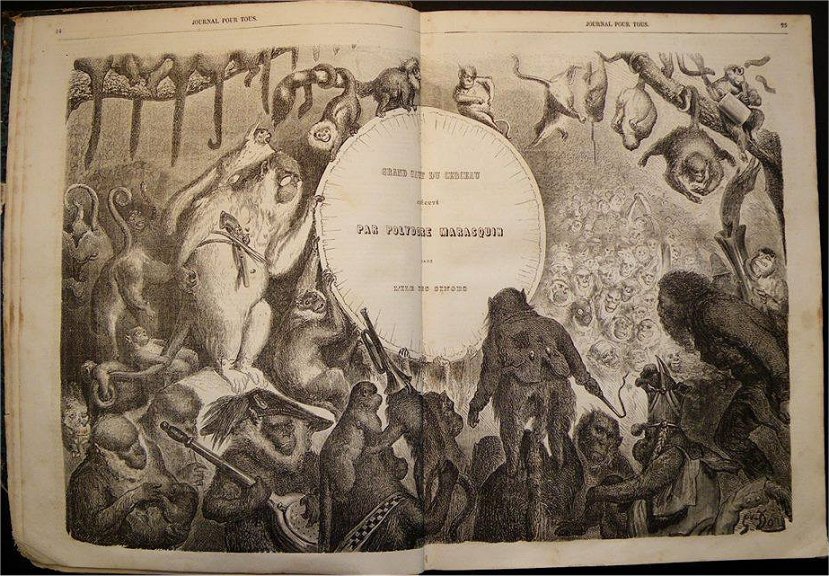
Last year, an author of noble intelligence, enhanced by an exemplary generosity, endowed, under the rather transparent veil of the Société des gens de lettres, several prizes destined to reward, amongst other creations of the mind, the best tale that would be sent in to a special contest. Having had the honour of being one of the judges in the field, we were in a position, in our modest stall, to count the number of lances, as it was said of yore in the language of chivalry, presented at this magnificent tournament. There were countless lances. If a few returned with the gold pennon on their lance, many were those nobly broken in the fray. Amongst the innumerable short stories addressed to the Société, and subjected to the contest criteria, there are some that will leave, in the annals of the committee, a lasting memory of corners marked with an odd symbol. Personally, we have read many whose characters were drawn with inks of different colours, and that, no doubt, with some sort of cabalistic purpose which we were unable to penetrate. We beheld others framed by ornamental borders, executed with the patience and monastic perfection of master copyists of the Middle Ages. The grammatical error was encircled with lovely little cherubs begging forgiveness for the compromised syntax. Nor would we want to omit a short story, otherwise most worthy, written at the foot of the Malakoff tower, beneath the crumbling walls of Sevastopol: it still smelt of powder. The northern climes also sent its own literary dispatches: two tales sent to the contest, dated, one from the confines of Sweden, the other from the more northern borders of Norway. Even the Lapps answered the call, from the city of Treviso. Author's Preface
By way of Spitzbergen, we will cross the Kamchatka and Japan, to arrive directly in China, which has not forgotten us. The supremely fanciful land of blue could not fail to have itself represented at the gathering of tales. Macao is the Chinese city from which was sent, to the headquarters of the Société des gens de lettres, through seas and tempests, in a lacquer chest, a tale which fate wished us to judge; but judge in first instance only.
After having read this tale, we were preparing ourselves to draft our faithful report, but we recognized with dread that the tale contained three or four-fold over the number of lines strictly allowed according to the wishes of the endower, and given the need of not having to evaluate the worthiness of twenty in-folio volumes, when one had only reasonably asked to crown common sense, wittiness, gracefulness, imagination --- the flower, the aroma of a few pages. Thus our task as reporter became pointless. The Chinese tale had put itself outside the terms of the contest.
Most saddened for our admirable colleague from Macao, we were already rolling up his ill-fated manuscript : we paused abruptly in this melancholy rotary motion that all rejected authors know. A thought had stuck us. We asked ourselves why, for want of the glory and dangers of a contest, our Chinese colleague could not have the more peaceful pleasure of some good publicity in a magazine. Let us give him this pleasure which he deserves. As with everything that comes back from the brink, his story appeared to us to be interesting in its point of view. They are memoirs. And notwithstanding what Pascal may have said against the "MYSELF," --- Pascal who never spoke but of HIMSELF, --- the "MYSELF" will always be read and preferred. These memoirs, as verily they are memoirs under a fancy moniker, are not exactly written in Chinese, though they were gathered on rice paper.
The author tells us, in a note tucked away in a corner of his manuscript, that he is begotten of Portuguese parents, that he is born of a French mother, and that he completed some advanced studies in the home of the brothers of the Congregation of the Mission (Lazarists), established in Macao. Again, this admission contravenes the practices of academic contests. So what? our most deserving colleague, Mr. Polydore Marasquin, does live in China; one must pardon him many things. Is he not already sufficiently punished for having written too long a work? It is to him, rather, that we beg forgiveness for having published his book without his approval, having cleaned up some of his sentences, and finally of having signed the whole thing with our name, which is of a physiognomy even more Chinese than his.
--- Léon Gozlan
The author of "Les Emotions de Polydore Marasquin" enjoyed a brilliant reputation at a period which will always be regarded as specially important in the literary history of France --- that is to say, during the quarter of a century immediately following upon the revolution of 1830; and even now, when the characteristics of popular French fiction have undergone a greatly to be regretted change, his works are read with pleasure by all of his countrymen whose tastes have withstood the pernicious influences of the generation of writers who have done, or are still doing, their worst to poison the springs of romantic literature. Translator's Preface
Léon Gozlan was born at Marseilles in 1806, and, being unfavoured by fortune at his birth, was destined by his parents to earn his living as an assistant-teacher in one of the schools of his birthplace. But speedily growing weary of the dull monotony and routine of this kind of existence, he one day wrote to the head of the establishment in which he was engaged:
"SIR,& -- Denis the younger, a tyrant out of work, set up a school at Corinth, and I thoroughly well understand the drift of this fancy of his: being no longer able to torment men, Denis took to tormenting infants. It was a compensation.
"As to myself, who have not yet any need for making little children responsible for the harm I have done to grown-up people, I confess, with all humility, that the profession of schoolmaster is decidedly disagreeable to me.
"When you receive this letter I shall be on board a ship on its way to the Senegal. Should I ever become King of the Mandingos, the most amiable tribe of negroes known on the face of the earth, be assured that I shall hasten to inform you of that happy event."
He was not more than twenty years of age when he adventured upon this voyage to Africa. What his purpose was in undertaking it, if he had any precise purpose, is unknown, for as to his having had any serious idea of getting himself made King of the Mandingos, it is hardly credible. Indeed, a rumour went abroad to the effect that, so far from seeking to establish good relations between himself and those excellent inhabitants of Senegambia, he would, on the contrary, have been more likely to deal with them as negroes were commonly dealt with at that time. Whatever were his actual relations with the Mandingos, however, the only fact certainly known was that, after exploring two of the principal affluents of the river Senegal, he took ship back to France, apparently enriched only by the discovery that the charms of life in Paris were incomparably more to his taste than those of African travel.
Deeply imbued with the belief that "to dare is to succeed," he, directly after his return, threw himself heart and soul into the career of literature, and gave to the public a long series of works of fiction, as well as plays, which won for him a recognized place in the ranks of his most brilliant contemporaries --- somewhere between Balzac, from whom he borrowed part of his keen observation, and Frédéric Soulié, to whose literary example he was indebted for some portion at least of the passionate sentiment he displayed in some of his romances.
But of his works in general this is not the place for speaking at length, and of the present book I need only say that, strikingly original in conception, it is executed with an untiring vivacity of idea and expression, making it not only one of the best and most characteristic of his lighter fictions, but enjoyable alike by young and old readers.
I was born at Macao, in China, and am descended from one of those bold adventurers who, towards the end of the fifteenth century, audaciously set sail from Lisbon, under the command of the renowned Vasco di Gama, to go and conquer the Indies. But however I may be entitled to pride myself, so far, upon the certainty of my genealogy, I must, in candour, admit that I have no plausible reason for believing myself to be the issue of any of the high-born followers of that illustrious chief. Chapter I
My grandfather has, indeed, sometimes insisted that our name of Marasquin comes by corruption from Mascarenhas one of the greatest names among the Portuguese who accompanied Vasco di Gama from the banks of the Tagus to the extremity of Asia; but I have always entertained serious doubts as to my grandfather's accuracy on this point. He himself, so far as I ever knew, was nothing but a hardworking tradesman established at Macao. His eldest son --- my father, Juan Perez Marasquin --- was never anything else, and I owe it to his memory to say that, during his life, his ambition was limited to being accounted an honest man and fair-dealing bird-fancier; for that --- I do not blush to own it --- was my father's calling, though there have been persons who have insinuated that he was nothing more than a simple poulterer. Of this the disproof is easy. Not only did my father deal in live birds, but he kept a menagerie --- one of the most extensive and variously supplied in the Portuguese Indies --- in which he collected all kinds of rare and curious animals. Sumatra, Java, Borneo, and New Guinea were represented in it by specimens of the most remarkable and uncommon creatures to be found in the all but impenetrable forests of those places. In the round of commerce there is hardly one that is more lucrative, owing to the taste of the Europeans established in the Indies and the almost insane passion of the Chinese for these interesting examples of natural history. To the sale of living animals my father joined the profession of taxidermist, and the latter was not the less profitable part of his business. From him I received lessons in the learned and delicate art of restoring to defunct birds and beasts the forms and habits exhibited by them during life. Thanks to his able instruction and example, I ultimately acquired remarkable skill in taxidermy; and it will be seen, in the course of this veracious narrative, that, to my aptitude in this useful and beautiful science, I owe my escape from a tragic end. For more than a century our business had prospered at Macao. On coming into possession of it by right of inheritance, my father had increased its field of operations; and, with the aid of the good and economical woman he married, he succeeded in making it the best establishment of its kind in existence. But if this sort of business brings in large profits, as I have said, it is, on the other hand, difficult, perilous, and often ruinous, as I myself have only too surely proved. Few people are aware of the difficulties under which the trade is carried on; it involves much more than merely the question of buying in the cheapest and selling in the dearest market: the animals have to be procured alive, before they can be profitably sold; hence the necessity of being at once tradesman and hunter, or, rather, of being a hunter before being a tradesman. My father, therefore, hunted and captured the animals he traded in --- a trade which I, in turn, learned by accompanying him, sometimes to the Chinese coast, sometimes into the jungles of the island of Hai-nan, so rich in wild beasts, sometimes even to Japan, in spite of the dangers inseparable from a navigation carried on in ill-constructed vessels; in spite of the Malay pirates, veritable seacormorants, devouring everything they come across; and in defiance of the dreadful penalties which, at that time, awaited all foreigners whom the Chinese and Japanese caught upon their inviolable territories. From these distant and perilous expeditions my father, and afterwards myself, brought back panthers, tigers, leopards, boa-constrictors, but, more especially, innumerable species of monkeys. It was in one of our last hunts on the shores of the island of Formosa that my father, attacked by a tiger, which he was about to envelop in a net, received several desperate injuries from the claws of the enraged beast. I was fortunately able to snatch him from the furious brute; but though I had the happiness to bear him back to his home, I had not the happiness to save his life. Under care of the unskilful doctors of the country, he languished for two years, his wounds refusing to heal, and died at length in horrible suffering. In giving up his last breath in my arms, he made me promise not to continue his perilous calling. I promised I would obey his dying wish; but as he had not left me wherewithal to support myself and my mother, and as I, --- to speak frankly --- had no taste for any other profession, I regret to be obliged to confess that I did not redeem my promise. The account I am about to give of the adventures I was destined to undergo will tell whether I had cause to applaud or to regret the course I took. On entering into possession of my father's business, I set to work with redoubled activity, with a view to proving to my wealthy patrons how worthy I was of a continuance of their patronage. I increased the number of my rarer animals; I sent out travellers, instructed to obtain specimens of other beasts of species wholly unknown, or little known, in the latitude of the Indies. Taught by experience, that the appearance of luxury dazzles, and consequently attracts the attention of buyers, I thoroughly renovated the exterior and interior of my bazaar. Bronze and gilding relieved the hitherto naked aspect of my cages. The utmost neatness reigned throughout my establishment, which I caused to be lit with gas --- a surprising novelty in Macao. Here I must indicate a particular trait of my character. At the time I took to the profession of bird-selling, I had a great love for animals, owing, in the first place, to my benevolent organization, and, subsequently, as a natural result of the studies I had been called to make, as to their forms, their expressions, their movements, their habits, their manners, their instincts, their passions, their intelligence, their sympathies, their antipathies, their caprices, their maladies, their affinities, more or less marked, with mankind, and the thousand other attributes essentially proper to their nature, which is, perhaps, still more obscure and mysterious than our own. I had even pushed my observations on the beings we have for cage-neighbours in the menagerie of the world so far, that I could easily recognize those whose instinctive aptitudes correspond with ours --- which would have made them, for example, lawyers, if there were any amongst monkeys; these were continually gesticulating, haranguing, and apostrophizing. I recognized others who would have made doctors --- these constantly employed themselves with the physical condition of others, looking at their tongues, examining their throats, and prying into the depths of their eyes: others would have made actors --- these grimaced, gambolled, and danced from morning to night: others, again, would have made astronomers --- these invariably bore themselves in such a way that the sun rose in a line with their noses: with the same infallibility of appreciation, I recognized those who would have had a taste for commerce --- these carefully gathered up all the fruit and grain that fell from the negligent hands of their companions, and heaped them in a corner. In the same way I could recognize misers, spendthrifts, swaggerers, worthy fathers of families, good or coquettish mothers, and bad sons; but, particularly, I could distinguish all shades of thieves, from the blacklog of fashionable society to the highway assassin. I could have said, with unerring precision, "There is a monkey who, if he wore a white cravat, might ride in his carriage; and there is another who, if he only habitually dressed himself in a black coat, would assuredly be hung." I thus attached myself to my boarders in the character of a naturalist, painter, physician, and philosopher, even more than by my title of buyer and seller; by force of penetration, I should have succeeded in being able to read in their eyes whatever were their thoughts, their wants, and their desires; I have no doubt whatever that, in this psychological study, I should have attained a power unknown to all the naturalists in the museums of Europe, if the fatal accident through which I lost my father had not suddenly checked my fondness for animals; for, after that event, I found it impossible not to look upon each one of them as the accomplice of the tiger which had killed him. This antipathy grew from day to day, and caused me, at first, to neglect them, but afterwards to punish them severely. They quickly understood the change which had been wrought in me; for animals keenly, and even more readily than ourselves perhaps, realize the difference between good and ill treatment; and they paid back, in hatred and spite, the punishment which I, sometimes a little too inconsiderately, inflicted upon them. It was a continuous struggle between them and me, reaching, at length, a post at which I could no longer control them, save with a rod of iron. From this state of things it resulted, that I ceased to be able to make them leave their dens, for the purpose either of punishing or taming them; and, on my side, I could not prudently venture into the cage of any one of them, On both sides, it was a condition of permanent anger and hostility; and there was no kind of ill-turn which they did not play me, the last one being of a nature so cruel and terrible that, if I passed it by in silence, the cause of the prodigious emotions it was afterwards my fate to endure would scarcely be intelligible. One brute alone in my collection was guilty in the highest degree, but all contributed to the terrible result, by their universal animosity towards me. I will, in the next chapter, relate the frightful vengeance of which those redoubtable creatures made me the defenceless victim.Vice-Admiral Campbell, who, at that period commanded the English naval force at Oceania, was accustomed, every time he came to Macao, to pay a visit to my bazaar, and to purchase a few specimens for his aviary and menagerie, in which he sought to beguile the tedium of his voyages between the islands, and the inactivity to which he was often condemned for months together, while his ship was lying at anchor. Chapter II
I think it useful to say a few words here as to the importance of the British naval stations in the waters of China and Australia.
The object for which they are established, but which they do not always accomplish, is to protect the lives and commerce of Europeans, in the latitudes infested by Chinese and Malay pirates --- yellow-skinned, innumerable, terrible.
These dreaded serpents of the sea, who are to Oceania what the Algerines once were to the basin of the Mediterranean, knew no authority under the sky; neither that of the Emperor of China, backed by his mandarins, nor that of the Sultans scattered about the great islands --- as in Borneo and Mindaneo; nor did they any more regard the authority of the British or Dutch officials, representing their respective nations --- nations powerful enough, no doubt, but too far off to command respect from such lawless hordes.
The Malay pirates dare all, and seek their prey everywhere. The Sooloo Archipelago, which numbers one hundred and sixty isles, is entirely peopled by them. On a given day they set afloat five hundred junks, manned by no less than five thousand sailors. They scour every hole and corner. The plunder they seize they share amongst them; their prisoners, if they take any, are held to ransom, but are more generally killed. At times they have pushed their audacity to the extent of swooping even into the midst of great commercial centres, such as Sumatra and Java; and, on one occasion, they came for powder and ball to Macao, which was compelled to supply them. As a race, they are indestructible; they have endured for ages, and they will endure for ages longer.
It is to protect British subjects, especially, against the poisoned cresses of these ferocious sea-robbers, as I have before said, that the British Government constantly station ships on the thousand points of the interminable coasts of China.
These British ships are often obliged to remain for entire years, in protection of places threatened with a visit from these pirates; in such cases, the officers establish themselves on shore, set up tents, or even establish groups of houses, in which they live with their families.
Naval campaigns of this sort are greatly dreaded by English sailors, compelled to fight at once against tempests, Malay pirates, fevers of all colours, and, worst of all, against the depressing influence of weariness --- that yellow-fever of the soul!
Vice-Admiral Campbell, who, as I have already said, commanded on one of these stations, had hoisted his flag on board the fine frigate Halcyon.
He was preparing to quit his anchorage at Macao the day when, in company with his principal officers, he paid a visit to my menagerie. Besides my aviaries, which were well stocked with birds of all climates, I possessed a rich collection of quadrupeds --- gazelles from Egypt, bisons from the prairies of Missouri, several blue goats, fourteen or fifteen great ant-eaters, jaguars, Senegal leopards, otters, polar bears, black panthers, antelopes, reindeer, one-horned rhinoceroses, Brazilian llamas, lions, and a magnificent show of tigers.
But the most special feature of my display was my gathering of monkeys, representing all phases of monkey character --- the gay, the malicious, the cunning, the savage, the grave, the pensive, the threatening, the witty, the stupid, the melancholy, the grotesque. I had them of all species, of all sizes, from the tiny marmoset to the enormous mandril and baboon.
Among all these monkeys, four especially disputed the curiosity of the crowds of persons who visited this gallery, firstly, two baboons of unequalled strength and ferocity. Both were bulky as men, intelligent as men, and, I was going to add, both were as malicious as men. They shook their cage so as nearly to tear it to pieces; often they overturned it, and, in the height of their rage, wrung the iron bars of which it was made as if they bad been rods of wax. What made the sight of these ferocious beasts so peculiarly attractive to the onlookers? Was it the extraordinary cruelty of their demeanour? I am almost tempted to believe so.
Two other monkeys shared the sympathy of the visitors, a male and female chimpanzee, about the same in age and equal in grace. The male was gentle as a young girl, delicate, sensitive, understanding everything, going as near to the limits of intelligence as is given to a being deprived of the divine light of the soul. He was fond of children, played with them, and exhibited such a passionate liking for music as to forget to eat when he heard the sound of an instrument.
He performed about me the office of a well-instructed footman, changing the plates at dinner and serving the wine --- even eating at table with me when I invited him. The attentions I paid him excited the other monkeys I almost to a frenzy of jealousy; and often their hatred left traces upon his soft and silky coat.
As to the fourth monkey, contrary to the habits of most of her sex and species, the young chimpanzee, instead of longing for ribbons, laces, and embroidered handkerchiefs, was content with her own natural grace and gentleness. She was never so happy as, when some one gave her a flower, which she would place upon one of her ears, or gaze at by the hour together in an attitude of melancholy. The soul of Mignon seemed to have passed into the frame of this pretty creature, and to speak tenderly from her yellow-blue eyes.
I had called my baboons, the one Karabouffi the First, the other, Karabouffi the Second; and I had named the male chimpanzee Mococo, the female Saïmira.
Mococo was deeply in love with Saïmira, and Saïmira was scarcely less deeply in love with the charming Mococo: it was, on both sides, a first love, simple and frank, interesting to follow as a study of the heart and emotion and thought among beings temporarily placed between the man and the monkey --- strange beings, whom an effort of genius may, one day perhaps, range in the class of men, from whom they are separated only by a transparent veil. A flash of lightning may break through this barrier and humanity count one family more.
Karabouffi the First also entertained a dark and terrible love for Saïmira. Nothing can compare with the black jealousy of the baboon. When he saw the two pretty chimpanzees pass in front of his cage, enjoying the liberty of going about the bazaar, his iron nails were drawn up like hooks, his savage eyes flashed maledictions, his blue lips were compressed like those of a vice, and his grinding teeth seemed as if they were burying themselves in one another. Terror spread throughout the menagerie.
There was not one of these animals, however, which did not remind me, point for point, of all the characters, all the desires, all the passions of mankind, on an infinite scale. I remained convinced with Buffon, who has written so admirably concerning animals, that if, instead of beating them, maltreating them, and making them constantly suffer, we were to study them with sustained interest, we should penetrate into the midst of an immense and unexplored world of ideas and sensations, wherein we have not yet so much as set foot.
Vice-Admiral Campbell was so pleased with the antics, the docility, the strangeness --- and, it must be confessed, also with the ferocity --- of my collection, that, before leaving, he purchased a pair of monkeys, his example being deferentially followed by the whole of the officers of his suite.
I own that I did not at all like to separate myself from Mococo and Salimira, but the Vice-Admiral's wife took so strong a liking for them, and pressed me so much that, in the end, I was forced to let her have them. I was satisfied, moreover, that my lady would take as much care of them as myself, and was careful to impress upon her the necessity of always keeping them out of the reach of their persecutor, Karabouffi the First. This she promised me to remember, and I confidently abandoned to her charge my two poor chimpanzees, who appeared to be still more affected than myself at the separation. They embraced me like two children, and their tears trickled down upon my hands. I was so moved as to be upon the point of taking them back, but I was a trader, it was my business to sell whenever I could; interest weighed down the scale.
As nearly all these gentlemen on the naval station, as well as their ladies, purchased my monkeys in pairs, as will have been remarked, it followed that, not possessing a complete number of families, one of my two baboons, Karabouffi the Second, in default of a mate, was left upon my hands. This situation irritated him to such a degree that he roared with rage and fury when he saw the rest of his cage companions go away.
Those, in their turn, taking pity on their comrade left in captivity, uttered the most savage cries, and tried hard to avoid being carried on board ship; it was, indeed, only by the free use of the lash and other means of coercion that they could be embarked by their new owners.
Nothing can convey a just idea, no description, no painting, of the dark and threatening look darted at me by the solitary baboon when I reached the bazaar after the departure of his companions.
The vengeance of the man most deeply moved by hatred, most fiercely irritated, never condensed in his eyes so many threats as I read in those of that baboon. I saw in them blood --- my blood.
This sale of monkeys, on which I had realized enormous profit, had taken place more than a year, when one night I was awakened by a horrible feeling of suffocation, by a dense smoke, which seemed to rise from between the joints of my bedroom floor. This floor, made of very thin boards, was immediately over the menagerie. I was stifling; It was with great difficulty that I was able to rise and make my way to the window. I throw it wide open, to save myself from being killed by asphyxiation, and because my mother was lying in an adjoining room.
But the air no sooner entered the chamber than, not smoke only, but flames, ascended from the openings in the floor --- flames enveloping the entire building from basement to roof!
My first thought was to rush for my mother. Too late! The back room, which she had made her bed-chamber, had been the first to be invaded by the smoke, and the smoke had killed my poor mother in her sleep, before she could call for help. Those who came to offer assistance had to tear me from her room, where I wished to die by her side.
I was carried away out of the burning house by neighbours, who laid me on a stone bench, whence I gazed upon the destruction of my establishment. Through the gaping entrance to the fast vanishing bazaar I was witness of a spectacle which I shall never forget.
In the midst of the flames which were roasting my beautiful birds, in the embraces, of which my magnificent tigers were writhing in horrible torments and uttering the wildest cries --- none daring to attempt to extricate them --- the baboon was dancing, chattering, romping, with hideous delight, waving a flaming brand in either hand. His attitude, his cynical looks, everything in the expression of his features, told me that he was the author of the conflagration; that, in this night of long-meditated vengeance, he had contrived to get possession of some lucifer matches, with which he had seen the bazaar-keeper light the gas; that he had succeeded in breaking his chain as well as the bars of his cage, and then turned on the gas to the full and set fire to it. That was the supreme and terrible vengeance of Karabouffi the Second.(1)
Somebody killed him with a gunshot in the midst of the flames. But I was, none the less, ruined, and had, none the less, lost my excellent mother.
Under the weight of so many afflictions and sufferings, I resolved to abandon my profession, my business as a bird-fancier, remembering, somewhat late, the advice of my father. For two years I traded in ivory, feathers, and furs; but not being versed in this kind of negotiation, I obtained but very small profit, and saw no hope of doing much better for the future. Chapter III
Then, too, this kind of life, so. much less active than that which I had formerly led, did not please me; whereas my previous mode of living was constantly brought back to my mind, by the force of habit and the bent of my studies in natural history. Even the dangers which it entailed made me regret it. In short, after many hesitations, I determined to return to it.
I was still young, and there remained to me one thousand piastres, placed at interest in the house of Señor Silvao, of Goa. I was thus in a position to reconstruct and stock my establishment; but, to do this, it would be necessary for me to make two or three voyages to Oceania, where the best hunters of wild beasts and birds of prey are to be found; and I further calculated upon hunting with them myself through the woods and marshes. It was a bold and adventurous resolution; but I had no other means of re-establishing myself at Macao.
Very shortly after making up my mind to this effect, I took leave of my relations and numerous friends, and made the final preparations for my departure.
I freighted a Chinese junk on my own account, to be at my sole disposal for an entire year. My first point of destination was New Holland --- that immense island, almost as large as a continent --- where I was sure, according to the accounts of travellers, to meet with the most powerful, the most varied, and the least known animals in creation.
I set sail in my Chinese junk on July 3, 1850, full of confidence in Heaven. The vessel I had hired did not make up for her slowness by strength of structure. It was an old junk, worn out by numberless voyages to the Corea and Japan, which might once possibly have been able to resist rough weather, but against which it now offered but a slight promise of resistance.
My first object being to reach New Holland, or Australia, we steered due south on quitting Macao.
During the space of a week we were favoured with a wind which carried us in that direction. We speedily, therefore, found ourselves in the midst of the Philippines, in spite of the small amount of order which reigned amongst the crew, composed of eight Chinese, eight Malays, and eight Portuguese --- three nations holding each other in the utmost detestation, somewhat as the Corsicans and Genoese did long ago, and, like them, finishing all their disputes by the arbitrament of the knife.
During the passage of the Island of Mindanao, and at the moment of entering the Strait of Macassar, the junk sprang a leak, and, as if to make us pay for the fair weather we had so far enjoyed, the sky grew dark and charged with storm from pole to pole.
For ten days we struggled to cross the Strait of Mindanao, the wind and currents constantly forcing us to the west; and the more we strove to resist this deviation from our proper course, the wider grew the openings in the sides of the junk.
To aggravate our position in the midst of a sea already perilous enough, the crew refused to work at the pumps, and so the water increased in the hold from hour to hour. One by one the Chinese, the Malays, and the Portuguese retired from the labour, as being too severe. Severe the labour was, it is true; but upon it rested the safety of all on board of the vessel.
Captain Ming-Ming, I then but too clearly saw, had no control over that antipathetic assemblage of sailors. I suspect even that, at an earlier date, he had been engaged in piracy with the eight Malays, who treated him on a footing of equality, clearly indicating an equivocal confraternity in the past, and destroying all present authority over them.
This discovery was very little assuring to me, who for a long time had been thoroughly acquainted with the conduct and humanity of these terrible miscreants. The revelation greatly alarmed me, I do not hesitate to confess; but I concealed my terror. Nevertheless, I loaded a pair of pistols, and put one in each of my trousers' pockets.
The crew had entirely ceased to work the pumps, and the water steadily rose in the hold. Less good sailors than either the Chinese or the Malays, the Portuguese were at length terrified by the fate with which we were all threatened. They talked of altering the vessel's course, but they were opposed and their purpose defeated by the Chinese and Malays; and this served to confirm me in the idea that I was not mistaken in regarding them as old pirates, seeing how strongly disinclined they were to show themselves in any port under the control of a regular police.
Besides, whither were we to steer? Where were we? On which side of the equator? Were we running towards the Straits of Malacca or those of Macassar?
It was not Captain Ming-Ming, much abler at smoking opium than in navigating a ship, who could answer these questions. The sky was black, the wind tore our big bamboo sails to shreds, and we were settling deeper and deeper in the water.
Only when it became clearly no longer possible to overcome the danger, did this precious gang of sailor-pirates think about what they were to do. The instinct of selfpreservation was awakened; but it was too late. They tried to empty the junk of water; the pumps were gorged, and would no longer act.
Then fear seized these bandits by the throat, and all of them, Malays, Portuguese, and Chinese, scanned the horizon wildly in search of land --- any land --- even though they might be all hanged as pirates the moment they set foot on it.
What was I doing all this time? Engaged in preserving from the mounting water my hunting weapons and nets, with the other implements I had brought from Macao, in the hope of replenishing my menagerie.
But, in the end, of what use might be all my trouble? Was I destined to escape from the critical position in which I was now placed?
On the twenty-eighth day of the vessel's voyage we had no resource but to abandon ourselves to the discretion of the tempest. The junk was left entirely to itself by Captain Ming-Ming. I do not believe, though I have been in many storms on the coast of Japan, during the voyages which I made with my father, that ever the sky and the waters were so frightfully disturbed. The old junk bounded upon the waves like an elastic ball upon a floor.
After three agonizing days, passed between life and death, we perceived a spot, black as ink, detach itself from the livid streak of the horizon. The Malays, whose eyes are gifted with an infallible power of penetration, declared that it was land, towards which we were being driven with the irresistible force of a tornado.
Night had almost immediately closed in upon us, and we had not had time to calculate whether, when the light of day reappeared, we should have reached or been carried past this land.
What a night! We had neither sails, nor masts, nor helm; and the junk was split in all directions.
At length day dawned! We looked about us: land was not more than a quarter of a mile distant from us! Chapter IV
But that quarter of a mile was composed of a chain of jagged rocks white with the foam of the sea, which broke upon them like glass furiously pulverised, and fading into space with the tenuity of ether. Impossible to avoid being broken upon them like the waves of the sea.
Little time had we for reflecting on the fate which awaited us. Two sudden and terrific shocks, following in almost instant succession, broke the back of the poor junk, the poop being at the same time carried away, and with it five of the crew. We hardly heard the cries they uttered before they were borne into the foaming abyss.
The remaining sailors, after great exertion, succeeded in launching a small boat hanging over the bulwark, with a view to endeavouring to reach the shore; but after getting her afloat, a terrible struggle ensued between them, as to which of them should get into her first. At most she was capable of containing six persons, and fifteen were attempting to invade her. Knives were drawn, and the combatants were fiercely stabbing one another, when the scene of their savagery sank under the feet of the conquered and their conquerors.
Standing apart from the rest, I at that moment caught sight of one of those buoys fastened by a light rope to the cable, and serving to show the point at which the anchor is holding beneath the water. Rapidly opening my knife I cut the rope at some distance from the cable, then seized the buoy with both arms and plunged with it into the boiling waves. For an instant drawn under water, I speedily remounted to the surface, and turned my head to see what my companions were doing. They and the last fragments of the junk had disappeared.
For three hours I struggled with death. What an agony! Each time I strove to seize hold of the points of rock shooting up between the foam and the sea, I was driven back by the retreating waves; my bleeding hands were wrenched from their painful grasp; my strength was failing me; I was barely able to retain hold of the rope attached to the buoy.
I had lost all energy, all sense of existence, when finally a great wave enveloped me and my buoy and whirled us together to the bottom of the water. I felt myself grow faint and cold; then I ceased to be conscious of anything.
When I reopened my eyes, I was lying upon a beach covered with wrack and other seaweeds, and I fancied that there were trees not very far from me. My astonishment was like that of a tipsy man awakening after a long sleep. I had not strength to rise.
The storm no longer raged. As well as I was able to judge, the sun had attained a considerable height, and was shedding a great heat upon me. The sand grew warmer and warmer under my outstretched open hands; consciousness of life returned to me, little by little. I questioned myself; I asked myself whether it was really me, and where I was. I soon acquired the certainty that I was in the neighbourhood of trees --- of a forest at no great distance off. My lethargy passed from me like a cloud. I presently rose and tried to walk a few paces; but my legs bent under me, as if they had been made of cotton-wool. However, I succeeded in holding myself erect.
Meanwhile the sun, which had been going up the sky, fell with full brightness upon the landscape. The heat of the air increased every minute, and speedily became so oppressive as to cause me to sink exhausted at the foot of a mangrove tree, the cool and refreshing shade of which, in a short time, infused a feeling of comfort into all my limbs. By degrees my eyes grew heavy with sleep, and I fell into a placid slumber.
I do not know how long I remained asleep; but when I awoke I calculated, by the decline of the sun, that it was about two o'clock in the afternoon. Judging by the sensation of rest of which I was conscious, I must have slept some seven or eight hours; but I could not be sure of this, because my watch had stopped, owing to the battering which my body had sustained before I had been washed on shore.
For the purpose of shaking off the stiffness which still remained after my long sleep, I rose and walked rapidly a few paces straight before me. I had gone but a very short distance in a direction opposite to the sea, when I saw something like a human form appear at the end of a long vista of trees which opened on my sight.
My first idea was that this was an inhabitant of the island on which I had unfortunately been wrecked; and I rejoiced at this meeting, though, at the bottom of my heart, I was not without a sense of uneasiness, as to the nature of the friend or companion sent me by fate.
Without hesitation I advanced towards this object, whatever it might be; but, after having pressed forward for some five or six minutes in the direction of the spot where I had seen it, I could see nothing of it. Had I been deceived? had a mirage of the sun caused me an hallucination? I could not explain my error, and it annoyed me extremely.
I continued to advance.
When I reached the spot where this vision had appeared to me, another horizon naturally met my view; and almost at the same moment, to my great satisfaction, I perceived the being on which I had already set eyes. Ah! how truly happy I felt. I could distinguish it even more clearly than when I had first caught sight of it, though the distance was still great which separated us. I observed it with extreme attention.
His movements appeared to me to be exceedingly active and rapid, for I noticed that he passed from one spot to another with the swiftness of a flash of lightning. The idea came into my head that he had seen me, and that my presence inspired him with alarm. Under this impression I advanced towards him with more confidence.
I had reached the very spot where I had last seen him when from a tall tree, an object undefinable at first sight --- a sort of shaggy and nervous body --- with loud, guttural and savage utterings, responded to from all distances by absolutely identical chatterings, fell at my feet. It was a monkey. At a bound the animal rose, then again threw itself down upon the ground, and ended by placing itself in the middle of my path, as if to forbid my passing.
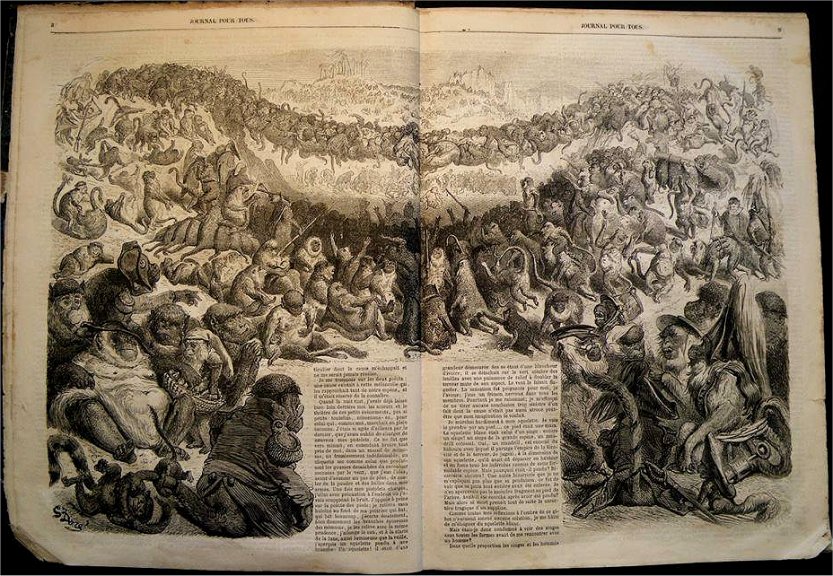
Such a pretension not being at all to my taste, I broke off the first branch that came to my hand, and threatened the brute with it. In answer, as it appeared, to a fresh outburst of chattering I saw, hastening from the four points of the horizon, glancing through the woods like gleams of light, clouds of monkeys of all shapes, colours, and sizes, who, in a moment, ran up the trees and out upon the branches, like squirrels, swarming upon all the raised points of ground about me, regarding me with their rapidly winking eyes --- all hurriedly, threateningly, hissing and grinding their teeth, in such a manner as fairly to deafen me. I was obliged to press my hands closely upon my ears to prevent my senses being shattered by the tremendous uproar of this new kind of tempest. Nothing like it, I think, had ever before been heard in the forests of Oceania.
As I had for a long time, at Macao, carried on a trade in monkeys, I easily, in spite of my agitation, recognized the different kinds I had to do with at this moment. Knowing by experience the maliciousness of these animals, when they are in large numbers, I resolved to beat a retreat; but it was too late. Behind me I saw, in eight or ten ranks closely pressed, other monkeys, some of which appeared to me to be so powerful that any attempt at flight would have been a grave imprudence on my part. I remained, therefore, where I was, but not without anxiety.
Presently the assembled monkeys began to move about me with demonstrations becoming more and more hostile, though I no longer held in my hand the unlucky branch which had been the first cause of their deep and furious irritation.
Meanwhile the heat had become overpowering at the open spot at which I was standing, and, after some time, which appeared to have modified to my advantage the disposition of my surveillants, I tried to move a few paces forward. I was, besides, horribly hungry and devoured by thirst; but I had scarcely made a movement before the groups of watchful monkeys reassembled around me, recommencing their threatening gestures, their cries, their grimacings, and their chatterings. They did even better; for they formed themselves into a square, and, when they had taken up this strategic position, of which I occupied the centre, one of them separated himself from the groups and came towards me.
Rapidly advancing, the brute snatched up the branch which I had dropped upon the sand, and, before I had time to put myself upon the defensive, rained a shower of blows upon my legs, arms, feet, head, face, back --- in short, upon every part of my body, causing me, hemmed in as I was on all sides, to spring and bound as if I had had burning coals under my feet.
I here frankly confess that I endured as much from shame as from physical pain. A vile monkey was beating me, an abominable ape was chastising me in the full light of day! Other wretched monkeys, witnesses of my moral abasement, were laughing, even writhing with delight, at the spectacle.
It was while I was thus furnishing them with this comedy, and they were affording me an opportunity for seeing them so closely, that I was struck by a singular doubt; the agitation of the moment, however, did not permit me to dwell upon it.
Ah, yes! My agitation was indeed great: flagellated by monkeys in the midst of an assemblage of monkeys! Only animals are capable of importing so much refinement into cruelty. I know that, in England as well as in France, people pay large sums of money for places to see a man executed, and that is the same at Brussels, Vienna (the capital of that philanthropic king, Josef the Second), at Berlin (the capital of a not less civilized kingdom); but, at least, we do not execute monkeys, and therefore, the right which they arrogated, of beating me, appeared --- but, for the moment, they were the stronger. It was hopeless to think of resisting them; and so I gave in to them.
The most melancholy part of the affair was that I could not see any end to the torment I was enduring; my executioner went on striking me without exhibiting the smallest sign of weariness.
Certainly, with one of the pistols which I had about me, and which it will be seen I had never been so imprudent as to divest myself during the voyage, I might easily have blown out the brains of this impudent animal; but I remembered, only too clearly, the incident which happened to the president of the Indian Company one day, when he was on an excursion in company with the famous French traveller, Tavernier, and while passing through a forest on the banks of the Ganges.
Astonished, like myself, by the great number of monkeys which he had seen suddenly gather about him, he had caused his carriage to be stopped and begged Tavernier to shoot some of them. The people in his suite, better informed as to the vindictive manners of these animals, begged him not to do anything of the sort; but the president insisted. Tavernier fired and killed a female monkey carrying her young ones.
In a moment all the other monkeys sprang, with cries of despair and fury, upon the president's carriage. They overpowered the coachman, the footmen, and the horses, and they would speedily have strangled and torn his lordship into fragments, if the carriage-blinds had not been rapidly drawn down, and if the people of his suite had not given regular battle to the assailants, of whom they disembarassed themselves only after infinite trouble.
That terrible example warned me against discharging my pistols into the body of the horrible animal, whose blows still continued to rain upon me, in spite of my anger, my rage, and the gestures I employed in defending myself. Nothing, alas! served me, and I should, assuredly, have perished under this frightful punishment, but that an idea flashed upon my mind --- an admirable idea, which, unfortunately, came very late, as excellent ideas generally come.
The keenness of my sufferings gave sharpness to my recollection, and I remembered that travellers, who had found themselves in a position similar to mine, had been able to extricate themselves by a means which I resolved to employ without a moment's delay. I unfastened my cravat and threw it, unfolded, into the midst of the assembled monkeys; it was a brilliant red cravat, bought at Bengal, the year before.
Scarcely had the monkeys perceived this sparkling piece of stuff, ere they sprang upon it with screechings of curiosity and joy. My executioner followed the general example, and I, while he and the others were disputing the prey I had thrown to them, ran away as fast as my legs would carry me, with all the strength I could bring into play, towards the interior of the island, where I counted upon meeting with some natives, and, perhaps, before then, a little water with which to quench my intolerable thirst. My hope was not completely disappointed.
After running breathlessly for a mile or two, I looked about me, and had the great satisfaction of seeing that I had not been followed by the monkeys. For more than an hour I continued my way without obstruction, over a soft sand, through groups of trees which now formed brilliantcoloured masses, now bent to the earth, as if indicating a ravine in which I might find water. I was worn out, perspiration enveloped me like a fiery mist. Should I be able to discover this ardently desired water?
On passing round a hill covered with silvery moss, I was suddenly struck by the sight of a lake at least a mile across, surrounded by tall trees, standing in rows, as if they had been so ranged by men learned in the art of laying out fancy plantations.
A gentle slope, covered with the same kind of silvery moss over which I had just passed, conducted me to the edge of the white and transparent sheet of water, so fresh in its primitive flavour as to intoxicate the drinker as completely as if it had been fermented wine!
I knelt down to drink of it, and the joy I felt in dipping my parched lips into it was so keen, so prolonged, that I must have knelt fully a quarter of an hour over this reviving beverage. My happiness was dream-like, so concentrated and silent was it. But the cry which escaped from my lips, on raising my head, was not altogether one of gratitude to Heaven, to which I owed the delicious joy of having thus refreshed my mouth and bosom: it was forced from me by surprise.
The spectacle which met my astonished gaze was this. To its entire extent the shore of the lake was covered by the same monkeys that had so pitilessly maltreated me. All had taken my kneeling attitude, all rose at the same time as myself, their muzzles moist and glittering with the water in which they had been dipped. While I imagined I had safely escaped from them, all had followed me silently through the dense borders of the forest, passing from branch to branch of the trees, from leaf to leaf, so to speak, and, on seeing me stoop to drink, all had closely imitated me. Chapter V
Though my limbs were aching with fatigue and smarting from the blows I had received, and though I was beginning to feel very seriously uneasy in my mind at finding myself constantly surrounded by this ever-increasing troop of monkeys, I could not help bursting into a loud laugh on seeing with what burlesque fidelity my least gestures, my most fugitive and involuntary movements, were copied and repeated. But I was almost seized with stupefaction on hearing my laughter instantly echoed by five or six thousand other cachinnatory explosions exactly like my own! I laughed still more loudly; they, in turn, laughed with increased loudness! It seemed as if there might be no end to the comedy.
Not understanding the meaning of this unusual disturbance, the birds, hidden in their mossy retreats, scattered in the tall ferns, swarming in the network of bindweeds spreading from tree to tree, sleeping under the leaves --- the large, the small, the invisible; birds of which their Creator alone knows the name, and of which the most gifted human tongue would find it difficult to describe the forms: birds dressed in brocade, like ancient doges, others wearing triplelace embroidered collars, like princesses of the house of Valois, others whose tail feathers look as if they were rays stolen from the sun; all arose, beating their wings, startled by that universal thunder-peal of laughter, filling the air with their flapping and whirling flight.
The monkeys themselves, though used to these outbursts on the part of the birds, were yet astonished at the strangeness and novelty of the spectacle, and all stood up to enjoy it. I then remarked something which I had not before noticed: many amongst my shaggy persecutors bore a sort of narrow red collar, for which it was at first impossible for me to account; the explanation occurred to me, however, after a short reflection. Each of those red collars was a fragment of the cravat I had abandoned to them, and which they had knotted under their chins. I have never seen anything more farcical than that ornament of toilette, with which some of them had nearly strangled themselves in their attempts to tie it securely, or to defend it against jealous comrades who had tried to deprive them of their treasure. These monkey cravats presented a sight with which I should have been delighted under any other circumstances.
My thirst I had no doubt assuaged, but my hunger remained unappeased. Far from it! for the satisfaction accorded to one sense had rendered the other more imperious. My craving for food, indeed, had been the more excited since, for about a quarter of an hour, I had caught sight of some trees growing on the shore of the lake, from which were hanging some kind of golden-coloured fruit, delicious to look upon, and doubtless more delicious to eat, but growing so high, so very high, so near to the summit of the trees, that no man, not even a Japanese sailor, could ever have succeeded in plucking them without the aid of a ladder. Trees from one hundred and eighty to two hundred feet high, without bark, without branches, without the least unevenness upon their trunks, not a resting-place of any sort for more than half of their entire height.
Hungrily my eyes feasted upon those fruits, my stomach wooed them with the tenderest yearnings; --- but how to get them! The thing was impossible. I tried, however, after many vain calculations, to throw a sharp stone with all the force I could command, in the bare hope of detaching them. I was not unskilful in this kind of exercise, and succeeded in touching the tree at which I had thrown, but I failed to dislodge any of its golden fruit.
After striking, the stone, of its own weight, fell from branch to branch with a great noise --- the smallest sound is magnified in these islands, where man has not destroyed the primitive silence --- bringing down with it a shower of withered leaves. But almost before it reached the ground the monkeys, who had eagerly followed all my movements, from the moment of my kneeling down to drink in the lake, fell to picking up all the stones they could find within their reach and throwing them at the upper branches of the trees.
Oh, the din, the crash, the hail, the rattle, of their attack! No destruction could possibly be more rapidly effected. They made a chain and passed stones from hand to hand, so that the throwers should not have to wait for missiles. Stories are told of whole fields of maize being devoured in the course of a few hours by the locusts of Libya; in a few minutes fruit, leaves, branches were stripped from the group of trees, the midst of which my stone had so ineffectively pierced; and those thousands of fruits, those piles of leaves, those heaps of creepers, this maze of branches, fallen upon the shore of the lake, so encumbered it that I had but to put out my hand to seize upon the fruit I so eagerly longed for.
It may readily be imagined that I lost no time-in doing this, but the moment the monkeys, to whom I owed this abundant provision, saw me raise one of the fruits to my mouth, the whole of them instantly copied me. Thousands of arms were raised to thousands of mouths, the manoeuvre being executed as by military command, and with the precision of Prussian discipline. I raised my elbow, all the elbows of the monkeys were raised. I cast away a fruit stone, in a moment the air was filled with rejected fruit stones. The echoes of the lake presently repeated nothing but the clatter of their teeth, and its surface almost entirely disappeared under the refuse of the fruit sucked and devoured with this burlesque unanimity and imperturbable imitation.
Though I was now delivered to all the chances of fortune and destiny, escaping from one danger only to fall into another still worse perhaps, I nevertheless desired to get free from the odious imprisonment in which I was held by these abominable creatures. Moreover, it, was not without alarm that I saw the daylight fading and night approaching. I dreaded finding myself alone in the midst of darkness with these legions of demons, whose fantastic surprises have not even human imagination for their limits. For our imagination is not a shadow of theirs; our impossible is reality to them. They are creatures eternally mad, to whom our madness is pure reason.
What would happen to me? Night --- and them! Doubtless, I should, next day, discover some natives, for this was not a desert island; doubtless, I should be able to reach the centre of the island, where, probably, their houses were built; but, meanwhile, I had to pass this dreaded night.
In my feverish anxiety, sharpened by the knowledge which I possessed of all these evil geniuses, the idea came to me --- in view of the fact of their eagerness to do everything I did --- to make believe to go to sleep. If I were clever enough to get them to imitate me to the extent of going to sleep, I might profit by their lethargy to escape from their surveillance and penetrate into the heart of the island. It is true that I was ignorant as to its configuration; but, during a night's march, I might, no doubt, be able to put ten or twelve leagues between them and me. The plan appeared to me to be a good one, and I at once carried it into execution.
I began by collecting some armfuls of dry leaves, and performed this preliminary operation with as much noise as possible, with the object of provoking the imitative attention of my spies. In this intention I was perfectly successful; for, instantly, the whole assembly set to work with the most comic eagerness, gathering heaps of dry leaves of the tulip tree, and spreading them upon the ground, as they saw me doing.
Delighted with this commencement, I heaped a considerable quantity of my leaves at the foot of a tree, which I had selected for a back-rest. They all immediately did the same. When I had thoroughly completed my arrangements, I stretched myself upon my bed and watched. But this time my imitators did not move. A bad sign!
There was, clearly, a hitch in the development of the calculation I had made for leading them into a trap. With paws plunged in the dry leaves, bodies held erect, muzzles turned towards me, and eyes glaring at me, they examined me, following the least movements of my body; but not one of them lay down. Were they beginning to distrust me? Pursuing my purpose, so as to be enabled to learn exactly what I had to expect, I stretched forth my arm, like a man falling off to sleep. I yawned with open mouth, and, finally, shut my eyes. Of these three acts, they only imitated one: they yawned to the very depths of their jaws; but that was all.
It was of no use keeping my eyes closed, they kept theirs constantly open. I carried the intended deception so far as to snore; it was unavailing: not a monkey, large or small, yellow, black, or green, was taken in.
Both they and I remained on guard.
It was at that moment that the doubt which had come into my mind while I was being bastinadoed again returned to it. I distinguished amongst the crowd of monkeys so attentively watching my movements, certain visages which were not unknown to me; but, as I had previously done, I put aside this strange perception, which could only have resulted from the troubled state of my brain, and from the common resemblance which these animals bear to each other. Chapter VI
During the space of a quarter of an hour-and such quarters of an hour seem like ages --- I had played this comedy of sleep, which, to my despair, did not make a solitary dupe, when, through my slightly opened eyes, I perceived two of the largest monkeys of the band approaching me. They were coming, not walking on all fours on the sand, but as they move from place to place in their wandering and vagabond life in the midst of woods, by springing from tree to tree and branch to branch, as noiselessly as birds.
Arrived immediately above my head --- it may readily be conceived that I had not lost sight of them for a single moment --- they slid quietly down the trunk of the tree to the ground; on reaching which, they passed, with the same noiseless precaution, one to my right, the other to my left side. In that position they remained motionless for several minutes.
I had to do with two hideous ourang-outangs, and both revealed their prodigious strength and agility by their thickset bodies, closely-knit and nervous limbs. From these characteristics I judged that they would easily get the better of ten unarmed men. After having observed, studied, and, so to speak, reckoned me up, with a gravity at once farcical and magisterial, as if to assure themselves that I was really asleep, one of them placed himself at my feet.
The ourang-outang on my right hand began by smelling me under the nose, after the manner of wild beasts: he then parted my hair attentively, curiously, from my forehead to the top of my head, with minute, delicate, excessive care; above all with intentions which my absolute state of personal cleanliness rendered wholly illusory. The Spanish boy, in Murillo's sublime and repulsive picture might have replaced me with advantage. Ah, how much I desired to see him in my place! For this total absence of reward for the pains taken by my ourang-outang led me to fear that, suddenly changing his line of conduct, he might, with a claw of one of his terrible hands, armed with nails of steel, strip off the entire hair and skin from my head, as the Red Indians, elder brothers of monkeys, scalp their victims.
While one of the ourang-outangs was affording me this perilous emotion, the other divested me of my shoes and amused himself, with the simplicity of a child wishing at any price to ascertain how and why her doll raises or lowers its arms on a spring being pressed, by bending and straightening my toes, appearing greatly astonished, and almost indignant, at finding that a man was as well constructed as a monkey.
Unfortunately for me, he took so much pleasure in this amusement as to finish by pulling off my stockings, which he immediately attempted to apply to his own use, but with no great success. Yes! I confess that the attention to my person exhibited by those two valets de chambre caused me frightful agony of mind --- which was redoubled when the ourang-outang which was at my feet, having no doubt had his taste excited by my stockings, wished to pull off my trousers.
I should have allowed him to carry out his intention, but the ourang-outang who was at my head opposed it with all his might, desiring to secure the garment for himself. Little by little the struggle became dark and furious. One by one I felt the buttons give way under the abnormal stress put upon them. Then I heard the sound of a rent in the cloth, and foresaw that speedily, under the efforts of these two formidable antagonists, the field of battle would be my own body --- my body which would feel the impression of their iron teeth, their harpy-like claws, a prey to their pitiless instinct of destructiveness. It was my sentence of death.
Before dying, however, I wished to make at least an effort to preserve my life. I slipped a hand into each of my trousers' pockets and drew my pistols from them without awaking the least suspicion. At the same instant, for events moved rapidly, I pointed the muzzle of one pistol towards my feet, the other towards my head, and made ready to kill my persecutors, though I felt sure that their death would be immediately followed by my own --- the fate which would overtake me after this double murder not being in the least doubtful; the two or three hundred monkeys assisting as actors or witnesses in the scene would rend me into a larger number of pieces than they had torn my cravat.
Moment by moment the final instant approached --- it arrived --- it was come. The seat of my trousers cracked. I pressed my fingers on the triggers.
A whistle, a screech, resounded! --- such a sound as only a locomotive with its breath of fire could send abroad from its iron chest, rang from echo to echo, like thunder in the depths of a valley. I opened my eyes: not a monkey --- not one --- was near me. I saw them flying --- flying with the swiftness of a bullet shot from a cannon; flying towards the same point; flying so as, presently, to offer to my sight nothing but thousands upon thousands of tails painting the horizon, and finally purging it of their abominable presence.
All had disappeared. I heard, dying away in the distance, the nervous grinding of their teeth, with which they appeared to excite themselves to triple rapidity of motion. Even this sound died out at last, until it became no more than the pulsation heard in the ears, when the blood is coursing from the heart. At last all became silent. The air was free, the earth had regained its serenity, as after the clearing off of a fetid mist.
I had risen to my feet, I breathed again, I was revived. But whence had come that formidable sound? from what tremendous chest had it issued? Was it a leopard wounded to death? a tiger in the pains of love? a man? What had it expressed? what meaning had it conveyed, that had been so generally understood? How could I learn this? to whom could I apply for information?
In the blink of an eye, solitude and silence had taken the place of frightful tumult, of savage and grotesque scenes, of which that mysterious sound had marked either the dénouement or the entr'acte; for what, in reality, was the meaning of the spontaneous disappearance of all those monsters, as by the interposition of a miracle --- an end, or only a suspension, of hostilities?
Night was advancing --- it was come. What was I to do? what was to become of me, in the midst of this unknown island, the possible inhabitants of which were the more frightful to my mind from the persistent way in which they hid themselves from my sight?
I should have been very glad to have remained until the next day at the spot where I was standing; but had I not to fear seeing my enemies return --- to see them return more determined than ever to torment me with their inexhaustible malignity, especially as now they knew how superior to me they were in audacity and strength? On the other hand, whither could I go, without exposing myself to the peril of being devoured by thousands of dangerous animals scattered in these woody labyrinths --- furze bushes growing higher than my head, and colossal roots --- gliding, swelling with venom, under all these vegetations monstrous as themselves?
My fluctuations of mind threw me into a burning fever. The beating of my heart sounded in my brain like the booming of a great bell, like the crash of the sea as one approaches it. This tumult of my blood made me, at moments, believe that I really heard distant voices, rising from the midst of large centres of population --- the same as I heard when in the country about Goa and Macao.
People who are wrecked have these kind of sickly hallucinations.
During this moment of my delirium, a red line suddenly tinged the horizon and parted it --- like the passing of a knife through the peel of a pomegranate. Then, at a point upon the edge of this red line, a globe of fire appeared and mounted the sky majestically. was the nearly full moon rising. Chapter VII
I thought that she rose for me alone, such was the calm she brought to my agitated spirits, by inundating me with her beautiful light. Her rays gave hope to my soul, and, to my eyes a smile from heaven. I regained courage. My blood redescended from my brain into my veins. I reasoned lucidly upon my situation, and proved to myself that I had no serious reason for remaining longer on the spot where I was.
My resolution was taken. With my knife I cut the strongest bamboo stem I could find on the edge of the lake, to use as a defensive arm; and I then set out to learn whether this vast, piece of fresh water had, as was presumable, any exterior outlet. That was a geological fact which it was of the highest importance to me to determine.
Great watercourses --- though there were some notable exceptions in Oceania --- all run into the sea; and if this lake, on the margin of which I was advancing had any important stream running from it, I was certain that by following it step by step, I should come to the sea. Moreover, as it rarely happens that the banks of these streams do not form the land-lines on which the inhabitants, urged by the instinct of need, erect their huts or their villages, I was equally certain of finding on my way some of these villages, huts, or inhabitants.
With the object, therefore, of discovering this outflow, if it existed, I set to work to explore closely the entire circumference of the lake, in spite of the jungles which interfered to turn aside my steps.
After pressing forward for about an hour, I was stopped by a confused noise. I listened with all my ears, then moved forward towards the sound, which became more distinct. I concentrated my attention, and at last was led almost in a straight line by the freshness and loud murmur of a waterfall of considerable volume. It was what I was seeking. The waters of the lake poured themselves into a lower basin, contracted themselves a little further on, and then became the stream or river on which I had counted. I followed the course of this natural canal, but not without stumbling upon strange difficulties.
Oh, no; it was not so easy a thing as may be imagined to continue one's way for any length of time along a bank at one place formed only of withered vegetable matter, so spongy, that sometimes it was wholly impossible to set foot upon it without sinking up to one's knees; at another spot the ground was entirely hidden many feet deep by a network composed of the matted fibres of bamboos, mimosas, and trailing plants --- tissues which had tenaciously crossed and recrossed one another during ages, and spread from shore to shore of the stream, forming a vault under which I could not pass, save by crawling.
It was while moving through one of these dark places in this manner, that, in putting my hand upon the ground to support myself, I seized hold of a roll of something cold as ice, while at the same moment I was struck in the face by a flapping wing: a double sensation --- a double horror! The icy roll was a serpent; the blow came from the clammy wings of an enormous bat. I even now shudder at the recollection of that frightful encounter.
For ten hours I advanced in this way towards an unknown point, but more and more persuaded as I proceeded that the part of the island I was exploring, under the perilous conditions I have tried to describe, was uninhabited; unless, indeed, it contained other lakes and other streams --- an eventuality highly doubtful, because of the limited extent of the groups of islands in the midst of which I had been wrecked. If I was thus forced to conclude that no inhabitants would be likely to appear at any distance from this stream, upon the banks of which no dwelling-place was visible, I was further compelled, by the same authority of reasoning, to conclude that neither did the island contain any wild beasts, who, it is known from the evidence of travellers, prefer the oozy margins of rivers, where they are sure to find, during the scorching hours of the day, abundant shade, also plenty of prey, and, at night, inviolate retreat.
When, at length, I got an uninterrupted view of the sky to the extent of several leagues to my right and left, day was beginning to dawn. The violent exercise I had taken, joined to the sudden bracingness of the air, added to the very slight meal I had taken many hours before --- for the fruit I had eaten, good and agreeable enough to the taste as they were, were not very sustaining to the civilized stomach --- had aroused within me the appetite of a tiger. I never before so much regretted that Providence had not reserved for us, for difficult occasions, the ability to live upon grass like some meaner animals, or provided us, like some others, with the means of seizing our prey with our hands. Formerly, in the primitive ages of the world, we may, perhaps, have had an organization less exclusive; but, however that may be, here was I, dying of hunger in the midst of this paradise of plants, of ferns, of magnificent roots, which would have been the delight of a horse or an ox.
While I was given up to these reflections, daylight dawned and steadily increased; objects began to detach themselves sharply from the tender violet background, tinted with yellow, the precursor of morn in Oceania and Southern China. A fresh breeze swept over the ground, and from its keenness and temper, if I may employ such an image, I felt that it had passed over the sea. The sea, I could have wagered, was not far off. Other signs assured me of this: the trees were less tufted, less spreading; the furze bushes, more compact and shorter, also became more rare. When the sun mounted, I should only have to cry: "There's the sea!" And that was what I presently said.
The sea was not more than two hundred paces from me when I caught sight of its wavelets, the same waves that had dashed so furiously yesterday, whitening an entire arc of the coast. Supposing some regularity to belong to the form of the island, this arc indicated, according to my calculation, a circumference of thirty leagues. Again, admitting, as I was bound to do from observation, that the distance I had travelled during the night was half the diameter of the entire island, that is to say, five leagues, the circumference would be, as I had guessed, about thirty leagues, the average of the islands amongst which I had been cast.
After having thus assured myself that the half of the island I was on was not inhabited, at least along the course of the stream I had explored, I was still, however, in hopes that I might find some natives on the sea-shore, especially if they were either fishermen, a profession common in Malaya; or traded in exchange, not so common a profession; or, finally, pirates, a profession which accompanies all the others in these violent countries.
I began my excursion along the sea-shore, in spite of the fatigue with which I was nearly overcome; but I had no time to lose, for the heat of the sun, once mounted in the heavens, renders all bodily exertion impossible under the vault of this white-glowing zone.
Though during the first three miles I saw no more inhabitants than I had previously seen, I at least became assured that my good friends of the night before --- the monkeys --- did not often visit this side of the island. The indications from which I formed this conclusion were these: Thousands of oysters were scattered about the beach, and two-thirds of them, at least, were open, not naturally, but owing to the insertion of a small stone between their two shells. Who had opened them in this way? My monkeys.
It is well known that oysters are a delightful feast for these animals, who have to employ a vast deal of cunning and tact to procure this delicacy, and not without danger to themselves. What do they do? They cast a stone between the two shells at the moment when the oyster opens them; and in this manner they are sure of devouring it, without exposing their paws or muzzles to the chance of being nipped by the oyster, who has the preservative faculty of being able to shut itself up at the moment of being seized.
Oysters were a much more substantial fare than the fruit I had eaten, and my pickers and stealers of monkeys having opened a great many more than they could consume, I joyfully set to devouring their leavings. Five or six dozen descended speedily into my grateful stomach. As I had no lack of fresh water at hand, I finished my breakfast with copious draughts out of the palms of my hands.
My appetite once appeased, my mental anxieties returned. Should I end by finding myself face to face with the natives of the island, at the turn of some bay, or behind some rock? Moved equally by hope and fear, I set out on my further exploration.
But after visiting many creeks, many little gulfs, in which the green foliage of the banian drooped to the very edge of the water, not only no inhabitant, black or coppercoloured, bistre or saffron, revealed himself to my eyes, but on the wide stretch of sea on which my eyes rested from five o'clock in the morning to noon, the hour at which the molten gold poured upon my head by the sun compelled me to pause on my way, I saw neither junk nor pirogue, no fragments of utensils; in fine, no remnants of any objects that could have been of any use to intelligent beings --- no trace of man.
This part of the island, then, was uninhabited on the shore, and, doubtless, it was the same inland. Still, nothing absolutely proved that the other side of the island, the half which I had not yet explored, was not inhabited.
It was impossible, however, at this hour of the day, to remain longer on this desert coast, scorched by the sun. I judged it prudent to quit the spot. My brain was already burning. But, before leaving the beach, I tore down a bamboo cane, the longest and straightest I could find, and, after having stripped the leaves from it, tied to its extremity one or two white handkerchiefs I had in my pockets when I sprang from the junk. If any passing ship or boat perceived this signal --- no very probable chance --- it would indicate the presence of a wrecked person, and perhaps somebody might attempt to deliver him.
The rude shocks of the previous evening, the extraordinary fatigues of the night, the mental suffering of all kinds by which I had been oppressed for three days, disposed me for the sleep I determined to take under the shade of the tamarind-trees growing between the sea and the more wooded parts of the island.
My eyes closed with indescribable happiness. The sensation of sinking into sleep was like that of floating in the air. The fresh breeze of the sea fanned my throbbing temples and lifted my hair, after having traversed my panting chest, refreshing and reinvigorating all my limbs. The mixture of strong vegetable odours on the beach, and the saline breath of the sea, charged with mysterious exhalations from the vasty depths of the Indian Ocean, formed a bouquet so delightful, so intoxicating, that I scented it even in my sleep.
I slept long, for --- strange fact --- the sun, which was at the zenith when I lay down, occupied exactly the same place in the sky when I awoke. I had, therefore, slept twenty-four hours.
Never will my awakening be effaced from the recollections of my life, so closely was it bound up with a circumstance of sorrow, of regret, even of remorse.
During my sleep I had a dream. In this dream I saw myself in the midst of those accursed monkeys from which I had so miraculously escaped on the previous evening. I was still in their power! Nothing was changed: neither the scene nor the actors. The lake was spread out before my sight, the trees waved by the water's edge, the leaves and fruit which had been stripped from them by the shower of stones littered the ground. My two terrible ourang-outangs had not quitted me; one was at my feet, the other at my head. They continued the persecution of which my unfortunate trousers were the theatre. Chapter VIII
After tearing my nether garment into two pieces, by force of tugging at it in opposite directions, they had bared my body and plunged into an attentive examination, especially of my chest and sides, which they appeared to wish to open for the purpose of seeing what they contained. To accomplish this purpose they each snatched up a large stone and prepared to break open my stomach, the mode they ordinarily employ when they desire to feed upon the interior of a tortoise or a cocoa-nut.
The two stones were already raised above my chest. My safety at any price! I fired at one of the two ourang-outangs and killed it. I was going to fire at the other, but the report of the first shot, which I had really fired in my sleep, awoke me. I was beside myself, furious, when I opened my eyes, and grasping the other pistol in my hand. A group of monkeys was before me; I took aim, pulled the trigger, a monkey was struck and fell. May Heaven for ever preserve me and mine from a similar spectacle!
My poor monkey, which was not a terrible ourangoutang, like those in my dream, but one of the smallest and most graceful species, dragged itself to my feet streaming with blood. I had mortally wounded it just below the heart.
Not wishing its sufferings to continue, I seized it by the tail, and whirling it round like a stone at the end of a sling, dashed it against the trunk of a tree, but the unfortunate little creature lived. With what a touching look it regarded me! How it licked my hand, beseeching me not to kill it! How it besought me with its little plaintive cries, which I still plainly hear! To put it out of its pain as quickly as possible, I rushed to the shore and held it, plunged in the sea, until it was drowned.
During all this time, which seemed to me as long as if the same. tortures were being operated upon myself, its charming little dying eyes continued to follow mine, its looks were at once a reproach and a prayer. What heartrending agony I endured! I shared it to the end. Were I to live a hundred years, that picture, in which suffering had raised the instinct of the brute to the level of man's cruel intelligence, would remain ineffaceably imprinted on my memory. These lines, which I have not written without feeling moved to the bottom of my heart, without tears in my eyes, are the chastisement of my useless murder, for the poor little monkey had done me no injury.
Later, I remembered what Buffon has said of this species: "It is one of the liveliest and most amusing of the monkey tribe, about the size of a cat, it has a brown body, and flesh-coloured face and ears. They are fantastic in their tastes and affections, they appear to have a strong inclination for certain persons, and a great aversion to others, and that constantly."
I was yet more dismayed by what I had done, not upon reflection, for I had killed the poor little monkey while I was still bedazed with sleep, and under the bewildering influence of the dream I had had, but upon returning to the spot where I had fired my pistol and finding what further had resulted from my half unconscious act, I then saw that I had not only killed one inoffensive monkey, but that, with the same shot, I had wounded another in the midst of the group into which I had so brutally fired.
All the other monkeys, for the most part belonging to the same species, were gathered about their wounded companion, putting their fingers in the wound as if to probe it. Presently some held the wound open by its edges, while others brought leaves, which they first chewed, and then delicately inserted into the wound.
This last trait deranged all my ideas in regard to the intelligence of animals, so ill-treated by some naturalists, who have confounded inferior species with species closely approaching to our own, falling into the enormous error which an ignorant observer might make, who should place upon the same line, under the pretext of their being both men, the crétin of the Alps and the admirably organized inhabitant of Italy and Greece.
Since that time, the example of monkeys lending themselves to each other's assistance in danger, and aiding each other with special remedies known only to themselves, has so often been repeated under my eyes, that I have here cited what I have seen, as much with assurance of being believed as in the hope of sharing with others the astonishment and interest with which it inspired me.
My poor monkeys afterwards retired, carrying with them their dear wounded companion, and left me with one sadness the more added to the distresses I already had weighing upon me. It was an evil day for me. I could not get rid of my depression, I could not drown my remorse for having committed that detestable murder. There was, besides, in the distressed physiognomy of these little animals, so marked an imprint of kindness, gentleness, suffering, and resignation --- a character so distinct from that of other monkeys, as to appear to me to entirely separate them, not merely by chance, by the shade of demarcation put between them by the distinctions of genus, but by a particular fact, the cause of which escapes me, and will never be revealed to me.
I was mistaken on two points, a cause existed for the melancholy which brought them into such close resemblance with human kind, and it was reserved for me to become acquainted with it.
By nightfall I had left far behind me the theatre and the actors in these little events, not so insignificant, be it observed, to him who, like myself, was in the midst of a strange country, with everything strange about him. I had been so agitated by my last adventure, indeed, as to have forgotten to reload my pistols, and it was not until towards midnight, on hearing close by me, in the midst of a group of mimosas, an indefinable sound, a sort of rattle, like that produced by the dried husks of the carob bean when shaken by the wind, that the idea occurred to me of re-charging my weapons before advancing further.
As soon as my pistols were reloaded, I moved cautiously towards the place whence the strange sound appeared to come. I raised myself upon the points of my toes, I held my breath, my heart all the while beating feverishly, and gently moved aside the thorny branches of the mimosas. I then, with infinite precaution, advanced my head and, in the full light of the unclouded moon, discovered a skeleton hanging from a branch.
A skeleton of enormous size! Its bones were ivory-white, it detached itself from the dark green of the leaves with a force of relief that doubled the blank terror of its aspect. It quivered in the night wind. I was startled. I confess, a nervous shudder ran through all my limbs. I reasoned with myself, however, and forced my mind not to draw too dismal a conclusion from a circumstance, the cause of which was, perhaps, not so atrocious as I imagined.
I walked boldly to the skeleton and took hold of one of its feet --- that foot was a hand. The whitened skeleton was that of a monkey, a monkey of gigantic bulk, a colossal mandril! Yes, the skeleton was that of a mandril, the enemy of the baboon, with which it shares the empire of ferocity and terror. I judged from its dimensions that this individual must have surpassed in height and strength all others known of this formidable species.
But why had he been hung? Another strange circumstance, which I could no more explain than that of his hanging, was, that his skin had been entirely removed. I could not find the least particle of it at the foot of the tree. Had he been flayed before being hung? In that case, his death at once took the tragic character of an execution.
As none of my reflections in the shadow of the gibbet afforded me any solution, I hastened away from the white skeleton. Was I condemned to see monkeys of all forms and under all aspects before meeting with a man?
In what proportion did monkeys and men occupy this morsel of land in the midst of the sea? It may easily be understood that my innocent desire, my eternal thought, was to know what kind of population really inhabited this island.
While, for the thousandth time, I was asking myself this question, it seemed to me, as I moved straight before me, that is to say, without at all knowing whither I was going, the brightness of the moonlight was, for several minutes, noticeably diminished. What was the cause of this enfeeblement? I looked up, its disc was really veiled by a reddish mist slightly mottled with grey.
This mist was not a cloud. Besides, in such clear weather, a cloud, the sign of wind or tempest, would have passed high up in the sky; it would not, as this mist was doing, brush the tops of the trees. For a moment, in fact, it descended so low as to make me think that it was not even a mist, but an exhalation of the lake, a vapour produced by the vast masses of vegetable refuse heaped in the island, that it was --
To put an end to my doubts, I climbed up to the highest branches of a tree, and from that point of observation beheld --- Victory and resurrection! --- it was the smoke of a fire lit in the island.
Fire! The island was inhabited, then --- inhabited by men! --- for man alone knows how to procure fire, man alone knows how to use it, man alone has need of it. I was among men, then; I was saved, or perhaps lost; but, at length, I was with men.
I slipped a second bullet into each of my pistols.
From that moment I energetically concentrated the forces of all my faculties, to the end of making my way as directly as possible towards the place where I supposed the hearth was, whence I had seen the light ascend. Now, with what object had that light been produced? Did it indicate one of those extravagant conflagrations, such as the savages of Oceania often indulge in, for the sole purpose of amusing themselves, by destroying whole tracks of forest in the course of a few hours? Or, did it betray the violent passage of a party of pirates who had landed on the island during the evening, and who were sharing their plunder by the light of an immense fires proceeding quite in accordance with their destructive habits? Or, again, did it indicate the spot principally occupied by the population who, at this moment of silence throughout Nature, were engaged in some sort of rejoicing --- perhaps performing some nocturnal sacrifice in the mysterious face of the stars? Chapter IX
All these questions remained unanswered in my mind, which fermented them with an interest, the weight of which may be estimated by whoever will identify himself with my lonely position --- defenceless, in the midst of a vast unknown.
Hope, however, supported me through all my, doubts. I was going, in the course of a few hours --- a few hours! --- to find myself once again among men. It was true, that these men would not be models of civilization; I was not ignorant of the fact that several of the islands of Oceania have, from all time, been the homes of anthropophagi; and there was nothing to tell me that the one on which I had been cast by the tempest was not of this number: but one is not always eaten by anthropophagi, any more than one is always bitten by serpents. One chance, out of many that were unfavourable, might befriend me, and it was that one chance of which I was in quest.
There is, besides, this to be said: that hope reasons no more than fear. More than all, one does not reason when one is suddenly, as I was, thrown back upon oneself by the shock of an extraordinary accident in the midst of a primitive nature, out of which, after all, we came, and which, after many centuries of transformation, gives back to us the instinct of its rights --- rights compromised by education and prejudice.
Without pausing to admire the magnificence of an extremely beautiful night --- beautiful even to me, cloyed as I was with the incomparable nights of the austral world; without lending an ear to harmonies all formed of notes of a character unknown, even to me, I must add --- for it must not be forgotten that each isle of Oceania is a separate world, a universe complete in itself, having often its flowers, its plants, its birds, its reptiles, and its men, different from the men, reptiles, birds, and plants of the neighbouring isle --- without pausing, I say, to remark any of these surprises, which at once alarm and delight, I continued to press forward with unvarying directness towards the point of the island where I suspected the fire must be, the flame of which I had seen afar off.
At the end of a three hours' walk, I perceived that to succeed in the object so energetically desired was not so easy a task as I had imagined. The soil of the island was not level throughout its whole extent. Whenever I descended into any hollow or ravine, I immediately lost sight of the reflection which served me for a lighthouse. Several times I was obliged to climb to the top of a tree to recover the direction I had lost.
Unfortunately, too, the fire from which my guiding light arose, was not always maintained at the same degree of intensity. It even happened, at a critical moment, when I had ascended to the topmost branches of a high tree, I was only able to distinguish a pale glimmer. My most ardent wish was that it should not be wholly extinguished before the dawn of day, which would but too infallibly overpower its light; but that wish was not realized. The light became paler, melted away; the fire fell and fell. Atrocious and alarming situation!
For a full hour before the break of day I could only advance upon the most uncertain indications, through torrents of creeping plants covering the ground, and tufts of bamboos, often impenetrable for forty feet together; what long circuits I was then obliged to make! On the other hand, a discovery which I made came in a very timely manner to counterbalance the despair into which I was falling on ceasing to see the promising light which I had followed with
Beyond the swampy plain of bamboos through which I had passed, not without leaving as records of my passage sundry pieces of my clothes and skin, I felt myself supported by more solid ground. It was while making my way through the bushes which covered it, and made of it a sort of immense natural orchard, that my hand rested upon some fruits. Tasting them at hazard, I found by their flavour that they were most excellent in quality; that they had none of the bitterness characteristic of almost all fruit that has not been cultivated by man.
This remark became for me a proof, not less convincing than that of the fire, that the island was inhabited. It greatly cheered me; it further encouraged me to persist in my hopes, since I could now affirm, without fear of disappointment, that not only was the island inhabited, but, more, that it contained men far advanced in agriculture, and consequently placed high in the scale of civilization.
At length daylight appeared; scarcely had its first rays shown themselves in the sky, ere the same strange and startling sounds Which I had heard three days before arose and rent the air. These frightful sounds were at first indistinct; but presently my offended ears recognised in them all the gradations given to the voices of savage beasts, from the hypocritical and nervous mewing of the tiger, the guttural barking of the hyæna, to the shrillest and most piercing hissing.
I fell back in terror at the outburst of this infernal cacophony, rising from the depths of a vast opening suddenly given to my sight by the diffusion of light. It was as if a battery had been suddenly unmasked and had discharged all its pieces at once. I had only time to spring on one side, without any very clear idea of what I was seeking to avoid, and to hide myself behind the trunk of a tree covered with a heavy mantle formed of all sorts of vegetable efflorescences, mosses, grasses, and foliage.
Day, which does not come by degrees, but bursts fully upon one in these inflammable zones, flooded the open space before me with its dazzling light; and between the openings in the trees, I saw --
What I saw would seem wholly incredible, did I not take care to support my statement by the scientific evidence of one of the most celebrated of German naturalists.
In the midst of a wide arena, a number of personages dressed in blue uniform, with cocked hats ornamented with plumes upon their heads, such as are worn by English naval officers, were gravely seated upon a raised spot, forming a kind of court-martial, in the midst of which was another personage likewise dressed in a blue uniform. The latter had his head covered with an admiral's hat.
My surprise will readily be shared. These judges were monkeys. Yes, they were monkeys --- nothing in the world but monkeys! But how came it that they were wearing those plumed hats and those clothes, under the like of which we are so little accustomed to see them in a state of nature? Where had they obtained them? All these questions it was impossible for one to answer before the course of events had brought with it its own explanation.
These monkeys were all of the onarine species --- redoubtable creatures, which are, as Buffon says, among the largest of the four-handed animals, and nearly equal in size to the baboons.
The big monkey, dressed in the scarlet uniform of a military officer, who presided, was a baboon. There could be no mistake as to that, to me, at all events: Karabouffi the Second --- Karabouffi the incendiary, was he not a baboon? Why did the recollection of that monster return to my mind at that moment?
The ourang-outang, to quote Buffon once more --- the ourang-outang, which most nearly resembles man, is the most intelligent, the gravest, and the most docile of all the monkeys; the magot, which recedes from the human form, and by its muzzle and canine teeth approaches to that of animals, is abrupt, disobedient, and sullen; and baboons, who resemble men only in the hands, and who have a tail, sharp nails, and wide nostrils, have the appearance of wild beasts, as they are in fact.
Three or four ranks deep about this hideous tribunal, I saw a crowd of monkeys of various species, but all of the worst sort, and also all dressed or ornamented, if one may make use of either term, with some fragment of the costume of some naval officer or officer of marines. Here one had a plumed hat, but had no coat; another had on a red coat, but had no trousers; another, on the contrary, was wearing a pair of white trousers, but had neither red coat nor waist-belt; one had only a waist-belt; another was distinguished by a pair of yellow gloves, in which, from want of usage, he encased first his hands and then his feet, or that which represents feet in a monkey; one had passed his arms through the sleeves of a midshipman's jacket, but with such little success that the behind side of the garment was before him. This one had so tightly encased his neck in a military stock as to give him the appearance of a drill-sergeant on parade, while his neighbour, more favoured, or perhaps higher in grade --- for I was still in ignorance as to the signification of the military rank of all these creatures, whose gravity astonished me at this moment a hundred times more than the extravagances of their confrères had terrified me --- while his neighbour, I say, wore the gold epaulettes and coat of a colonel --- of a colonel of unusual bulk too, as I could not help noticing, from its superabundance, the whole costume being finished by white gloves and a crimson silk sash with heavy gold tassels. However they were dressed, or not dressed, all carried a sword of some kind. How did they carry them? That is not the question.
What is certain is, that I should not come within a hundred miles of the truth if I were to try and describe the impressions I felt at witnessing this insulting parody of one of the nobler classes of society; at sight of these harlequin officers who, all of them, exhibited a tail more or less comically protruding from their blue or scarlet uniforms.
Meanwhile all these incongruities ceased at a frightfully guttural cry uttered by the big monkey occupying the post of president.
Deep silence was maintained for a few seconds, and during this interval I tried to reduce my ideas to order, furiously bemazed as they were by all I had seen spread before my astonished eyes. But how was I to do this? It was in vain that I interrogated myself as to what could be the strange company I was looking upon --- if, indeed, I was not dreaming, as I had done on the previous night, when, in my sleep, I had imagined myself being assassinated by two ourang-outangs.
What was my greatest astonishment was, not to see a kind of order reigning amongst these monkeys assembled in court-martial --- for I remembered what Maregrave, whom I shall presently quote, has said --- but it was to see all those officers' hats, all those uniforms, upon their brainless heads and ridiculous backs.
Were they simply buffoons, given to their masters, hidden like myself, the divertissement of a special entertainment? For a moment I paused at this supposition; but only for a moment. No, no; the thing was impossible. But, then, what was the meaning of this amazing masquerading? How could it --
Let me hasten to cite the illustrious naturalist Maregrave, whose testimony I have promised for the elucidation of a point which it is of the greatest importance to me that I should at once put beyond the pale of contestation. Chapter X
"Every day," he says, in his "Natural History" (p. 226), "morning and evening the onarines assemble in the woods. One of them takes a raised position and makes a sign with his hand to the others to seat themselves around him for the purpose of hearing him. As soon as they have taken their places, he begins a discourse in a voice so raised and precipitate that, to hear him from a distance, it might be thought that the whole assemblage of monkeys were speaking together. During all this time, however, only one has been speaking; all the others have maintained the most perfect silence. At length, when he has approached the end of his discourse, he makes a sign to the others to reply, and, at the same moment, all cry out together until, by another sign of his hand, he commands them to be silent. In an instant they all obey. Finally, the president continues, and brings to a conclusion his discourse or song; and it is only after having attentively listened to it. that the assembly breaks up and disperses."
The chief of the onarines, the big baboon, decorated with the hat of an admiral, ordered, by a wave of the hand, a score of monkeys, bound with thongs made of the filaments of bark, to be brought forward; and when they were ranged before him as criminals, he apostrophized them in a series of cries similar to those I had already heard, but modulated, as if they were expressing ideas. The wretched culprits --- if they were so --- trembled in their hairy skins and looked desperately about them for the means of escape. Vain illusion! Other monkeys, armed with knotty bamboos, guarded them on all sides.
After a few moments' close observation, it was easy for me to recognize in the monkeys brought to judgment the same species as that amongst which I had made so sad a victim. They contrasted with their judges by having more delicate limbs, by a conformation of skull more intelligent, and, more than all, by marked honesty of character, if such an expression may be permitted.
A little reflection made me understand that they represented, in zoology, a class antipathetic to that of their conquerors.
But, good heavens! what a frightful set of rascals were the supreme court of the baboon! How they tried to read in his eyes the opinion he would permit them to hold! Though some of them already had upon their heads the baldness of maturity or the whitened hair of age --- consequently the natural signs of prudence and respectability --- they not the less rivalled one another in sycophancy, with a view to attract the attention of their master. If he roared, they all set to work to see which of them could roar still louder; if he scratched his leg --- a sign of profound meditation --- they all hastened to attack their legs with their nails.
On his side, touched by the spectacle of so much humiliation, the august baboon now and then drew from the pouches, placed on either side of his mouth, some half-eaten nuts or fruit, which he threw into their faces --- a royal present which they devoured with a thousand contortions of pleasure, to show how much they were honoured and delighted by this piece of regal dirtiness. One has to descend thus low in the scale of being to meet with such abjectness.
They ought to blush to the bottom of their souls, gangrened by paradox, those who fear not to place on the same line the enlightened independence of man and the vague sentiments of equity which the philosophy of the eighteenth century has so gratuitously conceded to animals. It has been seen what has to be expected from the more intelligent in the matter of justice; I am now going to show it better still by the redistributive justice which was rendered under my eyes to all the little monkeys dragged to the bar of the supreme monkey-court for a crime of the nature of which I am still in ignorance.
Several old ourang-outangs, who had formerly lived in community of ideas, or rather of habit, with the accused, were, it appeared to me, on the point of relenting, under the influence of bygone memories, and perhaps of pronouncing a favourable verdict. What did the presiding baboon, on observing the advent of this misplaced pity? He rolled his vulture eyes under his heavy-knit brows, showed his sanguinary gums behind a smile formed of two wrinkles, he gave a ferocious snort, and the clemency of the ourangoutangs vanished.
Immediately after this the baboon-president threw his staff of justice into the midst of the arena. It was a signal. The monkeys enacting the parts of constables instantly fell upon the condemned and beat them with bamboo slaves with indescribable cruelty. While belabouring them in this way, they drove them out of the enclosure and, finally, chased them into the depths of the surrounding woods. It appeared to me that the criminals were driven to the part of the island where, on the previous evening, I had seen so many of their confrères melancholily vegetating, doubtless guilty of the same crimes as themselves.
This great act of justice seemed to me, who interpreted it a little too much after my own fancy, perhaps, a sort of consolidation needed by the baboon for the purpose of augmenting his authority; for all the monkeys about him, of various species, as soon as the proceedings of the court were terminated, rushed to congratulate him, to comb his hair with their fingers, lick, him, bound upon his back, and salute him with mingled respect and fear.
But what appeared to me the most incomprehensible part of the whole business was, as I have already said, that this farce, played by monkeys in the uniforms of English naval and military officers, had had for audience spectators, hidden, like myself, who had doubtless been a great deal more amused than I had been by what they had seen, for they were evidently in the secret of the comedy.
Followed majestically by his whole court, the baboon rose and marched from the picturesque prætorium where he had sat enthroned with so much éclat.
Determined to keep my personages in sight, dangerous as the proceeding might be, I accompanied them cautiously, step by step, and from tree to tree; and was, in this way, able to examine the spot where justice bad been rendered, and to perceive, not far from it, through a wide gap in the trees, a group of small painted houses, forming a village, constructed, point for point, in the Indian manner, like others I had seen at Java, Borneo, and generally in civilized Oceania.
Houses! I was about to find myself, then, not amongst a race more or less given to cannibalism, but amongst a people far advanced; in the midst, doubtless, of a European colony, English almost certainly, since the dresses worn by the monkeys were all, in cut and colour, of English nationality. In full confidence I now advanced behind all my monkeys, dressed in their blue and scarlet tatters, who were serving me as guides. Henceforth I should have no fear of them. I was almost tempted to seize some of them by their borrowed finery or by their despicable tails to amuse myself on the road. Get out of my way, you vile little wretches! I was nearly on the point of calling out to them.
But, for the purpose of obtaining a last view of them, before they were driven back into their cages under the lash of their master, who could not be far off, I threw myself into a sort of thicket by the side of the path. From this hidingplace, I said to myself, I shall be able to witness the passage of this diabolical procession, commencing with the chief, the big baboon.
I watched, and saw --- what? Could I believe my eyes? Was it possible that, under that hat with the streaming plume of cock's feathers, and in that coat of splendid hue, which dazed my sight, I recognized --- whom? My terrible baboon of Macao; the brute I had so many times thrashed, and which I had sold, the year before, to Vice-Admiral Campbell, on the eve of his departure --- in short, Karabouffi the First!
Karabouffi! no, no; it could not possibly be he. The Vice-Admiral, then, must have landed on this island! Might still be here? His ship here also? But, no, no; I was deceiving myself, my eyes had misled me---
At that moment I felt myself gently pulled by the arm, and turned my head quickly in the direction. A suppliant face met my gaze. This gentle and suppliant expression, which seemed to beam from the depths of human intelligence, poured from the eyes of Saïmira; yes, from the eyes of Saïmira, whom I found again in this island, as I found the baboon, and, doubtless from a like cause.
My charming chimpanzee by again pulling me by the arm and looking into my face with significant persistence, endeavoured to make me understand that I must follow her. Seeing that I resisted, she uttered several low cries and licked my hands. She had at first spoken to me, so to speak; she now besought me.
It was evident to me that I ran some great danger. I followed her. Her joy was then complete. As in moving through the thickets she lowered her head, I did the same. It was perilous for me to be seen.
At the end of a quarter of an hour's walk through the high bushes, we came to a place which I supposed to be behind the houses I had seen from a distance, the aspect of which had so inspired me with pleasure and confidence. Saïmira stopped me. What did she want? To show me a row of cages, all of which, except one, were empty. She drew me towards this still occupied cage. I looked into it. The prisoner it contained was Mococo, the other chimpanzee, whom I had sold with Saïmira on the day of my great sale to Vice-Admiral Campbell. Mococo!
My first movement was to open the cage of the poor chimpanzee and set him at liberty. But, on finding himself free, my dear Mococo hesitated as to whether he should first turn towards Saïmira or towards me, whom he had instantly recognized. His heart was shared between us; but it was towards me he sprang. For several seconds, like a child, he rested his head against my neck, to which he clung. I felt the beating of his heart. Chapter XI
When he had very gently passed his hands over my face and touched my cheeks with his muzzle, he sprang to the ground, and laid one paw tremblingly upon Saïmira's back, while the gentle Saïmira placed one of her paws upon him. Between those two beings, who had evidently suffered from their hard separation, there must then have passed confidences utterly impenetrable to our different minds; but one felt that if Heaven has given to intelligence a superiority over instinct, in all that relates to ideas, it has put no inequality between us and certain animals in the explosion of simple and primitive sentiments, by the aid of which is maintained the universal harmony of the world, which is founded upon the reciprocal drawing together of the beings composing it.
This touching scene had continued for the better part of a quarter of an hour, when Saïmira stretched her ears anxiously and refolded them with alarm. By a spontaneous movement she pushed Mococo back into his cage. She then darted at me a look the meaning of which I thoroughly comprehended; for I had, for a long time, known how to interpret the mimicry of these animals: a language, brief, invariable, written for all eternity on the day of their creation. Saïmira, invited me, by that sign, by that glance, to draw the bolt quickly upon the poor prisoner. I did it. She had heard a sound; I listened, and heard it also. It was the sharp grunt of a baboon and there was triumph in the tone of that cynical voice.
The terror of Saïmira, and the presence of the baboon by whom it was caused, told me clearly enough to convince me that it was he who held Mococo captive; I concluded from it, also, that he was the master and conqueror of the island on which I had been wrecked. What, then, was the part played by the inhabitants in the midst of this mysterious society by which I felt myself become more and more enveloped? The explanation of this could not come to me from the half intelligence of Saïmira. All that her affection for me suggested to her --- and that was almost as prodigious as reason --- was to hurry me away with her, with the object of saving me from a dangerous meeting with Karabouffi the First. I followed her therefore.
The road she took was in an opposite direction to that by which she rightly imagined the baboon was coming. We passed round one corner of the row of houses as he turned another corner, on his way to the cage of his rival, now become his prisoner.
Day was beginning to fade. Without being seen we passed along the fronts of the houses which I fancied were those of the English colony of the naval station.
It was in passing before these houses, which had appeared so bright and perfect from a distance, that I remarked that the whole of the windows were broken, dismantled, violently torn from their frames.
On raising my eyes, I perceived at the windows on the first floor, at the ends of several sticks, all sorts of things hanging: torn uniform coats, cravats, boots, tattered shoes, hats without crowns in them, empty bottles, napkins, rags of all colours, a number of shirts, and several sheets.
Who could have committed these acts of incredible folly, who could have caused so much devastation and desolation --- the effects of a sack, a pillage, or of a savage extermination?
It was, I said to myself, impossible to suppose that monkeys could have made themselves masters, either by surprise or by open force, of a garrison composed of brave soldiers and sailors commanded by excellent officers; that they had massacred them from the first to the last man, that they had installed themselves in their dwelling-places and appropriated their habiliments, their furniture, and their flags.
The more and more pressing solicitations of Saïmira did not permit me to prolong my reflections. She and I disappeared into the shadow of a neighbouring wood, and, for three hours, made our way under a sombre vault of banian-trees.
It was only after seeing me hidden in a natural grotto, formed of rocks covered with moss as long as the fleece of a sheep, and mantled by a thousand vegetable things which belong only to the soil of Australia, that Saïmira decided to quit me. But she did not leave me before turning upon me a long look laden with prayers, compassion and alarms; an eloquent farewell, which conveyed to my mind an express recommendation to me not to stir from my retreat.
Why did I not follow that advice! But at the end of a week's reclusion in the grotto, weariness took possession of me, weariness which was not relieved by the care of Saïmira, who every day came to cheer me by her presence. Never shall I forget the efforts of her mind to rise to the level of mine, of which I cannot say she penetrated all the ideas. A limit has been placed to the mental powers of these beings, a limit which they will never be able to overstep save by superior authority; but it becomes, by force of endeavours inspired by tenderness, almost equal with that of childhood.
Saïmira caressed me with her velvet-soft nose, slept with her little arms fast round my neck, or, when I myself was sleeping, climbed to the top of the highest trees to gather fruits for me, which she placed at the entrance to my grotto. With the exception of the power to smile and speak --- those two special attributes of man, and of half-civilized man --- she had all the faculties of superior beings: foresight, recollection, sensibility, affection, and almost modesty.
One day, when I had saved for her a small China orange --- a fruit very rare on this island, where I had found only one orange-tree bearing mandarines, the seed of which I suppose had been carried by the wind --- she took it with delight; but, in spite of all attempts on my part to induce her to eat it, she constantly refused, contenting herself with rolling it for several minutes together between her hands and gazing on it as something precious, then, with her fingers, she pensively played with the fibrous stem which was still attached to the fruit, and by which it had hung when I plucked it. Saïmira was reflecting.
When she quitted me that day she took with her the orange, of which I had made her a present. The next day, according to her habit, she came again to visit me in my grotto, and while she was playing with me, I noticed that around her left wrist she had a thin cord, tightly twisted several times. I wished to loosen it, under the idea that it might be hurting her, but she quickly drew her hand from me, and her look seemed to say, "Leave it with me."
I guessed. I remembered. The bracelet she so much valued was made of the fibre of the stalk of the China orange. Mococo had had the fruit, which she had refrained from eating, with the intention of giving it to him, while she, happy in the pleasure she had afforded him, preserved upon her wrist that tender souvenir of the event.
Either for the purpose of taking exercise, or for going, when the moon was clear, in search of wild pigeons' eggs, which I cooked in a hole made in the sand, and lined with the embers of a fire left to burn for several hours previously, I was accustomed to leave my hiding-place at nightfall. The pipe matches which I always had about me easily enabled me to light a fire. Thanks to the leadfoil in which they were packed, the sea water had not injured them when I was wrecked, while my tobacco, on the other hand, had suffered considerably.
On the last evening of my sojourn in the forest I perceived by the side of my grotto, at the moment I was quitting it with the intention of no more returning to it, a flame, similar to that which I had seen a few hours after I had been washed upon the island. By whom, I again asked myself, with the same agitation of mind, by whom can these great fires be lit, which mount so high into the air? It could only be done by men, but I dare no longer believe in their existence on this enigmatical island, where I had so often been deceived. Even admitting, on the other hand, that monkeys were ingenious enough --
But I would admit nothing, suppose nothing. I pushed forward in a straight line towards this fire, which I calculated must be placed between me and the wrecked houses of which I bore the lamentable appearance strongly impressed upon my memory.
Pursuing my straightforward course, in less than an hour and half's march I came extremely close upon the site of the conflagration. When I was not more than a hundred paces from it, the ground, until then level, began to rise suddenly, and I felt that I had come upon the side of a volcano. The soil became friable and crunched under my feet, and I judged that I was treading upon ancient lava.
All this caused me no astonishment. I knew that almost all the islands of Oceania were formed by volcanoes, either extinct or in course of eruption. But why had I seen this emission of flames only on two occasions? Why had it ceased to be visible at the end of eight hours? That was not the course ordinarily exhibited by these violent physical outbursts.
My uncertainty speedily ceased.
At the summit of the cone which I had ascended a strikingly strange scene awaited me. Chapter XII
Myriads of monkeys, motionless and silent, silent and motionless until they perceived my presence, surrounded the crest of the crater of a small volcano, which could not have been long in a state of activity.
The flames which it threw up in columns indicated a formidable combustive power, which was fed by the monkeys who, from time to time, threw into the crater armfuls of branches of lignum vitae and maple, entire shrubs, and masses of dry leaves, which they passed from one to another with incredible rapidity, as sailors pass from hand to hand the merchandise from a quay to the hold of a ship. The wood which fell into the crater, branches, roots, bark, and leaves, was brought perhaps from a league's distance.
Inexhaustible was the tearing down, the going and coming, untirable the movement of the busy labourers. It made me giddy to see the flames below flashing in those glittering eyes like electric sparks; to behold those agitated beards, those wrinkled faces, those stunted legs, those shaggy arms stretched out to receive fresh fuel and burl it into the blazing vortex, and, finally, to look upon that circle of spectators, all as serious and grave as dervishes adoring fire.
But from whom had these frightful monkeys learned to practise this regular work of destruction which they now appeared to be carrying on without power to stop, like machines which can no more be governed by him who has once set them in motion? Accident later gave me the answer to this question.(2)
As I have before said, all the monkeys had maintained silence till the moment they caught sight of me.
They saw me! Their silence was broken. From that moment, the recollection of which is never to be effaced from my memory, it would have needed the necromantic pencil of a Callot, or rather his diabolical spirit, to describe what took place.
First I heard a sound which made me crouch upon the earth, so closely did it resemble the outburst of a storm, succeeding to the contemplative silence with which these creatures had enjoyed the sight of their furnace before the event of my presence.
They saluted my coming! Their eternal enemy, man, had fallen into the midst of them, and that man, one who had sold monkeys! A man who had even sold, at Macao, many of those now present! A man who had compelled them to jump through hoops and play upon a tabor! A man who had sometimes flogged them to make them waltz, a flower stuck in their ears, a shepherd's hat upon their heads, and a crook in their hands! A man who had also, sometimes, harshly deprived them of bread and water, because they would not dress themselves in fancy trousers, and bow in the manner of French dandies!
What might I not expect?
Karabouffi the First, seated upon a block of lava, presided at this entertainment, as, in point of fact, he presided over everything in the island, submitted, I did not yet know under what circumstances, to his authority. His Ministers, as has already been seen, were nothing but his valets and executioners.
I had, as I have said, been discovered.
After the loud noise, of which I have spoken, all my old subjects of Macao sprung upon me; the others followed them. I was about to be torn in pieces.
It was at that moment of crisis that I chanced to remark, upon some of the fragments of dress displayed by my enemies, the name of Vice-Admiral Campbell's ship, the Halcyon.
Where was I, then? What had happened?
I should, probably, never have known, but for a cry uttered by Karabouffi at the supreme moment when I was disappearing under a mountain of baboons and monkeys of other species.
The action of their claws was arrested.
Karabouffi had other intentions concerning me. He uttered three guttural sounds, which were listened to with profound attention.
An order had been given; it was to be carried out.
On a last sign from Karabouffi, these buffoons of Nature throw themselves together like wreaths of serpents, and rapidly formed two chains. They tied themselves one to the other with their tails. Half of this living chain took me by the neck, the other half coiled itself about my legs, and I saw myself, without power to offer the least resistance, the central point of these two halves, which presently formed but one whole, but one chain, but one animated and convulsive garland.
The join effected, the portion of the chain representing the head, darted with arrow-like rapidity to the opposite side of the brazier, the part representing the tail remaining on the side where I had been seized; and a giddy swinging in the air commenced.
I leave my sad and ridiculous position to be imagined, if it can possibly be imagined: swung from right to left, from left to right, a glowing brazier, one hundred feet across, yawning beneath me.
The oscillations became swifter at every effort made by my tormentors, as they impelled me through the air, fifty feet on either side of the centre of the fiery gulf; and then -- But how could I calculate this frightful progression in the state of mind I was enduring?
Twenty thousand spectators, or, rather, twenty thousand grimaces, twenty thousand contortions, fifty ranks deep, surrounded the margin of the crater above which I floated. It was a forest of hairy skins, picked out with yellow and black muzzles, bristling with chattering and grinding teeth. At regular distances, gigantic four-handed constables, armed with staves, were keeping order during the entertainment --- and what an entertainment! Now I was thrown up into the clouds, now I felt the flames beneath me scorching my back. I say nothing about the pain I was put to, from being bound, throttled by those nervous cords, which entered living into my flesh. And I was not at the end of my sufferings!
The sweep of my course from side to side augmented every moment, the wreath of monkeys of which I made part, quickly exceeded its highest ascensional point; and then it became no longer a simple alternating movement, but a whirl, at first rapid, then furious. I had been the balance of a pendulum, I was now the wheel of a coach, the sail of a windmill, the stone in a sling. I felt myself become green, red, purple, violet, blue-mad with terror.
I cried out: my cries of anguish, despair, and fear were drowned in the midst of the yelping, screeching, and frenzied roaring of those myriads of malignant creatures, who, when they had tormented me enough to satisfy their appetite for this kind of pleasure, thus terminated their atrocious farce.
Giving one last, and furious impulse --- ah! it makes me delirious only to think of it --- giving one last and furious impulse to the immense chain, and when it had reached the highest degree of gyratory violence, they snapped it at the centre formed by myself, hurling me, like a ball, right across the flaming volcano, over the heads of the enthusiastic spectators, over everything, to a distance of a hundred feet. In falling, why was I not killed outright! --- I was reserved for further suffering.
What were your thoughts, while passing through space in a manner so contrary to the habitudes of our organization? my readers may ask me. I thought, how cruel we are when, to vary our pleasures, we put cats or dogs into the car of a balloon, and how much I had myself been blamable in one day attaching a poor monkey --- causing it to die of terror --- to the tail of a kite, for the purpose of amusing the idlers of Macao. I also had been attached to the tail of a kite. What right had I to complain?
On recovering consciousness --- I do not know for how long a space of time I remained insensible after my horrible fall --- I perceived two mandrils of the most rascally species, keeping watch over me, sabre in hand, and imitating as closely as a parody can imitate truth, the bearing and rigidity of English sentries. But, from want of experience, instead of limiting themselves to one gaiter on each foot, each of these mandrils had found four gaiters, one on either leg and one on either arm. I repeat, that I only attribute this grotesque superfluity of accoutrement to default of experience; for monkeys have not yet amongst them --- at least so I imagine --- field-marshals ingeniously rapacious enough to decree a costumal addition, out of which, by agreement with the army contractors, they would pocket millions.
Without having yet grown accustomed to this automatic society, I began, however, to explain to myself vaguely in what respect it presented to me a copy --- fantastic and grimacing --- of the life of civilized men, of our own lives in fact, Those uniform buttons which I had noticed at the time I was being tormented had afforded me a ray of light. It struck me as certain that these half-intelligent animals and the men whose dresses and other belongings they were soiling and treating with so much indignity must have lived together; of that there could be no doubt. It was true that I had yet to learn how it had come to pass that the one had become possessed of the other's spoils; and that was a question not easy to resolve immediately in my dangerous position. For let anybody try to reflect, when his head, the centre and rendezvous of all his faculties of reflection, is perpetually threatened by an iron-sword club.
The two sentinels with the four gaiters seeing me awake, ordered me by a sign to follow them. Calling to my assistance all the strength I could command, I obeyed.
They led me to the houses, the ruined condition of which I had seen a week previously when I was under the protection of Saïmira.
What had become of Saïmira?
What had become of Mococo?
What was to become of me?
My two guardians drove me with the flat of their sabres into the house which outwardly presented the best appearance, and which I supposed to have been the headquarters of the station, the dwelling-place of Vice- Admiral Campbell. Let me hasten to add, that the interior of this house did not greatly differ from that of the others in point of desolation; all its doors were gone, all its silk window-curtains were torn down; all its window frames dismantled. Chapter XIII
Yet a kind of order reigned in the midst even of this lamentable chaos. Thus, the pictures after having been taken from their places on the walls had been rehung, but reversed; the trees in the landscapes, for example, appearing with their heads turned downwards. I admit that, in regard to some of these pictures, the fact did not much signify, and was really, in regard to some others, a real advantage. Indeed, I should not be astonished if many people came to be of my opinion, after trying the effect of this reversement on some modern pictures.
Karabouffi the First, advertised of my approach by the chattering of my custodians, flew to meet me. The sight of the baboon caused me to be more than ordinarily afraid. This was the cause of my increased alarm.
From head to foot he was covered with feathers. This monkey, transformed into a bird, at first filled me with surprise and trepidation. Having more closely examined him, however, I assured myself that the thousands of feathers under which he had almost concealed him, were the plumes of writing quills. What was the meaning of this? Yes, quills; which he had stuck under his arms, above his ears, in his mouth, in his nose even, and which be had hooked on to his hairy skin in an undulating mass.
As he moved towards me some of these feathers were detached, and I noticed that they were already cut for use. The two ourang-outangs who accompanied him, and appeared to be his chief Ministers, were, in like manner, covered with quills prepared for writing.
He went before me to the principal room, whence he had come to receive me, and I there saw a hundred smaller monkeys, all alarmed, all agitated, lying upon desks, all dipping pens, and sometimes their arms, in numberless inkstands, and then writing upon sheets of paper placed before them; in short, all imitating the copying clerks in the public offices at Macao. They worked with the rapidity of wind; their pens grated upon the scribbled sheets of paper, which streamed from under their hands.
When one of these sheets had been sufficiently stained with ink, it was passed on to the more aged monkeys; by these it was signed and passed on again to other monkeys of still graver aspect, who, in addition to attaching their signatures, applied their seals. That done, the sheet was remitted to other and more alert monkeys, who, without an instant's loss of time, passed it from hand to band, as I had seen done, when they were throwing wood into the furnace into which I had nearly been thrown myself. In the course of ten minutes, the paper, which had been sent round the island by this telegraphic process, was brought back to the hands of Karabouffi, who, after having put it to his nose and snorted upon it --- handed it to an old monkey, doubtless invested with the office of archivist.
To me it was evident that all these savage creatures, after the departure, the flight, perhaps the assassination of the English station --- who could say which of the three? --- had seized all the papers they could find, all the pens, and the Vice-Admiral's seal; and that they had then, by servile imitation of what they had so frequently seen done, expedited a shower of orders on all sides, unconscious that they were, in this way, formulating a rather witty criticism of European bureaucracy, that pest which devours time, money, and man, and always ends with a paper, the last to receive it having the right to snort at it, and generally snorting.
Karabouffi imperiously flung in my face several handfuls of paper and several bundles of quill pens already cut. The expressive gesture he then addressed to me informed me that I had, without replying, to make use of paper and pens precisely as his monkey employés were doing under my eyes.
During three times twenty-four hours he and his did not suffer me to quit my seat, nor to rest my pen. I was constrained, under fear of all that can be imagined that is most terrible, to blacken with the utmost speed of my arms whole mountains of paper; and when all those leaves had disappeared under clouds of ink, one of those strange scribes withdrew it from beneath my hands and remitted it, as I have already described, to a series of monkeys, charged to bear it hurriedly round the island.
For seventy-two hours I was not allowed to repose, even at night, my enemies being, for the most part of them, endowed, as is known, with the faculty of seeing in the dark; these, as soon as they observed me to be drooping under the weight of deep, cruelly pulled me by the hair, thrashed me about the shoulders, or scored my face with their nails. What torture!
Oh, how I then pitied all the young generation of men condemned by the mediocrity of the birth, or the stupidity of their parents, to drudge at a desk from morning to night!
On the fourth day of this singular penitential labour I heard a bell ring, and, at the sound, thought I was saved. I could only attribute to a man the faculty of employing that kind of signal. I therefore resolutely quitted my redoubtable task and flew as fast as my legs would carry me towards the spot at which I supposed the bell to have been rung. I was, moreover, determined to die rather than remain longer in a place where I had been kept by constraint and blows. My guardians dare not stop me.
Breathless, I arrived under the beam to which the bell was hung: my disappointment was complete; it was not a man who had pulled the cord which had set it in motion, it was --- need I say what it was? Yes, they had learned even that exercise, in truth more easy to copy than many others, but yet denoting a succession of ideas not a little complicated, as will be seen.
The beam to which the bell was hung was placed at a considerable height from the ground, at the corner of a wide open court, the four sides of which were formed by an elegant arched gallery, opening into a number of rooms. This open space received light through an immense awning of rose-coloured canvas, always swelled by the wind, and filled with the eternal freshness arising from a natural basin in the centre, bordered by grass, shrubs and flowers.
United in bouquets by bands of creeping plants, tall bamboos rose with their thin stems and bright green foliage to the height of the semi-transparent aërial roof sixty feet above the ground. In India they call this breathing-place of the dwelling the verandah. Has India borrowed its verandahs from the Moors, or have the Moors taken the idea of their verandahs from the Indians, to transport it into Spain and Portugal? I do not know. All I know is, that during the great heats the inhabitants dine there, walk there in the evenings, and often sleep there at night. The divans of Cabul, the carpets of Cananor, the mats of Ceylon, and the hammocks of Manilla, are the ordinary furniture of verandahs.
Karabouffi, who had, without ceremony, appropriated to himself the handsomest lodging-place, had chosen the verandah for his court. Taking advantage of the tables always ready laid for the officers of the station, he and his suite sometimes ate there also, without ever changing the table-cloth, it need hardly be said.
On reaching the verandah I came into the midst of the most distressing disorder it is possible to conceive: plates scattered everywhere about, fractured china, silver dishes thrown here and there, caraffes broken, forks with their prongs buried in the wood of the table, bottles lying upon their sides, glasses piled one upon the other.
The bell which I had heard had been rung for dinner.
Karabouffi squatted in the centre of the table, between a soup-tureen and a stand of oil-cruets; his favourites seated themselves around him, wherever they could find or make room.
I confess that, ravenously hungry as I was, I did not take any very strong heed of the character of the guests, or of their postures. The French eat seated; the English eat without table-napkins; the Easterns eat with their fingers in place of forks; the Chinese eat with a pair of little ivory chopsticks; the Thibetians eat standing; the ancient Romans eat in a half-recumbent posture; the American Indians eat with hooked fish-bones. Why should I take objection to others, who eat as they pleased?
What I wanted was something to eat. The vegetables to which my companions confined themselves, and which they, now and then, wished to force into my mouth, did not greatly tempt me, though I was suffering cruelly from hunger.
While I was casting sad and haggard glances around the verandah, every arch of which opened into a separate room of the building, and while I was thinking of the excellent meals the English had there partaken, a signboard met my sight. It was placed above the doorway at the extremity of one side of the square court, and bore upon it these words, painted in black upon a white ground, "Staff-officers' kitchens."
I flew towards the spot, even more rapidly, perhaps, than I had sped at the sound of the bell. Kitchens! a plurality of kitchens! several kitchens! Needless to say that my impetuous movements were watched by the great dignitaries of Karabouffi, a crowd at that moment as much puzzled as hostile. A general feeling of curiosity, indeed, seemed to protect me against the habitual perversity of my four-handed tyrants.
In the eagerness of my forward rush I dashed into a large room three or four arches distant from the kitchens: this I at once concluded had been the reception-room of the station. It was very handsome and large, and had been less ravaged than the other divisions of the verandah; the armchairs did not appear to have been more than half torn to pieces, the central chandelier and gilt branched arms still ornamented the ceiling and walls. Several pieces of furniture, the uses of which the invaders had, no doubt, been unable to determine, remained almost intact --- a piano, an accordion, and a guitar.
From these evidences of partial preservation I judged that the remembrance of chastisements, which they must inevitably have suffered at the hands of the cooks, their natural enemies, had kept them at a respectful distance from the neighbourhood of the kitchens, of which they are, as everybody knows, the eternal pest.
I passed from the reception-room into the dining-room, and from the dining-room into the kitchens. Alas! for weeks, for months perhaps, the English had disappeared: I could not, then, expect to find the fires glowing, the spits turning before them, laden with joints, poultry, and game. All that met my sight was cold and dead. My monkeys had been there before me.
But monkeys as they were, and always will be, they had not been able to open the cupboards. The nails of the deprecators had left traces of their passage, written in long and deep scorings; but that was all. I could open these cupboards! Providence had guided me to them. They were crammed with jars of goose-grease, jars of pickles, jars of sweetmeats, jars of jam, boxes of dried fish, boxes of preserved vegetables and fruits. With what avidity I attacked all these food-treasures may be easily imagined.
Prudence commanded me not to be ungrateful; I therefore offered a jar of sweetmeats to his Majesty Karabouffi, who quickly buried his head in it down to his shoulders. But his subjects, envious and jealous, seeing this, immediately took to pulling him by the tail and legs, and, generally, to dispute with him the dainties he was seeking to monopolize. Karabouffi. held on firmly, and he and the jar resisted successfully. Nevertheless, it struck me that it was imprudent in a ruler to eat too many sweetmeats in the presence of his subjects.
The struggle continued, the jar began to crack. Infallibly a revolution was on the point of springing from this incident, insignificant as it was in appearance. For my part, I argued that, at this moment, a revolution might, perhaps, not turn to my advantage. One Karabouffi dead, twenty others would arise. Such things have been known to happen: it has even been remarked that the last Karabouffi was always worse than the others.
With a view, therefore, to averting an imminent catastrophe, this is the plan I hit upon: I emptied a bagful of nuts upon the ground; courtiers and subjects alike instantly left their chief to his repast of sweetmeats, and threw themselves upon the nuts.
It is a good political move, to throw a bagful of nuts from time to time into the midst of people disputing amongst themselves.
There was immediately a truce in the general discontentment, and I profited by it to taste a number of the delicious preserves under my hands. While I was thus engaged, I took great care to keep the cupboard-door half closed, so that my spies should not manifest any desire to share with me; for they would have carried off everything in the twinkling of an eye. But I was not careful enough, as will be seen.
After having eaten, I took a bottle of wine from a basket and broke the neck of it, for the purpose of drinking. I drank with pleasure --- with ecstasy; but, in my delight, I forgot the position I was in. I allowed the cupboard-door to swing open, and, while I was counting the stars, to use Sancho Panza's expression, my rascals slipped into the cupboard, fell upon the wine-baskets, broke off the necks of the bottles, as they had seen me do, and --- what followed may be guessed.
Once drunk, they took to abusing one another with the fiercest vehemence in monkey language; this they followed up by hurling plates and dishes at each other's heads, without ever missing their aim, and furiously pounding each other's backs with empty bottles, which they invariably succeeded in smashing. "Oh!" I said to myself, "how well Nature has done by teaching man, her favourite creature, the constant moderation he should impose upon himself, and which he does therefore impose upon himself, in the accomplishment of his desires! He is never seen to fall under the table, in the midst of such scandalous excess as I here see committed by these wretched copies of man! Chapter XIV
I was enchanted for my species.
It has been averred, I know, that men have sometimes forgotten themselves at dessert so far as to have lost their ordinary cool-headedness. Alexander is cited, who killed Clytus over their drink; and the case of Charles XII., who boxed his mother's ears on leaving the dinner-table. But observe how rare these examples must be when they have to be sought in the depths of history! I know, further, that it is affirmed that our worst maladies result from our spending too much of our time at table, and the abuse we make of wines and spirituous liquors; but those are only suppositions, and what are a few suppositions to the frightful reality spread before my eyes?
I could have found many comparisons yet more flattering to men while looking upon this revolting spectacle, if my mind had been sufficiently calm to allow of my abandoning myself to the pride of comparison between this degraded species and our own; but night came on, and I observed its advance with inexpressible alarm. This time I had not, as on the first day of my sad descent upon the island, the resource of hiding myself in the woods, and so escaping from my enemies. They were there, drunk, and I was in the midst of them.
My position was not a gay one, in the vortex of this pandemonium in delirium. The terror-inspiring darkness which came over the scene doubled my fears. All means of flight were cut off from me: I expected to be strangled, stifled, torn in pieces, where I stood trembling.
In the midst of my agitation, the idea flashed upon my mind of hiding myself in the cupboard, and, if so, shielding myself from the fate which threatened me. It was in trying to put this project in execution, and owing to the narrowness of the space into which I should have to squeeze myself, that I displaced the lid of a box, and, not precisely knowing what I was doing, plunged my hand into it. My hand closed upon some heavy object. I felt it with my fingers and looked at it, as well as the doubtful light would permit. Oh, happiness! it was a packet of composition candles --- candles! The box was filled with them.
I instantly drew my matches from my pocket and lit one of these candles, trembling with emotion as I did so. Delivered from the horror of darkness --- what a miraculous surprise! what a delight! Only, I had not remarked that, on shutting myself into the cupboard, so that my enemies might not play me any malicious trick, as they had done in regard to the wine, I had shut one of them in with me.
The brute I had thus involuntarily imprisoned uttered a cry of alarm, and I instantly reopened the door, for fear of what might happen. That did for me. My captive, finding himself set free, clung to the door so tenaciously that I must have crushed him had I persisted in trying to reclose it. Taking advantage of the breach effected, the other monkeys crowded into the citadel --- that, is, the cupboard --- and in a moment had pillaged the box of candles.
In the course of few seconds they had all lit their candles and were waving them about madly, their little satanic eyes at once dazzled and delighted by the dancing lights. From. one terror I fell into another: now they were going to set fire to me, like a faggot of sticks, with those flames so ill-held between their fingers that the skin of many of them were grilled, An inspiration came to me, born of the very danger I had drawn upon myself.
Crossing the dining-room, I went into the reception-room and placed one of my lighted candles on the window-sill; then I lit another and fixed it elsewhere. As I had calculated, what they saw me do, they instantly proceeded to imitate, by placing their lighted candles wherever they could find any place to fix them.
My plan had been successful: lighted candles had ceased to play an incendiary part in the orgie. But presently I observed that my enemies appeared to have recalled to mind the recollection of having before seen this room lit up in somewhat similar fashion, no doubt at some time when the head of the station had given an evening party. They exchanged looks of intelligence with one another. Their reminiscences became clearer rapidly. In a second, they were acting by common accord.
Without the least pause or indecision of purpose, some of them placed themselves in the posture known to boys as "making a back;" upon these others mounted and placed the lighted candles in the central chandelier, and in the brass sconces fixed to the walls. While watching them, I was less astonished at what they were doing, which, like all their other acts, was simply and closely imitative, than inclined to laugh, though my heart did not, at the moment, much incline towards gaiety.
What most certainly proved to me that these creatures had seen some of the entertainments given in this room, was that one of them, more happy in the efforts of his memory than his malicious companions, bounded, as soon as the process of lighting was completed, upon the piano, the keys of which he struck with his fore-paws. He had played upon the piano!
Judging, from the enthusiastic contortions he witnessed about him, that he was appreciated, the performer set to work to hammer the keys with his hind-paws also. Applauded still more enthusiastically by his audience, he belaboured the instrument with all four paws together, with his shaggy head, and even with the lower extremity of his supple back --- after the manner of a famous German pianist of whom I have heard.
The seductive influence of this extraordinary musical performance appeared to be irresistible. In a moment the crowd of monkeys, composed of twenty different species, were paired and dancing frantically. It was a ball --- a monkey ball!
The sight was not a beautiful one; but, may I be forgiven for saying that, as I gazed upon this whirling, writhing, attitudinizing mass, recollections of European ball-room antics, not altogether beautiful or dignified, returned to my mind with somewhat disquieting effect.
Karabouffi, from what motive I could not guess, had for some minutes deserted the ball. Down to that point, indeed, his presence had not greatly influenced the character of the entertainment, nor was his august absence heeded. How the little wretches danced and polkaed! A storm! a tornado! which was at its height, or seemed to be so, when Karabouffi returned. His absence was then explained to me.
On re-entering the ball-room, Karabouffi the First was giving his arm to Saïmira, who was trembling with fear. My thoughts instantly turned to poor imprisoned Mococo. The fate of poor Saïmira appeared only too clearly indicated by her presence here, in the power of the monster Karabouffi.
If any of my readers should feel astonished by the calm I seemed to enjoy in the midst of this tempest charged with danger for me, they would completely misunderstand the organization of this fantastic race, amongst which my ill star had thrown me. It has the faculty, or misfortune, which you please, of remembering or forgetting with the rapidity of lightning. At the moment when one of these animals is in the act of springing upon you to devour you --- who has not been witness of this strange reaction? --- he will often stop short in his intention to scratch his ear, or to steal with velvet hand upon a resting fly or ant. In the same way, at the moment when you think he is entirely occupied in watching a gnat, he suddenly springs upon you and claws your face. Such is the monkey.
This calm, at which I myself was surprised, was broken in this manner:
I have said that, in the room where the dancing was now going on, there was an accordion and a guitar. At a sign from Karabouffi, I was invited to take my part in a trio thus organized. One monkey placed himself at the piano, another had the accordion, I was favoured with the guitar. As I hesitated to abase myself to such a level of compliance --- pride is so incorrigible! --- I received such a blow upon the top of my head with the back of the instrument I had disdained as made me think I was killed. For three days afterwards I had an intolerable humming in my ears. That, I think, was the last benefit rendered to humanity by that odious piece of wood with six strings. I immediately learnt to play the guitar.
What a trio! However, by listening with great attention, it may be possible to discover, at a great depth, it is true, the primitive elements of music amongst the peoples of Oceania. If I had been collected enough to note down this air, it might subsequently have been executed by the pupils of the Paris Conservatoire as a specimen of lyric and religious sentiment among savages when paying their devotion to the rising sun, according to them, the father of Nature.
From this musical experience, it will be seen how little I could count upon a better disposition on the part of these mad creatures; not so mad, however, as not to put into their persecutions a diabolical calculation; and that calculation was to impose on me the humiliating obligation to do, as a man, all that I had formerly made them do as monkeys.
I had forced them to play the violin in public when they were in my bazaar; they compelled me to strum on the guitar, now that I was their prisoner. I had obliged them to dance upon a cord, to walk out to the extremity of a pole; they brought a pole, and imperiously commanded me, by easily understandable signs, to go through the same performance.
Cold perspiration beaded my forehead, while the monkey assembly was boiling with anticipatory excitement on seeing the degrading part I was condemned to play. To amuse monkeys --- I, one of the leading citizens of Macao! an honourable Portuguese!
The pole was placed in the centre of the room, and to maintain it in a vertical position, thirty quadrumanes, of three different standards of height, arranged themselves in a very ingenious manner. The smallest of the party seated themselves on the floor and held the pole upright in their midst; those of middle height leaned over them, holding the pole, the largest monkeys, the ourang-outangs and mandrils, doing the same over them again. As will be seen, a wheel of nervous limbs, of shoulders closely pressing, sustained the pole, which stood before me like a gibbet.
A second look from Karabouffi enjoined me to mount the pole. As I was preparing to leap over the living pedestal to climb the pole, a magaby, a giant, six feet long, stiffened his tail and lashed me with it, giving me two such sharp blows, one on the back, the other on the legs, that, bounding with rage and resolution, I sprang at the pole.
Must I say it? In spite of the utmost muscular efforts I could make, I could never reach, above the middle of the pole; but, on the other hand, I am glad to say that I was thoroughly ungraceful in this unaccustomed exercise. I slipped. I tried again --- and slipped afresh; new efforts, new failures; and that in the midst of unequivocal signs of disapprobation. On one side murmurs, on another contemptuous laughter; everywhere hisses.
What a revenge these wretched creatures were taking on me! Yes, I had flogged them when they had climbed clumsily at Macao; yes, I had gibed at them after flogging them! But, then, I am a man; I have received the light of intelligence, while they --
After all, does that give me the right to flog, insult, and otherwise maltreat them? The subject is one for calm consideration.
The exercise had exhausted me, as well as torn both my trousers and my coat --- both previously overtried by the incidents of my wreck. How was I to renew them, deprived of all resource as I was? But, at that moment, my skin demanded more care than my clothes, to which, indeed, I did not pay much attention until long after the event of the pole, though I here accord to them a passing regret.
Never was I able to ascend the last third of the pole, and I might have died in unavailing attempts to accomplish the feat but for an accident which, at length, came to put an end to my ridiculous punishment. Not strong enough, apparently, to bear the weight of my body in the exhausted condition I was reduced to, the pole suddenly snapped in two and fell into the midst of the arena, somewhat mollified by my fall and the derision with which I was received. I remained stunned, motionless in the centre of that mocking and pitiless ring.
But for the gentle and encouraging look of Saïmira, absorbed, I could see, with some project for rescuing me from the execrable position I was in, I should have blown my brains out with one of my pistols. Saïmira, however, still counselled me to resist. She seemed to me to say with that Emperor of Mexico: "Do I lie upon a bed of roses?"
While she was trying to find the means of saving me, this is the new part I was called upon to play in that brilliant evening entertainment:
I was drawn from the bitter confusion of my fall by the blow of a lash similar to that which had made me endeavour to mount the pole, but not so violent this time. The mandril who now touched me only wished to wake me. I saw before me one of my new masters --- for I had become as much their servant as they had formerly been mine --- comically scratching his leg, gaily turning somersaults in the air, putting out his tongue mockingly at me, spinning round upon his head, his legs divided like forks; in short, making a hundred grimaces which I had myself taught him at Macao.
After continuing these antics for several minutes, the sight of which he seemed to address to me rather than to the other spectators, he paused, looked at me, and waited. What did he want me to do?
A second stroke of the living lash which terminates the back of a mandril advertised me that I was expected to reproduce in public the feats of balancing and address which they had deigned to execute at my behest. The proof that I was not mistaken as to the sense of the advertisement I had received was that, after having timidly attempted one of the simplest feats, the tail of the mandril was raised without striking me. I had understood! And now I only had to perform before the company --- only to repeat the grimaces I had seen executed before my eyes. Oh, misery of the vanquished!
Could I have been brought so low --- to imitate a monkey? Red shame mounted to my cheeks. I began my exercises --- with what unspeakable suffering! Every time my manly dignity made me pause, the nervous tail of the ring-master lashed me in the face. What courage I needed --- and had! I imitated the dancing of bears, I bowed to the gentlemen, blew kisses to the ladies, and, finally, hat in hand, begging coppers of the company, as is done by trained monkeys at country fairs or in village streets.
I was on the point of sinking from bodily fatigue and moral prostration, this time to rise no more, when a noise louder than any which had filled the room while all these events had been taking place, arose on all sides. In a moment the room was half emptied. What had happened? Karabouffi, who, with his colossal white plume, I saw vanish into the dusk of the verandah outside, was at the head of this outrush.
It was to that excellent Saïmira I owed this diversion, to whom I also owe it that I did not that horrible night die on the spot from shame and suffering.
This is the plan she had hit upon for delivering me from the oppression of my persecutors: By an affectation of coquetry, she contrived so to inflame the jealousy of Karabouffi that exasperated and furious, he dragged her from the ball-room, and, in big brutal flight, was followed by the whole of his court and officials.
In short, I was left alone.
This unexpected isolation inspired me suddenly with a project which I executed with the promptness of despair.
I have said that the buildings had been devastated only so far as the rooms opening on to the verandah, and that of the large kitchens in which I had found provisions. As soon as I found myself alone, I hastened to shut the three doors of the reception-room on the side of the open arcade, and to barricade them within. Ten minutes after the miraculous departure of the brutes, such was the vigour with which I laboured, I was fortified against all possible attacks from them. They would have needed guns, even cannon, perhaps, to have dislodged me from the place I was now in. And I had victuals! Chapter XV
I spent the rest of that night of trials as tranquilly as in my own bedroom at Macao. I must have slept through several days.
At the end of that undetermined space of time, absorbed by leaden sleep, I tried on waking, and with a calmer mind, to take a view of my situation. I had no difficulty in making it immediately clear to myself that, so long as I remained upon this island, I was destined to be the victim of vengeances worse than death, which must, indeed, be the infallible end of all these vengeances. This consideration being in itself of a nature to put the matter out of the pale of discussion, I proposed to myself to seek, with the tenacity of a Latude imprisoned in one of the towers of the Bastille, the means of escaping from the conclusions, as to my position, posed so frankly by the voice of inexorable logic.
But what means should I seek? After weighing an infinite number of suppositions and calculations, I came to the conclusion that circumstances alone could answer that question. Aided solely by its own resources, my mind gave up the task. Did the means exist? Circumstances alone could enable me to verify the fact.
When, therefore, all was considered, I had nothing to do, or rather I could do nothing, but wait, with a firm heart and strong resignation, for whatever might happen to me; which is nearly always the determination one ends by arriving at.
I should know better what to think of my position when I had examined the retreat into which I had thrown myself, and ascertained whether any point of defence needed strengthening. In the first place, I assured myself that the three doors of the dining-room and that of the kitchen were capable of resisting --- the combined malice of my foes: they were of oak, framed in teak, the most solid of all wood; the locks were made in the best English manner, and added a guarantee of defence. The lower portion of the fortress, therefore, was impregnable.
But the doors opening on to the verandah once closed, the only light which could penetrate the interior of the building was such as found its way in through a small moresque bell-tower on the upper story; whence it followed that, condemned as I was never to open them, I should have to pass my days in that elevated part of the building, except, in the evening, I descended to the rooms below.
Not as yet having any idea of the character of that story, I, at once, went up to ascertain what it was like. A winding staircase, formed in the thickness of the wall, led to it. Once arrived, I saw that the rooms composing it had been kept in remarkable order by those who had occupied them. One of them was assuredly Admiral Campbell's study. On one side was a row of pigeonholes ranged against the wall, containing papers of importance, I had no doubt, judging by the labels attached to them.
But before pushing my examination further, I made my way to the bell-tower, the upper part of which was formed of transparent china, through which one might see without being seen. I turned my eyes upon the court of the verandah, which, as will have been understood from my description, was dominated by the moresque campanile, whence I looked down upon it, as well as upon the miniature lake and garden-plots. But that was not all upon which my eyes rested.
What did I see? My indefatigable enemies placed as sentinels from distance to distance on all the heights, on all the tree-branches, on every rise of the ground, on all sides, watching to see whether I quitted my retreat or showed myself at any opening where they could get sight of me, and, upon that, open their attack.
All were armed with bamboos and rattan canes of enormous size. It was a silent siege around an enemy invisible behind his lines of defence. But it was really impossible for them to mount to this floor, the height of which defied their malice; it was equally impossible for them to break the doors standing between their rage and me.
Reassured by the observations I had made on all sides, I continued my investigations in the apartments of Vice- Admiral Campbell.
I was at once delighted to find in the most distant room, that by which I had determined to commence my inspection, a small library of travels, containing the most esteemed works upon Japan, Tartary, New Guinea, New South Wales, and the other islands in Oceania, from Marco Polo to Dumont d'Urville. The majority of these useful books bore on their bindings the initials of the Vice-Admiral, and I felt certain that they bad formed part of the library of the Halcyon, and had been brought ashore to occupy the leisure of the naval station during its sojourn on land.
What a treasure I found in these books may easily be imagined. I had instantly the strongest desire to plunge into the perusal of some of them. By consulting them, I might, perhaps, learn what island it was on which I had been cast after being wrecked. I had already laid my hand upon the travels of the celebrated Spanish navigator who has given his glorious name to the isles called Mindanao, at the present time almost all of them peopled with Malayan pirates, when my attention was arrested by a book lying conspicuously upon the library table. I opened it, it was a manuscript.
Moved by a feeling of delicacy, I instantly closed the volume, but my eyes having rested upon the title of the work, written in bold characters on the title-page, "Personal and Private Journal of Vice-Admiral Campbell, Commander of the United Services on the English Naval Station in Oceania," I reopened the book with irresistible curiosity, and I may add that I am here permitted to quote or reproduce all the information of importance I then drew from it.
"Leaving Macao towards the end of July 1849," wrote the Vice-Admiral at the commencement of his journal, "I have, during the past six months that is to say, down to the month of January 1850 --- established my command sometimes in the latitude of the isles of Lucon, sometimes in the circle of the Philippines, without neglecting to pay a few visits to the Sooloo Archipelago, that indestructible ant's-nest of sea robbers.
The purely nautical events of those six months have been recorded day by day, and hour by hour, in the logbook of my ship, therefore I shall not relate anything in my journal which has already been carefully entered in the said logbook. All that I shall inscribe in this place will be entirely personal notes which I propose to transmit to the Admiralty on the first occasion that may offer itself.
"The following are the notes referred to," added the journal I had under my eyes. My attention was redoubled. I continued to read without losing a letter.
"It is as clearly demonstrated to me as a geometrical solution, that the naval forces of England, Holland, and Spain assembled in Oceania are, each from a different cause, insufficient to check the ever-growing audacity of the pirates spread over this portion of the globe.
"The Spanish force is contemptible, and would be utterly exterminated in the course of a few months, but for the help it constantly receives from that of England.
"The naval force of Holland, far more considerable as it. is, does not operate to any great extent beyond the latitude of Sumatra, Java, and some portions of Borneo, under the pretext, plausible enough it may be admitted, that its first duty and necessity is to watch over the safety of its own colonies.
"There remain our English forces.
"As we also are called upon to exercise great vigilance in guarding our colonies, and as we have perpetually to render assistance, as I have said, to the secondary naval powers, such as Holland, Spain, and Portugal, it becomes more and more obvious that we oppose with great difficulty, the depredations, pillages, burnings, and murders committed by the indestructible pirates of Malacca.
"On the other hand:
"The power of those unconquerable sea-robbers increases from year to year, their flotillas have become fleets, their barques, champans, and junks are, at the present time, almost equal to frigates; their sailors have never ceased to be the most energetic mariners on the face of the globe.
"For all these reasons we are compelled to triple the number of our war ships in the seas thus threatened, otherwise we should, at no greatly distant time, be placed in serious peril.
"It is my duty to inform the Admiralty on all those points, involving in the highest degree the interests and even security of our magnificent colonies in Australia and Oceania.
"Awaiting the reinforcements which the Admiralty will doubtless consider it indispensable to send me, it has appeared to me that I could not do better than place myself in the very centre of Malayan piracy, for the purpose of studying, in its midst, its progress, strength, and resources, with a view to crushing it at one blow, so soon as I shall have at hand the means I am at present wanting.
"I have chosen for my post of observation one out of the hundred and fifty or two hundred islands composing the redoubtable Archipelago of Sooloo."
Sooloo! surprise and alarm stopped me. Sooloo, that nest of skimmers of the sea, of birds of prey incessantly swooping down upon vessels of all nations! I was on an island in the Archipelago of Sooloo.
It was more than a quarter of an hour before I recovered from the agitation into which I was thrown by this discovery, and it was under the oppression of this state of mind, of this terrible assurance, that I was in the very heart of the Malayan inferno, I continued my perusal of the Vice- Admiral's journal and notes.
"Following the plan I have mentioned above," continued Admiral Campbell, "of confining to my ship's logbook the record of all purely nautical circumstances, I shall here continue to note down the events which shall have successively taken place, down to the moment of my quitting the island. I have now been here a fortnight, and we are at the 15th of January 1850. Chapter XVI
"After having placed the Halcyon in an anchorage so sheltered by wooded hills as to render her invisible a hundred fathoms from the shore, and having left a sufficient guard on board, I landed with the major part of my officers and crew, and took possession of the station.
"This island is called by the small number of natives I have found on it, Kouparou, signifying in the Malayan language ‘sleeping fire' or ‘the old volcano.'
"The natives are Tagals, and the Tagals are the oldest inhabitants of the Malaccas. They have everywhere been hunted down by the Malays. They are devoted to the Europeans, of whom they have the gentleness and instincts of civilization.
"By means of these Tagals, who live like Malays, though there is no love lost between them, I shall be enabled, to learn, by sending them as spies into all the islands in the Sooloo Archipelago, what is being done or meditated in those arsenals of piracy.
"Six months of such study, carried out on the spot, will teach me more than I could learn in fifty years by lying at open anchorage.
"I have had all the portable houses I had constructed at Calcutta brought on shore. Within ten days they were all set up, and we in possession.
"The houses look like a Sumatran village.
"The natives are delighted at our arrival.
"It is time to put my project into execution.
"I choose amongst the Tagals those upon whom I could most rely, and those I sent in fishing-boats to the neighbouring islands, for the purpose of getting from them, on their return, circumstantial reports in regard to piracy.
"This expedition took twenty days to prepare.
"It was ready on the 20th of February.
"On the following day it set sail.
"My spies have gone upon their errand.
"The natives I have retained near me are indispensable for the cultivation of the island, as well as to give me information respecting its topography and resources.
"Kouparou is extremely fertile; abounding in flowers, fruits, and game. The hunting and fishing are indescribably rich, even for Australia, where it is not too much to say that everything is wonderful. But for the importunity of the monkeys, with which the island swarms, Kouparou would be a garden rocked by the waves of the ocean. As it is, the landscape is spoiled by these pests, which literally swarm like flies."
He also! I cried; he has been in contact with those terrible animals! But what did he do when he found himself, like me, assailed, harassed, martyrized? Let me read on.
"My Tagals have returned, after being absent a month.
"The information they have brought me on the subject of piracy is abundant, and will be of the greatest service to me.
"Without exception, all their reports announce to me that a vast expedition of Malayan pirates is in course of preparation in the island of Bassilan, the capital of the Sooloo Archipelago, where the Sultan of Sooloo himself resides.
"Embarked in at least three hundred junks, the pirates intend to sail from that port as well as from the port of Besvan, Taonitaoni, and Palonan, to cruise in the Straits of Mindanao and the Celebes, with a view to seizing the rich cargoes shipped in China during the year by the merchants of England, Holland, Spain, and Portugal.
"The date of their setting forth is kept so secret that none of my faithful Tagals have been able to learn it; but, from the knowledge which I possess of the only winds which would permit of their quitting the archipelago of Sooloo, to sail, as they propose, to the north of Asia, I reckon that my pirates cannot get under weigh before the end of June, that is to say, not in less than three months from this time.
"When the moment arrives for them to set forth, the Halcyon will quit her concealed anchorage and, collecting the other vessels upon the station, will try conclusions with this myriad of daring and courageous robbers.
"The struggle will be a hot one, and I can but rely upon my own strength; for between now and the date I have calculated, the additional assistance I have demanded, cannot arrive from England. We shall do our best.
"In the meanwhile, my Tagals will return anew to Sooloo, Besvan, and the other pirate strongholds, and will keep me informed as to the events in preparation.
"Whatever may happen, here we are, installed in Kouparou; and I and my officers, with their families, are as comfortable as they can be in our wooden houses, surrounded by palm-trees. For elegance, my verandah may compete with those of Madras and Cananor.
"We want for nothing, and our amusements are numerous. The weather is delicious. I have never seen a more beautiful month of April, even in Australia.
"I am going swan-shooting --- but am half afraid of bringing back nothing but monkeys, as I did the last time I went in search of that kind of sport. They are everywhere. The chances are, that, if I were to fire at random on any side above my head, I should bring down a monkey.
"I have never seen any so savage; those which I brought with me from Macao are perfectly civilized beings compared with those I find here."
"Brave Admiral!" I cried: he remembers the purchases he made of me at Macao. What a reminder! Macao! Macao! --- should I ever see it again? But, let me go on with the reading of his journal.
"I was returning from shooting, on the occasion I have referred to, and had with me Karabouffi, who was dying of weariness, though he had about him a number of his compatriots. His spirits were being undermined by melancholy, owing to continued love for my pretty chimpanzee Saïmira, who loved only her dear Mococo." Alas! I said to myself, if he could only see Mococo now!
"An extraordinary incident occurred," continued the journal; "in the middle of a dense wood of pandanas and mimosas, in which I had lost my way with Karabouffi, I suddenly saw, coming towards me, a stick in his hand, which he carried like a sceptre, a gigantic mandril, black as a Caffre, followed by a troop of monkeys of the smaller species, who appeared to form a sort of court about him, so attentive and respectful were they all to him.
"Karabouffi himself, ordinarily so proud and untamable, trembled with terror on seeing him. He had recognized in him a master, and, consequently, an enemy. Tremblingly he came towards me and solicited my protection, even while his eyes flashed with yellow rage.
"I was in the act of taking aim at the colossal mandril, when the two animals sprang at each other and closed, with what struck me as being a superb exhibition of vigour and ferocity. It was evident that I had before me. two races, profoundly antagonistic, brought face to face.
"Karabouffi had visibly the worst of the encounter: the mandril, from his size and strength, was capable of getting the better of three such baboons as he.
"At the risk of being devoured if I should fail, I took advantage of a moment when the mandril had drawn back a few steps, the better to spring upon his antagonist, and sent a ball into his head. He fell, uttering frightful groans, which had in them something of the plaintive sufferings of a man.
"Karabouffi was triumphant. I thought he would have strangled me with his joyful embraces. As to the monkeys who had been in attendance on the black mandril, they speedily dispersed; which would not have been the case had they belonged to any of the stronger species. Fortunately for me, they were all belonging to the gentlest and most inoffensive of the four-handed family, or I should, assuredly, have had to defend myself against their vindictive aggression.
"Nevertheless, in flying, they had darted at Karabouffi glances which made him shudder. It would be unlucky for him to come under their claws.
"I intend to have this majestic mandril skinned and to leave his skin, a few days in the sun to dry, with a view to sending it, later on, to the Natural History Department of the British Museum."
That, then, was the explanation of the skeleton I found hanging on a tree, during the first days of wandering upon the island! It was that of the mandril killed by Vice-Admiral Campbell. My regret --- and that it was sincere may readily be believed --- was that he had not rather killed Karabouffi the First.
"As far as I am able to compare the manners. of animals in their relations to each other," the Vice-Admiral's journal went on, "this mandril which I have killed must have exercised sovereignty over this island before the Tagals --- who do not appear to have long occupied it --- landed upon it.
"On my return from this piece of sport --- or rather murder --- I deposited my gun in the arms-closet."
His gun in the arms-closet! --- I sprang to my feet at that indication, and rushed to examine all the closets I could find. At last I came upon the one in which the Vice- Admiral's arms were ranged, and found that it not only contained a number of beautiful sporting guns, but a large quantity of powder, and balls of all calibres.
Let my persecutors come now! --- I said to myself: "I am ready for them --- quite ready to receive them! In my transport, I hurried to the clock-tower, as if to defy them to their faces. They were still in the same places, and in the same attitudes of hostile defiance, only they were much more numerous.
That day I continued the reading of the Admiral's journal no further. I had reflected much; I was fatigued by the shock of the past evening. I resolved to go to dinner, though there still remained a good deal for me to read; but I promised myself that I would continue my reading at daybreak of the following morning.
My second repast of the preserved food of the station was one of the best I ever enjoyed. While selecting the nutriment most congenial to my taste, I saw that I had nourishment enough to sustain me so long as I might be forced to live in the state of sequestration in which circumstances had placed me.
I had also at my service many hampers filled with the choicest wines of Spain and the South of France. Vice- Admiral Campbell was a gourmet. Perhaps the wines he drank were somewhat too intoxicating; but the English like wines of that sort.
At dinner I tasted the contents of several bottles --- of too many bottles, no doubt; for I was greatly distressed when feeling my chest on fire from drinking so many different kinds of wine, I searched for water and could not find any. Probably, I thought, they went and drew it as it was wanted, from the tank in the centre, court, and did not store it within the buildings.
Whatever the fact may have been, I now found myself reduced to the necessity, of doing without water at my tooheating dinner. No harm came to my sleep, however, from the only good meal I had eaten since I had been cast on the island; no dream saddened or agitated it, and at the hour I had settled in my mind the evening before, I was again on foot.
I immediately went back to the Admiral's study by way of the stairs hidden in the wall --- so well hidden, I ought not to omit to say, that the devastators of the other houses of the station had not pillaged this study, for the simple reason that they had not suspected the existence of the stairs, which were, besides, closed, both at the bottom and top, by doors somewhat difficult to open.
Before continuing the reading of the Admiral's journal, I went up to the clock-tower, to see what was passing outside. The examination was not too satisfactory. Some changes had been effected: each of the besiegers had near him, in addition to his stick, a little heap of stones piled with care, like the shot and shells in our arsenals. To what uses were these stones destined? --- stones, so rare on an island on which sand abounds. where the meeting with a stone is an event, except on the sea-shore or the edge of the interior lake, which had furnished me with a few handfuls, when the idea came to me of employing them to dislodge some fruit from the trees it was growing on. No doubt, in the course of the following day or two, the answer to this enigma would be forthcoming --- an enigma of evil augury.
At length I returned to the Vice-Admiral's journal and read:
"Until the return of my Tagals, I continue to study the geology of Kouparou. Evidently it is of recent formation. The extinct volcano, of which it is the outcome, is still active at an appreciable depth, since water at high temperature constantly oozes through the bed of lava at its base.
"Should I be able to induce the Admiralty to make this a permanent harbour at this place, I shall demand, as one of the first requisites, that the island be thoroughly purged of. its monkeys, by an organized hunt of several months' duration. No effective lodgment can be made with such neighbours, in whose bilious looks one seems to read the threatening anger of people violently dispossessed of their property."
An admirable project! I cried; and if Vice-Admiral Campbell had had time to put it in execution, I should not now be where I am!
"We are now at the end of the month of May, during which time nothing has occurred calling for record in this place. Almost two months have passed since the second departure of my devoted Tagals, and I have not had any news of them. I imagine that they do not wish to return to Kouparou without being able to bring me information of the exact date of the pirate flotillas setting out."
Farther on, the Admiral remarks:
"I cannot but regard as a pure fancy, an observation made by Mr. Dawson, my secretary, who states that, last night, he saw lights moving upon the beach, such as are displayed by the fishermen or pirates of these countries. It must be admitted, however, that, although Kouparou is difficult to approach, and yet more to land on, in the midst of reefs which almost surround it to a distance of seven or eight leagues, it is not impossible that the lights seen may have been those of fires, lit by fishermen, people who had been wrecked, or even pirates.
"Whoever these persons may have been, they must have departed on the morning following their arrival, probably in the belief that this island, like the greater number of those with which the archipelago of Sooloo bristles, was uninhabited. I wish them a pleasant voyage.
"Mr. Dawson informs me that, after carefully examining the beach, at the points where he thought he had seen smoke arising, he has hastened to inform me that he was mistaken. He has not found any marks in the sand, nor any remain of fires on the shore. As I felt sure, it was a pure illusion on his part.
"To-morrow, the 1st of June, I give a dinner and ball to my officers and their families, in my delightful airy verandah.
"What is the meaning of this long knife, found plunged, point downwards, in the sand, by one of our sailors, on the shore opposite to that examined by Mr. Dawson? The knife is a Malay cresse, with saw-like edges, the murderous weapon with which the sea-robbers of Oceania arm themselves, and which is almost always poisoned. The sailor who found it cannot furnish any further information concerning it."
Yes, indeed, I asked, with the Vice-Admiral, what could be the signification of that knife? Whence had it come? why had it been driven into the sand?
Admiral Campbell made no further reference to it, but passed to the subject of his projected entertainment, the details of which he described thus:
"As the weather is magnificently calm, we shall dine at five o'clock on the sandy floor of the verandah, and we shall remain at table until the commencement of the ball when we shall enter the grand reception-room, specially decorated for he purpose. I owe my brave officers this distraction for the fatigues and tedium they have endured since we quitted Macao, six months ago, though the latter portion of the time has not been so trying to them.
"But for the daily increasing inquietude caused me by the prolonged absence of my Tagals, I should be at perfect ease in' this ignored and almost desert island. Can any disgrace have befallen my Tagals? Those Malays are so suspicious! What if they have suspected the mission of my agents?
"After all, my apprehensions may prove to have been groundless, and my faithful emissaries --- a little slow in their movements, like all primitive peoples --- may arrive tomorrow --- this evening, perhaps.
"I have left myself barely time to dress for dinner."
These words concluded a page.
I turned the leaf to continue my reading, but the Vice- Admiral's journal had abruptly closed with the trivial words I have quoted --- the journal, which I had hoped to read on for at least another fifty pages, stopped short, without a word about the events of the evening entertainment, the Malayan cresse discovered plunged in the sand, or the return of the Tagals. What misfortune could thus suddenly have stopped the course of the Vice-Admiral's pen! What about the Malays, their flotilla, the Halcyon? Nothing! nothing! nothing! Chapter XVII
A sinister blank followed the last line of the worthy Admiral's writing. Once more --- What had happened to the colony of Kouparou? and to himself, from that moment? Nobody to answer me. In face of me, silence, solitude, the jagged rocks over which, from reef to reef, I had been washed to the shore of this mysterious island; houses half destroyed, wild and mischievous animals, wearing with low derisiveness the uniform of the officers of a vessel belonging to the most powerful Sovereign in the world. And I alone --- alone in the midst of ourang-outangs, mandrils, and baboons!
All the rest of that day my haggard eyes, pictures of my troubled mind, never quitted the closing lines of the Vice- Admiral's journal, recording the preparations for a ball --- followed by a general massacre? But by whom had that massacre been perpetrated?
My whole reason revolted at the impossible supposition, that a conspiracy of monkeys --- though my own life at that moment depended on them --- could have produced so many crimes.
Night came: it was laden with terrors for me; frightful hallucinations, agonies, nightmares. At daybreak, feeling myself a little less agitated, I thought that if all the brave men of the naval station had been assassinated, I should, at least, have found their remains, their bodies; for, according to my calculation, we were only in July, and the Vice- Admiral's journal had not been closed before June; therefore, it could not be more than a month since all those abominations had been committed.
That highly reasonable idea having once entered my brain, I passed in review the facts with which the reading of the Vice-Admiral's journal had made me acquainted, and was conducted, step by step, to the following conclusions: --
The Tagal spies had allowed their purpose to be discovered.
The Malay pirates, finding that their plan had been found out, had not permitted the Tagals to return to Kouparou from their second visitation, but had flayed, and perhaps eaten them; for the Malays and somewhat addicted to anthropophagy.
After having eaten the Tagals, the Malays, whose vengeance never stops half-way, must have effected a preparatory landing on the island during the night, which would explain the distant lights seen by Mr. Dawson, Vice- Admiral Campbell's secretary.
The cresse planted in the sand on the shore was a symbolical threat addressed by the pirates to the naval force on the station, signifying that they would shortly return and stab them, or overpower them in some way or other. In fulfilment of their threat, they had returned, the time of their descent upon the island coinciding exactly with that of the entertainment given by Vice-Admiral Campbell to his officers.
The pirates must then have seized all the officers and men upon the island, and afterwards embarked with them on board the Halcyon. Finally, the Halcyon, which could not have offered any resistance, almost all her crew being on shore, must have been taken with all the prisoners, men and women, to Sooloo, or some other port in the redoubted archipelago of that name.
The landing, the surprise, and the abduction, must have been effected in the midst of the dinner which had preceded the ball; and thence the disorder and confusion remarked by me in the court of the verandah on the day I first penetrated it, not forgetting the part played by other devastators. The pirates and their prisoners being gone, the myriad of monkeys, of which the Vice-Admiral complains several times in the course of his journal, must have taken the places of the people of the naval station, profiting by the spoils neglected by the pirates, to dress themselves in the uniforms which the unhappy officers and crew of the Halcyon had not had time to secure, and to continue the destruction of the buildings and their elegant contents commenced by the pirates.
Finally, not for a moment allowing the thread of logical deduction which I held to be broken, I arrived at this general understanding of the situation: that the monkeys of a superior species had first possessed the island of Kouparou; that those monkeys had been dispossessed by the Tagals, who, in their turn, had been set aside by the English; that the English had been expelled by Malay pirates who had left it to the monkeys, who, in this way had for the second time assumed the sovereignty of the island --- a fate, by the way, reserved for most of the islands of Oceania, of which many already attest by the ruins seen upon them, that after having in bygone times been inhabited by people intelligent enough to cover them with magnificent buildings, they have given place to populations of monkeys. A frightful revolution!
Plunged in the most sombre reflection, after having thus accounted to myself for the misfortunes which had befallen the English station at Kouparou, I quitted Vice-Admiral Campbell's study and descended to the lower rooms, resolved no longer to entertain any serious thought of deliverance. I should have to live in this tomb, I said to myself, so long as it pleased Heaven to preserve my existence.
To think of escaping from my imprisonment was one of those extravagant hopes which spring only from madness; watched, guarded, surrounded, threatened as I was by jailers more cunning, more cruel a thousand times, than Malay pirates, I, once again, examined my doors, barricaded them more securely, and decided no more to see the light of day; for it will be remembered that I could only do so on condition of seeing also the circle of my assailants growing more and more sinister and threatening. I lit some candles and installed myself as if for eternity.
After having estimated the quantity of my provisions, I believed in the possibility of my spending three years at least in this dungeon without exposing myself to the danger of dying of hunger and thirst. But at the end of a fortnight of this dull and monotonous existence, I found myself a prey to an intolerable suffering arising out of the exceptional kind of life I was leading.
I must first mention, before referring further to this unforeseen calamity, that my poor clothes, long in a tattered condition, owing to the many tribulations undergone by their master, had one fine day the courage to part company from me. As I had neither needle nor thread to bind them together, I was constrained to resign myself to the necessity of living clothesless.
The inconvenience was a serious one, for, in the season which was approaching, the nights in these strange climates are damp and often cold, as in Europe. It was not long before I began to feel extreme pain in my limbs, accompanied by continuous low fever.
But the still graver inconvenience to which I have referred was the entire absence of water in the offices attached to the verandah. For the first few days I was not much affected by this deprivation of natural drink, having wines of various kinds at my command. Those wines, however, as I have already said, were all strongly alcoholized; whence it followed --- the more I drank of them to quench my thirst, the thirstier I became.
How was I to appease this thirst? Ah, with what delight would I have given a hundred thousand bottles of champagne for a glass of water! For a full fortnight I endured that torment, growing hour by hour more intense; but the crisis was threatening: my tongue was as dry as a strap of leather, my eyes were swollen and bloodshot, my hands were trembling with fever, my brain was baking under my burning skull. My dreams were those of madness.
In my lucid moments I demonstrated to myself how false are our tastes, how deceitful and lying our refinements in the factitious life of civilization. We never drink water so long as we can find anything else to drink; and here, at the end of fourteen or fifteen days drinking of the best wines and finest liqueurs, was I brought by it to the very verge of insanity.
With the blood in my veins on fire from thirst and fever, I one day, at the end of my powers of endurance, rushed to the Vice-Admiral's gun-room and loaded the thirty rifles and fowling-pieces I found there. I then carried them with a quantity of ammunition into the clock-tower, of which I broke two panes, so as to form loopholes. Those openings made, I prepared to begin firing upon those who prevented me from going to draw water from the lake, the blue surface of which I could see shining in the distance. Their life or mine!
But what an unexpected spectacle met my gaze through the loopholes I had made in the clock-tower, now-in the course of a few moments-to become a redoubt! On the day when I descended, with the intention of no more mounting to that place of observation, I had left two or three thousand monkeys guarding my retreat: I now beheld at least twenty thousand. Who could count them?
Count the number of insects drowned in the ocean of air, on a summer's evening, under the Line!
When I had last seen them, they had but insignificant heaps of stones; those heaps were now all greatly enlarged --- had become hillocks of projectiles --- and so near to one another that they had reached the level of the highest point of the verandah. The clock-tower, which had before risen above it, was now dominated by the ground occupied by the besiegers.
No matter! I will open fire! --- It is opened!
I fired into the thick of the living mass before me --- six bullets in each gun. I brought down an ourang-outang, a mandril, a baboon --- I know not how many more. The essential matter was that I should kill --- kill as many of them as I could. Once again I fired with the same results. I had made gaps of death twenty feet deep in their ranks.
But at the moment when, intoxicated by my heroic assassinations, I was about to fire for the third time, a rain of stones showered upon the face and sides of the verandah. What a storm! It is simply impossible to convey in words an idea of the sound made by this hurricane of beating stones, mingled with the hissings and chatterings of a myriad of mouths filled with insult and abuse. It drowned the reports of my guns.
All that I knew, all that I could distinguish, was I went on killing; that I killed by twenties, by hundreds but those, twenties, those hundreds, were immediately replaced, and the moment arrived when I was obliged to stop for the purpose of reloading my weapons.
But my foes did not stop; on the contrary, they redoubled their ardour; and I then discovered that the grand art of war was not less familiar to animals than to men --- that they even possessed more subtle ruses than professional warriors. For this was the moment --- when I appeared to be giving way --- chosen by Karabouffi, until then hidden behind his troops, to come forward and give them a new impetus. As the great Condé ran forward and threw his marshal's bâton into the lines of Senef, so Karabouffi flung his bâton. I was Senef.
I had a very narrow escape. So well directed was the baboon's bludgeon, that it entered the lantern of the clocktower like an arrow, then struck me and sent me rolling to the bottom of the stairs. My rage overflowed.
Though stunned by the fall, I remounted the stairs more quickly than I had descended them. But from that moment all the missiles struck the lantern, the top of which was speedily demolished, as were its four sides. It was time to renew the offensive vigorously. That is what I did.
I again set to-work to kill, though my forehead was wounded, several of my teeth knocked out, my fingers grazed, my chest bleeding. it will be remembered that I was quite naked. Twenty times before night came and never did it seem to me to come so slowly --- I recharged my thirty guns. What a labour! But the majority of them had become useless, from their barrels needing washing; three had burst in my hands.
Happily, night at last fell upon this scene of carnage, unexampled in the history of the world I verily believe. Animals, though they are more malignant than ourselves, do not fight at night. My assailants ceased their attack, I ceased mine. Victory remained in suspense.
To say the truth, my foes had already gained it; for an enemy which renews itself unceasingly, were it twenty times, a hundred times, less able and brave than its antagonist, must vanquish him in the end. Victory, then, means nothing but numbers? Without doubt; and the fact proves sufficingly how completely war is a mysterious art.
I descended to my room below, more ill than ever; excitement was mixed with fever, fever with despair. I shivered continuously, my teeth chattered in my head. The air, during the past few days, had become colder, and I should that night have died of cold, but for a miraculous discovery I made.
While searching in one of Admiral Campbell's boxes for munition with which to carry on the war next day, I put my hand upon a mass of fur, thick and soft as silk. On examining it and considering its prodigious dimensions, I felt convinced that this beautiful skin was no other than that of the gigantic mandril killed by the Admiral --- the brute whose skeleton had filled me with surprise and terror, as it hung upon the branch of a mimosa in the pale light of the moon.
It was with beatitude that I enveloped myself in this excellent fur, superbly black and warm as the skin of a bear. I did better: I put my legs in that of the animal, my arms in his arms --- that is to say, into what had been the casing of his arms and legs --- fixing the whole with the help of some twine, so that none of the warmth of my fur should escape through any of its openings. Chapter XVIII
Finally, as it was in my power to have a cap of the same fur as had supplied me with a coat and trousers, I drew the skin of the mandril's forehead over my own, and then looked at myself in a glass. I sprang back in amazement!
With my sunburnt skin, my hollow cheeks, my downdrawn mouth, exposing my teeth; with my sharp cheekbones, my hair hanging down upon my shoulders; with my beard of two months' growth, confounded with the mass of my hair; with my eyes rendered restless and melancholy by the fever which was devouring me, I took myself for the mandril himself! No; it was not possible to realize a more striking resemblance. So flurried was I by my appearance, that I dashed wildly about the room, for the purpose of assuring myself that I had not actually lost my human dignity.
Alas! must I confess it? --- if I had not entirely lost it, it seemed to me to have been singularly compromised. Under this monkey's skin I found myself possessed of an elasticity, of a flexibility truly alarming.
Before day had completely dawned, it was necessary that I should remount to the clock-tower, and I hurried up to my post. This time it was not I but the others who opened fire. I had given the example on the preceding evening, they now followed it, and the recommencement of hostilities was bad, very bad, for me.
At the end of five minutes' assault the wall behind the verandah-weak like all such walls-fell to pieces under the heavy rain of stones sent against it, and presently the light frame which supported it was laid bare. The clock-tower itself trembled to its foundation.
I was lost, the supreme moment approached --- I was separated from it only by a few seconds. Everything was crumbling about me. It only rested with me to choose, whether I would allow myself to be crushed under the ruins of the building I was in, or throw myself into the midst of those furious. and exasperated beings, drunk with the delirium of vengeance and of a victory which they knew could not escape them.
Deciding to die like a man, I took a Malay cresse in one hand and a revolver in the other, and sprang into the centre of the furnace.
I landed upon the ground upon my feet, when I had expected to disappear under a forest of claws: an empty space of three hundred feet was instantly formed about me. The whole army had fallen back, had retired with respect, with solemn terror, with downcast eyes and stunned spirits. I was petrified.
Writhing like serpents, these new reptiles approached me, Karabouffi crawling at their head. Crushed by the weight of some terrible fear, his enormous head was almost buried between his hunched up shoulders, and his forehead swept the ground. On reaching my feet, he licked them for a quarter of an hour; this act of submission achieved, he made way for the others, who, in turn, went through the same ceremony, none of them venturing to raise this kind of veneration to the height of my hands.
But what could the meaning be of all this reverence? It signified --- my extraordinary situation revealed it --- that, with my mandril skin, my shaggy chest, my mandril hands and legs, I had been mistaken for the colossal mandril which Vice-Admiral Campbell had suspected, and not without reason, of being an ancient Sovereign of Kouparou. Yes, I was looked upon as the great mandril who would have torn Karabouffi to pieces if the Vice-Admiral had not put a bullet into his brain.
This fanatical veneration, instead of cooling down, appeared to me to grow in intensity --- to become a universal appeal. An Indian god is not more adored by his superstitious worshippers. I might have marched over, stamped upon, that living carpet, of which not a hair was raised, nor would have dared to stir.
I was saved, then! Doubtless; but I was, at the same time accepted only as a monkey. More than that: I as manifestly recognized king of the monkeys by all the monkeys of Kouparou. What had I done to acquire this distinction? Fired a few gunshots, lost my head, and donned the coat of an illustrious individual.
Since it was so, since I must either perish or reign, as they say in classical tragedies, I think, I resigned myself to reign, though my people appeared to me a very ugly race. But I had no choice.
This resolution being taken, I nobly held out one of my paws to my predecessor, Karabouffi, whom I raised by this easily interpreted act of grandeur to the supreme rank of my Prime Minister.
Prodigious astonishment was caused about me by this first act of authority on my part; but I perceived that it was certainly to the taste of the generality.
My good sense had not misled me. I had always said to myself --- and that long before the nation of monkeys had placed the sceptre in my hands --- that it was bad policy in a Minister to worry, degrade, and punish; for, by acting in that way --- listening to the inspirations of hatred, or the counsels of fear --- he is sure to create for himself secret and implacable enemies; critics ready to blame all his acts, antipathies, all the more to be dreaded from being entertained by a discontented people --- he is sure to find, sooner or later, the evil of his method recoiling upon his own head.
Against Karabouffi, therefore, I exercised no sort of severity; and, after all, had he not had the generosity, while many times holding me in his power, to refrain from having me skinned alive?
Whatever was my respect for the fall of Karabouffi, however, I could not shield him from a mortification the most painful to his self-love. By the side of the prudence which I had exhibited, it was in the same degree important to me that I should display both energy and equity. Besides, in what I proposed to myself to do, I was only going to act upon the principle on which I had spared Karabouffi himself.
All the smaller kinds of monkeys, all the old partisans of the mandril whose place I occupied, were called back from exile and freed from disgrace. A few old ourang-outangs, a few baboons of the fallen Sovereign, and a few fellows dressed in plumed hats stolen from the naval station of Vice- Admiral Campbell, murmured in their beards; but I took no heed of their dissatisfaction.
The example I set was a good one and had a good effect. My proposal was instantly agreed to by all the high officials --- that is to say, by all the stronger species. Large and small fell into each other's arms and wept. Was their reconciliation sincere? It may have been. But I cannot bear to reflect.
The cruellest trial I had to endure was that of being obliged to submit to the presence of my predecessor. Followed by my Court and the whole of my subjects, having my Prime Minister, Karabouffi, on my right hand, I proceeded in great pomp towards the prison of the unfortunate Mococo. The procession was imposing.
We reached the horrible iron cage in which my poor chimpanzee was languishing. Saïmira, who was, at the moment, cheering him through his bars, was alarmed by the approach of the crowd. She, probably, imagined that we had come to take her lover away to execution. I was perplexed to know how to undeceive her without betraying myself. The event itself, however, served to reassure her.
I first released Mococo, then placed his trembling hand in that of the gentle Saïmira, and, by retaining their joined hands under the pressure of my own for a few moments, made them understand that I united them for good and all.
At the sight of their happiness, Karabouffi rent the air with a scream of despairing rage. I felt pity for his position; and, with a view to sparing his feelings the slow poison of daily looking upon the happiness of this truly well-assorted pair, I sent them away to spend their honeymoon in a beautiful spot in the island, which I chose for them.
The smaller species of monkeys appeared extremely satisfied with what I had done. Though, for the most part, they were not themselves models of orderliness, they approved my conduct; for that which is really right has in its influence this quality --- that it commands the homage even of vice; and that is, perhaps, its highest triumph. These commencements of what appeared to be so easy a reign, did not remove all uneasiness from my mind, though I hasten to say; after experience, that nothing is easier than to govern, and to govern well. I have often found it more difficult to sell a parroquet, when I was a birdfancier, than to be master of the will of a hundred thousand subjects, however unmanageable they had been at first.
But I must describe what was my gravest anxiety at the outset of my august reign. How could I feel perfectly at ease while the whitened skeleton of that mandril was hanging from a branch in the forest! The first of my subjects who caught sight of it would be sure to convey the information to the others; and then, what would become of me? Great and profound difficulty for a Sovereign to be in, with regard to his own skeleton!
There was nothing for me to do but quickly to think of some means of getting out of this frightful perplexity. No doubt it will be thought that the simplest thing to do was to get rid of the abominable skeleton. The most simple? Not for me, who was constantly surrounded by thousands of courtiers.
One stormy night, however --- such a stormy night as is never seen I in countries more solidly based --- one of those nights, filled with sulphur and electricity, which send tigers and elephants to sleep as if they were stones so heavy is the air that weighs upon their eyes and brains --- I went forth, My body-guards, my personal attendants, were all plunged in leaden sleep.
Such was the impetuosity of the wind in driving the clouds across the sky, it seemed as if it actually swept the moon itself before it. Trees of one hundred and fifty feet in height were snapped like matches, and, after being cast upon the ground, were carried away by the tempest like straws. The blow of even one of the dry leaves of these trees would have knocked me down: some of them, it is true, were a yard or two in diameter. In the course of three minutes I saw portions of the forest swept away and the ground left bared to the rock.
How it was that I was not borne off like an atom in the midst of this whirlwind will be incomprehensible to all who do not know that these storms move in currents, of varying breadth, in lines as even, as if they had been drawn with a rule. At two paces from the course of the tempest one may witness its passage without in the least feeling its effects. Such was the night I chose for my funereal expedition.
I succeeded in slipping from the verandah unseen, and, plunging through the shadows of the storm, reached the mimosa forest, where I knew myself to be hanging. I say "myself" because, henceforth, I had to imagine myself to be in every sense a mandril, the mandril discovered by Vice- Admiral Campbell.
On coming to the gallows-tree, I made a hole seven feet long and tolerably deep, and interred myself with all possible precautions, heaping upon myself first a layer of vegetable earth, then a layer of sand, then a layer of gravel, and, over the whole, a bed of dry leaves. At that strange and solemn moment I could not help thinking myself a personage even more extraordinary than Charles the Fifth himself; since, while he only looked on at his own funeral in the convent of Saint-Yuste, I, Polydore Marasquin, was at once my own funeral procession, my own grave-digger, and my own death. Indisputably I was the first example of a Sovereign and a man who had buried himself with his own hands.
From the moment when my mind was set at rest by the safe burial of myself, and while awaiting my complete deliverance, I thought only of taking thorough advantage of the error to which I owed my present security and reign.
As to the easiness of reigning, I have already expressed my opinion. Nothing can be easier. Your subjects themselves ordinarily spare you all the trouble in the matter. What they decree is, at any price, to find the successor infinitely better in all respects than his predecessor. Whatever he does, he is always more intelligent, more energetic, more generous. Nero and Louis XI were no exceptions to this rule. The second means of popularity offered to a new Sovereign, and its infallibility is equal to its simplicity, is to do exactly the contrary of his predecessor --- to be exactly the contrary of what he has been. He was talkative, be silent; he went on foot ride on horseback; he rode on horseback, go on foot; be was familiar, be distant; he was distant, be familiar; he was pacific, be warlike; he was warlike, be pacific; he loved the arts, despise them; he despised them, pretend to love them; he took delight in having a family, remain a bachelor; he was unmarried, marry; he scattered money recklessly, be economical; he was saving, throw money out of windows. I have said enough, I think, to show the value of my theory; let me now pass on to its application to my own case.
It goes without saying that, not having absolutely to govern men, but beings very inferior to men, though they bore a frightful resemblance to them, I had no occasion to apply my theory very rigorously; I only went so far with it as to ascertain how I could best turn to my advantage those inconstant, light, frivolous, passionate, and, above all, imitative beings.
My predecessor, Karabouffi, having caused his subjects --- become mine --- to destroy my graceful verandah, I could imagine nothing that would be more agreeable to them than to compel them to reconstruct it. I, therefore, took some fragments from the heap of ruins caused by their attack, and, in their presence, replaced them one upon the other in the symmetrical order they had occupied before their displacement. Instantly, as if by the moving of a fairy wand, the whole of the detached pieces of my verandah were readjusted admirably. Chapter XIX
I afterwards burned some stones to make lime. In a moment all my subjects were seized with a passion for masonry, and set-to pounding chalk, breaking freestone, fetching water, and making me lime enough to have rebuilt the Tower of Babel. They were delightful to look upon, white with lime-dust to the ends of their moustaches, to their elbows, to their knees.
Karabouffi, on seeing how I was being served by his old subjects, seemed to be thinking that he had only to follow the same plan as that which I was employing to have drawn from it the same results. He was right; but he had not done it. However, taught by experience, should he ever regain his sceptre, he had, to make himself popular, nothing to do but to demolish my work.
The verandah rebuilt from its ruins, I caused four superb alleys to be made through the surrounding forests, extending to a distance of several leagues and reaching to the sea. The magnificent openings were completed in the course of a few days, by means as simple as those to which I had had recourse to get my verandah reconstructed.
I began by tearing up three trees to the right, three to the left, and went on to mark out in this way the four roads I designed to have made through the forest. Axes and hands in a moment went to work at the trees. It was almost as if the tempest which had assailed me, on the night of my burial had again broken forth. In causing these openings through the forests to be made, my object was to see as far as possible whether any ship came to the island to deliver me.
It may readily be imagined that as soon as I had liberty of movement, I sought to find out whether there remained upon the island any traces which could indicate to me the fate, which I could not doubt had been a sad one, of the brave sailors and soldiers of the English station. The result of my investigations was this.
At the bottom of a bay running far inland, described in Admiral Campbell's journal as the place of anchorage of the Halcyon, I was struck by a peculiarity which clearly proved to me that the magnificent frigate had not quitted the bay in a natural manner; If she had been got under weigh according to the ordinary rules of navigation, her anchors would have been raised as well as the buoys marking their positions. Well, neither of those things had been done; the buoys were in their places, and I had but to slip my hand under one of them to assure myself that the anchors had not been moved. In their hurry the pirates had cut the cables level with the buoys, and then towed the frigate --- where?
I could no longer entertain any doubt as to her fate; my first inductions had not misled me. The whole of the English naval station had become a prey to the sea-scourgers of the archipelago of Sooloo.
While speaking of this expedition to the anchorage of the Halcyon, I must not forget to say that I was attended by the whole of the great dignitaries of my royal household, whose zeal carried them even so far as to make them jump into the water with me when I swam out to the spot where the buoys were floating, in default of a boat or pirogue of any kind to bear me. From this it will be seen how great was the affection of my courtiers for my august person.
After this brief absence I returned to my palace to admit the liveliest demonstrations of joy on the part of my subjects, to whom I became daily more and more delightful. Let me here say that what, more than anything, served to make me popular, the thing which marvellously well goes to prove the efficacy of my theory of government was that, contrary to my predecessor, who was habitually, down to the moment of his unmerited fall, accustomed to dress himself ridiculously, I went entirely bare --- that is to say, in nothing but my predecessor's skin. It is almost incredible how greatly this contrast put me in favour.
Under such circumstances I could hardly fail to moralize to this effect: that it is not always necessary to deck oneself with a theatrical head-dress to be accepted as a great king.
But I must confess, with the same frankness I have employed In the recital of my adventures down to this point, that it was this same advantage of reigning in my bare skin which caused me the bitterest mortification imaginable, and, considering the exceptional position I was in, the most serious danger. As I think of it a shudder runs through my frame, my hair rises on my head, and my heart turns sick as if I were about to faint.
Before relating this last event of my captivity in the island of Kouparou; I must speak of the effort I made to introduce into the dusky souls of those poor beings, light as infancy, fickle as folly, a few simple notions of right and wrong. I know that this may appear very shocking to some good people, but for myself I am not so sure that, among,other duties of our high intelligence, it may not be a human duty to do what we can towards raising the intelligence of beings inferior to ourselves.
However that may be, I argued in this way one day during my strange reign: since I can make an elephant go down upon his knees, and teach him to salute with his trunk the Jesuit Fathers of Macao, who sometimes visit my menagerie; since, further, I have been able to instruct a parroquet to sing a hymn, for which accomplished bird the Archbishop of Goa gave me forty pounds --- why should I not be able to infuse a few moral sentiments into the unhinged, but apparently stronger, mind of monkeys? They have the instinct of evil; let us try to give them the instinct of good.
No doubt, down to that time, their ways had been very irregular; but everything must have a beginning. Improvement is only a relative condition, and perfection merely a supreme result. It was scarcely possible that I could do any harm by the execution of my purpose, of attempting to do some good, though I admit this is more than can always be said of actions founded upon "good intentions."
I commenced my labour of moralization by forming for myself a sort of pulpit in the trunk of a large tree, whence I addressed my subjects, not by words, but by the most expressive gestures I could command, and apparently with success, since I observed that every, look of mine, every movement, was instantly and faithfully imitated. When I raised my eyes, the eyes of every one of my subjects were turned upwards; when I beat my breast, they beat their breasts; when I moved my lips as if in exhortation, the lips of all were set in rapid motion. I could not doubt but that I was thoroughly understood.
My only embarrassment was to know how long the impression I was able to convey to them so readily would hold by them. The answer could come from time alone. Time! I have named the rock always threatened me with destruction; the rock against which kings much more potent than myself had been dashed and shattered. Has time waited for them long enough to permit them to make themselves respected as a race? Have they even had time, in default of the race preceding them, to create a race to succeed them? Will they ever have time to do this?
The way in which time betrayed me, as Sovereign of Kouparou, was thus: --
I was, one day, holding a grand military review, and, in answer to the plaudits of my people, executing certain vigorous hunchings of my back and shoulders, by way of salute, when the mandril's skin in which I was dressed cracked! --- cracked at a nether point of my appropriated skin, where I had always found it least adaptable to my figure. For a moment I tried to persuade myself that the accident was not so absolutely perilous as I had at first thought it, but the next moment an unusual intrusion of cool air revealed the dreadful truth. It was as a mask falling in the midst of a ball! I was lost: the man was revealed! My reign, my grandeur, my life itself, were all escaping through that ignominious breach.
Ah! I had not foreseen for how short a time the skins even of the most illustrious last. How imprudent of me! --- how very imprudent! --- or, rather, how unfortunate!
Would my subjects perceive the accident? and if they did perceive it, what would they think about it?
During the remaining proceedings of the review, I dare not make the smallest movement, though the time spent appeared to me an eternity, so filled was my mind with anxiety and fear. It may easily be imagined, what ruses I had recourse to, in passing before my troops without betraying to them an event which would have brought about my instant ruin. In short, I hid my disaster as I could, and succeeded in reaching my verandah. at last more dead than alive.
I passed a horrible night --- passed it in mending my nether garment with the most ingenious care. Oh, how I gave myself up to the task! --- it was my reign I was patching up! I succeeded in bringing together the two edges of the fracture in a tolerably effective manner; but I felt that the reparation I had effected would not resist the least effort I should be compelled to make in walking or in sitting down, and, obviously, I could not stand during the whole remainder of my reign.
Misery of man, and even of man in some sort, raised to the summit of human dignities! --- a Government, a State, a reign, may, under certain circumstances, depend upon the solidity of a pair of trousers!
Night at length came to an end. At daybreak, my subjects, who had thought that I was indisposed during the review, pressed under. my verandah to gain tidings of my condition. There was nothing for me but to show myself on the balcony. I appeared; but the livelier were their demonstrations, the greater their efforts to testify their affection for my person, the more careful I had to be in acknowledging their loyalty.
I was obliged, however, in answer to their enthusiasm to descend into the midst of them by means of a cord, hung for this purpose between the balcony and the ground. With what infinite care I effected this descent, which will appear to many persons so far from regal! How I avoided the least tension of my muscles! How I waited till I was just upon the earth before springing into the midst of my devoted people!
So far, all went well --- though certain over-zealous monkeys of the more inquisitive species, every now and then raised their pointed muzzles to assure themselves that their impression of the day before had been ill-founded. Perilous inspection!
Escaping, at length, from the tenderness of my subjects, I was thankful for the success of my tailoring, while none the less convinced that my reign was fatally bound up with my furry raiment; that the durability of the one was limited to the durability of the other; that my trousers, symbolizing my destiny, could diminish day by day, and, sooner or later, drag me to ruin.
It has been said by the wisdom of nations, "There is no such thing as perfect happiness in this world;" for myself, I can declare that I should have been as happy as a man had any right to be in a position so strange as mine, but for the incessant threatening of my skin --- every moment on the point of rending.
As if destiny took pleasure in mingling irony with chastisement, the more nearly this fragile vestment moved towards an always imminent cataclysm the pleasanter my existence became. Tranquil in my respected sovereignty, I felt the pleasure of a captive set free, to approach the primitive nature for which we are made, in the midst of which both men and nations have always a tendency to prolong and revive themselves.
Civilized life, the contestable advantages of which we exalt with more of pride than of reflection, is only a stage of progress, only a stepping-stone even. The pure air I breathed, uninitiated by the dissolvent breath of the passions, gave existence to other tastes and desires within me. Relieved from the irritation of immoderate toil, the delicious fruits ever within my reach, and the limpid water of the lake or brook, sufficed my appetites.
Little by little I came to hold in horror the habit of living upon the flesh of animals, and, extending in thought to all humanity the revolution produced within myself, I predicted for future generations an epoch when it would be considered as criminal to eat a kid or a bird as to eat a man.
Even my mandril skin in which for the first few days of its adoption, I had felt ashamed, had come to appear to me a thousand times preferable to the odious carapaces of broadcloth, by turns accepted and rejected by the idiotism of fashion. Under the soft and elastic covering, at once supple, fine, and warm, it was as agreeable as it was easy for me to bend, to move, to spring from branch to branch, to let myself drop upon the sward below, to bound, to ran, to slip through the thorny underwood, to swing upon a waving bamboo stem, to reach the hill-top or the summit of the jagged rock.
Unfortunately it was not permitted to me to run through this entire gamut of movements with complete liberty of mind. I have clearly indicated the cause of my disability, and, now, I have to relate that one day, this obstacle, from the effects of another accident, took proportions so redoubtable, that this time no pins, or needles, or tailors in the world could have saved me.
The terrible and supreme accident which befell me was this: Chapter XX
I habitually slept in my mandril's skin, because to have quitted it, even in sleep, would have been an act of grave imprudence.
One night I had a highly moving dream. I dreamt that I had caused myself to be consecrated King of Kouparou by the Archbishop of God --- I, who at the best, was reigning only by virtue of a falsehood, and because my subjects were creatures of feeble intelligence, believing they saw in me an ancient king of their island, whereas I had only appropriated his skin for a suit of clothes. But so far, this was only a dream!
Surrounded by his magnificent clergy, all glittering with diamonds, the archbishop, after performing the whole of the ceremonies. practised at the consecration of Sovereigns, took an emerald crown from the radiant altar, and moved solemnly towards me to place it upon my head. That was the moment of the catastrophe.
As the archbishop, standing on one of the altar steps, dominated me by his whole height, I was obliged to receive the crown which he presented to me, to raise my two arms extremely. Now, in springing towards the archbishop, to help him to place the crown upon my head, for in my dream I appear to have enacted the whole scene as if it had been a waking reality --- I must have put too great, far too great, a strain upon my mandril skin. There was a sudden crack! --- and this time the rent extended from my neck to the bottom of my back without solution of continuity. The noise of this tremendous tear was so loud as to awaken me.
What a waking! My coat was nothing more than a flapping tunic, open behind instead of before, as is usual. I arose alarmed, terrified, in despair. I tried to doubt: my misfortune was but too real --- irreparable! For it needed instruments and means far beyond any I possessed this time to bring together the sundered portions of my regal purple. My reign was ended, and the end of my life would follow close-upon that of my reign --- and all because of that splitting of a piece of leather. Oh, what a miserable creature is man, to be thus at the mercy of the tenacity of a mandril's skin.
In face of this cruel and ironical event I was so perfectly persuaded of the certainty of my peril, that I proceeded instantly to barricade and fortify myself behind the walls of my verandah, as I had done the first time I was forced to turn the charming residence of Vice-Admiral Campbell into a fortress.
On the following day, my subjects, not seeing me appear abroad, assembled under my window, and I was distressed to see their truly touching anxiety without being able to reassure them, by showing myself to them. The next day they gathered in still greater numbers. On the third day the entire population of the island pressed around the verandah.
The affection of these devoted subjects, which had till then only translated itself into suppressed expressions, manifested itself in loud groans, deafening outbursts of sympathy, roars of tenderness. They demanded me --- they called to me --- they would have me amongst them at any price,
At that moment, I saw clearly how much more animals, even those placed lowest in the hierarchy of moral value, are grateful to their Sovereign than many intelligent beings. They did not forget in a day the good he had done to them, the exact justice he had spread amongst them, the order and happiness with which he had surrounded them, often at the expense of his own happiness, to throw themselves stupidly at the feet of another master, about whose intelligence or goodness of heart they know nothing.
Truth compels me to add that, at the end of five days of waiting without result, the love of my subjects assumed a strange character. Resolved at all cost to force their way in to me, since I would not go out to them, they recommenced the siege of my verandah and with the same means of attack --- that is to say, by the aid of sticks and stones, arms so decisive in their hands! And this time, inspired by a noble sentiment, they displayed incomparably greater eagerness to batter down the walls behind which I was secreting myself from their love.
How could I remain insensible to those marks of interest? Yet, I confess, I could have desired to see that immense interest display itself under less redoubtful forms. But, under any circumstances, I should have felt that I was committing a crime to have repulsed them this time with rifle and fowling-piece.
I offered no resistance; on the contrary, I wept with joy and pride at hearing the walls, the roof, the windows, the balcony, the doors, the whole framework of the verandah, crashing under the weight of the enormous stones hurled against them. Where could they have found such huge stones? Ah, how ingenious their tenderness must have been, to have enabled them to discover stones of such a size, in an island almost uniformly formed of vegetable refuse and fine sand!
Deeply was I affected by this devotion, the latest outcome of which would; infallibly, be my death; for what a cruel disillusion awaited them at the end of a few moments! They expected to find themselves in the presence of a mandril behind the walls overthrown by them; and they would lay hands upon a fair-complexioned man, though a Portuguese, and otherwise, to his misfortune, identical with all that is most agreeable to the completion of a well-formed man.
I had only a few minutes longer to sustain this siege, conducted by the purest devotion, to arrive at the most certain of murders: everything was crashing and falling about me. Another moment, and --
Three cannon-shots boomed in the distance!
Was it possible my ears had deceived me? I listened.
Three other shots followed those which had first seized my attention.
No! my ears had not been deceived. Not I alone had heard the sounds: they had been heard by the besiegers.
The entire island was listening.
A third time, three other shots were fired! It was a ship, then --- a ship arrived on these shores! --- a ship! --- a ship!
The cannon-shots continued to resound.
Disconcerted, alarmed, the besiegers had suspended their attacks. With stone in hand, muzzle raised, outstretched neck, fur magnetically ruffled, ear on guard, they sought to explain to themselves --- what I myself was dying to have explained.
Who were they who had come to the island? Had they come to deliver me? But could all those cannon-shots be for me alone? No! --- a ship in danger was signalling for aid? Or, had the pirates once more landed on the island? Yet, what was there left for them to steal? they had already carried off --- or, was it a fight? Chapter XXI
Ah, my anxieties were infinite!
Half an hour after the commencement --- the firing was carried on at measured intervals all that time --- I heard the sounds of drums and brass instruments of music. It was a landing in form! --- a conquest! --- the air spoke of victory!
My good and hostile subjects appeared more and more astonished. In the minds of many astonishment took the character of fear. The eyes of some were already seeking for openings in the forest, favourable to speedy flight. Through the din of exploded powder and the bray of trumpets, shouts of enthusiasm and words of command rose upon the ear. Troops were advancing! --- were they moving towards me!
Yes, they were certainly moving in my direction, for it was not long before I beheld, glistening in the air, at the end of one of the beautiful openings I had had made by my subjects, the barrels of muskets, bayonets, golden epaulets. Yes I could not be mistaken this time --- I beheld the uniforms of the British naval and marine services!
With what intensity my soul as well as my eyes followed the movements of that mass of men, advancing with so much rapidity and order towards my prison-house, may easily be imagined.
A shrill whistle was sent, I had no doubt, from the metallic throat of Karabouffi, my Prime Minister, and in thought, I suspect, my successor, since I had taken to hiding myself from the love of my people: instantly the whole of the assembled monkeys disappeared --- vanished, as it seemed, into air! Not one remained in sight. Gas itself could not have evaporated more fleetly.
The wide open space in front of the verandah was emptied in the twinkling of an eye.
A moment later, the ground was occupied by the British force, ranged in an open square, in the centre of which I saw a superior officer, surrounded by his staff, take up his position.
What a joyful and inexpressible surprise to me! In that officer I recognized brave Vice-Admiral Campbell. I uttered a loud cry; but I was too far from him to be heard.
The Admiral by a sign indicated that he was going to speak, and delivered the following address:--
"Gentlemen, you know by what a vile and criminal trick we were carried from this island, five months ago.
"You know the chastisement which has been inflicted on the Sultan of Sooloo by a British squadron, which had arrived in the Indian seas six months sooner than it was expected. His capital has been burnt: the Halcyon has been recaptured from the Malay pirates who traitorously carried her off; one hundred and fifty of them have received the punishment awarded to piracy, and have been hung to the yardarms of their junks and champans. Indemnities have been paid to the families of the brave sailors who have fallen through this outrage against the rights of civilized people.
"A last act of reparation was due to us.
"I come this day, with your aid, to accomplish it --- to take possession of this island in the name of Her Most Gracious Majesty the Queen."
Enthusiastic huzzas arose on all sides, and for awhile interrupted the brave Vice-Admiral. As soon as silence was restored, he went on: --
"I plant here the flag of England, and I invite you to salute it in the customary way."
Two volleys of musketry were fired simultaneously by the sailors and marines as the glorious British ensign floated in the breeze in front of the, verandah.
The ceremony of taking possession of the island was drawing to a close.
It was at that moment that I issued from the ruins of the verandah, covered as well as was possible by my torn and trailing mandril skin, but not sufficiently to be mistaken for an actual monkey by the Englishmen witnessing my grotesque apparition.
For an instant they were struck with astonishment on seeing a monkey of the largest species rush in, this manner into the midst of a solemn assembly, but their surprise as quickly turned to wild hilarity, when they heard me address Admiral Campbell.
"Who are you?" he asked completely puzzled by the nature of the personage, half man, half wild beast, addressing him.
"A Christian," I replied, "who has lived three months among monkeys."
"Are you one yourself?"
"No, Admiral. This skin is not my own."
"Faith, there's little doubt he speaks the truth, sir," said a young Irish lieutenant behind me.
"But how have you come to be dressed in this fashion?" asked the Admiral. "How do you come to be here, whom we left a bird-fancier at Macao; for I fancy I recognize you?"
"My story is such a long one, Admiral, that I should not think of relating it to you, but that it is closely bound up with your own adventures on this island."
"With mine!"
"With yours, Admiral."
Everybody looked at everybody else, and laughter was again breaking forth around me.
"I shall take the liberty of telling you my history, Admiral, when I shall be in a fitter condition of body and mind," I replied; adding, "I shall only need to say one word to convince you that it is worthy of your attention."
"And that word?"
"Admiral Campbell, I am the last king of this island."
This reply was not of a nature to check the laughing gaiety of my auditory, most of whom were young and, on that account, little given to indulgence. It must also be admitted that the appearance of this half-naked monarch, in the ragged skin of a monkey, justified the reception given to his royal words.
Vice-Admiral Campbell laughingly asked me whether, since I claimed to be King of Kouparou, I proposed to offer any opposition to his taking possession of the island.
I begged him not to make fun of an unfortunate person who had lost everything he possessed through being wrecked.
In reply the Vice-Admiral held out his hand to me, and assured me that he would see that I should not be a loser by my misadventure, and nobly he redeemed his promise.
At the earliest moment of leisure he could find, he was good enough to listen with attention to the recital of my many and distressing adventures in the midst of the monkeys. He took a lively interest in my vicissitudes of all sorts, which he made me promise to publish in the modest form in which they are now given to the world; and I publish them less from vanity of authorship, I am sure I may say, than to offer myself as an example to unfortunates who may suffer themselves to fall into discouragement and despair, if, like me, they should chance to be wrecked upon an island peopled by monkeys.
Thanks to the kindness of Vice-Admiral Campbell, who furnished me with funds, and to that of the officers under him, whose custom was more than ever assured to me, I continue at Macao, with success, my trade in wild and tame animals.
Filling up the measure of his kindness to me, Vice- Admiral Campbell has given to one of the numerous islands of the Archipelago of Sooloo the name of Monkey Island, or the Island of Polydore Marasquin.
At this moment of writing, I have money, prosperity, an honourable position --- I may even add that I have a loving wife and three charming children; yet --- will it be believed? --- I sometimes find myself sighing --
"Ah, when I was King of Kouparou! --- when I was a monkey!"
THE END
(1) Endnotes
How much Polydore Marasquin, by study and labour, had succeeded in civilizing his animals in captivity may be gathered from this event; monkeys, as is well known, having an instinctive horror of fire.
(2)Polydore Marasquin would have felt less surprise at seeing monkeys acting with this uniformity of purpose, and this accord of ideas, which appeared to him to belong exclusively to the developed faculties of man, if he had known this passage in Kolo's "Description of the Cape of Good Hope:" “This is the way in which monkeys pillage an orchard, a garden, or a vineyard. They ordinarily make these expeditions in troops: one party enters the enclosure while, another party remains upon the wall or paling as sentinels, to give warning of the approach of danger. The rest of the band place themselves outside at a short distance from one another, forming in this way a line from the place pillaged to their rendezvous. Having thus disposed themselves, the baboons commence their work of plunder, and throw to those in readiness upon the wall melons, pumpkins, apples, pears, &c., as they pluck them; those who are upon the wall pitch them to those who are below, and so on, through the entire length of the line, which generally ends at some mountain. When the sentinels perceive anybody approaching they utter a cry; at that signal the whole troop takes to flight with astonishing quickness."
| Chapter I-III | Origin of my name, Marasquin --- Error, in that regard, of my ambitious grandfather Nicolas Marasquin --- My ancestor's profession, honourable but fraught with danger --- It is also mine --- A tiger deprives me of my father, whose business I carry on in Macao, on the coast of China --- My fondness for animals and my art of stuffing them --- A terrible trick they play on me --- A few interesting remarks on Malay pirates, more uncontrollable yet than my animals --- The British outposts founded to destroy them, but themselves destroyed by yellow fever and something else we will tell of --- Vice-admiral Campbell and my menagerie --- What curious and rare items it contains at the time of his purchases --- Baboons and chimpanzees --- Passions and rivalries --- A monkey as ill-natured as a man --- My house burns --- The Chinese junk --- What happened to me after a big storm. |
| Chapter IV-VII | Shipwreck --- I alone survive --- The unknown island --- A human form appears to me --- It rains monkeys --- I receive a great shower of blows with some cane, which the Indians call rotang --- By whom is it given me? --- The danger to which an intelligent individual is exposed --- He is saved by his tie --- I am consumed by thirst --- I find water --- We are four thousand drinking --- An ingenious means to pick fruit from the top of a one hundred and fifty foot tall tree --- Two valets such as there are few of in Paris --- I miraculously escape their tender mercies --- A night between a boa and a bat with a wingspan of several feet --- Spirit of the oyster, genius of the monkey. |
| Chapter VIII-XI | I fall asleep and have a very troubled dream --- On my awakening I commit murder --- A sinister apparition in the middle of a wooded area --- What does it mean? --- I become aware of great light in the air --- I approach this glimmer of light which gives me hope that men have lit a fire --- It disappears --- Daylight returns --- An incredible spectacle before my very eyes --- I sit in on a court martial made up of four-legged members --- The corruption of justice amongst the monkeys --- Laughable parody of human institutions from the point of view of morality and of pants --- I make out a few houses under the trees and believe myself to at last be amongst my fellow-men --- I meet again with Sámira and Mococo --- The latter's captivity --- What the head of the court martial, whose attire I had not as yet admired, was --- I recognize in him one of my two baboons from Macao, the one I thrashed so many times and sold to Lord Campbell --- This meeting brings me no joy --- Karabouffi reigns on the island where I find myself --- I hide in a cave, foreseeing the effects of his recognizing me should I be discovered --- I am visited by Sámira --- The marvellous sensitivity of this charming creature --- Episode with a mandarin orange --- Boredom overcomes fear --- The light previously seen reappears --- Is it a volcano? --- Is it a cannibals' feast? Why does curiosity draw me from my hideout! |
| Chapter XII-XIV | A fatal glow lures me --- From whence did it burst forth? --- A new peril to which I am exposed --- The salesman is recognized by his erstwhile merchandise --- Three cries --- The living garland --- A hairy tyrant with a pen --- The limb to limb telegraph --- To what purpose? --- Dinner is rung --- The verandah --- The drawing-rooms and kitchen --- The pot of quince jam --- A wise reflection I allow myself in this regard --- A night of green monkeys and marmosets --- How this delightful evening ends. |
| Chapter XV-XXI | I barricade myself -- I am besieged -- The verandah becomes a fort -- What I discover in the back of a forgotten room -- Lord Campbell's log -- What this log states -- The Malay pirates and the Sultan of Sooloo -- Three hundred junks -- An marvellous hunt --- Death of a mysterious and colossal mandrill -- An explanation for the white skeleton -- Torture of a man reduced to drinking only the best of old vintages -- A dagger sunk in the sand -- The last feast at the outpost -- How did it end? End of an unfinished log -- One hundred bottles of champagne are not worth a single glass of water -- My clothes drop from me -- I open hostilities -- Great battle between a single man and an entire island of monkeys -- The verandah will collapse -- It is no longer holding up -- A pelt saves me -- From whence comes this magical pelt? -- I owe it my life and the crown -- The manner in which I govern --- Royal happiness deeply troubled by a snag -- I learn of the fate of the English outpost -- I am more and more adored by my subjects-- A cloud in the sky --- Sinister worries -- My kingdom for a pair of pants! -- The supreme joy of being an animal -- Happiness again troubled -- A fatal tear --- I am forced to retire from my subjects' tender affections for the most delicate of reasons --- Deliverance -- I see my country once again -- O Macao! -- My immortality. |

BILL
HILLMAN
Visit
our thousands of other sites at:
BILL and
SUE-ON HILLMAN ECLECTIC STUDIO
ERB
Text, ERB Images and Tarzan® are ©Edgar Rice Burroughs, Inc.-
All Rights Reserved.
All
other Original Work ©1996-2007/2015 by Bill Hillman and/or Contributing
Authors/Owners
No
part of this web site may be reproduced without permission from the respective
owners.