
Volume 1898b
Georges Dodds'
The Ape-Man: his Kith and Kin
A collection of texts which prepared the advent of Tarzan of the Apes by Edgar Rice Burroughs
Presents
|
|
|
|
| Chapter XIII. | Moses - His Capture - His Character - His Affections - His Food - His Daily Life - Anecdotes of Him |
| Chapter XIV. | The Character of Moses- He Learns a Human Word- He Signs - His Name to a Document - His Illness- Death |
| Chapter XV. | Aaron - His Capture - Mental powers - Acquaintance with Moses - His Conduct during Moses' Illness |
| Chapter XVI. | Aaron and Elisheba - Their Characteristics - Anecdotes - Jealousy of Aaron |
| Chapter XVII. | Illness of Elisheba - Aaron's Care of Her - Her Death - Illness and Death of Aaron |
| Chapter XVIII. | Other Chimpanzees - The Village Pet - A Chimpanzee as Diner-Out - Notable Specimens in Captivity |
| Chapter XIX. | Other Kulu-Kambas - A Knotty Problem - Instinct or Reason - Various Types |
| Chapter XX. | The Gorilla- His Habitat Skeleton - Skull - Color - Structural Peculiarities |
| Chapter XXI. | Habits of the Gorilla - Social Traits - Government - Justice - Mode of Attack - Screaming and Beating - Food |
| Chapter XXII. | Othello and Other Gorillas - Othello and Moses - Gorilla Visitors - Gorilla Mother and Child - Scarcity of Gorillas - Unauthentic Tales |
| Chapter XXIII. | Other Apes - The Apes in History - Habitat - The Orangs - The Gibbon |
| Chapter XXIV. | The Treatment of Apes in Captivity - Temperature - Building - Food - Occupation |
 During
my sojourn in the forest I had a fine young chimpanzee, which was of ordinary
intelligence, and he was of more than ordinary interest, because of his
history. I gave him the name Moses, -- not in derision of the historic
Israelite of that name, but owing to the circumstances of his capture and
his life. He was found all alone in a wild papyrus swamp of the Ogow‚ River.
No one knew who his parents were. The low bush in which he was crouched
when discovered was surrounded by water, and thus the poor little waif
was cut off from the adjacent dry land. As the native approached to capture
him, the timid little ape tried to climb up among the vines above him and
escape; but the agile hunter seized him. At first the chimpanzee screamed
and struggled to get away, because he had perhaps never before seen a man;
but when he found that he was not going to be hurt, he put his frail arms
around his captor and clung to him as a friend. In deed, he seemed glad
to be rescued from such a dreary place, even by such a strange creature
as a man. For a moment the man feared that the cries of his young prisoner
might call its mother to the rescue, and possibly a band of others; but
if she heard, she did not respond; so he tied the baby captive with a thong
of bark, put him into a canoe, and brought him away to the village. There
he supplied him with food and made him quite cosy. The next clay he was
sold to a trader. About this time I passed up the river on my way to the
jungle in search of the gorilla and other apes. Stopping at the station
of the trader, I bought the young chimpanzee and took him along with me.
We soon became the best of friends and constant companions.
During
my sojourn in the forest I had a fine young chimpanzee, which was of ordinary
intelligence, and he was of more than ordinary interest, because of his
history. I gave him the name Moses, -- not in derision of the historic
Israelite of that name, but owing to the circumstances of his capture and
his life. He was found all alone in a wild papyrus swamp of the Ogow‚ River.
No one knew who his parents were. The low bush in which he was crouched
when discovered was surrounded by water, and thus the poor little waif
was cut off from the adjacent dry land. As the native approached to capture
him, the timid little ape tried to climb up among the vines above him and
escape; but the agile hunter seized him. At first the chimpanzee screamed
and struggled to get away, because he had perhaps never before seen a man;
but when he found that he was not going to be hurt, he put his frail arms
around his captor and clung to him as a friend. In deed, he seemed glad
to be rescued from such a dreary place, even by such a strange creature
as a man. For a moment the man feared that the cries of his young prisoner
might call its mother to the rescue, and possibly a band of others; but
if she heard, she did not respond; so he tied the baby captive with a thong
of bark, put him into a canoe, and brought him away to the village. There
he supplied him with food and made him quite cosy. The next clay he was
sold to a trader. About this time I passed up the river on my way to the
jungle in search of the gorilla and other apes. Stopping at the station
of the trader, I bought the young chimpanzee and took him along with me.
We soon became the best of friends and constant companions.
It was supposed that the mother chimpanzee had left her babe in the tree while she went off in search of food, and had wandered so far away that she lost her bearings and could not again find him. He appeared to have been for a long time without food, and may have been crouching there in the forks of that tree for a day or two; but this was only inferred from his hunger, as there was no way to determine how long he had remained, or even how he got there.
I designed to bring Moses up in the way that good chimpanzees ought to be brought up; so I began to teach him good manners, in the hope that some day he would be a shining light to his race, and aid me in my work among them. To that end I took great care of him, and devoted much time to the study of his natural manners, and to improving them as much as his nature would allow.
I built him a neat little house within a few feet of my cage. It was
enclosed with a thin cloth, and at the door I hung a curtain to keep out
mosquitoes and other insects. It was supplied with plenty of soft, clean
leaves, and some canvas bed-clothing. It was covered over with a bamboo
roof, and was suspended a few feet from the ground, so as to keep out the
ants.
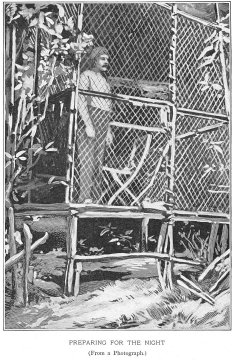 Moses soon learned
to adjust the curtain and go to bed without my aid. He would lie in bed
in the morning until he heard me or the boy stirring about the cage, when
he would poke his little black head out and begin to jabber for his breakfast.
Then he would climb out and come to the cage to see what was going on.
He was not confined at all, but quite at liberty to go about in the forest,
climb the trees and bushes, and have a good time of it. He was jealous
of the boy, and the boy was jealous of him, especially when it came to
a question of eating. Neither of them seemed to want the other to eat anything
that they mutually liked, and I had to act as umpire in many of their disputes
on that grave subject, which seemed to be the central thought of both of
them. I frequently allowed Moses to dine with me, and I never knew him
to refuse, or to be late in coming, on such occasions; but his table etiquette
was not of the best order. I gave him a tin plate and a wooden spoon. He
did not like to use the latter, but seemed to think that it was pure affectation
for any one to eat with such an awkward thing. He always held it in one
hand while he ate with the other or drank his soup out of the plate. It
was such a task to get washing done in that part of the world, that I resorted
to all means of economy in that matter, and for a tablecloth I used a leaf
of newspaper, when I had one. To tear that paper afforded Moses an amount
of pleasure that nothing else would, and in this act his conduct was more
like that of a naughty child than in anything else he did. When he would
first take his place at the table, he would behave in a nice and becoming
manner; but having eaten till he was quite satisfied, he usually became
rude and saucy. He would slyly put his foot up over the edge of the table,
and catch hold of the corner of the paper, meanwhile watching me closely,
to see if I was going to scold him. If I remained quiet, he would tear
the paper just a little and wait to see the result. If no notice was taken
of that, he would tear it a little more, but keep watching my face to see
when I observed him. If I raised my finger to him, he quickly let go, drew
his foot down, and began to eat. If nothing more was done to stop him,
the instant my finger and eyes were dropped, that dexterous foot was back
on the table and the mischief was resumed with more audacity than before.
When he carried his fun too far, I made him get down from the table and
sit on the floor. This humiliation he did not like, at best; but when the
boy grinned at him for it, he would resent it with as much temper as if
he had been poked with a stick. He certainly was sensitive on this point,
and evinced an undoubted dislike to being laughed at.
Moses soon learned
to adjust the curtain and go to bed without my aid. He would lie in bed
in the morning until he heard me or the boy stirring about the cage, when
he would poke his little black head out and begin to jabber for his breakfast.
Then he would climb out and come to the cage to see what was going on.
He was not confined at all, but quite at liberty to go about in the forest,
climb the trees and bushes, and have a good time of it. He was jealous
of the boy, and the boy was jealous of him, especially when it came to
a question of eating. Neither of them seemed to want the other to eat anything
that they mutually liked, and I had to act as umpire in many of their disputes
on that grave subject, which seemed to be the central thought of both of
them. I frequently allowed Moses to dine with me, and I never knew him
to refuse, or to be late in coming, on such occasions; but his table etiquette
was not of the best order. I gave him a tin plate and a wooden spoon. He
did not like to use the latter, but seemed to think that it was pure affectation
for any one to eat with such an awkward thing. He always held it in one
hand while he ate with the other or drank his soup out of the plate. It
was such a task to get washing done in that part of the world, that I resorted
to all means of economy in that matter, and for a tablecloth I used a leaf
of newspaper, when I had one. To tear that paper afforded Moses an amount
of pleasure that nothing else would, and in this act his conduct was more
like that of a naughty child than in anything else he did. When he would
first take his place at the table, he would behave in a nice and becoming
manner; but having eaten till he was quite satisfied, he usually became
rude and saucy. He would slyly put his foot up over the edge of the table,
and catch hold of the corner of the paper, meanwhile watching me closely,
to see if I was going to scold him. If I remained quiet, he would tear
the paper just a little and wait to see the result. If no notice was taken
of that, he would tear it a little more, but keep watching my face to see
when I observed him. If I raised my finger to him, he quickly let go, drew
his foot down, and began to eat. If nothing more was done to stop him,
the instant my finger and eyes were dropped, that dexterous foot was back
on the table and the mischief was resumed with more audacity than before.
When he carried his fun too far, I made him get down from the table and
sit on the floor. This humiliation he did not like, at best; but when the
boy grinned at him for it, he would resent it with as much temper as if
he had been poked with a stick. He certainly was sensitive on this point,
and evinced an undoubted dislike to being laughed at.
Another habit that Moses had was putting his fingers in the dish to help himself. He had to be watched all the time to prevent this, and seemed unable to grasp any reason why he should not be allowed to do so. He always appeared to think my spoon, knife, and fork were better than his own. On one occasion he persisted in begging for my fork until I gave it to him. He dipped it into his soup, held it up, and looked at it as if disappointed. He again stuck it into his soup. Then he examined it, as if to see how I lifted my food with it. He did not seem to notice that I used it in lifting meat instead of soup. After repeating this three or four times he licked the fork, smelt it, and then deliberately threw it on the floor, - as if to say, "That's a failure." He then leaned over and drank his soup from the plate.
The only thing that he cared much to play with was a tin can in which I kept some nails. For this he had a kind of mania. He never tired of trying to remove the lid. When given the hammer and a nail, he knew what they were for, and would set to work to drive the nail into the floor of the cage or into the table; but he hurt his fingers a few times, and after that he stood the nail on its flat head, removed his fingers, and struck it with the hammer; but of course he never succeeded in driving it into anything.
A bunch of sugarcane was kept for Moses to eat when he wanted it. To aid him in tearing the hard shell away from it, I kept a club to bruise it. Sometimes he would go and select a stalk of cane, carry it to the block, take the club in both hands, and try to mash the cane; but as the jar of the stroke often hurt his hands, he learned to avoid this by letting go as the club descended. He never succeeded in crushing the cane, but would continue his efforts until some one came to his aid. At other times he would drag a stalk of the cane to the cage and poke it through the wires, then bring the club and poke it through to get me to mash the cane for him.
From time to time I received newspapers sent me from home. Moses could not understand what induced me to sit holding that thing before me, but he wished to try it and see. He would take a leaf of it, and hold it up before him with both hands, just as he saw me do; but instead of looking at the paper, he kept his eyes, most of the time, on me. When I turned my paper over, he did the same thing with his, but half the time it was upside down. He did not appear to care for the pictures, or notice them, except a few times he tried to pick them off the paper. One large cut of a dog's head, when held at a short dis tance from him, he appeared to regard with a little interest, as if he recognized it as that of an animal of some kind; but I cannot say just what his ideas concerning it really were.
Chimpanzees are not usually so playful or so funny as monkeys, but they have a certain degree of mirth in their nature, and at times display a marked sense of humor. Moses was fond of playing peek-a-boo. He did not try to conceal his body from view, but put his head behind a box or something to hide his eyes. Then he would cautiously peep at me. He would often put his head behind one of the large tin boxes in the cage, leaving his whole body visible. In this attitude he would utter a peculiar sound, then draw his head out and look to see if I were watching him. If not, he would repeat the act a few times and then resort to some other means of amusing himself. But if he could gain attention the romp began. He found great pleasure in this simple pastime. He would roll over, kick up his heels, and grin with evident delight. His favorite hour for this sport was in the early part of the afternoon. I spent much time in entertaining him in this way and in many others, feeling amply repaid by the gratification it afforded him. I could not resist his overtures to play, as he was my only companion; and, living in that solitary manner, we found mutual pleasure in such diversions.
Another occasion on which he used to peep at me was when he lay down to take his midday nap. For this I had made him a little hammock. It was suspended by wires hooked in the top of my cage, so as to be removable when not in use. I always hung this near me, so I could swing him to sleep like a child. He liked this very much, and I liked equally well to indulge him in it. When he was laid in this little hammock, he was usually covered up with a small piece of canvas, and in spreading it over him I sometimes laid the edge of it over his eyes. But this caused him to suspect me of having some motive in doing so. Then he would reach his finger up, catch the edge of the cloth and gently draw it down, so as to see what I was doing. If he found that he was detected, he quickly released the cloth, and cuddled down as though he had drawn it down by accident; but the little rogue knew just as well as I did that it was not fair to peep.
I also made him another hammock, which was hung a few yards from the cage. It was intended that he should get into this without bothering me. But he did not seem to care for it, until I brought a young gorilla to live with us in our jungle home. As Moses had never used this hammock, I assigned it to the new member of the household. Whenever the gorilla got into the hammock there was a small row about it. Moses would never allow him to occupy it in peace. He seemed to know that it was his own by right, and the gorilla was regarded as an intruder. He would push and shove the gorilla, grunt and whine and quarrel until he got him out of it. But after doing so he would leave the hammock and climb up into the bushes, or go scouting about, hunting something to eat. He only wanted to dispossess the intruder, for whom he nursed an inordinate jealousy. He never went about the gorilla's little house, which was near another side of my cage. Even after the gorilla died Moses kept aloof from its house.
As a rule, I took Moses with me in my rambles into the forest, and I found him to be quite useful in one way. His eyes were like the lens of a camera; nothing escaped them. When he discovered anything in the jungle, he always made it known by a peculiar sound. He could not point it out with his finger, but by watching his eyes the object could often be located. Frequently during these tours the ape rode on my shoulders. At other times the boy carried him; but occasionally he was put clown on the ground to walk. If we traveled at a very slow pace, and allowed him to stroll along at leisure, he was content to do so; but if hurried beyond a certain gait, he always made a display of temper. He would turn on the boy and attack him if possible; but if the boy escaped, the angry little ape would throw himself down on the ground, scream, kick, and beat the earth with his own head and hands, in the most violent and persistent manner. He sometimes did the same way when not allowed to have what he wanted. His conduct was exactly like that of a spoiled or ugly child.
He had a certain amount of ingenuity, and often evinced a degree of reason which was rather unexpected. It was not a rare thing for him to solve some problem that involved a study of cause and effect, but this was always in a limited degree. I would not be understood to mean that he could work out any abstract problem, such as belongs to the realm of mathematics, but only simple, concrete problems, the object of which was present.
On one occasion while walking through the forest, we came to a small stream of water. The boy and myself stepped across it, leaving Moses to get over without help. He disliked getting his feet wet, and paused to be lifted across. We walked a few steps away and waited. He looked up and down the branch [sic] to see if there was any way to avoid it. He walked back and forth a few yards, but found no way to cross. He sat down on the bank and declined to wade. After a few moments he waddled along the bank about ten or twelve feet to a clump of tall, slender bushes growing by the edge of the stream. Here he halted, whined, and looked up thoughtfully into them. At length he began to climb one of them that leaned over the water. As he climbed up, the stalk bent with his weight, and in an instant he was swung safely across the little brook. He let go the plant, and came hobbling along to me with a look of triumph on his face that plainly indicated he was fully conscious of having performed a very clever feat.
 One dark, rainy
night I felt something pulling at my blanket and mosquito bar. I could
not for a moment imagine what it was, but knew that it was something on
the outside of my cage. I lay for a few seconds, and then I felt another
strong pull. In an instant some cold, damp, rough thing touched my face.
1 found it was his hand poked through the meshes and groping about for
something. I spoke to him, and he replied with a series of plaintive sounds
which assured me that something must be wrong. I rose and lighted a candle.
His little brown face was pressed up against the wires, and wore a sad,
weary look. He could not tell me in words what troubled him, but every
sign, look, and gesture bespoke trouble. Taking the candle in one hand
and my revolver in the other, I stepped out of the cage and went to his
domicile. There I discovered that a colony of ants had invaded his quarters.
These ants are a great pest when they attack anything, and when they make
a raid on a house the only thing to be done is to leave it until they have
devoured everything about it that they can eat. When they leave a house
there is not a roach, rat, bug, or insect left in it. As the house of Moses
was so small, it was not difficult to dispossess the ants by saturating
it with kerosene. This was quickly done, and the little occupant was allowed
to return and go to bed. He watched the procedure with evident interest,
and seemed perfectly aware that I could rid him of his savage assailants.
In a wild state he would doubtless have abandoned his claim and fled to
some other place, without an attempt to drive the ants away; but in this
instance he had acquired the idea of the rights of possession.
One dark, rainy
night I felt something pulling at my blanket and mosquito bar. I could
not for a moment imagine what it was, but knew that it was something on
the outside of my cage. I lay for a few seconds, and then I felt another
strong pull. In an instant some cold, damp, rough thing touched my face.
1 found it was his hand poked through the meshes and groping about for
something. I spoke to him, and he replied with a series of plaintive sounds
which assured me that something must be wrong. I rose and lighted a candle.
His little brown face was pressed up against the wires, and wore a sad,
weary look. He could not tell me in words what troubled him, but every
sign, look, and gesture bespoke trouble. Taking the candle in one hand
and my revolver in the other, I stepped out of the cage and went to his
domicile. There I discovered that a colony of ants had invaded his quarters.
These ants are a great pest when they attack anything, and when they make
a raid on a house the only thing to be done is to leave it until they have
devoured everything about it that they can eat. When they leave a house
there is not a roach, rat, bug, or insect left in it. As the house of Moses
was so small, it was not difficult to dispossess the ants by saturating
it with kerosene. This was quickly done, and the little occupant was allowed
to return and go to bed. He watched the procedure with evident interest,
and seemed perfectly aware that I could rid him of his savage assailants.
In a wild state he would doubtless have abandoned his claim and fled to
some other place, without an attempt to drive the ants away; but in this
instance he had acquired the idea of the rights of possession.
Moses was especially fond of corned beef and sardines, and would recognize a can of either as far away as he could see it. He also knew the instrument used in opening the cans. But he did not appear to appreciate the fact that when the contents had once been taken out it was useless to open the can again; so he often brought the empty cans that had been thrown into the bush, got the can-opener down, and wanted me to use it for him! I never saw him try to open a can himself otherwise than with his fingers. Sometimes, when about to prepare my own meals, I would open the case in which I kept stored a supply of canned meats and allow Moses to select a can for the purpose. He never failed to pull out one of the cans of beef bearing the blue label. If I put it back, he would again select the same kind, and he could not be deceived in his choice. It was not accidental, because he would hunt until he found the right sort. I don't know what he thought when his choice was not served for dinner. I often exchanged it for another kind without consulting him.
I kept my supply of water in a large jug, which was placed in the shade of the bushes near the cage. I also kept a small pan for Moses to drink out of. He would sometimes ask for water by using his own word for it. He would place his pan by the side of the jug and repeat the sound a few times. If he was not attended to, he proceeded to help himself. He could take the cork out of the jug quite as well as I could. He would then put his eye to the mouth of the vessel and look down into it to see if there was any water. Of course the shadow of his head would darken the interior of the jug so that he could not see anything. Then, removing his eye from the mouth of it, he would poke his hand into it. But I reproved him for this until I broke him of the habit. After a careful examination of the jug he would try to pour the water out. He knew how it ought to be clone, but was not able to handle the vessel. He always placed the pan on the lower side of the jug; then he leaned the jug towards the pan and let go. He would rarely ever get the water into the pan, but always turned the jug with the neck down grade. As a hydraulic engineer he was not a great success, but he certainly knew the first prin ciples of the science.
I tried to teach Moses to be cleanly, but it was a hard task. He would listen to my precepts as if they had made a deep impression, but he would not wash his hands of his own accord. He would permit me or the boy to wash them, but when it came to taking a bath or even wetting his face, he was a rank heretic on the subject, and no amount of logic would convince him that he needed it. When he was given a bath he would scream and fight during the whole process. When it was finished he would climb upon the roof of the cage and spread himself out in the sun. These were the only occasions on which I ever knew him to get upon the roof. I don't know why he disliked the bath so much. He did not mind getting wet in the rain, but rather seemed to like that.
He had a great dislike for ants and certain large bugs. Whenever one such came near him he would talk like a magpie, and brush at the insect with his hands until he got rid of it. He always used a certain sound for this kind of annoyance; it differed slightly from those I have described as warning.
Moses tried to be honest, but he was affected with a species of kleptomania and could not resist the temptation to purloin anything that came in his way. The small stove upon which I prepared my food was placed on a shelf in one corner of the cage, about halfway between the floor and the top. Whenever anything was set on the stove to cook, he had to be watched to keep him from climbing up the side of the cage, reaching his arm through the meshes, and stealing the food. He was sometimes very persevering in this matter. One day I set a tin can of water on the stove to heat, in order to make some coffee. He silently climbed up, reached his hand through, stuck it in the can, and began to search for anything it might contain. I threw out the water, refilled the can, and drove him away. In a few minutes he returned and repeated the act. I had a piece of canvas hung up on the outside of the cage to keep him away. The can of water was placed on the stove for the third time, but within a minute he found his way by climbing up under the curtain, and between that and the cage. I determined to teach him a lesson. He was allowed to explore the can, but finding nothing, he withdrew his hand and sat there clinging to the side of the cage. Again he tried, but found nothing. The water was getting warmer, but was still not hot. At length, for the third or fourth time, he stuck his hand in it up to the wrist. By this time the water was so hot that it scalded his hand. It was not severe enough to do him any harm, but quite enough so for a good lesson. He jerked his hand out with such violence that he threw the cup over and spilt the water all over that side of the cage. From that time to the end of his life he always refused anything that had steam or smoke about it. If anything having steam or smoke was offered him at the table, he would climb down at once and retire from the scene. Poor little Moses ! I knew beforehand what would happen. I did not wish to see him hurt, but nothing else would serve to impress him with the danger and keep him out of mischief.
Anything that he saw me eat he never failed to beg. No matter what he had himself, he wanted to try everything else that he saw me eat. One thing in which these apes appear to be wiser than man is, that when they eat or drink enough to satisfy their wants they quit. Men sometimes do not. Apes never drink water or anything else during their meal, but having finished eating, they want, as a rule, something to drink. The native custom is the same. I have never known the native African to use any kind of diet drink, but always when he has finished eating he takes a draught of water.
Moses knew the use of nearly all the tools that I carried with me in the jungle. He could not use them for the purpose for which they were intended, and I do not know to what extent he appreciated their use; but he knew quite well the manner of using them. I have mentioned the incident of his using the hammer and nails; but he also knew the way to use the saw; however, he always applied the back of it, because the teeth were too rough; but he gave it the motion. When allowed to have it, he would put the back of it across a stick and saw with the energy of a man on a big salary. When given a file, he would file everything that came in his way. If he had applied himself in learning to talk human words as closely and with as much zeal as he tried to use my pliers, he would have succeeded in a very short time.
Whether these creatures are actuated by reason or by instinct in such acts as I have mentioned, the caviller may settle for himself; but the actions accomplish the purpose of the actors in a logical and practical manner, and they are perfectly conscious of the fact.
From the second day after we became associated he appeared to regard me as the one in authority. He would not resent anything I did to him. I could take his food out of his hands, but he would permit no one else to do so. He would follow me and cry after me like a child. As time went by, his attachment grew stronger and stronger. He gave every evidence of pleasure at my attentions, and evinced a certain degree of appreciation and gratitude in return. He would divide any morsel of food with me. This is, perhaps, the highest test of the affection of any animal. I cannot affirm that such an act was genuine benevolence, or an earnest of affection in a true sense of the term; but nothing except deep affection or abject fear impels such actions in animals; and certainly fear was not his motive.
There were others whom he liked and made himself familiar with; there were some that he feared, and others that he hated; but his manner towards me was that of deep affection. It was not alone in return for the food he received, for my boy gave him food more frequently than I did, and many others from time to time fed him. His attachment was like an infatuation that had no apparent motive; it was unselfish and supreme.
The chief purpose of my living among the animals being to study the sounds they utter, I gave strict attention to those made by Moses. For a time it was difficult to detect more than two or three distinct sounds, but as I grew more and more familiar with them I could detect a variety of them, and by constantly watching his actions and associating them with his sounds I learned to interpret certain ones to mean certain things.
In the course of my sojourn with him I learned one sound that he always uttered when he saw anything that he was familiar with, -- such as a man or a dog, -- but he could not tell me which of the two it was. If he saw anything strange to him, he could tell me; but not so that I knew whether it was a snake, or a leopard, or a monkey; yet I knew that it was some strange creature. I learned a certain word for food, hunger, eating, etc., but he could not go into any details about it, except that a certain sound indicated "good" or "satisfaction," and another meant the opposite.
Among the sounds that I learned was one that is used by a chimpanzee in calling another to come to it. Some of the natives assured me that the mothers always use it in calling their young to them. When Moses wandered away from the cage into the jungle, he would sometimes call me with this sound. I cannot express it in letters of the alphabet, nor describe it so as to give a very clear idea of its character. It is a single sound, or word of one syllable, and can be easily imitated by the human voice. At any time that I wanted Moses to come to me I used this word, and the fact that he always obeyed it by coming confirmed my opinion as to its meaning. I do not think that when he addressed it to me he expected me to come to him, but he perhaps wanted to locate me in order to be guided back to the cage by means of the sound. As he grew more familiar with the surrounding forest he used it less frequently, but he always employed it in calling me or the boy. When he was called by it he answered with the same sound; but one fact that we noticed was, that if he could see the one who called he never made any reply. He would obey the call, but not answer. He probably thought that if he could see the one who called he could be seen by him, and it was therefore useless to reply.
The speech of these animals is very limited, but it is sufficient for their purpose. It is none the less real because of its being restricted, but it is more difficult for man to learn, because his modes of thought are so much more ample and distinct. Yet when one is reduced to the necessity of making his wants known in a strange tongue he can express many things in a very few words. I was once thrown among a tribe of whose language I knew less than fifty words, but with little difficulty I succeeded in conversing with them on two or three topics. Much depends upon necessity, and more upon practice. In talking to Moses I used his own language mostly, and was surprised at times to see how readily we understood each other. I could repeat about all the sounds he made except one or two, but I was not able in the time we were together to interpret all of them. These sounds were more than a mere series of grunts or whines, and he never confused them in their meaning. When any one of them was properly delivered to him, he clearly understood and acted upon it.
It had never been any part of my purpose to teach a monkey to talk; but after I became familiar with the qualities and range of the voice of Moses, I determined to see if he might not be taught to speak a few simple words of human speech. To effect this in the easiest way and shortest time, I carefully observed the movements of his lips and vocal organs in order to select such words for him to try as were best adapted to his ability.
I selected the word mamma, which may be considered almost a universal word of human speech; the French word feu, fire; the German word wie, how; and the native Nkami word nkgwe, mother. Every day I took him on my lap and tried to induce him to say one or more of these words. For a long time he made no effort to learn them; but after some weeks of persistent labor and a bribe of corned beef, he began to see dimly what I wanted him to do. The native word quoted is very similar to one of the sounds of his own speech, which means "good'' or "satisfaction." The vowel element differs in them, and he was not able in the time he was under tuition to change them; but he distinguished them from other words.
In his attempt to say mamma he worked his lips without making any sound, although he really tried to do so. I believe that in the course of time he would have succeeded. He observed the movement of my lips and tried to imitate it, but he seemed to think that the lips alone produced the sound. With feu he succeeded fairly well, except that the consonant element, as he uttered it, resembled "v" more than "f," so that the sound was more like vu, making the ''u" short as in "nut." It was quite as nearly perfect as most people of other tongues ever learn to speak the same word in French, and, if it had been uttered in a sentence, any one knowing that language would recognize it as meaning fire. In his efforts to pronounce wie he always gave the vowel element like German "u" with the umlaut, but the "w" element was more like the English than the German sound of that letter.
Taking into consideration the fact that he was only a little more than a year old, and was in training less than three months, his progress was all that could have been desired, and vastly more than had been hoped for. It is my belief that, had he lived until this time, he would have mastered these and other words of human speech to the satisfaction of the most exacting linguist. If he had only learned one word in a whole lifetime, he would have shown at least that the race is capable of being improved and elevated in some degree.
Another experiment that I tried with him was one that I had used before in testing the ability of a monkey to distinguish forms. I cut a round hole in one end of a board and a square hole in the other, and made a block to fit into each one of them. The blocks were then given to him to see if he could fit them into the proper holes. After being shown a few times how to do this, he fitted the blocks in without difficulty-; but when he was not rewarded for the task by receiving a morsel of corned beef or a sardine, he did not attempt it. He did not care to work for the fun alone.
In colors he had but little choice, unless it was something to eat; but he could distinguish them with ease if the shades were pronounced. I had no means of testing his taste for music or sense of musical sounds.
I must here take occasion to mention one incident in the life of Moses, such as perhaps never before occurred in the life of any chimpanzee. While it may not be of scientific value, it is at least amusing.
While living in the jungle I received a letter enclosing a contract to be signed by myself and a witness. Having no means of finding a witness to sign the paper, I called Moses from the bushes, placed him at the table, gave him a pen, and had him sign the document as witness. He did not write his name himself, as he had not mastered the art of writing; but he made his cross mark between the names, as many a good man had done before him. I wrote in the blank the name,
(the cross mark being omitted), and had him with his own hand make the cross as it is legally done by persons who cannot write. With this signature the contract was returned in good faith to stand the test of the law courts of civilization; and thus for the first time in the history of the race a chimpanzee signed his name.
When I prepared to start on a journey across the Esyira country, it was not practicable for me to take Moses along, so I arranged to leave him in charge of a missionary. Shortly after my departure the man was taken with fever, and the chimpanzee was left to the care of a native boy belonging to the mission. The little prisoner was kept confined by a small rope attached to his cage. This was done in order to keep him out of mischief. It was during the dry season, when the dews are heavy and the nights chilly; and the winds at that season are fresh and frequent.
Within a week after I had left him he contracted a severe cold. This soon developed into acute pulmonary troubles of a complex type, and he began to decline. After an absence of three weeks and three days I returned and found him in a condition beyond the reach of treatment. He was emaciated to a living skeleton; his eyes were sunken deep into their orbits, and his steps were feeble and tottering; his voice was hoarse and piping; his appetite was gone, and he was utterly indifferent to everything around him.
During my journey I had secured a companion for him, and when I disembarked from the canoe I hastened to him with this new addition to our little family. I had not been told that he was ill, and, of course, was not prepared to see him looking so ghastly. When he discovered me approaching, he rose up and began to call me, as he had been wont to do before I left him; but his weak voice was like a death-knell to my ears. My heart sunk within me as I saw him trying to reach out his long, bony arms to welcome my return. Poor, faithful Moses! I could not repress the tears of pity and regret at this sudden change, for to me it seemed the work of a moment. I had last seen him in the vigor of a strong and robust youth, but now I beheld him in the decrepitude of a feeble senility. What a transformation
I diagnosed his case as well as I was able and began to treat him, but it was evident that he was so far gone that I could not expect him to recover. My conscience smote me for having left him, yet I felt that I had not done wrong. It was not neglect or cruelty for me to leave him while I went in pursuit of the chief object of my search, and I had no cause to reproach myself for having done so. But emotions that are stirred by such incidents are not to be controlled by reason or hushed by argument, and the pain caused me was more than I can tell.
If I had done wrong, the only restitution possible for me to make was to nurse him patiently and tenderly to the end, or till health and strength should return. This was conscientiously done, and I have the comfort of knowing that the last sad days of his life were soothed by every care that kindness could suggest. Hour after hour during that time he lay silent and content upon my lap. That appeared to be a panacea to all his pains. He would roll up his dark brown eyes and look into my face, as if to be assured that I had been restored to him. With his long fingers he stroked my face as if to say that he was again happy. He took the medicines I gave him as if he knew their purpose and effect. His suffering was not intense, and he bore it like a philosopher. He seemed to have some vague idea of his own condition, but I do not know that he foresaw the result. He lingered on from day to day for a whole week, slowly sinking and growing feebler; but his love for me was manifest to the last, and I dare confess that I returned it with all my heart.
Is it wrong that I should requite such devotion and fidelity with reciprocal emotion? No. I should not deserve the love of any creature if I were indifferent to the love of Moses. That affectionate little creature had lived with me in the dismal shadows of that primeval forest for many long clays and dreary nights; had romped and played with me when far away from the pleasures of home; and had been a constant friend, alike through sunshine and storm. To say that I did not love him would be to confess myself an ingrate and unworthy of my race.
The last spark of life passed away in the night. Death was not attended by acute pain or struggling; but, falling into a deep and quiet sleep, he woke no more.
Moses will live in history. He deserves to do so, because he was the first of his race that ever spoke a word of human speech; because he was the first that ever conversed in his own language with a human being; and because he was the first that ever signed his name to any document. Fame will not deny him a niche in her temple among the heroes who have led the races of the world.
About the time I reached the trading post, two Esyira hunters arrived from a distant village and brought with them a smart young chimpanzee of the kind known in that country as the kulu-kamba. He was quite the finest specimen of his race that I have ever seen. His frank, open countenance, big brown eyes, and shapely physique, free from mark or blemish of any kind, would attract the notice of any one not absolutely stupid. It is not derogatory to the memory of Moses that I should say this, nor does it lessen my affection for him. Our passions are not moved by visible forces nor measured by fixed units. They disdain all laws of logic, spurn the narrow bounds of reason, and conform to no theory of action.
As soon as I saw this little ape I expressed a desire to own him. So the trader in charge bought him and presented him to me. As it had been intended that he should be the friend and ally of Moses, although not his brother, I conferred upon him the name of Aaron. The two names are so intimately associated in history that the mention of one always suggests the other.
Aaron was captured in the Esyira jungle by the hunters, about one day's journey from the place where I secured him; and with this event began a series of sad scenes in the brief but varied life of this little hero such as seldom come within the experience of any creature.
At the time of his capture his mother was killed in the act of defending him from the cruel hunters. When she fell to the earth, mortally wounded, this brave little fellow stood by her trembling body defending it against her slayers, until he was overcome by superior force, seized by his captors, bound with strips of bark, and carried away into captivity. No human can refrain from admiring his conduct in this act, whether it was prompted by the instinct of self-preservation or by a sentiment of loyalty to his mother, for he was exercising that prime law of nature which actuates all creatures to defend themselves against attack, and his wild, young heart throbbed with sensations like to those of a human under similar ordeal.
I do not wish to appear sentimental by offering a rebuke to those who indulge in the sport of hunting; but much cruelty could be obviated without losing any of the pleasure of the hunt. I have always made it a rule to spare the mother with her young. Whether or not animals feel the same degree of mental and physical pain as man, they do, in these tragic moments, evince for one another a certain amount of concern. This imparts a tinge of sympathy that must appeal to any one who is not devoid of every sense of mercy. It is true that it is often difficult and sometimes impossible to secure the young by other means; but the manner of getting them often mars the pleasure of having them; and while Aaron was to me a charming pet and a valuable subject for study, I confess the story of his capture always touched me in a tender spot.
I may here mention that the few chimpanzees that reach the civilized parts of the world are but a small percentage of the great number that are captured. Some die on their way to the coast, others die after reaching it, and scores of them die on board the ships to which they have been consigned for various ports of Europe and other countries. Death results not often from neglect or cruelty, but usually from a change of food, climate, or condition; yet the creature suffers just the same whether the cause is from design or accident. One fruitful source of death among them is pulmonary trouble of various types.
One look at the portrait of Aaron will impress any one with the high mental qualities of this little captive; but to see and study them in life would convince a heretic of his superior character. In every look and gesture there was a touch of the human that no one could fail to observe. The range of facial expression surpassed that of any other animal I have ever studied. In repose his quaint face wore a look of wisdom becoming to a sage; while in play it was crowned with a grin of genuine mirth. The deep, searching look he gave to a stranger was a study for the psychologist. The serious, earnest look of inquiry when he was perplexed would have amused a stoic. All these changing moods were depicted in his mobile face with such intensity as to leave no room to doubt the activity of certain faculties of the mind to a degree far beyond that of animals in general; and his conduct in many instances showed the exercise of mental powers of a higher order than that limited agency known as instinct. In addition to these facts, his voice was of better quality and more flexible than that of any other specimen I have ever known. It was clear and smooth in uttering sounds of any pitch within its scope, while the voices of most of them are inclined to be harsh or husky, especially in sounds of high pitch.
Before leaving the village where I secured him, I made a kind of sling for him to be carried in. It consisted of a short canvas sack, having two holes cut in the bottom for his legs to pass through. To the top of this was attached a broad band of the same cloth by which to hang it over the head of the carrier boy to whom the little prisoner was consigned. This afforded the ape a comfortable seat, and at the same time reduced the labor of carrying him. It left his arms and legs free, so he could change his position and rest, while it also allowed the boy the use of his own hands in passing any difficult place in the jungle along the way.
From the trading post to the Rembo was a journey of five days on foot. Along the way were a few straggling villages; but most of the route lay through a wild and desolate forest, traversed by low, broad marshes, through which wind shallow sloughs of filthy, greenish water, seeking its way among bending roots and fallen leaves. From the foul bosom of these marshes rise the effluvia of decaying plants, breeding pestilence and death. Here and there across the dreary tracts is found the trail of elephants, where the great beasts have broken their tortuous way through the dense barriers of bush and vine. These trails serve as roads for the native traveler and afford the only way of crossing these otherwise trackless jungles. The only means of passing the dismal swamps is to wade through the thin, slimy mud, often more than knee-deep, and sometimes extending many hundred feet in width. The traveler is intercepted at almost every step by the tangled roots of mangrove trees under foot or clusters of vines hanging from the boughs overhead.
Such was the route we came. But Aaron did not realize how severe was the task of his carrier in trudging his way through such places, and the little rogue often added to the labor by seizing hold of limbs or vines that hung within his reach in passing. Thus he retarded the progress of the boy, who strongly protested against the ape's amusing himself in this manner. The latter seemed to know of no reason why he should not do so, and the former did not deign to give one. So the quarrel went on until we reached the river; but by that time each of them had imbibed a hatred for the other that nothing in the future ever allayed.
Neither of them ever forgot it while they were associated, and both of them evinced their aversion on all occasions. The boy gave vent to his dislike by making ugly faces at the ape, and the latter showed his resentment by screaming and trying to bite him. Aaron refused to eat any food given him by the boy, and the boy would not give him a morsel except when required to do so. At times the feud became ridiculous. It ended only with their final separation. The last time I ever saw the boy, I asked him if he wanted to go with me to my country to take care of Aaron; but he shook his head and said: "He's a bad man." This was the only person for whom I ever knew Aaron to conceive a deep and bitter dislike, but the boy he hated with his whole heart.
On my return to Ferran Vaz, where I had left Moses, I found him in a feeble state of health, as related elsewhere. When Aaron was set clown before him, he merely gave the little stranger a casual glance, but held out his long, lean arms for me to take him in mine. His wish was gratified, and I indulged him in a long stroll. When we returned I set him down by the side of his new friend, who evinced every sign of pleasure and interest. He was like a small boy when there is a new baby in the house. He cuddled up close to Moses and made many overtures to become friends; but, while the latter did not repel them, he treated them with indifference. Aaron tried in many ways to attract the attention of Moses, or to elicit from him some sign of approval, but it was in vain.
No doubt Moses' manners were due to his sickness, and Aaron seemed to realize it. He sat for a long time holding a banana in his hand and looking with evident concern into the face of his little sick cousin. At length he lifted the fruit to the lips of the invalid and uttered a low sound; but the kindness was not accepted. The act was purely one of his own volition, to which he was not prompted by any suggestion from others. Every look and motion indicated a desire to relieve or comfort his friend. His manner was gentle and humane, and his face was an image of pity.
Failing to get any sign of attention from Moses, Aaron moved up closer to his side and put his arms around him in the manner that is shown in the picture of him with Elisheba. During the days that followed, he sat hour after hour in the same attitude, and refused to allow any one except myself to touch his patient; but on my approach he always resigned him to me, while he watched with interest to see what I did for him.
Among other things, I gave Moses twice a day a tabloid of quinine and iron. This was dissolved in a little water and given to him in a small tin cup kept for the purpose. When not in use, the cup was hung upon a tall post. Aaron soon learned to know the use of it, and whenever I went to Moses, Aaron would climb up the post and bring me the cup to administer the medicine. It is not to be inferred that he knew anything about the nature or effect of the medicine, but he knew the use, and the only use, to which that cup was put.
Aaron displayed a marked interest during the act of administering the dose, and seemed to realize that it was intended for the good of the patient. He would sit close up to one side of the sick one and watch every movement of his face, as if to see what effect was being produced, while the changing expressions of his own visage plainly showed that he was not indifferent to the actions of the patient.
While I was present with the sick one, Aaron appeared to feel a certain sense of relief from the care of him, and frequently went climbing about as if to rest and recreate himself by a change of routine. Whenever I took Moses for a walk, or sat with him on my lap, his little nurse was perfectly content; but the instant they were left alone, Aaron would again fold him in his arms, as if he felt it a duty to do so.
It was only natural that Moses, in such a state of health, should be cross and peevish at times, as human beings in a like condition are; but I never once saw Aaron resent anything Moses did, or display the least ill-temper towards him. On the contrary, his conduct was so patient and forbearing that it was hard to forego the belief that it was prompted by the same motives of kindness and sympathy that move the human heart to deeds of tenderness and mercy. At night, when they were put to rest, they lay cuddled up in each other's arms, and in the morning they were always found in the same close embrace.
But on the morning Moses died the conduct of Aaron was unlike anything I had observed before. When I approached their snug little house and drew aside the curtain, I found him sitting in one corner of the cage. His face wore a look of concern, as if he were aware that something awful had occurred. When I opened the door he neither moved nor uttered any sound. I do not know whether or not apes have any name for death, but they surely know what it is.
Moses was dead. His cold body lay in its usual place; but it was entirely covered over with the piece of canvas kept in the cage for bed-clothing. I do not know whether or not Aaron had covered him up, but he seemed to realize the situation. I took him by the hand and lifted him out of the cage, but he was reluctant. I had the body removed and placed on a bench about thirty feet away, in order to dissect it and prepare the skin and the skeleton for preservation.
When I proceeded to do this, I had Aaron confined to the cage, lest he should annoy and hinder me at the work; but he cried and fretted until he was released. It is not meant that he shed tears over the loss of his companion, for the lachrymal glands and ducts are not developed in these apes; but they manifest concern and regret, which are motives of the passion of sorrow. But being left alone was the cause of Aaron's sorrow. When released he came and took his seat near the dead body, where he sat the whole clay long and watched the operation.
After this Aaron was never quiet for a moment if he could see or hear me, until I secured another of his kind as a companion for him; then his interest in me abated in a measure, but his affection for me remained intact. His conduct towards Moses always impressed me with the belief that he appreciated the fact that the sick one was in distress or pain, and while he may not have foreseen the result, when he saw death he certainly knew what it was. Whether it is instinct or reason that causes man to shrink from death, the same influence works to the same end in the ape; and the demeanor of this ape towards his later companion, Elisheba, only confirmed this opinion.
Our progress was slow and the journey tedious. The only passage out of the lake at that season is through a long, narrow, winding creek beset by sand bars, rocks, logs, and snags, and in some places overhung by low, bending trees. But the wild, weird scenery is grand and beautiful. Long lines of bamboo, broken here and there by groups of pendanus or stately palms; islands of lilies, and long sweeps of papyrus spreading away from the banks on either side; the gorgeous foliage of aquatic plants, drooping along the margin like a massive fringe and relieved by clumps of tall, waving grass, forms a perfect Eden for the birds and the monkeys that dwell among those scenes of eternal summer.
After a delay of eight days at Cape Lopez, we secured passage on a small French gunboat called the Komo, by which we came to Gaboon. There I found another kulu-kamba. She was in the hands of a generous friend, Mr. Adolph Strohm, who presented her to me. I gave her to Aaron as a wife and called her Elisheba, -- after the name of the wife of the great high-priest. Elisheba had been captured on the head-waters of the Nguni River, in about the same latitude that Aaron was found in, but more than a hundred miles to the east of that point and a few minutes north of it. I did not learn the history of her capture.
It would be difficult to find any two human beings more unlike in taste and temperament than these two apes were. Aaron was one of the most amiable of creatures; he was affectionate and faithful to those who treated him kindly; he was merry and playful by nature, and often evinced a marked sense of humor; he was fond of human society and strongly averse to solitude or confinement.
Elisheba was a perfect shrew. She often reminded me of certain women that I have seen who had soured on the world. She was treacherous, ungrateful, and cruel in every thought and act; she was utterly devoid of affection; she was selfish, sullen, and morose at all times; she was often vicious and always obstinate; she was indifferent to caresses, and quite as well content when alone as in the best of company. It is true that she was in poor health, and had been badly treated before she fell into my hands; but she was by nature endowed with a bad temper and depraved instincts.
It is not at all rare to see a vast difference of manners, intelligence, and temperament among specimens that belong to one species. In these respects they vary as much in proportion to their mental scope as human beings do; but I have never seen, in any two apes of the same species, the two extremes so widely removed from one another.
While waiting at Gaboon for a steamer I had my own cage erected for the apes to live in, as it was large and gave them ample room for play and exercise. In one corner of it was suspended a small, cosy house for them to sleep in. It was furnished with a good supply of clean straw and some pieces of canvas for bedclothes. In the center of the cage was a swing, or trapeze, for them to use at their pleasure. Aaron found this a means of amusement, and often indulged in a series of gymnastics that might evoke the envy of a king of athletic sports.
Elisheba had no taste for such pastime, but her depravity could never resist the impulse to interrupt Aaron in his jolly exercise. She would climb up and contend for possession of the swing, until she would drive him away. Then she would perch herself on it and sit there for a time in stolid content; but she would neither swing nor play. Frequently during the day, when Aaron was lying quietly on the straw, she would go into the snug little house and raise a row with him by pulling the straw from under him, a handful at a time, and throwing it out of the box till there was none left in it. No matter what kind or quantity of food was given them, she always wanted the piece he had, and would fuss with him to get it; but having got it, she would sit holding it in her hand without eating it; for there were some things that he liked which she would not eat at all.
When we went out for a walk, no matter which way we started, Elisheba always contended to go some other way. If I yielded, she would again change her mind and start off in some other direction. If forced to submit, she would scream and struggle as if for life. I cannot forego the belief that these freaks were due to a base and perverse nature, and I could find no higher motive in her stubborn conduct.
Aaron was very fond of her and rarely ever opposed her inflexible will. He clung to her and let her lead the way. I have often felt vexed at him because he complied so readily with her wishes. The only case in which he took sides against her was in her conduct towards me.
When I first secured her she had the temper of a demon, and with the smallest pretext she would assault me and try to bite me or tear my clothes. In these attacks Aaron was always with me, and the loyal little champion would fly at her in the greatest fury. He would strike her over the head and back with his hands, and bite her and flog her till she desisted. If she returned the blow he would grasp her hand and bite it, or strike her in the face. He would continue to fight till she submitted. Then he would celebrate his victory by jumping up and down in a most grotesque fashion, stamping his feet, slapping his hands on the ground, and grinning like a mask. He seemed as conscious of what he had done and as proud of it as any human could have been; but no matter what she did to others, he was always on her side of the question. If any one else annoyed her, he would always resent it with violence.
About the premises there were natives all the time passing to and fro, and these two little captives were objects of special interest to them. They would stand by the cage hour after hour and watch them. The ruling impulse of nearly all natives appears to be cruelty, and they cannot resist the temptation to tease and torture anything that is not able to retaliate. They were so persistent in poking sticks at my chimpanzees that I had to keep a boy on watch all the time to prevent it; but the boy could not be trusted, so I had to watch him.
In the rear of the room that I occupied was a window through which, from time to time, I watched the boy and the natives, and when anything went wrong I would call out to the boy. Aaron soon observed this and found that he could get my attention himself by calling out when any one annoyed him, and he also knew that the boy was put there as a protector. Whenever any of the natives came about the cage he would call for me in his peculiar manner, which I well understood and promptly responded to. The boy also knew what the call meant and would rush to the rescue. If I were away from the house and the boy were aware of the fact, he was apt to be tardy in coming to the relief of the ape, and sometimes he did not come at all. In the latter event the two would crawl into their house and pull down the curtain so that they could not be seen. Here they would remain until the natives had left or some one came to their aid.
Neither of the apes ever resented anything the natives did to them, unless they could see me about; but whenever I came in sight they would make battle with their tormentors, and, if liberated from the big cage, they would chase the last one of them out of the yard. Aaron knew perfectly well that they were not allowed to molest him or his companion; and when he knew that he had my support he was ready to carry on the war to a finish. But it was really funny to see how meek and patient he was when left to defend himself alone against the native with a stick, and then to note the change in him when he knew that he was backed up by a friend upon whom he could rely.
Mr. Strohm, the trader, previously mentioned, with whom I found hospitality at this place, kept a cow in the lot where the cage was. She was a small black animal, the first cow that Aaron had ever seen. He never ceased to contemplate her with wonder and with fear. If she came near the cage when no one was about, he hurried into his box and from there peeped out in silence until she went away. The cow was equally amazed at the cage and its strange occupants, though she was less afraid than they, and frequently came near to inspect them. She would stand a few yards away with her head lifted high, her eyes arched and her ears thrown forward, waiting for them to come out of that mysterious box. But they would not venture out of their asylum while she remained. At last, tired of waiting, she would switch her tail, shake her head, and turn away.
When taken out of the cage Aaron had special delight in driving the cow away; and if she was around he would grasp me by the hand and start towards her. He would stamp the ground with his foot, strike with all force with his long arm, slap the ground with his hand, and scream at her at the top of his voice. If she moved away, he would let go my hand and rush towards her as though he intended to tear her up; but if the cow turned suddenly towards him, the little fraud would run to me, grasp my leg, and scream with fright. The cow was afraid of a man, and as long as she was followed by one she would continue to go; but when she discovered the ape to be alone in the pursuit, she would turn and look as if trying to determine what manner of thing it was. Elisheba never seemed to take any special notice of the cow except when she approached too near the cage, and then it was due to the conduct of Aaron that she made any fuss about it.
On board the steamer in which we sailed for home there was a young elephant that had been sent by a trader, for sale. He was kept on deck in a strong stall built for his quarters. There were wide cracks between the boards, and the elephant had the habit of reaching his trunk through them in search of anything he might find. With his long, flexible proboscis extended, he would twist and coil it in all manner of writhing forms. This was the crowning terror of the lives of those two apes; it was the bogie-man of their existence, and nothing could induce either of them to go near it. If they saw me approach it, they would scream and yell until I came away. If Aaron could get hold of me without getting too near the elephant, he clung to me until he almost tore my clothes, to keep me away from it. It was the one thing that Elisheba was afraid of, and the only one against which she ever gave me warning.
They did not manifest the same concern for others, but sat watching them without offering any protest. Even the stowaway who fed them and attended to their cage was permitted to approach the elephant; but their solicitude for me was remarked by every man on board. I was never able to tell what their opinion of the thing was. They were much less afraid of the elephant when they could see all of him, than they were of the trunk when they saw that alone. They may have thought the latter to be a big snake; but this is only a conjecture.
At the beginning of the voyage I took six panels of my own cage and made a small cage for them. I taught them to drink water from a beer bottle with a long neck that could be put through a mesh of the wires. They preferred this mode of drinking and appeared to look upon it as an advanced idea. Elisheba always insisted on being served first; being a female, her wish was complied with. When she had finished, Aaron would climb up by the wires and take his turn. There is a certain sound, or word, which the chimpanzee always uses to express "good" or "satisfaction," and he made frequent use of it. He would drink a few swallows of the water and then utter the sound, whereupon Elisheba would climb up again and taste. She seemed to think it something better than she was drinking, but finding it the same as she had had, she would again give way for him. Every time he used the sound she would take another taste and turn away; but she never failed to try it if he uttered the sound.
The boy who cared for them on the voyage was disposed to play tricks on them. One of these ugly pranks was to turn the bottle up so that when they had finished drinking and took their lips away, the water would spill out and run down over them. Several times they declined to drink from the bottle while he was holding it, but when he let it go, it hung in such a position that they could not get the water out of it at all. At length Aaron solved the problem by climbing up one side of the cage and getting on a level with the bottle; then he reached across the angle formed by the two sides of the cage and drank. In this position it was no matter to him how much the water ran out; it couldn't touch him. Elisheba watched him until she quite grasped the idea; then she climbed up in the same manner and slaked her thirst. I scolded the boy for serving them with such cruel tricks; but it taught me another lesson of value concerning the mental resources of the chimpanzee, for no philosopher could have found a much better scheme to obviate the trouble than did this cunning little sage in the hour of necessity.
I have never regarded the training of animals as the true measure of their mental powers. The real test is to reduce the animal to his own resources, and see how he will conduct himself under conditions that present new problems. Animals may be taught to do many things in a mechanical way, and without any motive that relates to the action; but when they can work out the solution without the aid of man, it is only the faculty of reason that can guide them.
One thing that Aaron could never figure out was -- what became of the chimpanzee that he saw in a mirror. I have seen him hunt for that mysterious ape an hour at a time. He once broke a piece off a mirror I had in trying to find the other fellow, but he never succeeded. I have held the glass firmly before him, while he put his face up close to it -- sometimes almost in contact. He would quietly gaze at the image and then reach his hand around the glass to feel for it. Not finding it, he would peep around the side of the glass and then look into it again. He would take hold of it and turn it around, lay it on the ground, look at the image again, and put his haul under the edge of the glass. The look of inquiry in that quaint face was so striking as to make one pity him. But he was hard to discourage. He resumed the search whenever he had the mirror.
Elisheba never worried herself much about it. When she saw the image in the glass she seemed to recognize it as one of her kind; but when it vanished she let it go without trying to find it. In fact, she often turned away from it as though she did not admire it. She rarely ever took hold of the glass, and she never felt behind it for the other ape.
Altogether Elisheba was an odd specimen of her tribe -- eccentric and whimsical beyond anything I have ever known among animals; yet, with all her freaks, Aaron was fond of her and she afforded him company; but he was extremely jealous of her, and permitted no stranger to take any liberties with her with impunity. He did not object to their doing so with him. He rarely took offense at any degree of familiarity, for he would make friends with any one who was gentle with him; but he could not tolerate their attentions to her. She betrayed no sign of affection for him except when some one annoyed or vexed him; but in that event she never failed to take his part against all odds. At such times she became frantic with rage, and if the cause was prolonged, she often for hours afterwards refused to eat.
On the voyage homeward there was on board another chimpanzee, belonging to a sailor who was bringing him home for sale. This one was about two years older than Aaron and fully twice as large. He was tame and gentle, but was kept in a close cage by himself. He saw the others roaming about the deck and tried to make up with them; but they evinced no desire to become intimate with one who was confined in such a manner.
One bright Sunday morning, as we rode the calm waters near the Canary Islands, I induced the sailor to release his prisoner on the main deck with my own, to see how they would act towards each other. He did so, and in a moment the big ape came ambling along the deck towards Aaron and Elisheba, who were sitting on the top of a hatch, absorbed in gnawing some turkey bones.
As the stranger came near he slackened his pace and gazed earnestly at the others. Aaron ceased eating and stared at the visitor with a look of surprise, but Elisheba barely noticed him. He scanned Aaron from head to foot, and Aaron did the same with him. He advanced until his nose almost touched that of Aaron, and in this position the two remained for some seconds. Then the big one proceeded to salute Elisheba in the same manner, but she gave him little attention. She continued to gnaw the bone in her hand, and he had no reason to feel flattered at the impression he appeared to have made on her. Aaron watched him with deep concern, but without uttering a sound.
Turning again to Aaron, the big ape reached out for his turkey bone; but the hospitality of the little host was not equal to the demand. He drew back with a shrug of his shoulder, holding the bone closer to himself, and then he resumed eating. Then a steward gave a bone to the visitor. He climbed upon the hatch and took a seat on the right of Elisheba, Aaron being seated at her left. As soon as the big one had taken his seat, Aaron resigned his place and crowded himself in between them. The three sat for a few moments in this order, till the big one got up and deliberately walked around to the other side of Elisheba and sat down again beside her. Again Aaron forced himself in between them.
This act was repeated six or eight times; then Elisheba left the hatch and took a seat on a spar that lay on deck. The big ape immediately moved over and sat down near her; but by the time he was seated Aaron again got in between them, and as he did so he struck his rival a smart blow on the back. They sat in this manner for a minute or so. Then Aaron drew back his hand and struck again. He continued his blows, all the while increasing them in force and frequency; but the other did not resent them. His manner was one of dignified contempt, as if he regarded the inferior strength of his assailant unworthy of his own prowess. It would be absurd to suppose that he was constrained by any principle of honor, but his demeanor was patronizing and forbearing, like that of a considerate man towards a small boy.
One amusing feature of the affair was the half-serious and half-jocular manner of Aaron. When striking, he did not turn his face to look at his rival, and the instant the blow was delivered he withdrew his hand as if to avoid being detected. He gave no sign of anger though he made no effort to conceal his jealousy; and the other seemed to be aware of the cause of his disquietude. The smirk of indifference on the little lover's face belied the state of mind that impelled his action, and it was patent to all who witnessed the tilt that Aaron was jealous of his guest. From time to time Elisheba would change her seat. Then a similar scene would ensue.
The whole affair was so comical and yet so real that one could not repress the laughter it evoked. It was the drama of "love's young dream" in real life, in which every man, at some period of his young career, has played each part the same as these two rivals played. Every detail of plot and line was the duplicate of a like incident in the experience of boyhood.
Elisheba did not seem to encourage the suit of this simian beau, but she did not rebuff him as a true and faithful spouse should do, and I never blamed Aaron for not liking it. She had no right to tolerate the attentions of a total stranger; but she was feminine, and, perhaps, endowed with all the vanity of her sex, and fond of adulation. However, my sympathies for the devoted little Aaron were too strong for me to permit him to be imposed upon by a rival twice as big and three times as strong as himself; so I took him and Elisheba away to the after deck, where they had a good time alone.
Elisheba was never very much devoted to me, but in the early part of her career she began to realize the fact that I was her master and her friend. She had no gratitude in her nature, but she had sense enough to see that all her food and comfort were due to me, and as a matter of policy she became submissive; but she was never tractable. She was doubtless a plebeian among her own race and was not capable of being brought up to a high standard of culture. She could not be controlled by kindness alone, for she was by nature sordid and perverse. I was never cruel or severe in dealing with her, but it was necessary to be strict and firm. Her poor health, however, often caused me to indulge her in whims that otherwise would have brought her under a more rigid discipline. The patient conduct of Aaron appeared to be tempered by the same consideration.
On arriving at the end of our long and arduous voyage, I secured quarters for the apes and quickly had them stowed away in a warm, sunny cage. Elisheba began to recover from the fatigue and worry of the journey, and for a while was more cheerful than she had been at any time since I had known her. Her appetite returned, the symptoms of fever passed away, and she seemed benefitted rather than injured by the voyage. Aaron was in the best of health and had shown no signs of any evil results from the trip.
On reaching the landing-stage in Liverpool, some friends who met us there expressed a desire to see the apes, and for that purpose I opened their cage in the waiting-room. When they beheld the throng of huge figures with white faces, long skirts, and big coats, they were almost frantic with fear. They had never before seen anything like it, and they crouched back in the corner of the cage, clinging to each other and screaming in terror. When they saw me standing by them, they rushed to me, seized me by the legs, and climbed up to my arms. Finding they were safe here, they stared for a moment, as if amazed at the crowd; then Elisheba buried her face under my chin and refused to look at any one. They were both trembling with fright, and I could scarcely get them into their cage again; but after they were installed in their quarters with Dr. Cross, who was to have charge of them, they became reconciled to the sight of strangers in such costumes. In their own country they had never seen anything like it, for the natives, to whom they were accustomed, wear, as a rule, no clothing except a small piece of cloth tied round the waist, and the few white men they had seen were mostly dressed in white; but here was a great crowd of creatures in skirts and overcoats, and I have no doubt that to them it was a startling sight when seen for the first time.
During the first two weeks after arriving at Liverpool, Elisheba improved in health and temper, until she was not like the same creature; but about the end of that time she contracted a severe cold. A deep, dry cough, attended by pains in the chest and sides, together with a piping hoarseness, betrayed the nature of her disease and gave just cause for apprehension. During frequent paroxysms of coughing she pressed her hands upon her breast or side, to arrest the shock and thus lessen the pain it caused. When quiet, she sat holding her hands on her throat, her head bowed down and her eyes drooping or closed. Day by day the serpent of disease drew his deadly coils closer and closer about her wasting form; but she bore it with a patience worthy of a human being.
The sympathy and forbearance of Aaron were again called into action, and the demand was not in vain. Hour after hour he sat holding her locked in his arms, as he is seen in the portrait given herewith. He was not posing for a picture, nor was he aware how deeply his manners touched the human heart. Even the brawny men who work about the place paused to watch him in his tender offices to her, and his staid keeper was moved to pity by his kindness and his patience. For days she lingered on the verge of death. She became too feeble to sit up; but as she lay on her bed of straw, he sat by her side, resting his folded arms upon her and refusing to allow any one to touch her. His look of deep concern showed that he felt the gravity of her case in a degree that bordered on grief. He was grave and silent, as if he foresaw the sad end that was near at hand. My frequent visits were a source of comfort to him, and he evinced a pleasure in my coming that bespoke his confidence in me and his faith in my ability to relieve his suffering companion; but, alas ! she was beyond the aid of human skill.
On the morning of her decease I found him sitting by her as usual. At my approach he quietly rose to his feet and advanced to the front of the cage. Opening the door, I put my arm in and caressed him. He looked into my face and then at the prostrate form of his mate. The last dim sparks of life were not yet gone out, as the slight motion of the breast betrayed; but the limbs were cold and limp. While I leaned over to examine more closely, he crouched down by her side and watched with deep con cern to see the result. I laid my hand upon her heart to ascertain if the last hope was gone; he looked at me, and then placed his own hand by the side of mine, and held it there as if he knew the purport of the act. Of course to him this had no real meaning, but it was an index to the desire which prompted it. He seemed to think that anything that I did would be good for her, and his purpose, doubtless, was to aid me. When I removed my hand, he removed his; when I returned mine, he did the same; and to the last he gave evidence of his faith in my friendship and good intentions. His ready approval of anything I did showed that he had a vague idea of my purpose.
At length the breast grew still, and the feeble beating of the heart ceased. The lips were parted, and the dim eyes were halfway closed; but he sat by as if she were asleep. The sturdy keeper came to remove the body from the cage; but Aaron clung to it and refused to allow him to touch it. I took the little mourner in my arms, but he watched the keeper jealously and did not want him to remove or disturb the body. It was laid on a bunch of straw in front of the cage, and he was returned to his place; but he clung to me so firmly that it was difficult to release his hold. He cried in a piteous tone and fretted and worried, as if he fully realized the worst. The body was then removed from view, but poor little Aaron was not consoled. How I pitied him! How I wished that he was again in his native land, where he might find friends of his own race!
After this he grew more attached to me than ever. When I went to visit him he was happy and cheerful in my presence; but the keeper said that while I was away he was often gloomy and morose. As long as he could see me or hear my voice, he would fret and cry for me to come to him. When I had left him, he would scream as long as he had any hope of inducing me to return.
A few days after the death of Elisheba the keeper put a young monkey in the cage with him, for company. This gave him some relief from the monotony of his own society, but never quite filled the place of the lost one. With this little friend, however, he amused himself in many ways. He nursed it so zealously and hugged it so tightly that the poor little monkey was often glad to escape from him in order to have a rest. But the task of catching it again afforded him almost as much pleasure as he found in nursing it.
Thus for a few weeks he passed his time; then he was seized by a sudden cold, which in a few days developed into an acute type of pneumonia. I was in London at the time and was not aware of his sickness; but feeling anxious about him, I wrote to Dr. Cross, in whose care he was left, and received a note in reply, stating that Aaron was very ill and not expected to live. I prepared to go to visit him the next day, but just before I left the hotel I received a telegram stating that he was dead. The news contained in the letter was a greater shock to me than that in the telegram, for which in part the former had prepared me; but no one can imagine how deeply these evil tidings affected me. I could not bring myself to a full sense of the fact. I was unwilling to believe that I had been thus deprived of my devoted friend. I could not realize that fate could be so cruel to me; but, alas ! it was true.
Not having been present during his short illness or at the time of his death, I cannot relate any of the scenes accompanying them; but the kind old keeper who attended him declares that he never became reconciled to the death of Elisheba, and that his loneliness preyed upon him almost as much as the disease. When I looked upon his cold, lifeless body, I felt that I was indeed bereft of one of the dearest and most loyal pets that any mortal had ever known. His fidelity to me had been shown in a hundred ways, and his affections had never wavered. How could any one requite such integrity with anything unkind?
To those who possess the higher instincts of humanity it will not be thought absurd in me to confess that the conduct of these creatures awoke in me a feeling more exalted than a mere sense of kindness. It touched some chord of nature that yields a richer tone. But only those who have known such pets as I have known them can feel towards them as I have felt.
I have no desire to bias the calm judgment or bribe the sentiment of him who scorns the love of nature, by clothing these humble creatures in the garb of human dignity; but to him who is not so imbued with self-conceit as to be blind to all evidence and deaf to all reason, it must appear that they are gifted with faculties and passions like to those of man; differing in degree, but not in kind. Moved by such conviction, who could fail to pity that poor, lone captive in his iron cell, far from his native land, slowly dying? It may be a mere freak of sentiment that I regret not having been with him to soothe and comfort his last hours, but I do regret it deeply. He had the right to expect it of me, as a duty.
Poor little Aaron! In the brief span of half a year he had seen his own mother die at the hands of the cruel hunters; he had been seized and sold into captivity; he had seen the lingering torch of life go out of the frail body of Moses; he had watched the demon of death binding his cold shackles on Elisheba; and now he had himself passed through the deep shadows of that ordeal. What a sad and vast experience for one short year! He had shared with me the toils and the dangers of sea and land over many a weary mile. He seemed to feel that the death of his two friends had been a common loss to us; and if there is any one thing which more than another knits the web of sympathy about two alien hearts, it is the experience of a common grief.
Thus ended the career of my kulu-kamba friend, the last of my chimpanzee pets. In him were centered many cherished hopes; but they did not perish with him, for I shall some day find another one of his kind in whom I may realize all that I had hoped for in him. I cannot expect to find a specimen of superior qualities, for he was certainly one of the jolliest and one of the wisest of his race. However fine and intelligent his successor may be, he can never supplant either Moses or Aaron in my affections; for these two little heroes shared with me so many of the sad vicissitudes of time and fortune that I should be an ingrate to forget them or allow the deeds of others to dim the glory of their memory. I have all of them preserved, and when I look at them the past comes back to me, and I recall so vividly the scenes in which they played the leading rôles; it is like the panorama of their lives.
In passing through the country of the Esyira tribe I came to a small village, where I halted for a rest. On entering the open space between two rows of bamboo huts, I saw a group of native children at the opposite end of the space, and among them was a fine big chimpanzee, sharing in their play. When they discovered the presence of a white man in the town, they left their sport and came to inspect me. The ape also came, and he showed as much interest in the matter as any one else did. I was seated in a native chair in front of the king's hut, and the people, as usual, stood around me at a respectful distance, looking on as if I had been some wild beast captured in the jungle.
The ape was aware that I was not a familiar kind of thing, and he appeared in doubt as to how he should act towards me. He sat down on the ground among the people and stared at me in surprise, from time to time glancing at those around him as if to ascertain what they thought of me. As they became satisfied with looking they retired one by one from the scene, until most of them had gone; but the ape remained. He changed his place a few times, but only to get a better view. The people were amused at his manner, but no one molested him.
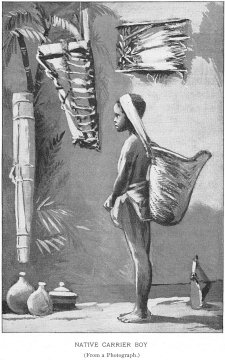 At length I spoke
to him in his own language, using the sound which they use for calling
one another. He looked as if he knew what it meant, but made no reply.
I repeated the sound, and he rose up and stood on his feet, as if he intended
to come to me. Again I uttered it, and he came a few feet closer, but shied
to one side as if to flank my position and get behind me. He stopped again
to look, and I repeated the word, in response to which he came up near
my right side and began to examine my clothing. He plucked at my coat sleeve
a few times, then at the leg of my trousers and at the top of my boot.
He was getting rather familiar for a stranger; but I felt myself to blame
for having given him the license to do so. For a while he continued his
investigations, then he deliberately put his left hand on my right shoulder,
his right foot on my knee, and climbed into my lap. He now began to examine
my helmet, ears, nose, chin, and mouth. He became a little rough, and I
tried to get him clown out of my lap, but he was not disposed to go. Finally
I told my boy -- who acted as interpreter -- to tell the native lads to
come and take the ape away. This amused them very much, for they saw that
I was bigger than the ape, and they thought I ought, therefore, to manage
him myself. They complied, however; but his apeship declined to go until
one of the men of the town interfered and compelled him to do so.
At length I spoke
to him in his own language, using the sound which they use for calling
one another. He looked as if he knew what it meant, but made no reply.
I repeated the sound, and he rose up and stood on his feet, as if he intended
to come to me. Again I uttered it, and he came a few feet closer, but shied
to one side as if to flank my position and get behind me. He stopped again
to look, and I repeated the word, in response to which he came up near
my right side and began to examine my clothing. He plucked at my coat sleeve
a few times, then at the leg of my trousers and at the top of my boot.
He was getting rather familiar for a stranger; but I felt myself to blame
for having given him the license to do so. For a while he continued his
investigations, then he deliberately put his left hand on my right shoulder,
his right foot on my knee, and climbed into my lap. He now began to examine
my helmet, ears, nose, chin, and mouth. He became a little rough, and I
tried to get him clown out of my lap, but he was not disposed to go. Finally
I told my boy -- who acted as interpreter -- to tell the native lads to
come and take the ape away. This amused them very much, for they saw that
I was bigger than the ape, and they thought I ought, therefore, to manage
him myself. They complied, however; but his apeship declined to go until
one of the men of the town interfered and compelled him to do so.
As he got down from my lap one of the boys bantered him to play. He accepted the challenge and ran after the lad until they reached the end of the open space between the houses, when the boy fell upon the ground, and the ape fell on him. They rolled and wallowed on the ground for a time. Then the ape released himself and ran away to the other end of the opening, the boy pursuing him.
When they reached the end of the street they again fell upon each other, and another scuffle ensued. It was plain to be seen that the boy could run much faster than the ape, but the ape did not try to elude him. The other children crowded around them or followed them, looking on, laughing and shouting in the greatest glee. First one boy and then another took his turn in the play, but the ape did not lose interest in me. He stopped from time to time to take another survey, but did not try again to get upon my lap.
After a long time at this sport the ape quit playing and sat down by the wall of a house, with his back against it; the children tried in vain to induce him to resume; but he firmly declined, and sat there like a tired athlete, picking his teeth with a bamboo splinter which he had pulled off the side of the house. His conduct was so much like that of the children with whom he was playing that one could not have distinguished him from them except by his physique. He enjoyed the game as much as they did and showed that he knew how to gain or use an advantage over his adversary. In a scuffle he was stronger and more active than the boys, but in the race they were the more fleet. He screamed and yelled with delight, and in every way appeared to enter into the spirit of the fun.
This ape was about five years old, and his history, as it was given to me, showed that he had been captured, when quite young, in the forest near that place and ever since that time had lived in the village. He had been the constant playmate of the children, ate with them, and slept in the same houses with them. He was perfectly tame and harmless; he knew by name every one in the village, and knew his own name.
The king's son -- to whom he belonged -- assured me that the ape could talk, and that he himself could understand what the animal said; but he declined to gratify my request to hear it. However, he called the ape by name, telling him to come, and the ape obeyed. The man then gave him a long-necked gourd and told him to go to the spring and bring some water. The animal hesitated, but after the command had been two or three times repeated he reluctantly obeyed. After a few minutes he returned with the gourd about half filled with water. In carrying the vessel he held it by the neck, but this deprived him of the use of one hand. He waddled along on his feet, using the other hand, but now and then he set the gourd on the ground, still holding to it, and using it something after the manner of a short stick. On delivering the gourd of water to his master, he gave evidence of knowing that he had done a clever thing.
I expressed a desire to see him fill the gourd at the spring. The water was then emptied out, and the gourd was again given to him. On this occasion we followed him to the place where he got the water. On arriving he leaned over the spring and pressed the gourd into the water, but the mouth of it was turned down so that the -- water could not flow into it. As he lifted the gourd out it turned to one side, and a small quantity flowed into it. He repeated the act a number of times and seemed to know how it ought to be done, although he was very awkward in trying to do it. Whenever the water in the mouth of the gourd bubbled, he clipped it back again and was evidently aware that it was not filled. Finally, raising the vessel, he turned and offered it to his master, who declined to relieve him of it. We turned to go back into the town, and the ape followed us with the gourd; but all the way along he continued to mutter a sound of complaint.
He was next sent into the edge of the forest to bring firewood. He had been gone only a few minutes when he returned with a small branch of dead wood which he had picked up from the ground. He was again sent, together with three or four children. When he returned on this occasion he had three sticks in his hand. The man explained to me that when the ape went alone he would never bring but one twig at a time, and this was sometimes not bigger than a lead pencil; but if the children went with him and brought wood, he would bring as much as he could grasp in one hand. He also told me that the animal would sit down on the ground and lay the sticks across one arm in the same manner as the children did, but he invariably dropped them when he rose up. Then he would seize what he could hold in one hand and bring it along. The man also said that, in carrying a single stick, the ape always used only the hand in which he held it; but that if he had three or four pieces he always curved his arm inwards, holding the wood against his side, and hobbled along with his feet and the other hand.
The next thing with which the man entertained me was sending the ape to call some one in the village. He first sent him to bring a certain one of the man's wives. She was several doors away from where we sat. The ape went to one house, sat down at the door for a moment, looking inside, and then moved slowly along to the next, which he entered. Within a minute he appeared at the door, holding the cloth that the woman wore tied around her, and in this manner led her to his master. He was next sent to bring a certain boy. This he did in a similar manner, except that the boy had on no clothing of any kind, and the ape held him by the leg.
During all these feats the man talked to him, as far as I could tell, in the native language only; though he declared to me that some of the words that he had used were those of the ape's own speech. However, he said that many words that the ape knew were of the native speech, and that the ape had no such words in his language. One thing that especially impressed me was a sound which I have elsewhere described as meaning ''good " or "satisfaction," which this man said was the word which these apes use to mean "mother." My own servant had told me the same thing, but I am still of the opinion that they are mistaken in the meaning of the sound, although it is almost exactly the same as the word for mother in the native speech. The difference being in the vowel element only, it is possible, I grant, that the word may have both meanings. A little later one of the women came to the door of a house and said, in the native language, that something was ready to eat; whereupon the children and the ape at once started. In the mean time she set in front of the house an earthen pot, containing boiled plantains, from which all the children and the ape alike helped themselves. In brief, the ape was a part of the family and was so regarded by all in the town. I do not know to what extent those natives may have played upon my credulity, but so far as I could discern, their statements concerning the animal were verified.
I proposed to buy the ape, but the price asked was nearly twice that of a slave. I could have bought any child in the town at a smaller cost. I have never seen any other chim panzee that I so much coveted. When standing in an upright position, he was quite four feet in height, strongly built and well proportioned. He was in a fine, healthy condition and in the very prime of his life. He was not handsome in the face, but his coat of hair was of good color and texture. He was of the common variety, but a fine specimen.
Mr. Otto Handmann, formerly the German consul at Gaboon, had a very fair specimen of this same species of chimpanzee. He was a rough, burly creature, but was well disposed and had in his face a look of wisdom that was almost comical. He had been for some months a captive in a native town, during which time he had become quite tame and docile. By nature he was not humorous, but he appeared to acquire a sense of fun as he grew older and became more familiar with the manners of men.
On my return from the interior I was invited by the consul to take breakfast with himself and a few friends; but owing to a prior engagement, I was not able to be present. It was proposed by some one of the guests that my vacant seat at the table should be filled by the chimpanzee. He was brought into the room and permitted to occupy the seat. He behaved himself with becoming gravity and was not abashed in the presence of so many guests. He was served with such things as were best suited to his liking, and his demeanor was such as to amuse all present. On the proposal of a toast all the guests beat with their hands upon the table, and in this the chimpanzee joined with apparent pleasure. After a few rounds of this kind, one of the guests occupying the seat next to the chimpanzee failed to respond with the usual beating; the chimpanzee observed the fact, turned upon the guest, and began to claw, scream, and pound him on the back and arm until the gentleman proceeded to beat; whereupon the ape resumed his place and joined in the applause. On this occasion he acquitted himself with credit; but an hour later he had fallen into disgrace by drinking beer until he was actually drunk, when he awkwardly climbed off the chair, crawled under the table, and went to sleep.
One of the clerks in the employ of the consul had a fair specimen of this species. It was a female, perhaps two years younger than the one just described, but equally addicted to the habit of drinking beer. It is the custom among people on the coast to offer to a guest something to drink, and on these occasions this young lady ape always expected to partake with the others. If she was overlooked in pouring out the beer, she always set up a complaint until she got her glass. If it was not given to her, she would go from one to another, holding out her hand and begging for a drink. If she failed to secure it, she watched her opportunity, and while the guest was not looking would stealthily reach up, take his glass off the table, drink the contents, and return the glass to its place. She would do this with each one in turn until she had taken the last glass; but if a glass was given to her at the same time that the others were served, she was content with it and made no attempt to steal that of another. In this act she evinced a skill and caution worthy of a confirmed thief; she would secrete herself under the table or behind a chair and watch her chance. She made no attempt to steal the glass while it was being watched, but the instant she discovered that she was not observed, or thought she was not, the theft was committed.
Her master frequently gave her a glass and a bottle of beer so that she might help herself. She could pour the beer with dexterity. She often spilt a portion of it and sometimes filled the glass to overflowing, but she always set the bottle right end up, lifted the glass with both hands, drained it, and refilled it as long as there was any in the bottle. She could also drink from the bottle and would resort to this method if no glass were given her. She knew an empty bottle from one that contained beer. I may remark here that I have known at least five or six chimpanzees that were fond of beer, and whenever they could get it would drink until they were drunk. I have never seen one, that I am aware of, that would drink spirits.
This ape was very much attached to her master, would follow him and cry after him like a child. She was affectionate to him; but she had been so much annoyed by strangers that her temper was spoiled, and she was irritable.
Arriving on the south side of Lake Izanga, I found a young chimpanzee at the house of a white trader. It was tied to a post in the yard, where it was annoyed by the natives who came to the place to trade. On approaching it for the first time, I spoke to it in its own language, using the word for food. It recognized the sound at once and responded to it. As I came nearer, it advanced as far towards me as the string with which it was tied would allow. Standing erect and holding out its hands, it re peated the sound two or three times. I gave it some dried fish. This it ate with relish, and we at once became friends. Its master permitted me to release it on the condition that I should not allow it to escape. I untied the cord and took the little captive in my arms. It put its arms around my neck as if I had been the only friend it had on earth. It clung to me and would not consent for me to leave it. I could but pity the poor, neglected creature. There it was, tied in the hot sun, hungry, lonely, and exposed to the tortures of every heartless native that chose to tease it. When it was not in my arms it followed me around and would not leave me for a moment. Its master cared but little for it and left it to the charge of his boy, who, like all other natives, had no thought or concern for the comfort of any creature but himself. I tried to purchase it, but the price was too much, and after two days our friendship was broken forever. But I was glad to learn soon after this that another of the traders had secretly released it and let it escape into the forest. The man who did this told me that he did it as an act of mercy. I often recall this little prisoner to mind, and always feel a sense of gladness at knowing that he was set at liberty by a humane friend. Whatever may have been his fate in the forest, it could have been no worse than to be confined, starved, and tormented, as he was while in captivity.
Another small specimen which I saw at Gaboon was not of much interest except from one fact, and that was it was broken out with an eruptive disease prevalent among the natives. This disease is called craw-craw, or kra-kra. It is said to originate from the water, either by external or internal use of that fluid. This animal was infected in the same way and on the same parts of the body as men are affected by the same disease, and is another instance of apes being subject to the same maladies as those of man. The specimen itself also exemplified the difference in intellect among these animals, for this one had in its face a look of mental weakness, and every act confirmed the fact. It was silent, inactive, and obtuse.
During my residence in the cage I saw fewer chimpan zees than gorillas; but from those I did see it was an easy matter to determine that they are much less shy and timid than the gorillas.
On one occasion I heard a chimpanzee in the bush not far away from the cage. I called him with the usual sound. He answered, but did not come to the cage. It is probable that he could see it and was afraid of it. I tried to induce Moses to call him, and he did once utter the sound; but he appeared to regret having made the attempt. I called again and the stranger answered, and from the manner in which Moses behaved it was evident that the call had been understood. Moses would not attempt the call again, but clung to my neck with his face buried under my chin. It was probably jealousy that caused him to refuse, because he did not want the other to share my attentions. I gave the food sound, but I could not induce the visitor to come nearer. I failed to get a view of him so as to tell how large he was, but from his voice I judged that he must have been about full-grown. Whether he was quite alone or not I was not able to tell; but only the one voice could be heard.
Another time while I was sitting quite alone, a young chimpanzee, perhaps five or six years old, appeared at the edge of a small opening of the bush. He plucked a bud or leaf from a small plant. He raised it to his nose and smelt it. He picked three or four buds of different kinds, one or two of which he put in his mouth. He turned aside the dead leaves that were lying on the ground, as if he expected to find something under them. I spoke to him, using the call sound; he instantly turned his eyes towards me, but made no reply. I uttered the food sound, and he replied but did not move. He betrayed no sign of fear and but little of surprise. He surveyed the cage and myself. I repeated the sound two or three times. He refused to approach any nearer. He turned his head from side to side for a moment, as if in doubt which way to go; then he turned aside and disappeared in the bush. He did not run or start away as if in great fear, but by the sound of the shaking bushes it could be told that he increased his speed after he had once disappeared from view.
One day I had been for a stroll with Moses and the boy. As we returned to the cage we saw a chimpanzee about half grown; he was crossing a rugged little path about thirty yards away from us. He paused for a moment to look at us, and we stopped. I tried to induce Moses to call out to him, but he declined to do so. As the stranger turned aside I called to him myself, but he neither stopped nor answered. This one appeared to be quite brown, but the boy assured me the hair was jet black, and that the light skin gave the appearance of brown color. To satisfy myself, I had Moses placed in the same attitude and posi tion, and, looking at him from the same distance, I became convinced that the boy was right.
One morning, having started with Moses for a walk, we had gone only some forty yards away from the cage when he made a sound of warning. I instantly looked up and saw a large chimpanzee standing in the bush not more than twenty yards away. I paused to observe him. He stood for a moment, looking straight at us. I spoke to him, but he made no reply; he moved off in a line almost parallel to the little path we were in, and I returned towards the cage. He did not come any nearer to us, but kept his course almost parallel with ours. From time to time he turned his head to look, but gave no sign of attack. I called to him several times, but he made no answer. When I had reached a place in front of the cage I called again, and after the lapse of a few seconds he stopped. By this time he was concealed from view. He halted only for a moment, changed his course, and resumed his journey. This was the largest chimpanzee I saw in the forest. Once, while sitting in the cage, I heard the sound of something making its way through the bush not more than twenty yards away; presently a chimpanzee came into view. As it crossed the path near by, I called three or four times, but it neither stopped nor answered. As well as I could tell, it appeared to be a female and quite grown.
I may take occasion to remark that, while the chim panzee is mostly found in large family groups,-- as I have reason to believe, from native accounts of them and from what has been told me by white men, -- I have never been able to see a family of them together. Each of these that I have mentioned, so far as I could tell, was quite alone. Whether or not the others were scattered through the forest in like manner, hunting for food, and all came together after this, I cannot say.
Another thing worthy of mention is the fact that both these apes, the chimpanzee and the gorilla, live in the same forest, and twice on the same day I have seen both kinds. This is contrary to the common idea that they do not inhabit the same jungle. It appears that where there is a great number of the one kind there are but a few of the other. The natives say that in combat between the chimpanzee and the gorilla the former is always victor, and on this account the gorilla fears the chimpanzee. I believe this to be true, because the chimpanzee, although not so strong as the gorilla, is more active and more intelligent.
The chimpanzee will not approach or attack man if he can avoid him, but he does not shrink from him as the gorilla does. One instance that will illustrate this phase of his character I shall relate. On one occasion recently, while I was on the coast, a native boy started across a small plain near the trading station. With him was a dog that belonged to the white trader of the place. The dog was in advance of the boy, and as the latter emerged from a small clump of the bush he heard the dog bark in a playful manner, and discovered him not more than thirty yards away, prancing, jumping, and barking in a jolly way with a chimpanzee which appeared to be five or six years old. The ape was standing in the path along which the boy was proceeding. He was, slapping at the dog with his hands and did not seem to relish the sport; yet he was not resenting it in anger. The dog thought the ape was playing with him, and he was taking the whole thing in fun. The boy looked at them for a few moments and retreated. As soon as he disappeared the dog desisted and followed him to the house. The boy was afraid of the ape and made no attempt to capture him. The ape was taken by surprise by the dog and the boy, and thus had no time to escape. He did not strike to harm the dog, but only to ward him off. The dog made no attempt to bite the ape, but would jump up against him and knock him out of balance, and this annoyed him. The ape didn't seem to understand just what the dog meant.
I shall not describe those apes that have been kept in captivity and are well known; but I will mention some of them. The largest specimen of the chimpanzee that I have ever seen was Chico, who belonged to Mr. James A. Bailey of New York. He was as large perhaps as these apes ever become, although he was less than ten years old when he died.
Perhaps the most valuable specimen for scientific use that has ever been in captivity is Johanna, who belongs to the same gentleman. The history that is given of her, however, is hardly to be taken in full faith. Her age cannot be determined with certainty, but it is said that she is about thirteen years old. I have reason to doubt that, although I cannot positively deny it. Whatever may be her exact age, it is certain that she has now reached a complete adult state. She has grown to be quite as large as Chico was at the time of his death. She is not of amiable temper, but is much less vicious than he was. She has some of the marks of a kulu-kamba.
In order to justify my doubts upon the subject of Johanna's age, I may state that Chico was hardly ten years of age when he died, but he had reached the adult period; and as males of any genus of the primates do not reach that state sooner than the females, it is not probable, since he was mature at ten, that she was not so until twelve. In the next place, her captors claim to have seen her within a few hours after her birth, and state that they watched her and her mother from time to time until she was one year old. Then they killed the mother and captured the babe. The claim is absurd. These apes are nomadic in habit and are rarely ever seen twice in the same place. They claim that she was born on January 19, but, from what I know of these apes, I conclude that is not their season of bearing. I doubt if any of them were ever born during that month. Again, it is claimed that she was captured by Portuguese explorers in the Congo, but the Portuguese do not possess along that river any territory in which these apes are ever found. They claim the territory around Kabinda, which would indicate that she came from the Loango valley instead of the Congo; but the cupidity of the average Portuguese would never allow anything to go at liberty for a year if it could be sold before that time.
Johanna is accredited with a great deal of intelligence, but I do not regard her as being above the average of her race. Since the death of her companion, Chico, she has received the sole attention of her keeper, and since that time has been taught a few things which are neither marvelous nor difficult. In point of intellect she cannot be regarded as an extraordinary specimen of her tribe. I do not mean to detract from her reputation, but I have failed to discover in her any high order of mental qualities.
The reason why Johanna may be regarded as the most valuable specimen for study is the fact that she is the only female of her race that has ever, in captivity, reached the state of puberty. She has done so, and this fact enables us to determine certain things which have never heretofore been known. This affords the zo”logists an opportunity for the study of her sexual developments which may not again present itself in many years to come. From this important point of view she presents the student with many new problems in that branch of science. I have elsewhere stated my opinion that the female chimpanzee reaches the age of puberty at seven to nine years, and I have many reasons which I will not here recount that cause me to adhere to that belief. But the uncertainty of the age of this ape does not destroy her value as a subject of scientific study.
The most sagacious specimen of the race that I have been brought in contact with is Consul II, who is now an inmate of the Bellevue Garden in Manchester, England. He has not been educated to perform mere tricks to gratify the visitor, in the way that animals are usually trained, but most of the feats that he performs are prompted by his own desire and for his own pleasure. There is a vast difference in the motives that prompt animals in the execution of these feats. I have elsewhere mentioned the fact that animals that are caused to act from fear do so mechanically, and the acts are not a true index to their intellect. While Consul and a few other apes that I have seen do many things by imitation, they do not do them by coercion. They seem to understand the purpose and foresee the result, and these impel them to act.
Some of the feats performed by this ape I have never seen attempted
by any other. One accomplishment is the riding of a tricycle. He knows
the machine by the name of "bike," although it is not really a bicycle.
He can adjust it and mount it with the skill of an acrobat. The ease and
grace with which he rides are sufficient to provoke the envy of any boy
in England. He propels it with great skill and steers it with the accuracy
of an expert. He guides it around angles and obstacles with absolute precision.
He is allowed to go at liberty a great deal of his time; and this is the
proper way to treat these apes in captivity. He rides the wheel for his
own diversion. He does not do it to gratify strangers or to " show off."
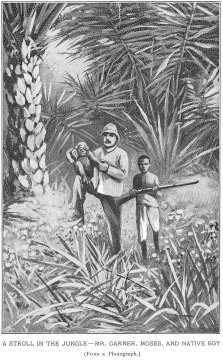 Another accomplishment
which Consul has is that of smoking a pipe, a cigar, or a cigarette. This
may not be commended from a moral standpoint, but it appears to afford
him quite as much pleasure as it does the average boy when he first acquires
the habit. He has also formed the habit of spitting as he smokes,-- but
he has the good manners not to spit on the floor. When Consul has his pipe
lighted he usually sits on the floor to enjoy a smoke, and he spreads down
before him a sheet of paper to spit on. When he has finished smoking he
rolls up the paper and throws it into some corner, out of the way. When
playing about the grounds he often finds a cigar stub. He knows what it
is, picks it up, puts it into his mouth, and at once goes to his keeper
for a light. He will not attempt to light his pipe or cigar, because he
is afraid of burning his fingers; but he will light a match and hand it
to his keeper to hold while lighting the pipe. He sometimes takes a piece
of paper, lights it in the fire, and hands it to some one else to light
his pipe for him. He is afraid of the fire and will not hold the paper
while it is burning. If any one hesitates to take it, he throws it at him
and then gets out of the -way. He is not fond of cigarettes, because he
gets the tobacco in his mouth, and he does not like the taste of it.
Another accomplishment
which Consul has is that of smoking a pipe, a cigar, or a cigarette. This
may not be commended from a moral standpoint, but it appears to afford
him quite as much pleasure as it does the average boy when he first acquires
the habit. He has also formed the habit of spitting as he smokes,-- but
he has the good manners not to spit on the floor. When Consul has his pipe
lighted he usually sits on the floor to enjoy a smoke, and he spreads down
before him a sheet of paper to spit on. When he has finished smoking he
rolls up the paper and throws it into some corner, out of the way. When
playing about the grounds he often finds a cigar stub. He knows what it
is, picks it up, puts it into his mouth, and at once goes to his keeper
for a light. He will not attempt to light his pipe or cigar, because he
is afraid of burning his fingers; but he will light a match and hand it
to his keeper to hold while lighting the pipe. He sometimes takes a piece
of paper, lights it in the fire, and hands it to some one else to light
his pipe for him. He is afraid of the fire and will not hold the paper
while it is burning. If any one hesitates to take it, he throws it at him
and then gets out of the -way. He is not fond of cigarettes, because he
gets the tobacco in his mouth, and he does not like the taste of it.
When Consul is furnished with a piece of chalk he begins to draw some huge figure on the wall or the floor. He never attempts to make a small design with chalk, but if given a pencil and paper, he executes some peculiar figure of smaller design. Those made with the chalk or the pencil are usually round or oval in shape, but if given a pen and ink, he at once begins to make a series of small figures containing many acute angles. Whether these results are from design or accident I cannot say, but he appears to have a well-defined idea as to the use of the instrument. Whether he can distinguish between writing and drawing I am unable to say.
The only abstract thing that his keeper has tried to teach him is to select from the letters of the alphabet. He has learned to distinguish the first three. These are made upon the faces of cubical blocks of wood; each block contains one letter on each of its faces. He selects with very few mistakes the letter asked for, and errors appear to result from indifference rather than from ignorance.
Consul is very fond of play, and he makes friends with some strangers on sight, but to others he takes an aversion without any apparent cause; and, while he is not disposed to be vicious when not annoyed, he resents with anger the approaches of certain persons. He is the only ape I have seen that can use a knife and fork with very much skill; but he cuts up his food with almost as much ease as a boy of the same age would do, and he uses his fork in eating. He has been taught to do this, until he rarely uses his fingers in the act. He is fond of coffee and beer, but does not care for spirits.
There is nothing that so much delights Consul as to get into the large cage of monkeys and baboons kept in the garden. Most of them are afraid of him. But one large Guinea baboon is not so, and on every occasion he shows his dislike for the ape. The latter takes many chances in teasing him, but always manages to evade his attack. He displays much skill and a great degree of caution in playing these pranks upon the baboon when at close range. Upon the approach of the ape the other animals in the cage all seek some refuge, and he finds great diversion in stealing up to their place of concealment to frighten them. Consul is very strong and can lift objects of surprising weight. It is awkward for him to stand in an upright position, but he does so with more ease than any other chimpanzee that I have ever seen. If any one will take hold of his hand, he will stroll for a long time and without apparent fatigue.
Owing to the sudden changes of temperature in that part of England where he is kept, he is provided with a coat and is often required to wear it when going out of doors. He does not like to be hampered with such a garment, and if for a moment he is not watched, he removes it and sometimes hides it to keep from wearing it. He is also provided with trousers; these he dislikes more if possible than his coat, but, above all other articles of wearing apparel, he dislikes shoes. His keeper often puts them on him, but whenever he gets out of sight he unties and removes them. He cannot tie the laces, but can untie them in an instant. He does not evince so much aversion to a hat or a cap and will sometimes put one on without being told; but he has a perfect mania for a silk hat and, if allowed to do so, he would demolish that of every stranger who comes to the garden. He has a decided vein of humor and a love of approbation. When he does anything that is funny or clever, he is perfectly aware of the fact; and when by any act he evokes a laugh from any one, he is happy and recognizes the approval by a broad chimpanzee grin.
In the corner of the monkey house is a room set apart for the keeper, and in this room supplies of food for the inmates are kept. In a small cupboard in one corner is kept a supply of bananas and other fruits. Consul knows this and has tried many times to burglarize it. On one occasion he secured a large screw-driver and attempted to prise open the door. He found the resistance to be greatest at the place where the door locked, and at this point he forced the instrument in the crevice and broke off a piece of the wood, about an inch wide, from the edge of the door. At this juncture he was discovered and reproved for his conduct; but he never fails to stick his fingers in this crack and try to open the door. He has not been able to unlock it when the key is given him, although he knows the use of the key and has often tried it; but his keeper has never imparted the secret to him, and his method of using the key has been to prise with it or pull it, instead of turning it after putting it in the keyhole.
The young keeper, Mr. Webb, deserves great credit for his untiring attention to this valuable young ape, and the results of his zeal are worthy of the recognition of every man who is interested in the study of animals.
Another specimen that may be regarded as an inter mediate type was recently kept in Bellevue Gardens at Manchester. He was playful and full of mischief. He had been taught to use a stick or broom in fight, and with such a weapon in his hand he would run all over the building, hunting some one to attack. He did not appear to be serious in his assault, but treated it as fun. It is a bad thing to teach to apes, because they grow pugnacious as they grow older, and all animals kept closely confined acquire a bad temper.
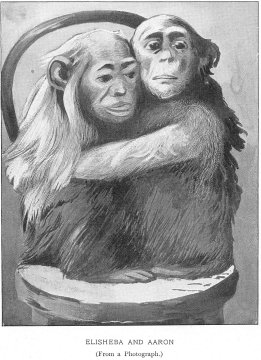 In an adjoining
cage was kept a young orang, and the two ate at the same table. The chimpanzee
appeared to entertain a species of contempt for the orang. The keeper had
taught him to pass the bread to his neighbor, but he obeyed with such reluctance
that his manner betrayed more disgust than kindness. A few small pieces
of bread were placed on a tin plate, and the kulu was required to lift
the plate in his hand and offer it to the orang before he himself was allowed
to eat. He would lift the plate a few inches above the table and hold it
before the orang's face; when the latter had taken a piece of the bread,
the chimpanzee withdrew the plate, held it for a moment, and dropped it.
Meanwhile he kept his eyes fixed on the orang. The manner in which he dropped
the plate looked as if he did so in contempt. When the meal was finished,
the kulu would drink his milk from a cup, wipe his mouth with the serviette,
and then get down from the table. The orang would slowly climb down and
go back to his cage. We shall not describe the details of their home life,
but they were two jolly young bachelors, one of which was as stupid as
the other was bright.
In an adjoining
cage was kept a young orang, and the two ate at the same table. The chimpanzee
appeared to entertain a species of contempt for the orang. The keeper had
taught him to pass the bread to his neighbor, but he obeyed with such reluctance
that his manner betrayed more disgust than kindness. A few small pieces
of bread were placed on a tin plate, and the kulu was required to lift
the plate in his hand and offer it to the orang before he himself was allowed
to eat. He would lift the plate a few inches above the table and hold it
before the orang's face; when the latter had taken a piece of the bread,
the chimpanzee withdrew the plate, held it for a moment, and dropped it.
Meanwhile he kept his eyes fixed on the orang. The manner in which he dropped
the plate looked as if he did so in contempt. When the meal was finished,
the kulu would drink his milk from a cup, wipe his mouth with the serviette,
and then get down from the table. The orang would slowly climb down and
go back to his cage. We shall not describe the details of their home life,
but they were two jolly young bachelors, one of which was as stupid as
the other was bright.
The specimens that were kept in the Gardens in New York were very fine. One of them was mentally equal to any other specimen hitherto in captivity. There were two kept in the Cincinnati Gardens which were also very fine. So far as I am aware, there have never been but nine of these apes brought to America; but six of these lived longer, and four of them grew to be larger, than any other specimens of this race have ever done in captivity. For some reason they never survive long in England or other parts of Europe. This is probably due to some condition of the atmosphere. It cannot be from a difference of treatment.
I have seen a large number of chimpanzees; most of them were in captivity; yet I have seen enough of them in a wild state to gain some idea of their habits and manner. Those described will be sufficient to show the mental character of the genus.
On board a small river steamer that plies the Ogow‚ was a young female kulu that belonged to the captain. Her face was not by any means handsome, and her complexion was darker than that of any other kulu I have ever seen. It was almost a coffee color. There were two or three spots yet darker in shade, but not well defined in outline. The dark spots looked as if they had been artificially put on the face. The color was not solid, but looked as if dry burnt umber had been rubbed or sprinkled over a surface of lighter brown. Although she was young (perhaps not more than two years old), her face looked almost like that of a woman of forty. Her short, flat nose, big, flexible lips, protruding jaws, and prominent arches over the eyes, with a low, receding forehead, conspired to make her look like a certain type of human being one frequently sees. This gave her what is known as a dish-face, or concave profile.
She had a habit of compressing her nose by contracting the muscles of the face, curling her lips as if in scorn and at the same time glancing at those around her as if to express the most profound contempt. Whatever may have been the sentiment in her mind, her face was a picture of disdain, and the circumstances under which she made use of these grimaces certainly pointed to the fact that she felt just as she looked. At other times her visage would be covered with a perfect smile. It was something more than a grin, and the fact that it was used only at a time when she was pleased or diverted showed that the emotion which gave rise to it was perfectly in keeping with the face itself. In repose her face was neither pretty nor ugly. It did not strongly depict a high mental status, nor yet portray the instincts of a brute; but her countenance was a safe index to her mind. This is true of the chimpanzee more, perhaps, than of any other ape. The gorilla doubtless feels the sense of pleasure, but his face does not yield to the emotion, while the opposite passions are expressed with great intensity, and with the common chimpanzee it is the same way, but not to the same extent.
The kulu in question was more a coquette than a shrew. She plainly showed that she was fond of flattery; not perhaps in the same sense that a human being is, but she was certainly conscious of approbation and fond of applause. When she accomplished anything difficult, she seemed aware of it; and when she succeeded in doing a thing which she ought not to do, she never failed to express herself in the manner described above. She always appeared to be perfectly conscious of being observed by others, but she was defiant and composed. There is nothing known in the catalogue of mischief that she was not ready to tackle at any moment and take her chances on the result. From the stokehole to the funnel, from the jack-staff to the rudder, she explored that boat. To keep her out of mischief, she was tied on the saloon deck with a long line; but no one aboard the vessel was able to tie a knot in the line which she could not untie with dexterity and ease. Her master, who was a sailor and an expert in the art of tying knots, exhausted his efforts in trying to make one that would defy her skill.
On one occasion I was aboard the little steamer when the culprit was brought up from the main deck, where she had been in some mischief, and was tied to one of the rails along the side of the boat. The question of tying her was discussed, and at length a new plan was devised. In the act of untying a knot she always began with the part of the knot that was nearest to her. It was now agreed to tie the line around one of the rails on the side of the deck, about halfway between the two stanchions that supported it, then to carry the loose ends of the line to the stanchion, and make them fast in the angle of the stanchion and the rail. As soon as she was left alone she began to examine the knots. She made no attempt at first to untie them, but she felt them, as if to see how firmly they were made. She then climbed upon the iron rail around which the middle of the line was tied and slackened the knot. She pulled first at one strand and then at the other; but one end was tied to the stanchion and the other to her neck, and she could find no loose end to draw through. First one way and then the other she drew this noose. She saw that in some way it was connected with the stanchion. She drew the noose along the rail until it was near the post; she climbed down upon the deck, then around the post and back again; she climbed up over the rails and down on the outside, and again carefully examined the knot; she climbed back, then through between the rails and back, then under the rails and back, but she could find no way to get this first knot out of the line. For a moment she sat down on the deck and viewed the situation with evident concern. She slowly rose to her feet and again examined the knot; she moved the noose back to its place in the middle of the rail, climbed up by it, and again drew it out as far as the strands would allow. Again she closed it; she took one strand in her hand and traced it from the loop to the stanchion; then she took the other end in the same manner and traced it from the loop to her neck. She looked at the loop and then slowly drew it out as far as it would come. She sat for a while holding it in one hand, and with the other moved each strand of the knot. She was in a deep study and did not even deign a glance at those who were watching her. At length she took the loop in both hands, deliberately put it over her head and crawled through it. The line thus released dropped to the deck; she quickly descended, took hold of it near her neck, and found that it was untied; she gathered it up as she advanced towards the other end that was tied to the post, and at once began to loosen the knots about it. In a minute more the last knot was released. She then gathered the whole line into a bundle, looked at those around her with that look of contempt which we have described, and departed at once in search of other mischief. Her air of triumph and content was enough to convince any one of her opinion of what she had done.
If this feat was the result of instinct, the lexicons must give another definition for that word. There were six white men who witnessed the act, and the verdict of all of them was that she had solved a problem which few children of her own age could have done. Every movement was controlled by reason. The tracing out of cause and effect was too evident for any one to doubt. Almost any animal can be taught to perform certain feats, but that does not show innate capacity. The only true measure of the faculty of reason is to reduce the actor to his own resources and see how he will handle himself under some new condition; otherwise the act will be, at least in part, mechanical or imitative. In all my efforts to study the mental caliber of animals I have confined them strictly to their own judgment, and left them to work out the problem alone. By this means only can we estimate to what extent they apply the faculty of reason. No one doubts that all animals have minds which are receptive in some degree. But it has often been said that they are devoid of reason and controlled alone by some vague attribute called instinct. Such is not the case. It is the same faculty of the mind that men employ to solve the problems that arise in every sphere of life, the one which sages and philosophers have used in every phase of science, differing only in degree.
This kulu-kamba knew the use of a corkscrew. This knowledge she had acquired from seeing it applied by men. While she could not use it herself with success, she often tried, and she never applied it to a wrong purpose. She would take the deck broom and scrub the deck, unless there were water on it; in that event she always left the job. She did not seem to know the purpose of sweeping the deck, and never swept the dirt before the broom. The action was doubtless imitative. She only grasped the idea that a broom was used to scrub the deck, but she failed to observe the effect produced. However, it cannot be said with certainty to what extent she was aware of the effect, but it is inferred from the fact that she did not try to remove the dirt. She knew what coal was intended for, and she often climbed into the bunker and threw it down by the furnace door. The furnace door and steam gauge were two things that escaped her busy fingers. I do not know how she learned the danger of them, but she never touched them. She had to be watched to keep her from seizing the machinery. For this she seemed to have a strong desire, but did not know the danger she might incur.
I was aboard a ship when a trader brought off from the beach a young kulu to be sent to England. The little captive sat upright on the deck and seemed aware that he was being sent away. At any rate, his face wore a look of deep concern, as if he had no friend to whom he could appeal. On approaching him I spoke to him, using his own word for food. He looked up and promptly answered it. He looked as if in doubt as to whether I was a big ape or something else. I repeated the sound, and he repeated the answer and came towards me. As he approached me I again gave the sound. He came up and sat by my feet for a moment, looking into my face. I uttered the sound again, when he took hold of my leg and began to climb up as if it had been a tree. He climbed up to my neck and began to play with my lips, nose, and ears. We at once became friends, and I tried to buy him; but the price asked was more than I desired to pay. I regretted to part with him, but he was taken back to the beach, and I never saw him again.
On another occasion one was brought aboard, and after speaking to him I gave him an orange; he began to eat it and at the same time caught hold of the leg of my trousers as if he did not wish me to leave him. I petted and caressed him for a moment and turned away, but he held on to me. He waddled about over the deck, holding on to my clothes, and would not release me. He was afraid of his master and the native boy who had him in charge. He was a timid creature, but was quite intelligent, and I felt sorry for him because he seemed to realize his situation.
On the same voyage I saw one in the hands of a German trader. It was a young male, about one year old. He promptly answered the food sound. Then I called him to come to me; but this sound he neither answered nor complied with. He looked at me as if to ask where I had learned his language. I repeated the sound several times, but elicited no answer. I have elsewhere called attention to the fact that these apes do not answer the call when they can see the one who makes it, and they do not always comply with it. In this respect they behave very much like young children, and it may be remarked that one difficulty in all apes is to secure fixed attention. This is exactly the same with young children. Even when they clearly understand, sometimes they betray no sign of having heard. At other times they show that they both hear and understand, but do not comply.
Another specimen that was brought aboard a ship when I was present was a young male, something less than two years old. He was sullen and morose. He did not resent my approaches, but he did not encourage them. I first spoke to him with the food sound, but he gave no heed. I retired a little distance from him and called him, but he paid no attention. I then used the sound of warning; he raised his head and looked in the direction from which the sound came. I repeated it, and he looked at me for a moment and turned his head away. I repeated it again. He looked at me, then looked around as if to see what it meant, and again resumed his attitude of repose.
On my last voyage to the coast I saw a very good specimen in the Congo. It was a female, a little more than two years old. She was also of a dark complexion, but quite intelligent. She had been captured north of there, and within the limits elsewhere described. At the time I saw her she was ill and under treatment; but her master, the British consul, told me that when she was well she was bright and sociable. I made no attempt to talk with her, except some time after having left her I gave the call sound. She answered by looking around the corner of the house. I do not know whether she would have come or not, as she was tied and could not have come had she desired to do so.
I have seen a few specimens of this ape, and most of them appear to be of a somewhat higher order than the, ordinary chimpanzee; but there is among them a wide range of intelligence. It would be a risk to say whether the lowest specimen of kulu is higher or lower than the highest specimen of the common chimpanzee, but taken as a whole they are much superior. I shall not describe the specimens which have been known in captivity, since most of them have been amply described by others.
If proper conditions were afforded to keep a pair of kulus in training for some years, it is difficult to say what they might not be taught. They are not only apt in learning what they are taught, but they are well disposed and can apply their accomplishment to some useful end. We cannot say to what extent they may be able to apply what they learn from man, because the necessity of using such knowledge is removed by the attention given to them.
There appear to be three centers of gorilla population. The first is in the basin of Izanga Lake; the second is on the south side of the basin of Lake Nkami; and the third is in the basin of the lake east of Sette Kama and west of the Nkami River. The gorilla is rarely, if ever, found in high or hilly districts. He appears to be restricted to the hummock lands, which are elevated only a few feet above tide-level. This is all the more singular from the fact that the ape appears to have a morbid dislike for water, and it is doubtful whether or not he can swim. It is true that he has one peculiar characteristic that belongs to aquatic animals. He has a kind of web between the digits; but its purpose cannot be to aid in swimming. I have been told that the gorilla can swim, and the statement may be true; but I have never observed anything in his habits to confirm this, and I have noted many facts that controvert it.
I know of no valid reason why he should be confined to the limits mentioned, unless it be on account of climatic conditions which are peculiar to this district. South of it the climate along the coast is much cooler. The country east of it is hilly and comparatively barren. North of the equator is a land of almost perpetual rain. Within this district dry and rainy seasons are more equally divided and more uniform in temperature.
The gorilla appears to be an indigenous product which does not bear transplanting. He thrives only in a low, hot, and humid region, infested by malaria, miasma, and fevers. It is doubtful if he can long survive in a pure atmosphere. The only specimen that I have ever heard of north of the equator was one on the south side of the Komo River, which is the north branch of the Gaboon. The point at which I heard of his being was within a few miles of the equator. I also heard of five having been seen a few miles southwest from Njole, which is located on the equator on the north bank of the Ogow‚, a little way east of the Nguni. They were said to be the first and only ones ever seen in that region within the memory of man. As to their being found between Gaboon and Cameroon, I find no trace along the coast of one ever having been seen in that part.
Certain writers have mentioned the fact that, in 1851 and 1852, gorillas came in great numbers from the interior to the coast. The fact is that then the gorilla was practically unknown to science. He had been reported by Ford, Savage, and others, but prior to that time there are no data to show whether or not they were more numerous in the years mentioned. There had never been a specimen brought to civilization. It was about that time that Dr. Ford sent a skeleton to America, and one had been previously sent to England. Some years earlier Dr. Savage had announced the existence of such a creature and had sent sketches of a skull, but it was more than ten years after the period in question that Paul du Chaillu brought out the first skins of gorillas and gave detailed accounts of their character, habits, and geographical distribution. From these facts it is not rash to conclude that the migrations of 1851 and 1852 are mere matters of fancy.
Gorillas are found in the Ogow‚ delta, about one degree south latitude; but not one has ever been known to come from the Crystal Mountains. At the time above mentioned neither traders nor missionaries had ascended the Gaboon River above Parrot Island (which is less than twenty miles from the mouth), except to make a flying trip by canoe. Nothing was known of those parts except what was learned from the natives, and that was very little. During my first voyage I went up the river as far as Nenge Nenge, about seventy-five miles from the coast. At that place I spent two days with a white trader, who had been stationed there for a year. I was assured by him that there were no gorillas in that section. The natives report that they have been found in the lowlands south of there, in the direction of the Ogow‚ basin; but their reports are conflicting, and none of them, so far as I could learn, claims that they are found north of there, nor in the mountains eastward. I admit that they may have been found in, and may yet inhabit, the strip of land between the Gaboon and the Ogow‚; but I repeat that there is no tangible proof that they were ever found north of the Gaboon. With due respect to Sir Richard Owen and other writers who have never been in that country, I insist that they are mistaken. It is true that one of the tribes living north of the Gaboon has a name for this animal; but it does not follow that the ape lives in that country. The Orungu tribe has a name for lion, but there is not such a beast within two hundred miles of their country. Not one of that tribe ever saw a lion.
A number of specimens of gorillas have been secured at Gaboon, but they have been brought there from far away. It is the chief town of the colony, and there are more white men there than elsewhere to buy them. It is not possible for a stranger to ascertain what part of the country a specimen is brought from. The native hunter will not tell the truth, lest some one else should find the game and thus deprive him of its capture and sale. I saw a specimen at Cameroon, and was told it had been captured in that valley, fifty miles from the coast; but I hunted up its history and found with absolute certainty that it was captured near Mayumba, two hundred miles south of Gaboon.
Even with the greatest care in hunting up the history of a specimen, one may fail, and often does fail, in tracing it to its true source; but every one, so far, that I have followed up has been brought from somewhere within the limits I have laid clown. Contrary to the statement of some authorities that these apes "have never been seen on the coast since 1852," I assert that by far the greatest number of them are found near the coast. I do not mean to say that they sit on the sand along the beach, or bathe in the surf, but they live in the jungle of the low coast belt. Along the lower Congo the gorilla is known only by name, and scores of the natives do not know even that. The nearest point to that river that I have been able to locate the gorilla as a native is in the territory about sixty or seventy miles northwest of Stanley Pool.
I am much indebted to the late Carl Steckelman, who was an old resident of the coast, a good explorer, a careful observer, and an extensive traveler. He was drowned at Mayumba in my presence in October, 1895. I knew him well and secured from him much information concerning the gorilla. On a map he traced out for me what he believed to be the south and southeast limits of the gorilla's habitat. Not thirty minutes before the accident in which he lost his life I had closed arrangements with him to make an expedition from Mayumba to the Congo, near Stanley Pool, by one route and return by another, but his death prevented the fulfillment of this plan.
Dr. Wilson, who was the first missionary at Gaboon, located there in 1842. About six years after that time he wrote a lexicon of the native language. In this the name of the gorilla does not appear at all. If the ape had been so very common, it is not probable that his name would have been omitted from this lexicon. Eight years later Dr. Walker, in a revision of the book, gave the definition, "a monkey larger than a man." But he had never seen a specimen of the ape, except the skulls and a skeleton which had been brought from other parts. It is true that at Gaboon Dr. Savage first learned about the gorilla and there secured a skull. From this he made drawings, on which account his name was attached to that of the animal in natural history. It was still a few years later that Dr. Ford sent the first skeleton to America, and Captain Harris sent the first to England. The former skeleton is in the Museum of Zo”logy at Philadelphia. Both of these specimens may have come from any place a hundred miles away from Gaboon.
It is possible that at this early date the gorilla may have occupied the peninsula south of the Gaboon River in greater numbers than he has since done, because up to that time there had been no demand for specimens. If this was true at that time, it is not so now; and if he is not extinct in that part, he is so rare as to make it doubtful whether or not he is found there at all as a native. In four journeys along the Ogow‚ River and the lakes of that valley I made careful inquiries at many of the towns, and the natives always assured me that the gorillas lived on the south side of that river. I spent five days at the village of Moiro, which is located on the north side of the river and about fifty miles from the coast. There I was told by the native woodsmen that no gorillas lived on the north side of the river, but that there were plenty of them along the lakes south of the river. They said that in the forest back of their town were plenty of chimpanzees, and that they were sometimes mistaken for gorillas, but there were absolutely none of the latter in that part.
In view of these and countless other facts I deem it safe to say that few or no gorillas can be found at any point north of the Ogow‚ River; and I doubt if the specimen heard of on the Komo was a genuine gorilla. The natives sometimes claim to have something of the kind for sale, in order to get a bonus from some trader, when in truth they may not have anything of the kind. The only point north of the Ogow‚ at which I have had any reason to believe a gorilla was ever found was in the neighborhood of a small lake called Inenga. This lake is nearly due west from the mouth of the Nguni River and something more than a hundred miles from the coast. Certain reports along that part appeared to have a flavor of truth; but there was no evidence except the statement of the natives.
In the lake region south of the river they are fairly abundant as far south as the head-waters of the Rembo, Nkami, and through the low country of the Esyira tribe; but they are very rare in the remote forests and unknown in the highlands and plains of that country. South of the Chi Loango they are quite unknown, and south of the Congo they are never heard of.
There are no possible means of estimating their number; but they are not so numerous as has been supposed, and from the reckless slaughter carried on by the natives in order to secure specimens for white men, they may ultimately become extinct. Up to this time their ferocity alone has saved them from such a fate. But the use of improved arms will soon overcome that barrier.
The skeleton of the gorilla is so nearly the same as that of the chimpanzee -- which has elsewhere been compared to the human skeleton -- that we shall not review the comparison at length; but we must note one marked feature in the external form of the skull, which differs alike from other apes and from man.
The skull of the young gorilla is much like that of the chimpanzee and remains so until it approaches the adult state. At this period the ridge above the eyes becomes more prominent, and at the same time a sharp, bony ridge begins to develop along the temples and continues around the back of the head on that part of the skull called the occiput. At this point it is intersected by another ridge at right angles to it. This is called the sagittal ridge. It runs along the top of the head towards the face; but on the forehead it flattens nearly to the level of the skull and divides into two very low ridges, which turn off to a point above the eyes and merge into that ridge. These form a continuous part of the skull and are not joined to it by sutures. The mesial crest in a very old specimen rises to the height of nearly two inches above the surface of the skull, and imparts to it a fierce and savage aspect; but in the living animal the crests are not seen, as the depressions between them are filled with large muscles, which make the head look very much larger than it otherwise would. These crests affect only the exterior of the skull and do not appear to alter the form or size of the brain cavity, which is slightly larger in proportion than that of the chimpanzee. These crests are peculiar to the male gorilla. The female skull shows no trace of them.
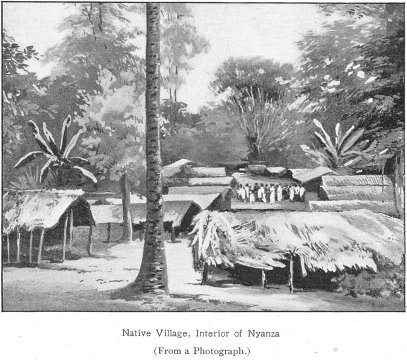
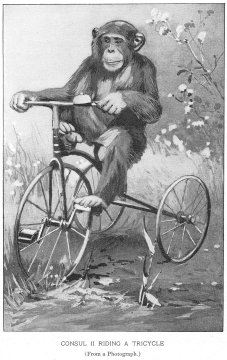
There is at least one case in which the male gorilla has failed to develop this crest. In the series of skulls found in the cuts given herewith, No. 6 is that of an adult male gorilla. I know it to be such, for I dissected the animal and prepared the skeleton for preservation. He was killed in the basin of Lake Ferran Vaz, not more than three or four hours' walk from my cage, and his body was at once brought to me. A good idea of his size can be obtained by reference to another cut given herewith. This cut is copied from a photograph taken by me. It shows some natives in the act of skinning the gorilla.
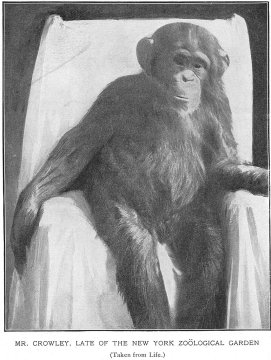 In this picture
the gorilla is sitting flat on the sand; his body is limp and is somewhat
shorter than it was in life. Yet it can be seen that the top of his head
is higher than the hip of the man who is holding him. In the foreground,
on the left of the gorilla, sits the man who killed him. He is sitting
on a log and is thereby a little more elevated than the gorilla. It did
not occur to me to place them side by side in order to make a comparison.
As he sits, the body and head of this gorilla measure nearly four feet
from the base of the spinal column to the top of the head. I had no means
of weighing him, but made an estimate by lifting him. I estimate that he
weighed at least two hundred and forty pounds. He was not an old specimen,
but comparing the skull with No. 7, in which the crests are well developed,
it is found to be larger, and other things point to the conclusion that
he was older than No. 7.
In this picture
the gorilla is sitting flat on the sand; his body is limp and is somewhat
shorter than it was in life. Yet it can be seen that the top of his head
is higher than the hip of the man who is holding him. In the foreground,
on the left of the gorilla, sits the man who killed him. He is sitting
on a log and is thereby a little more elevated than the gorilla. It did
not occur to me to place them side by side in order to make a comparison.
As he sits, the body and head of this gorilla measure nearly four feet
from the base of the spinal column to the top of the head. I had no means
of weighing him, but made an estimate by lifting him. I estimate that he
weighed at least two hundred and forty pounds. He was not an old specimen,
but comparing the skull with No. 7, in which the crests are well developed,
it is found to be larger, and other things point to the conclusion that
he was older than No. 7.
I am aware that one specimen does not of itself establish anything, but in this case it shows that the male gorilla does not always develop the crest. The head of this speci men was surmounted by the red crown which I have elsewhere described. No. 1, which is the skull of my pet, Othello, had the same mark. He was captured near the place where No. 6 was killed.
No. 2 is the skull of a female nearly four years old. She had the same mark. She was also captured in the same basin, but on the opposite side of the lake. The facial bones of No. 6 show that he had received a severe blow early in life; but the fragments had knit together, and the effect could not be seen in the face of the ape while alive.
No. 8 is the skull of a large male from Lake Izanga, which is on the south side of the Ogow‚ River, more than a hundred miles from the coast. This is one of the three centers of population mentioned. I do not know the history of this specimen. It was presented to me by Mr. James Deemin, an English trader, with whom I traveled many days on the Ogow‚ River, and who extended to me many courtesies.
No. 5 is the skull of an adult female. By comparing it in profile with No. 6, it will be seen that they resemble each other closely, except that the muzzle of the latter projects a little more, and the curvature of the skull across the top is less; but the transverse distance is a little greater. Nos. 2, 3, 4, and 5 are females; the others are males.
While this series is not complete in either sex, it is an excellent one for comparative study. I do not know whether or not the heads of those with the crests were the same color as No. 6, but the ntyii, which I have mentioned as possibly a new specimen of the gorilla, does not have this crown of red. His ears are also said to be larger than those of the gorilla, but smaller than the chimpanzee's. He is reputed to grow to a larger size than either of them. The skin of the gorilla is a dull black or mummy color over the body; but over the face it is a jet black, quite smooth and soft. It looks almost like velvet.
One fact peculiar to this ape is that the palms of both the hands and the feet are perfectly black. In other animals these are usually lighter in color than the exposed parts. In most other apes, monkeys, baboons, and lemurs, as in all races of men, the palms are lighter than the backs of the hands and feet. The thumb of the gorilla is more perfect than that of the chimpanzee, yet it is smaller in proportion to the hand than in man. The hand is very large, but has more the shape of the hand of a woman than that of a man. The fingers taper in a graceful manner, but by reason of the web alluded to they appear much shorter than they really are. It is not really a web in the true sense, but the integument between the fingers is extended down almost to the second joint. The forward edge of this is concave when the fingers are spread. When the fingers are brought together the skin on the knuckles becomes wrinkled, and the web almost disappears. This is more readily noticed in the living animal than in the dead. The texture of the skin in the palms is coarsely granulated, and the palmar lines are indistinct. The great toe sets at an angle from the side of the foot, thus resembling a thumb. It has more prehension than the corresponding member of the hand. The foot is less flexible than the hand, but it has greater strength and prehension.
At this point I wish to draw attention to one important fact. The tendons of the foot, which open and close the digits, are imbedded in the palm in a deep layer of coarse, gristly matter, which forms a pad, as it were, under the soles of the foot and prevents it from bending. Therefore it is not possible for a gorilla to sleep on a perch. In this respect he resembles man more than the chimpanzee does, but it is quite certain that neither of them has the true arboreal habit. The gorilla is an expert climber, but he cannot sleep in a tree. In the hand the tendons which close the fingers are the same length as the line of the bones, and this permits him to open the fingers to a straight line, which the chimpanzee cannot do.
One other important point I desire to mention. The muscles in the leg of the gorilla will not permit the animal to stand or walk erect. The large muscle at the back of the leg is shorter than the line of the bones of the leg above and below the knee. When this muscle is brought to a tension, those bones form an angle of from 130§ to 160§, or thereabouts. So long as the sum of two sides of a triangle is greater than the other side, a gorilla can never bring his leg into a straight line. In the infant state, while the muscles are elastic and the bones less rigid, the leg can be forced nearly straight. The habit of hanging by the arms and walking with them in a straight line develops the corresponding muscle in those members so that the bones can be brought in line and the limbs straightened.
The gorilla can stand upon his feet alone and walk a few steps in that position; but his motion is very awkward; his knees turn outward, forming an angle of 40§ or 50§ on either side of the mesial plane. He never attempts to walk in this position except at perfect leisure, and then he holds on to something with his hands.
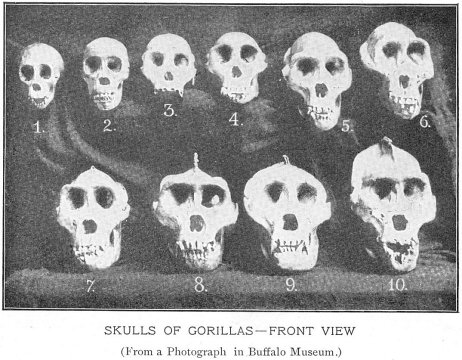 The leg of the
gorilla from the knee to the ankle is almost the same in size. In the human
leg there is what is called the "calf " of the leg, but in the apes this
is very small. However, there is a tendency in the ape to develop that
feature. In the human species the calf of the leg appears to belong to
the higher types of men. As we descend from the highest races of mankind
this characteristic decreases, and it almost disappears in the lowest savage.
The pygmies and the bushmen have smaller calves than any other men. It
is not to be inferred from this that apes would ever have this feature
developed in them by their elevation to a higher plane. So long as they
remain apes they will retain this characteristic, which is one of the distinctive
features of their apehood. One thing which makes the calf appear smaller
in the gorilla is the large size of the muscles about the ankle and the
flexibility of that joint. Also the fact that the joint of the knee is
larger in proportion to the leg makes it appear smaller than it really
is. The corresponding parts of the arm are more like those of the human
body.
The leg of the
gorilla from the knee to the ankle is almost the same in size. In the human
leg there is what is called the "calf " of the leg, but in the apes this
is very small. However, there is a tendency in the ape to develop that
feature. In the human species the calf of the leg appears to belong to
the higher types of men. As we descend from the highest races of mankind
this characteristic decreases, and it almost disappears in the lowest savage.
The pygmies and the bushmen have smaller calves than any other men. It
is not to be inferred from this that apes would ever have this feature
developed in them by their elevation to a higher plane. So long as they
remain apes they will retain this characteristic, which is one of the distinctive
features of their apehood. One thing which makes the calf appear smaller
in the gorilla is the large size of the muscles about the ankle and the
flexibility of that joint. Also the fact that the joint of the knee is
larger in proportion to the leg makes it appear smaller than it really
is. The corresponding parts of the arm are more like those of the human
body.
In a sitting posture the gorilla rests his body upon the ischial bones and sits with his legs extended or crossed. The chimpanzee usually squats, resting the ischial bones upon his heels. He sometimes sits, but more frequently he squats. When in either of these attitudes both kinds usually fold their arms across their breasts.
The hair of the gorilla is irregular in growth. It is more dense than that of the chimpanzee, but less uniform in size and distribution. On the breast it is very sparse, while on the back it is dense and interspersed with long, coarse hairs. The hair on the arms is long and coarse. The ground color is black, but the extreme end of the hair is tipped with pale white. This is so even in early youth. With age the white encroaches, until in extreme age the animal becomes quite gray. The top of the head is covered with a growth of short hair. In certain specimens this crest is of a dark tan color. It looks almost like a wig. This mark seems to be peculiar to certain localities. It is uniform among those captured in the Ferran Vaz basin.
A white trader living on Ferran Vaz Lake claims to have seen a gorilla which was perfectly white. It was said to have been seen on a plain near the lake in company with three or four others. It was thought to be an albino. In my opinion it was only a very aged specimen turned gray. A few of them have been secured that were almost white. It is not, however, such a shade of white as would be found in an animal whose normal color is white. I cannot vouch for the color of this ape seen on the plain, but there must have been something peculiar in it to attract attention among the natives. They regarded it as something very extraordinary.
So far, only one species of this ape is known to science; but there are certain reasons to believe that two species exist. In the forest regions of Esyira the natives described to me another kind of ape, which they averred was a half-brother to the gorilla. They know the gorilla by the native name njina, and the other type by the name ntyii. They do not confuse this with the native name ntyigo, which is the name of the chimpanzee. Neither is it a local name for the kulu-kamba. All of those apes are known to the natives. They described in detail, and quite correctly, the three known kinds of ape, In addition they gave me a minute account of the appearance and habits of a fourth kind, which I believe to be another species of the gorilla. They claim that he is more intelligent and humanlike than any one of the others. They say that his superior wisdom makes him more alert and, therefore, more difficult to find. He is said always to live in parts of the forest more remote from human habitation. On my next voyage I mean to hunt for this new species.
The dental formula of the gorilla is the same as that of man; but the teeth are larger and stronger, and the canine teeth are developed into tusks. One thing to be remarked is the great variety of malformations in the teeth of this animal. It is a rare thing to find among them a perfect set of teeth, except in infancy. The cause of this deficiency appears to be violence.
The eyes of the gorilla are large, dark, and expressive, but there is no trace of white in them. That part of the eye which is white in man is a dark coffee-brown in the gorilla. It becomes lighter as it approaches the base of the optic nerve. The taxidermist or the artist who often furnishes him with a white spot in the corner of his eye does violence to the subject. Those who pose him with his mouth opened like a fly-trap, and his arms raised like a lancer, ought to be banished from good society. It is true that such things lend an aspect of ferocity to the creature, but they are caricatures of the thing they mean to portray.
The ears of the gorilla are very small and lie close to the sides of the head. The model of them is much like the human ear. The lower lip is massive, and the animal frequently relaxes it, so that a small red line is visible between the lips. The usual height of the adult male gorilla, if standing quite erect, is about five feet ten inches. The tallest specimen that has ever been taken is a trifle more than six feet two inches.
I shall not pursue the comparison into minute details, but shall leave that to the specialist, in whose hands it will be treated with more skill and greater scope. As my especial line of research has been in the study of the speech and the habits of these animals, I shall confine myself to that. But the general comparison made is necessary to a better understanding of these subjects.
In the social life of the gorilla there are certain things in which he differs from the chimpanzee, but there are others in which they closely resemble each other. From the native accounts of the modes of life of these two apes there would appear to be a much greater difference than a systematic study of them reveals. The native version of things frequently has a germ of truth which may serve as a clue to the facts in the case; and while we cannot safely rely upon all the details of the tales they relate, we forgive their mendacity and make use of the suggestions they furnish.
The gorilla is polygamous in habit, and he has an incipient idea of government. Within certain limits he has a faint perception of order and justice, if not of right and wrong. I do not mean to ascribe to him the highest attributes of man or to exalt him above the plane to which his faculties justly assign him; but there are reasons to justify the belief that he occupies a higher social and mental sphere than other animals, except the chimpanzee.
In the beginning of his career of independent life the young gorilla selects a wife with whom thereafter he appears to sustain the conjugal relation, and he maintains a certain degree of marital fidelity. From time to time he adopts a new wife, but does not discard the old one. In this manner he gathers around him a numerous family, consisting of his wives and children. Each mother nurses and cares for her own young, but all of them grow up together as the children of one family. The mother sometimes corrects and sometimes chastises her young. This presupposes some idea of propriety.
The father exercises the function of patriarch in the sense of a ruler, and the natives call him ikomba njinn, which means "gorilla chief." This term is derived from the third person singular of the verb kamba, "to speak" -- i kamba, "he speaks." Hence "spokesman," or one that speaks for others. To him all the others show a certain amount of deference. Whether this is due to fear or respect is not certain; but here is at least the first principle of dignity.
The gorilla family of one adult male and a number of females and their young practically constitutes within itself a nation. There do not appear to be any social relations between different families, but within the same household there is apparent harmony. The gorilla is nomadic and rarely ever spends two nights in the same place. Each family roams about from place to place in the bush in search of food, and wherever they may be when night comes on, there they select a place to sleep.
The largest family of gorillas that I ever heard of was estimated to contain twenty members. The usual number is rarely ever more than ten or twelve. The chimpanzees appear to go in somewhat larger groups than these. Sometimes in a single group of chimpanzees as many as three, or even four, adult males have been seen. When the young gorilla approaches the adult state he leaves the family group, finds himself a mate, and sets out in the world for himself. I observe that, as a rule, when one gorilla is seen alone in the forest it is usually a young male about reaching the state of manhood. It is probable that he has then set out for himself, and that he is in search of a wife.
When two only are seen together they usually prove to be a young male and a young female. It sometimes occurs that three adults are seen with two or three children. In large families are seen young ones of different ages, from one year old to five or six years old. The older children arc always fewer in number than the younger ones. I have once seen a large female quite alone except for her babe. Whether she lived alone or was only temporarily absent from her family I had no means of ascertaining.
The gorilla chief does not provide food for his family. On the contrary, it is said that they provide for him. I have been informed, on two occasions and from different sources, that the gorilla chief has been seen sitting quietly eating under the shade of a tree while the others collected and brought to him his food. I have never myself witnessed such a scene, but it seems probable that the same story coming from two sources has some foundation of fact.
In the matter of government the gorilla appears to be somewhat more advanced than most animals. The chief leads the others on the march and selects their feeding grounds and their places to sleep. He breaks camp, and the others all obey him in these respects. Other gregarious animals do the same, but, in addition to these things, the gorillas from time to time hold a rude form of court, or council, in the jungle. It is said that the king presides on these occasions; that he sits alone in the center, while the others stand or sit in a semicircle about him and talk in an excited manner. Sometimes all of them are talking at once. Many of the natives claim to have witnessed these proceedings; but what they mean or allude to no native undertakes to say, except that there appears to be something of the nature of a quarrel. To what extent the chief gorilla exercises the judicial function is a matter of doubt; but there appears to be some real ground for the story.
As to the succession of the kingship there is no authoritative information as yet to be had; but from the meager data upon this point the belief is that on the death of the ikomba if there be an adult male he assumes the royal prerogative; otherwise the family disbands and eventually becomes absorbed by or attached to other families. Whether this new leader is elected in the manner in which other animals appoint a leader, or assumes it by reason of his age, cannot now be stated. There is no doubt that in many instances families remain intact for a long time after the death of their ikomba.
It has been stated by many writers that the gorilla builds a rude hut for himself and family. I have found no evi dence that such is the fact. The natives declare that he does this, and some white men affirm the same. During my travels through the country of the gorilla I offered frequent and liberal rewards to any native who would show me a specimen of this simian architecture; but I was never able to find a trace of one made or occupied by any ape. Sometimes they take shelter from the tornadoes, but it is usually under some fallen tree or a cluster of broad leaves. There is absolutely nothing to indicate that they rearrange any part of tree or leaves. So far as I could find, there is absolutely no proof that any gorilla ever put two sticks together with the idea of building a shelter. As to his throwing sticks or stones at an enemy, there is nothing to verify it, but much to controvert it. It is a mere freak of fancy.
The current opinion that a gorilla will attack a man without being provoked to it is another popular error. He is shy and timid. He shrinks alike from man and from other large animals. When he is in a rage he is both fierce and powerful; but his ferocity and strength are rated above their value. In combat no doubt he is a stubborn foe, but no one I have ever met has seen him thus engaged. His mode of attack, as described by certain travelers, is a mere theory. It is said that in this act he walks erect, furiously beats upon his breast, roars, and yells. In this manner he first terrorizes and then seizes his adversary, tears open his breast and drinks the blood. I have never seen a large gorilla in the act of assault.
During my stay in the jungle I had a young gorilla in captivity. I made use of him in studying the habits of his race. I kept him tied with a long line which allowed him room to play or climb about in the bushes, and at the same time prevented him from escaping into the forest, as he always tried to do the instant he was released. I frequently released him for the purpose of watching his mode of attack when recaptured. While being pursued he rarely looked back, but when overtaken he invariably assailed his captor. This gave me an opportunity of seeing his method of attack. In this he displayed both skill and judgment. As my native boy approached him he calmly turned one side to the foe and, without facing the boy, rolled his eyes in such a manner as to see him and at the same time conceal his own purpose. When the boy came within reach, the gorilla grasped him by thrusting the arm to one side and obliquely backwards. When he had seized his adversary by the leg, he instantly swung the other arm around with a long sweep, so as to strike the boy a hard blow. Then he used his teeth. He seemed to depend more upon the blow than upon the grasp, but the latter served to hold the object of attack within reach. In every case he kept one arm and one leg in reserve until he had seized his adversary.
It is true that these attacks were made upon an enemy in pursuit, but his mode of doing this appeared to be natural to him. He struck a severe blow and showed no sign of tearing or scratching his opponent. In these attacks he made no sound. I do not say that other gorillas never scream or tear their victims, but I take it that the habits of the young are much, if not quite, the same as those of their elders; and from a study of this specimen I am forced to modify many opinions imbibed from reading or from pictures and museum specimens which I have seen. Many of them represent the gorilla in absurd and sometimes impossible attitudes. They certainly do not represent him as I have seen him in his native wilds. I had a young female gorilla as a subject for study for a short time. Her mode of attack was about the same as that just described, but she was too large to risk very far in such experiments.
When the chimpanzee attacks,-- so far as I have seen among my own specimens,-- he approaches his enemy and strikes with both hands, one slightly in advance of the other. After striking a few blows he grasps his opponent and uses his teeth. Then, shoving him away, he again uses the hands. Usually, on beginning the attack, he accompanies the assault with a loud, piercing scream. Neither he nor the gorilla closes the hand to strike or uses any weapon except the hands and the teeth.
I have read and heard descriptions of the sounds made by gorillas, but nothing ever conveyed to my mind an adequate idea of their real nature until I heard them myself within about a hundred feet of my cage in the dead of night. By some it has been called roaring, and by others howling; but it is neither a roar nor a howl. They utter a peculiar combination of sounds, beginning in a low, smooth tone, which rapidly increases in pitch and frequency, until it becomes a terrific scream. The first sound of the series and each alternate sound are made by expiration; the intermediate ones appear to be by inspiration. How this is accomplished it is difficult to say. The sound as a whole resembles the braying of an ass, except that the notes are shorter, the climax is higher, and the sound is louder. A gorilla does not yell in this manner every night, but when he does so it is usually between two and five o'clock in the morning. I have never heard the sound during the day nor in the early part of the night. When screaming he repeats the series from ten to twenty times, at intervals of one or two minutes apart. I know of nothing in the way of vocal sounds that can inspire such terror as the voice of the gorilla. It can be heard over a distance of three or four miles. I can assign no definite meaning to it unless it is intended to alarm some intruder.
One morning, between three and four o'clock, I heard two of them screaming at the same time. I do not mean at the same instant, but at intervals during the same period of time. One of them was within about a third of a mile of me, and the other in another direction, perhaps a mile away. The points we respectively occupied formed a scalene triangle. The sounds made by the two apes did not appear to have any reference to each other. Sometimes they would alternate, and at other times they would interrupt each other. They were both made by giants of their kind, and every leaf in the forest vibrated with the sound. This was during the latter part of May. They scream in this way from time to time throughout the year, but it is most frequent and violent during February and March.
This wild screaming is sometimes accompanied by a peculiar beating sound. It has been vaguely and variously described by travelers, and currently believed to be made by the animal beating with his hands upon his breast; but that is not the fact. The sound cannot be made by that means. The quality of the sound shows that such cannot be the means employed. I have several times heard this beating and have paid marked attention to its character. At a great distance it would be difficult to determine its exact quality.
On one occasion, while passing the night in a native town, I was aroused from sleep by a gorilla screaming and beating within a few hundred yards of the village. I drew on my boots, took my rifle, and cautiously crossed the open ground between the village and the forest. This brought me within about two hundred yards of the animal. The moon was faintly shining, but I could not see the beast, and I had no desire to approach nearer at such a time. I distinctly heard every stroke. I believe the sound was made by beating upon a log or piece of dead wood. He was beating with both hands. The alternating strokes were made with great rapidity. The order of the strokes was not unlike that produced by the natives in beating their drums, except that in this instance each hand made the same number of strokes, and the strokes were in a constant series, rising and falling from very soft to very loud, and vice versa. A number of these runs followed one another during the time the voice continued. Between the first and second strokes the interval was slightly longer than that between the second and third, and so on through the scale. As the beating increased in loudness the interval shortened in an inverse degree, while in descending the scale the intervals lengthened as the beating softened, and the author of the sound was conscious of the fact.
I could trace no relation in time or harmony between the sound of the voice and the beating, except that they began at the same time and ended at the same time. The same series of vocal sounds was repeated each time, beginning on the low note and ending in each case with the note of the highest pitch, while the rise and fall of the series of the beaten sounds were not measured by the duration of the voice. The series each time began with a soft note, but ended at any part of the scale at which it happened to be at the time the voice ceased. The coinciding notes were not the same in every case.
No doubt the gorilla sometimes beats upon his breast. He has been seen to do this in captivity, but the sounds described above were not so made. Since the gorilla makes these sounds only at night, it is not probable that any man ever saw him in the act. It does not require a delicate sense of hearing to distinguish a sound made by beating the breast from that made by beating on dead wood or other similar substance.
I have attributed the above sound to the gorilla, because I have been assured by many white men and scores of natives that it was made by him; but since my return from Africa I have had time to consider and digest certain facts tabulated on my first voyage, and, as a result of these reflections, I doubt whether this sound is made by the gorilla. There are reasons to believe that it is made by the chimpanzee.
I observed that my own chimpanzees made a sound exactly the same as that I heard in the forest, except that it was less in volume. This was due to the age of the apes that made it. I could induce them at any time to make the sound, and frequently did so in order to study it. After my arrival in New York I found that Chico -- the big chimpanzee belonging to Mr. Bailey -- frequently made the same sound. This he always did at night. The cry was said to be so loud and piercing that it fairly shook the stately walls of Madison Square Garden. From reading the description given by the late Professor Romanes of the sound made by "Sally" in the London Gardens, it appears that she made the same sound. It is well known to the natives that chimpanzees beat on some sonorous body, which the natives call a drum. In 1890 I called attention to the beating practiced by the two chimpanzees in the Cincinnati Gardens. They frequently indulged in beating with their knuckles upon the floor of their cage. This was done chiefly by the male. The late E. J. Glave described to me the same thing as being done by the chimpanzees in the middle Congo basin.
It is not probable that two animals of different genera utter the same exact sound, and this is more especially true of a sound that is complex or prolonged. Neither is it likely that the two would have a common habit, such as beating on any sonorous body. Since it is certain that one of these apes does make the sound described, it is more than probable that the other does not. The same logic applies to the beating. Many things that are known to the chimpanzee are taken for granted in the gorilla; but it is erroneous to suppose that in such habits as these they would be identical. In view of the facts I am inclined to believe the sounds described are made by the chimpanzee and not by the gorilla.
There is another case in which the gorilla is wrongly portrayed. The female gorilla is represented as carrying her young clinging to her waist. I have seen the mother in the forest, with her young mounted upon her back, its arms around her neck, and its feet hooked in her armpits. I have never seen the male carry the young, but in a number of specimens of advanced age I have seen and called attention to the mark upon the back and sides which indicates that he does this. It is in the same place that the young one rests upon the back of the mother. In form it is like an inverted Y, with the base resting on the neck and the prongs reaching under the arms. This mark is not one of nature. It is the imprint of something carried there. In some specimens the hair is worn off until the skin is almost bare. The prongs are more worn than the stem of the figure. This is due to the fact that the abrasion is greater upon those parts than elsewhere. I do not assert that such is the cause, but I do assert that such is the fact.
The gorilla is averse to human society. In captivity he is morose and sullen. He frets and pines for his liberty. His face appears to be incapable of expressing anything resembling a smile, but when in repose it is not repugnant. In anger his visage depicts the savage instincts of his nature. He does not seem to bear captivity well, even when not removed from his native climate. The longest any one of them has ever been known to live in captivity was about three and a half years. The one shown in the accompanying cut belonged to a trader by the name of Jones. The name of the gorilla was Sally, and I have called her Sally Jones. She lived with her master three years and a half and died of grief at his absence.
The gorilla which lived with me for a time in the forest was a sober, solemn, stoical creature, and nothing could arouse in him a spirit of mirth. The only pastime he cared to indulge in was turning somersaults. Almost every day, at intervals of an hour or so, he would stand up for a moment, then put his head upon the ground, turn over, rise to his feet again, and look at me as if expecting my applause. His actions in this feat were very much like those of a boy. He frequently repeated this act a dozen times or more, but never smiled or evinced any sign of pleasure. He was selfish, cruel, vindictive, and retiring.
One peculiar habit of the gorilla, both wild and in captivity, is that of relaxing the lower lip when in repose. It is not done when the creature is in a sullen mood, but fre quently, when perplexed or in a deep study, this occurs. Another habit is that of protruding the end of the tongue between the lips, until it is about even with the outer edge of them. The end of the tongue is somewhat more blunted than that of the human. This habit is so frequent with the young gorilla that it would appear to have some meaning; but I cannot suggest what it is.
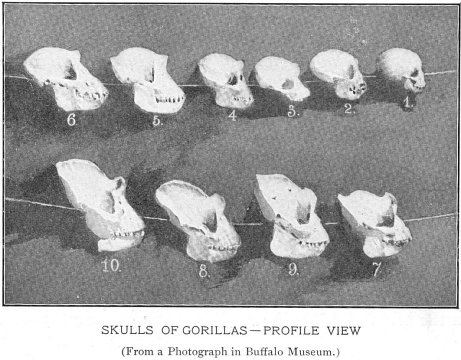 In sleeping, the
habit of the gorilla is to lie upon the back or side, with one or both
arms placed under the head as a pillow. He cannot sleep on a perch, --
as we have already noted,-- but lies upon the ground at night. I had pointed
out to me the place at the base of a large tree where a school of them
had slept the night before. One imprint was quite distinct. The stories
told about the king gorilla, or ikomba, placing his family in a
tree while he sits on watch at the base is another case of supposition.
In sleeping, the
habit of the gorilla is to lie upon the back or side, with one or both
arms placed under the head as a pillow. He cannot sleep on a perch, --
as we have already noted,-- but lies upon the ground at night. I had pointed
out to me the place at the base of a large tree where a school of them
had slept the night before. One imprint was quite distinct. The stories
told about the king gorilla, or ikomba, placing his family in a
tree while he sits on watch at the base is another case of supposition.
The food of the gorilla is not confined to plants and fruits. He is fond of meat and eats it either raw or cooked. He secures a supply of this kind of food by catching small rodents of various kinds, lizards, toads, etc. It is also well known that he robs the nests of birds, taking the eggs or the young. A native once pointed out to me the quills and bones of a porcupine which had been left by a gorilla who had eaten the carcass. It is not at all rare for them to do this. The fruits and plants upon which they chiefly live are acidulous in taste, and some of them are bitter. They often eat the fruit of the plantain, but they prefer the stalk of that plant; this they twist or break open and eat the succulent heart. They do the same with the batuna, which grows all through the forest. The fruit of this plant is a red pod filled with seeds imbedded in a soft pulp. It is slightly acid and astringent. The wild mangrove, which forms a staple article of food for the chimpanzee, is rarely if ever eaten by the gorilla. I once saw a gorilla try to seize a dog, but whether or not it was for the purpose of eating the flesh I cannot say. One, however, did catch and devour a small dog on board the steamer Nubia, while on a voyage home from Africa. Both animals belonged to Captain Button, and from him I learned of the incident. Gorillas have no fixed hours for eating, but they usually eat in the early morning or the late afternoon. In a few instances I have seen them refuse meat. They are perhaps less devoted to eating flesh than the chimpanzee is.
In the act of drinking, the gorilla takes a cup, places the rim in his mouth, and drinks in the same manner as a human being does. He does this without being taught, while the chimpanzee prefers to put both lips in the vessel. I have never known a gorilla that would drink beer, spirits, coffee, or soup. Their drink is limited to milk or water. The chimpanzee drinks beer and various other things.
At noon on the day of his decease he appeared to be quite well and in fine humor. He was turning somersaults and playing like a child with a native boy. He evinced much interest in his play, and his actions indicated that it gave him pleasure; but his face never once betrayed the fact. It was amusing to see him with the actions of a romping child and the face of a cynic.
He was supplied with plenty of his favorite food, had a good appetite, and ate with a relish. Just after noon I sent the boy on an errand. Near the middle of the afternoon I observed that Othello was ill. He declined to eat or drink and lay on his back on the ground, with his arms under his head as a pillow. I tried to induce him to walk with me, to play, or to sit up, but he refused. By four o'clock he was very ill. He rolled from side to side and groaned in evident pain. He kept one hand upon his stomach, where the pain appeared to be located. He displayed all the symptoms of gastric poisoning, and I have reason to believe now that the boy had given him poison. I should regret to foster this suspicion against an innocent person, but it is based upon certain facts that I have learned since that time.
While I sat in my cage watching Othello, who lay on the ground a short distance away, I discovered a native approaching him from the jungle. The man had an uplifted spear in his hand, as if in the act of hurling it at something. He had not seen me, but it did not for a moment occur to me that he had designs upon my pet. I spoke to him in the native language, whereupon he explained that he had seen the young gorilla and suspected that there was an old one close at hand, and being in fear of an attack, he was prepared. He said he was not afraid of a little one, but desired to capture him. I informed him that the gorilla was ill. He made an examination and assured me that Othello would die.
The man departed, and Othello continued to grow worse. His sighing and groaning were really touching. I gave him an emetic, which produced good results. I also used some vaporoles to resuscitate him, but my skill was not sufficient to meet the demands of his case. His conduct was so like that of a human being that it deeply impressed me, and being alone with him in the silence of the dreary forest at the time of his death, the scene had a touch of sadness that impressed me with a deeper sense of its reality. Moses watched the dying ape as if he knew what death meant. He showed no signs of regret, but his manner was such as to suggest that he knew it was a trying hour.
Othello died just before sunset, but for a long time prior to this he was unconscious. The only movements made by him were spasmodic actions caused by pain. The fixed and vacant stare of his eyes in his last hour was so like that of man in the hour of dissolution that no one could look upon the scene and fail to realize the solemn fact that this was death. The next day I dissected him and prepared the skin and the skeleton to bring home with me. They are now, with those of Moses and others, in the Museum of the University of Toronto.
When I first secured this ape and brought him to my house in the bush, he was placed on the ground a few feet from my cage. Near him were laid some bananas and sugarcane belonging to Moses, who had not yet seen the stranger. The gorilla was in a box with one side open, so that he could easily be seen. My purpose was to see how each would act on discovering the other. When Moses observed the food he proceeded to help himself. On seeing the gorilla he paused a moment and gave me an alarm. He was not himself deterred from taking a banana. He seized one and retreated. While he was eating the banana, I took the gorilla from the cage and set him on the ground by it. I petted him and gave him some food. Moses looked on but did not interfere.
When I returned to my cage Moses proceeded to inves tigate the new ape. He approached slowly and cautiously within about three feet of it. He walked around the gorilla a couple of times, keeping his face towards it, and gradually getting a little nearer. At length he came up within a few inches of one side of the gorilla and stopped. He stood almost on tiptoe, with only the ends of his fingers touching the ground. The gorilla continued to eat his food without so much as giving Moses a look. Moses placed his mouth near the ear of the gorilla and gave one terrific yell. The gorilla did not flinch or even turn his eyes. Moses stood for a moment looking as if in surprise that he had made no impression. After this time he made some friendly overtures to the gorilla, but the latter did not entertain them with favor, beyond maintaining terms of peace. They never quarreled, but Othello always treated Moses as an inferior. I do not know if he entertained a real feeling of contempt, but his manner was haughty and condescending.
There were but few articles of food that he and Moses liked in common, and, therefore, they had no occasion to quarrel; but they never played together or cultivated any friendly terms, as the chimpanzees did among themselves. This may have been due to the fact that the gorilla was so exclusive in his demeanor towards the chimpanzee as to forbid all attempts of the latter to become intimate. The chimpanzee by nature is more sociable and is fond of human society. He imitates the actions of man in many things and quickly adapts himself to new conditions, while the gorilla is selfish and retiring. He can seldom be reconciled to human society. He does not imitate man nor readily yield to the influence of civilization.
One special trait of the gorilla which I wish to emphasize is that he is one of the most taciturn of all the family. This fact does not confirm my theory as to their faculty of speech; but it is a fact, so far as I observed, although the natives say that he is as loquacious as the chimpanzee. Among the specimens that I have studied, both wild and in captivity, I have never heard but four sounds that differed from each other, and of these only two could properly be defined as speech. I do not include the screaming sound described in another chapter. I have not been able, so far, to translate the sounds that I have heard, and they cannot be spelled with our letters.
There is one sound which Othello often used. It was not a speech sound, but a kind of whine, always coupled with a deep sigh. When left alone for a time he became oppressed with solitude. At such times he often heaved a deep sigh and uttered this strange sound. The tone and manner strongly appealed to the feelings of others, and while he did not appear to address it to any one or have any design in making it, it always touched a sympathetic chord, and I was sometimes tempted to release him. Another sound which was not within the pale of speech was a kind of grumbling sound. This frequently occurred when he was eating. It was not exactly a growl, but a kind of complaint. Twice I heard this same sound made by wild ones in the forest near my cage. The only thing that I can compare it to is the habit that cats have of growling while eating. It appears to be done only when something is near. It is possibly intended to deter others from trying to take the food.
During my life in the cage I saw twenty-two gorillas; but I shall describe only a few of them, as their actions in most instances were similar. The first one that I had the pleasure of seeing in the jungle came within a few yards of the cage before it was yet in order to receive. He was exactly half grown. He must have been attracted by the noise made in putting the cage together. He advanced with caution, and when I discovered him he was peering through the bushes, as if to ascertain the cause of the sounds. When he saw me, he tarried only a few seconds and hurried off into the jungle. I did not disturb or shoot at him, because I desired him to return.
On the third day after I went to live in the cage a family of ten gorillas was seen to cross an open space along the back of a batch of plantains near one of the villages. A small native boy was within about twenty yards of them when they crossed the path in front of him. A few minutes later I was notified of their vicinity. I took my rifle and followed them into the jungle until I lost the trail. A few hours after this they were again seen by some natives not far away from my cage, but they did not come near enough to be seen or heard. The next day a family came within some thirty yards of the cage. The bush was so dense that I could not see them, but I could distinguish four or five voices. They seemed to be engaged in a broil of some kind. I suppose it was the family that had been seen the day before. The second night after that I heard the screams of one in the forest some distance from me, but I do not know whether it was the king of this family or another.
One day as I sat alone a young gorilla, perhaps five years old, came within six or seven yards of the cage and took a peep. I do not know whether or not he was aware of its being there until he was so near. He stood for a time, almost erect, with one hand holding on to a bough. His lower lip was relaxed, showing the red line mentioned elsewhere, and the end of his tongue could be seen between his parted lips. He did not evince either fear or anger, but rather appeared to be amazed. I heard him creeping through the bush a few seconds before I saw him. As a rule, they move so stealthily as not to be heard. I know of no other animal of equal size that makes so little noise in going through the forest. During the short time he stood gazing at me I sat still as a statue, and I think he was in doubt as to whether or not I was alive. He did not run away, but after a brief pause turned off at an angle and quietly departed. He lost no time, but made no great haste. The only sound he made was a low grunt, and this he did not repeat.
At another time I heard two making a noise among the plantains near me. I could obtain only a glimpse of them, but as well as I could see they were of good size, being almost grown. They were making a low sound from time to time, something such as I have described; but I could not see them well enough to frame any opinion as to what it meant. They were certainly not quarreling, and I was not sure that they were eating. I afterwards went and looked to see if I could find where they had broken any of the stalks. Their trail was visible through the grass and weeds, but I could find no broken stalk. They were moving at a very leisurely gait and must have been within hearing distance some ten or twelve minutes. They were quite alike in color and appeared to be so in size, although the adult male attains a much greater size than the female.
On one occasion I was standing outside of the cage some twenty yards away, and Moses was sitting on a dead log near by. I turned to him and was in the act of sitting down by him when he gave alarm. This he did in an undertone, apparently to avoid attracting the attention of the thing against which the warning was intended. I looked around, and discovered a gorilla standing not twenty yards away. He had just discovered us. He gazed for a moment and started on, moving obliquely towards the cage. I turned to retreat. At this instant Moses gave one of his piercing screams, which frightened the gorilla and he fled. He changed his course almost at right angles. He was going at a good rate before Moses screamed, but he at once increased his pace.
One day I heard three sounds which a native boy assured me were made by gorillas; they were in different direc tions from the cage. It was not a scream nor a howl, but somewhat resembled the human voice calling out with a sound like "hero!" These sounds were repeated at intervals, but did not appear to be in the relation of call and answer; and the animals making them did not approach each other while calling. The sounds were the same except in volume. One of them appeared to be made by an ani mal much larger than the animals that had made the two other sounds. I should state that this sound rarely occurred within my hearing during my stay in that part, and with one exception I never heard a gorilla make any loud sound during the day.
Another interesting specimen came prowling through the jungle as if he had lost his way. He found a small opening, or tunnel, which I had cut through the foliage in order to get a better view. Turning into that, he came a few steps towards the cae before he discovered it. Suddenly he stopped and squatted on the ground. He did not sit flat down. For a few seconds he was motionless. So was I. He slowly raised one arm till his hand was above his head, in which position he sat for a few moments. Then he moved his hand quickly forward, as if to motion at me. He did not drop his hand to the ground, but held it for a short time at an angle from his face. Then he slowly let it down till it reached the ground. During this time he kept his eyes fixed on me. At length he raised the other arm and seized hold of a strong bush, by which he slowly drew himself to a half-standing posi tion. Thus he stood for a few seconds, with one hand resting on the ground. Suddenly he turned to one side, parted the bushes, and disappeared. He uttered no sound whatever. Another came within about thirty yards of my retreat. When he discovered me he stopped and stared in a perplexed manner. He turned away to retreat, but, after going a few feet, turned round and sat down on the ground. He remained in that attitude for more than half a minute; then he rose and retired in the direction from which he had come.
The finest specimen of which I ever had a view, and at the same time the best subject for study, was a large female that came within a trifle more than three yards of me. A dog that belonged to one of the native villages had become attached to me and had found its way through the bush to my cage. He frequently came to visit me, and I was always glad to welcome him. One afternoon about three o'clock he came, and I let him into the cage for a while, to pass the usual greetings. I had a bone which I had saved from my last meal, and I threw this out to him in the bush a few feet away from the cage. He seized the bone and began to gnaw it where it lay. His body was in the opening of a rough path cut through the jungle near the cage, but his head was concealed under a clump of leaves. All at once I caught a glimpse of some moving object at the edge of the path on the opposite side of the cage. It was a huge female gorilla carrying a young one on her back.
When I first saw her she was not more than fifty feet away. She was creeping along the edge of the bushes and watching the dog. He was busy with the bone. Her tread was so stealthy that I could not hear the rustling of a leaf. She advanced a few feet, crouched under the edge of the bushes, and cautiously peeped at the dog. Again she advanced a little way, halted, crouched, and peeped. It was evident that her purpose was to attack the dog. Her approach was so wary as to leave no doubt of her dexterity in attacking a foe. Every movement was the embodiment of stealth. Her face wore a look of anxiety with a touch of ferocity. Her movements were quick but accurate, and her advance was not delayed by any indecision. The dog had not discovered her approach. The smell of the bone and the noise he was making with it prevented him from either smelling or hearing her. I could not warn him without alarming her. If he could have seen her before she made the attack, I should have left him to take his chances by flight or by battle. I should have been glad of an opportunity to witness such a combat and to study the actions of the belligerents, but I could not consent to see a friendly dog taken at such disadvantage. She was now rapidly covering the distance between them, and the dog had not yet discovered her.
When she reached a point within about ten feet of him I determined to break the silence. I cocked my rifle. The click of the trigger caught her attention. I think this was the first that she was aware of my presence. She instantly stopped, turned her face and body towards the cage, and sat down on the ground in front of it. She gave me such a look that I almost felt ashamed for having interfered. She sat for more than a minute staring at me as if she had been transfixed. There was no trace of anger or fear, but the look of surprise was on every feature. I could see her eyes move from my head to my feet. She scanned me as closely as if her purpose had been to purchase me. At length she glanced at the dog who was still gnawing the bone, then turned her head uneasily, as if to search for some way of escape. She then rose and retraced her steps with moderate haste. She did not run, although she lost no time. From time to time she glanced back to see that she was not pursued. She uttered no sound of any kind.
From the time this ape came in view until she departed was about four minutes, and during that time I was afforded an opportunity of studying her in a way that no one else has ever been able to do. I watched every movement of her body, face, and eyes. Being in the cage, I sat with perfect composure and studied her without the fear of attack. With due respect for the temerity of men, I do not believe that any sane man could calmly sit and watch one of these huge beasts approach so near him without feeling a tremor of fear, unless he were protected as I was. Any man would either shoot or retreat, and he could not possibly study the subject with equanimity.
The temptation to shoot her was almost too great to resist, and the desire to capture her babe made it all the more so. But I refrained from firing my gun anywhere within a radius of half a mile or so of my cage, and the natives had agreed to the same thing. My purpose in doing so was to avoid frightening the apes away from the locality. I had been told by the native hunters that if I wounded one of the apes the others would leave the vicinity and perhaps not return for weeks. It is said that if you kill one the others do not notice it so much as if you merely wounded it. Although they seem to be conscious of the fact of the killing, and for the time depart, they will return within a short time.
I could have shot this one with perfect ease and safety. As she approached, her head and breast were towards me; just before she discovered me her left side was in plain view, and when she sat down her breast was perfectly exposed. I could have shot her in the heart, the breast, or the head. Her baby hung upon her back, with its arms embracing her neck and its feet caught under her arms.
The cunning little imp saw me long before the mother did, but it gave her no warning of danger. It lay with its cheek resting on the back of her head. Its black face looked as smooth and soft as velvet. Its big, brown eyes were looking straight at me, but it betrayed no sign of fear or even of concern. It really had a pleased expression and wore the nearest approach to a smile I have ever seen on the face of a gorilla. I believe that this is their method of carrying the young and have elsewhere assigned other reasons for this belief. In this case it is not a matter of belief, but one of knowledge, and everything that I have observed conspires to show that this is not an exception to the rule.
During my sojourn of nearly four months in the jungle, where, it was said, a greater number of gorillas could be found than in any other place in the basin of that lake, I saw a total of only twenty-two. I saw one other at a time while I was hunting in the forest. I caught only a glimpse of him, and should not even have done that had not the native guide discovered and pointed him out to me. I believe that no other white man has ever seen an equal number of these animals in a wild state, and it is certain that no other has' ever seen them under such favorable conditions for study. I have compared notes with many white men along that part of the coast, but I have never found any reliable man who claims to have seen an equal number. All of them admit that my cage is the best possible means of seeing the apes. I know men who have lived in that part for years and who frequently hunt in the forest for days at a time, but never yet have seen a live gorilla.
I met one man on my last voyage who has lived on the edge of the gorilla country forty-nine years, making frequent journeys through the bush and along the water-courses in the interest of trade. This man told me himself that in all that time he had never seen a wild gorilla.
I would cite Mr. James A. Deemin as an expert woods man and a cool, daring hunter. I have enjoyed several hunts with him. He had traveled, traded, and hunted through the gorilla country for more than thirteen years. He told me that with two exceptions he had never seen a wild gorilla. The first he ever saw was a young one, and he once saw a school of them at a distance. On this latter occasion he was in a canoe and under the cover of the bushes along the side of a river. Unobserved he came near them.
Another man, whose name I am at liberty to mention, is Mr. J. H. Drake of Liverpool. By those who know him Mr. Drake has never been suspected of lacking courage in the hunt or of being given to romance. Yet in many years on the coast he saw but one school of these apes, and that was the same one that Mr. Deemin saw when the two men were traveling together. Others could be cited who testify that it is a rare thing for the most expert woodsman ever to see one of these creatures, and many of the stories told by the casual traveler cannot be received at par. I do not mean to impeach the veracity of others, but the temptation to romance is too great for some people to resist. While we cannot prove the negative by direct evidence, we must be permitted to doubt whether or not these apes are so frequently met in the jungle as they are alleged to be. I will give some reasons for being a sceptic on this subject.
Almost every yarn told by the novice is about the same in substance, and much the same in detail, as those related by others. It seems that most of them meet the same old gorilla, still beating his breast and screaming just as he did forty years ago. The number of gun-barrels that he is accused of having chewed up would make an arsenal sufficient to arm the volunteers. What becomes of all those that are attacked by this fierce monarch of the jungle? Not one of them ever gets killed, and not one of them ever kills the gorilla. Does he merely do this as a bluff and then recede from the attack? Or does he follow it up and seize his victim, tear him open, and drink his blood, as he is supposed to do? How does the victim escape? What becomes of the assailant? Who lives to tell the tale?
The gorilla has good ears, good eyes, and is a skillful bushman. One man walking through the jungle will make more noise than half a dozen gorillas make. The gorilla almost always sees and hears a man before he is seen or heard by him. He is shy and will not attack a man unless wounded or provoked to it. He is always on the alert for danger and rarely comes into the open parts of the bush except for food. He can conceal himself with more ease than a man can and has every advantage in making his escape. I do not believe that he will ever approach a man if he can evade him, but I quite believe that he will make a strong defense if surprised or attacked. I do not believe it possible for any one to see a great number of gorillas in any length of time unless he goes to some one place and remains there, as I have done. Even then he must sometimes wait for days without a trace of one. Silence and patience alone will enable him to see them. When the gorilla sees a man, he retires as soon as he discovers the nature of the thing before him. He does not always flee in haste, as some other animals do, but is more deliberate and cool about it. He will retreat in good order and always starts in time, if possible, to escape without being observed. I trust that I may be pardoned for not being able to believe that every stranger who visits that country is attacked by a gorilla.
Many people labor under the popular delusion that they have seen a gorilla with some itinerant menagerie, and it may be cruel of me to undeceive them. Up to this time there has been but one gorilla landed alive in America. This one arrived in Boston in the autumn of 1897. It was a mere baby and lived only five days. It was exhibited to the public during only a part of two days. The many alleged gorillas offered by mendacious showmen are vile fakes, and the exhibitors should be dealt with as impostors.
I regret that I have been compelled to deny much that has been said, but I make no apology for having done so. In this work I have sought to place these apes before the reader as I have seen them in their native forests. I have not clothed them in fine raiment or invested them with glamour. But I trust that this contribution may be found worthy of the approval of all men who love nature and respect fidelity.
I have the vanity to believe that the methods of study which I have employed will be made the means of farther research by more able students than the writer. In addition to those apes that I have seen in a wild state, I have seen about ten in captivity. Two of those were my own. They were good subjects for study, and I made the best use of them during the time I had them.
While in the jungle I accomplished one thing, in which I feel a just sense of pride, and that was making a gorilla take a portrait of himself. This will interest the amateur in the art of snapshots, and I shall relate it.
I selected a place in the forest where I found some tracks of the animal along the edge of a dense thicket of batuna. Under cover of the foliage I set up two pairs of stakes which were crossed at the tops, and to them was lashed a short pole forming something like a sawbuck. To this was fastened the camera, to which had been attached a trigger made of bamboo splits. One end of a string was fastened to the trigger, and the other end carried under a yoke to a distance of eight feet from the lens. At this point were attached a fresh plantain stalk and a nice bunch of the red fruit of the batuna. Upon this point the camera was focused, the trigger was set, and it was left to await the gorilla. That afternoon I returned to find that something had taken the bait, broken the string, sprung the trigger, and snapped the camera. I developed the plate, but could find no image of anything except the leaves in front of it. I repeated the experiment, with similar results, but could not understand how anything could steal the bait and yet not be shown in the picture. The third time I did this I was gratified to find the image of a gorilla, and also to discover the cause why the other experiments had not succeeded.
The deep shadows of the forest make it difficult to take a photograph without giving it a time exposure, and when the sun is under a cloud or on the wrong side of an object success is quite impossible. The leaves which were shown in the first two plates were only those which were most exposed to the light, and all the lower part of the picture was without detail. In the third trial it could be seen that the sun was shining at the instant of exposure. A part of the body of the gorilla was in the light, but most of it was in the shadow of the leaves above it. The left side of the head and face was quite distinct, so likewise were the left shoulder and arm. The hand and the bait could not have been distinguished except by their context. The right side of the head, the arm, and most of the body were lost in the view. The picture showed that the gorilla had taken the bait with his left hand, and that he was in a crouching posture at the moment.
While the photograph was very poor as a work of art, it was full of interest as an experiment. Although it did not result in getting a good picture, I did not regard the effort as a failure. It shows at least that such a thing is possible, and by careful efforts, often repeated, it could be made a means of obtaining some novel pictures. A little ingenuity would widen the scope of this device and make it possible to photograph birds, elephants, and everything else in the forest. When I return to that place on a like journey I shall carry the scheme into better effect.
In the annals of the world, the first record that alludes to these manlike apes is that of Hanno, who made a voyage from Carthage to the west coast of Africa, nearly five hundred years before the Christian era. He described an ape which was found in the locality about Sierra Leone. It is singular that the description which he gave of those apes should coincide so fully with the apes known at the present day; but it is quite certain that the apes of which he gave an account were neither gorillas nor chimpanzees. There is nothing to show that either of these apes ever occupied that part of the world, or that any similar type has done so.
The ape described by Hanno was certainly not an anthropoid, but a large dog-faced monkey or baboon, technically called cynocephalus. These animals are found all along the north coast of the Gulf of Guinea, but there is no trustworthy evidence of any true ape living north of Cameroon valley. The river that waters it empties into the sea about four degrees north of the equator. Here begins the first trace of the chimpanzee. As we pass along the windward coast, casual reports are current to the effect that gorillas and chimpanzees occupy the interior north of there; but when these reports are sifted down to solid facts, it turns out to be a big baboon or a monkey upon which the story rests. Its likeness to man, as described by Hanno, was doubtless the work of fancy, and the name troglodytes which he gave to it shows that he knew but little of its habits, or cared but little for the exactness of his statements.
The account given by Henry Battel, in 1590, contains a thread of truth woven into a web of fantasy. He must have heard the stories he relates, or seen some specimens along the coast north of the Congo. There are certain facts which point to this conclusion. The name pongo which he gave to one of them belongs to the Fiote tongue, which is spoken by the native tribes around Loango. Those people use the name, and it is commonly understood to be synonymous with the name njina, used by the tribes north of there. It is always applied to the gorilla. To me, however, it appears to coincide with the name ntyii, as used by the Esyira people for another ape, which is described in the chapter devoted to gorillas. It was from Loango that Dr. Falkenstein, in 1876, secured an ape under that name. It is singular that Baron Wurmb, in 1780, makes use of the name pongo for an orang. I have not been able to learn where he acquired this name, but it appears to be a native Fiote name for more than four hundred years, and the history of their language is fairly well known.
The name enjocko, given by Battel to another ape, is beyond a doubt a corruption of the native name ntyigo (ntcheego), and this name belongs north of the Congo from Mayumba to Gaboon. He may have inferred that these apes occupied Angola, but there is not a vestige of proof that any ape exists in that part of Africa. Even the native tribes of that part have no indigenous name for either of these apes. Other parts of his account are erroneous, and while he may have believed that these apes "go in bodies to kill many natives that travel in the wood,"and the natives may have told him such a thing, the apes do not practice such a habit. With all their sagacity, they have no idea of unity of action. If a band of them were attacked, they would no doubt act together in defense, but it is not to be believed that they ever preconcert any plan of attack. Neither do these apes ever assault an elephant. He is the one animal they hold in mortal dread. I have incidentally mentioned elsewhere the conduct of my two kulus on board the ship when they saw a young elephant. Chico, the big ape that has also been mentioned, was often vicious and stubborn. Whenever he refused to obey his keeper or became violent, an elephant was brought in sight of his cage. On seeing it he became as meek as a lamb and showed every sign of the most intense fear. Mr. Bailey himself told me of the dread both of his apes had of an elephant. Battel was also wrong in the mode he described of the mother carrying her young, and that of the apes in using sticks and clubs.
The ape known as Mafuka, which was exhibited in Dresden in 1875, was also brought from the Loango coast, and it is possible that this is the ape to which the native name pongo really belonged. This specimen in many respects conforms to the description of the ntyii given, but the idea suggested by certain writers that Mafuka was a cross between the gorilla and the chimpanzee is not, to my mind, a tenable supposition. It would be difficult to believe that two apes of different species in a wild state would cross, but to believe that two that belonged to different genera would do so is yet more illogical. I may state, however, that some of the Esyira people advance such a theory concerning the ntyii, but the belief is not general, and those best skilled in woodcraft regard them as distinct species.
To quote, in "pidjin" English, the exact version of their relationship, as it was given to me by my interpreter while in that country, may be of interest to the reader. I may remark, by way of explaining the nature of the "pidjin" English, that it is a literal translation of the native mode of thought into English words. The statement was: --
Ntyii 'e one; njinn 'e one; all two 'e one, one. Ntyii 'e one mudder; njina 'e one mudder; all two 'e one, one. Ntyii 'e one fader; njina 'e one fader. All two 'e one." By which the native means to say that the ntyii has one mother, and the njinn has one mother, so that the two have two mothers, but both have one father, therefore they are half-brothers.
The other version given in denial of this statement is as follows:--
'' Ntyii 'e one mudder; njina, 'e one mudder. 'E one, one. Ntyii 'e one fader; njinn 'e one fader. 'E one, one. All two 'e one, one. Ntyii 'e one mudder; njina 'e one mudder. All two 'e one, one. 'E brudder. Ntyii 'im fader; njina 'im 'e brudder. All two 'e one, one." The translation is that the ntyii has a mother, and the njina has a mother, which are not the same, but are sisters. The ntyii has a father, and the njina has a father, which are not the same, but are brothers; and therefore the two apes are only cousins, which in the native esteem is a remote degree of kinship.
The ape described by Lopez certainly belonged to the territory north of the Congo, which coast he explored, and gave his name to a cape about forty miles south of the equator. It still bears the name Cape Lopez. However, it is probable that at that time most of the low country now occupied by these apes was covered with water; that the lakes of that region were then all embraced in one great estuary, reaching from Ferran Vaz to Nazavine Bay, and extending eastward to the foothills below Lamberene. There is abundant evidence to show that such a state has once existed there, but it is not probable that these apes have ever changed their latitude.
The name solo appears to be a local name for the ordinary type of chimpanzee found throughout the whole range of their domain, and known in other parts by other names. In Malimbu the name kulu appears to apply to the same species, while in the southwestern part of their habitat that name, coupled with the verb kamba, is confined strictly to the other type. Along the northern borders of the district to which that species belongs, but where he is very seldom found and little known to the natives, he is called by the Nkami tribe kanga ntyigo, to distinguish him from the common variety, to which the latter name only is applied.
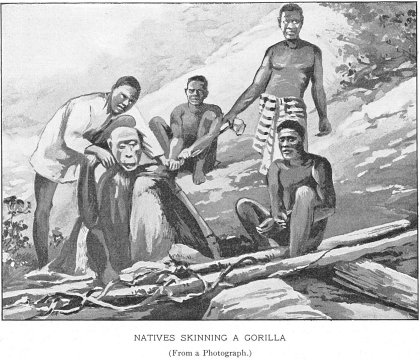 The etymology
of the name kanga as applied to this ape is rather obscure. In common
use it is a verb, with the normal meaning "to parch" or "fry," and hence
the secondary meaning "to prepare." Since this ape is said to be of a higher
order of the race, the term is used to signify that he is "better prepared
" than the other; that is to say, he is prepared to think and talk in a
better manner. But another history of this word appears to be more probable.
The ape to which the name is applied lives between the Nkami country and
the Congo. The name is possibly a perversion of kongo and implies
the kind of
ntyigo that lives towards the great river of that name.
The etymology of African names is always difficult because there is no
record of them; but many of them can be traced out with great precision,
and some of them are unique.
The etymology
of the name kanga as applied to this ape is rather obscure. In common
use it is a verb, with the normal meaning "to parch" or "fry," and hence
the secondary meaning "to prepare." Since this ape is said to be of a higher
order of the race, the term is used to signify that he is "better prepared
" than the other; that is to say, he is prepared to think and talk in a
better manner. But another history of this word appears to be more probable.
The ape to which the name is applied lives between the Nkami country and
the Congo. The name is possibly a perversion of kongo and implies
the kind of
ntyigo that lives towards the great river of that name.
The etymology of African names is always difficult because there is no
record of them; but many of them can be traced out with great precision,
and some of them are unique.
The name M'Bouve, as given by Du Chaillu, I have not been able to identify. In one part of the country I was told that the word meant the "chief " or head of a family. In another part it was said to mean something like an advocate or champion, and was applied to only one ape in a family group. The Rev. A. C. Goode, a missionary who recently died near Batanga, was stationed for twelve years at Gaboon. During that time he traveled all through the Ogow‚ and Gaboon valleys. He was familiar with the languages of that part, and he explained the word in about the same way.
Whatever may be said concerning the veracity of Paul du Chaillu, there is one thing that must be said to his credit. He gave to the world more knowledge of these apes than all other men had ever done before; and while he may have given a touch of color to many incidents, and related some native yarns, he told a vast amount of valuable truth; and I can forgive him for whatever he may have misstated, except one thing; that is, the starting of that story about gorillas chewing up gun-barrels. It has been a staple yarn, in stock ever since, and the instant you ask a native any question about the habits of the gorilla he begins with a stereotype edition of that improbable story.
In view of the fact that I have made careful and methodic efforts to determine the exact boundary of the habitat and the real habits of these two apes, I feel at liberty to speak with an air of authority. I have acquired my knowledge on the subject by going to their own country and living in their own jungle, and I have thus obtained their secrets from first-hand. With due respect to those who write books and speak freely upon subjects of which they know but little, I beg leave to suggest that if the authors had gone into the jungle and lived among those animals, instead of consulting others who know less than themselves about the subject, many of them would have written in a very different strain. I do not mean this as a rebuke to any one, but seeing the same old stories repeated year after year, and knowing that there is no truth in them, I feel it incumbent as a duty to challenge them. I believe that in the future it will be shown that there are two types of gorilla as distinct from each other as the two chimpanzees are. This second variety of gorilla will be found between the third and fifth parallels south and cast of the delta district, but west of the Congo. I believe it was represented in the ape Mafuka.
My researches among the apes have been confined chiefly to the two kinds heretofore described, but, I have seen and studied in a superficial way the orang and the gibbon. I am not prepared as yet to discuss the habits of those two apes, but, as they form a part of the group of anthropoids, we cannot dismiss them without honorable mention.
The orang outang, as he is commonly called, is known to zoology by the first of these terms alone. He is a native of Borneo and Sumatra, and opinions differ as to whether there are two species or only one.
The general plan of the skeleton of the orang is very much the same as that of the other apes. The chief points of difference are that it has one bone more in the wrist and one joint less in the spinal column than is found in man. He has thirteen pairs of ribs, which appear to be more constant in their number than in man. His arms are longer, and his legs shorter, in proportion to his body than the other two apes. The type of the skull is peculiar and combines to a certain extent more human like form in one part with a more beast like form in another. The usual height of an adult male is about fifty one inches.
I have never had an opportunity of studying this ape in a wild state and have had access to only a few of them in captivity. All of these were young, and most of them were inferior specimens. He is the most stupid and obtuse of the four great apes. Except for his skeleton alone, he would be assigned a place below the gibbon, for in point of speech and mental caliber he is far inferior. Perhaps the best authorities upon the habits of this ape in a wild state are Messrs. W. T. Hornaday and Alfred R. Wallace.
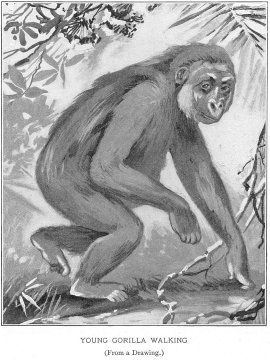 The smallest and
last in order of the anthropoid apes is the gibbon. He is much smaller
in size, greater in variety, and more active than any other of the group.
His habitat is in the southeast of Asia; its outline is vaguely defined,
but it includes the Malay Peninsula and many of the contiguous islands
cast and south of it.
The smallest and
last in order of the anthropoid apes is the gibbon. He is much smaller
in size, greater in variety, and more active than any other of the group.
His habitat is in the southeast of Asia; its outline is vaguely defined,
but it includes the Malay Peninsula and many of the contiguous islands
cast and south of it.
In model and texture the skeleton of the gibbon is the most delicate and graceful of all the apes, and in this respect is superior to that of man. He is the only one of the four apes that can walk in an erect position. In doing this the gibbon is awkward and often uses his arms to balance himself. Sometimes he touches his hands to the ground. At other times he raises them above his head or extends them on either side. The length of them is such that he can touch the fingers to the ground while the body is nearly or quite erect. In the spinal column he has two, and sometimes three, sections more than man. His digits are very much longer, but his legs are nearly the same length, in proportion to his body, as those of man. He has fourteen pairs of ribs.
The gibbon is the most active and probably the most intelligent of all apes. He is more arboreal in habit than any other. Many stories are told of his agility in climbing, and leaping from limb to limb. One authentic report credits one of these apes with leaping a distance of forty-two feet, from the limb of one tree to that of another. Perhaps a better term is to call it swinging, rather than leaping, as these flights are performed chiefly by the arms. Another account is that a gibbon swinging by one hand propelled himself a horizontal distance of eighteen feet through the air, seized a bird in flight, and alighted safely upon another limb, with his prey in hand.
There are several known species of this ape. The largest of these is about three feet high; but the usual height is not more than thirty inches. The voice of one species is remarkable for its strength, scope, and quality, being in these regards superior to that of all other apes. Most of the members of this genus are endowed with better vocal qualities than other animals.
This ends the list of the manlike apes. Next in order after them come the monkeys, then the baboons, and, last, the lemurs.
The descent, as we have elsewhere observed, from the highest ape to the lowest monkey presents one unbroken scale of imbricating planes. We have seen in what degree man is related to the higher apes. From thence we may discern in what degree his physical nature is the same as that of all the order to which he belongs. No matter in what respect man may differ in his mental and moral nature, his likeness to them should at least restrain his pride, evoke his sympathy, and cause him to share the bounty of his benevolence. Let him realize in full extent that he is one in nature with the rest of animate creatures, and they will receive the benign influence of his dignity without impairing it, while he will elevate himself by having given it.
We have already noticed the fact that the gorilla is confined by nature to a low, humid region, reeking with miasma and the effluvia of decaying vegetation. The atmosphere in which he thrives is one in which human life can hardly exist. We know in part why man cannot live in such an atmosphere and under such conditions, but we cannot say with certainty why the ape does do so. It would seem that the very element that is fatal to man gives strength and vitality to the gorilla. We know that all forms of animal life are not affected in the same way by the same causes; and while it may be said in round numbers that what is good for man is good for apes, that is not a fact.
The human race is the most widely distributed of any genus of mammals, and, as a race, it can undergo greater extremes of change in climate, food, or condition than any other kind of animal. Man's migratory habits, both inherent and acquired, have fitted him for a life of vicissitudes, and such a life inures him, as an individual, to all extremes. On the other hand, the gorilla, as a genus, is confined to a small habitat, which is uniform in climate, products, and topography. Having been so restricted to these conditions he is unfitted for any radical change, and when such is forced upon him the result must always be to his injury.
In certain parts of the American tropics there is found a rich gray moss growing in great profusion in these localities and on certain kinds of trees. It is not confined to any special level, but thrives best on low elevations. Under favorable conditions it grows at altitudes far above the surrounding swamps. Its character and quantity, however, are measured by the altitude at which it grows. It is an aerial plant, and it may be detached from the boughs of one tree and transplanted upon those of another. It may be taken with safety to a great distance, so long as an atmosphere is supplied to it that is suited to its nature, but when removed from its normal conditions and placed in a purer air it begins to languish and soon dies. If returned in time, however, to its former place or one of like character, it will revive and continue to grow.
What element this plant extracts from the impure air is unknown. It cannot be carbonic acid gas, which is the chief food of plants, nor can it be any form of nitrogen. It is well known that the plant cannot long survive in a pure atmosphere. Whatever the ingredient extracted may be, it is certain that it is one that is deadly to human life and one that other plants refuse. Moisture and heat alone will not account for it. We have another striking instance in the eucalyptus, which lives upon the poison of the air around it. There are many other such cases in vegetable life; and while the animal is a higher organism than the plant, there are certain laws of life that obtain in both kingdoms and involve the same principles.
Between the case of the gorilla and that of the plant there is some analogy. It may not be the same element that sustains them both, but it is possible that the very microbes which germinate disease and prove fatal to man sustain the life of the ape in the prime of health. The poison which destroys life in man preserves it in the ape.
The chimpanzee is distributed over a much greater range than the gorilla and is capable of undergoing a much greater degree of change in food and temperature. The history of these apes in captivity shows that in that state the chimpanzee lives much the longer and requires much less care. From my own observation I assert that all these apes can undergo a greater range of temperature than of humidity. The latter appears to be one of the essential things to the life of a gorilla. One fatal mistake made in treating him is furnishing him with a dry, warm atmosphere and depriving him of the poison contained in the malarious air in which he naturally spends his life. Both of these apes need humidity. In a dry air the chimpanzee will live longer than the gorilla, but neither of them can long survive it; and it would appear that a salt atmosphere is best for the gorilla.
I believe that one of these apes could be kept in good condition for any length of time if he were supplied with a normal humidity in an atmosphere laden with miasma and allowed to vary in its temperature. A constant degree of heat is not good for any animal. There is no place in all the earth where nature sustains a uniform degree of heat. We need not go to either extreme, but a change is requisite to bring into play all the organs of the body.
The treatment which I would recommend for the care of apes is to build them a house entirely apart from that of other animals. It should be eighteen or twenty feet wide by thirty five or forty feet long, and at least fifteen feet high. It should have no floor except earth, and that should be of sandy loam or vegetable earth. In one end of this building there should be a pool of water twelve or fifteen feet in diameter; and, imbedded in mold under the water, there should be a steam coil to regulate the temperature as may be desired. In this pool should be grown a dense crop of water plants such as are found in the marshes of the country in which the gorilla lives. This pool should not be cleaned out nor the water changed; but the plants should be allowed to grow and decay in a natural way. Neither the pool nor the house should be kept at a uniform heat, but the temperature should be allowed to vary from 60° to 90°.
In addition to the things above mentioned, the place should be provided with the means of giving it a spray of tepid water, which should be turned on once or twice a day and allowed to continue for at least an hour at a time. The water for this purpose should be taken from the pool, but should never he warmer than the usual temperature of tropical rain. The animal should not be required to take a bath in this way, but should be left to his own choice about it.
The house should contain a thin partition that could be removed at will, and the end of the building farthest from the pool should be occupied by a strong tree, either dead or alive, to afford the inmates proper exercise. The south side of the house should be of glass, and at least half of the top should be of the same. These parts should be provided with heavy canvas curtains, to be drawn over them so as to adjust or regulate the sunlight. In the summer time the building should be kept quite open, so as to admit the air and the rain. The rule that strangers or visitors should not annoy or tease them should be enforced without respect to person, time, or rank. No visitor should be allowed on any terms to give them any kind of food. The reasons for these precautions are obvious to any one familiar with the keeping of animals; but in the case of the gorilla their observance cannot be waived with impunity.
The ape does not need to be pampered. On the contrary, he should be permitted to rough it. Half of the gorillas that have ever been in captivity have died from overnursing. By nature they are strong and robust if the proper conditions exist; but when these are changed they become frail and tender creatures. They should not be restricted to a vegetable diet nor limited to a few articles of food, but should be allowed to select such things as they prefer to eat. I have grave doubts as to the wisdom of limiting the quantity. One mistake is often committed in the treatment of animals, and that is to continue the same diet at all times and to limit that to one or two items. It may be observed that the higher the form of organism the more diverse the taste becomes. Very hardy animals or those of low forms may be restricted to one kind of staple food. The higher form demands a change.
One thing above all others that I would inhibit is the use of straw of any kind in the cage, for beds or for any other purpose. If it be desired to furnish them with such a comfort, nothing should ever be used but dead leaves, if they can be supplied. In their absence a canvas mattress or wire matting should be used. There are certain kinds of dust given off by the dry straw of all cereal plants. This is deleterious to the health of man, but vastly more so to these apes. It is taken into the lungs and through them acts upon other parts of the body by suppressing the circulation and respiration. No matter how clean the straw may be, the effect will be the same in the end. Hay is less harmful than straw, but even the use of hay should not be permitted.
Another thing which is necessary is to entertain or amuse the apes in some way, otherwise they become despondent and gloomy. It is believed by those who are familiar with these creatures that loneliness or solitude is a fruitful cause of death. This is especially true of the gorilla.
Another important fact, little known, is that tobacco smoke is usually fatal to a gorilla, Every native hunter that I met in Africa testifies that this simple thing will kill any gorilla in the forest if he is subjected to the fumes for a sufficient time. I have reason to believe that this is true. It may not invariably prove fatal, but it will be so in many instances. The chimpanzee is not so much affected by it, although he dislikes it. The gorilla detests it and shows at all times his strong aversion to it. I have no doubt that this is one of the reasons why these apes die on board the ships by which they are brought from Africa.
Both of these apes are possessed, in a degree, of savage and resentful
instincts; but these are much stronger in the gorilla than in the chimpanzee.
The gorilla, therefore, requires firm and consistent treatment. This can
be used without severity or cruelty, but the intellect of the gorilla must
not be underrated. He studies with a keen perception the motives and intentions
of man, and is seldom mistaken in his interpretation of them. He often
manifests a violent dislike for certain persons, and when this is discovered
to be the case, the object of his dislike should not be permitted in his
presence, for the result is to enrage the ape and excite his nervous nature.
When he becomes sullen or obstinate, he should not be coaxed or indulged,
nor yet used with harshness. He should either be left alone for a time
or be diverted by a change of treatment.
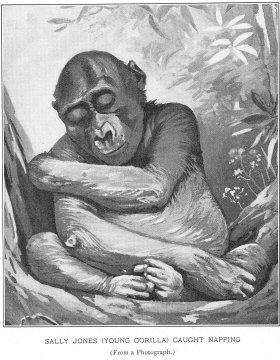 |
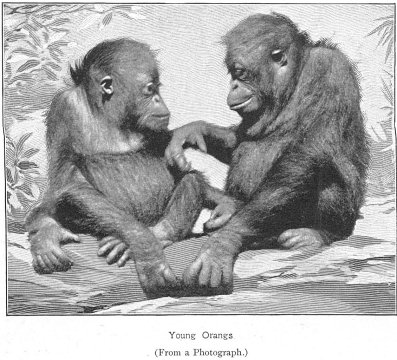 |
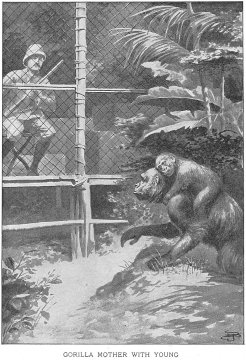 |
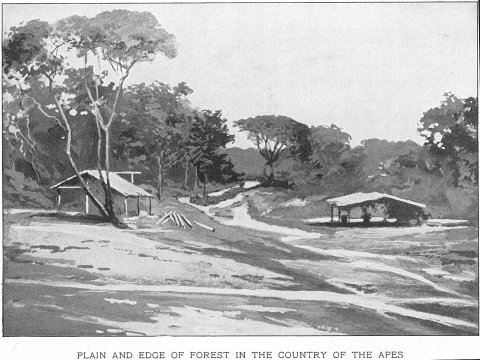
|
|
|
|

BILL
HILLMAN
Visit
our thousands of other sites at:
BILL &
SUE-ON HILLMAN ECLECTIC STUDIO
ERB
Text, ERB Images and Tarzan® are ©Edgar Rice Burroughs, Inc.-
All Rights Reserved.
All
other Original Work ©1996-2007 by Bill Hillman and/or Contributing
Authors/Owners
No
part of this web site may be reproduced without permission from the respective
owners.