
Volume 1813b
Georges Dodds'
The Ape-Man: his Kith and Kin
A collection of texts which prepared the
advent of Tarzan of the Apes by Edgar Rice Burroughs
Presents
http://www.erbzine.com/mag18/buel2a.htm
Heroes of the Dark Continent . . .
J.W. Buel
PART IIa: Chapters XXVI - XXX1 and Appendix &
Epilogue
CONTINUED FROM
PART II
TABLE OF CONTENTS
| Chapter XXVI. |
Adventures on the Route - Stanley's studies of the natives - Cruel
devices of the natives - Wounded in the feet by concealed skewers - Insects
that make life on the Congo unbearable - Mists of the morning - Poisoned
arrows - How the poison is made - Agriculture on the Congo - Exciting sport
on the Aruwimi - Hippopotami, monkeys and crocodiles - Mohammedans eating
hippopotami flesh under a dispensation - A hippopotamus adventure - Lieut.
Stairs in danger - Attacked by a wounded hippopotamus - Stanley to the
rescue - Among the crocodiles - The snake-eaters - How the crocodile is
hunted - Crocodile traps - The Wambutti dwarfs - Some fearful stories -
Appearance and customs of the dwarfs - Cannibalism - Affection exhibited
by a bereaved mother - Disposition of the Dwarfs' dead - The Quimbandes
- Habits and appearance - A tribe with tails - Scared by a camera - Singular
tribes - The M'teita tribe - Their customs and hospitality. |
| Chapter XXVII. |
The Approach to Albert Lake - A scramble for a sardine box - Weakened
by hunger - "Cheer up, boys!" - A park-like country - Purpose of the Maxim
gun - A big hunt - Charge of a mad buffalo - Look out for the rhinoceros!
- A dash through the carriers - A dreadfully scared company - A bath in
the lake - Return to the Aruwimi camp - Deplorable condition of the rear
column - Small-pox and other sufferings - Relief after a long siege of
starvation - A capture of Dwaris natives - Again on the brink of starvation
- Calling a council - Search for the missing - Letters from Jephson - Jephson
and Emin prisoners of the Mahdi - The victorious Mahdi - The situation
very serious - Release of Emin, but sad forebodings - Stanley's reply to
Jephson - Fascinated by the Soudan - Stanley's warnings - Arrival of Jephson
- A courier from Emin. |
| Chapter XXVIII. |
Discoveries which Excite the World's Applause - Stanley's feeling towards
Emin - Rehearsing the perils of his march - The Mayuemas and the slave
traders - Wonderful discoveries - The Ruewenzori snowy range - Salt lakes
- A geographical review - Correcting mistakes of the former explorers -
Extent of Albert Lake - Views about Albert Lake and Mt. Ruewenzori - Mistakes
of Baker - New sources of the Nile - Disappointments crowd fast on one
another - Dangerous position of Jephson and Emin - Invasion of the Mahdists
- Indecision of Emin - A lion hunt - Scarcity of lions in West Africa -
The game located - A night station in a tree - Approach of three lions
- A magnificent moonlight scene - Two lions wounded - Twenty shots required
to bag the game - A savage struggle with death - Carrying a lion's head
as a trophy. |
| Chapter XXIX. |
A Great Hunt - Shooting hippopotami on Albert Lake - An elephant hunt
- A terrifying spectacle - A vast sea of grass - Flanking the herd - Stanley
selects a great tusker - Retreat of the wounded elephant - The pursuit
- Another shot - Furious charge of the elephant - Narrow escape of Stanley
- Death of the monarch - Vast elephant herds in the Congo region - Tipo
Tib's vast stores of ivory - Value of the ivory annually collected - 200,000
elephants - Other rich products - Preparing to return to Zanzibar - Vigorous
measures for suppressing a conspiracy - Number and kinds of people composing
the returning caravan. |
| Chapter XXX. |
The March to the Sea - Justice to Emin - A letter from Emin - Another
letter from Stanley - The lofty Ruewenzori range - A fight - A delusion
- A brush with the Warasura - Scaling the mountain - A vast sea of salt
- The caravan stricken with fever - A land desolated by pillage - A tradition
of the Snow King - Fields of rich promise - Descriptions of the tribes
- Remarkable vicissitudes. |
| Chapter XXXI. |
End of the Journey - The return route - Expert tree - climbers - Why
they made their habitations in trees - Shooting an eagle by magic - A funny
scene - A singular annual custom - The Wahuma chief and his wives - Incidents
of the march - Dying on the way - An accident from exploding shells - Enraged
natives - Emin Pasha's daughter - A Hebrew turned Mohammedan - News of
Stanley's return - Dying in hammocks - Evil reports - A meeting between
Stanley and Wissmann - The mirth that a snake produced - Jephson's wild
ride - Arrival at Bagamoyo - Magnificent reception accorded the explorers
- A champagne banquet - An accident to Emin Pasha - His fall from a high
balcony and dangerous hurt - Honors to Stanley - Banqueted, toasted and
feted by distinguished people - Honored by the Khedive - His visit to Cairo. |
| APPENDIX. |
|
| ADDENDA --- AN EPILOGUE. |
|
ADVENTURES ON THE ROUTE.
The description which Stanley gives of his journey from Yambuya to Kavalli,
on Lake Albert, is in the nature of a report to a scientific body, and
therefore, while reciting the perils of the march, it does not descend
to the particulars of adventures, which he reserved for subsequent description,
for publication as well as to add exciting interest to the letters which
he wrote from Africa to his friends. It was my good fortune to be able
to secure facts from his correspondence, and to add here the principal
adventures of his most memorable journey.
As an explorer, whose chief mission, while philanthropic, was hardly
less an ambition to familiarize himself with new regions, Stanley could
not afford to disregard even the traditions respecting the country lying
along the Aruwimi river, especially since, though possibly idle stories,
they were evidently grounded firmly in the beliefs of both Arabs and natives
of all Central Africa. By this careful attention to beliefs, as well as
critical observation, he has been able to give us much information about
tribes which have never before been brought to the notice of even ethnologists,
much less to the great mass of people. To features of his march not described
in his letter to the Relief Committee we must therefore now address ourselves.
[Mustering
of the hostiles]
CRUEL DEVICES ADOPTED BY THE NATIVES.
Among other difficulties encountered on the journey, Stanley says that
very shortly after the expedition departed from Yambuya the members were
initiated into the subtleties of savage warfare. Among other arts practised
by the natives for annoying strangers was that of filling shallow pits
with sharpened splinters, or skewers, deftly covered over with leaves.
For barefooted people the results were terrible; and ten men were wounded
by these skewers, which would often perforate the foot quite through, or
the tops would be buried in the feet, producing gangrenous sores.
To these distressful annoyances, or more properly murderous obstructions,
complaint is added against swarming insects, such as gnats, flies and ants,
which, in some places attacked the expedition in such numbers and with
such venomous bites as forced the men to throw down their burdens and fight
for life. [Dwellings
of tribes below Nejambi Rapids.]
The mornings along the river were generally lowering and very sombre,
everything being buried in thick mist, which frequently did not clear off
until nearly noon. While this lasted the air was still as death, and gave
the insects opportunity for foraging off every living thing. When the sun
came out, and the breeze sprang up, the small winged creatures fled away
and settled.
The Nejambi Rapids marked the division between two different kinds of
architecture and language. Below were the cone huts; above were villages
long and straight, of detached square huts surrounded by tall logs of wood,
which added materially to the strength of the village. But all the villages
were hostile, and were also armed with strong bows from which poisoned
arrows were discharged with deadly effect. Stanley and his officers became
much exercised as to what might be the poison on the heads of the arrows
by which Lieutenant Stairs and several others were wounded, and from the
effects of which four died almost directly. During a halt at Avesibba several
packets of dried red-ants were found, and the secret was out. The bodies
of these insects were dried, ground into powder, cooked in palm oil, and
smeared on the arrow tips, and thus the deadly irritant, by which so many
men had been lost after the most terrible suffering, was conveyed into
the arrow wounds. This poison is so potent that it is forbidden to prepare
it near a village. [ELEVATED
DWELLINGS ALONG THE ARUWIMI.]
Stanley also mentions having seen immense piles of oyster shells on
several islands in the Aruwimi, though this peculiar species of bivalves
is not now found living in the river. He also notes a curious means employed
by the natives in clearing the forests of tall white-stemmed trees characteristic
of the Lower Congo, which is by building a platform about the trees, ten,
fifteen, and even twenty feet high, and then cutting off the trunk at that
height. The purpose of this most singular practice could not be discovered,
except that the natives considered too much labor involved in the clearing
out of trunks and stumps, and therefore thought all useful means were accomplished
by the lopping off of that portion of the tree whose foliage would give
too much shade to what they planted. Nor is this theory without reason,
for in Africa land has no ownership, and the tribes are usually migratory.
A single, or at most two crops are harvested by one family on the same
ground in many districts, hence a thorough clearing cannot be afforded.
Stanley also incidentally notes having seen occasional huts built on piles,
and even stumps of trees, at a considerable elevation, but does not give
us the reasons for this kind of architecture.
EXCITING SPORT ON THE ARUWIMI.
While a much larger part of the journey toward Kavalli was made on land,
along the river shore, yet in several instances large canoes, called nuggers,
were procurable at native villages, and in these the expedition travelled
until an interruption in the navigation compelled a return to the land.
Canoes were always hard to obtain, and in nearly all cases where they could
be hired the owners would not allow them to be taken beyond a few miles.
It is true, Stanley had a sufficiently well-armed force with him to take
by violence what he was unable to secure by purchase, but his was a peaceful
mission, and he avoided, even to the point of seeming cowardice, collisions
with the natives, in no instance beginning an attack, and always resorting
to every possible means for evading a fight even in his own defence. Notwithstanding
his sufferance, however, he was forced many times to make a vigorous defence
to avoid destruction at the hands of violently hostile tribes who opposed
every conceivable impediment at their command to his advance. [A
SCHOOL OF HIPPOPOTAMI.]
The short relays of canoes that were obtainable gave great relief to
the weary and footsore travellers, besides often affording exciting sport
to the hunters and venturously inclined members of the expedition. The
river has little current, on which account, as well as the few disturbances
of the ancient quiet of that region, it is made the haunt of great numbers
of hippopotami and crocodiles, while monkeys of many varieties are to be
constantly seen in wanton gambols among the trees that line the banks.
Being well supplied with arms and ammunition, Stanley and his lieutenants
found much amusement shooting the larger game from the canoes; and even
their Arab auxiliaries, who generally maintained a melancholy mien, threw
off their sullenness for an occasional hunt along the shores.
Many times during the trip the party were sorely pressed for food, and
were forced to many expedients to obtain it. The natives were generally
very poor themselves, and while having little to sell, were even less inclined
to furnish food for strangers. Hunting, too, was frequently a doubtful
resource, because, while in certain sections game was abundant, in others
there seemed to be no animal life whatever. The Arabs -- ; about
a dozen having followed the expedition after Tipo Tib left it at Stanley
Falls -- ; fared worse than the others, because of their religious
scruples about eating hippopotamus flesh, which they regard as unclean.
But the gnawing pangs of hunger finally overcame the proscription of creed
and belief, so that they were brought to partake of the forbidden food.
It was a ludicrous sight to Christians to see a lay Mohammedan acting the
part of priest and blessing the dead body of a hippopotamus preparatory
to making a feast, and in the ceremony to see so strong a religious barrier
destroyed. A common affliction does indeed make us all brothers.
[BLESSING
THE DEAD BODY OF A HIPPOPOTAMUS.]
A HIPPOPOTAMUS ADVENTURE.
The monotony of ruthless slaughter, which had continued for several days,
was at last disturbed by an exciting incident in which Lieutenant Stairs
figured more conspicuously than even his adventure-loving disposition desired.
Slow progress was being made by some of the party on shore while others
were poling and paddling at equally slow pace in a half-dozen nuggers,
Stairs being in the lead, and Stanley following in his steel whale boat,
the
Advance. In a considerable cove, where the river had once made
a turn and then swept back again into its former channel, [Stair's
adventure with a bull hippopotamus] leaving a half-stagnant elbow,
several hippopotami were seen sporting, and decision was immediately made
to attack them. Stairs pushed forward, his approach being hidden by a jutting
point, until he had gained a position sufficiently near to permit an effective
shot. The nugger was now brought round to an unexpected meeting with a
large cow hippopotamus, which Stairs fired at and badly wounded. [THE
PRISON OF EMIN PASHA AND MR. JEPHSON AT DUFFILI. -- ; (See page 530.)]
In its violent struggles the animal turned over and over in the shallow
place until its movements excited the compassion of its companions, three
of which came charging to the rescue, with one uncommonly large bull in
the lead. The shallowness of the water prevented the huge animals from
diving and coming up under the canoe, as is their custom, and forced them
to make the approach in full view. Thus when the bull, re-enforced by its
almost equally dangerous companions, came rushing towards the canoe with
wide open mouth, Stairs opened fire upon it, but to so little effect that
the animal was not checked, while its rage was greatly increased. The other
three, however, were frightened by the discharge of the gun and made off
in great haste, leaving their leader to fight the battle alone. The bull,
whose head now presented a horrible sight by reason of his gaping jaws,
red and frothing, with blood pouring from three wounds that seemed to be
discharging their flood directly into his mouth, came charging onto the
canoe, which it actually seized and would have torn in pieces together
with the occupants had not those following behind in the other canoes come
up at this juncture and poured an effectual broadside of shots into the
mad monster. The result, however, was a badly broken canoe, and an impromptu
bath by Stairs, who had leaped out of the boat when he saw the enemy's
mouth apparently opened to receive him.
AMONG THE CROCODILES.
Along the Aruwimi, especially in the more desert regions, where famines
are said to be frequent, the natives are omnivorous in their diet, eating
every kind of animal food, not excepting human flesh , crocodiles, monkeys,
snakes, lizards and worms. The snake-eaters are particularly repulsive
in their appearance no less than in their habits; for not only is their
food most vile, but their filth and squalor are equally so. A group of
these miserable people gathered about a fire, cooking their evening meal
of snakes and lizards, is a sight not only appalling but one at once so
disgusting and loathsome that we sorrow because all mankind is made of
one likeness. [Novel
means of killing crocodiles]
Having no effective arms with which to hunt the Crocodiles, some of
the Aruwimi tribes exercise a cunning expedient to effect the capture of
these dangerous reptiles, It requires a cool head and steady nerves to
put the plan into practice, but these requirements are seldom wanting among
savage people. The native hunter, when he seeks this kind of game, takes
with him a very simple arm, being only a thick stick some ten inches long,
through which runs a slender piece of iron sharply pointed at both ends.
Finding his quarry asleep along some sedgy bank, he cautiously and noiselessly
approaches until within a dozen feet or more of the crocodile. The hunter
now drops down into a prostrate position and crawls carefully along towards
the reptile's mouth. When within three or four feet he makes a peculiar
clucking noise, which arouses the crocodile but does not alarm it. His
motions are now such that the creature believes a meal to be near at hand
and turns his head to seize the prey; at this moment the hunter thrusts
his instrument into the mouth of the crocodile, who seizes it with avidity
only to find itself helpless to do any harm with its teeth. Generally the
pain caused by the sharp points of the weapon makes the crocodile very
angry and in its rage pursues the hunter. In this case the creature only
hastens its doom, for the hunter can easily keep out of reach of the crocodile's
tail, which is now its only means of offence, and when it is sufficiently
far from the water the hunter boldly seizes it and either doubles the forelegs
up over the back, beats it to death with a dub, or rips it up with a sharp
piece of iron which serves the purpose of a knife. [A
crocodile snare.]
Crocodiles are also caught by means of spring-traps made by bending
over a strong sapling and attaching to the end a vine with an iron hook
fastened to it, and a hoop so set that in reaching the bait on the hook
the creature must thrust his head through the ring. When the bait is seized
the vine is loosed from its fastenings and up goes the sapling, lifting
the crocodile just high enough -- ; while the hook serves to hold
him -- ; to leave him dancing on his hind legs and tail, and strangulation
ends his troubles in the course of an hour.
This same means of catching the crocodile is employed by a half-dozen
tribes of South American Indians, and it is also used by some of the people
in South Africa.
THE WAMBUTTI DWARFS.
It will be remembered that in Stanley's first trip across the Continent,
as he came near the upper waters of the Congo he met an Arab caravan under
Tipo Tib, which he engaged to escort him a considerable distance; that
the great Arabian chief told the intrepid explorer a wonderful story about
a race of dwarfs towards the north with whom he had once come in contact
much to his own cost. The reader will also recall to mind the fact that
while making his way down the Congo Stanley had the fortune to capture
a member of the pigmy tribe, but was not able to elicit any information
from him beyond the simple fact that he, like all others of his people,
was a cannibal.
The story of Tipo Tib received partial confirmation in the capture thus
made, and also in the harrowing fears of Kabba Rega, who assured Stanley
that there was a race of dwarfs living somewhere to the west of Unyoro
of the most violently vindictive dispositions, and who, besides possessing
surprising courage, were always murderously inclined, and capable of doing
the greatest mischief. For these Kabba Rega entertained such a fear that
he spoke of them as he would of avenging spirits, with powers of the supernatural.
[A
dwarf watch tower]
That these fearful stories were a superstructure of fable built upon
a small base of facts is not surprising, and it is with no wonder therefore
that Stanley found them to be so. But the pigmies are certainly a verity,
and even this much excites our liveliest interest to know something about
them. The tribe, called Wambuttis, occupy a considerable district lying
on both sides of the Aruwimi, and nearly midway between Yambuya and Albert
Lake. Their average height is certainly not more, perhaps less, than three
feet, but occasionally specimens of the tribe may be seen five feet in
height, while there are as many of the exceptionally short that scarcely
exceed two feet; a majority of them are slightly under three feet. But
though short of stature they are uncommonly muscular and are also very
ingenious, particularly in working iron. Their chief weapons are bows and
arrows, the former being occasionally made of steel and the latter invariably
tipped with metal. The few bows, indeed the only one seen that was made
of steel, seemed to be rather experimental than practical, for it was too
stiff for even the strongest man to draw effectively. But it is very interesting
to know that the tribe make and work steel, which is a most uncommon thing
in Central Africa.
CUSTOMS AND APPEARANCE OF THE DWARFS.
The Wambuttis are fishers and hunters and pursue both callings with great
success. In hunting the largest game they go in considerable bodies, surrounding
such animals as the elephant and literally worrying it to death by persistent
pursuit and the shooting of hundreds of arrows into it. They possess considerable
quantities of ivory as trophies of the hunt, and they manifest no small
ingenuity in carving it into fantastic designs for bracelets, anklets,
armlets, and even necklaces. [DWARF
SHOOTING SOCIABLE WEAVER BIRDS.]
Contrary, however, to tradition, the Wambuttis do not wear beards, and
in all respects they have the negroid characteristics of woolly hair, black
eyes, thick lips, flat nose and large mouth. They are certainly very courageous,
but not nearly so vindictive and cunningly cruel as Kabba Rega and Tipo
Tib represented; but that they are guilty cannibalism there was not wanting
the strongest evidence. Human skulls were frequently to be seen on poles
about their villages and in a single instance a fairly well- cured human
arm was seen hanging to the outside wall of a hut. It bore the appearance
of having been smoked for a considerable time, but none of the villagers
could be induced to talk about any of their habits. In fact, there was
no one in the expedition who could understand their language.
While the Wambuttis are evidently extremely barbaric, and no doubt practise
cruelties which distinguish all barbarous tribes, yet Stanley had ocular
proof of the fact that they also possess the most admirable traits of character
and are moved by the instincts of love. There was no evidence of polygamy,
while the domestic ties were evidently very strong. Each family resided
together in an elevated hut that was thatched with grass and carried up
in a cone shape to a sharp point, or central support, which projected several
feet above the crown of the roof. During a short stay at one of the villages
a child of one the natives died, and Stanley saw the evidences of intense
grief which the event caused. The mother appeared to be crazed by her sorrow
and had to be restrained by her friends from committing some desperate
act. Another woman, probably the grandmother, judged by her appearance,
took the dead body upon her lap and poured out a libation of tears and
wailings that was deeply affecting to behold. [Adventure
in the dwarf country.]
The disposition of their dead is similar to that practised by the Sioux
Indians, the bodies being placed in rude coffins, frequently made from
the hollow of trees cut of a proper length and closed at the ends, and
then deposited on scaffolds, where they are secure from wild beasts.
[Gathering
honey]
THE QUIMBANDES.
Beyond the dwarfs, or nearer Lake Albert, lives an exceedingly fine appearing
tribe called the Quimbandes, who are chiefly noted for their physical symmetry
and the peculiar manner in which they dress the hair. Their only clothing
is a narrow leathern girdle about the loins from which hangs, before and
behind, a strip of hide, or cloth when procurable. But while they bestow
small attention to their bodies, infinite care is evidently taken with
the hair, quite as much, indeed, as is bestowed by the Manyuemas. Some
are to be seen with the hair tightly rolled, with bright feathers rising
out of a chignon, while the more fastidious contrive by some artful means
to arrange the hair, by plaiting and twisting, into the form of a Roman
helmet, while yet others present the appearance of wicker- work.
The Quimbandes are an indolent people, whose only known manufacture
is willow baskets. They live chiefly by fishing, but vary their diet of
fish by eating various insects, notably the locust -- ; our grasshopper
-- ; which is highly esteemed by them. They also gather considerable quantities
of honey, as large stores were invariably found in their villages. Their
houses are miserable pretences, made by setting up a few poles with a rack
on top, which is then covered with loose grass. A ludicrous scene was precipitated
by Mr. Williams, when he attempted to photograph a group of females who
mistook his camera for a magic gun.
[THE
DWARFS' MANNER OF DISPOSING OF THEIR DEAD.]
A TRIBE WITH TAILS.
Adjoining the Quimbandes is another peculiar tribe almost equally symmetrical
in form and greatly resembling the Bongos, but Stanley has neglected to
give us even their local designation, though from a photograph we have
[First
conflict with the natives -- ; (See page 466)] been able to make
an excellent illustration. They wear scarcely as much clothing as their
neighbors, nor do they bestow any care on the hair, leaving it to run riot
like the indifferent pure Africans that they are. But they nevertheless
have some idea of decoration, though it develops, to our tastes, in an
increasing unsightliness rather than an improvement. The women affect the
pelele, or lip ring, like some of the South American tribes, and by inserting
a bit of ivory in the lower lip gradually enlarge the wound until pieces
of bone, wood, or ivory, more than an inch in diameter, may be inserted
and worn. Besides this singular, so-called ornament, they wear a cincture
of hide, with a bundle of grass tied in front to serve the traditional
purpose of fig-leaves, and a cow-tail hangs from the belt behind, which
led to the belief among travellers that they had natural tails. The wrists
and ankles are invariably encumbered by numerous iron rings, a form of
jewelery that is strikingly common among savage people. [Scared
by Mr. Williams' camera.]
Unlike the Quimbandes, these neighbors are an agricultural people, and
are also somewhat pastoral, though their herds of cattle and sheep are
always very small. They raise grain and tobacco and give considerable attention
to poultry. Their dwellings are pretentious in size, but are so fragile
in construction and material as to serve only a short time; either a fire
burns them [The
promised land: End of the great Congo forest region. -- ; (See page
476)] or a wind- storm soon destroys them. They are made almost entirely
of grass and bear a striking, resemblance to a large wheat stack, except
that the apex, instead of being pointed, is made to assume a bushy appearance.
THE M'TEITA.
Still further eastward is the M'teita tribe, who are a picturesque people
by reason of the numerous gewgaws the women especially affect, which, while
they do not clothe or conceal the body, certainly do highly decorate.
The women are of pleasing features and often real pretty, even to the
critical eye of an American. They are especially fond of bead-work, and
the belles ornament their bodies with strings of various colored beads
wound round and round the waist, breast, neck and head. In front is worn.
a lappet of cloth or skin, also decorated with beads, and the buttock is
covered with a piece of fringed cloth, while the arms and legs bear a very
burden of rings made of ivory, iron, and occasionally of copper. The men
are not nearly so vain and are content with a plain piece of cloth about
the loins -- ; in this respect being more modest than the women
-- ; and sometimes a necklace of either beads or a small bit of leather
with some equally simple ornament strung upon it. [A
dandy]
The M'teita do a little farming and raise a few goats and sheep, but
they are chiefly traders, and as such travel considerably in Uganda, Unyoro,
Usoga, and other kingdoms about Lake Albert. They construct very crude
dwellings of grass, and with this crudeness is also found an utter lack
of comfort or convenience, the floors having no covering except a thin
layer of grass, which is not changed often enough to prevent a very foul
odor, while the sides of thatch are so loose as to freely admit both wind
and rain. But for all this they appear to be a contented, and certainly
a hospitable people. [A
M'Teita man and woman]
THE APPROACH TO LAKE ALBERT.
Stanley's approach to Lake Albert was indicated by not only a marked improvement
in the natives, whose proximity to the semi-civilized lake tribes had produced
a distinct influence for their betterment, but also the change was clearly
noticeable in the game, which became gradually more plentiful. As Stanley
has said, a considerable part of the journey was made through an almost
desert region, which was not only an untrodden wilderness, but one in which
nature had withheld her bounty. Very frequently the expedition was reduced
to such desperate straits, for want of food, that the men were almost ready
to excuse the practice of cannibalism among the people whose homes had
to be made in such a country. Stanley mentions an incident somewhat ludicrous
in its aspect, to illustrate the hunger from which the whole expedition
suffered. He had bravely endured the privations in common with his men,
and went on an allowance so small that his strength became much impaired.
On one occasion he subsisted for an entire day on a single small box of
sardines, and in the evening, seated alone in a place where he hardly expected
to be observed, he ate the last little fish and then licked the oil out
of the can as clean as ever a starving animal picked a bone. But what was
his astonishment when at last he threw the empty box away to see three
natives, who had been secretly watching him, make a violent scramble for
it, and in the struggle for its possession they fought as do hungry dogs
over a piece of meat. At length the stronger one secured the box, and spent
quite half an hour both smelling and licking it, just as Stanley himself
had done. Possibly the tin attracted their admiration, but certain it is
that they would have prized, at that time, its former contents much more,
for hunger was plainly stamped on their pinched features.
CHEER UP, BOYS!
As the country became more park-like the spirits of those composing the
expedition grew buoyant. All the way Stanley had sought to sustain their
courage by many promises both of rewards and assurances that the hardships
would soon be at an end. His words were always, "Cheer up, boys; it is
only a short distance to the station, where we shall find plenty." Thus
so cheerful did he always himself appear, as did also his lieutenants,
that the influence on the carriers was such as to keep them on the march.
To turn back and go again through the desert wilderness was not to be thought
of, hence the men could hardly consider any other alternative than that
which lay before them, but many more would no doubt have fallen exhausted
by the way had not Stanley appealed to their courage as he did. At one
place, however, there was a mutiny, which, but for Stanley's prompt action
in visiting upon the leader a swift punishment by his own hand, might have
proved quite serious. But when the leader went down under a blow from the
handle of the great leader's axe, the others, only half persuaded to make
resistance, quickly resumed their burdens, and thenceforth continued obediently
on.
A show of force is the best preventive of actual violence, and the native
Africans never respect a man so much as the one who shows determination.
[STARVATION
PRECIPITATES A SCRAMBLE.] This knowledge is what induced Stanley to
take with him a Maxim gun, quite as much as the possible need for it. A
mere exhibition of its dreadful destructiveness would serve to over-awe
the natives, and therefore Stanley had not really expected to have to put
it to a deadly use, unless it should be necessary against well- armed and
hostile Arabs, who it was not unlikely would be met, or against the Mahdi's
forces, who were believed to have Emin Pasha a prisoner. But with his keen
perception of every situation, and his great forbearance, Stanley was not
forced to slaughter the natives, and drove his way through the darkest
regions with a very small sacrifice of human life.
[STANLEY
ENFORCING ORDERS]
CHARGE OF A MAD BUFFALO.
As the expedition reached the hills that overlook the great lake basin,
which is about twenty-five miles wide, game began to appear, and to procure
a supply of fresh meat, a hunting party was organized to make a drive among
the buffaloes, several of which had been seen. The main force and the carriers
continued on the route, while Stanley, Nelson and Parke, with a dozen beaters,
started on the hunt, intending to move parallel with the marching caravan.
They had covered several miles before a herd was discovered in a position
favorable for an attack, as they did not wish to be led away any considerable
distance from the co1umn. At length a drove was descried less than a mile
off to the right, and the beaters were sent out to get on the far side
and drive them in. They accomplished their purpose so well that the buffaloes
headed directly for the hunters who had dropped down in the grass out of
sight of the game. On they came at great speed until within a few yards,
when the three hunters rose up and delivered a volley that killed two cows
and severely wounded a bull. But the latter kept on at a thunderous pace
and, as if blinded by its wound, drove directly for the column of carriers.
[A
BUFFALO'S MAD CHARGE.] The mad animal was discovered when it was perhaps
a hundred yards off, when immediately there was an excitement that did
not wait for the order to break ranks. Every man for the moment was an
independent out of file, and the hurried manner of their wild, distracted
retreat was as laughable to the disinterested spectator as it was serious
to those in flight. Burdens were dropped with extraordinary promptness
and each man prepared to climb who could find a tree, while others just
ran any way under an impromptu call to find another place. The bull perhaps
never thought of making an attack, though its lowered head and high-flying
tail certainly looked very dangerous, but it passed on through the broken
ranks and out of sight without making any other demonstration.
[A
rhinoceros creates consternation]
LOOK OUT FOR THE RHINOCEROS!
Most singular to relate, on the next day the experience with the wounded
buffalo was repeated almost identically with a black rhinoceros. The hunters
had been shooting antelopes, when a rhinoceros was jumped, at which Parke
made a shot, bringing the animal to its knees, the bullet having no doubt
struck the animal in the shoulder; but on the next instant it was up again
and became a target for Stanley, who fired an ineffectual shot, which struck
it too high on the back to penetrate the armor-like hide. The rhinoceros
now had his anger up, but instead of turning to attack, which they seldom
do, tore away and went "whoof- whoofing" towards the moving column, less
than half a mile distant. The scare of the preceding day was yet fresh,
and the sight of a charging rhinoceros filled the cavalcade with a terror
which may not even be conceived, much less described. Down went the packs
with the violence of extreme haste, and away went the carriers with a swiftness
truly astonishing, every man for himself in tumultuous eagerness to reach
safety first. The animal, seeing his supposed enemy in retreat, took courage
and tossed one of the bundles on his horn, but did no further damage, taking
himself off into the brush with this single exhibition of his temper.
A DISAPPOINTMENT.
At length Stanley and his party sighted Lake Albert, and the tedious, toilsome
and perilous journey was at an end, at least for the time being. In Stanley's
letter, found on preceding pages, is contained a description of the arrival
at Kavalli, the station on Lake Albert, and an expression of his disappointment
in his failure to meet with Emin Pasha, and his inability to procure boats
to go in search of him. To this description I may add a few facts which
Stanley has since reported by private letter. His men were so overjoyed
at the sight of the lake, where food and rest were promised, that regardless
of their heavy burdens the carriers ran at their top speed, and as the
day was very hot, some of them actually sped down the hill and into the
lake, so eager were they for the relaxation and enjoyment which its clear
cool waters offered. A stop was made of some hours on the banks, during
which the entire expedition, of men, women and children, indulged the incomparable
pleasure of a delightful bath, in which the interest was so charming that
every past misery was forgotten.
A RETURN TO THE ARUWIMI.
After sporting in the refreshing waters for a time the expedition entered
Kavalli and remained there for nearly two weeks, Stanley all the while
using every possible effort to procure boats to go on to Wadelai, and hoping
all the while that news of his arrival would reach Emin and result in a
meeting. But, as Stanley has so graphically reported, all his efforts and
hopes were in vain, so that there appeared to be nothing for him to do
but retrace his steps to Banalya, on the Aruwimi (also called the Ituri)
river, where he had left his steel steam launch, as that was the only craft
that could be obtained. Jephson had been sent on with an escort, by land,
to Wadelai, which was known to be Emin's headquarters, some time before,
and Stanley felt that by communicating a knowledge of his proximity to
Lake Albert and his purpose to afford relief, that Emin would send one
of his steamers to Kavalli to await him. In this belief, Stanley gave direction
to a Kavalli chief to report his intentions, and then prepared to plunge
again into the wilderness which promised a repetition of all the perils
and dreadful hardships through which he had just passed. His carriers were
only induced to accompany him by his agreement to pay them very large rewards,
and by threats of punishment in case of their refusal. [A
wild rush into the lake.]
This return journey was accomplished in the manner already partly told,
as also the third march which took him back to Yambuya in search of the
rear column. To the descriptions previously given, however, I am permitted
to add further particulars from Stanley letters just to hand.
After Stanley's return to Kavalli with the steam launch he still was
unable to reach Emin, because in the mean time Emin had been to that station
and went away almost immediately without informing the Kavalli chief of
his intended destination, and particularly because reliable information,
in the form of letters from Jephson, reached him giving a brief account
of a Mahdi uprising that had occurred in the mean time which had resulted
in the capture of both Emin and Jephson, who were then held prisoners at
Wadelai. Stanley's force at Kavalli was too small to cope with so powerful
an antagonist as the Mahdi, so he hurriedly left Kavalli again for Yambuya
to bring up the rear column, with which additional force he hoped to be
able to effect a rescue of Emin and Jephson, even should a battle be necessary.
DEPLORABLE CONDITION OF THE REAR COLUMN.
Writing from a village called Kaffurro, on the Kargagwe river, a branch
of the Aruwimi, Stanley says:
"My last report was sent off by Salim Behammod
in the latter part of September, 1888. Over a year full of stirring events
have taken place since then. I will endeavor to inform you what has occurred.
When we reached the camp, after great privations, but nothing to what we
were afterwards to endure, we found the 102 of the yet remaining members
of the rear column in a most deplorable condition. I doubted whether 50
of them would live to reach the lake; but having collected a large number
of canoes, the goods and sick men were transported in these vessels in
such a smooth and expeditious manner that there were remarkably few casualties
in the rear column. But wild natives, having repeatedly defeated the Ugarrowwa's
raiders, and by this discovered the extent of their own strength, gave
considerable trouble and inflicted considerable loss among our best men,
who had always to bear the brunt of the fighting and the fatigue of the
paddling. However, we had no reason to be dissatisfied with the time we
had made. When progress by river became too tedious and difficult, an order
to cast off canoes was given. This was four days' journey above the Ugarrowwa's
Station, or about 300 miles above Banalya. We decided that as the south
bank of the Ituri river was pretty well known to us it would be best to
try the north bank, although we should have to traverse for some days the
despoiled lands which had been a common centre to the Ugarrowwa's and Kilinga-Longa's
bands of raiders. We were about a hundred miles from grass land; which
opened up a prospect of future feasts of beef, veal and mutton, and a pleasing
variety of vegetables, as well as oil and butter for cooking.[Fight
at Abi Sibbam August 13, 1887, Lieutenant Stairs wounded with an arrow.]
On October 30th, having cast off the canoes, the land
march began in earnest, and two days later we discovered a large plantation
in charge of Dwaris. The people flung themselves on the plantains to make
as large a provision as possible for the dreaded wilderness ahead. The
most enterprising always secured a fair share, and twelve hours later would
be furnished with a week's provision of plantain flour. The feeble and
indolent revelled for the time being on an abundance of roasted fruit,
but always neglected providing for the future, and thus became victims
to famine after moving from this place. Ten days passed before we reached
another plantation, during which we lost more men than we had lost between
Banalya and Ugarrowwa's.
SMALL-POX AND OTHER SUFFERINGS.
Small-pox broke out among the Manyuema, and the
mortality was terrible. Our Zanzibaris escaped the pest, however, owing
to the vaccination they had undergone on board the Madura. [A
DWARIS VILLAGE.] We were now about four days' march above the confluence
of the Ihuru and Ituri rivers, and within about a mile from Ishuru. As
there was no possibility of crossing this violent tributary of the Ituri
or Aruwimi, we had to follow its right bank until a crossing could be discovered.
Four days later we stumbled across the principal village of the district,
called Andikumu. It was surrounded by the finest plantation of bananas
and plaintains we had yet seen, which all the Manyuemas habit of spoliation
and destruction had been unable to destroy. There our people, after starving
during fourteen days, gorged themselves to such excess that it contributed
greatly to lessen our numbers. Every twentieth individual suffered from
some complaint which entirely incapacitated him for duty.
The Ihuru river was about four miles south-southeast from
this place, flowing from east-north-east. It was about sixty yards broad
and deep owing to heavy rains. From Andikumu six days' march brought us
to another nourishing settlement, called Indeman, situated about four hours'
march from a river supposed to be the Ihuru. Here I was considerably nonplussed
by a grievous discrepancy between native accounts and my own observations.
The natives called it the Ihuru river, and my instruments and chronometer
made it very evident it could not be the Ihuru. We knew finally. After
capturing some Dwaris we discovered it was the right branch of the Ihuru,
called the Duru river, this agreeing with my own views. We searched and
found a place where we could build a bridge across. Bonny and our Zanzibari
chief threw themselves into the work, and in a few hours the Duru river
was safely bridged. We passed from Indeman into a district entirely unvisited
by Manyuema." Here the writer describes daily conflicts with the Wambutti
dwarfs, which he found very numerous in this region, which have already
been noticed. The Wambuttis clung to the north-east route, which Stanley
wanted to take; accordingly he went south-east and followed elephant tracks.
[Dwaris
women]
He says: But on December 9th we were compelled to halt
for forage in the middle of a vast forest, at a spot indicated by my chart
to be not more than two or three miles from Ituri river, which many of
our people had seen. While we resided at Fort Bodo, I sent 150 rifles back
to a settlement that was fifteen miles back on the route we had come, while
many Manyuema followers also undertook to follow them. I quote from my
journal part of what I wrote on December 14th, the sixth day of the absence
of the foragers: Six days have transpired since our foragers left us. For
the first four days the time passed rapidly, I might say pleasantly, being
occupied in recalculating my observations from Ugarrowwa's to Lake Albert
down to date, owing to a few discrepancies here and there, which my second
and third visit and duplicate and triplicate observations enabled me to
correct. My occupation then ended. I was left to wonder why the large band
of foragers did not return.
ON THE BRINK OF STARVATION.
On the fifth day, having distributed all the
stock of flour in camp, and having killed the only goat we possessed, I
was compelled to open the officers' provision box and take a pound pot
of butter, with two cupfuls of my flour, to make an imitation gruel, there
being nothing else save tea, coffee, sugar and a pot of sago in the boxes.
In the afternoon a boy died, and the condition of the majority of the rest
was most disheartening. Some could not stand, falling down in the effort
to do so. These constant sights acted on my nerves until I began to feel
not only moral but physical sympathy, as though the weakness was contagious.
Before night a Mahdi carrier died. The last of our Somalis gave signs of
a collapse, and the few Soudanese with us were scarcely able to move. When
the morning of the sixth day dawned, we made broth with the usual pot of
butter, an abundance of water, a pot of condensed milk and a cupful of
flour for 130 people.
CALLING A COUNCIL.
The chiefs and Bonny were called to a council.
At my suggestion of a reverse to the foragers of such a nature as to exclude
our men from returning with news of the disaster, they were altogether
unable to comprehend such a possibility. They believed it possible that
these 150 men were searching for food, without which they would not return.
They were asked to consider the supposition that they were five days searching
for food, without which they would not return, and then had lost the road,
perhaps, or, having no white leader, had scattered to loot goats, and had
entirely forgotten their starving friends and brothers in the camp. What
would be the state of the 130 people five days hence? Bonny offered to
stay with ten men in the camp if I provided ten days' food for each person
while I would set out to search for the missing men. Food, to make a light
cupful of gruel for ten men for ten days, was not difficult to procure,
but the sick and feeble remaining must starve unless I met good fortune,
and accordingly a store of buttermilk, flour and biscuits was prepared
and handed over to the charge of Bonny. In the afternoon of the seventh
day we mustered everybody besides the garrison of the camp, ten men.
SEARCHING FOR THE MISSING.
Sadia, Manyuema chief, surrendered fourteen of
his men to their doom. Kibbobora, another chief, abandoned his brother,
and Fundi, another Manyuema chief, left one of his wives and her little
boy. We left twenty-six feeble and sick wretches, already past all hope
unless food could be brought them within twenty-four hours. In a cheery
tone, though my heart was never heavier, I told the forty-three hunger-bitten
people that I was going back to hunt for the missing men. We travelled
nine miles that afternoon, having passed several dead people on the road;
and early on the eighth day of their absence from camp we met them marching
in an easy fashion. But when we were met the pace was altered, so that
in twenty-six hours from leaving starvation camp we were back with an abundance
around us of gruel and porridge, boiling bananas, boiling plantains, roasting
meat and simmering soup. This had been my nearest approach to absolute
starvation in all my African experience. Altogether twenty-one persons
succumbed in this dreadful camp.
LETTERS FROM JEPHSON.
On December 23d the united expedition continued
the march eastward, and as we now had to work by relays, owing to the fifty
extra loads, we did not reach the Ituri ferry, which was our last camp
in the forest region before emerging on grass land, until January 9th.
My anxiety about Mr. Jephson and Emin would not permit me to dawdle on
the road, making double trips in this manner, so, selecting a rich plantation
and a good camp east of the Huri river, I left Stairs in command with 124
people, including Parke and Nelson, and on January 11th I continued my
march eastward. The people of the plains, fearing a repetition of the fighting
of December, 1887, flocked to the camp as we advanced and formally tendered
their submission, agreeing to the contributions and supplies. The blood-
brotherhood was entered into, the exchange of gifts was made and a firm
friendship established. The huts of our camp were constructed by natives,
and food, fuel and water were brought to the expedition as soon as a halting
place was decided on. We heard no news of white men on Lake Albert from
the people until on the 16th, at a place called Gevaris. Messengers from
Kavalli came with a packet of letters, with one letter written on three
several dates, with several days' interval between, from Jephson, and two
notes from Emin, confirming the news in Jephson's letter. You can but imagine
the interest and surprise I felt while reading the letters by giving you
extracts from them in Jephson's own words:
DUFFILI, NOVEMBER 7th, 1888.
"DEAR SIR: I am writing to tell you the
position of affairs in this country, and I trust the letter will be delivered
to you at Kavalli in time to warn you to be careful. On August 18th a rebellion
broke out here and the Pasha and I were made prisoners. The Pasha is a
complete prisoner, but I am allowed to go about the station, but my movements
are watched. The rebellion has been got up by some half-dozen Egyptians
-- ; officers and clerks -- ; and gradually others joined, some through
inclination, but most through fear. The soldiers, with the exception of
those at Labore, have never taken part in it, but have quietly given in
to their officers. When the Pasha and I were on our way to Regaf, two men,
one an officer, Abdul Vaal Effendi, and the other a clerk -- ; went
about and told to the people they had seen you, and that you were only
an adventurer, and had not come from Egypt; the letters you brought from
the Khedive and Nubar were forgeries; that it was untrue Khartoum had fallen,
and that the Pasha and you had made a plot to take them, their wives and
children out of the country and hand them over as slaves to the English.
[ONE
OF EMIN'S IRREGULARS DISPERSING A PARTY OF REBELS.] Such words in an
ignorant, fanatical country like this acted like fire among the people,
and the result was a general rebellion, and we were made prisoners. The
rebels then collected the officers from the different stations and held
a large meeting here to determine what measures they should take, and all
those who did not join the movement were so insulted and abused that they
were obliged for their own safety to acquiesce in what was done.
THE VICTORIOUS MAHDI.
"The Pasha was deposed and
those officers, suspected of being friendly to him were removed from their
posts, and those friendly to the rebels were put in their places. It was
decided to take the Pasha as a prisoner to Regaf, and some of the worst
rebels were even for putting him in irons, but the officers were afraid
to put their plans into execution, as the soldiers said they never would
permit anyone to lay a hand on him. Plans were also made to entrap you
when you returned and strip you of all you had. Things were in this condition
when we were startled by the news that the Mahdi's people had arrived at
Lado with three steamers and nine sandals and nuggers and had established
themselves on the site of the old station. Omar Sall, their general, sent
up three peacock dervishes with a letter to the Pasha demanding the instant
surrender of the country. The rebel officers seized them and put them in
prison and decided on war. After a few days the Mahdists attacked and captured
Regaf, killing five officers and numbers of soldiers and taking many women
and children prisoners, and all the stores and ammunition in the station
were lost. The result of this was a general stampede of the people from
the station of Brodons, Kirri, and Muggi, who fled with their women and
children to Labore, abandoning almost everything. At Kirri the ammunition
was abandoned, and was seized by natives. The Pasha reckons that the Mahdists
number about 1600. The officers and a large number of soldiers have returned
to Muggi and intend to make a stand against the Mahdists. Our position
here is extremely unpleasant, for since the rebellion all is chaos and
confusion. There is no head, and half a dozen conflicting orders are given
every day and no one obeys. The rebel officers are wholly unable to control
the soldiers. The Baris have joined the Mahdists. If they come down here
with a rush nothing can save us.
"The officers are all frightened at
what has taken place and are anxiously awaiting your arrival and desire
to leave the country with you, for they are now really persuaded that Khartoum
has fallen and that you have come from the Khedive. We are like rats in
a trap. They will neither let us act nor retire, and I fear, unless you
come very soon, you will be too late and our fate will be like that of
the rest of the garrisons of the Soudan. Had this rebellion not happened
the Pasha could have kept the Mahdists in check some time, but now he is
powerless to act. I would suggest, on your arrival at Kavalli, that you
write a letter in Arabic to Shukri Aga, Chief of the Mswa station, telling
him of your arrival and telling him you wish to see the Pasha and myself.
Write also to the Pasha or myself telling us what number of men you have
with you. It would perhaps be better to write to me, as a letter to him
might be confiscated. Neither the Pasha nor myself think there is the slightest
danger now of any attempt to capture you, for the people are now fully
persuaded that you have come from Egypt and they look to you to get them
out of their difficulties. Still it would be well for you to make your
camp strong. If we are not able to get out of the country, please remember
me to my friends, etc. Yours faithfully,
"JEPHSON."
At the time the above letter was written a messenger could not be obtained
to carry it over the route to meet Stanley, who was known to be returning
to the lake, and Jephson therefore had opportunity to add two postscripts
giving ampler details of the troubles by which they had been surrounded,
and also to convey the pleasanter information of Emin's release. He therefore
added the following, under date of November 4th:
RELEASE OF EMIN, BUT SAD FOREBODINGS.
"Shortly after I had written
you the soldiers were led by their officers to attempt to retake Regaf,
but the Mahdists defended it and killed six officers and a large number
of soldiers. Among the officers killed were some of the Pasha's worst enemies.
The soldiers in all the stations were so panic-stricken and angry at what
happened that they declared they would not attempt to fight unless the
Pasha was set at liberty. So the rebel officers were obliged to free him
and sent him to Wadelai where he is free to do as he pleases, but at present
he has not resumed authority in the country. He is, I believe, by no means
anxious to do so. We hope in a few days to be at Tunguru Station on the
lake, two days by steamer from Nsabe, and I trust when we hear of your
arrival that the Pasha himself will be able to come down with me to see
you. We hear that the Mahdists sent steamers to Khartoum for re-enforcements.
If so they cannot be up here for another six weeks. If they come up here
with re-enforcements it will be all up with us, for the soldiers will never
stand against them, and it will be a mere walk-over. Everyone is anxiously
looking for your arrival, for the coming of the Mahdists has completely
cowed them. We may just manage to get out if you do not come later than
the end of December, but it is entirely impossible to foresee what will
happen."
Jephson's second postscript, dated December 18th, reads:
"Mogo, the messenger, not
having started I send a second postscript. We were not at Tanguru on November
15th. The Mahdists surrounded Duffili station and besieged it for four
days. The soldiers, of whom there are about 500, managed to repulse them
and they retired to Regaf, their headquarters, as they have sent down to
Khartoum for re-enforcements and doubtless will attack again when strengthened.
In our flight from Wadelai, the officers requested me to destroy our boats
and the advances. I therefore broke it up. Duffili is being renovated as
fast as possible. The Pasha is unable to move hand or foot as there is
still a very strong party against him, as officers are no longer in immediate
fear of the Mahdists. Do not on any account come down to us at my former
camp on the lake near Kavalli Island, but make your camp at Kavalli on
the plateau above. Send a letter directly you arrive there, and as soon
as we hear of your arrival I will come to you. I will not disguise facts
from you that you will have a difficult and dangerous work before you in
dealing with the Pasha's people. I trust you will arrive before the Mahdists
are re-enforced or our case will be desperate. Yours faithfully,
"JEPHSON."
STANLEY'S LETTER IN REPLY TO JEPHSON.
Stanley immediately returned a reply to Jephson's letter by the messengers,
in which he wrote:
"Be wise, be quick, and waste no time. Bring
Buifa and your own Soudanese with you. I have read your letters half a
dozen times over, but fail to grasp the situation thoroughly, because in
some important details one letter contradicts the other. In one you say
the Pasha is a close prisoner, while you are allowed a certain amount of
liberty. In the other you say you will come to me as soon as you hear of
our arrival here, and 'I trust,' you say, 'that the Pasha will be able
to accompany me.' Being prisoners, I fail to see how you could leave Tunguru
at all. All this is not very clear to us, who are fresh from the bush.
If the Pasha can come, send a courier on your arrival at your camp on the
lake below here to announce the fact and I will send a strong detachment
to escort him to the plateau; even to carry him if he needs it. I feel
too exhausted after my 1300 miles of travel since I parted from you last
May to go down to the lake again. The Pasha must have some pity for me.
Don't be alarmed or uneasy on our account. Nothing hostile can approach
us within twelve miles without my knowing it. I am in the thickest of a
friendly population, and if I sound a war note, within four hours I can
have 2000 warriors to assist me to repel any force disposed to violence,
and if it is to be a war, why then I am ready for the cunningest Arab alive.
I have read your letter a half-dozen times and my opinion of you varies
with each reading. Sometimes I fancy you are half Mahdist or Arabist, then
Eminist. I shall be wiser when I see you. Now, don't you be perverse, but
obey and let my order to you be as a frontlet between the eyes, and all,
with God's gracious help, will end well. I want to help the Pasha somehow,
but he must also help me and credit me."
FASCINATED BY THE SOUDAN.
"On January 16th," says Stanley, "I received with this batch of letters
two notes from the Pasha himself, confirming the above. But not a word
from either Jephson or the Pasha indicating the Pasha's purpose. Did he
still waver or was he at last resolved? With any man than the Pasha or
Gordon one would imagine that being a prisoner and a fierce enemy hourly
expecting to give the coup mortal, he would gladly embrace the first chance
to escape from the country given up by his government. But there was no
hint in the letters what course the Pasha would follow. These few hints
of mine, however, will throw some light on my postscript, which here follows,
and of my state of mind after reading these letters. I wrote a formal letter,
which might be read by any person, Pasha, Jephson or any of the rebels,
and addressed it to Jephson, as requested, but on a separate sheet of paper,
after we reached Kavalli, I wrote a private postscript for Jephson's perusal,
as follows:
KAVALLI, Jan. 18th, 3 P.M.
"My DEAR SIR: --I now send thirty rifles and Kavalli's men
down to the lake with my letters, with my urgent instructions that a canoe
should be set off. [Torturing
the Mahdi's dervishes, by order of Emin Pasha's rebel officers.] I
may be able to stay longer than six days here, perhaps ten. I will do my
best to prolong my stay until you arrive, without rupturing the peace.
Our people have a good store of beads and couriers' clothes, and I notice
that the natives trade very easily, which will assist Kavalli's resources
should he get uneasy under our prolonged visit. Should we get out of this
trouble, I am his most devoted servant and friend; but if he hesitates
again, I shall be plunged in wonder and perplexity. I could save a dozen
pashas if they were willing to be saved. I would go on my knees and implore
the Pasha to be sensible of his own case. He is wise enough in all things
else, even for his own interest. Be kind and good to him for his many virtues,
but do not you be drawn into the fatal fascination the Soudan territory
seems to have for all Europeans in late years. As they touch its ground
they seem to be drawn into a whirlpool, which sucks them in and devours
them with its waves. The only way to avoid it is to obey blindly, devotedly
and unquestionably all orders from the outside. The committee said: 'Relieve
Emin with this ammunition. If he wishes to come out, the ammunition will
enable him to do so. If he elects to stay, it will be of service to him.'
[THE
COURIER TAKING EMIN'S LETTER.] The Khedive said the same thing, and
added that if the Pasha and his officers wished to stay they could do so
on their own responsibility. Sir Evelyn Baring said the same thing in clear,
decided words, and here I am after 4100 miles' travel with the last instalment
of relief. Let him who is authorized to take it, take it and come. I am
ready to lend him all my strength and will assist him, but this time there
must be no hesitation, but positive yea or nay, and home we go.
Yours sincerely,
"STANLEY"
THE ARRIVAL OF JEPHSON.
In the course of his correspondence Mr. Stanley says:
"On February 6th, Jephson arrived in the afternoon
at our camp at Kavalli. I was startled to hear Jephson, in plain, undoubting
words, say, 'Sentiment is the Pasha's worst enemy. No one keeps Emin back
but Emin himself.' This is the summary of what Jephson learned during the
nine months from May 25, 1888, to February 6, 1889. I gathered sufficient
from Jephson's verbal report to conclude that during nine months neither
the Pasha, Casati nor any man in the province had arrived nearer any other
conclusion than what was told us ten months before. However, the diversion
in our favor created by the Mahdist's invasion and the dreadful slaughter
they made of all they met inspired us with hope that we could get a definite
answer at last. Though Jephson could only say: 'I really can't tell you
what the Pasha means to do. He says he wishes to go away, but will not
move. No one will move. It is impossible to say what any man will do. Perhaps
another advance by the Mahdists will send them all pell-mell towards you,
to be again irresolute and requiring several weeks' rest.'"
COURIER FROM EMIN.
Stanley next describes how he had already sent orders to mass the whole
of his forces ready for contingencies. He also speaks of the suggestions
he made to Emin as to the best means of joining him, insisting upon something
definite; otherwise it would be his (Stanley's) duty to destroy the ammunition
and march homeward. He continues: "February 13 a native courier appeared
in camp with a letter from Emin, and with the news that he was actually
at anchor just below our plateau camp. But this is his formal letter to
me dated the 13th:
"'SIR: -- ; In answer to your letter of
the 7th inst., I have the honor to inform you that yesterday I arrived
here with my two steamers, carrying a first lot of people desirous to leave
this country under your escort. As soon as I have arranged for a cover
for my people, the steamers have to start for Mswa Station to bring on
another lot of people. Awaiting transport with me are some twelve officers
anxious to see you, and only forty soldiers. They have come under my orders
to request you to give them some time to bring their brothers from Wadelai,
and I promised them to do my best to assist them. Things having, to some
extent, now changed, you will be able to make them undergo whatever conditions
you see fit to impose upon them. To arrange these I shall start from here
with officers for your camp, after having provided for the camp, and if
you send carriers I could avail me of some of them. I hope sincerely that
the great difficulties you had to undergo and the great sacrifices made
by your expedition on its way to assist us, may be rewarded by full success
in bringing out my people. The wave of insanity which overran the country
has subsided, and of such people as are now coming with me, we may be sure.
Permit me to express once more my cordial thanks for whatever you have
done for us.
"'Yours,'
'EMIN.' "
DISCOVERIES THAT EXCITE THE WORLD'S APPLAUSE.
Considering the trials, sufferings, and almost unparalleled hardships through
which Stanley had passed in his philanthropic mission to relieve Emin,
whose situation was certainly critical, with his power and influence destroyed
and whose most ambitious and optimistic hopes could hardly picture a pleasing
prospect, it is but natural that the great explorer should feel a sense
of disappointment, if not disgust, at the unreasonable coolness and indifference
with which Emin received his suggestions. It is not surprising either that
this want of appreciation on the part of Emin should weigh heavily on the
mind of Stanley and cause him time and again to review the privations which
he had endured, in his undertaking to perform the most magnanimous and
unselfish service for one who, while unappreciative, nevertheless needed
the aid that had been rendered. Says he in a letter now before me:
"You know that all the stretch of country between
Yambuya and this place is an absolutely new country, except what may be
measured by five ordinary marches. First, there is that dead white of the
map now changed to a dead black. I mean that the region of earth confined
between east longitude 25 degrees and south latitude 29 degrees 45 minutes
is one great compact of a remorselessly sullen forest with a growth of
an untold number of ages, swarming at stated intervals with immense numbers
of vicious man-eating savages, and crafty undersized men, who were unceasing
in their annoyance. Then there is that belt of grass land lying between
it and Albert N'yanza, whose people contested every mile of our advance
with spirit, and made us think that they were guardians of some priceless
treasure hidden in the N'yanza shores or at war with Emin Pasha and his
thousands. Sir Percival in search of the Holy Grail could not have met
with hotter opposition. Three separate times necessity compelled us to
traverse these unholy regions with varying fortunes."
REHEARSING THE PERILS OF THE MARCH.
Referring to the imprisonment of Emin, Stanley then grows reflective over
the miseries which he had so heroically endured, and says:
"Incidents then crowded fast. Emin Pasha was
a prisoner, and an officer of ours was his forced companion, and it really
appeared as though we were to be added to the list. But there is virtue,
you know, even in striving unyieldingly, in hardening the nerves and facing
those overclinging mischances without paying too much heed to the reputed
danger. One is assisted much by knowing that there are no other coups,
and the danger, somehow, nine times out of ten, diminishes. The rebels
of Emin Pasha's Government relied on their craft and on the wiles of the
heathen Chinee, and it is rather amusing to look back and note how punishment
has fallen on them. Was it Providence or luck? Let those who love to analyze
such matters reflect. Traitors without the camp and, traitors within were
watching, and the most active conspirator was discovered, tried and hanged.
The traitors without fell afoul of one another and ruined themselves. If
not luck, then it is surely Providence in answer to good men's prayers.
Far away our own people, tempted by extreme wretchedness and misery, sold
our rifles and ammunition to our natural enemies, the Manyuema, the slave
traders' true friends, without the least grace in either bodies or souls.
What happy influence was it that restrained me from destroying all those
concerned in it? Each time I read the story of Captain Nelson's sufferings
I feel vexed at my forbearance, [ALONG
THE UPPER ARUWIMI.] and yet again I feel thankful, for a higher power
than man's severely afflicted the cold-blooded murderers by causing them
to feed upon one another a few weeks after the rescue and relief of Nelson
and Parke. The memory of those days at times hardens and again unmans me."
WONDERFUL DISCOVERIES.
But with all these sufferings, including also an illness of twenty-eight
days, which came near terminating fatally, and the apparent ingratitude
of Emin, with the enthusiasm of a great explorer Stanley suddenly rises
out of his depression of spirits to voice the joy of his important discoveries,
that seem at once to compensate him for every hardship and every slight
he ever endured. Says he: "Terrible as was this last march, it was delightful
in the wonderful discoveries that we made, which crowded fast one after
another upon our surprised vision. Snowy ranges of the Ruewenzori (cloud
king or rain creator), the Semliki river, the Albert Edward N'yanza, the
plains of Noongora, the salt lakes of Kative, the new peoples: Wakonju,
great mountain dwellers of a rich forest region; the Awamba, the fine-featured
Wazonira, the Wanyoro bandits, the Lake Albert Edward tribes and the shepherd
races of the eastern uplands, then the Wanyankori, besides the Wanyaruwamba
and the Wazinja, until at last we came to a church whose cross dominated
a Christian settlement, and we knew that we had reached the outskirts of
blessed civilization."
Continuing a report of his discoveries, written Sept. 8th, 1888, from
a natunda village on the Ituri, to Col. J.A. Grant, a member of the Relief
Committee, he says:
"My DEAR GRANT: --I have only been able to write
scrappy letters hitherto, though I start them with a strong inclination
to give our friends a complete story of our various marches and their incidents.
But so far I have been compelled to hurriedly close lest I should miss
the opportunity to send them. This one, for instance, I know not how to
send at present, but an accidental arrival of a caravan or an accidental
detention of the expedition may furnish the means. I will trust to chance
and write, nevertheless. [PUNISHMENT
OF A TRAITOR.]
"You, more than any of the committee, are interested in
Lake Albert. Let us deal with that first. When on December 13th, 1887,
we sighted the lake, the southern part lay at our feet almost like an immense
map. We glanced rapidly [Stanley's
and Emin Pasha's forces on the march to the coast.] over the grosser
details, the lofty plateau, the wall of Unyoro to the east and that of
Baregga to the west, rising nearly 3000 feet above the silver water, and
between the hills the stretched out plains, seemingly very flat and grassy,
with here and there a dark clump of brushwood, which, as the plain trended
southwesterly, became a thin forest. The south-west edge of the lake I
fixed at nine miles in a direct south-westerly line from this place. This
will make the terminus of the south-west corner 1 deg. and 17 min. north
latitude, by prismatic compass, magnetic bearing; of the south-east corner
just south of a number of falls 1 deg. 37 min. This will make it about
1 deg. 11 min. 3° sec., north latitude, magnetic bearing of 1 deg.
48 min. Taken from north latitude 1 deg. 25 min. 3° sec., this exactly
describes the line of shore running from the south-west corner of the lake
to the south-east corner of Albert. Baker fixed his position latitude 1
deg. 15 min. north if I recollect rightly. The centre of Mbakovia terrace
bears 1 deg. 21 min. 3° sec. magnetic from my first point of observation.
This will make his Vacovia about 11 deg. 15 min. 45 sec., allowing 10 deg.
west variation.
"In trying to solve the problem of the infinity of Lake
Albert, as sketched by Baker, and finding that the lake terminus is only
four miles south of where he stood to view it 'from a little hill' and
on 'a beautiful clear day,' one would feel almost justified in saying he
had never seen the lake. But his position of Vacovia proves that he actually
was there, and the general correctness of his outline of the east coast
of Vacovia to Magungo also proves that he navigated the lake.
VIEWS ABOUT LAKE ALBERT AND MOUNT RUEWENZORI.
"When we turn our faces north-east we saw that
Baker had done exceedingly well; but when we turn them southward our senses
in vain try to penetrate the mystery, because our eyes see not what Baker
saw. With Lieut. Stairs, Mounteney Jephson, Surgeon Parke, Emin Pasha,
Capt. Casati, I look with my own eyes upon the scene. I find Baker has
made an error. I am somewhat surprised also at Baker's altitudes of Lake
Albert and the Blue Mountains, and at the breadth attributed by him to
the lake. The shore opposite Vacovia is ten and a quarter miles distant,
not forty or fifty miles. The Blue Mountains are nothing else but a vast
upland, the highest cone or hill being not above 6000 feet above the level
of the sea. The altitude of Lake Albert by the aneroid and the boiling
point will not exceed 2350 feet.
"Last of all, away to the south-west, where he has sketched
his infinite stretch of the lake, there rises about forty miles from Vacovia
an immense snowy mountain, a solid, square-browed mass with an almost level
summit between two lofty ridges. If it was a beautifully clear day he should
have seen this, being nearer to it by thirteen geographical miles than
I was.
"About the lake discovered by me in 1876 I can learn very
little from the natives. At the chief of Kavalli's I saw two natives who
came from that region. One of them hailed from Unyampaka and the other
from Usongora. The first said that the Albert Lake is much larger than
that near Unyampaka. The other said that the southern lake is the larger,
as it takes two days to cross it. He describes it as being a month's march
from Kavalli. Their accounts differ so much that one is almost tempted
to believe that there are two lakes, the smaller one near Unyampaka, and
connected by a river or channel with that of Usongora.
"My interest is greatly excited, as you may imagine, by
the discovery of Ruewenzori, the snowy mountain, and a possible rival of
Kilima Njaro. Remember that we are in north latitude, and that this mountain
must he near or on the Equator itself; that it is summer now, and that
we saw it in the latter part of May; that the snow line was estimated at
about 1000 feet below the summit.
"Hence, I conclude that it is not Mount Gordon Bennett,
seen in December, 1876 -- ; though it may be so -- ; which
the natives said had only snow occasionally. At the time I saw the latter
there was no snow visible. It is a little further east, according to the
position I gave it, than Ruewenzori. All questions which this mountain
naturally gives rise to will be settled, I hope, by this expedition before
it returns to the sea.
"If at all near my line of march, its length, height and
local history will be ascertained. Many rivers will be found to issue from
this curious land between the two Muta Nzigas. What rivers are they? Do
they belong to the Nile or the Congo? There is no river going east or south-
east from this section except the Katonga and Kafur, and both must receive,
if any, but a very small supply from Mount Gordon Bennett and the Ruewenzori.
The new mountain must, therefore, be drained principally south and west;
if south, the streams have connection with the lake south; if west, Semliki,
a tributary of Lake Albert and some river flowing to the Congo must receive
the rest of its waters. Then, if the lake south receives any considerable
supply, the interest deepens. Does the lake discharge its surplus to the
Nile or the Congo? If to the former, then it would be of great interest
to you, and you will have to admit that Lake Victoria is not the main source
of the Nile. If to the Congo, then the lake will be the source of the River
Lowa or Loa, since it is the largest tributary to the Congo from the east
between the Aruwimi and Luama.
"For your comfort, I will dare to venture an opinion even
now that the lake is the source of the Lowa, though I know nothing positive
of the matter; but I infer from the bold manner in which the Aruwimi trenches
upon the domain that anyone would have imagined that it belonged to the
Nile. It was only ten minutes' march between the head of one of its streams
to the crest of the plateau whence we looked down upon Albert N'yanza.
From the mouth of Aruwimi to the head of this stream are 390 geographical
miles in a straight line. Well, next to the Aruwimi in size is the Lowa
river, and from the mouth of the Lowa to the longitude of Ugampaka Post,
in a direct line, it is only 240 geographical miles.
"Yours, very sincerely,
"HENRY M. STANLEY."
DISAPPOINTMENTS CROWD FAST UPON ONE ANOTHER.
The next letter received from Stanley reads as follows:
"I reached. the Albert N'yanza from Banalya for
the third time in 140 days, and found out that Emin and Jephson had both
been prisoners since the 18th of August, 1888, being the day after I made
the discovery that Barttelot's caravan had been wrecked. The troops in
the Equatorial Province had revolted and shaken off all allegiance. Shortly
after the Mahdists invaded the Province in full force. After the first
battle in May, the stations yielded and a panic struck the natives, who
joined the invaders and assisted in the work of destruction. [View
on the Semliki River]
"The invaders subsequently suffered reverses, and dispatched
a steamer to Khartoum for re- enforcements. I found a letter waiting for
me near the Albert N'yanza exposing the dangerous position of the survivors,
and urging the immediate necessity of my arrival before the end of December,
otherwise it would be too late. I arrived there on the 18th of January
for the third time."
Journeying thus back and forth with seemingly endless
sufferings, and a disappointment connected with every return to the lake,
Stanley became at length exasperated, and resolved upon heroic action to
prevent his labors from resulting in failure, which the civilized world
might really regard a farce. Emin was still at Wadelai, and appeared to
have no inclination to remove from that place to join Stanley, though his
indefinite letters in reply to Stanley's requests left it impossible to
determine whether he wished to escape or remain. [Stanley
bagging an antelope] Stanley's anxiety grew greater as the indecision
of Emin showed no signs of changing, and finally led to the transmission
of a letter couched in such language that it brought a reply from Emin
asking Stanley's indulgence for a time until he could communicate with
his people and ascertain whether or not they desired to leave the Equatorial
Province under Stanley's escort. This was the most pointed reply Emin had
yet made, although it added little hope to the situation, for Emin's people
were scattered over a large territory, and it would require months of time
to collect them together in the event that they decided to leave the country.
But Stanley's patience seems to be inexhaustible, and he concluded to wait,
devoting the period of provoking delay to an examination of the country
and to such sport as the great amount of game in the lake districts afforded.
A LION HUNT.
Stanley engaged the services of a half-dozen natives who were familiar
with the region to act as beaters, and with Williams, who was an inveterate
sportsman, he enjoyed a season of splendid hunting. Several species of
antelopes were [BUFFALO
SHOOTING ALONG THE SEMLIKI RIVER.] particularly numerous, as were also
buffaloes, and these fell to his rifle in great number. But the hunters
thirsted for something more exciting, a desire which was at length gratified.
Lions are scarce on the west side of Lake Albert, but they are occasionally
seen, and at the time of Stanley's visit some depredations had been committed
which were known to be chargeable to one or more lions, as the skeletons
of bullocks had been found, on the bones of which were unmistakable tooth-prints
of the lordly beast. Accordingly, arrangements were made to go in pursuit
of the game. The country which they were believed to infest was thoroughly
examined, but to no avail, and, after beating a district more than twenty
miles in diameter without seeing any evidences of a lion's presence, the
hunters were much discouraged, and would probably have returned but for
the alluring [Stanley's
escape from a wounded elephant] prospect of the country, which they
followed towards the great Ruewenzori mountain with continual delight at
the new wonders that burst one after another upon their enraptured vision,
as will be presently described in one of Stanley's letters.
At length a villager was met who gave the hunters the pleasing information
that two lions had visited the district on the night before, and had been
frightened from the carcass of a giraffe -- ; quite as uncommon in
that region as the lion -- ; which they had more than half devoured.
This was good news, indeed, as the lions were now not only located, but
it might be certainly depended upon that they would return to the feast
sometime in the night. The hunters accordingly followed a guide to the
place where the remains of the carcass lay, and finding it on the edge
of a wooded country, they had no difficulty in securing a safe position
in neighboring trees.
The moon did not rise until nearly midnight, so that the hunters set
up a piece of paper on a stick near the carcass, to serve them in definitely
locating the lions in case they made their visit to the body while it was
yet dark. But this precaution was unnecessary, for the hunters spent a
very uncomfortable four hours in their perches without hearing any sounds
of game whatever. At length the moon arose in great majesty, flooding the
plain and primeval forest, presenting at once a magnificent and romantic
view. A half-hour afterwards the hunters were greeted with a yet more interesting
sight, when they beheld the forms of no less than three lions, two of which
were of immense size. They made their approach slowly, as if expecting
an interruption, but finding everything still, they came on with more confidence,
though the largest one appeared the most timid, evidently taking upon himself
the responsibility of chief watcher. The hunters reserved their fire until
two of the great beasts crouched upon the shoulders of the carcass and
began devouring the body. At this instant two shots rang out almost simultaneously,
followed quickly by two others, and a roaring and growling from two wounded
lions that was truly frightful to hear. The one that acted as sentry bounded
off, but was evidently hit in the hind quarters, from the manner in which
he dragged his left leg; another escaped unhurt, but the smallest of the
three had been struck by two bullets and was unable to rise, but it rolled
over in agony, clawing at everything in reach, and growling with a savageness
that was appalling. From their perches the hunters poured shot after shot
into its body, but apparently to no effect, until at least twenty shots
had been fired before it ceased to struggle violently. When at last death
was certain, Stanley left his position in the tree and approached the body,
which he found to be bleeding from so many wounds that the hide was considered
useless, every shot, apparently, having taken effect, and several had passed
entirely through the body.
The hunt having terminated so favorably, Stanley and Williams returned
to the camp, bearing as a trophy the head of the royal beast to serve as
evidence of the truth of their story.
A GREAT HUNT -- ; PREPARATIONS FOR THE HOME JOURNEY.
The success of Stanley's hunt in the regions west of Lake Albert led others
to attempt an imitation of his prowess as a hunter, and the Arab contingent
started in quest of the two lions that had escaped; but though they were
gone more than a week, and found a great deal of game, including a considerable
herd of elephants, they saw no signs of the lions, nor did any of the villagers
in the district where Stanley's successful hunt occurred. Attention was
then given for several days to shooting hippopotami in Lake Albert, and
in the rivers flowing into it, several being killed and the carcasses given
to the lake natives, who very greatly enjoy hippopotamus flesh.
About the middle of February another hunting party was formed, not so
much for pleasure as for food, since a supply of fresh meat could only
be obtained by purchasing goats of the natives at an exorbitant price,
or by shooting antelopes and buffaloes, which, fortunately, were fairly
abundant. Stanley accompanied the party, carrying a Reilly rifle of large
calibre, as it was his ambition to bag one or more elephants after a sufficient
supply of meat had been secured, and it was his good fortune to meet with
success in this desire. In the regions of the Ruewenzori mountains, south
of Lake Albert, is a splendid range of grass lands, fairly teeming with
game of the largest species, and about the small lakes and ponds, which
are not infrequent in that district, elephants are more numerous than in
any other region of Africa, unless it be along the most fertile stretches
of the Congo banks.
It was not therefore a difficult matter for Mr. Stanley and his beaters
to find abundant adventure among the vast herds of elephants that make
the plains of this mountainous country their favorite grazing grounds.
A TERRIFYING SPECTACLE.
The first troop of elephants discovered by the hunters was in an open plateau
near the Semliki river, where the grass was so high as to cover nearly
three-fourths of their bodies, so that the portions visible bore some resemblance
to a school of giant turtles swimming on the surface of a vast sea of grass;
and in the distance, the undulations produced by the wind increased the
illusion, making the immense pasturage appear like a vast body of water,
rolling wave after wave towards the shore that lay miles beyond. As both
wind and cover were favorable, Stanley and his gun- bearers were able to
approach the herd without detection, and to get on their flank, where,
in case of a sudden bolt, the elephants would not be likely to run over
the hunters, which is really one of the greatest dangers encountered in
stalking these great animals. When in excellent range, Stanley selected
a large tusker and gave it a mortal wound at the first fire, but the stricken
elephant dashed away with the others, and ran nearly a mile before it halted
from exhaustion. The herd made towards the jungle on the left, where it
was easily followed by sight until all except the wounded elephant had
disappeared in the dense growth. Stanley pushed on in the wake of the herd
until he came near the stricken bull, and then reconnoitered for a position
that would enable him to give it a final shot. [ANTELOPE
SHOOTING IN THE SEMLIKI FOREST.] But the elephant was watchful, and
while not able to exert itself as before, there was still sufficient vitality
left to make it a dangerous foe. The beaters were called up, and as they
moved forward the elephant again retreated, until it had gained the forest,
where, in apparent exhaustion, it again stopped and trumpeted shrilly.
A fairly close view showed that the great bull had been struck in the left
temple, from which there was a copious flow of blood that left a well-marked
trail over the two miles which it had now travelled. Stanley continued
in pursuit until he again found his wounded quarry standing under a very
large tree [The
lion hunt] and presenting a spectacle of extraordinary rage, tossing
its trunk and head, frothing at the mouth, waving its tail and roaring
in a voice that startled everything in the forest. To shoot at so large
an elephant at long range, or without direction at one of its very few
vital spots, would be a mere waste of ammunition, so that Stanley gradually
approached nearer and nearer in order to secure a favorable shot; but this
effort proved futile, for at a sight of the hunter the great beast seemed
to summon all its remaining strength for a furious charge. Down it came
plunging through the brush like a nameless mighty thing pushing everything
before it, marking a route like a cyclone and filling the air with such
shrill trumpetings as pierced the ears and lent frenzy to excitement. Stanley,
being in its path, fired his heavy rifle at the monster's head, but with
no effect other than to bring its anger into yet greater emphasis, and
to invite an attack which the elephant made with an impetuosity truly appalling.
After firing his gun Stanley made a quick retreat, but not so quickly as
to throw the animal from his track, for now he was viciously and pertinaciously
pursued. The beaters had scattered in every direction, leaving their master
to his own wits and fortune, which most fortunately served him beneficently.
The elephant was gaining rapidly and must surely overtake him, when at
the last moment Stanley leaped to one side and dodged behind a large tree
just as the mighty leviathan went thundering by, blinded with unexampled
rage. In another moment Stanley's rifle was to his shoulder, and another
bullet was sent into the elephant, which now paused and quickly received
a third four-ounce ball in the side of the head near where he was first
hit. The first bullet fired would certainly have proved fatal in a few
hours, but it required the fourth shot to give the great bull his instant
quietus. On receiving the last bullet the great elephant stood still for
an instant, then raised his trunk slowly as he gradually sank down on his
forelegs until he plunged heavily forward on his head, then rolled over
on his left side quite dead. He was indeed a fallen monarch, who had stood
nearly eleven feet in height and armed with tusks which, after extraction,
weighed ninety pounds each.
VAST ELEPHANT HERDS IN THE CONGO REGION.
Although the district in which Stanley killed this uncommonly large elephant
does not properly belong to the Congo basin, the region is adjoining, and
is a part of the immense grazing lands in which these animals are so numerous.
Commenting on the great number of elephants in the Congo basin, and Tipo
Tib's enormous collections of ivory, Stanley says:
"Until recently we had heard a great deal about
Tipo Tib's store of ivory -- ; an enormous possession. Ward and other
officers of the Belgian company saw it; and some of them could have related
terrible tales of its history. There were tusks which told their own dark
records, blackened with the fire of the burning villages from which they
had been dragged; others stained by long burial in out-of-the-way places,
and only unearthed by their wretched owners for the ransoming of wives
and children. There may have been tusks, and no doubt there were, which
had been obtained in the way of legitimate trade; but, as a rule, the ivory
of the Arab hunter is plunder. It constitutes a vast store, and of enormous
value. There are said to be about 200,000 elephants, in about 15,000 herds,
in the Congo basin. Each carrying on an average about fifty pounds of ivory
in his head, these represent in the European market $5,000,000. But of
yet greater value than the ivory of Central Africa is the rubber, palm
oil, and orchilla weed which that region produces in most remarkable abundance.
If every warrior living on the immediate banks of the Congo and its navigable
affluents -- ; which are of the aggregate length of 10,800 miles,
within easy reach of the trader above Leopoldville -- ; were to pick
about a third of a pound of rubber each day throughout the year, or to
melt two- thirds of a pound weight of palm oil, and convey it to the trader
for sale, $5,000,000 worth of vegetable produce could be obtained without
exhaustion of the wild forest productions. At the same time, although limited
as compared with other products, ivory remains a very valuable article
of commerce. If 200 tusks arrived per week at Stanley Pool, or say 520,000
pounds of ivory per annum, it would still require twenty-five years to
destroy the elephants in the Congo basin. This estimate will enable the
reader to realize the value of Tipo Tib's store, numbering hundreds of
tusks, averaging certainly not less than fifty pounds each in weight."
[Two-horned
African rhinoceros]
Mr. Johnston's experiences on his ascent of the Congo bear out other
reports of the "happy hunting ground." The elephant seems to be in full
and haughty possession of plain and forest. Canoeing or steaming up the
river, you see, every morning, the previous night's devastations of the
elephants, who break and destroy much beautiful vegetation, and often waste
more than they eat. They are much more commonly seen during the dry season,
at which time, the smaller streams being exhausted, the elephants have
to seek the Congo for their bath and their drink. "Although they are much
more frequently met with above Stanley Pool, still in certain districts
of the lower river they are common, especially in the cataract region.
In the country opposite Isangila elephants were often shot by members of
Mr. Stanley's expedition; and at the Livingstone mission station of Banza
Manteka, fifteen miles from the south bank of the Congo, elephants have
at times trooped in long procession past the door of the mission house,
while the awe-stricken missionaries shut themselves up securely within."
PREPARING TO RETURN TO ZANZIBAR.
When the hunt was concluded with such magnificent success -- ; the
game bagged being twenty-one antelopes, five buffaloes, thirteen springboks,
three zebras, six pallahs and one elephant -- ; Stanley returned
with his party to the camp, hoping to be able to speedily move with his
own and Emin's people towards home. The enforced waiting had not been without
very great benefits, for on Stanley's third entry into Kavalli his men
were in a pitiable condition from sickness and ulcers, the result of their
last hard march, already described. This interval of waiting was employed
by Dr. Parke in relieving the intense sufferings of the afflicted. From
the time the expedition left Fort Bodo he had attended an average of one
hundred sick and afflicted daily. The effects of this rest and treatment
were seen in the fact that when the expedition reached Kavalli there were
less than 200 fit for service, whereas on the 1st of April there were 280
able-bodied men both ready and willing to start on the long march to the
sea.
Stanley sent his men to assist the removal of Emin and his people, or
rather to bring their effects that had been landed from the steamers, to
the plateau camp above Kavalli, from which point the start was to be made.
Selim Bey was sent up to Wadelai to muster the people about Tunguru and
Duffili, and bring them by steamer to the Kavalli camp, but now the greater
vexations began, because at the rate that Selim was collecting the Pasha's
people, it would require three months to get them together; besides, the
goods brought down from Wadelai and landed at Kavalli were of a character
that could not possibly be carried so great a distance as lay before them.
Without their effects the people did not want to move, and here was at
once a dilemma that exhausted all the vast store of patience that Stanley
is credited with. Emin Pasha had no influence whatever over his people,
and with Casati's efforts to persuade him to remain, the prospects for
conducting him out of the country were for a time cheerless indeed. In
a few days the Egyptians in camp promised to leave with Emin and Stanley
for the coast, but they soon changed their minds, after reflecting on the
privations of such a march as lay before them, while the Mahdi enemies
were now far away to the north, and a life of elegant ease was theirs while
on the N'yanza Lake.
VIGOROUS MEASURES FOR SUPPRESSING A CONSPIRACY.
Reporting the harassments from which he now suffered, Stanley writes:
"* * * I did not think I should be drawn into
this matter at all, having formed my own plans some time before; but it
intensified my feelings greatly when I was told that, after waiting forty-
four days, building their camps for them, and carrying nearly fourteen
hundred loads for them up that high plateau wall, only a few out of the
entire number would follow us. But on the day after I was informed that
there had been an alarm in my camp the night before; the Zanzibari quarters
had been entered by the Pasha's people, and an attempt made to abstract
the rifles. This it was which urged me to immediate action.
"I knew there had been conspiracies in the camp, that
the malcontents were increasing, that we had many rebels at heart among
us, that the people dreaded the march more than they feared the natives;
but I scarcely believed that they would dare put into practice their disloyal
ideas in my camp.
"I proceeded to the Pasha to consult with him, but the
Pasha would consent to no proposition -- ; not but what they appeared
necessary and good, but he could not, owing to the want of time, etc. Yet
the Pasha the evening before had received a post from Wadelai which brought
him terrible tales of disorder, distress and helplessness among Selim Bey
and his faction, and the rebels and their adherents.
"I accordingly informed him that I proposed to act immediately,
and would ascertain for myself what this hidden danger in the camp was,
and, as a first step, I would be obliged if the Pasha would signal for
general muster of the principal Egyptians in the square of the camp.
"The summons being sounded, and not attended to quickly
enough to satisfy me, half a company of Zanzibaris were detailed to take
sticks and rout everyone from their huts. Dismayed by these energetic measures,
they poured into the square, which was surrounded by rifles.
"On being questioned, they denied all knowledge of any
plot to steal the rifles from us, or to fight, or to withstand in any manner
any order. It was then proposed that those who desired to accompany us
to Zanzibar should step on one side. They all hastened to one side except
two of the Pasha's servants. The rest of the Pasha's people, having paid
no attention to the summons, were secured in their huts, and brought to
the camp square, where some were flogged, and others ironed and put under
guard.
"'Now, Pasha,' I said, 'will you be good enough to tell
these Arabs that these rebellious tricks of Wadelai and Duffili people
must cease here, for at the first move made by them I shall be obliged
to exterminate them utterly.'
"On the Pasha translating, the Arabs bowed, and vowed
that they would obey their father religiously.
"At the muster this curious result was returned: There
were with us 134 men, 84 married women, 187 female domestics, 74 children
above two years of age, 35 infants in arms; making a total of 514. I have
reason to believe that the number was nearer 600, as many were not reported
from a fear, probably, that some would be taken prisoners."
[Decorative
drawing in Greek style]
Justice to the reputation of Emin Pasha, who has been assailed for the
indifference, perhaps ingratitude, exhibited in his conduct towards Stanley
at their first meetings, demands that it be recorded to his credit that,
after the march really began, he gave his energies towards promoting the
comfort of all who accompanied the caravan, and a loyal submission to Stanley
as commandant. That he felt a sense of gratefulness for the relief given
we may well believe, and which he expressed in the following letter:
"MSLALA, August 23, 1889.
"SIR: Having reached, under the escort
of Mr. Stanley's expedition, to-day, this place, I cannot but hasten to
write just two words to tell you how deeply we all appreciate the generous
help you have sent us. When, in the stress of adversity, I first ventured
to make an appeal to the world asking assistance for my people, I was well
aware of such an appeal not passing unheard, but I never once fancied the
possibility of such kindness as you and the subscribers of the Relief Fund
have shown us.
"It would be impossible to tell you
what has happened here after Mr. Stanley's first start; his graphic pen
will tell you everything much better than I could. I hope, also, the Egyptian
Government permitting it, some future day to be allowed to present myself
before you, and to express to you then the feelings of gratitude my pen
would be short in expressing in a personal interview.
"Until such happy moments come, I beg
to ask you to transmit to all subscribers of the fund the sincerest thanks
of a handful of forlorn people, who, through your instrumentality, have
been saved from destruction, and now hope to embrace their relatives.
"To speak here of Mr. Stanley's and
his officers' merits would be inadequate. If I live to return, I shall
make my acknowledgments.
"I am, sir, with many and many thanks,
"Yours very obliged,
"DR. EMIN.
"W. McKinnon, Esq., Chairman of
Committee of the
Relief Expedition Fund."
"On the 10th of April," says Stanley,
"we set out from Kavalli in number about 1500,
for 350 native carriers had been enrolled from the district to assist in
carrying the baggage of the Pasha's people, whose ideas as to what was
essential for the march were very crude. On the 12th we camped at Mazamboni's;
but in the night I was struck down with a severe illness which well-nigh
proved fatal.
"During my illness -- ; of twenty-eight days
-- ; another conspiracy, or rather several conspiracies were afloat, but
only one was attempted to be realized, and the ringleader of that one,
a slave of Awash Effendi's, whom I had made free at Kavalli, was arrested,
and after court-martial, which found him guilty, was executed.
THE LOFTY RUEWENZORI RANGE.
"The route I had adopted was one which skirted
the Balegga Mountains at a distance of forty miles or thereabouts from
the N'yanza. The first day was a fairish path, but the three following
days tried our Egyptians sorely, because of the ups and downs and the breaks
of cone-grass. On arriving at the southern end of these mountains we were
made aware that our march was not to be uninterrupted, for the King of
Unyoro had made a bold push, and had annexed a respectable extent of country
on the left side of the Semliki river, which embraced all the open grass-land
between the Semliki river and the forest region. Thus, without making an
immense detour through the forest, which would have been fatal to most
of the Egyptians, we had no option but to press on, despite Kabba Rega
and his Warasura. This latter name is given to the Wanyoro by all natives
who have come in contact with them.
"The first day's encounter was decidedly in our favor,
and the effect of if cleared the territory as far as the Semliki river
free of the Warasura.
"Meantime we had become aware that we were on the threshold
of a region which promised to be very interesting, for daily, as we advanced
to the southward, the great snowy range which had so suddenly arrested
our attention and excited our intense interest (on May I, 1888) grew larger
and bolder into view. It extended a long distance to the south-west, which
would inevitably take us some distance off our course unless a pass could
be discovered to shorten the distance to the countries south. At Buhobo,
where we had a brief skirmish with Kabba Rega's raiders, we stood on the
summit of the hilly range which bounds the Semliki Valley on its north-west
and south-west sides. On the opposite side rose Ruewenzori, the Snow Mountain,
and its enormous eastern flank, which dipped down gradually until it fell
into the level, and was seemingly joined with the table-land of Unyoro.
The humpy western flank dipped down suddenly, as it seemed to us, into
lands that we knew not by name as yet. Between these opposing barriers
spread the Semliki Valley -- ; so like a lake at its eastern extremity
that one of our officers exclaimed that it was the lake, and the female
followers of the Egyptians set up a shrill 'Lululus' on seeing their own
lake, the Albert N'yanza, again. With the naked eye it did appear like
the lake, but a field-glass revealed that it was a level grassy plain,
white with the ripeness of its grass. Those who have read Sir Samuel Baker's
'Albert N'yanza' will remember the passage wherein he states that to the
south- west the N'yanza stretches 'illimitably.' He might well be in error
at such a distance, when our own people, with the plain scarcely four miles
away, mistook the plain for the N'yanza. As the plain recedes south-westerly
the bushes become thicker; finally acacias appear in their forests, and,
beyond these again, the dead black thickness of an impenetrable tropical
forest; but the plain, as far as the eye could command, continued to lie
ten to twelve miles wide between these mountain barriers, and through the
centre of it -- ; sometimes inclining towards the south-east mountains,
sometimes to the south-west range -- ; the Semliki river pours its
waters towards the Albert N'yanza.
A BRUSH WITH THE WARASURA.
"In two marches from Buhobo we stood upon its
banks, and, alas for Mason Bey and Gessi Pasha! Had they but halted their
steamers for half an hour to examine this river, it would have been sufficient
to excite much geographical interest; for the river is a powerful stream
from eighty to one hundred yards wide, averaging nine feet depth from side
to side, and having a current from three and a half to four knots per hour,
in size about equal to two-thirds of the Victoria Nile. [A
WARASURA WARRIOR.]
"As we were crossing this river the Warasura attacked
us from the rear with a well-directed volley, but, fortunately, the distance
was too great. They were chased for some miles; but, fleet as greyhounds,
they fled, so there were no casualties to report on either side.
"We entered the Awamba country on the eastern shore of
the Semliki, and our marches for several days afterwards were through plantain
plantations, which flourished in the clearings made in this truly African
forest. Finally, we struck the open again immediately under Ruewenzori
itself. Much, however, as we had flattered ourselves that we should see
some marvellous scenery, the Snow Mountain was very coy, and hard to distinguish.
On most days it loomed impending over us like a tropical storm- cloud,
ready to dissolve in rain and ruin on us. Near sunset a peak or two here,
a crest there, a ridge beyond, white with snow, shot into view --
; jagged clouds whirling and eddying round them, and then the darkness
of night. Often at sunrise, too, Ruewenzori would appear fresh, clean,
brightly pure; profound blue voids above and around it; every line and
dent, knoll and turret-like crag deeply marked and clearly visible. But
presently all would be buried under mass upon mass of mist, until the immense
mountain was no more visible than if we were thousands of miles away. And
then, also, the Snow Mountain being set deeply in the range, the nearer
we approached the base of the range the less we saw of it, for higher ridges
obtruded themselves and barred the view. Still, we have obtained three
remarkable views -- ; one from the N'yanza Plain, another from Kavalli,
and a third from the South Point.
SCALING THE MOUNTAIN.
"In altitude above the sea I should estimate
it to be between 18,000 and 19,000 feet. We cannot trust our triangulations,
for the angles are too small. When we were in positions to ascertain it
correctly, the inconstant mountain gathered his cloudy blankets around
him and hid himself from view; but a clear view, from the loftiest summit
down to the lowest reach of the snow; obtained from a place called Karimi,
makes me confident that the height is between the figures stated above.
"It took us nineteen marches to reach the south-west angle
of the range, the Semliki Valley being below us on our right, and which,
if the tedious mist had permitted, would have been exposed in every detail.
That part of the valley traversed by us is generally known under the name
of Awamba, while the habitable portion of the range is principally denominated
Ukonju. The huts of these natives, the Bakonju, are seen as high as 8000
feet above the sea.
"Almost all our officers had at one time a keen desire
to distinguish themselves as the climbers of these African Alps, but, unfortunately,
they were in a very unfit condition for such a work. The Pasha only managed
to get 1000 feet higher than our camp, but Lieutenant Stairs reached the
height of 10,677 feet above the sea, but had the mortification to find
two deep gulfs between him and the Snowy Mount proper. He brought, however,
a good collection of plants, among which were giant heather, blackberries
and bilberries. The Pasha was in his element among these plants, and has
classified them.
"The first day we had disentangled ourselves of the forest
proper, and its outskirts of straggling bush, we looked down from the grassy
shelf below the Ruewenzori range and saw a grassy plain, level seemingly
as a bowling-green, the very duplicate of that which is seen at the extremity
of the Albert N'yanza, extending southerly from the forest of the Semliki
Valley. We then knew that we were not far from the Southern Lake discovered
by me in 1877.
"Under guidance of the Wakonju I sent Lieutenant Stairs
to examine the river, said to flow from the Southern N'yanza. He returned
next day, reporting it to be the Semliki river, narrowed down to a stream
forty-two yards wide and about ten feet deep, flowing, as the canoe- men
on its banks said, to the N'yanza Utuku, or N'yanza of Unyoro --
; the Albert N'yanza. Besides native reports, he had other corroborative
evidence to prove it to be the Semliki.
"On the second march from the confines of Awavela we entered
Usongora, -- ; a grassy region as opposite in appearance from the
perpetual spring of Ukonju as a droughty land could well be. This country
bounds the Southern N'yanza on its northern and north-western side.
A VAST SEA OF SALT.
"Three days later, while driving the Warasura before us, or, rather, as
they were self-driven by their own fears, we entered, soon after its evacuation,
the important town of Kative, the headquarters of the raiders. It is situated
between an arm of the Southern N'yanza and a salt- lake about two miles
long and three-quarters of a mile wide, which consists of pure brine of
a pinky color, and deposits salt in solid cakes of salt-crystals. This
was the property of the Wasongora, but the value of its possession has
attracted the cupidity of Kabba Rega, who reaps a considerable revenue
from it. Toro, Ankori, Mpororo, Ruanda, Ukonju and many other countries
demand the salt for consumption, and the fortunate possessor of this inexhaustible
treasure of salt reaps all that is desirable of property in Africa in exchange,
with no more trouble than the defence of it.
"Our road from Kative lay east and north- east, to round the bay-like
extension of the N'yanza lying between Usongora and Unyampaka, and it happened
to be the same taken by the main body of the Warasura in their hasty retreat
from the salt-lake. On entering Uhaiyana, which is to the south of Toro,
and in the uplands, we had passed the northern head of the N'yanza, or
Beatrice Gulf, and the route to the south was open -- ; not, however,
without another encounter with the Warasura.
"A few days later we entered Unyampaka, which I had visited in January,
1876. Ringi, the king, declined to enter into the cause of Unroyo, and
allowed us to feed on his bananas unquestioned. After following the lake
shore until it turned too far to the south-west, we struck for the lofty
uplands of Ankori, by the natives of which we were well received, preceded,
as we had been, by the reports of our good deeds in relieving the salt-lake
of the presence of the universally obnoxious Warasura.
THE CARAVAN STRICKEN WITH FEVERS.
"If you draw a straight line from the N'yanza
to the Uzinja shores of the Victoria Lake, it would represent pretty fairly
our course through Ankori, Karagwe, and Uhaiya to Uzinja. Ankori was open
to us, because we had driven the Wayneyoro from the salt-lake. The story
was an open sesame. There also existed a wholesome fear of an expedition
which had done that which all the power of Ankori could not have done.
Karagwe was open to us, because free-trade is the policy of the Wanyambu,
and because the Waganda were too much engrossed with their civil war to
interfere with our passage. Uhaiya admitted our entrance without cavil,
out of respect to our numbers, and because we were well introduced by the
Wanyambu, and the Wakwiya guided us in like manner to be welcomed by the
Wazinja. Nothing happened during the long journey from the Albert Lake
to cause us any regret that we had taken this straight course; but we have
suffered from an unprecedented number of fevers. We have had as many as
150 cases in one day. Ankori is so beswept with cold winds that the expedition
wilted under them. Seasoned veterans like the Pasha and Captain Casati
were prostrated time after time, and both were reduced to excessive weakness
like ourselves. Our blacks, regardless of their tribes, tumbled headlong
into the long grass to sleep their fever fits off. Some, after a short
illness, died. The daily fatigues of the march, an ulcer, a fit of fever,
a touch of bowel complaint, caused the Egyptians to hide in any cover along
the route; and, being unperceived by the rear guard of the expedition,
were left to the doubtful treatment of natives of whose language they were
utterly ignorant. In the month of July we lost 141 of their number in this
manner.
"Out of respect to the first British prince, who has shown
an interest in African geography, we have named the southern N'yanza
-- ; to distinguish it from the other two N'yanzas -- ; the Albert
Edward N'yanza. It is not a very large lake. Compared to the Victoria,
the Tanganyika, and the Nyassa, it is small, but its importance and interest
lie in the sole fact that it is the receiver of all the streams at the
extremity of the south-western or left Nile basins, and discharges these
waters by one river, the Semliki, into the Albert N'yanza, in like manner
as Lake Victoria receives all streams from the extremity of the south-eastern
or right Nile basin, and pours these waters by the Victoria Nile into the
Albert N'yanza.
"These two Niles, amalgamating in Lake Albert, leave this
under the well-known name of White Nile.
A LAND DESOLATED BY PILLAGE.
"The southernmost stretch of the Ruewenzori range
projects like a promontory between two broad extents of the ancient bed
of the Albert Edward formerly known as the Muta Nziga. To avoid the long
detour, we cross this hilly promontory in a south-easterly direction from
the Semliki Valley, and enter eastern Usongora, and are in a land as different
from that at the northwestern base of the Ruewenzori as early summer is
from mid-winter. As we continue easterly, we have Ruewenzori on our left
now, and the strangely configured Albert Edward N'yanza on our right. The
broad plains which extend between were once covered by this lake. Indeed,
for miles along its border there are breadths of far-reaching tongues of
swamp penetrating inland. Streams of considerable volume pour through these
plains towards the N'yanza from Ruewenzori, without benefiting the land
in the least. Except for its covering of grass -- ; at this season
withered and dried -- ; it might well be called a desert; yet in
former times, not very remote, the plains were thickly peopled --
; the zeribas of milk-weed and dark circles of euphorbia, wherein the shepherds
herded their cattle by night, prove that, as well as the hundreds of cattle-dung
mounds we came across. The raids of Waganda and the Warasura have depopulated
the land of the Wasongora, the former occupants, and have left only a miserable
remnant, who subsist by doing "chores" for the Warasura, their present
masters.
"From Usongora we entered Toro, the Albert Edward N'yanza
being still on our right, and our course being now north-easterly, as though
our purpose was to march to Lake Albert again. After about twenty miles'
march we turn east, leave the plains of the Albert Edward, and ascend to
the uplands of Uhaiyana, which having gained, our course is south until
we have passed Unyampaka, which I first saw in 1876.
"South of Unyampaka stretches Ankori, a large country
and thickly peopled. The plains have an altitude of over 5000 feet above
the sea, but the mountains rise to as high as 6400 feet. As Ankori extends
to the Alexandra Nile, we have the well-known land of Karagwe south of
this river.
A TRADITION OF THE SNOW KING.
"Since leaving the Albert N'yanza, between Kavalli
and the Semliki river, we traversed the lands of the Wavira and Baregga.
On crossing the Semliki we entered the territory of the Awamba. When we
gained the grassy terrace at the base of the Ruewenzori range we travelled
on the border-line between the Wakonju, who inhabit the lower slopes of
Ruewenzori, and the Awamba, who inhabit the forest region of the Semliki
Valley. The Wakonju are the only people who dwell upon the mountains. They
build their villages as high as 8000 feet above the sea. In time of war
-- ; for the Warasura have invaded their country also -- ; they retreat
up to the neighborhood of the snows. They say that once fifty men took
refuge right in the snow region, but it was so bitterly cold that only
thirty returned to their homes. Since that time they have a dread of the
upper regions of their mountains.
"As far as the south-west angle of Ruewenzori, the slopes
of the front line of hills are extensively cultivated; the fields of sweet
potatoes, millet, eleusine, and plantations of bananas describe all kinds
of squares, and attract the attention; while between each separate settlement
the wild banana thrives luxuriantly, growing at as high an altitude as
the summits of the highest spurs, whereon the Wakonju have constructed
their villages.
"Though we were mutually hostile at first, and had several
little skirmishes, we became at last acquainted with the Wakonju, and very
firm, close friends. The common enemy were the Warasura, and the flight
of the Warasura upon hearing of our advance revealed to the Wakonju that
they ought to be friends with all those who were supposed to be hostile
to their oppressors. Hence we received goats, bananas, and native honey
in abundance; our loads were carried, guides furnished us, and every intelligence
of the movements of the Wanyoro brought us. In their ardor to engage the
foe a band of them accompanied us across Usongora and Toro to the frontier
of Uhaiyana.
DESCRIPTIONS OF THE TRIBES.
"South-west of Awamba, beyond the forest region
of the Semliki Valley, begins Usongora. This country occupies the plains
bordering the north-west and north of Lake Albert Edward. The people are
a fine race, but in no way differing from the finer types of men seen in
Karagwe and Ankori, and the Wahuma shepherds of Uganda. Their food consists
of milk and meat, the latter eaten raw or slightly warmed. [A
WAKONJU WOMAN.]
"The Toro natives are a mixture of the higher class of
negroes, somewhat like the Waganda. They have become so amalgamated with
the lower Wanyoro that we can find nothing distinctive. The same may be
said of the Wahaiyana. What the royal families of those tribes may be we
can only imagine from having seen the rightful prince of Usongora in Ankori,
who was as perfect a specimen of a pure Galla as could be found in Shoa.
But you need not conclude from this that only the royal families possess
fine features. [A
Wahuma band] These Ethiopic types are thickly spread among the Wahuma
of these Central African uplands. Wherever we find a land that enjoys periods
of peace, we find the Wahuma at home, with their herds, and in looking
at them one might fancy himself transported into the midst of Abyssinia.
"Ankori is a land which, because of its numbers and readiness
to resistance, enjoys long terms of uninterrupted peace; and here the Wahuma
are more numerous than elsewhere. The royal family are Wahuma, the chiefs
and all the wealthier and more important people are pure Wahuma. Their
only occupation, besides warring when necessary, is breeding and tending
cattle. The agricultural class consists of slaves -- ; at least such
is the term by which they are designated. The majority of the Wahuma can
boast of features quite as regular, fine and delicate as Europeans.
"The countries to the south of the Albert Edward are still
unexplored, and we have not heard much respecting them; but what we have
heard differs much from that which you find illustrated by that irregular
sheet of water called Muta Nziga in the 'Dark Continent' map.
"Ruanda bears the name of Unyavingi to the people of Ukonju,
Usongora and Ankori, and is a large, compact country, lying between the
Alexandra Nile and the Congo water-shed to the west, and reaching to within
one day's long march to the Albert Edward. It also overlaps a portion of
the south-west side of that lake. The people are described as being very
warlike, and that no country, not even Uganda, could equal it in numbers
or strength. The late queen has been succeeded by her son, Kigeri, who
now governs.
REMARKABLE VICISSITUDES.
"Since the commencement of our march homeward
from our camp at Ravalli, we have undergone remarkable vicissitudes of
climate. From the temperate and enjoyable climate of the region west of
Lake Albert we descended to the hot-house atmosphere of the Semliki Valley
-- ; a nearly three thousand feet lower level. Night and day were equally
oppressively warm and close, and one or two of us suffered greatly in consequence.
The movement from the Semliki Valley to the plains north of Lake Albert
brought us to a dry but a hot land; the ground was baked hard, the grass
was scorched, the sun, but for the everlasting thick haze, would have been
intolerable; in addition to which the water, except that from the Ruewenzori
stream, was atrocious, and charged with nitre and organic corruption. The
ascent to the eastern plateau was marked by an increase of cold and many
an evil consequence -- ; fevers, colds, catarrhs, dysenteries and
paralysis. Several times we ascended to over 6000 feet above the sea, to
be punished with agues, which prostrated black and white by scores. In
the early mornings, at this altitude, hoar-frost was common. Blackberries
were plentiful along the path in north-west Ankori, 5200 feet above the
sea-level.
"Yours obediently,
"HENRY M, STANLEY."
END OF THE JOURNEY.
Concluding the story of Stanley's last and most wonderful expedition, we
have now only to add a few facts and descriptions to carry the narrative
of the final great march from Albert Lake to Zanzibar. As described in
the preceding chapter, the route selected for the journey eastward was
south from Albert Lake along the Ruewenzori range and Semliki river, thence
south-eastward to the shores of Victoria Lake. This route proved a most
fortunate selection, not only because of the valuable geographical and
ethnological discoveries made, but also because the hostile Wanyoro tribes
were thereby avoided. M'tesa, had he been living, would no doubt have given
substantial aid to Stanley, but his successor, Kalema, was bitterly hostile
to Christians, and with the powerful force at his command could have easily
destroyed -- ; as he certainly would had opportunity offered
-- ; the expedition.
EXPERT TREE CLIMBERS.
The many tribes not previously met with by white explorers, which Stanley
came in contact with in the formerly unexplored region of Muta Nziga Lake,
lent a new interest to the expedition, and greatly increases its value.
Among other peoples whom Stanley describes in a letter printed in the preceding
chapter, he found a tribe which added to their other curious customs and
habits a singular propensity for climbing trees and making temporary habitations
thereon. This practice no doubt grew out of the persecutions to which they
were once subject by a more powerful neighboring tribe, which induced them
to make their abode in the loftiest trees, where they would be at an advantage
in repelling attack. Another reason is found in the frequent inundations
of the district, which rendered an altitudinous habitation at certain seasons
a necessity. Neither of these reasons now forcibly remains, for the people
no longer suffer from their cruel neighbors as they once did, and owing
to a gradual filling in of what was formerly a very low valley, the inundations
are less frequent. But old habits, especially when transmitted, are very
slowly abandoned, so that there are still to be occasionally seen these
so-called tree-dwellers, while the tribes continue to retain their expertness
as climbers. And their means for ascending large and lofty trees is quite
as curious as were their former habitations. In scaling large trees the
climber provides himself with a strong vine, which he throws around the
tree, and then seizing the two ends in either hand he puts his feet against
the body of the tree and by working the vine in a kind of twisting motion,
fairly walks up by a series of leverages. To see a native thus ascending
a tree, one would think the feat an easy one, but it requires much practice
before it can be accomplished. [A
tree climber]
These people, though living between tribes that had more or less intercourse
with Arab traders, knew nothing of firearms, and exhibited both curiosity
and alarm when a musket was fired in their midst. While in camp on the
Semliki Plain, Nelson shot an eagle in the sight of some of the natives,
and instantly a singular scene ensued. Scarcely had the bird fallen to
the ground when six athletic men rushed to the spot, and with grimaces,
as if half asking the privilege, they set to work to strip the eagle of
its quill feathers, and afterwards cut off the head and feet. The purpose
of these trophies was presently understood, when an interpreter explained
that the men thought the bird had been killed by magic, and that possession
of the quills or parts would give influence over spirits of the air.
Further south, and to the east of the Ruewenzori range, the tribes are
more familiar with Arab customs, and many of them are Mohammedans, a fact
which is particularly true of the Wahuma, who affect the use of loin cloths
and head dresses ornamented with feathers. Their habitations, however,
are those of the savage, being cone-shaped huts flimsily constructed, and
bearing a striking resemblance to those of our North American Indians.
It is stated that upon certain occasions, which may be designated as public
holidays, it is customary for the daughter of their chief or king to circulate
among her people, borne upon the back of a lusty servant, and scatter small
gifts, generally beads, to the throngs that gather about her way. This
ceremony is supposed to be a symbol of the care and generosity which the
ruler feels for his people, and the blessings that will follow obedience
to his commands.
The chief himself is distinguishable from his subjects only by a peculiar
headdress, which serves him as a crown, and the more pretentious dwelling
in which he resides. He has, like all African potentates, a great number
of wives, who minister to his wants with true slavish devotion, even to
the absurd extent of feeding him, and of holding a vessel to his royal
lips while he drinks. But aside from this custom, in which we observe the
badge of abject subordination, [PLUCKING
THE EAGLE FOR MAGIC FEATHERS] the king exacts no further humiliating
subjection from either his wives or his subjects, his real rule being tempered
with justice and moderation. So that upon the whole, being blessed with
a fertile district and a considerate king, the Wahuma may in truth be called
a happy people.
INCIDENTS OF THE MARCH.
After reaching the region along the south shores of Victoria Lake, there
was more or less fighting with the natives, but at no place was the expedition
opposed by a sufficient force to make the contests much more than brief
skirmishes, in which there were very few casualties. But while there was
little [Ceremony
of scattering beads] reduction of the caravan from this cause, other
more serious obstacles were encountered, which depleted the ranks by several
scores. There were occasional stretches of dense growth to be penetrated,
swamps to be passed, streams to be waded and fever districts to be covered.
These entailed hardships which brought on disease from which many never
rallied, and died even while being carried in hammocks. An accident also
occurred by which one of the Soudanese boys had his eyesight destroyed,
while another was so severely burned about the face and body as to require
nursing over the remainder of the way. Three boys had obtained some brass
shells, from which they attempted to remove the bullets by melting out
the lead. They placed the shells in a fire one evening after camp had been
made, and while blowing the coals on which the shells were laid the cartridges
exploded, with the results mentioned.
Occasionally, as the caravan passed by villages, the natives would rush
out with shouts, gesticulations and a display of their singular weapons;
and wizards would indulge in devilish dances in their incantations to oppose
the march, [THE
WAHUMA KING.] but finding small attention paid to their actions they
most frequently concluded their wild exhibitions by making overtures of
friendship; some, however, were disdainful to the last, and sent imprecations
upon the vanishing caravan after failing to exact a tribute for the privilege
of crossing their territory.
EMIN PASHA'S DAUGHTER
Among the members of the cavalcade was a daughter of Emin Pasha, a young
girl of six years of age, named Ferida. Upon being introduced to her by
her father, Stanley's curiosity was excited to learn what strange romance
had culminated in the girl before him, and, to his casual inquiries, he
learned the following interesting facts: Dr. Schnitzer (Emin Pasha) is,
by birth, a Silesian Jew, but his Hebraic origin did not impose a religious
prejudice against Islamism. In fact, the Doctor's long residence among
the Mohammedans of the Soudan and lake regions made him lend a willing
ear to the teachings of the Prophet, though possibly not so much from conviction
as from self-interest: -- ; for no one save a Mohammedan can live
in peace in that region. But at all events Emin embraced the Moslem faith,
outwardly at least, and accepted its teachings and practices. The Koran
permits every man to have more than one wife, provided he is able to support
a plurality, and as it was the universal custom of those about him to live
in polygamy, Emin had no wish to be a conspicuous exception, which might
reflect upon his sincerity as a Mohammedan, [EXPLOSION
OF THE CARTRIDGES.] and thereby destroy his influence; accordingly,
he lived as did his people, and supported more than a single consort. The
result of this union was the birth of a daughter, Ferida. This girl, though
not the most beautiful of her sex, possesses a lovely disposition, and
between her and the father there is an attachment really delightful to
behold. Born amid savage surroundings, she had no refining influence about
her save that exercised by her father; but through his constant care and
patient instruction, she was taught in the several branches, and now has
a fairly good education, which will be further advanced by all the advantages
that can be secured for her in the best colleges of Europe.
NEWS OF STANLEY'S RETURN.
The first reliable news received of Stanley's approach to civilization
was transmitted by Stanley himself to the British Consul at Zanzibar. The
dispatch was written at Mpwapa, November 11th, 1889, and announced his
arrival there on the fifty-fifth day after his departure from Lake Victoria,
and the one hundred and eighty-eighth day after leaving Kavalli. In addition
to making the glad announcement of his arrival at the German station of
Mpwapa, he wrote thus ruefully:
"Every previous expedition has seen the lightening
of its labors upon nearing the sea. But the long string of hammock bearers
with us now tells a different tale. Till we can place the poor things in
our company on shipboard there will be no rest for us. The worst of it
is that we have not the privilege of showing you at Zanzibar the full extent
of our labors. After carrying some of them a thousand miles, and fighting
to the right and left of the sick, driving the Warasura from their prey
over range after range of mountains, with every energy on full strain,
they slip through our hands and die in their hammocks. One lady, 75 years
old, mother of Vakiel, died in this manner.
"In North Usukuma, south of the Victoria N'yanza, we had
as stirring a time for four days as anywhere on our route. There was continuous
fighting during the greater part of the daylight hours. The foolish natives
took an unaccountable prejudice against Emin's people. They insisted that
they were cannibals, and had come for no good purpose. Talking was useless,
as any attempt to disprove their impression only drove them into a white-hot
rage, and in their mad hate, flinging themselves on us, they suffered severely.
"I am advised that the Semba and Mwene route is the best
for securing an abundance of food, and therefore I propose to adopt it;
but as regards danger from attacks by the natives, one road seems to be
as bad as the other."
[NATIVES
SENDING THEIR IMPRECATIONS AFTER STANLEY.]
RECEPTION AT BAGAMOYO.
At Mpwapa Stanley was greeted by several friends who ministered greatly
to his comfort, and who helped him on his journey to Bagamoyo, which was
a distance of three weeks' march. After resting two days the caravan continued
on, and on December 3d Major Wissmann met Stanley, Casati and Emin at the
head of the long procession, as it filed into the small village of Atoni,
on the Kinghani river. Having heard of the approach of Stanley's expedition,
Wissmann had provided horses for Stanley, Emin and the lieutenants, in
order to relieve the march of hardships at the latter end, and had these
ready when the entrance into Atoni was made
[JEPHSON'S
ADVENTURE WI'l'H A SNAKE.]
THE MIRTH THAT A SNAKE PRODUCED.
But the expedition was in great need of horses long before the meeting
with Wissmann, for everyone was both weary and footsore, while the highway,
though bearing the semblance of a road, was rough and thorn-bestrewed.
But it was not everyone in the expedition who could ride a horse, for to
many of those belonging to Emin's party such an animal was a novelty, while
even Stanley's assistants had lost much of their equestrianship in the
now commoner practice of cavalry service on donkeys, oxen and goats, which
latter animals Ward affirms served to bear both packs, and light men occasionally.
But after leaving Kavalli there was no kind of riding animal in the expedition.
One of the horses supplied by Wissmann was not exactly a Rocinante, but
it was no less distinguished for its quiet demeanor, on which account its
services were the more in demand, as there was not much confidence shown
by any of the party in their ability to keep company with a spirited horse.
However, it fell to the lot of Jephson to bestride this promising "beast,"
and off he set in good glee, at first distancing his followers, and keeping
a goodly pace until he met with a most unexpected mishap. While moving
at a slow trot, suddenly his horse reared with a spasmodic effort that
all but unseated him, and dashed away with a spirit that might wreck windmills
and opposing phantoms, giving Mr. ]ephson barely time to see a large snake
crawling along with some excitement in the road, and thus to surmise the
cause. [THE
EXPEDITION CROSSING A STREAM.]
When Jephson finally returned to the roadside from gathering up his
accoutrements he was met by Stanley and Wissmann trudging along on slower
horses near the centre of the caravan, and on relating his adventure he
became the object of a mirth that echoed along the line from one end to
the other, and which brought upon him so many good-natured jibes that he
could not again be induced to mount a horse even after his own was recaptured.
ARRIVAL AT BAGAMOYO.
Aside from the mishap to Jephson, there was no trouble experienced with
the horses so kindly provided by Wissmann, and a triumphal entry into Bagamoyo
was made at eleven o'clock, Wednesday morning, December 4. The town was
profusely decorated in expectation of their coming, carriers having gone
on in advance; and as the cavalcade came in sight of the coast, the German
man-of-war Sperber fired a salute of twelve guns. There were several
vessels lying in the roadstead, and all of these were handsomely decked
in flags, giving a beautiful appearance to the channel between Bagamoyo
and Zanzibar Island.
At three o'clock Wissmann entertained Stanley and Emin at a luncheon,
at which several Europeans were present, among others the captain of the
Sperber,
who welcomed Stanley, and then congratulated Emin on behalf of Emperor
William. In the evening there was a champagne banquet, attended by several
representatives of foreign powers, chiefly consuls. The German consul toasted
the Queen, which was followed by a toast to Stanley by Wissmann, which
brought forth a most eloquent reply from the great explorer. In the course
of his remarks, he gave praise to God for all that had been accomplished,
and most feelingly referred to those soldiers who had accompanied him and
left their bones, as an evidence of their devotion, bleaching in the forest.
His speech throughout was eloquently reverential and modest, and gave a
new exhibition of his true greatness.
AN ACCIDENT TO EMIN PASHA.
The joyful festivities that were thus inaugurated to manifest a gladsome
welcome to the returned explorers were continued to a late hour, and until
they were suddenly interrupted by a most deplorable accident, which came
very near ending the life of Emin Pasha, turning mirth into instant mourning.
Considerable wine was consumed during the ceremonies of jollification,
Emin Pasha indulging to an extent which rendered him nearly unconscious
of his surroundings. He had taken lodging at a typical Zanzibarian caravansary,
in which all the windows are so low that the sills are nearly on a level
with the floor. They are thus made in order to allow a fuller sweep of
air, so necessary in a tropical country, and also to serve as a doorway
leading out onto the veranda which invariably surrounds the second stories
of the large buildings. When Emin retired to his room it was after midnight,
and being very warm, as well as confused by the potations he had indulged
in, he walked out through the long open window and seated himself on the
railing of the balcony to catch the fresh air for a few moments before
taking his repose. While thus seated, receiving the cooling night breeze,
he lost his balance and fell to the ground below, a distance of nearly
twenty feet. He struck with such force upon his side that he lost consciousness,
but his groans attracted the attention of others who were sitting on a
porch on the first floor, and who hastened to his relief. The other members
of the expedition were notified immediately, and in a few moments tender
hands carried the unconscious body to a bed in the hotel, and Dr. Parke
was hurriedly summoned, as were also physicians connected with the English
and German fleets in the harbor. A brief examination showed that he was
very seriously, perhaps fatally, hurt. In fact, all the physicians except
Dr. Parke, gave it as their opinion that his injuries would prove mortal.
Blood was flowing from his mouth, nose and ears, while there appeared to
be equally dangerous body hurts. His physical condition, too, was much
depleted by the long march and fevers from which he had been suffering
for two months before, so that his chances for recovery appeared very small.
For nearly a week he remained unconscious, with a slightly blood-tinged
serum running all the while from his ears, and other symptoms of brain
concussion manifest. In the mean time telegrams of sympathy from Germany
and England came two and three times on each day, concluding with requests
for knowledge of Emin's condition. Anxiety was intense as it appeared that
through his death the world would be deprived of a report of his services
and discoveries in the Equatorial Provinces, but at length reason regained
its shattered throne and the Doctor awoke from his death-like stupor. Hope
revived as did the distinguished patient, and after four weeks he was pronounced
out of danger. During all this time he could not be removed, and it was
two months after the accident before he was able to leave Bagamoyo for
Zanzibar. But though Emin received the very best attention, his injuries
mended so slowly that it has not been thought advisable to send him either
to Cairo or Europe, and on the 14th of January he suffered a relapse that
leaves his condition still critical at this writing, January 20th.
HONORS TO STANLEY.
On the sixth of December Stanley crossed over to Zanzibar, where he was
received with loud acclamations and a hundred public receptions were tendered
him, while telegram after telegram from Queen Victoria, Emperor William,
the Khedive of Egypt, and great men of Europe, poured in upon him until
a less democratic and less sensible head would have been turned by a vanity
such wealth of applause and honor most frequently excites. Vessels in the
roads were a flutter with flags, bands serenaded him, toasts were drunk
in his honor, decorations were bestowed upon him, governments placed their
best ships at his service to convey him whither he wished to go and he
was feted with untiring attentions for a month before he left for Cairo
in a British vessel specially appointed to carry him. Arriving at Cairo
he was received by a distinguished delegation of British officers and residents,
who, after giving him a magnificent banquet, conducted him to the palace
of the Khedive, where he received a no less hearty welcome at the hands
of the Egyptian ruler, a banquet being given him at the palace on the third
day after his arrival. Three days later he was likewise honored by Sir
Evelyn Baring, while floods of invitations continued to pour in upon him
from scientific and distinguished social bodies in London.
Owing to his long continuance in a tropical country, and his emergence
in the winter season, Stanley wisely concluded to defer his return to England
until some time in the early spring, thus having to disappoint for a while
the expectations of his admirers, who had hoped to extend a hearty welcome
to him during the social season.
During this interval he is actively engaged preparing his final reports,
and conferring with the Khedive and representatives of other governments
concerning the suppression of the slave trade in Central Africa, the overthrow
of the Mahdi, extension of Khedival sovereignty in the Soudan, and the
projecting of railroads from the coast to the lake regions. His labors,
so heroically accomplished, are thus evidently but the beginning of others
of yet greater importance, for Stanley is now moved by an ambition to reclaim
the whole of Central Africa to civilization, in whose abilities the Christian
world reposes the greatest confidence.
[River
scene]
.
ADVANCE OF THE MAHDI, AND INSURRECTION OF THE PASHA'S TROOPS.
As already explained, Mr. Stanley, upon his first meeting with Emin, April
29th, 1889, made arrangements for returning to Fort Bodo to bring up the
garrison that had been left there, but thought it wise to leave Mr. Jephson
with the Pasha, who had to proceed back to Wadelai to confer with his people,
and ascertain how they would consider Mr. Stanley's proposal to conduct
them to the eastern coast.
Fort Bodo was only eleven days' march from Lake Albert N'yanza, but
upon reaching the camp Stanley learned that no news had been received from
the rear column, so he resolutely set out in search of them, as described
in Stanley's letter in the preceding chapter. A long interval therefore
elapsed before his return to the lake, during which time many stirring
events took place in Emin's province to which Mr. Jephson was a witness,
and who has given us some graphic pen pictures of the thrilling adventures
which befell him.
Mr. Jephson was the only member of the exhibition who actually reached
the Egyptian stations held by Emin on the Nile north of Lake Albert N'yanza.
It was he who, during many months there, witnessed and shared Emin Pasha's
final struggles with the treachery of the faithless Egyptians and Arabs,
and the mutiny of a large part of the Soudanese garrisons, left under his
command. Mr. Jephson and Emin Pasha had their lives threatened by these
rebels, and from August 20, 1888, to late in November were imprisoned at
Duffili, in the utmost uncertainty about their fate -- ; whether
they were to be delivered over to the Mahdi, whose army was rapidly approaching,
or to be put to death, or carried off into the wild and savage lands west
of the Nile. No other European was then in the neighborhood, and they were
quite out of reach of any direct help from Mr. Stanley.
Mr. Jephson's experiences are therefore unique in the history of these
adventurous doings, and may be regarded as the last chapter of the Fall
of the Soudan Government; as the concluding event of all those memorable
conflicts and disasters that began in 1882 with the rise of the Mahdi's
power, and which comprised the destruction of Hicks Pasha's army in Kordofan,
the mission of General Gordon, the siege of Khartoum, Lord Wolseley's grand
Nile Expedition, the capture of Khartoum and death of Gordon, in January,
1885; the repeated battles with Osman Digna near Souakim, and every other
incident of the past eight years in those vast territories lost to Egyptian
dominion, and now utterly cut off from intercourse with the civilized world.
Emin Pasha, in 1888, still remained in command of these stations, except
Lado, which had been captured [by] the Mahdi's forces, constantly advancing
to the south.
HORRIBLE TORTURE OF THREE DERVISHES.
Soon after the news that the Mahdi's people had arrived at Lado, Omar Saleh,
commanding the army from Dongola, sent a long letter to Emin Pasha, commanding
him, in the name of the Prophet, to surrender and accompany him to Khartoum,
where honors of all kinds were awaiting him at the Mahdi's hands. This
letter was brought to Duffili by three "peacock" dervishes. They were fine-looking
men, of the Arab type, with an extremely dignified and self- reliant bearing.
Their dress was somewhat peculiar: a long calico shirt, patched all over
with different-colored cloth -- ; red, blue, green and yellow
-- ; with the edges unhemmed and ragged; a loin-cloth of the same description
was round their waists, and a huge many-colored turban covered their close-shaven
heads; while for arms each carried a double-edged sword of the old Crusader
type and three enormous spears, with heads like an elongated ace of spades,
with immensely long bamboo shafts. When these dervishes, messengers of
the Mahdi's Lieutenant-General, arrived at Duffili, the garrison of that
station had already revolted against the rule of Emin Pasha.
The rebel officers seized the letter, and after reading it, placed it
in their divan. A large council was held, at which it was decided not to
surrender, but to collect as many men from each station as could be conveniently
spared, and dispatch a force to Rejaf to repel the invaders. Meanwhile
the dervishes: after being closely questioned, were put in irons and thrown
into prison. On hearing the news of the attack by the Mahdi's people, and
the subsequent fall of Rejaf station, the rebel officers again sent for
the dervishes, in the hope of getting some information from them concerning
Omar Saleh's strength and position. Being unable to obtain any news from
them, they resorted to the cruel torture of giving them plenty to eat,
but absolutely nothing to drink. For two whole days the poor fellows bore
it without murmuring, and the officers getting impatient, determined to
torture them by a method which is commonly used in the Soudan. They again
brought the dervishes before them, fastened a piece of split bamboo round
their heads, and had it twisted up so tightly by means of a tourniquet
that the bamboo cut through the flesh to the very bone. With every nerve
strained by the torture, and faint from loss of blood, not a groan escaped
the lips of these brave men, so strongly were they upheld by their fanatical
trust and faith in their Prophet. They could only say that God through
His Prophet would avenge them. It was a disgusting sight to see the Egyptian
officers and clerks delighting in the torture, and smiling and exulting
when the pain became too intense for flesh and blood to bear, and the poor
dervishes fell fainting to the ground. The Soudanese officers, with their
low bestial faces, gazed at these sufferings with a sort of stolid indifference,
but even that was better than the fiendish delight displayed by the cowardly
Egyptians. The black female slaves, who gathered round to see what was
going on, were more soft-hearted than their masters, and sobbed audibly
and wrung their hands, in very pity for the brave men who bore their sufferings
with such indifference and courage. Surely their religion could not be
a low one to support them under such fearful torture. No one deserving
to be called a man could help a feeling of admiration and respect rising
in his heart for these brave fanatics. It may be that some such feeling
crossed the mind of Fadl el Mulla, the chief of the rebels, for he ordered
the soldiers to unloose their bands and give them water, and they were
carried back to the prison in a semi-unconscious state. In a couple of
days they were able to move about again, though they were still heavily
ironed. Though beaten down in body and mind, their bearing towards their
captors was as dignified and self-reliant as ever, but their look of patient
suffering was more pathetic than any words. For weeks they remained in
prison, but no amount of suffering would induce them to betray their comrades
and give information against them. At length, when the Mahdi's forces were
before Duffili, the rebels decided to execute them. The soldiers had a
superstition that bullets were powerless to kill them; they were therefore
taken down to the river, and there beaten to death with clubs, and their
bodies were thrown to the crocodiles. If ever men suffered martyrdom for
their religion, it was those three brave dervishes whose fate is here described.
REBELLION OF EMIN'S SOLDIERS.
The scenes and incidents connected with the rebellion at Labore are graphically
described by Mr. Jephson, to whose accounts I am indebted for the information
here recorded. After leaving the northern stations of Kirri and Muggi,
Emin Pasha and Mr. Jephson, on August 12, arrived at Labore. It had been
Mr. Stanley's wish that Mr. Jephson should go round to all the stations
in the province and read to the people at each station the letters which
he had brought from his Highness the Khedive and Nubar Pasha in Egypt,
and Mr. Stanley had also given Mr. Jephson a proclamation from himself
to read to the soldiers. The chief of the station at Labore was one Surore
Aga, a Soudanese slave who had risen to the rank of captain in the Egyptian
army. He was a man on whom the Pasha had no reliance whatever, one of those
ignorant, fanatical men who hated and distrusted anyone who was not a Mohammedan.
The event proved that the Pasha's want of trust in him was well founded.
On the afternoon of August 13, the soldiers, officers, clerks and officials
of the station were drawn up ready to receive the Pasha and Mr. Jephson,
and so hear the letters and proclamation which had been read at the other
stations. It was noticeable that while Mr. Jephson was reading letters,
and was afterwards speaking to the men, several of them were inattentive,
and spoke in an undertone to one another; they appeared to be restless
and incredulous. After the letters had been read, and while the Pasha was
addressing a few words to them, a big burly Soudanese soldier, with a sort
of bull-dog face, stepped from the ranks, and exclaimed in a loud tone,
"All you are telling us is false: these people have not come from Egypt;
and those letters you have brought are forgeries. There is but one road
to Egypt, and that is by Khartoum, and we only know that road; we will
go by that road, or we will live and die in this country." He went on to
say that the Pasha and Mr. Jephson had been spreading lies in the province,
for had the letter which had just been read come from the Khedive, it would
have given the soldiers a command to go to Egypt, instead of saying they
might stay where they were if they liked.
The Pasha promptly seized the man by the collar, and tried to wrench
his gun from his hands, at the same time calling to his three orderlies
to arrest this man and put him in prison. Then arose a scene of confusion
which baffles all description. The soldiers, with loud cries and execrations,
surrounded the Pasha and Mr. Jephson, and, loading their rifles, pointed
the weapons at them. The noise and shouting were tremendous; and for a
few minutes there was no knowing how it might end. Some of the soldiers
made a rush at the Pasha, hurled him on one side, and bore off their companion,
with loud shouts of derision. The Pasha drew his sword to defend himself,
but the officers dashed in between him and the soldiers, and struck up
their rifles. At this moment a voice was heard crying out that the Pasha's
and Mr. Jephson's orderlies were attempting to seize the ammunition in
the storehouse. There was at once a general stampede to the powder-magazine,
and the Pasha was left alone. Mr. Jephson followed the soldiers, who at
first greeted him with howls and yells, but on his saying, "You see I am
not afraid of you; I am alone, because I know you are soldiers, and not
savages," they lowered their guns, and said, "No, we will not harm you."
The officers had done what they could to calm them, but had been powerless
to make any impression on the infuriated soldiers. If one of the guns which
the soldiers were brandishing about, loaded and cocked, had gone off, a
general massacre would have been the result, for when one shot was fired
there would have been no stopping the tumult that would have followed.
The behavior of some of the Pasha's people during the first few risky
minutes was peculiar. Rajab Effendi, the Pasha's secretary, hid behind
a tree, where he was found afterwards in a state of collapse. Araf Effendi,
a clerk, a queer-looking little Circassian, ran off screaming into Selim
Bey's hut, where he hid himself under an angareb (bedstead), crying out
that the Pasha and Mr. Jephson were murdered; while the black women of
the household kept up a running chorus of screams. But Vita Hassan, the
Pasha's apothecary, a Jew of Tunis, immediately on seeing what was happening,
rushed off to the Pasha's house, and brought him his revolver. The Pasha's
and Mr. Jephson's orderlies, and his boy Binza, also behaved with much
courage, and were a great help in quieting down the people. It afterwards
transpired that the soldier who started the mutiny was an orderly of Surore
Aga, and had been instigated by his master to create this disturbance.
This was the beginning of the rebellion. A week later, on August 20,
at Duffili, Emin Pasha and Mr. Jephson, on their arrival from the northern
stations, were made prisoners by order of Fadl el Mulla Aga, who had usurped
authority in the province. They were accused of conspiring against the
Khedive and his people, and of treating his officers with injustice; and
they suffered an irksome imprisonment of three months.
A DANGEROUS SITUATION.
Shortly after arriving at Chor Ayu, on the day of their departure for Labore,
the Pasha received a letter from Hawashi Effendi, the senior of all his
officers and chief of Duffili Station, saying that a rebellion had broken
out in Duffili, and that he was made a prisoner in his own house.
It appeared that Fadl el Mulla Haga, chief of Fabbo Station, with two
of his officers and sixty soldiers, had arrived in Duffili. They had told
the people that the Pasha was conspiring with Stanley to betray them, and
that Fadl el Mulla had been asked by certain officers, Egyptian and Soudanese,
to take the head of the Government. He had removed the sentries from the
storehouses and magazines, and had replaced them by sentries from his own
soldiers, and had placed Hawashi Effendi under arrest in his own house,
with orders to the sentries to permit no one to enter or leave the compound.
The soldiers, ever ready to believe ill against the existing Government,
and further excited by the stories and rumors spread abroad by the Egyptian
clerks and officials, had quietly given in, and Fadl el Mulla Aga had established
himself as chief of the station, and from that time was practically the
chief of the province. He had then liberated all the prisoners in the station.
The Pasha and Mr. Jephson were now indeed in a trap. The rebels of Rejaf
and Labore were to the north, the rebellion in Duffili to the south, to
the east was the Nile with its dangerous rapids, and a hostile population
occupied the country to the west. The Pasha, however, had some hopes of
putting down the rebellion in Duffili; so after considerable discussion,
it was decided that on the next day the Pasha, with Mr. Jephson and a few
followers, should march to Duffili, which was some sixteen miles distant.
It was then August 20, the Mussulman feast of Ed- el-Kebir; a bad time
for the rebellion to break out, as it was a four days' holiday throughout
the province, and a great deal of drinking, was going on, which would naturally
make the people more excitable, and ready to do mischief. However, nothing
was to be gained, by staying at Chor Ayu; and the only chance that the
Pasha had of putting down the rebellion was to proceed at once to the scene
of the trouble, and endeavor to prevent its spreading to the southern stations,
whose garrisons were supposed to be loyal.
On the road couriers were met, with another letter from Hawashi Effendi,
entreating the Pasha to come as quickly as possible, or it would be too
late to do any good. The messengers were eagerly questioned as to what
had taken place at Duffili, and they gave it as their opinion that things
were in a very bad way. The Pasha was in great anxiety, depressed and saddened
by the thought that the people with whom he had been living so long, and
for whom he had done so much, and was willing to do so much more, should
have turned against him, especially when help and relief were at last near.
A SULLEN SILENCE.
About three o'clock, the Pasha's party arrived at a hill, a mile and a
half from the station; here a halt was called, to enable the rear of the
column to come up. The party consisted of Emin Pasha and Mounteney Jephson;
Vita Hassan, a Tunisian Jew, who had been an apothecary in the Egyptian
service, and six years before came up to take charge of the hospital in
Lado; the Pasha's two clerks, Rajab and Araf Effendi; and Sultan Aga, a
Lieutenant from Wadelai Station, who was in charge of the native porters
carrying the baggage.
They could see the station in the distance, with the Pasha's flag flying
at the flagstaff, and large numbers of people grouped about the outside
of the station and in the square in front of the postern-gate, which was
at once a guard-room and the chief entrance to the station. As they neared
the station people might be seen massing in great numbers, and forming
up on each side of the path along which the Pasha and Mr. Jephson were
to pass. No salutes were fired, as is the usual custom on the Governor's
entering the station; nor were the troops drawn up in line to salute the
Pasha as he passed. It had always been his custom, when the trumpeters
had played the Khedivial Hymn and had given three cheers for the Khedive,
to inspect his troops, and to speak a few kindly words to them before entering
his house. On this occasion there was no sign or token of respect or greeting;
and as the party entered the station an order was given by an Egyptian
officer, and ten soldiers took their places in front of the Pasha and Mr.
Jephson, while the same number followed in their rear, cutting them off
from their own people.
The whole station was alive with people, who all -- men, women and children
-- seemed to have turned out to see the entry, and to witness their Governor's
humiliation. At a glance the Pasha saw it was hopeless to speak to his
people, or to endeavor to bring them round to his side. Everyone pressed
forward to see the prisoners, and to point at them with scorn. The clerks
and officers kept somewhat in the background, as if ashamed to meet the
Pasha's eye; while a party of soldiers, more or less excited by drink,
began singing and shouting out insulting words as he passed; they finally
made a rush at the Pasha's immediate followers, whom they disarmed and
marched off to prison.
Meanwhile, the twenty sentries, followed by the shouting rabble, conducted
the Pasha and Mr. Jephson through the station, every road and path to which
was blocked by the crowds that came to look at them as they passed. Their
entry on this day was a great contrast to their entry into the same station
little more than a month before. Then, the Pasha was received by his troops
paying all honor to their Governor; and Mr. Jephson was received with acclamations,
as a welcome guest, who had brought them good tidings from his great chief,
Mr. Stanley, one known to all the world; and the people had thronged, to
offer their salutations and to thank him for coming to help them. Now,
on every face was to be seen indifference or scorn and derision. The Egyptian
incendiaries had done their work, and all were against the Pasha.
THE PASHA MADE A PRISONER.
A large concourse of people had gathered in the square, which forms the
centre of the station, and on one side of which is the Pasha's compound.
An officer came forward and told the Pasha that he would now be a prisoner
in his own house, there to await his trial by a tribunal of officers, taken
from all parts of the province. The crimes of which he was accused were
those of treachery to the Khedive and his people, and of injustice to his
officers. The Pasha and Mr. Jephson were then conducted into their compound
amid the jeers and shouts of the people. Sentries were posted at the gate
and all round the thick boma which surrounded their quarters, and they
were allowed to hold no communication with the outside world.
The mutineers had sent for some of the rebel officers of Rejaf, Bedden,
Makraka, Kiri, Muggi, Labore, and the southern stations, to meet at Duffili
to consider the Pasha's case. On the arrival of all these officers, a large
council was held in the divan, and various witnesses were called to give
evidence against the Pasha. Mr. Jephson's three orderlies were called and
questioned by the rebels, who threatened to put them in chains if they
did not tell the truth. They gave their evidence in a straightforward manner,
telling the rebels they had come out with Mr. Stanley's Expedition by the
order of Effendina (the Khedive), and showed the officers their rifles,
marked with the Crescent and Star, to prove that they were Egyptian soldiers.
The officers asked, "Where, then, are your uniforms?" They answered, "They
were worn out on the road." The officers then made them go through a portion
of their drill, to see if they were really soldiers. Fortunately, Abdullah,
the sergeant, knew his drill, and acquitted himself well. The orderlies
were then dismissed, and an officer went over to Mr. Jephson's house to
request his attendance before the council.
At this time the greatest excitement prevailed in the station to hear
the result of the first sitting of the council, and an immense crowd was
collected to see the witnesses as they were conducted across the square
by the sentries. Fadl el Mulla Aga and Ali Aga Djabor, the latter Chief
of Rejaf, who had also rebelled, were elected Presidents of the Council.
This man had, some months before, tried to take the Pasha prisoner, and
had for three years been in rebellion against his authority. He had established
himself in Makraka, and lived like a bandit chief, making himself feared
and dreaded by his deeds of violence.
On entering the divan, all the officers and clerks rose and greeted
Mr. Jephson, and Fadl el Mulla introduced him to the different officers
and clerks, and to Sheik Mooragan, the chief priest, the biggest scoundrel
in the province; he was eventually the first man who went over to the Mahdists.
Mr. Jephson was then questioned closely about the expedition, its origin
and aims, and was made to go over the whole story from beginning to end,
but he was constantly interrupted by questions from different officers
and by exclamations of incredulity. The story was disbelieved, for the
officers all said that had the expedition come from Egppt the Khedive would
have sent some Egyptian officers with it; moreover, their relatives in
Egypt would certainly have written to them and sent their letters by Mr.
Stanley.
Mr. Jephson then produced the Khedive's letter, and handed it to Fadl
el Mulla; and the clerk of the station read it aloud before all the officers.
After various comments had been made on the letter, all of a doubting character,
certain brevets bearing the Khedive's signature were sent for, and the
signatures of the letter and brevets were examined by the clerks and compared
one with the other. For a minute or two they seemed uncertain, and then
the head clerk, rising from his mat, threw the letter at Mr. Jephson's
feet, exclaiming: "The letter is a forgery, and you and your master are
impostors!" A confusion of voices followed, everyone talking at the top
of his voice; and a plan was then and there made, in Mr. Jephson's presence,
to entrap Mr. Stanley on his return to the lake, and rob him of all his
guns, ammunition and stores, and then to turn him adrift to perish. Mr.
Jephson was then conducted back to his house, and so ended the first day's
sitting of the council.
HARDSHIPS OF THEIR IMPRISONMENT.
The life of Emin Pasha and Mr. Jephson during their imprisonment was not
a pleasant one. The rebel officers who began the revolution had behaved
with some kind of decency at first, but as time went on quarrels among
themselves began to be of everyday occurrence. The mornings were devoted
to dealing with the affairs of the province, and the afternoons were given
up to drunkenness and debauchery. All sorts of rumors concerning their
fate from time to time reached the prisoners' ears, and it was finally
settled that they were to be taken down in chains to Rejaf. Nobody known
to be friendly to the Pasha was spared, but was either imprisoned or his
house was looted.
The two European prisoners were shut up in a small compound, some ninety
feet square, surrounded by a high thick boma or fence. There were six huts
in the compound -- one occupied by the Pasha, one by Mr. Jephson, one by
Vita Hassan, two for kitchen and servants, and a storehouse. The prisoners
had a few books, perhaps half a dozen, which were read and re-read half
a dozen times over. From morning to night there was nothing to do except
to talk over the different rumors and reports which occasionally reached
their ears. Clerks sometimes were sent over by the rebel forces with different
letters they wished the Pasha to sign, all relating to his deposition.
Mr. Jephson was allowed to go about the station, but was always followed
by two sentries, who closely watched his movements, and reported them to
the rebels. It was a pleasure he seldom availed himself of, as the people
in the station were often exceedingly insulting. He was, however, obliged
to go out to buy and arrange for getting food, as the rebels cut off nearly
all their supplies, and only allowed them occasionally a little corn. Their
servants were insulted and abused, and humiliations were heaped on the
prisoners on every occasion.
The Pasha was very low in spirits, and depressed; it seemed almost impossible
at times to rouse him from his melancholy. And so the weary days dragged
on, until the Duffili people were electrified by the news that the Mahdi's
troops were again upon them, this time burning to avenge their former defeat.
The position of the prisoners seemed hopeless; accounts of the disasters
experienced by the Pasha's people were constantly reported to them. They
were unable to fight, and were not allowed to retire. The only thing left
for them to do seemed to be to wait with what patience they might for the
final blow. The rebel officers, in despair, at last appealed to the Pasha
for advice! but in the struggle to retake Rejaf, Ali Aga Djabor and some
of the Pasha's worst enemies were killed; and the remaining officers, being
alarmed at what had happened, sent Emin and Mr. Jephson as prisoners to
Wadelai. They had been just three months imprisoned at Duffili.
A JOYFUL LIBERATION.
In December, 1888, Emin Pasha and Mr. Jephson, having been released had
left Wadelai, on the Nile, for Tunguru, one of the Egyptian stations on
Lake Albert N'yanza, where Mr. Jephson could write to Mr. Stanley at Kavalli,
explaining the situation of affairs, and on Februpry 6th Mr. Jephson came
to report in person, telling Mr. Stanley plainly that the only remaining
obstacle was a sentimental feeling in Emin Pasha's own mind -- a conscientious
reluctance to leave the Soudanese people, so long entrusted to his care.
This feeling, which was shared by his only European assistant, Captain
Casati, is worthy of respect; and we know enough of Emin Pasha's character
and conduct to ensure for him a degree of personal esteem and sympathy
hardly less merited than that which public opinion has bestowed on General
Gordon. Though not a soldier, he had bravely and skilfully defended the
Egyptian stations against the attacks of the Mahdi's forces and their native
allies, while he had, during ten lonely years, administered the domestic
government of a large province with the best results, maintaining orderly
rule, promoting useful cultivation, improving the condition of the country
and the happiness of its natives; and he trusted in the loyalty of the
Soudanese black troops, whose gratitude and devotion he had amply deserved.
The traitors who conspired against him were some of the Egyptians and Copts
employed in the Civil Service, and some of the Arab military officers --
the same class of men who proved traitors to Gordon; and it is considered,
by those who should be well acquainted with these transactions, that Emin
Pasha ought to have dealt sternly and severely with those ringleaders of
the revolt while he had the power; and that by an undue leniency, a passive
toleration of their mutinous insolence, he brought himself into a helpless
position. A man of single-minded integrity, of unassuming modesty and simplicity,
of humane benevolence, a philanthropist, a philosopher, a student of the
natural and moral sciences, Emin Pasha was not well qualified for a despotic
commander who should put down rebellion with the hand of iron; nor had
he been trained in the school of military or strictly governmental service.
A MAN OF NOBLE QUALITIES.
When Mr. Jephson accompanied Emin to Wadelai, in April, 1888, he found
that "the 1st Battalion of troops, about 700 men, had long been in rebellion
against the Pasha's authority, and had twice attempted to take him prisoner;
the 2d Battalion, 650 rifles, though professedly loyal, was insubordinate,
and almost unmanageable; the Pasha possessed only a semblance, a mere rag
of authority; and if he required anything of importance to be done, he
could no longer order, he was obliged to beg his officers to do it." The
events in August and the following months, which have been fully narrated,
were the natural consequence of this false position; but we know not whether
to admire or to reprove the amazing tenderness of Emin Pasha, after the
manner in which he was treated, for the rebellious soldiery who had been
so far mislead, and his forgiveness of the Arab and Egyptian traitors.
He never thought of himself, but of saving those people and their families,
whom he would not leave behind.
Perhaps it was more of the innocent women and children that he thought;
for most of the black soldiers had married and settled, with plots of land,
houses and cattle, in the province under his gentle rule. We suppose that
they, being heathen, were in danger of being carried off into slavery by
the Mahdi's army; while the few Egyptians would have been put to death
without mercy, and some of the Arab officers, having fought against the
Mahdi, were perhaps in equal danger. Altogether, the number of people for
whose fate Emin Pasha was so painfully anxious was estimated at ten thousand,
mostly women and children. With rare generosity and humanity, whatever
may be thought of the equity of his views, this remarkable man -- Jew,
Mohammedan, Christian or philosopher -- declined to accept the immediate
rescue of himself and his personal attendants unless he could take the
people with him, and all their portable goods and chattels, under Mr. Stanley's
escort to the east coast, a condition which Mr. Stanley finally consented
to, and the removal was made, as was described in a previous chapter.
FROM AN EPIC TO A TRAGEDY.
The story of Stanley's journeys through Africa, and particularly that of
his trip to relieve Emin Pasha, is a tragic one, and has compelled the
startled interest and profound sympathy of the whole civilized world. The
sequel, however, is more distressing, though less dramatic, and from an
epic the theme must now change to an elegy if not a jeremiade.
The world delights in honoring a hero with adulation that approaches
worship, and will pour out libations upon his grave, but the same ready
spirit to glorify the great is no less prompt to pull down an idol when
discovery is made that it does not honestly possess the virtue which it
was once falsely supposed to embody. Mr. Stanley has not only led expeditions,
but he has also been the historian of his deeds; the world has believed
in him, and his reputation has grown amazingly upon each return he has
made from the wilds of Africa, for every ear has been eagerly open to the
astounding stories of perils, heroism and discovery which he had to relate.
When he returned from his successful expedition in search of Livingstone
the people of two continents bowed their heads in grateful admiration for
his deeds; when he crossed the dark region of Africa applause burst afresh
and praise for his heroism was on every lip. The tale of his hardships,
though told by his own pen, was received with unquestioned faith, and all
the earlier explorers of Africa's barbarous tropics were obscured by the
splendor with which his own name shone. People forgot to ask if there were
any means of confirming his statements, nor did they cease their applause
long enough to even wonder why none of the white men who accompanied him
returned to civilization; the spirit of vulgar adulation suppressed inquiry
why one after another of the brave Englishmen who set out with him on his
transcontinental journey fell by the wayside, not victims of attack by
hostile natives, but by accidents, as described in an earlier part of this
book.
Astounding revelations now being made, as to the real purposes of Mr.
Stanley's last expedition, and the true story of the fatal misfortunes
which nearly annihilated the Rear Column, have at last hushed the voice
of doxology, and reason has now stepped to the front with a demand for
investigation. If the hero of three expeditions passes the ordeal of honest
inquiry, he will emerge with honors not only unsullied, but his character
will appear the more glorious by a removal of the ugly doubts which now
disfigure it. If the need of unqualified praise which I have given to Mr.
Stanley in previous chapters shows disagreement with the imputations which
I now make, I beg that the reader will not charge such disunion to any
sudden enmity, but justly to revelations which have caused in me, as in
nearly every one who has heretofore admired him, a revulsion of feeling
which only his vindication after severe investigation can restore.
THE REAL PURPOSES OF THE EXPEDITION.
It is now openly charged, and with a basis of seemingly conclusive evidence,
that the so-called Emin Pasha Relief Expedition, instead of being a philanthropic
enterprise, was in reality a mercenary, if not a piratical undertaking.
Let us hope, for the sake of England and America that this claim is untrue.
But nothing at this time will justify suppression of the alleged facts
upon which this terrible charge has been made. It is maintained that information
reached the Khedive of Egypt, and was thence communicated to certain influential
persons in England, that during the Pasha's service as governor of Equatorial
Africa he had collected a vast quantity of ivory, the estimated value of
which was $4,000,000. Upon receipt of this report a scheme was conceived
by certain Englishmen to acquire possession of this vast and precious store.
In pursuance of this design, headed by members of the British East Africa
Company, Mr. Stanley was engaged to command an expedition, which was to
be despatched, however, for the ostensible purpose of relieving Emin, who
was represented as being a prisoner in the hands of the false prophet of
the Soudan, generally called the Mahdi. In fact, it is said, the expedition
was expected to perform a double service, both of which were calculated
to enrich those embarking in the undertaking, for besides acquiring the
ivory which Emin had amassed by trade with the natives, it was the intention
to open and secure additional territory in the richest region of Africa,
and an extent that would give the British Company not only possession of
the lake region, but a strip of marvellously rich land extending from the
Atlantic on the west to Zanzibar on the east. The value of such a landed
possession, with exclusive control of the Congo and lake navigation, can
hardly be estimated, and shows the scheme for its acquisition to have been
probably the most gigantic one ever projected.
It is further asserted by the English press, and corroborated by statements
reported to have been made by Emin himself, that when Stanley, after a
march of eighteen months from Yambuya, found the object of his search,
he was greatly disconcerted and sorely disappointed when he learned that
the immense quantity of ivory was at the bottom of Lake Victoria, having
been thrown there by Emin to prevent its capture by the Mahdi. Having thus
been defeated in his prime object, in order that the ostensible purpose
of his expedition might be preserved, Stanley requested Emin to accompany
him to Zanzibar, but to this Emin objected, stating in reply that he was
in no need of relief; that there was no present danger from the Mahdi,
who had retired to the north: that he felt perfectly secure in his position
among so many of his loyal subjects; and that, since great difficulty and
hardships would attend a removal of his people from their homes, he preferred
to remain with them and to share whatever fate might befall them. But Stanley
insisted, until finding persuasive words unavailing he finally used coercive
means, and by threats forced Emin to proceed with him (practically as a
prisoner) to Zanzibar, that he might give evidence of having rescued
the Pasha. Whether these charges be true or false, we have no present means
of knowing; possibly the facts have been exaggerated, but it is true that
Emin did not return to civilization, beyond Zanzibar; but on the other
hand, as soon as he recovered from the injuries sustained by his fall,
he immediately returned to his former station on Lake Victoria, where he
is at this writing.
IS TRAVELLING IN AFRICA DANGEROUS?
It is human nature to like sensation. A ghost story is sure to have more
readers than the relation of a scientific fact. Newspaper writers understand
this so well that the press, like books of fiction, pander to this morbid
desire, for it is an axiom that what is wanted enterprise will supply.
Mr. Stanley was a correspondent before he became an explorer, and those
who read his correspondence in the New York Tribune, sent while travelling
with the Hancock expedition against the Indians, and the Peace Commission,
in 1867, and who afterwards learned of the unreliability of his statements,
will better know how to appreciate the stories which he has related about
his experiences in Africa. But inaccuracy of statement may be pardoned
for the sake of a good tale, especially when it occurs in a newspaper,
which is rarely long preserved.
Mr. Stanley went to Africa for pleasure and profit, and he was not disappointed.
Pleasure he found in the elegant ease and lordship which travel in that
country affords, and profit came in immense measure from the books which
he wrote. This leads us to inquire: "Is travel in Africa accompanied by
great danger?" Readers of "HEROES OF THE DARK CONTINENT" are pretty well
able to answer this question. It is curious that Stanley is about the only
explorer of modern times that met with any great perils. Cameron, one of
the earliest travellers in east Africa, found very few; Mungo Park was
only harassed by Arabs; Burton, Speke, and Grant, who went to central Africa
long before Stanley, met with little or no hostility from the natives.
Sir Samuel Baker, who is nothing if not sensational, made two trips into
the lake region, accompanied by his wife. Livingstone spent twenty-six
years visiting all parts of southern and central Africa, and his wife,
the daughter of Missionary Moffat, was in the country for thirty years,
and both finally died there a natural death; Du Chaillu, Cumming, Anderson,
Cavilham, Barth, Swinefurth, Wissmann, Long, and hundreds of others spent
many years roaming over African tropics in pursuit of game, and in their
books record no dangers save such as they experienced with wild animals.
Instead of perils, a white man of good intelligence has greater security
in Africa than in Asia. The natives accept white men as their superiors,
and minister to their comfort in every way; instead of painful journeys
on foot, the white man is carried by slaves, and at every village he visits
chiefs are sure to receive him cordially and to send him several of his
choice wives to entertain him during his stay. Africa is, therefore, the
paradise of the hunter, the adventurer, the ambitious, and the sensualist.
No one can read the history of the most distinguished travellers in Africa
without arriving at the irresistible conclusion that, aside from a few
dangers from fevers in certain malarial districts, and very rare attacks
of wild animals, a journey through central Africa is accompanied by no
more perils than a trip over- land to California. No better proof of this
fact can be afforded than is presented by the desire of everyone who goes
into Africa to make repeated visits to its wilds. A few have been killed
there, just as a great many pioneers lost their lives on the frontier of
our own country, but hostility of the Africans cannot be compared with
the savage cruelty and murderous propensities of our western Indians. Indeed,
Sir Samuel Baker asserts that a man may travel in perfect security through
any part of Africa with no other weapon than a hand-organ.
MY TRIP THROUGH SIBERIA.
In 1882 I made an extensive journey through Siberia, going east as far
as Irkoutsk, and north on the Yenesei river to Yeniseisk, visiting many
mines, for the purpose of investigating the condition of exiles. On this
trip I experienced no hardships beyond those caused by a journey of 5000
miles in a wagon, generally met with kindly treatment, enjoyed myself as
never before or since shooting wolves on the borders of the tundra, and
chasing Siberian wild sheep over the plains. I saw a few pitiable sights,
but my individual experience, aside from this, was intensely delightful.
The reader may imagine my surprise when I perused the articles contributed
by Geo. Kennan to the
Century, and read his harrowing details of
suffering from unexampled hardships, though he went over the same route
that I had travelled. But he made a more readable story than I did, because
I confined myself to the drier details of fact, having no thought of dealing
in fiction. By his tales of privations endured, he excited the sympathy
of his readers and established himself as a hero -- of the Munchausen tribe.
Thousands of people read his papers in the
Century, and other thousands
paid their dollars to hear him lecture, so that he worked up a sensation
and received an immense reward for his services in the very productive
field of fiction.
Mr. Stanley may in this respect be compared with Kennan, since both
exhibit identical instincts and a correct appreciation of public desires.
But they are not wholly blameworthy, no more than the shop-keeper who sells
gaudy wares which people eagerly buy because they are pretty and cheap;
no more indeed than the novel-writer who tells a story to amuse a languid,
milk-and-water reader. True, the motive is different but the returns are
the same, for there is profit in neither, though good entertainment.
It is iconoclasm to destroy cherished fancies, and Mr. Stanley shrewdly
avoids such vandalism. He, like Du Chaillu, went out to discover a race
of dwarfs, and of course he found them; they are doubtless as unreal as
are many of the other monstrosities which have long been supposed to have
their haunts in African wilds, but we dearly love to have our fancy tickled,
and if to the dwarf tale he told he had added that he witnessed a battle
between the pigmies and a flock of cranes, and after the contest was over
his sight was gladdened by a fair view of a roc carrying away three elephants
in its beak and talons, the measure of our gratitude would be overflowing.
In this only are we disappointed.
DEATH FROM STARVATION.
Readers of "HEROES OF THE DARK CONTINENT" will remember, and those who
hear Mr. Stanley lecture will listen to him tell, the sad story of the
indescribable sufferings endured on his trip from Yambuya to Kavalli, and
pity follows fast on a description of the horrors of Camp Starvation, where
so many natives died, and from which Nelson was barely rescued. Since the
revelations made concerning the misfortunes of the Rear Column, and the
bandying of charges in violent cross-fire between Stanley and his officers,
many doubts have been excited in me which had no place in my mind before.
Like everybody else, I was carried away by enthusiasm and lent my voice
to swell the cry of praise for the great African hero. But calm examination
has succeeded, and I now discover many things which quite obscure the halo
which I once saw resting like a crown on Stanley's head. The inquiry presents
itself with remarkable persistence: How can the statement be explained,
that Stanley lost two-thirds of his entire force by starvation, while among
those who thus perished there was not a single one of his lieutenants?
In performing his memorable march to Kavalli and back again to the Aruwimi,
as already described, he was piloted by native guides who must have known
the country, or if he had no guides then his trust was certainly largely
imposed in his native carriers. The natives, even though they may not have
been familiar with the territory traversed, were undoubtedly better prepared
for the hardships encountered than was Stanley, or any of his white men.
Africans are natural hunters, they live like our Indians, providing only
for the day, and are accustomed to abstinence; in addition to this they
are great hunters, and in the absence of game they know how to get sustenance
out of berries, roots, and insects, so that a native can grow fat where
a white man will starve.
These well known facts emphasize the importance of the question that
has occurred to me with such force. Was it Stanley's brutalities that destroyed
so many of his native carriers, or is the story of starvation as he relates
it, with accompaniments most harrowing, only a fiction calculated to catch
the sympathy of his readers and thus exaggerate his heroism? The most cruel
innuendoes have been thrown out against Stanley respecting the loss of
the Englishmen who set out with him upon a passage of the Continent (in
1875), but these imputations are iniquitous, they are loathsome, and could
only emanate from insane jealousy united to total depravity. I could no
more believe that Mr. Stanley is brutish, a wanton or a poisoner, than
I can believe the equally damnable story that Barttelot tortured his people
to death and that Jameson purchased a little black girl and gave her over
to be killed to gratify an inhuman desire to see her eaten. At this the
soul of humanity revolts. The most depraved nature would stop short of
this, and people who believe in God and in civilization will cry shame
at such a libel, by whomsoever uttered. I likewise discredit, because of
its apparent unreasonableness, the story of so many of Stanley's carriers
and soldiers dying of starvation, because reason tells me that the lieutenants
who accompanied him would have been the first to succumb to privations
of any kind.
While the casual reader may, without reflection, think I do Mr. Stanley
injustice, it is certainly not my purpose, for no one has been a more sincere
admirer, as those who are familiar with the praise I have given him in
"WORLD'S WONDERS," and in previous chapters of "HEROES OF THE DARK CONTINENT,"
know. The serious reflections cast upon him, and the doubts which reason
at this late day has forced me to cast upon many of his statements, cause
me a grief like that which Laban felt when he lost his idols. And my sincerest
wishes now are that Mr. Stanley will be able, after a thorough investigation
is made, to substantiate the charges which he has preferred against the
officers of the Rear Column, and to relieve himself of the counter accusations
brought against him. When this is done and verification is received of
many astonishing statements which he has made in the face of improbability,
I win lift my hat in grateful acknowledgment, and renew all the admiration
which I formerly felt for him, as will tens of thousands of others whose
faith is just now like my own.
The charges against Officers of the Rear Column, and the counter accusations
of the survivors intimated in the foregoing, and out of which have grown
revelations so discreditable to those concerned in the expedition, may
be thus described:
STANLEY'S CHARGES AGAINST BARTTELOT.
Readers of "HEROES OF THE DARK CONTINENT" will recall the harsh language
used by Mr. Stanley in his letter to Mr. M'Kinnon, chairman of the relief
Committee, printed on pages 479-80, where he ascribes the sad condition
of the Rear Column -- as he found the remnants at Banalya -- to the irresoluteness
of Major Barttelot, and to the refusal of that officer to obey the instructions
given him when he (Stanley) started from Yambuya for the Albert Lake. These
reflections on the loyalty of the Commander of the Rear Column were cast
as well upon Ward, Troup and Jameson, whom he indirectly charged with insubordination,
if not cowardice and desertion. These insinuations Mr. Stanley renewed
and more explicitly declared in his book, which provoked Sir Walter Barttelot
to a public denial of the charge and to the publication of his murdered
brother's diary in refutation of the imputations. To the evidences presented
in support of his denials, Sir Walter preferred against Stanley the charge,
which is supported by the testimony of Mr. Troup, that when Stanley moved
with the advance for Albert Lake he took with him every able-bodied man
in the expedition, leaving the Rear Column with the sick, insubordinate
and vicious, and with such loads that it would have been impossible to
follow him, however greatly disposed the officers of the Column might have
been to do so.
In support of the charges of indecision and disobedience, which Mr.
Stanley saw proper to make against his lieutenants left in command of the
Rear Column, and irritated by the denials of the officers and their friends,
he has sought to substantiate his accusations by preferring or confirming
the most revolting criminations, such as strike not only at the character
of the living, but which are intended to impeach the honor of the dead
and bring civilization itself under arraignment.
STANLEY'S ARRAIGNMENT OF BARTTELOT.
Mr. Stanley's specific complaints are pointed chiefly against two of his
officers who gave their lives as sacrifices to the really condemnable purposes
of the expedition and whose lips may not now make answer to his impeachment
of their reputations. Against Barttelot Mr. Stanley makes presentment that
he was a martinet, a negro- hater, an insanely vindictive and inconceivably
cruel, hot- headed scapegrace. He charges that Barttelot, as chief officer
of the Rear Column, spent his time grimacing at the native carriers and
practising many forms of refined cruelty to the blacks in his services.
His specific allegations are to the effect that Barttelot experimented
with some poisons with the intention of administering a fatal dose to Tipo
Tib's nephew, a young man named Selim; against whom he conceived a violent
antipathy. On another occasion, Barttelot, in a moment of uncontrollable
passion, flew at a native woman like a mad dog and fastened his teeth in
her cheek. At other times, it is declared, that this maddened officer went
about the camp indiscriminately prodding the natives with a steel pointed
staff, and that these cruel acts were committed with scarce the semblance
of provocation. But his depravity and fiendishness were not limited to
injuries thus committed, for on the day before his own death Barttelot
is said to have kicked his little servant boy, named Soudi, in the side
with such brutal severity that the poor lad died two weeks later from his
hurts. Before this crime, however, it is charged that Barttelot ordered
a mission boy, named John Henry, who had acted as his interpreter in conferences
with Tipo Tib, to receive three hundred lashes, the penalty of death having
been remitted to that of flogging at the entreaty of Bonny. The crime for
which the lad was made to suffer was the theft of Barttelot's revolver
which he sold for food. The punishment was so severe that mortification
of the flesh quickly followed, and the boy died in twenty-four hours. On
the evening of the fatal kicking of Soudi, it is alleged that Barttelot
prodded a Manyuema man at least thirty times, and ended his fiendish attack
by beating the man's brains out, giving as his excuse that the victim had
attempted his life a week before. This murder greatly inflamed the natives,
who would have dealt summary justice to Barttelot had not Bonny knocked
the murderer down, and thus given them to understand that he would be justly
punished. On the following morning, July 19th, Barttelot was greatly incensed
by a noise made by the natives in their ceremonies of greeting the rising
sun. He sent two messengers to order a cessation of the pandemonium, but
his commands being disobeyed, in great irritation he went himself, as Stanley
maintains, armed with his steel pointed staff, and receiving only a grin
of defiance from a woman who was beating a drum, he violently assaulted
her. Her screams attracted the attention of her husband, a Manyuema named
Sanga, who thrust his rifle through a crack in his hut near by, and shot
Barttelot dead.
In all of these accusations Mr. Stanley is sustained by Mr. Bonny, with
only slight and unimportant correction of details.
TESTIMONY CONCERNING THE KILLING AND EATING OF A GIRL.
The charges brought against Jameson are a hundred fold worse than those
under which Major Barttelot has received condemnation. As Mr. Stanley could
only learn of the cruelties of Barttelot through information supplied by
those with the Rear Column, so is he confined to the same sources in the
testimony which he has to offer for the revolting accusation he makes against
Jameson. His charge is, that to gratify a fiendish curiosity Jameson purchased
a slave girl and gave her over to the cannibals to be eaten, exacting no
other reward than permission to witness the killing and the feasting and
to make sketches of the sacrifice and bloody orgies.
Mr. Stanley introduces the testimony of his Zanzibari servant, Saleh
Ben Osman, in proof of this terrible charge, whose statement is as follows:
Jameson was visiting Stanley Falls for the purpose
of urging Tipo Tib to provide the carriers which he had promised to Stanley.
Upon passing through the village of Wakumwa, Jameson asked the head man
of the Zanzibaris, Hamadi Ben Dowd, whether it was really true that the
natives were cannibals, and ate each other. "Of course it is perfectly
true," replied the other. Thereupon Jameson gave the man Hamadi some cloth
to buy a young slave. Presently he (Hamadi) came back, bringing with him
a young girl whom he had bought. Jameson then ordered him to hand her over
to the natives, and told them to kill, cook and eat her. The Zanzibaris
flatly refused to do this, and expressed their disgust by going away, but
Jameson himself took the girl by the wrist and handed her to her savage
executioners. She was stabbed with a knife, and whilst the body was still
quivering the natives cut off the flesh from the bones, and having toasted
it on sticks over the fire they ate it. During the whole of the ghastly
performance Jameson sat down and made sketches of it. Jameson was accompanied
by Maftwa, his boy, Hamadi Ben Dowd and seven Zanzibaris. Tipo Tib, who
heard of this upon Jameson's arrival at the Falls, refused to see him for
two days, being too disgusted to speak with him."
ASAAD FARRAN DESCRIBES THE CANNIBAL FEAST.
Osman evidently speaks as one retailing reports, but notwithstanding such
inadmissible evidence, great stress is laid upon his declarations. But
this hearsay [Copy
of sketches made by Jameson, illustrating the killing and cutting up of
a slave girl.] testimony is supplemented by the statement of another
of Mr. Stanley's servants, an Assyrian named Asaad Ferran, who was with
the Rear Column, acting as interpreter to Jameson when the latter went
to Stanley Falls to solicit from Tipo Tib the services of several carriers
that would enable the expedition to move from Yambuya towards the central
lakes. The statement, which is sworn to, reads as follows:
Mr. Jameson went to the chief's house, Mohammed
Ben Chamese, to visit him. There he saw Tipo Tib and Muni Somoai, chief
and leader of the 400 men. Many others were present.
After talking on different matters through Selim Masondi,
Tipo Tib's interpreter, Mr. Jameson said that he was very anxious to see
a man killed and eaten by the cannibals, because, he said, "In England
we hear much about cannibals who eat people, but being myself in the place,
I would like to see it done."
That was interpreted by Selim Masondi to Tipo Tib and
the other chiefs, whereupon, after consulting each other, they told Mr.
Jameson if he wants to see a thing like this he should buy a slave, which
he can present to the cannibals, and they will eat him. Mr. Jameson asked
how much was the price of a slave, and was told half a piece of a handkerchief.
This is six single pieces. He told them to pay the price, and went to the
house where he lodged and brought half a piece of handkerchief. He came
back with this and handed it to the man, who then went away. In a few minutes
he came back, leading a girl about ten years old.
The girl was led by the order of Tipo Tib and other chiefs,
at the request of Mr. Jameson, to the native huts to be eaten. Mr. Jameson,
myself, Selim Masondi and Farhani, Mr. Jameson's servant, presented to
him by Tipo Tib, and many others, followed. On reaching the native huts
the girl, who was led by the man who had brought her, was presented to
the cannibals.
The man told them: "This is a present from the white man.
He wants to see how you do with her when you eat her."
The girl was taken and tied by the hands to a tree. About
five natives were sharpening knives. Then a man came and stabbed her with
a knife twice in the belly. The girl did not scream, but she knew what
was going on. She was looking right and left, as if looking for help. When
she was stabbed she fell down dead. The natives then came and began cutting
her in pieces. One was cutting a leg, another an arm, another the head
and breast, and another took the inner parts of the belly.
After the meat was divided, some took it to the river
to wash it, and others went straight to their house. During the time Mr.
Jameson had a book and pencil in his hand, making rough sketches of the
scene. After this was over we also went back. I went to the chief's house.
Mr. Jameson went to his house. On my return Mr. Jameson had the sketches
already finished, painted with water colors. There are six small sketches,
neatly done. The first, when the girl was led by the man; the secoud, when
she was tied to the tree and stabbed in the belly, with the blood gushing
out. Another, when she was cut in pieces. The fourth is the man carrying
the leg in one hand and the knife in the other. The fifth is a man with
a native axe and the head and breast. The last is a man with the inward
parts of the belly. Mr. Jameson, when he finished these sketches, took
them to the chief's house and showed them to the people there, with many
other sketches.
A RETRACTION.
The gruesomeness of this statement, made by one who is confessedly too
ignorant to write an intelligent report in any language, certainly bears
signs of having been prepared by a practised hand. Its conclusiveness as
competent evidence is, however, far from being complete, by reason of the
fact that when an investigation of the horrible charge was begun by Belgian
officers, this same Asaad Farran voluntarily made the following retraction
of his former statement, also under oath:
SEPTEMBER 25, 1888.
I, Asaad Farran, lately interpreter with the Emin Pasha Relief
Expedition, declare most solemnly that the story of Mr. Jameson buying
a girl is altogether misunderstood at Lutel. The story is entirely untrue.
Such a charge against Mr. Jameson I declare to be unfounded. The six handkerchiefs
given by Mr. Jameson were a present, and had no reference whatever to the
occurrence with which, through the above misunderstanding, they have been
erroneously connected.
ASAAD FARRAN.
Witness: -- P. L. McDermot
W. Burdett Coutts.
Subsequently, through whose influence the reader must be left to decide,
Asaad Farran subscribed to his first statement, which was signed at Cairo,
March 4th, 1890, during Mr. Stanley's sojourn in that place.
It will be observed that there is a striking discrepancy between the
statements of Osman and Farran, the former declaring that Tipo Tib was
so incensed at Jameson's fiendishness that he refused to hold any intercourse
with him, while the latter states that Tipo Tib actually ordered the girl
to be prepared for the feast.
JAMESON'S REPLY TO THE CHARGES.
The report of Jameson's purchase of the slave girl, to be sacrificed to
the ghoulish appetite of cannibals, was first circulated by Farran sometime
in June, 1888, and coming to the ears of Jameson, that gentleman wrote
a letter, from which a portion referring to the cannibal story is thus
quoted:
STANLEY FALLS, August 3, 1888.
WILLIAM MACKINNON, ESQ.,
President of the Committee of the Emin Pasha Relief Expedition.
SIR: -- As you will see by Maj. Barttelot's letter, Asaad
Farran, the dismissed Arabic interpreter, has written the most false and
cruel statements about me after leaving Yambuya camp. As an officer of
this expedition, it is my bounden duty to you to clear my character from
such statements. I will tell now the simple narrative of the whole matter,
which, much as it shocked me at the time, I little dreamed could be turned
to such use against me. My whole time since my arrival here has been taken
up with the affairs of the expedition, and I have not had a moment to get
the necessary papers signed by the witnesses of everything mentioned by
Asaad Farran before a Belgian officer, as I mean to do, and forward them
to you. The facts of the case are these:
On my return journey from Kasongo, the day after our arrival
at Riba Riba, the chief sent for me. On arriving at his house I witnessed
a very curious dance, performed by some Wacasu slaves. He informed me that
these people, having had a number of deaths among them, had gone away into
the bush for two months, where no one had seen them, and returned to-day,
having finished their medicine meeting. Tipo Tib, who was at the house,
said: "This dance is generally followed by a lot of people being eaten,"
and he told me a lot of cannibal stories. I laughed, saying: "Since I have
been in the country I have heard many such stories, but I do not believe
them."
Another Arab present, who had been very kind to me on
my way to Kasongo, told me another horrible story, which I told him flatly
I did not believe could happen in any country in the world. He laughingly
said: "Give me a bit of cloth and see." I only thought this was another
of their plans for getting something out of me, and having some cloth of
my own, I sent my boy for a small piece of six handkerchiefs, which I gave
him. Then came the most horrible scene I ever witnessed in my life. Asaad
Farran even here cannot help lying. The whole thing happened so quickly
that had I wished I could not have sketched it. I had nothing to sketch
with, they all being in my house. The girl never looked for help. She seemed
to know what was her fate, and never stirred hand or foot or head, except
when she had to move to the place of execution. How the girl was obtained
I do not know, but I will send you all particulars, signed by the witnesses,
as promised.
Jameson died two weeks after writing this letter, and was thus prevented
from supplying the statements and witnesses which he promised to do, but
in the absence of these, which may yet be obtained if the investigation
is pushed, the following warm commendation of Jameson, written by Mr. Wilson,
Stanley's secretary, and presumably at the latter's direction, if not dictation,
was sent to the widow of Mr. Jameson, under date of February 28, 1890:
Mr. Stanley further begs me to inform you that,
at a fitting time and in a proper place, he will endeavor to prove the
chivalrous feelings which animated the young gentleman, the noble energy
which characterized him, and his high merits as a man and gentleman; and
that no one, not even his dearest relative, can regret the irreparable
loss which not only the expedition sustained in him, but science and the
whole world, more than himself.
Approved:
HENRY STANLEY.
Long before this letter was written, Mr. Stanley had the particulars of
the cannibal story from Farran's own lips, and which he evidently discredited
until brought before the bar of public opinion by counter charges preferred
against him by officers of the Rear Column, and the friends and relatives
of those who had died in the discharge of their duties at Yambuya camp.
THE POSITION OF JAMESON EXPLAINED.
A reasonable explanation of the cruel, shocking declarations made by Osman,
Farran, Bonny and Stanley against Jameson, especially in the light of Jameson's
own letter, is not difficult to conceive: The Manyuema have always been
regarded as cannibals, but being also the bravest and best soldiers of
all the native tribes, the Arabs have employed them, as Tipo Tib does now;
and though their customs may have been horrible, the Arabs have never sought
to interfere with them, as it would have opposed their interest to do so.
On the occasion referred to, as Tipo Tib stated, having returned from
a successful raid, or in celebration of some particular date or event,
the Manyuema were about to make their customary offering of human victims,
which fact coming to the ears of Jameson, he sought the opportunity thus
presented to witness acts of cannibalism. While feasting off the bodies
of human victims is by no means a rare custom with the Manyuema, they shrink
from the practice before the eyes of those who they know regard such acts
with horror; hence, to become a witness to their orgies, Jameson was required
to pay what may be called an admission fee of six handkerchiefs, the greed
of these cannibals being even greater for bright cloths than it is for
human flesh. We may condemn the revolting desire thus manifested by Jameson;
but while doing so, let us not be unmindful of the fact that he was powerless
to avert the sacrifice, and, that in seeking a view of the horrible execution
and cannibalism, he was only betraying such a morbid desire as is found
in ninety-nine of everyone hundred persons, as is evidenced by the immense
crowds attracted to the public hanging of a criminal. Another extenuating
cause may be found in the fact that Mr. Jameson was a scientist, who accompanied
the expedition solely for the advantages it offered him to make a study
of the insect, animal, vegetable and native life to be found in Central
Africa. He was a very rich man, highly esteemed by all the members of the
several scientific bodies in England with which he was connected, and who
would have profited by his experiences in Africa had he lived to publish
them, as was his intention.
The fact that Jameson made sketches of the killing and eating of the
slave girl is no evidence that he was instrumental in bringing about her
death for that purpose, otherwise a like charge might be made against Ward,
who made similar sketches, printed on page 441; representing acts which
he himself witnessed. And if he preserved and sent to England the head
of a negro who had been shot by an Arab, as Bonny relates, this fact can
hardly be urged in proof of Jameson's barbarity, since the many dried human
heads to be seen in nearly all the European museums are contributions made
by ethnologists and other scientists, who must have been equally as barbarous,
though they have not fallen under like condemnation.
A BELGIAN OFFICER CONTRADICTS STANLEY.
Mr. Stanley, when first referring to the killing of Barttelot, attributed
the cause not only to cruelties which that impetuous officer practised
towards the natives, but imputed the murder to immoralities on the part
of Barttelot towards the negro women, thus intensifying the disgrace which
he has sought to heap upon the character of the dead officer. In answer
to this charge, Lieutenant Baert, a Belgian officer who was private secretary
to Tipo Tib, and present at the court martial at Stanley Falls summoned
to try Sanga, Barttelot's murderer, makes the following statement:
Stanley's statement that any English jury would
have acquitted Sanga seems to be an impeachment of the court-martial's
fairness. The real fact is that during the trial Sanga himself alleged
no other motive for murdering Barttelot than that Barttelot, being disturbed
during the night of July 17 by Manyuema musical revels -- which he had
strictly forbidden -- issued from his tent, where Bonny also slept, and
discovered that the noise was made by Sanga's wife. He raised a stick against
her, whereupon Sanga, in unpremeditated anger, thrust a gun against Barttelot's
breast and fired. He was so close that Barttelot's clothes were found burned
on his body. This was the version of all the eye witnesses, corroborated
by Sanga himself.
The savage needed no stronger motive than the aforesaid
slight provocation to murder Barttelot, because he expected that, according
to Manyuema customs, he would not be sentenced to more than a pecuniary
penalty for taking another man's life. This impression was so much ingrained
in Sanga's mind that when he learned he was really going to be shot he
shrieked and swooned. This is a truthful account of the trial as recorded
by my fellow judges, Captains Haneuse and Bodson, and myself and embodied
in an official report, which can be found in the Congo State's archives.
Stanley's insinuations that Sanga was impelled by greater
and fouler provocations may rest upon secret reports, which he probably
believed true, but which are shown to be false by Sanga's own confession.
In addition to this statement of Lieutenant Baert, the log-book written
by Bonny himself, detailing the circumstance of the murder, has been published
and reads as follows:
BONNY'S LOG-BOOK DESCRIBING THE MURDER OF BARTTELOT.
July 17, 1888. -- Maj. Barttelot arrived from
Stanley Falls. Two men deserted on the road, taking his bag. He brings
letter from Tipo Tib to Minivi, cautioning him against disobedience and
reluctance about moving his people forward when ordered by the white man.
He also had a letter from Abdullah ordering him to let the Major have 60
slaves, for whom he had brought chains from Stanley Falls. Major Barttelot
told me that Tipo Tib had given him power of life and death over these
people, and had written to that effect to Somai. Soon after this the Manyuema
began firing guns, about 100 going off in five minutes. The Major and I
tried our best to stop this waste of powder. Somai said he could not stop
them. A Manyuema, who had discharged one of the guns, was caught by the
Soudanese, and the Major flogged him very severely. No gun was fired after
this during the night. [Signed] W. BONNY.
July 19. -- The Major sent his boy Soudi to tell the Manyuemas
to stop beating their drums about 9 o'clock p.m. It stopped. Just before
daybreak the Major again sent his boy Soudi to tell the Manyuemas to stop
beating drums and singing. The boy went. When he told them the message
loud murmurs were heard and there followed two shots.
"I will stop this, and I'll shoot the first man I catch
firing," said the Major.
I told him not to go out, but to leave them alone; it
was their daily morning custom to sing. I said, "They will soon be quiet."
He now called Amaris and three men to go and find the men who were firing.
When he dressed he got his revolver and went out with it in his hand. When
he came to where the Soudanese were, they said to him: "We cannot find
the man who fired." The Major then approached Somai's people, where a woman
was beating a drum and singing. While in this attitude a shot was fired
through a loop-hole in the house and the bullet passed through him, burying
itself in a post supporting the house. He fell dead. The Soudanese who
were with him at once began running away. I went out as soon as I heard
the Major had been shot, but none of the Soudanese would follow me. I believe
they were hiding in their houses because they had no guns to protect themselves.
When I got outside there was a stampede, a screaming,
shouting, firing, yelling, something fearful. With the help of Somai and
the Soudanese I got the Major's body brought to my hut. Then I proceeded
to quiet the people. When I met Sardi, one of the head men of the Manyuemas,
leading his men to attack me, I asked him if he had come to fight. He said
"no," and then I told him to go quietly to his house with his men. He did
so. I offered a big reward for the man who shot the Major, and at once
dispatched two messengers to Stanley Falls with a letter to Sir Walter
Barttelot, reading:
"SIR -- I regret to inform you of the death of your son,
Major Barttelot, who was shot through the chest this morning by a Manyuema.
The gun used was an old Tower 62, large bore. He was shot dead. I buried
him just within the forest, sewing him in his blanket and placing green
leaves at the bottom of his grave, covering his body with the same. I read
the church services over his body and ordered a wooden cross to be put
over his grave, I am, sir, your obedient servant, WILLIAM BONNY."
To Jameson I wrote:
"DEAR JAMESON -- The Major was shot
dead early this morning. Push on quickly. Have written S. Falls,
Yours, "BONNY."
I had now housed 300 loads, buried the Major, quieted
the people, opened communication with Stanley, written Sir Walter Barttelot
and Jameson, all of which brought this trying day to a close,
[Signed]
"WM. BONNY."
July 20. -- Discovered the man who shot the Major. He is
named Sanga.
[Signed]
"WM. BONNY."
August 10. -- Still at Unaria. Released 13 slaves from chains
to-day -- six men, seven women -- then handed them over to the Soudanese
to cook for them. Raided Zanzibaris' houses, which resulted in my getting
10 pieces of cloth. Gave a Zanzibari 60 lashes for being in possession
of four pieces of handkerchiefs.
"WILLIAM BONNY."
Aug. 17. -- Stanley arrived about 11 o'clock in the morning
in good health, but thin. He came by water in about 30 canoes, accompanied
by 200 followers, some of whom were natives belonging to Emin Pasha. I
briefly told Stanley the news, handed him 11 letters addressed to him,
and four addressed to Emin Pasha.
"W. BONNY."
HERBERT WARD'S CHARGES AGAINST STANLEY.
Before this, the reader has no doubt formed his opinion as
to the culpability of the officers of this unfortunate expedition, but
before concluding I beg to submit the statement of Herbert Ward in answer
to Stanley's charges, and to add that Mr. Ward is sustained by Mr. Troup,
who as I write is replying to Stanley's imputations from the public platform
in England:
I have always been loyal to Mr. Stanley. By loyalty
I mean that where praise was possible it has been given; where censure
might have been indulged in it was withheld. I had hoped to maintain this
attitude towards the leader of the expedition, but recent events make it
necessary for me to depart from this position and deal with matters frankly
and fully. It is obvious that in anything I say there is no malice, no
sudden expression of ill-feeling. The controversy regarding the rear guard
has drifted altogether away from the main point at issue, the question
of responsibility for the disasters of the rear guard. Personal matters
have been thrust into prominence and side issues have been raised, so that
the vital question is altogether obscured. Despite whether or not Jameson
bought a slave girl, and a hundred other matters which have been introduced
may be useful in assisting Stanley to form public opinion in his favor,
the matter in regard to which the whole controversy has arisen is quite
distinct, and must not be ignored.
Mr. Stanley's contention is that the rear guard was wrecked
by the irresolution of its officers, and their disregard of written instructions.
Stanley may or may not be a scrupulous man; he undoubtedly is a far-seeing
one, and it is impossible for anyone, calmly regarding this matter, to
avoid coming to the conclusion that a man of Stanley's character must have
had a purpose in making such a charge. It would appear as if he feared
one day he might have to answer the charge that has since been made, that
he himself was responsible for the disaster. Excepting for Stanley's personal
apprehension, there was not any reason why the details of Yambuya camp
should not have been left untold. The story of Barttelot's death was unknown
to his relatives, his comrades and employers, until Stanley thrust it before
the public. There was a generous conspiracy of silence, but Stanley's vanity
was alarmed, and lest it should happen that some one should say: "No doubt
he did a fine thing, but how about his rear guard?" he collected all the
tittle- tattle of the tale-bearers, all the passing trifles of petty individual
impatience, and thus equipped he attacked the characters of his subordinates.
STANLEY HIMSELF RESPONSIBLE.
Yet all this time he knew that he himself was
in part responsible for the catastrophe of Yambuya: Stanley would have
us believe that his statement of the natives was above suspicion. In every
respect the keynote of the expedition was struck by Stanley, when, after
disembarking, he started through the cataract region of the Lower Congo,
and left it to officers then inexperienced in African travel, to drive
the load-bearers along as best they could, when his peremptory orders could
only be carried out by the exercise of great severity. Stanley now talks
in a very exalted way of indifference of the officers of the rear guard,
but as a matter of fact he himself left the dead and sick behind him from
the first day's march. I, who came up a few days afterward, had to bury
some of the dead he had left in his track. Stanley says Barttelot and the
rest of us are responsible for the disasters, but who appointed Barttelot
to the command of the camp? It is now stated on all sides that Stanley
was informed beforehand that Barttelot was a thoroughly unsuitable man
for the work before him; yet he took him out, and actually, at the supreme
crisis of the expedition, selected this man for a position of momentous
responsibility. This is all the more surprising because of the fact that
it was a matter of common notoriety that Stanley disliked Barttelot just
as much as Barttelot disliked him.
What can be thought of Stanley under these circumstances
when he turned his back upon Yambuya, assuring Barttelot he had made a
wise choice in selecting him to guard the interests of the expedition during
his absence? It was a wise choice in one sense, for Barttelot was a true
British soldier, inasmuch as with splendid loyalty to the best traditions
of his service, he held sacred every instruction of Stanley's to the last.
Nevertheless, Barttelot was only thirty years of age,
hot tempered to a degree, and he frequently publicly confessed to abhorring
everything in the shape of a black man. So careful was Barttelot to observe
his orders, that in the face of starvation he refused to open the stores
of food which Stanley warned him were essential to the expedition. With
disease and death around him, he refused to open the cases which meant
relief and life. Yet Stanley accuses this man of disloyalty.
BARTTELOT OBSERVED ORDERS.
Barttelot obeyed his orders to the letter, and
would not give us the stores. He would not touch the medicines because
he had been told by his superior officer they were essential to the advance
column. There was no other reason for it but the man's stolid sense of
discipline. People will argue that we should have taken the law in our
own hands under the circumstances. This, however, would have been mutiny.
It assuredly would have led to general bloodshed, for it must be remembered
that fifty of our Soudanese, who were the soldiers of the expedition, and
were the only armed force in the camp, were under Barttelot's sole command.
He had served in Egypt with them, and their feelings towards him were those
of extreme loyalty.
If Stanley will come back to the original question which
he started, to apportion the blame of the disasters of the rear guard as
it should be apportioned, he must take at least a fair share of blame,
if blame there be, by his example. On the march up he initiated his staff,
in indifference to human suffering of his load-bearers, to a fatalistic
acceptance of their lot as mere beasts of burden. By the appointment of
Major Barttelot, under all existing circumstances, he deliberately risked
disaster, to use no stronger word. By the vague instructions he left he
placed Barttelot in a position of bewildering alternatives, and by the
alleged agreement with Tipo Tib he put Barttelot more or less at the Arab's
mercy.
Let Stanley give up publishing affidavits from negro valets
regarding the merits of bad men. Let him answer for himself whether he
should not bear some of the responsibility for the disasters of the rear
guard. Whatever he may have said or may know in regard to the conduct of
individual officers does not affect the main question of responsibility.
HERBERT WARD
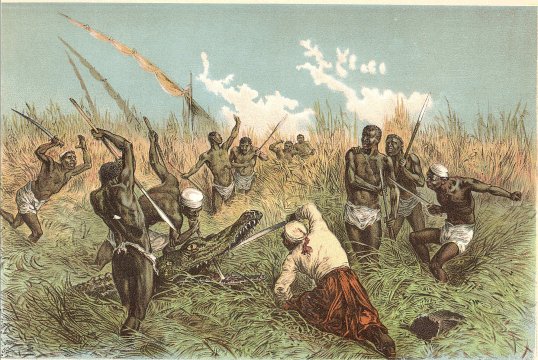
BACK
TO INDEX
Gallery of Line Art Illustrations
Comments/report typos to
Georges Dodds
and
William Hillman



BILL
HILLMAN
Visit
our thousands of other sites at:
BILL &
SUE-ON HILLMAN ECLECTIC STUDIO
ERB
Text, ERB Images and Tarzan® are ©Edgar Rice Burroughs, Inc.-
All Rights Reserved.
All
other Original Work ©1996-2007 by Bill Hillman and/or Contributing
Authors/Owners
No
part of this web site may be reproduced without permission from the respective
owners.
BACK TO INDEX
![[Mustering of the hostiles]](file:///D|/01 AA ERB PROJECTS/DODDS/New website/buel0001.jpg)