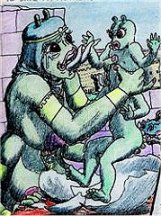
The biggest single curveball that Burroughs throws
us in the Princess of
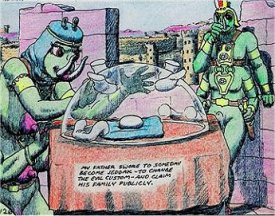
Mars is that his Martians lay eggs. This isn’t restricted
to the Green Men, who are, after all, weird alien critters to start with.
That would be okay.
But nope. The beauteous, the incomparable, the exquisite,
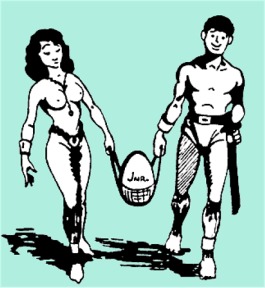
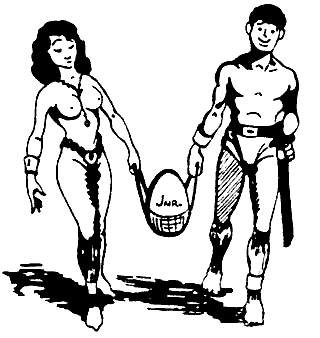
the utterly human appearing Dejah Thoris lays a snow white egg the size
of a goose egg.
That's just weird. So it turns out that the Barsoomians,
except for little dodges of skin colour, are absolutely and completely
identical to humans. Except, you know, for that whole egg laying
thing.
This provokes endless smutty conjectures among fans, as
to the size of Dejah Thoris’ divine rack, whether and why Barsoomians have
nipples, and most tellingly, whether they have navels.
To be fair, Burroughs describes his Barsoomian women as
being relatively small breasted, slender even. Tavia in A
Fighting Man of Mars is described as having a boyish figure.
And decorum forbids Burroughs from mentioning nipples (although many illustrators
have had no such reluctance when it came to male or even female depictions).
And there's no reference to navels.
But let's get serious here. Burroughs depicts Barsoom
as a society of nudists, so Barsoomians must have nipples, or people would
be remarking on John Carter's. Even if the women keep theirs
covered, the men would have no reason to.
And what about navels? Egg laying animals
don't normally have navels on Earth. John Carter disguises himself
as a red man. How does he get away with that, if the Barsoomians
have neither navels nor nipples?
Normally, thinking about things like this, I'd just say
I need to get a life. But the truth is, that this is what passes
for debate among fans. Nothing wrong with that. But I'm
just saying I'm obviously not alone in the 'get a life' category.
But seriously, this is just the tip of the iceberg, because
setting aside the question of why Egg-laying people have all these mammal
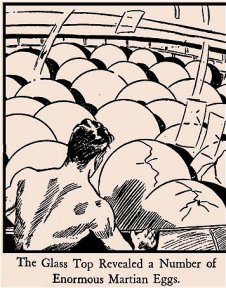
and mammary features, these aren't your ordinary eggs.
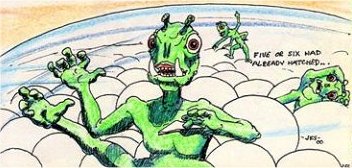
For one thing, Barsoomian eggs (the ones laid by humans
and perhaps by Tharks) actually seem to grow. The egg laid by a Barsoomian
human is about the size of a large goose or cassowary egg, big, but by
no means huge.
Then, suitably sheltered, it spends the next five years
maturing and growing, until finally, the newborn breaks through, with what
in human terms, would be a physiological age of eight or nine.
That's not out of the question, calves and foals are born
to cows and horses, able to stand up and begin to run around within hours
of birth. But these animals have a pretty long gestation period. So, you
know, five years of slow growth inside the egg... yep. Could be done.
One of the reasons that humans are born so helpless compared
to other animals is that we're literally preemies. We're being born way
premature, literally months before we're properly ready... but it's at
the last possible moment before the infants skull won't fit through the
pelvic girdle. We've hit a biological bottleneck (sorry for the pun).
Given that Barsoomian humans are hatched, there's no such
bottleneck, so they can be born the equivalent of foals or colts or calves,
with a lot of muscular and neurological set up all ready to go, which of
course, might extend the gestation time.
On the other hand... five years is a long, long time.
So perhaps the rate of growth inside the egg is substantially slowed down,
perhaps by a fifth. The child born who would be equivalent to a 12 or 14
month pregnancy in the womb, takes five years in the egg.
But here's the tricky part: How the hell does it happen?
I mean, let's face it, birds, lizards, reptiles of various sorts, they're
making big investments in eggs. They've got their own bottlenecks. They've
got to make their eggs as huge as possible, in order to have the biggest
possible yolk, which will give the nipper its start on life.
So, this is tricky. One, is it's got to be a huge up front
investment of biological material and energy. Two, you have to get
an egg that you can physically pass.
Mammals, on the other hand, are pay-as-you-go types, hooking
up the young 'uns to the surplus energy of the adult power plant.
Ever seen a robin's egg? Or a sparrow's? Tiny, uh? But
at the same time, huge in comparison to the creature that produced it.
By some example of scale, if a human woman was giving birth on the same
scale, she'd be passing things on the same size level as prize-winning
watermelons and pumpkins. All you ladies cross your legs now.
But obviously, this isn't going on, on Barsoom. Women
are all about laying these dainty little eggs, which grow on their own
into prize-winning watermelon-sized things.
Well, how is that possible? In order to grow, we have
to assume that on some level, the egg itself is alive. If the shell was
simple calcium, it would simply crack and fall to pieces. So it's got to
be some sort of membrane, perhaps calcium reinforced, but closer to skin
or hide or tissue than inert material.
And the egg not only has to keep the little nipper fed
for the whole five years, but has to accommodate his or her growth.
Now, the thing with reptiles, birds and whatnot, is that
they start with a finite food supply, the yolk. And that gets used
up pretty fast.
Huge bottleneck issue for birds. Reptiles and amphibians
are cold blooded, so they don't metabolize the food supply as fast. Birds
run a continuous fire and they're really complicated, so they basically
burn up the fuel. The result is that baby birds, when they're born, are
ugly, scrawny, helpless looking things, with just enough wiring to allow
them to scream for food. And these pathetic specimens are coming out of
the biggest frikking eggs that the birds can manage to lay without rupturing
themselves.
Barsoomians, however, are not coming out of the egg fast,
like baby birds, nor are they coming out of the egg half formed and helpless,
like baby birds.
Conclusion? There has to be some sort of ongoing metabolic
activity within the egg going on. Otherwise, to supply the needs
of a five year incubation for a mammal resulting in the discharge of a
half-adult, this egg would have to be the size of a of a small car, or
a minivan. Whatever, a goose egg won't do it.
So, to accommodate its own growth over the years, and
the consequent growth of its host, the egg has to be a separate, living,
biological entity.
Shocking, eh?
Okay, assume that the egg is a separate, living, biological
entity. What are its qualities?
Seems to look like an egg. So, not obviously green, not
obviously photosynthesizing, no obvious external structures like roots,
leaves, a tap system, feeders, respirators, etc. The lack of external structure
makes it look like an egg, but it tells us something...
The interface between the outside world and the inside
of the egg is the shell, or perhaps, a better word is 'skin.' Now, unless
the egg sneaks around and grows a mouth when no one is looking, it strikes
me that the skin has to be somewhat permeable.
Actually, eggs on our world are somewhat permeable.
Eggs are often laid a bit soft, and they harden. Terrestrial eggs
usually have some degree of oxygen/carbon exchange with the atmosphere
through microscopic pores. I might be wrong on that. But in
the case of Barsoomian eggs, the simple fact that they grow from a goose
egg size to something that can hatch out a ten-year-old suggests that there's
an ongoing interraction with the environment.
That is, things are getting through the skin. If nothing
gets through, then obviously, there's nothing that the egg could use to
grow with. When a baby chick grows in the egg, the yolk continuously shrinks.
That's because on Earth, an egg is laid with a fixed food supply.
Once hatched, there's nowhere to go but down.
Theoretically, you might pack raw materials in so that
when processed into a critter, it occupies a larger volume. But not to
the radical extent we are seeing.
The only solution is that the egg must be absorbing things
through the 'skin', molecules, nutrients, energy, water, in order to expand
internally.
It's likely as well that the egg probably excretes through
its skin as well. There are definitely metabolic activities going on -
two categories of metabolic activities. 1) The little barsoomian, and 2)
the egg itself, growing and sustaining the growth of the little barsoomian.
Metabolic activities means waste products. Waste products have to go somewhere.
So, my view is that on a microscopic level, the skin must
not only be flexible to allow for growth, but it must be permeable, with
lots of little pores and stuff, it has to breath.
Whatever sort of thing this egg is, it's obviously not
a mammal. The apparent level of metabolic activity seems extremely low.
Partially, this may be due to the interface, a sphere, even an oval egg
sphere shape, is just about the worst surface area to mass ratio you can
get. Basically, the larger the egg grows, the less surface area it has,
proportionately, to support its mass. Trees and plants get around this
problem by increasing their surface area with leaves and stuff. There's
almost no way a large egg could sustain itself.
Okay, but think about it. It's not like the egg is likely
to be solid inside, like an animal or a tree. Perhaps the real living anatomy
of the egg creature/plant is relatively small. ie, suppose it's mostly
a skin enclosing a large volume of substantially inert non-biological material
like...
Water?
Hmmm. Think about that. You're a living organism, you
are in some sort of erratic environment subject to droughts. So when water
comes along, you want to capture as much of it as possible and store it
for a good long time. The ultimate result of that would be something egg
shaped or spherical. Maximize the capture volume.
Enriched water? I mean, you've got all this nice water
sitting there. You could use it as a medium to store other by-products
of biological activity, necessaries to tide you over for that dry spell.
Sugars, proteins, fats, lipids, amino acids, complex molecules, all sorts
of raw materials.... in short, something very much like you might get in
a yolk? A storehouse of rich nutrients to sustain biological activity,
without actually being biologically alive itself?
Something that some biologically clever, opportunistic
animal might find a way to symbiotically implant its own young in? It would
save a bird the trouble of generating a yolk. Just implant it into the
egg thing, and the egg thing will continually replenish the yolk as part
of its biology.
Examples of symbiosis of various sorts are found throughout
nature. The most insane example of course, is that of flowers and bees.
Who could imagine that plants would co-evolve with races of insects and
use those insects as a vital part of their reproductive strategy, that
those insects would co-evolve to facilitate this strategy.
I’m sorry, I know bad implausible science fiction when
I see it, and that stuff is it!
The notion of synchronizing life cycles is well established,
female fleas synchronize to the breeding cycles of their dogs hormones,
so that when there's a bun in the oven, or a salami coming through the
door, they're all set to settle a new crop on the new life.
So its not out of the question that some sort of early
Barsoomian life might have achieved a form of symbiosis.
You want the mechanism? Here it is: You've got amphibian
life, non-shelled eggs laid in ponds as scum. No problem, frogs and salamanders
today. The trouble is, ponds dry out, all sorts of things can go wrong,
so the loss rate is high. No problem, you lay lots and lots of eggs. But
in the end, you're biologically limited, because you're stuck with that
pond, and it has to be a pond that is going to last long enough to sustain
the next generation.
Okay, so our Barsoomian amphibians evolve, they have heir
evolutionary flowering, they colonize every pond they can find, filling
it with eggs.
Including the marginal ponds that keep drying out because
they're in drought areas. Amphibians aren't too bright, they keep laying
their eggs there anyway. And there are enough amphibians drifting
over from the year round ponds that the egg stock is always high.
Now, on Earth, what happens is that some of these amphibians
manage to get hard shells around their eggs, which protects them from the
environment. Suddenly, they can lay eggs everywhere. That's it, they
call themselves reptiles, start smoking and hanging out at the 7-11 on
Saturday nights, and proceed to overrun the world... because, hell, they
can lay their eggs anywhere. They’re reptiles without a cause, and
they don’t take no guff.
On Barsoom, what happens, is that there's something else
in those drought ponds. Something with its own life cycle. Something that
probably exists as a fairly open structure in order to absorb water and
nutrients and process biological activity, but the minute the drought starts
or in anticipation of the drought, it collects all the water it can, containing
it inside itself, and enriching it with nutrients for later use.
Its doing this in ponds full of amphibian eggs... So,
it's not unlikely that the amphibians started to evolve to have their eggs
parasitize the Egg organisms. It would be as simple as an amphibian egg
or tadpole clinging to the inside of the skin and surviving the cleansing
process. A few generations of that, and you'll start to get really good
at it.
Of course, that doesn't get you far enough. There has
to be something in it that gets us to symbiosis.
So, let's think about the Egg organism. It has to reproduce
as well.
I'm not sure if it's a plant or animal. I'm kind of leaning
towards plant, because its main functions seem to be metabolic processes,
all of which plants have mastered, but it doesn't seem to show any animal
traits... hell, it just sits there.
Plants, in comparsion, do a lot more moving around than
this egg, flowers open and close, leaves turn and unfurl, all kinds of
structure develops, fruits, berries, leaves, whatnot. But plants and the
Egg organism both do tend to just sit there.
Of course, it might be a really primitive sort of animal,
like a coral or sea sponge, neither of which are known for partying hard.
Or perhaps in Barsoomian terms, it's a little of both, or not quite either.
But whatever it is, it has to reproduce. Now, I'm not
seeing a lot of complicated external structures. This is probably a pretty
basic, elementary organism. So, how does it reproduce? Spores most likely,
or gametes, clouds of offspring, each perhaps no more than a cell, or a
microscopic collection of cells containing all the genetic information
and basic metabolic processes to produce a new Egg organism.
At the biological level that we're at, it doesn't make
a difference whether it's a plant or animal, fish can lay up to a quarter
million eggs, basically discharging a cloud of roe, and plants can similarly
discharge hundreds of thousands of spores.
We're assuming that this is a water-storer organism, which
means that in part of its life cycle, it must exist with plentiful water.
So, it simply discharges its offspring into plentiful water, and bob's
your uncle. All the offspring need to survive is a conducive environment,
they're not fussy.
And they're being discharged by the millions, or hundreds
of millions, so there's a lot of opportunity for mutation and adaptation.
Now, here's a theoretical question... Could the 'spores'
of these Egg organisms survive on or inside a Barsoomian amphibian?
Undoubtedly. Within reason. After all, some sorts of infestation,
clogging up the bloodstream, would be fatal for all concerned. On the other
hand, if you look at us humans, our skin is loaded with dust mites, we
have fleas and lice, our bowels are loaded with bacterial flora and fauna,
and there are some potentially ugly parasites, including the tapeworm,
which can grow up to 30 feet long. Women's vaginal canals have their own
flora and fauna, and when the balance gets out of whack, you have yeast
infections.
So.... you're an Egg organism spore, you need water, perhaps
reasonably stable temperatures, potentially some source of nutrients? You
might well find a decent home in some Barsoomian amphibian's colon or egg
laying orifice. In short, at the beginning of its life cycle, the Egg organisms
might be prone to parasitizing Barsoomian amphibians.
But of course, unless they can reproduce at that state...
in which case, why do they need to grow into Egg organisms at all, they're
at a dead end. They need some way of reproducing.
Arguably, they could try to grow into an Egg organism
and reproduce inside the amphibian, an experience which the amphibian will
tend to find painfull and awkward, and quite likely fatal usually.
The best option for both parties at this point, would
be for the Amphibian to shed the Egg organism out of its body as quickly
as possible. The Egg organism goes on to a happy life of sitting there
and growing in hopefully hospitable conditions, the amphibian sheds a tumour,
everyone wins...
But the next evolutionary jump is an important one...
We know that parasites are biologically attuned to their hosts, that's
easy, lots of examples of that.
So, for the Egg organism, the best time to start growing
into an Egg thing and getting excreted would be when conditions are optimum,
lots of water around to start absorbing in anticipation of the drought...
And this would also happen to be the amphibians own egg
spawning season.
So, evolutionary advantage would tend to synchronize their
biology.
And since the amphibian eggs are being generated by the
millions or hundreds of thousands in the same body cavity that colonies
of Egg organisms are trying to build their egg skins in... it seems inevitable
that some of them would get mixed up...
The result would be an Amphibian laying an Egg organism
that contained one or more of its own amphibian eggs.
Well, hot damn, we have a fully integrated reproductive
cycle. And if it sounds a little improbable, go spend some time contemplating
honeybees and orchids.
This, of course, would be a huge breakthrough for Barsoomian
amphibians. They wouldn't be tied to ponds any more. Now they could go
out, smoke cigarettes, flirt with girls at the 7-11, raise hell and lay
their eggs anywhere they wanted! That'll show those reptiles!
In fact, since you've got a continously operating biological
plant feeding your little post-amphibian... you're actually doing better
than the reptiles, who have to deposit all their groceries up front.
You avoid the huge up front stockpile which is a drain on your physical
resources and a major limitation on your little zygote's potential.
You, like the mammals, can pay as you go. But unlike
the mammals, you aren’t being slowed down lugging the offspring around
and having it parasitize off your own biological operation.
There are, in fact, Reptiles and Mammals on Barsoom, John
Carter tells us. But somehow, they never amounted to much. Well,
no wonder.
There's a trade off, of course. The Egg organism is operating
at a much lower level of biological activity than you are. But all you
have to do is slow down the growth rate of your baby, and things synch
up again.
True, its going to take a lot longer, years maybe, before
your little post-amphibian is ready to greet the world. But so what? Your
biological investment is relatively minimal, just keep laying lots of eggs,
and it will all work out.
My thinking in other essays has been that Barsoomian life
has proceeded along at least three or four separate lines of evolution:
Four limbed, Six limbed, and Eight and Ten limbed.
(Of course, its also possible that Barsoomian life has
a single line of evolution which has some flexibility built in on number
of limbs. There's nothing in Burroughs either way, but if we look
at Lin Carter's Thanator in Lankar of Callisto, we find the Othode
which is literally identical to the Barsoomian Calot, except that it has
six limbs instead of ten. In Otis Kline's Tam, Son of the Tiger
we meet races of warlike six-limbed, monster-riding giants who may be Thark
offshoots. But in one of their cities, we see individuals with up
to ten limbs, which suggests that their underlying genetic plan has multiple
limb options, and in a genetically inbred and isolated population, these
traits may be expressing.)
But assuming that multiple evolutionary lines emerged,
it's not clear how widespread this symbiote was. Possibly, this solution
was not achieved by every single line of evolution.
We don't know that Eight-legged Thoats or Ten-legged Banths
reproduce through these Egg organism symbiotes. Maybe they do, maybe they
don't. They'd have had the same opportunities, I suppose, but they could
have gone down different paths. Perhaps the Reptiles are the ancestors
or relatives of one of the many-legged lines.
Or possibly, the symbiote turned out to be biologically
flexible, adapting or fitting itself opportunistically to several lines
of evolution. Which may help to explain why and how it was able to
fit itself to human biology.
We do know that the six-limbed creatures went down this
road because the Tharks do it this way, and they seem pretty happy with
it.
And we know that the alleged Barsoomian humans also do
it this way. But they may be flukes, since in every other respect, including
breasts, they seem pretty human.
Pretty human? Both John Carter and Ulysses Paxton
find them sexually compatible and quite anatomically normal in the bouncy
bouncy way. That says a lot. And Dejah Thoris manages to get
knocked up and produce an Egg from John Carter's precious bodily fluids.
Now its possible that the Princess is just fibbing that
the egg is his, and John Carter is merely dumb enough or gallant enough
to believe it. But the offspring, Carthoris, does seem to resemble
Dad, and has an otherwise inexplicable share of Dad’s Earth-born strength
and leaping ability. So I’m forced to concede that Barsoomians and
humans are genuinely interfertile.
Carthoris and Tara, tentative Earth/Barsoomian hybrids
are able to intermarry with Barsoomians and produce further offspring.
On earth creatures as close as Horses and Donkeys can only produce sterile
Mules.
So, they’re not pretty human. They are human, physically
and genetically. Not close to human, but biologically identical to
human.... Except for that whole egg laying thing.
How to explain this fluke? I have a few ideas.
First, it may be a simple cross infection. We pick up
parasites and give parasites to other animals all the time. This Avian
flu is simply a case of a particular parasite crossing the species line.
Happens a lot more with bacteria, and is a lot tougher the more complicated
the organism or the symbiosis, but it's not unheard of.
For instance, bees and flowers co-evolved to be with each
other. But other creatures have gotten into the act with those slut flowers,
including hummingbirds, bats, and some species of moths.
It may be that the uterus or vaginal canal of a mammal
is a particularly hospitable place for the Egg organism spores, and that
their symbiotic life cycle was so well established by this time, that they
simply adapted. So, what happened is that Barsoomian women who bathed in
certain pools would become infested unknowingly... unknowing until they
discovered that they were laying an egg. Obviously, some would try to conceal
this, if some of the eggs survived, you'd have by natural selection, an
'egg laying' option perfecting itself. After that, it's just politics and
controversies between the live birthers and the egg layers.
Alternately, we look to my 'are
Barsoomians human' essay, in which I postulate that Barsoomians are
humans who astrally teleported to Mars. In arriving on Mars, they astrally
constitute new flesh and blood bodies. I've speculated that the other intelligent
races, or at least some of them, may have arisen because like "The Fly"
they got some wrong local DNA in the mix. Well, some of that wrong local
DNA may have been the symbiotic Egg organism laying trait.
Finally, we can go back to the John Eric Flint hypothesis,
and suggest that it was a deliberate biological alteration by the Barsoomians,
perhaps a response to the changing of their planet... Basically,
the ancient Orovars or early Barsoomians had their babies the old fashioned
way. But then, when the planet started going to hell and the oceans
drying up, they altered their reproductive cycle to egg laying.
Could have happened that way.
Step right up and take your pick!
Just a note or two before I go. It strikes me that this
weird symbiotic reproductive cycle might well have been understood by early
Barsoomians. For instance, they would undoubtedly have been familiar with
'wild' or non-symbiotic versions of the egg organisms growing throughout
watered and marginal areas. They would have perceived these things as plants,
and given their egglike nature, perhaps perceived them as seeds, and they
would have certainly made the connection between their own egg symbiotes
and the wild eggs. Early philosophers and investigators could well have
speculated. Of course, eggs or seeds need an originating source. So we
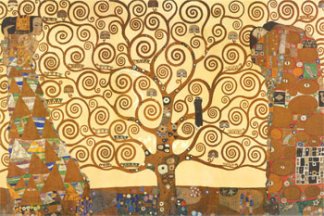
may be looking at the genesis of the "Tree of Life" myth.
I'd suggest that the "Tree of Life" myth probably arose
in an early Barsoomian hellenistic age of exploration, discovery and thought.
It was a sort of pre-science version of rational evolutionary theory, the
sort of thing that a Plato or Aristotle might have come up with. Note the
absence of the Gods or the supernatural in this myth?
Here's a wild speculation. We know that the "Tree of Life"
myth was central to the Therns and First Born religion. What if Egg laying
among Barsoomian humans was actually developed and promoted by the Therns
as part of their Iss Cult? Think about it.
If you come from an Egg, then obviously, you're connected
to the "Tree of Life" and contain divinity. If you are just born the natural
messy way, then you're just meat with no connection to the divine or higher
spirituality.
Thern religious mania and proselytizing may well have
resulted in the conversion of Barsoomian humans from a live birth people
to egg layers. Or in a society which featured both live
birth and egg laying, it might have encouraged a complete or near complete
shift from one to another.
This fits in with Flint's speculation that it was an artificial
thing. And, if we want to argue that Kline's, Farley's and others' stories
are set in Burroughs universe, it explains why people who might be transplanted
Orovars on the Moon, on Earth, on Venus and in Pellucidar are not egg layers.
Indeed, the Egg-symbiont might die out away from Barsoom.
The symbiont may be highly dependent upon its own commensalist bacteria
or micro-organisms, or it might have been sensitive to the presence or
proportion of key trace elements or amino acids particular to Barsoom.
I imagine that live birth might come as a pretty horrible surprise to Orovar
women who'd relocated to other worlds.
Finally, let me throw in a mischievous speculation or
two about the symbiote? Does the symbiote inhabit both men and women, or
merely the uterine canal? In the second case, the egg laying trait is to
be found in women, and guys are just guys. Except for reproductive genetic
mixing, there seems no particular reason why men should be carriers. Its
likely that women contain a diverse biological colony of the spores.
Of course, in laying her egg, she'd be bequeathing her
colony, or some fraction of it to her daughter. So, with even minimal loss,
the genetic pool of each lineage of women's symbiotes would grow narrower
and narrower. I wonder if this is a problem? Soft-shelled eggs? Non-hospitable
eggs? Or do Barsoomian women have some way of exchanging spore symbiotes
to keep up the genetic diversity? It might be as simple as taking baths
together (In Chessmen
of Mars, Tara takes a bath with her female slave. Unknowingly exchanging
spore symbiotes?)
Alternately, the egg spores may reproduce parthenogenically.
In fact, our own biology already contains an example of this. The
mitochondria of our cells contains its own DNA and does its own reproduction.
All of your mitochondrial DNA comes from your mother. All of hers
came from her mother, and so on back to the beginning.
One effect of this is that without sexual mixing of Mitochondrial
DNA, we can clock it. Mutations occur at a specific rate. By
measuring the differences between two persons Mitochondrial DNA we can
measure the amount of mutation, and then calculate how many generations
it would take to produce that much mutation. We can then work
our way backwards to the point where all humanity had to have had a common
ancestor, the original mother: Eve.
It gets better though. The fact that Mitochondria
have their own DNA tells us that once upon a time, they must have been
separate free-living organisms. Just another species of unicellular
critter or bacteria cruising around the oceans, having a good time.
So what happened?
Well, apparently this free-living, happy-go-lucky, wild
and crazy Mitochondria got absorbed or eaten by another, bigger cell somehow.
And, miraculously, instead of being digested or dissolved or whatever it
is that they do to each other, the Mitochondria somehow survived.
Instead of being broken up into component nutrients, it retained its identity,
and DNA and adapted to become a power plant, supplying energy to the rest
of the cell.
In fact, it’s the energy produced by the Mitochondria
that gives cells the power and metabolic rate that allows them to clump
together into larger and more complex organisms, to create complex multi-cellular
life.
All animal life on earth, from microscopic flatworms to
hundred ton blue whales exist only because a billion years ago, somehow,
a free living proto-mitochondria managed to strike a deal with the primordial
amoeba that had just eaten it.
One consequence of this may be that we're living in a
very empty universe. The mitochondrial deal might have been
a miracle, a once in a trillion year fluke. We don’t know how feasible
it was, how likely it is. We might find world after world of
life, but nothing more complicated than algae and slime molds, because
that mitochondrial deal only happened just the once, a billion years ago,
with us.
Isn't that bizarre. Like I said, I know bad,
implausible science fiction when I see it. Compared to whoppers like
the mitochondria deal, an egg-symbionte hijacking a mammal reproductive
process is actually pretty tame.



 .
.



 .
.