PULP PELLUCIDAR
Contents
The Inner
World, Fact, Fiction or Faction
Inner World
Fictions, Before ERB
Pre-ERB Pellucidar References
Post ERB Pellucidar References
The
Sunless City - a Pellucidar Case Study
The
Inner World, Fact, Fiction or Faction
The origins of the hollow world theory actually seem to
have their roots way, way back in pre-Copernikan cosmic theory.

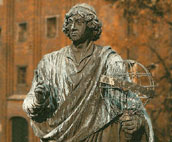
Let's back up a bit. Copernikus was the guy
who came up with the notion that the Earth revolved around the sun, and
not the other way around. Before that time, Greek and middle
eastern astronomers led by Ptolemy (no relation to Cleopatra's dynasty)
were developing a peculiar and somewhat biblically inspired theory of the
universe.
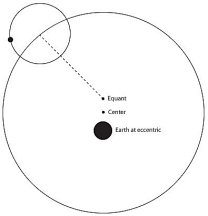 They
believed that the Earth was at the center of the universe.
Fair enough. However, it was pretty clear that there was a sky above
the Earth. This was believed to be a huge dome or globe called
the firmament. This was what kept the stars up, they were physically
embedded in the firmament, like spackle on a ceiling. All right.
Fair enough.
They
believed that the Earth was at the center of the universe.
Fair enough. However, it was pretty clear that there was a sky above
the Earth. This was believed to be a huge dome or globe called
the firmament. This was what kept the stars up, they were physically
embedded in the firmament, like spackle on a ceiling. All right.
Fair enough.
The notion of a physical firmament, a roof on the world,
was a very ancient one, and references to it can be found throughout the
bible. This archaic cosmology was then the foundation of notions
of heaven and hell. Heaven lay above the 'firmament' somewhere.
Hell lay beneath the Earth. Actually, above the firmament it
was pretty wet... After all, rains fell from the sky, and when God
decided to destroy the world, he opened up the firmament and let the flood
rains come down.
This is commonly known as the Ptolemaic
model, and it stuck around like an anchor around the neck of astronomy
for fifteen hundred years. Both medieval and early renaissance
European observers, as well as Arab observers adopted it and tried to refine
it as the problems accumulated.
Now, the thing was, medieval astronomers were basically
working with what they had. They were stuck with the firmament
theory. Well, they started to notice that the sun and the moon
seemed to be moving in ways different from the rest of the sky.
And then they noticed that the planets were also moving at different rates.
To make it worse, some of the planets would occasionally seem to move backwards
in the sky, before hiccuping and resuming their normal direction.
This was tricky. If there was only one firmament,
then everything in the sky should be moving at the same rate.
So, obviously, there was more than one firmament. Medieval cosmology
soon came up with a universe made up of a series of transparent spheres,
each nested inside the other, starting with the firmament and ending with
earth.
Okay, with us so far?
Let's not be too hard on these guys. Notions
of gravity, centrifugal motion, Newtonian physics were still far in the
future. Some things fell to or stuck to Earth.
Other things stayed up in the sky. They had to come up with
something.
Anyway, Copernikus came along and smashed the model of
concentric spheres, and then Newton came along later and put the kibbosh
on the whole thing. The notion of a cosmos as spheres nested
within spheres wound up on the dust heap of wacky ideas.
But you know, there isn't a notion out there that is so
dumb that some complete lunatic won't dust it off and run with it.
Hell, there are people who think George W. Bush isn't a cowardly moron,
so obviously, it takes all kinds.
So, we've got this really nifty theory of concentric spheres,
and its not applying to the Universe in general. But you know, there
was a lot of unnecessary veneration of ancient thinkers. So people
were reluctant to just throw away a perfectly good idea.
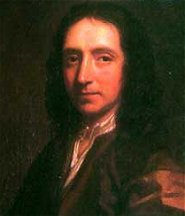 Okay,
if there weren't concentric spheres beyond Earth... Maybe they were
within Earth itself? In 1692 Edmund
Halley (discoverer of Haley's Comet) published an essay suggesting
that the Earth was a hollow sphere with a shell only 500 miles thick.
Within it were other hollow spheres corresponding in size with Venus and
Mars, with Mercury as a solid core. These spheres were inhabited
or at least supported life, and there was light for the whole thing, coming
from somewhere or other...
Okay,
if there weren't concentric spheres beyond Earth... Maybe they were
within Earth itself? In 1692 Edmund
Halley (discoverer of Haley's Comet) published an essay suggesting
that the Earth was a hollow sphere with a shell only 500 miles thick.
Within it were other hollow spheres corresponding in size with Venus and
Mars, with Mercury as a solid core. These spheres were inhabited
or at least supported life, and there was light for the whole thing, coming
from somewhere or other...
You can sort of see where Edmund came up with it.
Smoking a little opium perhaps, observing that the inner planets were all
different sizes that could conceivably fit one into another, refurbishing
concentric spheres... I can't actually say that Edmund came
up with it, though he can take the blame as well as any other.
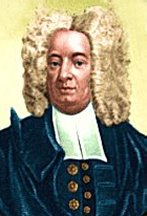 Then
in 1721
Cotton Mather,
taking time off from burning witches, took up the idea in The Christian
Philosopher. Of course, I'm not suggesting that Mather
was a disciple of Edmund Halley in any way. One was a noted astronomer,
the other was a vicious religious fruitcake. I suspect that they
probably never met and almost certainly wouldn't have gotten along.
Then
in 1721
Cotton Mather,
taking time off from burning witches, took up the idea in The Christian
Philosopher. Of course, I'm not suggesting that Mather
was a disciple of Edmund Halley in any way. One was a noted astronomer,
the other was a vicious religious fruitcake. I suspect that they
probably never met and almost certainly wouldn't have gotten along.
But these two examples show that the notion was sort of
floating around there in the thinking of the late 17th and early 18th centuries.
It was hardly based in science, but rather, a sort of muddy melange of
religious and philosophical conjecture. There wasn't really
anything that could recommend the theory, apart from a certain sense of
quasi-biblical symmetry. So I assume that eventually, it would
have simply died away like many other junk theories. What it
needed was a truly dedicated lunatic.
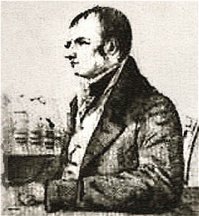 The
dedicated lunatic was Captain
John Cleves Symmes of the US infantry. Symmes makes it
into the history books, not just for his utter obstinacy in the face of
all reason, but for the relentless unswerving dedication he brought to
his theory. He was like a dog with a bone. He refused
to let it go, and in fact, spent so much time and effort preaching his
theory he actually spread the idea far wand wide and made enough converts
to keep it propagating.
The
dedicated lunatic was Captain
John Cleves Symmes of the US infantry. Symmes makes it
into the history books, not just for his utter obstinacy in the face of
all reason, but for the relentless unswerving dedication he brought to
his theory. He was like a dog with a bone. He refused
to let it go, and in fact, spent so much time and effort preaching his
theory he actually spread the idea far wand wide and made enough converts
to keep it propagating.
After fighting in the war of 1812, Symmes retired from
the army and came up with the goofy notion that the Earth was hollow.
Better than that, the Earth wasn't just hollow, but there was another Earth
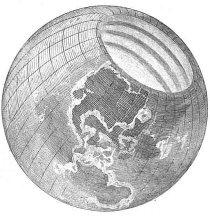
inside it. And another. All in all, he thought that the
Earth contained five concentric spheres, each nested inside the other like
one of those Russian dolls. And most amazingly, both the inner
and outer surfaces of each sphere, including our own, contained vegetation
and animal life. Each sphere contained polar openings, several
thousand miles across through which you could use to access the inner world.
 Now
hold on, why would the insides of the spheres be occupied?
Well obviously because the inside of the outer sphere, the firmaments around
the Earth were occupied by stars and planets. Thus, it seemed reasonable
that there would be something on the inside of the Earth, and it seemed
sensible it would be the same sort of stuff as on the outside.
Now
hold on, why would the insides of the spheres be occupied?
Well obviously because the inside of the outer sphere, the firmaments around
the Earth were occupied by stars and planets. Thus, it seemed reasonable
that there would be something on the inside of the Earth, and it seemed
sensible it would be the same sort of stuff as on the outside.
Well, remember what I said about being generous with those
early astronomers who were trying to make a firmament theory work?
Well, forget I said that. Mather and Halley were dabblers,
playing with the idea and moving on to their private concerns.
Symmes was a lunatic, a crackpot, a flake, and the people of his day knew
it. Hell, this was after Copernikus and it was after Newton.
There was just no Earthly reason to endorse his goof ball theory and he
was roundly ridiculed. He died in 1829, a barking lunatic to the
end.
But his views lived on. Somehow, he found disciples,
and two books were published expounding his theories. James
McBride's 1826 opus Symmes
Theory of Concentric Spheres and Americus Symmes' (his son) similarly
titled work of 1878.
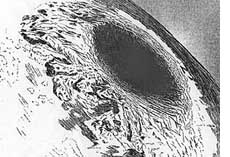 Thus,
these polar holes have come to be called 'Symmes
Holes.' It's remarkable how he was able to give his name
to a piece of utter nonsense and have it stick.
Thus,
these polar holes have come to be called 'Symmes
Holes.' It's remarkable how he was able to give his name
to a piece of utter nonsense and have it stick.
Now, okay, I've been hard on the guys. But arguably,
there was some evidence to suggest that peculiar things were going on at
the poles. Compasses became inaccurate as you approached the
pole, there were strange lights in the sky from aurora borealis or from
optical scattering. As they approached the pole, for instance, many
explorers reported seeing two suns in the sky, or images of spectacular
lands and even cities reflected in the clouds. Well, you can
do a lot with ice crystals and alternating layers of cold air, but explorers
didn't know this. Instead, what they knew was that the closer
you got to the poles, the more weird and unexplainable phenomena there
was.
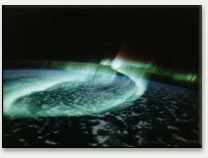 The
Auroras were particularly tricky. They were curtains of light shining
in the sky, seeming to emanate from the pole that were unconnected with
the sun or other light sources. Maybe they were coming from
a polar opening, maybe the light was shining out not from above the earth,
not from on the earth, but from inside the earth!
The
Auroras were particularly tricky. They were curtains of light shining
in the sky, seeming to emanate from the pole that were unconnected with
the sun or other light sources. Maybe they were coming from
a polar opening, maybe the light was shining out not from above the earth,
not from on the earth, but from inside the earth!
James McBride and Americus Symmes went at it like that,
and they assembled a huge conglomeration of data and mysteries, such as
migration routes of animals, unseasonably warm traces from northern regions
(dust and pollen blown up from the inner world), frozen mammoths (critters
from the inner world who had wandered to the surface and froze to death),
travellers reports, astronomy, physics and whatnot to support old man Symmes
theory.
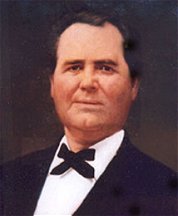 Around
the same time, Ignatius
Donnelly
was doing the same thing as he developed his theories of the lost continent
of Atlantis. And to be honest, there's a certain persuasiveness
to this reasoning. These guys basically came up with an idea,
and then they cunningly proceeded to cherry pick evidence, including endless
unexplained phenomena that cried out for answers, stealthily fitting it
into their theory, until it seemed to be a massive edifice buttressed with
an irresistible wealth of facts. But really, you can pretty much
use the same methods to prove anything.
Around
the same time, Ignatius
Donnelly
was doing the same thing as he developed his theories of the lost continent
of Atlantis. And to be honest, there's a certain persuasiveness
to this reasoning. These guys basically came up with an idea,
and then they cunningly proceeded to cherry pick evidence, including endless
unexplained phenomena that cried out for answers, stealthily fitting it
into their theory, until it seemed to be a massive edifice buttressed with
an irresistible wealth of facts. But really, you can pretty much
use the same methods to prove anything.
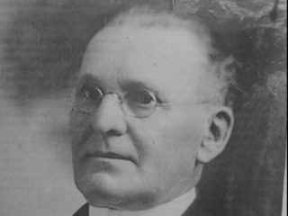
There were a few wrinkles after that. A fellow named
Cyrus Teed came up
with a hollow Earth theory in 1870 that remarkably claimed that we were
all living on the inside, not the outside of the globe. The
less said about that, the better. He called his theory Koreshan
Cosmology, and renamed himself Koresh, which carries unfortunate connotations
today.

Dr. Cyrus Reed Teed
In 1885 a guy named William F. Warren wrote Paradise
Found, or the Cradle of the Human Race at the North Pole, which sported
the remarkable theory that the human race had originated in a primordial
garden of Eden in the inner world
Now, the next big shift that came was with a guy named
Marshall B. Gardner, who worked for a corset company which sounds a lot
more fetishistic these days than it was then. It's almost
certain that somewhere along the line, he became aware of Symmes theory,
probably through Americus Symmes' or James McBride's compendiums.
He even swallowed Symmes theory, almost. By
this time, the whole notion of concentric spheres had pretty much reached
its philosophical exhaustion. There was just no good reason for it,
and we have evidence that the concentric spheres were vanishing from hollow
earth theory, since I've read a novel published in 1905, well before Gardner
came along, that had an inner earth but not concentric spheres.
Its an odd little paradox, the only reason that you had
a hollow earth theory at all was to get the space to put the spheres in.
But once the hollow world was established, you didn't really need the spheres.
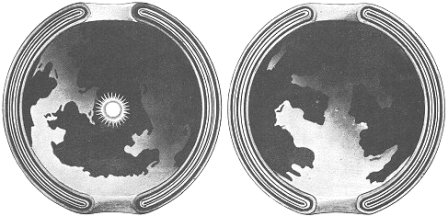
Gardner still saw a lot of evidence
for a hollow world.
Gardner's Hollow Earth
So, in 1913 he privately published a small book titled
Journey to
the Earth's Interior. The fact that it was privately
published tells us that he was pretty much a crank. If anyone
had taken him seriously, he would have been commercially published.
Still, he shared with Symmes the quality of obsession. He refused
to let it go and in fact became quite furious when anyone challenged his
notion, he was given to bouts of self pity, denouncing conventional scientists
and comparing himself to Galileo. Seven years later, he issued
a revised version of his book, expanded to 456 pages.
Gardner's great contribution was that he was sensible
enough to ditch all those concentric spheres and just stick with a hollow
earth. That made sense, all that evidence marshaled by Americaus
and McBride went towards showing that the world was hollow, not that there
was another world nested inside it.
According to Gardner, the Earth was hollow, it was a shell
800 miles thick, with 1400 mile openings at each pole. Inside,
there was a sun, 600 miles in diameter, giving life and heat perpetually
to the inner world. Other planets were built the same way, the Martian
ice caps were evidence that Mars was hollow. By this time, of course,
there had actually been several expeditions to the North Pole and the South
Pole. Gardner worked hard to argue that they never actually
made it. Apart from that, he was pretty much making the same sorts
of arguments as his predecessors.
And here we finally have Pellucidar.
The inner world of Burroughs has taken its classic form, though arguably.
We have an inner world, polar openings and an inner sun. We
even have prehistoric animals as represented by Mammoths and Woolly Rhinos.
The hypothetical inner world was a mysterious place, a mighty land filled
with lush vegetation and great animals extinct upon the outer world (24
hour sunlight), peopled with savages and mystical cities.
Now, let's be perfectly fair here. Gardner
was a crackpot from day one. He was a crank. He was a lunatic.
Nobody who knew anything took his claims seriously, and in fact, even before
he propounded them, the proof was overwhelming that he was wrong.
Hell, people had already been to the poles. The inner world
theories of Symmes from 1818 to 1878 and Gardner from 1885 to 1926 were
stuff and nonsense from the very start. They were equivalent of the
various junk sciences of today, whether it be scientology, new age mysticism,
crystal healing or ancient astronauts.
That said, they made fertile territory for fiction writers.
Is it any kind of coincidence that Burroughs wrote his first Pellucidar
novel only a year after Gardner self-published his book? Probably
not, though I'm not aware of any proof that Burroughs had obtained the
Gardner book. Still, he could have heard a lecture, read a magazine
article. It's pretty much a given.
You see, the thing is, adventure writers sort of needed
a Pellucidar. The world was filling in fast. Africa had
been the dark continent, but back in 1910 you could throw open a map and
find it thoroughly coloured in by the European powers. The
middle east, the orient, all these places were still mysterious, but no
longer as mysterious as they had been. The world was getting
pretty thoroughly explored, and with that exploration, the opportunities
for adventure writers narrowed.
Mars and Venus emerged, of course, as a source for adventure
stories. These were worlds well known and described, with their
own particular narratives. An inner world represented a brand
new place to have adventures. And it had its own narrative, it was
the inverted world, a place that was a mirror image of ours in some way
or the other, except inside out. Sometimes this amounted to social
satire, with reversed English/American societies skewered, sometimes it
was a womb-like primeval jungle land, the opposite of our own civilized
land. Based on the theories of the origin of frozen Woolly
Mammoths or Woolly Rhinos, the inner world was seen as a sanctuary of creatures
now vanished from Earth's surface.
Thus, the journey to the inner world became a minor but
recurring pulp staple, along the lines of planet and lost race stories.
It seemed to have a minor revival with the Nazis in Germany.
Hitler created the SS, which became a receptacle for Hitler's own occult
and pseudoscientific obsessions. The Nazis
seem to have been fertile ground for crackpots of all sorts, from bizarre
and futile racial theories, to strange notions of astronomy (they believed
that there had been six previous moons
all made of ice), and they flirted with the inner world theory, even
going so far, as some
Indeed, the notion of an inner world didn't quite die
away in the minds of crackpots. It seems to have survived into
the '40s and '50s, promoted by guys like Ray Palmer and talked up by Richard
Shaver. Shaver by the way, was not a Pellucidar enthusiast,
he believed in an underground race, but they lived in caverns, tunnels
and underground cities.
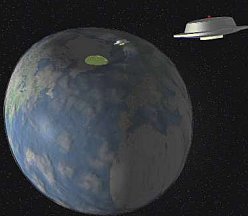
It morphed in bizarre ways. There was a theory,
for instance, that flying saucers were not from outer space, but inner
space. A hyper-advanced race from the inside of our hollow
world were flying around with saucers from the poles. Flying
Saucers were big in the fifties.
 Another
theory held that the defeated
Nazis had fled to the inner world through the Antarctic hole and were
even now planning to burst forth onto the outer world. This
had at least the cachet of fitting in with the Nazi's own lunatic notions.
The theory also explained that the flying saucers of the '50s were actually
Nazi
vehicles from the inner world. Personally, if the Nazis had flying
saucers, I don't see why or how they lost. One peculiarity
of this theory is that the Nazi's entered the inner world through the south
pole, rather than the north pole. Basically, Hitler and his
bunch fled across the Atlantic in 'cargo submarines' (no such thing), stopped
off in Argentina for a while, then headed through Antarctica.
There's a fevered compelling logic to this bit of lunacy.
Another
theory held that the defeated
Nazis had fled to the inner world through the Antarctic hole and were
even now planning to burst forth onto the outer world. This
had at least the cachet of fitting in with the Nazi's own lunatic notions.
The theory also explained that the flying saucers of the '50s were actually
Nazi
vehicles from the inner world. Personally, if the Nazis had flying
saucers, I don't see why or how they lost. One peculiarity
of this theory is that the Nazi's entered the inner world through the south
pole, rather than the north pole. Basically, Hitler and his
bunch fled across the Atlantic in 'cargo submarines' (no such thing), stopped
off in Argentina for a while, then headed through Antarctica.
There's a fevered compelling logic to this bit of lunacy.
Yet another theory had Shambhalla, the nonexistent mystical
city formerly attributed to Tibet, located in an inner world filled with
Gurus and Swamis. Its very new agey and therefore not as much
fun as ‘flying-saucer-riding Nazis from the earth's core.’
Of course, by the '60s the theory was on its last legs.
It survived only by cross pollination with other wacky fringe theories.
Cranks and Crackpots had more exciting fish to fry, whether it was invading
saucers, gray aliens, evil doers, communist infiltrators, ancient astronauts
and many other delusionary structures.
And of course, it made for good fiction...
Inner
World Fictions, Before ERB
 For
this section, I owe a great debt of gratitude to Richard Lupoff, and his
book, Edgar Rice Burroughs: Master of Adventure and David
Critchfield, and his "Von
Horst’s Pellucidar Website" (both of which I highly recommend)
who between them chronicle most of the pre-ERB and for that matter, most
of the post-ERB inner worlds. Rather than plagiarizing them
too much, I'll confine myself to chronological mentions and where possible,
quote their descriptions of the various inner world stories, and how closely
they line up to Pellucidar.
For
this section, I owe a great debt of gratitude to Richard Lupoff, and his
book, Edgar Rice Burroughs: Master of Adventure and David
Critchfield, and his "Von
Horst’s Pellucidar Website" (both of which I highly recommend)
who between them chronicle most of the pre-ERB and for that matter, most
of the post-ERB inner worlds. Rather than plagiarizing them
too much, I'll confine myself to chronological mentions and where possible,
quote their descriptions of the various inner world stories, and how closely
they line up to Pellucidar.
As a general comment, 'Inner World' novels and stories
have a long history, pre-Burroughs. Mostly, they seem to be subjects
of social and political satire or utopianism, these were essentially 'Gulliver'
stories, where travelers encountered strange and remarkable races which
were in turn, satiric comments on the society of our world.
They seemed to experience a remarkable flowering between
1880 and 1910. Why? Because, by this time, the world
was pretty thoroughly explored. There were still places to
go and things to see, like the source of the Nile. But by this time,
no one was expecting to find a race of dog headed humans in Abyssinia,
or a race of stork necked people in central Asia, nor even the Asian Christian
kingdom of Prester John. Thomas Jefferson might have believed that
mammoths or giant sloths were to be found in the American interior, but
by 1880, everyone knew different. There was simply no room on settled
Earth for extraordinary races and animals. On the other hand, the
world inside earth was unknown territory, a blank slate, completely ready
for Gulliver-esque travels and travails.
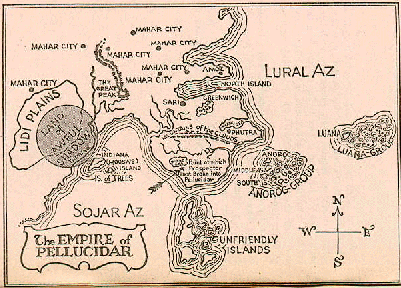
However, over time, we can see the evolution of ideas
which were either borrowed from or contributed to the pseudoscience, and
which indeed found their way into Burroughs' Pellucidar.
Pellucidar Map by Edgar Rice Burroughs
Among these notions were that the underworld was inhabited
by strange races of men, by prehistoric animals extinct on the surface,
that it had an inner sun, and even inner moons, that it featured wild seas,
underground passages and polar openings.
When Burroughs came along, the genre was arguably dying
out in favour of more lively and less complex stories. Burroughs
arguably redefined the genre as adventure stories, and redefined the inner
world as Pellucidar.
It might be entertaining to see how many of the pre- and
post-ERB inner world societies could comfortably be fitted into Pellucidar,
but alas, for the most part, I simply don't have a detailed knowledge of
the bulk of these stories.
Pre-ERB Pellucidars
1741 Journey to the World Under-Ground,
Ludvig Baron von Holberg - Nils Klim falls through a hole in the
earth into an inner world. On the inside are a sun and planets.
(Lupoff/Critchfield)
1786 The Adventures of Baron Munchausen
R.A. Raspe - The Baron goes just about everywhere, so of course, he pops
through a hole in the earth to china and back. (Lupoff)
1788 Icosamero by Giacomo Casanova — “Ship-wrecked
siblings are dragged by currents to an underwater crevice, through layers
of water and gas until they emerge in an unknown land. Protocosmo is a
gigantic island floating on a muddy substance at the center of the earth.
It has a sun which gives out pale pink light. It is full of kingdoms and
cities. The people, called Megamicroes, live in underground houses. They
are hermaphrodites and oviparous. The fauna of Protocosmo is similar to
Europe except for the flying horses.” (Critchfield)
1820 Symzonia, Adam Seaborn (probably Symmes himself)
- A sea vessels enters the inner world through the south polar hole and
finds two suns and two moons, which Lupoff suggests are reflections through
the poles. Other accounts of the story have the place lit by
mirrors reflecting polar light. Everything is white, people speak
a musical language, and surface worlders are descendants of Symzonians.
(Lupoff/Critchfield)
1833, 1835, 1838 Narrative of Arthur Gordon Pym,MS
Found in a Bottle, and Hans Pfall all by Edgar Allen Poe,
feature hints of an inner world, according to Lupoff. Though its
not actually seen. (Lupoff)
1864 Journey to the Center of the Earth
by Jules Verne, is sort of a hybrid. The Journey seems to pass
through an immense cave system, but it touches on an inner realm so vast
it literally has its own sea and weather system, a giant caveman is spotted,
as well as mammoths on land and sea monsters in the ocean.
The scientific ‘proofs’ which begin the journey point to a hollow earth.
But ultimately, the idea is too ridiculous even in the 1860s, and Verne
soft peddles his way back to an adventure through caverns.
1871 The Coming Race by Edward Bulwer-Lytton
--another deep cave system story, a utopia inhabited by an highly-evolved
race. Yes, it's the “dark and stormy night” guy. (Critchfield)
1880 Mizora by Mary E.
Bradley Lane – “in this world, males are no longer necessary.”
Written by an early feminist, apparently. (Critchfield)
1882 Pantaletta by Mrs. J. Wood
– “the inner world is run by an arrogant woman.” Another early feminists?
1885 The Third World - A Tale of Love and
Strange Adventure by Henry Clay Fairman — “an opening at the
North Pole leads to an inner world “ (Critchfield)
1888 Under the Auroras by William
J. Shaw (Critchfield)
1892 Al Modad by M. Louise
Moore (Critchfield)
1892 The Goddess of Atvatabar by William
R. Bradshaw. The protagonists enter through a polar opening, there
they find an advanced race which rides to war on 40 foot mechanical ostriches.
(Lupoff/Critchfield)
1893 Baron Trump's Marvelous Underground Journey
by Ingersoll Lockwood (1893)---illustrated by Charles Howard Johnson. “An
opening in arctic Russia conveys Trump into the interior world. He passes
through the strange countries of the Transparent Folk, the Rattlebrains,
and others. This lost race story is satirical and intended for adults as
well as children.” (Critchfield)
1894 From Earth's Centre by Bryon Welcome.
(Critchfield)
1895 Dreams of Earth and Sky
by Konstantin Tsiolkovsky. (Critchfield)
1895 Etidorpha by John Uri Lloyd.
A sort of pilgrim’s progress through the underworld. (Lupoff/Critchfield)
1895 Beyond the Paleocrystic Sea
by A. S. Morton. (Critchfield)
1897 In the World Below by Fred
Thorpe (Critchfield)
1898 Through the Earth by Clement
Fezandie – “highly illustrated, strange forces at the center
of the earth (~237 pages) “ (Critchfield)
1898 The Great Stone of Sardis by Frank R. Stockton.
Not really an inner world novel. It features a digging machine which
gets to the center of the earth and discovers a gigantic diamond, the Great
Stone. (Lupoff)
1899 The Secret of the Earth by Charles Willing
Beal, featured polar openings and an airplane trip to the inner world.
The Wright brothers would have been impressed. (Lupoff/Critchfield)
1900 “Nequa” by Jack Adams.
(Critchfield)
1901 Beyond the Great South Wall:
The Secret of the Antarctic by Frank Savile – “An expedition
to the Antarctic in search of lost treasures of the Mayans. The explorers
encounter Cay, a dinosaur worshipped by the Mayans. Illustrations by Robert
L. Mason. (~322 pages)” (Critchfield)
1903 The Land of the Central Sun by
Park Winthrop. (Critchfield)
1903 The Daughter of the Dawn
by William Reginald Hodder - “the Maori are a prehistoric race
in an inner world below New Zealand.” (Critchfield)
1904 Mr Oseba's Last Discovery
by George W. Bell - “the cover illustration is a globe
with a sailing ship coming from the polar opening.” (Critchfield)
1904 My Bride From Another World by
Rev. E.C.Atkins - “nudism & vegetarianism” (Critchfield)
1905 The Sunless City J.E. Preston Muddock
- see the case study, at the bottom.
1906 The Wolf-Men by Frank Powell
(Critchfield)
1908 The Smokey God by Willis George Emerson can
be found online, but it's a painful read, sporting an appalling combination
of sincerity and turgidity.
1908 Five Thousand Miles Underground by Edward
Stratemeyer writing as Roy Rockwood (Roy Rockwood was a house name, and
was also used for the Bomba the Jungle Boy series, as well as for adventure
stories to Mars and the Moon, all of them pretty sub-par and unreadable.
Several of ‘Rockwood’s adventures, including this one, can be found on
the net, however.
1915 The Earthomotor and Other Stories
by Dr.C.E. Linton (Critchfield)
Post ERB Pellucidars
1924 Plutonia by Vladimir Obruchev.
An inner world, prehistoric beasts. Lupoff makes a case that At the
Earth's Core might be the true inspiration, and that this is a Pellucidar
novel. But Rockwood or Verne could also be inspirations.
1927 Drome by John Martin Leahy.
An inner world, hideous monsters, a wicked priest, a beautiful princess
and apparently, absolutely terrible writing.
1929 The Radio Flyers and “The Radio Gun Runners”
Ralph Milne Farley. Pellucidar through and through.
1931 Tam, Son of the Tiger by Otis Adelbert
Kline - Actually, this seems to be an immense cave system under Burma,
a sort of mini-Pellucidar, which is inhabited by Blue, Thark-like, four
armed giant warriors and prehistoric animals. In the context
of a Burroughs/Kline shared universe, this would probably be a sort of
‘Hoos’ bubble, an opening between inner and outer worlds which has covered
over into its own little world.
1935 The Inner World by A. Hyatt Verill.
Possibly Lupoff’s candidate for worst ever.
1935 The Secret People by John Beynon Harris.
Actually, its just an immense cave system under the Sahara occupied by
albino negro dwarfs, and not actually an inner world per se.
1937 Hidden World (In Caverns Below) Stanton A.
Koblentz. An inner world, two warring advanced
nations.
Finally, although this is well beyond the pulp era, a
note should be provided for John Eric Holmes Mahars of Pellucidar
published
in 1976. There's also a lively trade in Pellucidar pastiches
and fanfics.
 That
said, the notion of a hollow earth is mostly discredited and worthless
in science fiction these days. Oddly, there are still pseudo-Pellucidars
in the form of immense cavern systems. The most recent underworld
novels have featured immense, hemisphere spanning cave systems, most notably
1999's The Descent which featured an immense cave system ranging
literally across the world, with outlets to the surface everywhere from
the Himalayas to Kansas, underground seas, a lost race of neolithic savages
with psychic abilities and strange animals; and 2002's Underland
by Mick Farren, which mixed Nazis, Vampires and a lost race of Jurassic
Reptiles in a series of gigantic caverns which ran from the north pole
to Antarctica.
That
said, the notion of a hollow earth is mostly discredited and worthless
in science fiction these days. Oddly, there are still pseudo-Pellucidars
in the form of immense cavern systems. The most recent underworld
novels have featured immense, hemisphere spanning cave systems, most notably
1999's The Descent which featured an immense cave system ranging
literally across the world, with outlets to the surface everywhere from
the Himalayas to Kansas, underground seas, a lost race of neolithic savages
with psychic abilities and strange animals; and 2002's Underland
by Mick Farren, which mixed Nazis, Vampires and a lost race of Jurassic
Reptiles in a series of gigantic caverns which ran from the north pole
to Antarctica.
Many of the post-Erb Pellucidars were influenced or shaped
by Burroughs own Pellucidar. While Burroughs drew on predecessors,
once he started writing, he probably occupied the field.
There were a couple of reasons. First, Burroughs simply wrote
more Inner World novels and stories. In total, he did seven Pellucidar
novels, counting serializations in magazines, and then reprintings in book
form, these novels represented not only a pretty big block, but they were
also showing up very frequently in different mediums, and so occupied a
fair chunk of the landscape. Simply by sheer mass, they threw
a long shadow, much as Barsoom's volume throws a long shadow over Mars.
Moreover, Burroughs' Pellucidar novels had a couple of
additional reasons for dominating the landscape. Tarzan
at the Earth's Core combined Pellucidar with his most famous franchise,
arguably injecting a lot of interest in his Pellucidar series and raising
the profile further. Finally, and this can be harsh, but Burroughs'
Pellucidar novels were just better written and a lot more readable and
exciting than other inner world novels. That's cruel, but go and
look up The Smoking God or
5000 Miles Underground and you'll
see what I mean.
Hence, it seems reasonable to assume that many of the
inner world novels or stories that come out after Pellucidar are defined
by Pellucidar, to the point where in the case of Farley's two stories,
you could fit them right in there. Or they may be defined by
their conscious attempt to oppose or do things differently than Burroughs
Pellucidar novels.
Ultimately, the inherent implausibility and ridiculousness
of the subject matter killed off the genre. However, there are still
mutterings of pseudoscience, and even recent novels and movies about immense
cave systems and strange ecologies.
The
Sunless City - a Pellucidar Case Study
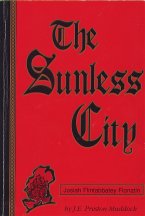 Professor
Flintabetti Flonatin becomes intrigued with an mysterious and apparently
bottomless lake in the Rocky Mountains. He decides to try and plumb
its depths with a mechanical fish, a submarine.
Professor
Flintabetti Flonatin becomes intrigued with an mysterious and apparently
bottomless lake in the Rocky Mountains. He decides to try and plumb
its depths with a mechanical fish, a submarine.
With his submarine, he dives down, down and further down,
eventually coming upon a strange land where gold is everywhere to be found.
He goes gold mad, filling his pockets and eventually succumbing to fatigue.
When he wakes, he is in a very strange place.
He is in a hall filled with strange people who look a little like monkeys
and have tails of varying length. They want to know who he is, and
why he's weighed down with useless worthless gold. Flin Flon
is almost in trouble, but the Princess of the realm is struck with love
and intercedes for him.
Thereafter, he becomes embroiled in a battle between two
court advisors. He becomes a tourist in this strange society.
The people of the city, who are refined and civilized, and have a society
where females are in charge, are opposed by an neighboring nation, their
opposites in every way. Flin Flon, being a stranger, is put
on trial for his very life. Eventually, he starts a revolutionary
movement to liberate the oppressed males. From there, he escapes
back to the surface with his remarkable story.
Sounds like classic Burroughs doesn't it?
Well, yes and no. Flin Flon, rather than being a typical Burroughs
hero is a middle aged, balding guy with warts, he's passive taking almost
no action and content to mostly be a spectator. The beautiful princess
who falls in love with him is actually a boot, she's horse faced, and about
as demure as a tavern brawl.
There's very little adventure, and way too many lengthy
conversations which are exercises in absurd style. This is
what passed for humour and wit at the turn of the 19th century.
And its not subtle humour. The land is called Esnesnon, the
princess's name is Yombot, the king is named gubmuh, the dueling savants
are Professor Ytidrusba and the learned Loofmot and Doctor Yrekcauq and
the lawyer is Hturtehteraps. Spell them all backwards and you
get an idea of the level of wit. What this really is, is a
Gulliver's Travel type satire.
Flin Flon comes upon a land of Monkey Men that consider
him primitive, they believe that their inferior souls wind up as tailless
beings on the surface, they value tin and consider gold trash, their women
are sexually aggressive and socially dominant, and so forth.
And all of these things, of course, they consider natural and right, and
explain at length to Flin Flon what a deluded freak he is, and how intrinsically
unimportant and backwards all his science and civilization is.
The inner world is a distorted mirror of the outer one.
That said, the trappings of this inner world, and this
story are all Burroughsian through and through, which sort of leaves us
with the uncomfortable feeling that Burroughs stories have lived backwards.
They were spoofed as trite cliches before they caught on. Thus,
the dashing hero is an old curmudgeon, the beautiful princess is ugly,
etc., her affection for Flin Flon is unrewarded, there are dueling cities
but that never comes into play.
Oddly you could fit this into Pellucidar.
The tailed Esnesnon people seem clear relatives of Burroughs' three races
of Pal-Ul-Don and his two races of Pellucidar prehensile-tailed men.
Though their tails are not apparently prehensile, these people follow the
practice of tail bobbing for social status, thus the highest ranking have
the longest tails and the lowest ranking have short tails.
There is a mention of prehistoric beasts, though this is mostly offscreen,
as is the dueling city. There's no visible sun, but rather
luminous clouds, so in Pellucidarean terms, its likely that the Esnesnon
and their rivals probably occupy one of Burroughs ubiquitous hidden valleys
with a permanent cloud cover.
Of course, its unlikely that Burroughs got his long tailed
monkey men from here. He could come up with it independently easily
enough. But the overall similarity or compatibility of the
setting and overall plot with Burroughs is remarkable. It shows
us that, as with Mars and Venus, a lot of the basic ideas or structure
of Pellucidar were lying around waiting to be had. In a sense,
Pellucidar existed as a fictional landscape before Burroughs wandered onto
the scene and made it his.
There's a small postscript to the story of the Sunless
City. Prospectors in northern Manitoba were looking for minerals,
and found a lucrative strike in some rugged territory. Now
these were guys who were living out in the bush for months on end, and
reading materials were shorthanded. Somehow, a copy of the Sunless
City wound up there, perhaps left behind by a passing traveler or trader,
and got read and passed around until it was dog eared. When
the prospectors found their big strike, one of the pits reminded them of
the Sunless City, so they named the area, and the town that grew up around
the strike "Flin Flon" after the hero of the story. Today,
the story is a minor bit of folklore in Canada, the town of Flin Flon has
several monuments to its fictional forbear, and the town museum sells copies
of the book, which is where I found it.