RADIO PELLUCIDAR
Farley's
Flyers of Pellucidar
I'd like to take a moment or two to look at Ralph Milne
Farley's Radio Flyers, with perhaps a note or two to his Radio
Gun-Runners.
I've written about Ralph Milne Farley in Radio
Free Venus and I'll happily refer you to that article. I
feel no special need to repeat myself at length. Instead, I'll
simply note that after Otis Adelbert Kline, Ralph Milne Farley was
probably the most interesting of the Burroughs imitators. Where Kline
worked jungle men, Mars and Venus, Farley worked Venus and Pellucidar.
Alternately, I've also written a couple of essays on the origins of Pellucidar
in pseudo science and in fiction, and I'll happily refer those to you as
well. On the other hand, you don't need to read any of these
to get through this.
Ralph Milne Farley (actually Roger Sherman Hoar) wrote
a trio of novels, the Radio Man series, in the 1920s, set on Venus which
were very very reminiscent of Burroughs Martian stories. From
there, he'd written an alien invasion novel that tied to his Venus trilogy,
and eventually returned in the late '30s to a couple of Radio Man adventures.
Along the way, he wrote an inner world novel titled The
Radio Flyers Essentially, the story is that a Chicago newspaperman
sends a couple of intrepid aviators, Eric Redmond and Angus Selkirk to
fly to the north pole and back.
Now, there'd been expeditions to the pole before, but
this was the 1920s, when people were inventing new aircraft every other
week and were always in the news for flying from one place to another place.
It was the age of Charles Lindbergh and Amelia Earhardt.
Things don't go so well, because once they reach the polar
region, they get lost. Even worse, they crash.
Separated Eric drifts on the ice floes. But instead of freezing to
death, he finds themselves entering warmer waters. Their ice
melts, he makes it to shore, and there he discover Vikings and Cavemen.
The Vikings are Christian settlers of Greenland, whose
ship had drifted into the interior world. The Cavemen are actually
inuit. Or more precisely, they're the ancestors of the Inuit people,
who according to this, were originally inner world dwellers who drifted
into the frigid outer world and adapted.
Eric, who knows a bit of Swedish, manages to communicate
with the Norsemen, hooks up with the local beauty queen/chief's daughter,
Helga, rescuing her from some cavemen. It turns out that the
girl is accident prone: At one point, a giant pterodactyl tries to fly
off with her, and at another point, a seven foot ape man tries to abduct
her, if that's not bad enough, traitorous Vikings want her for themselves,
so its just as well Eric is around. They get captured, they escape,
Eric figures out Hess inside the world. There are woolly mammoths,
glyptodonts and giant sloths, life is pretty primitive. Luckily,
there's a bright interior sun to keep everything lit.
Angus shows up in the airplane, having had his own adventures,
and the two friends have a reunion. Of course, Helga gets lost
again, and more adventures happen. She's abducted by a pterodactyl
but manages to kill it herself. Angus hooks up with Astroo, a Skraeling
Princess, which is good, but their airplane runs out of gas, which is bad.
They decide to build hang gliders, using pterodactyl leather for their
material.
Then they hook up with Helga's Norse people, but that
gets complicated, because there's a big battle with the Skraelings, and
some ambitious Vikings side with the Skraelings so that they make themselves
the rulers of the Vikings.
Eventually, everything works out though, and Angus and
Eric settle down to a happy life with their savage Princesses and adapt
to this new world quite nicely. So much for the Radio Flyers.
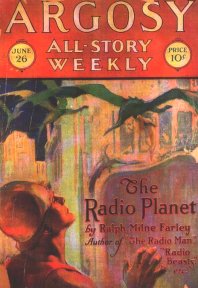
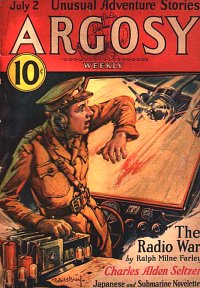
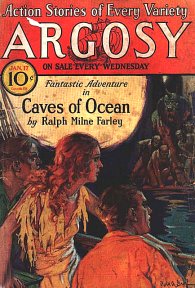
Unfortunately, of the Radio Gun Runners, we know
very little. On Bill Hillman's Erbzine, there's a passage
discussing Farley, where it is noted that the characters in the Radio
Gun-Runners figure out that they're entering the inner world by reading
the Radio Gun Runners in Argosy magazine. So, obviously,
it's a sort of sequel to
Radio Flyers, set in Farley's Pellucidar,
but that's as far as we can get.
Farley liked to do stuff like that. The Radio
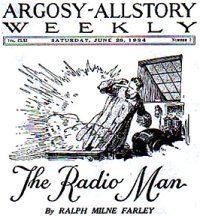
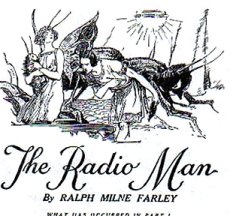
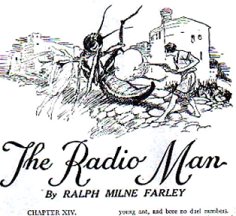
Flyers itself references the Radio Man adventures and publications
in Argosy. The chronicler of both the Radio Flyer
and
Radio Man adventures is the same fictional Robert Milne Farley,
and we must assume that they're both ‘true’ chronicles to each other.
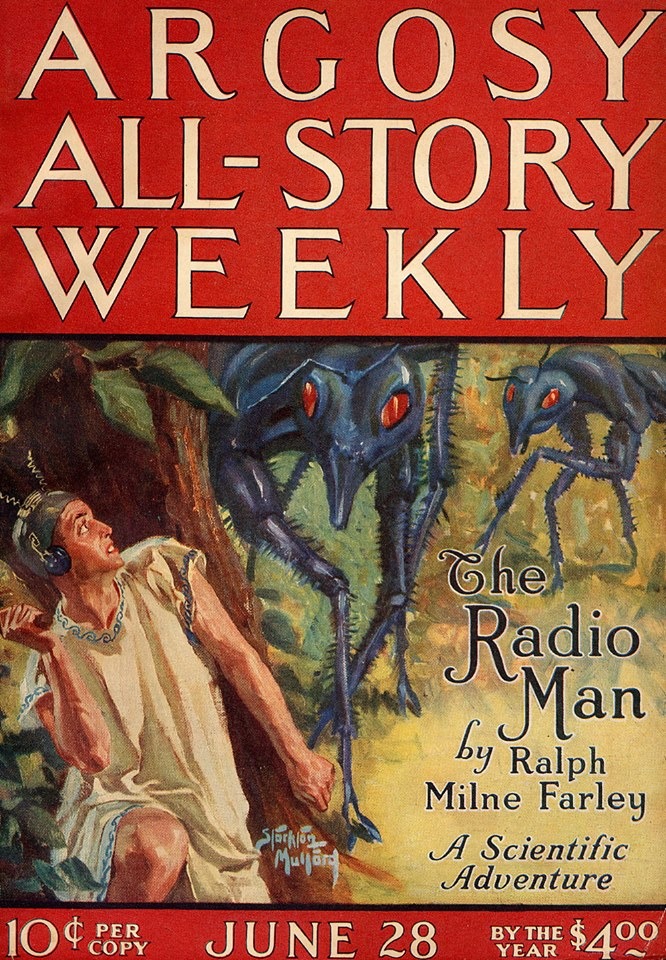
In the Radio Beasts, Myles Cabot returns to Earth
and mentions that Hess read the chronicles of his adventure as Radio
Man, published in Argosy. Then again in the Radio
Man Returns, various persons challenge the fictional Farley on the
reality of Myles Cabot.
It's a neat literary conceit that tends to tie his worlds
together. The inner world or Farley's Pellucidar of the Radio
Flyers and Radio Gun-Runners is in the same universe as Farley's
Venus. I suppose that means that if his Venus is the same planet
as Burroughs Venus, then his inner world must be in the same universe as
Burroughs Pellucidar stories.
But the point is that the Radio Gun-Runners is
clearly a second hollow world story or novel from Farley, and almost certainly
set in the same continuity as the Radio Flyers themselves.
Beyond that, however, I can say nothing more about it.
Indeed, there's even an interesting side note. There
is at least one substantial pastiche on the web which has Farley's and
Burroughs Pellucidarean characters meeting up and having an adventure together.
I believe its called Vikings
in Pellucidar.
You'll recall that when we looked at Mars, these sorts
of crossovers were pretty frequent, for Venus, they're nonexistent.
A crossover for Pellucidar... Interesting.
All right, so let's take a look at Farley's inner world.
It's peopled by Vikings who've sailed in from Greenland, and by Skraelings,
stone age savages who have given rise to the Inuit of the outer world.
The inner world is a tropical paradise with a twenty-four hour sun at its
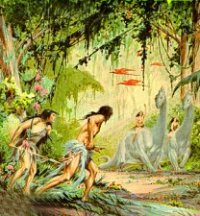
center. Among the creatures mentioned are glyptodonts, giant sloths,
woolly mammoths, eohippus, a seven foot tall gorilla-man and pterodactyls.
The biggest of the pterodactyls is robust enough to carry a human away.
Let's just give it up. This is Pellucidar,
no ifs ands or buts, and we all know it. Farley knows it and
Burroughs knew it. There's actually a reference which can be
found in Erbzine 0987:
THE SCIENCE FICTION FAN (1939 science fiction fanzine)
vol. 4 #4, whole number 39. 5 ½ x 8 ½, 20 pages. Ditto printing.
Article by Ralph Milne Farley on how he and Edgar Rice Burroughs read the
same book and were each inspired to write different stories by it (in Farley's
case The Radio Flyers). He even quotes a letter he had received from ERB.
That book was undoubtedly Marshall B. Gardner's privately
published manuscript,
Journey to the Earth's Interior, printed
originally in 1913 and reprinted expanded to 456 pages only a few years
later. According to Gardner, the Earth was hollow, it was a
shell 800 miles thick, with 1400 mile openings at each pole.
Inside, there was a sun, 600 miles in diameter, giving life and heat perpetually
to the inner world. Other planets were built the same way, the Martian
ice caps were evidence that Mars was hollow. By this time, of course,
there had actually been several expeditions to the North Pole and the South
Pole. Gardner worked hard to argue that they never actually
made it. Apart from that, he was pretty much making the same sorts
of arguments as his predecessors.
Gardner's book, of course, allows Farley to offer up a
fig leaf of deniability. Apparently, he and Burroughs corresponded
over this and Farley maintained that he took his inspiration from the same
book that Burroughs did, probably Gardner's work of pseudoscience, written
in 1913 and revised, expanded and reprinted in 1926.
Well, okay, fair enough. Except that At the Earth's
Core was published in 1914-15 and Pellucidar came out around
a year later. Tanar of Pellucidar and Tarzan at the Earth's
Core appeared in magazines in 1928-1929.
The Radio Flyers appears in 1929. The
Radio Gun Runners appears subsequently. This is after Burroughs
has chugged out no less than four Pellucidar novels, including one which
crosses over with his most famous creation, Tarzan.
Farley is a huge fan of Burroughs, and his Radio series
is pretty much a homage to Burroughs Martian series, and he was also a
friend of Burroughs. So, are we expected to believe that Farley
never read the Pellucidar novels, wasn't inspired by them?
Come on, who is kidding who here? No, instead he claims he took his
inspiration from Gardner.
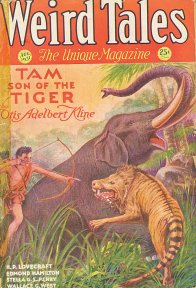 Yeah, and Otis Adelbert Kline's Jan and Tam
took nothing from Tarzan, and Kline's Martian novels have no resemblance
to Barsoom.
Yeah, and Otis Adelbert Kline's Jan and Tam
took nothing from Tarzan, and Kline's Martian novels have no resemblance
to Barsoom.
Did Farley take nothing from Gardner's book? Well,
I'll put it this way. What I think he took from Gardner was the license.
Gardner gave him a kind of plausible deniability, grounds to say he wasn't
working in Burroughs world, but merely taking his inspiration from the
same source, producing a similar work. Yeah, right. Whatever.
I'm pretty sure that Farley didn't get his gorilla-man and pterodactyls
from Gardner, no way, no how.
 There's
a certain justification to Farley. Remember that basically,
all these writers were working in shared worlds, worlds that were grounded
in the reality of the time, in the social narratives and concepts of the
time known to readers as well as writers. The wild west was
a shared world, the mysterious Orient was a shared world, darkest Africa,
old dying Mars and young thriving Venus. These were all places that
existed as shared landscapes irrespective of their realities.
Africa wasn't dark, the West had only been briefly wild, Mars and Venus
would turn out to be quite unlike our concepts. But each of these
places meant something to people, they had a look, a feel, a sort of landscape
and history associated with each.
There's
a certain justification to Farley. Remember that basically,
all these writers were working in shared worlds, worlds that were grounded
in the reality of the time, in the social narratives and concepts of the
time known to readers as well as writers. The wild west was
a shared world, the mysterious Orient was a shared world, darkest Africa,
old dying Mars and young thriving Venus. These were all places that
existed as shared landscapes irrespective of their realities.
Africa wasn't dark, the West had only been briefly wild, Mars and Venus
would turn out to be quite unlike our concepts. But each of these
places meant something to people, they had a look, a feel, a sort of landscape
and history associated with each.
Pellucidar, or Gardner's Hollow Earth, was another
one of these shared worlds. It was a minor one, but there was
an evolved vision, a narrative, a sort of consensus landscape there.
So Farley had a fig leaf to hide behind.
Of course, the trouble is that Burroughs vision became
more famous and more pervasive than Gardner's ever was. Even more
than Burroughs Barsoom shaped the visions of Mars, Burroughs Pellucidar
defined and described the inner world.
Look, it's been a long time, everyone is dead, the copyrights
have expired, so we may as well just fess up and be honest about the whole
thing. The Radio Flyers and Radio Gun-Runners are just a
couple of Pellucidar novels from a contemporary and peer of Burroughs.
Let's just call it what it is.