The Dreaded Fear of Many Maidens (and a Couple of Guys)
in Edgar Rice Burroughs’ Stories

Click/Tap for full-size collage
“A fate worse than death.” Edgar Rice Burroughs often uses those five
words, and variations of them, to foreshadow impending doom for many of
his characters. The image appears in thirty-three of Burroughs’
published stories, from A Princess of Mars in 1912 through Tarzan and
“The Foreign Legion” in 1944.
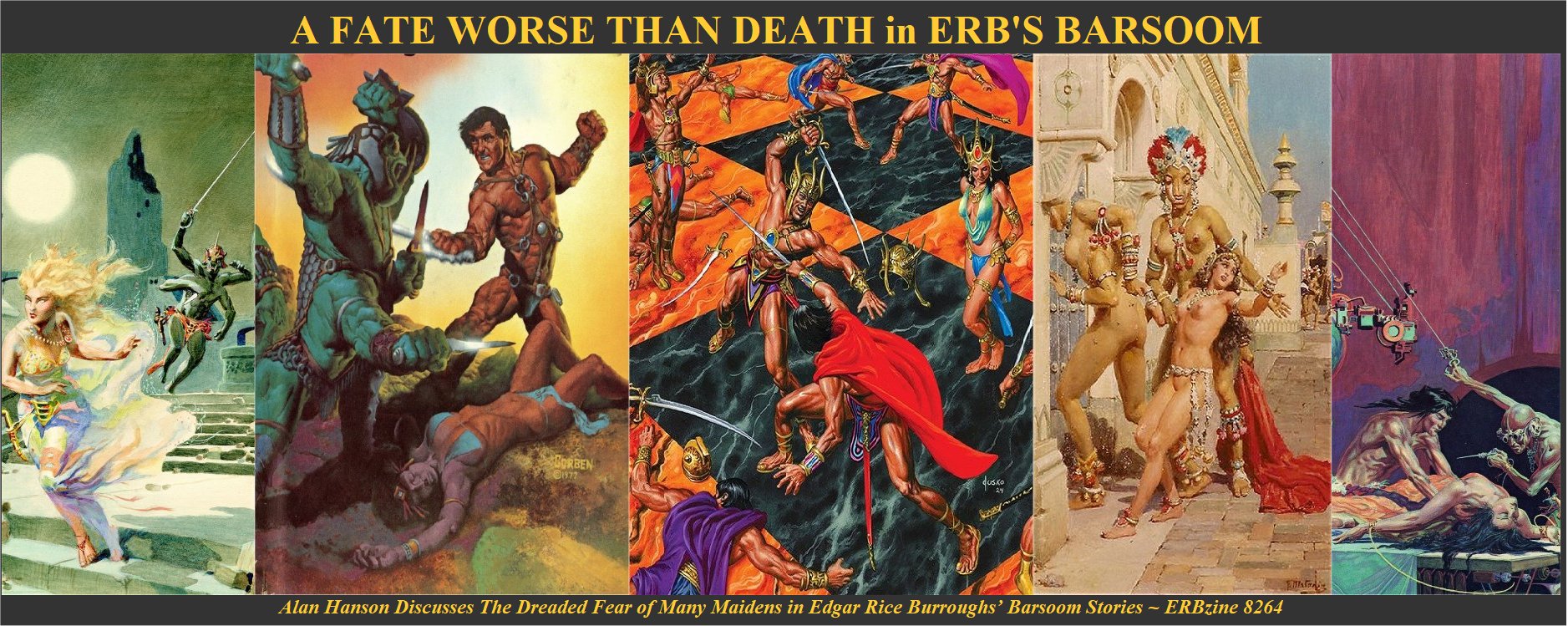
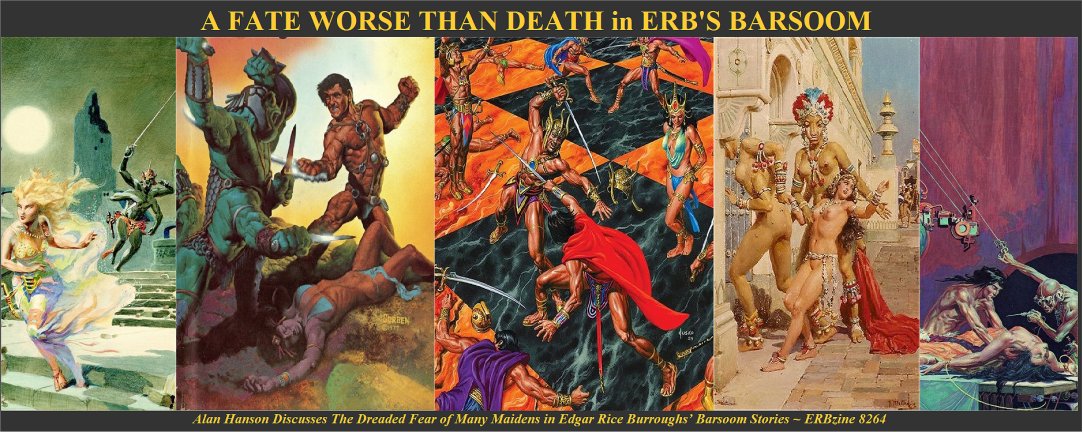
Most often the “impending doom” refers to sexual violation of
vulnerable female. Burroughs’ first such image appears in A Princess of
Mars, as narrator John Carter hears the appalling fate handed down to
Dejah Thoris by the “abysmal atavism,” Tal Hajus, Jeddak of the Green
Martians in the city of Thark.
“Princess of Helium, I might wring a mighty ransom from your people
would I but return you to them unharmed, but a thousand times rather
would I watch that beautiful face writhe in the agony of torture; it
shall be long drawn out, that I promise you; ten days of pleasure were
all too short to show the love I harbor for your race. The terrors of
your death shall haunt the slumbers of the red men through all the ages
to come; they will shudder in the shadows of the night as their fathers
tell them of the awful vengeance of the green men; of the power and
might and hate and cruelty of Tal Hajus. But before the torture you
shall be mine for one short hour, and word of that too shall go forth
to Tardos Mors, Jeddak of Helium, your grandfather, that he may grovel
upon the ground in the agony of his sorrow. Tomorrow the torture will
commence; tonight thou art Tal Hajus’; come!”
Although Burroughs’ green Martians are an intelligent race, their
brutish body structure adds a dimension of bestiality to Tal Hajus’
intentions to rape the red Martian princess. John Carter describes the
Jeddak of Thark thus:
“He had all the cold, hard, cruel, terrible features of the green
warriors, but accentuated and debased by the animal passions to which
he had given himself over for many years. There was not a mark of
dignity or pride upon his bestial countenance, while his enormous bulk
spread itself out upon the platform where he squatted like some huge
devil fish, his six limbs accentuating the similarity in a horrible and
startling manner.”
After John Carter helps Dejah Thoris escape that cruel fate, the two
flee the Green Martians in search of her home city. She tells Carter,
“If we make it, the debt of Helium will be a mighty one; greater than
she can ever pay you; and should we not make it, the debt is no less,
though Helium will never know, for you have saved the last of our line
from worse than death.”
In Burroughs Martian stories, several other Barsoomian damsels in
distress find themselves threatened by similar anguish. In The Gods of
Mars, the Thern princess Phaidor, captured by the Black Pirates, tells
John Carter of the terrible fate she expects to suffer. “No thern
damsel of all the millions that have been stolen away by black pirates
during the ages they have raided our domains has ever returned to
narrate her experiences among them. That they never take a man prisoner
lends strength to the belief that the fate of the girls they steal is
worse than death.”
In The Chessmen of Mars, Tara, the daughter of John Carter and Dejah
Thoris, finds herself under the spell of Luud, king of the Kaldanes, a
race of hideous, cannibalistic, mobile heads. When Luud begins
caressing her, Tara pleads for the red man Turan to save her. “Let them
not drag me to a fate worse than death,” she cries out. “Better that I
die now while my eyes behold a brave friend than later, fighting alone
among enemies in defense of my honor.”
In almost all of his later Martian stories, Burroughs continues putting
many of his female characters in danger of being raped. In A Fighting
Man of Mars, Hadron of Hastor saves the “slave girl” Tavia (actually a
princess of Tjanath) from a “fate worse than death.” He leaps into an
airship to rescue her from the evil intentions of Tul Axtar, the
villainous Jeddak of Jahar. Later, when Carter is condemned to death in
The Swords of Mars, his fear pales before the “far greater mental
perturbation” created by the knowledge that Dejah Thoris’ fate is to be
worse than death at the hands of Ul Vas, the Jeddak of the Tardis on
the Barsoomian moon Thuria. Again, in Skeleton Men of Jupiter, when
John Carter refuses to help Bandolian, Emperor of the Morgars on
Jupiter, conquer Helium, the emperor declares, “You shall be destroyed;
your mate will be hunted down and, I promise you, she will be found.
Her fate will be infinitely worse than death.”

“Fate Worse Than Death” In the Greystoke Family
Click/Tap for full-size collage
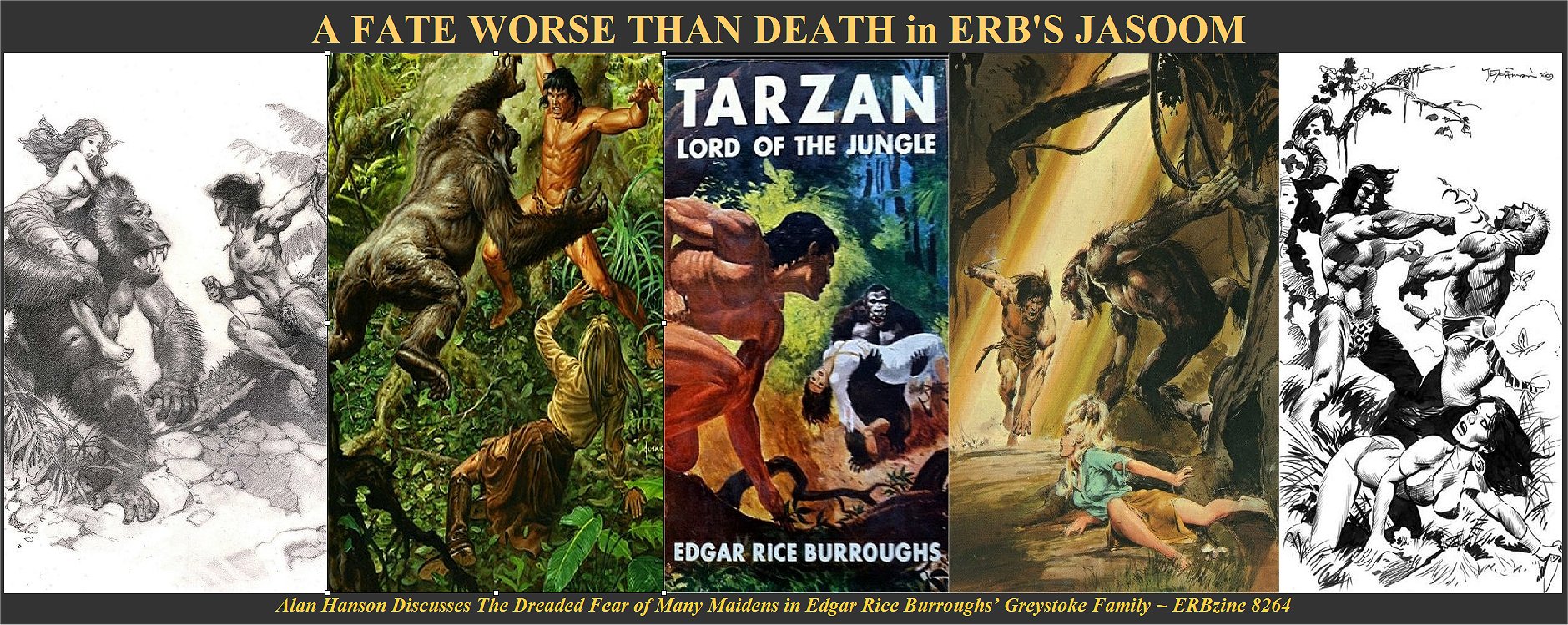
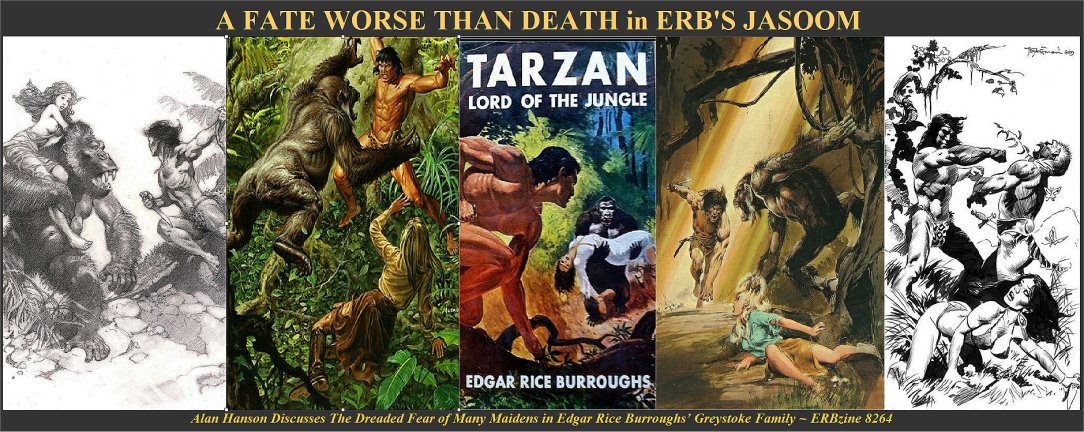
In Tarzan of the Apes, written in 1912, Burroughs put his leading lady
under the same fearsome fate that Dejah Thoris faced — rape and
bestiality. When banished from the tribe of Kerchak, the great ape
Terkoz lost his females. Coming across Jane Porter, Terkoz grabs her,
intending to take her away to what Burroughs declares, “a fate a
thousand times worse than death.” She is saved when Tarzan follows
Terkoz’s trail and kills him. Later, Jane wants her father to meet the
man who “saved her from death and worse than death,” but the timid
Tarzan refuses to go back to the cabin with her.
Some years later, in events recorded in The Beasts of Tarzan, Jane and
her (believed-to-be) infant son fall under the power of the dastardly
villain Nicholas Rokoff, who transports his captives to Africa. He
tells Jane of his plans to make her baby the son of a cannibal chief
and her the wife of a cannibal. After the baby dies, though, the
villain’s ire turns on Jane, who flees, looking for some way to end her
own life before Rokoff violates her.
“Behind her lay a fate worse than death, at the hands of human beings.
Before her lay an almost certain fate—but it was only death—sudden,
merciful, and honorable death. Without a tremor and without regret she
darted away from the camp, and a moment later the mysterious jungle had
closed about her.”
By the end of The Beasts of Tarzan, though, all of Jane’s fears of a
“fate worse than death” for their family fade away. Years later,
though, Jane faces that same fear once again. She vows to “put a bullet
into my own head” if the demented German officer Erich Obergatz tries
to bend her to his will in Tarzan the Terrible.
In The Son of Tarzan, Lord Greystoke’s future daughter-in-law Meriem
resists the assault of the evil Arab Ali ben Kadin, whom Burroughs
describes as “old and hideous and almost black” with one cheek
partially eaten away by disease. “If God is good,” Meriem declares, “I
shall be dead before morning, for if I still live, I shall be worse
than dead after tonight.” (Eventually, Korak comes to the rescue of his
future wife.)
Like Meriem, other white women in Tarzan’s country face abduction by
Arabs intending to sell them into “black harems” to the north. One is
Victoria Custer, a guest at Lord Greystoke’s home in Africa in The
Eternal Lover. She’s nabbed by Sheik Ibn Aswad, who plans to sell her
into slavery in the black harem of the Sultan of Fulad. Burroughs notes
that Victoria has but a “hint of the fate which awaited her, yet it had
been sufficient to warn her that death were better than the thing she
was being dragged through the jungles to suffer.”
A Roll Call of Other ERB Women Who Face “A Fate Worse than Death”
Click/Tap for full-size collage
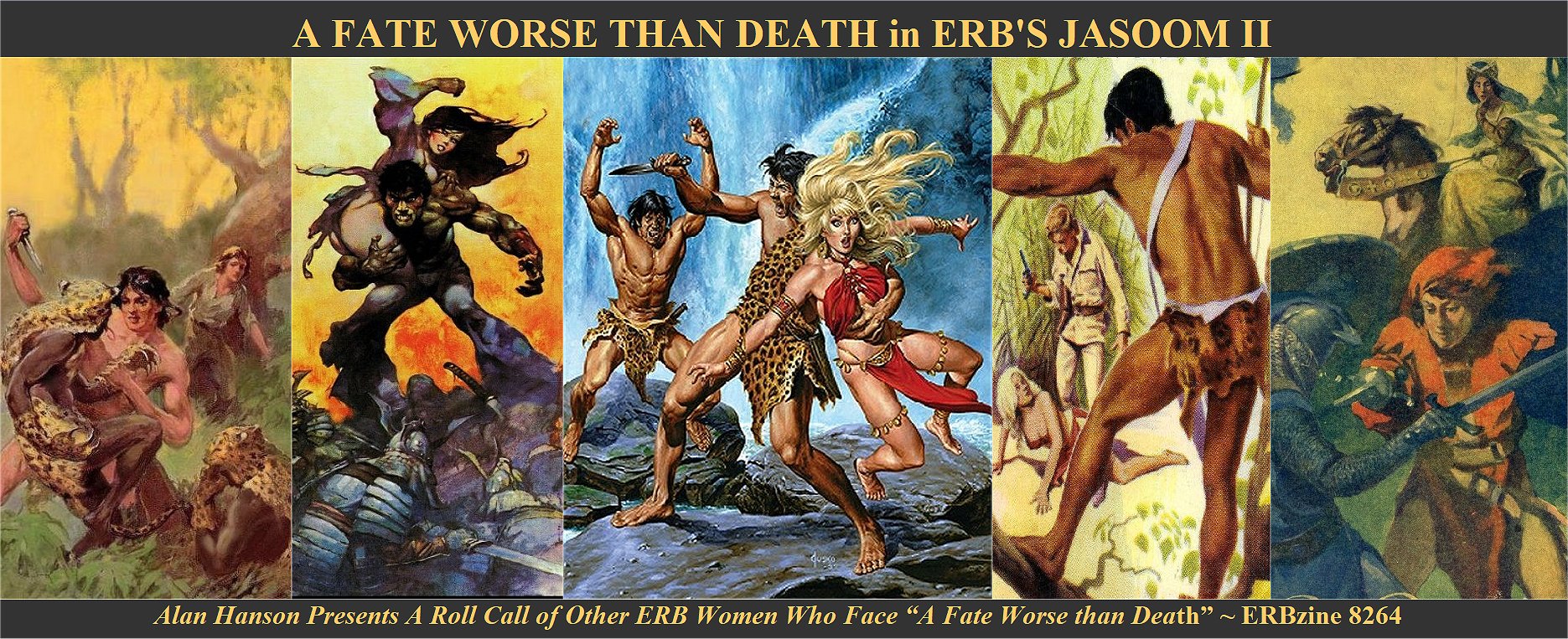
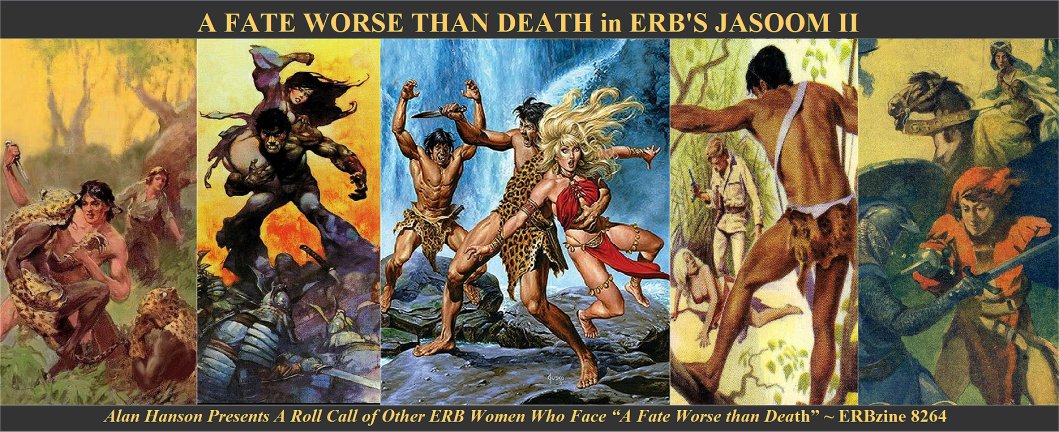
Other women in Burroughs’ Tarzan stories who find themselves facing “a
fate worse than death” include Victoria Custer in The Eternal Lover,
Bertha Kircher in Tarzan the Untamed, Lady Barbara Collis in Tarzan
Triumphant, Jessie Jerome (“Kali Bwana”) in Tarzan and the Leopard Men,
Rhonda Terry in Tarzan and the Lion Man, and Corrie van der Meer in
Tarzan and “The Foreign Legion”.
Many other female characters in various Burroughs stories are
threatened with the same horrid fate. They include Bertrade de Montfort
in The Outlaw of Torn, Nadara in The Cave Girl, Fou-tan in Jungle Girl,
Virginia Maxon in The Monster Men, Barbara Harding in The Mucker,
Pan-at-lee in Tarzan the Terrible, Victory in Beyond Thirty, Co-tan in
The Land That Time Forgot, Princess Mary in The Rider, Virginia Taylor
in The Man-eater, Jana in Tarzan at the Earth’s Core, and Duare in Lost
on Venus,
A Few Burroughs’ Men Face a “Fate Worse Than Death”
When the phrase, “a fate worse than death” appears in Burroughs
stories, it usually refers to the impending rape of a female character.
However, several men in Burroughs’ stories also are threatened with a
“fate worse than death.” Of course, it’s always something other than
the sexual threat faced by Burroughs’ female characters. For example,
in At the Earth’s Core, when David Innes kills Jubal “The Ugly One,” to
save Dian from a fate worse than death, she is far from grateful. “I do
as I please,” she tells him. “I am the daughter of a king, and
furthermore, I hate you.” A dumbfounded David then turns to Jubal’s
corpse and muses, “May be that I saved you from a worse fate, old man.”
Although Burroughs infused the fear of a fate worse than death in the
hearts of many of his female characters, they almost all escaped
degrading mistreatment. However, two characters who actually suffered a
fate worse than death in Burroughs’ stories were men. In Tanar of
Pellucidar, Bulf, a Korsar chief, comes up with a gruesome sentence for
two prisoners, Tanar and David Innes.
“There is a living death that is worse than death. These men are
accustomed to sunlight, to freedom, to cleanliness, to fresh air, to
companionship. There are beneath this palace dark, damp dungeons into
which no ray of light ever filters whose thick walls are impervious to
sound. The denizens of these horrid places, as you know, would have an
effect opposite to that of human companionship … A lifetime of hideous
loneliness and torture in silence and in darkness! What death, what
torture, what punishment can you mete out to these men that would
compare in hideousness with that which I have suggested?”
Tanar and David are then separated and confined in the silent, dark
dungeons beneath the Korsar city. After Tanar eventually finds a way
out, he describes to his sweetheart Stellara the torture he experienced.
“For a long time I thought that I was worse than dead. Darkness,
solitude and silence—God! That is worse than death. It was because of
you that I escaped. Thoughts of you kept me from going mad—thought and
hope urged me on to seek some avenue of escape. Never again as long as
life is in me shall I feel that there can be any situation that is
entirely hopeless after what I have passed through.”
Tanar’s “long time” in the “darkness, solitude and silence” of the
Korsar underground dungeons was miniscule compared to the time his
fellow inmate David Innes spent in that hellish place. To free David,
Tanar, first travels from Korsar back to Sari, where Abner Perry passes
the story of Innes’ confinement via the Gridley Wave to Jason Gridley
on the earth’s surface. Jason then travels to Africa, where he finds
and convinces Tarzan to lead a mission to rescue David from the
dungeons of Korsar. After Tarzan agrees, it takes seven months to build
the 0-220 rescue ship. Then, after three days’ sailing north, the
rescue team finally sails into Pellucidar.
While David Innes continues to endure his “fate worse than death” in
the dark dungeons of Korsar, Tarzan and other members of the outer
world rescue squad, wander around Pellucidar, encountering all kinds of
trouble, before finally getting their act together and rescuing David.
How long was David alone in that dark hell hole in Korsar? As time in
Pellucidar is undefinable, it’s hard to calculate. Unlike with Tanar,
Burroughs didn’t provide David’s thoughts on the experience. HIs future
adventures in Pellucidar, however, indicate his lengthy underground
sentence left no scars on his psyche. Still, his imprisonment in Korsar
was the longest and most dreadful “fate worse than death” ever
experienced by a Burroughs character, man or woman.
READ ALL THE BOOKS MENTIONED IN THIS ARTICLE IN ERBzine
https://www.erbzine.com/craft/

BILL
HILLMAN
Visit
our thousands of other sites at:
BILL
AND SUE-ON HILLMAN ECLECTIC STUDIO
ERB
Text, ERB Images and Tarzan® are ©Edgar Rice Burroughs, Inc.-
All Rights Reserved.
All
Original Work ©1996-2026 by Bill Hillman and/or Contributing
Authors/Owners
No
part of this web site may be reproduced without permission from the
respective
owners.