Official Edgar Rice Burroughs Tribute and Weekly Webzine Site Since 1996 ~ Over 15,000 Web Pages in Archive Volume 8261 |

|
Official Edgar Rice Burroughs Tribute and Weekly Webzine Site Since 1996 ~ Over 15,000 Web Pages in Archive Volume 8261 |
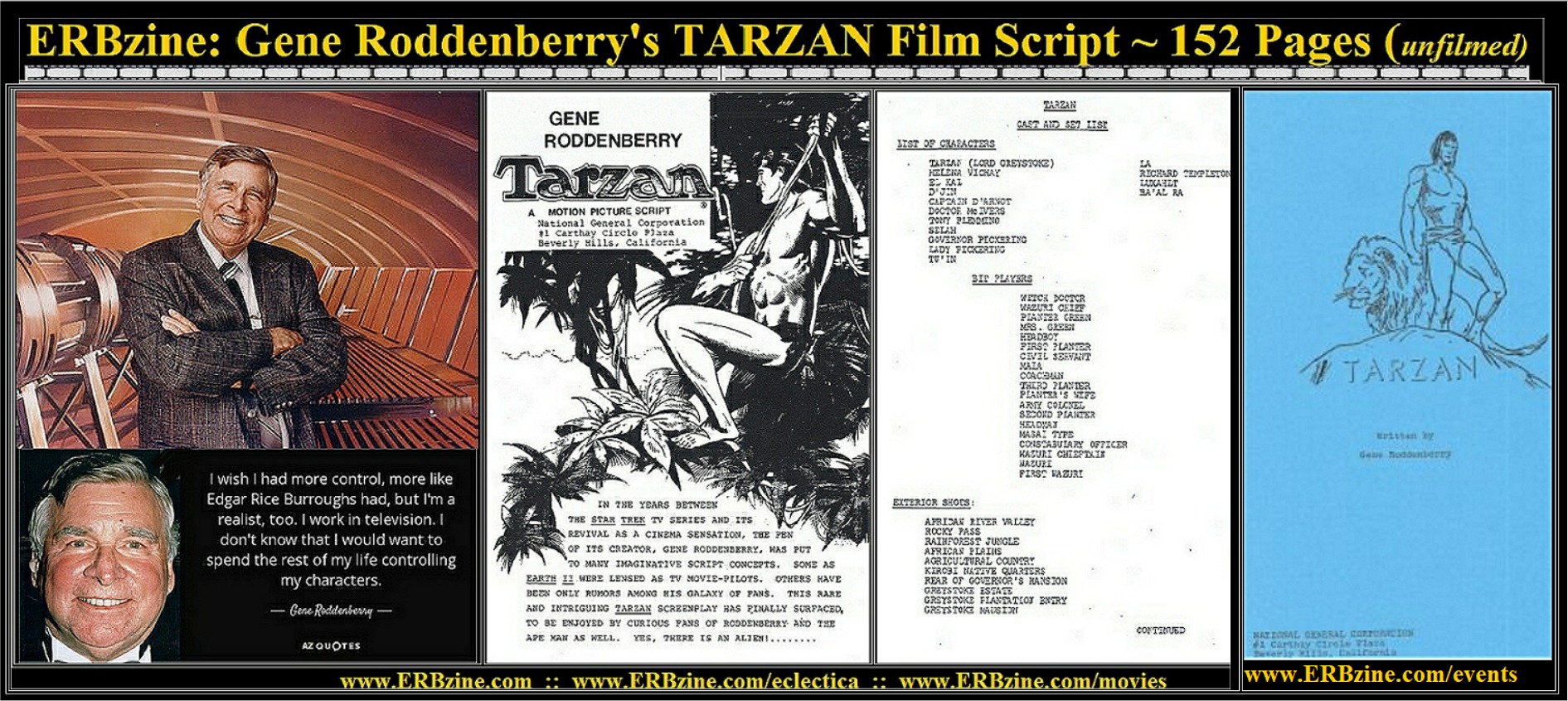
It has been 14 years since Edgar Rice Burroughs'famed literary hero, Tarzan of the Apes, swung his way into the movies. We last saw John Clayton, Lord Greystoke in theaters in Hugh Hudson's near-classic Greystoke: The Legend Of Tarzan (1984) starring Christopher Lambert. In a film that opened last week, Tarzan leaps on vines again in Carl Schenkel's Tarzan and the Lost City starring Caspar Van Dien and Jane March.
But did you know that Gene Roddenberry, Star Trek's legendary creator, once wrote a Tarzan script hoping to make his own stamp in the Apeman's jungle? That's right. In 1968, after relinquishing his Star Trek duties to Fred Freiberger, to producing the series' third season, Roddenberry signed a two-picture contract with National General, a production company.
The feature script that Roddenberry wrote was never produced, primarily because the script was deemed too expensive for the company and budget cuts brought it down to a movie-of-the-week level. This was not in line with Roddenberry's vision, as he wanted to get out of television at the time. A secondary reason why the script remained unused was that Roddenberry had allegedly written many sexually oriented moments in his characterization of our intrepid hero, not something for television.
Roddenberry got as far as location scouting in Mexico for the film and writing a full 169-page script, but very quickly, the project was quashedeven before casting had been considered. This means we don't know who might have become Gene Roddenberry's Tarzan!
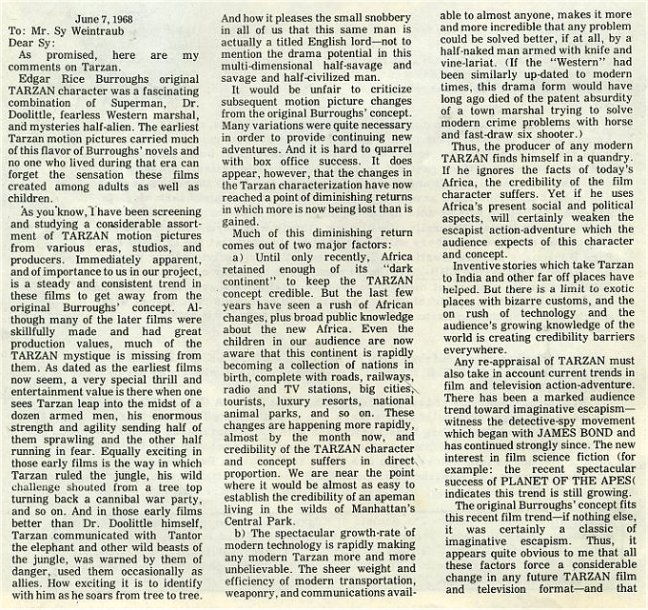
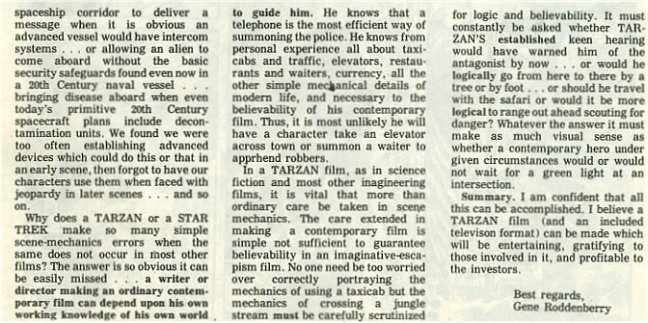
After carefully reviewing the books and all the previous films that had come before, Roddenberry arrived at the following creative decisions . In a long letter dated June 7, 1968 to long-time Tarzan film producer Sy Weintraub, Roddenberry outlined how he would have filmed Tarzan.
Roddenberry recognized the many incarnations of Tarzan, from a character who had extreme difficulty with the English language and spoke only in "monosyllabic" terms to an "intelligent" and well-spoken man. He understood different filmmakers' attempts to find different "spins" in filming the character such as Tarzan Goes to India (1962).
However, said Roddenberry, Tarzan was best presented in the late 1800s in the "dark continent" mystique of Africa because contemporary Africa in the late 1960s was very different and does not have the deep jungles as imaged by Burroughs. Placing the film in this period also exuded a more "romantic" flavor than a Tarzan of contemporary times. Roddenberry admired the dichotomy of a savage man-beast who swung through the jungles that also learned to become comfortable in civilized society with the title of a English lord. He much preferred an "intelligent" man than Johnny Weissmuller's popular "Me Tarzan! You Jane!" dialogue, an interpretation that Burroughs himself hated!
Regarding Jane Porter, Roddenberry decided to unburden our hero to go and have adventures. He also felt that nudity and sex were elements that, if handled tastefully, were important to the mythos.
What ruined the character in previous films, observed Roddenberry, was the general unbelievability of the character's abilities and the way in which writing was executed in selected scenes and trivial items. For example, in various films, it's not very believable that Tarzan could swim faster than he could run on land to prevent a crocodile attack. It also isn't very believable for a man who has lived a lifetime among the predatory jungle to allow himself to be ambushed by white hunters just to have an exciting moment of fisticuffs. Films would also show Tarzan being repulsed at the sight of snakes or of animals preying upon each other. Roddenberry simply blames writers' ignorance of the true challenges of a character operating in a hostile jungle environment. He asserted that extra care was needed in this area for best consistency.
Gene Roddenberry's script is essentially a blending of the action jungle adventure and science fiction genre. Known only to a few close friends, Lord Greystoke has a secret identity as the shadowy jungle man raised by apes known as Tarzan. The story begins in 1890, with the introduction of an evil Arab named El Kal and his companion Selah who possesses a strange cylindrical metallic object capable of producing fiery heat, and El Kal uses it to kill members of Tarzan's faithful Wazuri tribe. He is also the man responsible for the death of Tarzan's mate, Jane.
When Tarzan discovers his tribal friends killed by El Kal, he's gripped with a terrible anger. His old foe, previously believed dead, is alive and baiting him.
In the Crown Colony City, we see a party in full swing in a crowded Governor's Mansion Ballroom and are introduced to Governor and Lady Pickering. We also meet French Navy Captain D'Arnot, Tarzan's oldest and closest friend, and Lady Helena Vichay, a beautiful woman. Also in the crowd is Doctor McIvers, a Scotsman. Publicly, Lord Greystoke is theCommissioner of the Interior of this region.
The evil Arab El Kal is obsessed with obtaining a secret map that Helena possess so that he can locate the source of more heat weapons and a diamond mine.
Even after ransacking Helena's bedroom, and personally threatening her, El Kal fails to locate the map. We find out later that it is Helena's valuable necklace medallion that serves as a map.
To vanquish his foe, Greystoke (who casually reveals his true identity to Helena) as Tarzan with his Wazuri tribesmen set an elaborate ambush against El Kal. But they fail, and later, El Kal captures the apeman and tortures him with a bullwhip. But Tarzan escapes with Helena and is forced to spend several weeks recovering from wounds at a nearby lake before travelling to the location indicated in the medallion.
As the apeman and the girl arrive at an elaborate, sheer cliff location where they think Richard Templeton will be found, El Kal and his men secretly watch their activities.
After locating hidden doors and activating strange markers, Tarzan and Helena enter a vast alien chamber of silver metal and ride up a stone elevator leading them to the discovery of a lost society of Egyptian priests and soldiers. For centuries, these people have been guarding a giant metallic statue.
Inside the temple we see a giant crypt bearing the sarcophagus of Ba'al Ra, an eight-foot life-like metal statue, of one of the ancient gods who remained on Earth from centuries ago.
Roddenberry describes the ancient god as "Half-manlike, half some strange animal. Three claw hands and feet with talons, a fanged animal, 'alien' face. The statue wears a Pharaoh's waist garment and shows mixed fur and reptilian scales of a magnificent muscled body which dwarfs the physique of the apeman."
Having learned all about the lost civilization, Templeton is obsessed with reviving Ba' al Ra.
It's discovered that Helena's father was a priest from this place and for generations these people have been waiting for the genetically perfect woman to fit into the golden mold hidden in the walls so that Ba' al Ra could rise again from his sleep and take the woman as his new-found bride.
With the cylindrical weapon, Templeton blasts Tarzan into unconsciousness and whisks him to the dungeons. Waking up, Tarzan encounters 'pets,' 11 lovely and exotic ladies who wear golden collars with 12 feet of golden chain and tied to walls. He meets La, the high priestess from the lost city of Opar. Apparently she was supposed to enter the golden mold and awaken the ancient god, but Helena's appearance changed all that.
After freeing Helena and La from the golden chains, Tarzan has a climatic confrontation with Templeton. Events turn complicated when El Kal and his people arrive. Recognizing they have a common enemy in Tarzan, El Kal pledges his allegiance to Ba' al Ra as his new-found god.
A screaming Helena is placed in the golden mold and in an earth-shaking awakening, Ba' al Ra rises from his centuries-long sleep. When Templeton won't kneel to Ba' al Ra, a swift taloned hand swipes against him and he dies, thrown aside like a rag doll.
The newly awakened ancient god rampages into the jungle and surprisingly El Kal's heat weapon blasts don't manage to stop Ba' al Ra.
To defeat the rampaging centuries-old alien, Tarzan is forced to create in a hurry a series of spring loaded spear traps. In a lunging jump onto the creature's body, Tarzan twists and turns the spears into his guts managing to significantly weaken and enrage the alien.
The creature finally succumbs when he stumbles blindly back to the temple and takes a hand on one of the cylindrical objects at a storage cache. Accidentally triggering the firing stud, Ba' al Ra heat rays the other weapons and thus is enveloped in a flash and thunderous explosion.
In the far distance, Helena and Tarzan are rocked and shaken by the resulting flash and earthquake.
Epilogue: Tarzan returns to the Greystoke mansion to see his friends D'Arnot, McIvers and the Governor ... but with Helena and La accompanying him in the chariots. D'Arnot and McIvers are bewildered to see 10 very curious and sexually excited women enter the room. They rush toward and surround the two men who are flustered and nervous.
With a word, Tarzan commands La and she pulls out a bullwhip and snaps commands for the women to behave. These women are to be taken to their homes, says the apeman. In an exchange between La and Tarzan, we understand Helena is carrying Ba' al Ra's child...
The story as written is a fascinating read. Greystoke/Tarzan is rendered reasonably faithfully in dialogue and actions, unlike so many adaptations, particularly the ones that ERB himself detested. This Tarzan is clearly not a superman. He's wounded, ambushed, whiplashed and tortured.
We recognize the typical jungle scenes and the clever installment of a science fiction element with the invention of a heat ray weapon and theancient gods, The Wanderers. It's an interesting blend of Roddenberry-esque aliens and a "lost civilization" that Burroughs so much explored in his books such as Tarzan and the Lost Empire.
Only thrice has D'Arnot been portrayed in celluloid so it's interesting that Roddenberry found a role as a framing device. The lost film, Revenge of Tarzan (1920), Greystoke the Legend of Tarzan (1984) and the recent series Tarzan: The Epic Adventures had actors playing D'Arnot.
A word on character names: It is fascinating and somewhat hilarious to note that El Kal is an anagram (and a thinly veiled one at that) of Superman's Kryptonian name, Kal-El! (If by sheer coincidence El Kal is a legitimate Arabian name, the coincidence is still there, nonetheless.) Roddenberry reused the character name Helena in his 1974 Questor Tapes TV pilot. It's faithful for Roddenberry to use La who was the high priestess in the forgotten city of Opar in the early Burroughs novel, Tarzan and the Jewels of Opar. This jungle landmark, of course, figures in the current feature now playing in theaters.
To see Roddenberry's take on Lord Greystoke/Tarzan as a secret identity from the outside world is astounding, albeit contrived. By merely stripping off his English clothing, and donning a loincloth with a knife, Greystoke reverts to his savage persona. It is a clever twist of various interpretations of the character as either "intelligent" or "dumb." In Roddenberry's view, he's both when it pleases him.
The claims that this script brings us a particularly sexual Tarzan is unfounded. There's only a few so-called semi-nude scenes for Helena and our jungle hero, and perhaps later in the end with the 11 chained women depending how they're clothed, but this story is by no means risqué or unfilmable by today's standards. It's only in one uncomfortable scene where the traitor Flemming dies as El Kal's men attempts a quick circumcision as a sacrifice.
If there's anything disappointing about this story, and many films share the same blame, it is that there is a disconnection between our lead hero and the tribes of gorilla apes that raised him. Too many films claim he is an "ape-man" but so consistently fail to demonstrate this in story terms. The best they do, most of the time, is throw in a chimpanzee. And here we have none. It's why Hugh Hudson's Greystoke film is so well regarded.
All elements considered, however, if properly cast, costumed, directed and budgeted, there's no reason why Gene Roddenberry's adaptation of Edgar Rice Burroughs' most famed literary creation can't be respectfully filmed.