
Official
Edgar Rice Burroughs Tribute and Weekly Webzine Site
Since
1996 ~ Over 15,000 Web Pages in Archive
Volume 8233
|
THE CHESSMEN OF MARS
e-Text
Edition
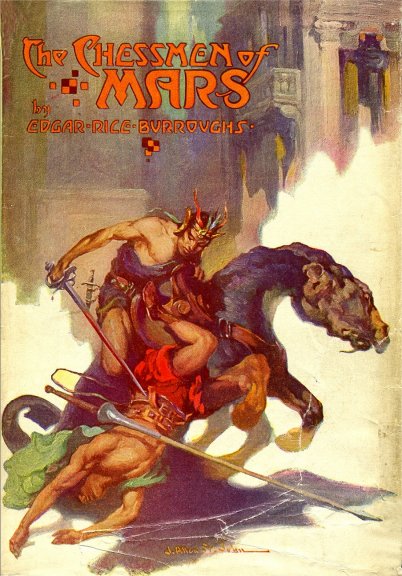
Evolution of the story. . . and Jetan
by Irwin Porges
During 1921, Burroughs completed a remarkable work, one that for imagination and
for complexity of detail and settings exceeded any of his previous writings. In
"The Chessmen of Mars," written January 7 to November 12, 1921, he
produced an incredible aggregation of characters and creatures and devised
Martian customs and practices of unusual ingenuity. His worksheet, one of the
most involved he had ever prepared, listed seventy items — people, buildings,
rooms, equipment, and geographical references, all briefly identified or
explained. Weaving the theme of the game of chess — called jetan on Mars — into the story was truly
an inspiration.
This Barsoomian game is normally played upon a board of a
hundred alternate black and orange squares, with the two opponents each
allotted twenty pieces in either black or orange. But in "The Chessmen of
Mars" the climactic game becomes one of life and death, played on a huge
scale. A gigantic jetan board is laid out in the arena at Manator: "Here
they play at Jetan with living pieces. They play for great stakes and usually
for a woman — some slave of exceptional beauty. . . . When a warrior is moved
to a square occupied by an opposing piece, the two battle to the death for
possession of the square. . . ." Each player is dressed according to the
piece he represents.
The idea developed undoubtedly from Burroughs'
knowledge of chess and his turning to the game for an occasional diversion.
During this period his opponent at times had been his secretary, John Shea. In
the prelude to "The Chessmen of Mars," with John Carter once more
returning to earth, Burroughs, as his nephew, opens with a reference to the
game he had been playing: "Shea had just beaten me at chess, as usual. . .
." Burroughs had "twitted" Shea about his skill, mentioning a
theory that "phenomenal chess players are always found to be from the
ranks of children under twelve, adults over seventy-two or the mentally
defective. . . ."
It appears, however, that Burroughs preferred to assume
the role of a regular loser at chess in the story, a role not indicated in real
life. A January 3, 1921, entry in his diary, written before he had begun
"The Chessmen of Mars," reads: "Played one game of chess with
Shea. Won. If scientific theories are correct it is more of an honor to lose at
chess than win. I do not recall ever having lost a chess game — though I have
played but few times. . . ." He then jokes about the fact that this
ability might establish him within the three classes described in the
scientific theory.
<>
<>In February 1922 John Shea left Burroughs' employ and was
later associated with the Hollywood Studios whose general manager, William
Sistrom, in 1924 accepted an offer to manage the proposed Edgar Rice Burroughs
Productions, Inc. The enterprise, launched with a goal of producing stories by
Burroughs and other authors, was to be financed by George B. Currier in Los
Angeles; however, the organizational plans never materialized.
<>
<>
Concerning the game jetan, Burroughs received a letter
of August 6, 1922, from Elston B. Sweet, a convict in Leavenworth Prison. Sweet
offered information of unusual interest. After reading "The Chessmen of
Mars," he and a fellow prisoner had used the details provided in the story
to carve a full set of pieces for jetan. Sweet noted, ". . . We have not
only played dozens of games between us, but have succeeded in making the game a
favorite among several other prisoners." He inquired whether jetan was
being manufactured commercially, and if so, hoped that Burroughs would send him
a set. According to Sweet, he and his friend had been sentenced to terms of
fourteen and ten years; however, in 1924 Sweet's sentence, commuted to six
years, expired, and he was released.
On August 16 Burroughs responded to explain that the
two prisoners had made the first set of jetan and that no commercial set had
been produced. Reader interest in jetan remained high. Burroughs
supplied a further summary of the game for publication in the appendix of the
novel, and in September 1927 two young fans, Stephen Lavender and John
Creighton of Thomaston, Maine, sent Burroughs a photograph of the jetan board
and pieces they had made. A chapter is devoted to jetan in the book Chess Variations by John Gollon, published
in 1968.
Because of his jetan theme, Burroughs in "The
Chessmen of Mars," achieves a unity and intensity not attained in other
works which at times could become loosely strung sequences of adventures,
battles, and escapes. In addition, the Burroughs imagination is startlingly
evident with the creation of the rykors, headless bodies that are mounted by
the hideous Kaldanes, living heads without bodies who manipulate the brainless
flesh. As explained by Ghek, a Kaldane who later assists Tara of Helium, the
heroine of the story, the Kaldanes are part of nature's evolutionary purpose,
with the brain becoming larger and more powerful. This process would continue:
". . . in the far future our race shall develop into the superthing — just
brain. . . . Deaf, dumb and blind it will lie sealed in its buried vault far
beneath the surface of Barsoom — just a great, wonderful, beautiful brain with
nothing to distract it from eternal thought."
Because of strong friendship ties with Bob Davis, Burroughs felt he
should be given an opportunity, in his new agency, to market "The Chessmen
of Mars." However, the price stipulated by Burroughs, as quoted by another
agency, was a minimum of $7,500. On March 23, 1921, Davis agreed to contact
magazine editors and to "talk about a figure around $10,000." The
price, even farther beyond the bounds of realism than the story, brought no
takers; the year drew to a close with "The Chessmen of Mars" unsold.
On December 12, Charles MacLean of Popular
Magazine rejected the story, commenting ". . . If he
[Burroughs] were to try something not quite so extravagant, something like
Jules Verne's submarine story, he would break into a new field and one I think,
offering a better chance for his genuine literary ability. .. ." Resigned
to the inevitable, Ed, as in the past, returned to his only available market
and to a far more modest price; on January 4, 1922, Munsey's bought the story
for $3,500.
Davis' venture into his own corporation proved to be
brief. To Ed, on November 4, 1921, he explained that while his agency had been
even more successful financially than he had anticipated, the business world
was not to his liking. "I prefer literature to the counting room," he
remarked. "I am something of a lemon as a business man." He revealed
that he would return to his old position at Munsey's on the first of the year.
The experience with "The Chessmen of Mars"
plunged Ed into a state of gloom; the limited market for his type of fantasy
stories was painfully evident. His depression drove him, on November 15, in a
letter to Davis, to state once more, ". . . As I wrote Joe Bray today, I
think I am through writing Martian and Tarzan yarns...."
In his letter Sweet also wrote, "Only a soldier
of fortune, such as we have been for some years, can really appreciate the true
value of your stories, as we dream much, and act at any time there is occasion,
or when hazardous Adventure calls. Such a man, I believe, was your `hero,' John
Carter, War Lord of Mars." Sweet added that if he and his friend were
released in the future they might be able to make ERB a "paying
proposition" for the game of Jetan, "as played on a large scale with
wrestlers and boxers as the `pieces,' instead of the swordsmen who played the
game to the death, on bloody Mars." Sweet reminded ERB that if he
forwarded a set of Jetan pieces, he should not expect any payment, as they were
without funds.
ERB, in his response, wrote,
"I think I have a copy of the rules somewhere among my papers, and if I
can locate it I will send it to you. . . . Your idea of playing with boxers and
wrestlers is an excellent one. To these might be added fencers.. .
On September 7, 1927, ERB wrote to Lavender and
Creighton, "A great many people have written me telling me that they have
played Jetan with home-made pieces, but you are the first to send me a
photograph of a Jetan board and the pieces used. Insofar as I know, it is the
only photograph of its kind in existence." He expressed the wish that the
photo had been larger and more distinct and requested another print to be sent
to his publisher. On November 25 the two boys wrote to explain that new pictures
of the Jetan set were being sent to ERB. ERB, on December 5, noted that the
boys' letter was postmarked "Andover," and he wondered if they were
students at the academy. He mentioned that he had attended there
Davis, in business for himself, had contacted Ray Long
at Cosmopolitan about "The
Chessmen of Mars," but Long was not interested. ERB's detailed worksheet
includes a glossary of some seventy-five names and places and reminders of
story incidents. The 93,000-word story was printed as a seven-part serial in Argosy All-Story Weekly, February 18 to
April 1, 1922, and published as a book by McClurg on November 29, 1922...
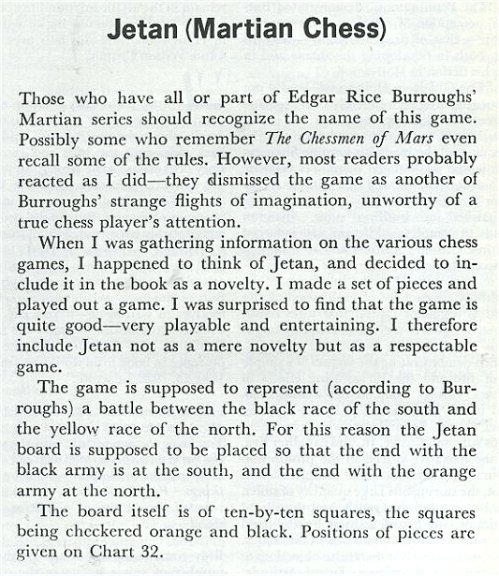
A page of explanation of Martian game of Jetan,
invented by ERB for The Chessmen of Mars,
as printed in the book Chess Variations
by John
Gollon, Charles F. Tuttle Co., 1968.
|
For those who care for such things, and would
like to try the game, I give the rules of Jetan as they were given me by
John Carter. By writing the names and moves of the various pieces on bits
of paper and pasting them on ordinary checkermen the game may be played
quite as well as with the ornate pieces used upon Mars.
THE BOARD: Square board consisting of one hundred
alternate black and orange squares.
THE PIECES: In order, as they stand upon the board in
the first row, from left to right of each player.
Warrior: 2 feathers; 2 spaces straight in any direction
or combination.
Padwar: 2 feathers; 2 spaces diagonal in any direction
or combination.
Dwar: 3 feathers; 3 spaces straight in any direction or
combination.
Flier: 3 bladed propellor; 3 spaces diagonal in any direction
or combination; and may jump intervening pieces.
Chief: Diadem with ten jewels; 3 spaces in any direction;
straight or diagonal or combination.
Princess: Diadem with one jewel; same as Chief, except
may jump intervening pieces.
Flier: See above.
Dwar: See above.
Padwar: See above.
Warrior: See above.
And in the second row from left to right:
Thoat: Mounted warrior 2 feathers; 2 spaces, one straight
and one diagonal in any direction.
Panthans: (8 of them): 1 feather; 1 space, forward,
side, or diagonal, but not backward.
Thoat: See above.
The game is played with twenty black pieces by one player
and twenty orange by his opponent, and is presumed to have originally represented
a battle between the Black race of the south and the Yellow race of the
north. On Mars the board is usually arranged so that the Black pieces are
played from the south and the Orange from the north.
The game is won when any piece is placed on same square
with opponent's Princess, or a Chief takes a Chief.
The game is drawn when either Chief is taken by a piece
other than the opposing Chief, or when both sides are reduced to three
pieces, or less, of equal value and the game is not won in the ensuing
ten moves, five apiece.
The Princess may not move onto a threatened square, nor
may she take an opposing piece. She is entitled to one ten-space
move at any time during the game. This move is called the escape.
Two pieces may not occupy the same square except in the
final move of a game where the Princess is taken.
When a player, moving properly and in order, places one
of his pieces upon a square occupied by an opponent piece, the opponent
piece is considered to have been killed and is removed from the game.
The moves explained. Straight moves mean due north,
south, east, or west; diagonal moves mean northeast, southeast, southwest,
or northwest. A Dwar might move straight north three spaces, or north one
space and east two spaces, or any similar combination of straight moves,
so long as he did not cross the same square twice in a single move. This
example explains combination moves.
The first move may be decided in any way that is agreeable
to both players; after the first game the winner of the preceding game
moves first if he chooses, or may instruct his opponent to make the first
move.
Gambling: The Martians gamble at Jetan in several ways.
Of course the outcome of the game indicates to whom the main stake belongs;
but they also put a price upon the head of each piece, according to its
value, and for each piece that a player loses he pays its value to his
opponent.
|



BILL
HILLMAN
Visit
our thousands of other sites at:
BILL
and SUE-ON HILLMAN ECLECTIC STUDIO
ERB
Text, ERB Images and Tarzan® John Carter® Priness of Mars®
are ©Edgar Rice Burroughs, Inc.- All Rights Reserved.
All
Original Work ©1996-2026 by Bill Hillman and/or Contributing Authors/Owners
No
part of this web site may be reproduced without permission from the respective
owners