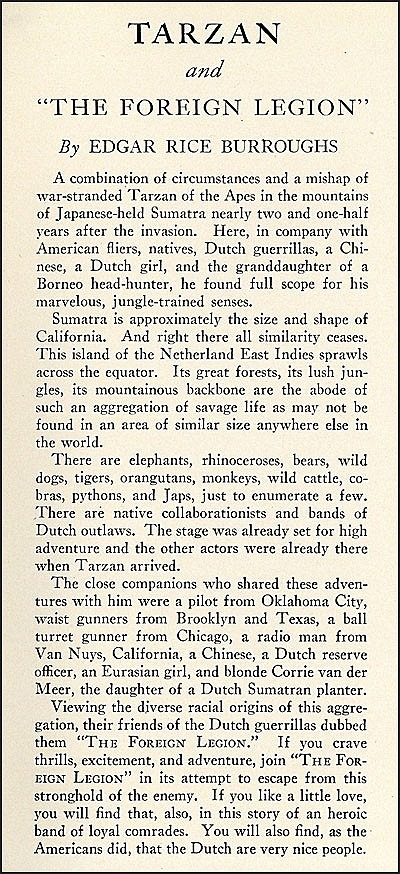
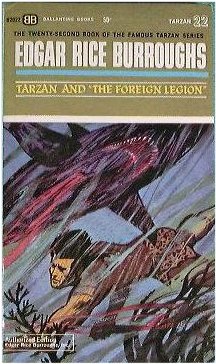
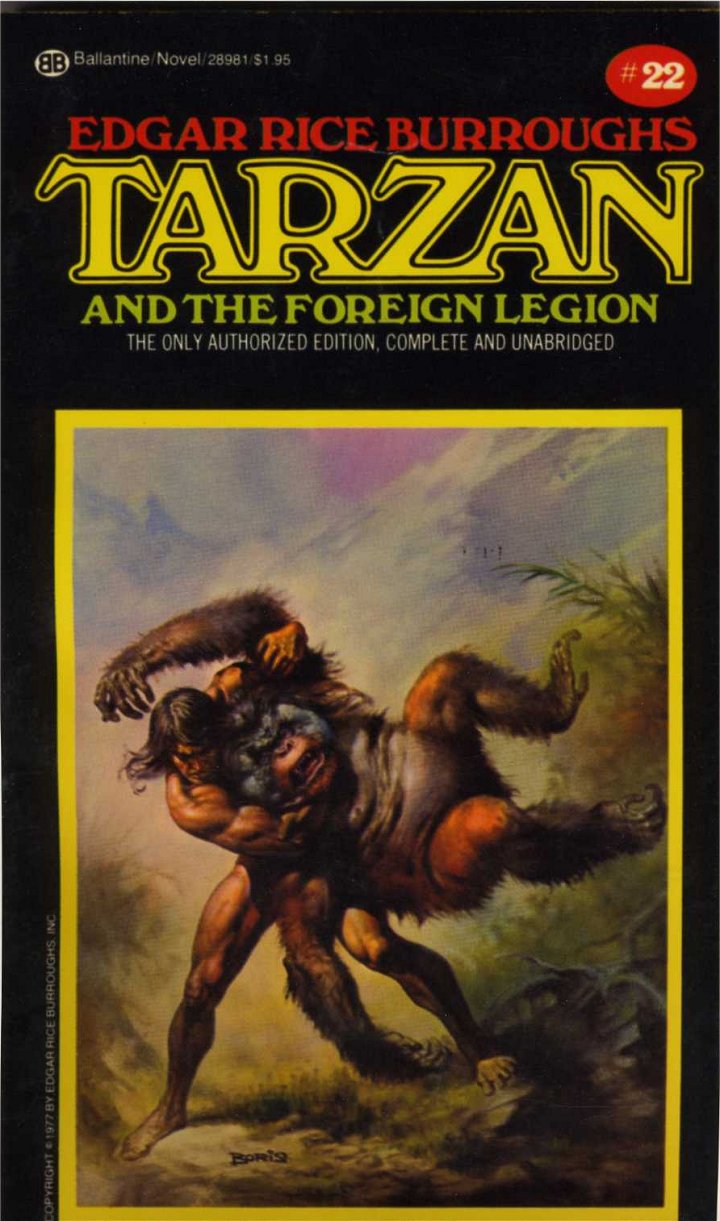
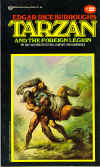
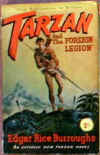
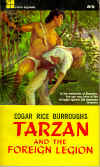
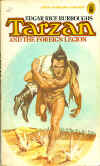
Tarzan and "The Foreign Legion"
By Edgar Rice Burroughs
A Review by Ryan
Harvey (Blackgate.com)
Burroughs needs no excuse for discussion in a magazine
dedicated to heroic fantasy and planetary romance. Adventure literature
as we know it springs from the influence of Burroughs in the early twentieth
century. Although pulp magazines existed before Burroughs published Under
the Moons of Mars and Tarzan of the Apes, this double-punch in 1912 changed
the style of this publishing medium for the remainder of its lifetime,
and the influence continued into the paperback revolution and on into our
era. Burroughs looms as one of the Titans of genre literature. But the
true question is: Why am I re-reading so much of his work right now, in
concentrated doses that I usually reserve for no author?
One answer is that I enjoy writing about Burroughs almost
as much as I enjoy reading him. For an author who supposedly crafted straightforward
entertainment, Edgar Rice Burroughs’s novels contain a remarkable breadth
of ideas for debate and consideration. But a deeper reason for such current
copious reading of Burroughs is that his work always gives me a unique
uplift. In times of uncertainty and concern, I find that no author can
temporarily re-energize me than ERB. Even a violent and embittered book,
such as the one I’m about to discuss, provides an energy boost like a literary
vodka with Red Bull. Burroughs knows how to make life seem wild, colorful,
and far removed from the petty concerns of the every day. It isn’t strictly
“escapism,” a word I dislike, but a form of romantic empowerment. Burroughs’s
daydreams on paper enhance our yearning for that which is beyond what we
have to struggle with in day-to-day life.
End of psychological exegesis. The curtain now rises on
today’s Tuesday Topic: one of Burroughs’s most unusual books, one that
few have read because—let’s face the facts—how many but the most dedicated
fans manage to reach Book #22 in a long-running series?
The Tarzan saga comes to its end with Tarzan and “The
Foreign Legion”. Although two more Tarzan books would appear posthumously,
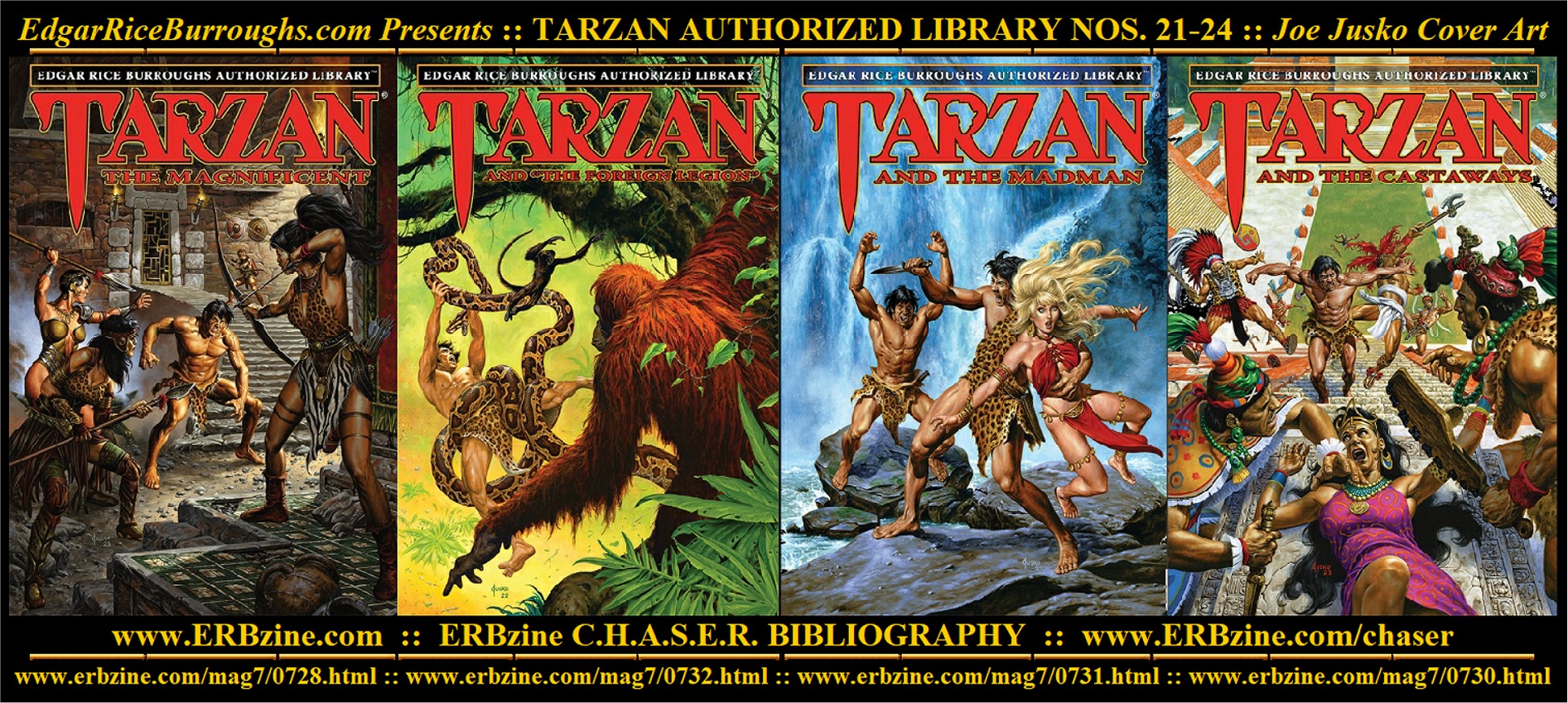
Tarzan and the Madman and the compilation Tarzan and the Castaways, Burroughs
had written both previous to “The Foreign Legion.” He wrote this final
Tarzan adventure in April–June 1944 in Honolulu during his service as a
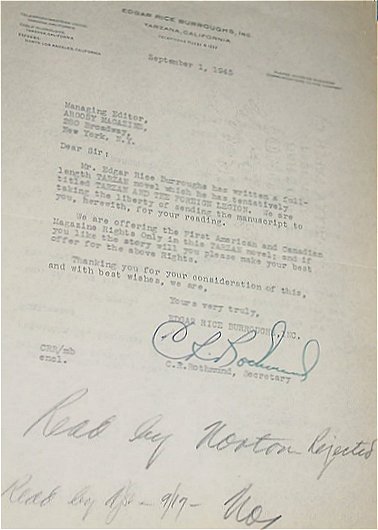
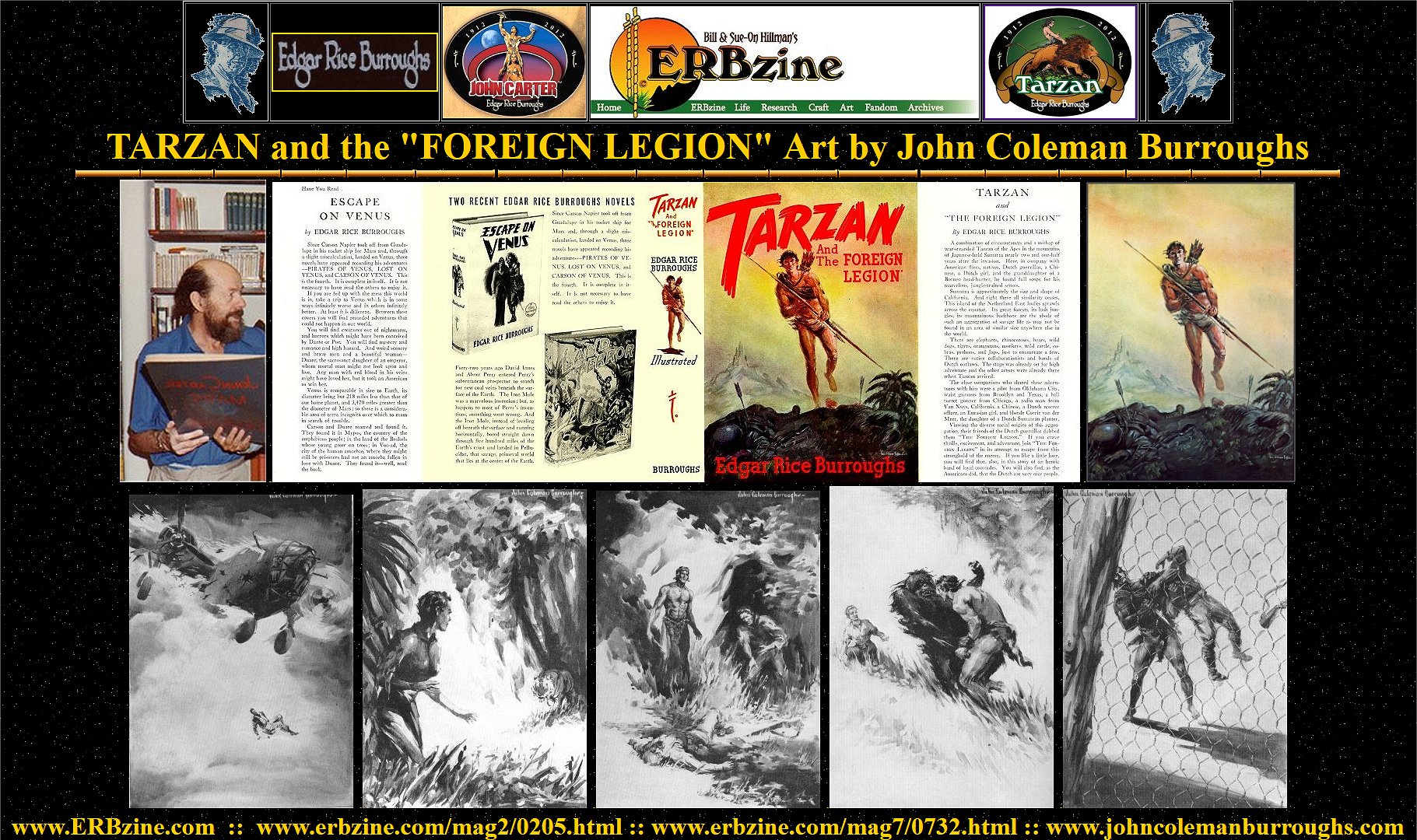
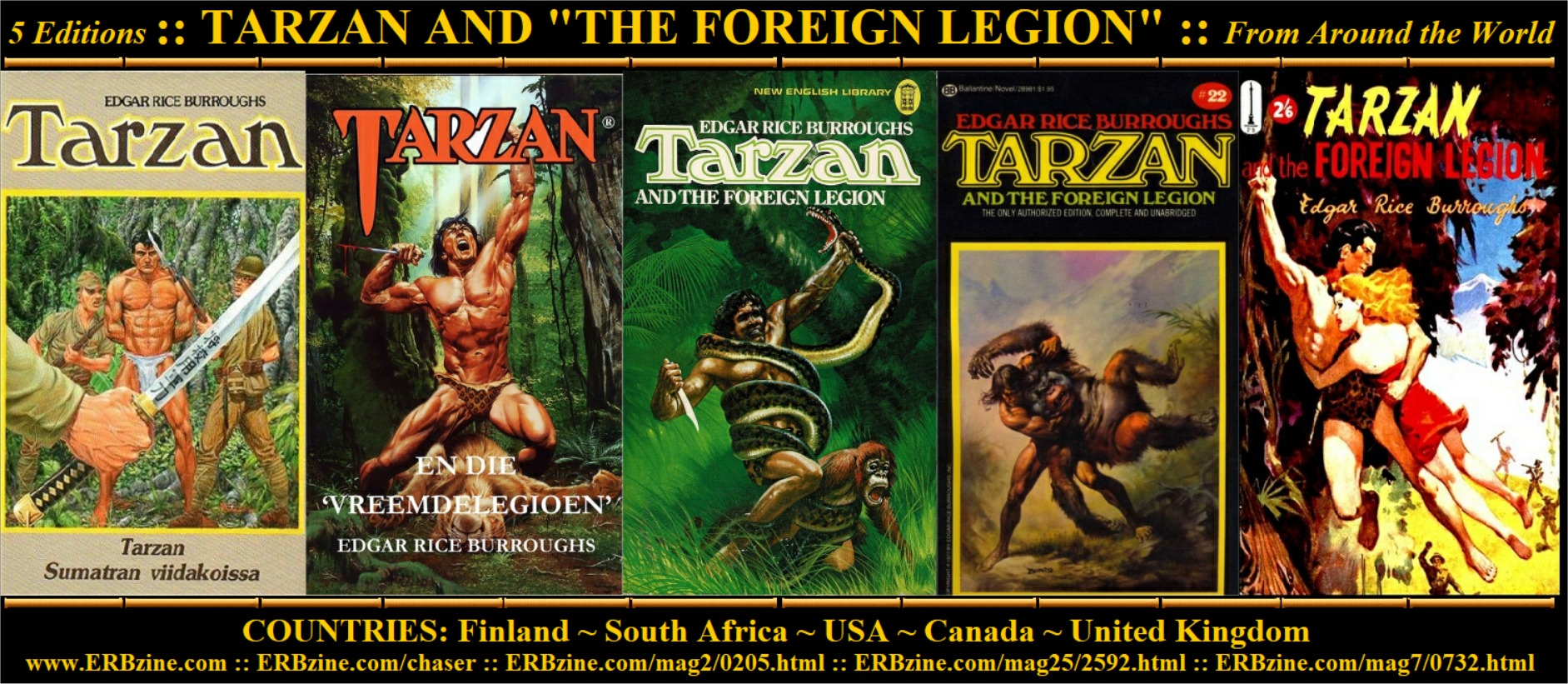
war correspondent. His own publishing company, Edgar Rice Burroughs Inc.
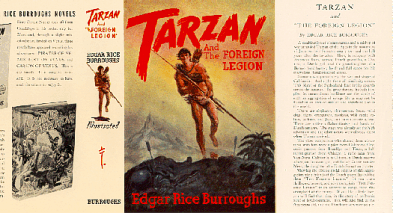
(he was the first writer to incorporate himself), released the novel in
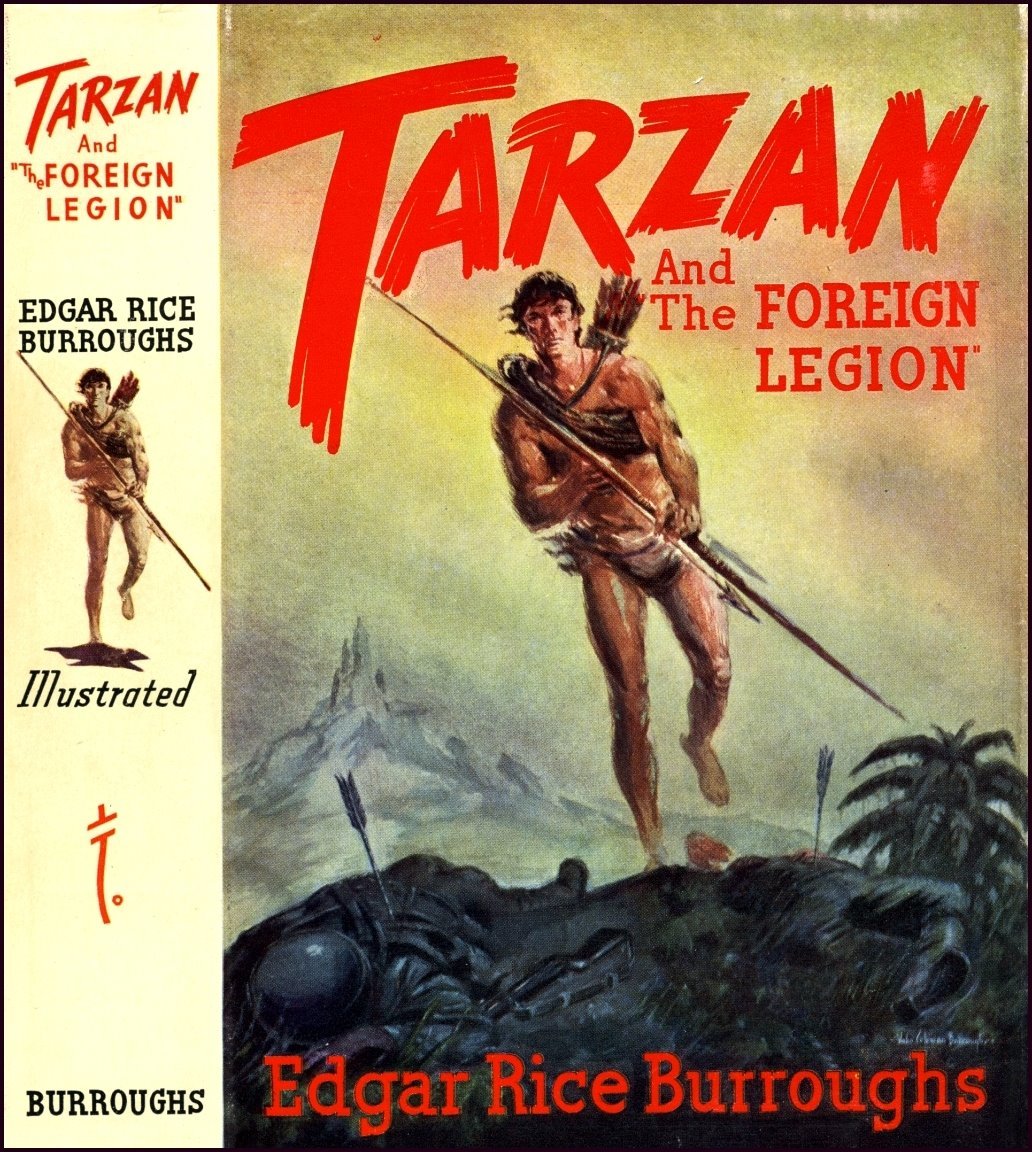
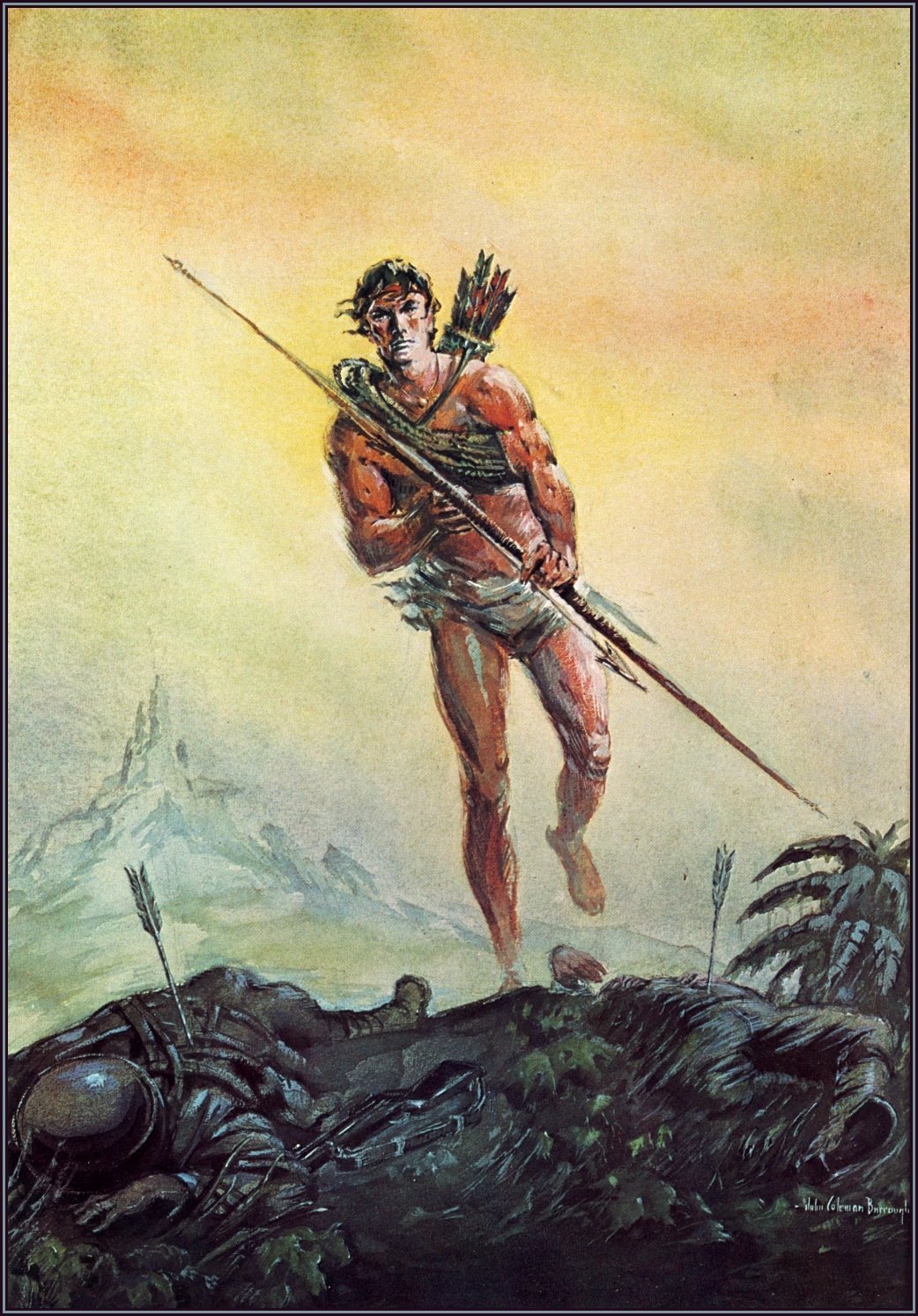
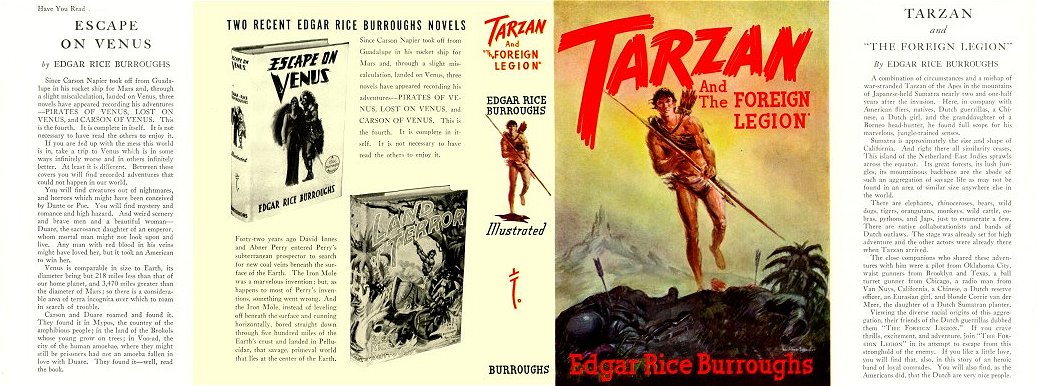
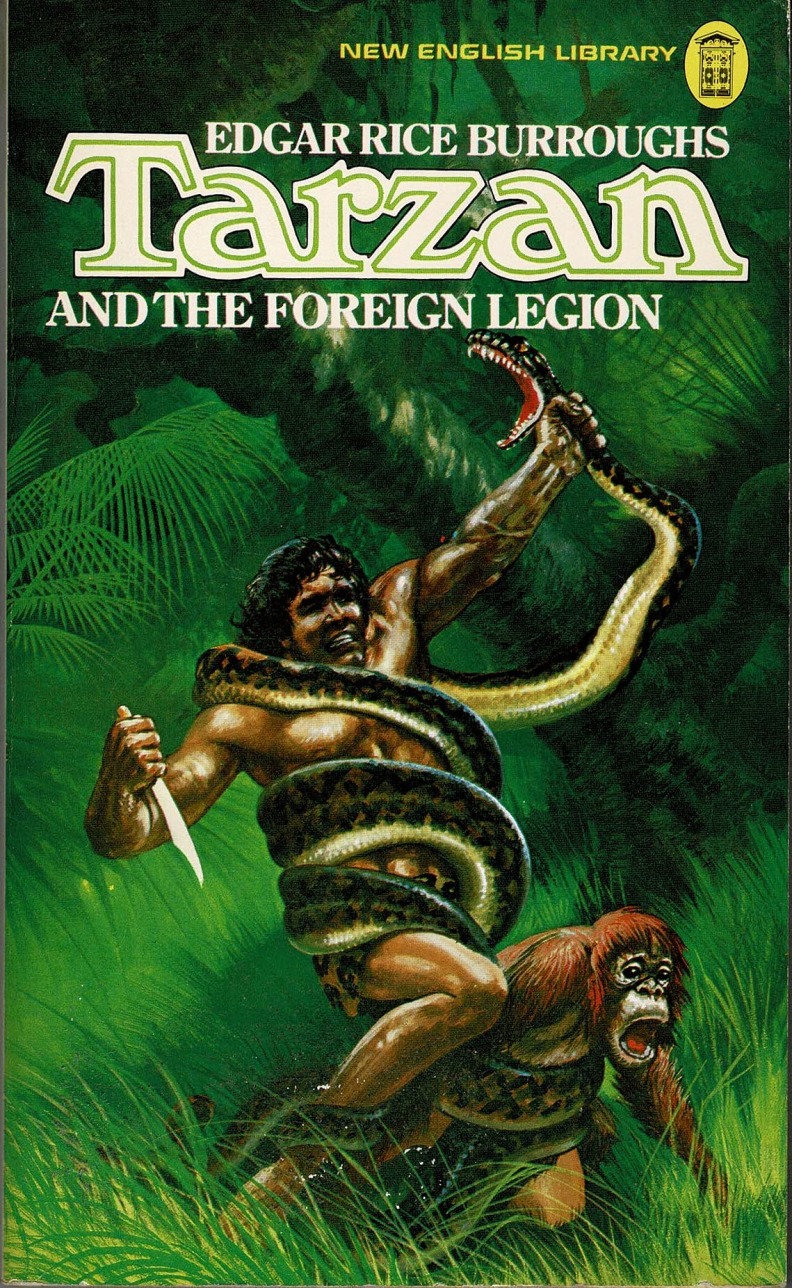
1947 with a cover from his son John Coleman Burroughs. It was the last
Tarzan book published in the author’s lifetime. Only one more novel would
appear before Burroughs’s death in 1950, Llana of Gathol, and that contained
four previously published Barsoom novellas.
The Tarzan novels, which made their creator’s fame beginning
with Tarzan of the Apes in 1912, limped through an interminable number
of volumes and appeared creatively spent by the mid-1930s. The early Tarzan
books contain some of Burroughs’s finest writing—the original is an uncontested
American classic, and would make my short list of favorite novels—but the
repetition among the last ten or so turns maddening. Only hardcore ERB
completists can drag themselves through more than one of these late books
consecutively. I found Tarzan and the Leopard Man almost impossible to
complete, making it the only time I considered tossing aside a Burroughs
novel unfinished.
But Tarzan and “The Foreign Legion”, the twenty-second
published Tarzan novel, shows Burroughs throwing off his formula for a
last creative blast, and it’s one of the best entries in the long series.
Apparently, Burroughs had also wearied of the continual parade of lost
cities in the African jungles, Tarzan getting amnesia, Tarzan impostors,
dueling vanished civilizations, and Jane under threat. Or perhaps the inspiration
of war action convinced him to turn his writing toward a military adventure
starring his most famous creation. Whatever the reason, the author pulled
himself out of his slump for a strong final season.
Tarzan had gotten involved in world war before. In the
seventh novel, Tarzan the Untamed (1919), set during the Great War, Tarzan
fights German invaders who burned down his African estate and kidnapped
Jane. The novel still depends on the standard jungle adventuring, only
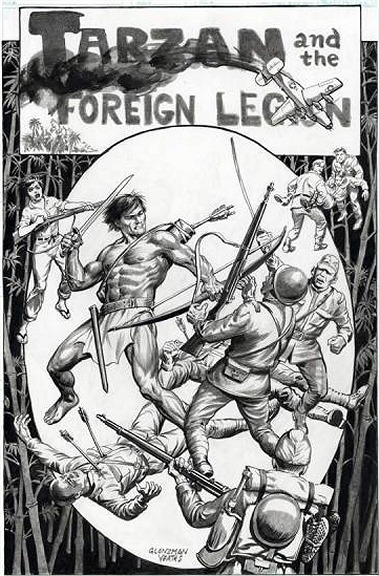
with bloodthirsty German villains as an opening sally. But Tarzan and “The
Foreign Legion” puts Tarzan into a World War II movie and casts him alongside
a motley bunch of American soldiers right out of Hollywood Central Casting—comic
relief included. Trapped on the Japanese-occupied island of Sumatra, they
form an ersatz “Foreign Legion”—hence the quotation marks in the title,
so readers won’t expect Tarzan to go to Algeria to join the cast of Beau
Geste. (John Clayton does speak fluent French, however. It might have worked.)
The story opens brutally when a Dutch family flees the
Japanese invasion of Sumatra. The parents both die, leaving their daughter
Corrie van der Meer in hiding for two years. Eventually, the Japanese Captain
Matsuo and Lieutenant Sokabe find her and carry her off as a prize.
The remainder of the set-up gets taken care of in the
next chapter. An American Liberator plane, while on an unarmed reconnaissance
mission, gets shot down over the Sumatran wilds. Four of the crew manage
to bail out and land safely. British observer Col. John Clayton hits the
ground and immediately strips to a loincloth and starts swinging through
the trees, right at home in the jungle. It doesn’t take much for Clayton
to revert to his true personality of Tarzan of the Apes. As Burroughs has
reminded us many times, Clayton feels himself closer to Tarzan than British
nobility.
But Tarzan is not alone this time: he’s ready to lead
the rag-tag band of soldiers in their deadly exile in enemy territory.
His three companions are Capt. Jerry Lucas of Oklahoma, Sgt. Tony “Shrimp”
Rosetti from Chicago, and Sgt. Joe “Datbum” Bubonovitch, a Brooklynite
with a flair for zoology and big words served with a thickly rendered accent.
In the repartee between the group, readers can often catch echoes of service
comedies and sometimes the interplay between Monk and Ham from the Doc
Savage novels. However, most of the characterization probably derives from
Burroughs’s own experience with meeting enlisted men during his time as
a war correspondent. His phonetic rendering of Bubonovitch’s and Rosetti’s
accents in prose tends toward the annoying, but this was standard way of
rendering argot during the time. The humorous exchanges are sometimes witty
and other times overplayed, but it’s definitely not Tarzan business-as-usual.
When Tarzan and his “Foreign Legion” learn about the kidnapped
Dutch girl in the vicinity, they move immediately to save her. Tarzan executes
a clever rescue, but the Japanese pursue the band. Jerry Lucas professes
a strong dislike for Corrie—actually for any woman—which immediately means
the two will fall for each other hard. We know the rules. A love triangle
of sorts develops when the Dutch guerilla fighter Tak van der Bos enters
the action, but after a few chapters of doubt, the novel dismisses this
conflict with a sentence. Jerry’s own stated “misogyny” and the constant
dangers he and Corrie face put up much greater obstacles to their happiness
than the love triangle detour. Another romance develops for the team’s
other avowed “woman-hater,” Shrimp, when he starts to fall for the Eurasian
beauty Sarina, who comes to Corrie’s aid when she least expects it. (This
is one of the few moments where Burroughs reverses the expectations of
how the Asian characters will act, an event that surprises even Corrie.)
The adventures of Tarzan and his companions on Sumatra
puts them up against not only the Japanese occupiers, but also Sumatran
collaborators, Dutch pirates, and nature’s own menaces. The heroes get
separated, kidnapped, rescued, and reunited through a string of escapades.
They eventually join Dutch guerilla fighters to take the combat to the
Japanese in some thrilling jungle warfare. The climax features a breathless
ocean pursuit, sharks and submarines included.
But Burroughs doesn’t forget his hero’s connection to
nature and the animal fantasy aspect of Tarzan’s legacy. Tarzan discovers
he can communicate with the orangutans on the island as well as he can
the apes of Africa. He gets in a classic “fight for supremacy” with one
of bulls of an orangutan tribe, Oju. Later, Tarzan has to face Oju again
after the furious bull ape kidnaps Corrie.
Much of this sounds like a standard Tarzan actioner, but
it doesn’t read that way. Tarzan serves as a superhero who gets people
out of jams and uses his jungle-lore when needed, but his companions are
the true protagonists. This shift toward the supporting cast gives readers
an outside perspective on the famous hero that rarely appears in the other
books. Tarzan vanishes for extended periods, and the war action stays with
the hardy and good-naturedly bickering American soldiers and the resourceful
Corrie.
The inclusion of these additional heroes allows the story
to develop more character interaction, and even some philosophical discussions.
In one section, the Foreign Legionnaires debate the nature of war—and what
hatred does for and to a person in conflict. “Hatred” forms the most important
theme of the novel, which the characters revisit many times between the
action. Burroughs approaches the idea of hated in an ambivalent way. Sometimes
characters speak about the way hate twists people, such as what it has
done to change Corrie, but at other times hatred seems the only logical
response. In a talk with Corrie, Jerry makes the point that “Tarzan says
that it does no good to hate, and I know he’s right. But I do hate—not
the poor dumb things that shoot at us and whom we shoot at, but those who
are responsible for making wars.” And Corrie responds that she feels she
does not hate enough: “You never saw your mother hounded to death and your
father bayoneted…. If you had and didn’t hate them you wouldn’t be fit
to call yourself a man.” These moments add a layer of moral complexity
to the novel that is rare in Burroughs later writing.
One philosophy that Burroughs spends scant time on is
patriotism. This will strike many as odd, considering that Tarzan and “The
Foreign Legion” is a wartime adventure with American soldiers battling
the Japanese. But Burroughs creates a world of chaos where the only true
motivation that makes sense is hatred for the declared enemy. This is a
social as well as physical jungle, and operates under the jungle’s law.
The story makes the enemy clear, but it rarely waves the flag for freedom
and democratic ideals. Is this an embittered Burroughs speaking? Or does
the story merely have no place for this philosophy, choosing instead to
highlight the individual’s struggle over the nation’s? “I don’t think any
of us know what we are fighting for except to kill Japs, get the war over,
and get home,” Jerry says during one interlude. “After we have done that,
the goddam politicians will mess things all up again.”
But Burroughs’s cynicism about warfare doesn’t mean he
treats the established enemy with any sensitivity. There’s no point in
belaboring the way the he describes the Japanese. It’s ugly and in synch
with the “power of hate” theme. Burroughs wrote the book during the height
of the war in the Pacific, so don’t expect an even-handed Letters from
Iwo Jima treatment. In fact, expect the treatment of the enemy to get quite
brutal, with the Japanese described as “monkeys” of low intelligence and
undiluted savagery. (The exception is the character of Lt. Tada, who is
vicious, but has an excellent, even witty grasp of colloquial English.
I wish he appeared in more of the book, since he makes a multi-faceted
villain.) Burroughs probably based a lot of the racial insults on what
he had heard from the soldiers he knew during his time as a war reporter.
However, and this the pulp scholar and objective academic
in me speaking, I find the xenophobia and racism on display one of the
book’s fascinating aspects; while reprehensible, they shed light on World
War II attitudes without the prism of modern sensibilities. No writer would
approach this material in the same way today. However, O Casual Reader,
you have been warned. Not that I imagine casual readers will pick up this
novel, and pulp fans and Burroughs enthusiasts will know what to expect
from the time period.
The most refreshing character in the story is Corrie,
who proves herself a capable shot with a rifle and a skilled archer in
her jungle adventures. It feels as if Burroughs is trying to create a semblance
of a 1940s woman, far removed from the types he had once written at the
start of his career. Corrie still gets kidnapped and seized a lot, however.
Burroughs wasn’t ready to totally break his formula into pieces.
The author treats his famous hero in some unusual ways.
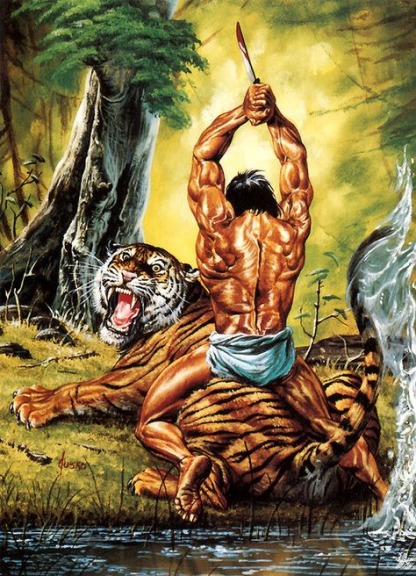
The name “Tarzan” doesn’t even appear until a quarter of the way through
the page count. Tarzan’s companions finally realize Colonel Clayton’s identity
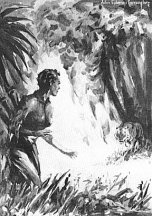
when they watch him wrestle and kill a tiger with his bare hands. Burroughs
can’t resist a referential joke in this heroic moment:
…raising his face to the heavens, [he] voiced
a horrid cry—the victory cry of the bull ape. Corrie was suddenly terrified
of this man who had always seemed so civilized and cultured. Even the men
were shocked.
Suddenly recognition lighted the eyes of Jerry Lucas.
“John Clayton,” he said, “Lord Greystoke—Tarzan of the Apes!”
Shrimp’s jaw dropped. “Is dat Johnny Weismuller?” he
demanded.
No Shrimp, this fellow can speak in complete English sentences.
There is another instance in the book where it appears
that people know Tarzan from popular culture: they know who he is and about
his previous adventures. Since Burroughs often wrote his stories from the
perspective of a fictional version of himself, a reader might assume that
the pseudo-Burroughs documents have made it to the rest of the world, and
apparently made it into the movies.
In another intriguing detour late in the story, Tarzan
suggests that he has achieved longevity, perhaps even immortality, from
an African witchdoctor. This explains how he has appeared as a young, virile
man in adventures stretching back to before World War I. In another meta-reference,
Jerry comments after hearing this: “I never gave a thought to your age,
Colonel…. but I remember now that my father said he read about you when
he was a boy. And I was brought up on you. You influenced my life more
than any one else.”
Tarzan further elaborates on his opinion of his possible
immortality:
“Would you want to live forever?” asked van der Bos.
“Of course—if I never had to suffer the infirmities of
old age”
“But all your friends would be gone.”
“One misses the old friends, but one constantly makes
new ones. But really my chances of living forever are very slight. Any
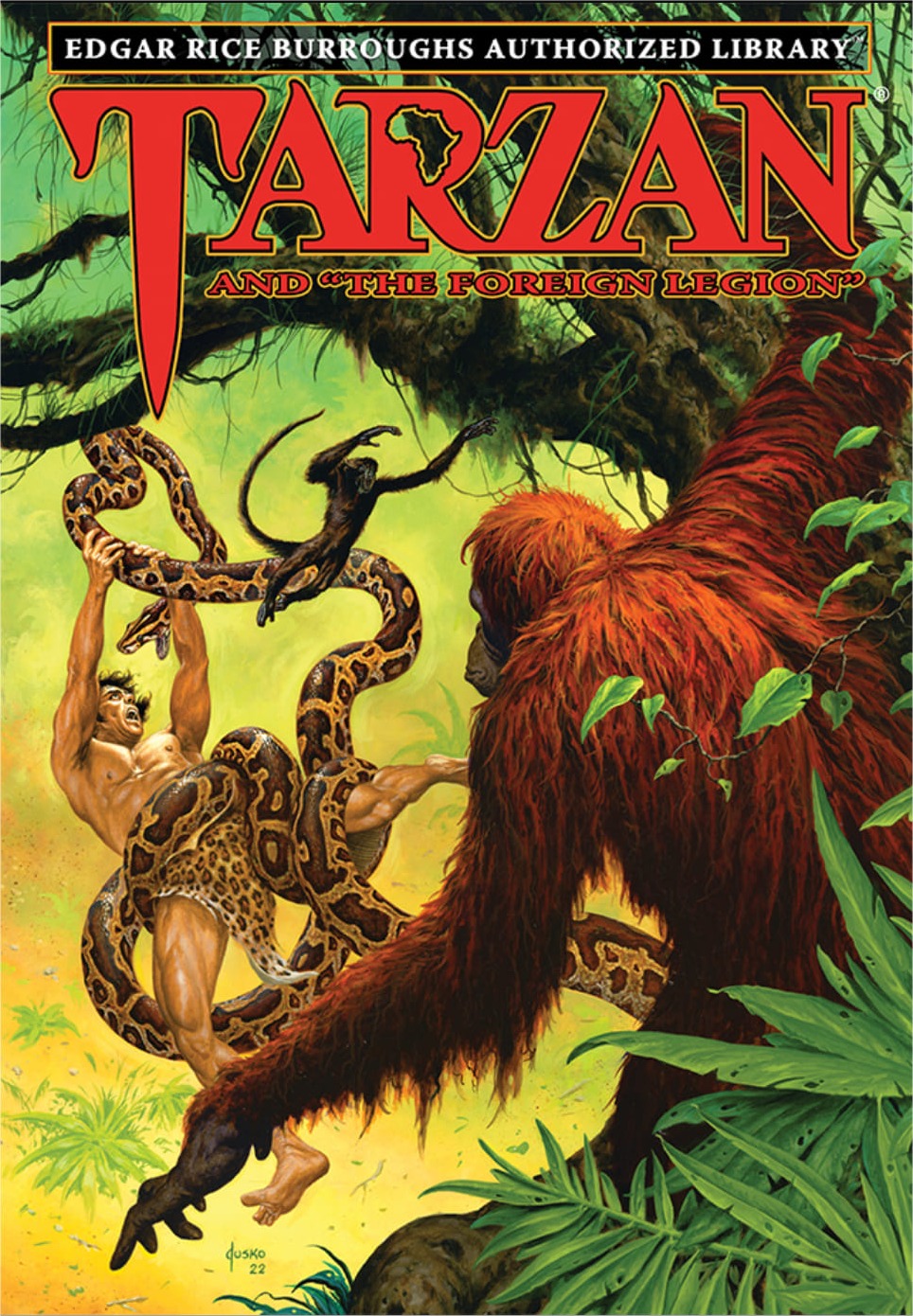
day, I may stop a bullet; or a tiger may get me, or a python. If I live
to get back to my Africa, I may find a lion waiting for me, or a buffalo.
Death has many tricks up his sleeve beside old age. One may outplay him
for a while, but he always wins in the end.”
Two ideas come to mind when I read this passage. One is
that Jane, Tarzan’s wife, receives no mention anywhere in this novel. Has
she perhaps died, or aged beyond Tarzan’s young years and left him? The
second is that Burroughs, nearing his seventieth birthday when he wrote
the novel, knew his own mortality was approaching. The elegiac power of
this section is surprising.
But readers can safely answer the debate about Tarzan’s
immortality: yes, he will live forever. Heroic icons such as he can never
truly die. It is rare for an author to create an enduring popular culture
immortal: Arthur Conan Doyle with Sherlock Holmes, Bram Stoker with Dracula,
Ian Fleming with 007. Burroughs achieved it with Tarzan. And this last
adventure—a powerful surge of action, characterization, comedy, fury, hatred,
and rumination—proves why Tarzan at the last towers as, truly, Tarzan the
Invincible.