Official Edgar Rice Burroughs Tribute and Weekly Webzine Site Since 1996 ~ Over 10,000 Webpages in Archive |
|
Official Edgar Rice Burroughs Tribute and Weekly Webzine Site Since 1996 ~ Over 10,000 Webpages in Archive |
|
text-only version |


JACK OF TIME
By F. X. Blisard
Chapter 3
Time's Fool
SYNOPSIS OF CHAP. 2:
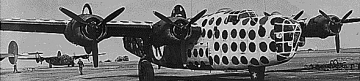
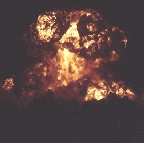
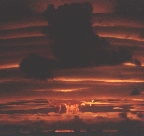
On Christmas Eve, 1950, young WW2 veteran Malcolm McHugh (whose duty it was to guard "Major Ed Burroughs" during the latter's mysterious sojourn at Los Alamos; see Chapter 1 for details) receives a special-delivery package from the estate of the late novelist Edgar Rice Burroughs. The package contains a thick, typed manuscript, a handwritten letter, and a single, unlabelled CD-ROM (the latter, of course, a complete mystery to McHugh). The letter, from Major E. R. ("Jack") Burroughs, explains what has transpired since he parted company with Sgt. McHugh on August 5th, 1945. It seems that the A-Bomb blast at Hiroshima (on August 6th) sucked Jack's plane (and all its occupants) further into the future, to the time and place of the next A-Bomb blast, the one at Nagasaki 3 days later. The process accelerated with each successive "bump" so that they were automatically "fast-forwarded" in time by each A-Bomb blast they encountered, until the last A-Bomb in human history has been detonated, by which time (2045) humanity has also mastered the art/science of time-travel. Public policy, however, "now" requires all incoming "maverick" time-travelers from the past to be quarantined (so as to remain ignorant of exactly which time period they have landed in and of what has transpired in history since their own time) until the authorities can arrange for their return to their own proper time and place.


 |
At the head of the gauntlet stood a tall, stout, jet-black fellow in
full uniform and sunglasses, his hands grasping the ends of a swagger-stick
pressed against the back of his thighs. He towered over us as Groves, Gridley,
and I approached, followed by the balance of our strange crew (whom I had
taken to calling "The Walking Wounded"). When we halted a few paces in
front of him, he and Groves exchanged salutes. "Well done, General," said
the giant, with a toothy grin. "The council will be most impressed. This
way, please," and he motioned down the center of the gauntlet with his
swagger-stick, while turning sharply left-face, inviting Groves to fall
in beside him. They set off together towards the troop truck chattering
like old friends, while the rest of us staggered behind as best we could,
those who could walk assisting those who could not--except, of course,
for their excellencies, Colonel Rokovitch and Major Paulinov, who kept
demanding to be taken to the Soviet Embassy. As if there even were
a "Soviet Union"--as they knew it--any more!
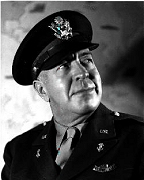
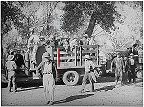
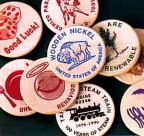
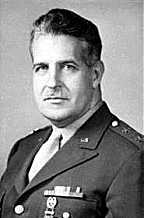
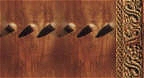
At the rear of the truck, the General and the Giant took up flanking positions to oversee our boarding. While the four of us (Groves, Gridley, the Giant, and myself) were helping the "Walking Wounded" onto the flatbed, the two Russians managed to leap past us and up into the van in search of the "best" seats (those closest to the cab). "Typical," snorted Groves with disgust. "Some things just never change, do they?" As I turned my head to make a witty retort, Groves' elbow grazed my head, knocking off my cap. "Ooops!" said the General, bending down to pick up the fallen haberdashery and, in the process, "accidentally" kicking it under the truck's tailgate. Cursing (a bit too dramatically, I thought), he crouched down to retreive it. He ended up on his hands and knees before finally reaching the thing and, as he crawled back out from under the tailgate, he found me crouched down waiting for him, with a quizzical look on my face. He gave me a wink and grabbed my arm for stability as, still cursing, he stiffly regained his feet. As I was helping him up, he whispered in a tone so low I could barely catch it even though our heads were scant inches away from each other: "Watch out for those Rooskies. They're up to no good. That's all I can tell you--" and then, without missing a beat, he exclaimed loudly, "Major, we're both gettin' too old for this kinda nonsense," and proceeded to secure my cap snugly on my head for me as if he were my mother or something! "Now there!" he exclaimed dramatically, brushing the flat top of the cap with the back of his hand. "We can't have you catchin' cold, now, can we?" I began to "get" what this little farce was all about as I instinctively reached upwards to straighten the cap and realized that it was about a size smaller than it had been before its descent to the tarmack. "Well, Major," he said, sticking out a hand of farewell, "it's sure been swell, but here's yer hat an' there's the door, as they say. Of course, I won't be permitted any further contact with you from this point on. Policy, you know!" As I shook his proffered hand, I raised my eyes upward towards my cap's visor, saying, "Enda th' road, eh? Well, don't take no wooden nickels, Gen'ral." He just grinned and said, "That's about all they use nowadays, Major! Who would've thought it--trees more precious than gold? What a world, huh? Give my regards to Broadway--as long as it lasts! Alley-oop!" He cupped his hands to make a stirrup and I mounted the flatbed with as much grace as the circumstances permitted. The tailgate slammed shut and the truck lurched forward. Groves stood in the center of the tarmack, at attention and frozen in mid-salute. As I raised my hand to return the salute, he curled the last three fingers of his upraised hand and tapped his index finger repeatedly against his own cap's visor. Then the absurd image was obscured by engine exhaust and we were gone around the corner of a building. Once away, I removed my hat and turned it over to examine it. The sweatband was clearly embroidered with the words "Property of Gen. L. Groves, USA." Behind the sweatband, and lining the entire inner circumference of the cap, was a gleaming metallic strip embossed with tiny Braille-like bumps. Before I could inspect the strange device more closely, however, I had the uneasy feeling of someone's eyes upon me. I turned my head in the direction of the cab and found myself staring across the length of the van straight into the eyes of Colonel Rokovitch. Returning his steely gaze, I smiled pleasantly and gave him a mock salute, then ran my hand over my scalp and donned my hat again, cocking it over my eyes and slouching down as if for a nap. I must have really nodded off, for I was jostled awake by the impact of the truck grinding to an abrupt halt. |

 |
Two pairs of strong black hands seized the corners of the canvas flap
and the curtain rose on a most impressive scene--the same ebon giant who
had greeted us on the tarmack stood, arms akimbo, framed in the sunlit
oblong formed by the rear opening of the van above the tailgate. The man
broke into a broad grin and stuck out a great hand as he stepped towards
me. "Major Burroughs!" he exclaimed, in perfect English. "What an honor
to finally make your acquaintance!" I stuck out my own great hand to meet
his. His grip was firm and sure. He went on: "I am General Omofolabo Mugambi,
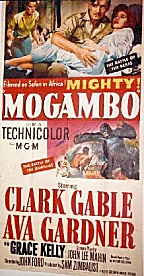
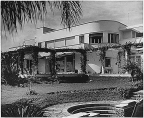
Chief of Security for Kenya State, at your service. Welcome to Rancho Mogambo,
ancestral home of the Mugambi family." My eyes must have been bulging,
for he hastened to add: "No, no! No relation of course. But it never hurt
us any to have our family name spread so far and wide by your famous stories.
Imagine, for example, my surprise upon my first business trip to Hong Kong
-- being wined and dined by the president of the Matai Shang Society ...all
because of my name! How was I to know that the biggest livestock baron
in Southern China was an 'ERB-ivore'?" And he roared with laughter at the
joke which -- at that point -- was totally lost on me. My hand still held
a prisoner in the giant's iron grip, I let out a feeble chuckle and turned
my face towards young Gridley for some re-assurance that I had not gone
off the deep end. The lieutenant, however, was no less mystified, for the
General next turned to him and--thankfully, releasing my hand in the process--subjected
him to a similar procedure. After these preliminaries, the General issued
a few curt orders to his men, and the process of attending to the "Walking
Wounded" commenced. Those who could walk were tenderly assisted by the
same soldiers whose mein had so intimidated us at the airfield. And those
who could not walk were expertly transferred to stretchers and swiftly
but smoothly carried to the main building, a rambling, one-storey, brick
edifice, where each man in turn was handed over to one in a seemingly endless
train of tall young women in flowing, white-and-red striped gowns. Even
the two Russians were accorded every courtesy, although, if they appreciated
it, they certainly did not show it, refusing to so much as acknowledge
their caretakers' existence, let alone respond to their solicitations with
even a word of thanks. "Imperious bastards," I muttered, "you'd think they
owned the place."
"They did--once upon a time." It was General Mugambi. "But these two could not possibly know that--unless our TSC intelligence operation has been severely compromised." "Well, Gen'ral," I replied, "I wouldn't lose any sleep over it if I were you. Their whole generation had some kind of Messiah complex, if you ask me. Almost like they were trying to out-czar the Czars." "Very perceptive, Major Burroughs," said he. "Our historians tell us that the Soviet expansion into Africa in the second half of the 20th century was--" His dissertation was cut short by a woman's scream coming from inside the main building, followed immediately by sounds of a scuffle -- clanging pans, breaking glass, lound thumps, and, just as we reached the open door, the heartfelt moan of a deep-voiced man and the shrill repetition of some Slavic monosyllable I did not recognize. The sight that met our eyes as we rushed to the scene, however, gave eloquent meaning to the epithet. Major Paulinov was kneeling on the floor in the corner of the infirmary, clutching his groin with both hands and rocking back and forth, weeping. Not far from him, face-down and prostrate on the floor, was the still form of Col. Rokovitch, the lower half of his body protruding from underneath an overturned table. Walking triumphantly away from the satisfyingly sad scene was a group of the tall young women, talking to each other excitedly and casting occasional glances over their shoulders at the two fallen "comrades." Our own "GI Joes and Willies" -- either on their feet or struggling to rise from stretchers and ranged in a semicircle around the room at varying distances from the scene of carnage--suddenly broke into thunderous applause and cheers. General Mugambi, laughing loudly, commanded four of his men to "take out de trash" and the squad unceremoniously seized the two Russians and "escorted" them out the door to a destination I was not eager to ascertain. Reading my countenance, the General said, "Not to worry, Major. They won't be harmed -- not permanently -- just isolated until it's time for your return. Then they will be your problem -- yours...and President Truman's!" He laughed again. "But come," he roared, flinging an arm around each of us (Gridley and me). "You both are seriously stinking. My head wife will personally see to your ablutions." I looked around nervously at the lithe young women attending the "Walking Wounded." "Which one of these--" The General laughed again. "These? These are my daughters! What kind of barbarian do you take me for?" |

 |
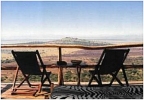
He led us down a flight of stairs that opened onto a huge, round, sunlit
chamber just below ground level--an artfully constructed skylight in the
shape and hue of a forest canopy bathing the room in a soft green glow.
The room was furnished in a combination of traditional African artifacts
and modern Japanese furniture. In the exact center of the room, facing
us from behind a polished teakwood desk, sat a tall, shapely, middle-aged
black woman, garbed in a white linen robe and matching turban, typing expertly
at a thin, flat keyboard embedded in the desktop and not attached to anything
that even faintly resembled a typewriter. Her eyes were rivetted on a thin,
flat oblong of glass or plastic that rose up from the desktop at a 45-degree
angle just beyond the keyboard. When we entered, she looked up in our direction
with a most enchanting smile, then poked one of the keys with her long,
tapering index finger and rose to greet us, speaking directly to the General:
"Home from the hunt, I see, O my husband? And what," she glanced briefly
at Gridley and me, "is this the cat is dragging in with him, hmmm?"
Drawing nearer to the General and placing one hand upon his shoulder, she
eyed us up and down with an amused look on her face, as if one of her children
had brought home a stray puppy. I, for one, felt naked as a jaybird, painfully
conscious of the stench radiating from my clothes. The General, clearly
in the presence of a superior, was at a temporary loss for words. Seized
by an impulse to assert my mere humanity, I cleared my throat and came
to attention.
"Madam," I purred, removing my hat and placing it over my heart, "I am Major E. R. Burroughs, U.S. Army Reserve, Correspondence Corps, at your service. And this," I motioned towards Gridley, "is my esteemed comrade-in-arms, Lieutenant Alexander Gridley, U.S. Army Air Corps, pilot extraordinaire." Bowing at the waist, I cocked my eye in Gridley's direction, caught his eye, and arched my eyebrow towards the floor. The young idiot finally caught on and hastily joined me in my desperate gesture of gentility. Rising again to my full height and clicking my heels together for good measure, I stared straight into the woman's eyes and tilted my head slightly to one side, and grinned. During this little charade, Madame Mugambi's expression hardly changed from its original mode of cool, confident amusement, although I thought I saw a ripple of surprise cross her countenance at one point. The General's face, on the other hand, ran an emotional gamut, from confusion, to shock, to dismay, and finally to elation when he saw his wife was pleased. The two of them, I thought, were quite the picture of 21st-century domesticity. "It speaks," she said, drily. "Perfect." Then, patting her husband's shoulder dismissingly and bidding him "Run along now, dear, like a good little warlord," she slid gracefully in between young Gridley and myself, offering each of us an elbow, and said, "Gentlemen, shall we?" I glanced at the General, who returned my inquisitive look with a shrug, a deadpan smirk, and a roll of the eyes which I, as a twice-married man myself, understood perfectly. "My name," the lady of the house informed us as she gently tugged us in the direction of an archway across the room, "is Orinmala, but you may call me...the Queen of Sheba." That was when I realized I was going to like her. The "Servants' Quarters," as she called them, were a beehive of activity--a maze of artficially lit subterranean corridors and sub-chambers converging on a central complex that combined kitchen, laundry, lavatory, and machine-shop facilities together under yet another forest-canopy skylight identical to the one beneath which the "Queen of Sheba" had received us. Leaving us in the custody of an elderly manservant she called Padraic, the Lady Orinmala departed, with the admonition that he was to personally oversee our ablutions and deliver us to the main dining hall by noon. Once alone with Padraic, I wasted no time in interrogating the fellow with respect to an observation I had made upon being introduced to him. "Paddy, my good man," I began, tentatively, as he escorted us to the showers, "I couldn't help noticing, but...you're white, aren't you?" Paddy smiled good-naturedly and said, "Well now, that depends, sir...." and he trailed off as he diligently set about helping me off with my flight jacket. "Depends? On...?" "On how strictly you want to define the term. I am, as ye've no doubt already observed, an Irishman. And an Irishman, as the British were so fond of sayin', is only..." "Only...a nigger turned inside out?" "Exactly, sir. I see ye know yer Kipling." "More or less. But, see here, I was given to understand that white people had become more-or-less extinct in the early part of this century. Was I misinformed? Or are you one of those lucky bastards 'retrieved' by the 'TSC' engineers?" |

 |
"Well, sir, I surely wasn't 'retrieved' from anywhere -- except the
slums of Belfast, where me Da' had taken us to avoid the 'death throes
of the high and mighty', as he used to call it. It was an awesome
sight, and a terrifyin' thing, to see the lords of the earth go stark ravin'
mad when faced with their own mortality. They were determined to
take as many of us with them as they could, once they finally realized
there was no escape for them. The 'Caucasian Plague' we called it,
and the 'White Death'. A wasting disease it was, but it only struck
the 'pure-bred' white aristocrats -- and all them aspiring upper-middle-class
executives -- throughout the British Isles, Europe, Australia, and North
America. Those of us who survived could only have done so because of some
'black blood' in our genealogy, however far back and attenuated.
I've heard that back in your century -- and, presumably, before -- a curious
notion prevailed that 'white blood' was somehow superior, and that even
'people of color' subscribed to the strange theory, ranking each other
according to how light their pigmentation was. Nowadays,
of course, we're all just glad to be alive -- and grateful for that trace
of 'black blood' in our bloodlines that allowed each of us to weather the
storm."
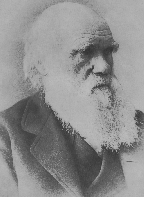
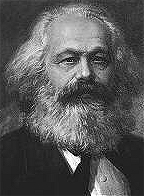
"So...Darwin has spoken, eh? The fittest survived?" "Darwin? Oh Lord, that's right, sir--yer generation still held to the Darwinian doctrine of...what did he call it? Evolution? Aye, that's it! That was before the sciences of genetics and astrophysics established the historical veracity of the ancient Hebrew cosmology. I hate to be the bringer of bad tidings, Major Burroughs, but the Darwinian theory now enjoys the same standing in scientific -- and public -- opinion as the Flat Earth Society! Even the old 'hollow earth' theories command more credence these days. I'm frightfully sorry, sir. I know that you were quite fond of Mr. Darwin's writings...." "Well, I'd sure like to review some of the literature documenting all that. I don't suppose there's a decent library--" "Oh, quite the contrary, sir! The Lady Orinmala's archives are world famous. They combine the holdings of the old Vatican Library, your own Library of Congress, the Leningrad Museum, and the British Museum. She was quite the scholar, you know, before she took up politics." "Don't tell me, let me guess. She's ...what? President of the United States of Africa?" "Why...yes sir...but how did you know?" "I didn't. I was joking." "Oh, I see. Yes...quite funny, sir. Really." "Never mind," I sighed. "Right now I'm more concerned about that free lunch she promised us. I'm about as clean as I'm gonna be now... you have something decent for us to wear while you're de-lousing our uniforms, Paddy? Oh, and I'd like to hang on to my hat, if you don't mind. I don't think it got soiled any. I just feel kinda naked without it." "Of course, sir. Quite understandable." And the old bird disappeared momentarily to rummage through a locker. Fearful that I would end up wearing one of those flowing robes that the Lady O. and her daughters seemed so fond of, I was quite relieved when Paddy produced two pairs of plain kakhi fatigues for young Gridley and me. |


 |
He ushered us into the dining hall at precisely noon. The room
put me in mind of a medieval banquet scene -- with the exception that knives
and forks rather than fingers and incisors were the utensils of choice.
Otherwise, every element of the classic scene was present, albeit in appropriately
"translated" form. The by-now familiar decor--round, subterranean
room with "forested" skylight and mix of African and Japanese furnishings--was
supplemented by the addition of a strangely luminous, meticulously detailed
mural running continuously around the room's circumference like an architectural
frieze. I soon realized, however, that this "mural" was actually
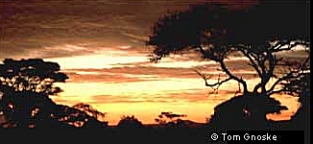
a brilliant, life-sized photograph of the surrounding above-ground landscape,
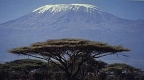
complete with Mount Kilamanjaro off in the distance. The luminous
effect, I assumed, must have been due to ingenious "backlighting" such
as I had seen done on Hollywood "sound stages." The ubiquitous image
was dizzying at first, but soon had its intended soothing effect, conducive
to a pleasant dining experience. Midway between the mural and the
room's centerpoint was a series of long, curved tables arranged in a wide
circle concentric to the room's periphery. White linen tablecloths,
glazed earthtone dishes, and stone vases filled with brilliant samples
of the local flora adorned the tables, and the variety of diners already
seated represented every race on earth -- except, of course, my own.
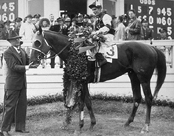
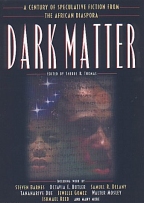
At the center of that table farthest from the door through which we had entered sat the Lady Orinmala. At our appearing, she rose to her feet and struck a glass goblet repeatedly with her fork until the buzz of conversation ceased and all eyes turned towards her. "My friends," she projected in a controlled voice, "please join me in a warm welcome for our honored guests," and led the room in a round of polite applause while Paddy led us directly to her table. My face was still beet red as I took my seat to her immediate right and Gridley to her left. The lad's ebon face seemed to shine a bit more than usual, but it must have been merely a reflection of the noonday sun, for he seemed distinctly more comfortable with the situation than I was. But my embarrasment at being the center of attention in a roomful of strangers was soon overcome by my inevitable curiosity at this unusual convocation of the nations. "So," I essayed, to no one in particular, "FDR's pipe-dream of reviving the old 'League of Nations' has finally become a reality, eh? What was it he wanted to call it? The 'Tide of Nations'? The 'Untied Nations'? The 'Unified Nations'?...Somebody tell me if I'm getting warm here....?" From the expressions of amusement on the faces around the room, I could tell that my opening sortie had misssed the mark. Orinmala promptly intervened: "I believe the name they finally arrived at for that ill-fated organization,was 'The United Nations'." "Ill-fated?" I queried excitedly. "You mean the Allies failed to learn from history?" "Really, Major," she replied, "you've just arrived from the closing days of the first war after the so-called 'War to end All Wars'. Did you really expect the Euro-American Empire to fare any better than its predecessors?" "Euro-American Empire?" I echoed. "You mean the Allies stayed allied after the war? Even Russia? Or did we drop The Bomb on them, too?" "Orinmala," intoned a gray-bearded, elderly black man seated to my immediate right. "Remember...policy--" "I am well aware of policy, Professor," the lady riposted. "Have I said anything so far in breach of it?" "'Ill-fated'," parried the professor, "is a very suggestive descriptor of events that are still in Major Burroughs'...future. You could easily set in motion a dialectic that--" "Spare me the Marxist stereotypes, will you, Will?" A friendly jab to the intellectual solar plexus, that. "They hardly apply any more." "There you go again, Madame President!" the old boy complained, his nostrils flaring. "Why don't you just come right out and tell him the winner of the 1946 Kentucky Derby!? |
 |
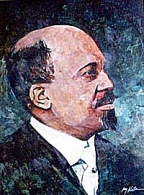
"Professor DuBois,"
cooed the lady with an almost hypnotic effect. "For an old radical, you
seem extremely conservative on this point."
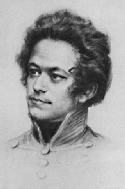
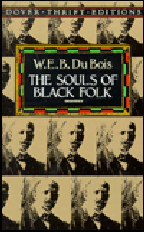
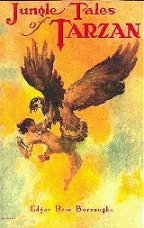
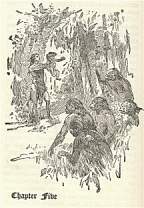
"DuBois?" I blurted out, in a flash of recognition. "Any relation to that socialist fella from my century?" The old boy turned towards me, slack-jawed and sppechless. I figured he needed some prompting, so I continued. "He wrote a lot about Negro History...started up an outfit called the 'National Association for Advancing Colored People' or something... ran this rabble-rousing magazine called 'The Crisis', I think...first colored man to get the Ph.D. degree from Harvard. Surely you've heard of him, at least--he was a big believer in this Pan-African business you folks seem to have latched onto...." I trailed off as I caught the changing expressions of my fellow diners, which, during the course of my brief biographical excursus, had gone from amazement to bemusement to amusement. There was something in the way they all turned their gaze in the professor's direction, in the way their faces became more and more animated as his became more and more apoplectic. Then it hit me. "You're him, ain't 'cha?" I aksed, sober as a judge. He was too flummoxed to acknowledge my revelation, but I knew it nonetheless. "Retrieved by the TSC Engineers, right?" He swallowed hard and found his voice. Nodding almost imperceptibly, he whispered: "How did you know?" "Reckon I jes' got that writer's knack fer readin' people," I said, trying to sound rustic and wise. "Or mebbe I'm jes' lucky." "Or mebbe," a strangely familiar voice behind me cut in, "dat Cracker Gen'l Groves bin shootin's mealy mouf off agin." I turned and, to my shock, there stood Groves himself, framed in the nearest archway, impeccably dressed in an EAF uniform identical to the one worn by Gen. Mugambi earlier. I was glad to see the old fox, glad in the feeling that reinforcements had arrived. "Took the words right out of my own 'mouf', Les," snorted the professor as Groves strode into the room. "I might have known you had something to do with the Major's seeming clairvoyance. What other beans did you spill?" The General, seemingly oblivious to the Professor's remarks, strode directly to Orinmala's side and, standing at attention, lightly struck his left breast once with his fist and bowed his head, remaining frozen in that position until the lady stretched out her hand and turned her head in his direction. Then, to my amazement, Leslie Groves, lily-white scion of the late, great "Euro-American Empire," took the proffered black hand in his own and reverently kissed it. The action seemed as natural and automatic to him as the military salutes he had exchanged with me and countless other men in uniform. "Welcome, General Groves," said Orinmala, smiling. "We are glad that you were able to join us on such short notice. Please be seated." And she motioned Paddy to see to the General's needs. As he took his seat, a few places to my right, he resumed his conversation with Professor DuBois as if nothing had intervened. "Will, I think you underestimate Major Burroughs' powers of observation. There's precious little of the present state of affairs that he didn't foresee in his own imagination over a century ago." "Imagination?" the professor bristled. "Need I remind you of the Major's most notorious statements on that subject?" "Refresh my memory, Will." "I refer you to his remarks in Jungle Tales, Chapter...," and the professor extracted from his vest pocket a slim metallic object about the size and shape of a cigarette case, placed it in the open palm of his left hand and poked the cover of the object with his right index finger. The case sprang open on cleverly concealed hinges like a little notebook, and he proceeded to poke away at an array of buttons on the surface of the right-hand 'page'. As he did so, the blank surface of the left-hand 'page' began to fill up with intricate grid-like patterns, just like a miniature radar screen I was so absorbed in the professor's actions that I had failed to notice that all of our fellow diners--including Goves and Orinmala--had produced from their own pockets similar devices and were manipulating them in like manner. "Ah!" exclaimed Professor DuBois with obvious delight. "Here it is -- 'Tarzan and the Black Boy', in Jungle Tales of Tarzan, Chapter 5, Verses 59 and 60," and he proceeded to read from a printed text that had appeared on the left-hand 'page' of his device: "...and for the first time there entered his dull, Negroid mind a vague desire to emulate his savage foster parent. But Tibo, the little black boy, lacked the divine spark which had permitted Tarzan, the white boy, to benefit by his training in the ways of the fierce jungle. In imagination he was wanting, and imagination is but another name for super-intelligence.Upon concluding his recitation, Professor DuBois turned to me and said, "Major Burroughs, do you deny that you wrote those words?" "Sure I wrote 'em," I said. "What I can't believe is that anybody's still reading them!" "Now you underestimate yourself, Major," interjected Orinmala. "You really don't understand what far-reaching social and intellectual currents you set in motion with your writings, do you?" "Social...intellectual...what in the world are you people talking about?" "Major Burroughs," she said, smiling, "this gathering is NOT a session of the United Nations, nor any other geopolitical organization. This is the annual meeting of the International Burroughs Bibliophiles -- a simple literary society dedicated to the study, preservation, and proliferation of your published and unpublished works." When I came to, I was flat on my back under the table, reacting sharply to the smelling salts that Gen. Groves was waving under my nose. |
ERBzine 0280 JACK OF TIME: ERB Novel Intro & Ch. 1 - "After the Fire..." |


Volume
0433

BILL
HILLMAN
Visit
our thousands of other sites at:
BILL
and SUE-ON HILLMAN ECLECTIC STUDIO
All
ERB Images© and Tarzan® are Copyright ERB, Inc.- All Rights Reserved.
All
Original Work © 1996-2006/2011 by Bill Hillman and/or Contributing
Authors/Owners
No
part of this web site may be reproduced without permission from the respective
owners.