Edgar Rice Burroughs wrote Barsoom for Barsoomians.
That is to say, except for the occasional interloper from Earth the stories
of Mars were by and for Martians. Sure, there was the occasional
interloper from Earth, John Carter or Ulysses Paxton, but these guys tended
to go native pretty quickly, adopting the methods and mores of the culture
around them. But for the most part, the Barsoom stories took
Barsoom on its own terms, looking at life and existence as the natives
saw it. It truly was another world, very distinct from our own.
Earthlings became a part of it, but their earthly natures were not terribly
significant.
There's no story, for instance, where John Carter sets
up a modern "Henry Ford" style industrial plant to mass produce fliers,
for example, or where he single-handedly builds an industrial structure
to get himself a working radio... Although there are other examples
of such stories throughout science fiction, beginning with Mark Twain's
Connecticut
Yankee in King Arthur's Court. That's just a different
kind of story.
There are, of course, lots of different kinds of stories
in science fiction and literature. Spaceman's Burdenwas
another one.
Look at it this way. First come the explorers
and adventurers, people who go out and discover new worlds, new realms.
John Carter on Barsoom, Professor Challenger in the Lost World, Sinbad
of the Seven Seas, Stanley and Livingston in Africa, Lewis and Clarke in
America, Columbus and Magellan, the intrepids who ventured into India and
China. The adventurers brought back tales and stories, exotic trinkets,
the philosophies and techniques of new lands.
But on Earth, the adventurers and explorers of the European
era were eventually followed by traders and armies, the companies came...
The British East India Company, the North West Company, the Hudson's Bay
Company, the Congo Rubber Company, and with the companies, came white men,
European cultures and values, commerce, fortresses, trade, armies and Empires.
And as it went in the real world, so it went in science
fiction, particularly the unconscious science fiction of the thirties and
forties, even into the fifties and sixties. It was the science
fiction that said that men of Earth would reach out to other worlds, savage
worlds, wild worlds, or civilized but less advanced worlds, and would rule
them. Because, after all, what else was there to do with them?
And wasn't it the best thing, for them and us? Although, on
second thought, perhaps it wasn't such a good thing at all, some might
aver.
But it was basically all a version of the belief in "White
Man's Burden," written in an era when Europe and America ruled, directly
or indirectly, the whole of the rest of the world. It was a
time when you could look at a map of Africa and sea practically every bit
of it dotted with the colours of Europe. A time when India
was British, Indochina French, Indonesia Dutch and China a prostrate giant
where local citizens stepped into the gutters to let European and Americans
filled with purpose stride by. White Man's Burden dies hard,
it's become the last reason for America to try to hold onto Iraq...
the ‘moral obligation’ to protect the Iraqis from each other.
So it's no surprise that the science fiction of the day
should reflect the world it lived in, and White Man's Burden should have
its literary equivalent in Space Man's Burden. If anything,
it was kind of late. The ‘space man's burden’ stories really
only began to show up in the thirties and forties, whereas the colonial
empires had been building since the 17th century and probably had peaked
out at the turn of the 20th. I don't hold it against the literature
for being late to the party. Science fiction as a mass commercial
form really only dated back to the 20's at best. So they were pretty
on top.
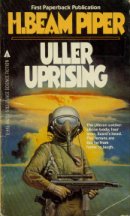 Sometimes
it was fairly unconscious stuff. H. Beam Piper's
Uller
Uprising features a local race of aliens trying to throw off the
rule of human empire, and self-righteously getting a nuke down the throat
for daring to threaten white men and women. Other later works,
including Poul Anderson's Palesotechnic league stories had a much
more conflicted view of the morality of empire.
Sometimes
it was fairly unconscious stuff. H. Beam Piper's
Uller
Uprising features a local race of aliens trying to throw off the
rule of human empire, and self-righteously getting a nuke down the throat
for daring to threaten white men and women. Other later works,
including Poul Anderson's Palesotechnic league stories had a much
more conflicted view of the morality of empire.
Interestingly, Burroughs never really wrote this kind
of story. For all that it may be fashionable to diss the man
for racism, its worth noting that his protagonists joined and triumphed
within the societies they encountered. They didn't overrun it.
Tarzan was always 'of' the Apes. Imperial aspirations or pretensions
were absent from Burroughs work, there was no divine or racial right to
European or American rule, no 'White Man's' or 'Space Man's' burden.
Possibly Burroughs writing formed before this genre really
caught on. Remember that he started off with many of his key
series, Barsoom, Tarzan, Pellucidar and Caspak, begun and often several
books written between 1912 and 1920. But almost certainly, Burroughs
would have been well familiar with hoary old imperialists like the author
of Mowgoli, Rudyard Kipling, and his period of productive writing extended
through the 1930s and 40s. So there was ample opportunity for him
to get into it. But he didn't.
I suppose that for whatever reason, Burroughs just wasn't
interested. Empire invariably is like the Holiday Inn.
No matter what far flung exotic realms it penetrates, the Imperial aesthetic
is simply to reproduce a version of home far, far away. Just
as Holiday Inn hotel rooms are pretty much the same from Nepal to Tierra
Del Fueggo, Imperial life in Kinshasha and New Delhi are pretty much the
same... Only the colour of the waiters differ. For better
or worse, that just didn't seem to do it for Burroughs, the notion of imposing
middle America on the Jungles of Africa or the deserts of Barsoom was fundamentally
repellent. Barsoom was for Martians, and if an Earthman went
there, well, he could darned well don a harness, pick up a sword and try
and fit in.
It's just me, but I think that this says something about
Burroughs' racism or lack thereof. Let's face it.
Tarzan and John Carter were white supermen in lands of black Africans or
red Martians. But the simple fact that they were white supermen didn't
translate to the notion that all white men were supermen, or particularly
super, or that white society had any innate superiority.
Of course, now that I think of it, David Innes with his
Empire of Pellucidar is a bit of an exception isn't it... Well,
perhaps an exception that proves the rule. Abner Perry was
nobody's idea of the Aryan superman, and his notion of bringing the benefits
of civilization to Pellucidar through the re-invention of poison gas suggests
that someone's tongue was firmly in their cheek.
Besides, if David Innes was playing at White Man's Burden
in Pellucidar, Carson Napier on Venus was discovering that the folk of
the jungle world considered him something of a rube. And in
Pellucidar, as with Barsoom, Burroughs was more than happy to hand the
reins of the protagonist over to local heroes, like Gahan of Gathol, Tan
Hadron of Hastor, or Tanar of Pellucidar.
But where was I?
Oh yes. Burroughs never brought Space Man's
Burden to Barsoom.... His Mars would always belong to Dejah
Thoris and Tars Tarkas and their cities and tribes....
Which brings us to Leigh Brackett....
Leigh Brackett
and the Universal Mars
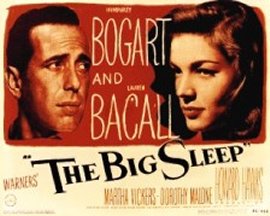
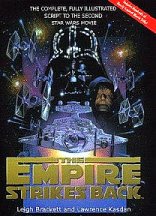
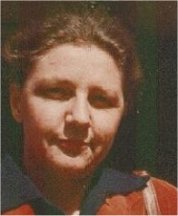
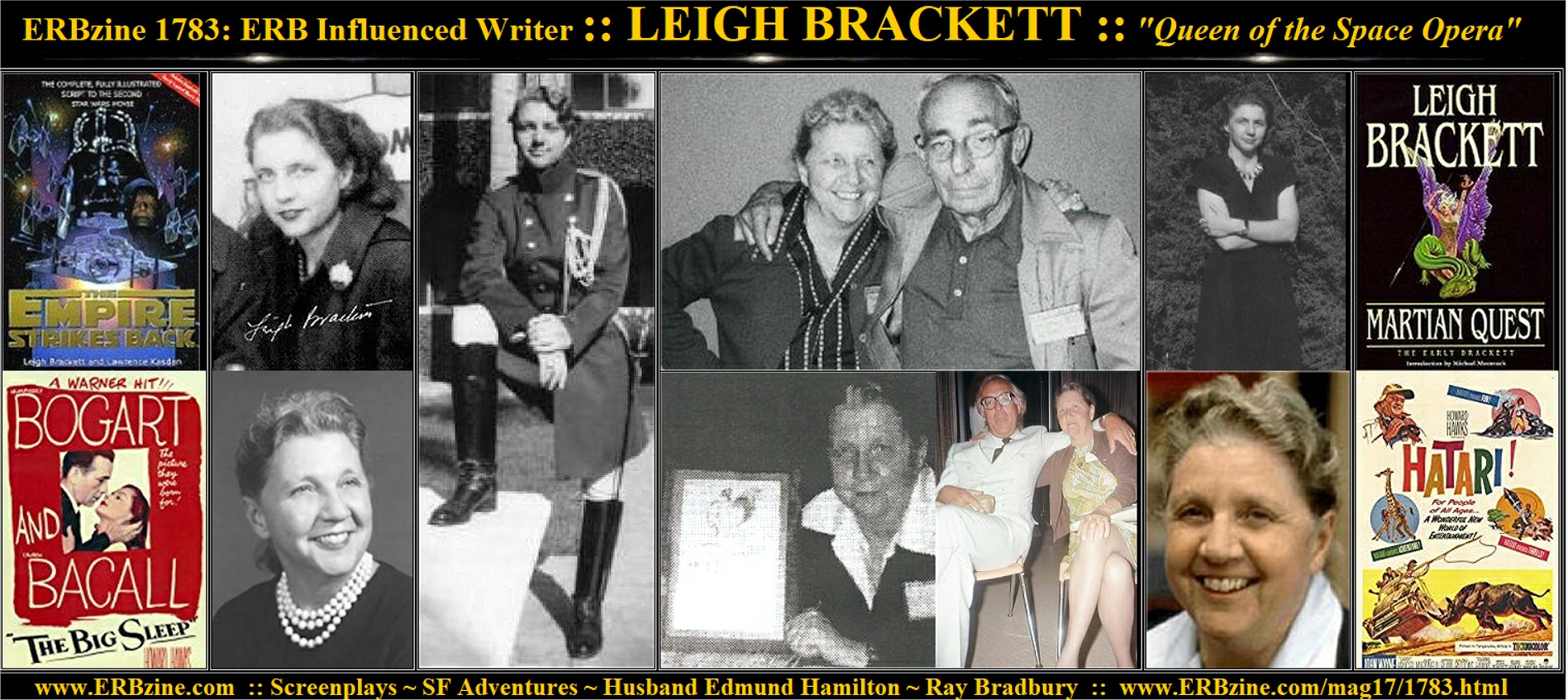
Leigh Brackett, born 1915, died 1978, was one of the more
talented and influential writers in the field of science fiction.
In addition to the genre, she wrote mystery novels, and was even a notable
screenwriter -- among her scripts are The Big Sleep, Rio Bravo,
The
Long Good-bye and remarkably, The Empire Strikes Back.
Her body of SF work consisted of some sixty short stories and a dozen novels
between 1940 and 1978, including collaborations with Ray Bradbury and with
her husband, Edmund Hamilton.
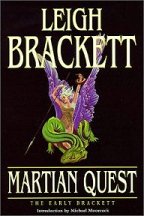
And Bracket wrote Mars. Her first story published,
in 1940, was Martian Quest. She would follow that up
with ten stories and four novels set principally on her Mars, and another
half dozen set on or around other planets of the solar system which touched
on Mars, as well as over a dozen more set on Venus, Mercury, the Jovian
moons or other regions, all of which constituted a kind of interlocking
solar system.
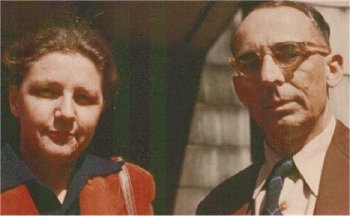
Leigh Brackett and Edmund Hamilton
Indeed, you can look up Leigh Brackett's Solar System
on the Wikipedia, as well as separate entries for her Mars, Venus, Mercury
and Jupiter.
Leigh
Brackett's Solar System
Mars
in the Fiction of Leigh Brackett
Venus
in the Fiction of Leigh Brackett
Mercury
in the Fiction of Leigh Brackett
Jupiter
in the Fiction of Leigh Brackett
Did Brackett set out to write a coherent solar system,
did she sit down and design herself a universe? Probably not.
As the Wikipedia says, it reflected an ‘accumulating use of detail and
setting from one story to the next, until a reasonably coherent universe
had been built up after the fact.’
It's sort of a natural thing that writers do, borrowing
from oneself. You put all that work into coming up with a scene
or setting, it offers multiple possibilities, you find yourself referencing
or re-using it. Stories or ideas inspire each other, and a
writer often tips the hat to other stories or characters.
You get any writer who accumulates a body of work, and
quite often, you'll start to see internal references between one story
or novel and another, that applies to everyone from Shakespeare to Faulkner,
from Burroughs to Lovecraft to King. I don't know why, maybe
it's a natural in-joke for writers to slip characters or settings from
other stories, perhaps there's an element of laziness, or a kind of economy
of creativity at work. But just about any writer with a real body
of work winds up doing it to some extent. Building worlds in your
head seems to bring an urge to connect them up, and a literary universe
of sorts comes into being.
Of course, it doesn't just stop there. Writers are
influenced by other writers, they're influenced by predecessors and friends.
They're definitely influenced by the culture around them, by the stories,
the narratives, the movies and films, the politics and politicians of the
day. A lot of this winds up in their writing, sometimes in
subtle ways, sometimes in obvious ways, and sometimes in little tip of
the hat 'in jokes' or references, sort of like cameos in the movies.
For instance, without looking too hard, you can find a
few Lovecraft references here and there in the works of Steven King.
Deliberate and direct references. Does Lovecraft's Chtulhu
mythos include the oeuvre of King? Well, possibly, if you're
willing to go there. Or perhaps just a few of King's stories
fit in Lovecraft's world, and most in his own world, and a few more inhabit
a strange borderland.
But anyway, Leigh Brackett's stories featured a Mars whose
landscape she found herself re-using. Not just the larger vision
of a Mars, but specific things -- cities like Valkis and Jekkara are mentioned
again and again, Madame Kan's house of pleasure comes about, the lost city
of Sinharat is revisited, Rhiannon is a part of ancient Mars.
And it expands, Eric John Stark is reused for a second Martian story, and
then goes to Venus, meanwhile, the setting of his first story is recycled
for another story. The Venus stories accumulate as well, and
the milieu extends to Mercury and Jupiter.
In some ways, its not a terribly coherent universe.
As the Wikipedia article notes, good frikking luck trying to establish
a timeline. There's gaps and problems, as there usually is when you're
basically making it up as you go along.
But Brackett's Mars and Venus did not spring whole from
her imagination. As I've noted in other essays, both Mars and Venus
were already well established landscapes with their roots deep in the science
of the late 19th and early 20th century, and even more deeply rooted in
the social myths and narratives of the age. I don't propose
to go over it in detail, that would be tedious. If you're interested,
feel free to take a look at my other articles about Mars and Venus.
The short version is that between 1860 and 1940, there
was a powerful imaginary or cultural ‘landscape’ of Mars as an ancient,
dying, desert world. A place that had once had oceans and continents,
but which had gradually turned into a desert. In the narrative,
the Martians, if they existed, were an equally ancient and decadent race,
extending their civilization's life by building elaborate networks of canals.
This had developed through the work of astronomers like Schiaparelli, Flammarion
and Lowell, it had emerged through social philosophers, speculation, and
indeed, through the works of writers like H.G. Wells and Edgar
Rice Burroughs.
During this time, a second narrative emerged of Venus
as a young hot world, filled with oceans and teaming jungles, any civilization
on it would be new and raw, all but primitive. In between the
two, of course, was Earth, always the happy middle between too hot and
too cold, too young and too old, between oceans and jungles on the one
side and deserts and ruins on the other, between the ancient decadence
and decay of Mars and the squalling primeval riot of Venus.
Mars and Venus were not just planets for which a limited
set of astronomical observations existed, but they were psychic landscapes
in the culture, freighted with ideas and narratives that were embedded
in the culture. They were landscapes that were as real and
vivid, or as unreal and archetypal as the wild West, the mysterious Orient
and darkest Africa. Brackett did not invent her Mars or Venus,
for the most part, she inherited it.
It makes a bit of sense when you think about it.
It takes a heck of a lot of work to create a brand new world, and having
done so, the odds are it will be so strange and foreign that no one will
get into it. It's always much easier, and much more tempting,
for a writer to slip into a known world, a known milieu, a place that the
audience is already familiar and with and willing to go. The truth
is that often, people don't like things to be too strange. They like
familiar places where they know the ground rules.
And Brackett didn't simply inherit a generic Mars of bare
bones narratives, something that takes off from the writings or speculations
of a Percival Lowell. This would only give us an ancient race,
perhaps in decline, huddling around or along a few canals.
There was more to it: She was influenced,
guided, by the literary Mars. And let's face it, there were
more than a few variations on literary Mars, including Wells. But
the one that stood out, the one that she drew most heavily on, was Barsoom.
Consider the following parallels between Barsoom and
Brackett's Mars.
Both feature dominant races of Human Martians, all but indistinguishable
from Earth humans, physically, emotionally and sexually. Brackett's
Martians tend towards amber or yellow eyes, often have olive or weatherworn
skin colours, but they could walk the streets of Helium or New York without
attracting too much notice.
It's also society that revolves around personal honour and
shame, and known and notable for swordsmanship and personal weaponry.
It's also an equestrian society. Nope, they don't
have horses. But to get around, the Martians ride around on large,
bad tempered, somewhat reptilian beasts. By and large, Brackett
never really describes them, I don't think she even awards them a name.
They're simply ‘mounts’ ‘beasts’ ‘steeds’ etc.
In some of the stories, particularly Beast Jewel of Mars,
the elite city state Martians seem to have their own fliers, perhaps from
the Earthmen, or perhaps indigenous. The warriors walk around
in kilts and harnesses.
It's a Mars with lost races and hidden enclaves, especially
around the north pole, relics from bygone ages.
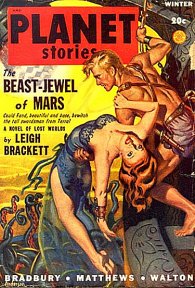 City
states, Martian Princesses, sword wielding, honour-driven, half-naked heroes
riding around on ungainly beasts, discovering lost enclaves....
Come on, this is Barsoom. This ain’t nothing but Barsoom.
Bits and pieces of this, tropes from here and there can be found in other
Mars novels. Otis Adelbert Kline's Mars books are like this
of course, but those draw directly from Barsoom. Arnold's Gullivar
Jones has a lot of this, as does Pope's Journey to Mars.
Both have been argued as candidates for Burroughs inspiration.
There are other stories and novels about human identical Martians, even
human identical Martians inhabiting city states. There were other
major Mars writers, like Wells and Bradbury, or C.S. Lewis.
City
states, Martian Princesses, sword wielding, honour-driven, half-naked heroes
riding around on ungainly beasts, discovering lost enclaves....
Come on, this is Barsoom. This ain’t nothing but Barsoom.
Bits and pieces of this, tropes from here and there can be found in other
Mars novels. Otis Adelbert Kline's Mars books are like this
of course, but those draw directly from Barsoom. Arnold's Gullivar
Jones has a lot of this, as does Pope's Journey to Mars.
Both have been argued as candidates for Burroughs inspiration.
There are other stories and novels about human identical Martians, even
human identical Martians inhabiting city states. There were other
major Mars writers, like Wells and Bradbury, or C.S. Lewis.
But the sheer volume of parallels is inescapable.
It seems mischievous to argue that Brackett could have come up with all
of these things independently, or that she might have drawn from other
writers or ‘common’ ideas. The truth is that Barsoom was just
the biggest and most obvious thing on the Martian landscape.
Brackett's first few stories were of Mars, and to a lesser
extent, Venus, and then the other planets of the solar system.
She began publishing in 1940. We can presume that she was reading
intensively in the genre before that. The entire Barsoom canon
up to Swords of Mars was published by 1936, and would have been
available to her. The romance themes implicit were probably
attractive and appealing to a young girl. In 1940, when her
first two or three published stories were about Mars, Burroughs was publishing
Synthetic
Men of Mars. Between 1940 and 1943, when Brackett published
eight Martian stories, five venus stories and six other solar system stories,
Burroughs was publishing through magazines on the same newsstands the novellas
that would be collected as Llana of Gathol,
Escape on Venus
and Savage Pellucidar.
Brackett's Mars was literally shoulder to shoulder with
Burroughs' Mars, appearing literally in the same magazines or on the same
newsstands, perhaps at the same times or within weeks or months of each
other. We have a young writer doing stories in the face of this large
cultural narrative, and in the face of this huge body of work.
I think that there's no question that Brackett's Mars was based largely
upon Barsoom. That's just the fact of the matter.
Brackett herself freely admitted the inspiration, as did
her husband Edmund Hamilton, in a forward to one of her short story collections.
Barsoom shaped Brackett's Mars.
Leigh Brackett's
Barsoom (Yeah, my subtitles suck. Live
with it.)
Barsoom may have been the starting point for Brackett's
Mars, but she really didn't write typically Barsoomian adventures.
Perhaps there was simply no point. Burroughs Martian adventures
were in a class by themselves, there was no point in trying to write in
that vein, at least, not on Mars. There's clones and then there's
clones.
Even Lin Carter, wanting to do Barsoom style adventures,
didn't have the nerve to set them on Mars. The comparison would be
inescapable, and so he relocated to Thanator. A lot of 'Burroughsian'
adventures tended to be set on other worlds, just as many Jungle Man adventures
tended to be set away from Africa.
Instead of ripping adventures, or sword and planet, or
planetary romance, as the genres are called Brackett opted for more personal
and more conflicted stories. The characters were rougher, more
ambiguous and often a lot more talkative. Instead of simple
plainspoken heroes, she shifted to hapless innocents and cynical thugs.
Her renditions of Mars were in their own ways, more complex but more primitive,
it was a world of mysteries and age, but one which did not suffer the brash
interlopers from Earth very well. Brackett's stories, on the
whole, are less about adventure than about fatal and futile culture clashes.
You won't see Burroughsian heroes in Brackett's Mars,
or if you do, the idea of them gets chewed up pretty quick. Eric John Stark
comes closest, but in many ways, he's an amoral anti-hero, chewed up, spat
out and as likely as not to be working for the wrong side or doing the
wrong things. He's a lot closer to Clint East wood's 'Man with no name'
than he is to John Carter, and a lot closer to being an occasionally principled
thug than either of those.
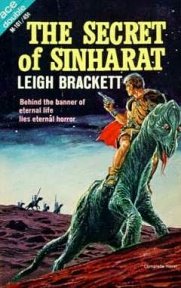
Indeed, that's basically his role in the Secret of Sinharat.
He's a renegade on the run, persuaded to infiltrate a gang of thugs, which
he can do, largely because he is a thug himself. There's a
gritty spaghetti western quality to Stark that's a marked contrast to the
wholesomely sociopathic John Carter.
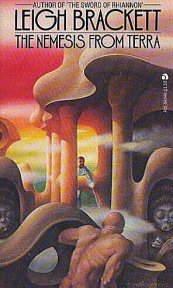
Rick Urquhart of The Nemesis From Terra is another
testosterone-choked thug, a powerful force, but ultimately a barbarian.
In his first chapter, he shoots a little old lady who has given him shelter.
Rick's nemesis are Jaffa Storm and Ed Fallon, colonial exploiters. You
have the impression that Rick would have been happy enough working right
alongside them, had circumstances been different, and that his real objection
to them is that he's not running things. Rick's nominal allies recognize
a potential thug and tyrant and are at best ambivalent. In the end, Rick
realizes that the best thing he can do for Mars, once he's disposed of
other would-be tyrants, is to leave it.
Burk Winters of The Beast Jewel of Mars comes close
to being a John Carterish hero. He's a man so in love with his girl, Jill
Leland, that he risks everything... But in this case, risking everything
does not involve lots of heroic derring do, but rather volunteering himself
to the seamy underworld of Mars and addiction to an exotic drug, which
causes both mental and physical regression. There is, as with Burroughs,
an exotic and beautiful alien princess, Fand (option: evil). But Burk's
single act of courage and daring is to kidnap the Princess and expose her
to the same drug that is regressing him and his fellow Earthlings. What
does the Princess become?
"In spite of himself, he cried
out.... It had eyes, that was the worst of it. It had eyes, and it looked
at him."
So, he kidnaps a Princess and mutates her into a hideous
degenerate slug thing. Yikes. I don't think John Carter
ever imagined being that vile. In the end, Winters is regressed
to a bestial ape man who beats a swordsman to death with his bare hands...
And oddly you get the sense, he hasn't degenerated very far.
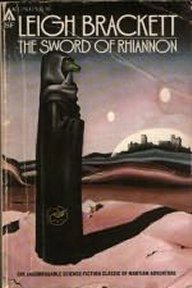 Only
Matt Carse from Sword of Rhiannon escapes being a violent thug,
largely because he's transported into the remote past where that sort of
thing is much more ok.
Only
Matt Carse from Sword of Rhiannon escapes being a violent thug,
largely because he's transported into the remote past where that sort of
thing is much more ok.
Heroes are mostly ineffectual. Or perhaps
ineffectual is the wrong word. Rather, all too often, their heroism,
their struggles seem irrelevant to the real personal or moral issues.
Burk Winters in the Beast Jewel shatters the drug trade, brings
down the royal house of Valkis and escapes with his girl. A typical
Burroughsian resolution? On the other hand, it's clear that
he could not save his girlfriend Jill from her drug addiction, and probably
can't save her or himself from its effects. At the core of Winters' adventure
is a deeper sense of futility and helplessness.
Similarly, Stark witnesses the defeat of evil Rama in
Secret
of Sinharat, but can't quite destroy their technology, instead, the
temptation to evil remains. The heroes of Mars Minus Bisha,
the Last Days of Shondakor, and Purple Priestess of the Mad Moon
all stumble into situations they cannot change. Their efforts, when
they make them, prove futile. They're either irrelevant, or they
make the situation worse. They come away with souls blighted by tragedy.
Carey, the hero of Return to Sinharat goes on an
epic quest to prove that the situation cannot be changed... and in fact,
shouldn't be changed. Matt Carse of Sword of Rhiannon turns out
to be a pawn of greater forces, the 'god' Rhiannon seeking revenge on lapsed
followers.
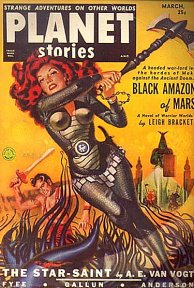
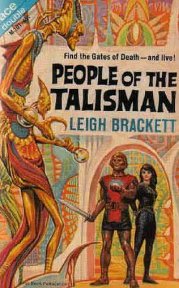
Even Eric John Stark in the People of the Talisman
(Black Amazon of Mars) presides ineffectually over not one, but
two doomed races. Travelling to the city of Kushat with a magic
talisman, he's unable to get his warnings of invasion heeded, nor is he
able to beat back the invasion. Fleeing with some Kushati, they seek
out lost race of primeval Martians only to find they're more decadent and
helpless than the Kushat. These lost Martians give out super-weapons
when asked, but the weapons no longer work, their civilization no longer
functions, and they're simply playing sadistic games in the boredom of
their twilight. Stark's only contribution is to hasten their extinction.
In a conversation, Stark reveals himself to be an aimless, purposeless
drifter.
Indeed, to the extent that they have any effect at all,
Brackett's protagonists tend to wind up hurrying the inevitable fate along,
their own efforts to survive or change things accelerating the pace of
doom. The destruction of the Talisman Martians by Stark is one example,
the fall of Shondakar another. Even Rick Urquhart in Nemesis From
Terra is often trapped helplessly, watching allies or enemies die around
him.
In the end, Brackett's Martian heroes seldom really win.
At best they survive, often burdened with painful and hard won knowledge,
events surge past them, good intentions lead to disaster, a strong sword
arm is overwhelmed by tides of circumstance and naive optimism and good
nature is broken on the rocks of bitter wisdom.
Ladies and Gentlemen, this is not cheerful reading.
Brackett's Mars is not really about heroism or adventure.
Rather, its about tensions.
In her Mars, the Earthmen have come, not as isolated adventurers
joining the society, but rather, in the phase of traders and conquerors.
John Carter and Ulysses Paxton go native, finding a place within Martian
society. But Brackett's new generation is a different breed, and
her new age is a different place.
Eric John Stark is a rootless wanderer, rejecting Earth,
he finds no real home on Mars. Burk Winters is an Earthman through
and through. Rick Urquhart is a grifter and hard man, born
in space he doesn't belong on Mars, or on Earth, or anywhere.
But the real interloper on Mars is not the individual Earthmen, who are
struggling along. Rather, it's civilization.
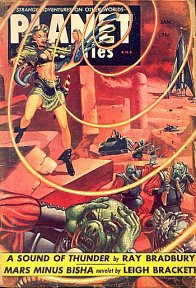 Earth
has come to Mars, and particularly, Euro-American Earth. Kahora
is established as a trade city, a vast domed town created as an outpost
of Earth and Commerce upon Mars. Spaceports are built.
Trading corporations are established. Sometimes the intervention
is well meaning, as with the Doctor in Mars Minus Bisha, and the
archeologist in
Purple Priestess of the Mad Moon. But always,
it is an intervention, it is Earth imposing its ideas, its values, its
way of life on Mars.
Earth
has come to Mars, and particularly, Euro-American Earth. Kahora
is established as a trade city, a vast domed town created as an outpost
of Earth and Commerce upon Mars. Spaceports are built.
Trading corporations are established. Sometimes the intervention
is well meaning, as with the Doctor in Mars Minus Bisha, and the
archeologist in
Purple Priestess of the Mad Moon. But always,
it is an intervention, it is Earth imposing its ideas, its values, its
way of life on Mars.
Earth is in charge. In Secret of Sinharat,
Eric John Stark is enlisted by colonial police in a plot to meddle in Martian
politics. The city states are allowed their nominal independence
and isolation, but commerce on the planet, the reins of the economy, and
interplanetary trade are all firmly in the hands of Earthmen.
Martian ways and institutions survive. But the true measure
of real power is seen in Return to Sinharat, where the Earth colonial
government is beginning an ambitious planet-wide scheme of water diversion
which would require relocating entire cities and peoples.
Nope, the locals are definitely not running things.
Rather, they are shouldered aside, to stew in impotence and resentment.
Indeed, in The Nemesis From Terra, the remnants of the Martian old
guard are outright murdered.
And the Martians resent it. In Beast Jewel
of Mars, the hatred and resentment of the Martian nobility of Valkis
is clearly on display, as is a sort of anti-Earth underground movement.
Hatred or dislike for terrestrial humans is a running theme, showing up
in almost every story and novel. Secret of Sinharat, The
Nemesis From Terra and Road to Sinharat all feature attempts
at planet wide rebellions against Earth and Earth influence.
In short, the landscape of Brackett's Mars is the familiar
landscape of the British East India Company, French Indochina, the Dutch
East Indies, the European ‘protectorates’ in Africa and the Middle East.
It's a landscape of colonial traders and armies, co-existing uneasily with
a subjugated but still functioning local civilization.
Her stories are about the politics of Empires and slaves,
of the tensions and twisted relationships between the strong against the
weak, the foreign versus the local, the interlopers versus the natives,
the advanced against the primitive. There's an uneasy,
queasy dynamic, full of arrogance and resentment, a vibe where even good
intentions can amount to futile gestures, where heroism is irrelevant and
hatred is an undercurrent.
Indeed, perhaps in some ways, the sorts of dynamics and
tensions that fuel her stories may find their roots in more primal tensions
-- the conflicts inherent in being a woman in a male dominated patriarchal
society.
Yes, Brackett's version of Barsoom really is all about
Space Man's Burden, but she's not nearly so jingoistic as H. Beam Piper
in Uller Uprising,
or other more unconscious galactic empires. Rather, her work
seems fascinated with the intractable emotional tensions inherent in these
situations, tensions that paralleled her own situation.
I don't think that Brackett saw her Martian stories in
terms of her personal sexual/social dynamics. To the extent
she seemed to identify with anyone, it was with people like Eric John Stark
or Matt Carse, people whose situations had put them on the fringes, not
accepted in the dominant society, but not truly fitting into the subordinate
society either. I don't think she identified fully with her
Martians, not in the way that Burroughs did. But rather, I
think she sympathized with them, seeing a similar dynamic to social tensions
around her.
Matching
Burroughs to Brackett
It strikes me that the similarities are so profound between
Burroughs' and Brackett's Mars, that it might be more productive for us
to try to explain the differences between the two versions of Mars.
I think that the biggest difference between the two is
in the eye of the beholder, it's one of perspectives.
Burroughs, I think, fully identified with his Martians.
His stories are very much on the inside, looking out, and they accept without
questioning the Martian values and views of life. His characters
took it for granted that they should fight half way around the world for
love, or duel to the death for a personal slight.
Brackett's stories contain more distance.
We still see much of Barsoom in the world that she draws, but now it's
from the eyes of a foreigner. ‘What's with all these swords?
These people are way too willing to kill each other. What's with
the resentment? The clannishness? Seriously, you want to duel
to the death over ...that???’ Brackett's Mars is often depicted
at arms length, the strangeness and insularity, the clannishness of the
Martian society is viewed by people who are remote from it, and viewed
by people the society resents.
What it amounts to is a point of view. If
we looked at the adventures of Tan Hadron in Fighting Man of Mars
from the same sort of perspective that Brackett employs, Hadron's adventures
become darker and more conflicted, his motives become almost middle eastern
and feudal, his actions more fatalistic. He isn't a young man
off on an ill-considered adventure, but a feudal zealot on a mission of
honour so culturally ingrained it's barely conceivable for us.
This sort of leads me to argue that Brackett's Mars basically
is Barsoom, it's merely Barsoom from a different point of view, and different
point in time.
Brackett's Martians seem more clannish and tribal than
Burroughs Martians. Things seem rougher and more hard bitten.
Is it simply that difference in the observer's perspective?
Yes. But there's more going on.
Look at who Burroughs writes about: Princesses and
Fighting men, nobles and heroes, the scions of Helium and Gathol.
He writes about men who can simply commandeer flyers and warships, men
and women at the upper levels of their society and whose societies are
at the top of the Barsoomian heap.
Brackett on the other hand, sets her sights considerably
lower. Basically, it's Thug Life. Eric John Stark
is no John Carter. Rather, he's a self destructive loaner and
low life, out on the fringes of society. His friends are thieves
and brigands, literally. His milieu, the world he moves through,
are mercenaries, barbarians and cutthroats. With no real direction,
he's an aimless wanderer. The cities he visits, dead Sinharat
and isolated Kushat, are at best backwaters and boondocks.
In both of his adventures on Mars, Stark hangs out with
or deals with the nomadic barbarian tribes. They show up a lot.
Barbarians surround doomed Shondakar, and confront Rick Urquhart in Nemesis
From Terra. Mars Minus Bisha features a child dropped
off by nomads. Road to Sinharat has the protagonist sneaking
past nomads and seeking shelter with an old grave robber pal. Matt Carse
from Sword of Rhiannon is a low life bullying other low lifes. Only
in a few stories, The Beast Jewel of Mars, Nemesis From Terra
and People of the Talisman do we encounter the Martian nobility
and royalty. It's not a long acquaintance, they're foreign
to and removed from the protagonists. In Beast Jewel they're drug
runners, in Nemesis they're bitter exiles plotting a return to glory and
getting slaughtered in the process, and in Talisman they're simply petty
fools completely out of touch.
Mostly, what Brackett writes about is the seamier sides
of Martian life, the more archaic and traditional peoples on the margins
of the Martian mainstream. Basically, she's just writing a
different class of people.
Let's face it, John Carter would never be found in Madame
Kan's house of pleasure. I think he'd be shocked it exists.
Despite all this, it really does seem that the Martians
of Brackett's world are a more dour, more hard-bitten, more tradition bound
and in many ways more primitive or less technologically or socially sophisticated
people than those of Barsoom. Their culture seems narrower,
and the people more intrinsically hostile and suspicious. Perhaps
they really are subtly different from John Carter's people?
Even if we accept this, in the following chapter, I think
that we can explain the process by which Barsoomian culture shifts subtly
from that known by John Carter to that seen by the Earth Colonialists.
However, before we get into that, I just want to make a few observations.
There's no sign of Green Men of course. But then,
there doesn't need to be. Their ranges and areas are well defined,
and they're probably rare outside their tribal territories.
I could see that their ferocious prowess and implacable natures might leave
Earthmen giving them a wide berth.
That still leaves a lot of space for human nomadic tribes
in some areas. Indeed, in Otis Adelbert Kline's Outlaws
of Mars, we see that there are human nomadic tribes around the hinterland
areas of Khalsifar and Xancibar. So the existence of such tribes
is not a barrier to Barsoom.
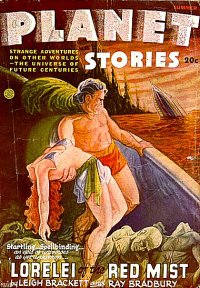 The
Brackett Martians seem to be ethnically different. Let's face
it, Burroughs doesn't spend a lot of time on eye colour, so we don't know
what the colours or ranges for the Barsoomians are. Brackett's
Martians often sport yellow or golden eyes, which seems an obvious Bradbury
reference. Brackett and Bradbury actually collaborated on a Venus
story, Lorelei of the Red Mist.
The
Brackett Martians seem to be ethnically different. Let's face
it, Burroughs doesn't spend a lot of time on eye colour, so we don't know
what the colours or ranges for the Barsoomians are. Brackett's
Martians often sport yellow or golden eyes, which seems an obvious Bradbury
reference. Brackett and Bradbury actually collaborated on a Venus
story, Lorelei of the Red Mist.
(Looked at another way, Brackett's Mars straddles a midpoint
between Burroughs' Mars full of Martians and Bradbury's Mars in which the
Martians have passed away leaving ruins and memories, and humans are left
to confront themselves. She straddles a border where the Barsoomians
and Earthmen uneasily contemplate sharing a world with each other.)
Burroughs writes that the dominant population is copper
skinned or ‘red’ but then spends a lot of time discovering races and enclaves
that prove him wrong. So I've argued, and it's quite likely
that there's more racial variation than we've seen. So the
olive skinned or weather darkened Martians might simply be a different
regional blend of the Red race.
There's no indication of Barsoomian longevity. Or
is there? In The Secret of Sinharat, there's a throwaway
line: "Kala might have been beautiful once, a thousand years
ago as you reckon sin." Perhaps fact, perhaps hyperbole.
The critters that they ride may be thoats.
Or perhaps not. Brackett never bothers to give them a name,
or any sort of description. All we know of them is that they're scaly
hided, bad tempered, hissing, or squealing and large enough to ride or
for a team to draw a canal boat. In another spot, they're referred
to as rangy beasts with padded hooves. Another point there's a reference
to a flesh comb that serves as a forelock. It's possible that in
some remote areas of Mars different animals than thoats may be domesticated
for riding. In Synthetic Men of Mars and the Giant
of Mars for instance, the Malagor, a giant swamp bird, replaces the
Thoats.
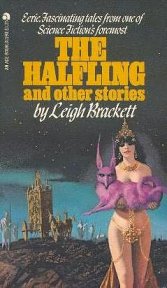 There
is one reference to a clearly Burroughsian creature: A Martian Sand-Cat
or Sand-Leopard appears in The Halfling. The creature
is described as feline in appearance or nature, about the size of an earth
leopard, and it has six legs.
There
is one reference to a clearly Burroughsian creature: A Martian Sand-Cat
or Sand-Leopard appears in The Halfling. The creature
is described as feline in appearance or nature, about the size of an earth
leopard, and it has six legs.
Fliers are occasionally seen, but never described.
The most significant aspect of this is that the term used is the Barsoomian
‘flier’ rather than airship, spaceship, aircraft, plane, etc.
Although she writes frequently of Mars, Brackett shows
us relatively few of the cities and towns. Barrakesh straddles
the equator. Barrakesh, Valkis and Jekkara are all cities on
the same canal in the Southern Hemisphere, near a former sea.
Valkis and Jekkara were originally on the shores of the ‘White Sea’ and
Jekkara has hills behind it to the east. Barrakesh straddles
the equator, and to the north of them there are the barbarian tribes of
Kesh and Shun. Within the territory of the Barbarians are the dead
cities of Shondakar and Sinharat. There is a city called Ruh, capital
of some ancient long gone Empire. Kahora is a trade city built
by Earthman. Somewhere in the far north is a small, isolated city
of Kushat, surrounded by the barbarian Mekh, and its neighbor the more
substantial city of Narissan. Taarak are a northern hemisphere Barbarian
tribe on the other side of the world from the areas of Shondakor.
Okay, cool. The thing is, Burroughs gave us
new cities with every book. There seems no obvious reason that
we cannot fit these into Barsoom somewhere. Indeed, Jekkara
might well be a sister city to Jahar, as we'll explore later.
Of course, the question arises as to why we hear about
Jekkara, Valkis and Ruh as dominant cities in Brackett's stories.
If Brackett's world really is Barsoom, where is Helium, Ptarth, Kaol and
Gathol?
I think that the real explanation there may go back to
these being the cities that Earth has the most access and most influence
in. Helium is around, but like Thailand or Japan or Persia,
keeps Earth and Earthmen at arms length. Earth's influence
tends to be strongest at vulnerable points.
Tharks
in Space
We don't find Tharks on Brackett's Mars. Brackett
never mentions a race of giant four-armed green Barbarians.
Fair is fair, if she had, the copyright lawyers would have been right on
her tail. Tharks are just too distinctive for anyone else but
Burroughs to use and get away with.
Instead, Brackett's barbarian nomads, as with Kline, are
standard Martian humans. Hard-bitten, a bit wild, but definitely
human and part of the greater culture. Her nomadic tribes include
the Kesh, the Shun, the Mekh and the Taraak. Let's think Mongols
and leave it at that.
But interestingly, The Nemesis From Terra does
have a counterpart to Burroughs' Great White Apes. Rick
Urquhart is pursued by black apes, strange martian anthropoids, no larger
than human, but clearly non-human and dangerous. Their description...
"A black anthropoid from
the sea bottom pits, one of the queer inhabitants of an evolutionary blind
alley you were always running into on Mars. Some said they had once
been men, and degenerated in their isolated barren villages. Others
said they were neither man nor ape, just something that got off on a road
that went nowhere. Rick didn't care much. All that interested
him was that the black apes were trained now like hounds....
Four black shadows came slipping on silent paws... He went down under
a weight of sinewy bodies, beast quick, strong, with the musky smell of
the furred animal..."
So are these the four-limbed or six-limbed variety of apes?
Regular apes, or relatives of Burroughs Great White Apes? Mutated
degraded descendants of Caer Dhu? Or perhaps relatives of the
black apes found in Gullivar Jones? She doesn't say.
That's all we get. Typically, Brackett stints on the description,
perhaps encouraging the reader to fill in the blanks themselves, depending
on how close or how far they feel they are from Barsoom. This
sort of thing actually occurs fairly often in Brackett, the woman just
ain't big on description, which suggests that she's relying on our familiarity.
Writers like Otis Adelbert Kline, Ralph Milne Farley and
Lin Carter, if they did not place four-armed giants on Mars, still managed
to sneak races of four-armed giants, some of whom bore very suspicious
resemblances to or ancestry from Martian Green Men, onto other planets.
I've touched on some of these elsewhere, particularly in Tharks in Space.
Do we find races of four armed giants in other planets
in Leigh Brackett's solar system? Not quite. But we do
find apparently two races of four-armed humanoids. Quoting
from the Wikipedia:
Venus:
Lohari Not much is known about this rare reptilian species;
they live in the Lohari swamps, have four arms each, and crawl like serpents.
(The Citadel of Lost Ships)
Callisto: Callisto possesses
two quite distinct intelligent species. One type is humanoid, though smaller
and thinner than humans, and with four arms. These Callistans have scarlet
eyes, white fur, and scarlet feather-like antennae atop their heads. They
possess psionic abilities that they can project through the music of specially
designed instruments (The Citadel of Lost Ships).
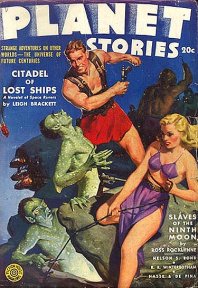 Dwarf
Tharks? It's notable that both of these races appear or are
mentioned in the same story. Without actually having the story before
me, I can only speculate that they may be related. It's possible
that someone has misread the story and that there's only one four-armed
race. Although smaller than humans, they Callistan humanoids do have
some psychic talent which might imply that there's relationship with the
telepathic green martians.
Dwarf
Tharks? It's notable that both of these races appear or are
mentioned in the same story. Without actually having the story before
me, I can only speculate that they may be related. It's possible
that someone has misread the story and that there's only one four-armed
race. Although smaller than humans, they Callistan humanoids do have
some psychic talent which might imply that there's relationship with the
telepathic green martians.
Another story, the Halfling contains six-armed,
mentally deficient ‘geeks’ with armour-plated backs, and a reference to
six-armed geeks with antenna. As always, we wonder if the reference
isn't mistakenly six-armed for six-limbed.
Not much, but there it is. The question with regard to
Callisto is, can we reconcile these local aliens with the Thanator depicted
by Lin Carter? Well, yes and no. Certainly Carter never
mentions such creatures on his Thanator. But then again, he's also
carefully left large parts of his planet unexplored.
Linguistic
Connections to Barsoom
Following up on Linguistic
Archeology and Orovars, an essay I wrote here, (somewhat related to
an essay I wrote on the evolution
of religion on Barsoom).
A word or two about this subject. I think
I'm getting a bit carried away at points. It's a fun bit of
gamesmanship, but really, how much weight can we put on it?
First, let me say that Burroughs himself put quite a bit
of time and effort into manufacturing his Barsoomian language, and using
it consistently and reliably. Burroughs was big on notes and world building,
and he was hardly reckless in doing so. He created not just
a Barsoomian language, but a fairly full vocabulary for Mangani and Pal-Ul-Don,
and even dabbled a bit with language in Pellucidar, Venus and Caspak.
He created elaborate glossaries or dictionaries for both Pal-Ul-Don and
Barsoomian, which means that he actually did sit down and work these things
out.
He was not a stupid man. He knew and understood
English very well, and he was exposed to other languages and had an opportunity
to grasp that languages operated with fundamental underlying rules, that
words were often cobbled together out of other words, and that a single
word might form a root going off in all sorts of directions.
He could see the influence of history on words and names, and indeed, on
the naming of geography and places.
What this resulted in, was that he tended to use his fictional
languages very consistently, and that he seemed to be employing or applying
rules and constructions which might not be articulated out loud, but that
nevertheless showed up over and over. This was consistent, not just
within his language, but within the world that he built. I'm not saying
that he sat down and crafted the whole thing overnight, or indeed engaged
in a systematic process. I think that Barsoomian was kind of
an evolving thing for him, he just kept making notes, and reviewing notes
to make sure that his new words and concepts were consistent with the old
ones.
Tor, Tar, Thur and Thar came up a lot, simply because
he liked the sound of them, and perhaps some inspired others.
It's not a stretch to decide that relatives of the Thark green men might
have cousins with similar sounding names like Thurd. After
a while, he needs to come up with a name for an archaic God.... Well,
he's already used a lot of Tur sounding words for archaic place names,
and this suggests the name for the archaic god. It's a backwards
effect, but it's a real process, which also tends to support analysis.
The point is that whether Burroughs language process was
deliberate or unconscious (and I'd argue for a mixture), it produced a
coherent body of language and linguistic rules that was consistent enough
that we can analyze and deconstruct it, as we did in Orovars and Linguistic
Archeology.
Now, here's where it gets interesting. What
I've found through other works, is that we can take the linguistic rules
of Barsoom and apply them to other Martian novels and stories, such as
Otis Adelbert Kline's, and they seem to work. That is, place
names, words and terms found in writers, including Arnold, Tolstoy, Kline,
Lewis and Carter, seem to harken back and make sense when we apply Barsoomian
rules.
Partly, this is because the units are often so basic.
I'm working with syllables and phonemes. Partly there's a certain
amount of cheating going on, because I'm prepared to be flexible, allowing
for both different written versions of the same or similar sounds, and
for natural linguistic drift.
In some cases, as with Arnold and Lewis, this is probably
(but only probably) coincidence. In other cases, I'm not so sure.
The thing is, that when we look at writers like Kline,
Carter, Brackett and even Tolstoy, we can say with certainty that we know
they were exposed to and heavily influenced by Burroughs and Barsoom.
Absolutely no question of that. So when they write their own
Mars novels or stories, that writing is itself influenced by Barsoom, and
they find themselves automatically or unconsciously coming up with words
that are ‘barsoom friendly,’ words that feel right for Mars.
I don't think that they sit down, pore through Barsoom
glossaries, dope out syntax, deconstruct the linguistic rules and apply
them to make new words, or place their old words properly. That's just
silly. But what I do think, is that in reading the Barsoom stories, they
absorb the flavour of the words and unconsciously absorb meanings and linguistic
rules, which become part of how they think creatively about this world
and develop their own ideas and words.
That's not a big stretch. I've caught Otis Adelbert Kline
using a mangani word in his own universal primate language in Tam, Son
of the Tiger. Lin Carter in his Callisto series winds up using a Barsoomian
word for unit of measurement as a measurement word on his Thanator, and
he makes no bones about seeking phonetic resemblances to harken back to
Barsoom in his fantasy series. So I think it's pretty well
established that it does go on.
Of course, writers make up their own words and linguistic
rules unrelated to Burroughs Barsoom, but that's fair. The
point is not to say that it all has to derive from Barsoom, but merely
to say that we can find Barsoom in it.
So what about Brackett? Can we find Barsoom's
linguistics in her own Mars?
Well, first, take a look at some of her places: Barrakesh,
Kesh, Jekkara, Vishna.... Yeah, these are obvious plays on
Marrakesh, Cush, Sahara, Vishnu.... Middle eastern or Oriental names
or places. What does this tell us? Basically, that
Brackett isn't reaching very deep, she's basically working off the top
of her head, picking up whatever sounds exotic. Much has been
made of the gaelic influences in her Martian names, but really, this is
just more of the same. She's just reaching for whatever is
easy and obvious for her. So this includes gaelic and middle
eastern or oriental words. She's not busting her ass coming up with
words, or with linguistic rules. She's basically skimming off
the upper levels of her subconscious, or the lower levels of her consciousness.
Well, follow that thought. The more unconscious
your process, the more likely it is that you're just going to be picking
up on whatever is lying around and handy, isn't it? And we've
already shown that Barsoom was incredibly influential on her picture of
Mars. At least as, and likely far more influential on her Mars than
her knowledge of gaelic history or middle eastern culture.
And Barsoom has a large set of words and linguistic rules that would have
seeped easily into the back of her mind.
So, logically, what we'd expect to find would be a close
linguistic affinity between Brackett's Mars and Barsoom. We should
be able to find words all over the place which employ Barsoomian concepts
and constructions. And in fact, we do...
I should acknowledge, on Brackett's behalf, that she never
employs a bona fide discrete Barsoomian word that I can find.
On the other hand, she's pretty cagey with her Martian language.
Although the Martians are clearly depicted as an alien culture, and with
a distinct psychology, values and outlook, we don't get a lot of alien
words to represent that distinctiveness.... Practically none.
Her Martians refer to Mars as ‘Mars’ and not by a local word.
Phobos and Deimos have Martian names, but in most stories, even the Martians
refer to the moons by their Earth names. We don't get the Martian
word for Princess or King. We're never told the name of whatever
the hell that reptilian bad tempered thing is that Eric John Stark and
others are riding around the desert on, or if we are told, it's not used
very often.
In short, we get very little Martian language from her
at all, amazingly enough. I sat down and made a count, and
through four novels and six short stories I found a total of four, only
four, Martian words which were not personal names, place names or tribal
names. This is particularly remarkable when we realize that in terms
of number of stories or word counts, she's somewhere in the vicinity of
Barsoom itself in terms of sheer volume.
But then, this is an irritating, or perhaps helpful thing
with Brackett. She seems more than content to rely upon the
audience's knowledge of and assumptions about a world that, if it is not
actually Barsoom, that is close enough that an audience will fill in the
blanks themselves. So she doesn't go out of her way to clutter
up things with descriptions which might undermine that ‘filling in the
blanks as Barsoom or pseudo-Barsoom.’ So if the warriors
wear harnesses, well, we don't hear much more about it, they ride about
on steeds which aren't described, and their fliers are vague references.
Of course, the thing is, if you're resting that heavily
on Barsoom, and leaving so many things blank, well, don't blame me if I
find it very easy to fold your fictional Mars back into the fictional landscape
that you took it from originally.
You know, it occurs to me that since I've written Linguistic
Archeology, I've peppered these sorts of linguistic analysis as chapters
into a handful of other essays. Same thing with the geography
of Greater Barsoom, a few core essays, and then subdiscussions in a bunch
of
other essays. I think perhaps one of these days, if there's
any interest, I should go back and pull them all together and put out a
couple of comprehensive essays on the Language of Greater Barsoom,
and Geography of Greater Barsoom. Perhaps throw in a
Greater
Venus, and Greater Pellucidar essay. Ah well, not
here, not now.
But onwards, back to Leigh Brackett and Barsoomian linguistics:
As I was saying, I think we can actually find connections between the words
and word roots in Brackett's Mars and Barsoom to suggest that they may
well be the same place...
The key in Linguistic Archeology was to examine Burroughs
Barsoomian language for recurring patterns. Repeated uses of root
words that could be found in prefixes or suffixes or in the body of a word.
Some of these were given to us directly by Burroughs,
who seems to have clearly intended that adding a suffix 'a' or 'ia' to
a name meant that it was a daughter. Thus 'Thuvia' is the daughter of 'Thuvan.'
This is the most obvious and commonly remarked observation about the Barsoomian
language. But there are other things we can figure out, which
suggests that Burroughs was using consistent linguistic rules consciously
or unconsciously.
Other words or word roots were used consistently enough
that we can dope them out fairly easily. 'Than' is a warrior. Panthan or
'Pan Than' is a mercenary, Gorthan or 'Gor Than' is an assassin.
To this we could probably add Utan or 'U Than' which is a rank of command,
assuming that the 'Tan' is a modified 'Than'. And working from that, Jetan
becomes 'Je Than' about a game of warriors Barsoomian chess.
See the pattern. There's a common root, 'Than', which
clearly means fighter or warrior. If we assume some degree of pronunciation
drift (regional accents, differences in pronunciation over time, etc.),
we can relate it reasonably to usages in other similar words where the
fundamental meaning of 'warrior' seems to be continued. So, with 'Than'
we've got a useable root word of original Orovar (an ancestral race of
Barsoom).
From there we could look at 'Pan' or 'Gor' to determine
if these roots show up elsewhere, and if we could derive a common meaning.
Take 'Pan'. This shows up in the northern polar nation
of Panar and its city, Pankar. It also shows up in the personal name Pan
Dan Chee (a relic Orovar from Horz), and Pandar (a phundalian warrior),
its use in names being found in archaic cultures.
From there, we make a guess, that Pan may be a very ancient
word, perhaps meaning wanderer, or in some uses, refugees. Which suggests
that Panar may be Pan R or 'Refugees of R', and the city of Pankar may
be 'Children of the Refugees'. Pankar is a domed city of Red Men, similar
to the domed cities of the yellow O Kar. The O Kar cities were founded
by refugee yellow men fleeing north. So Pankar and Panar were themselves
likely refugees, 'wanderers' as in people fleeing. Possibly, Pankar
was originally a yellow city of different name, overwhelmed by a nation
of red refugees. It does seem to fit.
Sometimes, we might not be able to guess at a meaning
in a root, but we can see it showing up often enough or consistently enough
to identify it as a significant root word without quite knowing what it
means.
Anyway, in Linguistic Archeology and Orovars, we found
certain recurring linguistic themes or artifacts, which we can apply to
Brackett's Mars, suggesting that there are is a linguistic connection or
identity between the two versions of Mars.
As I've noted, frustratingly, or conveniently, as you
choose, Brackett gives us almost no Martian words. There's
Shanga, a reversion ray; Yril, a sort of wood; Getak, a game, and Thil,
a narcotic drink.... And that's it for the stuff I've managed to
read. There are no words for animals, clothes, common objects, special
rituals, whatever. She never even gets around to naming the
riding beast.
Apart from those four words, there are only a scattering
of place and tribal names and a score of personal names. So,
most of this discussion will tend to focus on place names, with a few allusions
here and there to personal names.
One of the most common and crucial words in Barsoom relates
to the ancient religion of Tur. A great many place names, numbers, titles
and personal names can be related back to Tur or its variants, Thur, Tor,
Thur, Tar, Thar... With Brackett, we see a few examples of 'Tur-ism' in
place names for cities and tribes:
Kathuun = Ka Thu (Tur) N
Taarak, Tarak = Tur A k
(Thark?)
Tur-ism also shows in at least a few personal names:
Thord (Tur-D), Tor-Esh (Tur-Iss), Otar (O-Tur), Thorn (Tur-N)
There seemed, in Barsoomian, to be a caste of derivative
words or roots that may have originally related to and drived from Tur.
These include Zar (meaning loosely, sky, sun or home), Kar or Kor (children
or perhaps followers), Far and/or Var (meaning people), Tar or Ther (possibly
holy, people or holy people), Bar (ground, land), Hor (city), Dar
(great or many, large number).
So, looking at some of Brackett's place names, we can
break them down into Barsoomian roots and analogues.
This allows us to take a hard look at some of Brackett's cities and tribes:
Jekkara Ja Kar A.
We've established that the 'a' denotes daughter, and Kar denotes people.
The 'Ja' is also found in Barroom's Jahar (Ja Hor, City of Ja), Tjanath
(Ja Nat), Jasoom (Ja Soom or Earth).
Ja or Jah is also a very very common name component, as
in Dejah or Sarkoja. 'Je' may be a variant pronunciation, which shows up
in Jetan, Jed and Jeddak. The implication might be that Ja or Je could
mean 'high' or 'noble' or perhaps ‘king.’ Thus, Jekkara would
translate into Barsoomian as 'Noble People's Daughters'.
And by extension, this would give us a full translation
for the Barsoomian Chess game of Jetan: Ja-Than = Ja (Noble)
+ Than (Warrior) or Nobles & Warriors. Sort of literal,
kind of like ‘Snakes and Ladders’ or ‘Dungeons and Dragons.’
Brackett's story ‘The Halfling’ refers to a Martian came called Getak (Je-Tak
or Ja-Tak?) which may be a variation on Jetan.
This deconstruction suggests that Jekkara may well be
related both geographically and culturally to Jahar or 'Noble City', and
Tjanath. Indeed, it may have inherited regional hegemony from
Jahar after the sack of that city and the catastrophe of U-Gor in Fighting
Man of Mars.
Then there are the two cities of Caer Dhu (the Caer Dhu
of the serpent men from Sword of Rhiannon, and presumably a later Caer
Dhu occupied by humans which was destroyed by shanga reversion as noted
in the Beast Jewel of Mars), and Caer Hebra, a surviving city of
winged people. The ‘Caer’ is obviously a gaelic allusion, but
I'd translate it phonetically as either ‘Kar’ or ‘Sar’. So,
basically, it's a dressed up version of what has become some very familiar
Barsoomian terms.
Caer Dhu is also interesting because its suffix, Dhu (or
Du), is reminiscent of Burroughs Barsoomian cities of Duhor (Du-Hor) and
Dusar (Du-Sar). Otis Adelbert Kline's Swordsman of Mars
also features a third city, probably in the same general region, Dukor
(Du-Kor). We might be able to infer some sort of broad relationship
in geography or history between the four cities of these three writers....
Though clearly, three of them are humans unrelated to the extinct Dhuvians.
The prefix ‘Du’ also appears in The Last Days of Shandakor,
in a personal name, Duani, or Duani. Shandakor, in mind of nothing
in particular, is also close to the name of a city of Lin Carter's Callisto,
which has its own Barsoomian connections.
Sark (Sar K), is an ancient empire
in Sword of Rhiannon, so it seems to be an old and traditional name.
Sark also shows up in Otis Adelbert Kline's Sarkiss in ‘Outlaws of Mars.’
Meanwhile, Lin Carter's ‘Flame of Iridar’ features a character named Sarkand,
also from ancient times. Sar or Zar features prominently in
Tolstoy's 'Aelita: Princess of Mars'.
There are a few other interesting place names in Brackett,
which seem to use Barsoomian roots or Barsoomian constructions.
Kahora (Ka Hor A)
(Kar Hor A?) (People's City of Daughters?)
Varl (Var L)
Quiri (Kar E)
Kharif (Kar If)
Karadoc (Kar A Doc)
Karthedon (Kar-Tha-Don)
Khondor (Kon-Dor)
Quiru (Kar-U)
Sark (Sar-K)
There are also a few Barsoomian names: Kor
Hal, Kardak (Kar-Dak), Corin (Kor-In), Narrabar (Nar-A-Bar), Penkawr (Pan-Kor
or Pan-Kar)
Interestingly, where in many of the place names of Burroughs
Barsoom, we found frequent references to Tur (including variants: Tor,
Thor, Thur, Thar, Tar); many of Brackett's Martian cities seem to contain
variants of Iss. We might actually expect this, when you think
about it. After all, if Tur really had such influence in the naming
of geographical features, we might expect the later Iss cult to have its
own ‘naming’ urges.
Valkis (Val K Iss)
Barrakesh (Bar A K Iss)
This is interesting because of the root Bar, which seems to be Land. The
translation would be 'Daughter Land of Iss'.
Narrissan (Nar Iss An) (Nar-Iss-Zan?)
Kesh (K Iss) A barbarian tribe in the southern
hemisphere.
Shun (Iss Un) A barbarian tribe in the southern
hemisphere.
Of course, although Brackett doesn't give us the local
Martian name of Mars, she does give us the names of the moons, and uses
them once or twice. And they're not Thuria and Cluros. They're
Denderon and Vishna. Problem...?
Well, even on Earth, we have different names for our satellite
'the moon' and 'luna', so perhaps its not entirely fatal.
It may well be that Barsoomians may have multiple names for their own moons.
Phobos is, in Burroughs world, called Thuria, or Ladan
by its inhabitants. On Brackett's Mars its called Denderon.
Meanwhile, the second moon, Deimos, is called Cluros by Burroughs and
Vashna by Brackett.
Let's deconstruct this a bit. Cluros breaks down into
two words: 'Clur' or 'Klur', which may be a variant of 'Kar' meaning child
or children; and 'Os' which may be a variant of Iss. Thus, while Thuria
can be easily translated as 'Daughter of Tur', Cluros might translate as
'Child of Iss.'
Vashna may have a very similar meaning. Its central syllable,
'Ash' may be another variant of 'Iss.' The 'a' attached as a suffix denotes
female or daughter. So Vashna might translate loosely as 'Daughter
of Iss', which is very close the meaning of Cluros, and related to the
meaning of Thuria.
On the other hand, Brackett's counterpart to Thuria is
Denderon. Here, we are not on solid ground in finding a true parallel,
though there are some interesting things.
'Den' doesn't appear at all in Burroughs, though 'Dan'
appears as a root in Zodanga and in personal names like U Dan and Pan Dan
Chee, but unfortunately, a meaning eludes us. Most significantly, 'Dan'
appears most significantly in the place name, Ladan or La Dan, the Tarid
(local inhabitants) word for Phobos. So, possibly it's a significant word,
but we can't quite figure it out.
'Der' may be related to 'Dar' which seems to be a religious
root for large. Perhaps a reference to Thuria's distance or being the larger
moon? At best, we might find a loose parallel to the Thurians own name
for their world, Ladan or 'La Dan' to 'Dan Dar N'
In Brackett's stories, there are occasional references
to ruins left behind on Phobos. As we know, in Burroughs stories,
Phobos (Thuria) is actually inhabited. This implies that sometime
between John Carter and Eric John Stark, something very unpleasant and
final may have happened to the inhabitants of Thuria. Itself
a hint that greater and more wide ranging changes have been at work.
What does this all amount to? Well, obviously,
Brackett's Martian places and names seem to fit neatly into Barsoom without
much trouble at all. Which only goes to emphasizing that Brackett's
Mars and Burroughs Mars are essentially the same place, though at different
times and through different viewpoints.
Brackett's
Future History of Barsoom
The critical difference between Burroughs' Barsoom and
Leigh Brackett's Mars, the difference that everything else flows from,
is time.
Burroughs Barsoom chronicles the adventures of John Carter
and his allies from approximately 1865 through to about 1945.
Essentially, they're told in contemporary time, encompassing the late 19th
and early 20th centuries.
Leigh Brackett's Martian stories take place much later.
Her short story collection, 'The Coming of the Terrans' gives a series
of dates on each story title, ranging from 1998 to 2038. On
the other hand, these dates aren't referenced in the stories themselves,
which seem to connect to or relate to stories much later. At
the
earliest, we can set Brackett's Mars stories as beginning in the 21st century,
several decades after John Carter.
Eric John Stark occupies a cluster of stories set on Mars
and Venus. Stark's other Martian story, seems to refer indirectly
to the events of the Beast Jewel of Mars, dated 1998. One of the
stories in the 'Coming of the Terrans' collection is 'Road to Sinharat'
dated as 2038. But this story seems to occur later in Brackett's
history, years after the events of the Secret of Sinharat, featuring
Eric John Stark.
If we go by the dates set in 'Coming of the Terrans' this
seems to suggest that Stark's period of activity is somewhere between 2010
and 2020. This really does seem way too early, perhaps by as
much as a century. Stark would have to have been born in the 1980s.
His history was an orphan raised on Mercury, which suggests that early
exploration colonization of the inner solar system by Earth probably dated
as far back as the 1960s. That simply doesn't seem feasible.
Given this, I'd tend to regard the dates given in the story titles as interpolations
and unreliable. I'm prepared to accept the order of stories,
but not the specific dates. It's possible, I just tend to regard
it as unlikely.
The only dates which are actually given in any of Brackett's
stories are for the Water Pirates, set in the 25th century, and
Interplanetary
Reporter, set in the 26th. These stories feature a Mars
well integrated into the interplanetary trade and political network, and
relatively independent of Earth. So they're at the end of the colonial
period.
Given this, I'd suggest that the Barsoomian colonial period
probably ran from the 22nd century to the 24th. Potentially,
it was much shorter. On Earth, the Colonial period for India
dated from roughly 1700 to 1950, or about 250 years, give or take.
On the other hand, the Colonial period for much of Africa ran from 1890
to 1960, or perhaps five to seven decades.
So what happens to turn Burroughs Barsoom into Brackett's
Mars?
Well, Earth does, obviously.
In the intervening decades of centuries, John Carter may
well have died. There are indications that he is immortal or
quasi-immortal. But an accident with thoat or flyer, a lucky shot
or a quick sword thrust, might well end the life of the Warlord of Helium.
John Carter lives dangerously.
Or possibly, John Carter is still around on Brackett's
Mars, defending and preserving Helium and his allies from the intrusions
of the yankee bandits from Earth. There's nothing in Brackett
that would demand Carter start pushing up daisies. Indeed,
if we look to European colonialism, we find several states, Ethiopia in
Africa, Persia in the Middle East, Thailand in the Orient who were able
to preserve their independence from the Colonial Europeans. One of these
states, Japan, even managed to push back.
So its not unlikely that Carter is still around, and that
Helium and other allies are still maintaining some degree of autonomy and
independence. Many of Brackett's stories seem to revolve around
the weaker or prostrate city states, the vulnerable or colonized territories,
such as Barrakesh, Valkis and Jekkara. So we may simply have
a situation where some parts of Mars are more thoroughly dominated by the
terrans than other parts, and Brackett's works focus on the places where
colonial domination is most obvious.
Indeed, Brackett repeatedly refers to Mars ‘Confederation
of City States’ suggesting that something resembling the Heliumatic league
might still be around, although weakened and attenuated.
Still, its clear that with the coming of the Terrans,
Barsoom falls on hard times. So, what is probably happening?
Probably a number of things.
First, we have to consider that Barsoom during John Carter's
era is undergoing all sorts of major changes. The Iss religion
has been overthrown and discredited. But Carter himself notes
that some groups of Therns are refurbishing the cult and touting a ‘Reformed
Iss’ faith with a decidedly more mystical and user friendly angle.
It's likely that the fall of the Iss faith would open the door to a resurgence
of the Tur cult, or even to new religions and religious impulses.
Ethnically, the O-Kar, the First Born, the Therns and
even relict populations of Orovars have all been re-discovered and re-united
with the mainstreams of Barsoomian life. Therns have left Valley
Dor and now wander freely around Barsoom. The past suggested
that the ethnic makeup of Barsoom was fairly uniform. Now,
in John Carter's era, there is an increasingly more diverse ethnic background,
there's more likelihood of more colours and kinds of persons in different
areas. And the breakdown in Barsoomian's splendid isolations
suggest that we may discover that even Barsoom's red race was not so uniform
as we had thought.
There are downsides of course, the empire of Jahar pretty
much lies in ruins, and if the rest of the planet is looking good, things
are probably pretty bad for Jahar and its satellite cities.
They probably represent the weakest and most vulnerable areas.
There may be other areas of Barsoom equally devastated by wars and conflict.
The economies of the Therns and First Born were completely destroyed as
a result of Gods of Mars, and that of the O-Kar didn't do so well
out of Warlord of Mars, so its possible that all of these societies
are still struggling. Indeed, in Llana of Gathol, John Carter
mistakes Pan-Dan-Chee for a Thern, because so many of them have taken up
the trade of the Panthan... Clearly, if the Therns are turning in
large numbers to the way of the Panthan, the bedrock Thern society is probably
not able to offer them a reason to stay home.
It's worth noting that with improved fliers (Thuvia,
Maid of Mars), improved weapons (Fighting Man of Mars) and an
increasingly powerful Heliumatic league that the stage is set for more
ferocious and devastating wars. Helium will do well.
Its enemies will do very, very badly, suggesting perhaps, a lot more vulnerability
to outside influences... Such as enterprising Earth traders
and imperialists.
Finally, we have to wonder at the economic changes wrought
in the era of the warlord. New technology, more communication
and more trade between the cities should allow for an expanding growing
economy. And there are all sorts of signs of this. But there's a
downside. A stable economy may not grow dramatically, but it doesn't
experience contortions or contractions.
Barsoom may be experiencing a cyclic boom and bust, expanding
and contracting economy. What does this mean?
Well, it means that if Earth traders and imperialists come along at the
right time, then Barsoom could well be very vulnerable.
The bottom line is that between economic cycles, and local
disruptions from wars or other crises, Barsoom, or parts of Barsoom, would
be very vulnerable to economic infiltration and political, even military,
domination from Earth. Places like Helium or Ptarth might be
strong enough to keep the Earthlings at bay. Places like Jekkara
or Valkis might have little choice but to jump.
Meanwhile, what's likely to happen when Earth clashes
with a vulnerable Barsoom?
Disease? Don't sell that short.
Barsoom hasn't had all that much experience with Earthmen, and the ones
who have come over have been pretty healthy. But there's every
reason to think that the Barsoomian population might be vulnerable to Earthborn
bacteria (Wells Martians certainly were). Disease did much
to depopulate the Indians of the American continents, and isolated populations
like Japan, recorded successive waves of plagues and social upheavals from
visitors. The initial introduction of large scale contact with
Earth might have loosed a series of plagues or illnesses that could have
reduced populations and destabilized many cities and social orders.
Did this happen? Brackett gives no evidence
of this. But then again. We don't really know what happened
at this initial stage. It might well have been, given the lives
of Barsoomians, that a plague might not have been noticed.... For
instance, a disease which is not virulent enough to produce overt or debilitating
symptoms, might still kill lots of people by starting the aging process
prematurely, wiping out whole classes (probably the most stable and technically
essential classes of Barsoomian society). Other illnesses might
induce fatigue, weakness, perhaps mildly slow down reflexes... the effects
might be so subtle that they aren't really noticed.... except that people
are dying in duels and accidents at a much higher rate. Or perhaps
something as simple as making injuries unaccountably more lethal.
Even subtle effects might destabilize Barsoomian societies.
But even without disease, Barsoomian society is in trouble
when it encounters the Earthmen. There's an economic mismatch.
Here, let me quote the excellent article, Thoughts
on Barsoom by Seldan Christian. Christian's given the
matter of Barsoom's economy and population considerable thought, and his
conclusions are extremely well reasoned. I highly recommend
this to any serious student of Barsoom:
Notably, I'd like to quote Christian at this point:
"Barsoom isn't a consumer
society, but a very long-lasting product-keeping one. Their producers don't
know planned obsolescence. Buildings for example, although the science
of the Orovars has faded away, still last really long: not 1 million years
but 20,000 surely – see MMM. In a city of say, 1 million people, you have
maybe 300,000 buildings. Well if they last 20,000 years and the population
is stable, it means only 15 have to be built every year. Which means a
very small workforce is needed in the construction industry. Many everyday
objects are in stone or strong metal (PM). Furniture can last millennia
as well. Textiles, they don't use many, not even for the beds – they use
furs and skins mostly, which are much longer lasting and can be worked
by few people in big quantities. Even light bulbs last for millennia. And
so on and so forth. Practically, only the sandals and the harnesses, and
of course the food and the armament wear fast. The ships for example, if
a ship of 100 years is old and one of 15 is at the limit, since Helium
has 1000 or 1500 ships it means it builds 100 of them a year. The industry
of warships is probably by far the most active and the biggest activity
upon Mars. But anyway, this sort of economy requires much less people than
upon Earth."
"Is there mass industry upon Barsoom?
I don't think so, except for ships and probably pipes and weapons. When
you produce things that last for millennia, you don't really need Fordism,
not to speak of informatics and such. A single talented individual with
a handful of apprentices can craft many things, even fliers for example,
for many thousands of customers. Inventive and skillful people able to
put together complex machinery exist upon our orb as well."
Okay, so the point is that Sildan is basically seeing Barsoom
as a stable, long term, crafts-oriented economy which produces relatively
low volumes of goods, but probably balances off with expense and quality
of good. Planetary trade is relatively low. It's
a stable system, but not a manufacturing system, or a high volume system.
It's the sort of economy that many middle eastern or third world countries
had.
What happens when a high volume, industrial manufacturing
economy impinges on Barsoom? A lot of new money, a lot of new goods
flood into the system. There's a huge flush of apparent wealth,
as all sorts of new toys come available for everyone at low low prices.
Credit is introduced to support the purchases, and debt begins to accumulate
throughout the system.
Meanwhile, the traditional economy begins to shudder and
shake, contracting and contorting as the impinging economy produces much
larger volumes of goods at cheaper prices. Perhaps the products
aren't as good, but the advantage of volume and price more than makes up
for it. But Earth comes to Barsoom with some seriously advanced technology.
Which means that not only are the goods being sold cheaper, and more bountiful,
they may well be better.
There's no opting out of Earth's economics.
As with the Maori and their gunpowder wars, the Barsoomian societies that
don't play, find themselves left far behind and at the mercy of their competitors.
In the 19th century, Europeans introduced western goods, particularly firearms,
to the Maori of New Zealand. Maori with firearms wiped out
Maori who did not. No Maori had the choice not to trade.
During the early fur trade in North America, Indian tribes who obtained
superior medicine, goods, and weapons from Europeans inflicted the same
sorts of damage on their neighbors. Many Barsoomian city states find that
they have no choice, they have to play the game in order to keep up.
The trouble is that the Barsoomian economies cannot keep
up, they aren't designed to produce at a rate that will keep up with the
Earth economy and its trade. The only restriction on Earth
is the bottleneck of interplanetary shipping, which probably is the only
thing that saves Barsoom from utter economic collapse. But still,
with its lower rates of activity, Barsoomians find themselves selling off
their accumulated surpluses, their seed corn, their wealth and entitlement,
participating in the new Earth industrial economy. Forests
which might last centuries or millennia are cleared away in years, mines
are brought on line and worked intensively, herds of thoats are slaughtered.
Any resource which generates capital in order to trade with the Earthmen
is harvested ruthlessly. Any product which is valued by Earth
is bid up rapidly, resources are committed disproportionately to producing
that product. Productive capacity is exceeded, and as raw materials
or fundamentals get exploited past renewable levels, local economies collapse.
The Kaolians wonder what the hell happened to their forests all of a sudden,
they find themselves rich in toys, but the key underpinnings of their economy
are gone.
And after that, or perhaps during this, they find themselves
accumulating debt rapidly. This applies throughout Barsoomian
society, from warriors, to nobles to Jeddaks, isolated wanderers to city
states and empires. With debt comes political vulnerability.
The Barsoomians find themselves having carved their own economic foundations
out from under them. Barsoom experiences worldwide depression,
the Bankers and financiers from Earth wind up running the show. Earth
businesses dictate their own terms, setting conditions, establishing operations.
In short, whether John Carter is around or not, Barsoom's
planetary economy, and a large number of local economies, become road kill
when they meet the Merchants of Earth. If we assume that Barsoom's
economy is only partially integrated, then its simply that much more vulnerable.
If we suppose that Barsoom's economies might have been in a slump when
or at some point where Earth comes along and gears up, then its that much
worse.
And the Barsoomians simply will not understand.
They'll understand virtue and honour, they'll understand loyalty, the traditional
virtues and values, they'll see their city states and nations.
And it will all be as they have always understood it. But for
the most part, the operations of economics will take them by surprise.
Their economies, and from there, their societies, will be divided, impoverished,
subjugated, even dismantled before their eyes, and they won't have a clue
as to how it could possibly be happening.
Terrifying? But it's happened dozens of times over
the last three or four centuries to traditional economies which encounter
the west. Hell, its happening even today. All you
have to do is look at Africa and Latin America to see entire societies
being ground to powder by the operations of market forces.
Large parts of the Barsoomian economy or technology might
simply drop away.
Right now, in Haiti, because of free trade agreements
with the United States, it is cheaper for Haitians to import rice, than
it is for Haitian farmers to grow it. What's the result?
The devastation of the Haitian agricultural economy. Basically,
farmers can't make a living, so they walk off the land and go to the cities.
Without the farmers to sustain the local economies, those economies collapse.
With the collapse of the local economies, the national economy shudders,
shakes and limps. It's not a good thing.
With the local economies going, and large numbers of landless
former farmers looking for work, the governments tax base dwindles away.
To function, it must take loans from international bankers. The bankers
in turn dictate Haiti's economic and political policies. Haiti becomes
a bankrupt state, unable to resist foreign interests. Its only
option is to throw open for investment, sell off the rest of its heritage,
and beg for foreign investment to hire the now starving citizens in slave
labour factories for pennies a day. It's a desperate situation.
The traditional Haitian economy, traditional agriculture, factories, skills
and products are gone. Now, everyone dances to the tune of
foreign money, sewing shirts or sneakers for Wal-Mart. For
many Haitians, the traditional way of life is gone, and what has replaced
it is poverty, misery, starvation and rootlessness.
This is probably what happens on Barsoom.
Or at least some version of this happens on Barsoom. Possibly
not so disastrous, but its easy to see parts of the Barsoomian economy
simply disintegrating. It's hard to say what gets lost, or
how it is lost. Would the Barsoomians still be manufacturing
or producing flyers, or would that technology and industry be lost?
What about radium weapons? Who knows. We might well see a Barsoom
that seems to be moving backwards technologically, no longer producing,
or no longer able to sustain the traditional industry. Flyers
may be rare in Brackett's Mars simply because the portions of the Barsoomian
economy that produced them may no longer exist. The lifestyle
of Barsoomians in Brackett's colonial era may be apparently simpler and
more primitive than even a century before.
As I've said, there's nothing radical or unique about
this. It's happened on Earth many times, and its happening
on Earth right now.
Then of course there's the military and technological
gap. Simply put, Earth technology is likely more ferocious
and more advanced by this time than a lot of Barsoomian tech.
For instance, the Barsoomian flyers are nice and impressive.
But clearly, they're not fast compared to Earth vehicles that can travel
between planets, or cruise at supersonic speeds. They're also
not heavily armoured enough to stand up to Earth's blasters, lasers and
space artillery. Helium's mighty war fleet, impressive on Barsoom,
might be about as effective against Earth's weapons systems as the Polish
Cavalry was against Nazi Panzer Brigades.
Even in economic terms, it's not clear that the local
flyers would be able to compete effectively against Earth transportation.
Indeed, from what we know of Barsoom, it's not clear that flyers are used
economically. In all the Barsoomian tales, I can't recall a
single instance of a flyer being used as a freighter, they're almost invariably
one or two man scouts, or warships of different sorts. And
it's clear that not all Barsoomian city states have fliers, even a sophisticated
state such as Kaol, did not have an aerial navy. We can expect,
at the very least, that the size and quality of aerial navies varies considerably
over the surface of the planet, and that few, if any, are anywhere close
to Barsoom in size or quantity.
The radium rifles and pistols are impressive, of course.
But how do they stack up against Ray Guns and Energy Blasters.
Moreover, there may be vulnerabilities in the supply and production train
that supports radium rifles or pistols. Would a well-placed attack
on a radium mine or mines, or processing plant cause a fatal shortage of
radium bullets? What's the production capacity for radium bullets....
What happens when you need tens of thousands of bullets, but can only manufacture
at the rate of hundreds?
Worse, Barsoom's military culture resembles that of Bushido
in Japan. All very well when you've got enemies who think like you
do. But Barsoom's Martial culture focuses on swordsmanship,
honour and personal courage. Earth's Martial culture focuses
on machine guns, saturation and standing way back out of danger while you
incinerate the opponent in a ‘kill zone.’ The difference in
Martial cultures between Barsoom and Earth might well provoke a lot of
Barsoomian resentment and hatred. But its also a recipe for
Earth kicking Barsoomian ass.
It's not likely that the Earthmen would come as conquerors.
They'd show up as traders. But as their interests grew, as their
numbers increased, as the resentment fostered, sooner or later they'd realize
that there would be a confrontation. And when that happened....
Well, let's just say that they, or their local allies would be ready for
it... and the results wouldn't be pretty.
The result is that while the Barsoomians retain their
nominal independence in tribes and city states, real power erodes dramatically.
The Barsoomians continue to rule where the Earthmen see no interest and
no profit. Barbarians are left alone so long as they stay out of
the way... as are royal families.
But the reality is that power and control, influence,
takes new forms and all of this is in the hands of the Earthmen.
Worse, the ultimate power, the power of war and violence is firmly in Earth's
hands, a power that they're willing to use brutally or slyly as the case
may be.
Martian society becomes withdrawn and resentful.
Hatred and anger towards Earth and Humans intensifies. Under
siege in ways they do not understand, Martians withdraw to traditional
family and clan structures, becoming more conservative and more taciturn,
emphasizing and holding to values, and contemptuous of those who do not
share them.
Earthmen are a fact of life. A new language,
‘low Martian’ comes into being, a pidgin tongue used to talk to the Earthmen.
But large parts of the technological and cultural heritage are lost, or
at least suppressed, the marvels of the fliers and flying warships pass
away.
Earth's influence begins in the most vulnerable societies,
probably in the devastated ruins of Jahar's former Empire.
Jahar, having fallen, is displaced by its sister city, Jekkara.
Influence extends to other vulnerable cities, Ruh, Valkis, Narrisan.
More dominant cities find their influence curtailed, or become isolationist,
or have to make their own compromises.
There are all sorts of variables of course.
How strong the Barsoomian societies were, where they were in economic cycles,
what the bottleneck of interplanetary trade was. But
it's pretty straightforward that the expansion of Earth and regular commerce
with Barsoom would tend to reduce Barsoom from the world known by Burroughs
to the Mars of Leigh Brackett.
Did Brackett actually work all this out for herself?
Not a chance. But then again, she didn't need to. The
examples of colonial societies were everywhere for her to see:
Central America, Latin America, the Caribbean, South Africa, Algeria, Egypt,
India, China, Indochina, Africa, the Middle East... You name it.
All she had to do was open a newspaper, talk to an immigrant grocer, read
any modern history.
Oh, and just for the record, don't get too worked up by
the degradation and fall of Barsoom. If we go by Brackett's
stories, the colonial era lasts only a few centuries at most.
Mars eventually throws off the yoke of Earth's domination and by the 24th
and 25th centuries it is an equal partner in the Solar System along with
Earth and Venus.
Empires don't last, as America is now finding out.
~ Den Valdron
17,000 Words