.
During the first three decades of the 20th century P.J.
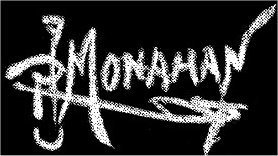
Monahan was one of New York's most prolific illustrators. He created ads,
movie posters, commissioned art but the majority of his work was for the
"pulp" magazines of the day. His paintings were noted for composition,
design and use of colours -- stimulating images full of romance and adventure.
Sadly the work of P.J. Monahan and the other pulp artists of that time
have not received the recognition of their contemporary illustrators, whose
work appeared in art galleries and the "slick" magazines. Of particular
interest to followers of the works of Edgar Rice Burroughs are the artists
of who illustrated the pulp magazines in which most of ERB's stories
first appeared. Before seeing release in hard cover, Tarzan et al appeared
in the Argosy/All-Story/Cavalier and Munsey's magazines as
well as in Blue Book, Red Book, Amazing, Modern Mechanics & Invention,
Fantastic Adventures, Thrilling Adventure Stories, and even Liberty.
The best known illustrators for these magazines were P. J. Monahan, Modest
Stein, Clinton Pettee, Stockton Mulford, Pahl Stahr, and of course the
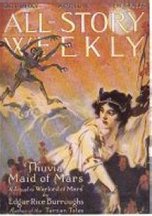
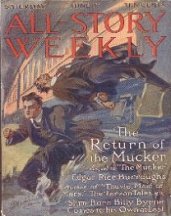
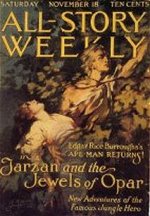
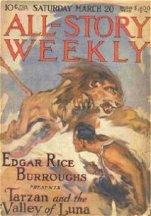
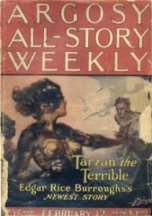
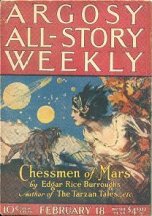
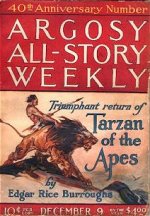
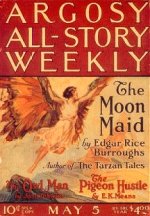
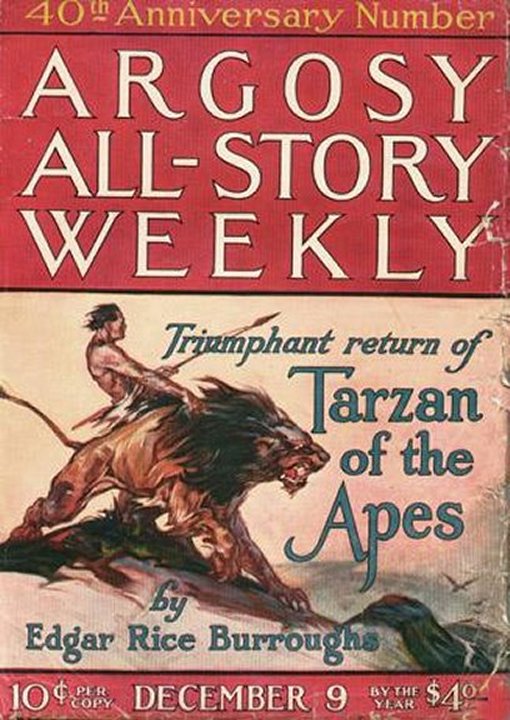
great J. Allen St. John. Between 1913 and 1923 P.J. Monahan painted
wonderful covers for 13 All-Storys that featured ERB stories.
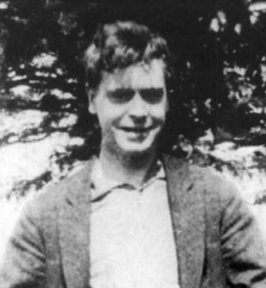
Patrick John Sullivan (Monahan) was born in Des Moine,
Iowa, on January 4, 1882. His parents, John and Mary, had immigrated from
County Cork, Ireland in the '70s via Boston to a homestead in the Des Moines
area. The Sullivans had three children, Patrick, Eugene and Anne. The only
two members of the Sullivan family to survive the flu epidemic of 1891
were Patrick and Eugene. The boys were taken in and raised by neighbours
Rose and Jim Monahan.
Patrick won a four-year art scholarship to Drake University
of Ministers where his artistic talent bloomed. This talent won him a first
prize at the St. Louis Exposition and the opportunity to further his art
studies in Europe, where he went on to win more awards and even painted
a full-figure painting of Pope Pius X. After graduation he worked as a
newspaper illustrator in Chicago and St. Louis.
On October 24, 1905, Patrick married Louise Cecelia Averill,
much against the wishes of her family, who were staunch Protestants who
objected to his Catholic and orphan background. After the birth of their
first child, Cecelia, they moved to New York where Patrick worked at illustrating
fashion catalogues. His reputation grew and soon he was painting covers
for Leslie's Weekly, The New Broadway Magazine, The Delineator,
and
Judge Magazine. In 1909 his work was featued with that of 16
other top artists to appear in the collection, "Judge Art Prints."
This led to work for higher class magazines and by 1911
he was doing interiors for The Ladies Home Journal, Cosmopolitan, Leslie's
Weekly, Pearson's Magazine, The Hearst Magazine and Hampton's.
He kept a small studio in New York in the Printers Craft Building, but
was now able to afford to move the family to a more upper class area in
New Jersey. By 1912 he was doing cover work for syndicated newspapers across
America, colour illustrations for New York World newspaper and he also
did the cover and eight interiors for his friend Jack London's book, Smoke
Bellew. He was invited to become a member in the Society of Illustrators
headed by Charles Dana Gibson (creator of the "Gibson Girl") and became
friends with artists such as James Montgomery Flagg, Norman Rockwell and
many other top artists of the day. Contracts with Street and Smith Publications
provided steady employment for titles such as: Air Trails, Western Story
Magazine, Detective Story Magazine, People's Magazine, etc. His imaginative
composition, design, use of colours and his stimulating images full of
romance and adventure were soon providing ideal illustrations for Munsey's
stable of adventure writers: Edgar Rice Burroughs, Rex Stout, H. Bedford
Jones, Frank L. Packard, J. Allen Dunn and George Allan England. Soon he
was producing colour cover paintings ($125 each) for the Munsey pulp magazines:
Munsey Magazine, Argosy, All-Story, Cavalier, and Railroad Man's Magazine.
In 1912, Robert H. Davis and Thomas Metcalf of The
All-Story Magazine published the first installment of an unknown writer's
first novel: Under the Moons of Mars in the February issue.
Response for this unique romantic science fiction tale was so overwhelming
that they followed it up in the October issue with another of the author's
highly imaginative tales -- Tarzan of the Apes -- with a
cover illustration by Clinton Pettee. This proved to be the start of a
new era of pulp fiction in which P. J. Monahan would play a major part.
Through all his work for society magazines and fashion
catalogues, Monahan had developed a special skill in the painting of women.
This talent would serve him well in the crafting of pulp adventure covers.
Monahan's colourful heroines exuded an air of innocence, femininity, and
romance that appealed to both sexes. He also did all his own lettering
-- and was often called upon to paint over the original magazine lettering
to adapt the paintings for use on dust jackets for hardcover book releases.
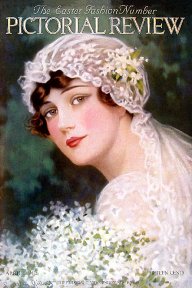
Besides this regular work he freelanced for even more
magazines -- Adventure, Woman's Magazine, Pictorial Review, The Designer,
Colliers -- and doing covers and interior illustrations for numerous
books. P.J. had many other interests and achievements besides magazine
and book illustrations.
OTHER INTERESTS AND ACHIEVEMENTS
-
helped in the war effort in 1917-18 by producing propaganda
materials and paintings for Liberty War Bond drives.
-
taught at the Art Students League in New York
-
formed his own agency to solicit art contracts
-
sang in a church choir
-
sang tenor at Carnegie Hall wihtthe Walter Damrosch Oratorium
-
invented and patented the Monahan rotary motor
-
invented an umbrella that could be folded into a purse or
satchel
-
an avid baseball player
-
managed a double-A baseball team called the West New York
Giants
-
painted movie posters and magazine ads for Fox studios using
images of the popular stars of the day: Tom Mix, Hoot Gibson, William S.
Hart Mary Pickford, Douglas Fairbanks, and D.W. Griffith's "A Birth of
a Nation."
-
painted some of the most beautiful models in New York --
many of whom went on to become famous on stage and screen and the Ziegfeld
Follies.
-
friend and fellow-artist Robert Ripley went on to gain fame
with his "Believe It or Not" syndicated feature.
-
unwound by hunting and fishing
-
collected books and art by other artists he admired
-
well-versed in astrology
-
appreciated music and collected records -- especially those
of Enrico Caruso
-
studied many subjects, including math, history, politics
-- and was a great admirer of Leonardo da Vinci
-
wrote an unpublished novel titled "The Land That Time Forgot"
-- apparently lost
-
bought a farm in Dover, NJ in 1924 and became a gentleman
farmer
-
father of eight children -- but never got over the loss of
first born Cecelia who died in 1910 after eating paints from her father's
artist palette
SOON TO APPEAR: FISK TIRE PAINTING STORY & MONAHAN
ROTARY ENGINE
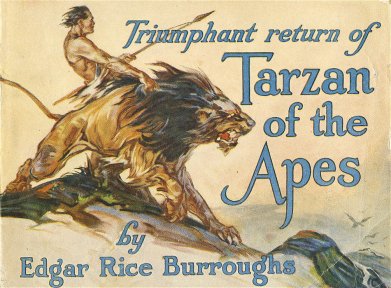
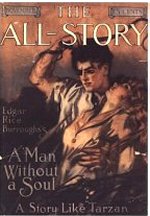
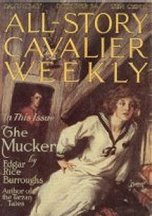
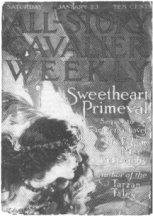
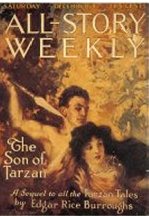
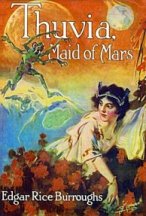
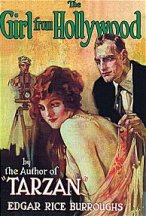
Between 1913 and 1923 -- at the request of Edgar Rice
Burroughs -- P.J. painted all 13 of the covers for the Argosy/All-Story
pulps featuring ERB stories. The first was for "A Man Without A Soul"
-- a painting for which he himself posed -- and the last was "The Moon
Maid." The model for most of the Tarzan covers was a P.J. regular,
Joe Murray -- in fact, Murray's image pre-dated the well-known Elmo Lincoln's
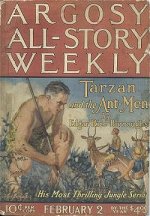
film appearance. Curiously, the last cover painting he was paid for ($150)
was that of "Tarzan and the Ant Men," but the cover was never used.
Surprisingly a different cover by Stockton Mulford appeared on the February
2, 1924 issue. It has been suggested that P.J.'s rendering of the ant men
with faces resembling those of real ants did not match the Burroughs description.
After choosing appropriate scenes to illustrate -- often
with the help of his wife Louise -- P.J. would make preliminary sketches
which he would submit to the Munsey art director for approval. He then
sketched the image onto a 24" x 36" canvas using brown tones of oil paint
and then took a day or two to finish the painting in full colour. P.J.
kept ownership of the canvases and after they were returned he stored most
of them in his NY or NJ studio. All of these paintings -- except for the
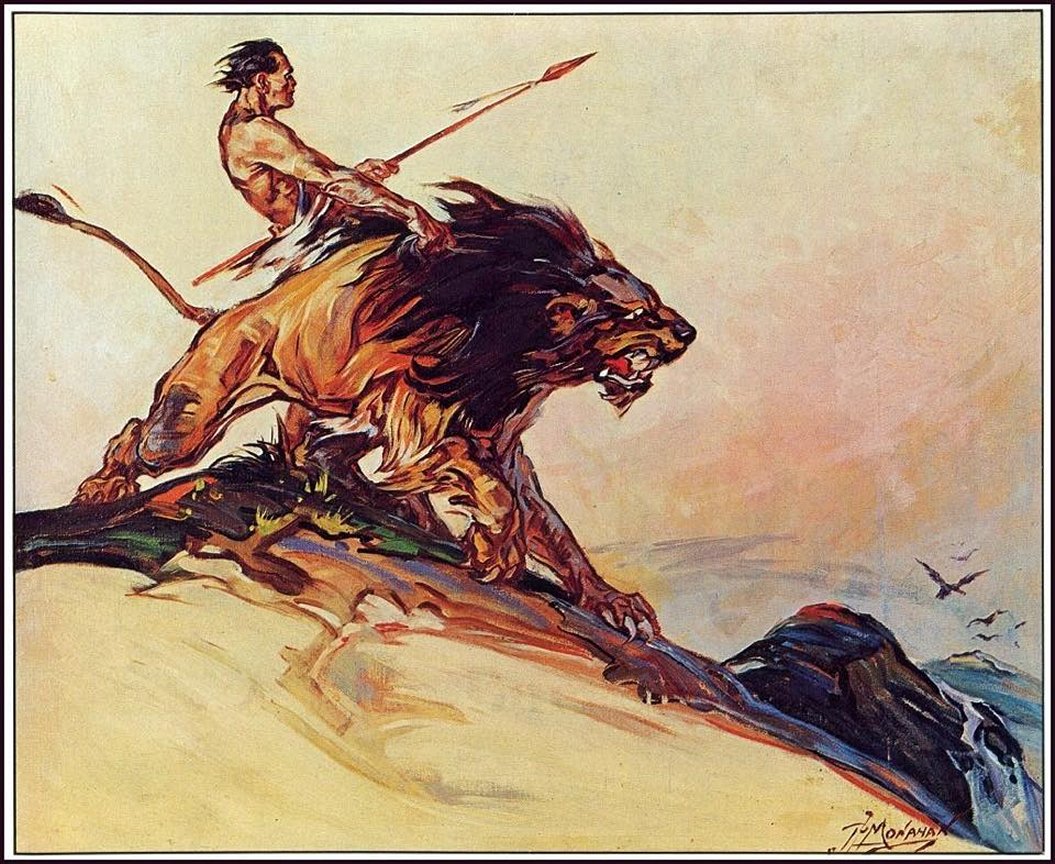
Tarzan and the Golden Lion painting that was purchased by
ERB -- were either sold or given to friends . . . or tragically lost in
a fire that demolished his New Jersey studio.
After leaving Munsey's in 1923 he continued to work for
Street and Smith, often turning out a cover a day for magazines such as:
Action Stories, People's Magazine, Complete Novel Magazine, Complete
Story Magazine, Love Stories and numerous others. The main impetus
for this demanding schedule seemed to be his determination to make good
the money lost by friends who had invested in his failed rotary engine
project. P.J.'s lack of business sense led to Louise stepping in to serve
as his business manager. Partly because of Louise's health problems they
bought a 32-acre farm in 1924 and eventually converted part of a three-storey
barn on the property into a studio.
P.J. left Street and Smith in 1926 and started work for
George T. Delacorte, Jr.'s Dell Publishing Co. -- doing increasingly boring
romantic cover and interior illustrations for Sweetheart Stories
and Cupid's Diary. He also did covers for Fiction House Publications'
Love Romances. In 1927, King Features hired him to produce a daily
newspaper strip adaptation for Shakespeare's classics: Romeo and Juliet,
Hamlet, The Merchant of Venice, Macbeth, and Taming of the Shrew --
as well as others such as Dickens' Pickwick Papers. By this time
some of his kids were helping with reading manuscripts for cover ideas,
as well as working as his inkers and models.
A series of tragedies hit the Monahans in 1928. The barn
and studio burned down, destroying 200 Monahan paintings, art supplies
and P.J.'s art and book collection. Soon after he was involved in a traffic
accident and the resulting head injury plagued him with severe headaches
which affected his work and creativity for the rest of his life.
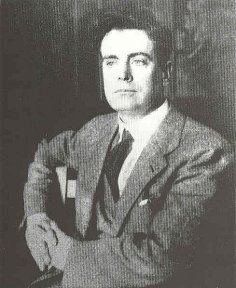
Patrick Monahan died of a massive cerebral hemorrhage
at age 49 on November 1, 1931. He is buried in St. Mary's Cemetery at Wharton,
New Jersey. Louise never remarried and raised their eight children on their
farm. She died at age 84 on June 12, 1968 and was buried alongside her
husband.