.
CONTENTS
Reference: World of Kong: A Natural
History of Skull Island
Is it really possible?
Islands,
Continents and the Evolution Superhighway
Stop the
World, I want to Get Off....
Welcome to Kong Island
The Colonization
of Kong Island
From
Kong Island to Skull Island, Immigrant Species?
A
Digression on Flying Rodents and Aerial Anomalies
The Kongs Come to
Kong Island
The
Mighty King Kong, Eighth Wonder of the World
WEB REFS

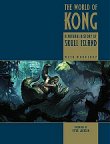
Note: This essay is a tribute
to the book, “World of Kong: A Natural History of Skull Island” by Weta
Workshop, published 2005 by Pocket Books, which in turn is based upon and
derived from both the original King Kong and Son of Kong movies of the
1930s, and upon Peter Jackson’s King Kong remake of 2005. Each
is an extraordinary work in and of itself. This essay is devoted
to exploring and extending certain of the ideas contained in these remarkable
works.
Is
it really possible?
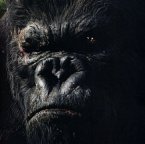
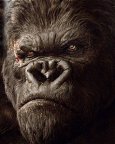
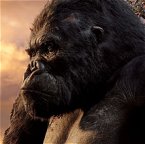
“At the center of Skull
Island, living in a cavernous lair suspended high above the jungle, and
lord of all he surveyed was Kong. The last of his kind, Kong
was a huge and powerful ape, far larger than any hitherto known species.
He was the king of his world, a nightmarish force to the Skull Islanders,
and an anomaly to science. Kong became the icon for the wonder and
power of nature in his time.” (page 211)
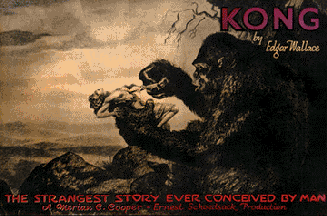
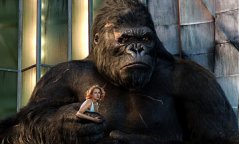
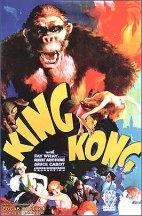
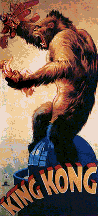
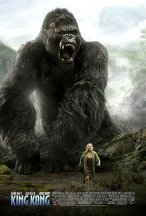
The size of King Kong has varied from one movie to the next.
We’ll ignore the Toho movies, King Kong vs Godzilla and King Kong Escapes,
blot out the DeLaurentis Kong movies, try not to think about various cartoons.
What we’re left with is the original King Kong, its sequel,
Son of Kong, the Peter Jackson remake, and the Weta Workshop book, ‘The
World of King Kong: A Natural History of Skull Island.” These
things give us estimates of anywhere between 25 feet and 40 feet standing
erect.
That’s a big monkey. Is it really possible for a
mammal to get that big?
Dinosaurs certainly got even larger, the sauropods would
have made King Kong look like a midget, and several other lines, the Hadrosaurs
and Iguanadonts, the Carnosaurs and the Ceratopsians produced individuals
which, by weight at least, were in Kong’s class.
What about mammals? Well, we’re looking at
it the wrong way. Most animals don’t stand upright.
So if we adjust Kong’s posture to a more typical quadruped, he’s probably
standing about fifteen feet tall at the shoulder. Definitely,
that’s pretty huge. We can estimate a size range of somewhere
between seven and fifteen tons.
On the other hand, this puts him in the size class of
a great many large mammals. The Unitatheres, the Brontotheres,
the Pyrotheres, Giant Sloths, Elephants, Mammoths, Mastodons, Hippos, Rhinos
and even Camels produced species who were in the size range of several
tons. So Kong is well within (or at the outer edges) of the
size ranges of several lines of dinosaurs and mammals.
Even if we’re off, and his shoulder height is 18 to 25
feet, he’s probably in the vicinity of twenty-five to thirty tons.
That would put Kong beyond the range of most dinosaur species, but he’s
still smaller than the sauropods. And he’s still within
the size range of Indricotherium (aka Baluchitherium), an offshoot of the
rhinoceros and the largest mammal ever to have lived. So we know
that mammals can get that big.
Of course, Indricotherium was a highly specialized herbivore
who spent a lot of time eating. He was heavily adapted for
a life spent consuming large quantities of roughage, with highly developed
grinding and chewing teeth, heavy jaws, a longish neck and head, and a
very sophisticated digestive system designed to break down the heavy cellulose.
All the really big mammals have been very sophisticated herbivores.
Look at a cows multiple stomachs and cud chewing. Consider
the teeth and the versatile trunk of the elephant. Some creatures
have symbiotic bacteria in their stomache to help them with the job.
The really big mammals are all serious specialists.
In contrast, it appears that Kong lacked many of these
adaptations. Kong had a heavy jaw, but this was clearly more
suited to applying great pressure than chewing continuously.
His teeth sported huge fighting canines, which probably got in the way
of chewing, and the rest of his teeth were probably not extremely well
adapted. Primates, by and large, are not serious specialists
in consuming roughage, and Kong looks like he was following the usual model.
For the most part, Primates are herbivores of course.
But they’re usually a specialized sort of herbivores: They
are frugivores. For most primates, including monkeys and apes,
the principal diet is fruits, berries and nuts. For some, that
is the exclusive diet. Some monkeys eat leafy greens, as do
chimps and gorillas. Gorillas are noteable for primarily eating greens,
and because they consume so much roughage, they’re known for their pot
bellies.
The trouble with Gorillas is that they’re not particularly
good leafy green eaters. They have to search out the tenderest young
shoots, the most suculent plants. Unlike an ox which simply grabs
a mouthful and chews, the Gorillas are careful feeders, taking only a fraction
of what an Ox can. Because of this, they eat more slowly and carefully,
and have to spend more energy doing it.
Gorillas simply lack the adaptations that would allow
them to eat greens as indiscriminately as an Ox. Thus, an Ox
is capable of eating far more in a given territory than a Gorilla.
The result is that an Ox can grow much larger and faster than a Gorilla,
it can eat more quickly, and it can pack more Oxen into a given space.
Essentially, it outcompetes the Gorilla. Stuck in the same
field, the Ox will eat rings around the Gorilla. So, the Gorillas
retreat deep into the forest where they can quietly see to their diets
without too much aggravation.
Its this dietary handicap that limits the size of the
Gorilla. And the Gorilla has trouble transcending this handicap
because of the competition. Conceivably, a Gorilla could move
into areas where there are more greens it likes, but there are too many
animals eating all sorts of greens, and they eat the Gorillas food along
with everything else, faster than the Gorilla can. So that’s a kind
of cap on the ability to grow.
Another limit on growth is predators. In their
own environment, including in a troop, Gorillas are pretty safe.
But when they move outside of it, they take risks. Leopards,
Lions, Tigers, Hyeanas and Crocodiles are all pretty good at taking down
big game, including creatures bigger than Gorillas. If
predators can take down a water buffalo, even a bull gorilla is at risk.
Worse, Gorillas grow slowly and have vulnerable young. So even
when the bull gorilla isn’t too worried, predators may eat all the offspring,
and that’s just bad news.
So the bottom line is that Gorillas wind up confined to
their habitats, and to the limitations of the food supply and lifestyles
of their habitats. They’re at a ceiling where it is hard to
get any bigger.
Can we get bigger primates than Gorillas?
Not these days. An adult bull Gorilla can weigh in at 250 lbs, or
75 pounds heavier than an average human. The biggest weighed in at
450 lbs, though that might involve some obesity. Orangs also
can get up around 200 lbs. Humans of course, can get around 200 pounds
plus, and if you look at obesity, we’ve produced specimens in the 600 to
1000 pound range (but they weren’t happy or long lived specimens).
Actually, human ranges of size offer hints for Gorillas.
The tallest human was Robert Wadlow, who stood nine feet tall and weighed
perhaps five hundred pounds. The most obese human went 1000
lbs. We can assume that these are the upper structural limits
of the human skeleton.
But compare the human skeleton with the skeleton of a
gorilla, and we immediately notice that the bones are vastly heavier and
more robust. A gorilla is a lot stronger than human being.
This suggests that in human terms, Gorillas are vastly over-engineered
for their size. They’ve got the sort of heavy bone structure
that could support a much bigger and heavier animal.
There’s an interesting thought there. Are
modern Gorillas pygmies? Were their ancestors giants, and they’ve
simply inherited the massive heavy bones that those giants needed?
Beats me. The fossil record doesn’t show giant Gorillas.
The fossil record does show a famous giant ape called
Gigantopithecus. Gigantopithecus wasn’t a gorilla, rather,
it was a separate species. Estimates of how big he got vary,
ranging from eight to ten feet in height, to 600 to 1500 pounds weight.
There are only a few fragmentary bones and teeth for Gigantopithecus, nothing
like a complete skeleton, so what he looked like and how he lived is speculative.
It appears that Gigantopithecus may have resembled a heavy
jawed cross between a Gorilla and an Orangutang. He was a strictly
ground dwelling animal, and probably walked on his knuckles, like a gorilla,
although there are suggestions he may have gotten around on his fingers
like a chimp, or on the sides of his hands like a sloth. Unlike
a Gorillas mighty canines, Gigantipithecus teeth seemed to be basically
flat, and close examination shows that he was chewing a lot of bamboo.
In habits and lifestyle, he was probably a lot like the Giant Panda, a
slow moving giant, grazing through bamboo forests. He appears
to have been confined to Asia, though he had a fair range.
Gigantopithecus was nowhere near Kong’s size.
He was so far from it, that the distinction between him and a Gorilla is
hardly significant. And he probably wasn’t the ancestor of King Kong’s
species. Rather, he seems to have been a side issue, one of
those pathways that goes off in its own direction and leaves the mainstream.
King Kong himself strongly resembled a Gorilla, and its
likely that his ancestors came from some main line of ape evolution, rather
than a specialized side branch.
But, we’re getting away from ourselves here.
Given the inherent features of the primate skeleton, looking at the bones
of a Gorilla or Gigantopithecus, could it produce a creature as big as
Kong?
I would argue yes. To support this, I’d point
out an even more unlikely race of giants: The sloths.
Sloths, by anyones estimation, were probably poor candidates to produce
elephant sized monsters. They were edentates, a fairly primitive,
mostly toothless bunch of tree climbers. Sloths were so specialized
as slow moving tree climbers that they developed large hooked climbing
claws and their wrists and ankles turned permanently inwards.
Because of this, sloths when they became giant ground walkers, had to walk
on the sides of their feet. So, originally tree dwellers, bad
teeth, bad feet, slow moving and poor design. You wouldn’t
think Sloths would get very far or amount to very much.
But somehow they did it South America, and not only that,
they were successful enough to move up through North America and compete
successfully head to head with Mastodons, Mammoths, Rhinoceri and Brontotheres.
The biggest Sloth, Megatherium weighed as much as an elephant and could
rear up to a height of as much as eighteen feet. And he was
still a feeb with bad teeth walking around on the sides of his feet.
So, if the Sloths could get this far, well, it doesn’t
seem impossible that the Apes could match or even beat that record.
For one thing, the apes have better teeth and they’re not hobbling on the
sides of their feet.
Indeed, if we look at King Kong, he doesn’t seem so unrealistic
in his size. Look at the thickness of his arms and legs.
Big animals have thick arms and legs because they need thick bones to sustain
their weight. Elephants have legs like pillars. But interestingly,
an elephant can jump but only once. If they were to jump, their weight
when they hit the ground, would cause the bones of their legs to shatter.
On the other hand, Kongs arms and legs look to be more than twice as thick
as the limbs of mammoths or even Indricotherium. Part of that,
obviously, is that it has to be. Elephants and Indricotheriums basically
used their legs as pillars, bearing their weight straight down, and lifting
carefully to take steps. Kong uses his limbs, particularly
his arms, much more flexibly. Instead of simply being stiff pillars,
Kongs arms and legs bend and flex to fight and climb. So they
have to be much more muscular and much thicker. With all that,
however, the thickness of Kongs limbs and body seem to be well within the
proportions he needs to carry the weight he’s got. So, on the surface,
compared to other giant mammals, Kong looks like he’s viable.
So anyway, assuming Primates could do it, obviously they
haven’t, outside of Kong’s species. We don’t have giant primates
or even Kong’s species in the fossil record. So where does
he come from? How does he come about? How did his species
manage it?
How did the sloths manage it? Part of their
secret is that the Sloths didn’t emerge in the biological mainstream of
connected continents which were Africa, Asia, Europe and North America.
Rather, the sloths developed in isolation on an Island continent where
there was less competition and more opportunities.
This then, is likely the secret of the giant Kong apes.
They’re an Island species.
Islands,
Continents and the Evolution Superhighway
A word or two about Islands.
Most life on Earth is connected, and I mean that in a
very practical way. Asia is physically joined to Europe.
Africa connects to both Asia and Europe through land bridges.
North America is technically separated right now, but has been connected
frequently off and on through land bridges.
What this means is that plant and animal species can move
back and forth. Nowadays, this doesn’t seem terribly obvious.
But there was a time when elephant species, mammoths and mastodons, roamed
through four continents. Now they’re restricted to two species in
corners of two continents.
Apes were to be found throughout Africa, and through India
and China. Again, Apes are confined to the Orangutangs of Southeast
Asia and the Gorillas and Chimps of central Africa, with vast ape-empty
territory in between. Once upon a time, apes species roamed
in those areas.
This ‘old world’ amounts to almost 40 million square miles.
It’s the largest continuous laboratory of life on Earth, and because of
that volume, adaptation proceeds faster but rather more uniformly.
All life, all plant species, all animal species in these vast territories
are part of the same interconnecting tapestry.
Which brings us to Islands. Islands are the
places out of the loop, where the rules are different. Islands are
where evolution goes off in different directions.
Historically, there have been three big Island continents.
Australia, which still possesses a unique collection of marsupial and monotreme
life forms, from Kangaroos to Duck billed platypuses, marsupial lions and
wolves, and giant monitor lizards. South America, which possessed
its own remarkable assortment of flora and fauna right up until it connected
with North America. During its time, South America produced
its own strain of monkeys, created saber toothed tigers out of marsupials,
and imitation elephants, horses and giraffes. The final antarctic
continent was Antarctica, which has, unfortunately, abandoned most flora
and fauna, except for a few penguins, for a exciting new career opportunities
as an ice cap.
There are also the large Islands of Madagascar, with its
Elephant Birds and Lemurs, and New Zealand, with its Moas and Kiwis, which
have been separated from the mainland for fifty or sixty million years,
or were never part of a mainland, and each has produced a remarkable assortment
of unique species.
There have probably been other similarly unique ecological
Islands, Iceland perhaps, or Cuba and the Greater Antilles. However,
human discovery and settlement have wiped away much of their potential
uniqueness.
Finally, there are actual bitty islands, like Mauritius
and Reunion in the Indian Ocean, Bermuda and St. Helena in the Atlantic,
and Hawaii and the Galapagos in the Pacific, which produce their own distinctive
bits of life.
Of course, we’re operating right now on a fairly narrow
view of Islands. Anything that is geographically or climactically
isolated, so that there are barriers to getting in or out, constitutes
an Island in ecological terms. The Sahara desert for instance,
is a sort of Island with unique climactic and geographical conditions,
the life that lives in it isn’t able to live very well outside of it, and
so it goes its own way. The Sahara desert, or a mountain range
for that matter, forms a barrier between two green and fertile areas, making
them effectively Islands isolated from each other. The continents
are full of such ‘islands’ or ‘zones’ which act as shorter term biological
laboratories for developing and refining species. But these
are relatively short term things in terms of the bigger picture, and they’re
far more permeable than our stereotypical Islands.
The trick is that the Islands, large and small, are dealt
a different deck of cards. They don’t have the full panoply
of species which the supercontinent has. So, their evolutionary
processes make do with a different set of cards. Australia
separated when Marsupials were the only game and before modern mammals
had evolved, thus Australia’s life was marsupial based. South America
separated a little later, and developed its species based on marsupials
and early placental mammals. Madagascar separated from Africa before
prosimians had advanced to monkeys, and so developed Lemurs.
All New Zealand had to work with was birds, so it made things out of flightless
birds.
In the big supercontinent of course, these things wouldn’t
have worked. Marsupials, early mammals, lemurs and flightless
birds were roadkill on the evolutionary superhighway. But off in
their hidden islands, off the beaten path, they had the freedom from competition
to go and do interesting things and produce their own editions. In
some cases, their little special editions were actually competitive - from
South America for example, Armadillos, Glyptodonts, Opossums and Ground
Sloths found themselves surviving the invasion from the North, and even
expanding their range.
Of course, life isn’t independently invented.
All life on Earth can be traced back to increasingly remote common ancestors.
So all of the Island continents and Islands were once connected to the
evolutionary superhighway at some point, either through having their land
masses physically joined or connected by land bridges, or by migrations
of that life out to empty, unconnected lands.
It’s the migrations that I want to focus on.
Stop
the World, I want to Get Off....
Let’s stop and think about a place like the Galapagos
or New Zealand. Its not part of a continental mass.
It was never part of a continental mass. Instead, its just
some nice fertile real estate, sitting around unoccupied, waiting for tenants.
So where do the tenants come from? Well, its
not as if these places are going to spontaneously germinate their own life.
Instead, life comes in from abroad.
In the case of New Zealand, birds move in and get comfortable.
Since there’s lots of food and no predators, birds don’t need to be light
trim flyers. Some start gaining weight, getting bigger and
lose the power of flight. Next thing you know, you’ve got Moas standing
fifteen feet tall.
In the Galapagos, Iguanas move in. There’s lots
of plants to eat, no advanced mammals to eat them first, no predators to
make Iguanas life tough. So the next thing you know, you’ve
got six foot long iguanas, swimming around, munching on seaweed and cactus.
So, how did they get there in the first place.
Well, the current theory is that they ‘rafted’.
Basically, trees or driftwood, floating pieces of vegetation
get washed off the shores of continents by storms or floods or tsunami.
These pieces of wood and debris wind up floating around on the ocean.
Most of it sinks or winds up back on continent shorelines.
Some of it winds up on the beaches of islands.
Now, once in a while, these piece of flotsam and jetsam
are occupied or become occupied when they get floated out to sea.
Usually, its pretty small life. Insects and such. Sometimes
though, it’s a bit larger creatures. Small turtles, iguanas,
lizards, the occasional monkey. Sometimes this flotsam and
jetsam gets used as a convenient resting place by birds or bats who have
poor sense of direction.
Some of them are simply blown by storms. I
remember a few years ago, a wild Pink Flamingo was discovered in marshes
in New Brunswick. The poor bird had been picked up by hurricane winds
and literally blown thousands of miles all the way from Florida.
In short, nature sometimes can pick up and cast its children vast distances.
Thus, we get Monkeys rafting over to South America, Lemurs
rafting over to Madagascar, little tortoises rafting across the Indian
ocean, lizards winding up in the Galapagos. And once there,
finding virgin territory and new opportunities, they start to evolve and
radiate into remarkable new forms.
Of course, it’s a long shot for creatures to raft over.
They’re essentially trapped on some piece of floating wood drifting aimlessly
on the currents or wind. Eventually, most likely, they dehydrate
or starve to death. Or they’re devoured by seagoing predators.
Or their piece of wood becomes water logged and sinks. There
is no inevitable rule that says that their raft has to take them to solid
land anywhere, and certainly there is no rule that says they have to make
it alive. Even where an animal comes within sight of land, they might
still not make it to shore.
So, colonization is usually done from the mainlands closest.
The longer you float, the better the odds that you won’t wind up anywhere,
or that you’ll be too starved or dessicated to make it to shore alive,
or survive very long after you get there.
Birds have an easier time of it, they can fly and look
for pieces of debris to land on. They can go up and look
around from a far greater altitude, and if they see something they can
strike for it. Thus, most of the most remote islands, like
New Zealand, Mauritius and Reunion are colonized by birds.
Land animals are in a tough spot, they can’t leapfrog
to another floating piece of debris, they can’t spot land as easily, and
if they do spot it, they have to swim for it, which is a lot more difficult.
The advantage goes to small reptiles which are able to survive privations
more easily. Small mammals are also a better bet, since they need
less food and water and might hold out a little longer. The paws
and claws of small animals are far better suited to hanging on and moving
around on a piece of debris.
Simple math tells us that there will be all kinds of debris
being blown into the sea, but small pieces will greatly outnumber large
pieces, and are more likely to travel more quickly.
Thus, if we look around, we find Iguanas and Tortoises
making it out to the Galapagos, together with various species of finches.
Birds and Reptiles, but not even small mammals. It’s a long
trip. In South America, we found monkeys rafting over from
Africa after the continents separated, some 50 million years ago.
The monkeys had some advantages - they were very good at hanging on with
hands and feet, and the gulf between Africa and South America was much
smaller than it is now. But that gulf kept widening, and even after
a few million years, not even the monkeys could make the trip
On remote islands in the Indian Ocean, we found giant
tortoises. Largely because their ancestors, tiny tortoises,
were among the only creatures who made it, and because almost nothing else
could survive the privations of their Islands.
On Mauritious and Reunion, the birds made it, producing
the Dodo. On New Zealand, the birds made it again, producing the
Moas. In Madagascar lemurs made it over from Africa and diversified,
while birds produced the Aeropornis or Elephant-birds.
We’ve said small animals, reptiles and mammals can occupy
large and small pieces of debris. Larger animals can only occupy
large pieces of debris. And of course, not only are there much
fewer ‘rafts’ for larger animals, but the rafts move more slowly,
the large creatures are more vulnerable to the environment, and they have
far more difficulty holding on. A mountain goat or a deer may
be swift and agile in their environment, but they’re no great shakes at
hanging onto a log floating in the ocean. A leopard adapted
for tree climbing might be able to do it. A wolf or a lion, more
used to open country, probably couldn’t.
It is incredibly rare for larger animals to make the trip
to islands. Usually, when we see large animals on an Island,
they’ve either evolved there - as with the Elephant Birds, Moas, Giant
Tortoises, Galapagos Iguanas, etc. Or they’ve crossed over
on Land Bridges which have now sunk which is how Kangaroos wound up in
New Guineau, or Orangutangs in Indonesia, or the Tasmanian Wolf ended up
in Tasmania.
Off the top of my head, I can only think of three examples
of large or medium sized animals who made it out to isolated Islands on
their own. Two of them are in Madagascar, the local crocodile
species, and a pygmy hippopotamus. Both of these are semi-aquatic
creatures, adapted to surviving in the water and decent swimmers.
Not good enough swimmers to normally make the trip from Africa to Madagascar.
But we could imagine a tropical storm or typhoon, or tsunami sweeping their
ancestors out there.
The only other example was a now extinct species of ground
sloth that made it to Cuba. The sloths were not good swimmers,
let’s admit that right now. But they had a few things going for them.
Cuba was relatively close to Florida. The Ground sloths, particularly
the smaller ones had the claws and gripping limbs that would enable them
to hang onto a log better than practically any other large or medium sized
animal without actual hands, and they were vegetarians, so if they were
hanging onto an uprooted tree, they could survive for a time on the leaves
of that tree. A leopard couldn’t hang on as well, nor could
it eat the vegetable matter it was clinging to. So, miraculously,
sloths made it to Cuba.
Of course, getting there is only half the fun.
Even if an animal on a ‘raft’ makes it to a new land, and the odds are
pretty much hundreds or thousands to one, it still has to find a home in
its new land. That is, it has to find an environment or habitat enough
like its old one that it can survive. There’s no guarantee of that.
Plenty of birds and lizards probably ended up on the islands of the giant
Indian Ocean tortoises and starved to death. The more specialized
the diet, the more specialized the habitat needs, the worse your chances.
And even if the animal wins the lottery and by some fluke,
makes it to land, and manages to survive in that land.... What’s
it going to do? How does it reproduce? Unless its
already pregnant, its going to need a mate. In particular,
its going to need a mate of the same species and opposite sex, who has
managed to go on the same journey, within the breeding lifetime of our
hero, and who has wound up in roughly the same neighborhood.
That pink flamingo I mentioned, who got blown all the
way to Canada... He was due for a short and fairly unhappy life.
He wasn’t going to be finding a girlfriend anywhere, and even if he managed
to outlast the predators who were willing to experiment with new menu,
the Canadian winter was going to get him. Luckily, he was unique
and strange enough to the area that people spotted him and decided to send
him home.
Which means that our long odds have to be squared or cubed.
When we’re talking about Island Colonization, very few species manage to
gain a foothold. New visitors are most likely to be of the
same species that have been able to make the journey. Thus,
finches, iguanas and tortoises made it to the Galapagos, but the trip was
just too onerous for rats. Over a few hundreds of thousands
of years, you’ll get more iguanas and tortoises and even the occasional
finch, but the rats don’t make it. For a creature to survive
the trip, find a new home and find a mate is a complete fluke, its statistically
inevitable, perhaps, that someone is going to make it there. But
it is not going to happen often.
Sloths might make it to Cuba, but they surely were not
going to make it all the way out to remote Bermuda. Cuba was
close enough that you could see the occasional chance, even a regular chance.
But the farther you were drifting randomly in the ocean, the worse your
chances got. Even if one, by some fluke did, the odds of a Ms Sloth
making it to Bermuda before Mr. Sloth died of old age were astronomical.
Thus, the new colonists are seldom challenged by interlopers.
Your new country has to have other castaways like yourself, but the odds
are that if there are other castaways surviving, they’ll be creatures similar
to yourself. Over time, New Zealand probably got a few several
visits or castaways, but they would all be from the same species of extremely
hardy birds. Nothing else made the trip, or at least, didn’t make
the trip often enough to found a breeding population. So, the colonizing
species generally has the place to themselves. Instead, they spread,
multiply, and diversify.
Welcome
to Kong Island
“The origin of Kong’s species
is as obscure as Skull Island itself. But what seems certain is that
his kind arrived no earlier than a few thousand years ago and were not
native to the island.” (page 211)
So, lets get back to the Kongs. What we probably
have here is a repeat of the Sloths in Cuba. Apes have hands,
gripping feet, and the sort of skeletal and muscle structure that would
allow them to hang on to a washed away tree for dear life and not let go.
Like the Sloths, they’re vegetarians, so in a pinch, they’ll be eating
the leaves.
It’s just remotely possible that an ape, or that apes,
could survive the journey of castaways. Of course, that’s not
an unlimited playing card.
The original Kong Apes were probably not giants.
They were likely no larger than gorillas or chimps, and perhaps were close
relatives of the gorillas. Occasional tree climbers, mostly forest
dwellers. They may have been juveniles of their species.
Humans, by the way, are also good tree clingers.
After the Indonesian Tsunami of 2004, one survivor was found way out in
the Indian Ocean, clinging to a tree that had been swept from the shoreline.
This gives us a window into the origin of the Kong.
We can imagine a similar tsunami hundreds of thousands, or millions of
years ago, sweeping clear shorelines occupied by troops of apes, uprooting
entire forests of trees and carrying a handful of survivors out to sea,
some of whom, pregnant females, juveniles (juveniles would be more likely
to head for trees in the event of a disaster), perhaps clinging to the
same trees, a few surviving the trip to their new homeland.
Kong Island might well have been colonized in a single
incident. The Kongs may well have derived from a single breeding
pair, or an extremely small number of individuals. Apes are
highly social, and band together, so there is a decent chance that a storm
or tsunami that sweeps one out would sweep others.
The Island that they were cast away too must never have
been geologically connected to the mainland or to other islands.
Most of the Indonesian Islands were once connected to each other, and thus
share flora and fauna. New Guinea was never connected to the
Indonesian archipelago, though it is visibly adjacent. Rather, it
was connected to Australia. Our hypothetical Kong Island hasn’t
been connected to the Asian mainland, Australia or the Indonesian archipelago.
That suggests its sitting on a geologically distinct plate.
Why? Because if it was occupied with mainland flora
and fauna, imported from a land bridge, there would have been predators
and competing herbivores, and the apes wouldn’t have had the opportunity
to grow into giants. But more on that later...
We can also assume that the Island, although distinct
for most of its history, could not have been too far from the nearest Asian
or Indonesian land. Why? Because the farther away
the more difficult and less likely it would have been to have rafted.
Madagascar and South America were close enough to Africa, fifty and sixty
million years ago for Lemurs and New World Monkeys to raft over.
Madagascar is still pretty close, but more advanced monkeys and apes have
never been able to make the trip. Cuba was pretty damned close to
allow Sloths to make the trip. So, at best, Kong Island is
probably no more than 200 miles from some mainland, and quite possibly
closer. On the other hand, it can’t be too close, so perhaps
no closer than 50 miles.
Water levels can change of course. They’ve
gone up, and where once Indonesia was a solid mass connecting to Asia,
it’s a bunch of Islands. So its shorelines are undoubtedly dozens
upon dozens of miles from where they were originally. But you’re
still not going to change things too radically. Your maximum distance,
even assuming that seas have risen and shorelines receded, is no more than
a few hundred miles. Its likely that with the increase in sea
levels, the sort of rafting that allowed Kongs or other animals to make
it to Kong Island is now impossible, or dramatically less likely.
And we can assume that the Kong Island was fairly hefty.
How large? Therein lies the question. Madagascar is quite
large, but the largest creature it ever produced was the Aeropornis at
a mere 10 feet and thousand pounds, and some lemurs that got up around
450 pounds. New Zealand is pretty big, though not quite so
large, and it produced the Moa, which was only several hundred pounds though
fifteen feet tall. The dragons of Komodo, the tortoises of the Indian
ocean, the Iguanas of Galapagos are only a few feet long.
Generally, Islands have limited food supplies.
So the tendency is that small animals can get larger to take advantage
of a food supply without competition, but large animals get smaller in
order to maximize their opportunities. Thus, Madagascar and
New Zealand took pigeons and made giant birds out of them. But Sicily
took an elephant and reduced it to the size of a dog, Wrangel Island’s
mammoths were smaller than ponies, Flores hominids became hobbits and Madagascar’s
hippos became pygmies.
If we go by the example of Madagascar and New Zealand,
maximum sizes for Islands their size seem to be 500 to 1000 pounds.
So perhaps our Kong Apes were not destined to grow very large.
But let’s think about it a little more. One of the
things with both Madagascar and New Zealand is that their giants started
off from the size of pigeons. The ancestral creatures to the
giant birds and lemurs probably weighed no more than a pound.
So these creatures expanded some 500 fold. To grow a one pound
creature to a 500 pound monster, you need a lot of extreme and specialized
adaptations, its not easy, there are inbuilt limits.
So perhaps what the Moa and Giant Lemur and Elephant Birds were running
up against were not the limits of their environment but the limits of their
own biology?
Lets go take another look at Islands and the maximum sizes
that they can carry. Sri Lanka supports a population of Asian
Elephants, who are Elephant sized, thank you very much. I believe
that Asian Elephants are also to be found on Indonesian Islands like Java,
Sumatra, Borneo, etc.
The thing is that a continent is big, but its not the
size of a habitat. African elephants are big, but they’re not
scrounging around the whole length and breadth of a continent. Their
habitat is appreciably smaller. Sometimes fairly large animals
in Africa or Asia scrounge around in fairly small habitats.
So, if you’ve got a reasonable sized Island, the next question you’ve got
is how much habitat it has. Sri Lanka had lots of good habitat
for Asian elephants, Sicily had really bad country for elephants, not much
good habitat. So, you could conceivably have an Island with
a rich fairly uniform habitat that could support a population of large
beasts.
Of course, there are certain minimums. Something
the size of a Kong or an Asian Elephant is going to need a certain volume
of green stuff each day to survive. A population of them are
going to have a very clear minimum daily requirement. To sustain
that minimum daily requirement, you need a lot of plants. In
fact, you need so many plants that the amount eaten each day is a tiny
fraction of the green, say 1000th, because the plants have to keep reproducing
and maintaining themselves. If your population of Kongs ate
only 100th of the available greenery, well, after four months, they’d have
starved to death. If they ate only one 360th of the available greenery,
then, after a year, they’d have eaten everything they started out with,
and they would be left eating only the stuff that was growing in the last
years. A few months later, that’s gone, and they’re starving again.
So what this means is that you can calculate fairly exactly how much environment
or habitat is needed to support a population of Kongs. Something
the size of Mauritius or the Galapagos won’t cut it. Ideally,
we might want to look at something Madagascar or New Zealand, or Java or
Sumatra, sized, but that might not be in the cards. I don’t
think we should be looking at anything smaller than Sri Lanka or thereabouts.
So, we’re developing our profile of Kong Island.
Some place say a hundred to four hundred miles off the coast of Indonesia,
separated by empty ocean, no intermediate islands, formed on a separate
continental shelf, with no geological connection to either the mainland
or Indonesia. It is or was a tropical Island with a fairly
uniform habitat, probably rain forest jungle, and its about the size of
Sri Lanka.
I say ‘was’ because obviously, Kong Island isn’t around
any more. I’m pretty sure that someone in Carl Denham’s universe
would have noticed an Island filled with giant apes. Particularly
since this Island was also home to an advanced human civilization that
probably had contact with other Southeast Asian cultures.
According to Weta Workshop, Skull Island was sinking and
had vanished by 1948. Skull Island was the product of the Indo-Australian
and Eurasian tectonic plates sliding against each other. However,
Skull Island or the land mass of which Skull Island was the last fragment
of a land mass that had existed since the Cretaceous era. The
closer truth is that Skull Island probably represented the remains of a
small continental plate which was being submerged between the junctures.
Kong Island was probably an aspect of the same plate which
had been forced up. It is not clear if Kong Island had ever
been an above sea part of the Skull Island plate, or whether it had been
elevated for the first time by tectonic forces. However, it
was new and uninhabited virgin territory, undespoiled by the voracious
Skull Island life forms. It was as pristine and open to new
life as New Zealand had been. So if it was not actually new
land, then it had been previously submerged and re-emerged.
As a leading edge of the deteriorating Skull Island plate,
it existed for only a few millions of years before finally re-submerging
some two thousand years ago. Its destruction heralded
the eventual end for the Skull Island remnant.
The
Colonization of Kong Island
What else is living on the Island? Even though
the Island was probably geologically related to Skull Island, it was clear
of dinosaurs and other Skull Island fauna. Otherwise, the Kongs
would have had no opportunity to evolve. They needed a pristine landscape.
Likewise, it would have been equally clear of mainland fauna.
Indeed, its likely that Kong Island lay between Skull
Island and the mainland. It’s also likely that Kong Island was far
closer to the mainland than it was to Skull Island. Obviously, Kong
and perhaps other species indicate to us that its fauna originated from
the mainland, rather from the more aggressive Skull Island population.
So what was the life on Kong Island? Lots
of vegetation. It’s a lot easier for plants to get to Kong Island.
They or their seeds can wash up on shores, be blown on the wind, or carried
and excreted in the guts of birds.
Many of the plants on Kong Island would have travelled
as seeds in the digestive tracts of birds. To persuade birds
to eat them, they would have to be fruits or nuts. So its likely
that Kong Island has a much higher proportion of fruit and net trees, of
berries and similar plants than on the mainland. So the
energy and food value of the greenery on Kong Island is much higher than
on the mainland.
Its not easy for plants either though. So what you’ll
find is that plants immediately start to evolve and specialize, disperse
and diversify. There are palm trees all over the Pacific, right
up to South America, so Palms got around. On the other hand, each
Island sports its own unique species.
Kong Island is in a well watered tropical region, so we
can expect that the Island will be covered by immense old growth rainforest
and a thick, rich biological diversity.
Of course, there will be birds. You’ll
get a variety of flying birds, and even some unique specimens of flying
birds. The range will include everything from parrots to herons.
Given the likely lack of predators, we might see flightless
birds evolving as they did in New Zealand, Madagascar and several other
places. You might even get some fair sized flightless birds.
There will probably be an assortment of lizards and snakes,
some turtles. Crocodiles are likely, but their semi-aquatic
lifestyle means they’re not too much trouble in the rain forest.
We might get some of our castaway lizards or snakes growing into large
predators, like Pythons or Komodo Dragons. But since a lot
of the life they intend to prey upon is going to be flying birds, well,
there’s not a lot of room for them to develop. They might dine on
the flightless birds that may evolve, but that’s a tough sell.
Mostly, they’ll probably stick to stealing eggs, and preying on insects
and smaller life.
There may be a few other mammals that make it to the Island.
Most of them are going to be small, and mostly tree dwellers.
So shrews, squirrels, perhaps some insectivores or herbivorous rodents.
The most interesting specimens may be prosimians who now
exist in enclaves around the Pacific. The prosimians are an almost
extinct line, the ancestors of modern old world monkeys, new world monkeys
and apes. The big stronghold of the pro-simians is Madagascar
where the lemurs hold sway. But beyond that, there are creatures
like the Tarsier, the Potto and the Loris.
From
Kong Island to Skull Island, Immigrant Species?
Why is this interesting? Because of this passage
in World of King Kong: A Natural History of Skull Island.
“Burglar Monkey, Perfossor
Novus. The curious Burglars were not true monkeys at all but relatives
of tarsiers and lorises - primitive primates akin to the ancestors of monkeys
and apes... not especially fast or possessing of impressive defenses...”
(Page
The Burglar Monkey’s are something of a mystery on Skull
Island. They are one of only a very small group of mammals - the
others were the Kong, Gaur and Humans, all artificially introduced, the
Rat-Monkeys and the flying Rodents. What they’re doing on Skull
Island is a puzzle. It appears that Skull Island has been separated
from the mainlands since at least the Cretaceous, so it has missed out
on mammalian evolution. The prosimians appeared well after
the Cretaceous, so they weren’t part of the natural flora and fauna.
The prosimians may have rafted over to Skull Island, that’s
entirely possible. But it seems unlikely that the little creatures
would have been able to find a refuge in the ferocious competition of Skull
Island. It’s hard to imagine them not being eaten on the spot
by dinosaurs or centipedes. There were no shortage of ferocious predators,
and almost every conceivable niche would already have been occupied.
So I’m thinking that the Burglar Monkeys didn’t evolve
on Skull Island. It’s more likely that the prosimians who evolved
into parallel monkeys, rafted over to a more genial unoccupied, empty island
closer to the mainland where they could evolve in security.
And from there, they were carried to Skull Island by the same people who
carried the Kongs and the Gaur. I’m suggesting that the Burglar
Monkeys are actually Kong Island fauna, transported either as pets, food
animals or perhaps simple stowaways.
Are there other survivors of Kong Island transplanted
to Skull Island? Possibly, although it is difficult to be sure.
One would anticipate that the creatures that transferred from Kong Island
to Skull Island could come only by rafting, or by riding along with humans,
either as domesticated ‘paying passengers’ or as vermin.
So, what are our other candidates? The best
ones are species of flightless birds. Its hard to imagine how
flightless birds could have evolved on Skull Island. The most
remarkable flightless birds, the Dodo, the Elephant Birds, the Moa and
Kiwi, the Penguins have all evolved on Islands which were sheltered and
lacked predators.
There have been flightless birds on continents.
In modern times, we have the African Ostrich, the South American Cassowary,
and the Australian Emu. Ancient north and south America produced
Phororacos and Diatrama.
But Phororacos emerged in North America after the dinosaurs
had wiped out and before the mammals had really come to dominate.
North America was then an Island continent. Diatrama was a predator
of an Island continent, and arguably, the isolated nature of the Island
continent produced the Cassowary. The Emu developed on another
isolated island continent. Only the Ostrich remains a puzzle.
But the overwhelming evidence seems to be that giant flightless birds tend
to develop only in empty niches, basically, where there is no significant
mammal competition or active predators. So, how do they develop
on Skull Island, which has full niches and a vast assortment of predators.
It’s more likely that the flightless birds were the original
inhabitants of Kong Island, and were transported, perhaps as food or small
draft animals. This would include Hylaeornis
(page 149), Noctopervagus (page 150), Pinnatono (page 151).
Other possibles would include the flightless predator birds, Brutornis
(page 74) and Zeropteryx (page 76) both of whom preyed on small
animals, and the Carrion Storks (page 72).
Some Skull Island creatures, however, are puzzles.
They are not likely to have originated on Skull Island, but it doesn’t
seem likely that they are products of Kong Island. Still, these
strange creatures are worth a look.
One mystery is the Rat-Monkey, which is also found in
Sumatra. The provenance of this ugly little creature, host to a necrotizing
virus with symptoms similar to both rabies and leprosy is unknown.
That it is found in Sumatra and Skull Island suggests that it was also
a denizen of Skull Island, although where it truly evolved and how it made
its way is a true puzzle. The rat monkey does not seem to clearly
be a true primate, nor a true rodent. Rather, it seems to have been
a mammalian equivalent of a vulture, a predatory scavenger of nasty and
omnivorous disposition. Among its vulture-like adaptations
were a long muzzle and hairless head and neck. Since Skull Island
had no shortage of predators and scavengers, it is likely that the Rat-Monkey
was not originally native to Skull Island. It also seems unlikely
to have been a mainland creature, where presumably, the niches for scavengers
were also filled. It may have been an offshoot of the prosimian
line of Kong Island which also produced the Burglar Monkeys.
If indeed we are looking at two separate lines of prosimians
originally from Kong Island, this suggests that Kong Island was the site
of a remarkable flowering of the primate line comparable to the New World
Monkeys of South America and the Lemurs of Madagascar.
Chameleons are primarily in Madagascar, but the species
is also found in Africa and Europe. Given this range, we can assume
that they were at some point widespread all along the Indonesian and African
coasts. So, it is entirely possible that they rafted over to
Skull Island directly from the mainland, or they could have come either
rafting from Kong island or by human transmission. The tree
climbing, slow moving chameleons are a textbook rafting species.
(Page 169)
The Carrion Parrots. Parrots may have appeared
after the cretaceous, and although primarily creatures of South and Central
America, are found as widely distributed as Asia and New Zealand.
A jungle bird, the Skull Island Parrots are believed to have appeared only
a few million years ago. Its unlikely that they were brought
over by human action. They may have existed on Kong Island, but it
is more likely that they are the products of direct rafting from the mainland
or indirect rafting from Skull Island, well before the advent of humans,
and it is likely that they evolved to their present form on Skull Island.
(Page
73).
A
Digression on Flying Rodents and Aerial Anomalies
The Flying Rats. The biggest mystery of Skull
Island are the apparently impossible flying rats. It is not well
understood how a true powered flying species manages to successfully evolve.
Outside of Skull Island, there are only four successful examples: Insects,
Pterosaurs, Birds and Bats. Insects achieved flight but were limited
in size, allowing the other species to enter the air. Pterosaurs
learned to fly without competition. Birds grew in the shadow
of Pterosaurs, but somehow found unoccupied niches, it may simply have
been that their adaptations were superior and they could steal niches from
the cruder, clumsier pterosaurs. Bats apparently succeeded
by colonizing the night, a territory that the birds had left vacant, and
date back almost to the beginning of the age of mammals, some 60 million
years ago..
But by the modern period, birds and bats had with their
flight, colonized every available land mass. Birds occupied just
about every rock they could build a nest on, from the Antarctic, to New
Zealand, Mauritius, the Galapagos, you name it. Bats were the only
mammal species to make it to New Zealand or Hawaii. So, where and
how could Flying Rodents have evolved that they would not have had to contend
with birds or bats dominating the sky and filling the niches?
Yet the Flying Rodents are not a marginal or fledgling
order. There were at least six major, highly distinctive
species on Skull Island, including specimens whose wing spans and sizes
compared credibly with the major pterosaurs, birds and bats.
The size and diversity of these creatures speaks to an extremely well established,
highly developed, and lengthy evolutionary history.
So where do they come from? The only potential
window that seems open would have been in the Jurassic/Cretaceous, during
the period before bats evolved and when pterosaurs were declining and birds
were simply getting started. A line of flying rodents might
well have held its own against clumsy pterosaurs and early crude birds.
Essentially, we can speculate that if Birds were able
to evolve under Pterosaurs, then other species, including the Vultursaurs
and the Swampwings could have done so too. There might have
been a Jurassic renaissance, a proliferation of crude attempts at powered
flight by several different lines. In this early battle, the
birds dominated early, leaving the other lines trapped in isolated regions
or limited niches. The birds may have initially simply been better
flyers. Or they may have been able to spread more quickly and widely,
or adapt and diversify more rapidly into niches.
The flying rodents might have developed on an Island habitat
where there was no competition from birds at all, and perhaps no significant
predators to trouble them. The flying rodents may well have
been Skull Island’s first inhabitants, and could well have originally evolved
there. Alternately, they may have been geographically localized in
the Asian area, or in tropical forests.
Indeed, that makes a degree of sense. It’s clear
that on Skull Island, the flying rodents are more than a match for the
birds. They dominate the aerial ecosystem.
That poses its own problem. Why aren’t flying rodents
kicking ass all over Indonesia and Southeast Asia? They’re
clearly powerful, sophisticated, agile flyers with a variety of adaptive
abilities. The most obvious reason is that they cannot escape
Skull Island. They never perfected the great long distance
high flyers that birds did, and were unable to successfully cross the waters.
The few flying rodents that did make it were perhaps the poorest of the
lot, unable to compete with the birds of foreign lands. The big guns
were trapped at home.
This may give us some idea of the flying rodents evolutionary
history. We know that Skull Island was connected to the mainlands
during the Cretaceous/Jurassic eras, and that it was colonized by dinosaurs.
We also know that Skull Island separated during the Cretaceous, avoiding
the great extinction of the dinosaurs. They may have evolved
originally on Skull Island or colonized it with the other Cretaceous life
forms. If they did evolve on Skull Island, the period of connection
during the Mezosoic would have allowed them to spread. Obviously,
they were not well enough evolved at that time to survive the mass extinction
in the rest of the world. It is likely only after the Mezosoic
that they came into their own on Skull Island and won the battle with the
birds early on. The bats were simply shut out. Evolving
and perfecting their flight after the Mezosoic, the bats found they were
unable to penetrate Skull Island’s niches, which were already occupied.
But the by the time the flying rodents perfected their evolution, they
were trapped on Skull Island and the birds dominated worldwide.
Were the Flying Rodents inhabitants of Kong Island?
It’s possible. But in this case at least, the transmission was the
other way. The flying rodents, if there would have been colonizing
from Skull Island.
The
Kongs Come to Kong Island
All right, so we have our picture of Kong Island.
Along come the Kongs, a few washed up individuals, probably juveniles and
females, perhaps no larger than modern Gorillas, the survivors of some
ferocious tsunami or hurricane, clinging to the trunks and branches of
floating trees.
The fluke nature of the chance colonization by such an
unusually large creature probably highlighted one of the weaknesses of
the Kongs. We know that the later Kong Island Civilization
successfully colonized Skull Island and transplanted Kongs there.
We also know that this culture had contact with the mainland cultures.
So why weren’t Kongs transplanted to and surviving on the mainland?
One reason might be the relative lack of genetic diversity
of the Kongs. They had begun from a very narrow genetic pool, perhaps
as small as one or two breeding pairs. On their island, their
population was inbred. Thus, they lacked the robust diversity
which would have allowed them to resist diseases. No big deal
on their island, where there were no diseases. No big deal on Skull
Island where most of the diseases were not adapted to mammals. But
on the mainland they would have been vulnerable to most primate diseases
and humans were primates. They would have been lain low by everything
from smallpox to phneumonia.
There were other reasons why the Kongs might not have
thrived on the mainland. As big as they were, they could still be
bled out and brought down by human weapons. The techniques
that allowed humans to kill mammoths and elephants would work here.
They might well have found it difficult to access food, or to compete with
specialized herbivores and predators.
Still, these are the obstacles and pitfalls of their future.
When they first arrive on their island, what does our small breeding population
find?
For them, a jungle paradise. It is a virgin island.
The jungles are endless, rich and brimming with food. The only
land animals are a handful of species of flightless birds.
The only competition in the trees are an assortment of monkeylike prosimians.
One of the prosimians is a scavenger/carnivore, a couple
of the flightless birds are predators. But these creatures restrict
themselves to small game. The Kongs are already too large to be prey
for these, they have nothing to fear.
Even better, from the Kongs’ hypothetical point of view,
there are no large herbivores to compete with them for bounty.
There are no oxen, no buffalo, no tapirs, elephants, rhinos, there are
no deer or antelope, there are no grazers, no browsers. There
are no competitors with multiple stomachs, nor with symbiotic bacteria
to process food, there are no rivals with extensive cud chewing and rows
of large flat grinding teeth. The Kongs arrive as the dominant
herbivores. Top o’ the food chain, ma!
Which means in turn, that there are neither predators
nor competitors to inhibit their growth. The Kongs can safely
wander beyond their normal enclaves, secure in the knowledge that they
will not be attacked or driven off. They can vary their diet.
They have time to adapt to expand their food supply and range of diet.
Does this include a shift to a more omnivorous diet? The acquisition
or development of symbiotic bacteria to break down plant pulp?
The development of special feeding techniques?
Do the Kongs encounter a digestible garden?
Remember that Kong Island probably has a much higher proportion of fruiting
plants, nut and berry producers than the mainland. So the Kongs
probably had access to a substantially richer plant density than on the
mainland. The Kongs’ diet is supplemented with shellfish, eggs, insects,
small animals.
Of course, that’s not nearly enough, but it’s a lot better
start than Elephants or Rhinos get. These huge animals reach their
immense sizes by consuming large quantities of low value food, forage and
roughage. Well, there’s plenty of that stuff on Kong Island
and very little competition for it. No animals are substantially
better at eating it than the Kongs. So why not?
Gorillas actually eat a fair bit of roughage, low quality
and low energy shoots and leaves. They may prefer the tenderest and
most edible, as likely the Kongs do. But adapting to this lifestyle
leaves them more able to extend their diet. So, there’s no
particular reason that a Kong cannot adapt to feed as effectively as an
elephant. Elephants have one trunk, Kongs’ can eat with both hands.
Arguably, the Elephants digestive system and teeth are better adapted for
the task. But then again, there are no elephants around, and the
Kongs physical dexterity and intelligence means that they’re accessing
a much wider variety of potential foods and food sources than Elephants.
The Kongs lack of specialization works to their advantage.
Sure, they don’t have the 20 pound chewing teeth that elephants use, and
they don’t have the four stomachs of hoofed ungulates, but they have the
intelligence and adaptability to exploit a large variety of food sources
that Elephants or Oxen would never glance at.
Their only rivals are the giant flightless birds.
But the Kongs have a few advantages over the Birds. They have
more physical capability, and thus can beat up or intimidate their rivals
with fists, teeth and clubs. They’re more intelligent, and thus can
outsmart their rivals. They’re probably accessing wider ranges of
diet. And they’re socially organized. The birds aren’t
any kind of real rivals with their narrow diets and behavioural ranges.
But apart from the availability of food, and the lack
of predators or competitors, is there any specific factor which might spur
the growth of Kongs? Certainly: Other Kongs.
We know that primate troops are highly territorial, and that they engage
in ‘wars’, exercises of competition and dominance between troops to determine
who controls disputed feeding territories. The troop with the
biggest most aggressive members wins. So, the Kong troops with
bigger members, particularly males, get better access to feeding grounds.
They reproduce more and their offspring eat better. The bigger
males are attractive to females. Big females are attractive
to males and can take their pick of suitors.
Getting big is an imperative for social and sexual selection
among the Kongs. And there isn’t anything to offer a limit
to their capacity for growth, except physics and food supply.
Growing larger, of course, requires more and more food.
As the Kongs grow larger, necessarily, the mix of their diets will shift
from high value to low value, as they are forced to eat more and more volume.
This probably brings them problems, since they are not as highly adapted
for eating low value plants as Elephants and other herbivores.
But growing larger brings more opportunities for feeding
as well. Indeed, growing larger makes it easier to push the
birds out of the way. Growing larger enables them to reach
higher into trees and branches, to pull down or dig out new food.
By the time an ape is as large as a chimp, its generally too big for a
tree dwelling lifestyle (Orangs are a notable exception). So,
for the most part, the Kongs were forced to give up the trees and the upper
levels. But growing larger and having a greater reach and more strength
allows them greater access to trees and higher levels. Indeed, here
they have an advantage over elephants and giraffes. A giraffe
can’t eat much higher than the reach of its neck, an elephant can’t eat
higher than the reach of its trunk, both are stuck on four feet.
But a Kong can stand upright on two legs, and reach straight up with its
long arms. A Kong can climb and cling to the trunk and largest branches
of a tree and reach for or shake down fruit and vegetation.
Growing larger removes them from even modest consideration
by the local predators. A predator bird might well think of
taking on an Ape that is half or three quarters its size, but won’t even
bother with one that outtops it. Rivers and swamps offer rich
feeding areas, but may also offer pythons and crocodiles. An
ape the size of a man has to worry about crocodiles. An ape
the size of a water buffalo will not be troubled. The bigger
you get, the more, strength you have to press opportunities and advantages.
Elephants knock over trees to feed. The Kongs could literally
rip stubborn but nutritious roots from the ground, knock over trees, pull
down branches, kill unwary flightless birds, wade in ten feet of water
for fish and selfish, invade seagull rookeries or pretty much anything
else they wanted. Starting out already as a fairly robust large
creature, the Kongs grow and grow over time.
After that, the only limitation on the Kongs growth is
the laws of physics themselves. And this, ladies and gentlemen,
is is where we came in.
I give you....
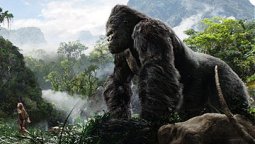
The
Mighty King Kong, Eighth Wonder of the World.

.