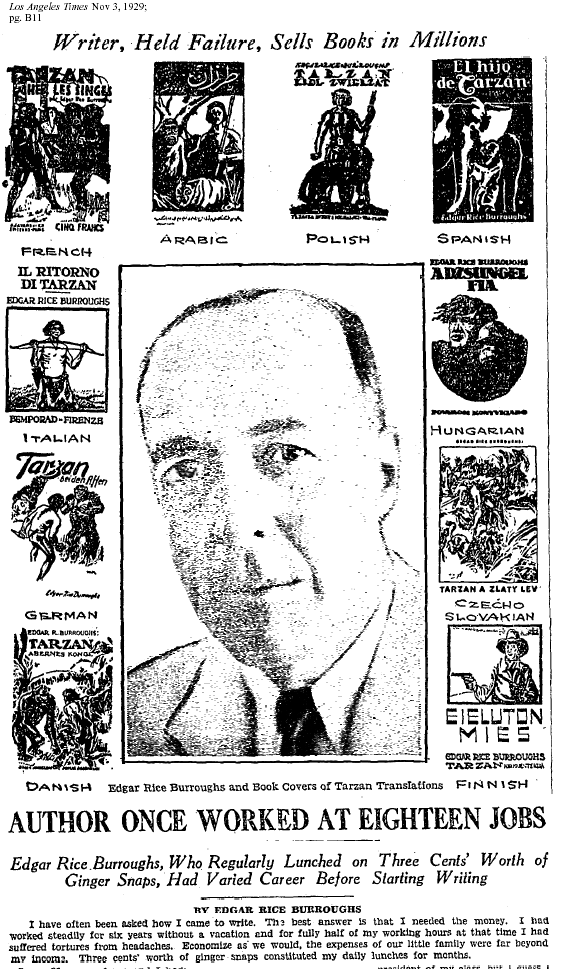
Edgar Rice Burroughs who regularly
lunched on three cents worth
of ginger snaps had varied career before
he starting writing.
Los Angeles Times ~ November 3, 1929
BY
EDGAR RICE BURROUGHS
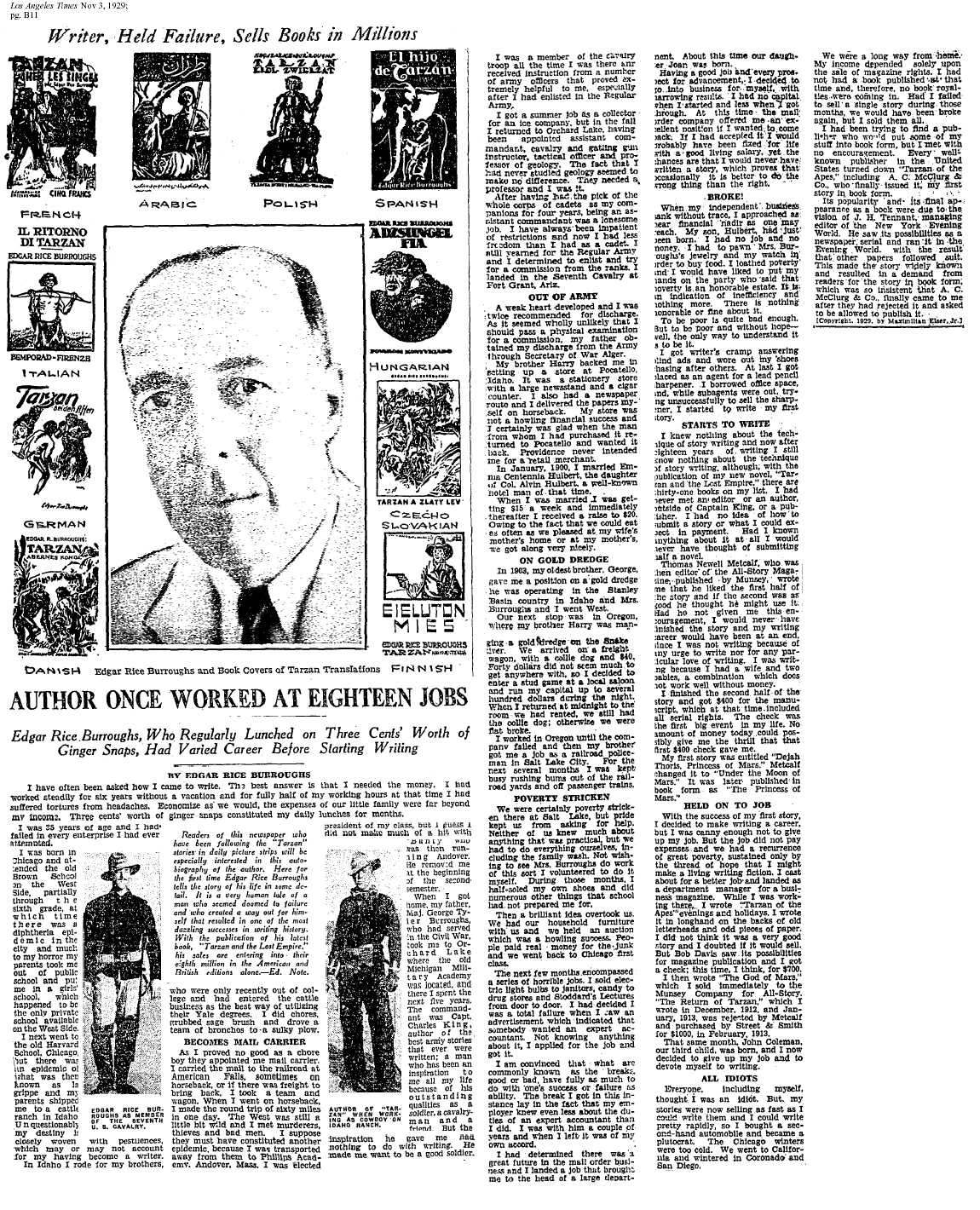
Readers of this newspaper who
have been following the "TArzan" stories in daily picture strips will be
especially interested in this autobiography of the author. Here for the
first time Edgar Rice Burroughs tells the story of his life in some detail.
It is a very human tale of a man who seemed doomed to failure and who created
a way out for himself that resulted in one of the most dazzling successes
in writing history. With the publication of his latest book, "Tarzan and
the Lost Empire," his sales are entering into their eighth million
in the American and British editions alone -- Ed. Note.
I have often been asked how I came to write. The best
answer is that I needed the money. I had worked steadily for six years
without at vacation and for fully half of my working hours at that time
I had suffered tortures from headaches. Economize as we would, the
expenses for our little family were beyond my income Three cents'
worth of ginger snaps constituted my daily lunches for months.
I was 35 years of age and I had failed in every enterprise
I had ever attempted.
I was born in Chicago and attended the old Brown School
in the West Side, partially through the sixth grade, at which time there
was a diphtheria epidemic in the city and much to my horror my parents
took me out of public school and put me in a girls' school, which happened
to be the only private school available on the West Side.
I next went to the old Harvard School, Chicago, but there
was an epidemic of what was then known as the grippe and my parents shipped
me to a cattle ranch in Idaho. Unquestionably my destiny is closely woven
with pestilences, which may or may not account for my having b ecome a
writer.
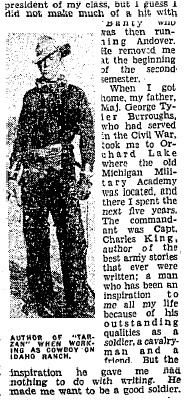
In Idaho I rode for my brothers, who were only recently
out of college and had entered the cattle business as the best way of utilizing
their Yale degrees. I did chores, grubbed sage brush and drove a team of
broncos to a suly plow.
BECOMES MAIL CARRIER
As I proved no good as a chore boy they appointed me
mail carrier. I carried the mail to the railroad at American Falls, sometimes
on horseback, or if there was freight to bring back, I took a team and
wagon. When I went on horseback, I made the round trip of sixty miles in
one day. The West was still a little bit wild and I met murderers, thieves
and bad men. I suppose they must have constituted another epidemic, because
I was transported away from them to Phillips Academy, Andover, Mass. I
was elected president of my class, but I guess I did not make much of a
hit with __anty who was then running Andover. He removed me at the beginning
of the second semester.
When I got home, my father, Maj. George Tyler Burroughs,
who had served in the Civil War, took me to Orchard Lake where the old
Michigan Military Academy was located, and there I spent the next five
years. The commandant was Capt. Charles King, author of the best army stories
that ever where written; a man who has been an inspiration to me all my
life because of the outstanding qualities as a soldier a cavalryman and
a friend. But the inspiration he gave me had noting to do with writing.
He made me want to be a good soldier.
I was a member of the cavalry troop all the time I was
there and received instruction from a number of army officers that proved
extremely useful to me, especially after I had enlisted in the Regular
Army.
I got a summer job as a collector for an ice company,
but in the fall I returned to Orchard Lake, having been appointed assistant
commandant, cavalry and gatling gun instructor, tactical officer and professor
of geology. The fact that I had never studied geology seemed to make no
difference. They needed a professor and I was it.
After having had the pick of the whole corps of cadets
as my companions for four years, being an assistant commandant was a lonesome
job. I have always been impatient of restrictions and now I had less freedom
than I had as a cadet. I still yearned for the Regular Army and I determined
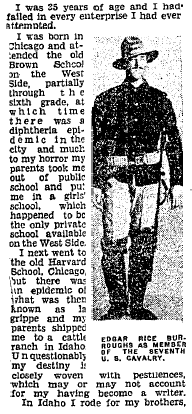
to enlist and try for a commission from the ranks. I landed in the Seventh
Cavalry at Fort Grant, Ariz.
OUT OF ARMY
A weak heart developed and I was twice recommended for
discharge. AS it seemed wholly unlikely that I should pass a physical examination
for a commission, my father obtained my discharge from the Army through
Secretary of War Alger.
My brother Harry backed me in setting up a store
at Pocatello, Idaho. It was a stationery store with a large newstand and
a cigar counter/. I had a newspaper route and I delivered newspapers myself
on horseback. My store was not a howling success and I was certainly glad
when the man from whom I had purchased it returned to Pocatello and wanted
it back. Providence never intended me for a retail merchant.
In January, 1900, I married Emma Centennia Hulbert, the
daughter of Col. Alvin Hulbert, a well-known hotel man of that time.
When I was married I was getting $15 a week and immediately
thereafter I received a raise to $20. Owing to the fact that we could eat
as often as we pleased at my wife's mother's home or at my mother's, we
got along very nicely.
ON GOLD DREDGE
In 1903, my oldest brother, George, gave me a position
on a gold dredge he was operating in the Stanley Basin country in Idaho
and Mrs. Burroughs and I went West.
My next stop was in Oregon where my brother Harry was
managing a gold dredge on the Snake River. We arrived on a freight wagon
with a collie dog, and $40. Forty dollars did not seem much to get anywhere
with, so I decided to enter a stud game at a local saloon and run my capital
up to several hundred dollars during the night. When I returned at midnight
to the room we had rented, we still had the collie dog; otherwise we were
flat broke.
I worked in Oregon until the company failed and then my
brother got me a job as a railroad policeman in Salt Lake City. For the
next several months I was kept busy rushing bums out of the railroad yards
and off passenger trains.
POVERTY STRICKEN
We were certainly poverty stricken there at Salt Lake,
but pride kept us from asking for help. Neither of us knew much about anything
that was practical, but we had to do everything ourselves, including the
family wash. Not wishing to see Mrs. Burroughs do work of this sort I volunteered
to do it myself. During those months, I half-soled my own shoes and did
numerous other things that school had not prepared me for.
Then a brilliant idea overtook us. We had our household
furniture with us and we held an auction which was a howling success. People
paid real money for the junk and we went back to Chicago first class.
The next few months encompassed a series of horrible jobs.
I sold electric light bulbs to janitors, candy to drug stores and Stoddard's
Lectures from door to door. I had decided I was a total failure when I
saw an advertisement which indicated that somebody wanted an expert accountant.
Not knowing anything about it, I applied for the job and got it.
I am convinced that what are commonly known as the breaks,
good or bad, have fully as much to do with one's success or failure as
ability. The break I got in this instance lay in the fact that my employer
knew even less about the duties of an expert accountant than I did. I was
with him a couple of years and when I left it was of my own accord.
I had determined there was a great future in the mail
order business and I landed a job that brought me to the head of a large
department. about this time our daughter Joan was born.
Having a good job and every prospect for advancement,
I decided to go into business for myself, with harrowing results. I had
no capital when I started an d less when I got through. At this time the
mail order company offered me an excellent position if I wanted to come
back. If I had accepted it I would probably have been fixed for life with
a good living salary, yet the chances are that I would never have written
a story, which proves that occasionally it is better to do the wrong thing
than the right.
BROKE
When my independent business sank without a trace, I
approached as near financial nadir as one may reach. My son, Hulbert, had
just been born. I had no job and no money. I had to pawn Mrs. Burroughs's
jewelry and my watch in order to buy food. I loathed poverty and I would
have liked to put my hands on the party who said that poverty is an honorable
estate. It is an indication of inefficiency and nothing more. There is
nothing honorable or fine about it.
To be poor is quite bad enough. But to be poor and without
hope-- sell, the only way to understand it is to be it.
I got writer's cramp answering blind ads and wore
out my shoes chasing after others. At last I got placed as an agent for
a lead pencil sharpener. I borrowed office space, and, while subagents
were out, trying unsuccessfully to sell the sharpener, I started to write
my first story.
STARTS TO WRITE
I knew nothing about the technique of story writing and
now after eighteen years of writing I still know nothing about the technique
of story writing, although, with the publication of my new novel, "Tarzan
and the Lost Empire," there are thirty-one books on my list. I had never
met any editor or an author outside of Captain King, or a publisher. I
had no idea of how to submit a story or what I could expect in payment.
Had I known anything about it at all I would never have thought of submitting
half a novel.
Thomas Newell Metcalf, who was then editor of the All-Story
Magazine, published by Munsey, wrote me that he liked the first half of
the story and if the second was as good he thought he might use it. Had
he not given me this encouragement, I would never have finished the story
and my writing career would have been at an end, since I was not writing
because of any urge to write nor for any particular love of writing. I
was writing because I had a wife and two babies, a combination which does
not work well without money.
I finished the second half of the story and got $400 for
the manuscript, which at that time included all serial rights. The check
was the first big event in my life. No amount of money today could possibly
give me the thrill that that first $400 check gave me.
My first story was entitled "Dejah Thoris, Princess of
Mars." Metcalf changed it to "Under the Moons of Mars." It was later published
in book form as "The Princess of Mars."
HELD ON TO JOB
With the success of my first story, I decided to make
writing a career, but I was canny enough not to give up my job. But the
job did not pay expenses and we had a recurrence of great poverty, sustained
only by the thread of hope that I might make a living writing fiction.
I cast about for a better job and landed as a department manager for a
business magazine. While I was working there, I wrote "Tarzan of the Apes"
evenings and holidays. I wrote it in longhand on the backs of old letterheads
and odd pieces of paper. I did not think it was a very good story and I
doubted if it would sell. But Bob Davis saw its possibilities for magazine
publication and I got a check; this time, I think for $700.
I then wrote "The Gods of Mars," which I sold immediately
to the Munsey Company for All-Story. "The Return of Tarzan," which I wrote
in December, 1912, and January 1913, was rejected by Metcalf and purchased
by Street & Smith for $1,000 in February 1913.
That same month, John Coleman, our third child, was born,
and I now decided to give up my job and to devote myself to writing.
ALL IDIOTS
Everyone, including myself, thought I was an idiot. But,
my stories were now selling as fast as I could write them and I could write
pretty rapidly, so I bought a second-hand automobile and became a plutocrat.
The Chicago winters were too cold. We went to California and wintered in
Coronado and San Diego.
We were a long way from home. My income depended solely
upon the sale of magazine rights. I had not had a book published at that
time and, therefore, no book royalties were coming in. Had I failed to
sell a single story during those months, we would have been broke again,
but I sold them all.
I had been trying to find a publisher who would put some
of my stuff into book form, but I met with no encouragement. Every well-known
publisher in t he United States turned down "Tarzan of the Apes," including
A. C. McClurg & Co., who finally issued it, my first story in book
form.
Its popularity and its final appearance as a book were
due to the vision of J. H. Tennant, managing editor of the New York Evening
World. He saw the possibilities as a newspaper serial and ran it in the
Evening World, with the result that other papers followed suit. This made
the story widely known and resulted in a demand from readers for the story
in book form; which was so insistent that A. C. McClurg finally came to
me after they had rejected it and asked to be allowed to publish it.