ATAMIAN
SPECULATES ON TARZAN'S BIRTHPLACE
from The
Origin of Tarzan by Sarkis Atamian (1997)
[p. 87] This problem of where exactly in Africa
was the site of the Greystoke cabin, has concerned scholars for many years.
The Reverend H.H. Heins is a scholar in
the field of ERBology (I apologize if this is a newly-coined phrase, but
I may have seen it somewhere before – at any rate we need a convenient
label to identify the vast topic).
Heins has written the preface to Lupoff
and he says:
Exactly where, dear reader, was
Tarzan born? While never mentioned by name, the location of the little
cabin on the shore of the landlocked harbor on the West coast of Africa
is given in Jane Porter's letter in chapter xviii of Tarzan of the Apes
as "About 10 Degree South Latitude." Now there is only one place in the
Southern Hemisphere where the Tenth and adjacent parallels intersect the
west coast of Africa. Tarzan was born in Portuguese Angola."
Farmer disagrees with this and rightly
so – but for the wrong reasons. His estimates, though for fictional purposes,
are nevertheless based on his obvious knowledge of some important facts,
and are more realistic. But he is a long way off for reasons unknown, given
the facts. He puts the Greystoke cabin site where the Fuwalda put
the Claytons off on the beach which Farmer estimates to be halfway between
Iguéla and Setté Camma, in the present Gaboon, then part
of the French Congo, approximately two degrees South latitude. He does
so because the 10 degree south which Jane Porter's letter (and Reverend
Heins' calculations) indicates would place the site more than 300 miles
south of the Congo River near the present site of Quicama National Park
in Angola (Farmer). Such a site would place the cabin where there are no
gorillas south of the Congo River, says Farmer, and concludes that, "Internal
evidence from the Tarzan books indicates that the coast of Gabon was the
correct location, even if we did not know that from other sources...."
The internal evidence may refer to, "...Burroughs'
statement that the Porter party was fifteen hundred miles north of Capetown..."
which would place the site in Portuguese Angola plus the absence of gorillas
that far south. He gives us no other reference to internal evidence, and
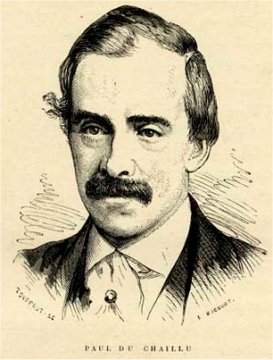
none about external evidence, although he undoubtedly has Du Chaillu in
mind whom he has read. Of course, his handling of these facts give his
fictional context a beautiful verisimilitude, and his statement that this
"...was another example of Burroughs' efforts to mislead the reader about
the true location... " may very well be true. But an unwary reading of
the passage will not expose a contradiction or two in Farmer.
Since he has read Du Chaillu, he should
have known Du Chaillu believes there are no gorillas south of Setté
Camma – not south of the Congo River which is too far south by nearly 300
miles from Setté Camma, let alone 300 miles south of the farther
Congo River!
I can find no Iguéla on Du Chaillu's
map, (though Setté Camma is prominent) nor on Stanley's original
[p. 89] map of the Congo and the Gaboon, nor in recent (1972) Rand-McNally
maps. It may be that Farmer uses Iguéla as a fictional name, but
I don't think so – there is probably such a place in the maps he has used.
His general location as the Gaboon, instead of Angola, is correct, however.
In the second sentence on the first page of Chapter One (right at the outset),
Du Chaillu tells us that:
My purpose was to spend some years
in the exploration of a region of territory lying between latitude one
north and two south, and stretching back from the coast to the mountain
range called the Sierra Crystal, and beyond as far as I should be
able to penetrate.
According to his map, the farthest south he
penetrated in gorilla country was below Cape St. Catherine, to the coast,
at about one degree, seventy five minutes south below which there are no
gorillas. From Setté Camma to Cape Lopez is approximately 150 statute
miles, North West. Approximately half way between these two points the
very large Fernand Vaz river and its Delta pour into the Atlantic. Du Chaillu
has walked north from his southernmost point along the river (which parallels
the coast for some distance) and the ocean. But he stops cold at Fernand
Vaz because it is impassable beyond that point.
Cape St. Catherine along the way would
be one of the ideal locations for the Greystoke cabin, but we shall see
why it is too far south. From the Fernand Vaz to Cape Lopez, north, is
the vast area of the Ogobai Delta where the large Ogobai River some 50
miles inland, branches into the Nazareth River which empties into the sea
above Cape Lopez while the other branch (still the Ogobai) flows into the
Fernand Vaz emptying into the sea below Cape Lopez. A third mighty river,
the Mexias, fed by the Ogobai and Fernand Vaz empties into the sea at the
southernmost tip of Cape Lopez. The delta area, therefore, is crisscrossed
dozens of times by these rivers and their tributaries. It is an abysmal
swampland, at least 2,500 square miles. It would be nearly impossible to
walk from Fernand Vaz to Cape Nazareth (let alone from Cape St. Catherine)
– which is why Du Chaillu stopped until a ship picked him up.
The problem is that if the Greystoke cabin
stood anywhere along the coast between these two points of Fernand Vaz
and Nazareth Bay, then how could Tarzan and Lt. Paul D'Arnot, 20 years
after the Claytons are marooned, walk north to the unnamed settlement?
If they go inland to avoid the impassable Ogobai Delta, and then head north,
they would have to cross three major rivers and ERB makes no mention of
them, or of any boats used in any crossings. When Tarzan and D'Arnot return
from Mbonga's village (where Tarzan rescues D'Arnot from another cannibal
episode) to the Greystoke cabin, the Clayton-Porter entourage has been
rescued by D'Arnot's French cruiser and gone.
Tarzan and D'Arnot head north for
three
weeks when Tarzan, on learning of it, decides to go back to the cabin
area to uncover the treasure chest buried by the ruffians of the Arrow.
D'Arnot talks him out of this and they walk another week to reach
an unnamed missionary settlement on the coast under the head of Father
Constantine. They rest here for a week and then walk for
another month
until they reach the coastal settlement (unnamed), prior to their departure
for France. The "settlement," however, is civilized enough to have the
necessary equipment so that D'Arnot can send his cablegrams outside.
Now the only place north of Nazareth
Bay where there could be a settlement advanced enough for D'Arnot to send
his cablegrams, where Tarzan and D'Arnot saw a "little group of buildings,"
and "many boats," in a "little port," and "a coast town," and stay in a
"hotel," and meet a "number of whites" (all ERB's words) who bet Tarzan
5,000 francs that he cannot kill a lion single-handedly and unarmed,
can only be on the left bank of the French Gaboon River Delta at, or near,
King William Point – after Count Bouet-Willaumetz had signed a treaty with
King Denis of the Mpongwe. It is a straight shot from Nazareth Bay to the
Point, along the coast through lovely territory. Du Chaillu himself walked
it – all 150 statute miles of it. There are no large rivers or swamps to
break up the route. There are occasional villages along the way, one of
which Tarzan and D'Arnot could have visited with Father Constantine, as
ERB says they did.
Secondly, it is D'Arnot's fellow officers
and a French cruiser that rescue the group at the Greystoke cabin. When
the crew of the cruiser attacks Mbonga's cannibal village, they are 200
men strong, led by 10 officers (under the tactical command of Lt. Charpentier)
and two surgeons. It seems like a lot of fire power for a primitive cannibal
village (ERB is taking no chances), but the cruiser which carried that
kind of complement had to have enough logistics problems that could only
be solved by a naval base or station adequate for the job, about which
ERB says not a word. Such a vessel could not just drop in from thin air
– even ERB would not go that far.
Vaucaire in his biography of Du Chaillu,
drawing partly from Explorations, says that soon after the treaty
in 1842, the "French had built enormous warehouses to serve as a base of
supplies for the West African fleet " and that fleet contained at least
26 vessels to match roughly the same numbers that the British and Portuguese
kept in the area, each cautiously keeping an eye on the other. Indeed,
this was the fabulous Gold Coast of slave, ivory, gold, rubber, and mineral
fame – formerly operated by the Portuguese. What is more logical than having
a Frenchman, Lt. D'Arnot, appear on the scene? Who else but a Frenchman
would be most likely to be found in the French Gaboon where the coin of
the realm is the franc, and where the French flotilla lay?
It is now (in Du Chaillu's time) the French
Gaboon on both sides of the Delta and the River, and important enough for
the upper bank to become Libreville, and has had an important influence
on that part of Africa ever [p. 92] since. ERB underplays all this, of
course, just as he did the location of the Greystoke cabin. Obviously,
he may not have had these Gaboon locations in mind, at all, when Tarzan
and D'Arnot finish their two month trek. But something like this he would
have to have in mind (and this is the likeliest place) in order to get
his heroes to do what they do, and if Tarzan is to learn French in order
to learn how to speak English, meet the civilizing tutelage of D'Arnot,
and get to Paris. If ERB had not forgotten all these impressions when he
first read Du Chaillu, he would refrain from advertising it, however, or
revealing too many clues from this to Du Chaillu. The same is true for
the Greystoke cabin site.
Well, one must bite the bullet at this
point. Where was the likeliest site for the Greystoke cabin? At Nazareth
Bay, which ERB disguises as a "...beautiful ... landlocked harbor." It
is only one-half degree south of the Equator, it has all the sea coast
and tropical jungle and distant mountains (the Sierra Crystal, if nothing
else), and the great apes, gorillas, natives, the proximity to French civilization
and sailors, soldiers and marines – English, French, and Portuguese.




 Page
84 and 85:
Page
84 and 85: