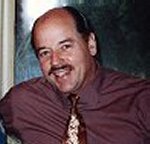
He's an ex-cowboy, miner and policeman; but as
a writer his books have sold over 25,000,000 copies despite the fact (which
only he will admit) that he can't spell and has no memory. It's Edgar
Rice Burroughs!
Tarzan's father represents 183 pounds of ex-cowboy, storekeeper,
battery maker, miner, door-to-door salesman, mail-order "big shot," policeman
-- and what not.
You'll find him today smoking up San Fernando Valley sunshine
in a town named Tarzana which he built. There he sits, making cute
little chains of paper clips, examining lead pencils, opening and shutting
desk drawers, tying knots in string and rummaging through old papers: For,
at 62 years of age, Edgar Rice Burroughs is writing another fantastic tale.
It is his forty-seventh novel!
The whole world knows Tarzan, the fictional strong man
and the ambidextrous tree-swinger who fraternizes with apes. In fact, the
varied peoples of the glove have put out everything from dollars to shekels
to coax Tarzan into fifty-eight languages and dialects.
The result?
The nimble-witted Mr. Burroughs has got rid of some 25,000,000
copies of Tarzan lore besides multitudinous other books and magazine yarns
about Mars, cave maidens and devils; but even that isn't thE magnitude
of the Tarzan enterprise!
In the first place, Mr. Burroughs is virtually his own
publisher with a limited sales organization. Add to that now some of his
other sources of income: Tarzan comics, daily and Sunday; radio scripts,
and cinema. From these of course, he carves a nice hunk of money; for it
he never turns a hand!
"I let other men tend to all that," he'll tell you, "men
who can spell and remember. I can't do either one. Lord, look at all the
books they've got to work with . . . and I'm doing two new ones very
year."
Press Mr. Burroughs for the source of the Tarzan idea
and he'll sit there and look at you and drum on his desk.
"What was it," you ask, "a nightmare; or did you eat too
many green apples?"
Author Burroughs will light one of your cigarettes before
he answers; that is, if they're the right brand.
"I don't know where Tarzan came from," he'll say. "That's
the honest truth. Of course, I've been asked that question so many times
that I know by experience that folks won't believe the truth. That being
the case, I've developed perfectly swell fiction story about Tarzan's origin.
You see, once upon a time, mythology tells us, there were a couple of kids
named Romulus and Remus who were being nursed by a she-wolf --
"Aw, let's be frank about this thing. Tarzan grew out
of a dollar sign!"
You see, once Mr. Burroughs really needed money, for food.
He knew dire poverty and want from every angle because, in his youth, life
for him was sort of a hodge-podge. He didn't begin to write until he was
35 years of age. Before that he did about everything else; sometimes at
a profit, sometimes at a loss.
Complications began for Chicago-born Edgar when he was
still at an early age. Two schools, committed to educating him along with
a myriad other youths, closed down because of an epidemic. That's why his
family took him out of the city to work for two of his brothers from Yale
-- on an Idaho cattle ranch.
Later, when he wanted to open a stationery store in Pocatello,
one of his brothers financed that. It flopped. From then on young Burroughs
bounced from his father's battery business at $15 a week into matrimony,
dredging for gold, and a railway's police department.
It was his job to grab a "freight" out of Salt Lake City
and ride at the blind door in the back of the tender to club bums out of
a free hop to Butte. The pickings were so poor that Mr. Burroughs had to
half-sole his own shoes. He quit.
From then on he sold electric light bulbs to janitors,
tried peddling candy to drug stores, and took on a lecture series to sell
from door to door. He became an accountant through sheer "crust," that
is, he got an accountant's job. His problem, however, was still one of
getting enough to eat. A mail-order post helped that.
In fact, the probability is that Mr. Burroughs really
could have shaken a career out of the mail-order business if he had enjoyed
it as he does Tarzan. He followed it up the ladder to an executive post
and then, because his daughter Joan was being born and because he didn't
like the idea of being an employee for the rest of his life, he resigned
and tried the game for himself. It didn't work.
By the time Hulbert Burroughs came into this world his
father was answering classified advertisements and taking on the agency
for a lead pencil sharpener. There was one more Burroughs child, John Coleman.
Tarzan, too, was being born about that time and it really happened like
this:
One careful look at the then current magazines proved
to Edgar Rice Burroughs that you didn't have to be a genius to write.
"It seemed like a good source of money," he'll tell you,
"and heaven knows I needed funds about that time!
"So I took on some sub-agents for the pencil sharpener
business and ground out my first story in longhand. I called it Dejah Thoris,
Princes of Mars. It didn't have anything to do with Tarzana, but it was
actually my start in that direction. It's just 'A Princess of Mars' today.
For it I got $400.
"'Tarzan of the Apes' was really my third story, but it
was the second one I sold. I think the famed editor, Bob Davis, gave me
about $700 for that. However, by then I was working as a department manager
for a business magazine and I had decided to make writing my career.
"You can see now that my need of money inspired Tarzan
. . . and I still write Tarzan for money. He pays good dividends . Besides
the books, 222 newspapers are using Tarzan as a comic strip character or
as a Sunday funny paper feature. He's been in many a movie. In fact, Sol
Lesser, head of Principal Productions, has contracted me to do five more
Tarzans . . . and has an option on one of my non-Tarzan yarns."
Mr. Burroughs will tell you, too, that he has no exalted
idea of his world-renowned fantastic writing.
"I don't think it's 'literature'," he admits without shame.
"I'm not fooling myself about that. I don't care whether it's filled full
of dangling participles or not . . . or split infinitives or anything
else. It sells. That's the first consideration. It amuses. That's the second.
There are no more as far as I'm concerned.
"You see, Tarzan has sort of got me into a rut. I'd like
to write heavier stuff . . . just to satisfy myself. However, why
should a man do that when he appears to be satisfying a world of other
people?"
From the very time that Tarzan stories took book form
they never have been out of print. Even Tarzan of the Apes, written in
1912, is still going through an edition every year.
There's a faint trace of humor back of that, too; for,
when Bob Davis bought that it was a magazine story. Practically every well-known
book publisher in the country turned it down when Mr. Burroughs tried to
get it between two covers. Newspapers, running the yarn as a serial story,
really forced Tarzan into novel form.
Work habits?
Mr. Burroughs will tell you he hasn't any.
"I write when I want to," he'll insist. "Nobody can call
me a liar for anything I say about Tarzan. Always the tales are laid in
some fantastic setting and I can do with my hero exactly as I please. There's
no worry about locale. There's no struggle for accuracy. There's just plot.
. . and fantasy."
Inspiration, it appears comes about the time that Mr.
Burroughs is interested in going to bed. He never lets it bother him.
"Do I get up and put on my slippers and throw my cloak
about me while Tarzan throbs in my soul?"
"I do not!
"It's too much fun to sleep. Anyway, I always remember
my Tarzan plot the next morning. That's unique, too, because it is the
only thing I can remember.
"Take the word 'tawny', for instance. That's one of my
favorites when it comes to describing Tarzan. But do I know how to spell
it? Yeah . . . I think I do. However, that's an exception to the rule.
Why spell? That's what secretaries are for: It's much easier to hire secretaries
than it is to carry a lot of jumbled up alphabet around in your head.
"I can't dictate Tarzan stories to them, though I've tried
it dozens of times. You see, I can't remember what I just said. That makes
secretaries awfully sore. It makes me sore too, when I use a mechanical
recorder and try to dictate into that. I about wear the record out playing
it back to myself. . . to see what I just said.
"Names are particularly tough on me. I can't remember
them, either. I can carry a whole Tarzan plot in my mind when I want to;
I don't have to use an elaborate outline. Do you think I can remember the
cast of characters for it? I write down every name!
"You know, at 58 I took up flying. My sons wanted to learn
so I went along and tried to learn, too. Well, we were standing out at
Clover Field one day and an awfully nice little woman came up and spoke
to me. She introduced herself . . . and I thought that was mighty fine
of her.
"Do you fly?" I asked.
"'A bit,' she said.
"Her name was Ruth Elder.
My memory's just that way."
That's one of the reasons why Mr. Burroughs still prefers
to write in longhand. He says the typewriter tires him and, anyway, his
writing is very easy to read . . . as long as he reads it himself.
It takes just about a month for him to dish up 80,000
words, the length he sets for his average Tarzan yarn. Maybe he sits down
and actually plots two or three chapters. Probably he doesn't.
"It all comes from some very simple idea," he'll explain.
"That being the case, I can plot as I go, pyramiding complication upon
complication to suit my own fancy and taste. I'm glad other people like
the same stories I do. It's so convenient that way."
Back in the old "silent" days a Tarzan movie was one of
the first pictures to gross more than $1,000,000. Then some producer got
hold of Tarzan and didn't do so well with him.
"I think any other character would have died," Mr. Burroughs
will admit. "Tarzan, though, just swung to another movie tree. It was the
late Irving Thalberg who really put Tarzan across to the showgoers. Mr.
Thalberg made three pictures with Tarzan and each grossed more than $2,000,000!"
Don't think for a moment that Mr. Burroughs writes Tarzan
"down" for children. He tired that just once. It was costly.
"Children and adults have the same kind of minds . . .
if they're both normal." Mr. Burroughs will insist. "I've proved it again
and again. Let some novelist with a general story try to 'write down' to
a youngster's vocabulary and even the kids won't read it. They're insulted.
I don't blame them a bit. You can charge me with anything you want to but
you can't justly say that I go around insulting little boys and girls."
Actually, however,. a costly survey once was made to determine
Tarzan's reader audience. It proved that about 80 per cent of the people
who turned ot Mr. Burroughs books were adults. The same figure goes for
the movies. Ask any competent syndicate man and he'll tell you that all
successful comic strips are prepared for mature newspaper subscribers.
When it comes to comics, radio and pictures, Mr. Burroughs
doesn't write the Tarzan continuity. He does though, insist on seeing the
scripts and okehing the method of presenting his character.
No, he does not draw!

The Tarzan you'll find in today's comic section is adapted
from Mr. Burroughs books by and artist. Mr. Burroughs's job is a writing
job. . . and that alone. "Once," he'll confess, "I was rather prolific
at ti. I had a peak year of 400,000 words or more. That amused me, so I
used to keep a graph of exactly how much wordage I turned out annually.
I don't do that any more. That's worse than accounting. I tried that once
in my life when I didn't know anything about it and now I don't want anything
to do with records of that sort.
"My yearly production now runs less than 200,000 words.
You see, I try to do two Tarzans at about 80,000 words apiece.
"Rewrite?
"There's not very much of it to do in a Tarzan story.
Again, you must remember that I know that I'm not writing 'literature.'
The polishing on the finished script is relatively simple.
"However, I don't see that all that should be any reason
for anyone apologizing to me for reading Tarzan. That's a helluva thing
to do. It's tactless, to say the least!"
Mr. Burroughs's workday is reckoned in terms of about
four hours. It's concentrated four hours, though; even though part of it
goes to making chains out of paper clips and looking through the junk in
his card case. That's part of the job. Almost any experienced writer will
tell you that when he sits down to labor he empties his desk drawers
on the floor. . . or paces around, or goes out and washes his hands
a half dozen times. . . or something. Stories are born that way and
it's no joke.
For relaxation Mr. Burroughs plays tennis and bridge.
"That's good enough for me," he'll say. "Anyway, I've
got to keep my mind in shape!"