Official Edgar Rice Burroughs Tribute and Weekly Webzine Site Since 1996 ~ Over 15,000 Web Pages in Archive Volume 8238 |
|
Official Edgar Rice Burroughs Tribute and Weekly Webzine Site Since 1996 ~ Over 15,000 Web Pages in Archive Volume 8238 |

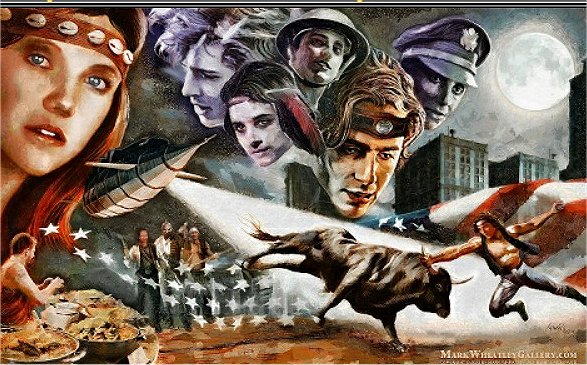
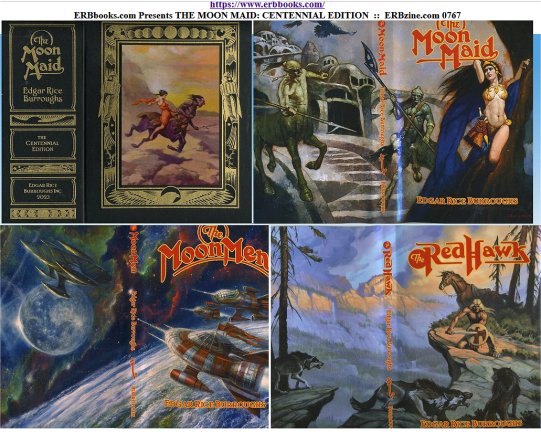
The 100th anniversary of the A.
C. McClurg publication of the THE MOON MAID was in February 2026.
The focus in this article will be the things happening in the world that
influenced Burroughs when he wrote the novel. It was a busy time. World War One
had ended and prohibition was becoming a reality. The Russian Revolution filled
the news and the fear of the rise of communism was growing into a fierce flame.
American patriotism was at an all-time high. The short-lived League of Nations
was formed, the Ottoman Empire was ending, women gained the right to vote, and
Charles Ponzi was in the news. The Jazz Age was coming, but no one knew that at
the time.
I’ll leave the character and place names
in the novel for another article and only briefly touch on lineal reincarnation
as presented in the story.
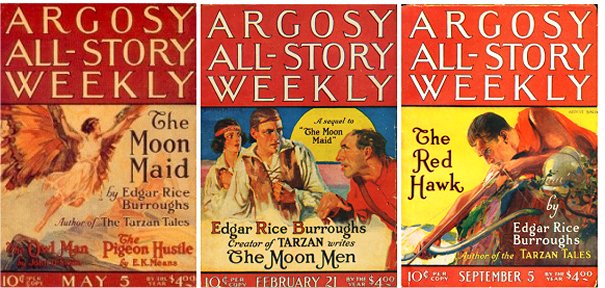
The chronology of when the three parts of The
Moon Maid were written seems a little disjointed because Edgar Rice
Burroughs wrote “Under the Red Flag” aka “The Moon Men," which became part two of the novel before he
wrote “The Moon Maid,” which became part one. After finishing The
Moon Maid, he rewrote “Under the Red Flag,” as “The Moon Men.”
Part three, “The Red Hawk,” part three, was written third. The
publication order was Maid, Men, and Red Hawk.
‘Under the Red Flag,” the first
story written for the trilogy was a strong
condemnation of communism presented by Burroughs as fiction and it featured an
America invaded and occupied by communists. No publisher would buy it and as
was noted previously, it was rewritten as “The Moon Men.” The reasons
that it didn’t sell, are outlined later in this article. Burroughs wrote “The
Moon Maid,” the first third of the novel of the same name, as a lead in for
his rewritten Moon Men version of “Under The Red Flag.” “The
Red Hawk” continued the story of America’s occupation by Kalkars, the
fictionalized communists and their human collaborators and the American’s revolt
against them. The combined three stories clearly demonstrate Burroughs mistrust
of communism – especially Russian communists. The final story is a perfect
example of a quote attributed to Edmund Burke, “The
only thing necessary for the triumph of evil is for good men to do nothing,” There is no evidence that Burke ever said or wrote that
comment, but that doesn’t make it untrue. The closest thing to be found in his
writings, is "When bad men combine, the good must associate; else they
will fall, one by one, an unpitied sacrifice in a contemptible struggle."
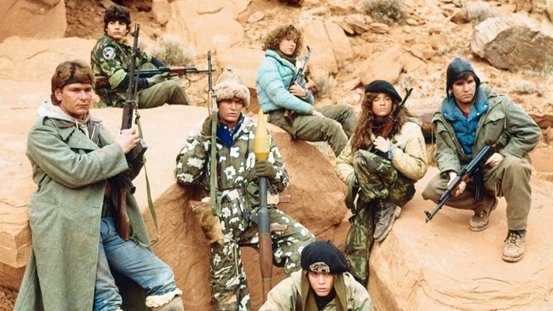
When I first saw the film, “Red Dawn,”
I was astonished at the similarity in theme to “The Red Hawk.” American
patriots, live off the land like Native Americans, never surrender, and lead
the resistance against the invaders. "C'mon! We're all going to die, die standing up!"
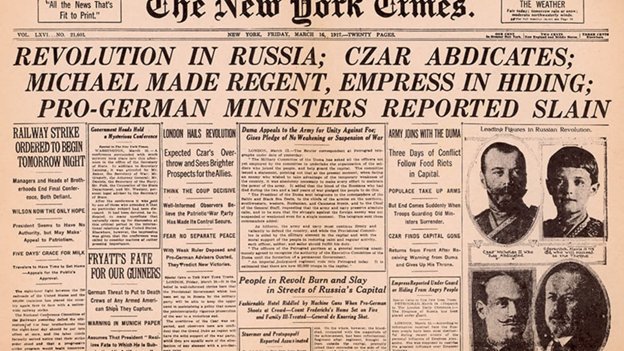
The world was a different place when Ed
sat down to write “Under the Red Flag” in 1919. The Russian Revolution
was big news. Without turning this into a history class, here’s some key dates.
In March of 1917, Tsar Nicholas II abdicated and a provisional government was
formed. The October Revolution in 1917, the Bolsheviks seized Petrograd,
arrested members of the provisional government at the winter palace, and the Council
of People’s Commissars was established as the new government. That wasn’t the
end of things. In February 1918, the Bolsheviks formed the Red Army and a
brutal conflict between the Bolshevik Red Army and the ‘White Army’ began. The
civil war lasted for four years, ending with the formation of the Soviet Union
in 1922. Why does what was going in Russia have to do with anything? When ERB
originally wrote “Under the Red Flag,” the invaders of America were Bolsheviks.
The story remained unsold and after he wrote “The Moon Maid,” he rewrote “Under
The Red Flag,” and changed the communists to into Kalkars. Same bad guys, same
politics, same philosophy, different name.
Clear evidence of this was provided on
December 4, 1918, when Edgar Rice Burroughs submitted a proposal to the
Department of Justice. He planned to alert the American people to the dangers
of being governed by Bolsheviks (Communists) by writing a fictionalized account
about life under Bolsheviks rule.
Burroughs requested background information
so his novel would be as accurate as possible, but the Department of Justice
refused to help, instead the chief of the Chicago bureau of the Department of
Justice (Federal Bureau of Investigation), a man named Hinton G. Clabaugh wrote
back to Burroughs and told him, thanks, but no thanks. He declined to provide
any information and suggested that Burroughs abandon the entire project -
basically to leave the government’s strategy to the people in charge.
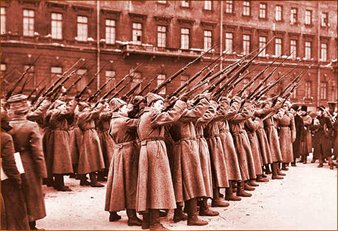
Burroughs ignored Calbaugh’s instructions
and wrote a book anyway. The result was ‘UNDER THE RED FLAG.’ After he couldn’t
sell the story, ERB then wrote ‘The Moon
Maid’ to set up a repurposed ‘The Moon
Men,” aka UTRF rewritten and finally the
‘The Red Hawk,’ about evicting Bolshevikian
Moon Men from America. Pretty sure I made up that word. Burroughs anticipated the same type of
‘political censorship,” and when he wrote CARSON OF VENUS, a novel in
which the Nazi’s were lampooned, he cleverly changed NAZI to ZANI. It worked.
This article won’t explore in detail the
lineal incarnations of Julian, who is a protagonist in each of three stories,
but as a different incarnation of himself. Lineal reincarnation is one version
of ‘immortality,’ a regular theme in ERB’s works. Lineal
reincarnation describes the common perception of rebirth as a sequential,
one-life-after-another process, moving forward in time, but spiritual
traditions often view reincarnation as non-linear, driven by karma and
consciousness rather than strict dates, suggesting souls might skip forward or
backward in time, or experience multiple lives simultaneously across different
realities, challenging the straight-line view of past and future
lives. Strict linear reincarnation, as presented by Edgar Rice Burroughs
in “The Moon Maid,” is not a tenet of Hinduism, Buddhism or Jainism, the
primary religions who believe in reincarnation. I suppose that one could say
that the simplest description of lineal reincarnation
would be “I am my own grandpa,” not to be confused with the song of the same
name written by Dwight Latham and Moe Jaffe, performed by Lonzo and Oscar in 1947, a song inspired by the Mark
Twain article, “Very Closely Related “ published in “The Wit and
Humor of the Age” in 1883. Did ERB read the Twain article? He could have,
but we’ll never know. The song has been covered by hundreds of times, including
one version by the Muppets.

Burroughs’s view of lineal reincarnation relies of the belief
that Julian, unlike the rest of us, can remember, or see if you will, his future
lives as well. This concept was also explored by H. Rider Haggard in some of
his later novels.
Burroughs concluded the trilogy with the
patriotic story, “The Red Hawk,” a tale that focuses on the American
resistance to Kalkar rule. In a way it could be characterized as the second
American revolution. The resistance people live like the Apache that Burroughs
came to admire when he was in the U. S. Cavalry stationed at Fort Grant near
Willcox, Arizona. As mentioned before, the world was a busy place during the
years between when ERB wrote The Moon Maid, rewrote The Moon Men,
and when he sat down to write “The Red Hawk.”
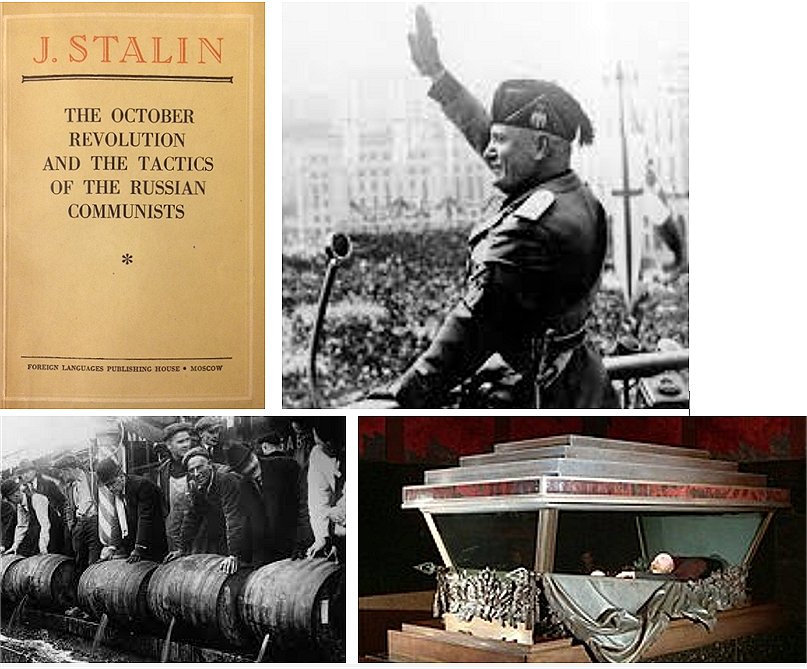
The fascism movement was founded, the Nazi
Beer Hall Putsch took place, Lenin died and Stalin gained control of the
communist party, the Ottoman Empire came to an end, the fascist, Mussolini took
power in Italy, Prohibition was in full force in America, and the rise of
unions was happening in the United States. Ed wasn’t a fan of any of those
happenings.
“ON THE ROAD TO OCTOBER” was published in 1924 with a preface by
Stalin, The October Revolution and
the Tactics of the Russian Communists. The book and the preface were widely
read and reviled in the West, but we can only wonder if ERB read it.
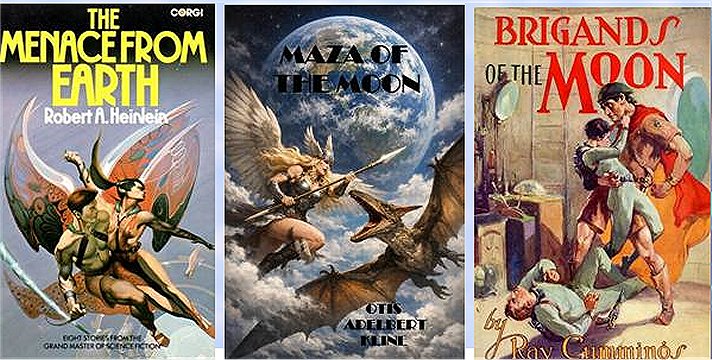
MOON MAID REFERENCES IN ERBzine

BILL HILLMAN
Visit our thousands of other sites at:
BILL and SUE-ON HILLMAN ECLECTIC STUDIO
ERB Text, ERB Images and Tarzan® John Carter® Priness of Mars® are ©Edgar Rice Burroughs, Inc.- All Rights Reserved.
All Original Work ©1996-2026 by Bill Hillman and/or Contributing Authors/Owners
No part of this web site may be reproduced without permission from the respective owners