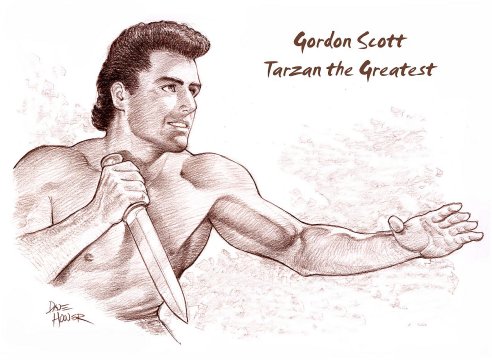
Thirteenth-century China
was "a time of myth and mysteries, conquest and courage," at least according
to the opening title sequence of 1962's Samson and the Seven Miracles
of the World. The film's plot concerns Samson (not the biblical Samson,
but simply a large and supernaturally strong man who has chosen to go by
that name) rendering assistance to a group of Buddhist monks who are trying
to restore the rightful emperor to power by taking on the Mongol horde
and their leader, Garak, who threatens to subvert the process of bloodline
sovereignty.
Samson, played by the American actor
Gordon Scott, is not from China, but finds himself there in the course
of his duties of wandering the earth and righting wrongs. The fact that
he wanders a fully clothed earth dressed only in a pair of boots and tight
orange
high-cut shorts seems to attract little notice, although it may explain
the conversion, at one point in the movie, of the evil and buxom Kiutai,
who takes up Samson's side and is brutally whipped by Garak for her perfidy.
Along the way, Samson wrestles a
tiger, uproots a tree, beats up a group of men with the support column
from a tavern balcony, and, in the seventh miracle of the title (the last
miracle at any rate--they do not total seven), manages to topple the Mongol
palace despite being killed, shackled, and walled into a catacomb in the
palace basement (in that order).
Despite the unorthodox locale, Asian
extras, and sets left over from the production company's previous film,
Marco Polo, Samson is an excellent example of the sword-and-sandals gladiator
pictures churned out during the 1960s. It is the kind of movie Gordon Scott
calls "a laugh," the kind he says you could make standing on your head.
Scott made dozens of them, and for most people Samson and the Seven
Miracles is largely forgettable. Scott will be better remembered as
the 11th actor to play Tarzan, a role he filled in the mid to late 1950s,
but for one fan, and eventually for Scott himself, Samson was a life-changing
event.
Roger Thomas grew up in Baltimore
but spent the summers in farm country -- West Virginia, Pennsylvania, or
Ohio. Thomas saw Scott play Samson at the Buckstown drive-in theater while
his family was staying in Rogersville, Pa., in the '60s, and he never forgot
it.
At the end of the movie, Samson
looks directly into the camera. The hero, victorious, is asked, "Must you
really leave us?"
"My task here is finished," he responds.
"Destiny brought me here. Now I must go wherever there is a fight between
right and wrong."
At least that's how it happens on
the autographed videocassette in Thomas' collection. He remembers the line
slightly differently: "Where will you go?" "Wherever I am needed."
Thomas is 62, with slicked-back
hair, a neatly trimmed beard, and a pitch-perfect Johnny Cash baritone
twang. He has a near photographic memory, particularly when it comes to
movies. While it is possible that he has mistaken the line, it is more
likely that the movie he saw as a boy, dubbed from the Italian, was a slightly
different cut.
Samson and the Seven Miracles has also appeared under
the names
Goliath and the Golden City and Maciste at the Court
of the Great Khan, the second a nod to the original Italian version,
in which Samson is, in fact, the stock Italian movie hero Maciste, a similarly
large man of unknown origin, given to earth-wandering and wrong-righting.
Whatever the exact words, the intent
is the same -- boilerplate hero stuff -- but the effect it had on Roger
Thomas was undeniable. He became a fan of Gordon Scott. Decades later,
after his hero came to live in the back bedroom of his South Baltimore
rowhouse, Thomas asked him what the last line of the movie meant, and Scott
told him, "I was talking to you. Didn't you know that?"
In its roots and in its meaning,
the diluted term "fan" carries with it the sense of, if not exactly religious
reverence, something close to it. From the Barry Manilow Fan Club to the
Japanese otaku, the enthusiast looks to the heavenly star for something
outside of everyday life. It is hero worship. It's girls screaming at the
Beatles, or sleeping with the Rolling Stones. It's the autograph line outside
the concert, the flash bulbs at the premiere.
F. Scott Fitzgerald wrote that the
rich are different than you and I. Had he lived to see the current age
of celebrity, he might have added that the rich are closer to us than the
famous. The famous live in exotic places, behind high walls, and we pay
men with cameras to spy on them. They are better than us, different from
us, bigger than us. They don't work regular hours, they don't eat regular
food, and they emphatically do not live in our back bedrooms.
Gordon Scott lived the life of the
famous. He was admired by men, and women desired him. He traveled the world
and he flew first class.
In a Baltimore County nursing home
recently, Thomas tried to explain his admiration for Scott, who squirmed
in his chair, unable to keep from interrupting. The trappings of Scott's
fame were hidden away in the dresser of the room he shared with a stranger.
It is doubtful that his nurses, or even his roommate, knew of his career
on film.
Thomas: "All my life, he's
been the inspiration for me. I used to spend my vacation time looking for
him. I never did give up."
Scott: "This is a really
sick man"
Thomas: "I'm proud to be
that sick. He changed me, and I didn't turn out too bad. I used to work,
make my money, go to the movies. All my life it's been Gordon Scott this
and Gordon Scott that."
Scott: "Can you imagine trying
to live up to that shit?"
Thomas: "They don't make
them any better than that in my book. Nothing. They don't have anything
better today."
Scott: "That's a great compliment,
and no joke, Roger."
Thomas: "It's from the heart,
old friend."
Later, after Thomas has left, Scott
says this: "Roger is a marvelous guy. He's more than a fan--he's more like
a friend or a brother or a son. He's a real nice guy."
According to the Internet Movie
Database, Scott has starred in 25 movies, but when he looks over the list,
he says, "They aren't all here."
Scott has played the heroes of mythology,
from Samson (tag line: "The Mightiest of Them All!") to a founder of Rome
(in 1961's Romulus and Remus). He has taken a few turns as Goliath
(in
Goliath and the Vampires and Goliath and the Rebel Slave).
Scott has been Hercules, Zorro, Julius Caesar, and Buffalo Bill. He has
been a gladiator (Gladiators of Rome) and a cowboy (opposite Joseph
Cotten in Gli Uomini dal passo pesante, released in America as The
Tramplers). He played a spy (Danger! Death Ray!) and a sheik
(or a close relative, in Kerim, Son of the Sheik).
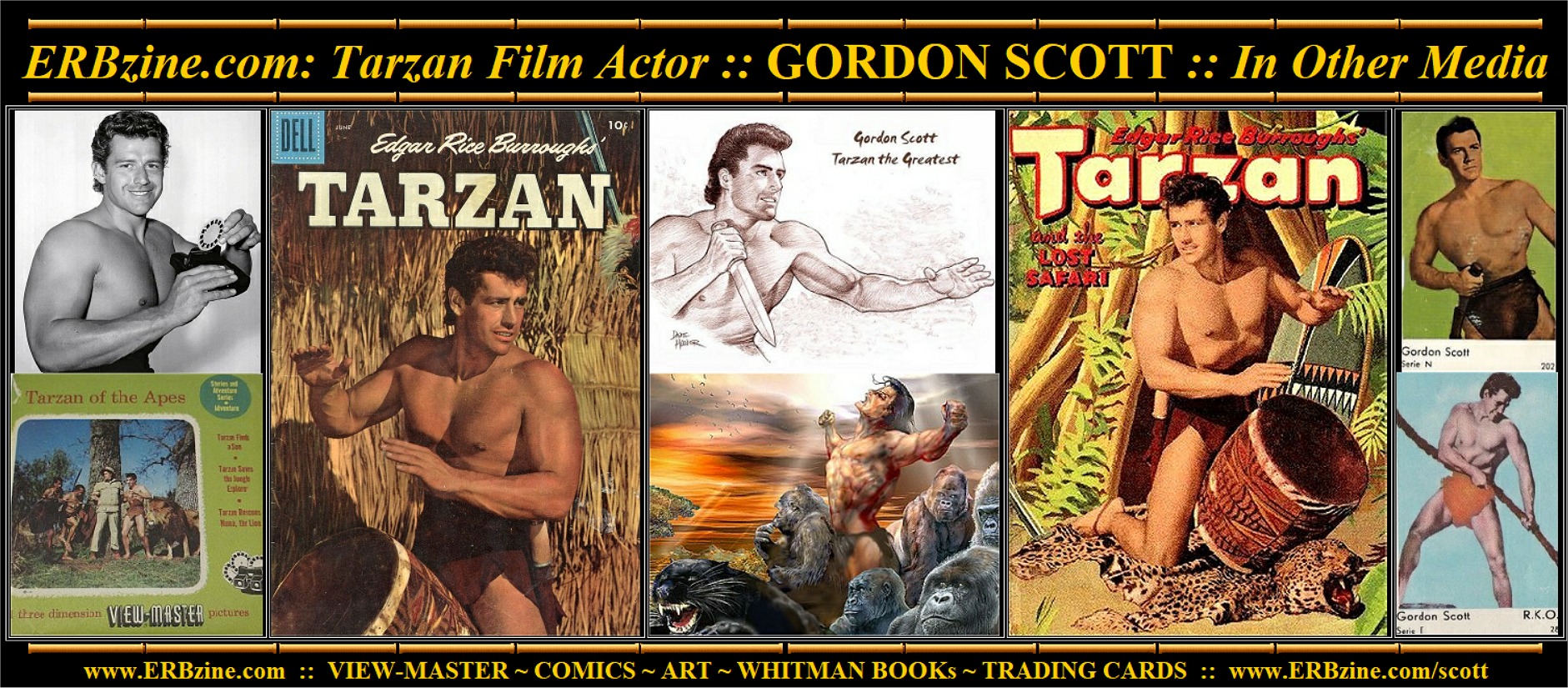
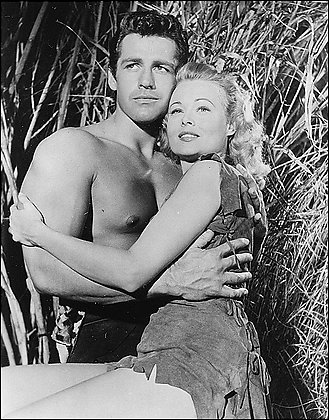
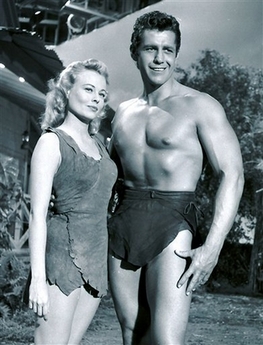
Vera Miles ~ Gordon Scott ~ Cheetah
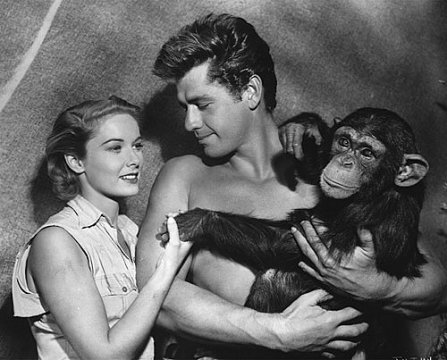 But
to a generation of men who were boys (and women who were girls, or perhaps
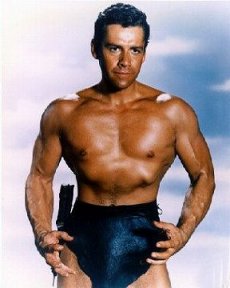
slightly older than girls) in the late 1950s, Gordon Scott is Tarzan, the
larger-than-life ape-man whom he played in six films from 1955 to 1960,
and whose picture appeared on posters and comic books around the world.
But
to a generation of men who were boys (and women who were girls, or perhaps
slightly older than girls) in the late 1950s, Gordon Scott is Tarzan, the
larger-than-life ape-man whom he played in six films from 1955 to 1960,
and whose picture appeared on posters and comic books around the world.
Gordon Scott isn't as big as he
used to be, but then, almost no one is. In a recent series of interviews
during a temporary stay at a Baltimore County nursing home, he dressed
casually (though less casually than Samson), in sweats and a black-on-black
Yankees cap, and sat in a wheelchair. As he spoke about his life, he pulled
references from a wardrobe behind him -- a book about the men who starred
as Tarzan, an October, 1964 copy of Young Mr. America magazine featuring
"Gordon Scott: Hollywood's King of the Muscle Men." At the height of his
fame, he weighed 240, and stood 6-foot-2, but Gordon Scott was big even
before he was Gordon Scott, when he was still just Gordon Werschkul, a
German-American kid growing up in Portland, Ore., where he was born in
1927. He started bodybuilding when he was about 15 -- as soon as he realized
it made him a hit with the ladies. "Vanity," he says, "is the crutch of
us all."
When he was drafted in 1944, his
size got him held back in basic training for five months while the Army
special-ordered a uniform to fit him. All the other guys he trained with
went into the old Rainbow division and off to fight and die on some Pacific
island. "They're under the sand, now," he says. The uniform came in time
for Scott to spend the tail end of the war training other soldiers in California
and Texas. After he got out, he worked a variety of jobs, until someone
noticed the big man working out at the Sahara Hotel in Las Vegas and asked
if he wanted to manage the health club. He did, and "that was two and a
half of the greatest years of my life," he says, a remarkable statement,
given what was to come in 1953 as he worked out poolside at the hotel.
"I was out there working on the
[diving] board," he recalls. "They had a three-meter board at that time,
and I was out there working out on it. After I got out of the pool, this
guy introduced himself, said he was an agent and wanted to talk to me.
They were casting someone to be the new Tarzan, and he wanted me to come
down and meet Sol Lesser, the producer. I said, `Sure,' you know, just
for a lark. I didn't take it seriously at the time. We met Lesser on a
Wednesday, we tested Friday and Saturday, and I was signed Monday."
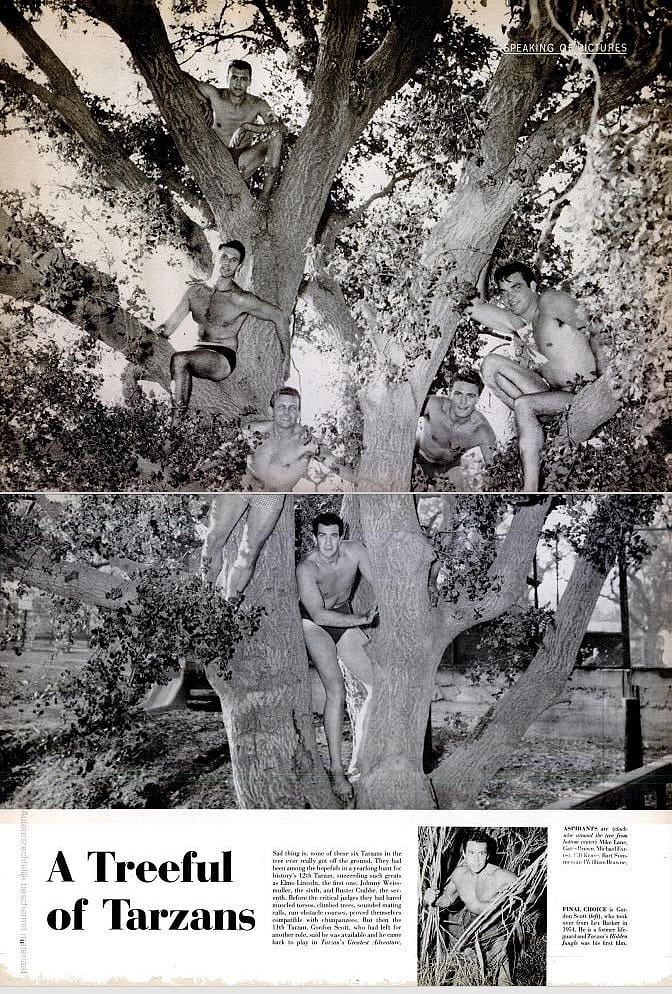
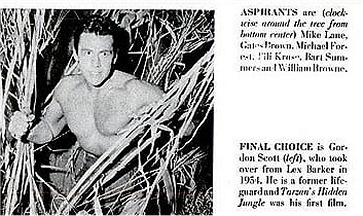
The producers had already tested
some 200 actors and athletes from around the world to fill the role of
Tarzan. Gordon Werschkul, who had never considered acting, became Gordon
Scott, the new hero of one of the most popular and long-lived action film
series ever. ("Werschkul" was a little too close to Weissmuller, as in
Johnny, still the best-known Tarzan actor.) Scott's first movie was filmed
in the wilderness of a back lot at RKO Studios--the same one used for Gone
With the Wind. "They had a little jungle fixed up out there," he says,
"and we went out."
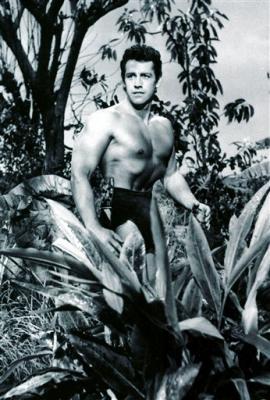 Tarzan's
Hidden Jungle, released in 1955, was not a very good movie. Nor were
1957's Tarzan and the Lost Safari, '58's
Tarzan and the Trappers
(which began life as a TV series before being re-edited into a feature
film), or Tarzan's Fight for Life, released the same year, but people
liked Scott. His size helped him there, too--he did his own stunts, just
because he could, and the filmmakers could get right in there for a closeup.
The fight for life got a little too real when the script called for Tarzan
to wrestle a huge python.
Tarzan's
Hidden Jungle, released in 1955, was not a very good movie. Nor were
1957's Tarzan and the Lost Safari, '58's
Tarzan and the Trappers
(which began life as a TV series before being re-edited into a feature
film), or Tarzan's Fight for Life, released the same year, but people
liked Scott. His size helped him there, too--he did his own stunts, just
because he could, and the filmmakers could get right in there for a closeup.
The fight for life got a little too real when the script called for Tarzan
to wrestle a huge python.
"It can get nasty if they grab
onto you," Scott says. "You know, serpents have those teeth that slant
back. It's hard to pull them off you. That was a big one, I think it was
19 feet, weighed about 200 pounds. But it was funny--they kept it in a
warm box to make it kind of lethargic, so it wouldn't wake up, but they
kept taking the shots over and over again, so it kept waking up a little
bit more. By the time we got the shot, it was a really angry snake. But
we got some good shots."
All four movies were produced by
Sol Lesser. ("A cheap prick," as Scott remembers, "if you'll pardon the
expression. I never liked him."). But the franchise, with Scott attached,
switched hands in 1959, and Tarzan got a makeover.
"Sy Weintraub, he was the new producer,"
Scott says. "I wasn't the only one who thought [the movies were], you know,
too homey, with the kid and Jane. Edgar Rice Burroughs wrote about the
guy as a wild son of a bitch. [Weintraub] wanted to show that a little
bit more."
The next Tarzan movie was filmed
on location in Africa, and the villain was played by a pre-James Bond Sean
Connery. Another difference was Tarzan's expanded vocabulary, beyond the
"me Tarzan, you Jane" of previous films--a relief for Scott. That film,
Tarzan's
Greatest Adventure, and 1960's Tarzan the Magnificent are considered
two of the best in the series. They were also Scott's last. He had offers
in Europe for 10 films, and fears about getting typecast as Tarzan, so
off he went. There were offers for more Tarzans, but he wasn't interested.
He highballed them--said he would sign for $150,000, an unheard of price
at the time, and would do only one picture a year. "I knew they wouldn't
accept it," he says.
"If you're successful at [playing
Tarzan], it ruins you for any other thing," he says. "Weissmuller was the
same way. He was very successful at it, and he couldn't get arrested. It's
like Superman--Chris Reeve was great at that, and he worked at other things,
but not a great deal, because he was tagged as that."
Europe was fun, anyway. His friend
Steve Reeves was there, an old buddy from a gym in Oakland, Calif., where
a group that included Reeves, Scott, and Jack La Lanne had worked out together
in the '40s. Reeves had helped kick off a mythological frenzy in Italian
cinema with his turn as Hercules in the 1958 movie of that name and the
following year's Hercules Unchained. Hercules was joined by (and
largely interchangeable with) Samson, Maciste, and another Italian strongman
called Ursus, and the strongmen ruled the screen. It was the perfect place
for a strongman/actor like Scott. Reeves brought him in for The Duel
of the Titans, released in Italy as Romolo e Remo, in which the two
played the twin founders of Rome. He made movies in Italy and elsewhere
in Europe for most of the rest decade, deploying his 19-inch biceps in
the pursuit of truth and justice. "A lot of body films, you know, sword
and sandal," he says.
After running out of myths to adapt
for the screen, Italian filmmakers set Hercules and company on anyone who
could put up a fight, from vampires and pirates to moon men and the lost
city of Atlantis, churning out low-budget sword and sandal pictures at
a fantastic rate -- between 1958 and 1965, the four big-name heroes appeared
in more than 55 films.
The movies Scott and Reeves were
in always involved the heroes invoking ancient gods, so Scott would needle
Reeves, calling the big man up on the phone and when Reeves answered, Scott
would boom, "By the gods!" Reeves hated that.
American companies specializing
in dubbed and re-cut versions of Italian films also cashed in. American
International Pictures, whose logo graces the credits of Samson and
the Seven Miracles of the World, made its mark on the teen-trash-horror-exploitation
genre in the '50s with films like Reform School Girl and Attack
of the Giant Leeches, but also distributed hundreds of dubbed foreign
films to the domestic drive-in market. Anything was fair game--American
International brought to U.S. shores not only the off-brand Italian strongman
Colossus in Colossus and the Amazon Queen but also Federico Fellini's
La
Dolce Vita.
The brief golden age of the strongman
films ended around 1965, when poor box office receipts for the film Hercules,
Samson, Maciste, and Ursus: The Invincibles showed that it was possible
to have too much of a good thing. One of the writers credited on Scott's
Romolo e Remo, Sergio Leone, would soon gain international fame for his
work in the next big Italian-film fad--the "spaghetti western."
After the success of Leone's Dollars
trilogy, beginning in 1964, the Italian film industry set its sights on
the Old West. The line between the strongman pictures and the spaghetti
westerns was only made bright by the heroes and costumes (some pitting,
for example, Zorro against Maciste blurred even that). The plots and their
comic-book morality transferred genres well, and so did Scott, with his
rugged good looks and a physique that was impressive, yet not too large
to be strapped into a cowboy outfit. Scott made a handful of westerns,
including the film he considers one of his best: The Tramplers,
with Joseph Cotten and Jim (look-alike son of Robert) Mitchum.
Being an actor, he says, "is one
thing I'd never thought about doing, but once you're in it, it spoils you
for anything else if you're successful at it. The money's so easy, you
meet beautiful people. My god, that's the ideal situation--kind of a fantasy
world. It's the best way to travel, too. First class, and you get to see
a lot of interesting places."
And then, around 1966, Scott stopped
making movies and returned to the United States. The reasons for his return
are one of the few things he declined to discuss for this article. He had
a personal matter to deal with, he says, and when it was over he had lost
the desire to act.
The Tarzan films and the gladiator
pictures lived on, in countless weekend television matinées, introducing
new viewers, whether they knew it or not, to Gordon Scott. Danger! Death
Ray! was satirized on Mystery Science Theater 3000. Scott hadn't seen
it but says some of the parodies he'd seen making fun of his movies "were
damn clever."
Roger Thomas never wanted to be
in the movies -- that's his wife Betty's thing. He just wanted to watch
them.
"In my childhood, I had strict parents,"
he says. "I mean, super strict. You had to do everything by the code or
you paid for it. I had to do all my chores and everything, to get my money,
and I knew if Gordon Scott was playing Tarzan, I could see a guy -- if
I had him on my side, if I could be like that, they wouldn't do this, you
know? You get beat up when you're a kid and you think, I want to be like
that. Just the inspiration of it, you see him and, Man, I'm all right."
Thomas did a lot of bodybuilding
himself as a young man, a lot of power lifting, and a bit of showing off.
"Just a little strongman stuff," he says, "twisting iron spikes, stuff
like that."
He worked at a commercial cookware
manufacturing plant on North Point Boulevard, in Dundalk, handling the
iron and steel. "In those days they had these big griddles, like on the
stove over there," Thomas says. "They took the magnet lift to pick it up.
I used to do it by hand. Then the guys I used to work with would bring
me stuff and say, `Let's see you bend that.' I mean, they took this forklift
-- old forklift, it's called a Pettibone, from the '40s, and it was solid
iron. They put it on a Fairbanks Morse scale, it weighs 6,700. Now, this
was a photo published in, I believe it was 1968, in Muscular Development
magazine. I lifted the entire side off the ground -- tilted it over."
Thomas' strength got him jobs, but
it was a mixed blessing. Everyone wanted him to bend something, lift something,
or fight someone. "My arms used to get me the jobs," he says. "They'd say
`You with the arms, come on.' After a while you learn it's not an advantage
-- it's a total thing against you. It'll kill you."
No matter how big Thomas got, though,
he always remembered Samson, Tarzan, Goliath, and the man who played all
of them.
"I'd be unloading tractor trailers
on the docks, or just wherever, or handling the iron inside," he says.
"And you've got 50 different people hollering at you at one time and, you
know, you can only do one thing at a time--at the most. I used to think
to myself, you know, I just wonder how Gordon would handle a situation
like this. It's a little crazy sounding, but it just . . . well, maybe
he would do this, and I would just handle it. He always told me, `Don't
worry about nothing, just do the best you can.'"
Thomas may have wanted to meet Scott
his whole life, but it's not like that's all he did. When he was 7, for
instance, he wanted to meet the Three Stooges. When they appeared at Gwynn
Oak amusement park, he snuck under the tent to see them. Security wanted
to kick him out, but Moe Howard intervened. (Hey, if the kid wants to see
us that bad . . .) And so, Thomas ended up at the table -- there's Larry,
there's Curly, with Moe sitting right here with his arm around him. Moe
gave him a match pack (with the matches ripped out: "You don't need these,
kid.") and he wrote on the inside, "To my pal Rog, from Moe Howard."
If Thomas still had that today,
it would fit right in with his other stuff. Betty says he needs a whole
other house to keep all that stuff--movies, artwork, knives, just about
everything else. But nothing he would ever part with. Everything has a
connection, a memory, a story.
Remember House on Haunted Hill?
With Vincent Price? When Thomas was a kid, he told his mother that someday
he would find that house, and he looked for it all over the place. He says
he finally found it when his train caught fire outside of Barstow, Calif.,
going to Los Angeles.
"We were in the observation car,"
he says. "Me and Betty and a guy named Joe--an Indian, from up in L.A.--and
I looked over and I see this big puff of smoke and flames shot out. I grabbed
him and threw him down the stairs. I said, `Hold your breath.' He didn't.
We end up in Los Angeles at the hospital at night. Now here, you're going
to think this is weird, but I tell you, honest truth. I go out to get some
air and I'm standing on Vermont Avenue. In my ear it sounded like this
voice said to me, `Look, look, I'm here.' Right. I said to Betty, `Will
you do something with me tomorrow? Now I know this is going to sound crazy,
but ride down to Vermont Avenue with me.' She said, `Why?' I said, `Because
I just want you to.' We got down there, looked up, there's my house. I
was a guest seven times in that house, so I accomplished that, too."
His greatest non-movie-related accomplishment
is likely marrying Betty, an actress who has appeared (under the name Betty
Willey) in around 40 films and TV shows, mostly in small roles, beginning
with a part as a cop in John Waters' 1990 Cry-Baby. Sometimes, people
don't believe Betty has been in as many films as she says, so she brings
pictures. That's her with Johnny Depp, her with Adam West. Waters, with
whom she has worked in several films, is her favorite director, and she
has appeared in Homicide, The Corner, and The Wire. She has
run a karate school and been a champion swimmer. For one movie, Dead
Laughing, she had to claw her way out of a grave dressed as a zombie
bride. She came home in costume and surprised Roger, who was standing at
the window. "I turn around," he says. "And there she is--in full makeup,
with blood dripping. I almost knocked her clear through the wall. I said,
`You didn't come home like this?', and she said, `Yeah I did.' I mean,
it was gruesome. Your first instinct is either to jump out the window or
let her have it.
"There were never two more adventurous
souls, I think, than her and I at one time," he says.
They orbited the same circles around
Baltimore for years without meeting -- his friend dated her sister, he
and his dad helped her parents out after a car accident one day -- and
then one night in 1984, she came into the grocery where he was working.
She was dressed for work in her nurse's uniform, and she was mad. Someone
at the store has accused her brother of stealing. Roger smoothed things
over (it was the guy behind the meat counter). As he walked her to the
door he said, "You look like you could use a hug." And she said, "Yeah.
Can I have one?"
People called them Romeo and Juliet,
and on rainy days they would get together in the lobby at Johns Hopkins
Hospital, where she worked, and sit and talk about how one of these days
Roger would take her to Hollywood, and all the things they would do and
the people they would meet, not thinking for a second that any of it would
happen. But then Betty got a part in A Christmas Carol at the Fells
Point Corner Theatre, and then came Cry-Baby. She would take just
about any role that came along, flying out to Hollywood to meet people
and audition, and while Betty was looking for work, Roger was looking for
Gordon Scott.
After Scott stopped acting, he toyed
with the idea of writing a book about his life. "I figure everybody gets
one book," he says. But the notes and journals he had been keeping for
years were stolen during his travels. "Why they would do that, I don't
know," he says. "But it was a great loss to me. All the things I remembered.
That kind of broke my back."
He joined up with the autograph
show circuit -- appearing at fan conventions in California, Florida, and
points between, making paid appearances to sign memorabilia -- often with
his old friend Steve Reeves. In late April 2000, they were both scheduled
to appear at an autograph show in California. "I called him and told him
I was going to get there two days early," Scott says. "He said, `I'm not
feeling too well.' Five days later he was dead. Just like that. Never drank
or smoked or any of the stuff that usually kills at that age. That was
a kick in the head. Goddamn it. Good guy." Reeves was 74.
Meanwhile, it seemed like Thomas
kept missing Scott wherever he went -- he would be in a collector's store
in Hollywood looking through pictures of Scott, and the shop owner would
say the actor had just been in.
"Over the years of looking for him,
it was just a little challenge," Thomas says. "I just wanted to walk up
to him and say, `Hey, I'm probably your biggest fan that ever was, I just
want to shake your hand one time.'"
It took about seven years of trips
to California, and a tip from Edgar Rice Burroughs' grandson Danton --
whom Thomas had met through collecting circles, and who knew that Scott
was staying with a family in Arizona -- to get a phone number, but Thomas
was nervous. "I really didn't know what I was going to say. I had no idea.
I didn't want to sound too . . . you know, you're babbling, you feel like
a child, sometimes."
When he dialed the number, he settled
on, "Hello, Mr. Scott, I'm Roger Thomas from Baltimore, Maryland. And I'm
probably the biggest fan you've ever had in your life."
"Really?" Scott responded. "You
know, you don't hear that much anymore."
The two men began a correspondence.
Thomas sent gifts for birthdays and Christmas, tracking down Scott's rarer
films for him. Scott wanted to do something for Thomas in return, but Thomas
told him, "No. All my life from when I was young, you gave me everything
I needed, for real." He says Scott told him, "You know, I believe you are
what you say you are."
About a year after Reeves died,
things weren't working out for Scott in Arizona. He had been living for
years on money from his autograph shows and other appearances, along with
residual payments from his films. He decided to take Roger up on his offer
of a visit to Baltimore.
Thomas still remembers that Scott
flew into BWI for their first face to face meeting on March 16, 2001, at
6:20 in the evening. And there it was, after all those years, that Roger
Thomas from Baltimore was finally going to meet his idol, and the idol
would meet his No. 1 fan. Scott had flown halfway across the country to
meet Thomas, who had a friend drive him to the airport.
And they missed each other.
Thomas: "Being stupid, I
didn't have a sign that said `Gordon Scott,' and I'm standing there like
a boob, and they brought him out in a wheelchair. I must've had my back
turned."
Scott: "He's running up and
down saying `Have you seen Gordon Scott?' `Have you seen Gordon Scott?'"
Thomas: "`What's he look
like?' Well, if you see him, you'll know the man. For God's sake, he's
Tarzan!"
When he finally found him, the actor
was at a bank of pay phones, trying to get ahold of someone to pick him
up. After all of Thomas' planning, the first words his hero spoke to him
in person were "It's about damn time." Thomas was so excited he forgot
his ride at the airport. They took a cab home.
"I came out here to visit Roger
and Betty," Scott says. "And while I was out here it turned into an extended
stay, because I had a good time. I hadn't lived on the East Coast and I
wanted to see what it was like. I came out for a couple of weeks and I
stayed for years."
In fact, Scott stayed with them
for almost six years, sharing the Thomases' South Baltimore house with
their dog Babe and two large tropical birds. Scott spent most of his time
in his room, reading books Roger got from the nearby library. The trio
took their meals together, watched movies together, and Scott gave Betty
pointers on her acting. "Most of the time, he was a recluse," Roger says.
"He liked his privacy and that was it."
They talked about Scott's films
-- Roger's enthusiasm for the minute details was boundless. During a visit
to Scott in the nursing home, Roger came through the door bursting with
news.
Thomas: "Guess what I have
for you? Your rarest, unattainable movie, The Son of the Sheik."
Scott: "We shot that at King
Farouk's, before he went out of business."
Thomas: "You had that horse
[in The Tramplers], an Arabian, wasn't it?"
Scott: "I wanted kind of
a rangy horse, that Frederick Remington used to draw--all bone and sinew--and
I got him. And he could run like hell."
Over the course of his residence
in the Thomas household, Scott gave Roger many of the things he kept from
his movies -- the coat he wore in The Tramplers, for example, and
the golden sheath knife the studio gave him when he retired from the Tarzan
franchise. The knife is one of Roger's most prized possessions, and he
becomes visibly emotional while speaking of it.
Roger says Scott was depressed a
lot, believing people had forgotten him. At the same time, however, he
refused offers from movie producers, fans, and journalists who tried to
reach him through the Thomases. After Scott went into the nursing home,
Roger was worried for his friend and began reaching out to the people who
had been asking for Gordon Scott.
Scott entered the nursing
home for rehabilitation of what he said in February was "trouble with the
upper respiratory. Physically, I'm fine. I don't have any aches or pains
-- it's just my breathing." He expected to be out in a few weeks.
Roger and Betty were Scott's only
regular visitors at the nursing home. He has children but declined to discuss
them for this article, saying only that they were grown and have their
own lives to live.
Scott hadn't done anything to publicize
his address at the nursing home, and did not admit many visitors, but during
a visit in February he had received a few fan letters anyway. He pulled
them out of his wardrobe.
"This is 50 years after -- these
people are in their 50s and 60s," he said. "I used to get 12 and 15 a week,
maybe 5,000 after an opening. And really, very embarrassing to read --
nobody's really that good.
"It can turn your head if you're
not laughing too much, but they're sincere, and I appreciate that," he
continued. "They're good people, and they hit every phase of life as we
know it--from the very wealthiest to the dead poor -- but that Saturday
morning, or the other days, they went to see it and it got them out of
the house. And they enjoyed it. So you know, you contribute something to
the general population. It's not like building any great discovery or anything,
but it's just . . . doing a job well, and people enjoy it, and that means
a lot."
While Scott was at the nursing home,
he received a visit from Sky Brower, a fan from Arkansas who runs one of
the many Tarzan fan sites on the internet. Brower had been trying for years
to track down the actor and had written a letter to the Thomases' address.
The letter went unanswered. Brower tracked down a phone number and spoke
to Betty, but didn't get through to Scott. When Brower heard that Scott
had gone into a nursing home, he tried again, and coordinated a visit to
Baltimore.
With money raised from Tarzan fan
sites, he bought Scott copies of several of his movies, an LCD television,
and a DVD player. When Brower posted the story of his visit on his web
site, inquiries about Scott's health began coming in. Two of Scott's leading
ladies from his Tarzan films have since written to Brower. For his part,
Brower wrote in an e-mail that "the time spent with this great man will
remain one of my most special memories."
The day after Brower visited in
February, Scott went into the hospital -- first Good Samaritan, for some
swelling in his legs, then to Johns Hopkins for a series of heart surgeries.
At Hopkins, the Thomases had trouble
getting information on about Scott's condition, but Betty talked her way
in. As of April 27, she reported, he was unconscious about 90 percent of
the time and was being fed through a tube. A few days before, the hospital
had asked the Thomases whether or not to put Scott on life support. They
told the hospital yes, but the responsibility wore heavy on them. They
were afraid of doing the wrong thing and had been unable to locate any
members of Scott's family. Roger had tried to ask Scott what they should
do in the event of his death; Scott never wanted to talk about it.
On the morning of April 30, as this
story was being prepared for press, Betty Thomas called to say that Gordon
Scott had died. He was 79 years old. Roger Thomas was too upset to come
to the phone.
Back in February, while Scott was
still in the nursing home, he kept the television on, always tuned to black
and white movies.
"I like the old ones," Scott said.
"They have that Turner Classics -- some of the foreign language things
I really like. You see some of the really great ones, too. They're great
entertainment, and they're a companion--in a place like this particularly.
"Everyone has to have that -- to
get away from what they're doing and to be transported to a place, whether
it's intellectual or just going to the funny farm. It's something that's
comparatively cheap to do, and you get great enjoyment out of it. When
a film comes on, I don't try to analyze it, although subconsciously that
happens anyway. I don't say, `Well, how did they do that background or
get that shot?' Bullshit. I get into the story, and sometimes the photography
is so beautiful. I'm a fan."
© 2007 Baltimore
City Paper


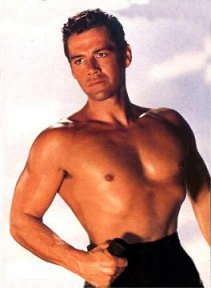













 Gordon
Scott, 80, a screen Tarzan of the late 1950s who became a muscular star
of Italian "sword and sandal" productions, died April 30 at Johns Hopkins
Hospital. He had pneumonia. Before becoming a screen Tarzan, Mr. Scott
had been an Army drill sergeant, judo instructor, truck driver and Las
Vegas hotel lifeguard.
Gordon
Scott, 80, a screen Tarzan of the late 1950s who became a muscular star
of Italian "sword and sandal" productions, died April 30 at Johns Hopkins
Hospital. He had pneumonia. Before becoming a screen Tarzan, Mr. Scott
had been an Army drill sergeant, judo instructor, truck driver and Las
Vegas hotel lifeguard.
 Gordon
Scott may have hung up his loincloth four decades ago, but he was still
fondly remembered by some movie fans for his portrayal of jungle superman
Tarzan and later roles in westerns and sword-and-sandals gladiator films.
The actor -- who went from being an unknown Las Vegas hotel lifeguard to
Hollywood star overnight, and seemed to vanish overnight after a 24-movie
career -- died Monday at Johns Hopkins Hospital of complications after
several heart surgeries.
Gordon
Scott may have hung up his loincloth four decades ago, but he was still
fondly remembered by some movie fans for his portrayal of jungle superman
Tarzan and later roles in westerns and sword-and-sandals gladiator films.
The actor -- who went from being an unknown Las Vegas hotel lifeguard to
Hollywood star overnight, and seemed to vanish overnight after a 24-movie
career -- died Monday at Johns Hopkins Hospital of complications after
several heart surgeries.
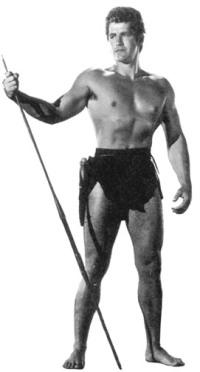 Gordon
Scott, a handsome, muscle-bound actor who portrayed Tarzan in the 1950s,
has died. He was 80. Scott, who had been living in a working class section
of south Baltimore, died Monday at Johns Hopkins Hospital of post-heart
surgery complications, a hospital spokesman said.
Gordon
Scott, a handsome, muscle-bound actor who portrayed Tarzan in the 1950s,
has died. He was 80. Scott, who had been living in a working class section
of south Baltimore, died Monday at Johns Hopkins Hospital of post-heart
surgery complications, a hospital spokesman said.