 Personal
Glimpses of World-Famed Southlanders Personal
Glimpses of World-Famed Southlanders
Los Angeles Times ~ October 27, 1929
LEE SIDE O' L.A. By Lee Shippey
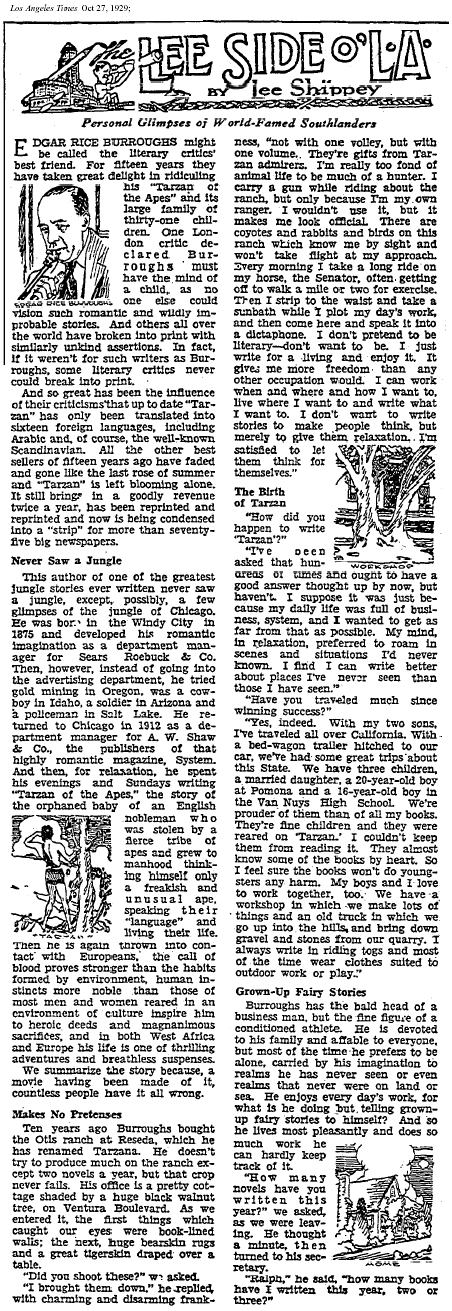
Edgar Rice Burroughs might be called the literary
critics' best friend. For fifteen years they have taken great delight in
ridiculing his
Tarzan of the Apes and its large family of thirty-one
children. One London critic declared Burroughs must have the mind of a
child, as no one else could vision such romantic and wildly improbable
stories. And others all over the world have broken into print with similarly
unkind assertions. In fact, if it weren't for such writers as Burroughs,
some literary critics never could break into print.
And so great has been the influence of their criticisms
that up to date "Tarzan" has only been translated into sixteen foreign
languages, including Arabic and, of course, the well-known Scandinavian.
All the other best sellers of fifteen years ago have faded and gone like
the last rose of summer and "Tarzan" is left blooming alone. It still brings
in a goodly revenue twice a year, has been reprinted and reprinted and
now is being condensed into a "strip" for more than seventy five big newspapers.
Never Saw A Jungle
This author of one of the greatest jungle stories ever
written never saw a jungle, except, possibly, a few glimpses of the jungle
of Chicago. He was born in the Windy City in 1875 and developed his romantic
imagination as a department manager for Sears Roebuck & Co. Then, however,
instead of going into the advertising department, he tried gold mining
in Oregon, was a cowboy in Idaho, a soldier in Arizona and a policeman
in Salt Lake. He returned to Chicago in 1912 as a department manager for
A.W. Shaw & Co., the publishers of that highly romantic magazine, System.
And then, for relaxation he spent his evenings and Sundays writing Tarzan
of the Apes, the story of the orphaned baby of an English nobleman
who was stolen by a fierce tribe of apes and grew to manhood thinking himself
only a freakish and unusual ape, speaking their "language" and living their
life. Then he is again thrown into contact with Europeans, the call of
blood proves stronger than the habits formed by environment, human instincts
more noble than those of most men and women reared in an environment of
culture inspire him to heroic deeds and magnanimous sacrifices, and in
both West Africa and Europe his life is one of thrilling adventures and
breathless suspense's.
We summarize the story because, a movie having been made
of it, countless people have it all wrong.
Makes No Pretenses
Ten years ago Burroughs bought the Otis ranch at Reseda,
which he has renamed Tarzana. He doesn't try to produce much on the ranch
except two novels a year, but that crop never fails. His office is a pretty
cottage shaded by a huge black walnut tree, on Ventura Boulevard. As we
entered it the first things which caught our eyes were book-lined walls;
the next, huge bearskin rugs and a great tiger skin draped over a table.
"Did you shoot these?" we asked.
"I brought them down," he replied, with charming and disarming
frankness, "not with one volley, but with one volume." They're gifts from
Tarzan admirers. I'm really too fond of animal life to be much of
a hunter. I carry a gun while riding about the ranch, but only because
I'm my own ranger. I wouldn't use it, but it makes me look official. There
are coyotes and rabbits and birds on this ranch which know me by sight
and won't take flight at my approach. Every morning I take a long ride
on my horse, the Senator, often getting off to walk a mile or two for exercise.
Then I strip to the waist and take a sunbath while I plot my day's work,
and then come here and speak it into a dictaphone. I don't pretend
to be literary -- don't want to be. I just write for a living and enjoy
it. It gives me more freedom than any other occupation would. I can work
when and where and how I want to, live where I want to and write what I
want to. I don't want to write stories to make people think, but merely
to give them relaxation. I'm satisfied to let them think for themselves."
The Birth of Tarzan
"How did you happen to write 'Tarzan'?"
"I've been asked that hundreds of time and ought to have
a good answer thought up by now, but haven't. I suppose it was just because
my daily life was full of business, system, and I wanted to get as far
from that as possible. My mind, in relaxation, preferred to roam in scenes
and situations I'd never known. I find I can write better about places
I've never seen than those I have seen."
"Have you traveled much since winning success?"
"Yes, indeed. With my tow sons, I've traveled all over
California. With a bed-wagon trailer hitched to our car, we've had some
great trips about this State. We have three children, a married daughter,
a 20-year-old boy at Pomona and a 16-year-old boy in the Van Nuys High
School. We're prouder of them than of all my books. They're fine children
and they were reared on 'Tarzan.' I couldn't keep them from reading
it. They almost know some of the books by heart. So I feel sure the bodies
won't do youngsters any harm. My boys and I love to work together, too.
We have a workshop in which we make lots of things and an old truck in
which we go up into the hills, and bring down gravel and stones from our
quarry. I always write in riding togs and most of the time wear clothes
suited to outdoor work or play.
Grown-Up Fairy Stories
Burroughs has the bald head of a business man, but the
fine figure of a conditioned athlete. He is devoted to his family and affable
to everyone, but most of the time he prefers to be alone, carried by his
imagination to realms he has never seen or even realms that never were
on land or sea. He enjoys every day's work, for what is he doing
but telling grown-up fairy stories to himself? And so he lives most
pleasantly and does so much work he can hardly keep track of it.
"How many novels have you written this year?" we asked,
as we were leaving. He thought a minute, then turned to his secretary.
"Ralph," he said, "how many books have I written this
year, two or three?"
. |